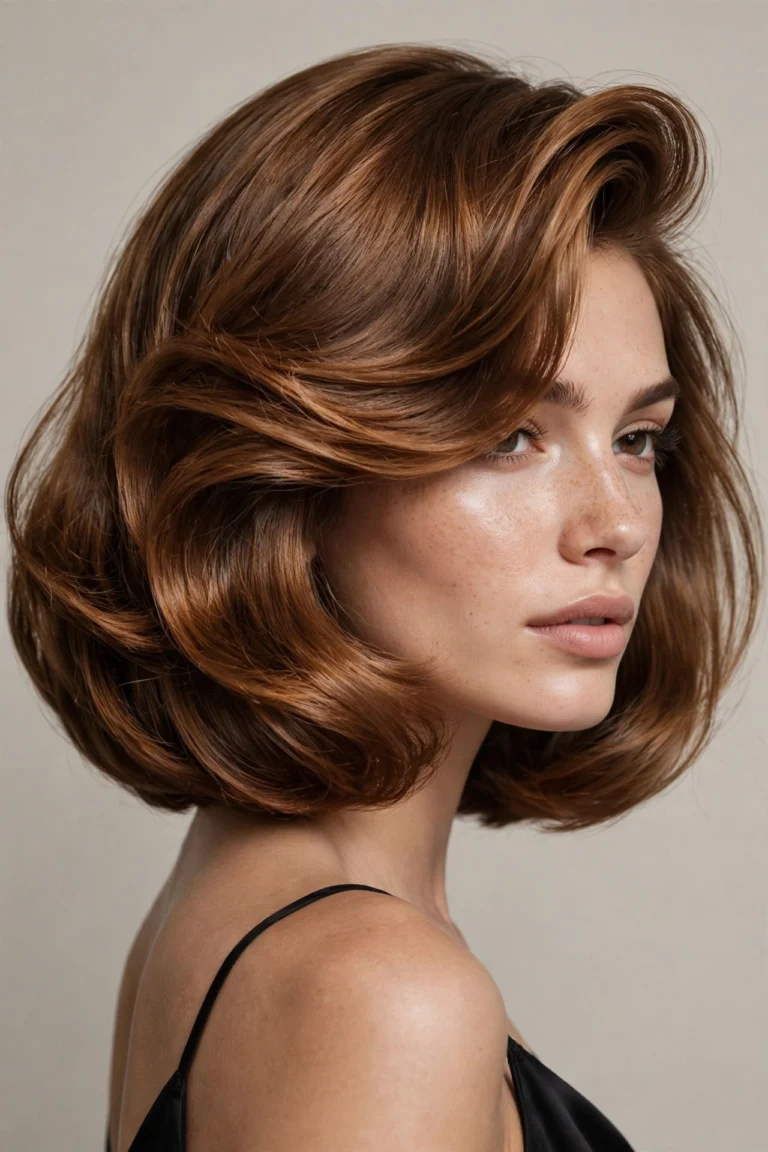
The Scandi Bob: 2026’s Effortlessly Cool Minimalist Haircut
The Scandi Bob: 2026’s Effortlessly Cool Minimalist Haircut
Some haircuts arrive with a bang — pun fully intended — and others slip in quietly, the way the best-dressed woman walks into a room. The Scandi bob belongs firmly in the second camp. It doesn’t shout. It doesn’t need neon color or razor-sharp asymmetry to get noticed. It just sits there at your jawline, clean and calm and impossibly chic, making everyone wonder why their own hair can’t look that easy.
And 2026 is officially the year the world caught on. Searches for the “Scandi bob” have surged by an astonishing 408% in just three months, according to booking platform Fresha — making it the breakout bob of the year, outpacing the butterfly bob (+174%) and the Riviera bob (+125%). Somewhere between Copenhagen street style and the quiet luxury movement, this minimalist cut became the haircut that busy women, minimalists, and reformed high-maintenance girls are all asking for by name.
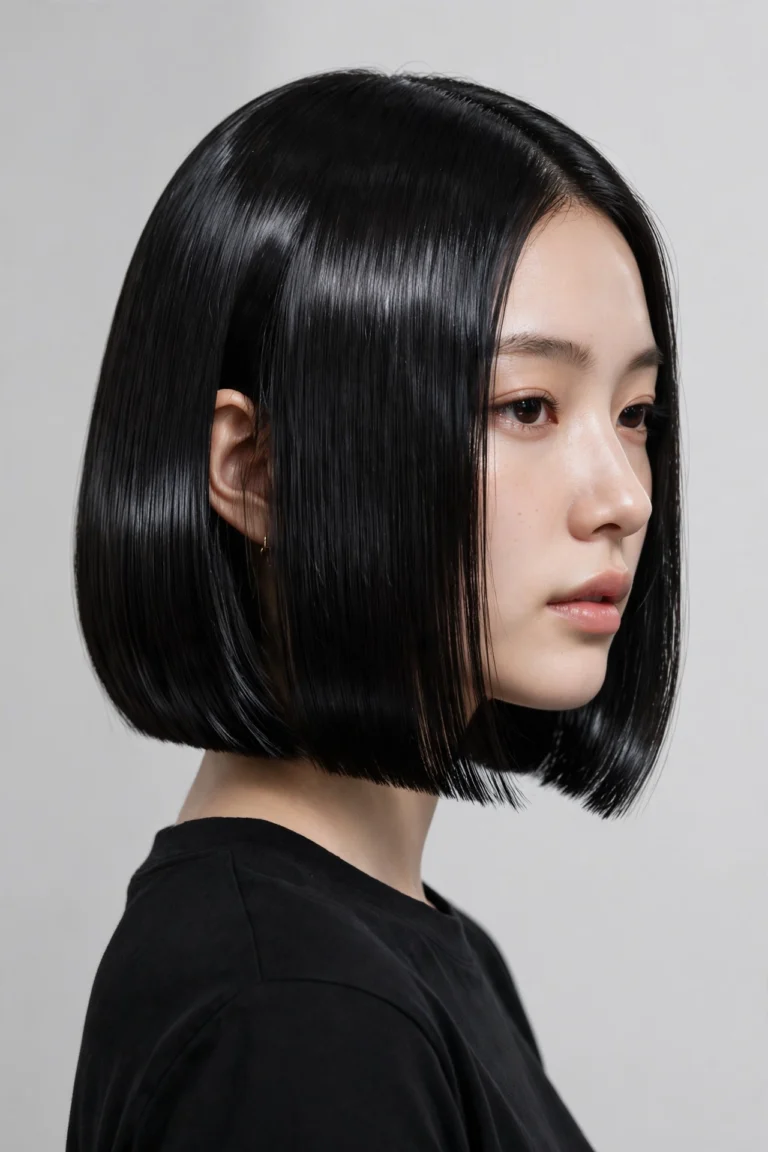
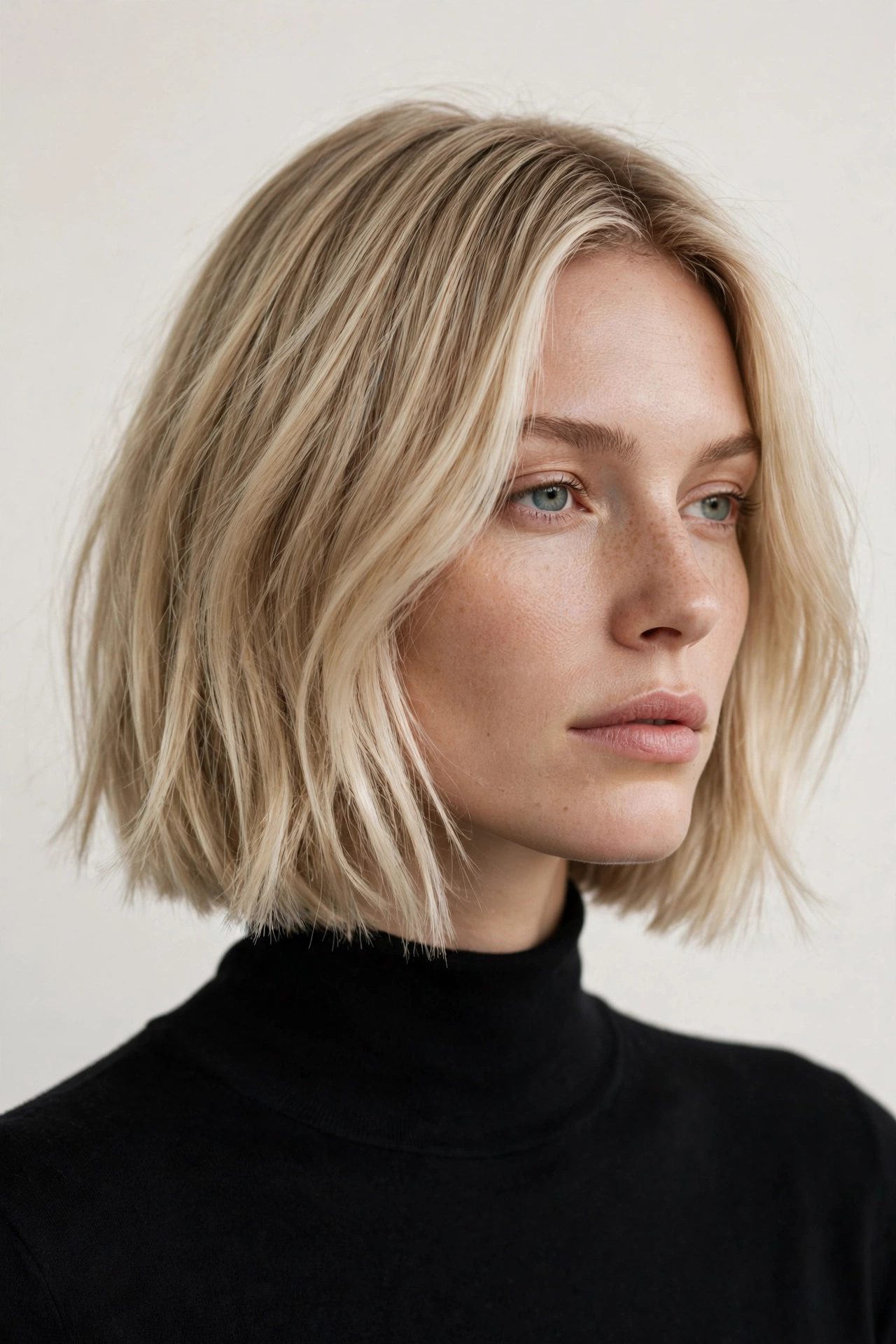
So what exactly is it? Think of the Scandi bob as the bob stripped back to its most intentional form: jaw-length or just below, cut in one clean line with barely-there layering, worn with a relaxed side flip that keeps it from ever looking stiff. It borrows its philosophy from Scandinavian design itself — nothing superfluous, nothing fussy, just beautiful proportions and honest materials. In this case, the honest material is your hair, moving the way hair actually moves.
In this guide, we’re going deep. You’ll learn exactly what defines the cut, how it differs from its French and Italian cousins, who it flatters most, the precise language to use at the salon, ten gorgeous variations to bring to your appointment, and how to style and maintain it at home with minimal effort.
One more thing worth saying upfront: the Scandi bob is not a “one season and done” trend. Minimalist cuts have staying power precisely because they aren’t gimmicks — there’s no extreme feature to date them. Women who got this cut two years ago are still wearing it, just slightly evolved. That’s the quiet confidence of Scandinavian design applied to hair: it doesn’t chase the moment, so it never looks behind it. Let’s get into it.
What Exactly Is the Scandi Bob?
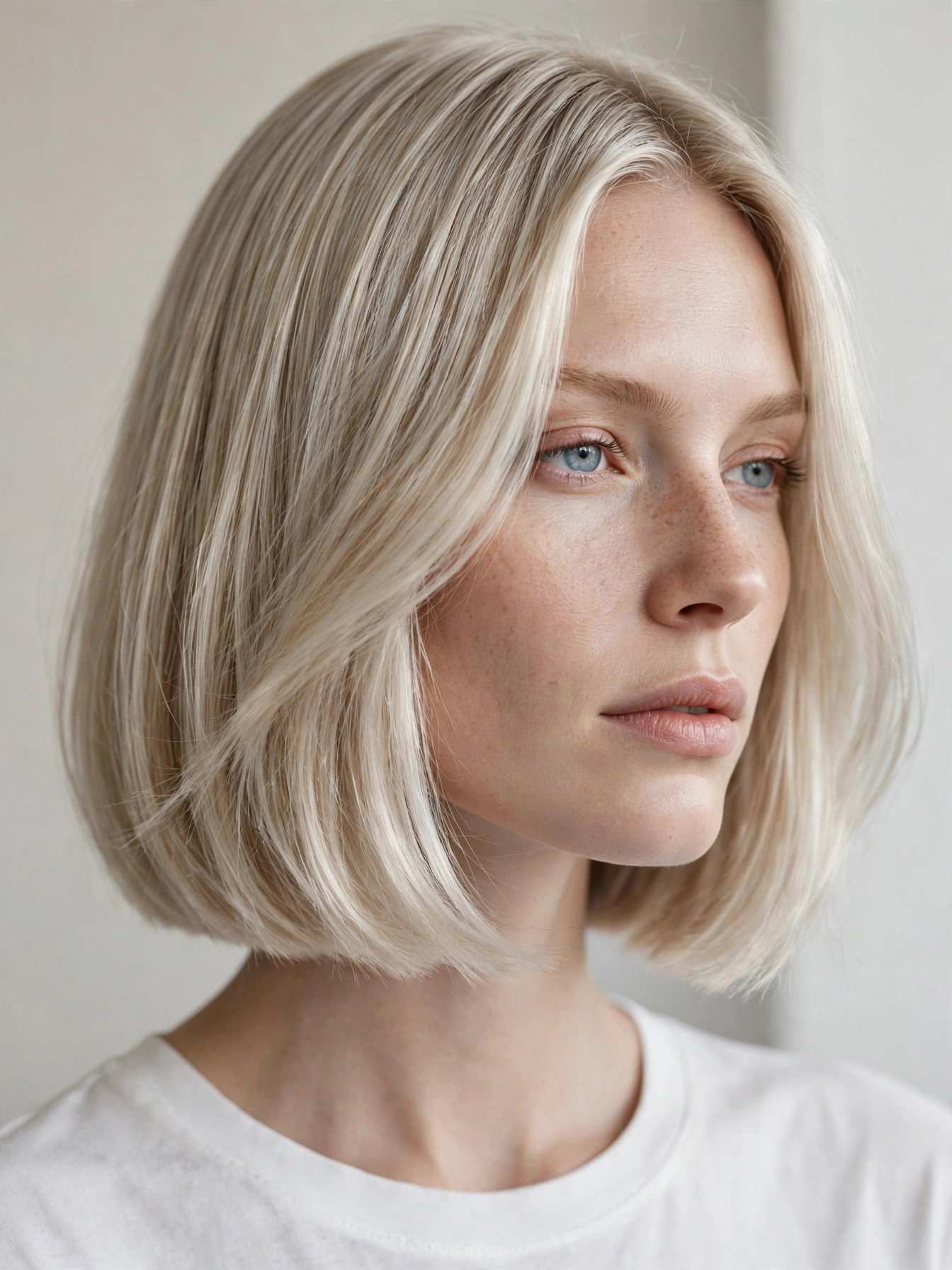
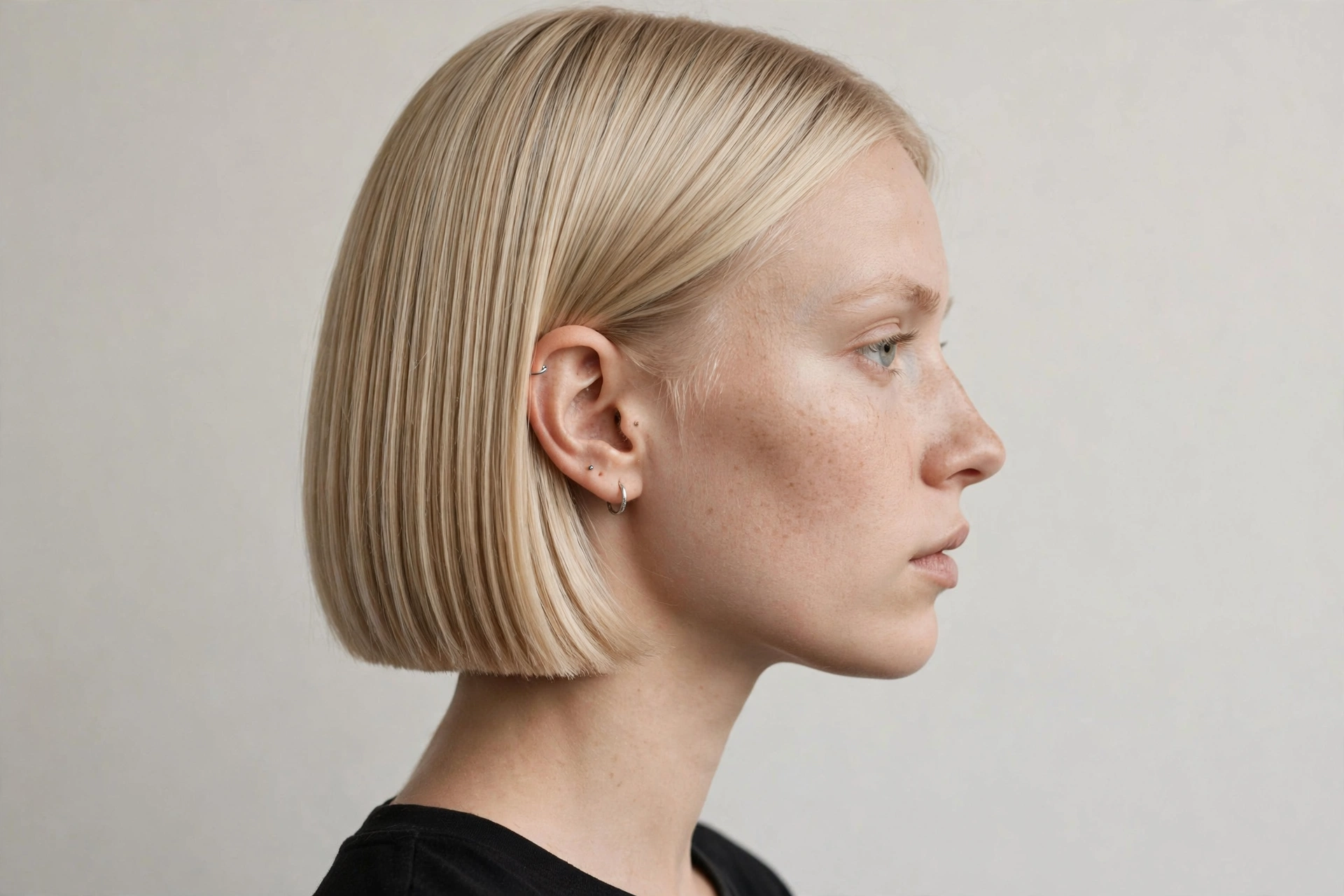
Strip away the trend-cycle noise and the Scandi bob is beautifully simple: a blunt bob that sits at the jawline or just below it, cut with a clean, sharp perimeter and very discreet, minimal layering. The name comes from its spiritual home — Scandinavian minimalism, the design philosophy that gave us pale wood furniture, white walls, and wardrobes built on ten perfect pieces. Applied to hair, that philosophy means no excess: no heavy texture, no dramatic asymmetry, no styling that fights your natural movement.
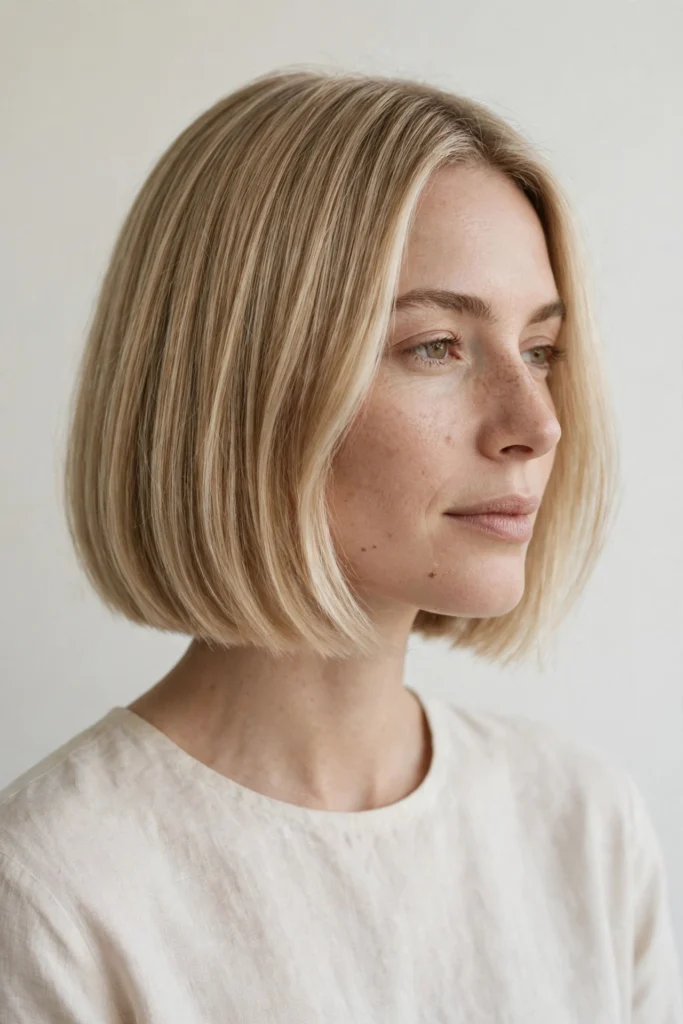
The signature detail — the thing stylists point to when distinguishing a true Scandi bob from a generic blunt bob — is the relaxed side flip. Instead of a severe center part with mirror-image sides, the Scandi bob is usually worn with a soft side parting, letting the front sections fall with a touch of asymmetry around the face. That single gesture is what keeps the cut from reading as corporate or severe. It looks spontaneous, almost accidental, even though the precision underneath is doing all the work.
Hair experts describe it as a blunt bob with soft edges: the outline is strong enough to look deliberate, but the very ends are softened just enough to move. There’s no harsh graduation stacked at the back, no chunky layers carved through the interior. The weight sits at the perimeter, which is exactly why the cut is so flattering on fine hair — nothing is thinned out, so the ends look thick and healthy.
Length-wise, the classic Scandi bob lands right at the chin or grazes just below the jaw. Some wear it slightly longer, brushing the shoulders — at which point you’re edging into Scandi lob territory, which we’ll cover in the variations below. The throughline is always the same: clean lines, natural movement, and a finish that looks polished without looking labored.
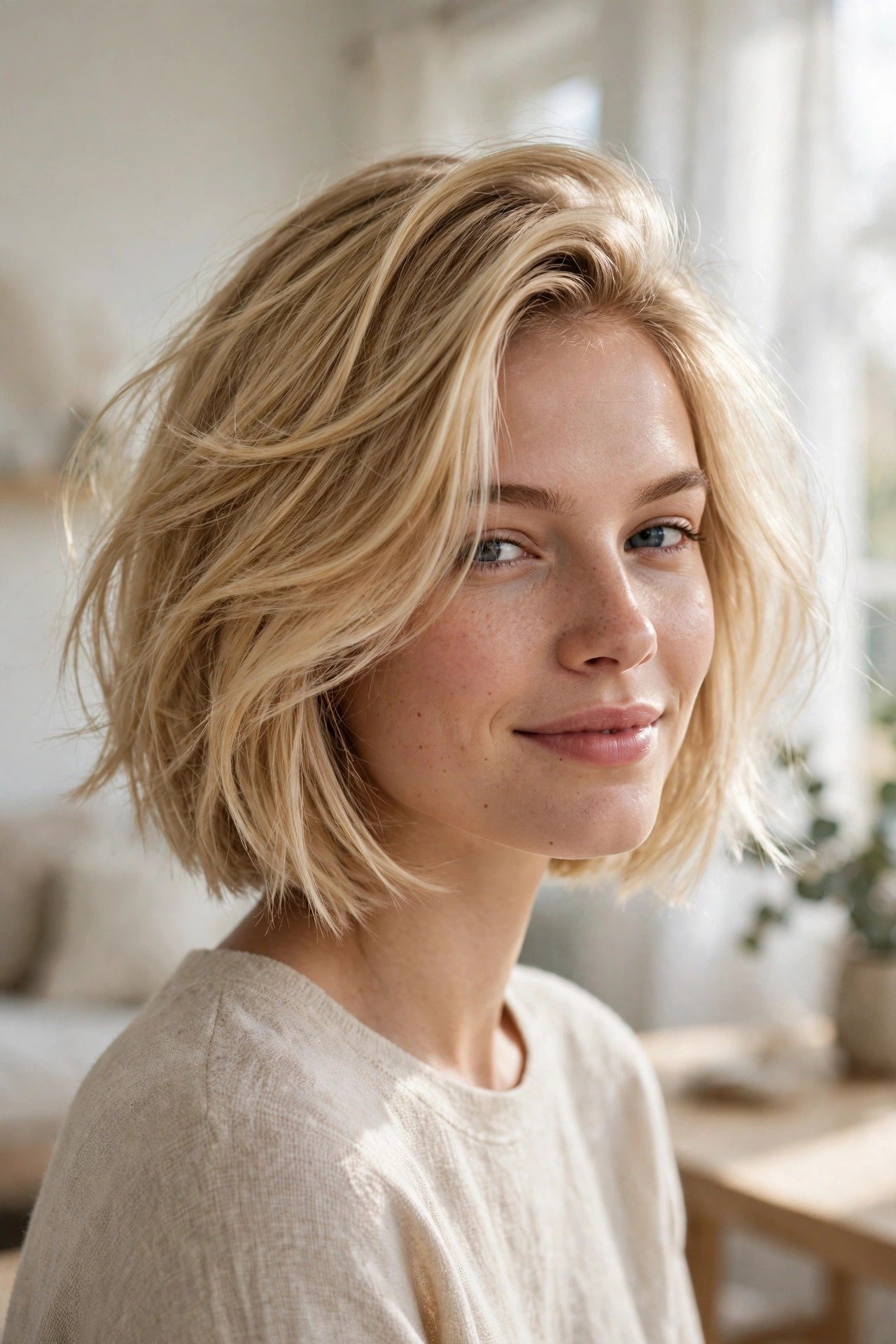
Why the Scandi Bob Is Exploding in 2026
Trends don’t surge 408% by accident. The Scandi bob’s rise is the result of several cultural currents arriving at once — and honestly, it was overdue.
First, there’s the quiet luxury effect. Over the past few years, fashion has moved away from logo-heavy maximalism toward something more restrained: beautiful fabrics, perfect tailoring, nothing screaming for attention. Hair is simply following the wardrobe. The Scandi bob is the haircut equivalent of a perfectly cut wool coat — it doesn’t need decoration because the shape is the decoration.
Second, there’s genuine fatigue with high-maintenance hair. The era of the 45-minute blowout, the weekly gloss appointment, the shelf full of styling products is losing its grip — especially on women juggling careers, kids, and actual lives. The Scandi bob promises something radical: a cut that looks intentional with three to five minutes of effort. Air-dry friendly, wash-and-go capable, and forgiving as it grows out. For busy mums — the demographic driving much of that 408% search spike — that’s not a nice-to-have, it’s the whole point.
Third, Copenhagen cool has become a genuine aesthetic force. Scandinavian street style — clean, unfussy, confident — dominates mood boards and saved folders. The Scandi bob is that energy translated to hair: it looks like the woman wearing it has better things to do than fuss over her ends, and somehow that reads as the ultimate luxury.
Finally, it photographs beautifully. The clean perimeter and soft movement translate in every light — bathroom selfie, golden hour, flash photography at dinner. In an era where your haircut lives on camera as much as in person, a cut that never has a bad angle is a serious asset.
Scandi Bob vs French Bob vs Italian Bob: What’s the Difference?
Bob haircuts have collected a lot of passport stamps lately, and it’s fair to feel confused. Here’s how the Scandi bob actually differs from its most famous relatives — because getting the wrong one at the salon is a very fixable but very annoying mistake.
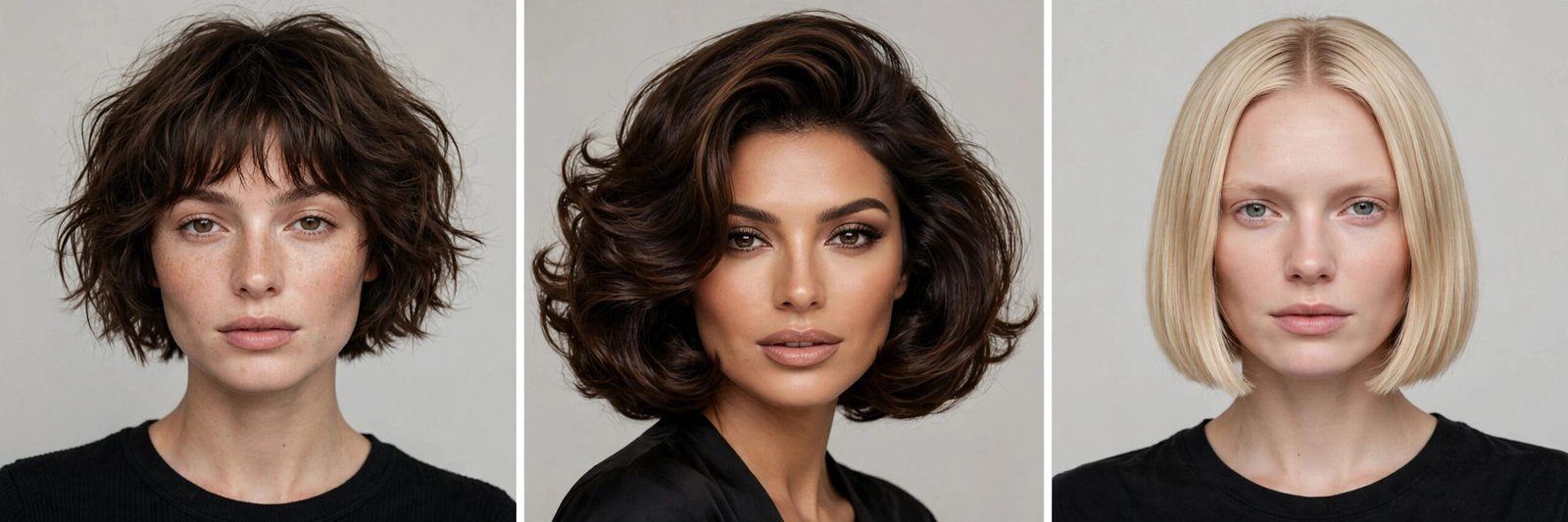
The French bob is the flirt of the family: cropped shorter (often above the chin), worn with a tousled, slightly undone finish and frequently paired with a bold, brow-grazing fringe. It has a retro, Parisian, almost cinematic feel — think vintage film heroine. The Scandi bob is calmer and more modern by comparison: longer, cleaner, less coquettish. Where the French bob winks at you, the Scandi bob just looks good and gets on with its day.
The Italian bob is the glamorous one: chin-length with serious volume, a bouncy, expensive-looking sweep, and a distinctly polished finish. It’s the bob that looks like it just stepped out of a Milan salon — because it probably did. The Scandi bob deliberately dials all of that back. Less volume, less drama, more restraint. If the Italian bob is a silk blouse, the Scandi bob is a perfect white tee.
The Riviera bob, this year’s other rising star (+125% searches), is the beachy sibling: layered, textured, sun-kissed, and easygoing — the haircut equivalent of salty air and linen. The Scandi bob shares the effortlessness but not the texture; where the Riviera bob is tousled, the Scandi bob is clean.
The simplest way to remember it: the Scandi bob is the minimalist of the group. Fewest layers, cleanest line, least styling required — and arguably the most versatile, because restraint goes with everything.
Who Does the Scandi Bob Suit Best?
The honest answer is: more people than you’d think. But like any precision cut, it has its sweet spots — and knowing them helps you walk into the salon with realistic expectations and walk out thrilled.
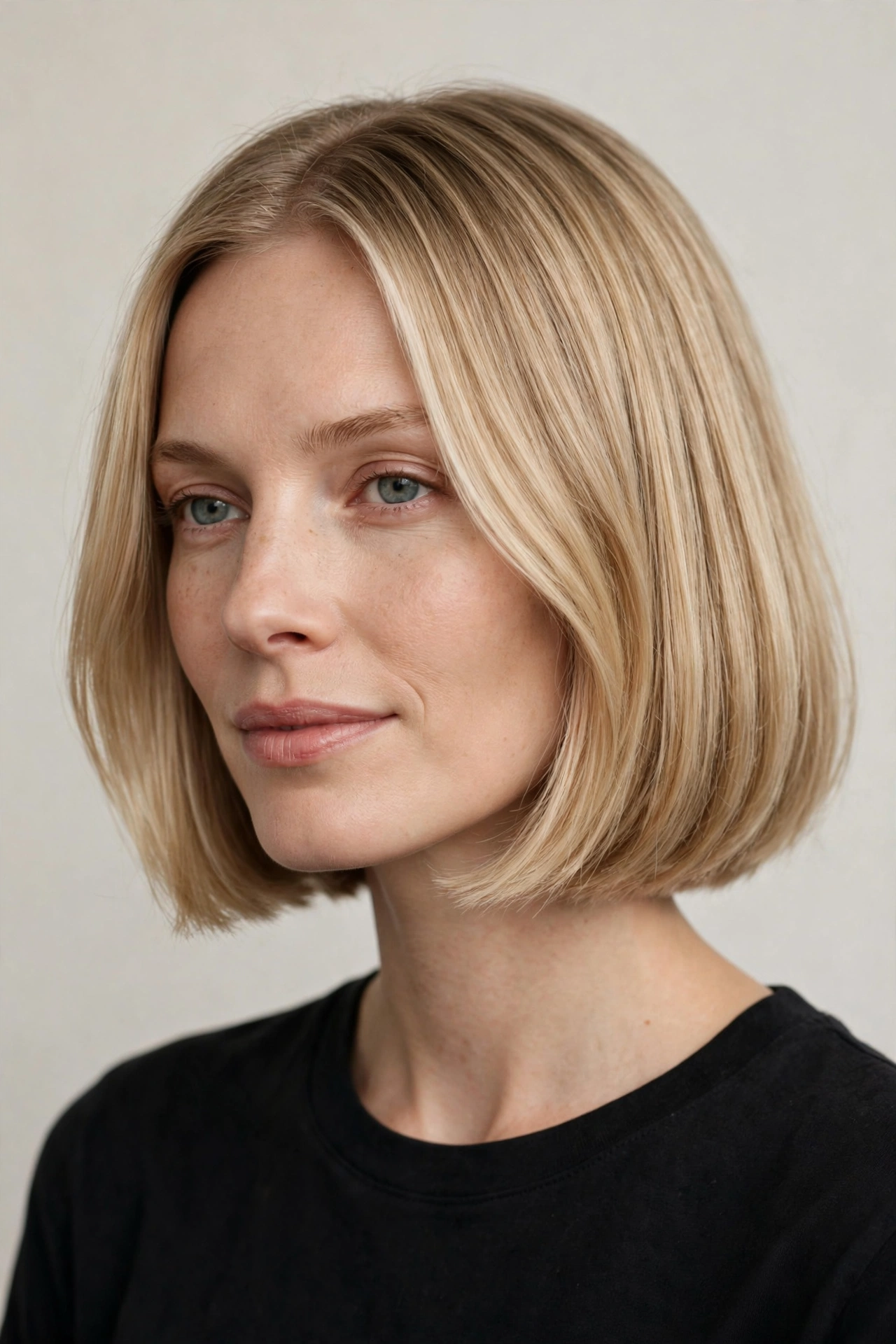
Face shapes. Oval and heart-shaped faces are the natural home of the Scandi bob — the jaw-length line echoes and sharpens already-balanced proportions beautifully. Round faces can absolutely wear it, but ask your stylist to keep the length just below the chin rather than right at it; that extra centimeter elongates rather than widens. Square faces benefit from the signature side flip, which breaks up strong jawlines with soft asymmetry. Long faces should consider pairing the cut with a fringe (Birkin bangs are the classic Scandi choice) to balance forehead-to-chin proportions.
Hair textures. Straight to slightly wavy hair is where the Scandi bob truly sings — the clean perimeter holds its line while natural movement keeps it from looking helmet-like. Fine hair is arguably the biggest winner: because the cut keeps all its weight at the ends with minimal layering, fine hair looks thicker and denser than it would in a layered cut. Medium-density wavy hair gets that coveted airy, touchable finish almost for free.
Thick hair needs a skilled hand — without careful internal weight removal, a blunt bob on very thick hair can balloon outward into a triangle. A good stylist will quietly remove bulk from the interior while keeping the perimeter line intact. Curly hair can work beautifully too, but expect modifications: a little extra length and soft, long layers to stop the silhouette from feeling heavy or pyramid-shaped. Be upfront about your texture at the consultation; the cut adapts well, but only if your stylist plans for it.
Age. This is one of the rare cuts that’s genuinely ageless. On younger women it reads fresh and fashion-forward; on women over 40 and 50, it’s quietly transformative — the clean jawline-skimming length lifts the face, the minimal styling keeps it modern rather than “set,” and the whole effect is polished without trying too hard. It’s no coincidence the cut has a devoted following among Scandinavian women of every generation.
Lifestyle. If your mornings are measured in minutes, not hours — you’re the target audience. The Scandi bob rewards low effort. If you love elaborate heat styling and changing your look daily, you might find its simplicity boring after a month. Know thyself.
How to Ask Your Stylist for a Scandi Bob
Walking in with the right language is half the battle. “Just make it look Scandinavian” will get you a blank stare; the phrases below will get you the cut.
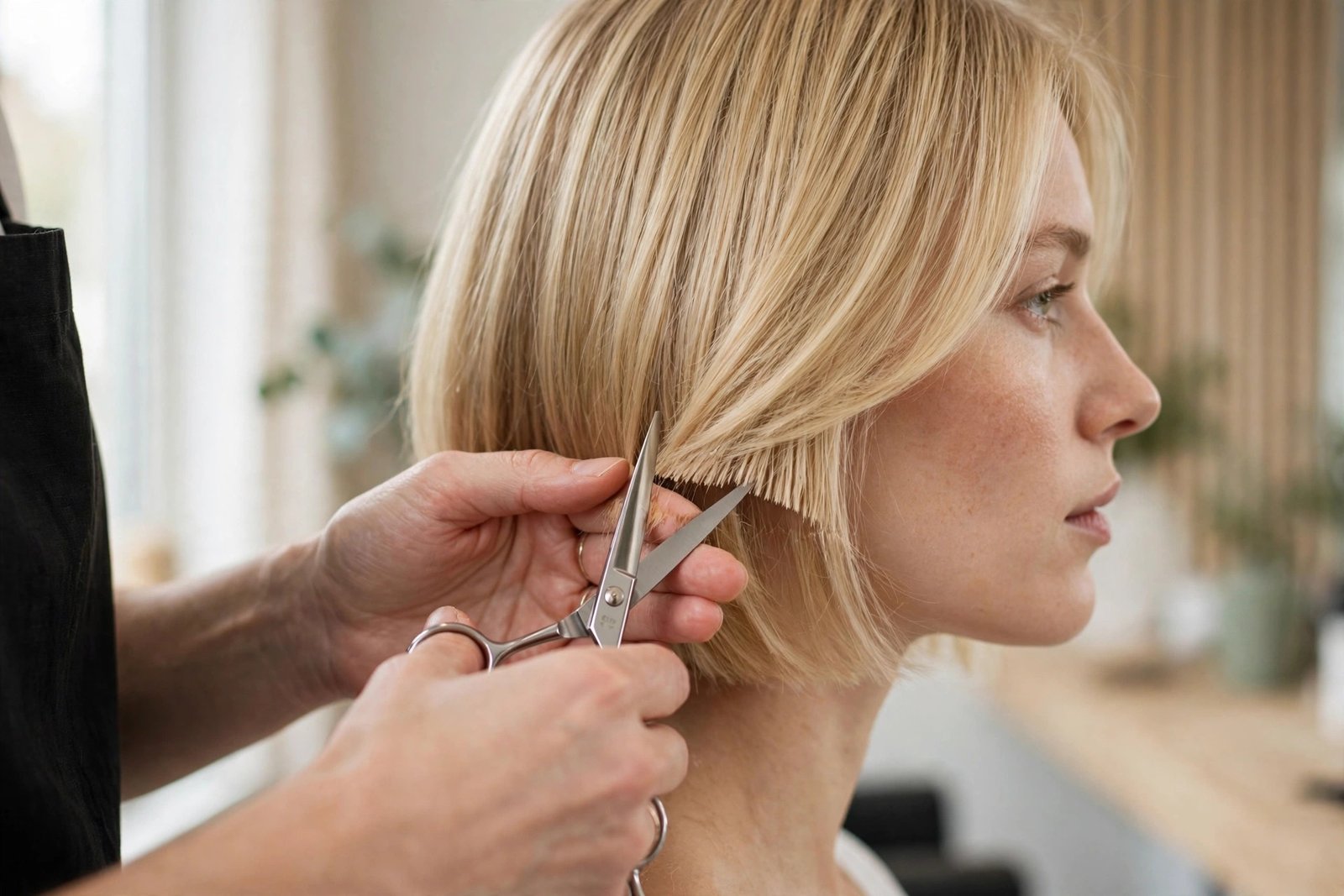
Start with this sentence: “I’d like a blunt bob with soft edges and minimal layering, sitting at the jaw or just below.” That one line communicates the three non-negotiables — strong perimeter, softened ends, barely-there layers.
Then get specific about the details that make it Scandi rather than generic:
Length: Point to exactly where you want the line — at the jaw, below the chin, or brushing the collarbone for the longer version. Bring reference photos (several, from different angles) because “chin length” means slightly different things to different stylists.
Parting: Mention the side flip. “I’d like to wear it with a soft side part” tells your stylist to cut the front with a touch of asymmetry so it falls naturally to one side, rather than cutting both sides as perfect mirror images.
Texture plan: If your hair is thick or curly, say so upfront and ask: “How will you adapt the shape so it doesn’t puff out at the sides?” A confident, specific answer means you’re in good hands. A vague one means consider a second opinion.
Fringe or no fringe: Decide beforehand. The classic Scandi pairing is Birkin bangs — soft, brow-skimming, slightly parted — or curtain bangs for a lower-commitment option. No fringe at all is equally authentic; the clean forehead-to-jaw line is very Copenhagen.
Finally, ask about the grow-out. A well-cut Scandi bob should grow gracefully for 8–10 weeks before needing a reshape. If your stylist winces at that timeline, the cut may be too dependent on precision to live with comfortably.
10 Stunning Scandi Bob Variations to Try in 2026
The beauty of a minimalist cut is how much range lives inside its simplicity. Small shifts — an inch of length, a fringe, a parting change, a color choice — create entirely different moods. Here are ten variations worth saving to your phone before your appointment.
1. The Classic Chin-Length Scandi Bob
This is the archetype: one clean line grazing the chin, minimal layering, soft side part. It suits oval and heart-shaped faces best and shows off strong jawlines and great earrings. Styling is almost insultingly simple — a little mousse at the roots, a quick paddle-brush blow-dry, done. If you’re trying the trend for the first time, start here; it’s the purest expression of the look and the easiest to grow out if you change your mind.
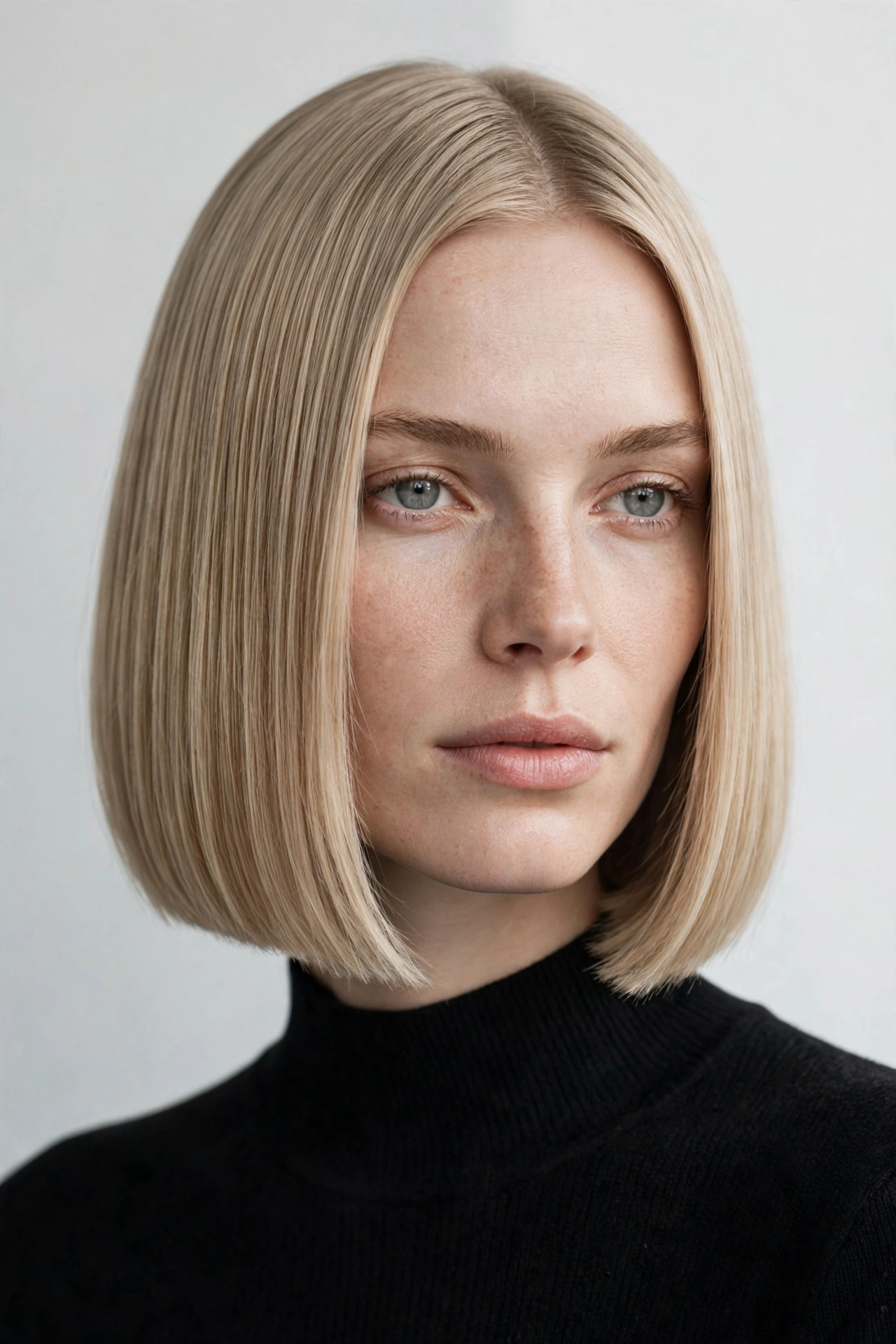
2. The Scandi Lob (Long Bob)
Not ready to go full chin-length? The Scandi lob keeps the same philosophy — clean perimeter, minimal layers, relaxed side flip — but lets the length brush the collarbone. It’s the diplomatic choice: all the Scandinavian polish with the security blanket of longer hair. It also grows out of a shorter bob beautifully, making it the ideal transitional cut. Works wonderfully on round faces, where the extra length adds flattering vertical lines.
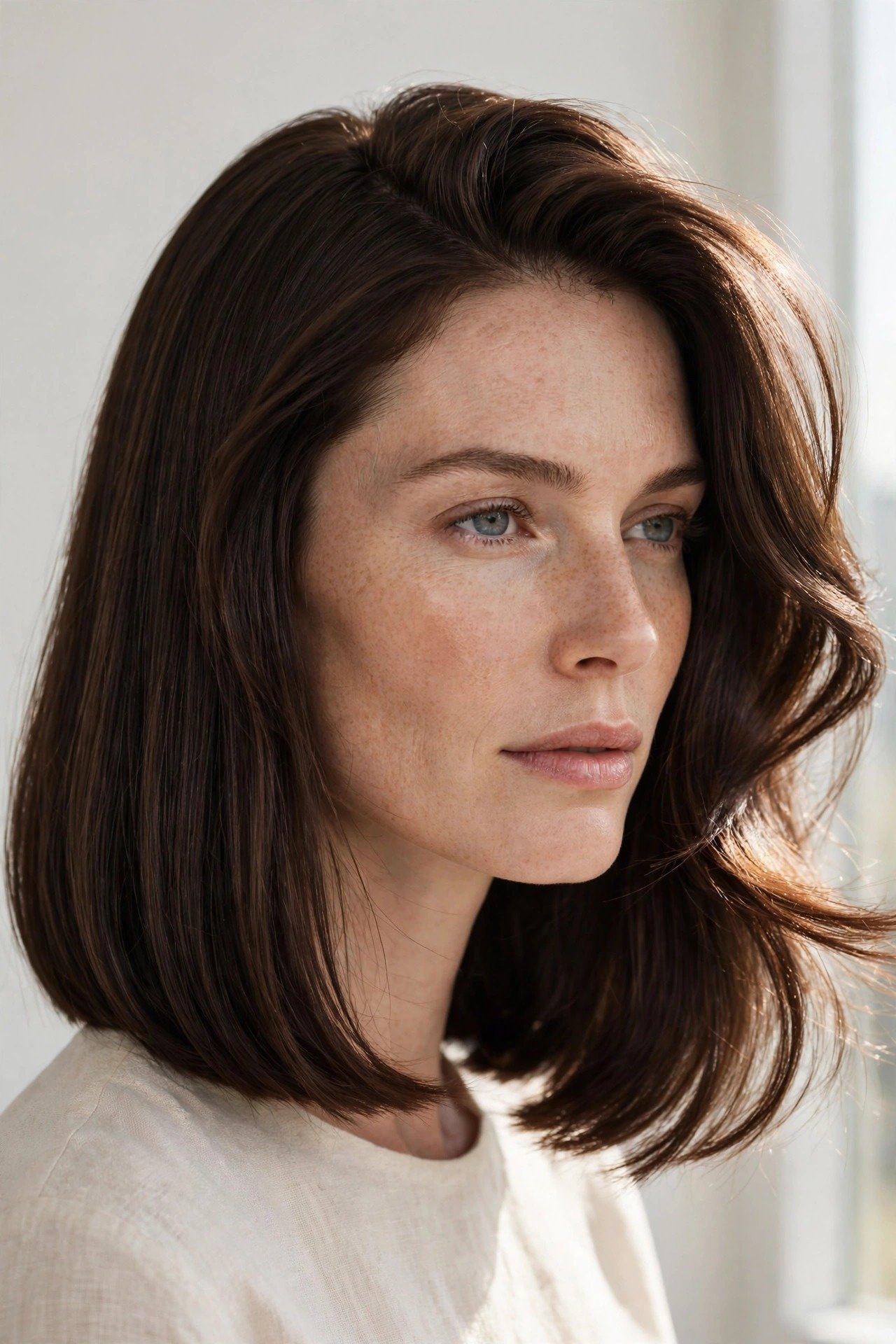
3. Scandi Bob with Birkin Bangs
Named for Jane Birkin’s legendary fringe, these are soft, brow-grazing bangs with a slightly parted, lived-in feel — never blunt, never perfect. Paired with the Scandi bob’s clean jawline, they create the ultimate French-meets-Scandinavian hybrid: a little romance up top, all discipline below. Best on straight to wavy hair; the bangs need trimming every 3–4 weeks to stay at their best, so factor that into your maintenance budget.
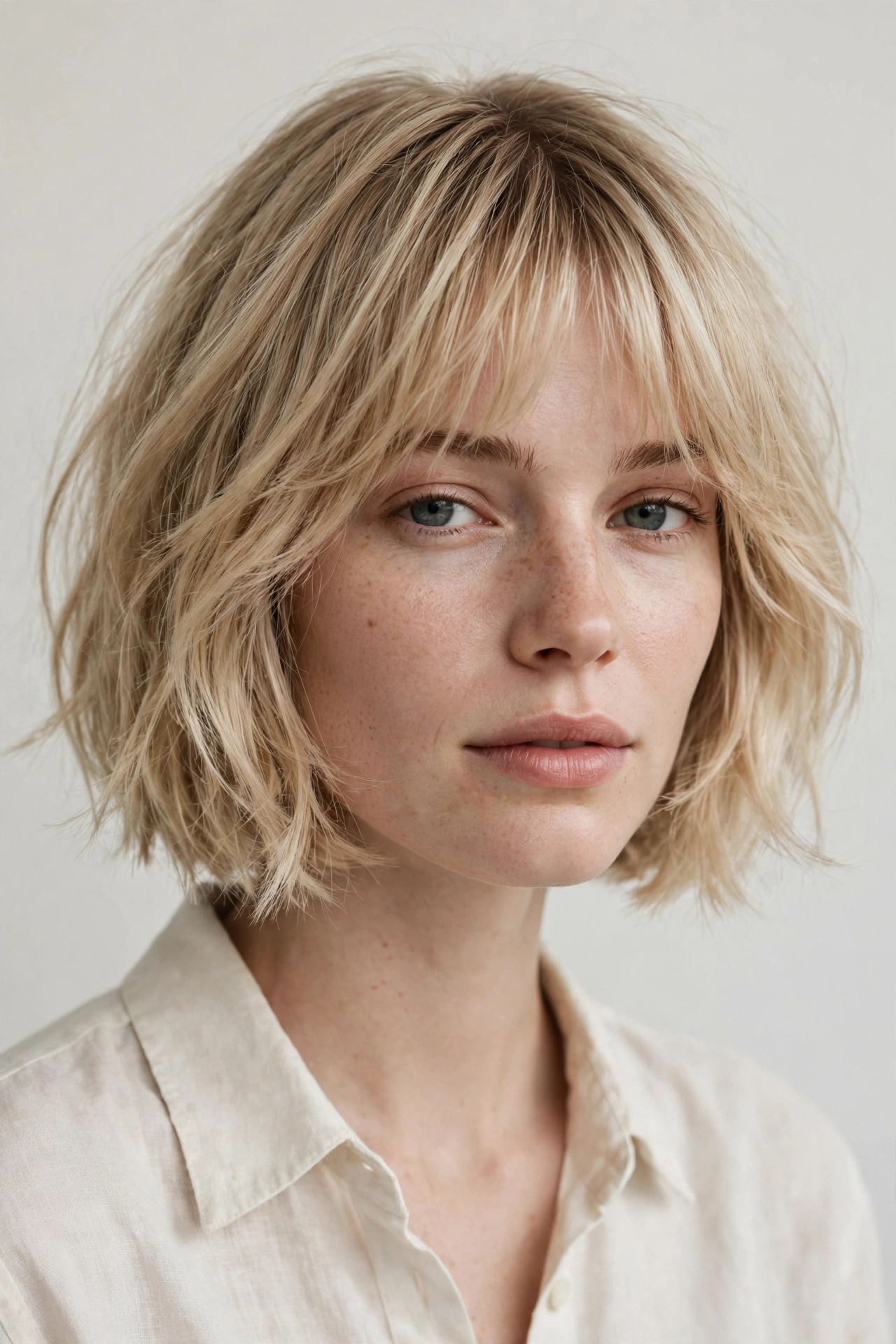
4. Scandi Bob with Curtain Bangs
The lower-commitment fringe option. Curtain bangs part softly in the middle and sweep to each side, framing the face without covering the forehead. They blend seamlessly into the bob’s front sections as they grow, which means no awkward in-between phase — a genuine advantage over blunter fringe types. Particularly flattering on high foreheads and great for glasses wearers, since there’s no heavy fringe competing with frames.
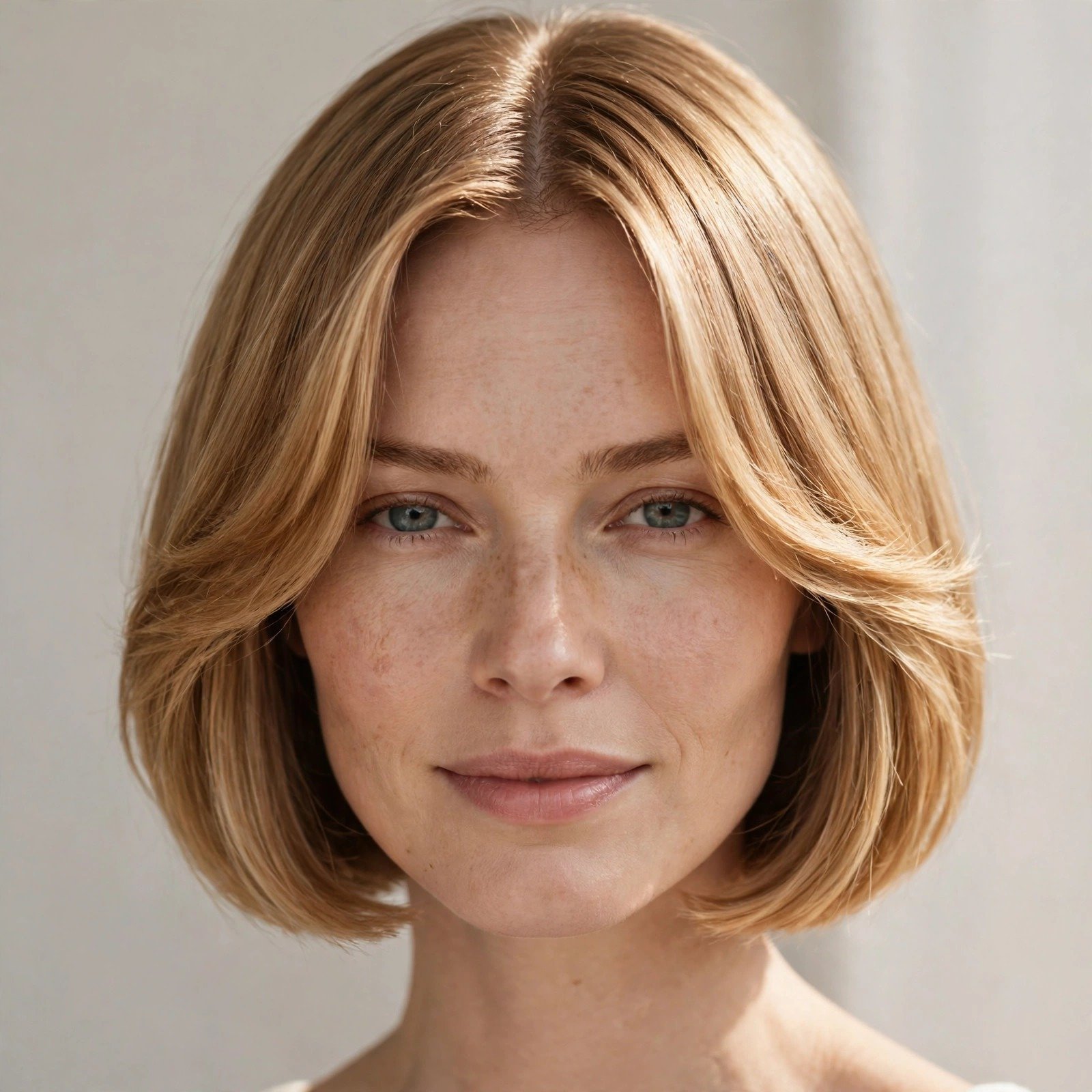
5. The Deep Side-Part Scandi Bob
Take the signature side flip and commit to it: a deep, deliberate side part that sweeps the front dramatically across the forehead. This version adds instant volume at the roots and a touch of old-Hollywood polish while keeping the minimalist perimeter intact. It’s the dressiest of the variations — the one to choose when your bob needs to attend a wedding. Flip the part to the other side midday for a free volume refresh.
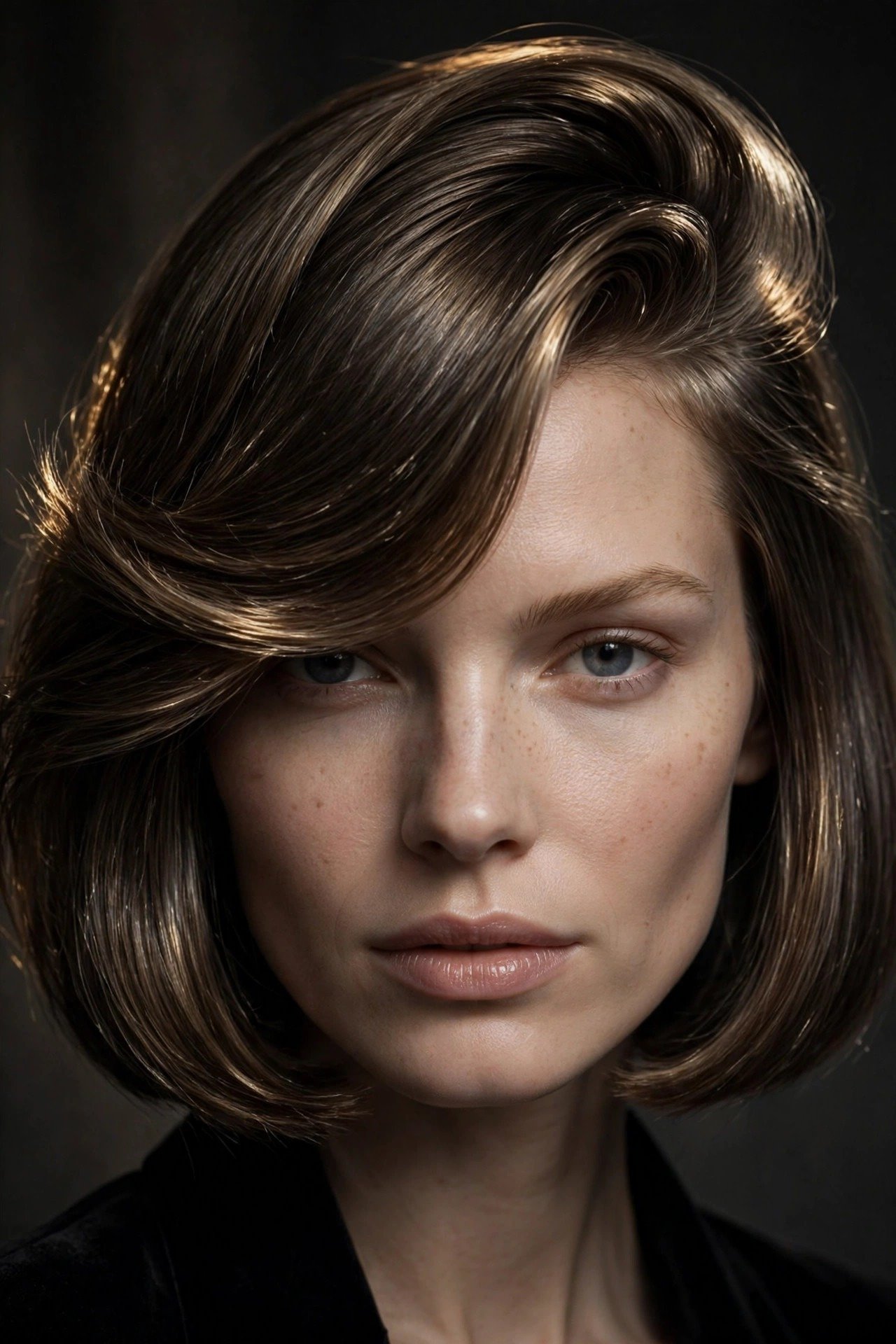
6. The Textured Wavy Scandi Bob
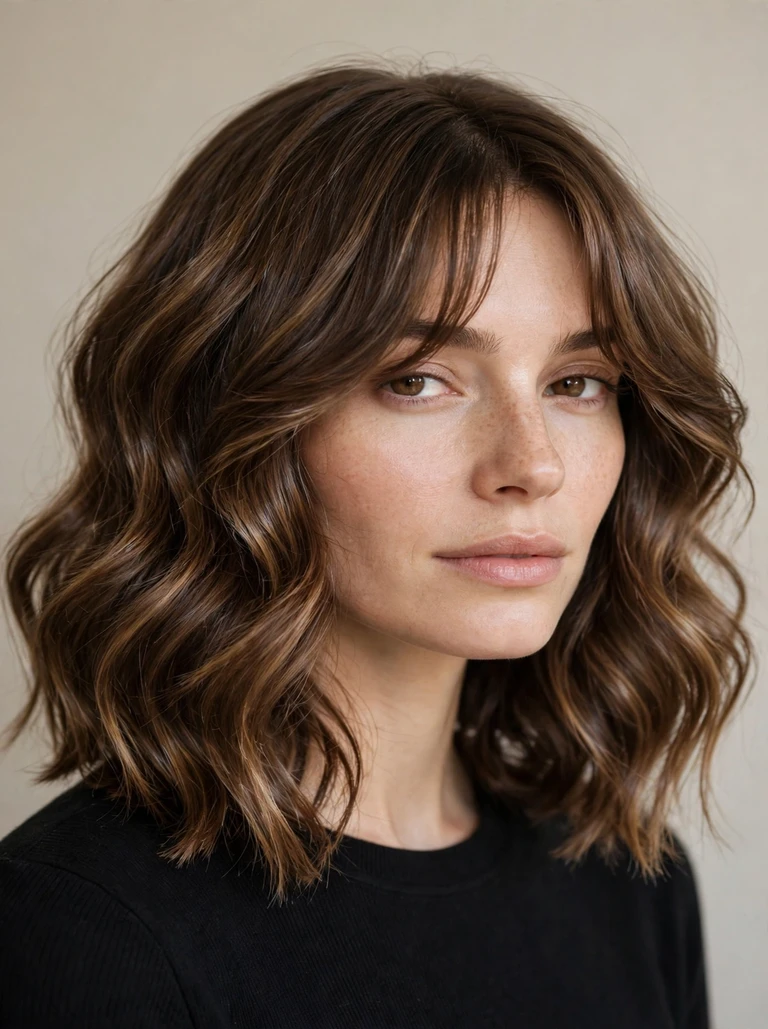
For those whose hair has natural wave, this version leans into it. The cut stays the same — clean perimeter, minimal layers — but the styling embraces air-dried texture instead of smoothing it away. A scrunch of sea-salt spray on damp hair, a rough dry or full air-dry, and you have the beachy-Copenhagen hybrid that’s dominating saved folders right now. It’s the most wash-and-go of all the variations and proof that “minimalist” doesn’t have to mean “sleek.”
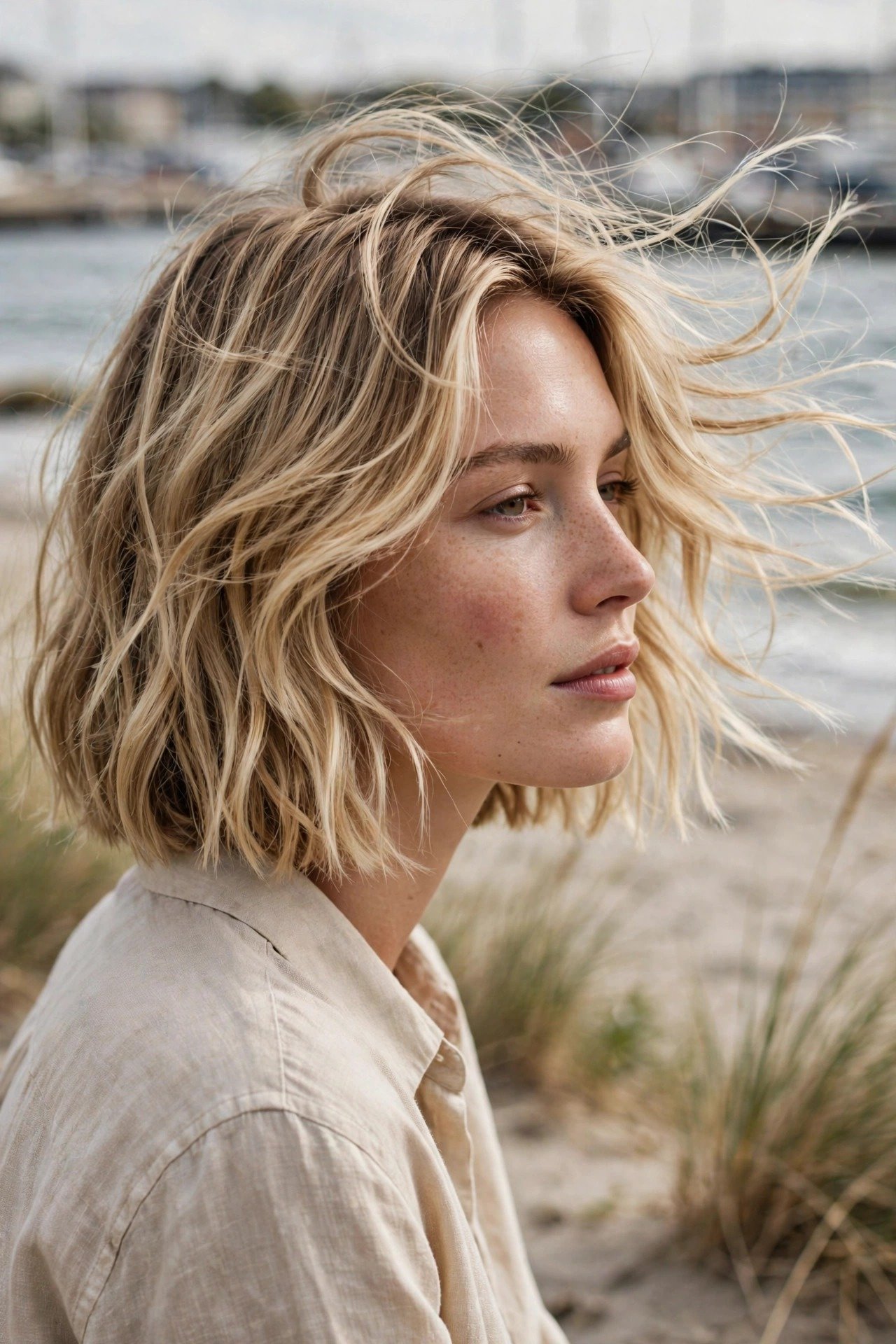
7. The Sleek Straight Scandi Bob
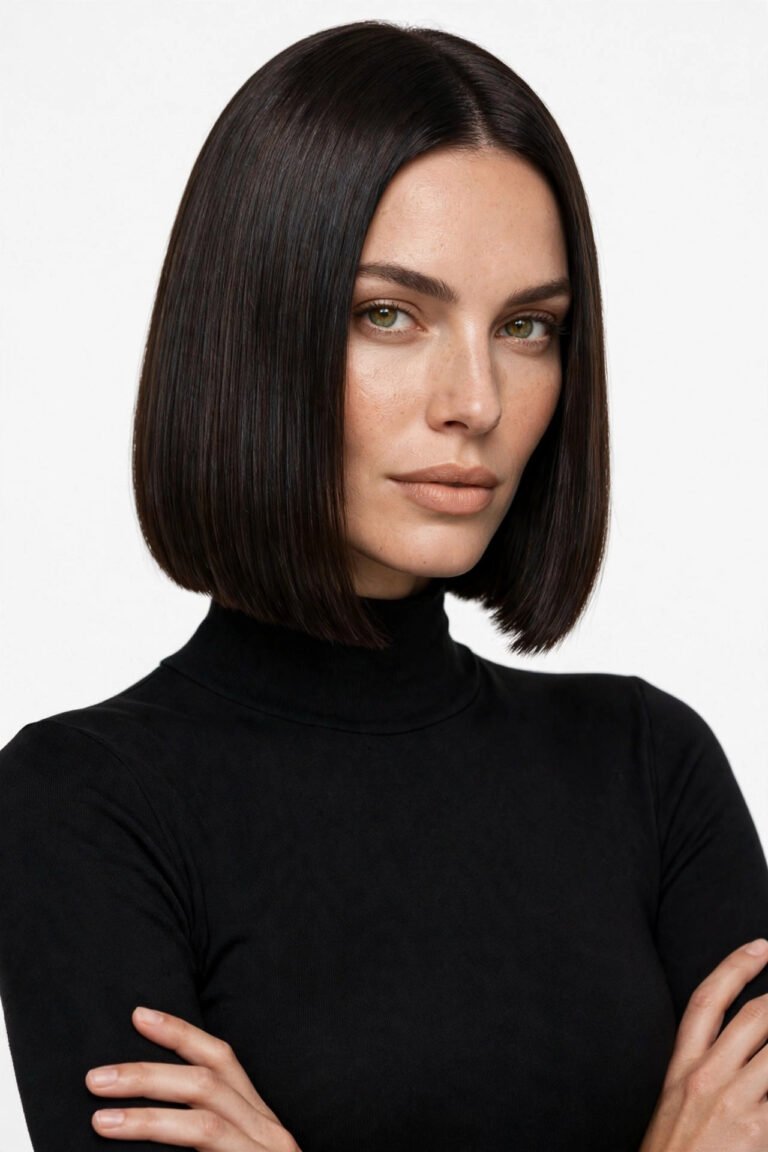
The power-dressing version. Worn pin-straight with a mirror-shine finish, the Scandi bob’s clean geometry becomes almost architectural — this is the cut at its most deliberately chic. Achieving it takes a flat iron and a smoothing serum, plus hair healthy enough to reflect light, so it’s higher maintenance than its air-dried siblings. But for evenings, big meetings, or anyone whose personal style leans sharp rather than soft, nothing beats it.
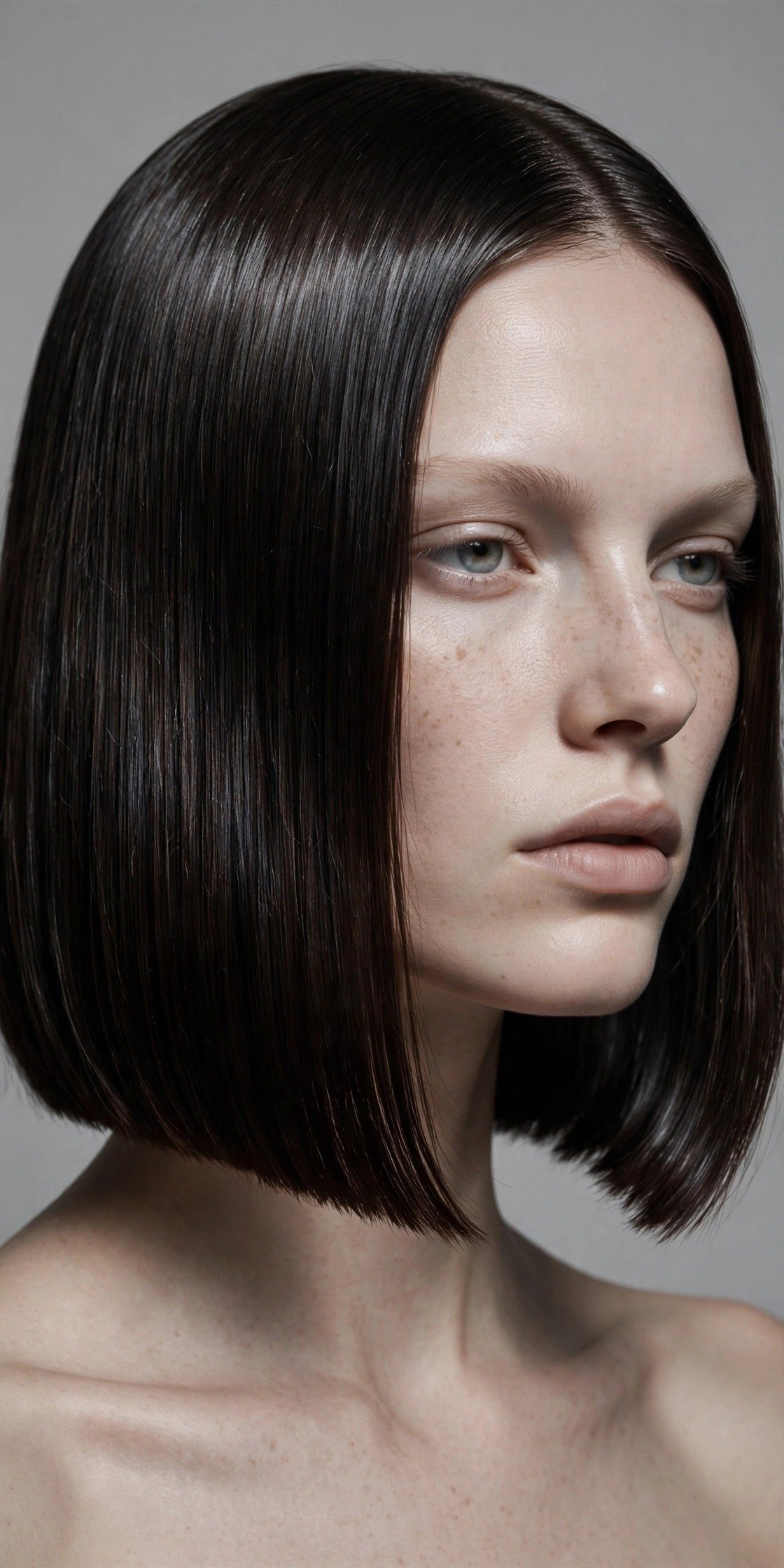
8. Scandi Bob with Face-Framing Layers
A whisper of concession for those who fear the one-length look will feel too blunt: the very front sections are given soft, long face-framing layers while the back and perimeter stay clean. The effect is subtle — movement around the cheekbones, a little softness where the hair meets the face — without sacrificing the thick, healthy-looking ends that make the cut special. A good middle ground if you’re transitioning from a layered cut.
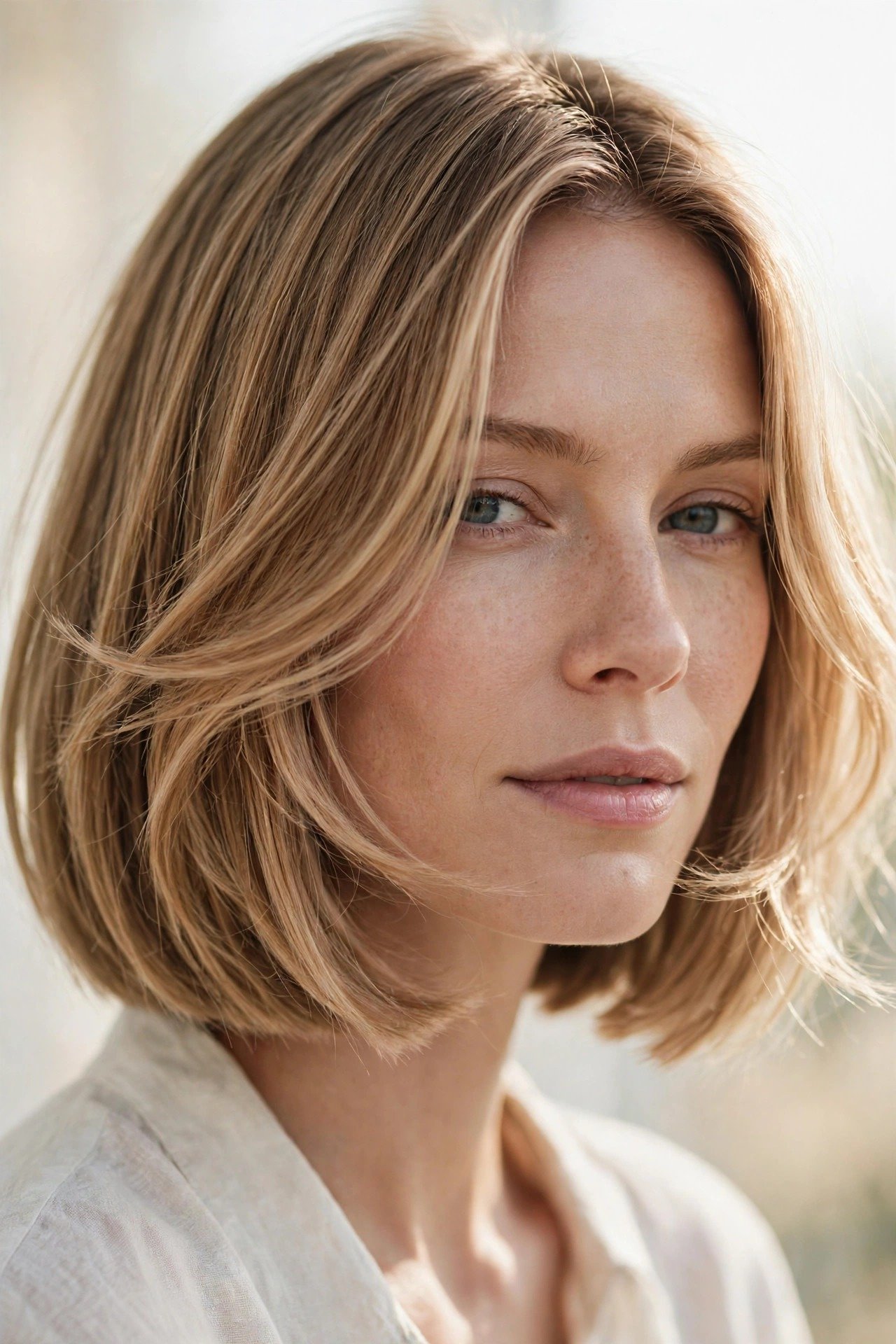
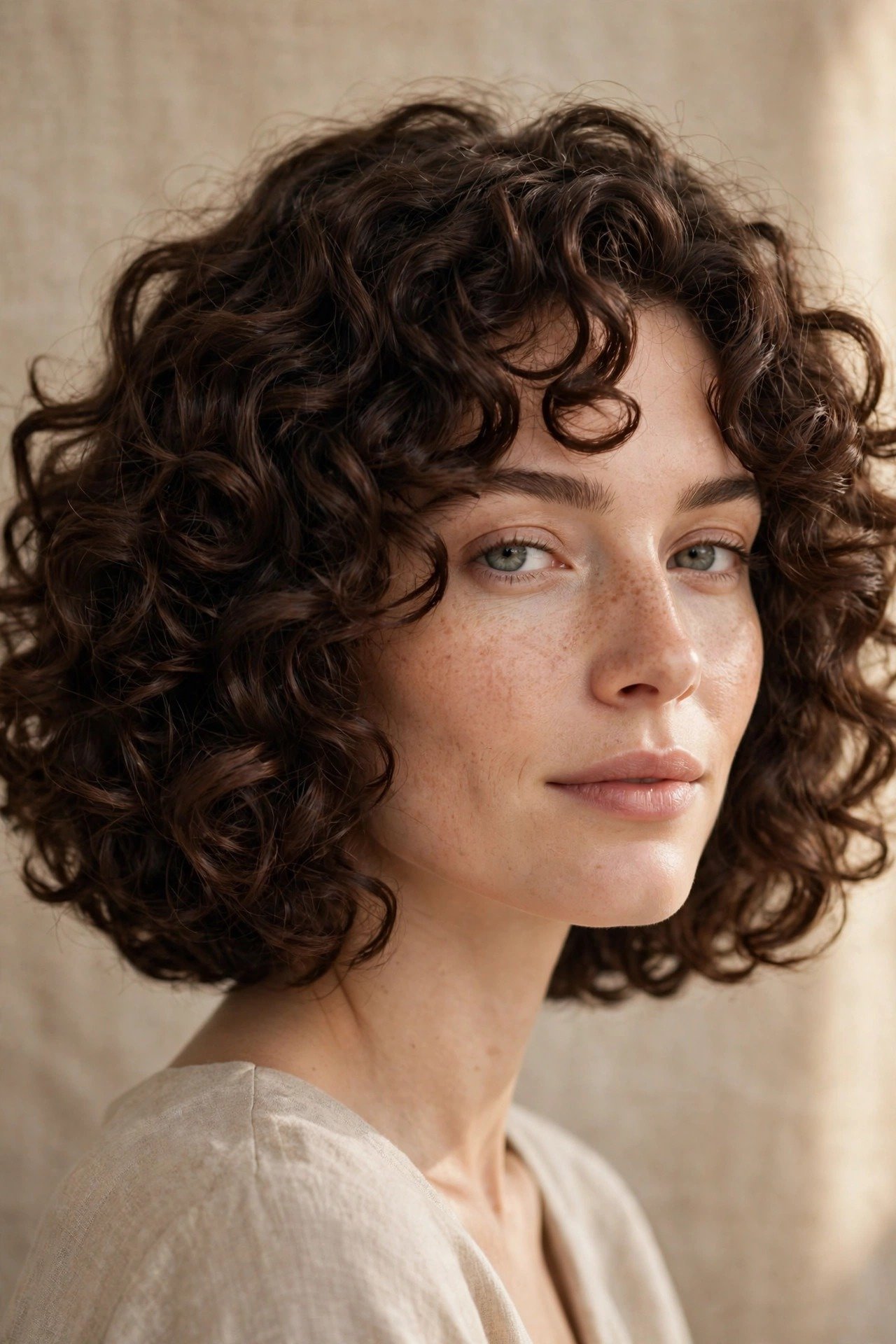
9. The Curly Scandi Bob
Yes, curls can do Scandinavian minimalism. The curly Scandi bob keeps the jaw-to-shoulder length and the strong shape but builds in soft, long layers to distribute volume evenly — the key to avoiding the dreaded triangle silhouette. The result is a beautifully rounded, bouncy bob with natural movement in every direction. It requires a stylist experienced with curly cutting (dry-cutting specialists are ideal) and a good curl cream, but the payoff is a cut that’s genuinely distinctive.
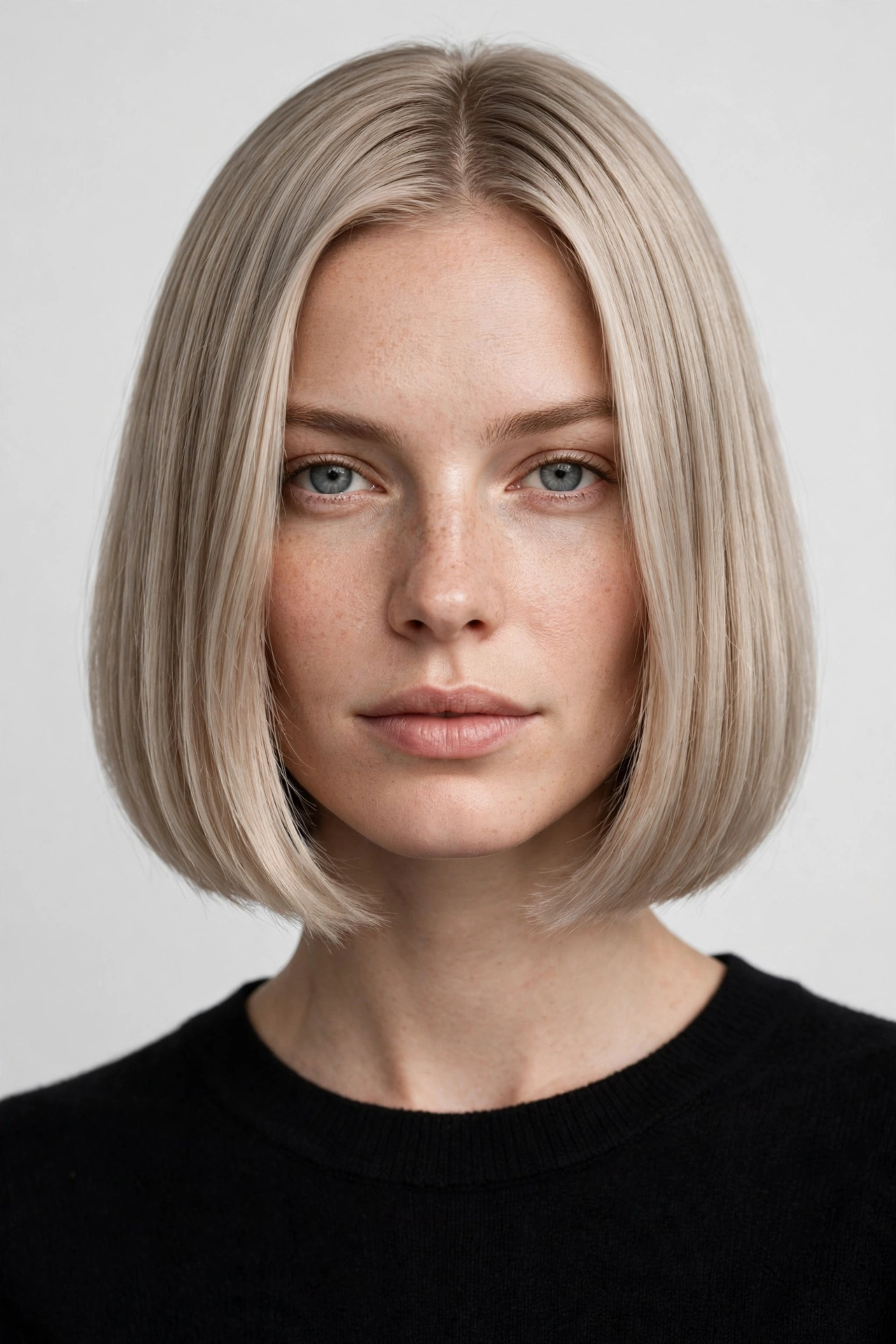
10. The Ash Blonde Scandi Bob
Color as a variation, because on this cut, color does heavy lifting. Cool ash blonde — the shade most associated with Scandinavian beauty — amplifies the cut’s clean lines and gives the perimeter an almost graphic quality. The pale, even tone makes the shape read sharper and the shine more visible. It demands upkeep (toning every 6–8 weeks, purple shampoo at home), but paired with the minimalist cut it’s arguably the definitive 2026 look: ice-blonde, jaw-length, unbothered.
How to Style Your Scandi Bob at Home
Here’s the good news the 408% search spike is really about: the daily routine is short. The cut does the heavy lifting; your job is just to enhance what it’s already doing.
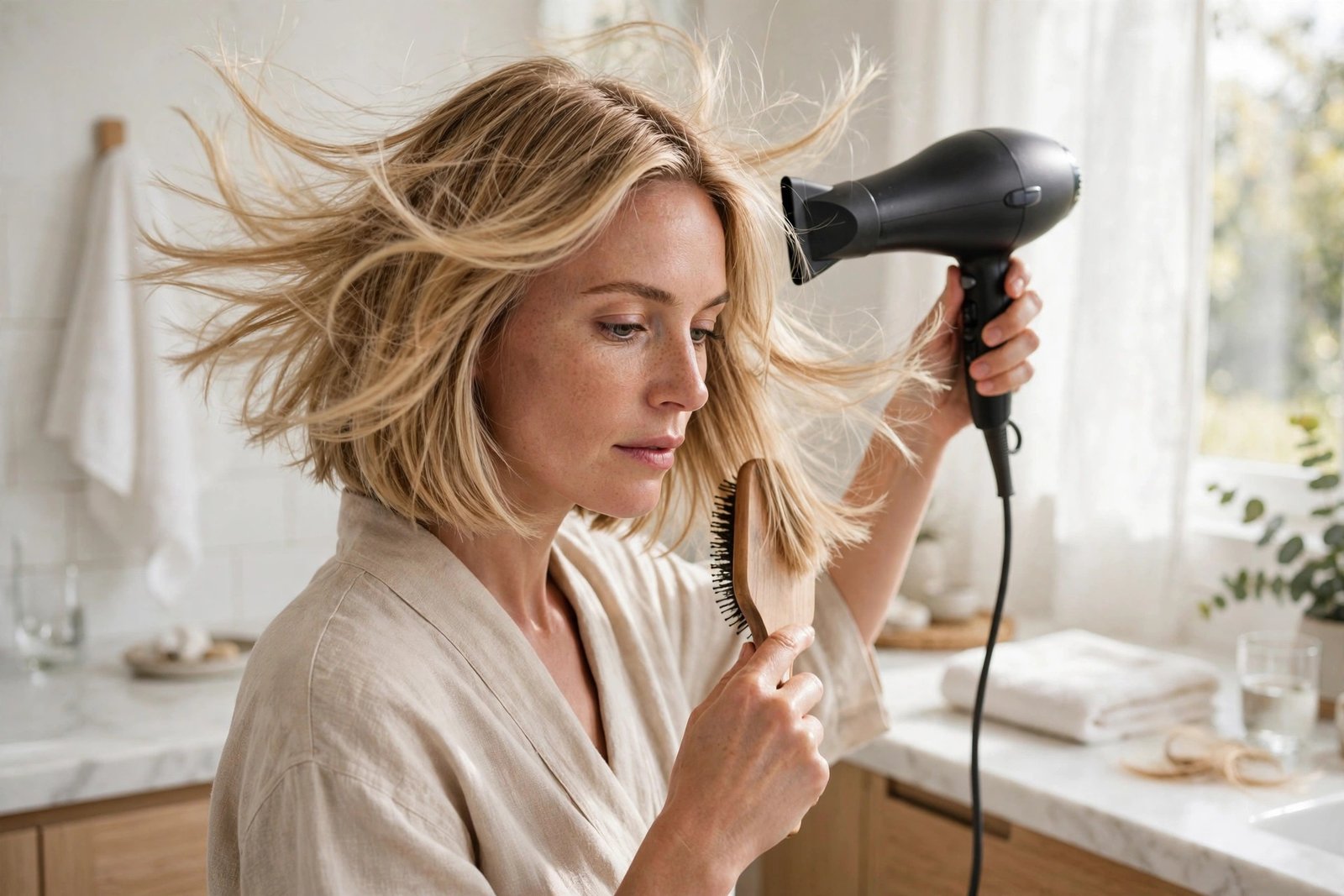
The 5-minute everyday routine: Start with damp hair and work a golf-ball-sized amount of volumizing mousse through the roots — this is what creates the signature lift and side flip. Blow-dry with a flat paddle brush (not a round brush; you want the silhouette to stay close to the head, not balloon outward), directing the front sections to the opposite side of your intended part for natural volume. Finish with a pea-sized drop of shine serum on the very ends. That’s it. No straighteners, no curling irons — the cut is designed to look softly undone, and heat-styling it into submission defeats the purpose.
The air-dry option: On days when even five minutes feels ambitious, apply a leave-in conditioner to the mid-lengths and ends, flip your part to the opposite side while damp, and let it dry naturally. Once dry, flip the part back. The root lift this creates is the oldest stylist trick in the book and it works beautifully on this length.
Adding texture: For the wavy variation, mist sea-salt spray through damp hair and scrunch gently as it dries. For sleeker days, smooth the top layer with a flat iron — just the canopy, not every strand — and add shine cream to the ends. The goal is always touchable, never stiff; if your hair can’t move, you’ve used too much product.
Parting play: A middle part gives the bob a calm, symmetrical, almost editorial feel. A side part adds movement and personality, especially with one side tucked casually behind the ear. Both are correct — switch between them depending on your mood, your outfit, or which side slept better.
Keeping It Sharp: The Maintenance Guide
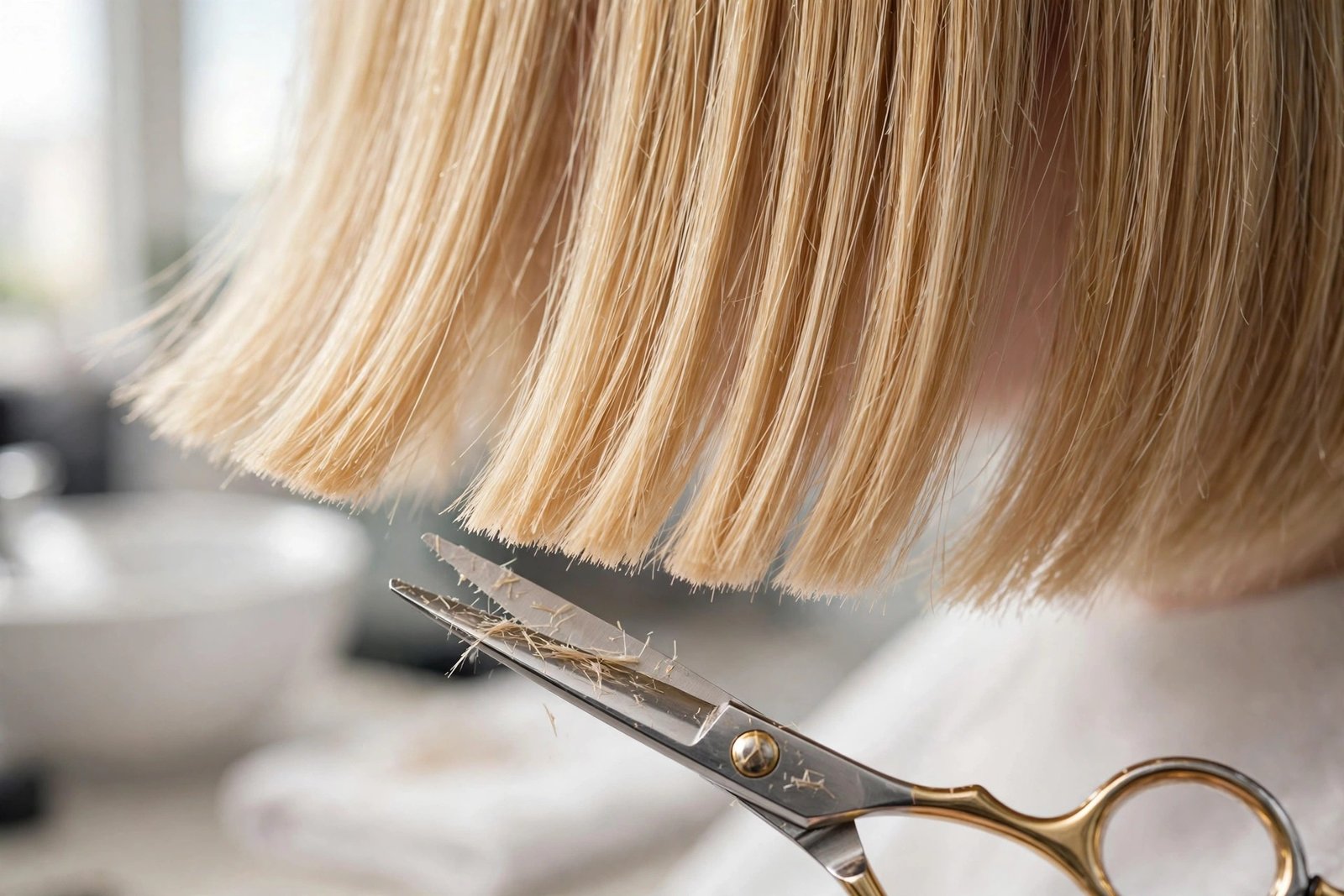
Minimalist cuts are honest cuts — there’s nowhere for grown-out ends to hide. The Scandi bob needs regular trims to keep its signature clean perimeter, but the schedule is reasonable: every 8–10 weeks for most people, or every 6 weeks if you’re meticulous about the line.
Between appointments, the ends are everything. A blunt perimeter shows damage faster than a layered cut, so treat the last two inches like royalty: a weekly nourishing mask, heat protectant every single time you use hot tools, and trims at the first sign of splitting rather than waiting. Split ends on a blunt bob don’t just look dry — they visually break the clean line that defines the whole haircut.
Color maintenance depends on your shade. Natural or near-natural colors are blissfully low-maintenance. Bleached ash blonde — the signature Scandi shade — needs toning every 6–8 weeks and purple shampoo once a week at home to keep brassiness away. Darker all-over colors need root touch-ups on your natural schedule but are otherwise easy.
The grow-out, happily, is graceful. Because there’s minimal layering, a Scandi bob grows into a Scandi lob without an awkward phase — just let it go and keep the ends trimmed. Many women find their “growing out” period becomes a whole second haircut they love equally.
The Best Hair Colors for a Scandi Bob
On a cut this clean, color isn’t decoration — it’s architecture. The right shade sharpens the geometry; the wrong one can blur it. Here’s what works best.
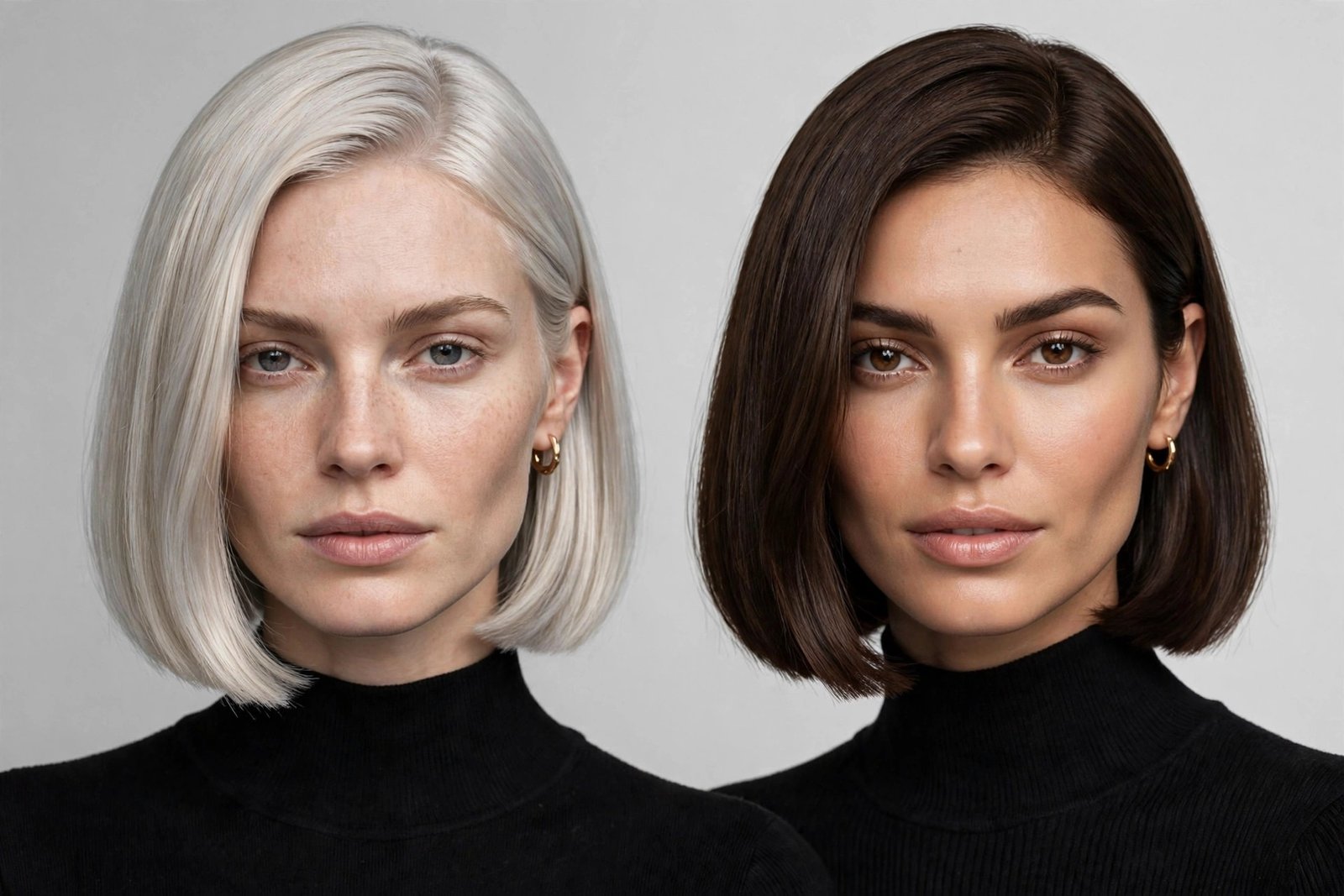
Ash blonde and Nordic blonde: The iconic pairing. Cool, pale, almost silvery blonde makes the blunt perimeter look razor-sharp and gives the hair an expensive, glassy shine. It suits fair to medium skin tones best and needs the most upkeep, but it’s the definitive Scandi statement.
Lived-in bronde: For those who want the Scandinavian feel without the bleach commitment, bronde — the blonde-brown hybrid with soft, grown-out roots — keeps things natural and low-maintenance while adding dimension that flatters the cut’s clean lines.
Rich chocolate brunette: Don’t sleep on dark shades. A glossy, even chocolate brown gives the Scandi bob incredible depth and makes the shine the star. It’s lower maintenance than blonde, suits a wider range of skin tones, and looks quietly luxurious — very old-money Copenhagen.
Copper and warm tones: The wildcard. Warm copper against the cool minimalism of the cut creates a beautiful tension — soft color, sharp shape. It’s having its own moment in 2026 and pairs surprisingly well with the Scandinavian aesthetic.
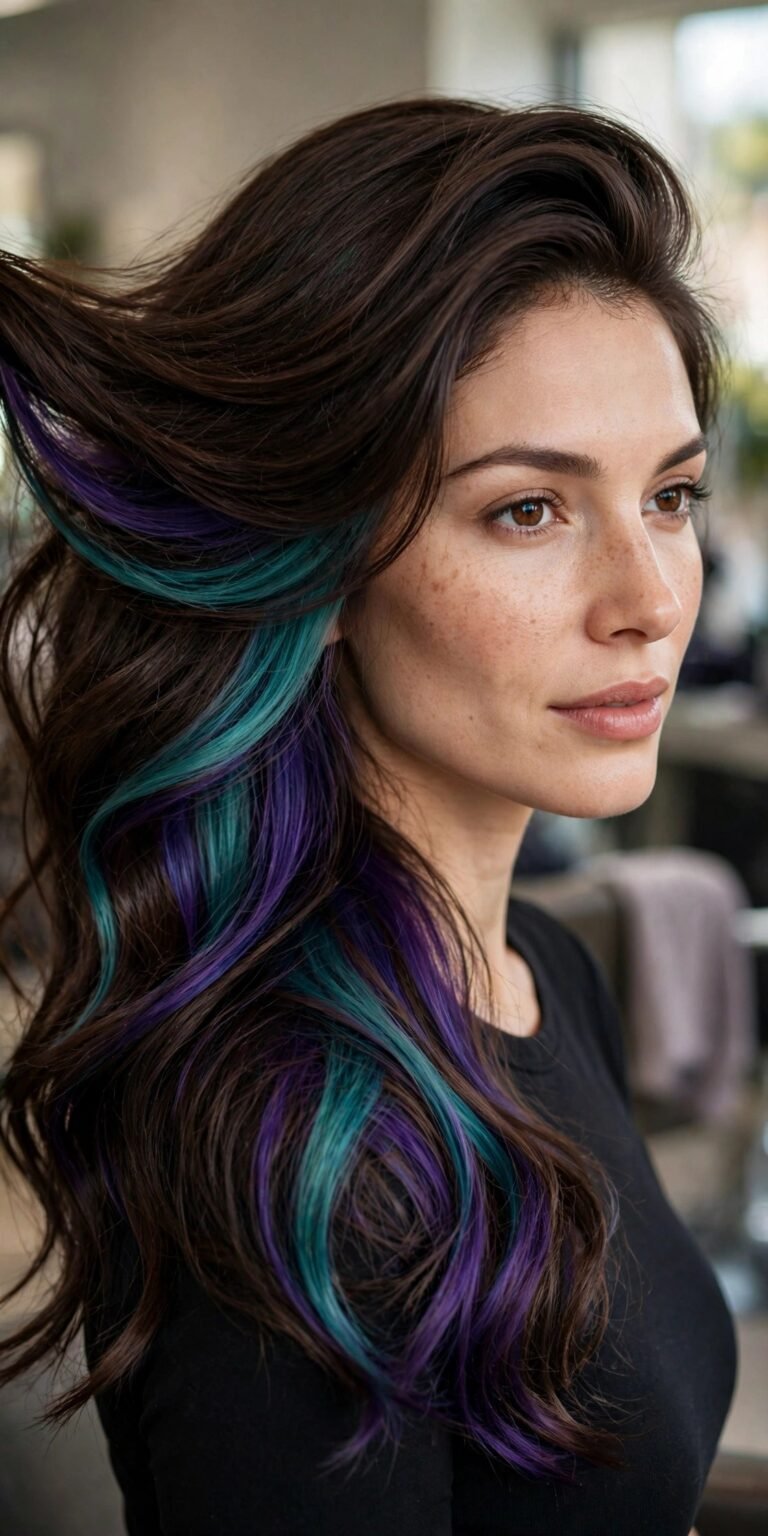
What to avoid: Heavy highlights with stark contrast can chop up the clean perimeter visually, and fantasy colors fight the minimalist philosophy. If you love dimension, ask for babylights or a soft balayage that stays within two shades of your base — movement without noise.
Scandi Bob FAQs
Is the Scandi bob good for thin hair? It’s one of the best cuts for fine or thinning hair. Because the cut keeps nearly all its weight at the perimeter with minimal layering, the ends look thicker and fuller than they would in a layered style. Ask your stylist to keep the line blunt and avoid thinning shears.
How is it different from a regular blunt bob? The softened edges and the relaxed side flip. A classic blunt bob is often worn with a severe center part and mirror-image sides; the Scandi version deliberately introduces a touch of asymmetry and softness so it reads effortless rather than severe.
Can I get a Scandi bob with curly hair? Yes, with modifications. You’ll want slightly more length and soft, long layers to distribute volume and avoid a triangular silhouette. Find a stylist experienced with curly hair — ideally one who dry-cuts curls — and bring reference photos of curly bobs specifically.
How often do I need trims? Every 8–10 weeks to keep the perimeter sharp. The bangs, if you have them, need attention every 3–4 weeks. The grow-out is graceful, so you won’t look unkempt between appointments — just slightly softer.
Does it work for women over 50? Beautifully. The jaw-skimming length is lifting, the minimal styling keeps it contemporary, and the clean lines read polished at any age. It’s one of the most requested “grown-up but modern” cuts in salons right now.
Can I style it for formal occasions? Absolutely. The sleek straight version with a deep side part is genuinely elegant — add a shine serum and tuck one side behind the ear with a minimal hair accessory. The cut’s simplicity is what makes it dress up so well.
Final Thoughts
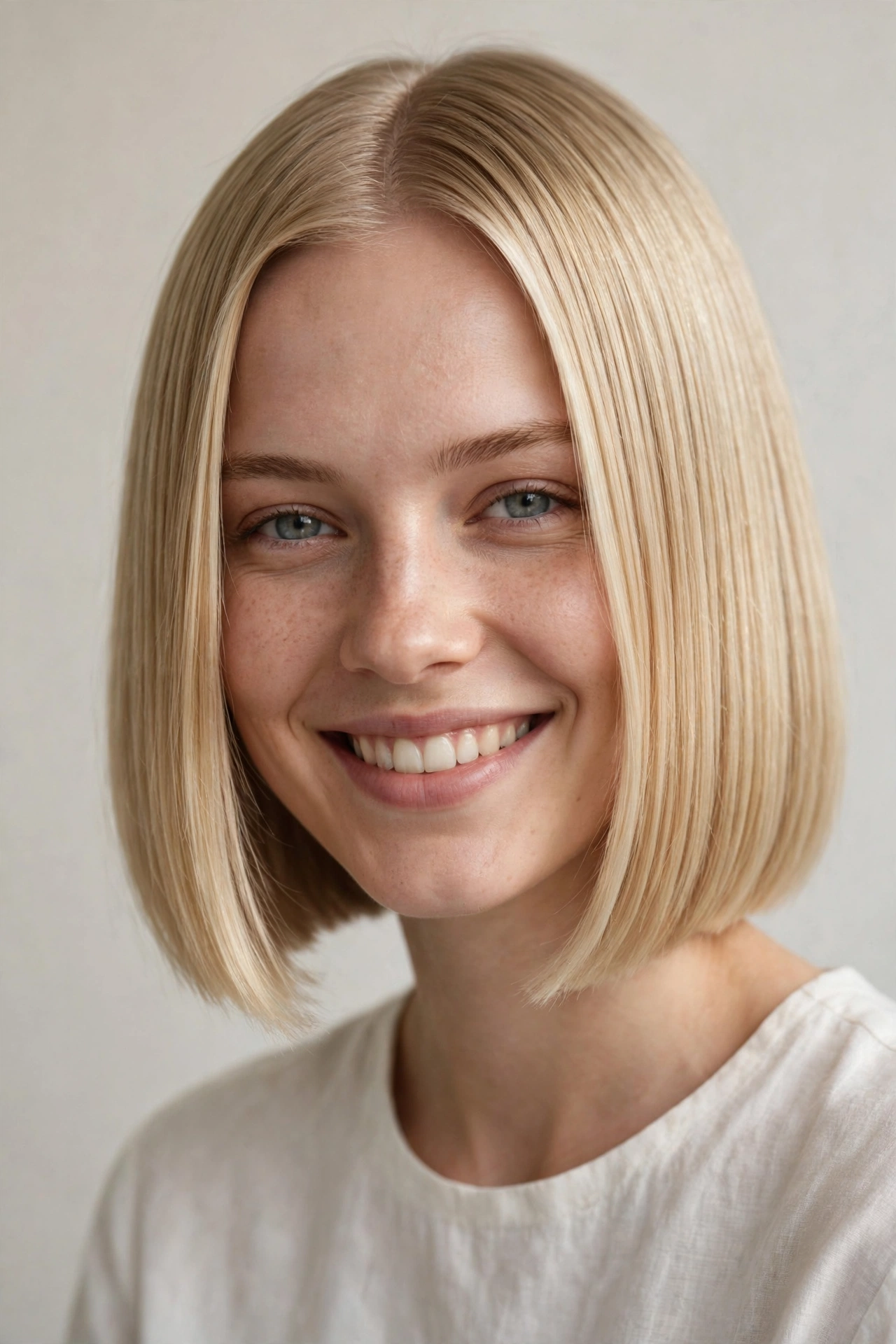
The Scandi bob endures because it respects something most trend haircuts don’t: your time. It doesn’t ask for forty-five minutes every morning or a standing weekly appointment. It asks for a good cut, a little mousse, and the confidence to let simplicity do the talking.
In a beauty culture that’s finally questioning the high-maintenance contract, that’s quietly revolutionary. The 408% search surge isn’t just a trend statistic — it’s thousands of women deciding they’d rather have a haircut that works for their life than a life organized around their haircut.
So save your reference photos, book the appointment, and learn the magic sentence: “a blunt bob with soft edges and minimal layering, at the jaw.” Copenhagen cool is one salon visit away. Your mornings are about to get significantly easier.
Conclusion
The Scandi bob proves that the coolest haircut of 2026 is also the simplest. With its blunt ends, barely-there layers, and undone Scandinavian texture, it flatters oval, square, and heart-shaped faces while working beautifully on straight to wavy hair. It is the ultimate low-maintenance statement cut for women who want polish without effort.
To keep your Scandi bob looking fresh, ask your stylist for a straight-across cut with soft interior texture, and style with a pea-sized amount of matte cream for that airy, lived-in finish. Whether you wear it tucked behind the ears or loose and tousled, this minimalist haircut delivers maximum impact in 2026.