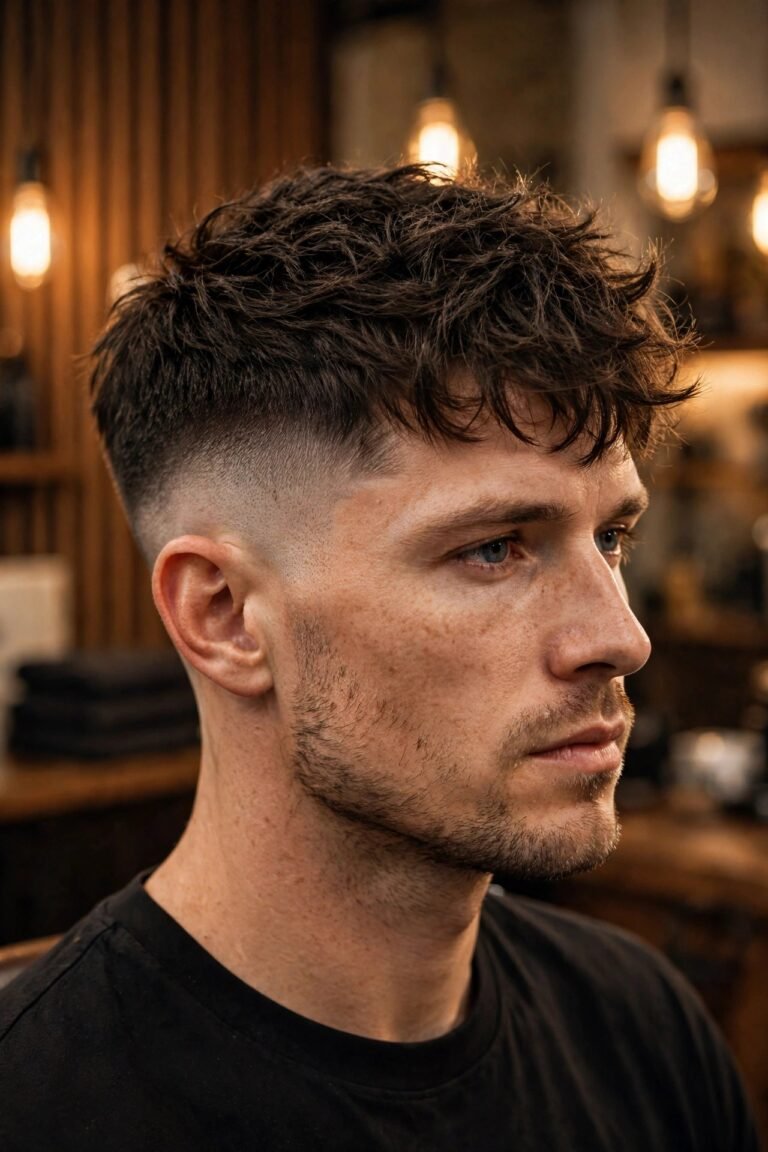
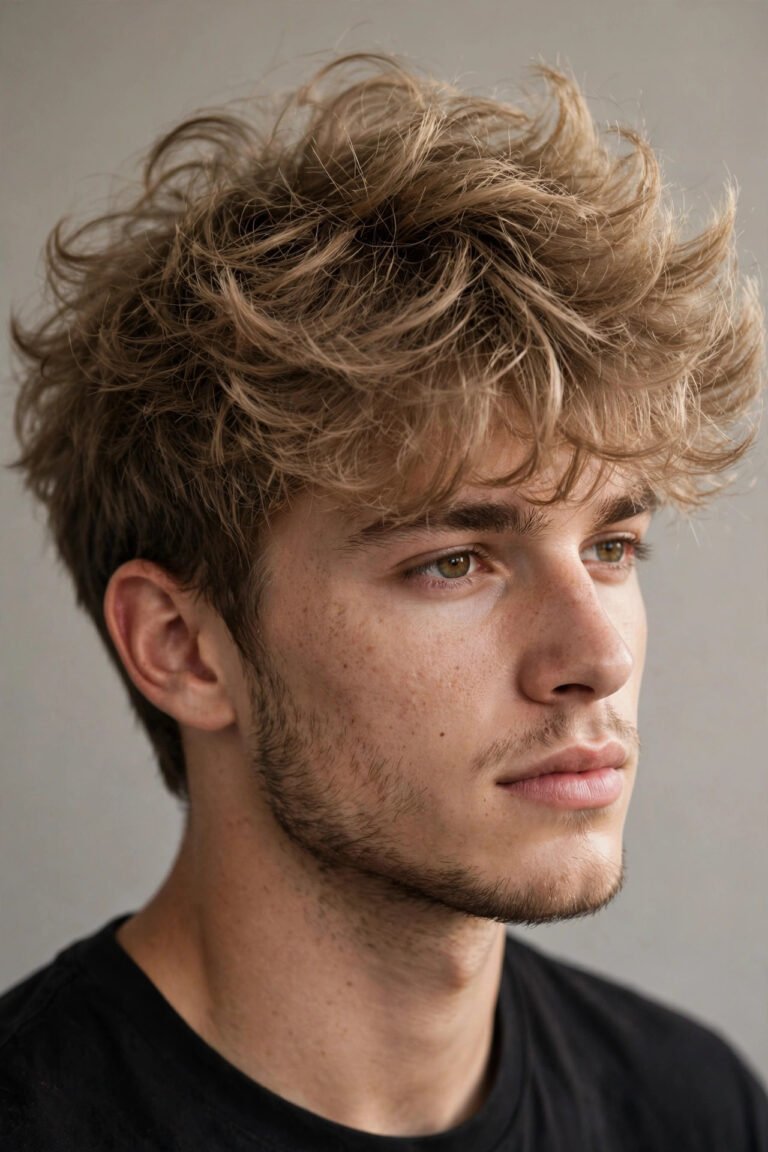
Widow’s Peak Men 2026: 14 Hairstyles That Work With Your Hairline
Widow’s Peak Men 2026: The Expert Hairline Guide
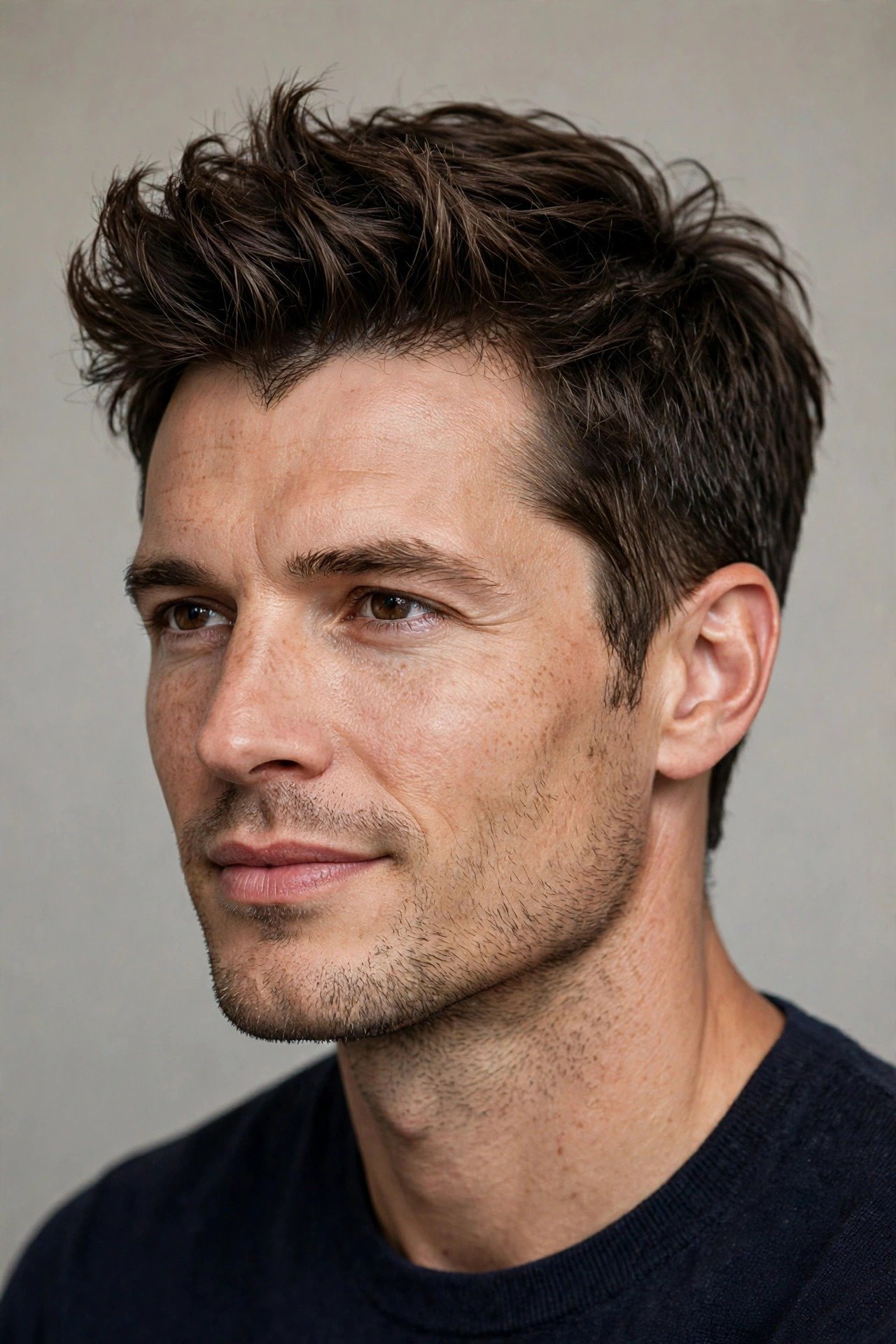
If you’re one of the many widow’s peak men wondering which haircuts actually work with a V-shaped hairline, here’s the truth most barbers won’t tell you upfront: a widow’s peak is not a flaw to hide — it’s a feature to style around. Some of the most iconic men’s hairstyles in history, from classic side parts to modern textured crops, look better with a defined peak than without one. This expert guide breaks down 14 hairstyles that flatter a widow’s peak in 2026, with the exact barber script for each, styling steps, and honest advice on which cuts to avoid.
You’ll learn: what a widow’s peak is (and isn’t), the difference between a peak and a receding hairline, which cuts flatter vs. fight your hairline, word-for-word barber scripts, and answers to the questions men with widow’s peaks ask most.
Here’s what this guide won’t do: it won’t tell you to shave the peak off (a maintenance nightmare), it won’t pretend the peak is invisible (it’s not, and it doesn’t need to be), and it won’t recommend the same three generic cuts every other article lists. Instead, you’ll get the barber’s actual decision framework — which styles incorporate the V, which dissolve it with texture, and which turn it into a feature — plus the exact words to use in the chair so no well-meaning barber ever tries to ‘even out’ your hairline again. Fourteen styles, five questions answered honestly, and zero anxiety about your hairline by the end.
Table of Contents
- Widow’s Peak Men 2026: The Expert Hairline Guide
- 14 Hairstyles That Work With a Widow’s Peak
- Styling Tips, Hairline Care & Maintenance
- Frequently Asked Questions
- Conclusion
What Is a Widow’s Peak — and Is It Receding?
A widow’s peak is a V-shaped point in the center of the hairline, caused by genetics — it’s simply how your hair grows, and it’s been considered a distinguished trait for centuries (the name comes from the peaked hoods widows wore in mourning). Roughly a third of men have some degree of a widow’s peak. Crucially: a widow’s peak is not hair loss. It’s a stable hairline shape you’ve likely had since your teens.
The confusion comes because a receding hairline can look similar in the early stages. Here’s how to tell them apart: a widow’s peak is a single centered V with full density on both sides of the point — the hairline is otherwise intact. A receding hairline thins at the temples first, creating an M shape with visibly sparser corners, and it progresses over time. If your temples are thinning and the V is getting deeper year over year, that’s recession, not a peak — and the buzz cut guide for receding hairlines is the more honest resource. If the V has looked the same since you were 18, it’s a peak: style it, don’t fear it.
Cuts That Flatter vs. Cuts That Fight a Widow’s Peak
Flatter: styles with forward or textured movement (fringes, crops, quiffs) soften the V into the overall shape; side parts can incorporate the peak as a natural part anchor; slicked-back styles turn the peak into a deliberate, sharp feature. Texture is your universal friend — it breaks up the hairline’s outline so the V reads as character, not focus.
Fight: severe middle parts that split exactly at the peak’s point (spotlights it); very short uniform cuts with no styling that leave the hairline as the only visual event; comb-overs that try to bury the peak (they draw the eye straight to what you’re hiding). The rule: work with the V or style past it — never try to erase it.
Two nuances worth knowing. First, peak depth matters: a subtle peak (half an inch) suits nearly everything including short crops and side parts, while a deep peak (an inch or more) leans on the dissolving strategies — textured fringes, quiffs, curls — because there’s more V to work with. Match the strategy’s strength to the peak’s depth. Second, density around the peak matters more than the peak itself: a V with thick hair on both sides is easy to style around; a V with thinning temples is a different situation (that’s recession — see the receding hairline guide linked above). When the hair around the peak is healthy and dense, every one of the 14 styles below is on the table.
What to Tell Your Barber: The Widow’s Peak Script
“I have a widow’s peak and I want to work with it. Keep enough length at the front hairline to style with texture — don’t cut the peak itself short or square it off. I’d like [style name], with the front blended so the V looks intentional. Please don’t try to ‘fix’ the hairline — just cut the style around it.”
Say it in the first 30 seconds. Barbers who don’t know about the peak may try to “even it out” — a well-meaning disaster that takes months to grow back. Also ask the barber to check the peak from the front, not just the chair mirror: hairline work is a front-view job. And bring reference photos of men with visible peaks wearing the style — it proves the look works.
14 Hairstyles That Work With a Widow’s Peak in 2026
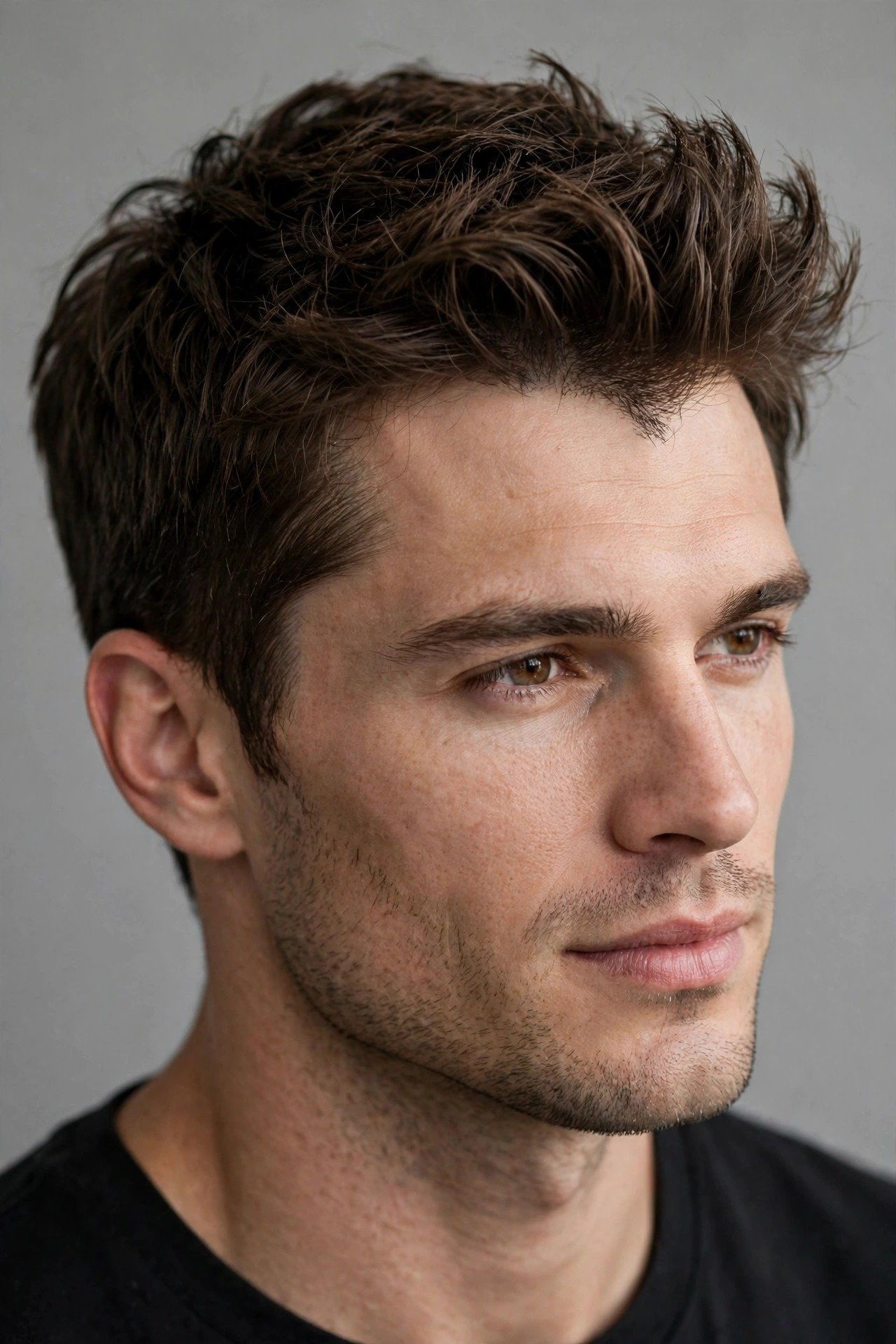
Every style below is chosen because it flatters a V-shaped hairline — either by softening it, incorporating it, or turning it into a feature. Each includes who it suits, the barber script, styling, maintenance, and the mistake to avoid.
1. Textured Fringe Forward
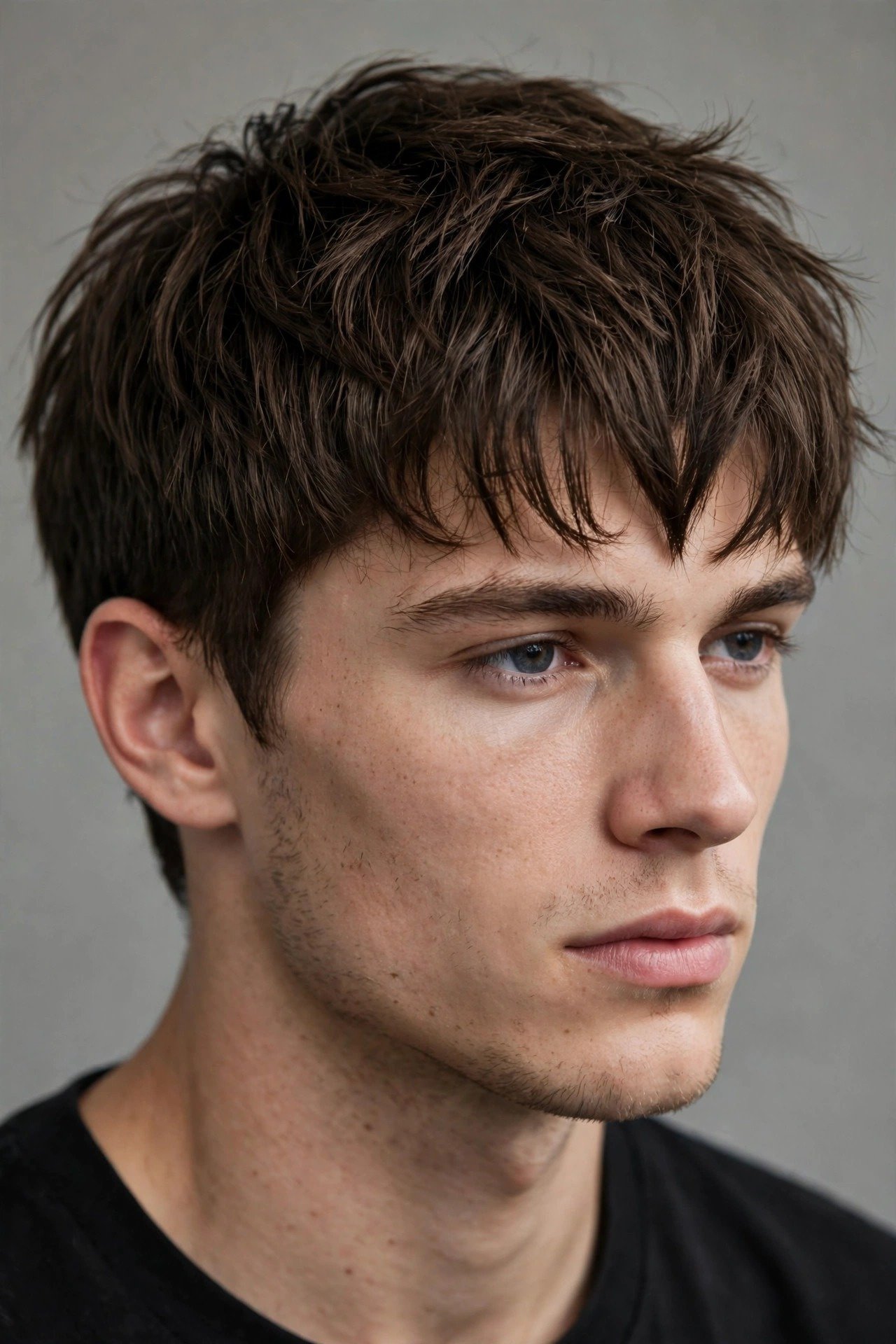
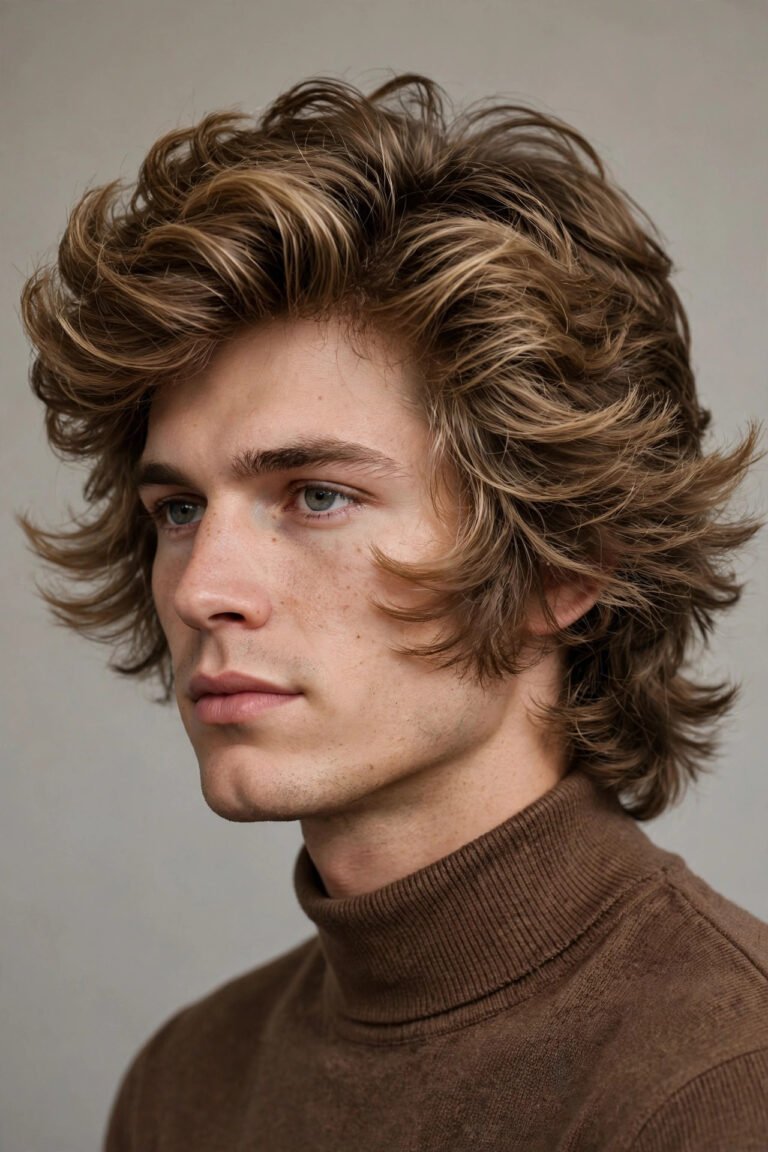
The most forgiving widow’s peak style: a textured fringe falling forward breaks the hairline’s outline completely. The V disappears into piece-y texture — the peak becomes invisible without any awkward covering-up.
Who it suits: The universal recommendation; all face shapes; straight to wavy hair. Especially good for deeper peaks.
Barber script: “Textured fringe, 3 inches on top falling forward, point-cut so it breaks up my hairline naturally. Keep the peak’s length — don’t cut into the V. Tapered sides.”
Styling (5 minutes): Sea salt spray on damp hair, rough-dry forward, pinch pieces. Let the fringe fall where it wants — uneven is the point.
Products: sea salt spray, texture powder. Maintenance: fringe trim every 4 weeks.
Mistake to avoid: a blunt straight fringe — on a peak it bounces unevenly and frames the V instead of hiding it. Texture is non-negotiable.
Pro tips & variations: This is the cut to request when you’re unsure — it flatters every degree of peak, from subtle to deep, and it gives the barber maximum room to work. Variation: grow the fringe to 4 inches and wear it swept slightly across for a softer look, or keep it at 3 inches for a sharper finish. If your peak is very deep, ask the barber to keep extra length directly above the V — the surrounding texture needs to be long enough to break up the point. Between cuts, the fringe is the first thing to overgrow — a 5-minute fringe trim keeps the camouflage working.
2. Deep Side Part
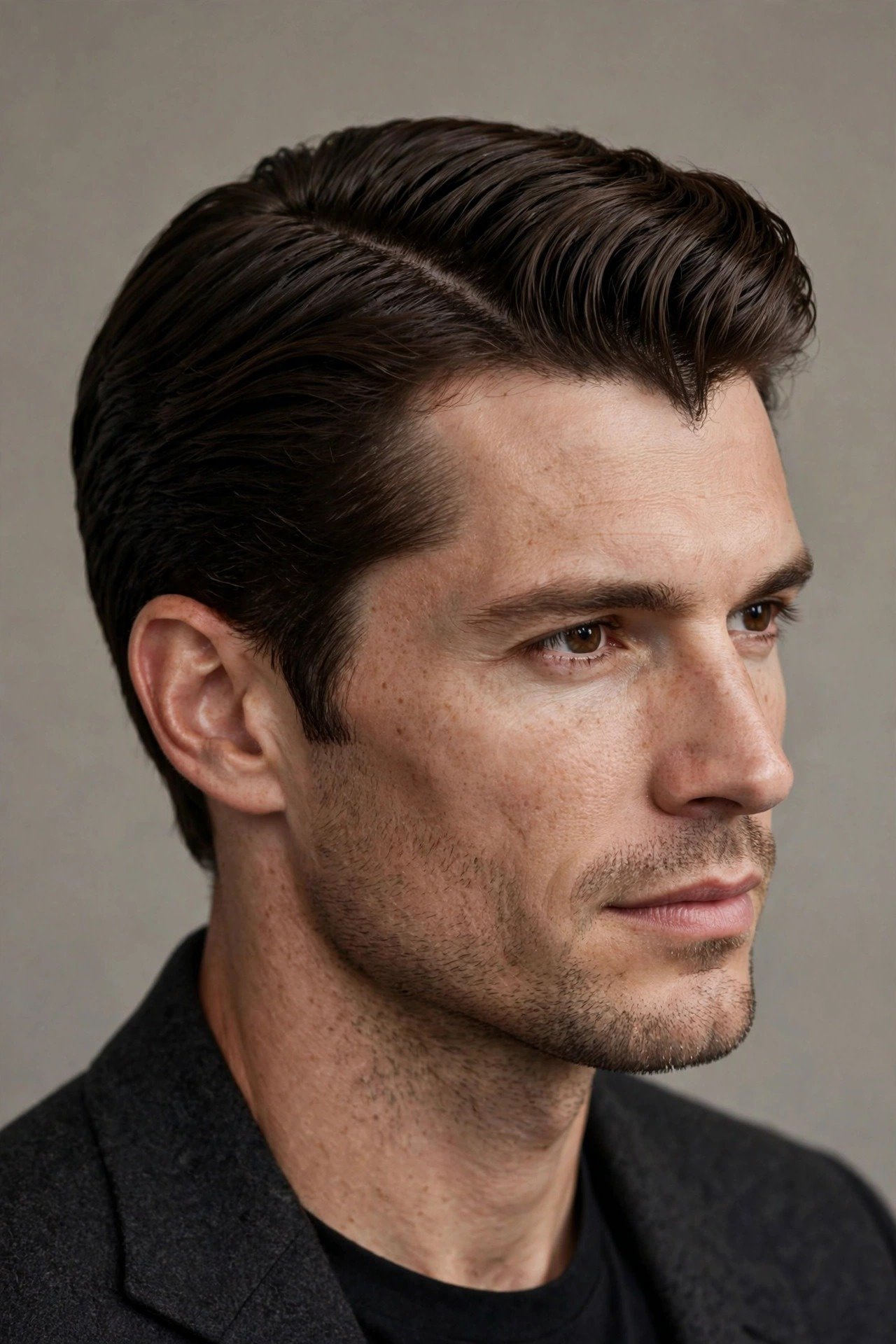
The classic power move: a deep side part uses the peak as a natural anchor — the part line flows from the V, making it look like the hairline was designed for the style. Distinguished, sharp, timeless.
Who it suits: Professional settings; square and oval faces; straight to wavy hair. The most “intentional” way to wear a peak.
Barber script: “Deep side part, 3–4 inches on top, tapered sides. Work the part from my natural peak — let the V anchor the part line instead of fighting it.”
Styling (7 minutes): Finger-part on the deep side, blow-dry up and over for volume, settle with matte paste. The part should look combed, not carved.
Products: mousse (volume), matte paste. Maintenance: trim every 4 weeks. See the side part haircut guide for variations.
Mistake to avoid: a razor-sharp hard part shaved through the peak — it looks surgical. Keep the part soft.
Pro tips & variations: The side part is the peak’s natural ally because hairlines already want to part near the V — you’re cooperating with growth patterns, not fighting them. Find your part by combing everything forward and seeing where it naturally splits; that’s your line. Variation: a lower, more dramatic part (above the temple) reads vintage and bold; a higher part (above the eyebrow arch) reads modern and subtle. Product note: the part stays put better with a blow-dry — drying the hair in the part’s direction ‘sets’ it for the day.
3. Slick Back — Own the Peak
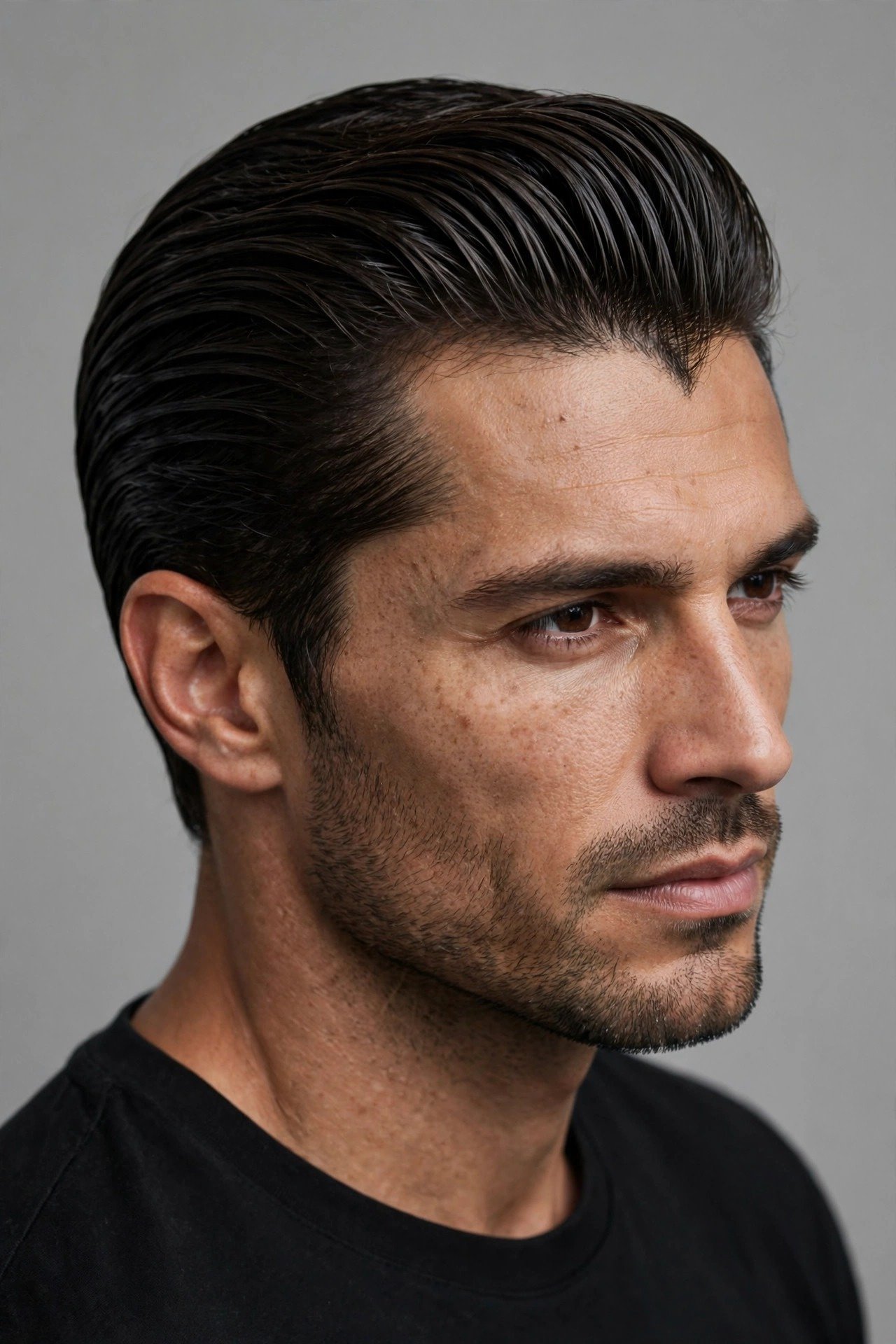
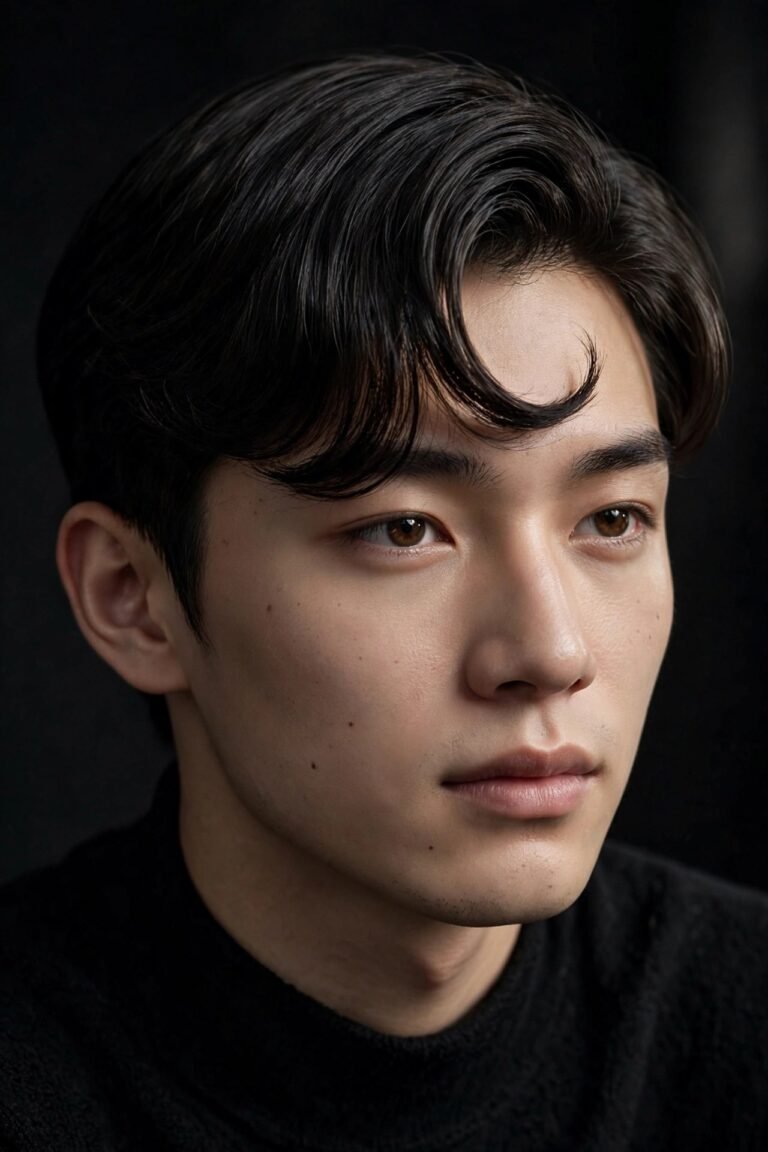
The bold choice: slick everything straight back and let the V stand proud. On the right face it’s magnetic — the peak becomes a signature, the way it was for Hollywood’s golden-age leading men. Confidence is the product here.
Who it suits: Strong jawlines and square faces; thick straight to wavy hair; men comfortable with a sharp, deliberate look. Needs 4–5 inches on top.
Barber script: “Slick-back length — 5 inches on top, scissor-cut sides. I want to wear it back off my peak, so keep the front hairline clean and don’t thin the peak itself.”
Styling (8 minutes): Cream or light pomade on damp hair, comb straight back, blow-dry back for hold. Finish with a medium-hold product — not wet-look gel.
Products: styling cream, medium-hold pomade. Maintenance: trim every 5–6 weeks. The slick back undercut is the edgier variant.
Mistake to avoid: doing this with thinning temples — a slick-back on a receding (not peak) hairline spotlights the loss. Be honest about which you have.
Pro tips & variations: This is the confidence play, and it works best when the rest of the grooming is sharp — clean neckline, maintained sides, intentional finish. Half-hearted slick-backs look accidental; committed ones look iconic. Variation: a looser, finger-combed slick-back reads modern; a comb-defined one with a slight sheen reads vintage. Honesty check before choosing this: it only works on a true peak with full temples — if there’s any thinning at the corners, the slick-back becomes a spotlight on recession rather than a celebration of the V.
4. Messy Quiff
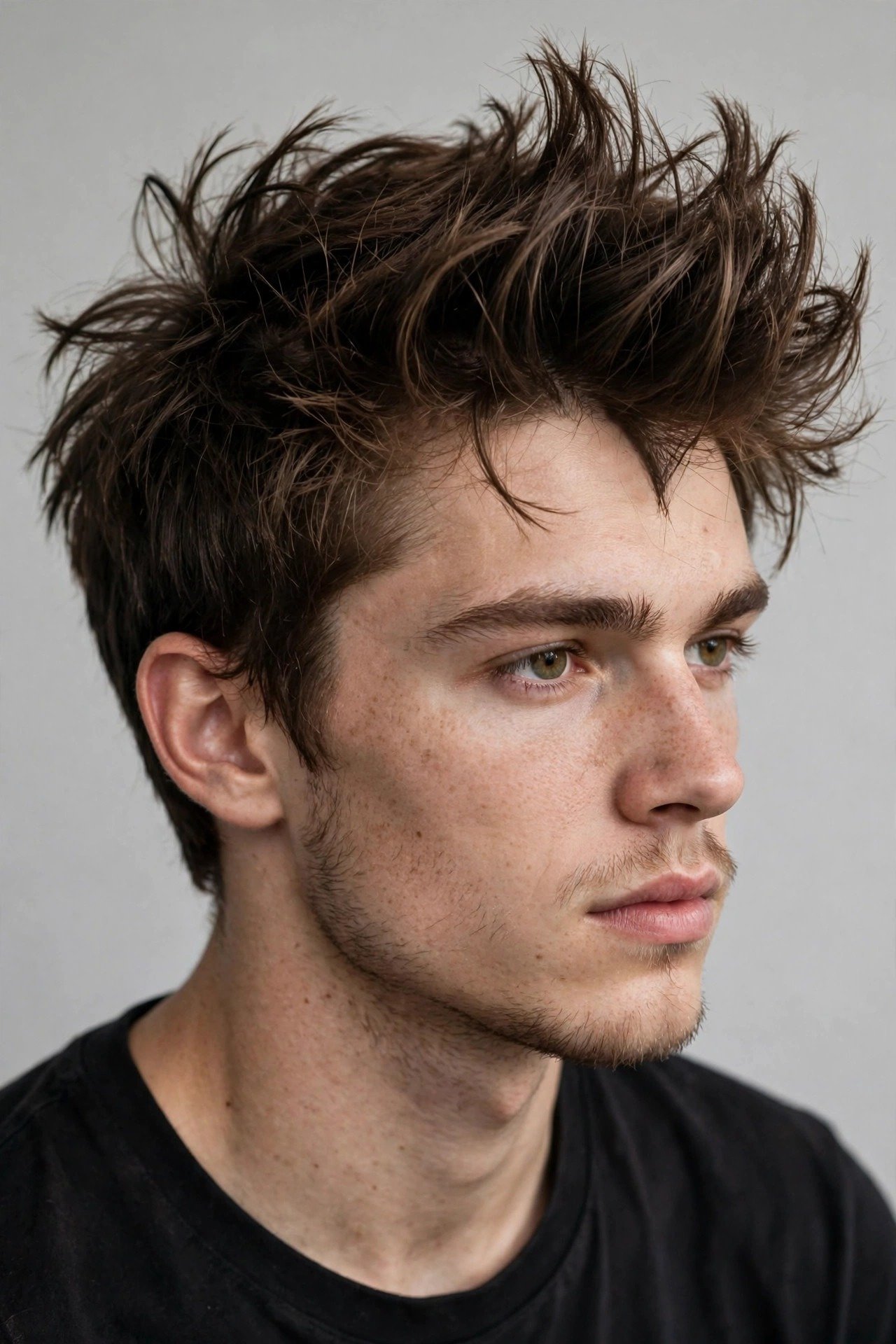
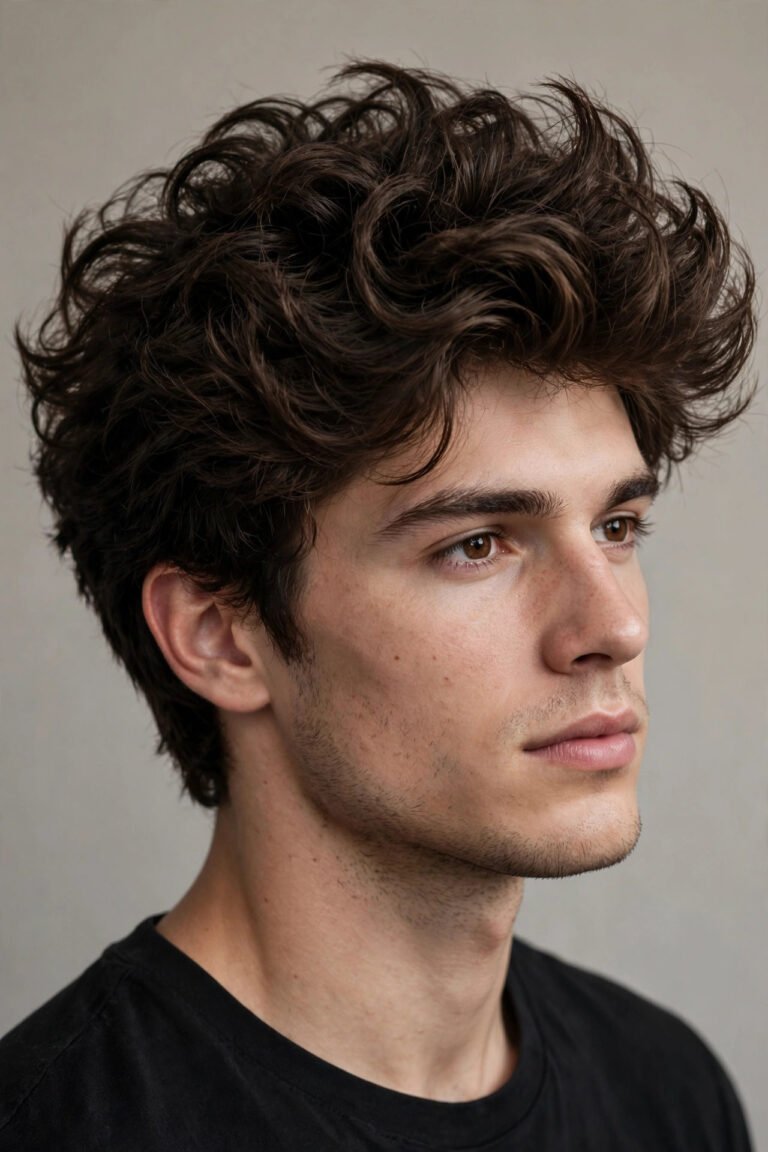
Height plus texture: the quiff’s lifted front pulls the eye upward while the messy texture dissolves the hairline’s outline. The V gets lost in the best possible way.
Who it suits: Round faces (the lift slims); oval faces; straight to wavy hair with medium density.
Barber script: “Messy quiff: 4 inches in front, textured throughout, interior weight out for lift. Blend the front so my peak disappears into the texture — don’t define the hairline.”
Styling (8 minutes): Mousse at roots, blow-dry up and forward with fingers, pinch the front into pieces. Deliberately imperfect.
Products: mousse, matte paste. Maintenance: trim every 4–5 weeks.
Mistake to avoid: a neat, sculpted quiff — precision styling outlines the peak. Messy is the strategy.
Pro tips & variations: The quiff’s height is doing strategic work here — it pulls the eye up and away from the hairline, so commit to real lift rather than a half-hearted bump. Dry the front in two directions (forward first, then up and back) to double the root volume. Variation: a forward-leaning messy quiff hides more hairline; a back-swept one shows more but looks dressier. This is also the best peak style for photographs — the height and texture photograph as pure style, with the hairline invisible in the overall shape.
5. French Crop
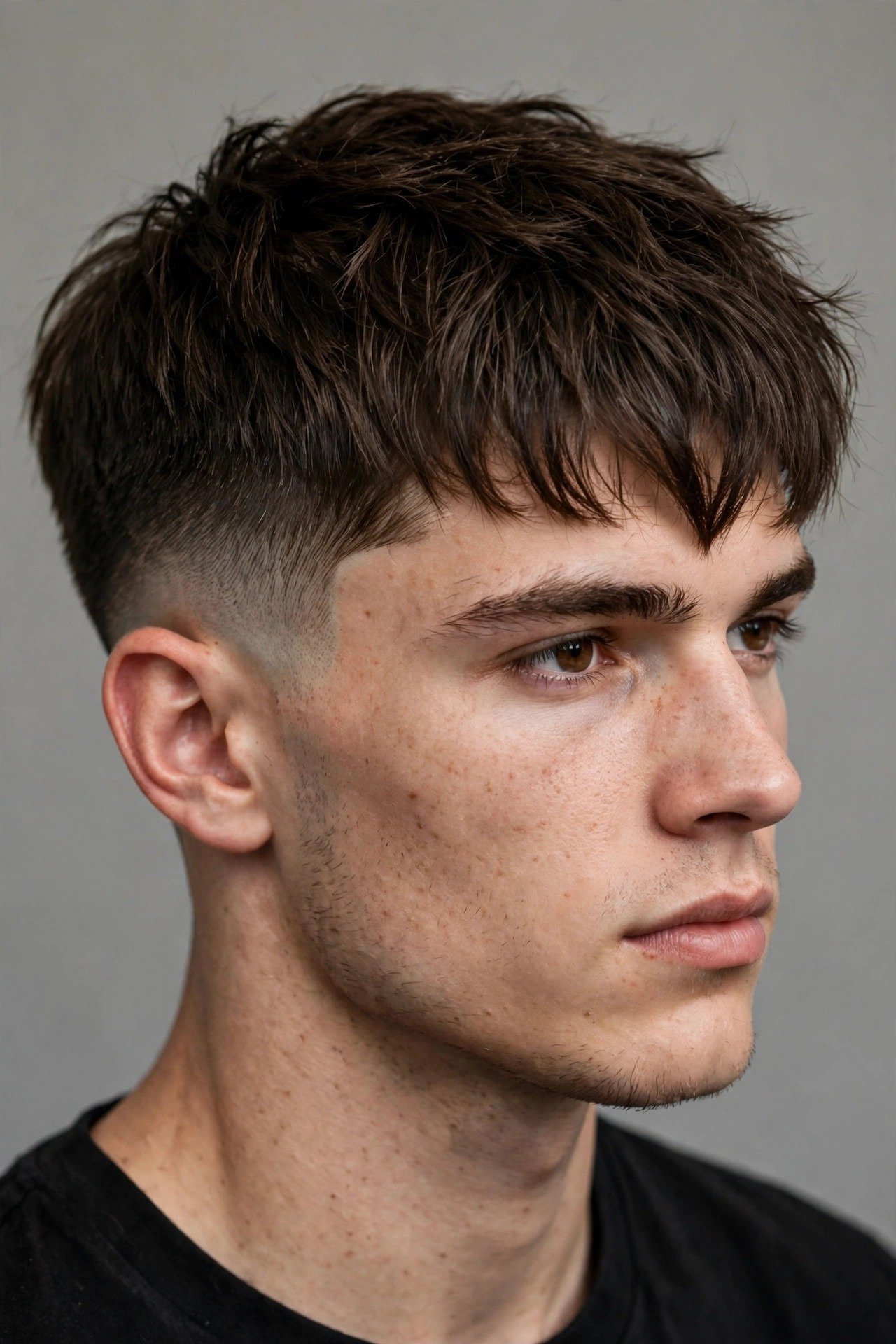
Short, textured, forward — the French crop’s blunt-ish textured fringe sits right over the peak zone, neutralizing it while looking sharp. Low maintenance, high compatibility.
Who it suits: All face shapes; the go-to for guys who want short hair without spotlighting the hairline. Works on straight, wavy, and curly textures.
Barber script: “French crop: 2 inches on top, textured fringe, mid fade on the sides. Keep the fringe long enough to soften my peak — don’t crop into the hairline.”
Styling (3 minutes): Tiny amount of matte paste, push forward, done. The lowest-effort style on this list.
Products: matte paste. Maintenance: trim every 3–4 weeks.
Mistake to avoid: cutting the fringe too short — under 1.5 inches it can’t cover the V and the crop fights the peak instead of flattering it.
Pro tips & variations: The French crop is the lowest-maintenance peak style on this list — three minutes with matte paste and you’re done, which makes it the practical default for busy men. Variation: a slightly longer top (2.5 inches) gives more texture to work with; the classic 1.5-inch version is sharper but less forgiving. The critical detail is fringe length: it must be long enough to soften the V — if the barber crops it too short, the peak pops out and the whole strategy fails. Speak up in the chair if it looks too short.
6. Buzz Cut — Short and Even
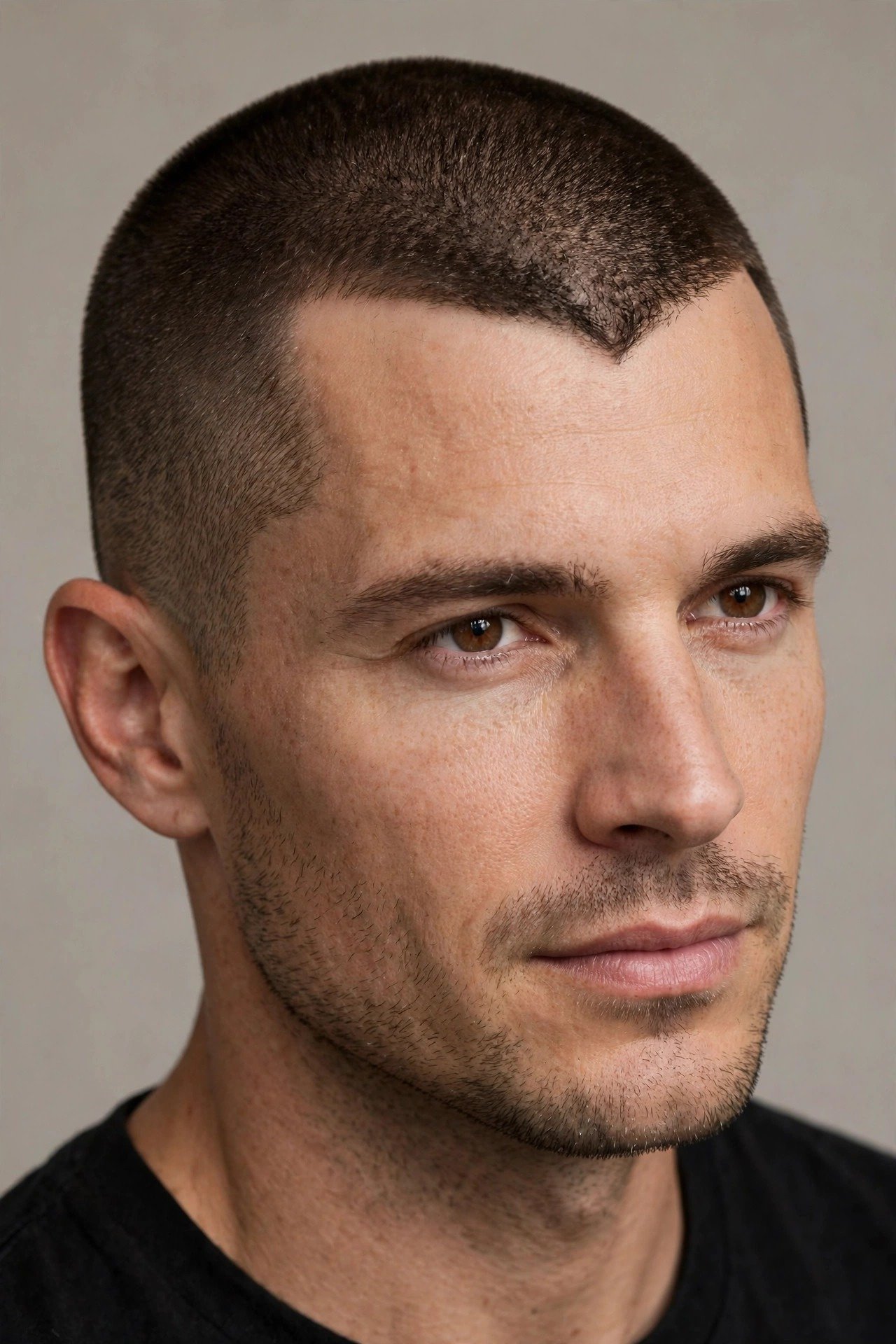
The honest minimal: a uniform buzz doesn’t hide the peak — it normalizes it. When everything is the same length, the V reads as just how your hair grows, which is exactly what it is. Surprisingly flattering for slight to moderate peaks.
Who it suits: Good head shape and strong features; slight to moderate peaks (very deep Vs stay visible — that’s fine, it’s honest). The ultimate low-maintenance choice.
Barber script: “Buzz it even — #3 on top, #2 on the sides, no design into the hairline. Leave my peak exactly as it is; just take the length down.”
Styling (0 minutes): None. Wash, towel, go. A little matte moisturizer if the scalp gets dry.
Products: none needed; scalp moisturizer optional. Maintenance: re-buzz every 2–3 weeks.
Mistake to avoid: going to a #1 or skin on a very deep peak — ultra-short makes the V the only feature. #2–#3 keeps balance.
Pro tips & variations: The buzz is the honest minimal — and honesty suits the peak, because a uniform cut makes the V read as simply how your hair grows. Variation: a #4 on top with #2 sides keeps a hint of style; a uniform #2 everywhere is pure utility. Pro tip: get the hairline cleaned up (not reshaped) at the barber — a crisp perimeter around the natural peak looks deliberate, while a fuzzy one looks neglected. And wear sunscreen on the scalp for the first week — newly buzzed scalps burn fast.
7. Faux Hawk
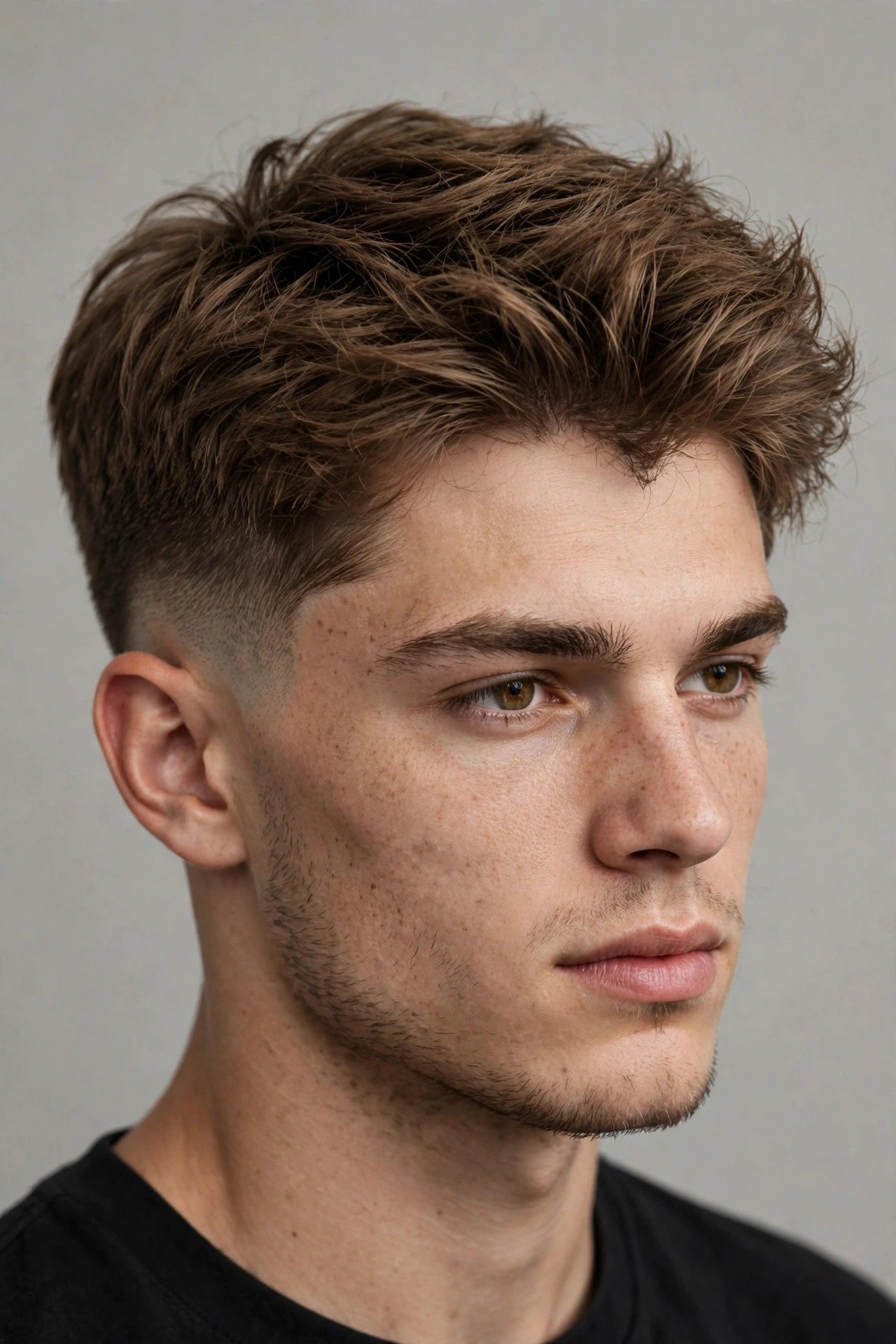
Strategic misdirection: the fohawk’s central strip pulls the eye up and back, away from the hairline. The peak sits at the front of the strip and reads as the style’s starting point — geometry working for you.
Who it suits: Oval and diamond faces; straight to wavy hair; guys who want edge. The strip needs 3 inches minimum.
Barber script: “Soft fohawk: 3.5 inches through the center with texture, mid fade on the sides. Let my peak be the front of the strip — don’t cut it back.”
Styling (6 minutes): Sea salt spray, rough-dry the center upward, let it fall naturally textured. Soft, not spiked.
Products: sea salt spray, matte paste. Maintenance: fade touch-up every 3 weeks.
Mistake to avoid: stiff liberty spikes — the aggressive version frames the hairline harshly. Keep it soft and textured.
Pro tips & variations: The fohawk’s center strip creates a visual runway from the peak upward — the eye follows the texture, not the hairline. Keep the strip at 3.5 inches minimum; shorter strips don’t have enough presence to redirect attention. Variation: wear the strip forward and textured for a fringe-fohawk hybrid that hides more hairline, or swept back for the classic fohawk line. This style also grows out better than most edgy cuts — skip the fade touch-ups and it melts into a textured crop.
8. Middle Part Curtains
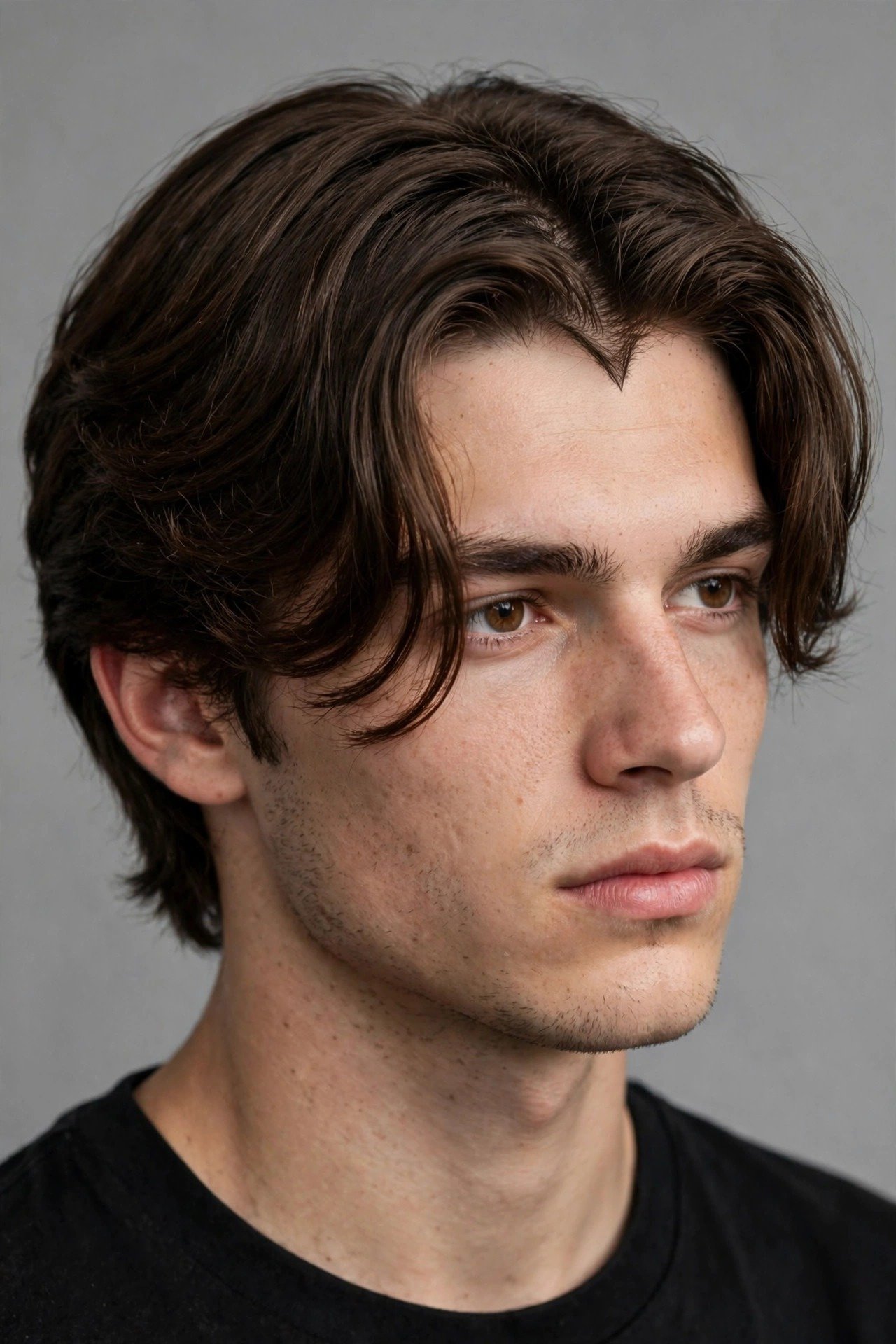
Counterintuitive but effective: soft curtains parted just off-center let the peak hide in the part’s natural irregularity. The key is soft — a severe center part spotlights the V, but textured curtains with a lived-in part swallow it.
Who it suits: Symmetrical oval faces; 4–6 inches of front length; straight to wavy hair. Under-35s wear it most naturally.
Barber script: “Textured curtains: 5 inches in front, face-framing layers, soft off-center part. My peak should disappear into the part — keep everything soft, nothing severe.”
Styling (7 minutes): Part slightly off-center on damp hair, blow-dry the front forward then sweep each side out. Cream on the face-framing pieces.
Products: light cream, mousse. Maintenance: trim layers every 6–8 weeks.
Mistake to avoid: a razor-sharp center part — it creates a runway straight to the peak. The part must look accidental.
Pro tips & variations: The secret is the softness: a severe center part is the one part that spotlights a peak, but textured curtains with a lived-in, slightly-off part swallow it completely. Train the part by parting wet daily for two weeks. Variation: tuck one side behind the ear for asymmetry, or let both sides fall for the full curtain effect. If your face is very symmetrical, this style is at its best — the mirrored curtains frame and flatter balanced features beautifully.
9. Pompadour
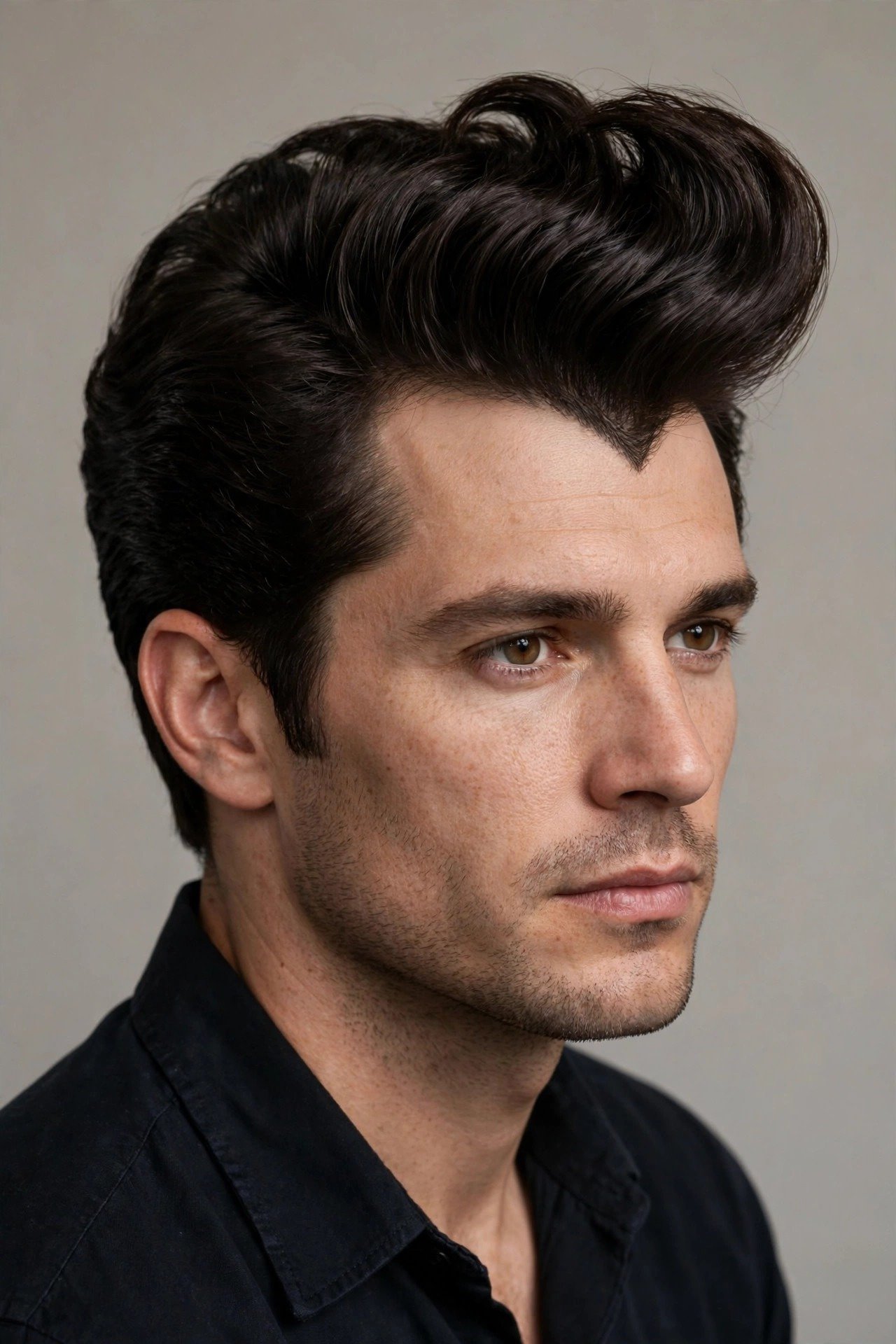
Vertical drama: the pomp’s height draws every eye upward, and the swept-up front turns the peak into a launchpad. Vintage, bold, and one of the few styles where a strong V genuinely improves the look.
Who it suits: Round and square faces (height slims and sharpens); thick straight to wavy hair; 4–5 inches in front. A commitment — this is a daily styling cut.
Barber script: “Classic pomp: 4–5 inches in front, graduated back, tapered sides. Build the front to sweep up from my peak — use the V as the foundation, don’t bury it.”
Styling (12 minutes): Mousse at roots, blow-dry the front up and back with a round brush, set with medium-hold pomade. The most involved routine here — worth it.
Products: mousse, medium-hold pomade, round brush. Maintenance: trim every 3–4 weeks; the graduation shows growth.
Mistake to avoid: a flat, low pomp — without real height, it’s just hair pushed back, and the peak gets no help. Commit to the volume.
Pro tips & variations: The pompadour demands the most daily effort here — 12 minutes and real technique — but it pays back with the most dramatic peak-flattering effect, because maximum height means maximum misdirection. Invest in a round brush; it’s the tool that builds the pomp’s structure. Variation: a lower, textured pomp for daytime and a higher, more sculpted one for evenings — same cut, different styling intensity. This is a lifestyle cut: if you won’t style daily, pick the quiff (style 4) instead and save yourself the frustration.
10. Taper Fade with Texture
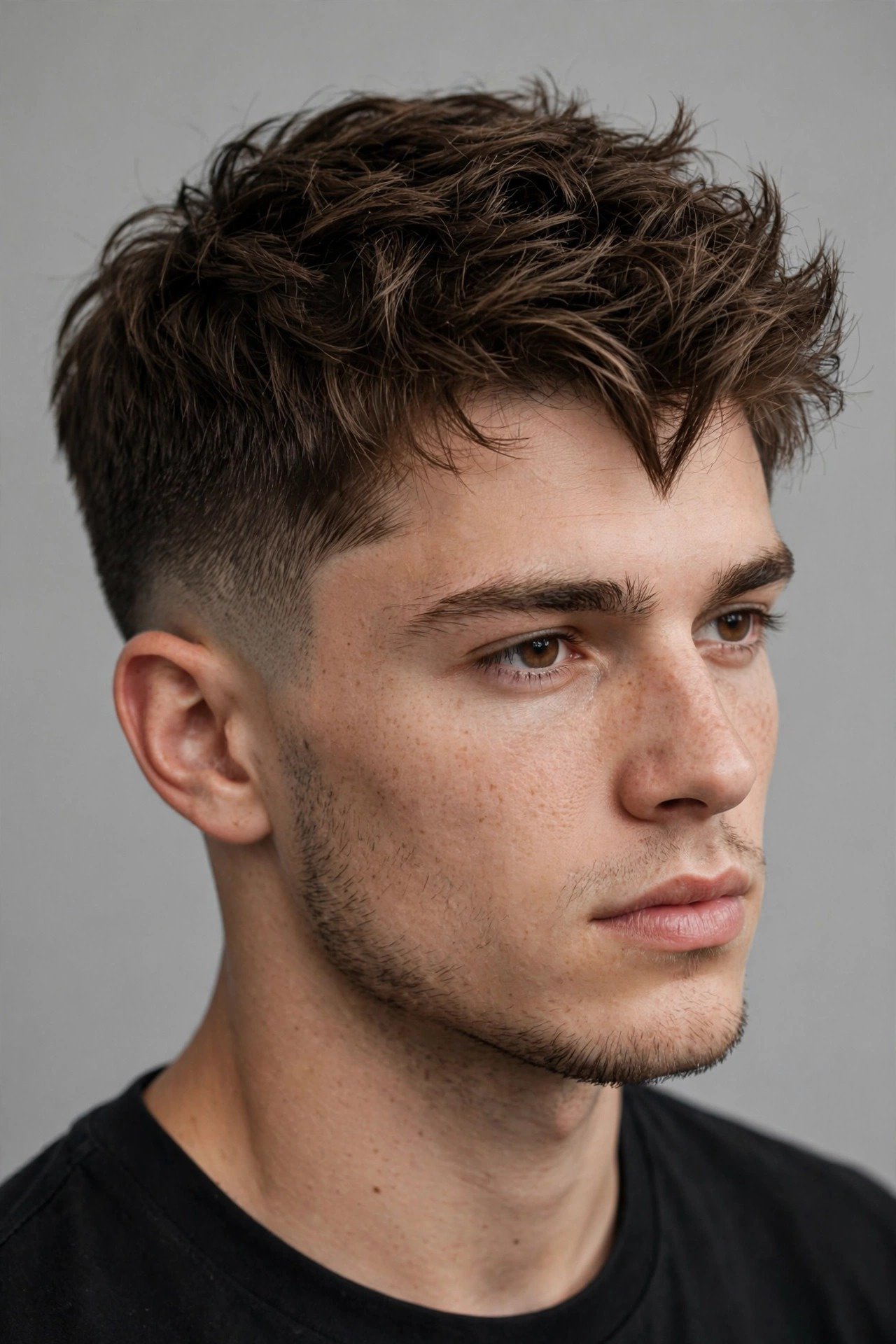
Clean frame, textured top: the low taper keeps everything sharp while 3 inches of texture up top dissolves the hairline. Modern, tidy, and peak-friendly — the safe upgrade from any basic cut.
Who it suits: Every face shape; the most versatile style here. Great first “peak-aware” cut for guys currently in a generic short back and sides.
Barber script: “Low taper, 3 inches of textured length on top, point-cut front. Work around my peak — soften it with texture, don’t cut into it.”
Styling (6 minutes): Mousse at roots, finger blow-dry forward, texture powder at the crown. The taper provides the “clean”; the top provides the camouflage.
Products: mousse, texture powder. Maintenance: taper cleanup every 2–3 weeks; top trim every 5 weeks.
Mistake to avoid: a high skin fade — the harsh contrast makes the hairline the focal point. Keep the taper low and soft.
Pro tips & variations: This is the safe upgrade — if you’re currently in a generic short-back-and-sides and want to be peak-aware without a dramatic change, this is the cut. The taper keeps everything tidy while the textured top does the camouflage work. Variation: push the top forward for maximum hairline softening, or sweep it to the side for a smarter finish. Maintenance is the tradeoff: the taper needs edge cleanups every 2–3 weeks, so factor in the barber visits before committing.
11. Long Flow Back
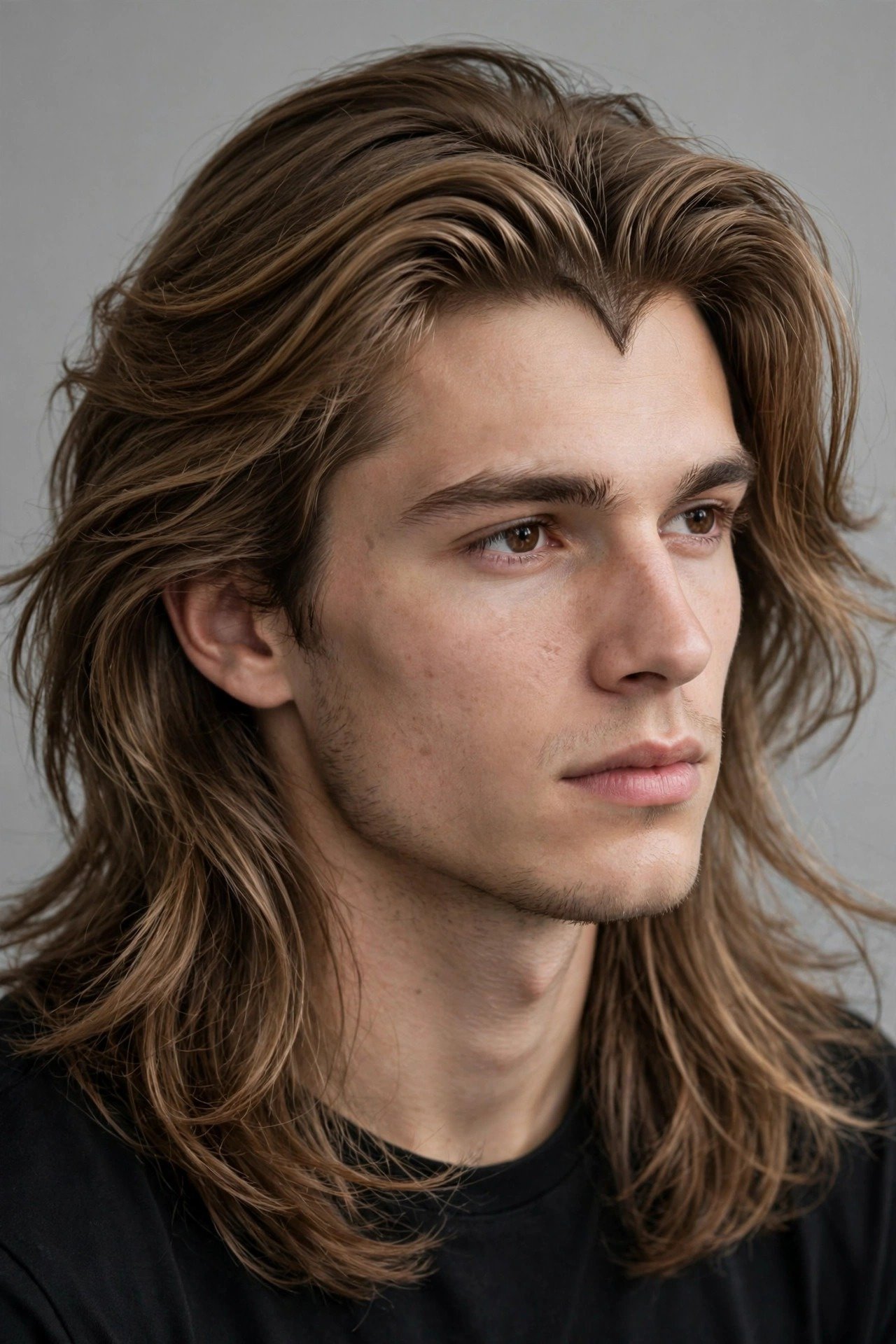
Length solves everything: 6+ inches swept back turns the peak into the natural origin point of the flow. The V becomes where the style starts — which is exactly what a hairline is supposed to be.
Who it suits: Thick straight to wavy hair; oval and oblong faces; patience required (this is a 12-month grow-out from short).
Barber script: “Growing a flow: keep the length, layer for movement, clean the neckline only. I wear it back from my peak — don’t touch the front hairline.”
Styling (8 minutes): Leave-in conditioner, blow-dry back with fingers for volume, cream to settle. The “dust and tidy” trim every 8–10 weeks keeps it healthy.
Products: leave-in conditioner, styling cream. Maintenance: trim every 8–10 weeks.
Mistake to avoid: the awkward-stage chop — months 3–5 look rough; push through with headbands or hats, not scissors.
Pro tips & variations: Length is the ultimate peak solution because 6+ inches swept back turns the V into the style’s natural origin point — the hairline becomes where the look starts, which is its job. The grow-out is the challenge: months 3–5 are awkward, so plan for hats, headbands, or a strategic undercut phase. Variation: wear it with a middle part for a more dramatic flow, or swept straight back for simplicity. Once past shoulder-grazing length, the peak is a complete non-issue — nobody sees a hairline through a full flow.
12. Caesar Cut
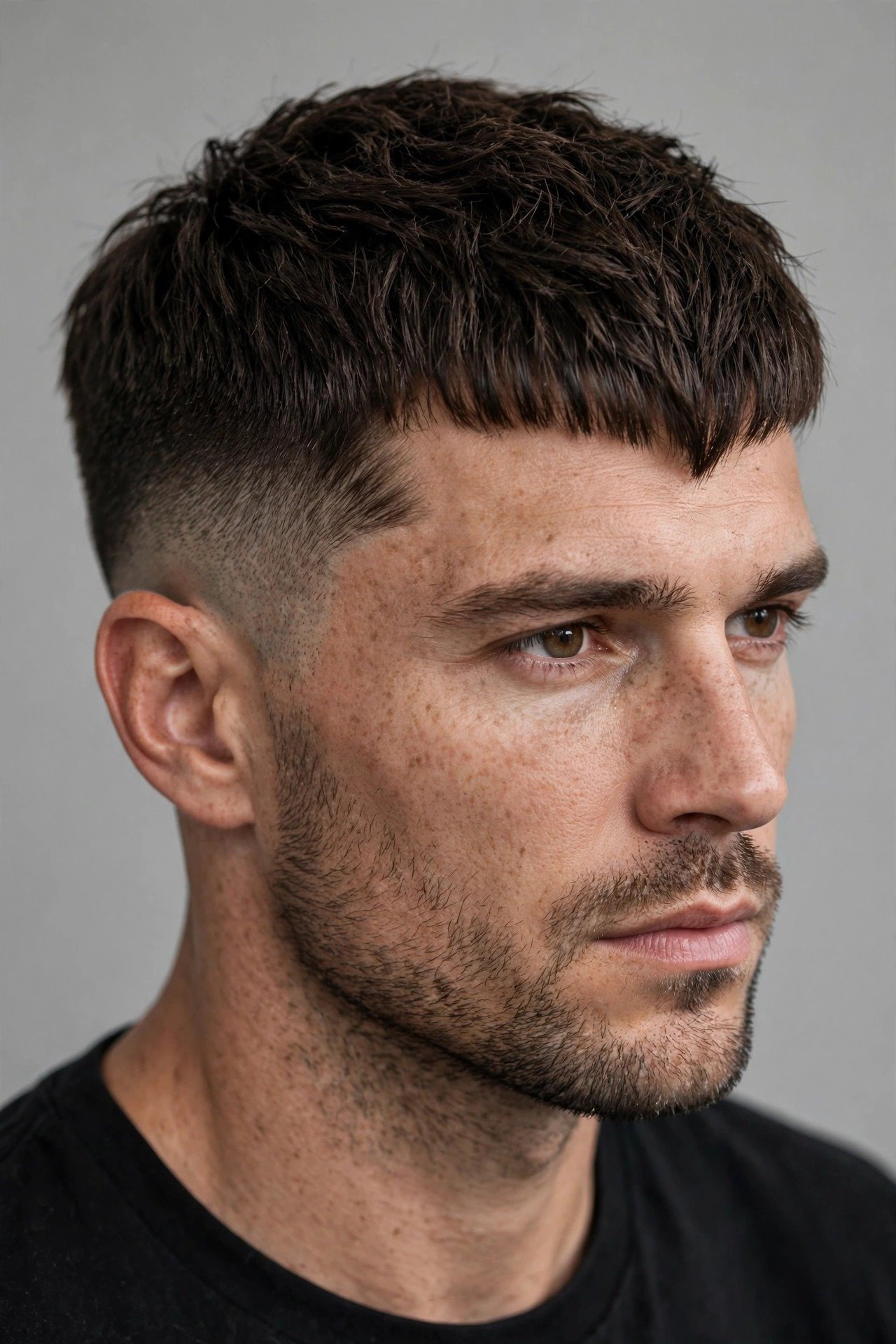
Two thousand years of proof: the Caesar’s short horizontal fringe was literally designed for strong hairlines. The straight-across fringe with texture softens the V into the cut’s geometry — ancient Rome solved this.
Who it suits: Straight to wavy hair; square and oval faces; guys who want short, sharp, and zero-fuss. Great on a budget — easy for any barber.
Barber script: “Caesar: 1.5–2 inches on top, short textured fringe straight across, fade on the sides. Keep the fringe textured so it blends with my peak.”
Styling (3 minutes): Matte paste, push the fringe forward, done.
Products: matte paste. Maintenance: trim every 3–4 weeks. A dedicated Caesar cut guide has the full breakdown.
Mistake to avoid: a razor-sharp fringe line — the hard horizontal against the V looks drawn-on. Texture softens the geometry.
Pro tips & variations: Two thousand years of emperors can’t be wrong — the Caesar’s horizontal fringe was designed for strong, defined hairlines, and the peak slots right into its geometry. Variation: the classic short Caesar (1.5 inches) is sharpest; a longer ‘modern Caesar’ (2.5 inches) with more texture is more forgiving. The fringe must be textured, not blunt — a razor-straight line against the V looks drawn-on, while point-cut texture blends the hairline into the cut. This is also the cheapest cut to maintain: any competent barber can execute it.
13. Side-Swept Undercut
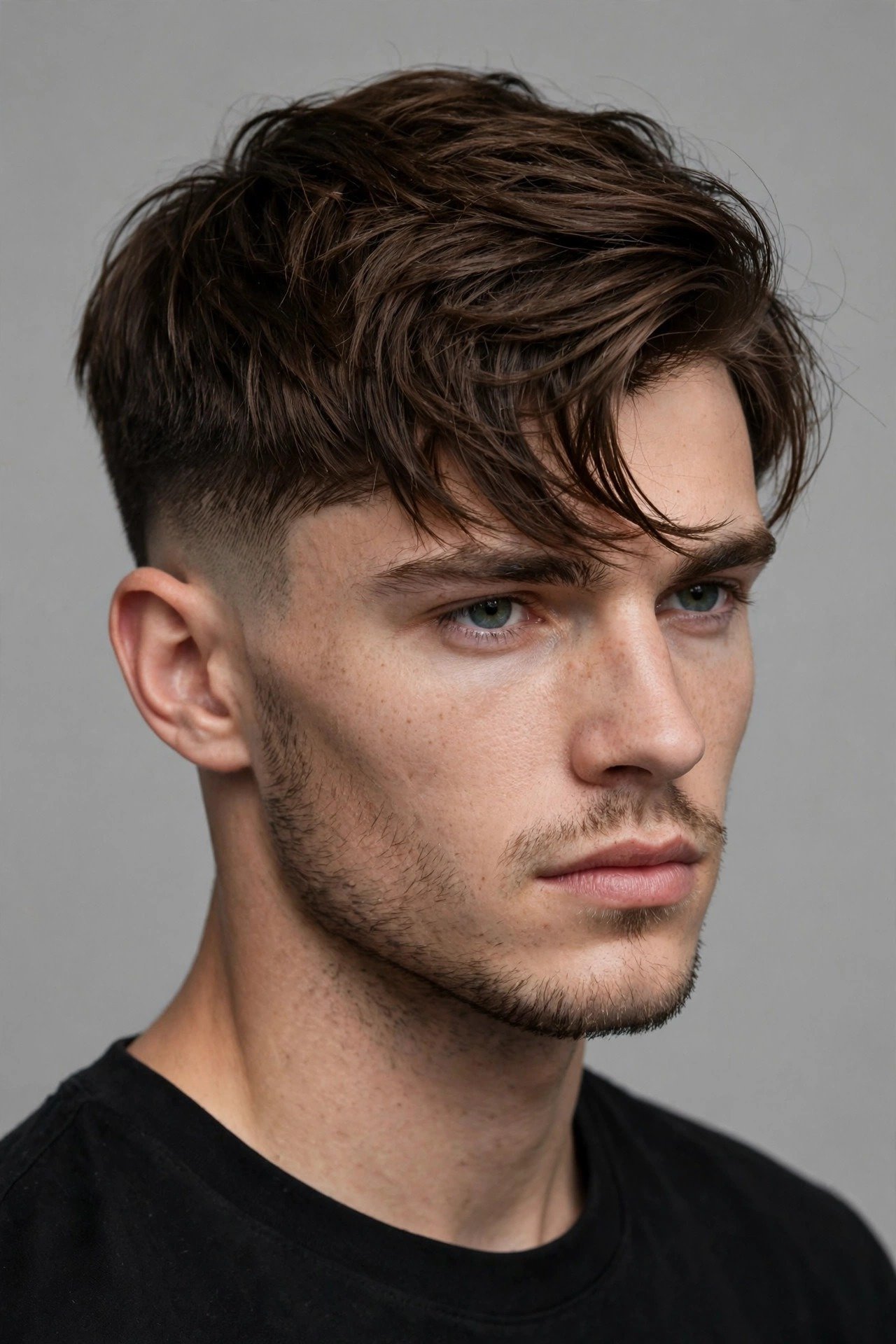
The sweep is camouflage: 4–5 inches of top swept across the forehead moves the visual focus sideways, and the peak hides under the sweep’s origin. Edgy sides, forgiving top.
Who it suits: Thick hair that sweeps well; oval and heart faces; modern dressers. Needs real length to sweep — 4 inches minimum.
Barber script: “Side-swept undercut: disconnect the sides at a #2–#3, leave 5 inches on top to sweep across. The sweep should start near my peak and move across — soften the hairline with the direction.”
Styling (7 minutes): Mousse at roots, blow-dry the top across the forehead, set with matte paste. The sweep direction is the whole trick.
Products: mousse, matte paste. Maintenance: undercut re-cut every 3 weeks.
Mistake to avoid: sweeping with no volume — a flat sweep clings to the hairline and outlines the V. Lift at the roots first.
Pro tips & variations: The sweep direction is doing the camouflage work — it moves the eye sideways across the forehead instead of letting it settle on the V. The sweep must have volume at the roots; a flat sweep clings to the hairline and outlines the peak instead of hiding it. Variation: a deeper sweep (from a low side part) hides more; a softer sweep looks more natural. This style needs real length — 4 inches minimum, 5 is better — so it’s a grow-out commitment, not a same-day transformation.
14. Curly Top with Taper
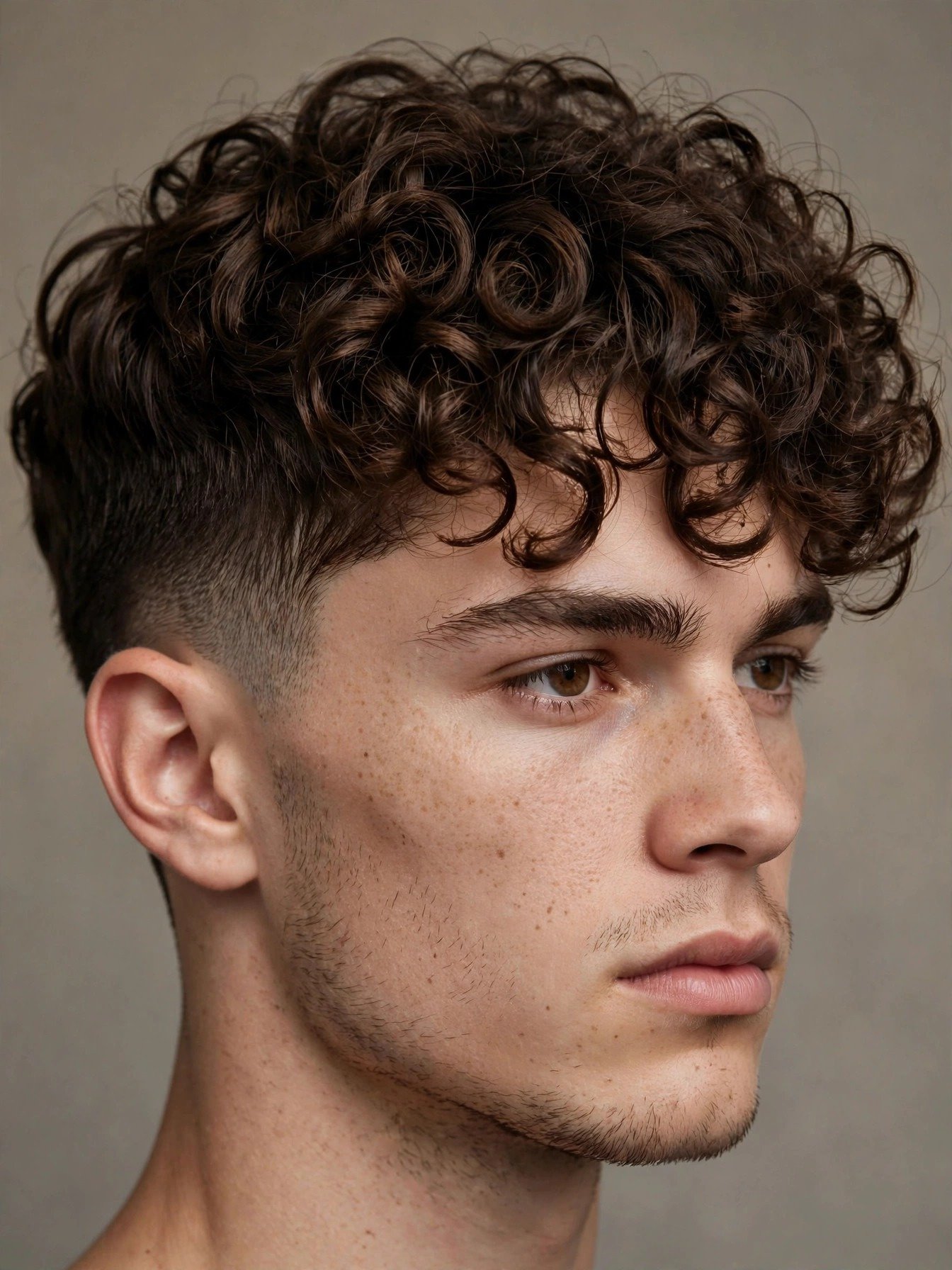
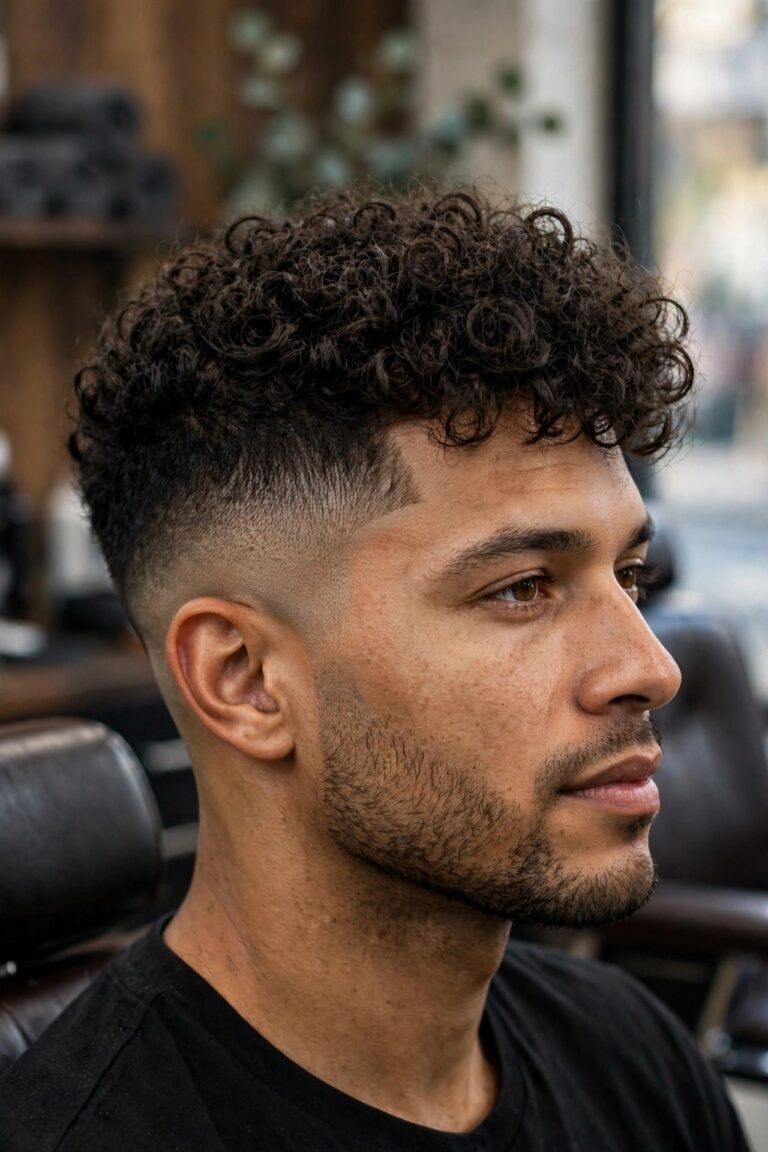
Curls are the ultimate distraction: defined curls on top with a clean taper make the hairline completely irrelevant. Nobody looks at a hairline when the curls are doing that. The highest “peak? what peak?” energy on this list.
Who it suits: Natural curls and tight waves (2C–3B); all face shapes. If you have the texture, this is the answer.
Barber script: “Curly top: keep 3–4 inches of curl, shape the silhouette round, taper the sides. Don’t cut into my peak — let the curls fall naturally over the hairline.”
Styling (10 minutes): Curl cream on soaking-wet hair, scrunch, diffuse. Let the front curls fall forward over the peak zone.
Products: curl cream, light gel. Maintenance: trim every 6–8 weeks; deep-condition weekly.
Mistake to avoid: cutting the front curls short to “clean up” the hairline — short curls spring up and expose the V. Length is camouflage.
Pro tips & variations: Curls are nature’s misdirection — defined texture on top makes the hairline completely irrelevant, because no one looks past great curls. The front curls are doing the work, so keep them long enough to fall naturally over the peak zone — cutting them short makes them spring up and exposes the V. Variation: pick the roots out for maximum volume and presence, or keep the curls defined and clumped for a neater finish. Weekly deep-conditioning keeps the curls healthy enough to hold their shape, which is what makes the whole strategy work.
Styling Tips, Hairline Care & Maintenance
Daily Styling Principles for a Widow’s Peak
- Texture over precision. Every style here works because texture breaks up the hairline. When in doubt, add separation, not neatness.
- Style from the front. Check the hairline in a front-facing mirror, not just the barber’s side mirror. The peak is a front-view feature.
- Keep front length. The single biggest lever: 2+ inches at the front hairline gives you styling options; under an inch gives you none.
- Volume is camouflage. Lift at the roots pulls the eye up and softens the V’s outline. Flat styling does the opposite.
- Never cut the peak itself. No squaring it off, no “evening it out,” no shaving the point. It grows back weird and takes months.
Hairline Care
A widow’s peak needs no special treatment — it’s healthy hair, and no product or technique will (or should) change its shape. But watch for the thing men confuse it with: if your temples start thinning or the V deepens year over year, see a dermatologist early; treatments work best at the first sign of recession, and a dermatologist can tell you definitively whether you’re seeing a stable peak or early loss — which ends the anxiety either way. Otherwise, keep the hairline moisturized (dry skin flakes draw attention), avoid tight hairstyles that pull at the front, and don’t over-shampoo the hairline area. For the genetics behind hairline shapes, the widow’s peak article covers the inheritance science; for clipper work on short styles, Wahl’s guides are the industry reference.
Maintenance Schedule
Textured tops and fringes: trim every 4–6 weeks. Fades, tapers, and undercuts: edge cleanup every 2–3 weeks (the contrast styles show growth fastest). Long flows: dust every 8–10 weeks. And the standing rule: tell every new barber about the peak in the first 30 seconds, every time — even if you think it’s obvious.
For recession rather than a peak, the receding hairline buzz guide is the honest next read; for peak-friendly parts, the middle part guide covers the curtain approach in depth.
What NOT to Do: The Peak Mistakes
Shaving the point off: it grows back stubbly within days, creating a permanent 5 o’clock shadow on your forehead that looks far worse than the natural V — and you’ll be maintaining it forever. Letting a barber ‘even it out’: squaring off a peak removes the point but creates an unnatural straight hairline that takes months to grow back; say ‘don’t touch the hairline’ in the first 30 seconds of every appointment. The comb-over cover-up: sweeping hair across to bury the peak draws the eye directly to what you’re hiding — texture dissolves the V, but covering it spotlights it. Severe middle parts: a razor-sharp center part creates a runway straight to the peak; if you want curtains, keep the part soft and slightly off-center. Ignoring it with a new barber: even obvious peaks get ‘fixed’ by barbers who weren’t told — the 10-second warning saves months of grow-back. The pattern: every peak mistake comes from fighting the V instead of styling around it.
Growing Out & Changing Styles with a Peak
Switching styles with a widow’s peak follows the same rules as the styles themselves: keep 2+ inches at the front during transitions, because front length is what gives you options. Growing from short to long: the peak actually helps — it gives the growing front a natural shape instead of an awkward blunt edge. Get ‘dust and tidy’ trims (ends only, shape untouched) every 8 weeks. Going from long to short: the first short cut is the risky one — bring reference photos of men with peaks wearing the target style, and warn the barber before the clippers come out. The awkward in-between: months 2–4 of any grow-out look rough on everyone; a textured fringe or messy quiff carries you through because both styles thrive on imperfect length. Trying something bold: the peak is not a constraint on boldness — the slick-back and pompadour here are proof that strong hairlines suit strong styles. Change the cut, keep the principles: texture, front length, and a barber who’s been briefed.
Beard & Grooming Pairings for a Widow’s Peak
Facial hair changes how a widow’s peak reads — use it strategically. Short boxed beard + textured top: the classic pairing; the beard’s structure balances the hairline’s V and the overall look is deliberate and masculine. Stubble + French crop: low-maintenance harmony — both are short, textured, and unfussy. Clean-shaven + slick-back: the bold vintage combination; without a beard, the peak becomes the face’s signature, so the styling must be sharp. What to avoid: a heavy, overgrown beard with an unkempt peak-area cut — when both the beard and the hairline are undefined, the whole face looks unfinished. Keep the cheek lines of the beard crisp; a sharp beard perimeter makes the natural peak look intentional by association. Eyebrows matter too: groomed brows frame the forehead and draw the eye to the middle of the face rather than the hairline — a 2-minute brow tidy (just the strays) pays surprising dividends. The principle: every defined line on your face (beard edges, brow shape, neckline) makes the peak’s natural V look like one more deliberate choice rather than an accident.
The First Appointment: A Checklist
Walking in prepared changes the outcome. Bring: 2–3 reference photos of men with visible widow’s peaks wearing your target style (this proves the cut works with a V). Say first: ‘I have a widow’s peak — please don’t touch the hairline itself, just cut the style around it.’ Ask: ‘Can you check the front hairline from the front, not just the mirror?’ Watch for: clippers heading for the peak’s point in the first minutes — speak up immediately; it’s easier to stop than to fix. Before you leave: check the hairline yourself in a front-facing mirror and ask for adjustments on the spot. A good barber respects the briefing; a great one remembers it next visit. After two appointments with the same barber, the briefing becomes unnecessary — which is why finding your barber matters as much as finding your cut.
Frequently Asked Questions

Is a widow’s peak attractive on men?
Yes — it’s widely considered a distinguished, masculine trait, and countless actors and models wear theirs prominently. Attractiveness comes from styling it with confidence, not from the hairline shape itself; every style in this guide is proof it works as a feature. The men who look best with peaks share one trait: they chose a cut that works with the V instead of apologizing for it. A textured fringe or a deliberate slick-back signals that the hairline is intentional — and intentional always reads as attractive.
What haircut is best for a widow’s peak?
The textured fringe is the most universally flattering — it softens the V into piece-y texture with minimal effort. For short hair, the French crop or Caesar; for bold, the slick-back that owns the peak. The best cut is the one that matches your hair texture and how much daily styling you’ll actually do. Be honest about maintenance: a pompadour flatters enormously but demands 12 minutes daily, while a French crop needs 3. The ‘best’ haircut is the best one you’ll actually maintain — choose accordingly and you’ll look better than the guy with the perfect cut he never styles.
Should I shave my widow’s peak off?
Almost never — shaving the point creates a maintenance nightmare (it grows back stubbly in days) and usually looks worse than the natural V. The only exception is if you’re already shaving your whole head; otherwise, style around the peak instead of fighting it. Think about the math: a shaved peak needs touching up every 2–3 days forever, while a textured fringe needs a trim every month and looks better. The peak is stable, natural, and free — the razor gives you a chore, stubble, and a less natural hairline.
Will my widow’s peak turn into baldness?
A true widow’s peak is stable — it’s genetics, not hair loss, and it doesn’t predict baldness. But male pattern baldness can develop independently: if your temples thin or your crown sheds, that’s separate from the peak. Track with yearly photos; change over time means recession, stability means peak. The practical move: photograph your hairline once a year in the same lighting. If the V looks identical year after year, stop worrying entirely. If the temples are receding, see a dermatologist early — treatments work best at the first sign, and waiting costs you options.
How do I hide a widow’s peak without looking like I’m hiding it?
Don’t hide it — dissolve it with texture. A textured fringe, messy quiff, or curly top breaks up the hairline’s outline so the V reads as natural character. This is the core principle of the entire guide: the eye is drawn to contrast and outline, so breaking up the hairline’s edge with piece-y texture removes the thing people would notice. You’re not concealing anything — you’re just giving the eye better things to look at.
Conclusion
A widow’s peak was never the problem — the wrong haircut was. Every style in this guide works on the same principle: texture dissolves the V, length gives you options, and confidence does the rest. Whether you soften it with a fringe, anchor a side part on it, or slick everything back and let it stand proud, the peak becomes part of the style instead of fighting it.
The practical takeaway is simple: keep 2+ inches at the front, tell your barber about the peak before the clippers come out, and never let anyone “fix” your hairline. Bring one of these 14 styles to your next appointment — bring the photo and the script together, because the combination leaves nothing to chance. Give the routine two weeks to become habit; the first week feels deliberate, the third week feels like you. And if you ever catch yourself worrying about the hairline again, remember the reframe that makes all of this work: nobody is judging your V. They’re registering your overall grooming — the texture, the edges, the confidence. Nail those and the peak becomes what it always was: just how your hair grows. You’ll stop thinking about your hairline entirely — which is exactly the point. The best widow’s peak style is the one you forget you’re wearing.