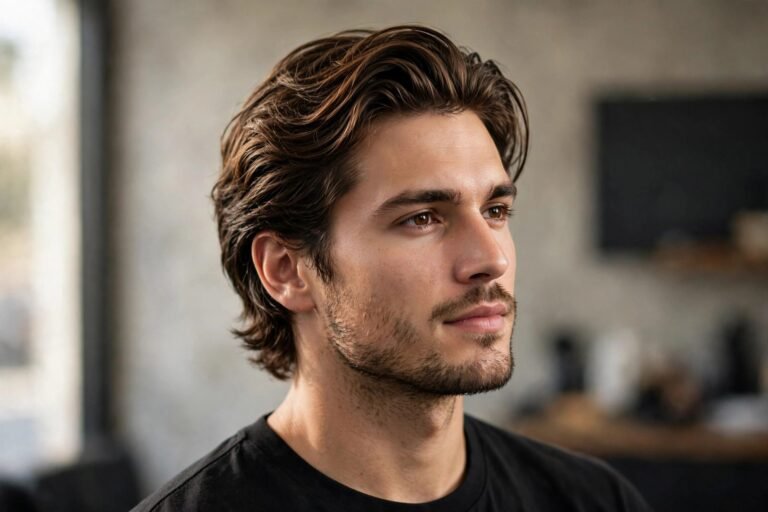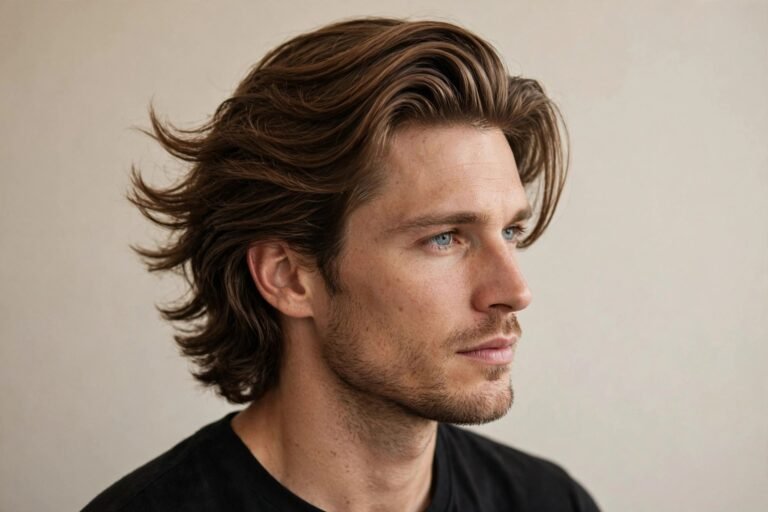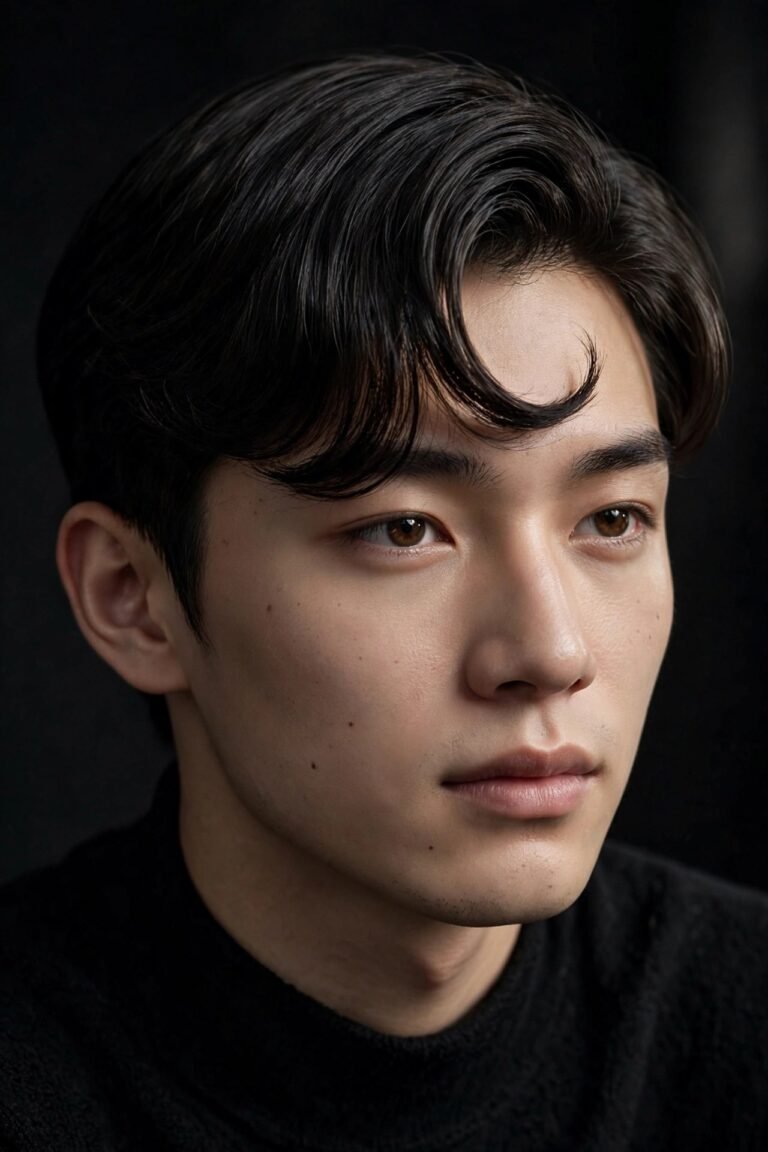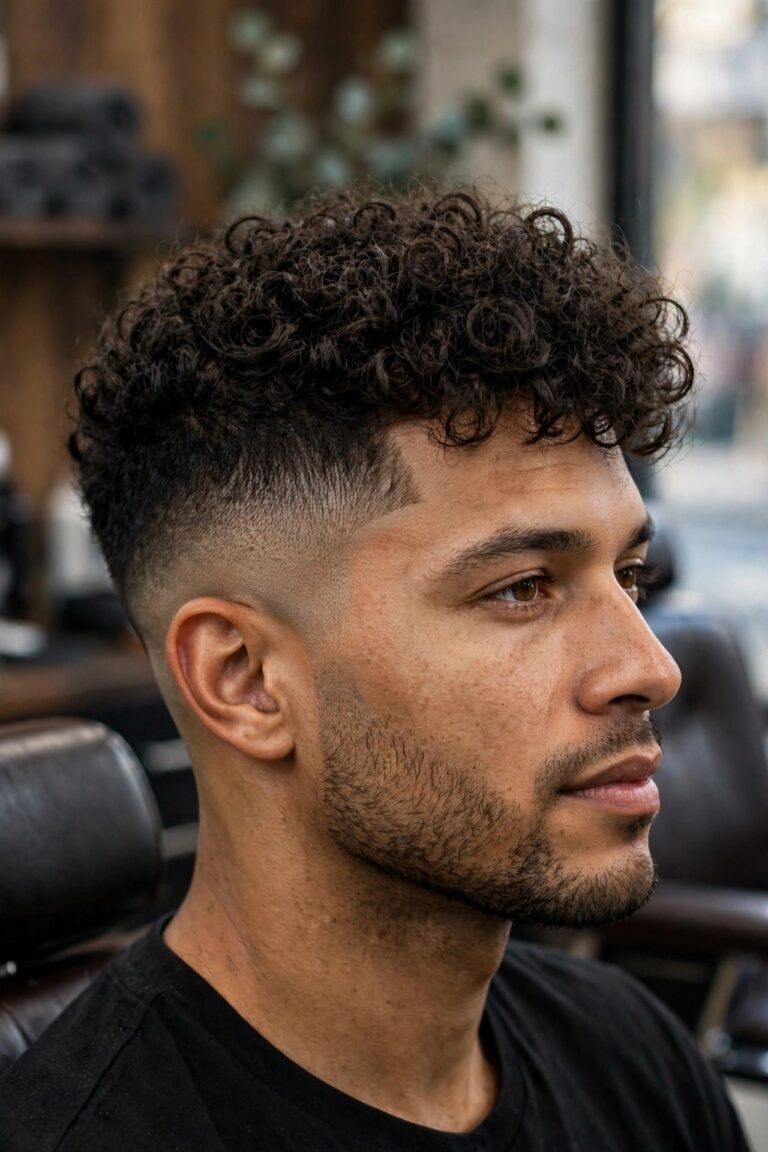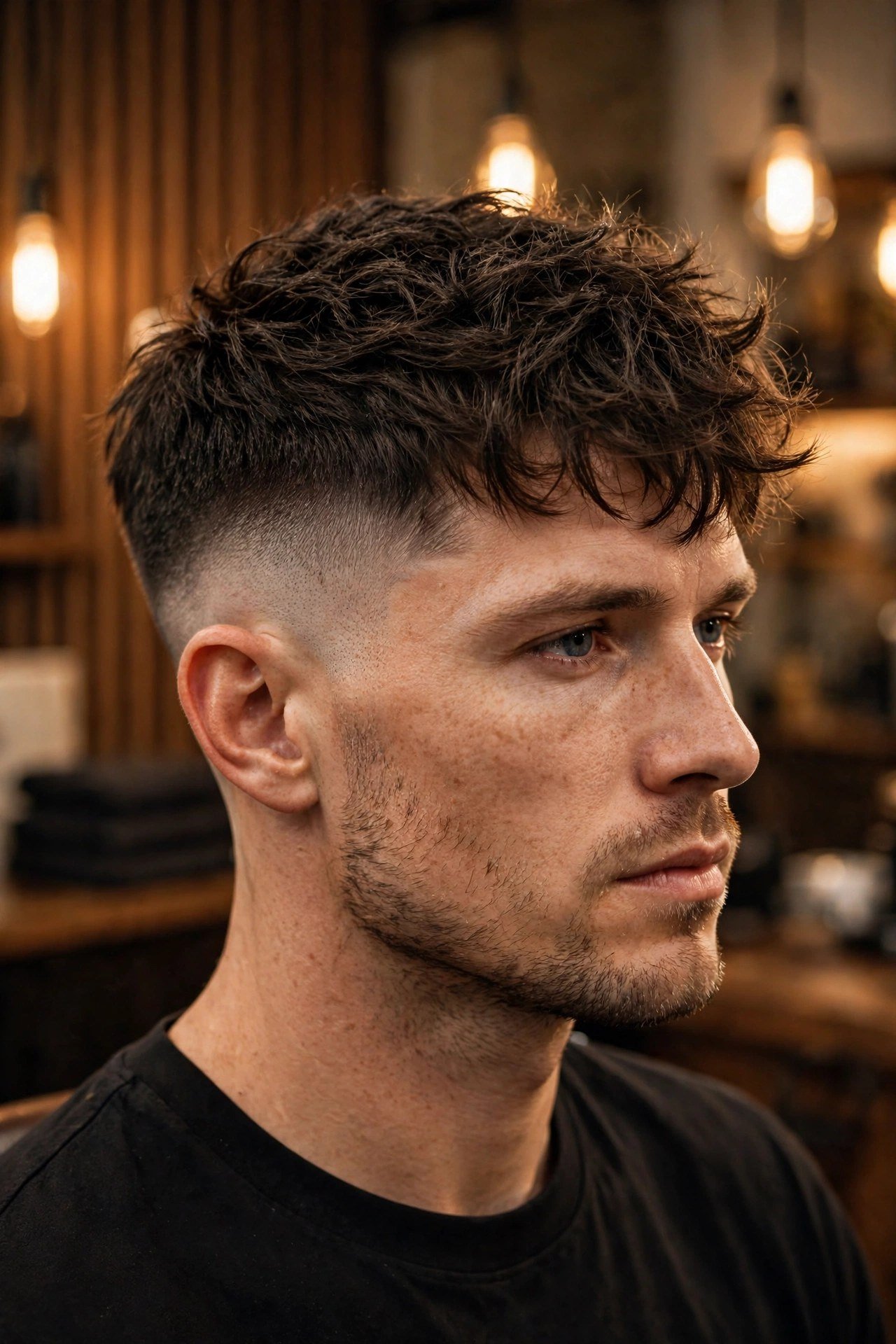
Shadow Fade Men 2026: 16 Subtle Gradient Styles
There’s a fade that doesn’t announce itself when you walk into the room. No bald strip above the ear. No hard line where the haircut starts and ends. Just a soft, melting gradient that goes from the longer top down into a dark whisper of hair at the sides — like the whole cut was drawn with a charcoal pencil instead of a razor. That’s the shadow fade, and if your skin fade keeps looking rough by week two, this is the cut you should have been getting all along.
I’ve been cutting hair long enough to watch fades cycle through their eras. The high skin fade had its loud years. The burst fade had its moment. But the guys who come back to my chair the most consistently — the ones who look sharp every single time without living in the barbershop — are the shadow fade guys. There’s a reason for that. A shadow fade is the only fade that forgives you for being busy.
Here’s the honest truth about fades in 2026: the aggressive stuff is aging out. Office dress codes, client-facing jobs, wedding season, family photos — most men need a cut that looks deliberate on day one and still looks respectable on day eighteen. The shadow fade men are asking for this year is exactly that cut. It sits in the sweet spot between a clean taper and a proper fade, and it grows out like it was designed to, because it was.
So this guide covers everything. What a shadow fade actually is (and what it isn’t), the honest difference between it and a skin fade, the exact words to use in the barber’s chair so you don’t walk out with something you didn’t order, sixteen distinct shadow fade styles grouped by the top they pair with, how to style and maintain the cut at home, and the questions I hear about this fade more than any other. By the end, you’ll know whether this is your cut — and if it is, you’ll know exactly what to ask for.
One promise before we start: no fluff. I’m not going to tell you this fade will transform your life or that it’s perfect for everyone. It isn’t. Some guys need the sharpness of a skin fade, and I’ll tell you who those guys are. But for the majority of men with jobs, schedules, and a reasonable budget, the shadow fade is the smartest fade you can get in 2026. Let’s get into it.
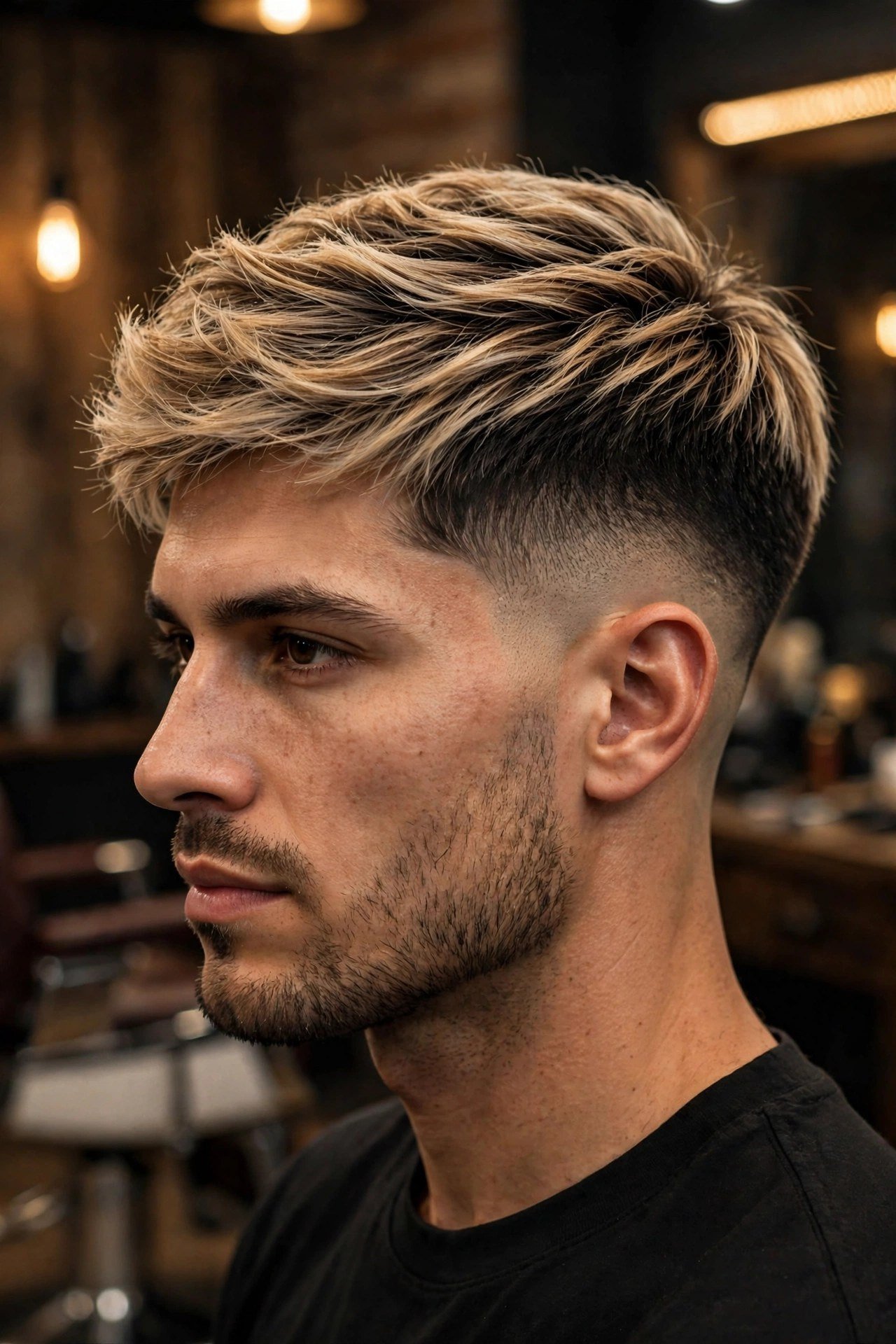
What Is a Shadow Fade, Really?
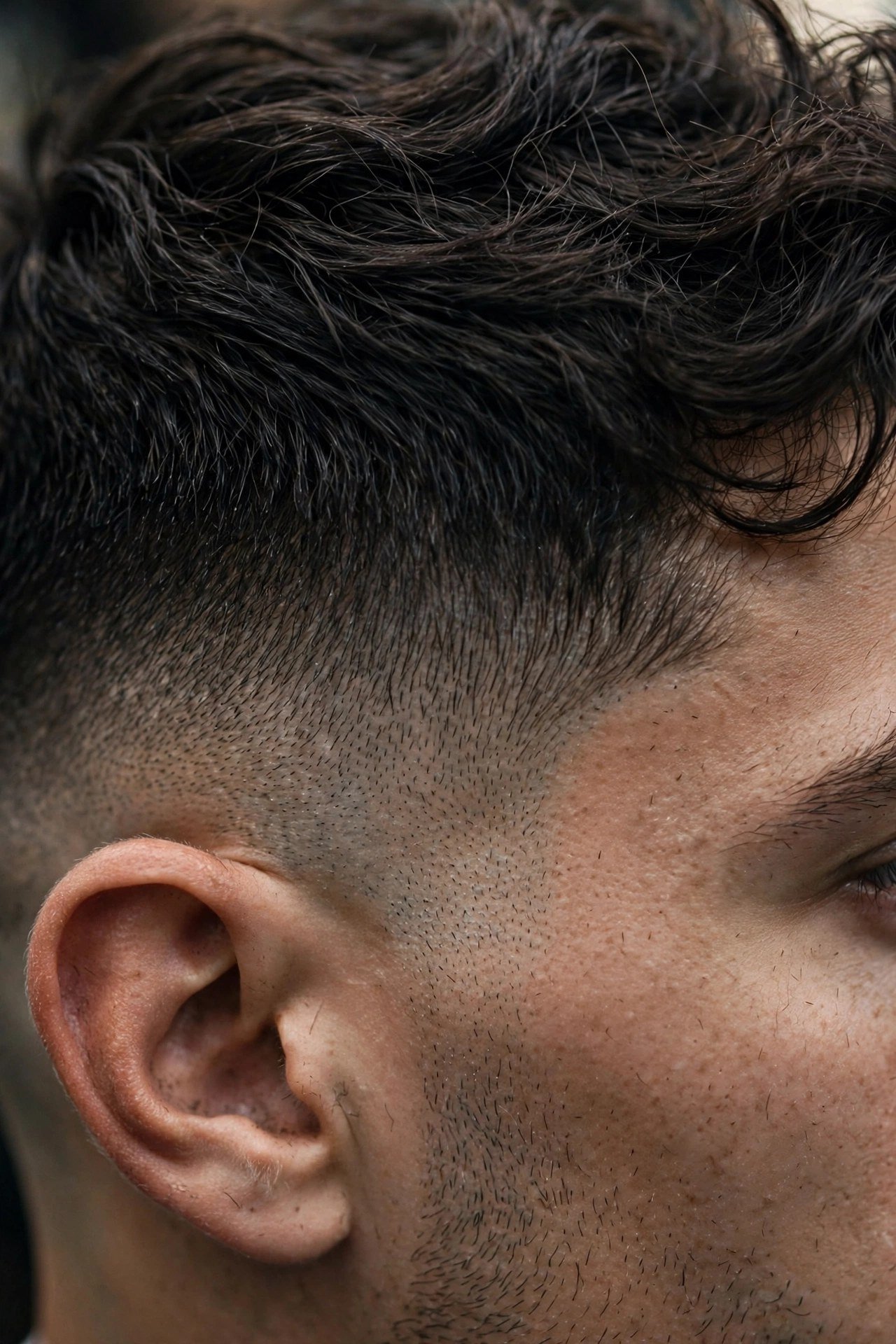
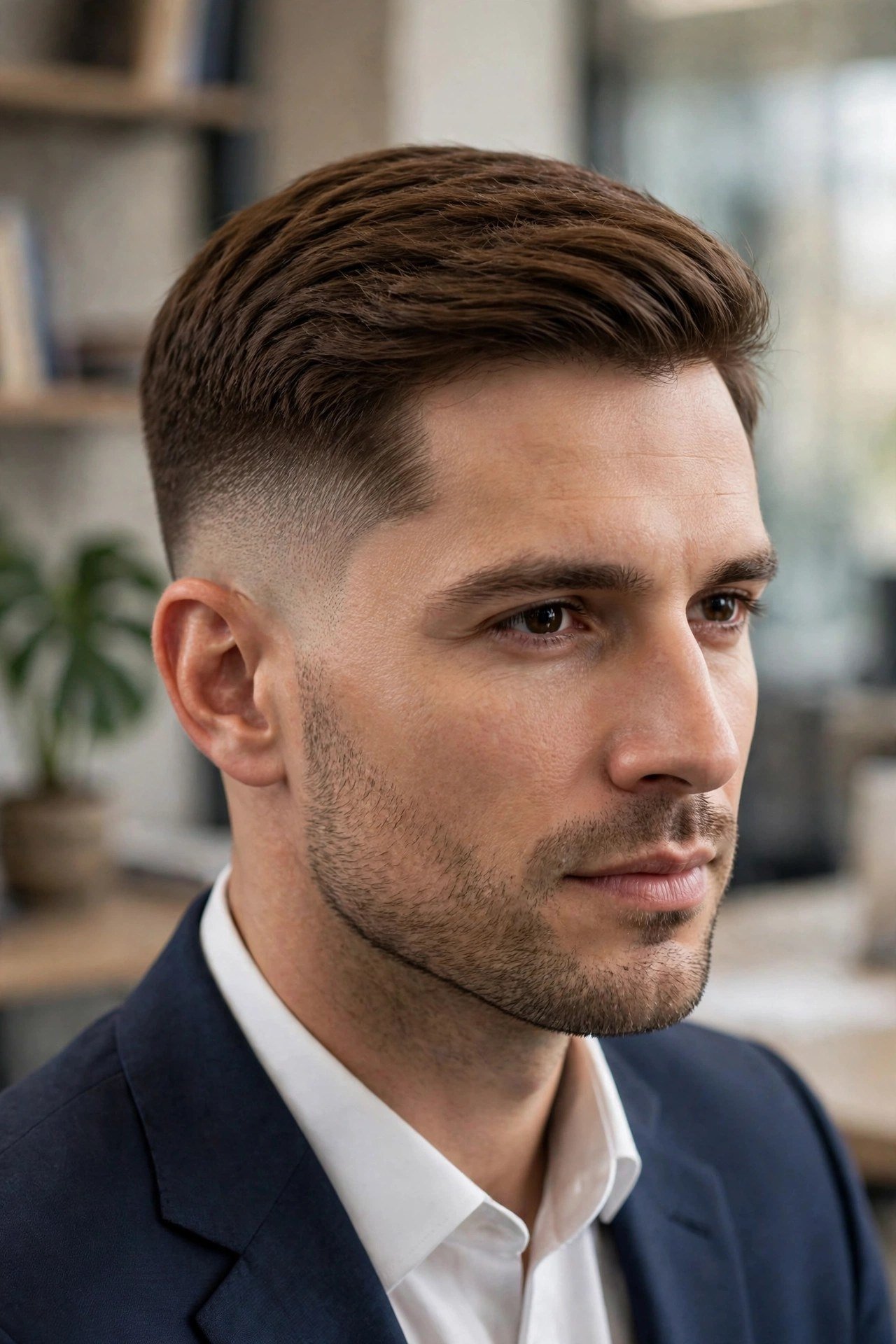
A shadow fade is a soft, low-contrast fade where the barber leaves a “shadow” of hair at the shortest point instead of taking it down to skin. Where a skin fade ends at bare scalp — a zero, foil-shaved, nothing left — the shadow fade stops at roughly a 0.5 to 1 guard. That’s about 1.5 to 3 millimeters of hair. It sounds like almost nothing, but visually it’s everything. That thin layer of stubble creates a dark, soft band that reads as shadow rather than skin, and the whole gradient melts from the longer top down into it with no harsh lines anywhere.
The key word is melt. A proper shadow fade has no visible steps, no lines of demarcation, no place where you can point and say “here’s where the fade starts.” The barber builds it by working through the guards in small increments — 1, then 0.5, sometimes a 0.75 in between — and blending each transition with the clipper-over-comb technique or a flicking motion at the lever. When it’s done right, the sides look like a photograph that fades into darkness at the edges. That’s where the name comes from. It’s a shadow, not a boundary.
Most shadow fades sit low to mid on the head. The fade typically starts just above the ear and around the temple, keeping the darkest, fullest hair higher up on the sides. This placement is part of what makes the cut so wearable. A low-starting fade with a soft bottom doesn’t reshape your head the way a high fade does. It cleans up the edges — the neckline, the sideburns, the area around the ears — without stripping the sides bare. The result looks like your hair, just better organized.
Now here’s what a shadow fade is not. It is not a low taper, though the two get confused constantly. A taper is a small, contained fade at the neckline and sideburns that leaves the sides at full length. A shadow fade runs the full gradient up the side of the head — it’s a complete fade, just a soft one. And it is definitely not a skin fade with a fancy name. If your barber takes you to skin at the bottom and calls it a shadow fade, he gave you a skin fade and hoped you wouldn’t notice. The defining feature of the shadow fade is that the shortest point still has visible hair. No skin, no shine, no bald line.
Why does this matter so much? Because that millimeter or two of hair changes everything about how the cut ages. A skin fade shows growth as contrast — dark stubble against pale skin — within about a week. The shadow fade shows growth as texture.
The sides just get slightly fuller, slightly softer, and the whole thing still reads as intentional for two to three weeks. It’s the difference between a cut that expires and a cut that matures. For a guy who can’t get to the shop every ten days, that difference is worth real money.
Shadow Fade vs Skin Fade: The Honest Difference
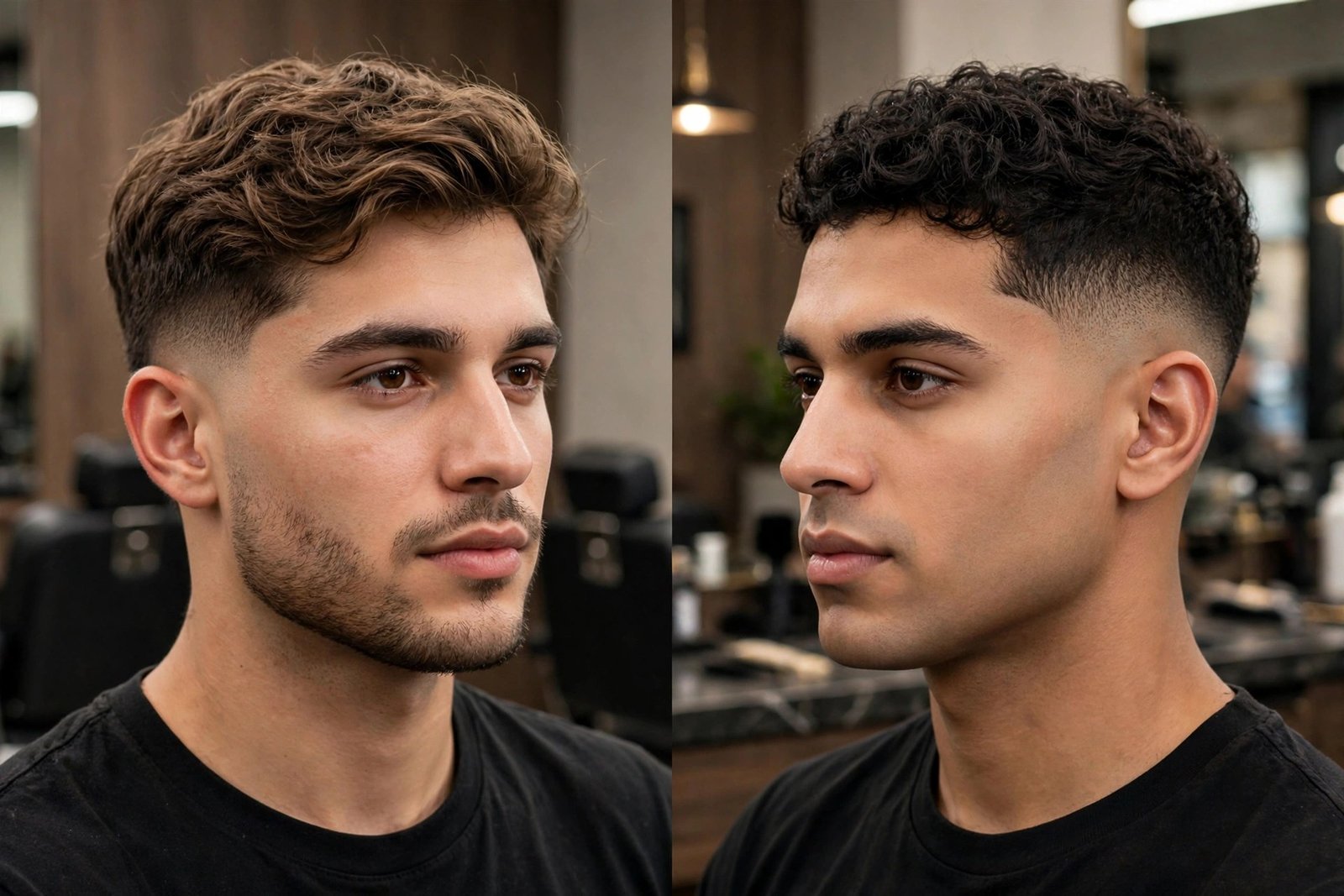
Every week some guy sits in my chair and says “give me a fade” without knowing which fade he means, and the difference between the shadow fade and the skin fade is the single most important thing to get right. So here’s the honest breakdown, no sales pitch.
The skin fade goes to zero. Bare scalp at the bottom, usually foil-shaved or shaved with a zero guard closed. The gradient runs from skin up to the top length, and the contrast is high — you can see exactly where hair ends and skin begins. It looks incredibly sharp on day one. Dramatic, clean, almost sculpted. Guys love it for events, for photos, for the first three days after the cut.
The shadow fade stops at stubble. The bottom of the fade is a 0.5 or 1 guard — visible hair, no skin showing through. The contrast is low. The gradient looks like it was airbrushed on. It’s less dramatic on day one, and that’s the point. It trades the shock value of fresh skin for something that looks good on day one and still looks good on day twenty.
Here’s where honesty matters: the skin fade is higher maintenance than almost any other cut. The bottom grows out visibly within five to seven days. The sharp line softens, the contrast fades, and by week two it can look tired. If you’re getting a skin fade, you’re committing to the shop every ten to fourteen days, or you’re comfortable with a cut that has a short shelf life. Plenty of guys are fine with that. The weekly shop visit is a ritual for some men, and there’s nothing wrong with it.
But if you’re not that guy — if your schedule is packed, if forty dollars every two weeks adds up, if you’d rather your haircut just behave — the shadow fade wins on every practical measure. It grows out gracefully because there’s no skin-to-hair contrast to break down. The regrowth blends into the existing stubble.
You can push shop visits to every three weeks, sometimes four, and nobody at work will notice you stretched it. Over a year, that’s the difference between twenty-six haircuts and fifteen. Do the math on what you pay per cut, and the shadow fade pays for itself.
There’s also the setting to consider. A fresh skin fade in a conservative office reads loud. It’s not unprofessional — plenty of professionals wear skin fades — but it’s noticeable. The shadow fade men wear to the office in 2026 reads quiet. It looks like a very good, very clean haircut. Your boss notices you look sharp; he doesn’t notice your fade. For client-facing work, interviews, weddings, and anywhere you want the attention on you rather than your haircut, the shadow fade is the safer, smarter choice.
One more difference nobody talks about: head shape forgiveness. A skin fade exposes the exact shape of your head at the sides. If you have bumps, asymmetry, or a head shape you’re not thrilled about, the skin fade puts it on display. The shadow fade’s layer of stubble softens all of that. It’s like the difference between harsh overhead lighting and a soft lamp. Same room, very different impression.
So who should get the skin fade? Guys who love the sharp look, who don’t mind frequent shop visits, who want maximum contrast and drama, and whose head shape looks good exposed. Who should get the shadow fade? Everyone else — especially guys who want a fade that works as hard on week three as it does on day one.
How to Ask Your Barber for a Shadow Fade
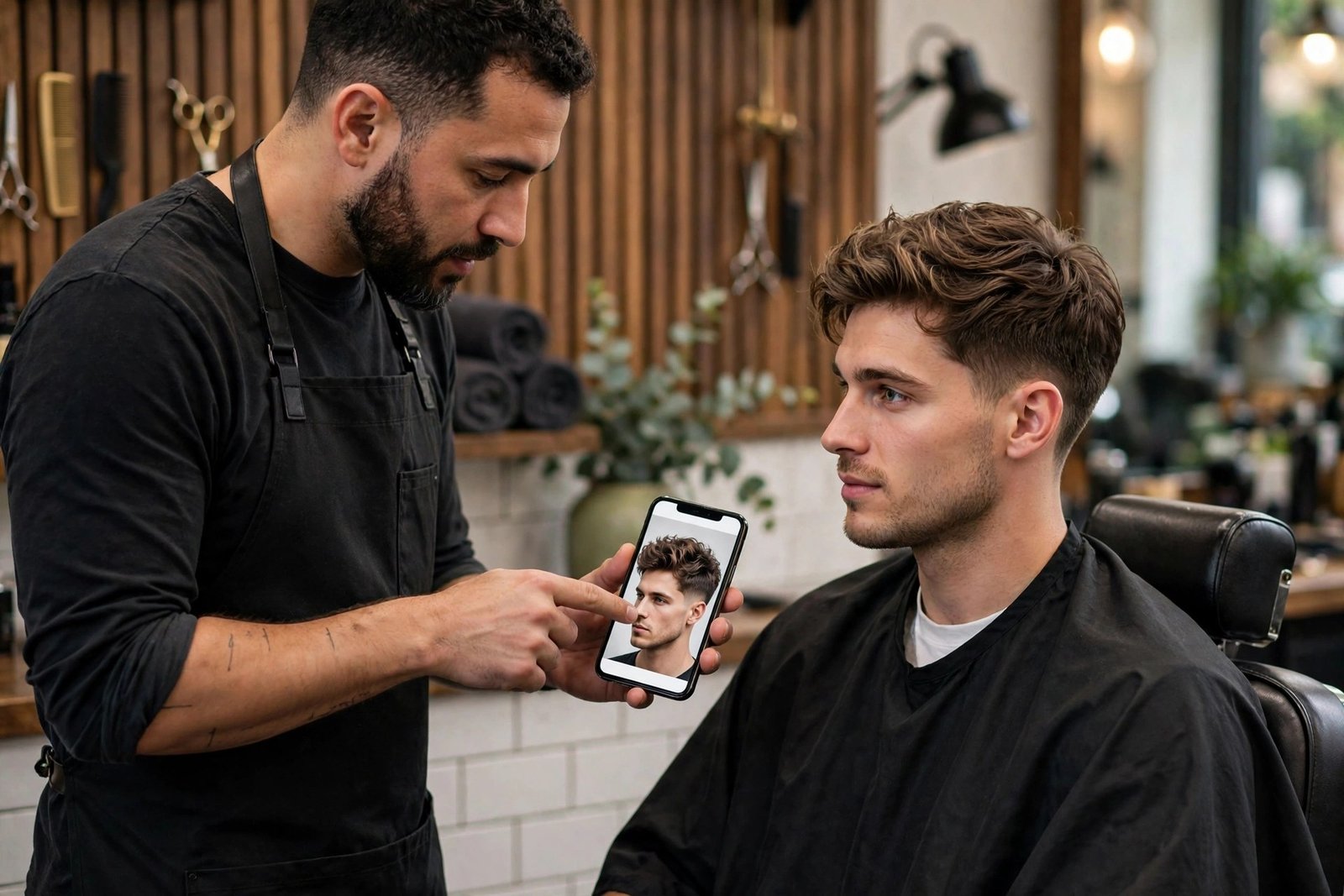
This is the section that saves you from the most common shadow fade disaster: asking for it by name and getting something else. “Shadow fade” is not a universal term. Some barbers know it cold. Some have never heard it. Some think it means a skin fade with soft blending. So don’t rely on the name alone. Here’s the exact script.
Start with this sentence: “I want a fade on the sides, but I don’t want it to go to skin — leave a shadow of hair at the bottom, like a 0.5 or a 1 guard.” That one sentence does more work than the name of the cut ever will. It tells the barber the two defining facts: it’s a full fade, and the shortest point keeps visible hair. If he nods and says “got it,” you’re in good hands. If he looks confused, show him a photo — which you should have ready regardless.
Then specify the height. “Keep it low” means the fade starts just above the ear. “Mid” means it starts around the temple. For most guys getting their first shadow fade, low is the move. It’s the most forgiving, the most professional, and the easiest to grow out. You can always go higher next time. Going too high on the first visit and hating it is a three-week sentence.
Then the top. This is where guys mess up by saying too little. The shadow fade is only the sides — the top is a separate decision. Tell your barber the top length and style: “Leave the top long enough to texture, about two inches,” or “I want a crop on top, short and forward.” The sixteen styles below give you the vocabulary for this. Pick one before you sit down.
Finally, the blend. Say the word “soft” and mean it: “Blend it soft, no hard lines.” A good barber will flick the clippers at each guard transition to erase the lines. If you want to be specific, ask for the fade to be built with half-guard steps — 1, then 0.5, with the lever used in between. That’s how the gradient gets its melt. Barbers who rush fades skip the half steps and leave visible bands. The words “take your time blending it” are worth saying out loud.
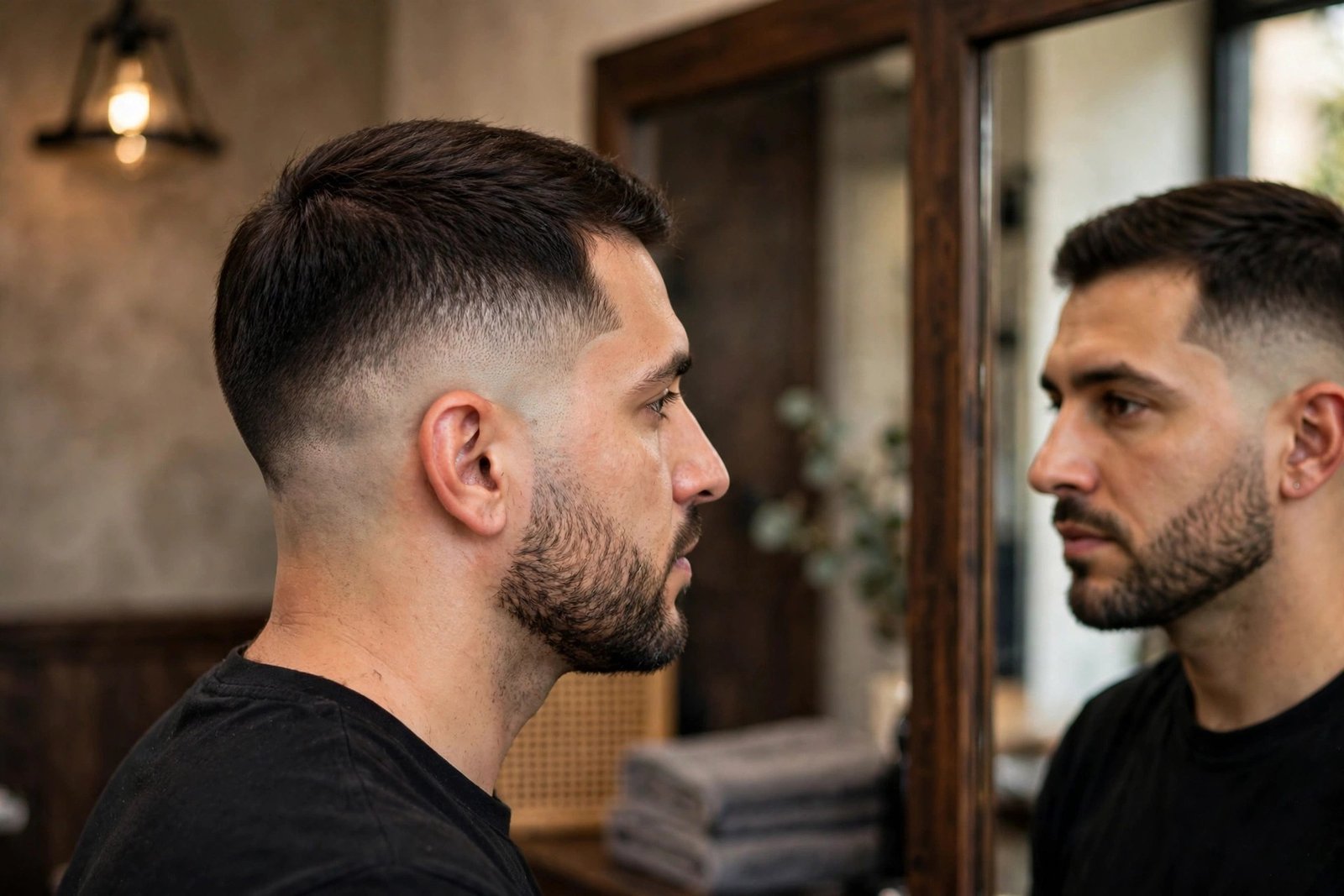
Bring reference photos. I say this about every cut and I’ll keep saying it, because a photo ends every debate. Save two or three pictures of shadow fades you like — the side view matters most, since that’s where the fade lives. Show the barber, point at the bottom of the fade, and say “see how there’s still hair there, no skin — that’s what I want.” Thirty seconds of showing beats five minutes of describing.
And one warning: if your barber reaches for the foil shaver or starts taking the bottom to skin after you asked for a shadow fade, stop him. Politely, immediately. “Hey, I wanted to keep hair at the bottom, not go to skin.” It’s your head and your money. A good barber won’t be offended — he’ll appreciate the clarity. The bad outcome is sitting quiet, watching the skin appear, and walking out with a cut you didn’t order.
Shadow Fade Styles 1–3: Textured Crop Pairings
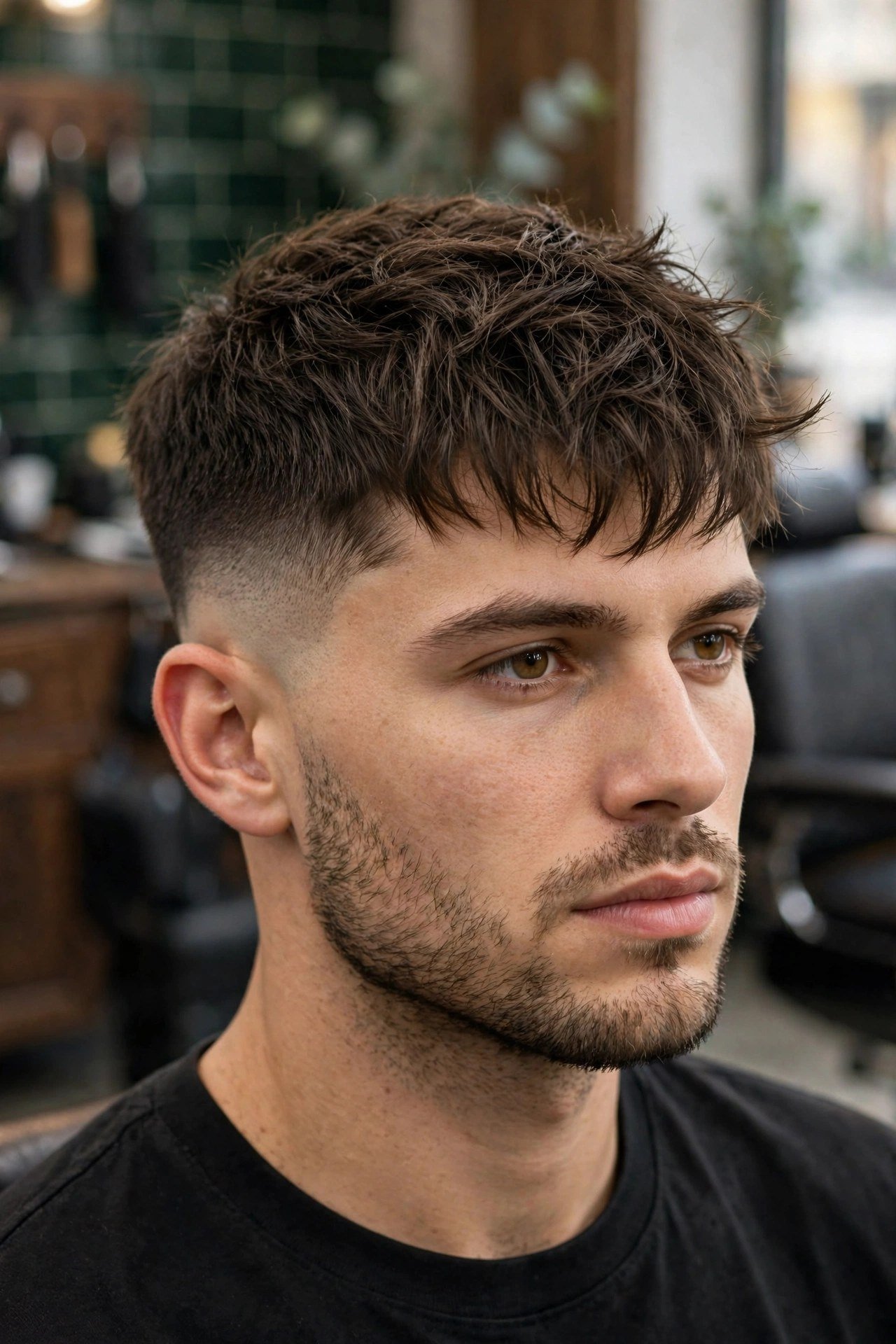
The textured crop is the shadow fade’s best friend in 2026, and it’s not close. The crop — short on top, worn forward with choppy texture — matches the fade’s whole philosophy: clean without being fussy, styled without looking styled. The shadow fade melts up into the crop’s textured top, and the two halves of the cut speak the same language. If you’re getting your first shadow fade and you don’t know what to put on top, start here.
1. Classic Textured Crop with Shadow Fade
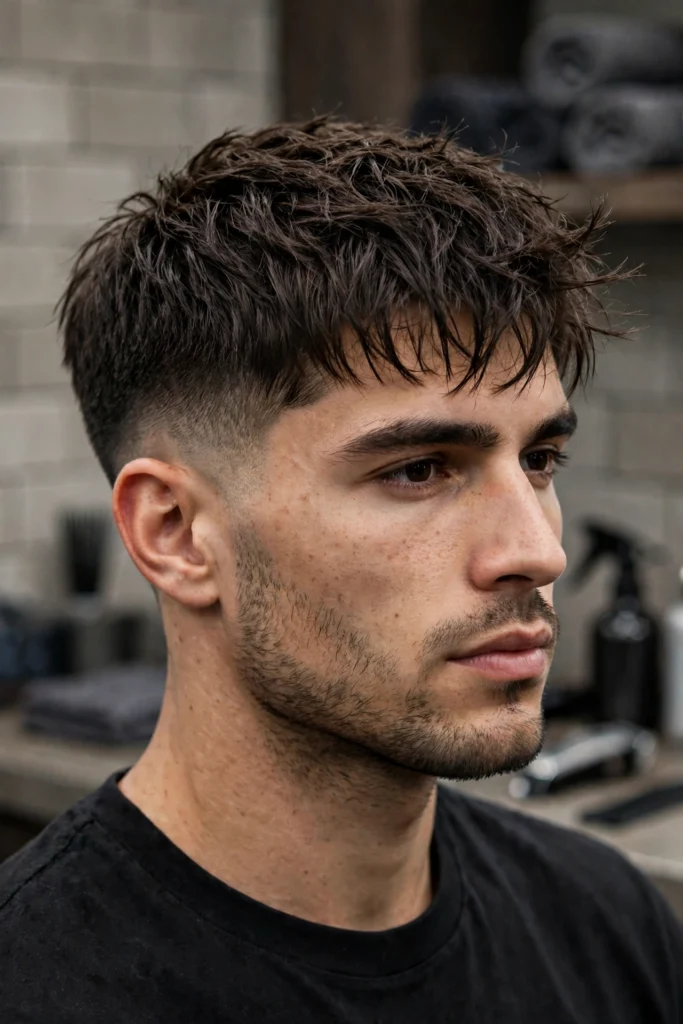
The standard. Two to three inches on top, cut with point-cutting or a razor to create separation and movement, worn forward with a matte product. The sides run a low shadow fade — 1 guard at the bottom melting up into the crop’s length. Nothing extreme anywhere. This is the cut I recommend to guys who say “just make me look good, I don’t want to think about it.”
What makes it work is the balance. The textured top has enough length to show movement and enough shortness to stay out of your face. The shadow fade keeps the sides tidy without the aggression of a skin fade. Together they read as one intentional cut rather than two ideas stapled together. It suits straight, wavy, and thick hair equally well — the texture technique adapts to whatever you’ve got.
Styling takes about ninety seconds. Towel-dry, work a pea-sized amount of matte clay through the top, push everything forward and pinch a few pieces for separation. Done. It looks better slightly imperfect, so don’t overwork it. Maintenance is a trim every three weeks: the crop’s edges soften gracefully and the shadow fade grows out without drama. This is the lowest-effort high-reward cut on this entire list.
2. Messy Textured Crop with Shadow Fade
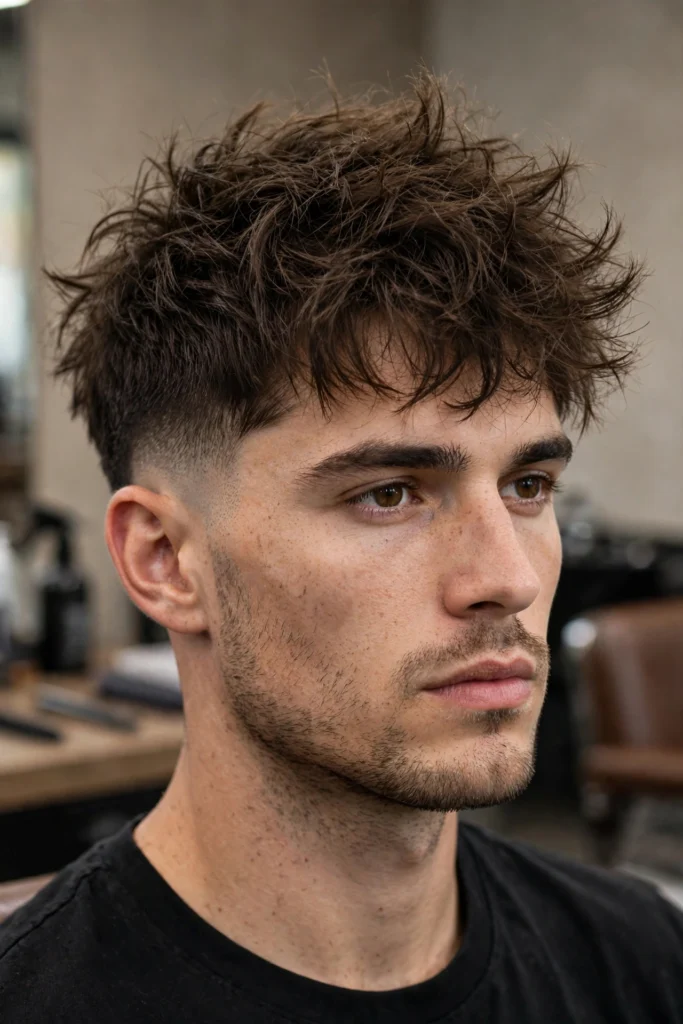
Take the classic crop and loosen it up. The top stays longer — three to four inches — and the texture gets wilder: more separation, more pieces going their own direction, a deliberately undone finish. The shadow fade underneath stays clean and controlled, which is what keeps the whole thing from looking like you just woke up. The contrast between the wild top and the disciplined sides is the entire point.
This style works best on guys with thick or wavy hair that has natural movement. If your hair wants to do interesting things on its own, this cut lets it. The barber’s job is to remove weight and create the texture; your job is to stop fighting your hair’s instincts. Guys with very fine, flat hair will struggle here — the messy crop needs some natural volume to look intentional rather than limp.
For styling, sea salt spray is your friend. Spray it into damp hair, rough-dry with your fingers, then add a small amount of matte paste and twist random sections. The goal is controlled chaos — every piece looks acidental, but the overall shape looks deliberate. Refresh the shadow fade every three weeks and get the top’s texture re-cut every four to five. Let the top grow a little wild between cuts; that’s the style working as designed.
3. French Crop with Shadow Fade
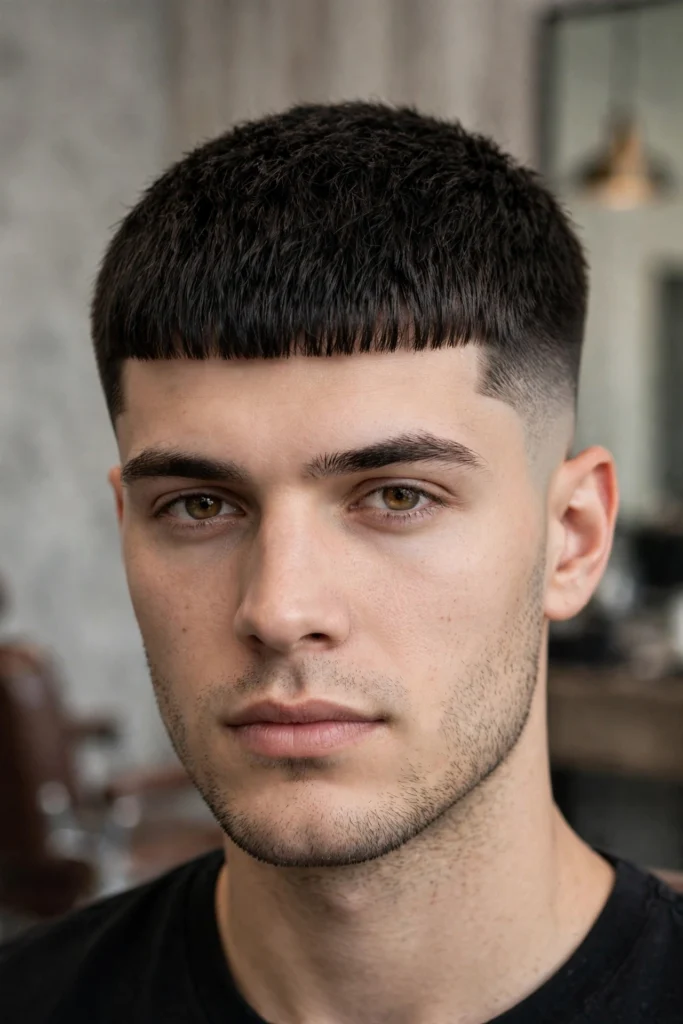
The French crop is the tidier cousin — short fringe across the forehead, blunt or slightly textured, with the top kept compact. Paired with a shadow fade, it’s one of the sharpest combinations in 2026. The straight fringe line gives the cut architecture, and the soft fade keeps the sides from competing with it. Everything about this cut says precision.
The fringe is the make-or-break detail. It should sit just above or right at the eyebrows — long enough to read as a fringe, short enough to stay out of your eyes. Your barber should cut it straight across with slight texture at the ends so it doesn’t look like a bowl cut. Tell him “blunt but not heavy” and he’ll know what you mean. The fringe also does quiet work for guys with larger foreheads or receding hairlines: it covers the hairline completely and honestly.
This is a great office cut. It’s neat, it’s contained, it photographs well, and it needs almost no daily styling — a little product pushed forward and you’re out the door. The one thing to watch is fringe trims. The fringe grows into your eyes faster than the rest of the cut grows out, so budget a quick fringe tidy at the two-week mark, or learn to trim it yourself with thinning shears. The shadow fade underneath will happily go three weeks without attention.
Shadow Fade Styles 4–6: Side Part and Comb Over Pairings
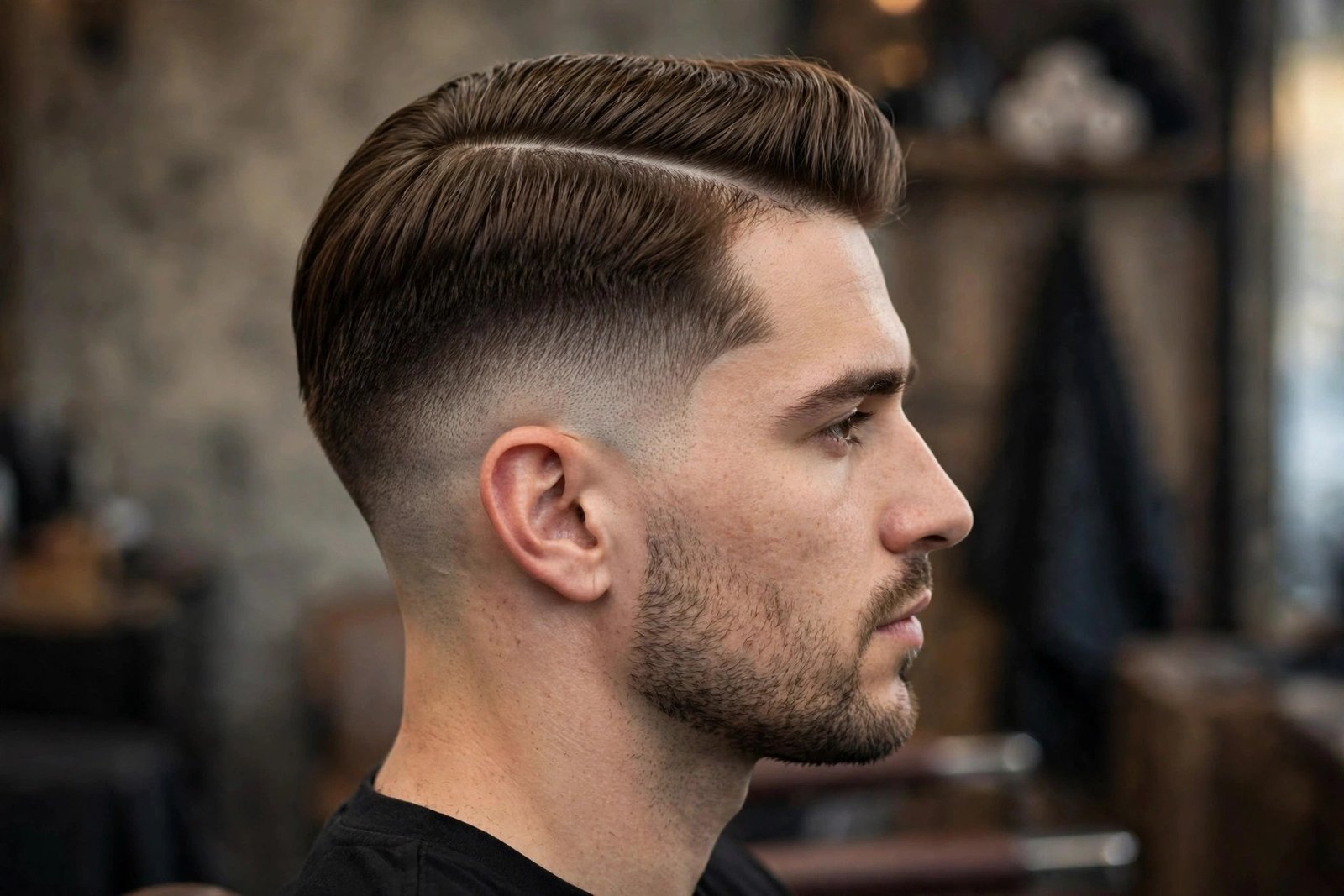
The side part never left — it just got better haircuts around it. Pairing a classic side part or comb over with a shadow fade is how you get the polish of a traditional cut with the modern edge of a fade. The shadow fade is the right fade for this job specifically because it doesn’t fight the part’s formality. A skin fade next to a side part can look like two different decades colliding. The shadow fade just looks like a very good haircut.
4. Classic Side Part with Shadow Fade
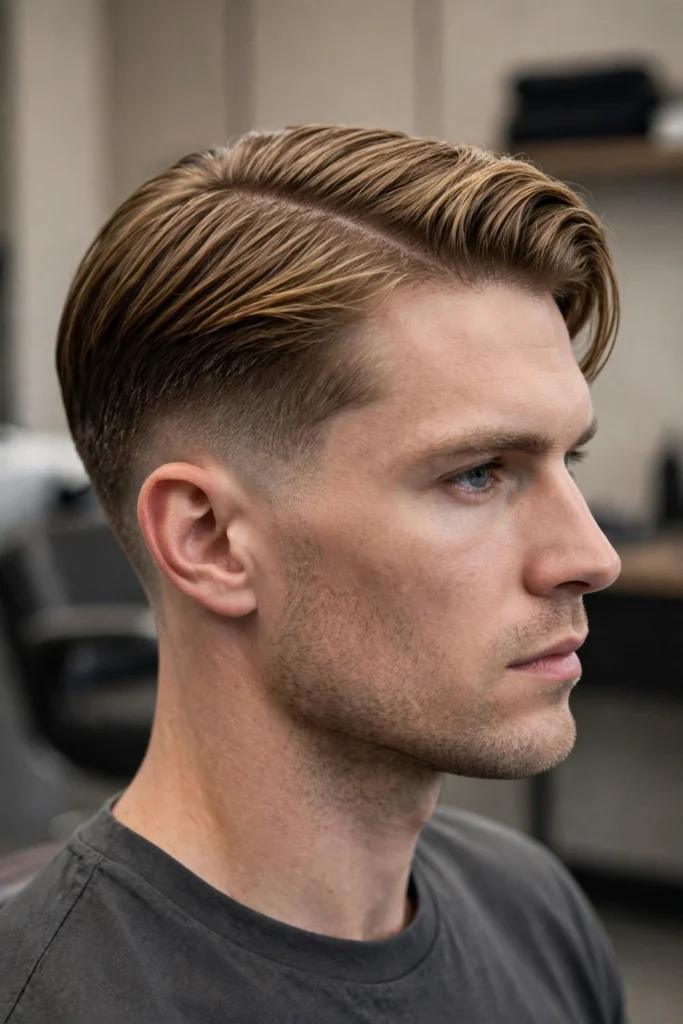
The timeless one. Hair parted on the side — find your natural part, don’t fight it — with three to four inches on top swept to the side, and a low shadow fade on the sides and back. This is the cut that works at a wedding, a job interview, and a bar on the same day. It’s been working for a century and the shadow fade just gave it a 2026 update.
The key detail is the part itself. Ask your barber to define it but not carve it — no hard part razor line unless you specifically want that extra edge. A natural part with a shadow fade looks expensive. A razor-carved hard part with a shadow fade looks like you’re trying too hard; the fade is already doing subtle work, and a hard line contradicts it. Keep the language soft: “clean part, nothing shaved in.”
Styling is straightforward but non-negotiable. Blow-dry the top to the side with a brush for volume, then finish with a medium-hold product — pomade for shine, cream for a natural finish. This cut looks unfinished without product, so don’t skip it. The good news: it holds all day once set, and the shadow fade needs nothing from you between shop visits every three weeks.
5. Comb Over with Shadow Fade
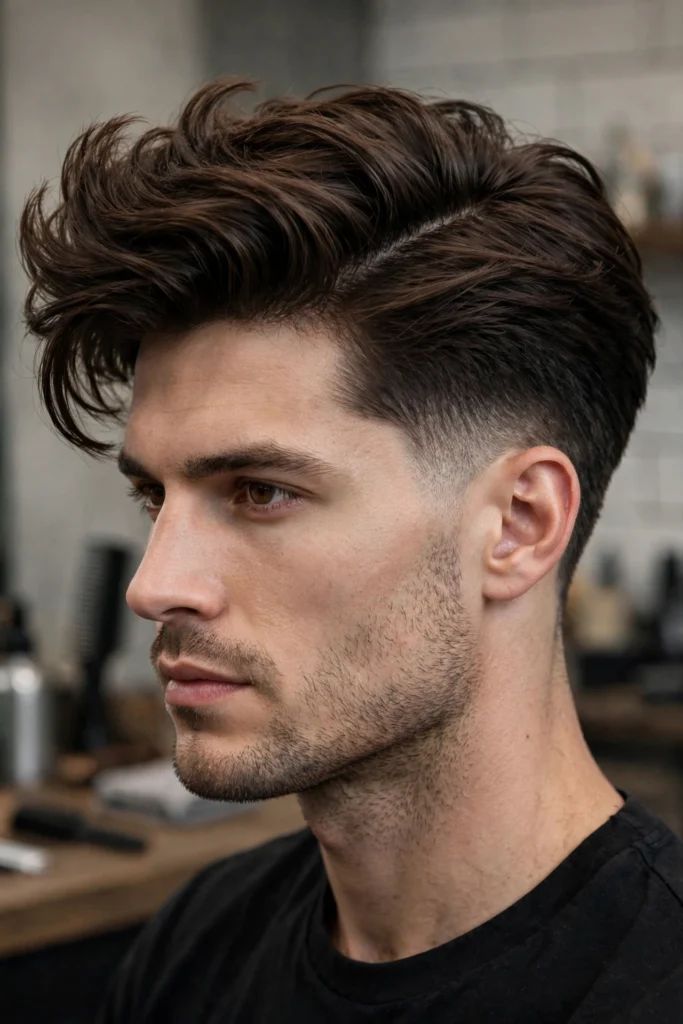
The modern comb over — not the desperate kind, the deliberate kind. Top length of four to five inches swept across from a low side part, with volume at the front, sitting over a mid shadow fade. This is a bigger, more present cut than the classic side part. It has presence. It fills a room a little.
Volume is everything here. The comb over dies flat. Your barber should layer the top to remove weight so it lifts instead of lying limp, and you need to blow-dry it with volume at the roots — lift the front up and over, don’t just paste it sideways. A pre-styler like sea salt spray or a volumizing mousse before the blow-dry makes the difference between a comb over with height and one that looks tired by noon.
Face shape matters more with this style than most. The comb over’s volume on top adds height, which flatters round and square faces but can exaggerate an already long face. If your face is oblong, keep the volume moderate and the fade lower to add width at the sides. Your barber should be thinking about this; if he’s not, find one who does. Maintenance runs three weeks for the fade, four for the top’s shape.
6. Side Sweep with Shadow Fade
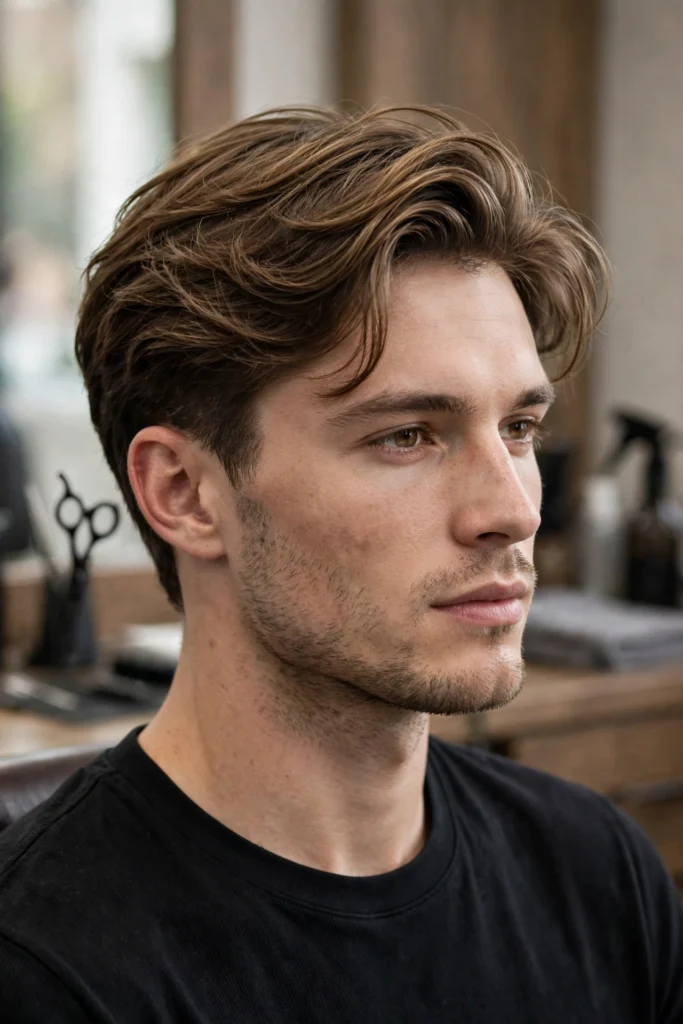
The relaxed version of the side part. No defined part line — the top just sweeps to one side with natural flow, like the wind did your styling for you. Length runs three to five inches, the sweep starts from a soft off-center point, and the shadow fade keeps the sides clean underneath. This is the side part for guys who don’t want to look like they have a side part.
This style lives or dies on hair texture. Wavy and thick hair sweeps naturally and holds the shape with minimal product. Straight fine hair will need more help — a blow-dry with direction, a light-hold cream, and acceptance that you’ll restyle it once during the day. That’s not a flaw in the cut; it’s just the honest cost of the style on that hair type. Know your hair before you commit.
The styling routine is the easiest of this group: towel-dry, a small amount of cream or light paste, push everything to your preferred side with your fingers, done. No brush, no blow-dryer required on most days. It looks best with a little natural imperfection, so resist the urge to make it neat. The shadow fade does the neat part of this cut. Your job is the easy part.
Shadow Fade Styles 7–9: Quiff, Pompadour and Faux Hawk
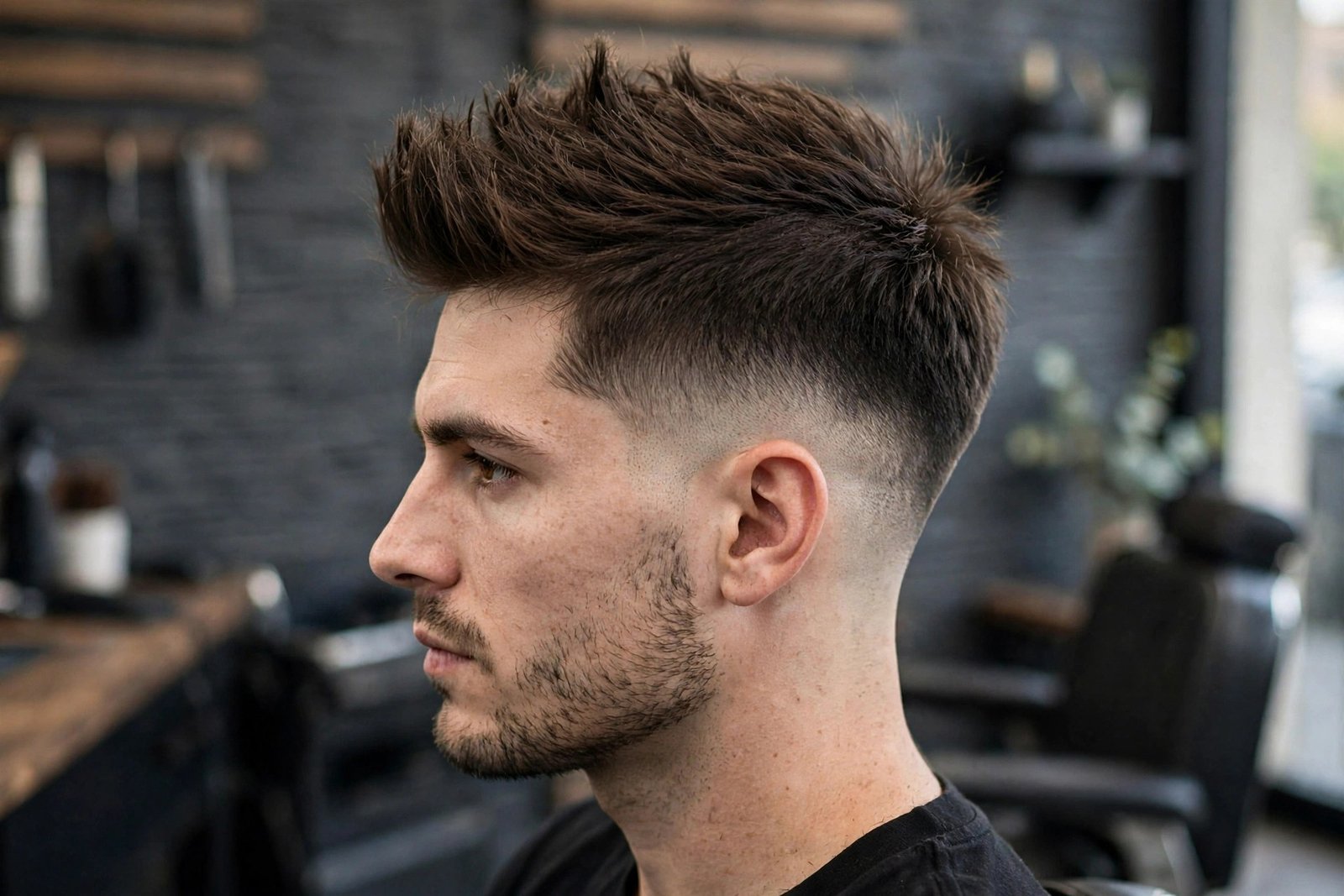
Now the volume section. Quiffs, pompadours, and faux hawks all put height and presence on top, and the shadow fade is the ideal foundation for them — it gives the cut a clean base without the stark skin contrast that can make a big top look disconnected from the sides. The gradient acts like a ramp, carrying the eye smoothly from the short sides up into the volume. These styles take more daily effort than the crops, but they pay it back in presence.
7. Textured Quiff with Shadow Fade
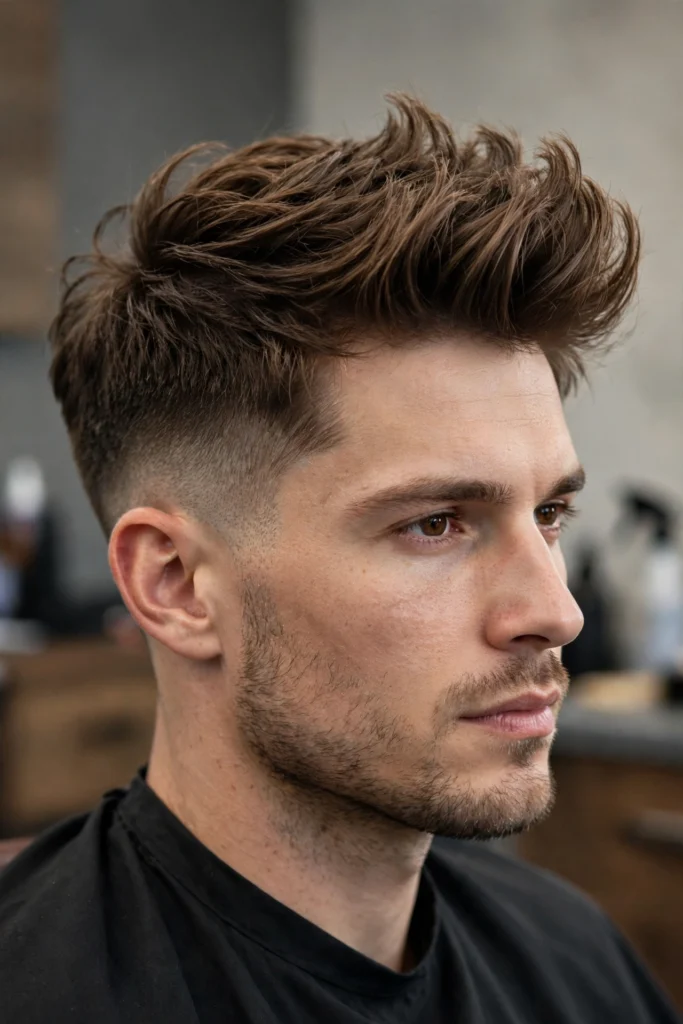
The quiff — volume swept up and back at the front — is the most requested high-volume style in shops right now, and the shadow fade version is the most wearable one. Four to five inches at the front, shorter toward the crown, with a mid shadow fade on the sides. The quiff gives you height and movement; the fade keeps everything below the volume clean and modern.
The blow-dryer is not optional here. The quiff is built with heat: dry the front up and back with a round brush or vented brush, building volume at the roots. Then lock it with a strong-hold matte product — clay or a firm paste. Guys who try to quiff with product alone end up with a flat front that collapses by lunch. Ten minutes with the dryer in the morning is the real cost of this style. Budget it honestly before you commit.
Length management matters. The quiff needs enough front length to stand up — at least three and a half inches — but if the front gets past five inches it starts flopping instead of lifting. That means the top needs shaping every three to four weeks even though the shadow fade could go longer. Tell your barber to maintain the front length and just clean up the shape; you don’t want him taking the height away in the name of tidiness.
8. Modern Pompadour with Shadow Fade
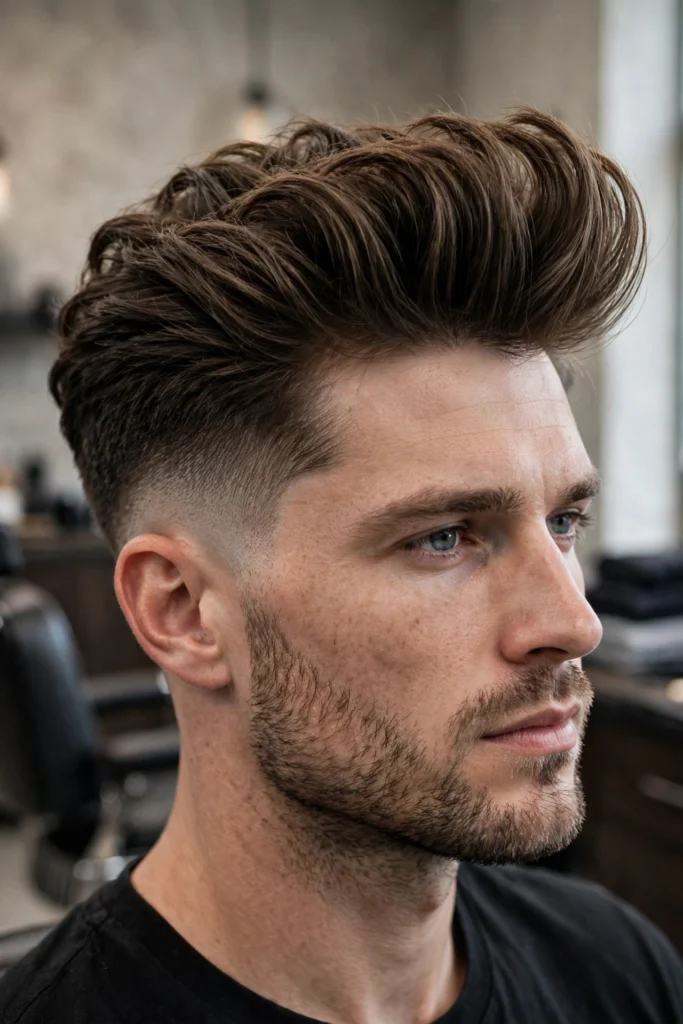
The pompadour is the quiff’s bolder older brother — more volume, more sweep, more commitment. The modern version keeps it textured rather than slicked: volume swept up and back with visible separation instead of the greased 1950s shell. Over a shadow fade, the modern pomp looks current rather than costume. The soft fade stops the whole thing from reading retro.
This is a big-hair cut and it knows it. You need density — thick hair, or at least medium hair with some body. Fine thin hair can’t hold a pompadour’s structure; it’ll look like a wish rather than a style. Your barber should be honest with you about this in the consultation. If he tries to build a pomp on hair that can’t support it, he’s selling you a cut, not giving you one.
Styling follows the quiff playbook turned up: blow-dry up and back with serious root lift, pre-styler for grip, then a strong-hold product with a matte or natural finish. The modern pomp should move a little when you shake your head — if it’s helmet-solid, you’ve used too much product or the wrong one. This is a fifteen-minute morning. It’s a statement cut and it asks for statement effort. On the right guy, with the right hair, nothing on this list looks better.
9. Faux Hawk with Shadow Fade
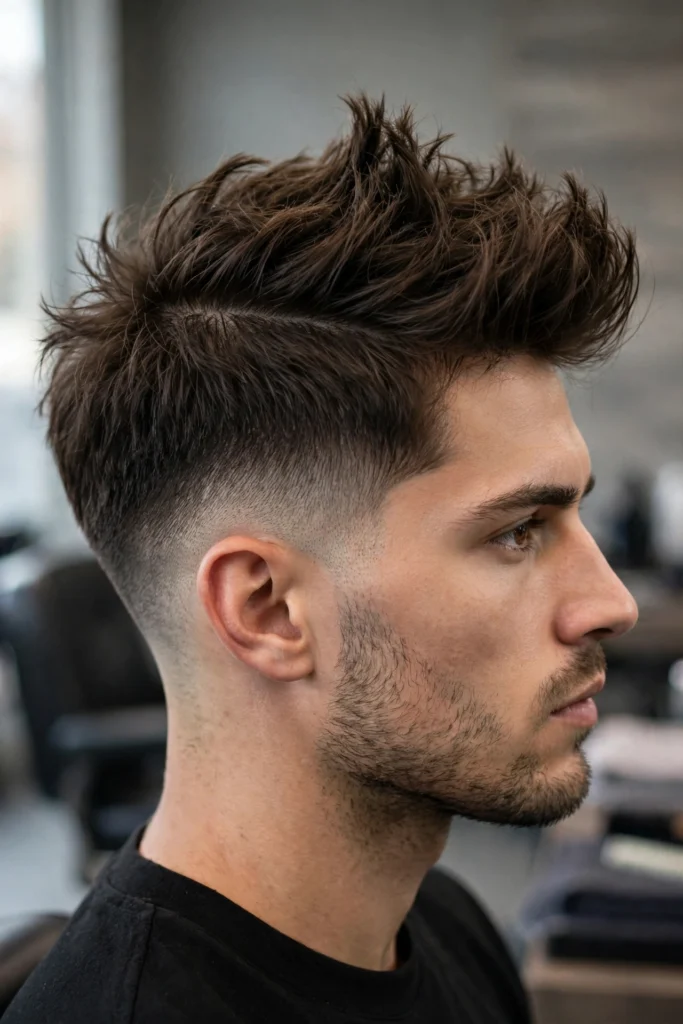
The faux hawk — hair pushed up to a central ridge, sides faded — is the edgiest style that still works with a shadow fade’s subtlety. The shadow fade actually improves the faux hawk for most guys: a skin fade next to a faux hawk can look aggressive, almost punk, while the shadow fade’s softness keeps it stylish rather than severe. You get the shape’s energy without the attitude problem.
The ridge is the whole cut. Length runs longest at the center — three to four inches — and the barber tapers the top down toward the sides so the center stands tallest. Styling pushes everything toward the middle and up: blow-dry the center upward, then use a strong product to define the ridge. It doesn’t need to be spiky. The 2026 faux hawk is textured and a little messy at the peak, not gelled into points.
Here’s the practical note: the faux hawk is the highest-maintenance style in this group for daily styling, but the shadow fade underneath is the lowest-maintenance fade you can pair it with. That balance matters. You’re already spending ten minutes on the top each morning; you don’t want a fade that also demands weekly attention. The shadow fade lets you put all your effort where it shows — on the ridge — and ignore the sides for three weeks.
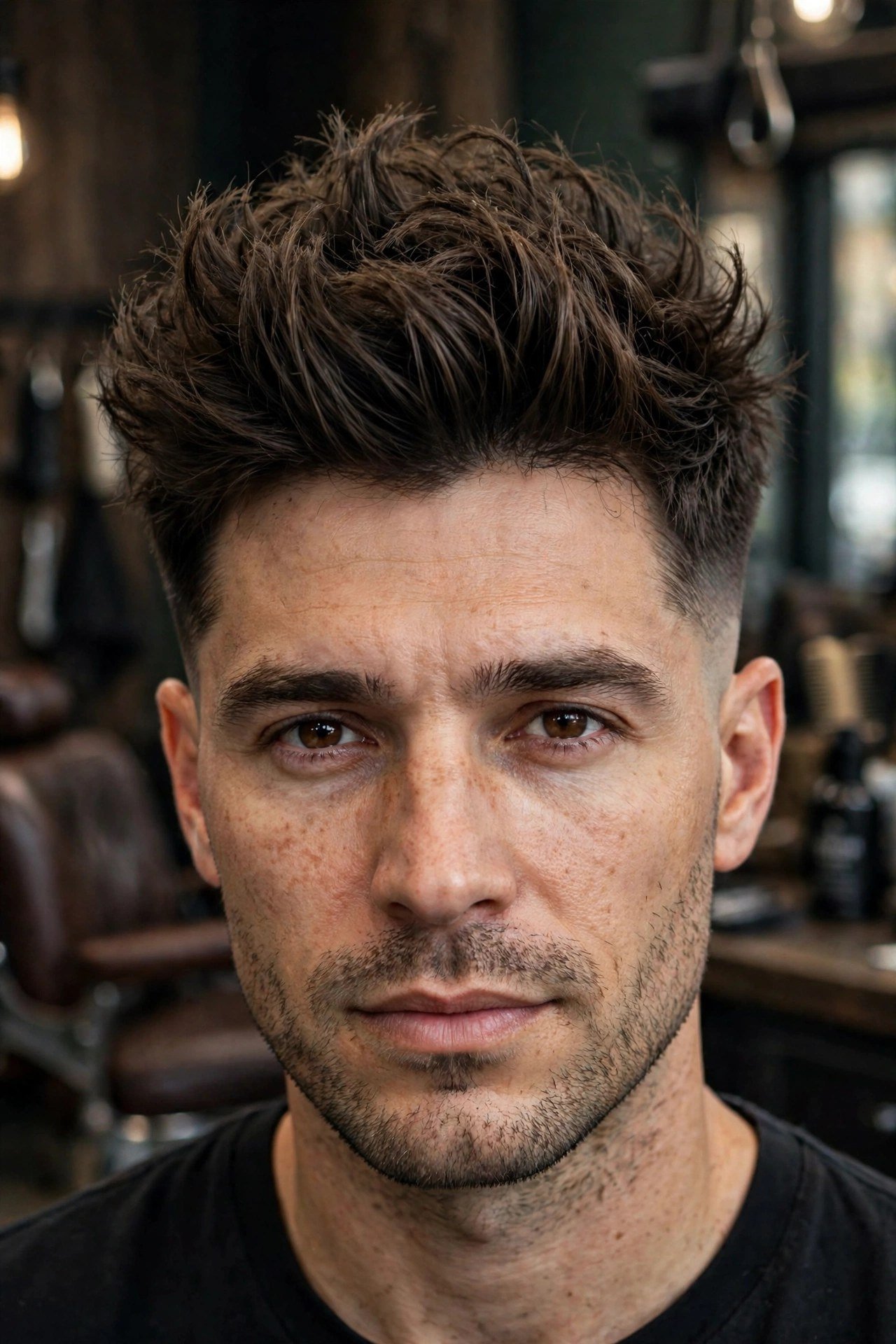
Shadow Fade Styles 10–12: Curly and Wavy Pairings
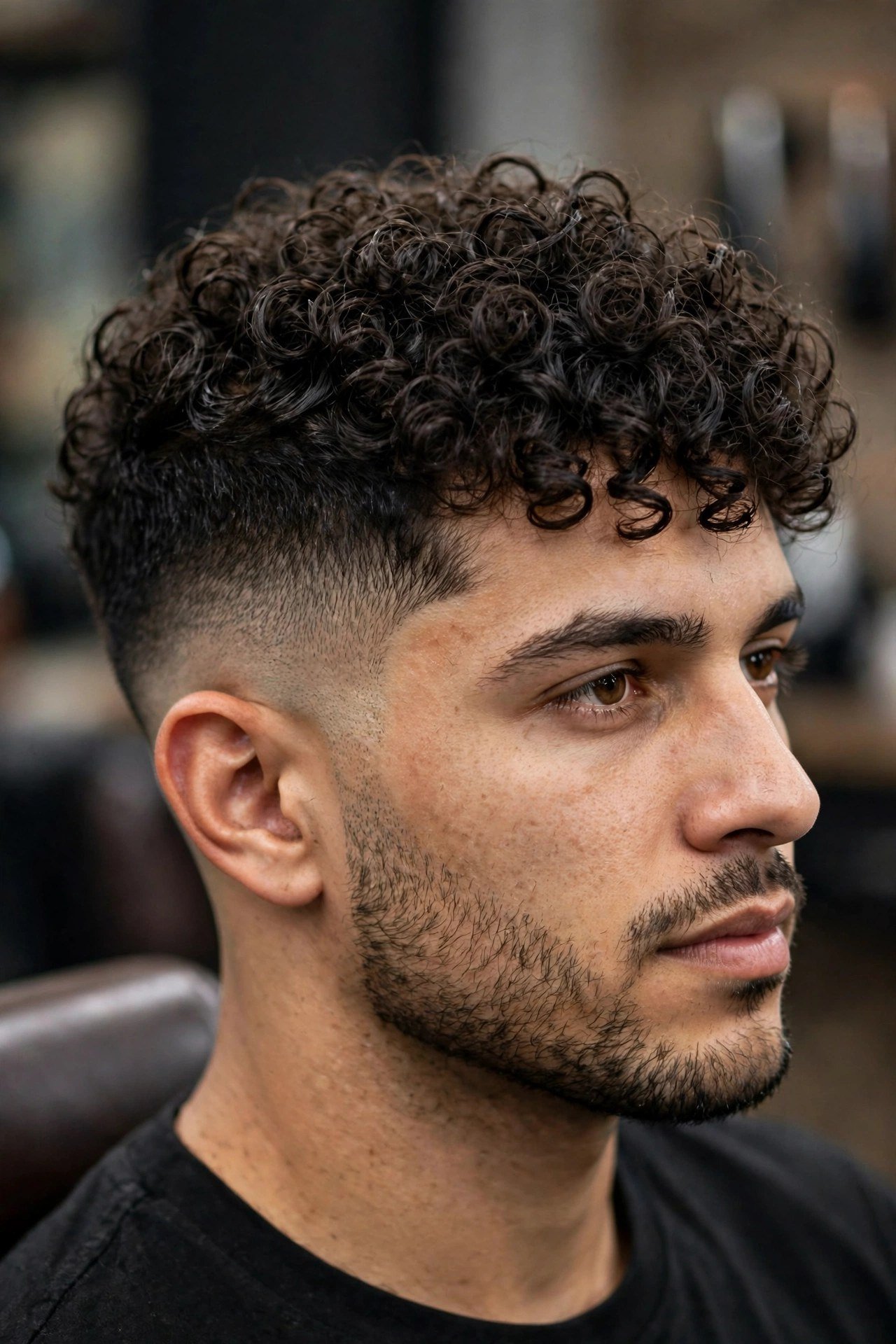
Curly hair and shadow fades are a natural match, and it’s a shame more curly guys don’t know it. The shadow fade’s softness complements curl texture instead of fighting it — there’s no harsh skin line cutting against the curls’ organic shape. The fade just quietly recedes while the curls do the talking. If you’ve got curls or waves and you’ve been getting skin fades, try the shadow version once. You’ll see the difference immediately.
10. Short Curls with Shadow Fade
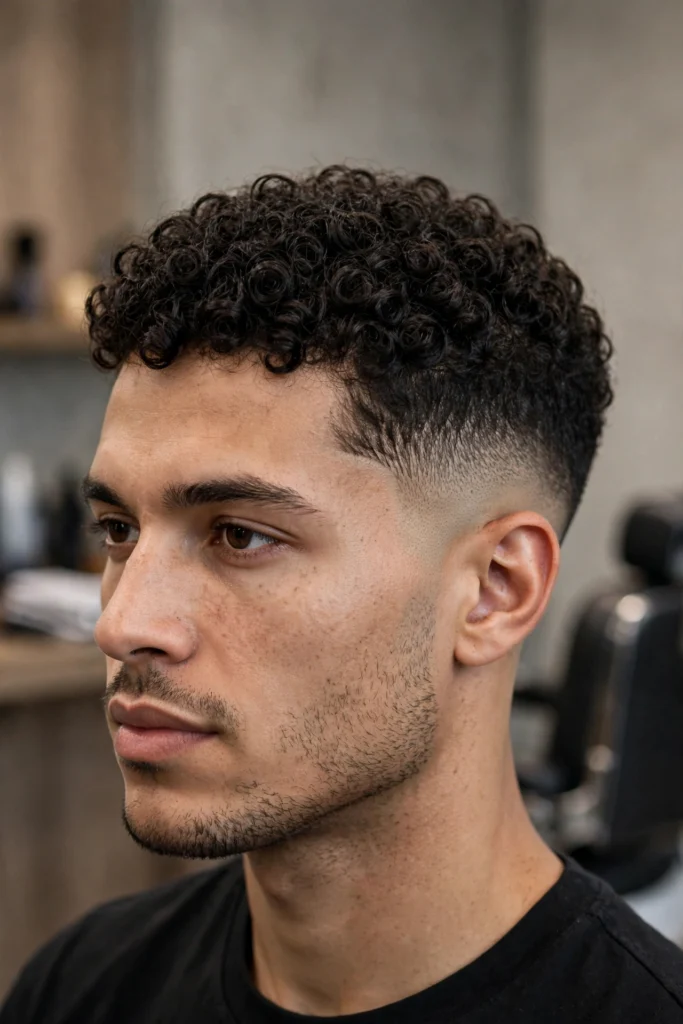
Tight curls kept short on top — one to two inches of curl — over a low shadow fade. This is the cleanest way to wear curls in 2026. The short curl length keeps the texture defined and manageable, and the shadow fade cleans up the sides without exposing the scalp the way a skin fade would. The whole cut looks neat from every angle, which is not something every curly cut can claim.
The barber’s technique matters here. Curls should be cut dry or with minimal tension, because wet curls spring up shorter than they look and an overconfident barber can take off twice what he meant to. Tell him to cut the curls with the grain of the texture and leave the shape rounded, not flat. The shadow fade underneath is standard clipper work — the artistry is all in the top.
Daily routine is simple: curl cream or leave-in conditioner on damp hair, scrunch, and go. Short curls don’t need diffusing or elaborate routines — the length does the work. Refresh the fade every three weeks and get the curls shaped every four to five. This is one of the easiest styles on the list to live with, and it looks better than most of the high-effort ones.
11. Curly Top with Shadow Fade
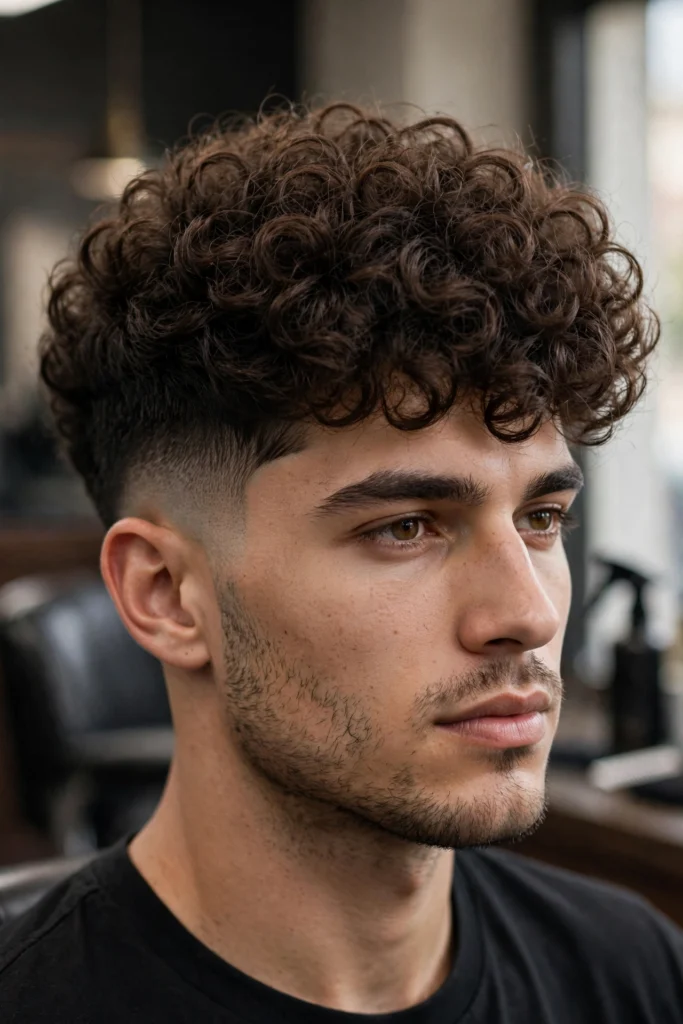
More length, more curl, more presence. Three to five inches of curls on top — defined, shaped, with real volume — over a mid shadow fade. This is the style for guys whose curls are their best feature and who want a cut that shows them off instead of taming them. The shadow fade’s job is to frame the curls, not compete with them.
Shape is everything. Unshaped long curls over a fade can look like two different haircuts, so the barber needs to sculpt the curl mass into a deliberate silhouette — rounded on top, tapering into the fade at the sides. Ask for the curls to be “shaped into the fade” and point at the transition zone. That blend area, where curl meets gradient, is where this cut succeeds or fails.
Product-wise, this is a curl-cream-and-diffuser situation if you want definition, or a wash-and-go with leave-in if you prefer the natural look. Either way, don’t let the curls dry out — dry curls frizz, and frizz ruins the clean contrast with the fade. A weekly deep condition keeps the texture healthy. Trim the curls every five to six weeks to maintain the shape; the shadow fade will need its three-week refresh on its own schedule.
12. Wavy Top with Shadow Fade
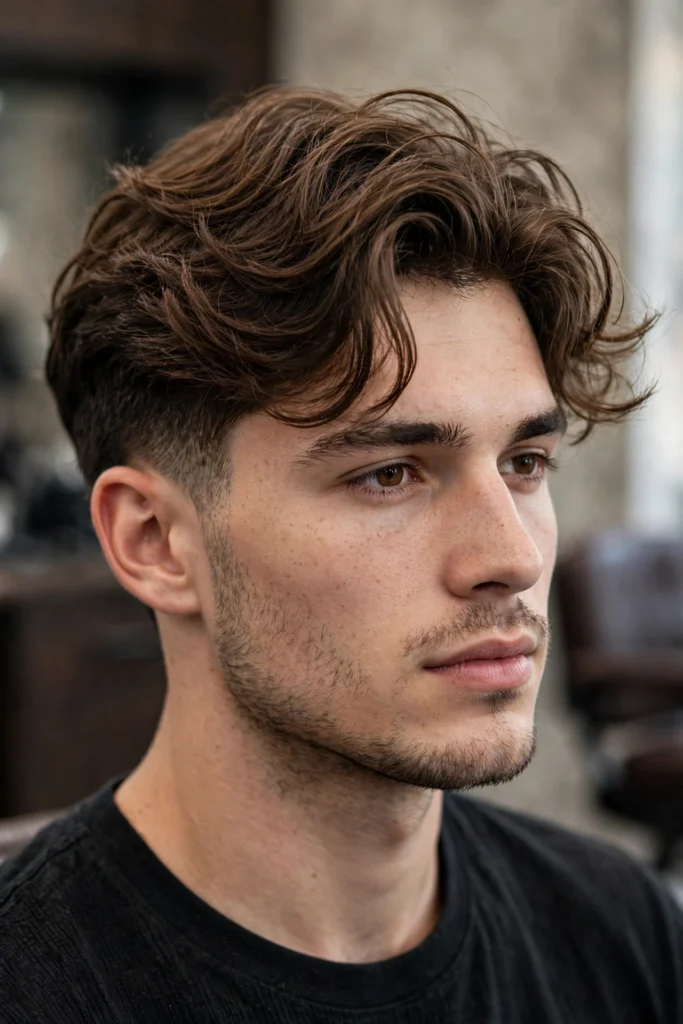
The middle ground between straight and curly. Loose waves, two to four inches, worn with natural movement over a low shadow fade. This is an effortlessly good-looking cut — the waves give the top texture and flow, the fade keeps the sides sharp, and the whole thing looks like you have great hair without trying. (You will be trying a little. That’s fine.)
The cut should enhance the wave pattern, not fight it. Your barber should cut with the waves’ natural direction — layers that follow the movement rather than cutting against it. Tell him you want to wear it wavy and let him see your hair’s natural behavior before he starts cutting. A barber who cuts wavy hair the same way he cuts straight hair will give you a cut that only looks right when it’s blow-dried straight. You don’t want that.
Styling is light: sea salt spray on damp hair, scrunch, air-dry or diffuse. A tiny amount of cream on the ends if they frizz. The waves should look touchable, not product-heavy. This is a genuinely low-effort style — five minutes most mornings — and the shadow fade underneath stretches to three or four weeks easily. For guys with natural wave, this might be the best effort-to-result ratio on the entire list.
Shadow Fade Styles 13–14: Short and Sharp
Not every guy wants length on top. Some want the whole cut short, clean, and out of the way — and the shadow fade is arguably at its best in short configurations. When the top is short, the fade’s softness becomes the star of the cut. There’s no long top to distract from the gradient, so the melt itself carries the style. These are the lowest-maintenance options on the list, full stop.
13. Buzz Cut with Shadow Fade
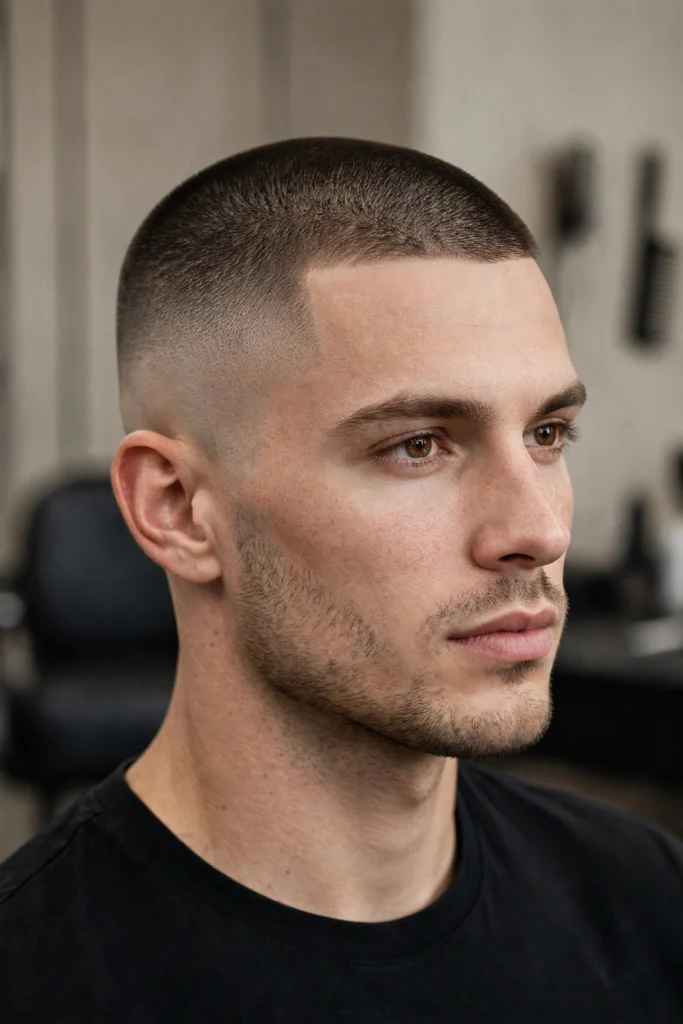
A buzz cut is usually one length all over. The shadow fade version breaks that rule in the best way: the top stays at a 3 or 4 guard, and the sides fade softly down to a 0.5 or 1. It looks like a buzz cut that went to finishing school. Same simplicity, much better shape.
This is the cut for guys who want to spend zero minutes on their hair. There’s nothing to style — it looks right straight out of the shower. It works in every setting, from the gym to the boardroom, and it suits every head shape because the fade adds structure that a uniform buzz lacks. The shadow fade’s stubble bottom also means the cut grows out evenly; a skin-faded buzz shows a harsh regrowth line within days, while this one just gets gradually fuller.
The honest trade-off: you’ll see your scalp’s shape more than with longer styles, so if you have scars or bumps you’re self-conscious about, the longer top of the other styles hides more. But for most guys, this is the ultimate practical cut. Refresh every two to three weeks — the whole cut takes fifteen minutes in the chair — and you’re done. Some guys learn to maintain the fade themselves with clippers and stretch shop visits even further.
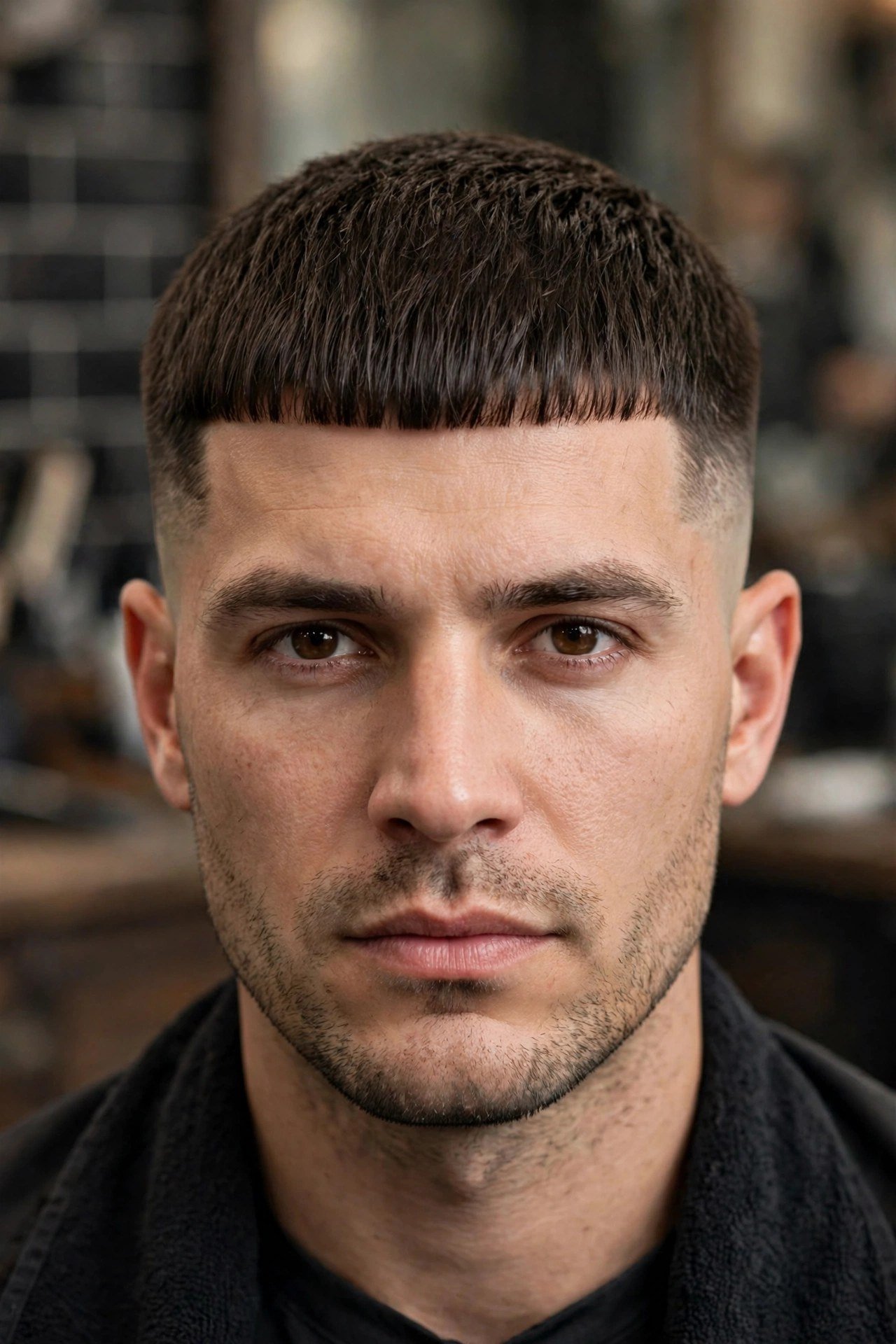
14. Short Caesar with Shadow Fade
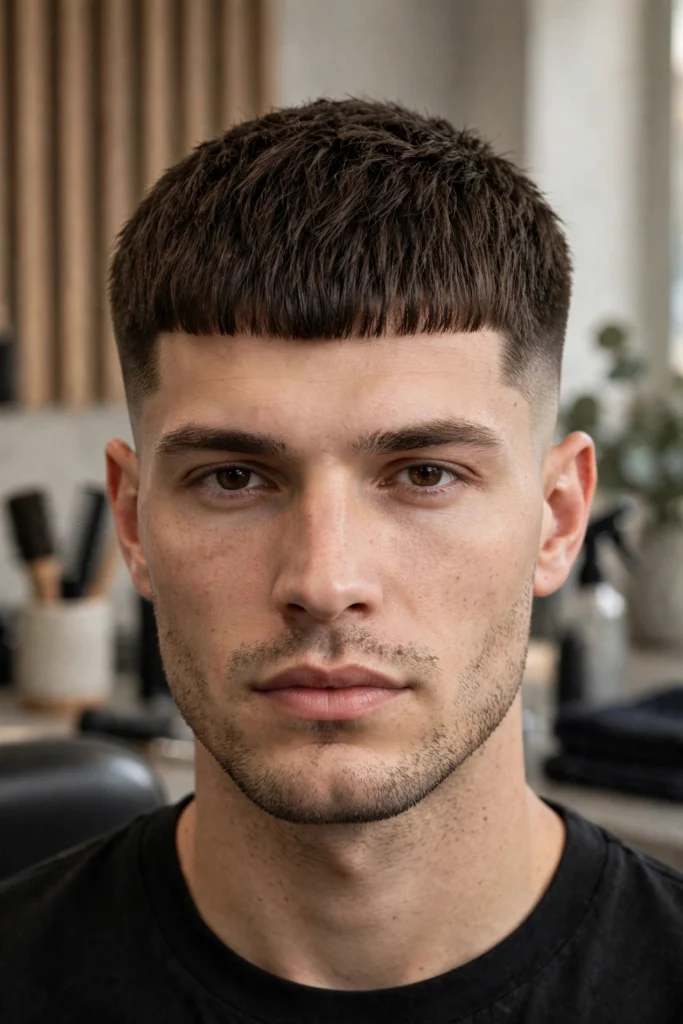
The Caesar — short all over with a straight fringe across the forehead — gets a modern update with a shadow fade on the sides. The classic Caesar’s uniform length can look flat and dated; the fade gives it dimension and a contemporary edge. The fringe stays the signature: short, straight across, sitting high on the forehead.
The fringe length is the critical detail. Too long and it reads as a bowl cut; too short and it disappears. The sweet spot is about half an inch to an inch, cut straight with slight texture so it doesn’t look stamped on. Your barber should cut the fringe after the fade, checking the balance between the two. The fringe and the fade are having a conversation in this cut — they need to be at compatible volumes.
This is another near-zero styling cut. A little product if you want the fringe to sit flat, or nothing at all. It’s particularly good for guys with thinning at the crown, because the short uniform top doesn’t try to hide anything — it just looks deliberate. And like the buzz, the shadow fade underneath grows out gracefully. Two to three weeks between cuts, no daily effort, sharp in every setting. The Caesar with a shadow fade is the quiet overachiever of this list.
Shadow Fade Styles 15–16: Beard Pairings and the Professional Cut
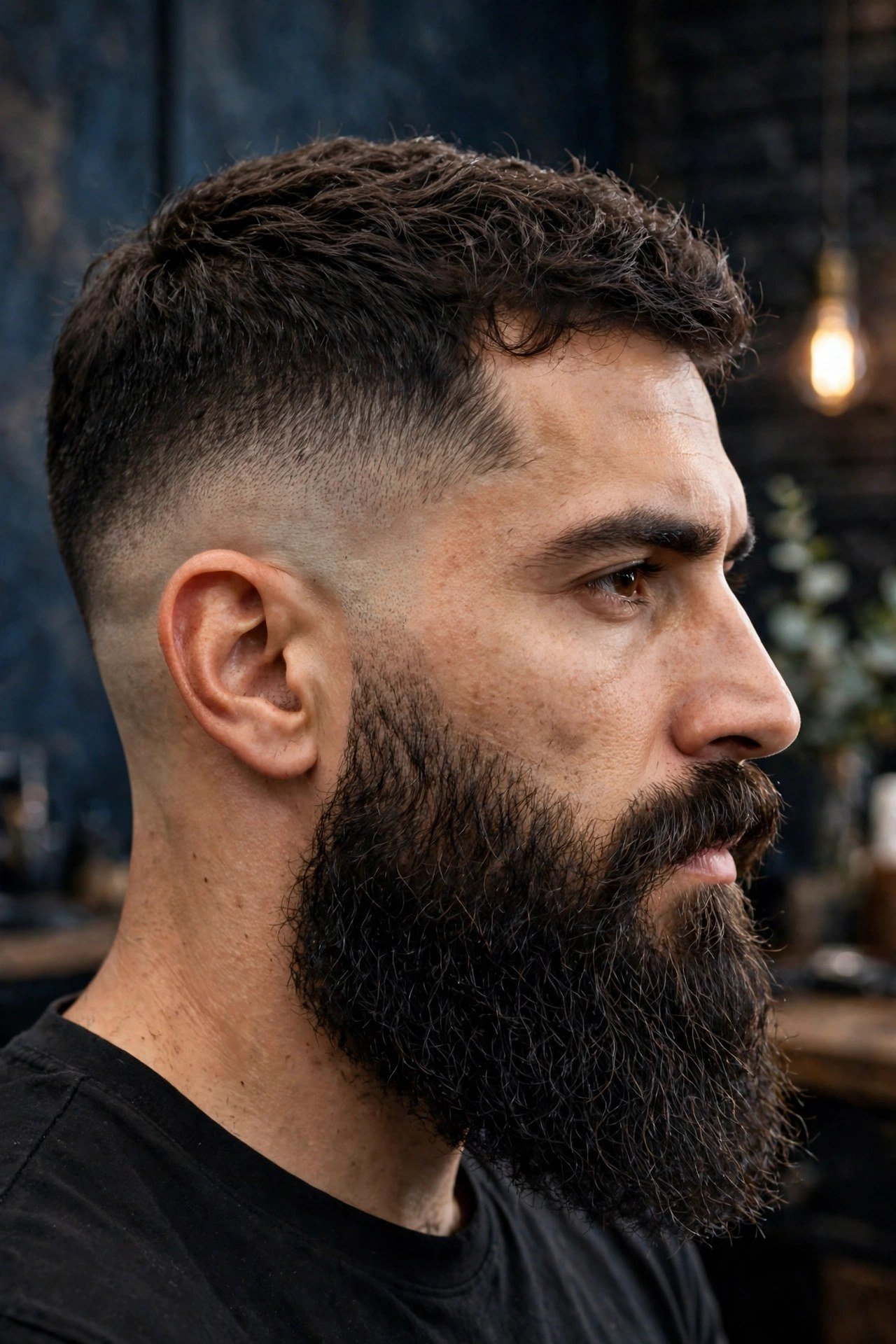
The last two styles are about context — how the shadow fade works with a beard, and how it works in the most conservative professional settings. These are the styles for guys whose haircut has to do a job beyond looking good: it has to connect with facial hair, or it has to pass the strictest dress code without raising an eyebrow.
15. Shadow Fade with Beard
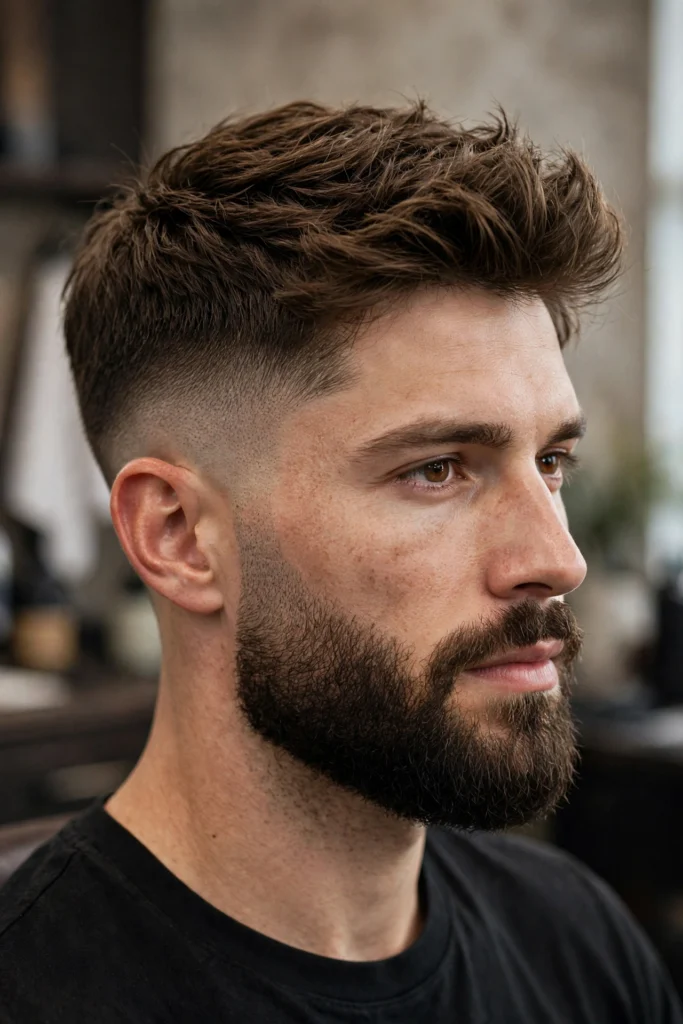
The shadow fade plus a beard is one of the best-balanced combinations in men’s grooming. Here’s why: the fade’s soft bottom creates a natural transition zone into the beard. With a skin fade, there’s often a harsh gap — bald skin, then beard — that looks disconnected unless the barber blends it deliberately. The shadow fade’s stubble melts into the beard’s lower density, and the whole side of the head reads as one continuous, intentional shape.
The blend zone between the fade and the beard is where your barber earns his money. Tell him to “fade the beard into the cut” — he should graduate the beard’s top edge down into the shadow fade’s bottom so there’s no line where one ends and the other begins. Some barbers do this naturally; some need to be told. Look at the sideburn area in the mirror before you leave the chair. If you see a hard horizontal line, ask him to soften it.
Beard length changes the equation. A short boxed beard with a shadow fade looks sharp and corporate. A longer full beard with a shadow fade looks rugged but groomed — the fade keeps the overall impression tidy even as the beard gets wilder. Either way, keep the beard’s cheek line clean and the neckline defined; an unkempt beard will drag down even the best fade. Maintenance: fade every three weeks, beard shape-up every two, daily beard oil. It’s more total upkeep than the other styles, but the result is the most complete-looking head on this list.
16. The Executive Shadow Fade
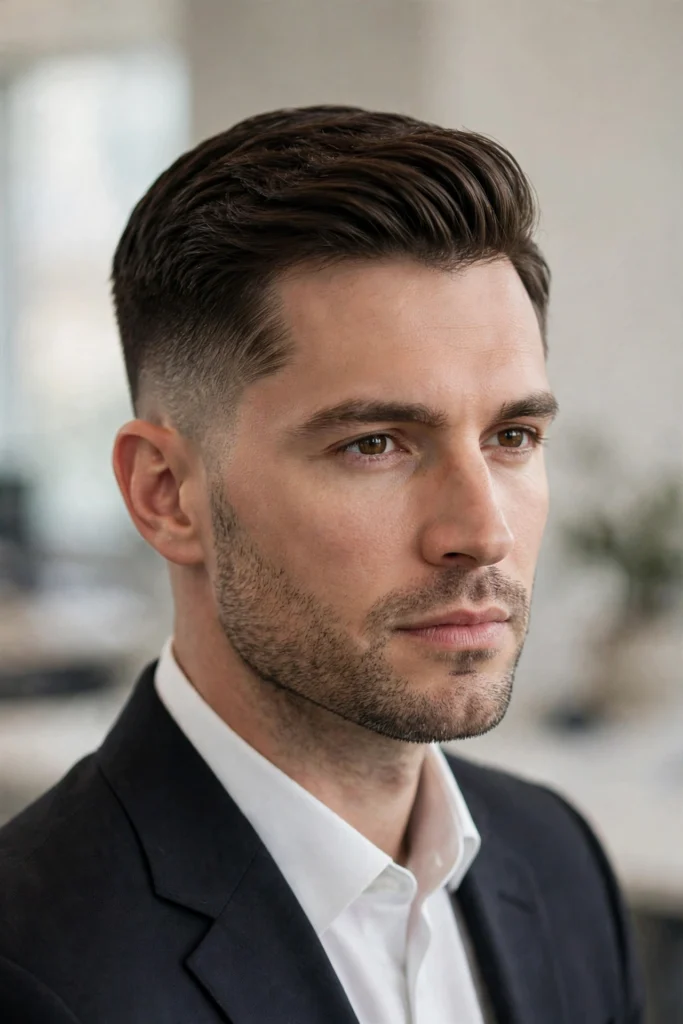
This is the most conservative style here, and it’s the one I cut most often for lawyers, bankers, executives, and grooms. Neat tapered top — two to three inches, side-parted or swept back — over a very low, very soft shadow fade. The fade barely registers as a fade; it reads as an exceptionally clean traditional haircut. That’s the point. In settings where a visible fade would be a statement, this cut makes no statement at all. It just looks right.
The details are all restraint. The fade starts low — barely above the ear — and the bottom stays at a full 1 guard, not a 0.5. There’s enough gradient to look modern and clean, but nothing that would photograph as a “fade” in a company headshot. The top is classic: enough length to part or sweep, cut clean with no aggressive texture. Your barber should understand that the goal is invisible excellence. If someone notices your haircut in a board meeting, something went wrong.
Styling is a side part or a neat sweep-back with a classic product — a light pomade or cream with a natural finish, nothing matte and edgy, nothing high-shine and retro. Comb it, set it, forget it. This cut holds all day and needs nothing until the next appointment. Get it refreshed every three weeks — the low fade grows out so gracefully that you could stretch to four, but the top’s neatness is what sells the executive look, and that needs its three-week tidy. This is the shadow fade for the guy whose haircut is part of his professional uniform.
Styling and Maintenance: Keeping the Shadow Fade Sharp
The shadow fade’s biggest selling point is how little it asks of you, but “low maintenance” is not “no maintenance.” Here’s the honest routine — what the cut needs, what it doesn’t, and where guys go wrong.
Daily styling depends entirely on your top. The fade itself needs nothing — no product, no attention, no morning routine. That’s the beauty of it. Your effort goes to whatever’s on top: ninety seconds of clay for a crop, ten minutes of blow-drying for a quiff, nothing at all for a buzz. Pick your top style with your real morning in mind, not your aspirational one. The guy who buys a pompadour routine but lives a crop lifestyle will hate his haircut within a week, and it won’t be the fade’s fault.
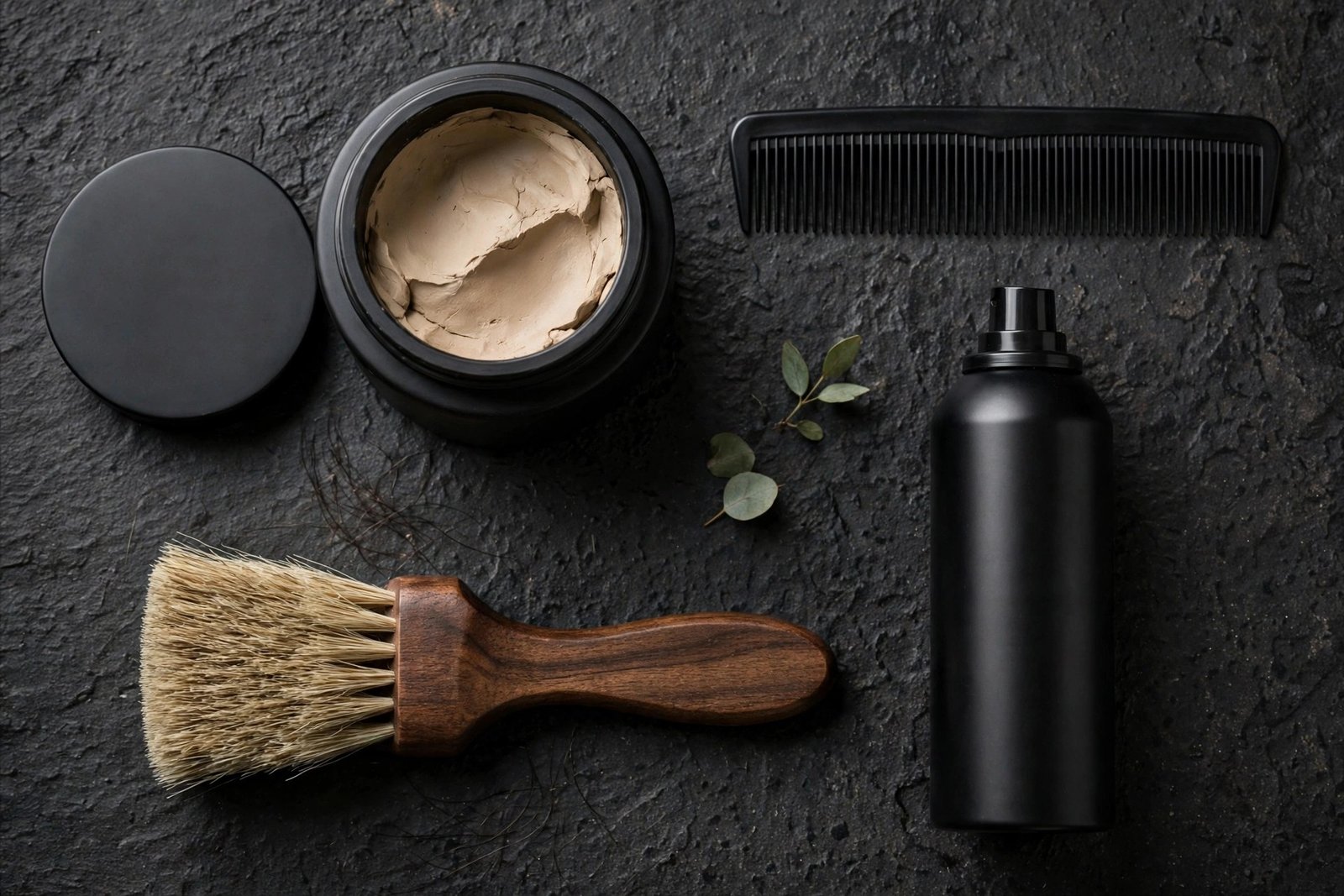
Product-wise, keep it simple. One matte product (clay or paste) covers most of the styles on this list. Add a blow-dryer if your style has volume, and a sea salt spray if your hair is wavy or you want texture. That’s the complete kit for ninety percent of shadow fade wearers. You don’t need a shelf of products. The fade does half the visual work for free, which means the top needs less help than it would over grown-out sides.
The trim schedule is where the shadow fade earns its reputation. Every three weeks is the sweet spot for most guys — the fade stays crisp, the top stays shaped, and the cut never has an awkward phase. Can you stretch to four? Usually yes, especially with the shorter and more conservative styles.
The cut will look slightly softer, slightly more natural, but still intentional. What you can’t do is what skin fade guys do — there’s no weekly urgency here. The shadow fade doesn’t punish you for being busy. That’s the whole point.
Between cuts, there’s almost nothing to do. No lineup to maintain unless you have one carved in — and most shadow fade styles don’t need a hard lineup, since the softness is the aesthetic. If your neckline gets fuzzy, a quick clean-up with a trimmer at home handles it, or ask your barber for a neckline tidy between full cuts. Many shops do it cheap or free for regulars. Don’t let a fuzzy neckline sit for three weeks; it’s the one thing that makes a growing shadow fade look neglected rather than natural.
The mistake I see most: guys treating the shadow fade like a skin fade and coming in every ten days out of habit. You’re wasting money. The cut is designed to age well — let it. The second mistake: going too long, past five or six weeks, and letting the fade grow into a uniform length. At that point it’s not a shadow fade anymore, it’s just grown-out hair, and the barber has to rebuild the gradient from scratch. Three to four weeks. That’s the window. Stay in it and this is the easiest great haircut you’ll ever own.
Shadow Fade FAQs
These are the questions I hear about the shadow fade more than any other cut — in the chair, in messages, from guys considering the switch from a skin fade. Straight answers, no hedging.
What guard is a shadow fade?
The shortest point of a shadow fade is typically a 0.5 guard (about 1.5 millimeters) or a 1 guard (about 3 millimeters). That’s the defining feature — visible hair at the bottom, no skin. From there the barber works up through the guards in small steps: 1.5, 2, sometimes 3, blending each transition until the gradient melts into the top length. If your barber goes below a 0.5 — to a zero or foil — it’s not a shadow fade anymore, it’s a skin fade. The guard at the bottom is the whole identity of the cut, so it’s worth stating explicitly: “don’t go below a 0.5.”
How often does a shadow fade need a trim?
Every three weeks is the sweet spot for most guys. The fade stays defined, the top keeps its shape, and you never hit an awkward growing-out phase. You can stretch to four weeks with the shorter styles — the buzz, the Caesar, the executive cut — because there’s less shape to lose. What you don’t need is the ten-to-fourteen-day cycle that skin fades demand. The shadow fade’s soft bottom means regrowth shows as texture, not contrast, so the cut ages gracefully. Going past five or six weeks is the limit; beyond that the gradient grows out and the barber has to rebuild it from scratch.
Is a shadow fade good for the office?
It’s one of the best fades for professional settings. The shadow fade reads as a clean, well-kept haircut rather than a statement fade — there’s no bald skin, no harsh lines, nothing that draws attention to the cut itself. Paired with a side part, a neat crop, or the executive style above, it passes the strictest dress codes without a second glance. That’s exactly why so many professionals switched to it in 2025 and 2026. If your workplace is conservative, ask for the fade low and the bottom at a full 1 guard; if it’s business-casual, you have room to go a little higher and a little softer at the bottom.
What’s the difference between a shadow fade and a low taper?
They get confused constantly, so here’s the clear line: a taper is a small, contained fade at just the neckline and sideburns, leaving the full length on the sides of the head. A shadow fade is a complete fade — the gradient runs up the entire side of the head — it’s just a soft one that stops at stubble instead of skin. Think of it this way: a taper cleans up the edges, a shadow fade reshapes the sides. The taper is subtler and grows out even more invisibly; the shadow fade gives you more of a styled, intentional look. If you want the faintest possible cleanup, get the taper. If you want a real fade without the skin, get the shadow fade.
Does a shadow fade work on all hair types?
Yes — and that’s one of its strengths. The shadow fade is about the sides, and the clipper work is the same regardless of what’s on top. Straight, wavy, curly, coily, thick, fine — the fade itself works on all of it. What changes is the top you pair it with, which is why this guide has sixteen options. Thick hair gets great texture crops and quiffs. Curly hair gets the curly-top styles. Fine hair does well with the Caesar, the buzz, or a neat side part that doesn’t demand volume the hair can’t give. The only real consideration is very light or blonde hair: the “shadow” effect is less visible on light hair because there’s less contrast between the stubble and the skin. It still looks clean — the gradient is just subtler. On dark hair, the shadow fade shows its full depth.
Conclusion
Here’s what it comes down to. The skin fade is a great haircut with a short shelf life and a high maintenance bill. The shadow fade is a great haircut that respects your time and your wallet. It gives you the clean, intentional look of a fade — the gradient, the shape, the sharpness — without the bald bottom that starts expiring the moment you leave the chair.
Sixteen styles, one fade. Whether you’re a textured-crop guy, a side-part professional, a curly top, or a buzz-cut minimalist, there’s a version of this cut with your name on it. The formula doesn’t change: soft gradient on the sides, stubble — not skin — at the bottom, and a top that suits your hair and your mornings. Get those three things right and the cut takes care of the rest.
My advice if you’re switching from a skin fade: give it one full cycle. Get the shadow fade, wear it for three weeks, and pay attention to week two and three — the weeks where your old fade used to look tired. That’s where this cut wins. When you realize you still look sharp eighteen days after the cut without a touch-up, you’ll understand why the shadow fade men are getting in 2026 isn’t a trend. It’s just the smarter fade.
Book the chair. Bring the photo. Say the words: “fade it soft, leave a shadow at the bottom, no skin.” Then enjoy the next three weeks of not thinking about your hair.