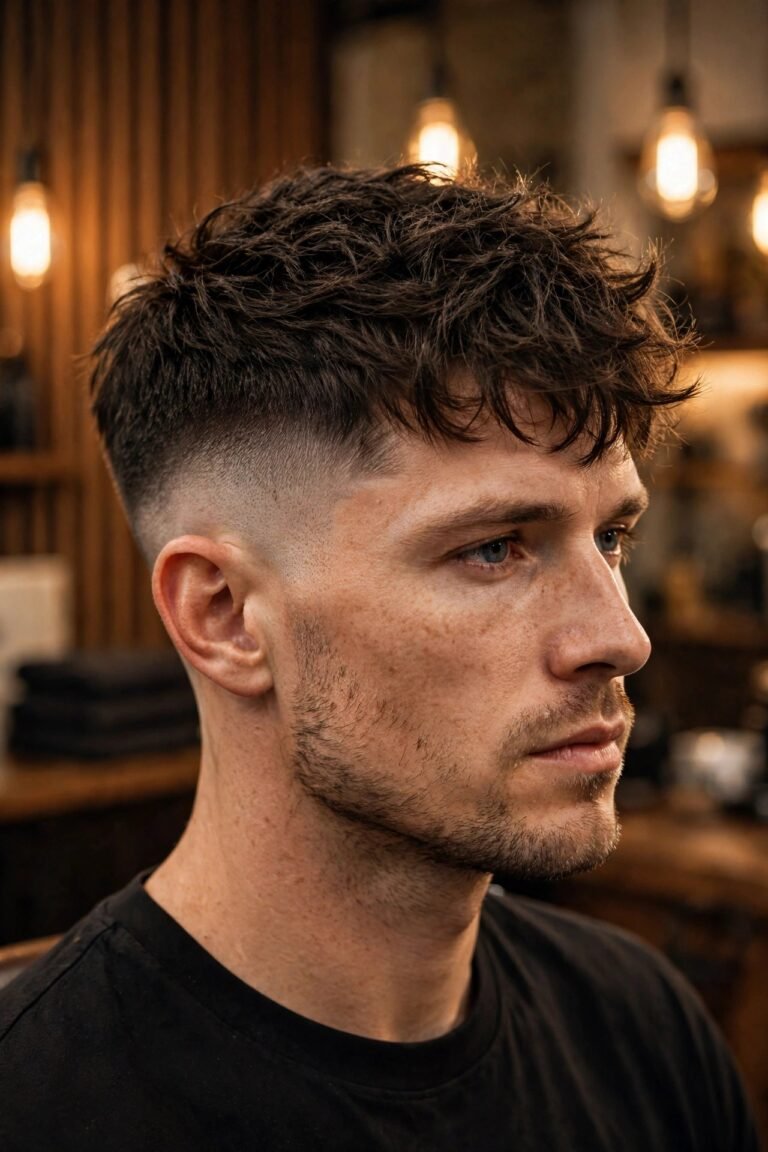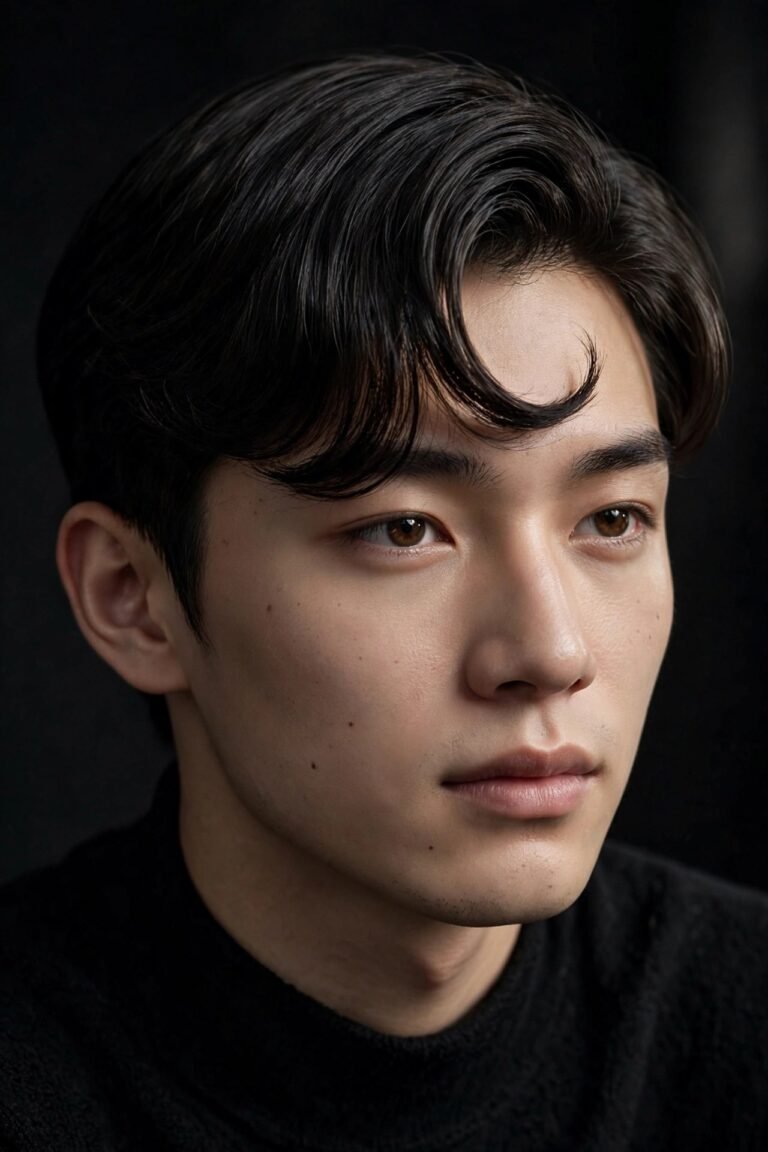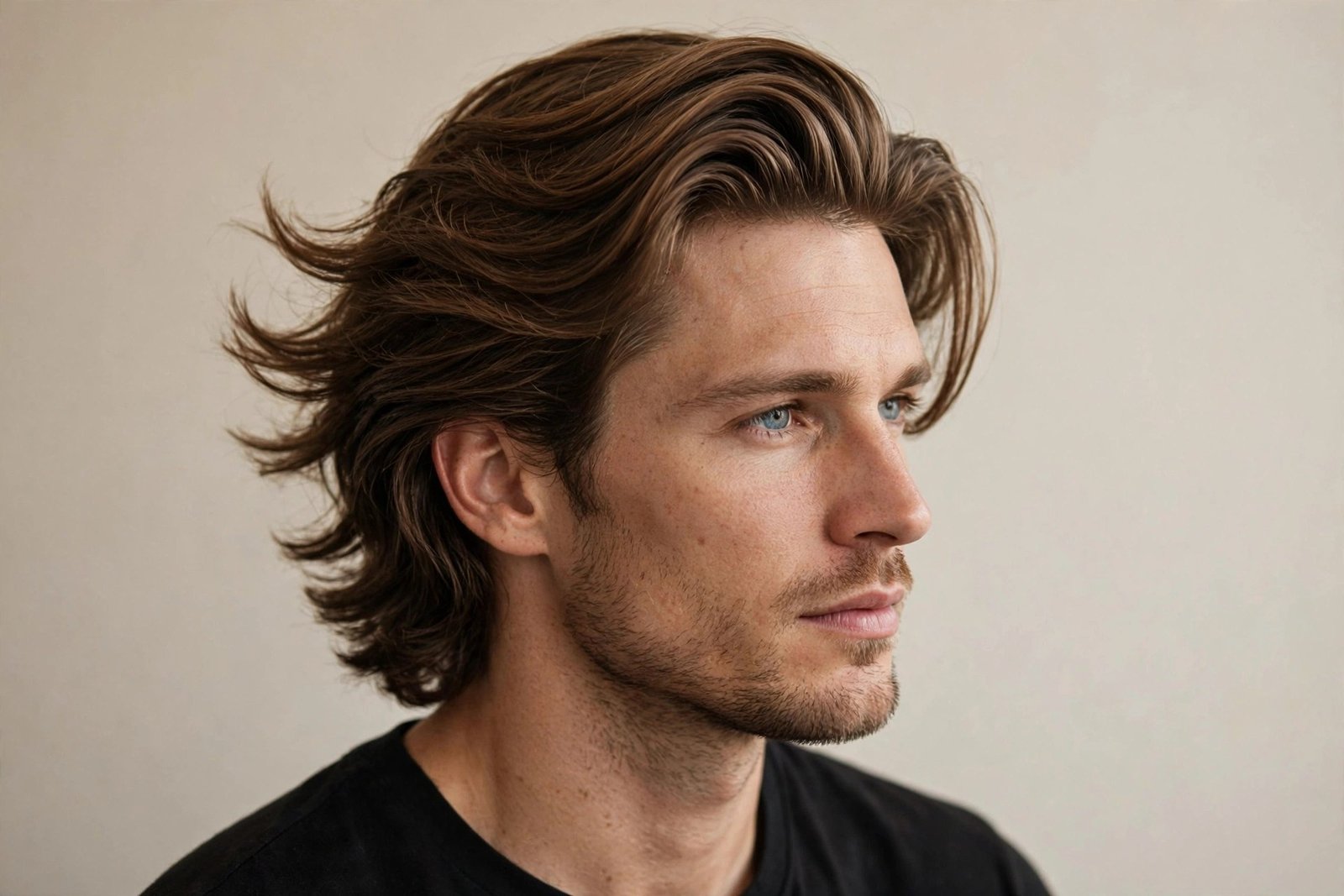
Bro Flow Men 2026: 16 Effortless Swept-Back Styles
Here’s the honest part most guides skip: the bro flow is easy to wear and hard to grow. Once the length is there, your morning routine is about four minutes — some sea salt spray, fingers through the hair, out the door. But getting to that length means surviving months of an awkward middle stage where your hair does whatever it wants. This guide covers the whole journey, not just the pretty ending. I’ll tell you what the bro flow actually is, exactly what to say to your barber, sixteen ways to wear it in 2026, the styling routine that keeps it moving, and the grow-out survival plan that separates the guys who make it from the guys who shave it all off in month three.
Why is the bro flow big right now? Because grooming culture got tired. The 2020s belonged to the precision fade — tight sides, sharp lineups, everything edged like a architectural drawing. It looked great and it demanded a shop visit every two weeks. The bro flow is the answer from guys who wanted something that looks sharp without living in the barber’s chair. It sits right in the middle of the bigger 2026 swing toward longer, natural men’s hair: curtains, middle parts, shags, and flows all sharing the same DNA of texture over precision.
A quick note on who this is for. The bro flow works best on straight to wavy hair with some natural texture. Very tight curls can absolutely grow into a flow, but it becomes a different animal — more volume, more width, more character. Thin or thinning hair can work with a shorter flow, but a long one will expose it. And face shape matters less than you’d think, which is one of the cut’s real strengths. We’ll get into all of that below, including the face-shape breakdown most articles gloss over.
One more thing before we start. Everything in this guide comes from what actually happens in barbershops and in front of bathroom mirrors — not from a mood board. Some of it is unglamorous. The awkward phase is real. Some hair types fight the flow harder than others. But if you’ve ever wanted hair that moves when you move, this is the cut, and by the end of this article you’ll know exactly how to get there.
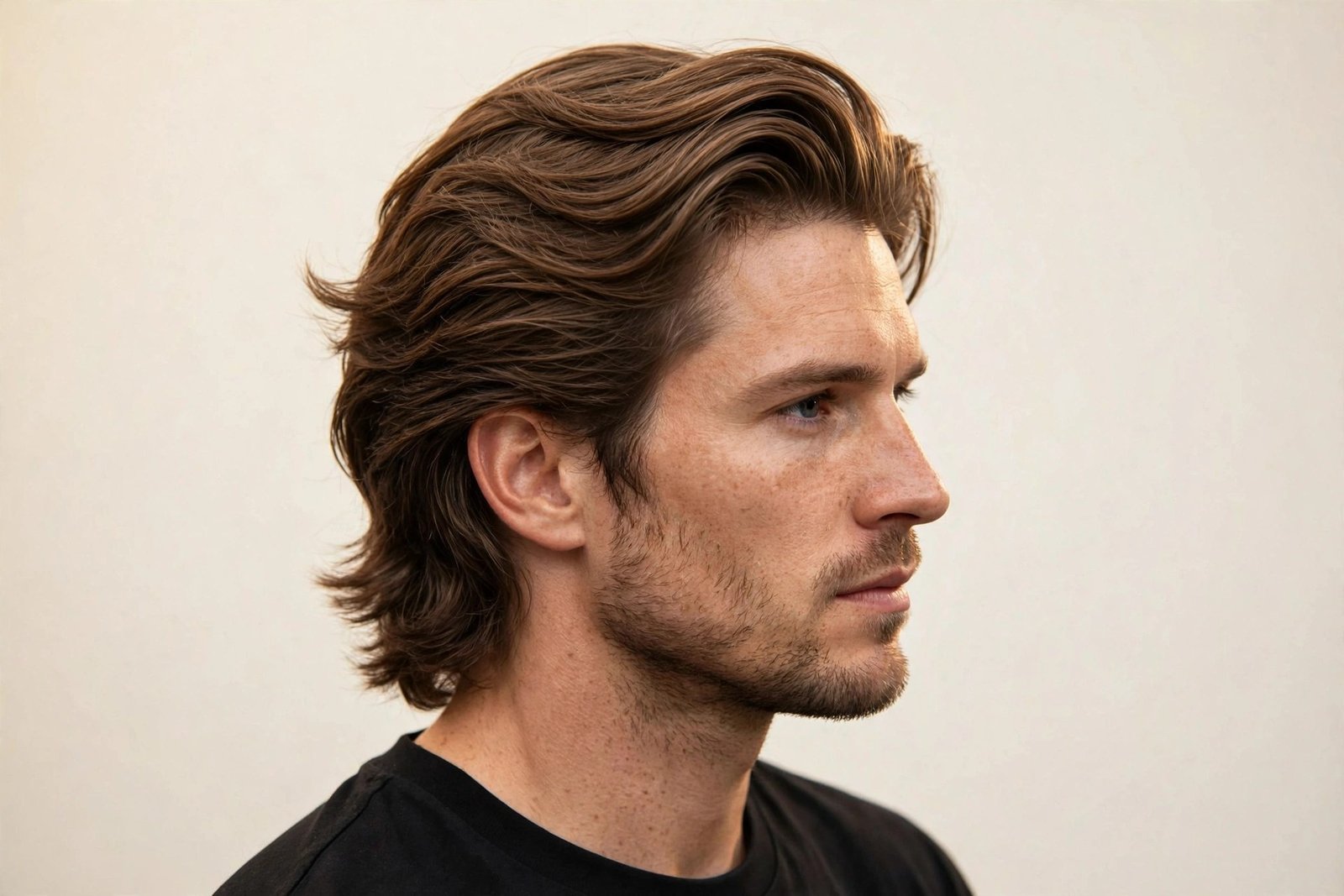
What Is the Bro Flow, Really?

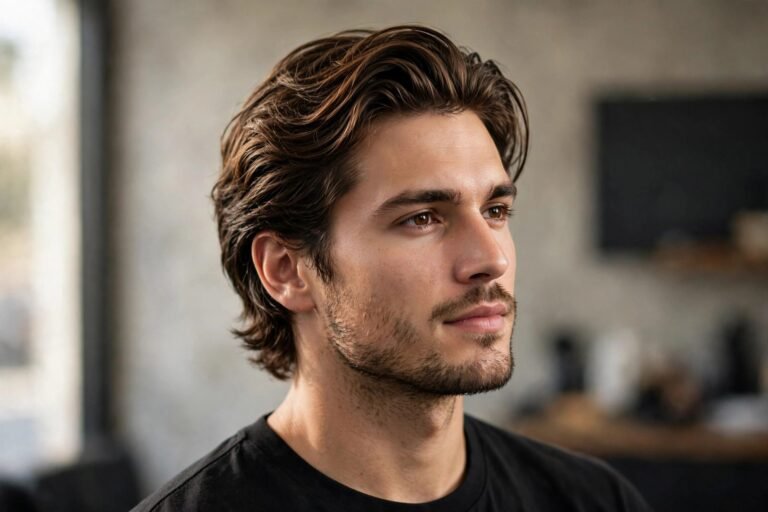
Strip away the trend talk and the bro flow is simple: a medium-length men’s cut where the top is grown to roughly four to six inches or more and worn swept back, flowing away from the face. The sides grow out too — they blend into the back rather than being faded short. There’s no hard line anywhere on the head. The silhouette is one continuous movement of hair from front to back, which is why it reads as effortless even when it took you some effort.
The bro flow’s spiritual home is hockey. For decades, NHL players grew their hair through the season, tucked it under helmets, and revealed these magnificent sweeps in the playoffs — the famous “playoff flow.” Barbers noticed, guys in the stands noticed, and the cut crossed over. It’s refined hockey hair: the same DNA, but shaped with intention so it works in an office, at a wedding, and everywhere in between. When someone says “bro flow” in 2026, they mean the deliberate version, not the accidental one under the helmet.
Texture is the whole game. The bro flow lives or dies on natural movement — the way the hair bends, flips, and sits when it’s healthy and long enough. That’s why sea salt spray is practically the official product of the cut: it adds grit and separation that mimics a day at the beach. Guys with natural wave get the easiest version of the flow because the hair already wants to move. Straight-haired guys can absolutely pull it off, but they’ll lean harder on texture products and sometimes a little blow-drying to teach the hair to sweep back instead of lying flat like a curtain against the skull.
What the bro flow is not: it’s not a slick back, it’s not a man bun, and it’s not “I stopped getting haircuts.” A slick back uses heavy product and combs everything tight and uniform — the opposite of the flow’s loose movement. A bun hides the length. And just not cutting your hair produces a shapeless blob, not a flow; the difference is the shaping. A real bro flow has deliberate length distribution — longer on top, controlled through the sides, blended at the back — so the hair moves as one piece. That’s the part that needs a barber’s eye, and we’ll get to exactly what to ask for next.
How to Ask Your Barber for the Bro Flow
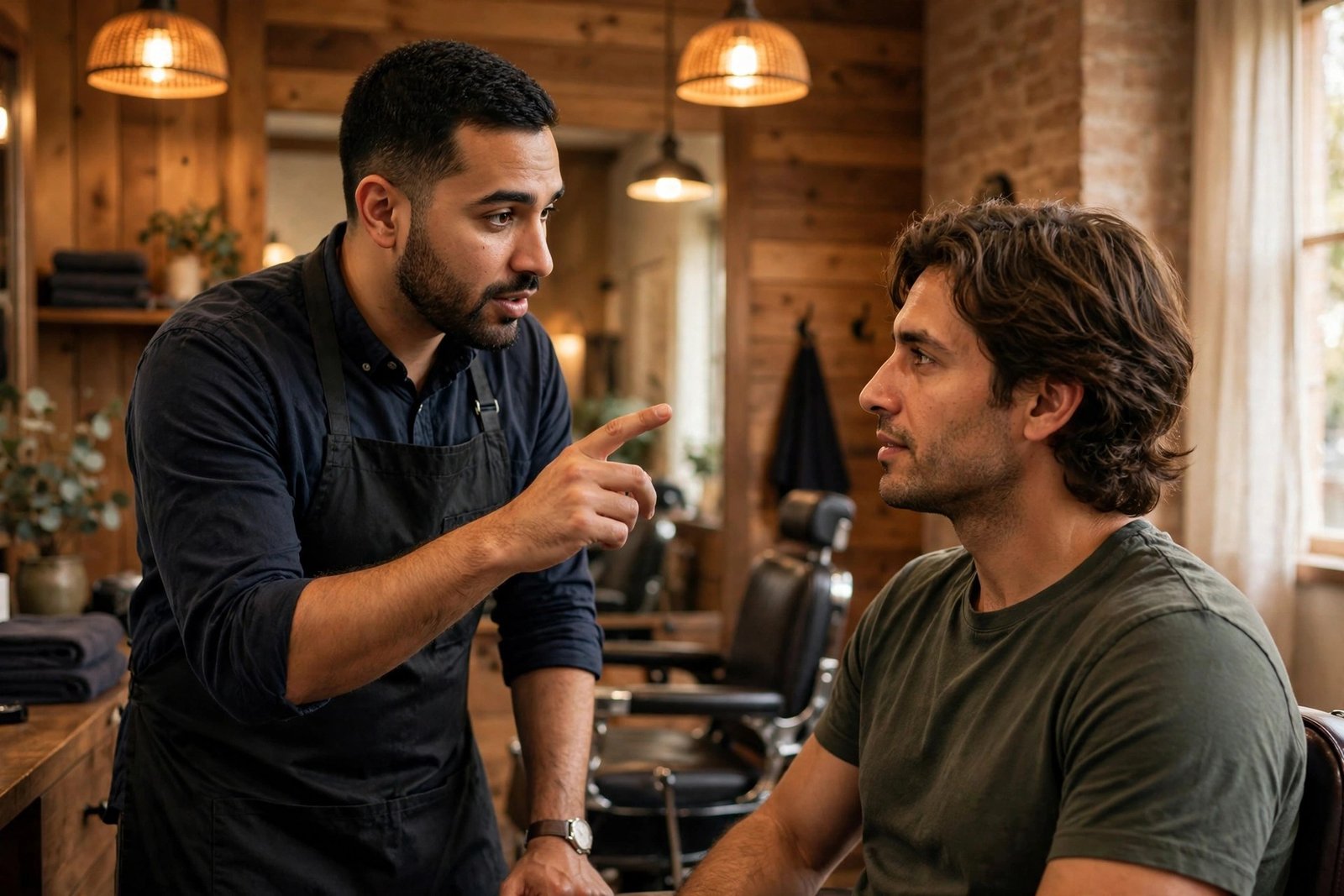
Walk into the shop and say “bro flow” and a good barber will know what you mean. But “a good barber” is doing a lot of work in that sentence. Barbers hear trend names differently, so bring specifics and bring photos. Here’s the script that gets you the cut instead of a misunderstanding.
Start with the goal: “I want to grow into a bro flow — swept back, medium length on top, natural movement.” Then the length instruction: “Keep the length on top — I’m aiming for four to six inches. Just clean up the shape, don’t take real length off.” Then the sides, and this is the critical part: “Blend the sides into the back, no hard fade. I want the sides to grow with the top — taper them lightly so they sit, but nothing skin-tight.” If your barber reaches for the clippers to give you a skin fade on the sides, stop them. That’s the single most common way a bro flow appointment goes wrong: the barber defaults to what they cut all day and the flow dies before it starts.
Ask about texture and shaping: “Point-cut the ends so it has movement and doesn’t look blunt.” Point cutting — snipping into the hair vertically instead of straight across — is what creates the piece-y, lived-in ends that make a flow look like a flow instead of a bowl. If your hair is thick, add: “Take out some bulk underneath so it lays back without puffing out.” Thick hair without bulk removal will fight you every morning; a good barber thins the under-layers so the top layer sweeps back clean.
Bring three photos on your phone: one of the overall length you want, one showing the sides/back blend, and one showing the texture. Photos end debates instantly. And be honest about where you are in the grow-out: “I’m at month two, just shaping it up” gets you a very different cut than “I’ve got the length, refine it.” Finally, ask your barber when to come back. For a growing flow, every eight to twelve weeks for a shape-up is plenty. If they tell you to come back in three weeks, they might not understand the assignment — or they’re just trying to sell you appointments.
Bro Flow Men Styles 1–3: The Classics
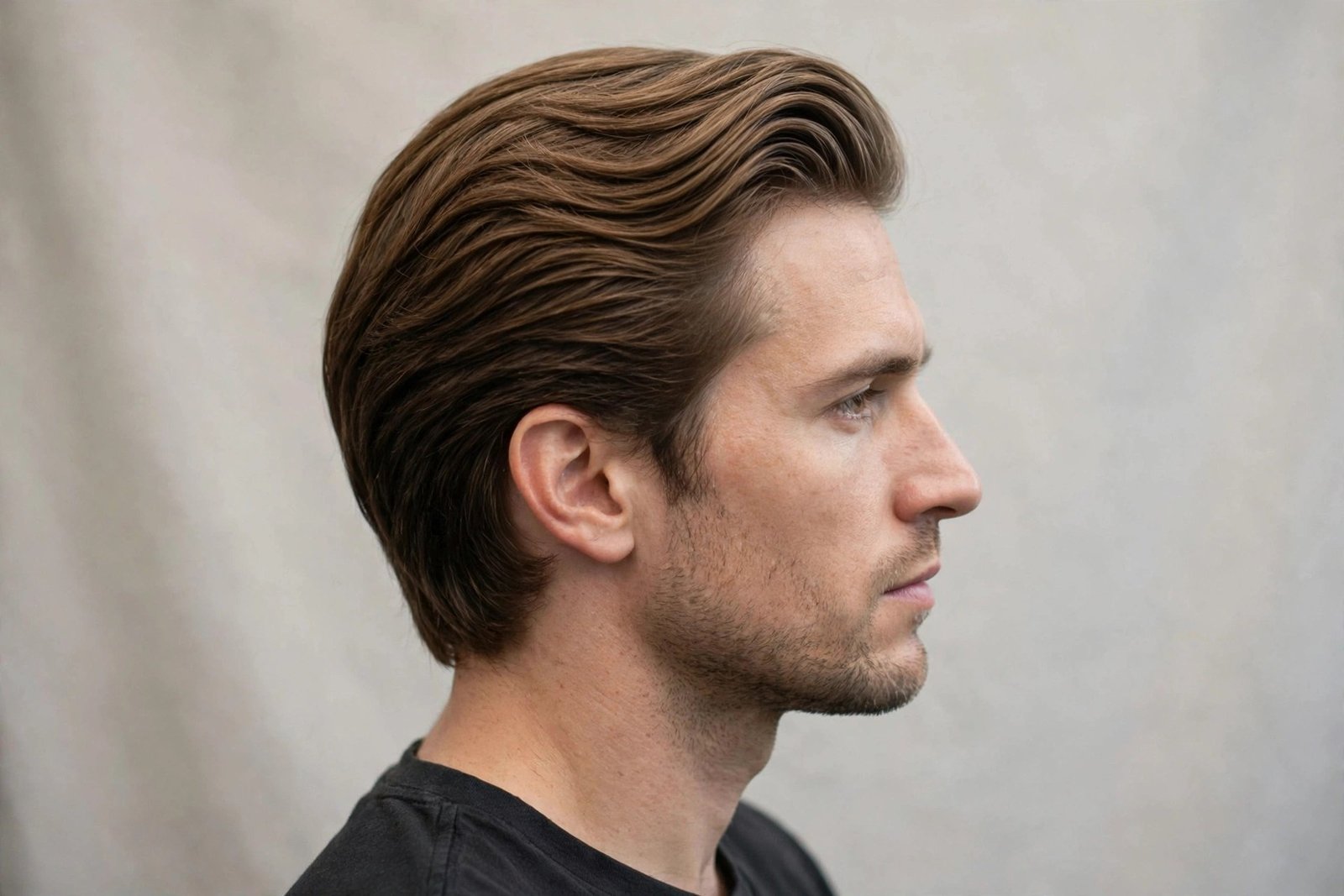
Before the variations, the foundations. These three are the styles the whole bro flow idea is built on — the versions that work for the most guys with the least fuss. If you’re new to the flow, start here. Master one of these and every other style on this list is just a tweak away.
1. The Classic Bro Flow
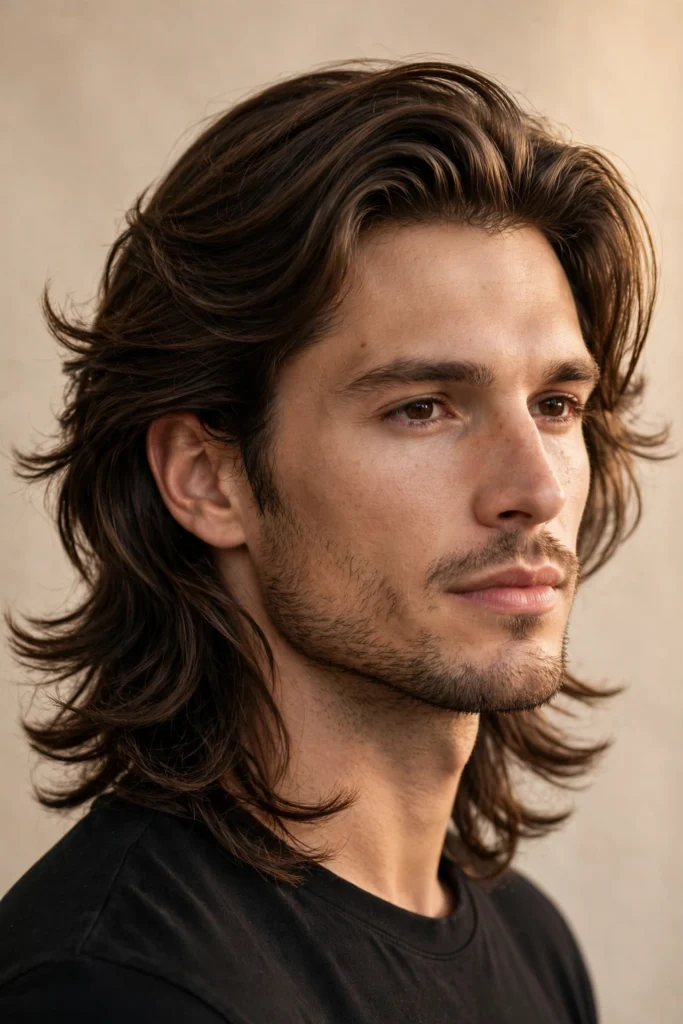
This is the baseline: four to six inches on top swept straight back, sides grown out and blended, everything moving in one direction. No part, no texture tricks, just clean backward momentum. The classic works because it flatters nearly everyone — the swept-back direction opens up the face, and the length softens strong jawlines while adding presence to softer ones. It’s the flow at its most versatile: fine at a desk, fine at a bar, fine in a team photo.
Styling is minimal, which is the point. Sea salt spray on damp hair, rough-dry with your fingers pointing the hair back, and a pea-sized amount of light cream through the ends if they need taming. The whole thing takes five minutes once the length is there. The classic is also the most forgiving version during grow-out — because there’s no defined part or texture pattern to maintain, the awkward stages just look like a slightly messier version of the goal. If you can only commit to one flow, commit to this one.
2. The Wavy Bro Flow
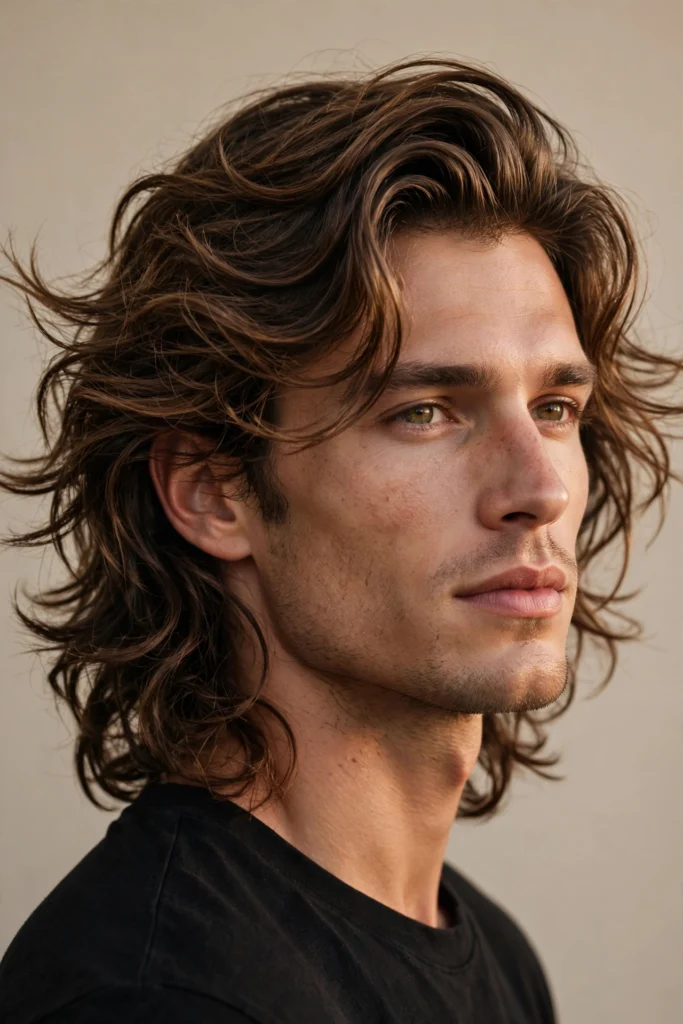
If your hair has natural wave, the bro flow was basically invented for you. The wavy version leans into the bend instead of fighting it — the waves create built-in movement that straight hair has to fake with product. This is the version you see on surfers, musicians, and guys who look like they don’t own a comb. The waves do the styling for you; your job is just to point them in the right direction.
The trick with wavy flow is enhancing without over-controlling. Scrunch sea salt spray into damp hair rather than combing it through — combing pulls waves straight, scrunching encourages them. Let it air-dry or diffuse on low heat. A light matte paste on dry hair adds definition to individual waves, but use a small amount; heavy product weighs waves down and turns the flow into a helmet. Wavy-haired guys also get the best second-day hair of anyone on this list. Sleep on it, shake it out, and the waves often look better than day one.
3. The Textured Bro Flow
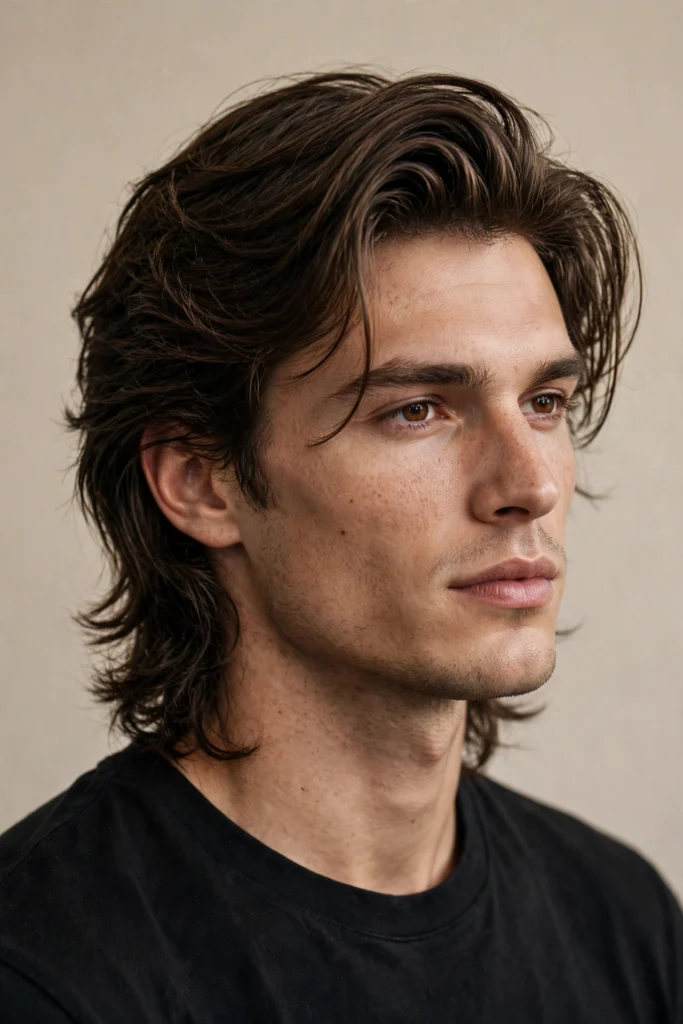
The textured flow is the classic with the volume turned up. More layers, more piece-y separation, more deliberate messiness. Your barber point-cuts aggressively and maybe razors the ends, creating a top that breaks apart into distinct pieces instead of sweeping back as one sheet. The result has more energy and more attitude — it reads younger and bolder than the classic.
This version needs a texture product to hold the separation: matte clay or paste worked through dry hair, piece by piece. The mistake guys make is using too much and gluing the pieces together, which defeats the purpose. Start with less than you think, add only if the pieces won’t stay separated. The textured flow also shows off healthy hair best — split ends and damage are more visible when the hair is broken into pieces, so this is the version where regular trims and conditioning actually matter. Every eight to ten weeks, take a quarter inch off the ends. Your future self will thank you.
Bro Flow Men Styles 4–6: The Pairings
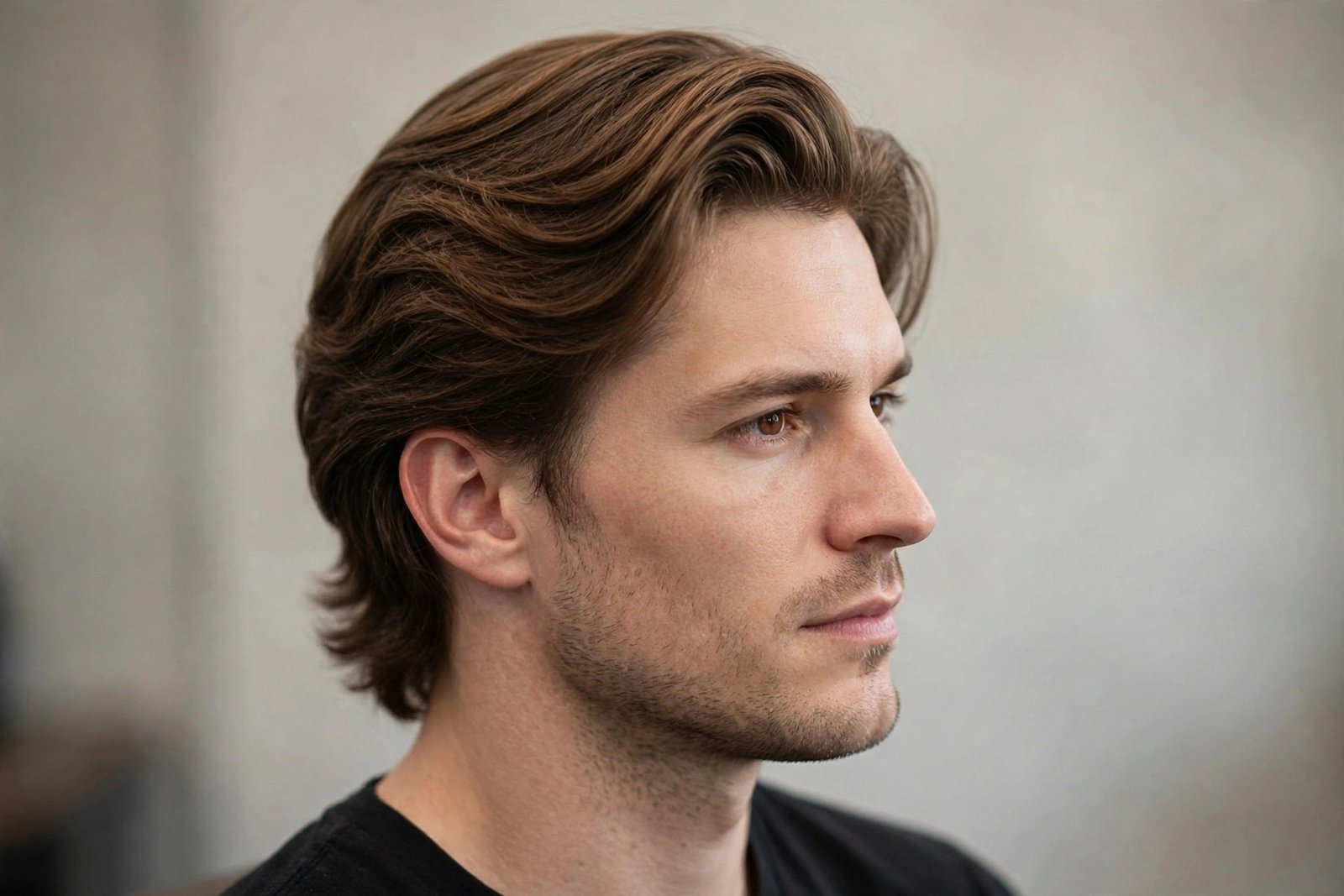
The flow doesn’t have to exist alone. These three pair it with the elements guys ask about most — cleaner sides, facial hair, and deliberate contrast. Each pairing changes the cut’s personality without changing its soul.
4. Bro Flow with Low Taper
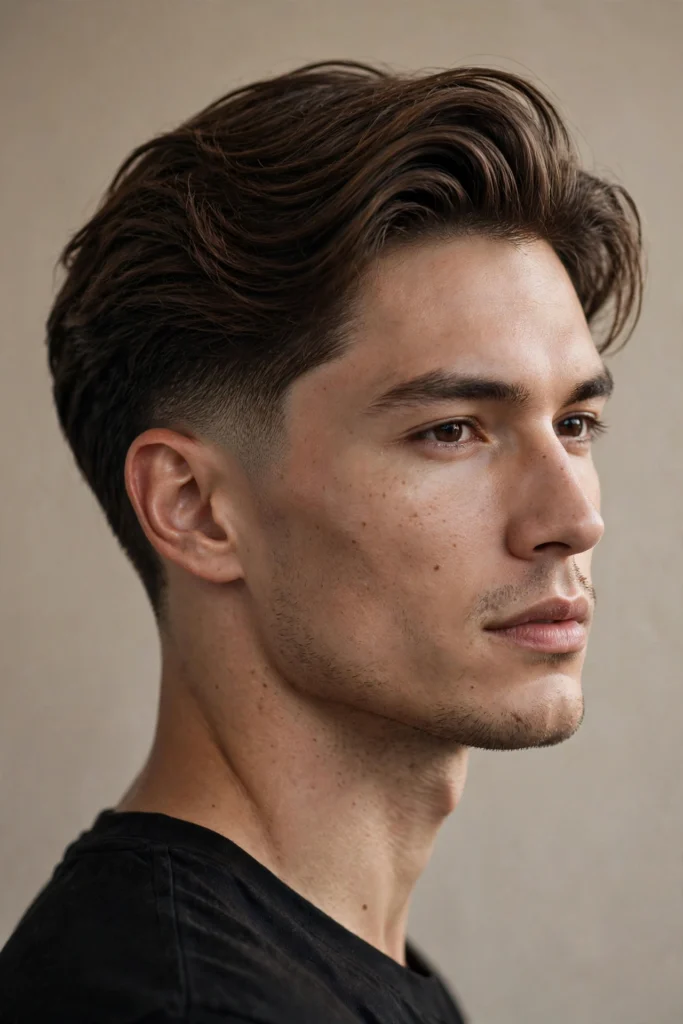
Purists will tell you a real flow has no fade at all, and they’re technically right. But the low taper pairing is the compromise that keeps the flow alive for guys who can’t show up to work with grown-out sides. The taper stays low — tight around the ears and neckline, fading up into the grown-out sides — so the top keeps all its flow while the edges look intentional. From the front, it’s a bro flow. From the side, it’s a man who gets haircuts.
The key word is “low” and the key instruction is “blend, don’t disconnect.” The taper should melt into the longer sides, not create a shelf where short meets long. Ask your barber to keep the taper tight to the perimeter — ears, sideburns, neckline — and leave everything above it alone. Maintenance is the trade-off: you’ll need the taper cleaned up every three to four weeks, which means more shop visits than a pure flow. But if your office has opinions about hair, this version keeps the peace.
5. Bro Flow with Beard
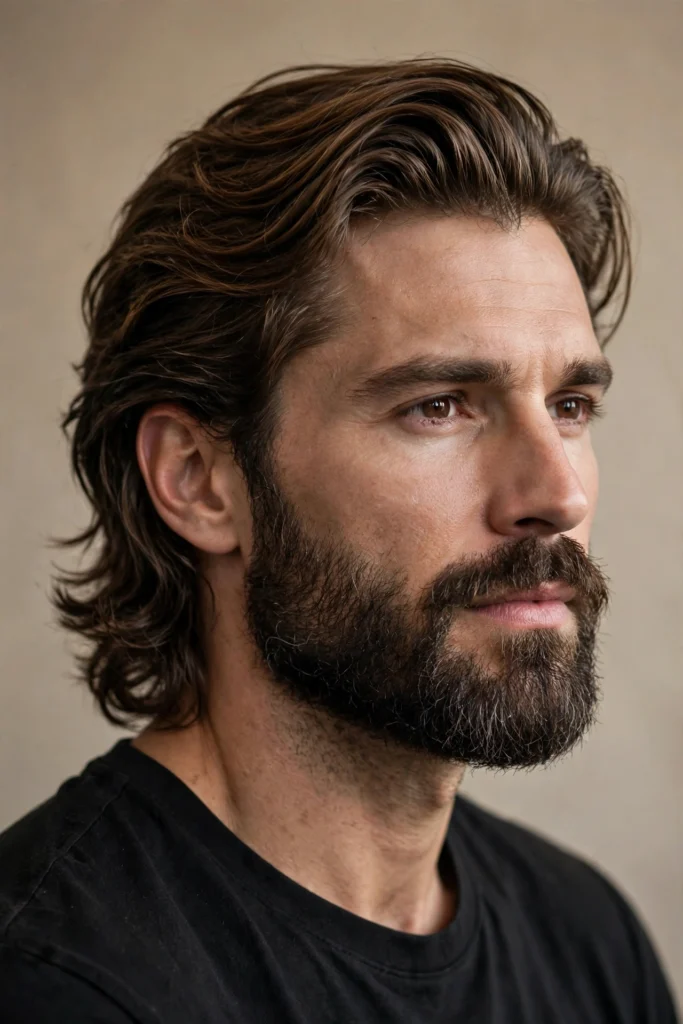
Long hair and a beard is one of the oldest combinations in men’s grooming, and the bro flow wears it well. The flow’s softness on top balances a beard’s weight below, and together they create a full, deliberate look that reads confident rather than scruffy. The pairing works best when the beard is shaped — cheek lines cleaned up, neckline defined — because an unkempt beard plus grown-out hair crosses the line from “rugged” into “lost in the woods.”
The transition zone matters. Where the sideburns meet the grown-out sides, your barber should blend rather than disconnect — unless you want the sharp contrast, in which case make it deliberate and keep it sharp. Beard length should roughly echo hair length: a short boxed beard with a long flow can look top-heavy, while a fuller beard balances it. And condition both. A flow plus a dry, wiry beard is two maintenance jobs, not one — beard oil daily, same as the hair routine. Guys who nail this pairing look like they stepped out of a grooming ad. Guys who skip the beard maintenance look like they’re between addresses.
6. Bro Flow with Undercut Sides
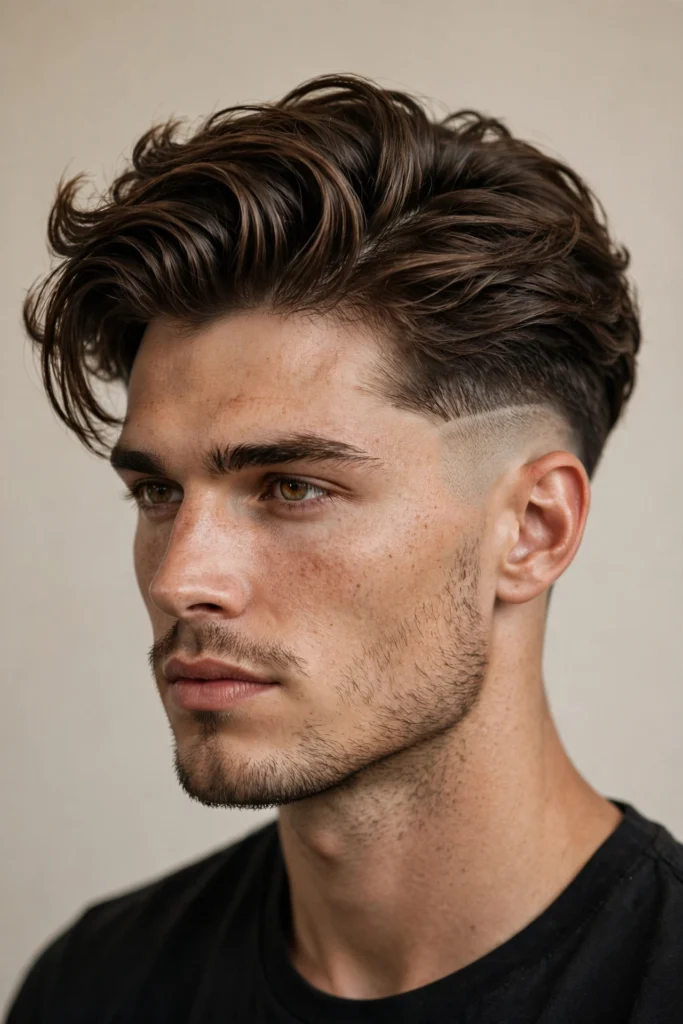
This is the boldest pairing on the list: the top flows long while the sides are cut short in an undercut, creating maximum contrast. It’s less “effortless surfer” and more “deliberate statement.” The undercut version suits guys who love the flow’s length on top but want edge — it reads modern and a little aggressive, and it photographs dramatically because the contrast is so strong.
Be honest about the commitment before you choose this one. The undercut needs maintenance every three to four weeks or the contrast goes muddy, and growing out of it later means an awkward phase where the sides catch up to the top. It also changes the flow’s character: with short sides, the top has nothing to blend into, so it needs more deliberate styling to look intentional rather than accidental. If you want the flow with training wheels off, this is it. If you want low maintenance, look at number four instead.
Bro Flow Men Styles 7–9: The Parts
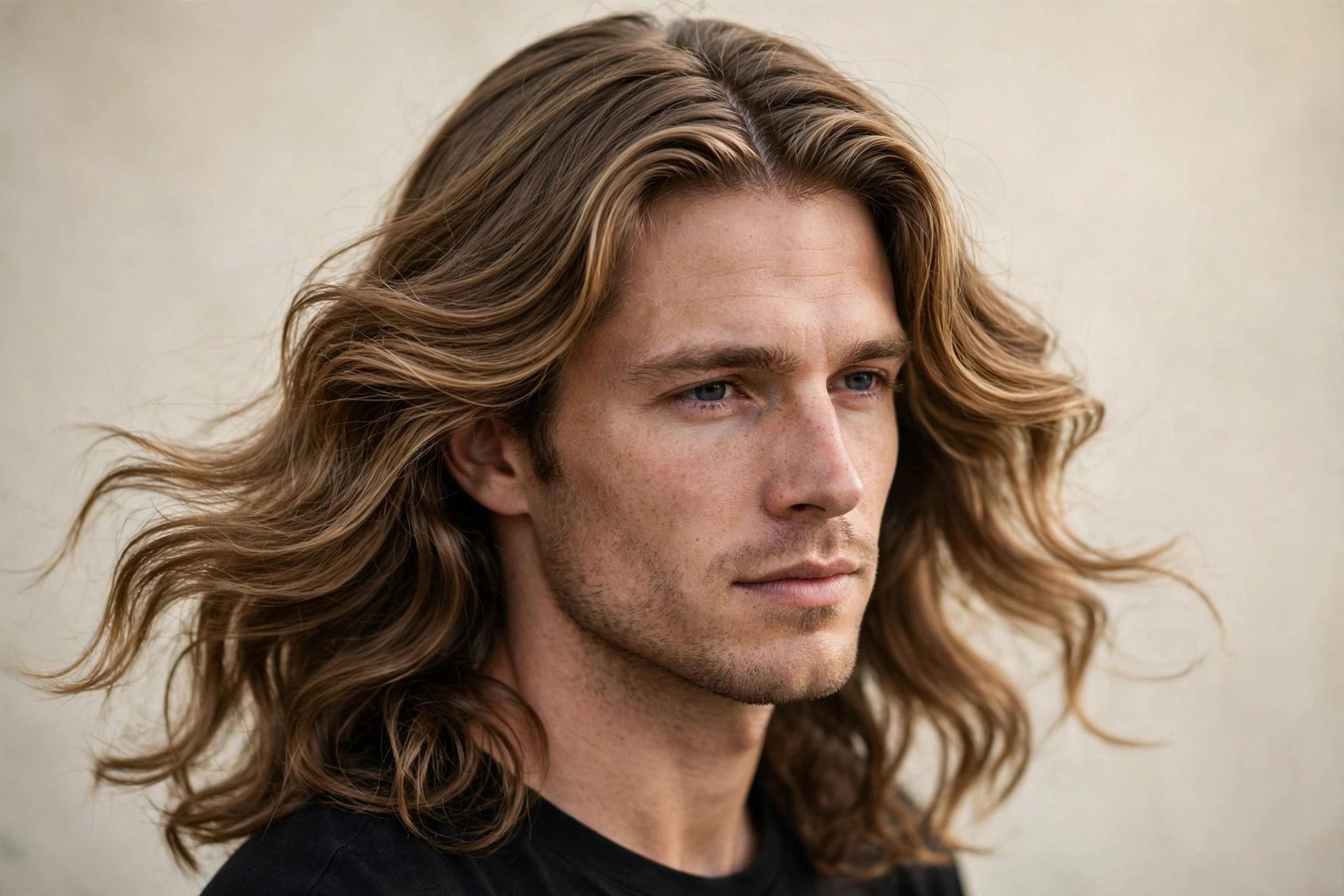
Where the hair divides changes everything. A flow with no part, a middle part, and a side sweep are three different haircuts that happen to share a length. These three explore the parting options, from the cleanest to the most relaxed.
7. Bro Flow with Middle Part
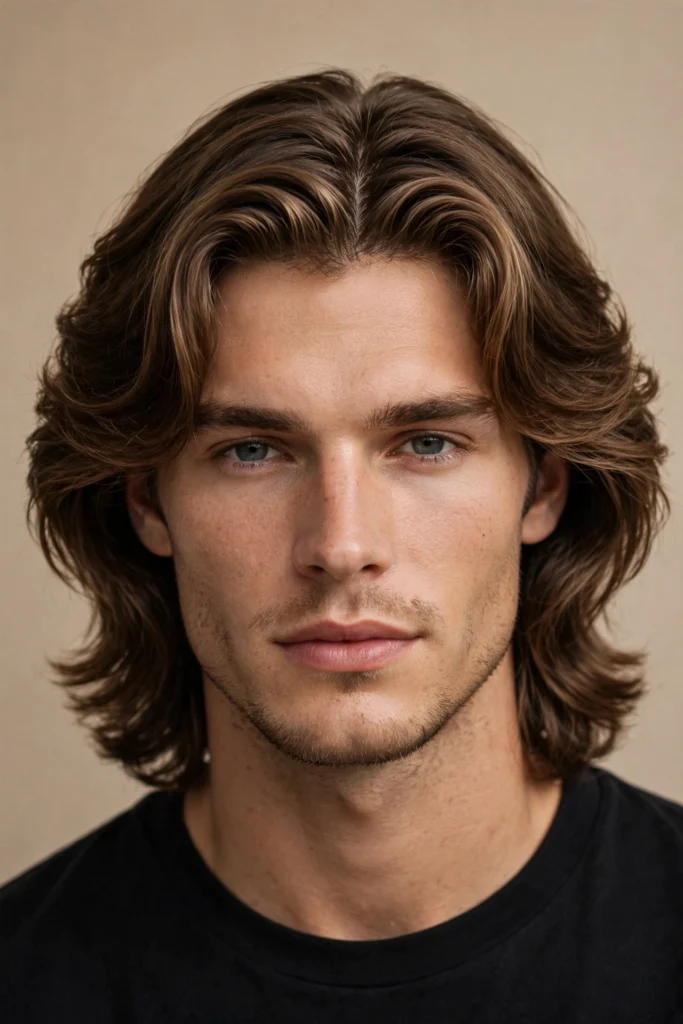
The middle part flow — curtains grown out and swept back — is the 2026 sweet spot where two trends meet. The hair parts cleanly down the center and flows back on both sides, framing the face symmetrically. It’s the most deliberate-looking version of the flow, and it suits guys who like structure: the center part gives the eye something to follow, which makes the whole cut look more designed than the part-free versions.
The part needs to be trained. For the first couple of weeks, part damp hair down the middle with a comb and let it dry that way — the hair has memory, and you’re teaching it. Once trained, the part will fall into place on its own. This version favors symmetrical faces and works beautifully on oval and square shapes. One caution: a middle part plus a flow draws attention to the forehead and hairline, so if your hairline is receding, this part will announce it. The side-swept version below is the kinder choice in that case.
8. Side-Swept Bro Flow
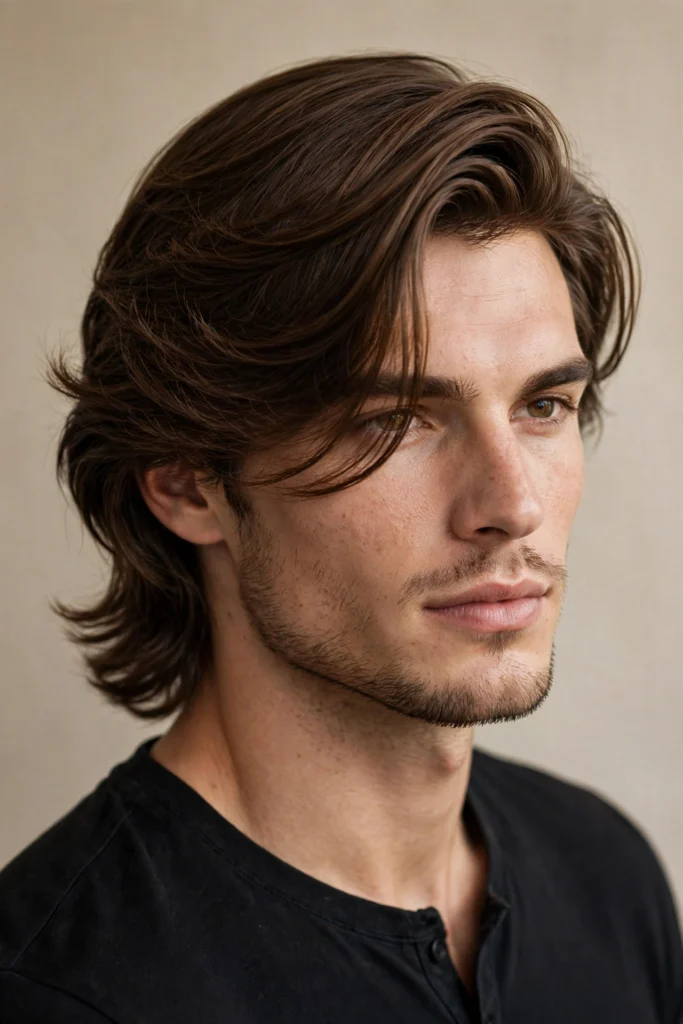
Instead of sweeping straight back, the side-swept flow pushes the length up and over to one side — volume at the roots, movement across the forehead, everything flowing diagonally. It’s the most dynamic version of the cut, with a sense of motion even when you’re standing still. The asymmetry flatters a wide range of faces because it breaks up symmetry and adds visual interest.
Styling needs a little root lift to work. Blow-dry the roots upward and to the side on medium heat — this is the one flow version where I’d actually recommend the blow dryer as a regular tool, because air-drying tends to collapse the sweep flat. A light volumizing mousse on damp roots before drying gives the sweep something to stand on. Then matte paste through the lengths for control. The side-swept flow is also the best choice for guys with cowlicks, since the diagonal direction works with unruly growth patterns instead of fighting them.
9. The Slicked-Back Bro Flow
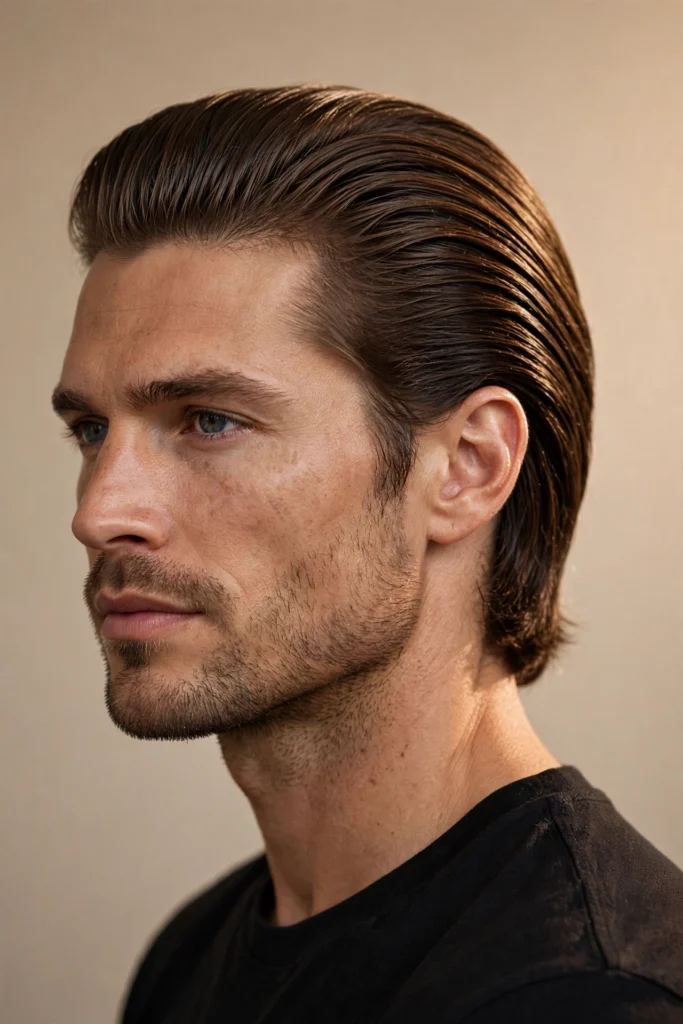
The flow’s polished cousin. Same length, same grown-out sides, but styled with a light pomade or cream and combed back smooth for occasions that need it — weddings, interviews, dinners where the surfer version would raise eyebrows. The hair stays back all day, the silhouette is clean, and from a distance it reads almost like a classic slick back. Up close, the length and the soft ends give it away as a flow.
Don’t use heavy pomade. The classic slick-back products — the high-shine, helmet-grade stuff — will crush the flow’s movement and make it look like a different, stiffer haircut. Use a light cream pomade or a fiber cream: enough hold to keep it back, enough flexibility that it still moves when you turn your head. This version is a styling choice more than a separate cut, which is its real value — grow the flow once, and you get both the casual and the polished version from the same head of hair. Keep the product light and wash it out properly; product buildup is the enemy of every flow.
Bro Flow Men Styles 10–12: The Lengths

Length is the variable that changes the flow most. These three cover the spectrum — the starter length for guys still growing, the full long version, and the shaggy middle ground where rock history lives.
10. The Short Bro Flow (Starter Flow)
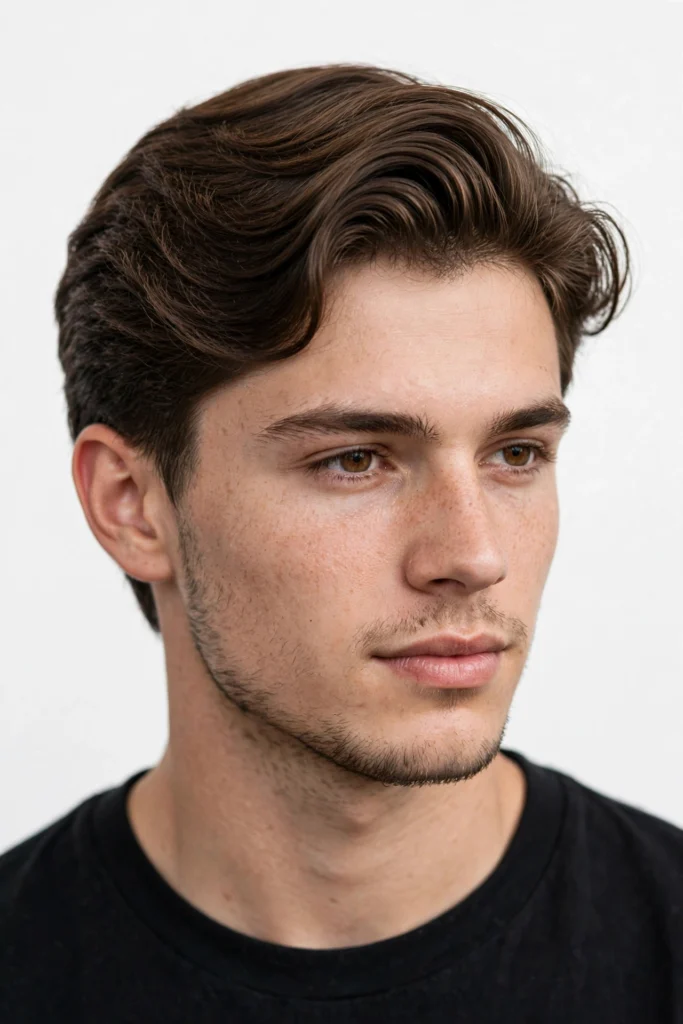
Not everyone starts with the length, and the starter flow is the honest version for guys in months one to three of growing out. The top is three to four inches — long enough to push back, short enough to control. The sides are kept neat and blended so the whole thing reads as a deliberate short cut rather than a grow-out in progress. This is the flow’s on-ramp, and there’s no shame in it.
The starter flow is actually easier to style than the full version because shorter hair obeys better. A little sea salt spray, push it back with your fingers, done. It’s also the version to choose if you’re testing whether the flow suits you before committing to the full grow-out. Live with the starter for a month. If you like what you see in the mirror, keep growing. If you don’t, you’ve lost nothing — it’s a perfectly good haircut on its own. Think of it as the flow’s trial period.
11. The Long Bro Flow
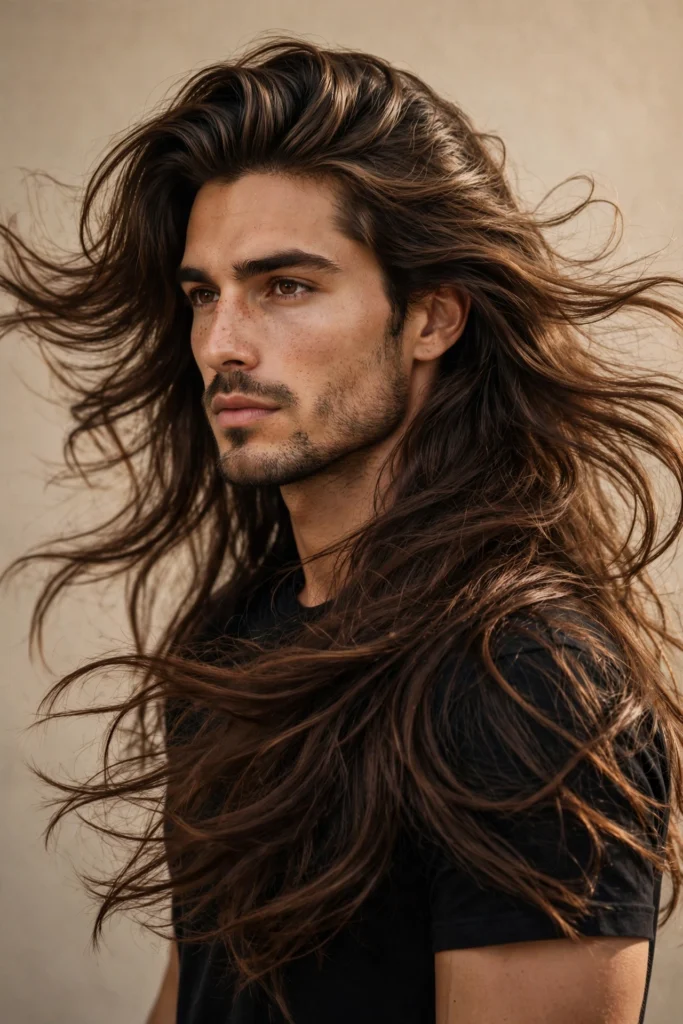
Shoulder-grazing or beyond, the long flow is the full commitment — the version that turns heads and starts conversations. At this length the hair has real weight and real movement; it shifts when you move, catches wind, and photographs like nothing shorter can. This is the playoff-hockey version, the rockstar version, the one that makes people ask where you get your hair cut.
Long flow demands long-hair discipline. Condition every wash — long hair’s ends are old hair, and old hair needs help. Get the ends trimmed every ten to twelve weeks; split ends travel upward and a long flow with damaged ends looks straggly instead of lush. Sleep with it loosely tied or in a loose braid if it tangles overnight. And accept the maintenance reality: more shampoo, more conditioner, more drying time, more everything. The long flow is the best-looking version and the most work. That’s the trade, and it’s worth it if you want it — just go in with your eyes open.
12. The Shaggy Bro Flow
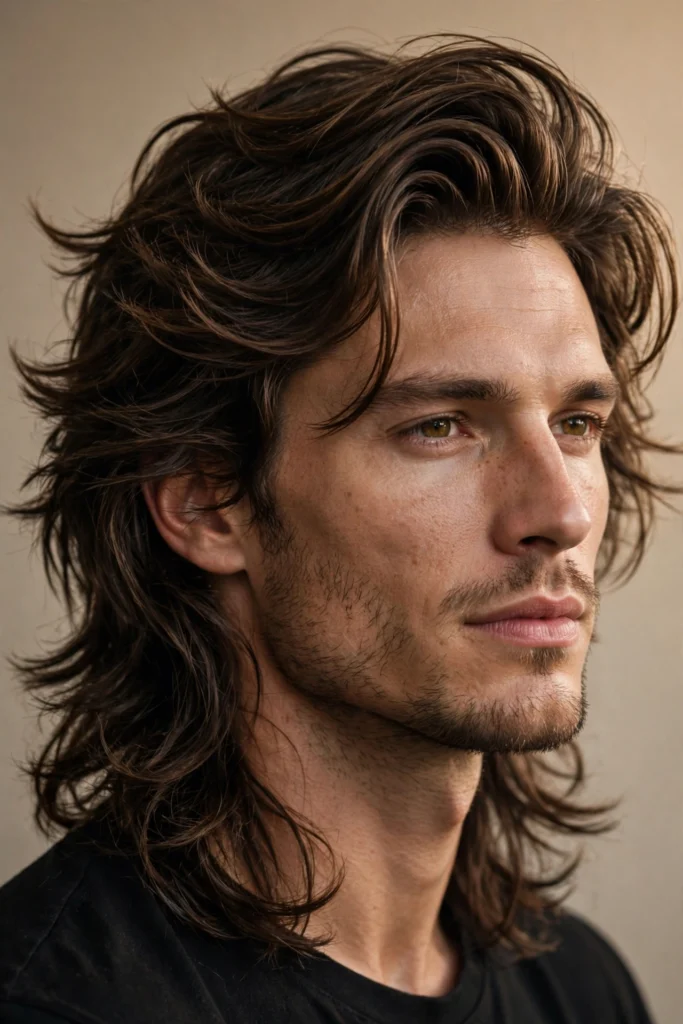
The shaggy flow borrows from the 70s and 90s — more layers, more texture, ends that flip and kick instead of lying obediently. It’s the flow with rockstar DNA: think grown-out shag meets swept-back flow. The layers create natural volume and the flipped ends give it a wildness the classic doesn’t have. This version suits guys with thick hair especially well, because the layers remove the bulk that would otherwise make a thick flow puff out.
Styling the shaggy flow is about encouraging the chaos, not controlling it. Sea salt spray, scrunch, air-dry — the layers do the rest. A razor-cut finish from your barber enhances the piece-y ends; ask for it specifically if you want the full shag effect. The shaggy version is also the most forgiving of bad hair days, because “messy” is the entire aesthetic. If your hair has a mind of its own and you’ve spent years fighting it, stop fighting and grow the shaggy flow. It was designed for hair like yours.
Bro Flow Men Styles 13–14: The Weekend Versions
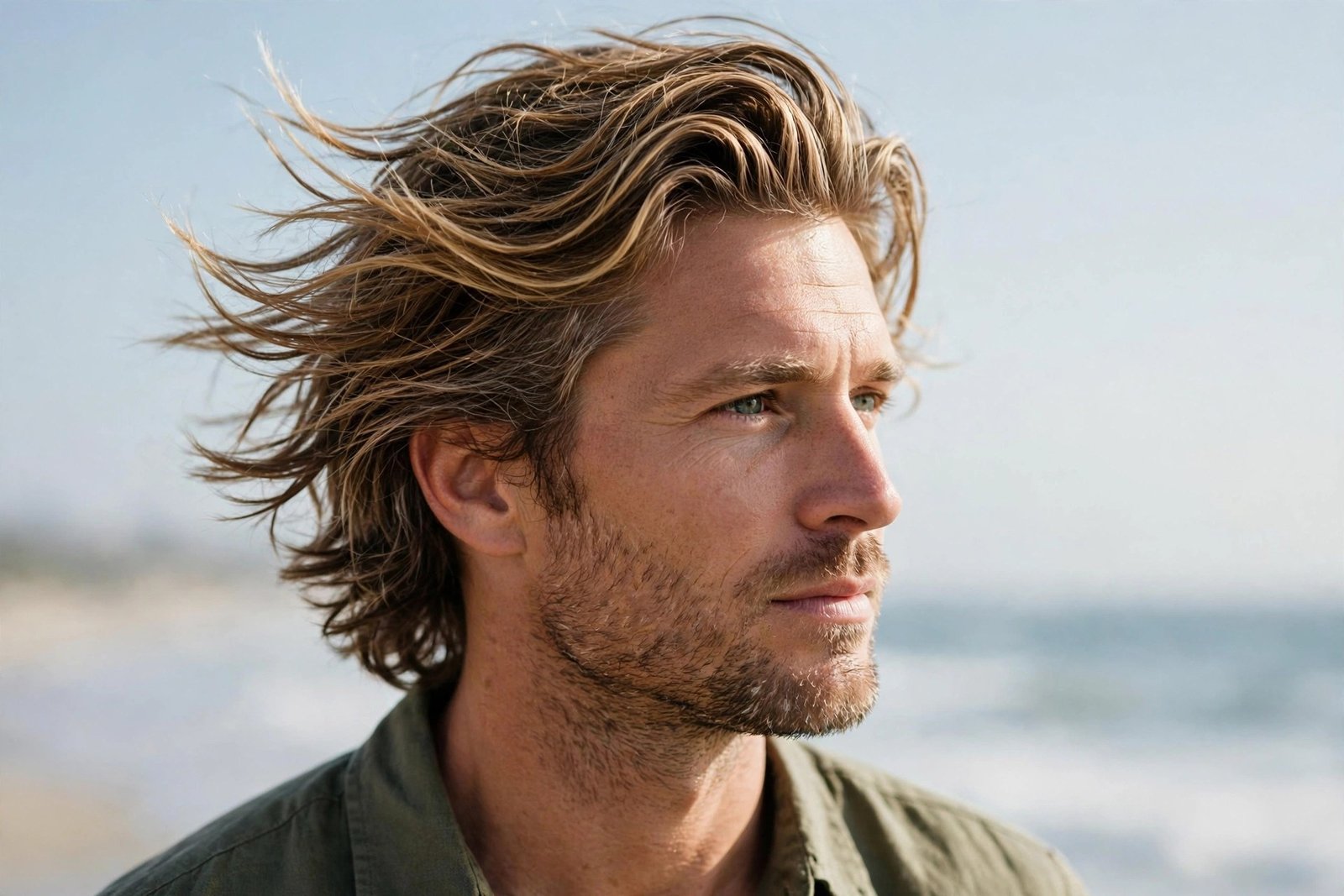
Some flows are built for salt water and sunlight. These two are the relaxed end of the spectrum — the versions that look best slightly undone and get better the less you fuss over them.
13. The Surfer Bro Flow

The surfer flow is the bro flow at its most natural — sun-lightened, salt-textured, wind-shaped. The hair is medium to long, the texture is beachy, and the whole thing looks like the ocean styled it. This is the version with the least barber involvement and the most lifestyle involvement: it’s less a cut and more a condition that happens to guys who spend time outside.
You don’t need to live near a beach — sea salt spray is literally bottled ocean, and it’s the entire styling routine. Spray damp hair generously, scrunch, air-dry. That’s it. If you want the sun-lightened ends, they come free with actual sun exposure over a summer, or your colorist can fake them. The surfer flow suits wavy hair best and looks slightly undone by design, which makes it the lowest-pressure version on this list. The only rule: keep the ends healthy. Sun and salt dry hair out, so condition more than you think you need to.
14. The Curly Bro Flow
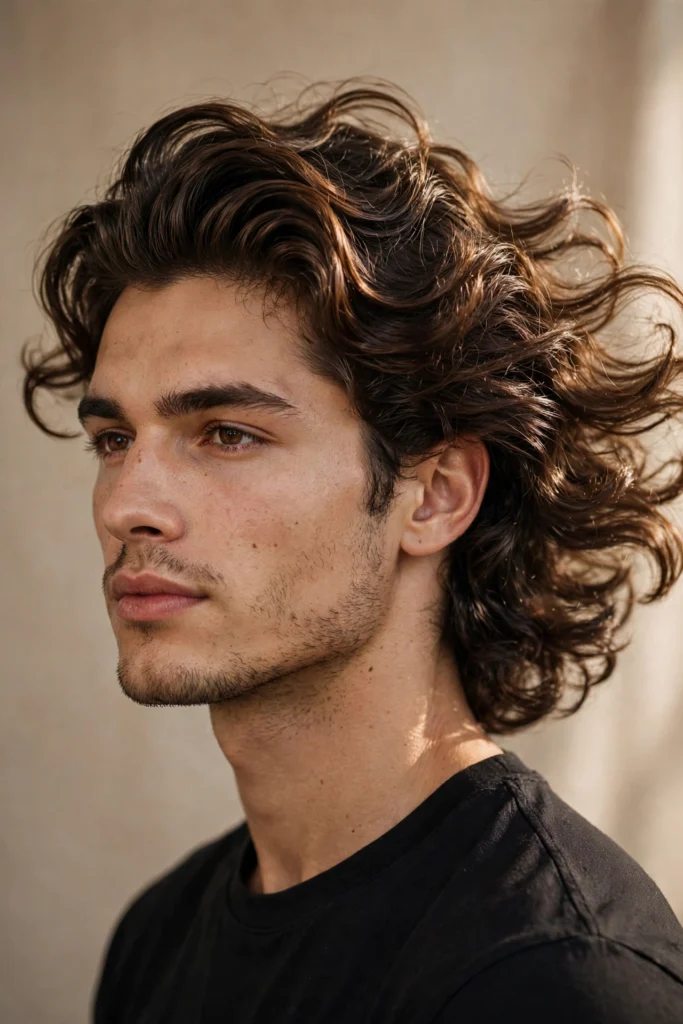
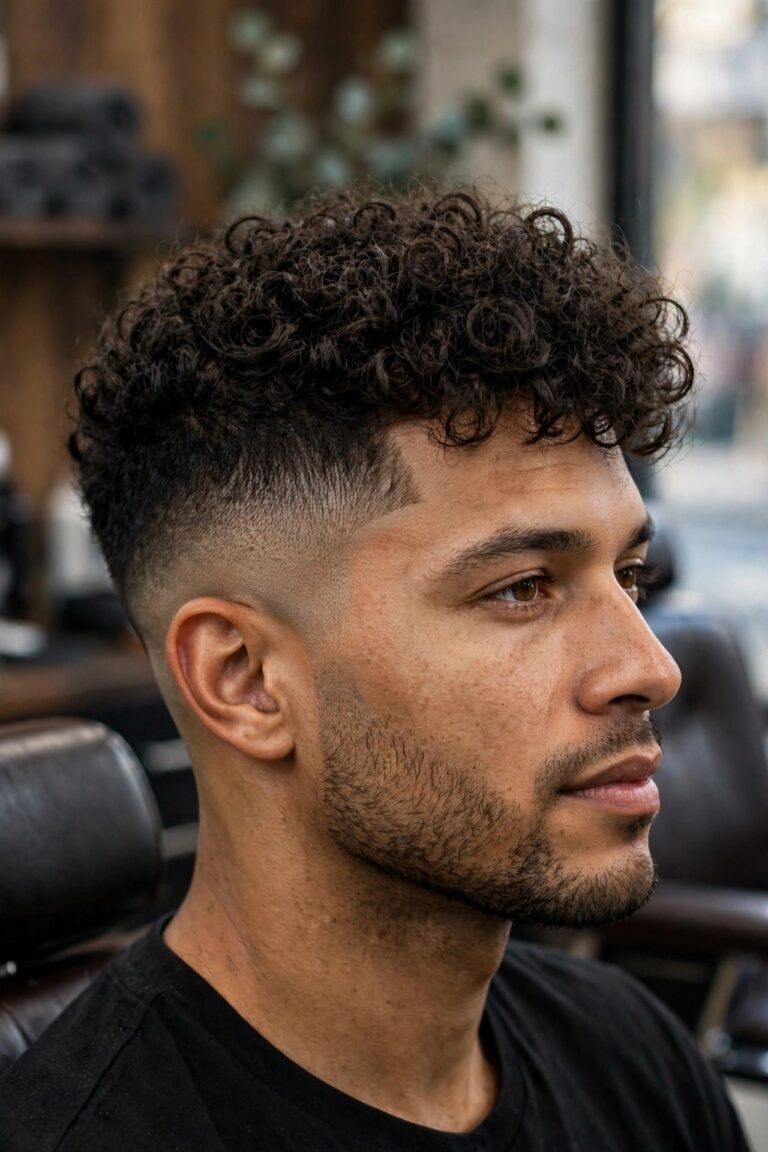
Curly hair grown into a flow becomes something special — bigger, bolder, with volume and movement that straight hair can’t touch. The curls are grown out and directed back, creating a flow with real three-dimensional texture. This version has the most personality on the list. It doesn’t whisper; it announces.
Curly flow needs moisture above all else. Curly hair is naturally drier, and dry curls frizz instead of flowing. Leave-in conditioner on damp hair, then a curl cream to define — scrunch it in, don’t rake it through, because raking breaks up curl clumps. Diffuse or air-dry; never rough-dry curly hair with a towel, which is a guaranteed frizz bomb. The sides need management too: curly sides grow outward, not downward, so your barber should shape them to tuck and blend rather than letting them triangle out. Get the moisture and the shaping right and the curly flow is genuinely one of the best-looking cuts a curly-haired guy can wear.
Bro Flow Men Styles 15–16: The Bold Statements

The last two are for guys who want the flow plus something extra — color dimension and boardroom polish. Proof that the cut’s range runs from beach to office.
15. Bro Flow with Sun-Kissed Highlights
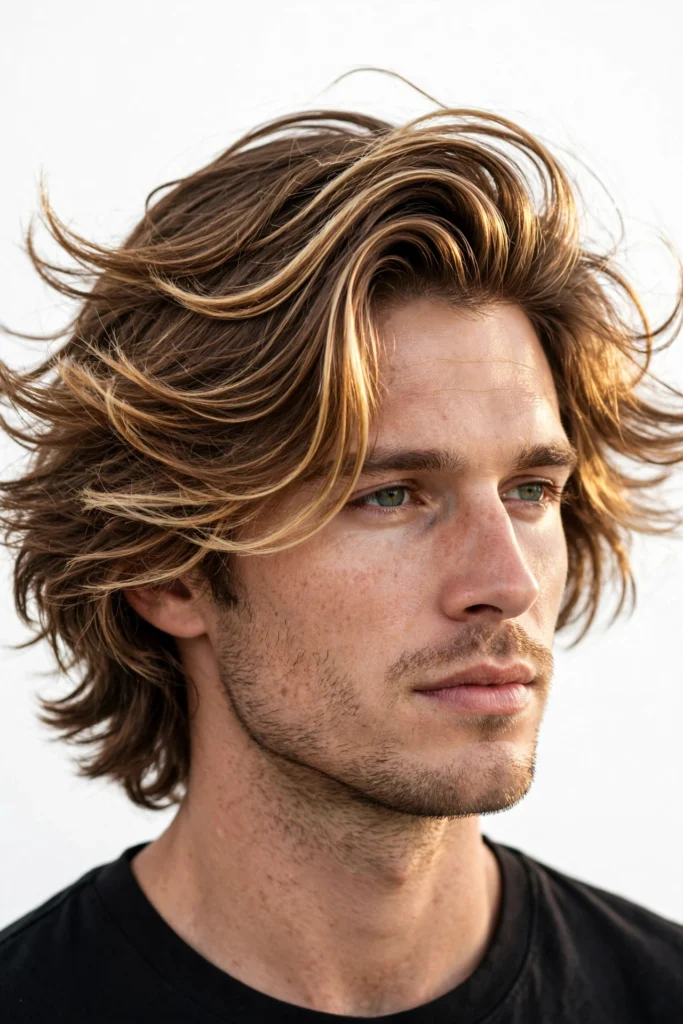
Color changes the flow completely. Sun-kissed highlights or a subtle balayage through the lengths adds dimension that makes every wave and bend visible — the light pieces catch the eye and the darker base gives them something to play against. On a flow, where movement is the whole point, dimension is a multiplier. The same cut with and without highlights looks like two different haircuts.
Keep it natural or don’t do it at all. The goal is “spent the summer outside,” not “spent three hours in a salon chair” — ask your colorist for a lived-in balayage, two shades lighter at most, focused on the mid-lengths and ends where the sun would actually hit. Maintenance is refreshingly low: because there’s no harsh regrowth line, you can go three to four months between appointments. The one non-negotiable is hair health — lightened hair needs conditioning and occasional toning, because brassy, damaged highlights will drag the whole flow down. Done right, this is the version that gets compliments from strangers.
16. The Executive Bro Flow
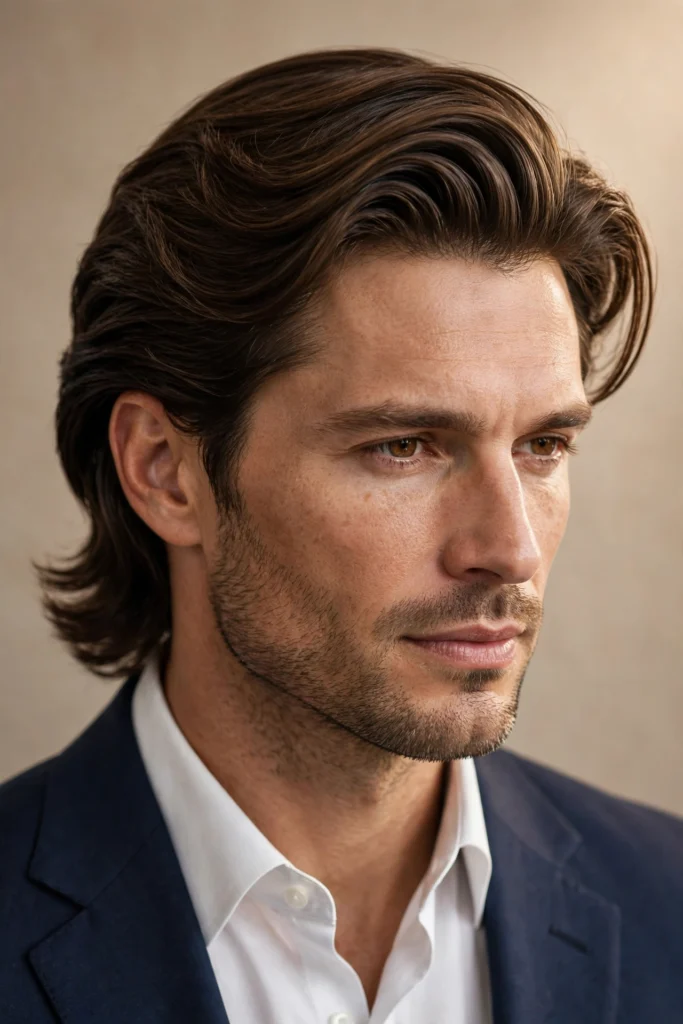
The boardroom flow. Same grown-out length, but styled with intention: tucked neatly behind the ears, swept back smooth, every strand in formation. It keeps the flow’s length and movement while reading completely professional — the version that walks into a client meeting without a second thought. Plenty of guys in finance, law, and consulting wear exactly this; they just don’t call it a bro flow.
The styling is the polished routine: blow-dry back smooth with a brush for control, light cream pomade for hold without shine overload, tuck behind the ears. It takes ten minutes instead of four, and it lasts all day. The cut underneath can be identical to the classic — the difference is entirely in the styling, which means one head of hair gives you both the weekend flow and the weekday executive. That’s the flow’s secret superpower: it’s not one haircut, it’s a wardrobe. Grow it once, style it a dozen ways.
Does the Bro Flow Suit You? Face Shapes and Hair Types
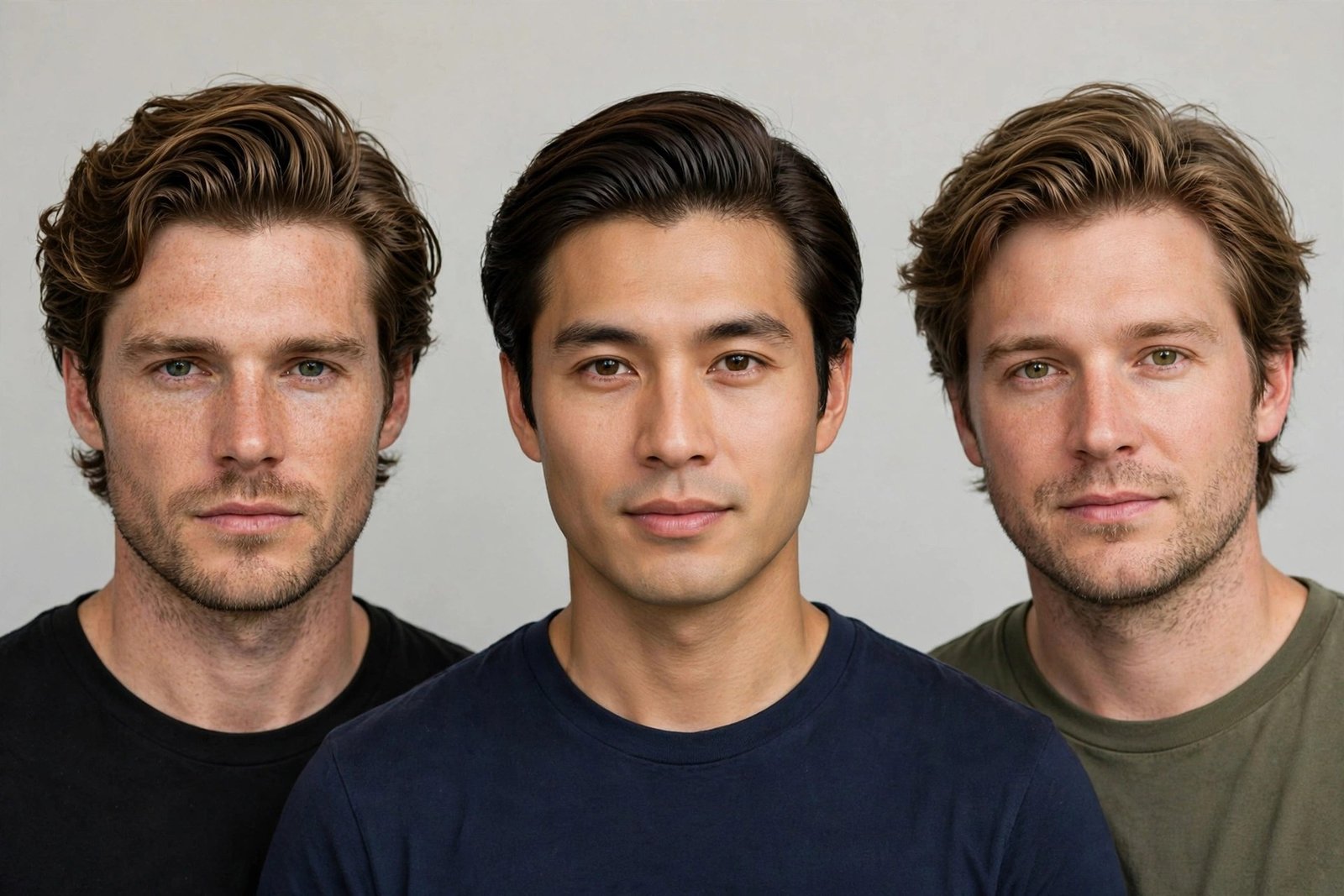
Here’s the good news first: the bro flow is one of the most forgiving cuts in men’s grooming. Because the hair moves and the silhouette is soft, it doesn’t carve your face into a shape the way a skin fade or a sharp fringe does. That said, “forgiving” isn’t “universal,” so here’s the honest breakdown.
Oval faces can wear every version on this list — the balanced proportions take length in any direction. Square faces do well with the classic, the wavy, and the side-swept versions, because the flow’s softness offsets a strong jawline; avoid the slicked-back version if your jaw is very wide, since pulling everything tight emphasizes the width. Round faces want volume on top and height at the crown — the textured flow, the side-swept, and the long flow all add the verticality that flatters roundness; keep the sides from puffing outward, which widens the face. Oblong faces should be careful with too much height on top — the classic and the surfer versions, which sit closer to the head, work better than the big-volume shaggy or curly versions.
Hair type is the bigger factor. Straight to wavy hair (the majority of flow wearers) gets the easiest ride — the hair sweeps back naturally and holds the direction. Thick hair needs bulk removal from your barber or it will puff instead of flow; this is a cutting issue, not a styling issue, so say it in the chair. Curly and coily hair can absolutely flow, but it’s a different cut with more volume and needs the moisture routine from style fourteen — don’t expect it to look like the straight-hair photos, expect it to look better in its own way. Fine or thinning hair: keep the flow shorter (the starter length), because long fine hair separates and exposes the scalp. And a receding hairline plus a swept-back style is a combination to think twice about — the flow pulls attention to the hairline, so the side-swept version or a shorter flow is kinder than the slicked-back one.
Styling the Bro Flow: Products and Routine

The bro flow’s reputation is “wake up and go,” and that’s mostly true — once the length exists. The actual routine is short but specific, and the products matter more than the technique. Here’s the daily playbook.
Start with damp hair. The flow styles best from damp, not wet and not dry — towel off after a shower until it’s just moist. Spray sea salt spray through the lengths, focusing on the mid-shaft to ends where you want texture. This is the foundation product: it adds the grit and separation that makes hair look lived-in instead of limp. Then push everything back with your fingers — not a comb, fingers — working from front to back. Finger-styling keeps the natural separation; a comb makes it uniform and flat, which kills the flow’s character.
Drying is where guys split into two camps. Air-drying gives the most natural result and it’s what the surfer and wavy versions want — just leave it and let it do its thing. Blow-drying gives more control and more volume: use medium heat, point the dryer back, and lift at the roots with your fingers for the side-swept or executive versions. Diffuser if you’re curly. Either way, don’t over-dry — the flow should feel like hair, not straw. Finish with product on dry hair: a pea-sized amount of matte paste or light cream, warmed between your palms and worked through the ends. The ends are where the flow lives or dies — defined ends look styled, frizzy ends look neglected.
The product shelf, kept minimal. Sea salt spray (the non-negotiable core), a matte paste or clay for texture and hold, a light cream or fiber cream for the polished versions, and a leave-in conditioner if your hair runs dry. That’s the complete kit — four products, and most days you’ll use two. What you don’t need: heavy pomades (they crush movement), gels (they crunch), hairspray (it freezes the flow solid, defeating the purpose), and anything with “extra strong hold” on the label. The flow’s whole identity is movement. Buy products that allow movement.
Wash routine matters more than guys expect. Shampoo two to three times a week, not daily — overwashing strips the natural oils that give the flow its lived-in texture, and squeaky-clean hair is actually harder to style into a flow. Condition every time you shampoo, focusing on the ends. Once a week, if you use a lot of product, do a proper clarifying wash so buildup doesn’t weigh the hair down. And get the ends trimmed every ten to twelve weeks. Split ends on a flow are visible from across the room because the ends are the whole show.
Growing It Out: The Awkward Phase Survival Plan

Nobody warns you about months two through four. Month one, your hair is just short. Month five, you’ve got something that looks like a flow. But months two, three, and four are the awkward phase — the hair is too long to look intentional and too short to sweep back. It flips out at the ears, poofs at the sides, and does whatever it wants in the morning. This is where most guys quit. Here’s how to not be most guys.
First, understand the timeline so you can see where you are. Hair grows roughly half an inch per month. From a short cut to a four-inch flow is eight months of pure growth — but you don’t need the full four inches for it to start looking right. Around three inches on top (month five or six from short), the hair gets heavy enough to sweep back and stay. The worst of the awkwardness is months two through four, when the top is one to two inches and has opinions. Knowing it’s temporary — and knowing exactly when it ends — makes it survivable.
The survival tactics are practical. Get a shape-up every six to eight weeks during the grow-out: not a haircut, a tidy — clean the neckline, trim around the ears, take a whisper off the ends to keep them healthy. This is the difference between “growing it out” and “gave up on haircuts.” Wear a hat or style it forward on bad days; there’s no prize for suffering visibly. Sea salt spray actually helps in the awkward phase too — texture disguises the in-between-ness. And tell your barber the plan at every visit: “I’m growing a flow, just clean it up.” If you don’t say it, they’ll cut it like a finished haircut and set you back two months.
The mental game is the real battle. You’ll have a day around month three where you catch your reflection and think about buzzing it all off. Every guy who’s grown a flow has had that day. Take a photo instead — monthly progress photos are the secret weapon, because the mirror lies to you daily but a photo from two months ago tells the truth. Find one reference photo of the flow you want and keep it on your phone; look at it on the bad days. And remember what you’re buying with the awkward months: a haircut that, once grown, needs four minutes a morning and looks better than everything that needs forty. The awkward phase is the price of admission. Pay it.
FAQ

Quick answers to the questions guys actually ask — in the chair, in comments, and in messages to friends who already have the flow.
How long does it take to grow a bro flow?
From a short haircut, expect six to eight months to reach a proper four-to-six-inch flow. You’ll have something workable around month five or six, when the top hits three inches and gets heavy enough to sweep back. From a medium cut that’s already a couple of inches long, cut that timeline roughly in half. Hair grows about half an inch per month and there’s no product or trick that changes the biology — anyone selling you a faster timeline is selling you something. The guys with great flows all have the same story: they just didn’t quit.
Can I get a bro flow with straight hair?
Yes — straight hair flows fine, it just needs more help than wavy hair. The challenge is that straight hair wants to lie flat against the skull instead of sweeping back with body. Sea salt spray is your best friend: it adds the grit and lift that straight hair lacks naturally. A blow dryer on medium heat, directed back with your fingers lifting at the roots, trains the direction. And ask your barber for layers and point-cut ends — blunt-cut straight hair looks like a curtain, textured straight hair looks like a flow. Very fine straight hair should keep the flow shorter; the starter length is the honest choice there.
What products do I actually need for a bro flow?
Four, and most days you’ll use two. Sea salt spray for texture (the core product), a matte paste or clay for definition and light hold, a light cream for the polished versions, and conditioner — which counts as a product because the flow’s ends need it. Skip the heavy pomades, gels, and extra-strong-hold anything; they all work against the movement that makes a flow a flow. Total cost for a solid kit is modest, and everything lasts months because you’re using small amounts. The flow is one of the cheapest cuts to maintain once it’s grown — the grow-out patience is the real cost.
Does the bro flow work for a professional office job?
Yes, with the right version and styling. The executive flow — tucked behind the ears, swept back smooth — reads completely professional and plenty of guys in conservative industries wear it. The low-taper pairing keeps the edges clean for stricter dress codes. What doesn’t fly in most offices is the surfer version at full beach mode, but that’s a styling choice, not a cut problem — the same head of hair does both. Keep it clean, keep the ends healthy, style it with intention in the morning, and nobody’s questioning it. A well-kept flow looks more polished than a growing-out fade, frankly.
How often should I get the bro flow trimmed?
Every ten to twelve weeks once it’s grown — you’re maintaining ends and shape, not cutting length. During the grow-out, a tidy every six to eight weeks: neckline, around the ears, a whisper off the ends. The flow is the opposite of a fade’s schedule; if your barber wants you back in three weeks, that’s a fade schedule and it’ll keep resetting your progress. Tell them the plan every visit. The only exception is the low-taper and undercut pairings, where the short sections need their own three-to-four-week rhythm while the top keeps growing.
Conclusion
The bro flow endures because it’s honest. It doesn’t pretend your hair is something it’s not — it takes what grows out of your head and shapes it into its best version. No architecture, no weekly appointments, no product helmet. Just length, texture, and movement. In a grooming era that spent a decade chasing precision, there’s something refreshing about a cut whose whole philosophy is letting hair be hair, only better.
If you’re starting from short hair, here’s the whole plan in one paragraph: tell your barber you’re growing a flow and get shape-ups every six to eight weeks, survive months two through four with hats and sea salt spray, take a monthly photo so you can see the progress, and around month six start styling it for real. Pick your version from the sixteen above — the classic if you want safe, the wavy if your hair does the work for you, the executive if the office is watching. Four products, four minutes a morning, one great head of hair.
Sixteen styles, one grow-out, zero shortcuts that actually work. The awkward phase is the price and the flow is the reward, and every guy wearing one paid the same price you’re about to pay. Book the shape-up, buy the sea salt spray, and start growing. Your flow is waiting.