Induction Cut Men 2026: 28 Military-Sharp Styles, Lengths & Honest Advice
The Induction Cut Is Taking Over 2026 — Here’s the Honest Guide
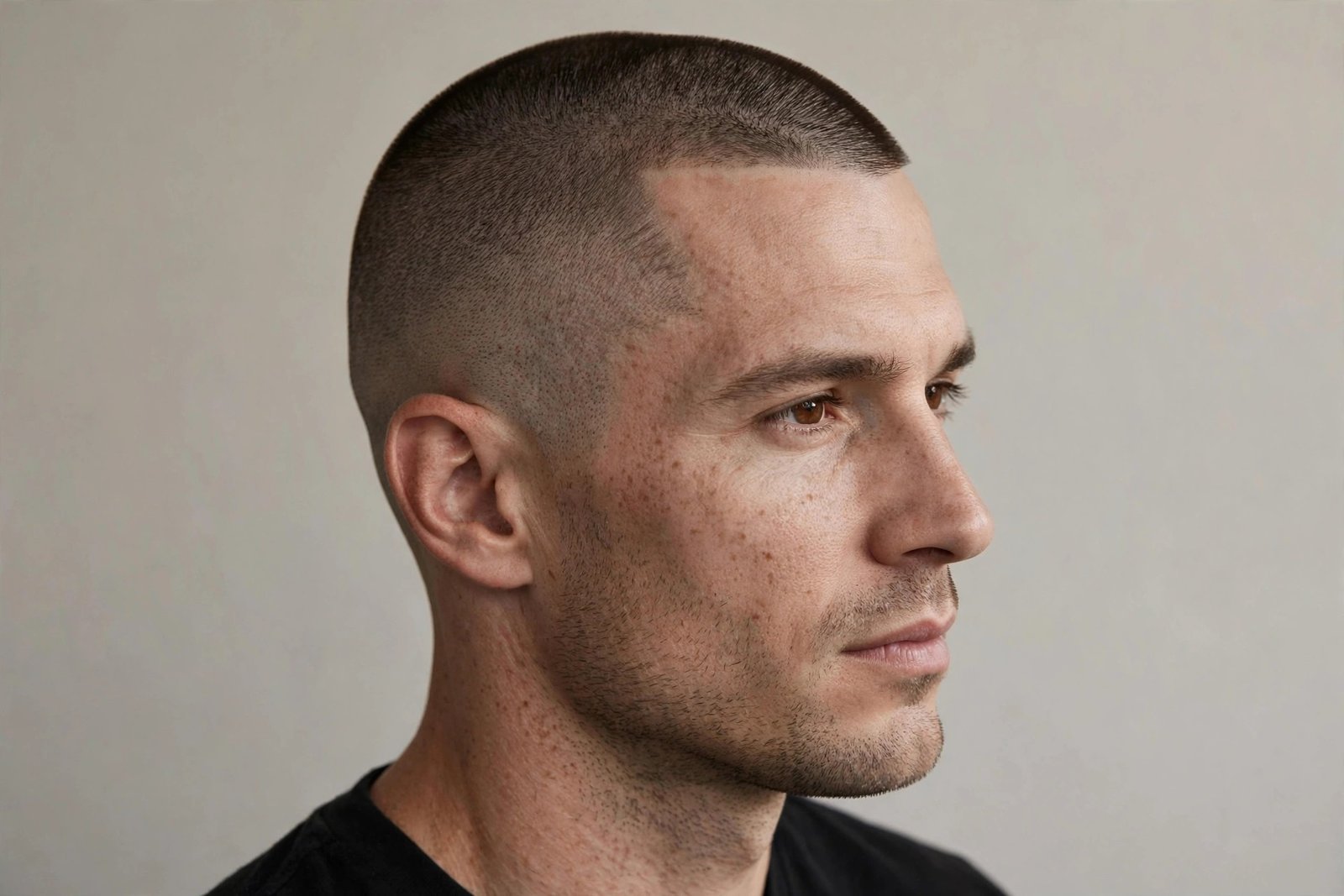
There’s a haircut quietly dominating barbershop chairs in 2026, and it’s the shortest one in the book. The induction cut men trend has exploded — booking-platform data shows searches up roughly 83% year over year — and it makes perfect sense once you see it. One guard. All over. Zero styling. It looks sharp, disciplined, and oddly expensive, like you hired someone to simplify your entire morning.
But here’s what most articles won’t tell you: the induction cut is also one of the most unforgiving haircuts a man can get. There’s nowhere to hide. Your head shape, your hairline, every bump on your scalp — it’s all on display. That’s exactly why I wrote this guide the way I did. You won’t find vague fluff here. You’ll find what the cut actually is, how it differs from a buzz cut and a crew cut, which guard length to ask for, how to adapt it for civilian life (beard, fade, face shape, thinning hair), and 28 genuinely distinct styles so you walk into the barbershop knowing exactly what you want.
I’ve watched this cut on hundreds of heads over the years — in the chair, on the street, in old military photos my grandfather kept. The induction cut done right is a power move. Done wrong, it’s a two-week sentence of hat-wearing. This guide is built to make sure you land in the first camp. Let’s get into it.
Table of Contents
- The Induction Cut Is Taking Over 2026
- What the Induction Cut Actually Is
- 28 Induction Cut Styles for Men in 2026
- Maintenance, Barber Scripts & Scalp Care
- Frequently Asked Questions
- Conclusion
What the Induction Cut Actually Is (No, It’s Not Just a Buzz Cut)
Let’s clear this up first, because barbers hear the confusion every single day. The induction cut is the haircut given to new military recruits on their first day of basic training — the literal moment of induction into service. Traditionally it’s a #0 or #1 guard taken at one single length over the entire head: crown, sides, back, everything. No taper. No fade. No “a little longer on top.” The whole point is uniformity — speed, hygiene, discipline, and a head of hair that needs nothing from you for the next week.
A buzz cut, by contrast, is the entire family of clipper cuts. A buzz can be a #4 on top with tapered sides. It can have a skin fade, a textured top, a lineup. The induction cut is the most extreme, most uniform member of that family — the one that refuses all variation. And a crew cut? That’s a different animal entirely: longer on top (usually an inch or more), tapered sides, actually styled with product. If your cut needs pomade, it isn’t an induction.
The civilian version you’ll see in this guide keeps the induction’s DNA — ultra-short, uniform, crisp — but it borrows a few modern tricks. A sharp lineup along the hairline. A subtle fade on the sides. A beard for balance. These adaptations are what took the cut from boot camp to barbershop, and they’re why it works on men who’ve never worn a uniform in their lives.
Why 2026 Fell Hard for the Shortest Cut in the Book
Every few years, men’s hair swings hard toward simplicity, and 2026 is one of those years. Search any barbershop booking platform and the induction cut men want most in 2026 sits near the top of every trending list. After a long run of high-maintenance styles — the textured crops, the curtain cuts, the two-hour morning routines — a lot of men hit a wall. The induction cut is the backlash: fifteen minutes with clippers, no product, no styling, and you look deliberate instead of lazy. Style editors at GQ have been spotlighting ultra-short military cuts as the year’s defining men’s look, and the street has followed.
There’s also a deeper reason, and I’ll be honest about it: the induction cut reads as confident. Shaving your head down to a shadow says you’re not hiding anything. In an era of filters and forty-five-minute grooming routines, that kind of directness stands out. Athletes wear it. Actors wear it between roles. Regular guys wear it because the shower-to-door time is under four minutes.
And practically speaking, it’s cheap. A decent pair of clippers costs less than two barbershop visits, and the cut itself is the easiest one to learn at home — one guard, all over. The barrier to entry is basically zero, which is why the trend keeps feeding itself. Try it once, realize you look good, never go back. That’s the pipeline, and 2026 is full of men currently inside it.
Who Actually Suits an Induction Cut — the Honest Version
Barbers won’t always tell you this part, but I will: the induction cut flatters some men enormously and punishes others, and it comes down to three things — head shape, hairline, and scalp condition. Oval and square faces tend to look superb; the short length sharpens strong jawlines and cheekbones and gives the whole face a carved quality. If you’ve got good bone structure, this cut is basically a spotlight for it.
Round faces need a little strategy. A uniform #1 all over can make a round face look rounder — there’s no hair up top to add height or angles. The fix is simple: grow a beard (even stubble changes the geometry), or ask for a slightly longer guard on top than the sides so there’s a whisper of height. Long, narrow faces have the mirror-image issue: the cut can emphasize length, so again, facial hair or a touch more length on top helps balance things out.
Then there’s the scalp question. At a #0, every bump, scar, and mole shows. At a #1 or #2, most of that disappears into the shadow of hair. If you’ve never seen your bare scalp before, start at a #2 and work down — you can always go shorter next time, but you can’t un-cut a #0 before a wedding. Thinning hair, though? That’s where this cut genuinely rescues men. When everything is 3mm long, the contrast between thick and thin zones nearly vanishes. Many barbers quietly consider the induction the most dignified answer to a receding hairline that exists.
28 Induction Cut Styles for Men in 2026
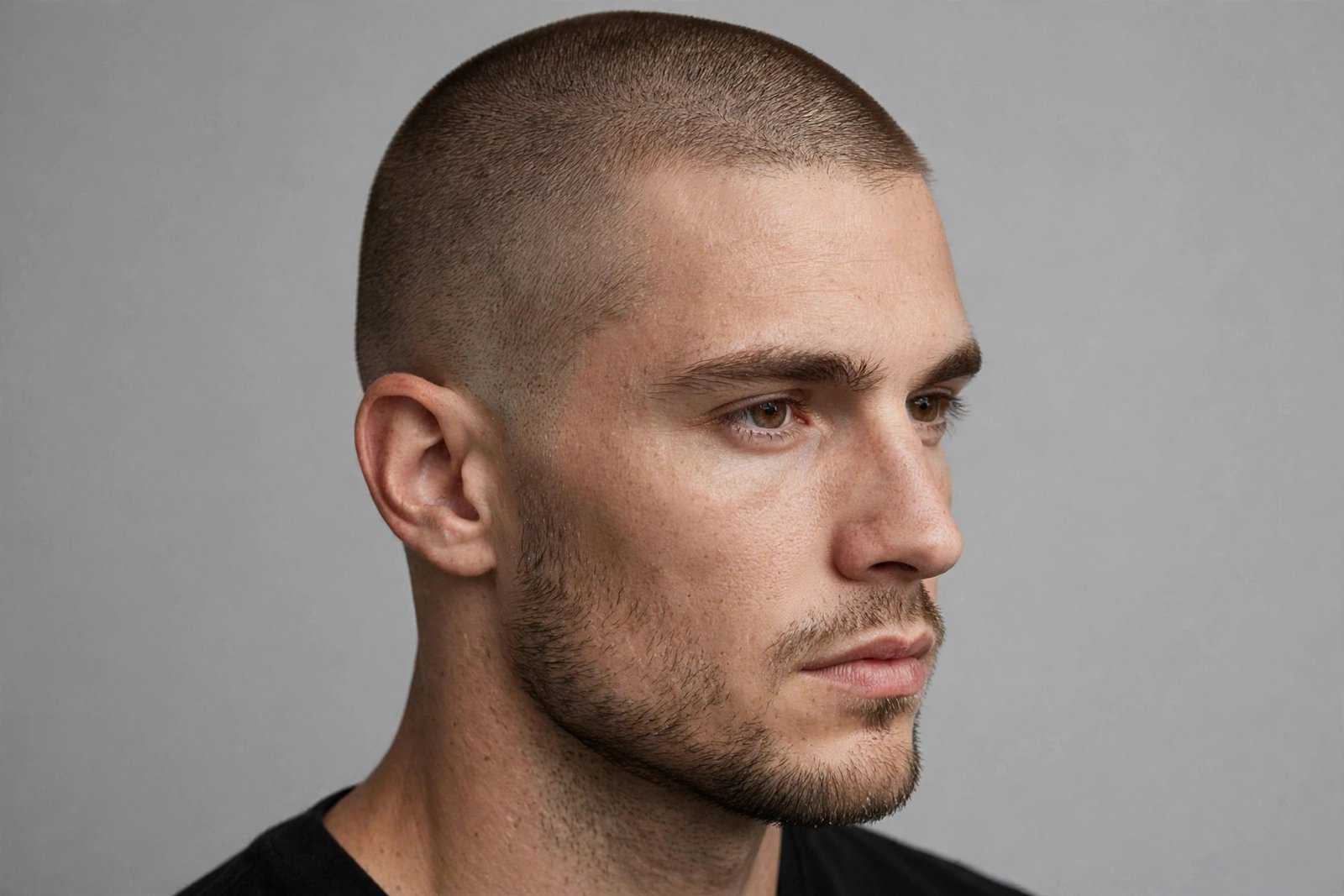
Here they are — 28 induction cut men are actually wearing in 2026, from the authentic boot-camp original to the civilian-adapted versions that are actually driving the 2026 trend. Every style below is genuinely different: different guard, different finish, different face it’s built for. Read the honest downsides on each one before you commit, because at this length there’s no styling your way out of a bad choice.
1. The Classic Single Guard 1 Induction
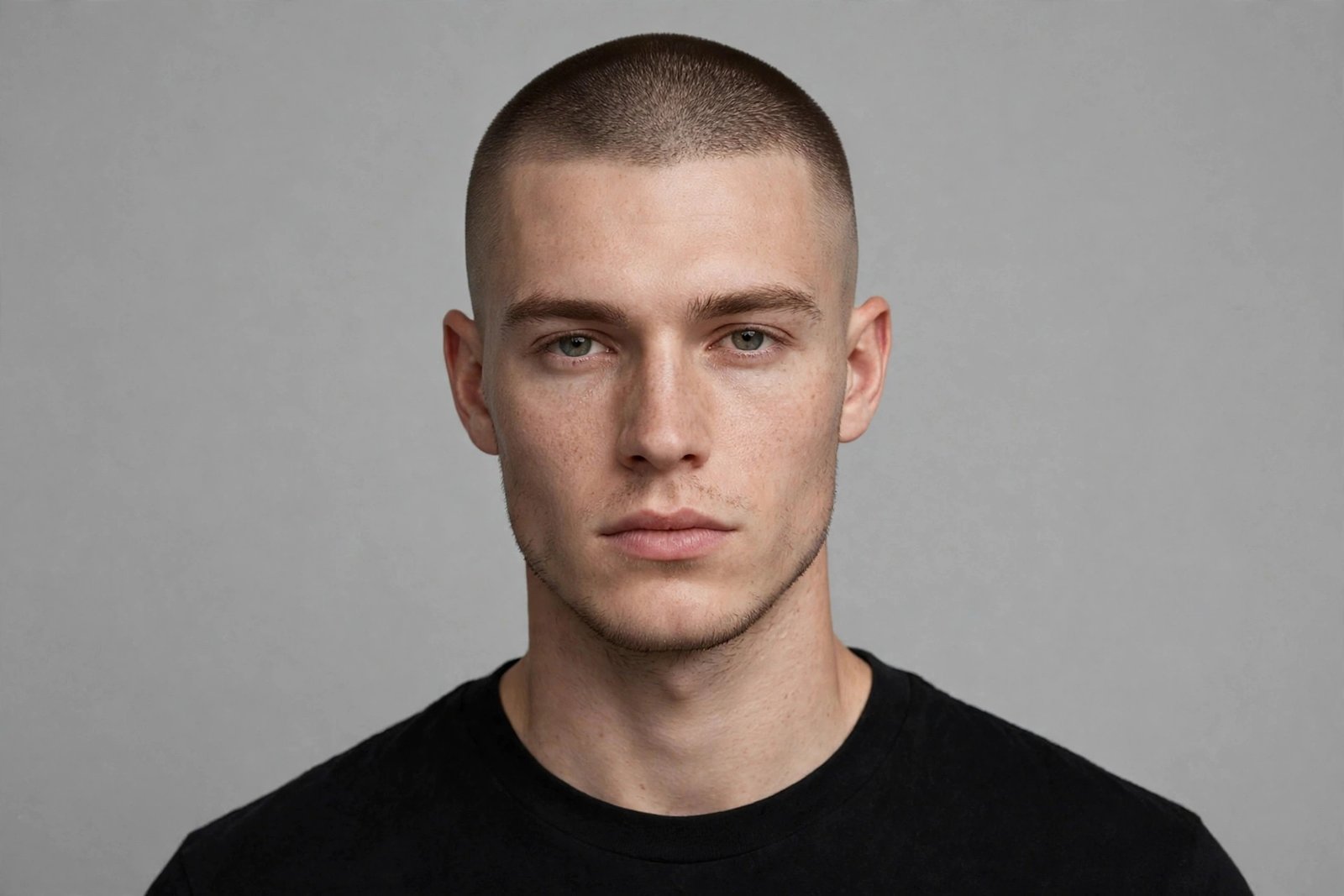
This is the one that started it all — the authentic induction in its purest civilian form. A single #1 guard (3mm) taken at exactly one length over the entire head: crown, sides, nape, everything. No taper, no fade, no lineup tricks. What you get is a uniform shadow of hair that looks disciplined from every angle and feels like velvet under your hand. It’s the reference point every other style on this list is measured against, and the induction cut men new to the trend should try first.
Who suits it? Almost everyone, honestly — which is why it’s number one. The #1 leaves just enough hair to soften scalp imperfections while still reading as a true induction. Oval, square, and heart-shaped faces look particularly strong. It suits men who want the statement without the severity of skin.
Ask your barber for: “Single #1 guard all over, one length everywhere, natural hairline.” That’s the whole script. Ten words, fifteen minutes, done.
Maintenance is the easiest of any haircut on earth: run the #1 over your head once a week at home and you’ll never need a barber for this again. The honest downside? Growth shows fast. By day eight it starts reading less “military sharp” and more “hasn’t been to the barber” — so the weekly touch-up isn’t optional if you want it crisp. It also does nothing to add height, so very round faces should pair it with a beard (see style 8).
2. The Zero-Guard Skin Induction
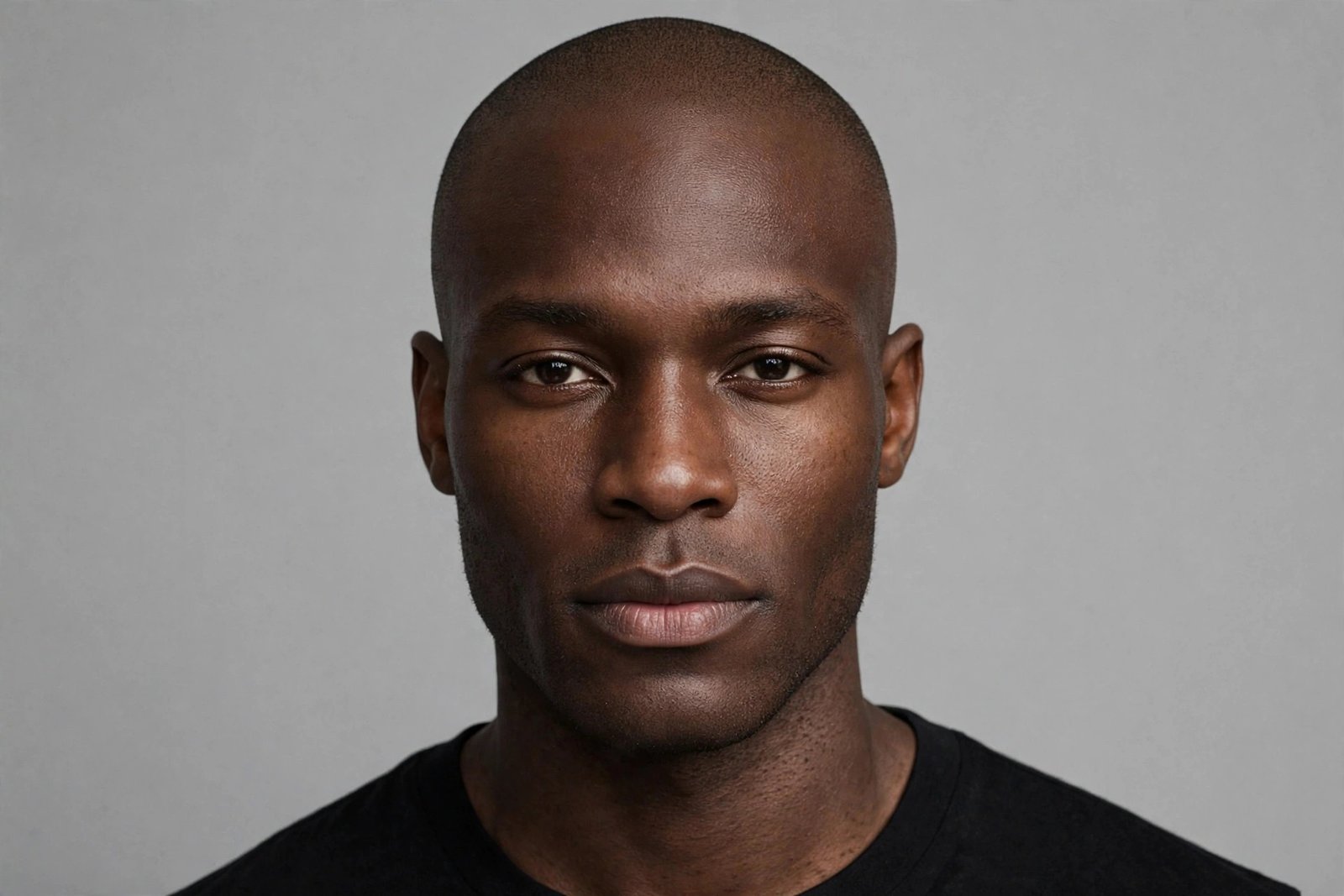
The hardcore version. A #0 guard — 0.5mm, essentially skin with a five-o’clock shadow of stubble — taken uniformly over the whole head. This is as close to the actual military induction as a civilian can get without a razor. It has a stark, sculptural quality that photographs beautifully and turns heads in person. There’s something almost architectural about a well-executed skin induction: the shape of the skull becomes the hairstyle.
Who suits it? Men with smooth, even scalps and strong bone structure. Oval and square faces with defined jawlines look phenomenal. It’s also the nuclear option for advanced thinning — at #0, there is no hair left to look thin, only a clean shadow. Athletes and men who train hard love it because sweat, helmets, and headgear become non-issues.
Ask your barber for: “Zero guard all over, one length, clean up the hairline.” Some barbers will finish with a foil shaver around the edges — say yes, it’s worth it.
Maintenance means touching up every 5 to 7 days, because stubble grows visibly overnight at this length. The honest downsides are real: every bump, scar, mole, and asymmetry on your scalp is now public information. Sunburn is a genuine hazard — your scalp has likely never seen direct sun, so sunscreen is non-negotiable for the first month. And regrowth itch is a thing; keep the scalp moisturized or the first week will test you.
3. The 2 Guard Civilian Induction
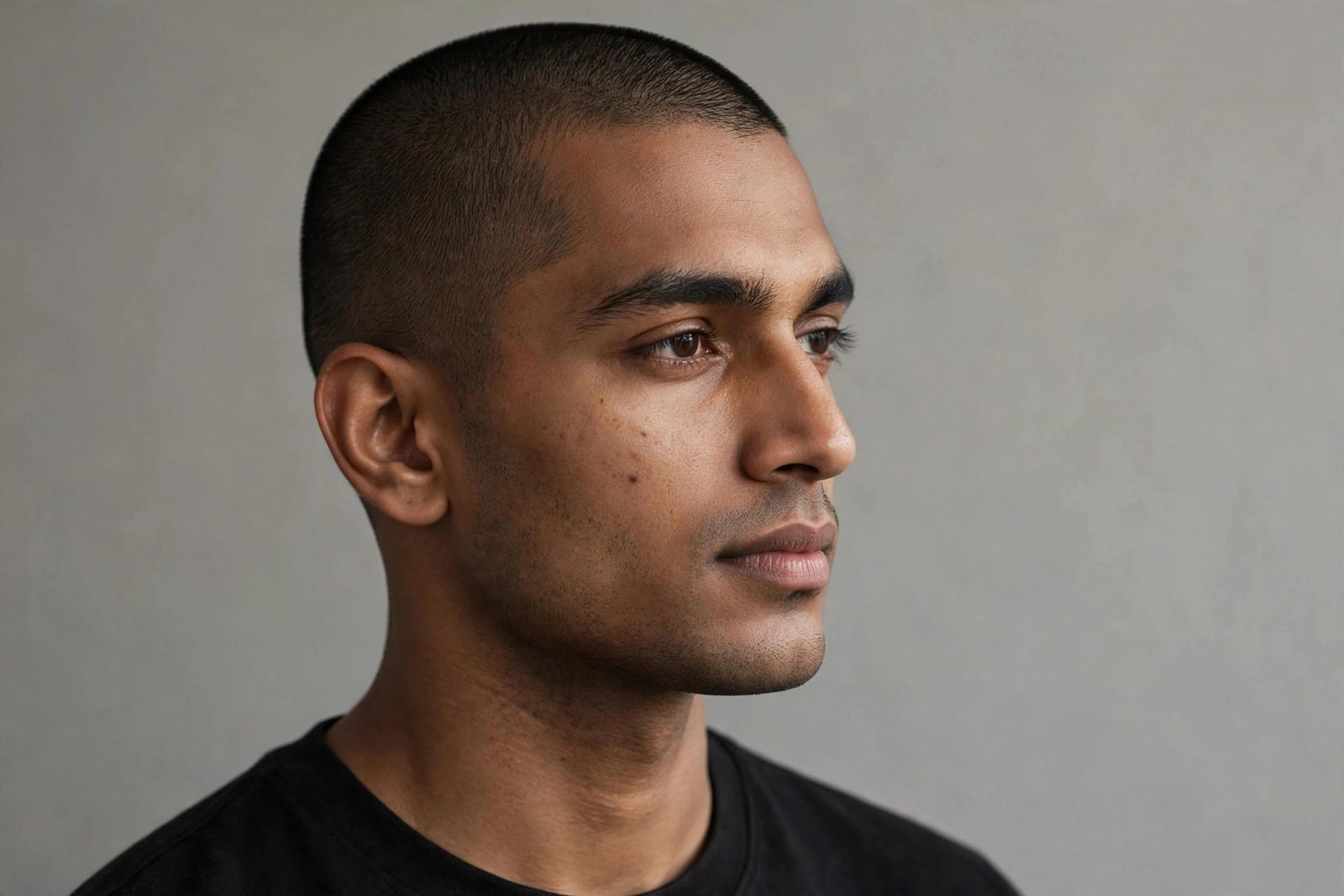
The diplomat of the induction family. A #2 guard (6mm) all over gives you the uniform, one-length silhouette of a true induction with noticeably more hair on the head — enough to show texture, catch light, and forgive an imperfect scalp. This is the version most barbers recommend to first-timers, and it’s the smartest entry point into the trend. It reads “sharp and intentional” to everyone, including your boss and your mother-in-law.
Who suits it? Beginners, cautious professionals, and men with slightly uneven scalps. The extra 3mm over a #1 hides a multitude of sins — small bumps, minor scars, slight asymmetry all vanish into the texture. Round faces benefit too, because the added length on top creates a whisper of height that a #1 can’t. If you’ve never gone this short before, start here. You can always go shorter next visit.
Ask your barber for: “Single #2 guard all over, one length, keep the hairline natural or lightly cleaned up.”
Maintenance stretches to every 10 to 14 days, and many men find they can push it to two weeks without looking scruffy. The honest downside: purists will tell you a #2 isn’t a “real” induction — and technically they’re right, it’s drifting toward buzz-cut territory. But I’d rather you wear a #2 confidently than a #0 you regret. The other note: at 6mm, cowlicks and growth patterns start to show, so if your crown swirls aggressively, ask the barber to check it from behind before you leave the chair.
4. The Induction with a Sharp Lineup
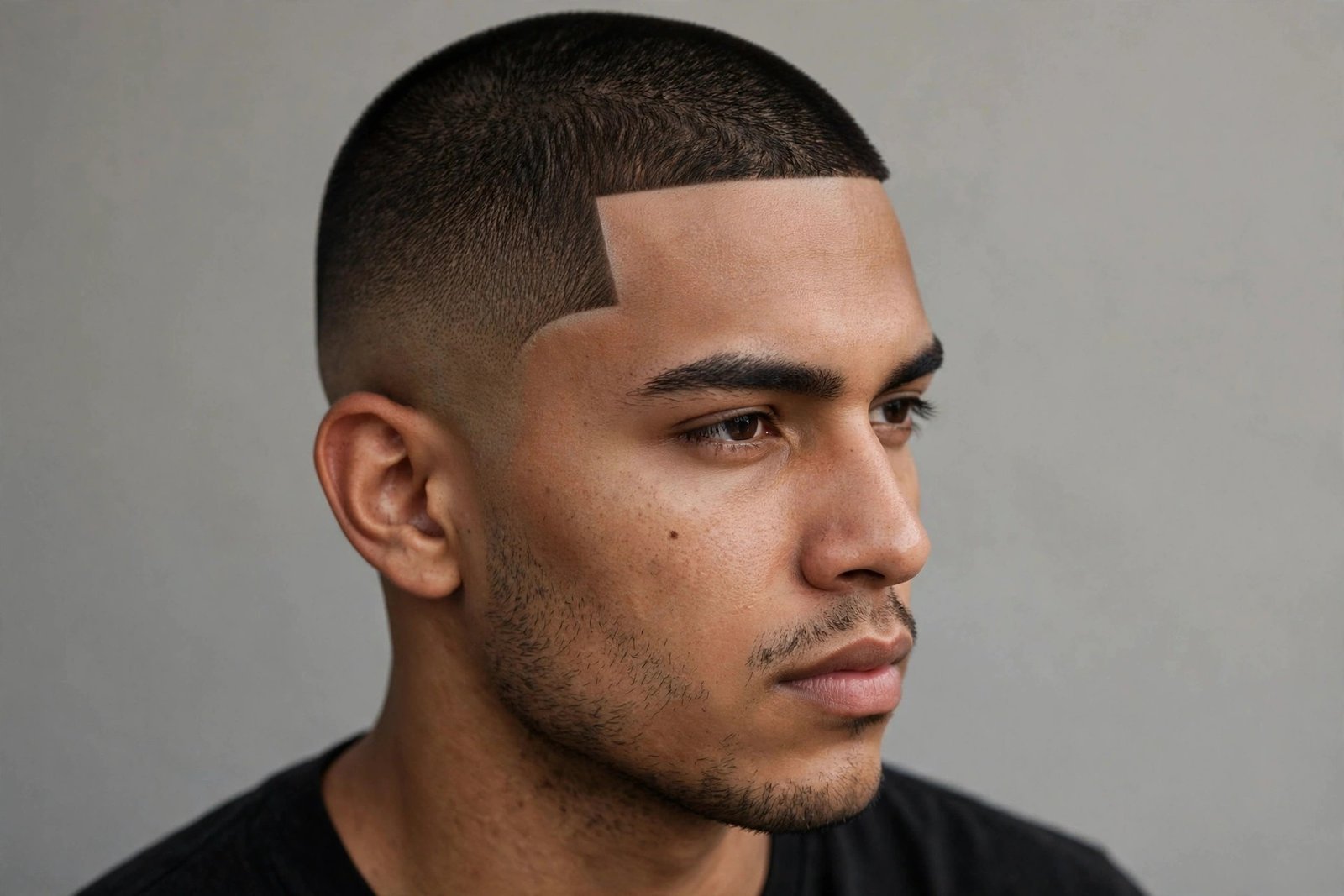
Take the classic #1 induction and add one barber-crafted detail: a razor-sharp lineup along the forehead, temples, and sideburns. The hair itself stays uniform and military, but the edges are carved with surgical precision — crisp corners, clean curves, a hairline that looks drawn with a ruler. This single detail is what separates a 2026 induction from an actual boot-camp cut. It’s the difference between “I just enlisted” and “I chose this.”
Who suits it? Men with reasonably straight, defined natural hairlines. The lineup amplifies whatever your hairline is doing, so strong hairlines look incredible and ragged ones get exposed. It suits younger men and streetwear-leaning styles particularly well, and it photographs like a dream — which is half the point in the social media era.
Ask your barber for: “Single #1 all over, then line up the forehead and temples sharp — squared or rounded to match my natural hairline.” Bring a photo. Lineup shapes are personal, and “sharp” means different things to different barbers.
Maintenance is the catch: a lineup goes fuzzy in about 5 days. You’ll need a trimmer at home for edge touch-ups between cuts, or you’ll be in the chair weekly. The honest downside is the commitment — this is the highest-maintenance induction on the list despite the short hair. Push the lineup too far into the hairline and it starts looking artificial; a good barber follows your natural line rather than inventing a new one. And if your hairline is receding unevenly, a hard lineup can frame the recession like a picture — consider style 14 instead.
5. The Induction with Mid Fade Sides
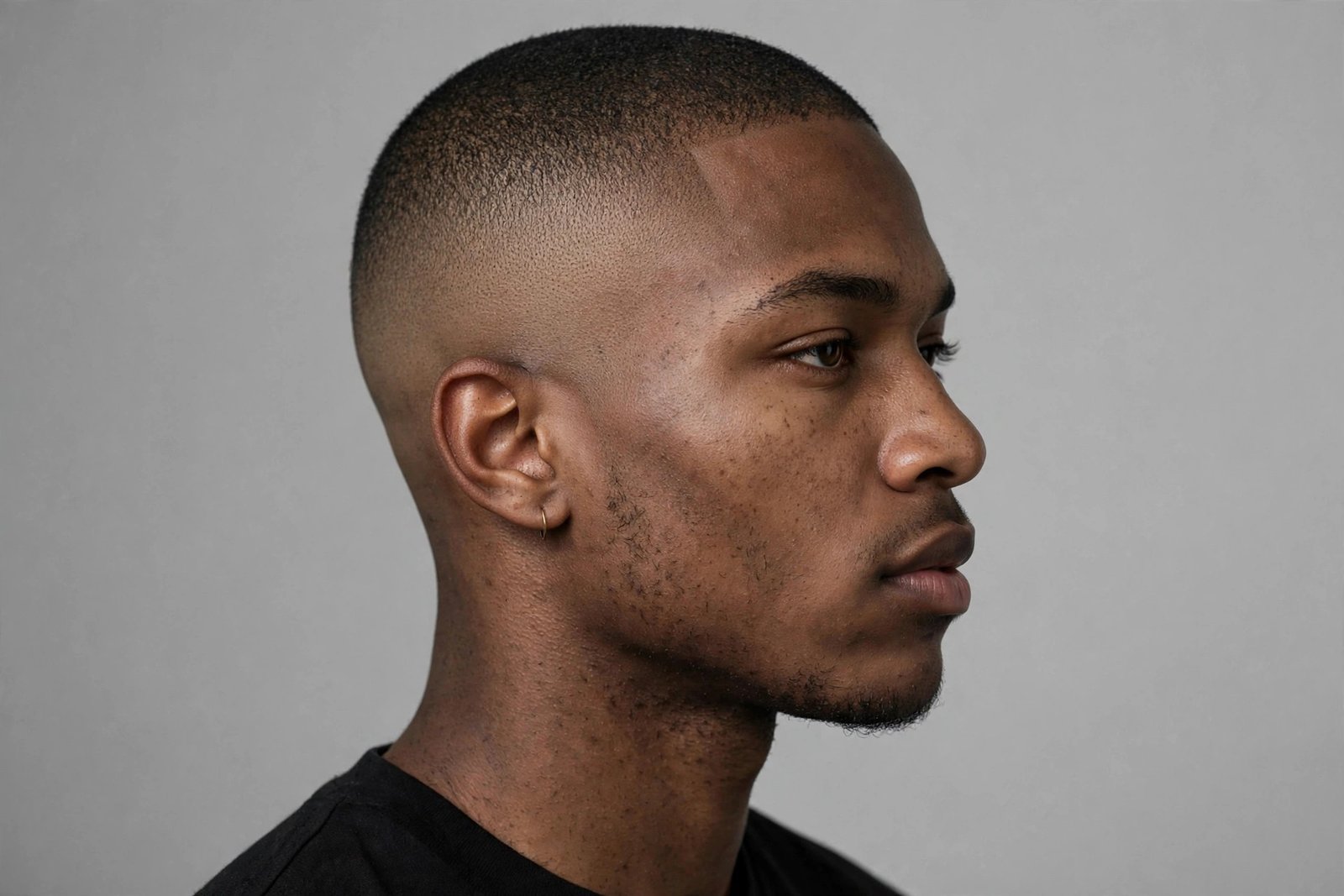
The most popular civilian adaptation on this list, and probably the version you’ll see most on the street in 2026. The top stays a uniform induction length (#1 or #2), but the sides and back are faded — typically a mid fade that melts from the top length down to skin around the middle of the head. You keep the induction’s no-nonsense top and gain the sculpted, modern finish of a fade. It’s the best of both worlds, and barbers report it as the induction cut men request most this year.
Who suits it? Men who want the induction attitude with a barbershop finish. The fade adds shape and structure, which flatters round and square faces alike — the gradient on the sides slims the silhouette of the head. It also suits men whose workplace frowns at a full military cut; the fade reads “styled” rather than “enlisted.”
Ask your barber for: “#1 (or #2) on top, all one length, with a mid skin fade on the sides and back.” If you want it softer, ask for a mid taper fade instead of skin — same idea, less contrast. Fans of faded short cuts will also want to browse our buzz cut fade styles for more fade-top combinations.
Maintenance runs every 10 to 14 days — the fade grows out faster than the top, and a grown-out fade looks messy rather than rugged. The honest downside: this is no longer a DIY-friendly cut. Blending a fade at home is genuinely hard, so you’re committing to regular barber visits. It also technically breaks induction purity (there’s now more than one length on the head), so if you want the authentic thing, this isn’t it. But for most men, this is the version that actually gets worn.
6. The Induction with Skin Fade Sides
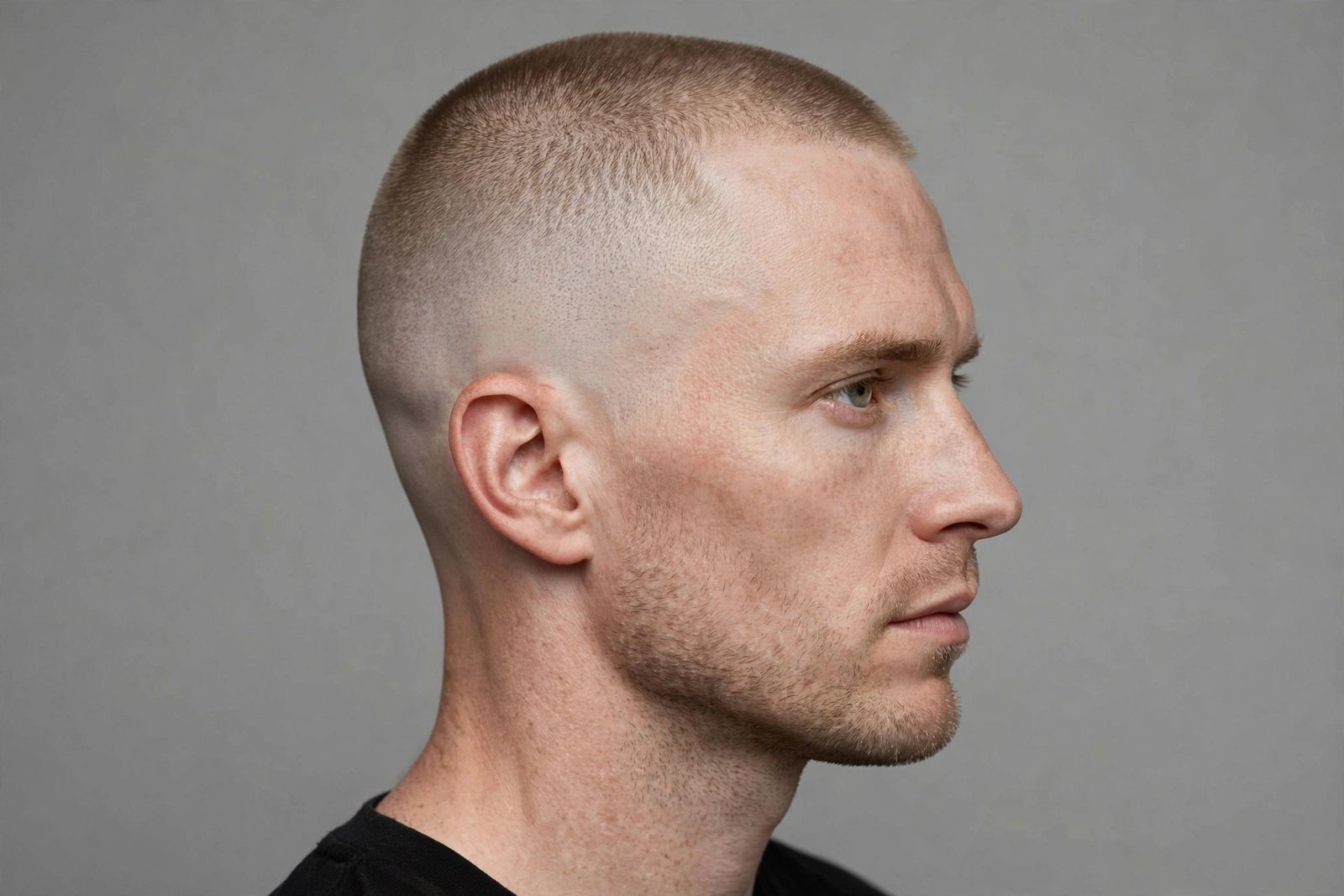
Style 5’s bolder sibling. Same uniform induction top, but the sides drop all the way to bare skin in a high-contrast skin fade. The effect is dramatic: a cap of short hair floating over clean-shaven sides, with a crisp transition line where they meet. It’s aggressive, modern, and unapologetic — the haircut equivalent of a tailored black suit. In 2026 this is the go-to for men who want their short hair to look expensive.
Who suits it? Men with good head symmetry and clean scalps, because the skin fade exposes everything on the sides. Strong jawlines and defined cheekbones pair beautifully with the contrast. It suits younger men and anyone in creative or style-forward environments. Darker, denser hair shows the fade gradient best — very fine or light hair can make the blend look washed out.
Ask your barber for: “#1 on top, one length, with a high skin fade on the sides — take the fade up to about an inch above the ear.” Specify where you want the fade to sit; “high,” “mid,” and “low” produce completely different cuts.
Maintenance is weekly — a skin fade has a shelf life of about 7 days before the stubble softens the contrast that makes the cut work. The honest downside is the upkeep bill: this is a barber’s cut, not a home cut, and you’ll be in the chair often. It also grows out awkwardly; miss two weeks and the sides look fuzzy rather than faded. And in conservative workplaces, the high contrast can read as edgier than a uniform induction. Know your office before you commit.
7. The Induction with a Low Taper
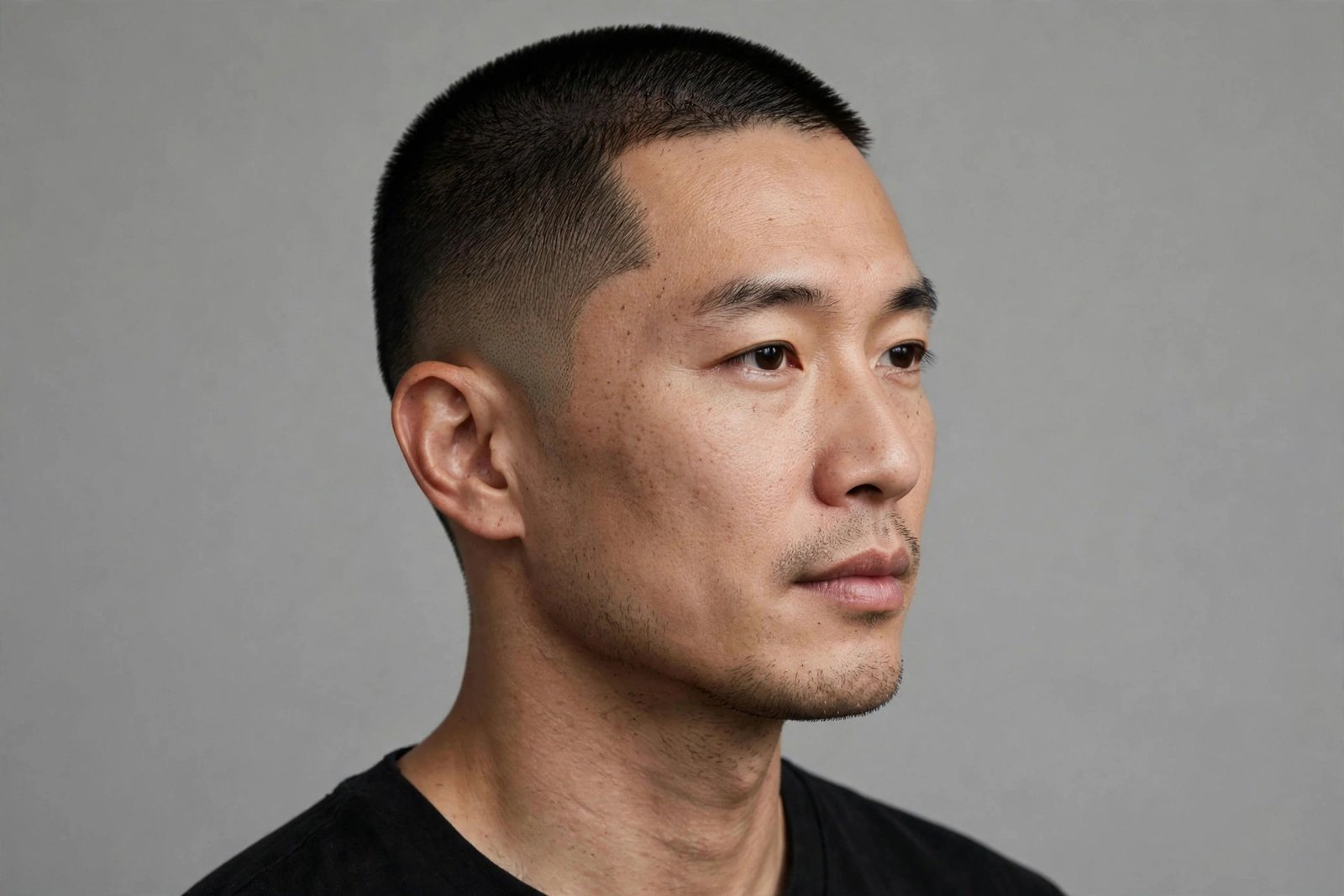
The quiet professional’s induction. The top is a uniform #1 or #2, and instead of a full fade, the sides get only a subtle taper — the hair gradually shortens toward the neckline and around the ears, but never disappears. From a distance it reads as a classic induction; up close, the edges are refined and deliberate. It’s the version worn by men who need to look sharp in a boardroom on Monday and don’t think about their hair the rest of the week.
Who suits it? Professionals, older men, and anyone who finds fades too trendy. The taper keeps the cut’s military DNA intact while removing the one thing that can make an induction look rough: fuzzy, overgrown edges at the nape and sideburns. It suits all face shapes because it changes nothing about the silhouette — it only cleans the perimeter.
Ask your barber for: “Single #1 all over, with a low taper at the neckline and around the ears — no fade, just clean up the edges.” Emphasize “no fade” or some barbers will fade it by habit.
Maintenance is forgiving: every two to three weeks, and the taper grows out gracefully rather than collapsing. You can even maintain the neckline yourself with a trimmer. The honest downside is subtlety — nobody will notice this cut, which is either the point or the problem depending on your personality. If you want your haircut to make a statement, pick style 5 or 6. This one whispers. It also won’t fix a round face or add any shape; it’s a refinement, not a transformation.
8. The Induction with a Full Beard
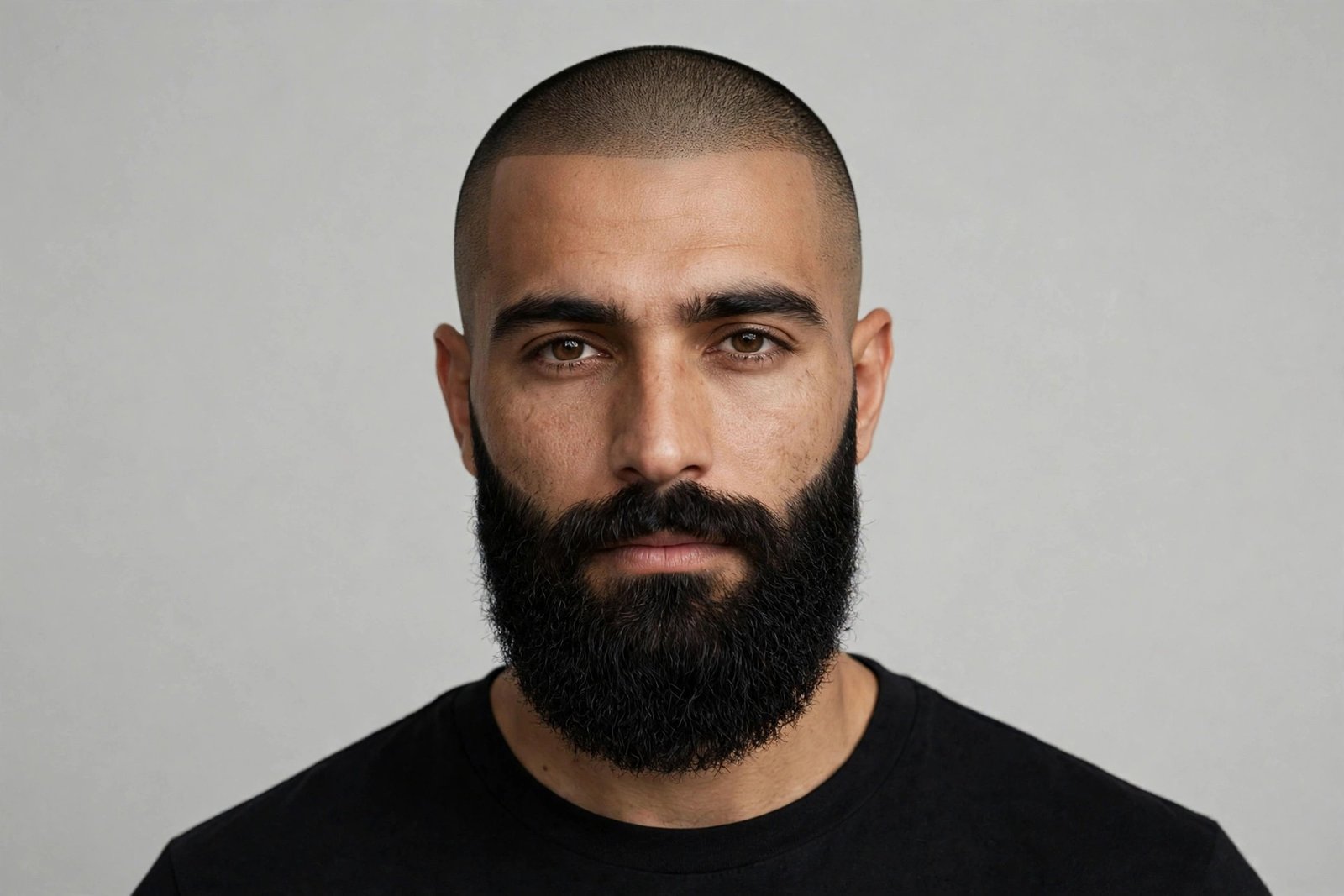
Ask any barber what pairs best with an induction cut and most will say the same thing: a beard. The logic is pure geometry. An induction removes all the hair — and therefore all the visual weight — from the top of the head. A full beard puts weight back on the lower half of the face, rebalancing the whole silhouette. The contrast between the ultra-short top and a dense, shaped beard is one of the strongest looks in men’s grooming right now, and it photographs like a fashion editorial.
Who suits it? Men with round, oval, or softer faces gain the most — the beard adds angles and length where the cut removes them. It’s also the secret weapon for men worried about a #0 or #1 looking too severe; the beard keeps the overall impression masculine rather than stark. You need decent beard density for the full version, but even a short boxed beard works.
Ask your barber for: “Single #1 induction on top, and shape the beard — clean cheek lines, defined neckline, keep the length.” Get both done in the same visit so the barber balances them together. Our guide to buzz cuts with beards has more pairing ideas in the same family.
Maintenance splits in two: the head every 7 to 10 days, the beard with regular shaping (cheek lines weekly, full reshape every 2 to 3 weeks). The honest downside is that you’re now maintaining two things instead of zero — the “no maintenance” promise of the induction partially evaporates. A patchy or thin beard can also undermine the look; if your beard grows in wispy, go for stubble (style 9) instead of forcing density that isn’t there. And keep the beard conditioned — a dry, frizzy beard next to a crisp induction looks like two different people.
9. The Induction with Stubble

Not every man can — or wants to — grow a full beard, and that’s exactly where stubble earns its place. A #1 induction paired with three to five days of facial stubble gives you 80% of the beard-balancing effect with none of the maintenance. The stubble adds texture and masculinity to the lower face, softens the severity of the short cut, and takes literally zero effort beyond not shaving. It’s the lowest-maintenance version of the balanced induction look.
Who suits it? Men with patchy beard growth — stubble hides patchiness that a full beard would expose. It suits younger men who can’t yet grow density, and men who like the rugged look without the grooming routine. It works on every face shape, though round faces gain the most from the added jaw definition.
Ask your barber for: “Single #1 induction on top. Leave the stubble — just clean up the neckline of the beard area.” Or skip the barber entirely for the facial hair: stop shaving four days before your cut and let the appointment do the rest.
Maintenance is beautifully simple: keep the head on its 7-to-10-day cycle and trim the stubble back to your preferred length once or twice a week with a beard trimmer (usually a 2–3mm guard). The honest downside: stubble has a scruffy ceiling. Past about a week it stops looking intentional and starts looking like you forgot to shave, so there’s a narrow window where it looks its best. It can also irritate sensitive skin and look uneven in photos if the growth is patchy — keep it short enough that patches read as texture rather than gaps.
10. The Induction with a Goatee
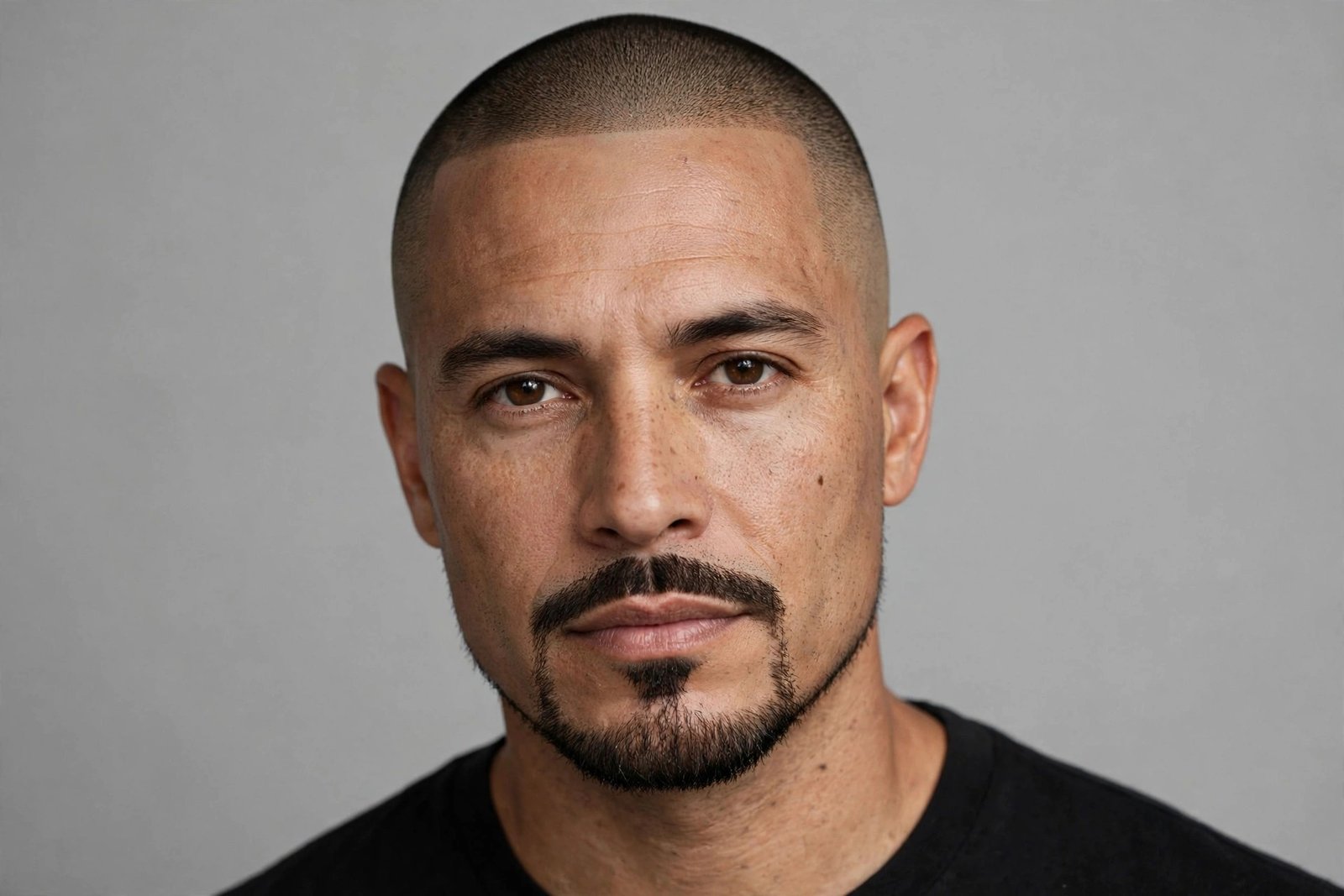
The goatee does something clever with an induction cut: it draws the eye to the center of the face — chin, jaw, mouth — creating a vertical line that adds length and focus. Paired with the ultra-short top, the effect is sharp and deliberate, with a touch of 90s-rebel energy that 2026 has fully rehabilitated. A neatly shaped goatee next to a crisp induction reads confident and a little dangerous, in the best way.
Who suits it? Men with round or wide faces benefit most, because the vertical emphasis of the goatee counteracts width. It’s also a strong choice for men with weaker chins — the goatee literally builds a chin where nature was modest. Smaller-framed men often prefer a goatee over a full beard because it doesn’t overwhelm their features.
Ask your barber for: “Single #1 induction, and shape a goatee — defined edges, clean cheeks, soul patch optional.” Decide in advance whether you want the classic chin-only goatee or the fuller version that connects to a mustache; they give different impressions.
Maintenance means edging the goatee every few days — the lines are the whole point, and fuzzy lines ruin it. The honest downside: goatees are polarizing. Some people love them, some people still associate them with villains in movies. It’s also a precise style; an asymmetrical goatee is immediately obvious, so you’ll need a steady hand or regular barber visits. And if your chin hair grows in patchy, this style will announce it — be honest with yourself about your growth pattern before committing.
11. The Induction with a Mustache
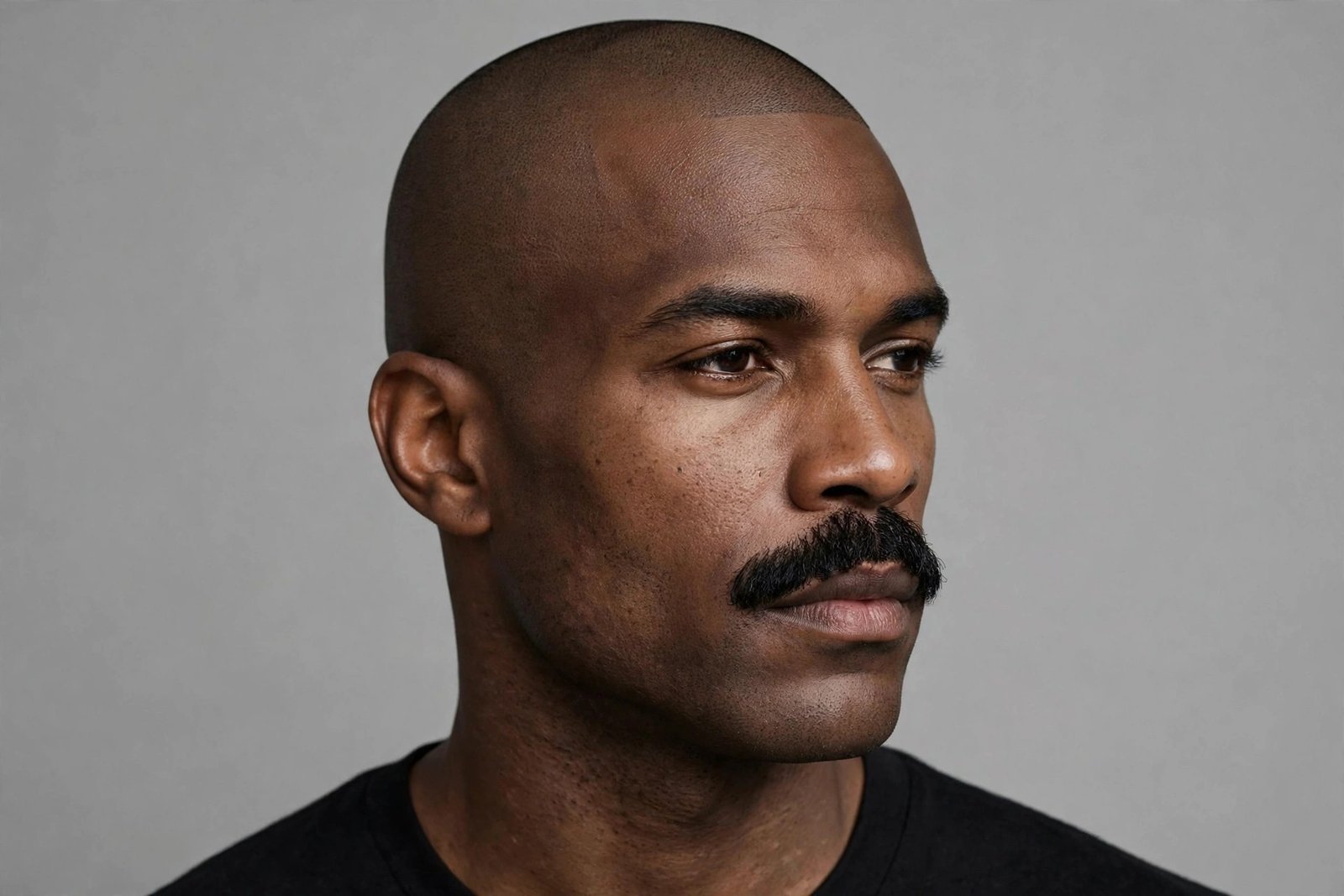
Here’s one nobody saw coming: the mustache-induction combo is quietly one of 2026’s coolest pairings. The ultra-short, disciplined top meets a strong, intentional mustache, and the contrast is magnetic — military precision up top, personality on the lip. It works because both elements are bold and simple; neither competes with the other. A thick chevron or a neat cropped mustache turns the plainest induction into a statement.
Who suits it? Men with strong lip and chin area who want character without a full beard. It suits oval and oblong faces particularly well — the horizontal line of the mustache breaks up facial length. It’s also the answer for men whose cheeks won’t grow a beard but whose mustache comes in thick; play to your strengths.
Ask your barber for: “Single #1 induction, and trim the mustache — keep it full but clean, just above the lip line.” Specify chevron (full, straight across) or cropped (shorter, neater) — they read very differently.
Maintenance: trim the mustache weekly to keep it out of your lip, and a tiny bit of wax keeps it in shape if you go chevron. The honest downside is cultural baggage — mustaches still carry strong associations, from vintage cool to costume-party, and you’ll get opinions. A mustache also demands confidence; worn hesitantly, it looks like a dare you lost. Commit fully or skip it. And keep it clean — food in the mustache next to a military-sharp cut is a contrast nobody wants.
12. The Textured-Top Induction
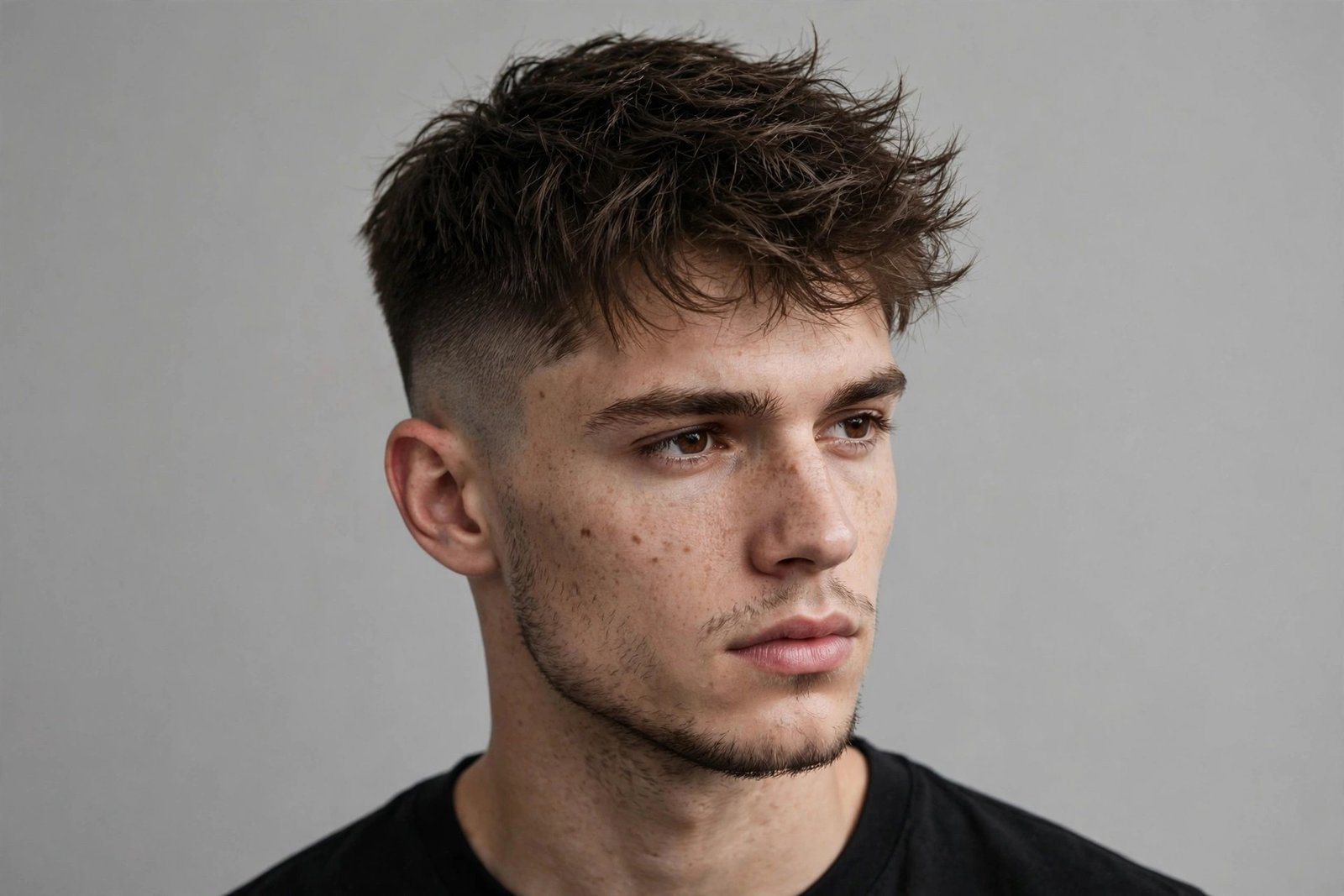
The rebel of the list — and I’ll be upfront: this one bends the induction rules. The sides and back stay a true uniform induction (#1 all over), but the top is left slightly longer (a #3 or #4) with a touch of texture worked in. From most angles it reads as an induction; from the top, there’s just enough hair to show movement and catch light. It’s the induction for men who love the aesthetic but aren’t ready to surrender every millimeter.
Who suits it? Men with thick, straight, or wavy hair that shows texture well at short lengths. It suits round faces because the extra length on top adds the height a pure induction can’t. It’s also the gentlest landing for men transitioning down from longer styles — the psychological jump from a textured crop to this is much smaller than the jump to a #0.
Ask your barber for: “#1 on the sides and back, one length — but leave the top at a #3 with some texture, blended at the parietal ridge.” This needs a skilled barber; the blend between the #1 sides and the longer top is where the cut succeeds or fails. Our Caesar cut guide covers similar short-textured territory if you want more ideas in this family.
Maintenance every 10 to 14 days, and the top may want a tiny amount of matte product to emphasize the texture. The honest downside: purists will correctly point out this is a buzz cut with induction sides, not a true induction. If authenticity matters to you, this will itch. The texture also means it’s the only induction on this list that can look messy — skip the touch-ups and the top goes fuzzy while the sides stay sharp, which is the worst of both worlds. Stay on schedule.
13. The Induction for Thinning Hair

If I could hand one haircut to every man quietly stressed about thinning hair, it would be this. Here’s the physics of it: thinning looks bad because of contrast — long hair next to sparse areas makes the sparse areas obvious. Cut everything to a uniform #1 or #2 and the contrast collapses. There’s no long hair left to emphasize what’s missing. What remains is an even shadow that reads as a deliberate style choice, not a retreat. I’ve watched men walk out of the chair ten years younger with this cut — not because it adds hair, but because it removes the anxiety.
Who suits it? Men with diffuse thinning across the crown, widening parts, or general density loss. It suits every face shape and every age — this is genuinely the most democratic style on the list. The key decision is guard length: diffuse thinning does best at a #2 (the extra length evens out patchiness), while more advanced thinning often looks cleaner at a #1.
Ask your barber for: “I’m thinning on top — give me a uniform induction, #2 all over, and tell me honestly if you’d go shorter.” A good barber will assess your pattern and adjust. That honesty is worth more than any guard number.
Maintenance every 10 to 14 days; thinning hair actually grows out more gracefully at these lengths because there’s less contrast to begin with. The honest downside: this cut doesn’t hide thinning so much as reframe it, and if you’re hoping nobody notices you’re losing hair, no cut can promise that. What it promises is dignity — and it delivers. One more note: be gentle with the scalp. Thinning areas can be sensitive, so use a light moisturizer and don’t press the clippers hard against the skin.
14. The Induction for a Receding Hairline

The receding hairline is where the induction cut performs its best magic trick. A high hairline looks like a problem when it’s framed by longer hair — the long hair draws a spotlight to exactly where the hair isn’t. Shave it all down to a #1 and the hairline stops being a story. It becomes a feature: a strong, masculine frame that looks intentional and rugged. Some of the best-looking inductions I’ve seen were on men with serious recession, because the cut turns a source of stress into a non-issue.
Who suits it? Men with temple recession, maturing hairlines, or a high forehead they’ve been trying to cover. It suits square and oval faces especially well — the exposed forehead actually emphasizes strong brow and bone structure. The further back the hairline, the shorter you should generally go; a #1 beats a #2 when recession is advanced.
Ask your barber for: “Receding at the temples — uniform #1 induction all over, and keep the hairline natural, don’t try to reshape it.” This last part matters: some barbers try to “fix” a receding hairline with an aggressive lineup, which only frames the recession. Natural is better.
Maintenance on the standard 7-to-10-day cycle. The honest downside: the first cut is psychologically the hardest — exposing a hairline you’ve been covering feels vulnerable for about three days, and then most men wonder why they waited years. Also, if the recession is very uneven (one temple much higher than the other), a #0 can emphasize the asymmetry; a #1 is more forgiving. And skip the hard lineup here (style 4) — it draws lines around exactly what you’re trying to de-emphasize.
15. The Induction for Round Faces
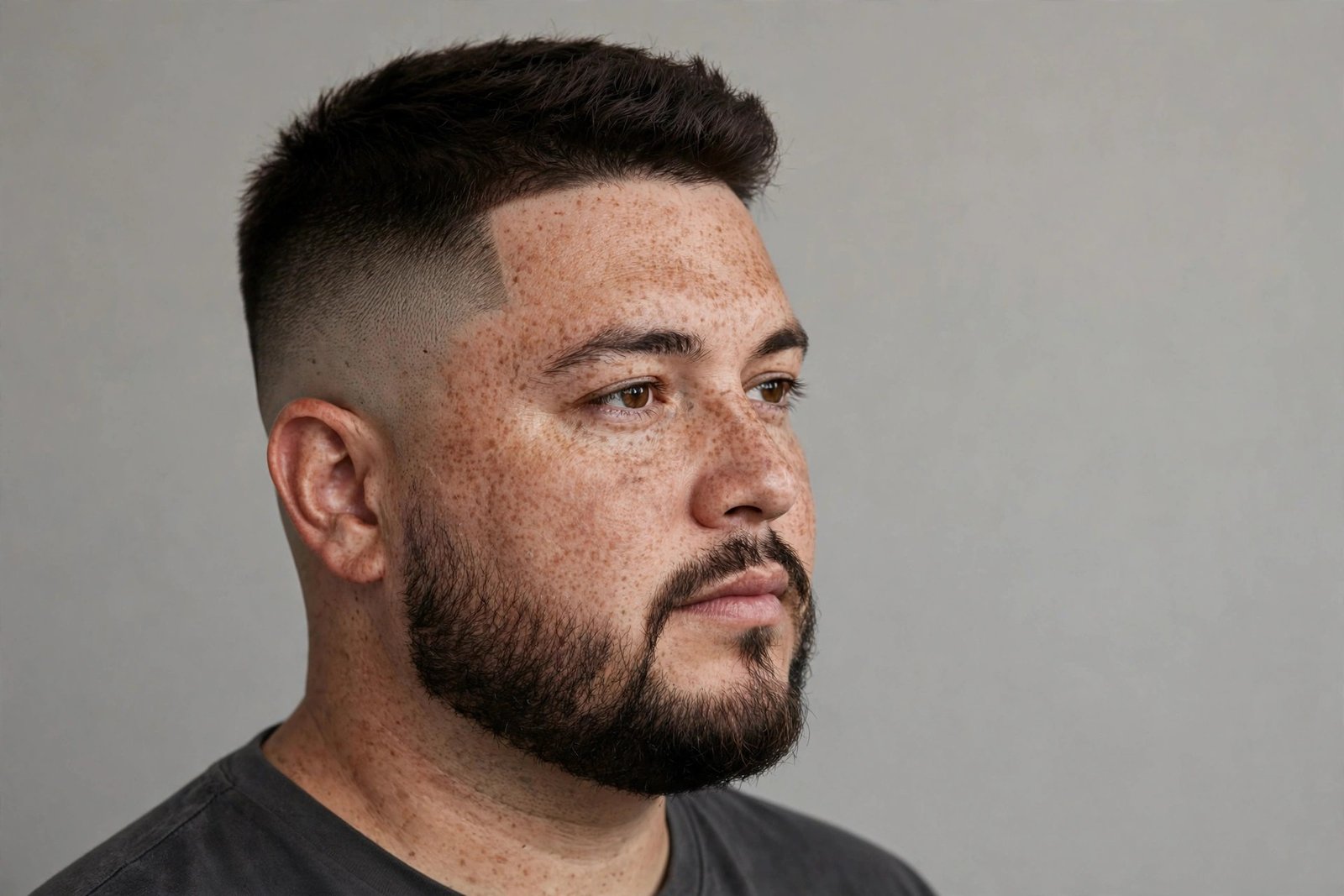
Round faces and induction cuts need a strategy session, because the default #1 all over can emphasize roundness — no height on top, no angles on the sides, just a smooth sphere. But the fix is straightforward and this style bakes it in: keep the induction short on the sides (#1) while leaving the top one guard longer (#2), and add a beard or even heavy stubble. The extra length on top creates verticality, the beard adds jaw definition, and suddenly the round face has structure. It’s the same cut, rebalanced.
Who suits it? Men with round or full faces who want the induction look without the bowling-ball effect. It also suits men carrying a bit of extra weight in the face — the vertical emphasis slims the overall impression. The beard component is doing real work here, so commit to it.
Ask your barber for: “#1 on the sides and back, #2 on top — and shape a beard with some length on the chin to add definition.” The chin length is the key detail; it visually lengthens the face.
Maintenance every 10 days for the head, weekly beard shaping. The honest downside: this is the least “pure” induction on the list — two lengths on top plus a beard means you’ve left induction territory and entered buzz-cut land. If the label matters to you, this will bother you. It also requires the most moving parts of any style here (two guards, beard shaping), so it’s not the grab-and-go option. But for round faces, it’s the difference between a cut that works and a cut that fights you.
16. The Induction for Square Faces
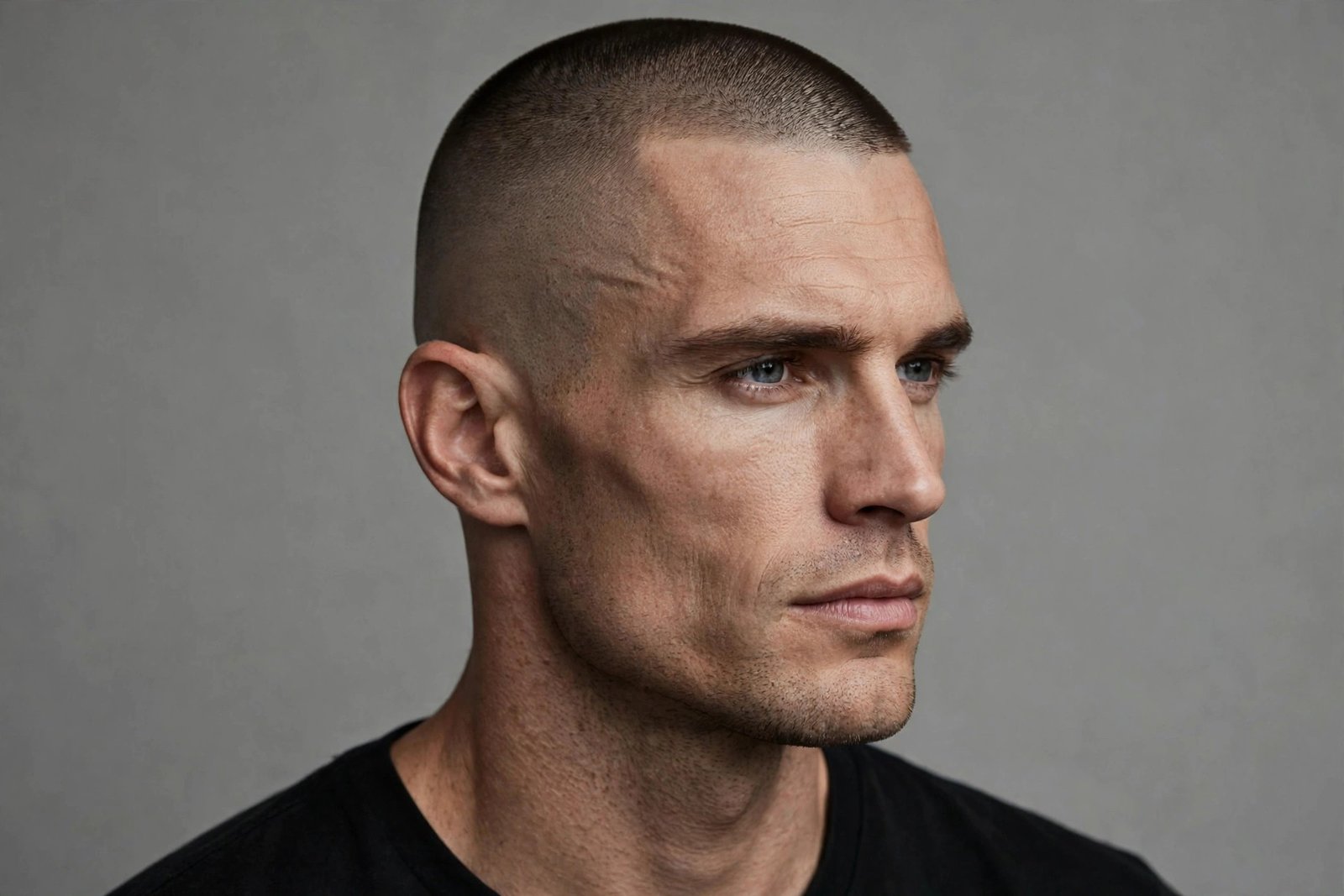
If round faces need strategy, square faces need nothing at all — the induction cut was practically designed for them. Strong jaw, defined cheekbones, broad forehead: the ultra-short length strips away everything soft and leaves the architecture. A #1 induction on a square face looks carved, powerful, almost statuesque. This is the combination you see on action heroes and athletes, and it’s not a coincidence. The cut and the bone structure amplify each other.
Who suits it? Square, rectangular, and strong-jawed faces — the cut’s natural constituency. It also suits men with prominent cheekbones who want them showcased rather than softened. If you’ve ever been told you have a “strong face,” this is your cut.
Ask your barber for: “Classic #1 induction, all one length. Clean up the hairline but keep it masculine — squared corners if my hairline allows.” A squared lineup complements a square jaw beautifully.
Maintenance is the easy standard: weekly touch-ups keep it razor sharp. The honest downside is that there’s nowhere to hide — a square face with an induction is a lot of face, and in some settings it can read as severe or intimidating. If your workplace rewards softness, consider the #2 (style 3) or the low taper (style 7) to take the edge off. Very angular faces can also look harsher with a #0, so the #1 is the sweet spot here — short enough to showcase the structure, long enough to keep it human.
17. The Induction for Oval Faces
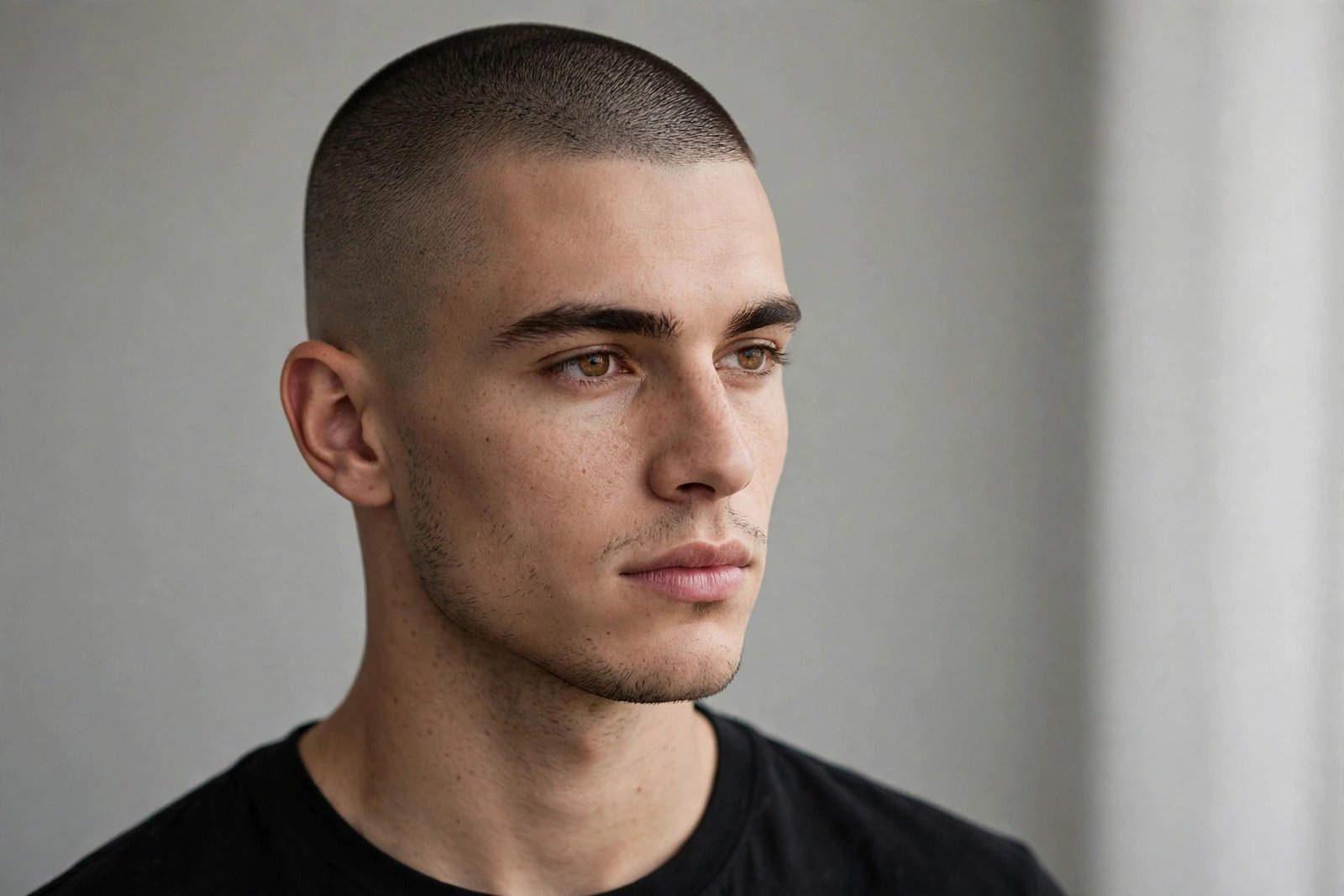
Oval faces hit the jackpot with induction cuts — balanced proportions, a forehead and jaw in harmony, nothing to correct and everything to show off. The uniform short length sits perfectly on an oval face because there’s no imbalance for the cut to exaggerate. If you have an oval face, you can wear any style on this list, but the pure classic #1 (style 1) is the one I’d steer you toward: it’s the cleanest expression of the cut, and your face shape lets it shine without any compensating tricks.
Who suits it? Oval faces, obviously — but also as the “safe recommendation” for any man unsure about his face shape. When in doubt, the oval-face approach (pure induction, minimal adaptation) is the baseline everything else is measured against.
Ask your barber for: “Classic #1 induction, one length all over, natural hairline.” Keep it simple — your face is doing the work.
Maintenance is the standard weekly cycle. The honest downside: there isn’t much of one, which is a strange thing to write. If I had to find a flaw, it’s that the cut can look almost too easy on an oval face — like you didn’t try. Add the sharp lineup (style 4) if you want visible craft, or a beard if you want edge. But the base cut? Flawless. Consider this the control group of induction cuts.
18. The Induction for Oblong and Diamond Faces
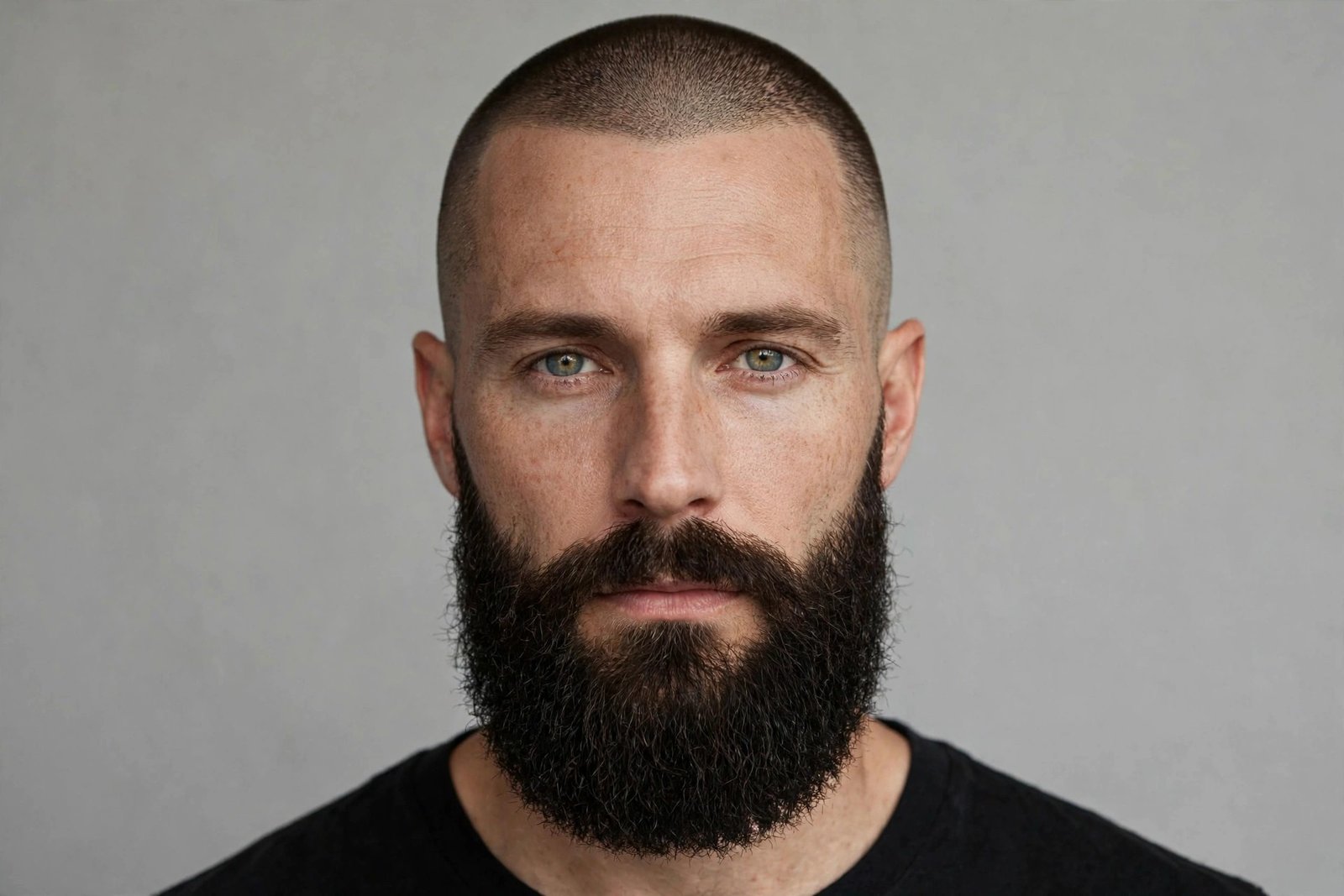
Long, narrow faces face the mirror-image challenge of round ones: the induction’s lack of width can make a long face look longer. Diamond faces (narrow forehead and jaw, wide cheekbones) have a related issue — the cut exposes the cheekbones dramatically, which is striking but can look severe. The solution for both is width: a beard adds horizontal volume to the lower face, and keeping the sides at a #2 rather than a #1 avoids over-slimming the silhouette.
Who suits it? Men with oblong, rectangular, or diamond face shapes who love the induction aesthetic. The beard is doing structural work here, so this style assumes you can grow one — even a short boxed beard changes the geometry meaningfully.
Ask your barber for: “#2 on the sides, #1 or #2 on top — keep a little width on the sides — and shape the beard fuller on the cheeks to balance the length.” The cheek fullness is the detail most men miss; everyone focuses on chin length, but for long faces, cheek volume is what actually balances things.
Maintenance every 10 to 14 days for the head, with regular beard shaping. The honest downside: without the beard, this cut can make a long face look noticeably longer — I’d call the facial hair semi-mandatory here, not optional. Diamond faces should also be careful with the #0; the exposed cheekbones plus skin-short hair can look gaunt. Stay at #1 or #2 and let the beard do the balancing.
19. The Induction with a High Hairline

A high hairline — whether it’s always been high or it’s matured that way — makes many men nervous about short cuts. The fear is that less hair means more forehead. But the induction cut actually handles high hairlines better than almost any longer style, for a simple reason: long hair next to a high hairline creates a stark boundary that draws the eye; uniform short hair softens that boundary into a gradient. The forehead becomes part of the look rather than a problem to frame.
Who suits it? Men with naturally high foreheads or mature hairlines that have stabilized. It suits confident dressers — this cut pairs beautifully with strong personal style because the high hairline plus short cut reads as distinguished rather than deficient. Think of it as the haircut equivalent of owning the room.
Ask your barber for: “Uniform #1 induction, and do not touch the hairline — no lineup, no reshaping, keep it completely natural.” This is the opposite of style 4’s advice, and it’s deliberate: carving lines around a high hairline only emphasizes it.
Maintenance on the weekly cycle. The honest downside is the psychological one — the first week of seeing your full hairline exposed can rattle men who’ve spent years covering it with fringe. Give it ten days before you judge. Also, avoid the #0 here unless your scalp is flawless; at skin length, a high hairline plus visible scalp can read as thinner than it is. The #1’s shadow of hair is your friend — it keeps everything looking intentional and full.
20. The Induction with Curly Texture
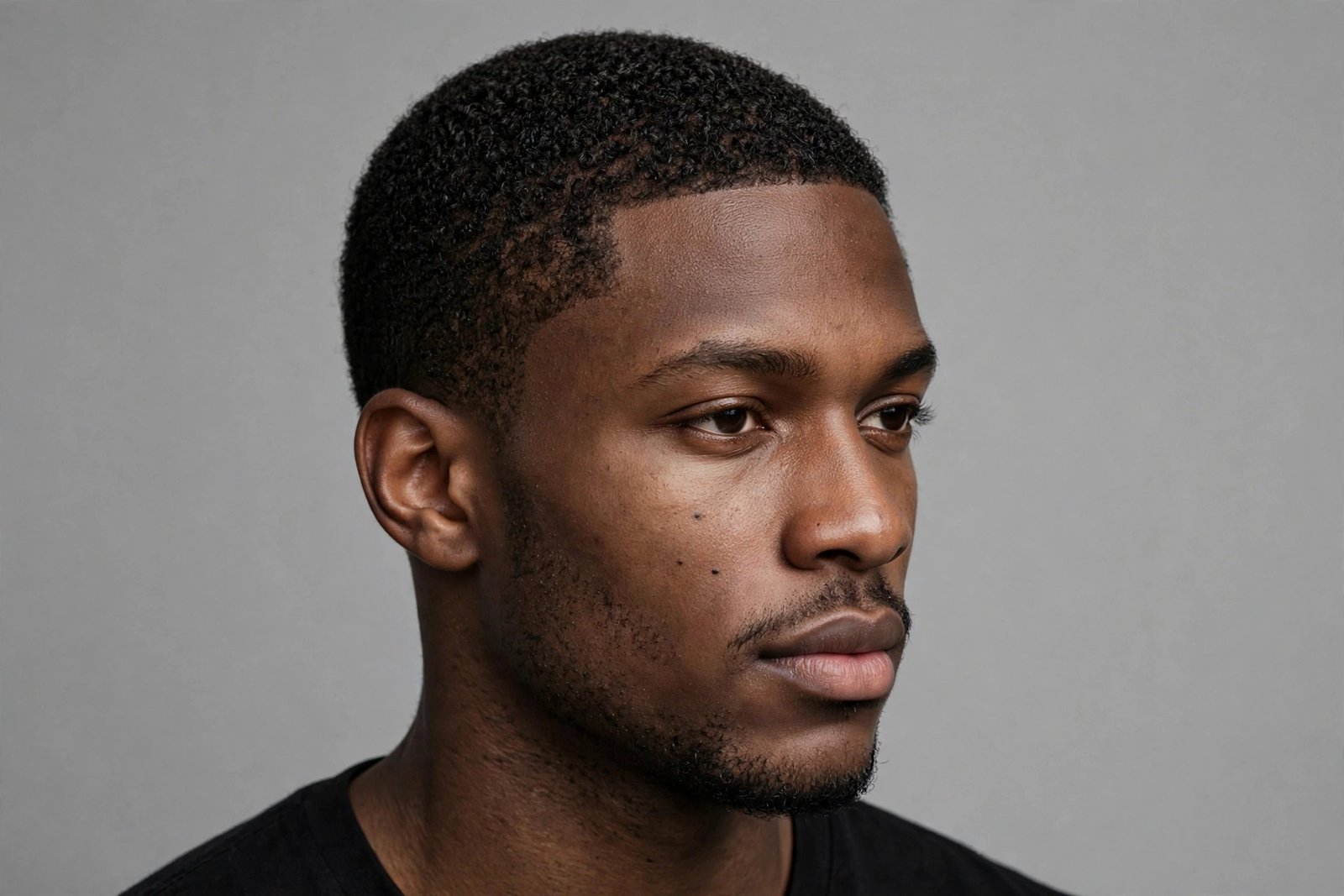
Curly hair at induction length does something beautiful: instead of a flat shadow, you get a rich, even texture — thousands of tiny curls clipped to a uniform length, creating a dense, velvety surface that straight hair can’t replicate. A #1 or #2 on tight curls produces that classic military look you see on servicemen with coily hair: crisp, geometric, incredibly sharp. The curl pattern becomes the finish, like a texture you chose rather than one you’re managing.
Who suits it? Men with curly, coily, or kinky hair textures — this cut was practically made for them. It suits every face shape because the texture itself adds visual interest that flat cuts lack. It’s also the ultimate low-maintenance option for curly hair: no products, no picking, no twist-outs, no wash-day marathons. Just clippers and freedom.
Ask your barber for: “Uniform #1 (or #2 for softer texture) all over, cut with the grain of the curl.” Find a barber experienced with your hair texture — cutting curly hair at clipper length still requires understanding growth patterns, especially at the crown and nape.
Maintenance every 7 to 10 days; curly hair at short lengths can start to look uneven as it grows because curls spring up at different rates. Keep the scalp moisturized — curly scalps tend toward dryness, and short hair offers no protection. The honest downside: at #0, very tight curls can leave the scalp looking patchy where curl patterns vary in density; a #1 is more forgiving. And if you ever grow it back out, the transition from induction to longer curls passes through an awkward in-between stage — commit to the short life or plan the grow-out carefully.
21. The Induction with Wavy Texture

Wavy hair at induction length keeps a hint of its personality — a #2 guard over natural waves produces a soft, rippled surface that catches light beautifully and looks less severe than the same length on straight hair. The waves break up the uniformity just enough to add character while the cut stays firmly in induction territory. It’s the friendliest version of the cut: all the sharpness, none of the starkness.
Who suits it? Men with wavy or loosely curled hair who want short without sterile. It suits softer facial features and younger men particularly well — the wave texture keeps the overall impression approachable. It’s also forgiving on imperfect scalps, because the texture disguises minor unevenness.
Ask your barber for: “Uniform #2 all over, cut with the wave pattern, not against it.” Cutting against strong waves at short lengths can create patchy spots where the hair springs differently.
Maintenance every 10 to 14 days. The honest downside: as it grows, wavy hair at the awkward in-between lengths (around 2–3 weeks) can start to look fluffy rather than sharp — the waves lift the hair instead of lying flat. Stay on schedule or you’ll pass through a pouf phase. Also, very strong waves can make a #1 look slightly uneven from certain angles; if your waves are aggressive, the #2 is the safer guard. This is a cut that rewards consistency.
22. The Marine Corps Induction
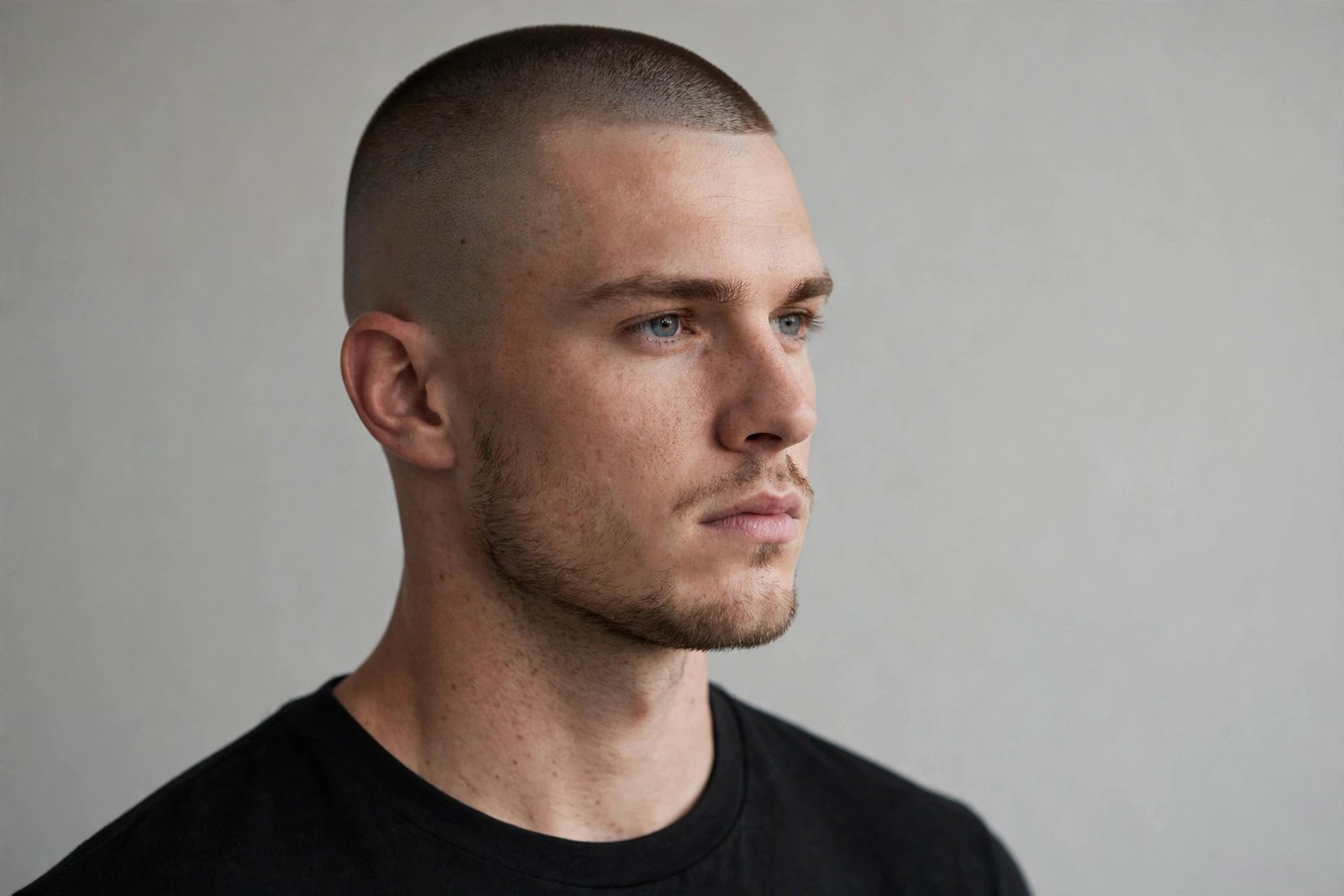
Now we enter authentic territory. The Marine Corps induction — the legendary “zero” — is the most severe haircut in the American military: sides taken to the skin, top at a #0, the whole head essentially shaved to stubble. It’s not a style choice in the Corps; it’s a rite of passage. But civilians have adopted it as the ultimate statement cut, and in 2026 it carries a raw, uncompromising energy that softer cuts can’t touch.
Who suits it? Men who want the real thing — no adaptations, no softening. It suits the same men as the zero-guard induction (style 2) but turned up: smooth scalps, strong features, total commitment. Veterans and military-adjacent men often choose it for authenticity; civilians choose it for impact.
Ask your barber for: “Marine Corps style — zero all over, skin on the sides, as close as the clippers go.” Any barber near a base will know exactly what you mean; elsewhere, the description does the work.
Maintenance every 5 to 7 days — this cut has the shortest shelf life on the list. The honest downside is everything about its severity: maximum scalp exposure, maximum sunburn risk, maximum shock value for anyone who knows you with hair. It can also read as aggressive in professional settings; this is not the cut for a job interview at a bank. But worn with confidence, it’s magnetic. There’s a reason it’s legendary — it strips a man down to essentials and dares the world to deal with it.
23. The Army Regulation Induction
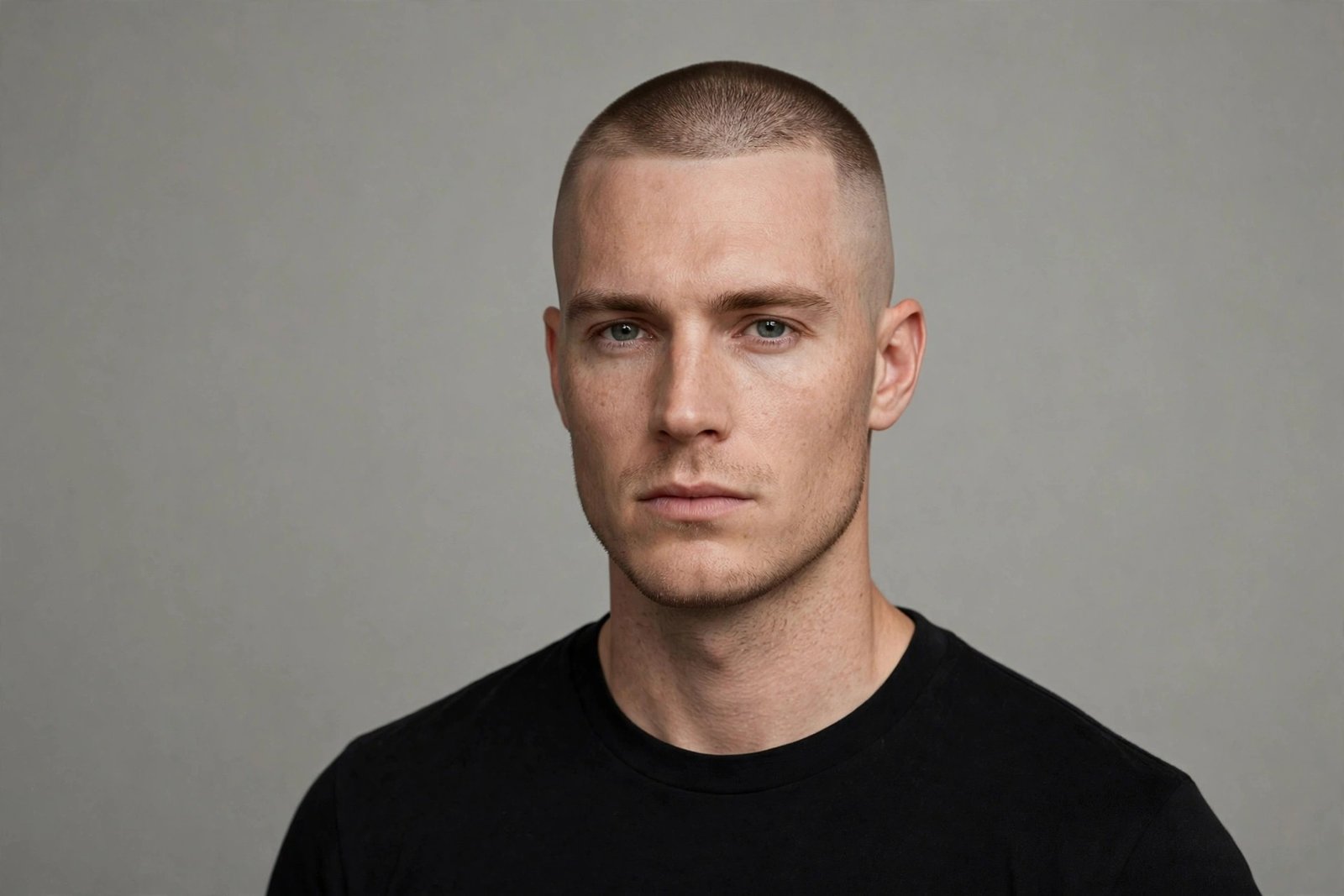
The Army’s version is the classic most people picture when they hear “military haircut”: a #1 or #2 taken uniformly over the whole head, neat, disciplined, regulation-precise. Less severe than the Marine zero, more uniform than the Navy’s tapered styles. It’s the induction as institution — the haircut of a million basic-training photos, and the one that translates most naturally to civilian life. If you want authentic military without the shock factor, this is it.
Who suits it? Practically everyone — this is the everyman’s authentic induction. It suits professionals who want a military edge without alarming HR, and it’s the version most flattering to average head shapes because the #1–#2 range forgives minor imperfections. Men who admire military aesthetics but live civilian lives land here.
Ask your barber for: “Army regulation style — single #1 guard all over, uniform, clean neckline.” Add “no fade, no taper” if your barber reaches for blending guards out of habit. Fans of classic military cuts should also check our crew cut updates for athletic men — the crew is the Army cut’s longer, styled cousin.
Maintenance weekly to bi-weekly depending on your chosen guard. The honest downside: it’s almost too normal. The Army induction doesn’t turn heads; it earns nods. If you want your haircut to be a conversation, pick the Marine zero or a faded adaptation. This one is for men who want to look sharp without explaining themselves — which, to be fair, is most men most of the time.
24. The Navy Induction
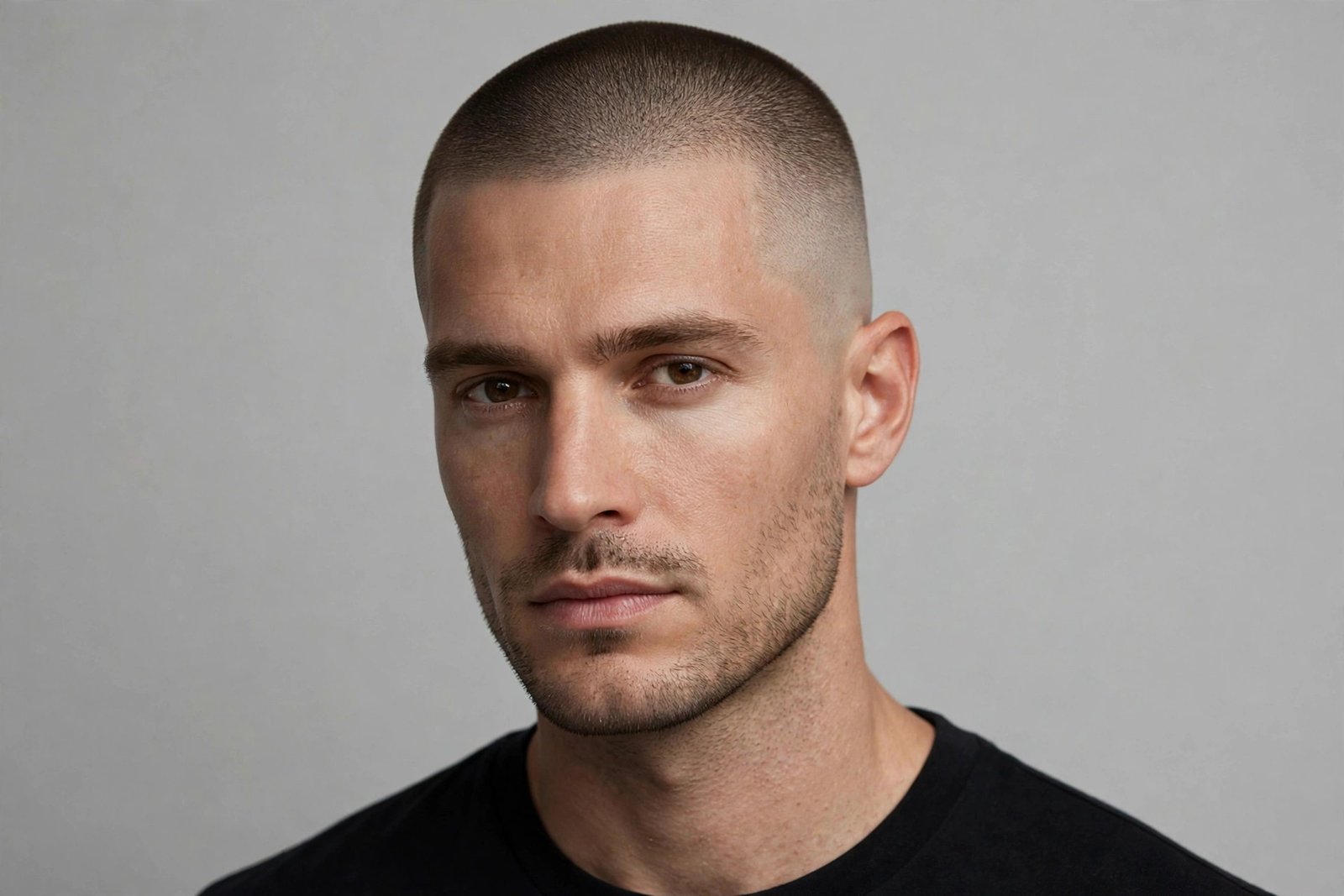
The Navy has always allowed a touch more polish, and its induction reflects that: typically a #1 or #2 on top with neatly tapered — not faded — sides, everything crisp and squared away. It’s the most “groomed” of the authentic military inductions, the one that looks equally at home in dress uniform and civilian clothes. In 2026, it’s become the thinking man’s military cut: all the discipline, with a finish that suggests attention to detail.
Who suits it? Men who like military precision but want a refined edge. The taper gives it a finished quality that the raw Army version lacks, so it suits professional environments slightly better. It flatters most face shapes, and the taper’s subtle shaping helps men with less-than-perfect head symmetry.
Ask your barber for: “Navy style — #1 on top, uniform, with a neat taper on the sides and back, no skin fade.” The distinction between taper and fade matters here; the Navy look is about neatness, not contrast.
Maintenance every 10 to 14 days. The honest downside is that it’s the least distinctive of the military trio — to most eyes, it’s just a neat short haircut, and the naval heritage is invisible without explanation. It also requires a barber who understands tapering; a bad taper looks worse than no taper at all. But as a daily-wear authentic induction, it’s arguably the most livable of the three service styles.
25. The Buzz-Induction Hybrid
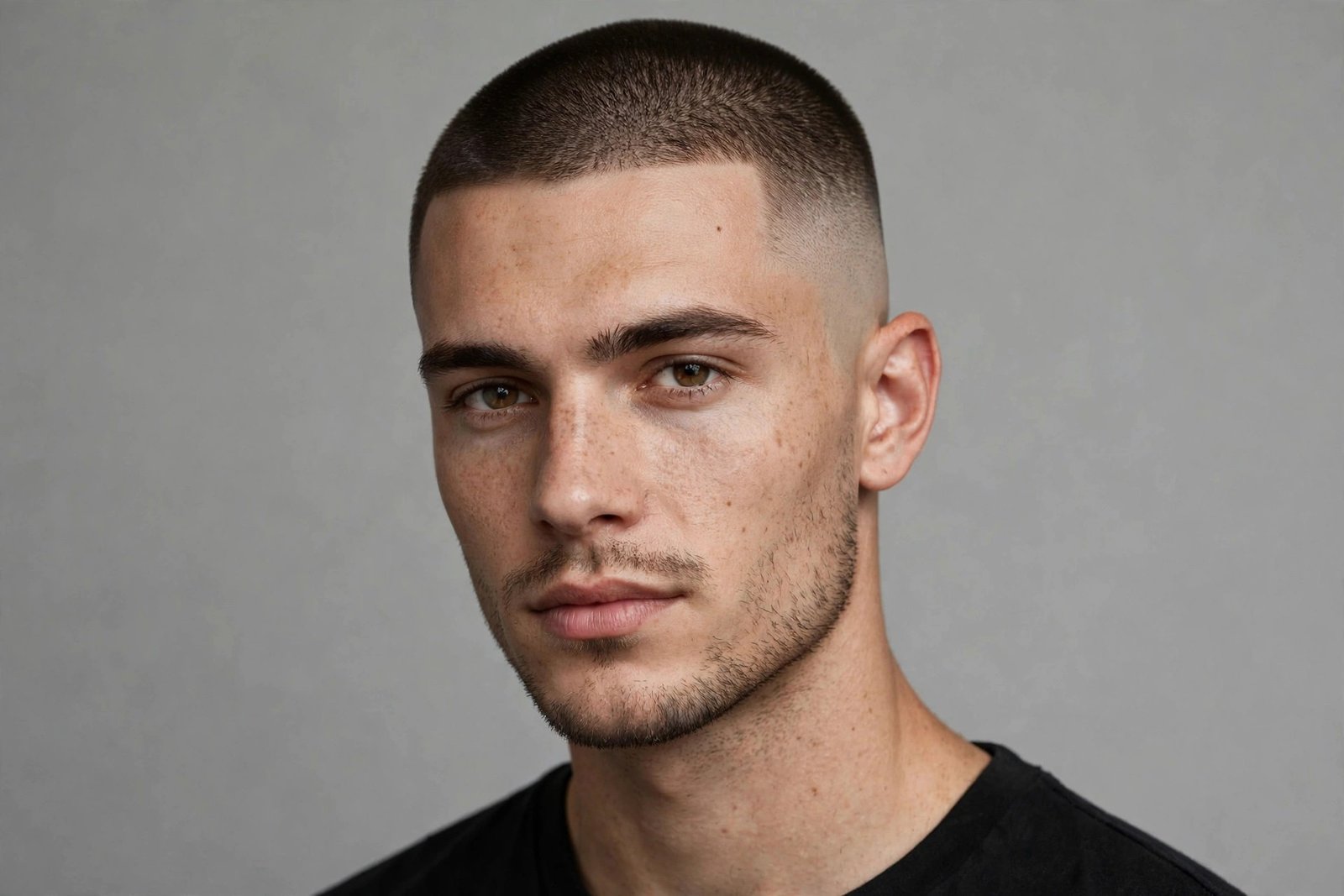
For the man caught between two instincts — the induction’s discipline and the buzz cut’s versatility — the hybrid splits the difference honestly. The crown and top are a true uniform induction (#1, one length), while the sides and back get a smooth taper that blends the induction top into neatly shortened sides. It’s not a fade (no skin), not a pure induction (not one length), but a deliberate middle ground that looks fantastic and wears easily.
Who suits it? Men who love the induction look but live in the real world of offices, weddings, and family photos. The taper softens the cut’s severity just enough for any setting while keeping the top’s military character. It suits men with slightly uneven head shapes too, because the taper’s shaping camouflages asymmetry the uniform cut would expose.
Ask your barber for: “#1 uniform on top, tapered — not faded — on the sides and back, blended at the ridge.” The “not faded” instruction is essential; otherwise you’ll walk out with style 5.
Maintenance every 10 to 14 days. The honest downside: hybrids satisfy nobody completely. Induction purists will say it’s just a short buzz cut (they’re right), and buzz-cut fans will say it’s too severe on top. It’s a compromise, and compromises are inherently unexciting. But you know what? Most men don’t need excitement from a haircut — they need to look good every day with minimal thought. This delivers exactly that, which is why it quietly outsells the purer styles.
26. The Induction with a Defined Hairline Shape
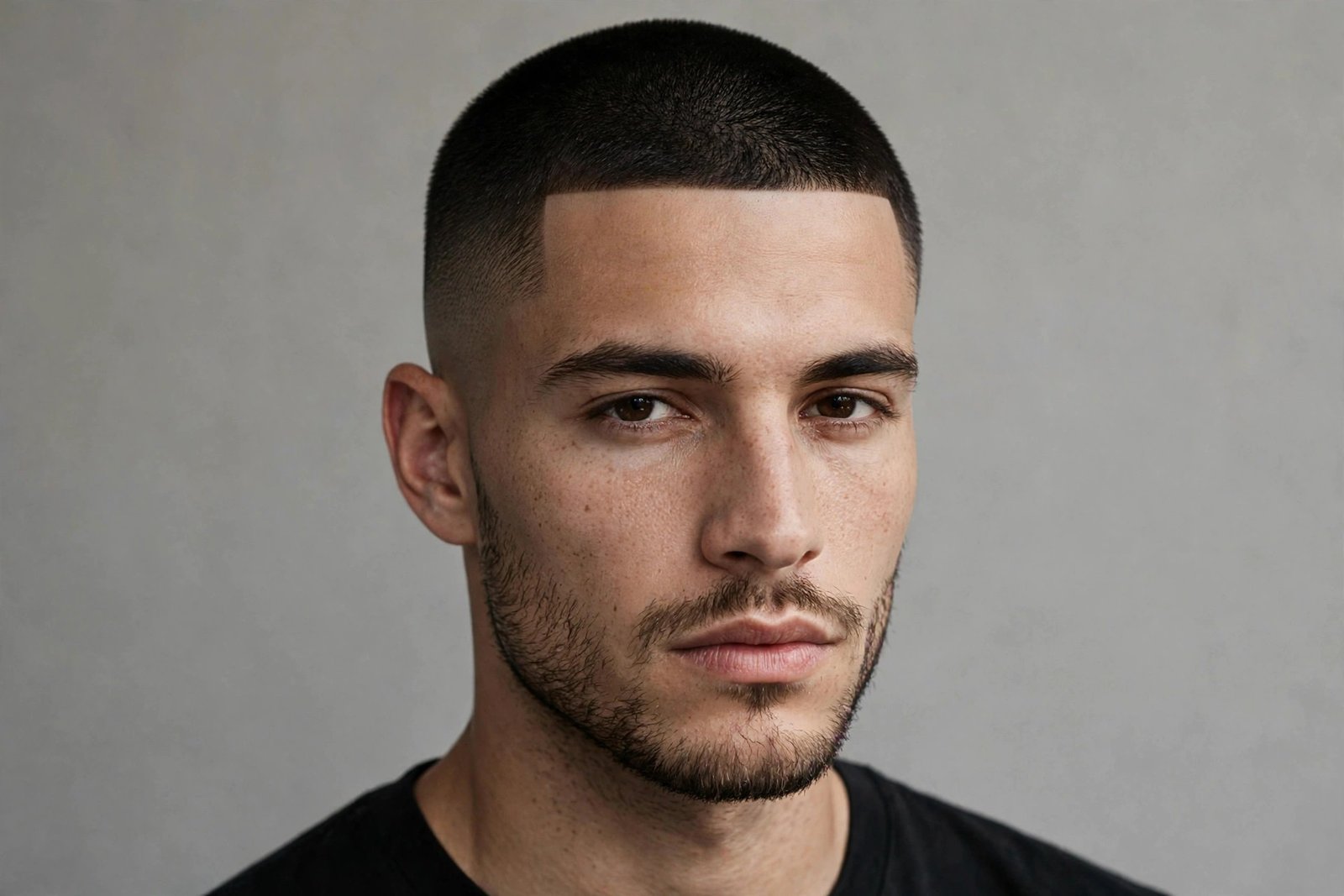
This is barber artistry applied to the simplest canvas. The cut itself is a standard #1 induction, but the hairline is deliberately shaped — squared at the temples, rounded at the corners, or carved into a subtle widow’s-peak emphasis — turning the hairline into a design element. At induction length, the hairline is the hairstyle’s detailing, the way stitching is the detailing on a plain suit. A shaped hairline elevates the whole cut from basic to bespoke.
Who suits it? Men with full, even hairlines that can hold a shape. The shaping works with your natural growth — a good barber enhances what you have rather than imposing geometry. It suits detail-oriented men who appreciate craft, and it photographs exceptionally well for anyone building a personal brand.
Ask your barber for: “Standard #1 induction, but shape my hairline — squared temples, cleaned corners, work with my natural line.” Bring reference photos; hairline shaping is subjective and “defined” varies wildly between barbers.
Maintenance is the price of precision: the shaped edges blur within a week, so you’ll need a trimmer for home touch-ups or weekly barber visits. The honest downside is the risk of over-shaping. An aggressive reshape can look artificial and, worse, it can move your apparent hairline in ways that age poorly as your real hairline changes. The golden rule: enhance, don’t redesign. A natural hairline with clean edges beats a sculpted one that fights your growth pattern every time.
27. The Two-Week Grow-Out Induction

Here’s a style nobody talks about but everybody wears: the induction at two weeks. The #1 has grown to roughly a #3, the edges have softened, the scalp shadow has filled in — and honestly, it looks great. Softer, more relaxed, less severe. Some men prefer this lived-in stage to the fresh cut and deliberately maintain their induction at this length, touching up just enough to keep it tidy. It’s the induction for men who like the aesthetic but not the maintenance treadmill.
Who suits it? Busy men who can’t do weekly touch-ups, and men who find the fresh #1 too stark. The grown-out length is more forgiving on every front — scalp imperfections, uneven growth, head shape — because the extra hair softens everything. It suits casual environments and men whose style is more relaxed than regimented.
Ask your barber for: “Take it to a #1, but I’m going to let it grow — just clean up the neckline and edges.” Then maintain only the edges at home every week or so, and do the full cut every three to four weeks.
Maintenance is minimal — that’s the whole point. The honest downside: there’s a fine line between “lived-in induction” and “overdue haircut,” and it sits around week three. Past that, the cut loses its identity and just looks neglected. You also never get the razor-sharp look that makes the induction special; this is the cut’s comfortable middle age, not its prime. Know which one you want before you commit to the grow-out lifestyle.
28. The Corporate Induction
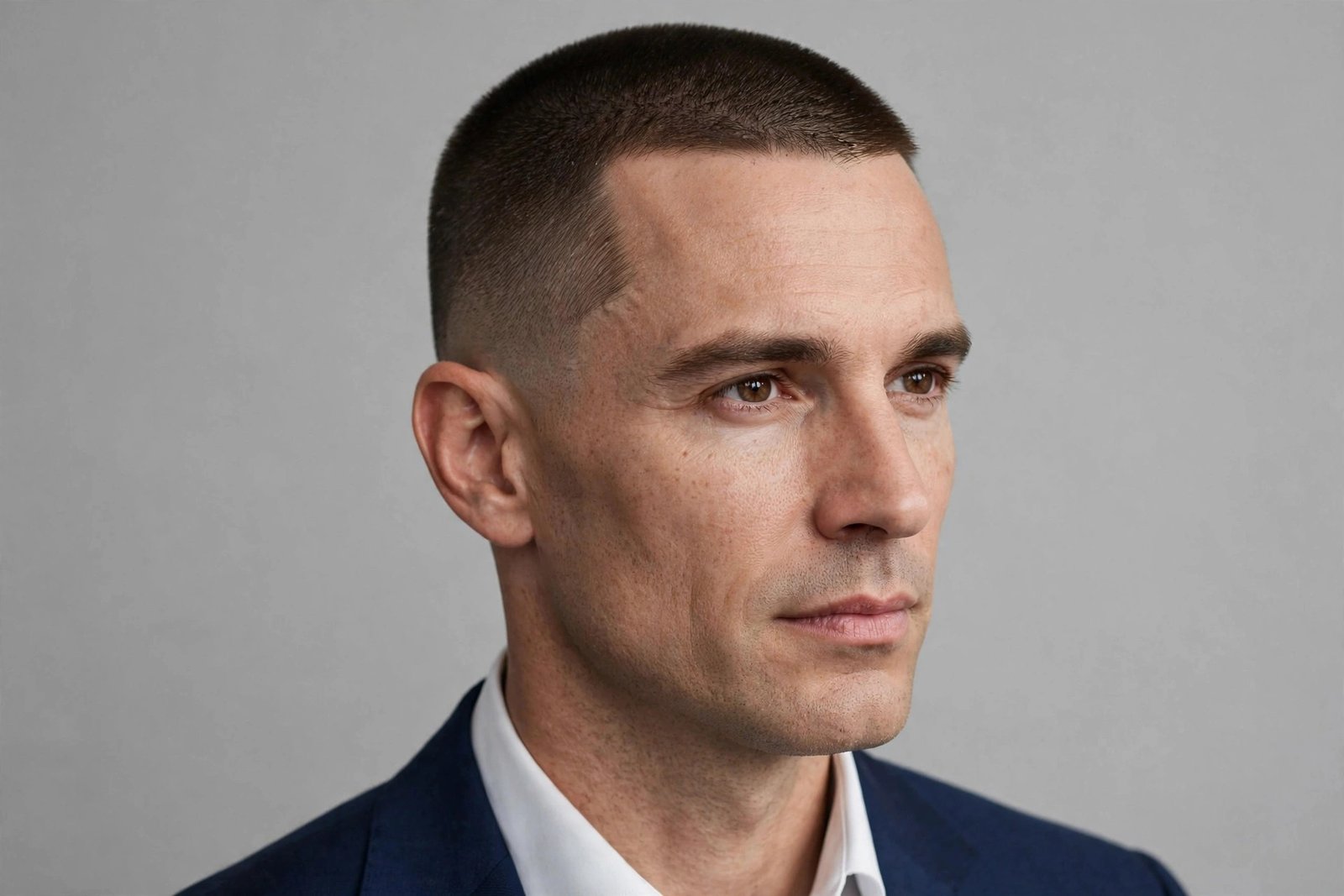
The final style is the one for the boardroom: a #2 induction all over — the softest true induction length — with a neat low taper at the edges and a completely natural, untouched hairline. Nothing severe, nothing trendy, nothing that needs explaining. It reads as a confident, no-nonsense professional who has better things to do than think about hair. In 2026, as workplaces keep relaxing while still rewarding polish, this is the induction that threads the needle.
Who suits it? Professionals in finance, law, consulting, medicine — anywhere that sharp matters more than edgy. It suits older professionals particularly well; the #2’s softness is dignified rather than severe. It’s also the safest first induction for any man nervous about the leap.
Ask your barber for: “Conservative #2 all over, one length, low taper at the neckline, keep the hairline completely natural.” The word “conservative” does heavy lifting here — it tells the barber exactly which version of short you mean.
Maintenance every two to three weeks — the most forgiving schedule on this list. The honest downside is anonymity: this cut makes zero statement, and if you chose the induction trend for its edge, this version sandpapers it off. It’s also the closest to “just a short haircut,” which means nobody will compliment it — they’ll just think you look tidy. For many men, that’s precisely the goal. Own it.
Maintenance, Barber Scripts & Scalp Care
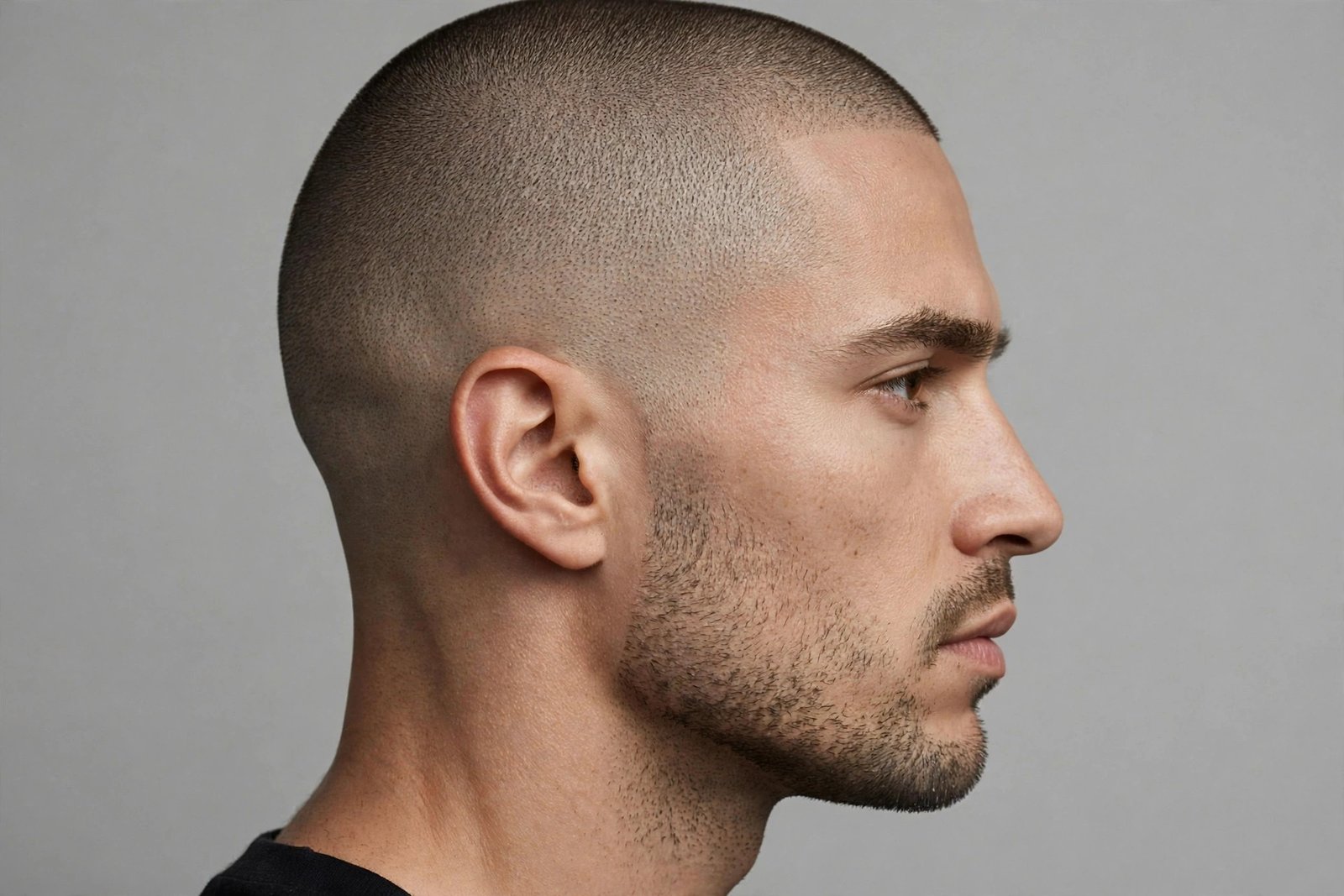
Here’s the part that actually determines whether your induction cut looks incredible or just short: the maintenance. The cut itself takes fifteen minutes. Keeping it sharp is a small ongoing discipline — and the scalp care is something almost nobody warns you about until they’re sunburned and itchy. This section covers the home routine, the barber routine, and the scalp routine. Get all three right and the induction cut men love becomes the easiest great haircut of your life.
The Home Touch-Up: Doing Your Own Induction Like a Pro
The beautiful secret of the induction cut is that it’s the one haircut genuinely designed for DIY. One guard, all over — there’s no blending to learn, no scissor work, no styling. Here’s the method that works: start with clean, dry hair (damp hair clumps and cuts unevenly). Attach your guard — the same one your barber used — and work against the grain in smooth, overlapping passes: up the back, up the sides, front to back over the crown. Overlap every pass by about half the clipper’s width so you don’t leave tracks. Then do a second pass with the grain to catch strays.
The tricky spots are the crown swirl and behind the ears. For the crown, use a handheld mirror to check your work — the swirl pattern can leave a visible tuft if you only cut in one direction. Go over it from two or three angles. Behind the ears, fold the ear down gently and run the clipper carefully around it. Take your time here; nicked ears bleed impressively and hurt disproportionately.
Invest in decent clippers — this is the one place not to cheap out. A mid-range corded or cordless clipper with sharp blades cuts cleanly in one pass; a cheap one drags, pulls, and leaves uneven patches that scream “home job.” Oil the blades every few uses, brush out the hair, and store the guards somewhere you won’t lose them. Total time once you’re practiced: fifteen minutes, once a week. That’s the entire hair routine. Compare that to your old forty-five-minute styling sessions and try not to smile.
The Barber Visit: What to Ask For and How Often
Even DIY devotees should see a barber occasionally — a professional shapes the hairline, cleans the nape properly, and spots things you can’t see in a mirror. The visit script for a classic induction is beautifully short: “Single #1 guard all over, one length everywhere, clean up the hairline and nape.” If you want an adaptation, name it precisely: guard number, fade or taper details, lineup preferences. Vague instructions (“just make it short”) produce vague results; the induction rewards specificity.
How often? For a #0 or #1 kept razor-sharp: every 7 to 10 days if you’re doing it at home, every 2 weeks at the barber. For a #2 or a tapered version: every 2 to 3 weeks. The faded adaptations (styles 5 and 6) need the most frequent professional attention because fades collapse visibly — budget for every 10 to 14 days if you wear one.
A word on tipping and loyalty: find one barber who does your induction well and stick with them. Short cuts are deceptively skill-dependent — the difference between a good #1 and a great #1 is in the edges, the evenness, the hairline judgment. A barber who knows your head shape, growth patterns, and preferences will deliver a better cut in less time than a stranger with a fancier shop. Loyalty pays in haircuts.
Scalp Care: The Part Everyone Forgets
Nobody warns you about this, so I will: your scalp is about to experience things it hasn’t experienced in years, and it will complain. First, the sun. A scalp that’s been under hair for decades burns fast and burns badly — and a sunburned scalp under a fresh induction is genuinely miserable. For the first month, wear a hat outdoors or apply sunscreen to your scalp. Yes, sunscreen on your head. It feels strange exactly once, and then it becomes habit. After a few weeks your scalp builds some tolerance, but never skip protection in strong sun.
Second, dryness and itch. Short hair means your scalp’s natural oils distribute differently, and many men get flaky or itchy in the first couple of weeks. The fix is simple: a light, fragrance-free moisturizer massaged into the scalp after showering. Nothing heavy, nothing greasy — just enough to keep the skin comfortable. If you get the classic regrowth itch (that prickly feeling around day 3–4), moisturizer plus a cool rinse usually settles it.
Third, washing. You barely need shampoo anymore — a gentle wash two or three times a week is plenty, and many men just rinse with water on other days. Over-shampooing a nearly-bare scalp strips it and causes the flakiness you’re trying to avoid. Treat your scalp like facial skin now: gentle cleanse, moisturize, protect from sun. That’s the whole regimen, and your scalp will thank you within two weeks.
Growing It Out: If You Ever Want To
Every induction ends eventually — curiosity, a wedding, winter, or just the urge for change. Growing out from a #1 is a journey with distinct phases, and knowing them removes the anxiety. Weeks 1–3: the soft grow-out (style 27), still looks intentional. Weeks 4–6: the awkward stage — uneven, fluffy, neither short nor long. This is where most men panic and re-cut. Push through.
The strategy: get the sides and back trimmed every 3–4 weeks while letting the top grow — this keeps the silhouette tidy while the top catches up. Around week 8–10 you’ll have enough length on top for a proper short crop or textured cut, and your barber can shape the whole thing into something deliberate. The full transition from induction to a styled short cut takes about three months.
During the grow-out, a little matte styling product becomes your best friend for the first time — it tames the fluff and gives the growing hair some direction. And be patient with the crown swirl; it’s always the last area to behave. The grow-out is the only phase of induction life that requires any styling effort at all, which tells you everything about how easy the rest of it is.
Frequently Asked Questions
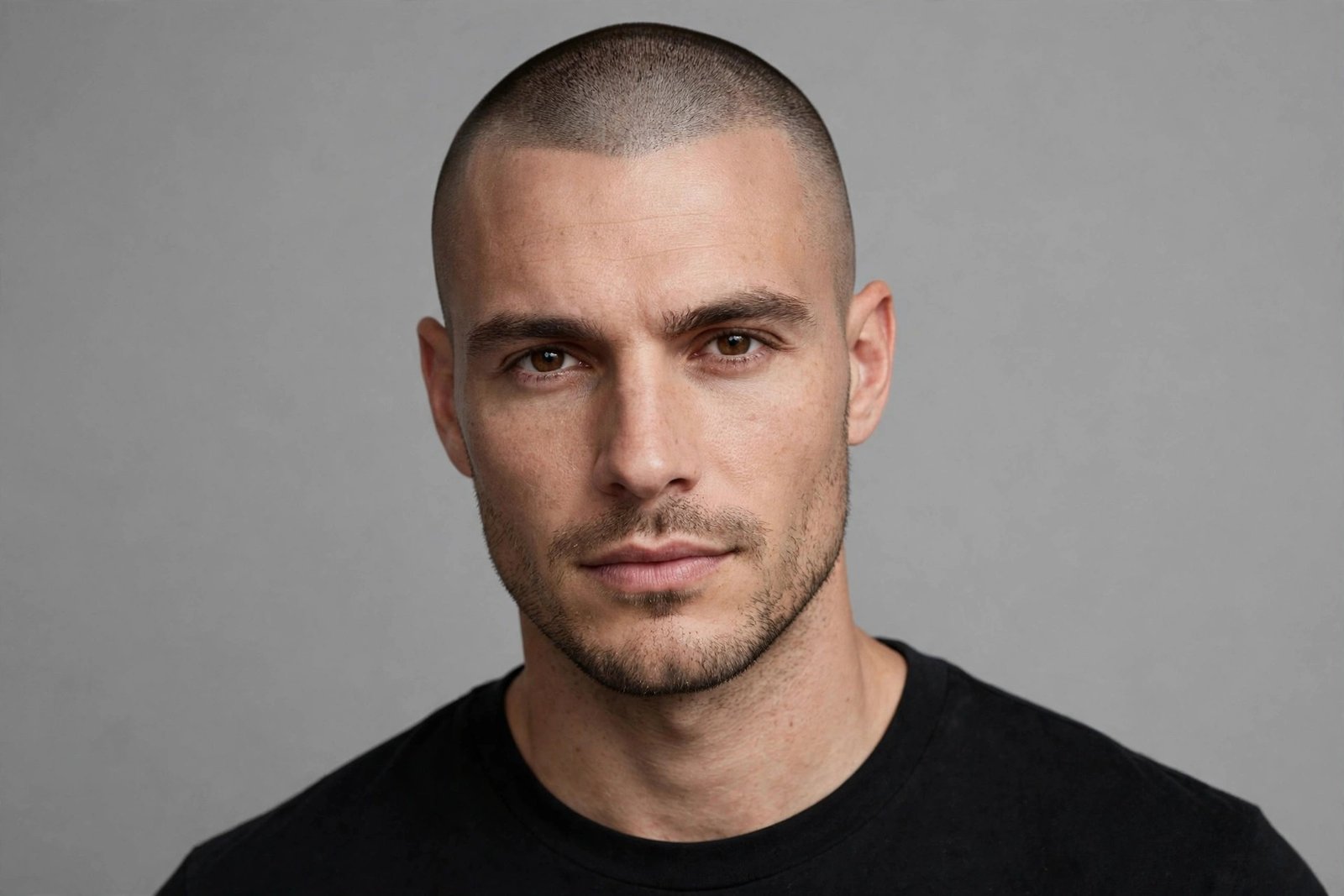
Straight answers to the questions men actually ask about the induction cut men are getting in 2026 — no fluff, no hedging.
What exactly is an induction cut?
The induction cut is the ultra-short, single-guard-all-over haircut given to military recruits on day one of basic training, hence the name. Traditionally it is a #0 or #1 guard (0.5mm to 3mm) taken evenly over the entire head: top, sides, and back, with no taper, no fade, and no styling. It is the shortest standard military cut, one step above a fully shaved head. The civilian 2026 version keeps the spirit — uniform, crisp, brutally low-maintenance — but often adds a sharp lineup or faded sides so it reads as a style choice rather than boot-camp issue.
What guard length is a true induction cut?
Traditionally, an induction cut is a #0 (0.5mm, essentially skin) or a #1 (3mm) guard used all over the head with no variation. In practice, most civilian barbers treat guards #0 through #2 as induction territory, with #1 being the sweet spot: short enough to read as a true induction but long enough to show a shadow of hair rather than bare scalp. Anything at a #3 or above starts drifting into buzz-cut territory. If you want the authentic look, ask for a single #1 guard all over; if you want the hardcore military version, ask for a #0.
What is the difference between an induction cut and a buzz cut?
Think of it this way: every induction cut is a buzz cut, but not every buzz cut is an induction cut. A buzz cut is the whole family of clipper cuts, and it can vary — longer on top, tapered sides, a fade, a textured top. The induction cut is the most extreme, most uniform member of that family: one guard, everywhere, no blending, no contrast. The induction is also defined by its origin — it is literally the cut given at military induction. If your cut has faded sides or a longer top, you have a buzz cut, not a true induction.
How often does an induction cut need maintenance?
Plan on touching it up every 7 to 10 days if you want it looking razor-sharp, because at these lengths even a few days of growth changes the look completely. The good news is that maintenance is dead simple. Most men learn to do it themselves with a decent pair of clippers and a mirror — one guard, all over, fifteen minutes. If you would rather visit a barber, book every two to three weeks. Between cuts, keep the scalp moisturized and wear sunscreen, because your scalp is now seeing the sun for the first time in years.
Does an induction cut suit thinning hair or a receding hairline?
Honestly, this is where the induction cut shines brightest. When hair is cut this short, the contrast between thick and thin areas nearly disappears — there is no long hair left to emphasize what is missing up top. Many barbers call it the most dignified answer to thinning hair, miles better than a comb-over or a wispy grow-out. A receding hairline also looks more deliberate and masculine at induction length. The one caveat: if your thinning is patchy or your scalp shows irritation, go a touch longer (a #2) rather than skin-short so the scalp reads as even.
Can I get an induction cut at a regular barbershop?
Absolutely — it is one of the simplest cuts a barber can do, and any competent barber has done hundreds of them. The key is being specific, because ‘short all over’ means different things to different people. Use the script in this guide: name your guard number, say ‘all over, no taper,’ and decide on the lineup. If you want the civilian-adapted version with faded sides, say so explicitly — otherwise a good military-style barber will give you the full uniform cut by default.
What should I ask my barber for to get an induction cut?
Say this: ‘Single #1 guard all over, no taper, no fade — and clean up the hairline with a sharp lineup.’ That is the classic civilian induction. Want the authentic boot-camp version? Swap in a #0. Want it softer? A #2. If your barber looks unsure, add ‘like the military induction cut, one length everywhere.’ Bring a photo from this guide if you want the adapted version with faded sides, because that is where interpretations start to differ — the fades need a reference.
Will an induction cut suit my head shape?
Here is the honest truth barbers sometimes skip: the induction cut puts your head shape completely on display, so it flatters some shapes more than others. Oval and square faces tend to look fantastic — the short length sharpens strong bone structure. Round faces can look rounder, and very long or narrow heads can look longer; a beard or a slightly longer #2 guard usually fixes both. Lumps, bumps, and scars also show more at #0. When in doubt, start with a #2 — you can always go shorter, but you cannot un-cut it.
Conclusion
Twenty-eight styles, one truth: the induction cut men keep choosing is the most honest haircut a man can wear. There’s no styling to hide behind, no length to compensate with, no product to fake texture. It’s you, your head shape, and a pair of clippers — and that’s exactly why it works. In a grooming culture built on forty-five-minute routines and shelf after shelf of product, choosing the shortest cut in the book is a quiet act of confidence. The 2026 surge isn’t really about military nostalgia. It’s about men discovering that less hair can mean more presence.
So here’s my parting advice, barber to reader: start with the #2 if you’re nervous, go straight to the #1 if you’re not, and give it a full two weeks before you judge. Take care of your scalp, keep the edges clean, and pick the variation that fits your face and your life — not the one that looks coolest in a photo. The right induction cut doesn’t just change how you look. It changes your mornings, your shower, your packing for trips, your whole relationship with the mirror. Fifteen minutes, one guard, zero fuss. Welcome to the easiest great haircut you’ll ever wear.