Hair Designs for Men 2026: 16 Line-Ups, Patterns & Art Cuts
Hair Designs Men Love in 2026: Line-Ups, Patterns & Art Cuts That Actually Turn Heads
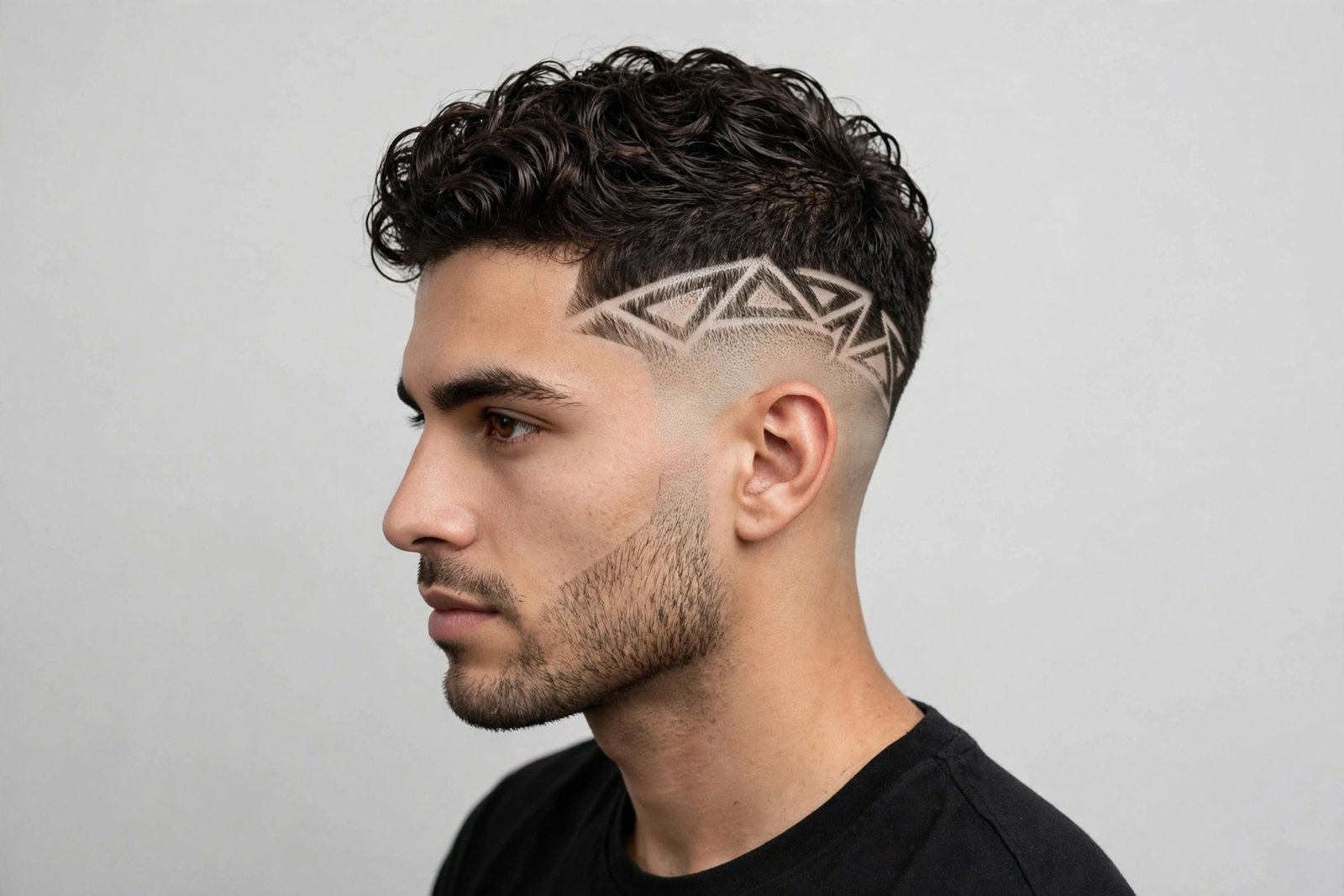
Hair designs men are asking for in 2026 aren’t the timid single-line edge-ups of five years ago. The modern hair design is a full statement — razor-carved patterns, geometric fades, crisp line-ups so sharp they look drawn with a ruler, and freestyle art cuts that treat the side of your head like a canvas. Walk into any good barbershop in a big city right now and you’ll see it: guys getting actual artwork carved into their fades, and barbers who’ve quietly become tattoo artists with clippers. This guide breaks down the 16 best hair designs for men in 2026 — what each one is, who it flatters, exactly what to tell your barber, how to maintain it, and the honest downsides nobody at the shop will mention until you’ve already paid.
Inside: the difference between a line-up, a pattern, and an art cut (they’re not the same thing, and mixing them up is how you walk out with the wrong haircut), 16 designs ranked by boldness and commitment level, the barber script that gets you what you actually want instead of what the barber feels like doing, a maintenance routine that keeps sharp lines crisp instead of fuzzy, and answers to the questions men ask before they let a razor near their hairline.
Here’s the thing most guys get wrong about hair designs: they think it’s all about the barber’s skill. It’s not. A great design on the wrong hair type, the wrong growth pattern, or the wrong lifestyle looks terrible within four days. Your hairline shape decides what a line-up can do. Your hair density decides whether a pattern reads clean or looks like a smudge. And your willingness to come back every 10 to 14 days decides whether you should get a subtle micro-line or go full freestyle art. This guide will help you pick the design that fits YOUR head, not some model’s head on Instagram.
I’ll be honest with you — I’ve seen more hair designs than I can count, and the difference between a $25 disaster and a $60 masterpiece is rarely the price. It’s communication. The guys who walk in with reference photos, who can name what they want (“hard line with a parallel ghost line, skin fade 0 to 1 on the sides”), walk out happy. The guys who say “do something cool” walk out with something the barber was experimenting with for the first time. This guide gives you the vocabulary to be the first guy.
Table of Contents
- Hair Designs for Men 2026: Line-Ups, Patterns & Art Cuts That Actually Turn Heads
- 16 Hair Designs for Men in 2026
- Styling Routine, Maintenance & Keeping Designs Sharp
- Frequently Asked Questions
- Conclusion
What Actually Counts as a “Hair Design”?
People throw the word around loosely, so let’s get precise. A hair design — the kind of thing hair designs men pin by the thousand — is any deliberate visual element a barber creates with clippers, a razor, or a trimmer that goes beyond a standard cut — and it breaks into three families that matter for your decision-making.
Line-ups (edge-ups) are the foundation. This is the crisp, defined shaping of your natural hairline — forehead, temples, sideburns — using a trimmer and usually a straight razor finish. A line-up doesn’t carve new shapes into your hair; it sharpens the frame your face already has. If you’ve never had a proper line-up with a razor finish, you don’t know what your hairline actually looks like. It’s the single highest-impact thing a barber can do in five minutes, and it’s the gateway drug to everything else on this list.
Patterns are shaved or razor-etched shapes cut into faded or short hair — zigzags, parallel lines, diamonds, waves, checkerboards. They’re created by removing hair in controlled shapes, usually with a trimmer over a fade, so the pattern shows as clean scalp (or stubble) against the fade’s gradient. Patterns are semi-permanent: they grow out in 2–3 weeks, which makes them the perfect low-commitment entry into designed hair.
Art cuts (freestyle designs) are the top of the food chain — curved tribal work, stars, lightning bolts, flames, geometric murals that wrap from temple to nape. These are done freehand or with stencils, and they take a barber with genuine artistic skill. A great art cut looks like a tattoo made of hair. A bad one looks like someone lost a fight with a trimmer. Choose your artist like you’d choose a tattoo artist: look at their portfolio of healed work (grown-out photos), not just the fresh chair pics.
One more distinction worth knowing: color designs (bleached lines, colored patterns) are a whole separate discipline. This guide covers cut and razor designs only — carved, not colored. If you want to add color to a design, do the cut first, live with it for a week, then decide. Color on top of a fresh design can look incredible, but it also triples your maintenance bill and limits how often you can get the lines re-carved.
Why 2026 Is the Year Hair Designs Went Mainstream
Five years ago, a carved hair design said “I’m 19 and I have opinions.” In 2026, it says “I have a good barber and I know what I want.” The shift happened for a few real reasons, not just trend cycles.
First, the technical bar rose dramatically. Clipper technology got sharper, detailing trimmers got more precise, and barbers started treating design work as a specialty rather than a party trick. The average design in 2026 is cleaner than the best design was in 2021. Lines are sharper, curves are smoother, and the blending around patterns is invisible instead of choppy. When the craft gets this good, mainstream guys stop being scared of it.
Second, workplace norms finally caught up. The corporate fade with a subtle parallel line or a ghost design is now completely normal in offices that would have written you up for it five years ago. Grooming culture shifted from “conservative = professional” to “well-groomed = professional,” and a crisp line-up with a tasteful micro-design reads as meticulous, not rebellious — a shift the men’s style press at GQ has been tracking for years. The key word is tasteful — a sharp edge-up and a thin secondary line work anywhere; a full flame mural doesn’t, and you should know that going in.
Third, social media did what social media does: it made reference photos universal. You no longer have to describe a design with hand gestures and hope. You show your barber exactly what you want, they show you what they’ve done, and the gap between expectation and result shrinks to almost nothing. The barbers who lean into this — full portfolios, honest “I can’t do that on your hair type” conversations — are the ones with waiting lists. Find one.
Who Should Get a Hair Design (and Who Should Think Twice)
Hair designs flatter almost everyone, but the RIGHT design depends on your hair, your hairline, and your life. Here’s the honest breakdown.
Best candidates: Guys with thick, dark, coarse or tightly curled hair get the most dramatic designs — the contrast between shaved scalp and dark hair makes patterns pop. A crisp line-up works on every hair type and every skin tone, full stop. Men with defined natural hairlines get the sharpest edge-ups. Guys with active social lives, creative jobs, or just a taste for standing out will enjoy bolder patterns the most.
Think twice if: Your hair is very fine and light-colored — designs will be subtle rather than striking, because there’s less contrast between the carved line and the surrounding hair (a good barber will compensate with width and depth, but set expectations accordingly). If your hairline is actively receding, aggressive line-ups can draw attention to it — talk to your barber about softer edge work instead. And if you can’t commit to a touch-up every 10–14 days, stick to designs that grow out gracefully (micro-lines, simple parallel lines) rather than intricate art that turns to fuzz in week two.
The hairline truth barbers won’t volunteer: A line-up doesn’t create a hairline, it reveals one. If your hairline is naturally uneven, patchy, or very high, a hard razor line can look artificial — like a sticker on your forehead. A skilled barber will read your hairline and suggest the line-up shape that works with it: slightly rounded for high foreheads, squared for strong foreheads, softened for thinning temples. The goal is the best version of YOUR hairline, not a copy of someone else’s.
16 Hair Designs Men Are Getting in 2026
Sixteen designs, ordered from everyday-wearable to full art-piece. Each one gets the full treatment: what it is, who it suits, the exact barber script, maintenance reality, variations, and the honest downside. Pick your commitment level before you pick your design.
1. The Classic Sharp Line-Up
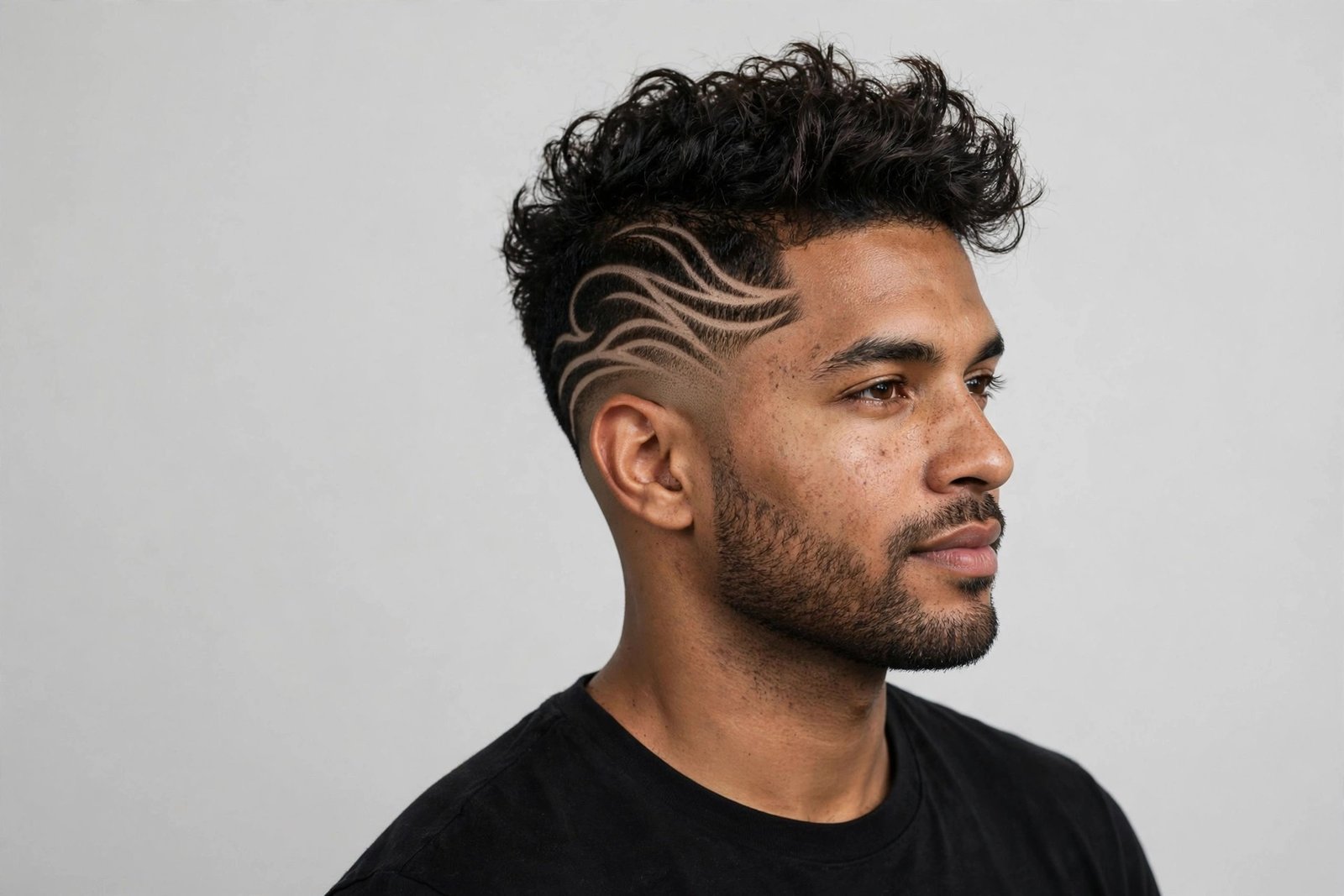
The foundation of everything. A classic sharp line-up is your barber defining your entire front hairline — forehead edge, temple corners, and sideburns — into crisp, straight, symmetrical lines using a trimmer followed by a straight razor finish. No carved shapes, no patterns, just your hairline at its absolute sharpest. It sounds simple. It is not simple. The difference between a decent line-up and a great one is about two millimeters of precision and a barber who checks symmetry from multiple angles instead of eyeballing it from the side.
This suits literally everyone, which is why it’s first on the list. Thick hair, thin hair, curls, waves, straight — a clean edge-up improves all of it. It particularly transforms guys who’ve been getting “just a trim” from barbers who skip the razor finish. If your hairline has never been razor-finished, the first time feels like someone cleaned your glasses — suddenly everything looks HD. Men with strong, full hairlines get the most dramatic effect: that squared-off temple corner and razor-sharp forehead line is the single most masculine grooming detail in barbering. If you wear your hair ultra-short, the line-up matters even more — see our breakdown of sharp buzz cut line-up ideas for how edge-ups transform short cuts.
The barber script: “Line-up with a razor finish, keep my natural hairline shape, just sharpen it. Squared temples.” That’s it. If you want it more dramatic, add “push the corners slightly.” If you’re nervous about it looking too harsh, say “soften the forehead line a touch.” A good barber will show you in the mirror before the razor touches skin — if yours doesn’t offer, ask. This is your face; micromanage politely.
Maintenance is where line-ups live or die. A fresh line-up lasts 7–10 days before regrowth softens the edges, faster if your hair grows quickly. You have two options: learn to do quick touch-ups yourself with a detail trimmer (takes five minutes once you learn, and plenty of guys do their edges between cuts), or book barber visits every 10–14 days. Many shops offer a discounted “edge-up only” service — ask yours. The DIY route works fine for the forehead line and sideburns; leave the temple corners to the barber until you’ve practiced, because a slipped hand there is visible from across the street.
The honest downside: once you’ve had a truly sharp line-up, every haircut without one feels unfinished. It’s a grooming standard upgrade that ruins cheap haircuts for you forever. Also, if you’re in the awkward phase of growing out your hairline, line-ups every week will slow visible progress slightly — worth it for most guys, but know the tradeoff.
2. The Geometric Fade Pattern
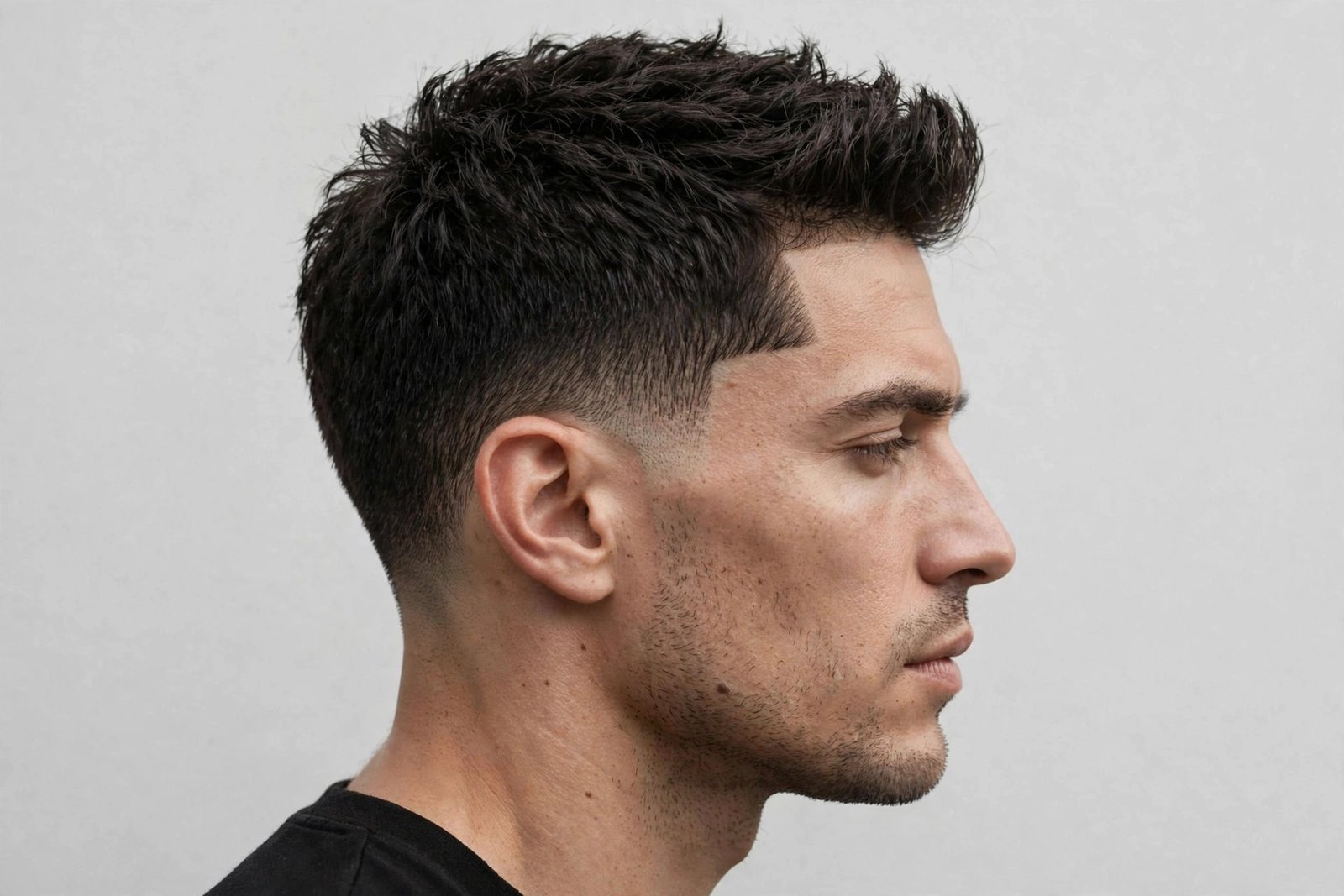
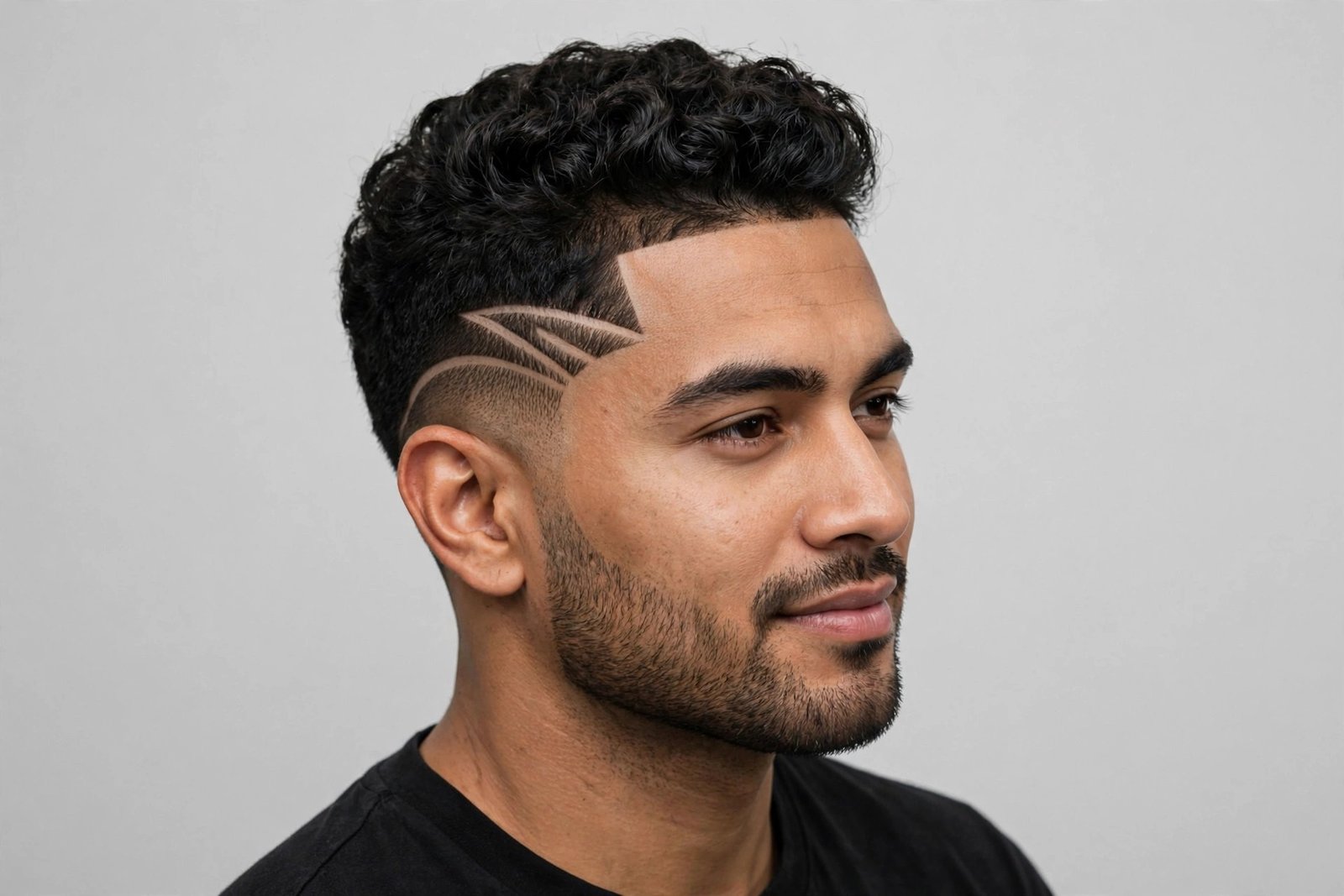
Where line-ups end and art begins. A geometric fade pattern is a set of clean, angular shapes — think precise angles, chevrons, or interlocking lines — carved into a skin fade, usually on the temple or just above the ear. The geometry is the point: straight edges, sharp points, mathematical symmetry. Done well, it looks like architecture on your head. The fade underneath does half the work here, so it pays to understand your options — our guide to fade haircuts for every man covers which fade heights give carved patterns the best canvas. Done badly, it looks like a geometry homework accident, so this is a design that punishes imprecise barbers severely.
This suits guys with medium-to-high skin fades, because the pattern needs the clean gradient as its canvas — the contrast between the carved shape and the faded hair around it is what makes it read. Thick, dark hair gives the boldest result; the shaved lines appear as pale scalp against dark hair, and the sharper that contrast, the more the geometry pops. It works especially well with angular face shapes and strong jawlines, since the angular pattern echoes your bone structure. Rounder faces can wear it too, but ask the barber to angle the pattern upward — it draws the eye up and adds perceived structure.
The barber script: “Mid skin fade, and I want a geometric pattern on the temple — something angular, like a chevron or angular zigzag. Keep it medium size, not tiny.” Bring a photo. Geometric work is one of the most photo-dependent designs because “angular pattern” means ten different things to ten different barbers. Specify placement: temple, above the ear, or wrapping toward the nape. And ask the barber to sketch it with the trimmer (light pass first) so you can approve the shape before they commit to depth.
Maintenance: the carved lines grow in within 2–3 weeks and start looking fuzzy around day 10. The fade itself needs its usual 2-week rhythm anyway, so the pattern maintenance piggybacks on your normal cut schedule — this is one of the designs that doesn’t add extra shop visits. You can’t touch up carved geometry at home (well, you could, but you’d be redrawing architecture freehand in a mirror, and that ends badly), so budget the pattern into your regular fade appointments.
The honest downside: geometry shows mistakes mercilessly. An asymmetry of even a few millimeters reads as “wrong” to the human eye because we’re wired to notice broken symmetry in geometric shapes. Curved, organic designs forgive a wobble; chevrons do not. Vet your barber’s portfolio specifically for geometric work — a guy who’s great at fades might be mediocre at carved angles, and this design exposes that gap.
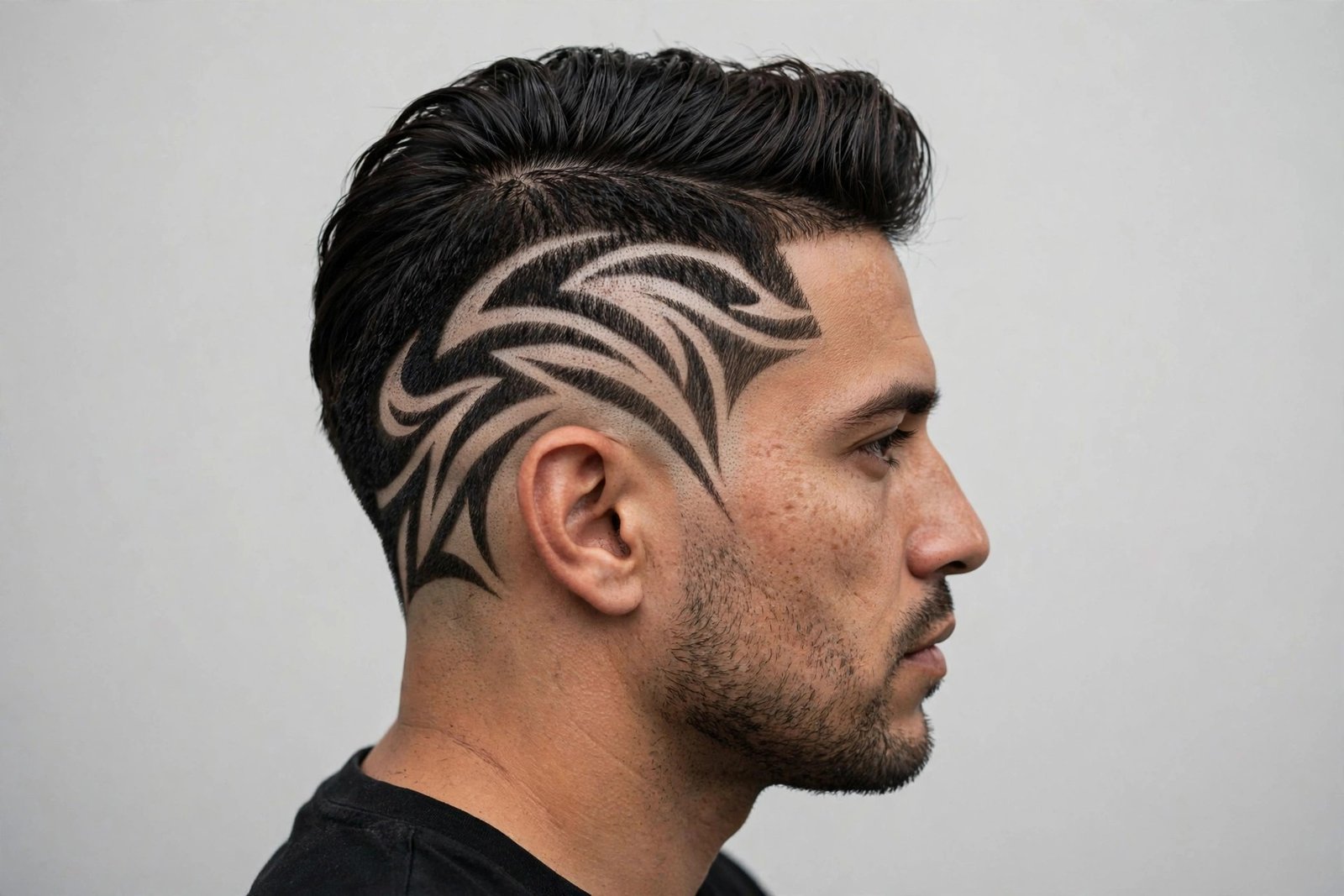
3. Curved Tribal-Inspired Lines
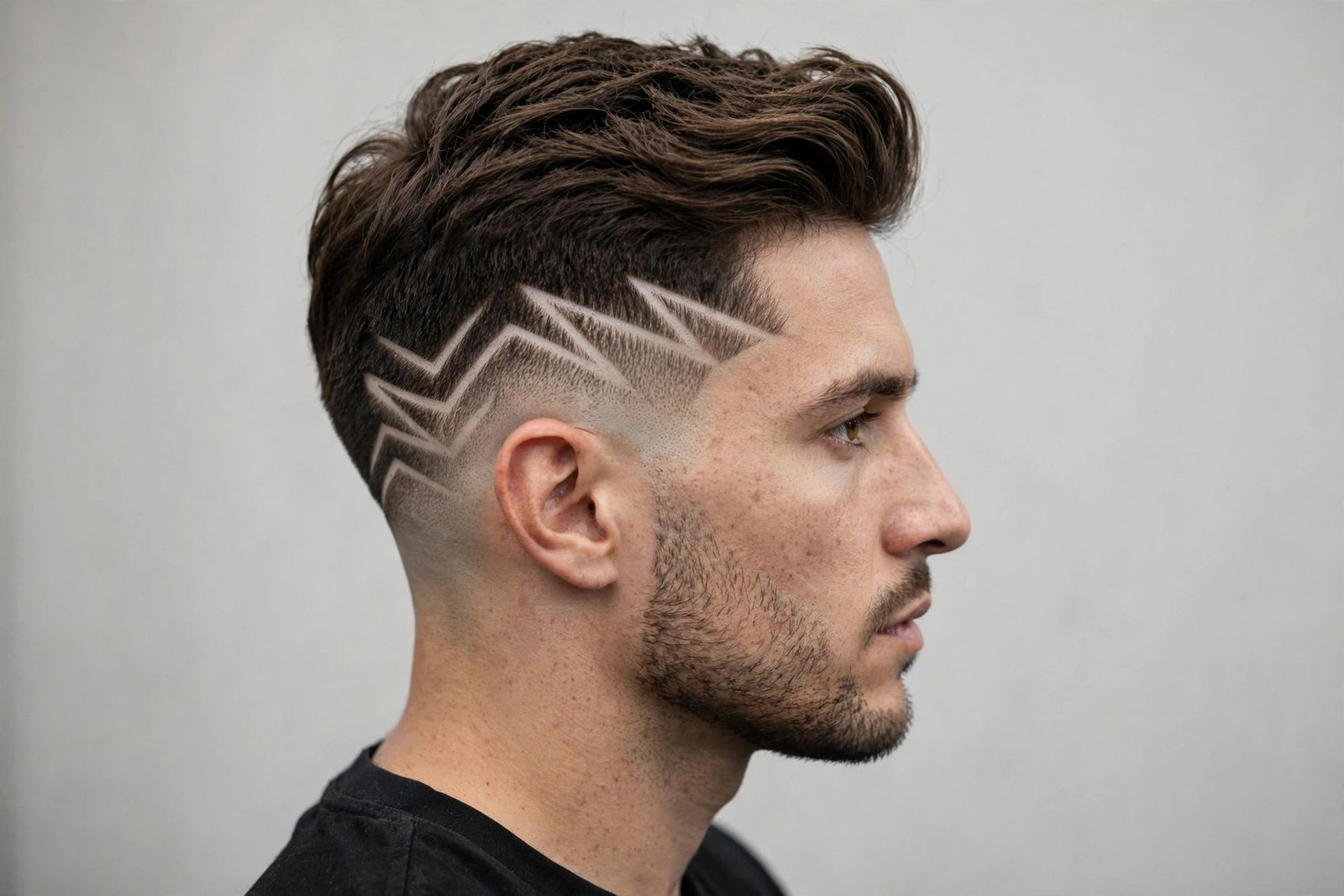
The design that started the whole movement. Curved tribal-inspired lines are flowing, swooping shapes — thick tapering curves that sweep from the temple back toward the ear or down the nape — carved into a fade. They draw from traditional tribal tattoo aesthetics: bold curves, pointed ends, dynamic flow. This was the dominant hair art of the late 90s and early 2000s, and its 2026 revival is cleaner, more refined, and far more precise than the original era — think tribal lines with a graphic designer’s discipline.
This suits men with longer fades (low or mid rather than high skin), because the curves need room to flow — cramming a tribal sweep into a tight high fade looks cramped. It pairs beautifully with textured tops: curls, waves, or longer textured crops, where the organic curves on the sides echo the natural movement on top. Guys with round or square faces benefit most, since the diagonal flow of the curves breaks up facial symmetry and adds motion. It’s also one of the most forgiving designs for first-timers, because curves hide minor imperfections better than straight geometry.
The barber script: “Low fade with tribal-style curved lines on the sides — flowing curves, tapered ends, sweeping back from the temple. Keep them bold, not thin.” Specify how many curves: one bold swoop per side is classic and clean; two or three interlocking curves is more elaborate. Ask about symmetry — true mirror symmetry or complementary asymmetry (different but balanced curves per side) is a stylistic choice; most barbers default to mirrored, but complementary curves can look more artistic. Again: reference photo. Tribal means something different to every generation of barber.
Maintenance mirrors the geometric pattern — 2–3 week lifespan, fuzzy by day 10–12, re-carved at your normal fade appointment. Curves grow out slightly more gracefully than angles, which is a real practical advantage: a fading tribal line looks intentional for a few days longer than a fading chevron. Touch-ups are barber-only; freehand curves are the hardest thing to self-trim, and a wobbly curve looks worse than no curve at all.
The honest downside: the tribal association cuts both ways. Some people will read it as classic barbershop artistry; others will read it as dated. The 2026 refined version avoids the cliché by being cleaner and more minimal than the 2002 version — one or two bold curves, not a full side-of-head mural. If you’re worried about the dated perception, keep the curves minimal and let the precision speak. And be aware: this design photographs as “bold” even when it feels subtle in person, so consider your workplace before going big.
4. The Starburst Design
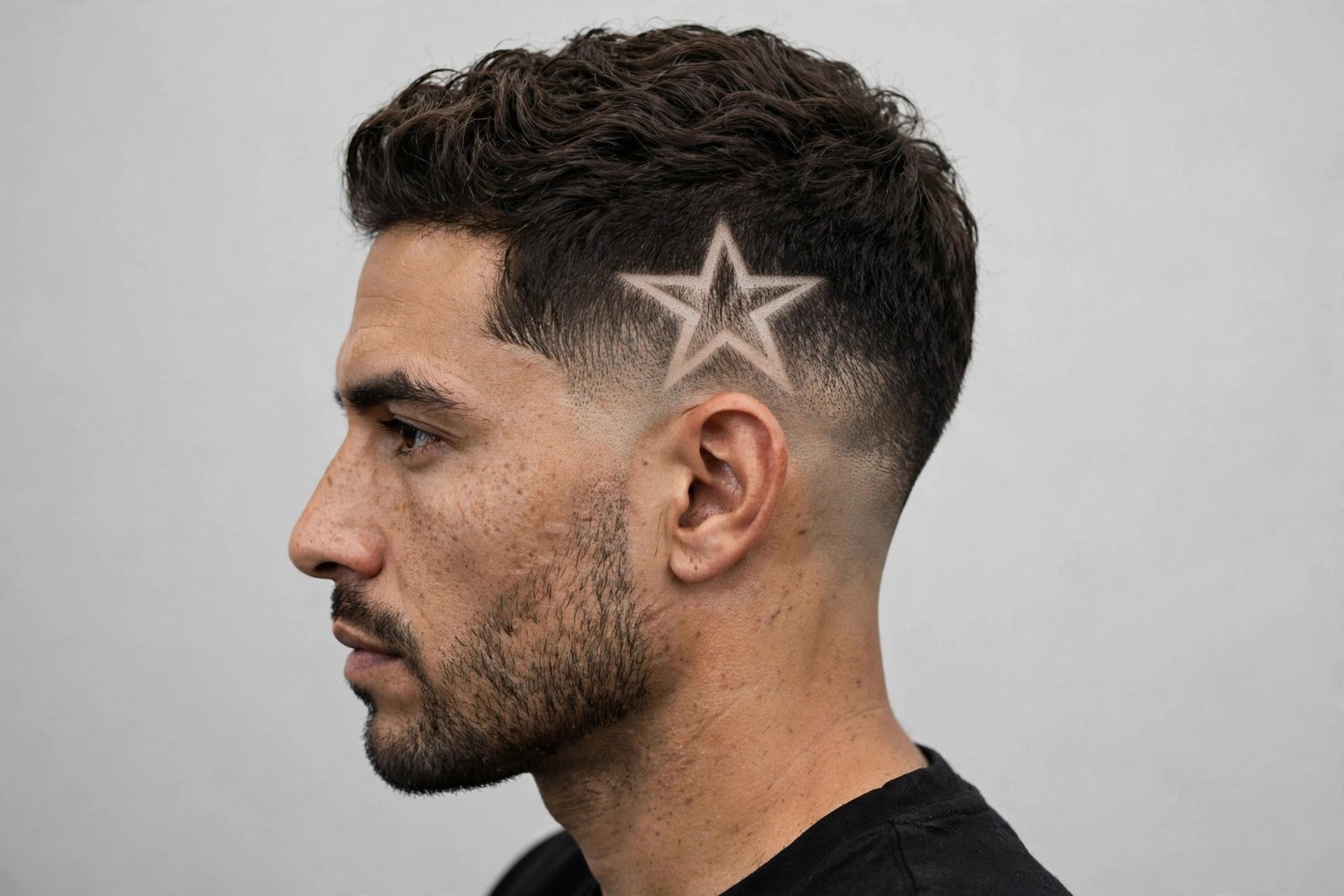
Maximum impact, minimum subtlety. A starburst design is a star — usually a five-pointed star, sometimes a stylized multi-point burst — carved into the fade, most commonly on the temple or just behind the ear. It’s bold, it’s unmissable, and it’s the design people will ask you about. The starburst works because the human eye is drawn to radial symmetry; even a simple star reads as deliberate art from across a room.
This suits confident guys who want a conversation piece — let’s not pretend this is a subtle design. It works best on medium-to-dark hair with a clean mid or high fade, where the pale carved star contrasts sharply against the surrounding hair. Placement matters enormously: a temple starburst is front-and-center bold; a starburst tucked just behind the ear is a reveal — invisible from the front, striking in profile. Temple placement deserves extra thought since it’s the most visible real estate on your head — see temple fade ideas for men for how the pros frame that zone. The behind-the-ear placement is the smart move for guys who want the art without the all-day visibility, and it photographs incredibly well.
The barber script: “I want a star carved into the fade, right here” — point to the exact spot — “medium size, clean five-point star, sharp points.” Size calibration matters: too small and it reads as a blob; too big and it dominates your whole head. A good rule is roughly the size of a large coin to a bottle cap for a temple star. Ask the barber to outline it lightly first for approval. Some barbers use a stencil for stars — that’s fine, even preferable; a stencil star is perfectly symmetrical, and freehand stars are where lopsided points happen.
Maintenance: stars are among the faster designs to look fuzzy, because the points are thin carved lines that fill in quickly — expect crispness for about 7–10 days, then a soft star-shaped shadow for another week. Re-carving is quick (it’s a small area), so many barbers will refresh it during a normal cut without much extra charge. The shape itself is simple enough that some barbers will touch it up between full cuts for a small fee — ask.
The honest downside: there’s no “business casual” starburst. This design commits you to a look, and while it grows out fine, while it’s fresh it’s unmissable. It’s also the design most likely to be copied — stars are popular enough that you’ll occasionally meet your hair-twin. If originality matters to you, customize: an elongated star, a star with a curved tail, or a star integrated into surrounding line work makes it yours.
5. The Lightning Bolt Design
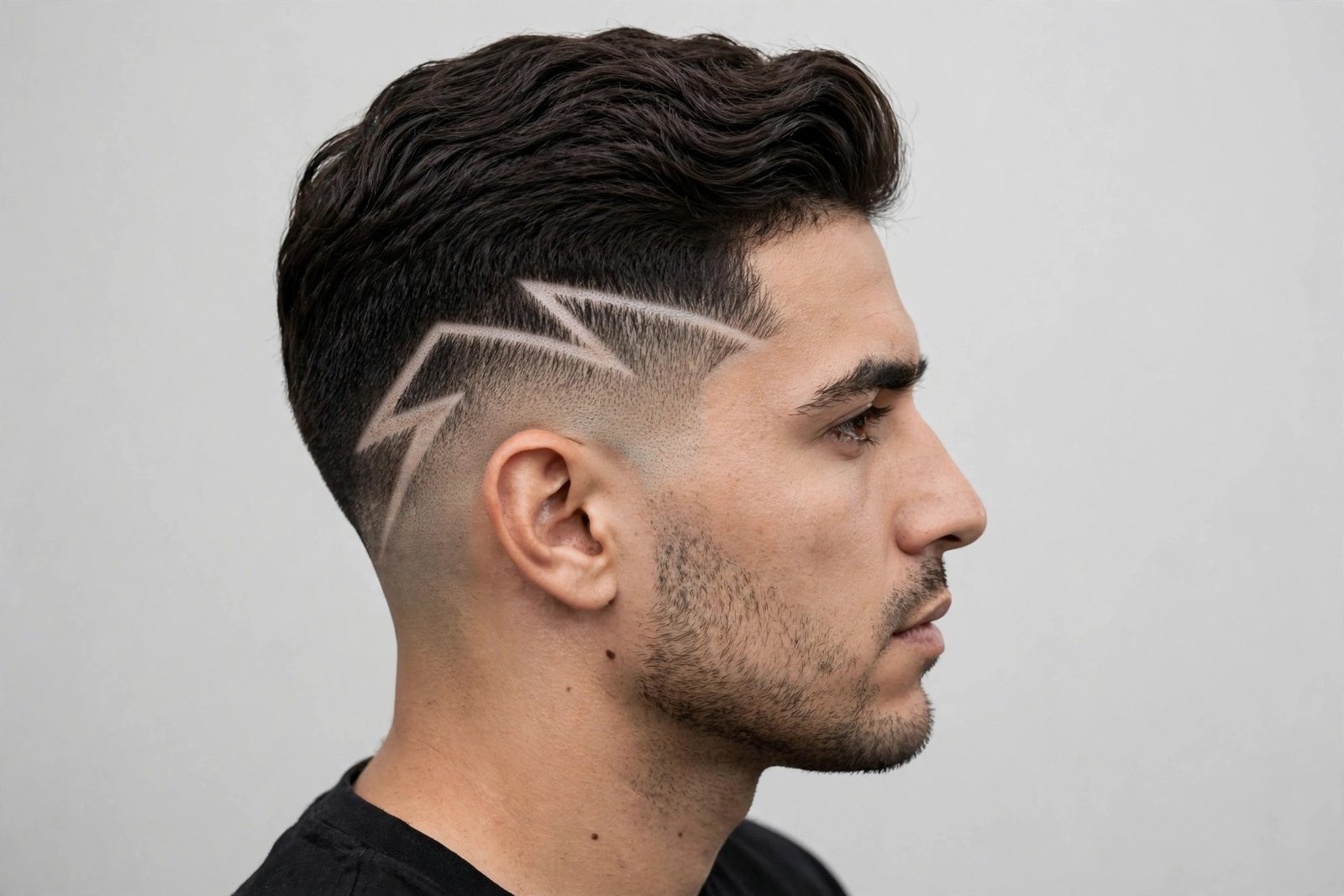
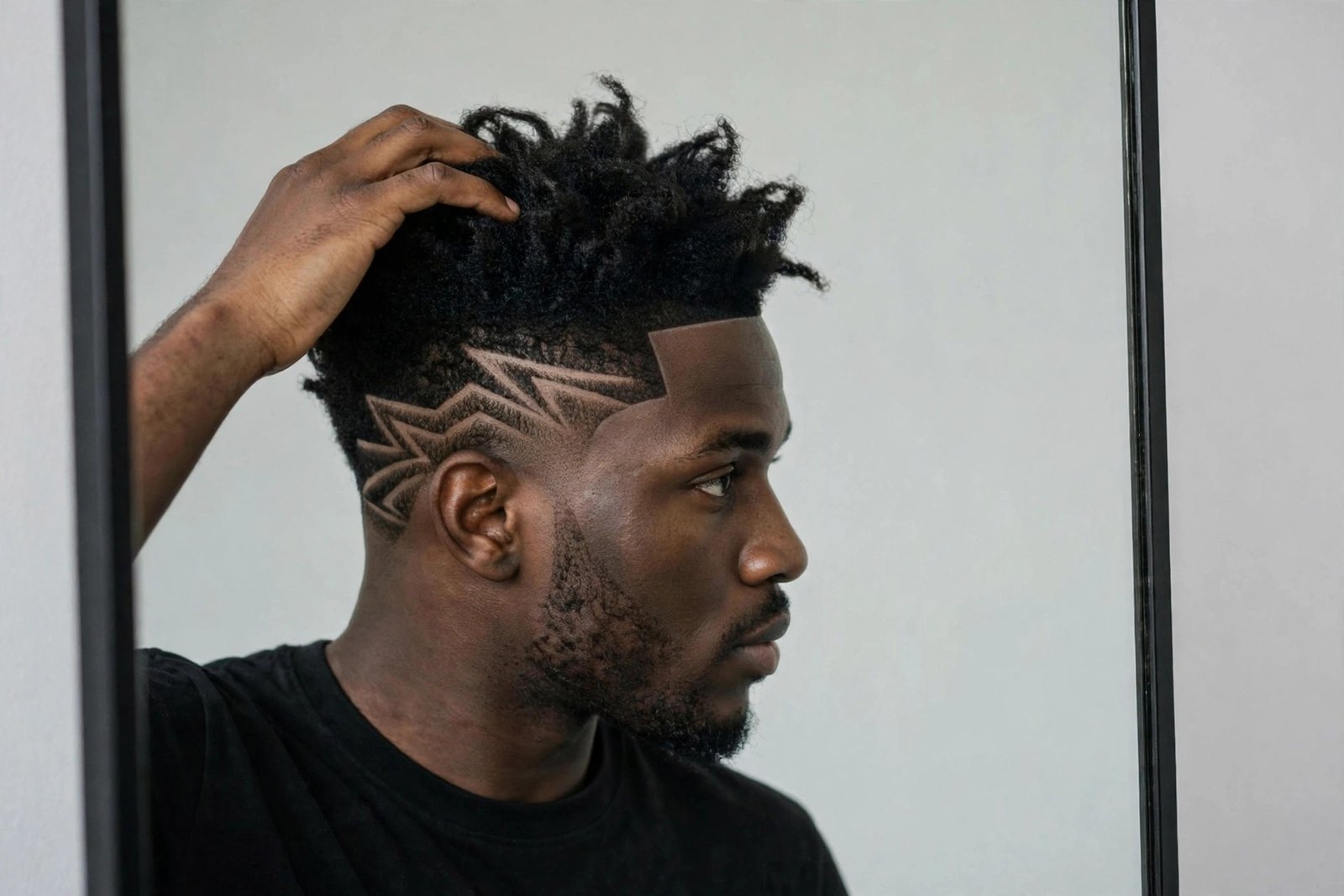
Energy, carved into hair. The lightning bolt is one of the most requested hair designs men ask for by name: a zigzag bolt shape carved into the fade — one sharp, dynamic slash of negative space that reads as pure motion. It’s one of the most popular hair designs men request in 2026, and the reason is simple: it looks fast. The bolt’s jagged silhouette does something no other design does — it makes a static haircut feel kinetic, like your head is moving even when you’re standing still. Barbers love it too, because a bolt is a single confident shape rather than fiddly detail work.
This suits athletic guys, younger men, and anyone whose personal style leans streetwear or sporty — the bolt carries an energy that matches that aesthetic perfectly. It works on any fade height but looks best on a mid fade where the bolt has vertical room to stretch. Thick hair gives the boldest bolt; on finer hair, ask the barber to make the bolt wider — a thin bolt on thin hair can disappear, while a wide bolt reads clearly on any texture. Face shape is flexible here: the bolt’s diagonal energy suits everyone, though it pairs especially well with strong jawlines since both read as “sharp.”
The barber script: “Lightning bolt carved into the fade on this side” — pick your side — “one bolt, medium width, sharp angles.” Decide on the bolt’s direction: angling down-and-back is the classic; angling up adds aggression. Some guys get matching bolts on both sides (mirrored) and some go single-sided for asymmetry — single-sided is the 2026 preference, since asymmetry reads as more deliberate and less “matching tattoo” energy. A single bolt takes a skilled barber about five minutes; it’s a great first carved design because it’s simple, bold, and hard to mess up badly.
Maintenance is standard carved-design territory: crisp for 7–10 days, then a soft bolt-shadow for another week or so before it needs re-carving. The bolt’s wide shape actually grows out better than thin-line designs — a fading bolt still reads as a bolt for a while, whereas a fading thin line just reads as fuzz. Like the star, it’s a small area, so refreshes are quick and often folded into your regular cut at minimal extra cost.
The honest downside: the bolt is popular enough to be almost a cliché in some barbershop circles — it’s the design equivalent of a tribal armband tattoo in 2003. That doesn’t mean don’t get it; it means make it yours. Vary the width, add a secondary thin parallel line alongside it, or integrate it into a larger composition. A bolt with a personal twist beats a stock bolt every time. And if you’re over 35 and in a conservative industry, a lightning bolt might raise more eyebrows than you want — the micro-line designs further down this list are your safer entry point.
6. Zigzag and Diamond Patterns
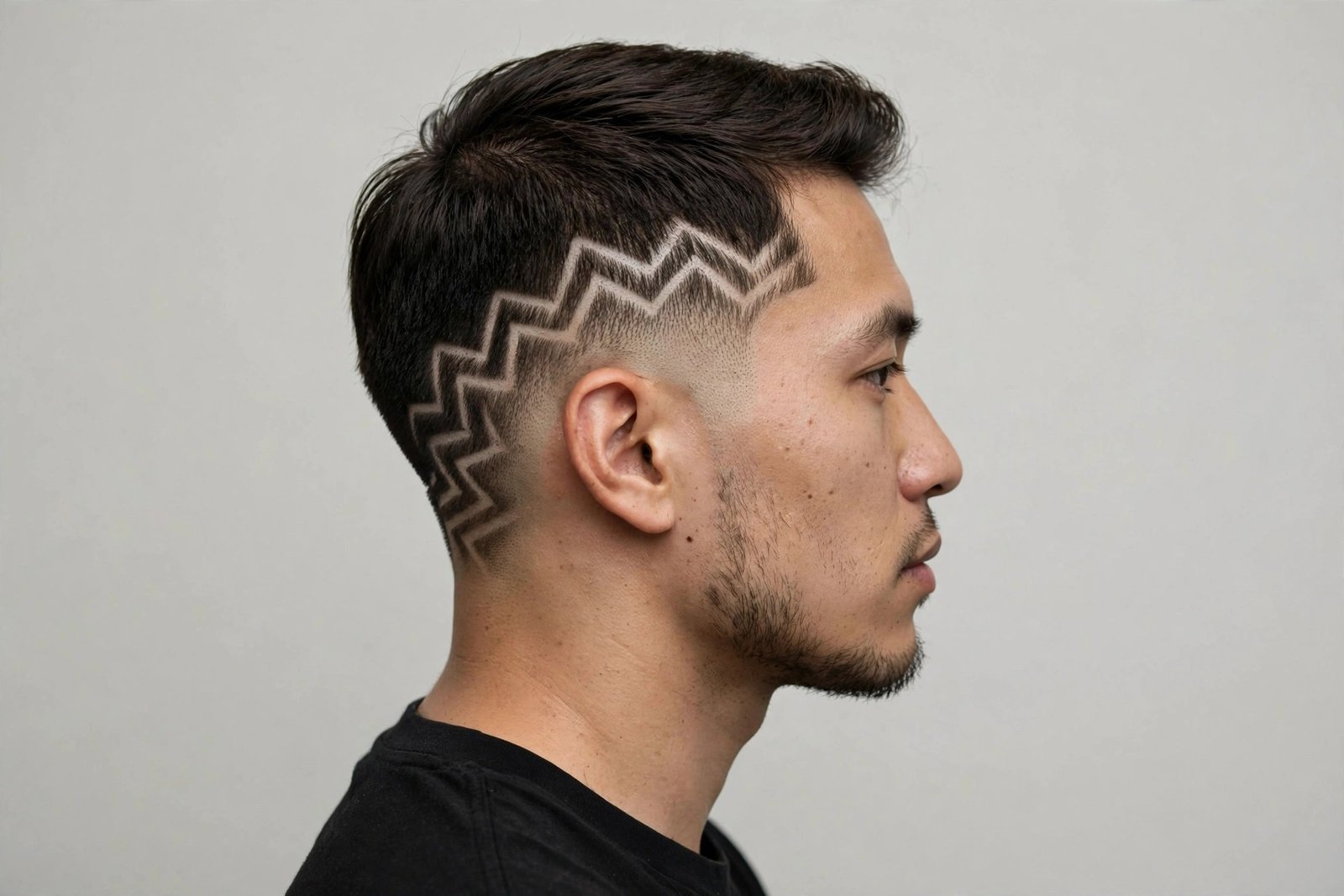
Geometry with rhythm. Zigzag and diamond patterns are repeating angular shapes — a zigzag band running along the fade, or a row of diamonds marching from temple to nape — carved with trimmer precision. Where the geometric pattern (design #2) is usually a single statement shape, zigzag and diamond work is about repetition: the visual rhythm of identical shapes in sequence. It’s the difference between a logo and a pattern, and on the side of a head, rhythm reads as sophistication.
This suits guys who like their boldness organized — the pattern-lover rather than the art-piece-lover. It works beautifully on longer fade areas (low to mid fades) where the repeating shapes have room to run. The classic placement is a zigzag band following the fade’s arc from temple to behind the ear, or a diamond row along the parietal ridge. Dark, dense hair gives maximum contrast; on lighter hair, ask for deeper carving (closer to skin) so the shapes read clearly. This is also one of the best designs for curly hair — the geometric repetition contrasts gorgeously with organic curl texture on top.
The barber script: “I want a zigzag band carved along the fade, following the arc from temple to back — even spacing, medium width” or “a row of three diamonds along the side, evenly spaced.” Evenness is everything with repeating patterns: one diamond bigger than the others ruins the rhythm. Ask the barber to mark the spacing lightly before carving — a good pattern barber will measure or at least eyeball-mark the divisions. Specify the number of repeats: three to five zigzags or diamonds is the sweet spot; fewer looks sparse, more looks busy.
Maintenance: repeating patterns grow out at the same rate as other carved designs (crisp ~10 days), but they have a unique advantage — even as they soften, the rhythm remains visible longer than a single shape does. A fuzzy zigzag still reads as a zigzag. Re-carving is more time-consuming than a single shape because every repeat needs individual attention, so expect this to add a few minutes (and possibly a few dollars) to your cut. Worth it — the rhythm is the whole point, and half-grown uneven repeats look sloppy fast.
The honest downside: this is a precision design that demands a precision barber, and it’s the one most likely to disappoint if your barber “wings it.” Uneven zigzags are immediately obvious. Also, the band placement along the fade arc means the pattern sits in the most visible part of your haircut — there’s no hiding it, and no growing it out quietly. Commit to the rhythm or pick something subtler.
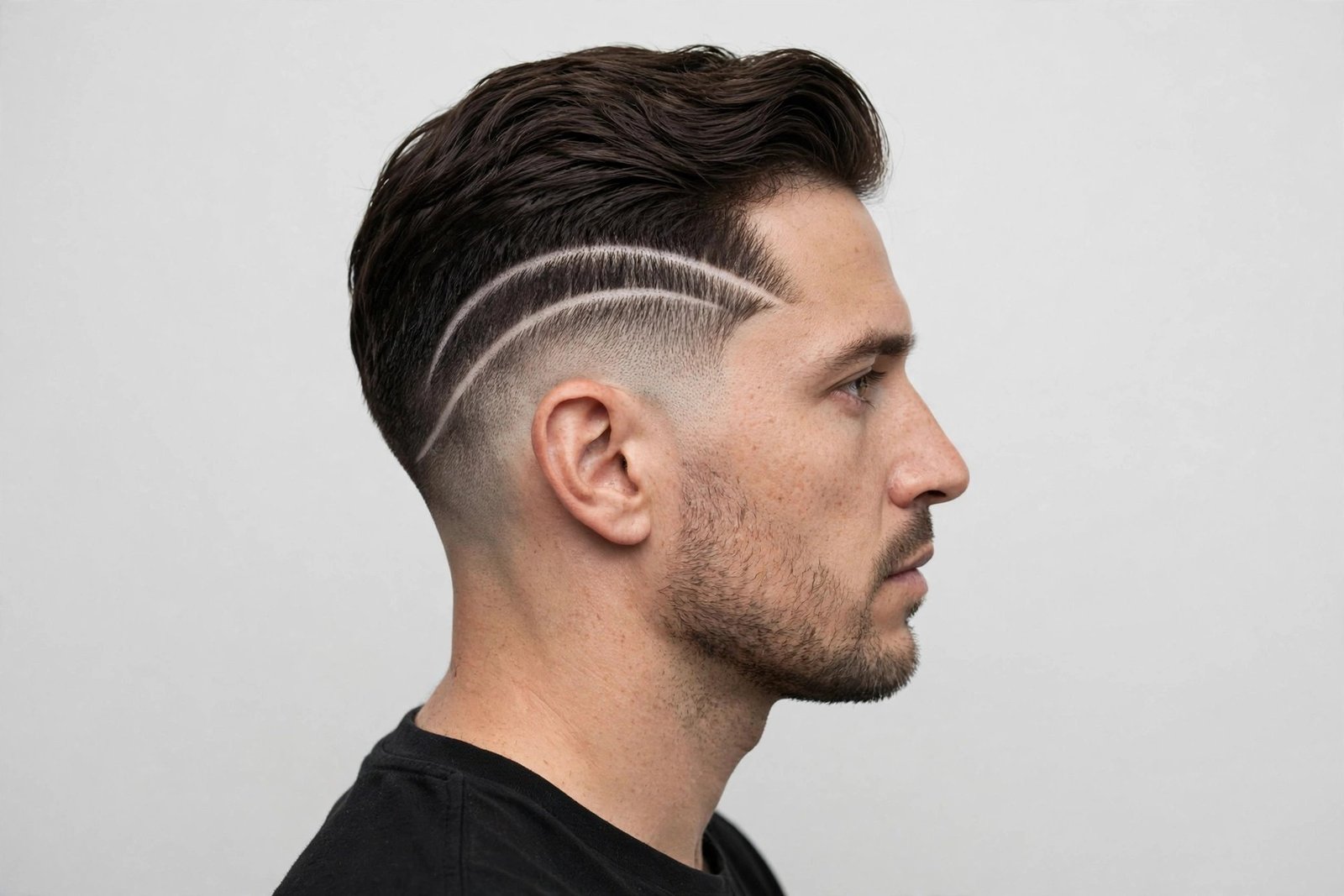
7. The Swoosh: Speed Lines
Minimalism with momentum. The swoosh design is one or two clean, curved parallel lines sweeping back along the fade — like motion lines in a comic panel. It’s the “less is more” entry in carved design: no shapes, no symbols, just pure directional energy. In 2026, the swoosh is having a quiet moment among guys who want designed hair without the “I got art carved in my head” conversation at work. It’s there, it’s sharp, and it doesn’t demand explanation.
This suits the design-curious professional — the guy who wants an edge-upgrade without a statement piece. It works on any hair type and any fade, and it’s one of the few carved designs that reads well on fine, light hair, because the long sweeping line is visible even with low contrast. Placement is typically a single arc above the ear sweeping toward the nape, or dual parallel swooshes for more presence. It’s particularly flattering on longer faces, since the horizontal sweep visually widens the head and balances length.
The barber script: “Two parallel swoosh lines on the fade, sweeping back from above the ear — smooth curves, even spacing, medium length.” Or for the minimalist version: “One clean swoosh line, just above the ear.” The critical detail is the curve quality: a swoosh lives or dies on smooth, confident curvature. A hesitant, wobbly swoosh looks like a mistake. This is a design where you want a barber with steady hands and experience — ask to see their line work specifically. Spacing between dual lines should be even and roughly equal to the line width; too close and they merge as they grow, too far and they read as two unrelated lines.
Maintenance is the easiest of all carved designs: the lines are simple, the area is small, and re-carving takes two minutes. Crisp for 10–14 days (longer than most carved work, since there’s no fine detail to blur), and even grown-out, a soft swoosh-shadow looks intentional. This is the design you can stretch to a three-week cut cycle without embarrassment. DIY touch-ups are even feasible for the steady-handed — a detail trimmer and a mirror can maintain a simple swoosh between cuts, though I’d still let the barber do it the first few times while you learn the curve.
The honest downside: it’s almost too safe. The swoosh is the design guys get when they want to say they have a design without really having one — and there’s nothing wrong with that, but if you’re craving real art, this won’t scratch the itch for long. You’ll be back in six weeks asking for the lightning bolt. Also, on very dark dense hair, a single thin swoosh can get lost; go dual-line or slightly wider for visibility.
8. The Spiral Design
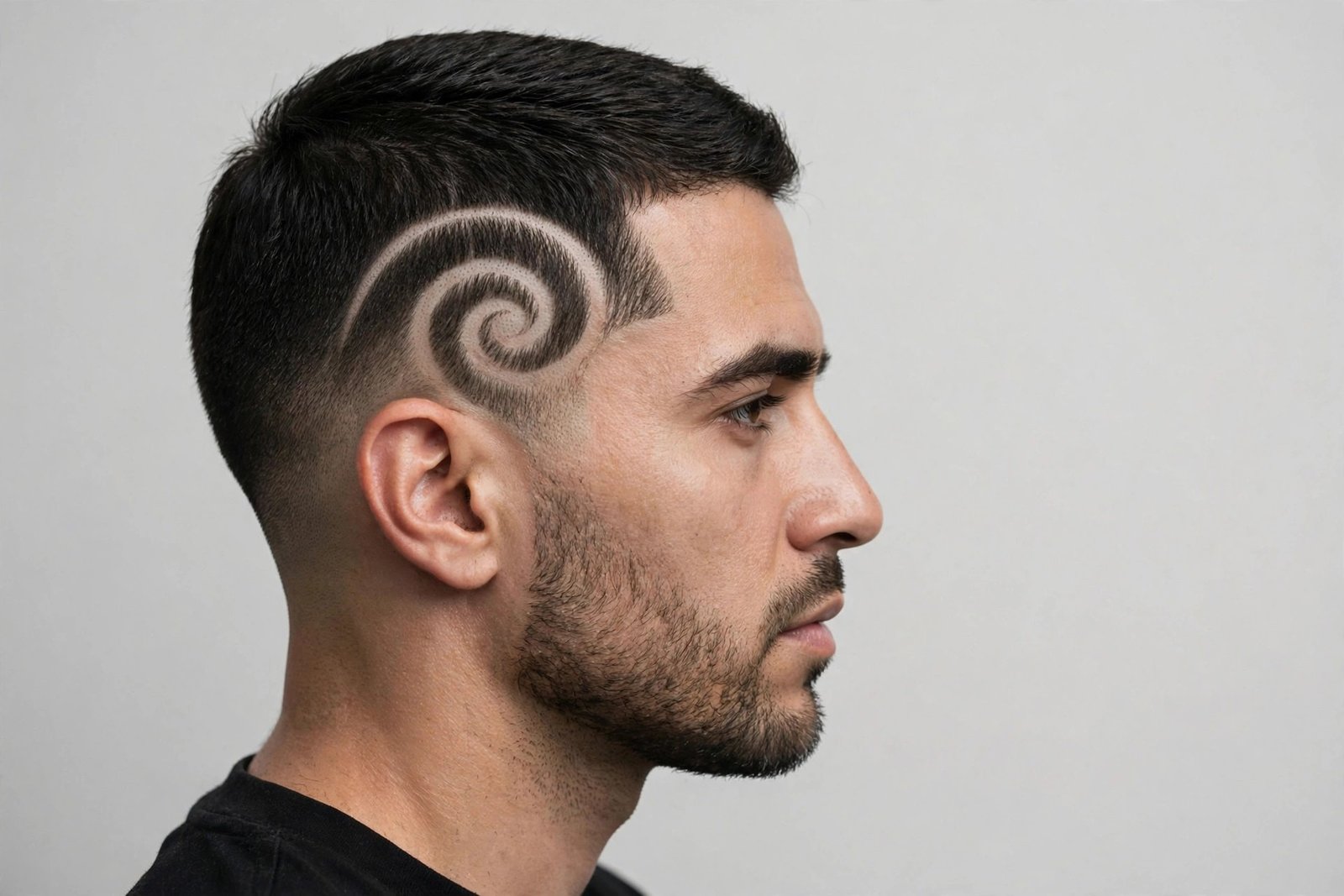
Hypnotic geometry. The spiral is a carved coil — a continuous curve winding inward — placed on the temple or the back of the head. It’s the most visually arresting design on this list per square inch: the human eye can’t help but follow a spiral inward, which means people will stare at the side of your head trying to trace it. In the best way. The spiral is 2026’s sleeper hit among design enthusiasts — less common than stars and bolts, more impressive than both.
This suits the guy who wants the most interesting design in the room without the largest design in the room. A spiral packs enormous visual complexity into a small area, which makes it perfect for the temple or the nape — spots where a big mural would be too much but a small shape feels too simple. It works on any hair type with enough density to show contrast, and it’s spectacular on coily and curly hair, where the carved spiral echoes the natural curl pattern. Placement on the back of the head (the occipital area) is the connoisseur’s choice: invisible from the front, a full reveal from behind.
The barber script: “A spiral carved here” — point — “tight coil, clean lines, about this big” — show the size with your fingers. The spiral’s difficulty is in the line consistency: the carved channel must maintain even width as it winds inward, which requires a barber who can control pressure on a curve. This is genuinely one of the harder designs to execute well. Vet the portfolio hard — look for curved work, not just straight lines. A barber who’s great at geometric angles may struggle with a spiral’s continuous curve, and a lopsided spiral is worse than no spiral.
Maintenance: the spiral’s fine inner coils blur faster than the outer rings — expect the center to soften around day 7–10 while the outer coil stays crisp a bit longer. The design degrades gracefully though; a softening spiral still reads as a spiral for a solid two weeks. Re-carving requires the same skill as the original, so this design locks you into your skilled barber — you can’t cheap out on the touch-up with a spiral. Budget accordingly.
The honest downside: difficulty and rarity. Fewer barbers can do a great spiral than can do a great star, so your options are limited and the price reflects it. It’s also a design that demands to be seen — a spiral tucked where nobody looks is wasted art. If you’re getting one, commit to placement where it shows. And fair warning: people will touch it. Strangers will ask to see it. If you’re not a “let me show you the back of my head” person, pick something front-facing instead.
9. The Crosshair Design
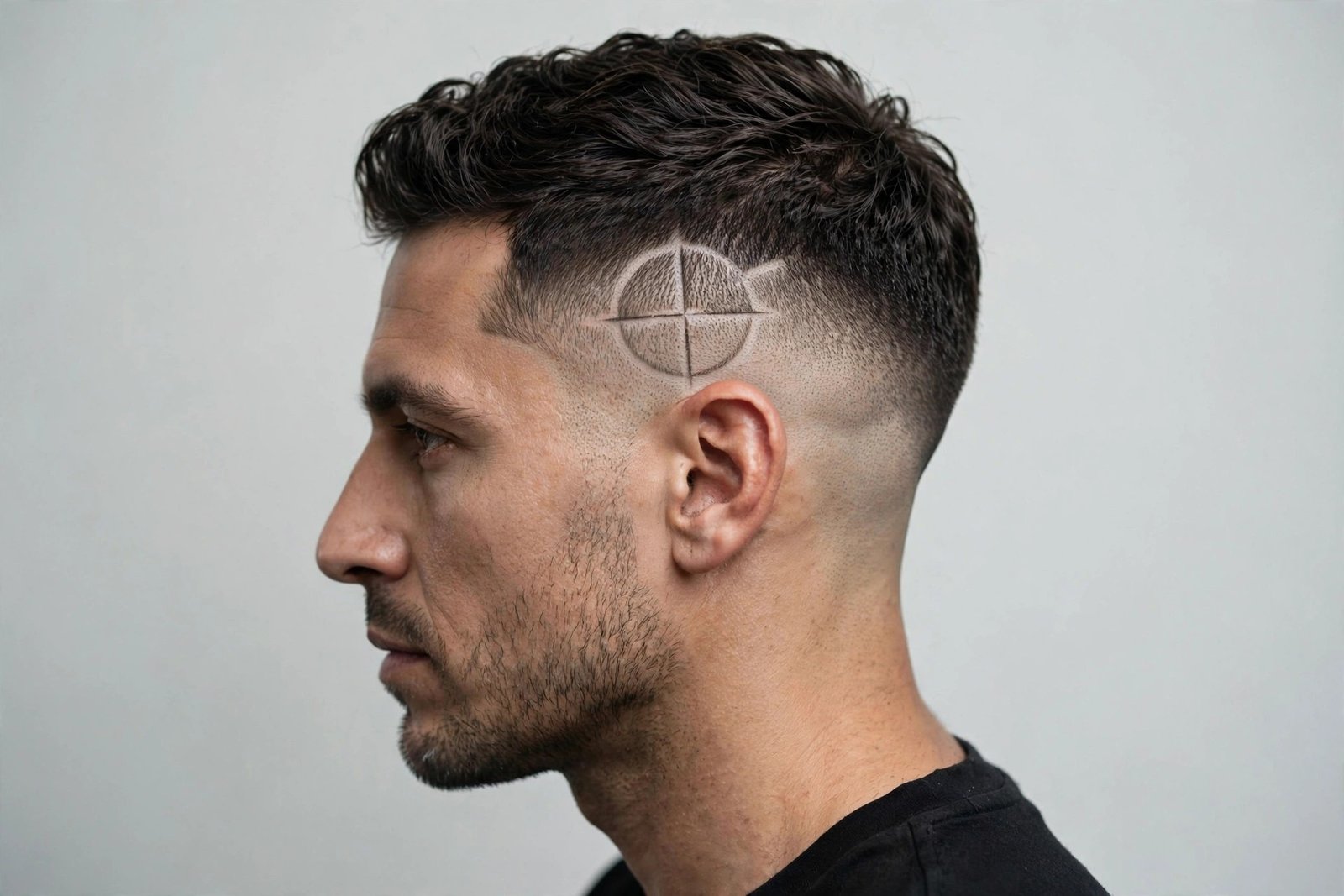
Precision as aesthetic. The crosshair is two thin carved lines crossing at right angles — like a scope reticle — usually placed on the temple or just above the ear, often integrated into a fade. Sometimes it’s a simple plus; sometimes it’s a plus inside a carved circle, which is the full crosshair look. It’s stark, minimal, and quietly aggressive — the design equivalent of a well-tailored black suit. No curves, no decoration, just intersection.
This suits minimalists with an edge — guys whose style is clean and controlled and who want their hair to match. It works on every hair type and every fade height, and it’s one of the best designs for fine or light hair, because the crossing lines create a focal point through geometry rather than contrast. The crosshair is also the rare bold design that works in conservative environments: from a distance it reads as a subtle detail, not a statement. Up close, it’s unmistakable. That dual register — quiet from far, sharp from near — is its superpower.
The barber script: “A crosshair carved on the temple — two thin lines crossing, with a circle around the intersection. Keep it small and precise.” Or the simpler version: “Just the crossing lines, no circle.” The circle version is more visually complete; the lines-only version is more minimal. Size should be modest — roughly thumbnail-sized. The critical execution detail is the intersection: the lines must cross at a true right angle with clean edges. A crosshair with a sloppy intersection looks like a mistake, not a design. This is simple enough that most competent barbers can do it, but check the portfolio for line work anyway.
Maintenance is easy: small area, simple shapes, quick re-carve. Crisp for 10–14 days, graceful fade after. The circle (if you get one) blurs slightly faster than the straight lines, but the overall design holds up well on a normal cut cycle. This is another design where a steady-handed guy can learn DIY touch-ups — two straight lines are the most forgiving carved shapes to self-maintain, though the circle is trickier. When in doubt, let the barber handle it.
The honest downside: symbolism. A crosshair is a gun-sight reference, and while most people read it as abstract geometry, some won’t. If you work in an environment where that association could be misread — schools, certain corporate cultures — consider the swoosh or micro-line instead. It’s a shame, because geometrically it’s one of the cleanest designs, but context matters and I’d rather you know now than after the fact.
10. The Wave Pattern
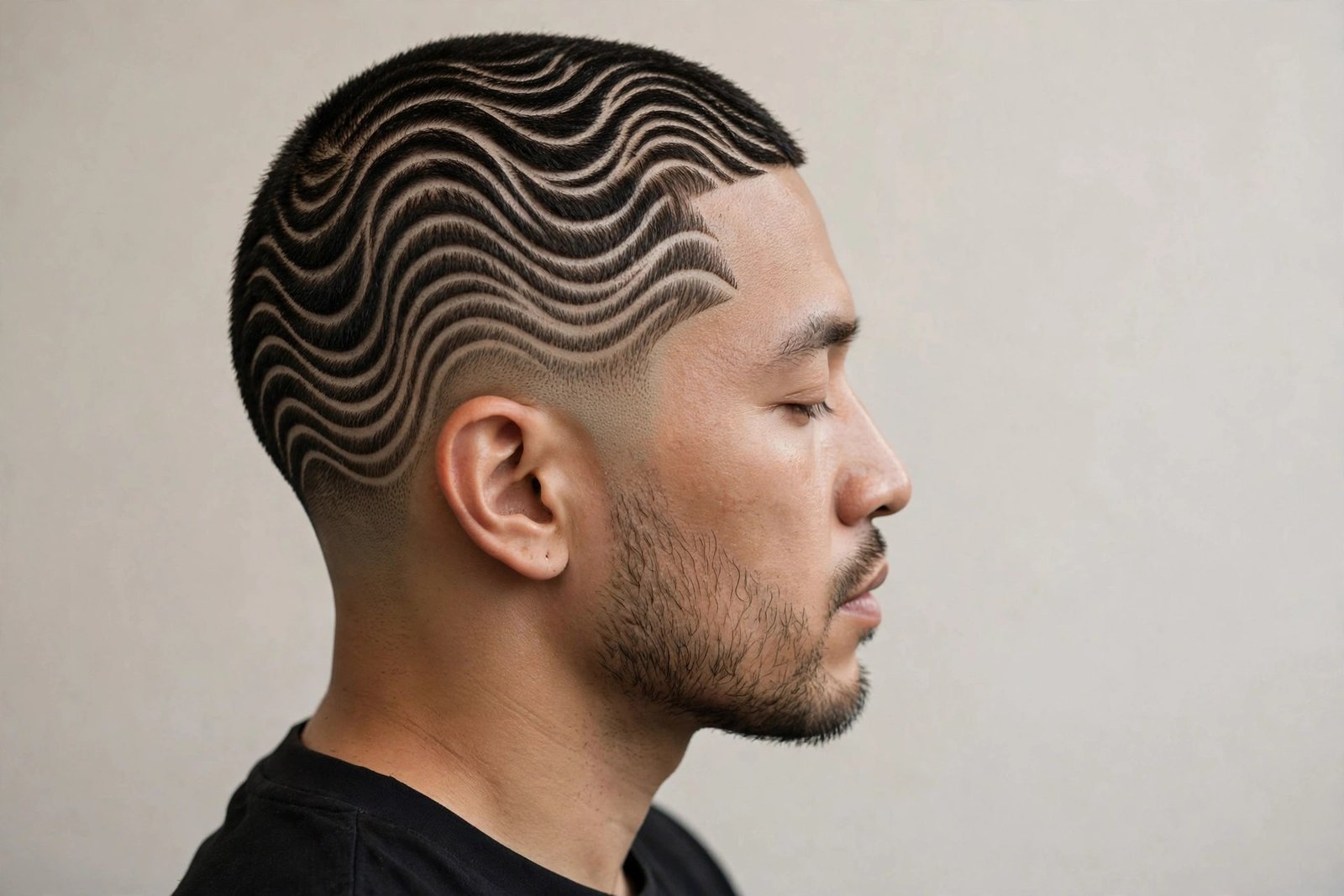
Flow, carved. The wave pattern is a series of smooth, parallel undulating lines carved into the fade — like contour lines on a topographic map, or sound waves frozen in hair. It’s the organic counterpart to the zigzag: same repeating-rhythm idea, but with curves instead of angles. The result is deeply satisfying to look at — there’s something primal about wave patterns that makes people stare. Ocean, sound, wind — the wave reads as natural in a way angular designs never do.
This suits guys with wavy or curly hair especially — the carved waves on the sides harmonize with natural wave texture on top, creating a cohesive look where the whole head feels designed. It also suits longer fades where the waves have room to undulate; cramming waves into a tight high fade truncates the rhythm. On straight hair, the wave pattern adds the movement the hair itself lacks, which is a nice trick — the design supplies what the texture doesn’t. Face-shape-wise it’s universally flattering, since the horizontal wave rhythm balances both long and round faces.
The barber script: “Wave pattern on the fade — three or four parallel wavy lines, smooth undulation, running from temple to back.” Specify the wave amplitude: tight, small waves read as texture; broad, sweeping waves read as art. Medium amplitude is the versatile choice. Even spacing is critical — waves that drift closer and further apart look accidental. Ask the barber to establish the wave rhythm with a light pass first; waves are freehand-friendly but the rhythm needs to be set before committing to depth. This is a design where an experienced freehand barber outperforms a stencil every time.
Maintenance mirrors the zigzag: crisp ~10 days, rhythmic shadow after, re-carved at your normal appointment. Waves grow out more gracefully than any angular pattern — a softening wave still looks like a wave, just a gentler one. Some guys actually prefer the wave at week two, when it’s softer and more organic. If that’s you, tell your barber to carve it slightly deeper initially so the sweet spot lands in week two rather than day one.
The honest downside: waves are deceptively hard to carve well. Smooth, even, parallel undulation requires a barber with genuine freehand control — it’s closer to drawing than to clipper work. A wobbly wave is immediately obvious and there’s no fixing it except growing it out. This is a portfolio-vet design: look specifically for curved, flowing work. And like the tribal curves, waves photograph as bolder than they feel in person — moderate your size if you’re design-shy.
11. Abstract Freestyle Art
The deep end. Abstract freestyle art is exactly what it sounds like: your barber creating an original, freehand composition on the side or back of your head — flowing lines, shapes, negative space, whatever emerges from their artistic instinct and your head’s canvas. No stencil, no reference photo, no repeat. Every freestyle piece is one of one. This is where hair design becomes actual art, and where the barber’s skill ceiling matters more than anywhere else on this list.
This suits the true enthusiast — the guy who’s had patterns and wants the next level, or the art-lover who treats his head as a gallery. It demands a barber who is genuinely an artist, not just a technician: look for someone whose portfolio shows varied, original compositions, not the same five designs repeated. It works best with a large canvas — a full side of the head or the entire back — so longer fades or disconnected cuts with substantial faded area are ideal. Hair type matters less here than barber skill; a great artist can compose for any texture, though high contrast (dark dense hair) gives them the most to work with.
The barber script is a conversation, not a sentence: “I want a freestyle piece on the back of my head — something original, flowing, your style. I’ve got about this much canvas” — indicate the area — “and I like bold lines over fine detail.” Then listen. A real freestyle artist will ask about your taste, maybe sketch ideas, and tell you honestly what your head shape and hair can support. If a barber just says “yeah I can do freestyle” without questions, walk away — that’s not an artist, that’s a guy with a trimmer and confidence. The consultation IS the skill test.
Maintenance is the most demanding on this list: intricate freestyle work blurs unevenly (fine details go first, bold lines last), so by week two it can look half-finished rather than gracefully grown-out. Plan on touch-ups every 10–14 days without fail, and accept that each touch-up is essentially a mini art session — budget both time and money accordingly. Some freestyle enthusiasts photograph each iteration; watching the piece evolve across cuts is part of the pleasure. But be realistic: this is a high-maintenance relationship with your barber’s chair.
The honest downside: everything about freestyle is variable — price, time, outcome. You’re commissioning art, not ordering a haircut, and art has art’s unpredictability. A piece you love fresh might grow out awkwardly. Your artist might have an off day. And you’re locked into that specific barber; nobody else can touch up someone else’s freestyle composition without ruining it. If your artist moves shops or you move cities, you start over. Go in with eyes open: the ceiling is the highest on this list, and so is the commitment.
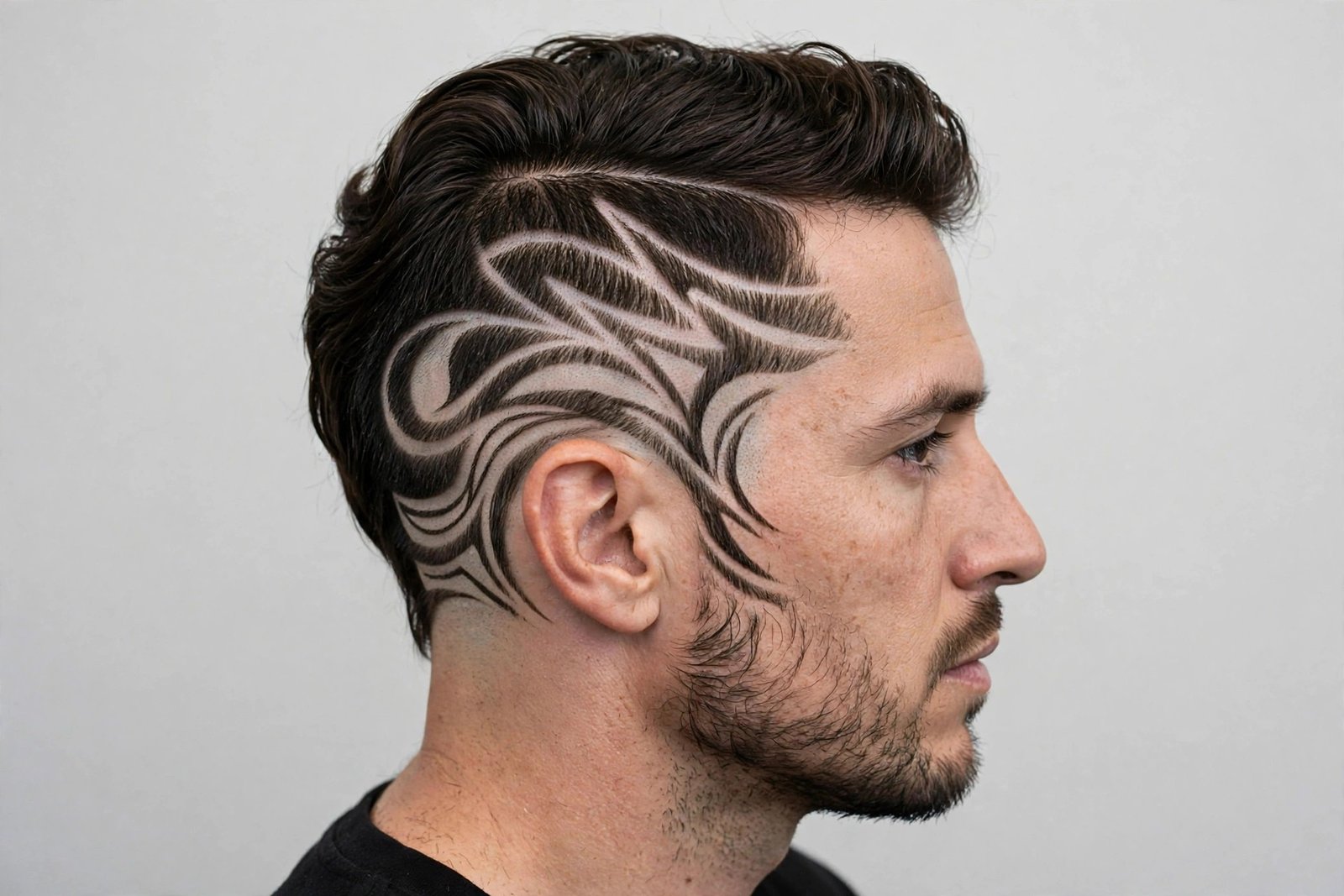
12. The Star-and-Fade Combo
Composition over isolation. The star-and-fade combo takes the starburst (design #4) and integrates it into the fade itself — the star isn’t just carved ON the fade, it’s part of a larger composition where the fade’s gradient, a carved guideline, and the star work together. Think of it as the difference between a sticker and a mural: the combo version has the star sitting inside a carved arc or aligned with the fade’s transition line, so the whole side of the head reads as one designed piece rather than “fade plus star.”
This suits guys who liked the starburst idea but want something more sophisticated — the combo elevates the star from bold symbol to designed composition. It works best on mid-to-high fades where there’s enough gradient real estate to compose with. The design rewards barbers who think in terms of the whole head: the star’s placement should relate to the fade’s arc, the temple line-up, and even the neckline. When it’s done right, strangers can’t quite tell where the “design” ends and the “haircut” begins — it’s all one piece. That’s the goal.
The barber script: “I want a star integrated into the fade — not just a star on top of it. Carve an arc or guideline that the star sits in, so it feels like part of the cut.” This requires a barber who designs holistically, so the consultation matters: ask “how would you compose this with my fade?” and listen for specifics about placement, arc, and balance. A barber who immediately understands is your guy; a barber who looks confused will give you a sticker-star, which is fine but not what you’re asking for. Reference photos of integrated compositions help enormously — search for the look specifically, not just “star haircut.”
Maintenance is slightly more involved than a standalone star, because the composition has more elements to refresh — the star, the arc, the fade blend around both. But it all happens within your normal cut appointment, so it’s not extra visits, just a few extra minutes. The composition grows out as a unit, which actually looks better than a standalone star growing out — the arc and fade soften together, keeping the designed feel longer. Expect a solid two weeks of good looks, three if your hair grows slowly.
The honest downside: you’re paying for design thinking, not just clipper time, and not every barber charges fairly for that — some will quote you a “design fee” that doubles the cut price for what amounts to ten extra minutes. Ask the price upfront, every time, before the clippers come out. And the combo’s sophistication is lost on most observers — 90% of people will just see “cool star haircut.” If you’re doing it for the compositional subtlety, know that the subtlety is mostly for you and your barber. Which is fine. The best design details are the ones you notice in the mirror.
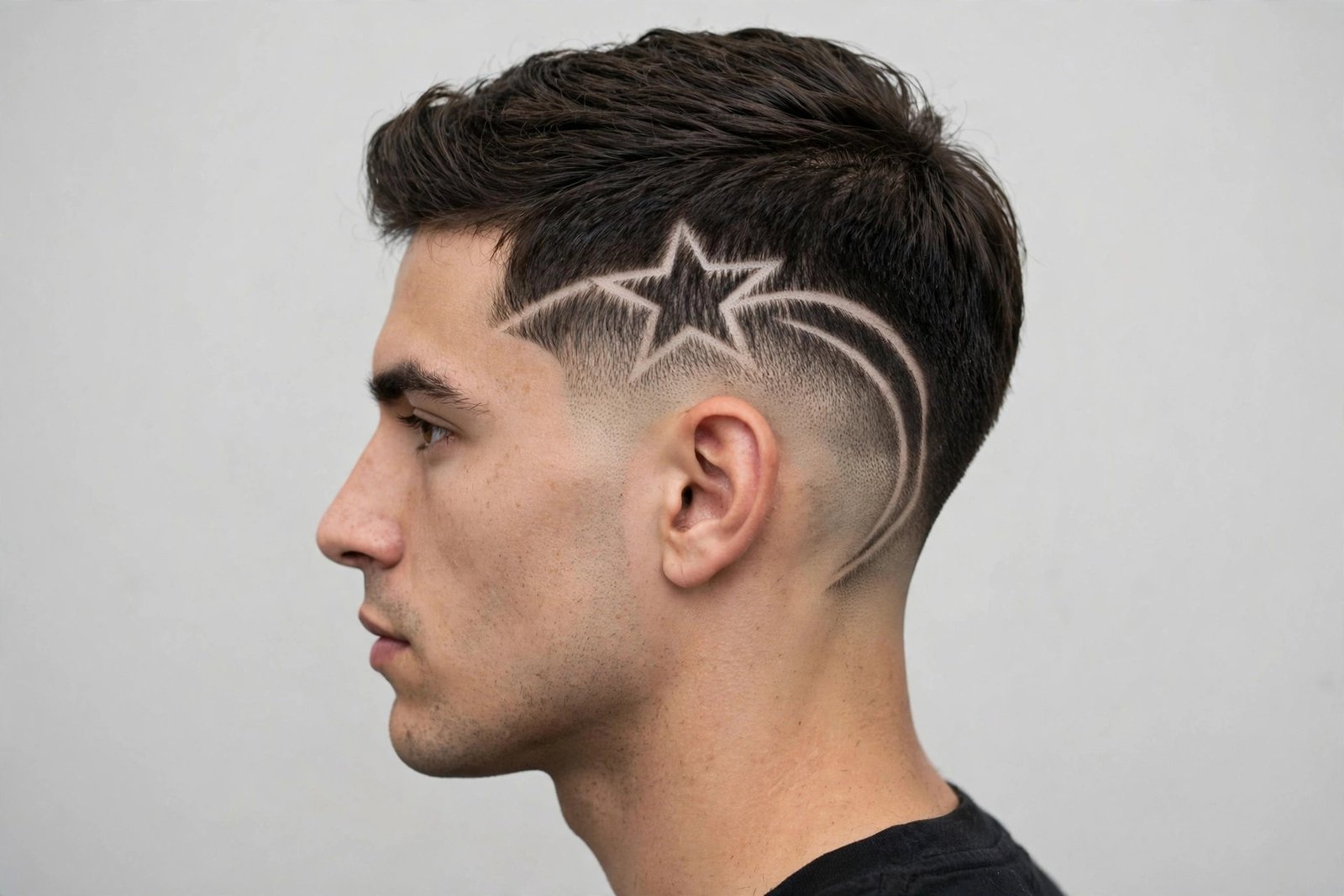
13. The Double Line Design
Understated precision. The double line is two thin, parallel carved lines — straight or slightly curved — running along the fade, usually above the ear or along the temple. It’s the tailored-shirt version of hair design: nothing flashy, everything exact. In 2026, the double line has become the professional’s design of choice — the thing guys get when they want designed hair that passes in any room, from boardroom to bar.
This suits everyone, genuinely. It’s the most democratic design on this list: works on any hair type, any fade, any face shape, any age, any workplace. The parallel lines create a clean visual detail that reads as meticulous grooming rather than artistic statement. On fine or light hair, keep the lines slightly wider for visibility; on thick dark hair, thin lines give razor-sharp definition. It’s particularly good for guys with strong natural hairlines who want a design that complements rather than competes with their line-up — the double line sits below and behind, framing without stealing focus.
The barber script: “Two parallel lines on the fade, just above the ear — thin, straight, even spacing.” Or with a slight curve: “Two parallel lines with a gentle curve, following the head shape.” The spacing calibration is the whole design: lines too close together merge into one thick line as they grow; lines too far apart read as two separate lonely lines. The sweet spot is spacing roughly equal to the line width, maybe slightly more. A good barber knows this instinctively; if yours asks “how far apart?”, that’s actually a good sign — it means they’re thinking about it rather than guessing.
Maintenance is minimal: the lines are simple, the re-carve takes a minute, and they hold crispness for a full two weeks — sometimes longer. This is the design with the best crispness-to-effort ratio on the entire list. DIY touch-ups are genuinely practical here: two straight lines are the easiest carved shape to maintain yourself with a detail trimmer, and plenty of guys do. Even grown-out, the soft double-line shadow looks deliberate. If low maintenance is your priority, this is your design, full stop.
The honest downside: it’s common. The double line is popular enough that it’s becoming the default “I want something but not too much” design, which means it’s losing some distinctiveness. If you want to stand out, this isn’t the one. But if you want the single most versatile, lowest-risk, highest-reward design in men’s barbering — the one design I’d recommend to my own brother — it’s the double line. Sometimes the obvious choice is obvious for a reason.
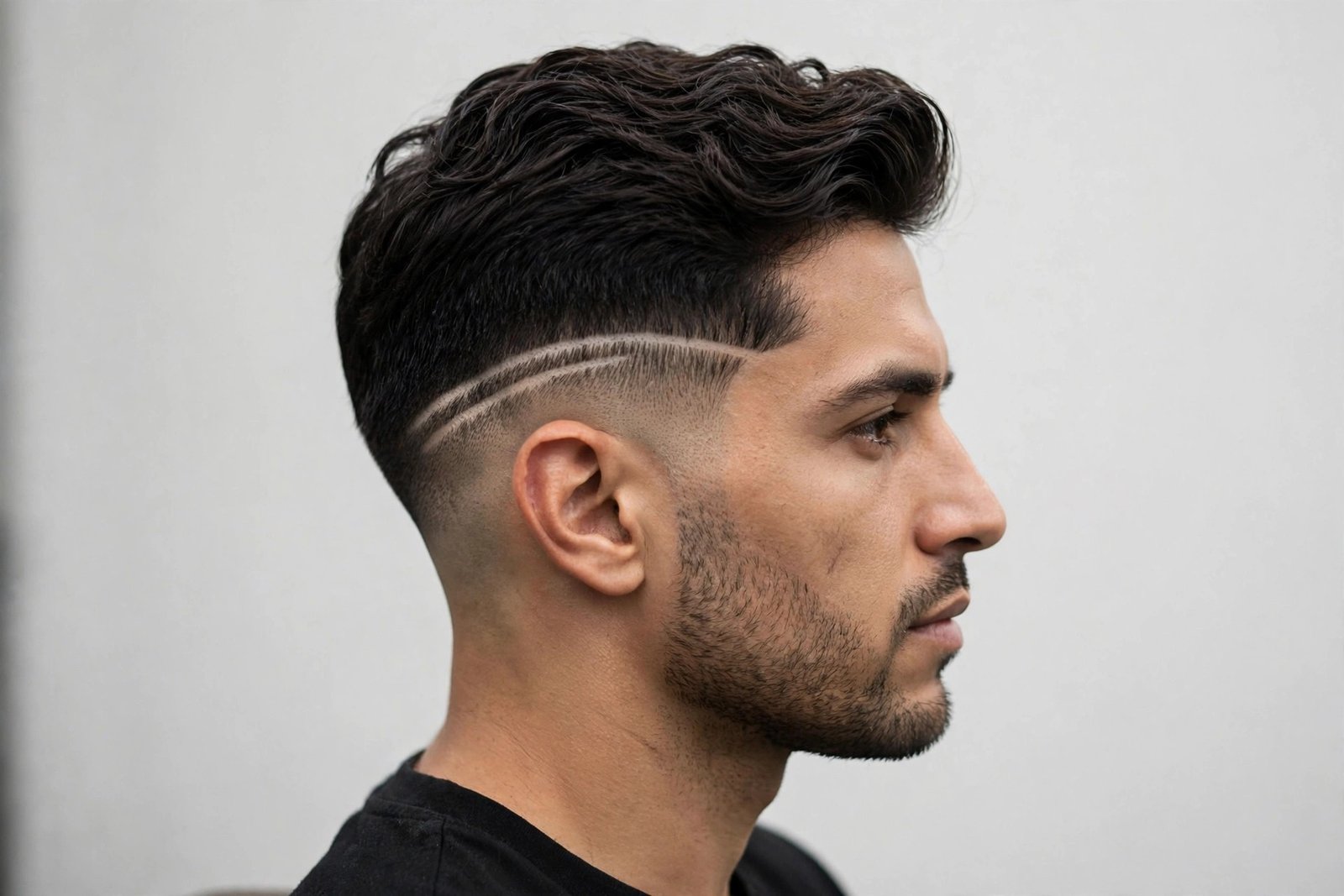
14. The Checkerboard Pattern
Bold geometry, maximum contrast. The checkerboard is a grid of alternating carved and uncarved squares — an actual checkerboard — worked into a faded area, usually on the side of the head or the back. It’s the most graphic, most unmissable pattern on this list: from any distance, the alternating squares read instantly. There’s no subtle checkerboard. It’s a statement the way a checkered flag is a statement.
This suits the bold and the young — let’s be direct: the checkerboard is a young man’s design, and it knows it. It works best on high-contrast hair (dark and dense) with a substantial faded area, because the pattern needs multiple squares to read as a checkerboard rather than “some squares.” A minimum 2×3 grid is the starting point; 3×4 is the full statement. Placement on the back of the head is classic — it’s the reveal design, hidden from the front, explosive from behind. Side placement is bolder and more confrontational. Know which one you are before you sit down.
The barber script: “Checkerboard pattern on the back of my head — alternating carved squares, 3 by 4 grid, clean edges.” The grid math matters: the squares must be uniform, which means your barber needs to plan the grid before carving — measure, mark, then cut. A freehand checkerboard with drifting square sizes looks homemade. Ask how they’ll lay out the grid; a barber who describes marking it out first is the right barber. Square size should be proportionate to the area — roughly thumbnail to large-coin size each. Too small and it reads as texture, not pattern; too big and you only fit four squares.
Maintenance is the price of boldness: the checkerboard’s many edges blur at different rates, so by week two it can look patchy rather than patterned — some squares crisp, some fuzzy. This design does NOT grow out gracefully. Plan on strict 10–14 day refresh cycles, and accept that the re-carve takes real time (every square, every edge). It’s also the design most affected by uneven hair growth — if your hair grows at different rates across the area (common on the occipital), the pattern degrades asymmetrically. Your barber can compensate by carving problem areas slightly deeper.
The honest downside: commitment and context. The checkerboard is a lifestyle design — it affects how you’re perceived in every room you enter, and unlike a star or bolt, it doesn’t read as “cool detail,” it reads as “this guy’s whole thing.” Make sure it’s your whole thing before you commit. It’s also the hardest design to grow out if you change your mind: a half-grown checkerboard looks like a skin condition, not a fading design. The grow-out strategy is to let the whole area grow to uniform length and then reshape — which means 3–4 weeks of awkward. Go in with conviction or don’t go in.
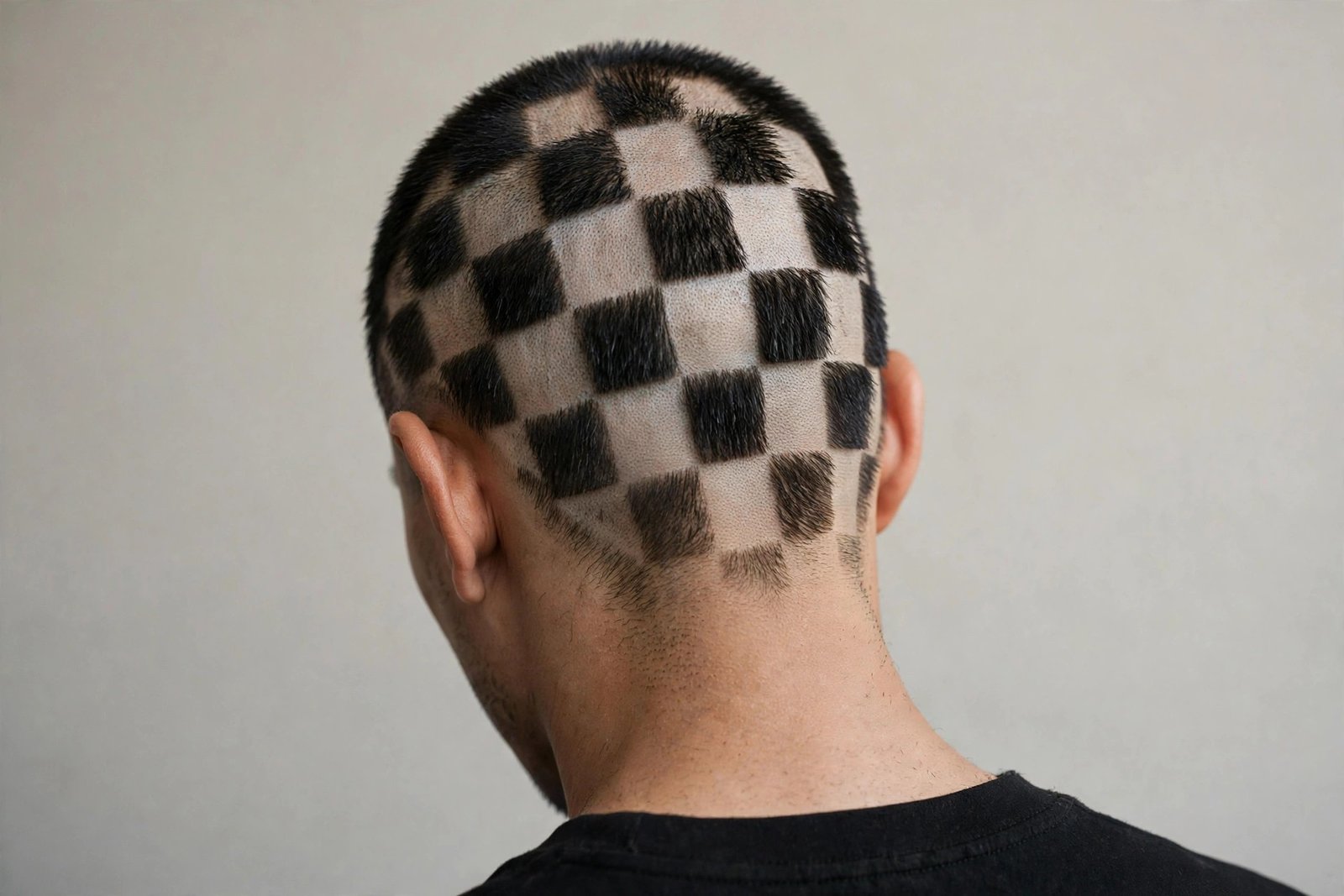
15. The Flame Design
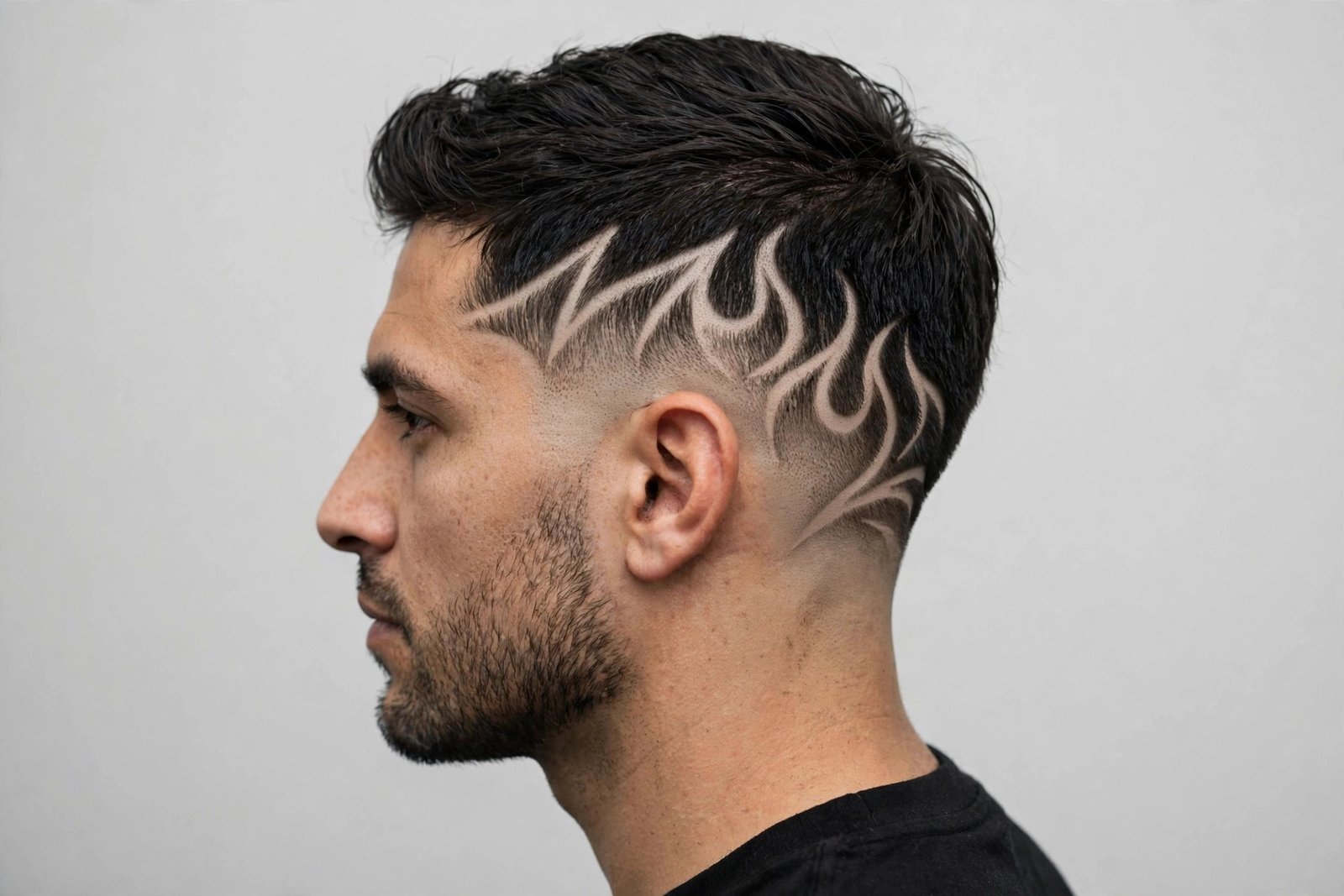
Controlled fire. The flame design is carved tongues of flame licking upward along the fade — pointed, curved shapes with the characteristic flame silhouette, usually rising from the temple or sweeping up from behind the ear. It’s dramatic, it’s dynamic, and it’s unapologetically extra. The flame is what you get when subtlety has left the building and you’re here for the art. In 2026, refined flame work — cleaner lines, more negative space, less 2003 excess — has brought this classic back into the conversation.
This suits performers, creatives, athletes — anyone whose personal brand includes intensity. The flame’s upward licks add visual height and energy, which flatters guys who want their hair to feel alive. It needs a real canvas: a full side fade or the back of the head, because flames need room to rise. Cramped flames look like squiggles; flames with room look like art. High-contrast hair gives the most dramatic flames; the carved negative space reads as the “heat” against the dark “fuel” of the surrounding hair. It’s also one of the few designs that looks great in motion — turning your head makes the flames seem to flicker, which is half the fun.
The barber script: “Flame design rising up the side — carved flames, pointed tongues, medium size, clean lines.” Specify the flame count and scale: three to five flame tongues is the classic composition; fewer looks sparse, more looks busy. Direction matters — flames should rise (upward or up-and-back); downward flames read as dripping, which is a different (and usually worse) look. This is a freehand design that rewards artistic barbers enormously — look for portfolios with organic, flowing work. A flame carved by a geometry specialist will look stiff; a flame carved by a freehand artist will look alive.
Maintenance is demanding: the flame’s pointed tips are fine detail that blurs fast (crisp ~7 days), while the broader bases hold longer — so the design degrades unevenly, tips first. By week two, flames can look like vague wavy shapes rather than fire. Strict 10–14 day touch-ups, no exceptions, and each touch-up is a real art session, not a quick re-carve. Budget time and money like the freestyle piece, because that’s essentially what this is — just with a flame theme.
The honest downside: the flame is the hardest design on this list to wear casually. It dominates every outfit, every room, every first impression. It’s also the design with the strongest “era” association — flames will always carry a hint of early-2000s energy, and the refined 2026 version only partially escapes that. If you’re under 30 and your life supports the energy, it’s magnificent. If you’re not sure, you’re not ready — and that’s fine. The double line will still be here.
16. The Subtle Micro-Line
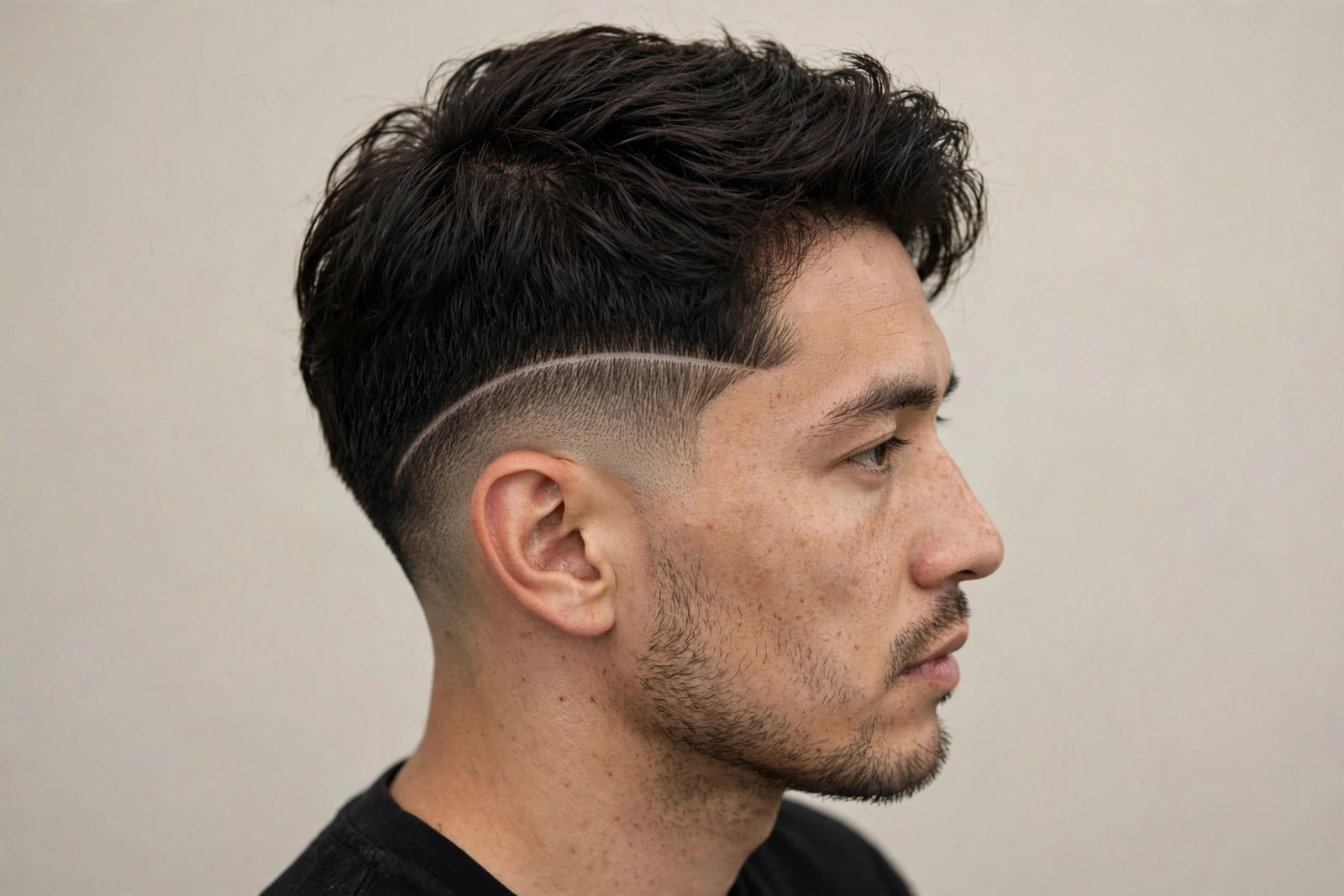
The design for people who don’t do designs. The micro-line is a single, very thin carved line — barely wider than the trimmer blade — placed discreetly: along the part, just above the ear, or tracing the fade’s edge. It’s the whisper of hair design: most people won’t consciously notice it, but everyone will register that your haircut looks exceptionally sharp. In 2026, the micro-line is the fastest-growing design among men over 30, and the reason is obvious — it’s all of the precision with none of the commitment.
This suits everyone, but it especially suits the design-skeptic: the guy who’s curious but nervous, the professional who can’t risk boldness, the minimalist who thinks carved stars are for other people. It works on every hair type — on fine light hair it’s a delicate detail, on thick dark hair it’s a razor-fine accent. Placement along the natural part line is the classic move: it sharpens the part itself, making the whole haircut look more deliberate. It’s also the perfect first carved design — the lowest-stakes way to find out if you like having designed hair.
The barber script: “One thin line along my part — just the trimmer width, nothing wider. Subtle.” Or: “A single micro-line just above the ear, following the fade.” The thinness is the design, so be explicit: “thinner than you think” is useful guidance, because barbers default to bolder. A micro-line should be the width of the trimmer blade with no widening passes — one confident stroke. Placement precision matters more than with any other design: a micro-line in the wrong spot looks like an accident, while a micro-line in the right spot looks like intention. Have the barber mark it and check the mirror before carving.
Maintenance is nearly zero: the line is so thin that it grows in within 10–14 days, and the grow-out is invisible — it just disappears. Re-carving takes thirty seconds during a normal cut. There’s no awkward phase, no fuzzy-shadow period that looks bad, no commitment. This is the only carved design you can try once, decide you don’t like, and have completely gone within two weeks with zero evidence. That reversibility is its superpower.
The honest downside: it’s so subtle that some guys feel underwhelmed — they worked up the nerve to get a “design” and walked out with something only they can see. If you want visible art, the micro-line won’t satisfy you; it’s a detail, not a statement. And on very dark, dense hair, even a micro-line can read bolder than intended — the contrast does the talking. But as an entry point, a professional-safe accent, or a permanent subtle signature, nothing beats it. Every other design on this list is a bigger swing; the micro-line is the bunt that always gets on base.
Keeping Hair Designs Men Sharp: Styling Routine & Maintenance
Here’s the truth about hair designs men love in photos versus hair designs men actually live with: the photo is day one, and you live with days two through fourteen. The difference between a design that looks incredible for two weeks and one that looks tired by day five is maintenance — not just barber visits, but what you do at home every day. This section is the unglamorous part nobody posts about, and it’s the part that actually determines whether your design was worth the money.
The First 48 Hours: Protecting Fresh Work
The first two days after a carved design are when it’s most vulnerable — and when most guys unknowingly sabotage it. Fresh carved lines are essentially controlled skin irritation: the trimmer and razor have exfoliated the skin along the design, and that skin needs a calm 48 hours. The rules are simple but non-negotiable.
Don’t wash the carved area aggressively for 24 hours. A gentle rinse is fine; scrubbing the design with shampoo on day one irritates the freshly worked skin and can cause redness that makes the design look inflamed rather than crisp. When you do wash, use lukewarm water and let the shampoo run over the area rather than scrubbing it — the design doesn’t need direct scrubbing, it’s skin-level art, not dirty hair. Pat dry, don’t rub. Rubbing a fresh design with a towel is how you turn sharp lines into irritated pink blurs.
Skip heavy products on the carved area for the first day. Pomades, waxes, and clays sitting in carved lines do two bad things: they fill the negative space (making the design less visible) and they can irritate freshly razored skin. If you need hold on top, apply product to the top hair only, keeping it clear of the carved sides. After 48 hours, normal product use is fine — the skin has calmed and the design is set. Moisturizer is the exception: a light, fragrance-free moisturizer on the carved area actually helps, keeping the skin calm and the contrast clean. Think of it as aftercare, the same way you’d moisturize after a close shave.
Sleep matters more than you’d think. The first couple of nights, try to sleep on your back or on the side opposite a fresh side design — grinding a fresh carve into a pillowcase for eight hours softens the crispness measurably. A silk or satin pillowcase helps generally (less friction on all your hair), but it’s genuinely noticeable with fresh designs. This sounds fussy. It is fussy. Great hair is fussy. Accept it or accept fuzzier lines — your call.
The 10–14 Day Cycle: Your Real Maintenance Schedule
Every carved design operates on a biological clock: your hair grows roughly half an inch per month, which means carved lines start visibly softening around day 10 and need re-carving by day 14. This isn’t a suggestion — it’s follicle math. The guys with permanently crisp designs aren’t lucky; they’re just on the cycle. Here’s how to run it without it consuming your life.
Book your next appointment before you leave the shop. This is the single most effective maintenance habit, and it costs nothing. Barbers with design skills book out — the good ones are often 1–2 weeks out — so “I’ll call when it needs it” means “I’ll get an appointment three weeks from now when the design is long gone.” Standing appointments are even better: same day, every two weeks, automatic. Treat it like a subscription, because that’s what it is. The design is the product; the appointment is the delivery mechanism.
Learn the DIY edge touch-up. Between full appointments, you can maintain line-ups and simple carved lines yourself with a quality detail trimmer — and this is the skill that separates the guys with always-sharp hair from the guys with a two-week cycle of sharp-to-shaggy. The technique: stretch the skin taut with your free hand, use the trimmer with no guard, and follow the existing line — you’re tracing, not creating. Never freehand a new line; only refresh what the barber established. Practice on the sideburns and forehead line first (forgiving areas), and leave temple corners and carved curves to the professional until you’re confident. One confident pass beats three hesitant ones — hesitation causes the wobbles.
Know the grow-out personalities of your designs. Not all designs age equally, and knowing yours helps you time appointments. Thin-line designs (micro-line, double line, crosshair) age gracefully — they fade to soft shadows that still look intentional. Fine-detail designs (spiral centers, flame tips, checkerboard edges) age badly — they blur into ambiguity. Bold simple shapes (star, bolt, tribal curves) age in the middle — recognizable but soft. Time your touch-ups to the fastest-aging element of your design, not the slowest. If your flame tips are fuzzy at day 10 but the base is fine at day 14, you’re on a 10-day cycle whether you like it or not.
Budget honestly. A design cut every two weeks costs roughly double a monthly regular cut over the year — that’s the real price of designed hair, and you should decide it’s worth it before you start. The guys who get a design once, love it, then let it grow out because “it’s too much upkeep” would have been happier with the micro-line. There’s no shame in choosing low-maintenance designs; there’s only the mild tragedy of a great design abandoned to fuzz. Pick the design whose maintenance you’ll actually do, not the one whose photo you liked most.
Daily Styling: Products and Technique That Show Off the Design
Your daily styling either showcases your design or buries it, and the difference is mostly product discipline. The carved areas need to stay clean and product-free; the top needs whatever your cut requires. This split-brain styling is the core skill of living with designed hair. And don’t forget the frame below the design — a carved fade with a sloppy beard neckline undoes half the effect, so keep the beard shaped too; our guide to beard styles that pair with fades shows which combinations work best.
The product rule is simple: matte and light on the sides, whatever you want on top. Heavy, shiny products migrate — pomade on top melts down into the carved lines by afternoon, filling the negative space and dulling the contrast. If you love a shiny top, apply product only to the top hair, starting an inch above the design, and use less than you think you need. Matte clay or light cream on top is the design-friendly default: it stays where you put it and doesn’t shine-compete with the carved work. For the carved area itself: nothing. Clean, dry, product-free carved lines have the maximum contrast and the sharpest read. If the skin looks dry, a tiny amount of light moisturizer — not styling product.
Washing technique matters. When you shampoo, the carved sides need only the rinse-through — no direct scrubbing, ever. Scrubbing carved areas accelerates the blurring and irritates the skin, which reduces contrast (red, irritated skin next to dark hair reads worse than calm skin). Conditioner on the top is fine and recommended; keep it off the carved sides, since conditioner residue in carved lines dulls them. The whole wash should take the same time as normal — you’re just redirecting the effort to the top and letting the sides ride along.
Drying technique is underrated. If you blow-dry, dry the top normally but keep heat off the carved areas — direct heat on freshly maintained designs (especially within 48 hours of a touch-up) irritates the skin. Let the sides air-dry; they’re short, they’ll be dry in minutes. If you air-dry everything, just make sure you’re not sleeping on wet carved designs (see the pillowcase point above). A quick pass with a dry towel — patting, not rubbing — on the sides is all they need.
The mirror check is a 10-second habit that pays off enormously. Every morning, glance at your design in the mirror from the side angle — not front-on, where everything looks fine, but from the side, where the design lives. You’re checking for three things: product migration (shiny residue in the lines — wipe with a damp cloth), overnight flattening (sleep-pressed hair over the design — a quick finger-fluff fixes it), and growth (when the lines start looking soft, it’s appointment time). Ten seconds, every morning, and your design never surprises you by looking tired in someone’s photo.
Growing Out or Changing Designs: The Exit Strategy
Every design ends eventually — you get bored, your life changes, or you just want a reset. Having an exit strategy before you need one is the mark of someone who thinks about hair properly. Here’s how designs end gracefully versus awkwardly.
The universal grow-out method: stop re-carving and let the whole area grow to uniform length, then reshape. This takes 3–4 weeks for most designs and it’s the only clean exit — trying to “fade out” a design by blending around it usually just creates a weird transitional shape. During the grow-out, keep the rest of the cut maintained (line-up, overall shape) so you look intentional rather than neglected; the growing design area just gets left alone. Yes, there’s an awkward phase — usually weeks 2–3, when the design is half-gone and reads as neither art nor clean cut. Hats exist. So does perspective: it’s three weeks, not three months.
Design-to-design transitions are smoother than design-to-nothing. Going from one carved design to another is easy: the barber grows the old design out for one cycle (or in some cases carves the new design to incorporate the old lines), and you’re back to crisp in a single appointment. Some transitions are natural — star to star-and-fade-combo, double line to swoosh, tribal curves to wave pattern. Ask your barber “what would you evolve this into?” — good design barbers think in progressions, and evolving a design across appointments is one of the genuine pleasures of committed designed hair. Your head becomes a sketchbook with really good erasers.
The nuclear option — buzzing it all off — is always available and always works. If a design goes wrong (bad barber, wrong choice, changed mind), a uniform buzz cut resets everything in ten minutes. It’s the ultimate safety net, and knowing it exists should make you braver about trying designs, not more cautious. The worst case isn’t permanent. The worst case is two weeks of growing a buzz back to design length. That’s it. Every design decision in this guide is reversible within a month, usually within two weeks. Which means the only real mistake is never trying.
Frequently Asked Questions
Real questions from real guys considering which hair designs men actually live with day to day — answered straight, no barbershop mystique.
How long do hair designs for men last before they need a touch-up?
A carved design stays crisp for 7–14 days depending on the design’s complexity and your hair growth rate, then softens progressively over the following week. Thin-line designs (micro-line, double line) hold their crispness longest — up to two full weeks — because there’s less fine detail to blur. Intricate designs (spirals, flames, checkerboards) start softening around day 7–10 as the fine edges fill in. Your personal hair growth rate is the biggest variable: fast growers (noticeable stubble within days of a shave) should plan on the shorter end, slower growers can stretch longer. The practical rule: when you catch yourself thinking “it’s getting fuzzy” in the mirror, you’re already 2–3 days overdue — book the touch-up at the first sign of softening, not when it’s fully grown out. Most design enthusiasts settle into a standing 2-week appointment rhythm, which keeps every design type permanently crisp without constant calendar-watching.
Do hair designs work on thin or fine hair?
Yes, but with adjusted expectations and smart design choices. The challenge with fine or thin hair is contrast: carved designs read through the difference between shaved skin and surrounding hair, and fine, light-colored hair produces less contrast than thick, dark hair. The fix is choosing designs that rely on shape rather than contrast — the crosshair, double line, and swoosh all read clearly on fine hair because their geometry does the work. Ask your barber to carve slightly wider lines than they would on thick hair; a wider carved channel compensates for lower contrast. Line-ups are the great equalizer — a sharp edge-up looks phenomenal on thin hair, sometimes even better than on thick hair, because the defined hairline adds structure that fine hair lacks naturally. What to avoid: very fine detail work (spiral centers, thin flame tips) and large-area patterns (checkerboard), which can look patchy rather than precise on thin hair. Be honest with your barber about your hair’s limits — a good one will steer you toward designs that flatter your texture instead of fighting it.
How much should I expect to pay for a hair design?
Pricing varies wildly by market and complexity, but here are honest ranges. A line-up added to a regular cut: usually included or a small add-on. Simple carved designs (single line, micro-line, double line, swoosh): often folded into the cut price or a modest design fee. Medium designs (star, bolt, zigzag band, geometric pattern): expect a design fee on top of the cut — the carve takes 10–20 extra minutes. Complex freestyle art (full compositions, flames, checkerboards, elaborate tribal): priced more like art commissions, reflecting 30–60+ minutes of specialized work. Big-city shops with design specialists charge at the top of every range; that’s usually worth it, because design skill is the thing you’re actually buying. Always ask the total price before the clippers come out — “how much for the cut plus this design?” — because design fees are the most common source of barbershop bill shock. And remember the ongoing cost: designs need touch-ups every 2 weeks, so multiply any per-visit price by 26 to see the annual commitment. If that number makes you flinch, choose a low-maintenance design rather than abandoning a high-maintenance one mid-year.
Can I get a hair design if my workplace is conservative?
Absolutely — this is exactly what the subtle end of the design spectrum is for. The micro-line, the double line, and a clean swoosh are all effectively invisible as “designs” to anyone not looking closely; they register as exceptionally sharp grooming, which conservative workplaces reward, not punish. A crisp line-up with a razor finish is the safest power move in professional grooming — it reads as meticulous, not rebellious. The designs to avoid in conservative settings are the unmissable ones: stars, flames, checkerboards, large tribal pieces, anything on the back of the head that reveals itself when you turn around. Placement is your friend: a micro-line along the part or a double line tucked above the ear gives you designed hair that only reveals itself up close. And designs are temporary — even the bold ones grow out in weeks — so a conservative guy can absolutely get a bold design before a vacation and return to professional mode with a fresh cut. The key insight: “hair design” isn’t one thing, it’s a spectrum from invisible to unmissable, and there’s a point on that spectrum for every workplace.
Will a hair design damage my hair or skin?
Carved designs don’t damage the hair itself — the carving removes hair at skin level the same way any close shave does, and it grows back normally with no effect on texture, thickness, or growth patterns. That’s the good news, and it’s worth stating clearly because the myth persists: shaving or carving hair does not make it grow back thicker, darker, or different in any way — that’s one of the most persistent grooming myths, and the biology of how hair grows confirms it. The skin is the part that needs care. Fresh carved work is mild skin exfoliation plus close blade contact, which can cause temporary redness, sensitivity, or in rare cases minor irritation bumps — the same as any close shave. Guys with sensitive skin should tell the barber upfront; a good barber will use a lighter touch and recommend a soothing post-cut routine. The main risk is technique-related: an aggressive barber pressing too hard with a trimmer can cause razor burn along the design, which looks bad and feels worse. This is another reason to vet your barber — gentle, confident hands are a skill, not a given. Aftercare is simple: keep the area clean, moisturize lightly for the first 48 hours, and don’t pick at any irritation. Within two days, the skin is fully calm and the design is just hair (or the absence of it).
How do I find a barber who’s actually good at hair designs?
Portfolio, portfolio, portfolio — and specifically, portfolio of the TYPE of design you want. A barber with a great fade portfolio might be mediocre at carved art; a barber with great geometric work might struggle with freehand curves. Look for healed work, not just fresh chair photos: ask to see (or look for in their social media) photos of designs at one to two weeks of growth, which reveals whether their work holds up or was only photogenic on day one. Ask other guys with good designs where they go — the designed-hair community is small and word-of-mouth is brutally honest. During the consultation, the right barber asks questions: about your hair type, your maintenance willingness, your workplace, what you liked in the reference photo specifically. A barber who just says “yeah I can do that” without questions is a red flag — they’re either overconfident or not listening, and both end badly. Price is a signal but not a guarantee: design specialists charge more because the skill is rare, but an expensive bad design artist is still a bad design artist. Start with a small design (micro-line, double line) as a skill test before commissioning anything elaborate — it’s a cheap audition that reveals everything about their precision, consultation style, and honesty.
What’s the difference between a hard part and a hair design?
A hard part is a shaved line along your natural part that sharpens and defines where the hair divides — it’s technically a carved line, so it sits at the boundary between “haircut detail” and “hair design.” The difference is intent and visibility: a hard part serves the haircut (defining the part), while a hair design serves as visual art (the line IS the point). In practice, the micro-line design in this guide is essentially a hard part placed as art rather than function — same technique, different purpose. Many guys get both: a hard part defining the division plus a design element elsewhere. They compose well together because the hard part’s straight geometry contrasts nicely with curved or symbolic designs. If you’re design-curious but cautious, a hard part is the perfect gateway — it’s a standard barbershop service, it grows out invisibly, and it teaches you what carved lines feel like before you commit to visible art. Just know that a hard part changes how your hair lies along the part line permanently (until it grows out), so it’s slightly more committal than a micro-line placed decoratively.
Conclusion
Here’s what it all comes down to: hair designs men actually keep — not the ones that photograph best on day one, but the ones that still look sharp on day twelve — are the designs matched to the guy wearing them. The micro-line on the cautious professional. The lightning bolt on the guy whose energy matches it. The freestyle piece on the enthusiast with a great artist on speed dial. The design is never just the design; it’s the design plus your hair type, and the best hair designs men keep for years are the ones matched honestly to all four, your barber’s skill, your maintenance discipline, and your life. Get those four aligned and any of these sixteen will look incredible. Get them misaligned and even the best carve in the world turns to fuzz and regret.
So start where you are, not where Instagram is. If you’ve never had designed hair, get the line-up with a razor finish and a micro-line, and see how it feels to have intentional hair. If you’re ready for more, pick the design whose maintenance you’ll actually do — that’s the real selection criteria, more than boldness or beauty. Find the barber whose portfolio makes you jealous, show up with reference photos and honest answers about your life, and let them do what they do best. Your head is a canvas, the chair is waiting, and the worst case is two weeks of grow-out. That’s a bet worth taking.