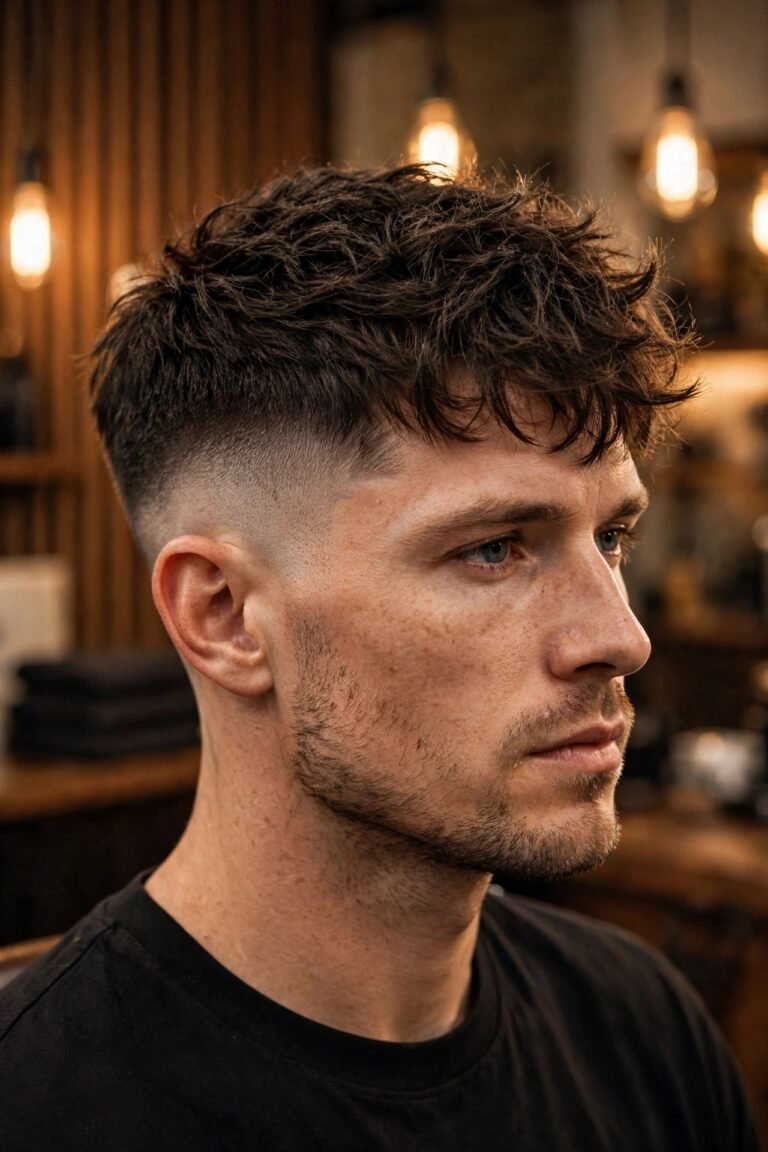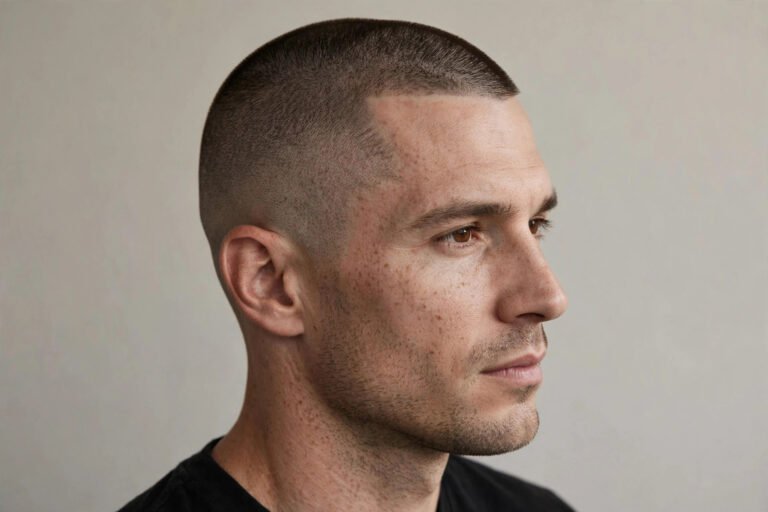
Wedding Hairstyles for Men 2026: 16 Groom-Ready Looks
Your Hair Is in Every Single Wedding Photo — Make It Count
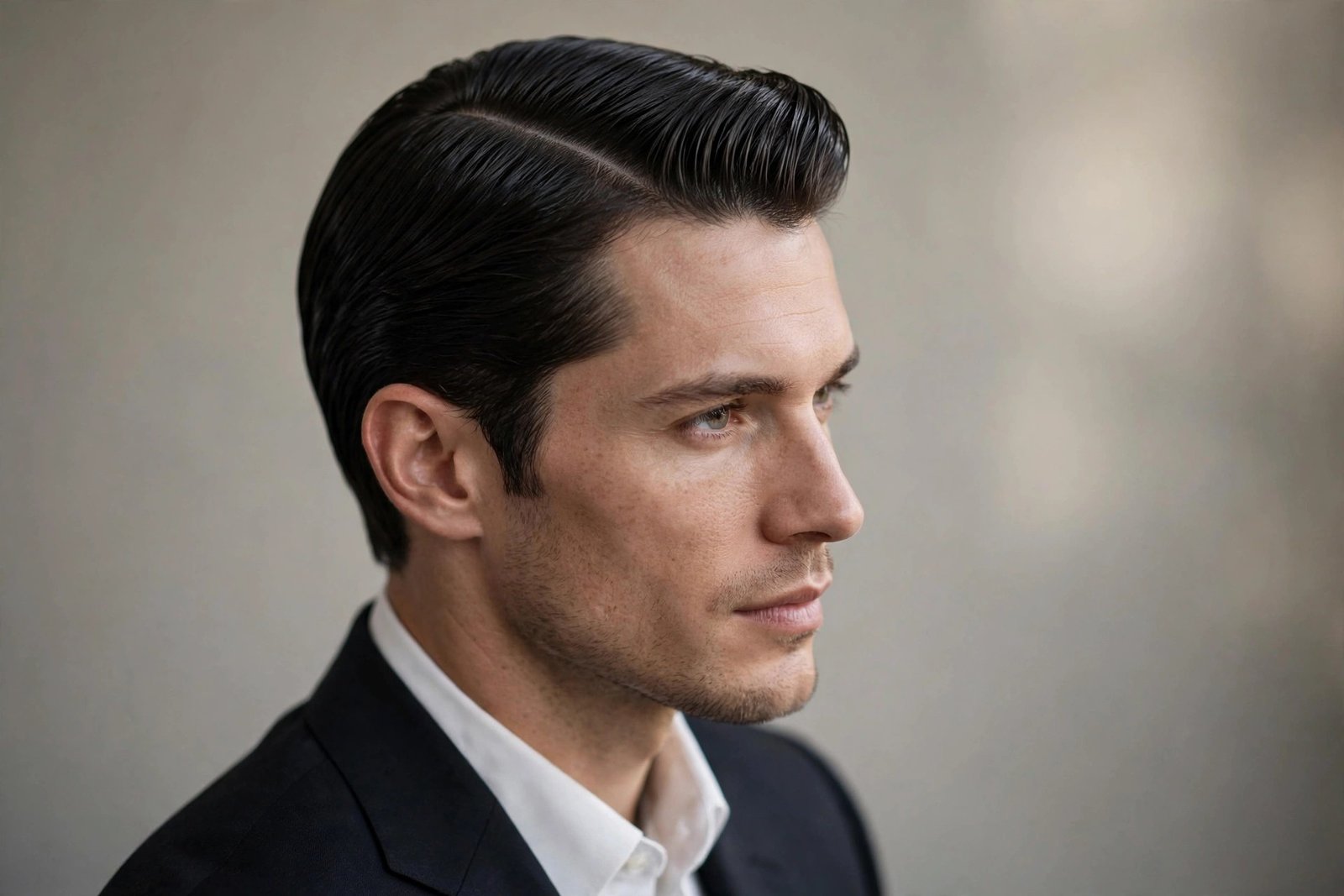
Let’s get one thing straight: nobody remembers the centerpieces. Ten years from now, when someone pulls your wedding album off the shelf, they won’t be studying the table settings or the DJ’s playlist. They’ll be looking at your face — and right above it, your hair. That’s why picking from the wedding hairstyles men actually wear with confidence deserves more thought than a rushed five-minute decision in the barber’s chair the week before. The suit gets hung back in the closet. The flowers wilt by Monday. But your hair? It’s in every single photograph, forever. I’ve seen grooms spend four months obsessing over cufflinks and exactly zero minutes thinking about the thing sitting on top of their head in 400 pictures. Don’t be that guy.
Here’s the truth nobody tells grooms: your wedding day haircut is not the day to experiment. I once watched a friend — let’s call him Dan — walk into a barbershop three days before his wedding with a screenshot of a celebrity cut and walk out looking like a completely different person. Not in a good way. His fiancée cried. Not happy tears. He spent the whole ceremony tugging at hair he didn’t recognize in the mirror. The photos are beautiful, but every time he looks at them he sees a stranger in a rented tux. The lesson isn’t “play it safe and look boring.” The lesson is that wedding hair is a refined version of you, not a reinvention.
That’s exactly what this guide is built around. Below you’ll find sixteen genuinely wedding-worthy hairstyles for 2026 — every one of them tested against the only criteria that matter on the day: does it photograph well from every angle, does it survive hugging forty relatives, does it still look sharp at midnight, and does it actually look like you? For each look I’m giving you the full playbook: who it suits, exactly what to tell your barber (word for word), how to style it yourself that morning, which products to buy, the honest downsides, and the small variations that make it yours. No fluff, no vague “just ask for something classy.” Real scripts, real talk.
One more thing before we dive in. Start early. Whatever style you fall in love with here, book a trial run four to six weeks before the wedding. Wear it to a nice dinner. See how it holds up through an evening of real life. Take photos in daylight and bad lighting. Your wedding day is the worst possible time to discover that a slick-back makes your forehead look like an airport runway. A trial run costs one haircut. A bad wedding haircut costs you a lifetime of photos. The math is easy.
Table of Contents
- Your Hair Is in Every Single Wedding Photo
- 16 Wedding Hairstyles for Men in 2026
- The Groom’s Hair Routine: From One Month Out to Midnight
- Frequently Asked Questions
- Conclusion
What Actually Makes a Hairstyle Wedding-Worthy?
Not every sharp haircut is a wedding haircut, and this is where a lot of grooms go wrong — most lists of wedding hairstyles men find online never mention this. Your everyday cut might look great in the office, but a wedding puts your hair through a stress test most styles never face. So before we get to the sixteen looks, let’s talk about what separates a genuinely wedding-worthy style from one that just looks good on Instagram. First: it has to photograph well from every angle. Wedding photographers shoot you from the front, the side, the back, from above during the ceremony, and in harsh midday sun during portraits. A style with a beautiful front but a messy, undefined back will betray you in the wide shots. Ask yourself honestly how your hair looks from behind — that’s the view your guests stare at through the entire ceremony.
Second, and this one surprises people: it has to survive the hugging. I’m serious. You will be embraced, cheek-kissed, head-rubbed by uncles, and possibly tackled by your college friends. A wedding hairstyle held together by hope and a whisper of hairspray will collapse by the first dance. The best wedding styles have structural integrity — they can take a beating and still look intentional. That’s why so many of the looks below pair a defined shape with the right product: the shape does the heavy lifting, the product just locks it in.
Third, it needs to last twelve-plus hours without looking tired. Your hair at 9 PM should look like a slightly more relaxed version of your hair at 2 PM, not like a different, sadder haircut. This is mostly about choosing the right finish. Ultra-wet, helmet-glossy styles tend to look greasy by evening. Bone-dry matte styles can go frizzy in humidity or on the dance floor. The sweet spot for most grooms is a natural-to-satin finish — polished but alive. Your barber can steer you, but knowing this going in saves you from the extremes.
And finally, the most important criterion: it has to look like you on your best day, not like someone else entirely. Your partner fell in love with you. The goal is the version of you that gets stopped by strangers asking where you got your haircut — not a costume. If you’ve worn your hair the same way for five years, your wedding style should be that haircut, elevated: cleaner lines, better product, sharper finish. If you’re the adventurous type who’s always changing it up, then sure, go bolder — but do the trial run. Always do the trial run.
Groom Hair Trends Dominating 2026
Wedding hair for men in 2026 has a clear personality, and honestly, it’s a good one. The era of the rock-hard, shellacked helmet is finally, mercifully over. What I’m seeing on real grooms this year is polish with movement — hair that looks expensive and deliberate but still like it could move in a breeze. Think of it as the difference between a mannequin and a movie star. The texture trend that took over everyday men’s hair over the last few years has finally made it to the altar, and it suits weddings beautifully: a little texture catches the light in photographs in a way that flat, pasted-down hair never does.
The second big shift is personalization over uniformity. Grooms in 2026 aren’t all asking for the same cut anymore — the wedding hairstyles men are actually booking now are chosen for the individual, not the trend cycle. The groomsmen might coordinate suits, but hair is increasingly individual — the groom picks the style that suits his face, hair type, and personality. Barbers tell me the most common request now is some version of “clean it up but keep what makes it mine.” I love this. It means the photos look like a group of real men, not a boy band lineup.
Third: the fade is maturing. Skin fades aren’t disappearing, but on wedding days I’m seeing more soft tapers and blended transitions instead of harsh, high-contrast fades. A softer transition photographs more elegantly and grows out more gracefully — which matters, because your honeymoon photos are a week later and nobody wants a haircut with a visible expiration date. If you love fades, ask for a low or mid taper with a natural blend rather than a skin-tight high fade. You’ll thank me on day eight.
Finally, there’s a quiet return to classic lengths on top. After years of everything cropped short, more grooms are growing the top out — side parts with real sweep, quiffs with genuine height, flows with actual movement. Longer hair on top gives your barber more to work with and gives you more styling options on the day. If your wedding is six months out and you’re thinking of growing it, start now. Length is the one thing a barber can’t fake.
Match the Hairstyle to Your Wedding Vibe
Here’s a mistake I see constantly: a groom picks a hairstyle he loves in isolation, without thinking about the wedding itself. But hair doesn’t exist in a vacuum — it sits above your collar, next to your partner’s hairstyle, inside a venue, in a season. A slicked-back wet look that slays at a rooftop evening wedding in the city can look oddly severe at a barefoot beach ceremony. A relaxed bro flow that’s perfect for a vineyard wedding might feel underdressed next to a black-tie dress code. So before you commit, run your favorite through the vibe check.
Start with formality. Black tie and formal evening weddings call for more structure — defined parts, controlled shapes, polished finishes. Think side parts, slick backs, sharp tapers. Semi-formal and garden weddings are the sweet spot for most of the styles below: texture, natural movement, that “expensive but effortless” zone. Casual, beach, or rustic weddings give you the most freedom — flows, longer styles, softer finishes all work, but “casual” doesn’t mean “I woke up like this and skipped the barber.” It means polished ease, which actually takes more skill, not less.
Then consider the season, because weather is the silent killer of wedding hair. Summer outdoor wedding? Humidity is coming for you, so lean toward shorter sides, stronger-hold products, and styles with built-in structure rather than styles that depend on staying perfectly in place. Winter wedding? Static and dry air are the enemies — a little extra conditioning in the weeks before, and finishes that don’t go crispy. Spring and fall are the easy seasons, which is one more reason they’re peak wedding season.
And please, coordinate with your partner — not to match, but to harmonize. If she’s wearing a sleek, sculptural updo, your soft messy texture creates a nice contrast. If she’s going romantic and loose, your sharper structured cut balances it. You don’t need a joint hair consultation (though honestly, it’s not a terrible idea). Just have the conversation. The photos of you two together are the ones that matter most, and hair harmony — not matching, harmony — is one of those invisible things that makes couple portraits look stunning.
16 Wedding Hairstyles for Men in 2026
Alright, the main event. Sixteen looks, each one genuinely worthy of the biggest day of your life. Search “wedding hairstyles men” on Pinterest and you’ll drown in generic stock photos — this isn’t that. I’ve ordered them roughly from most classic to most modern, but don’t read too much into the order — the best wedding hairstyle for you is the one that fits your hair, your face, and your wedding. For every style you get the full breakdown: what it is, who it flatters, the exact words for your barber, the wedding-morning styling routine, upkeep, variations, and the honest downsides nobody else will tell you about. Let’s go.
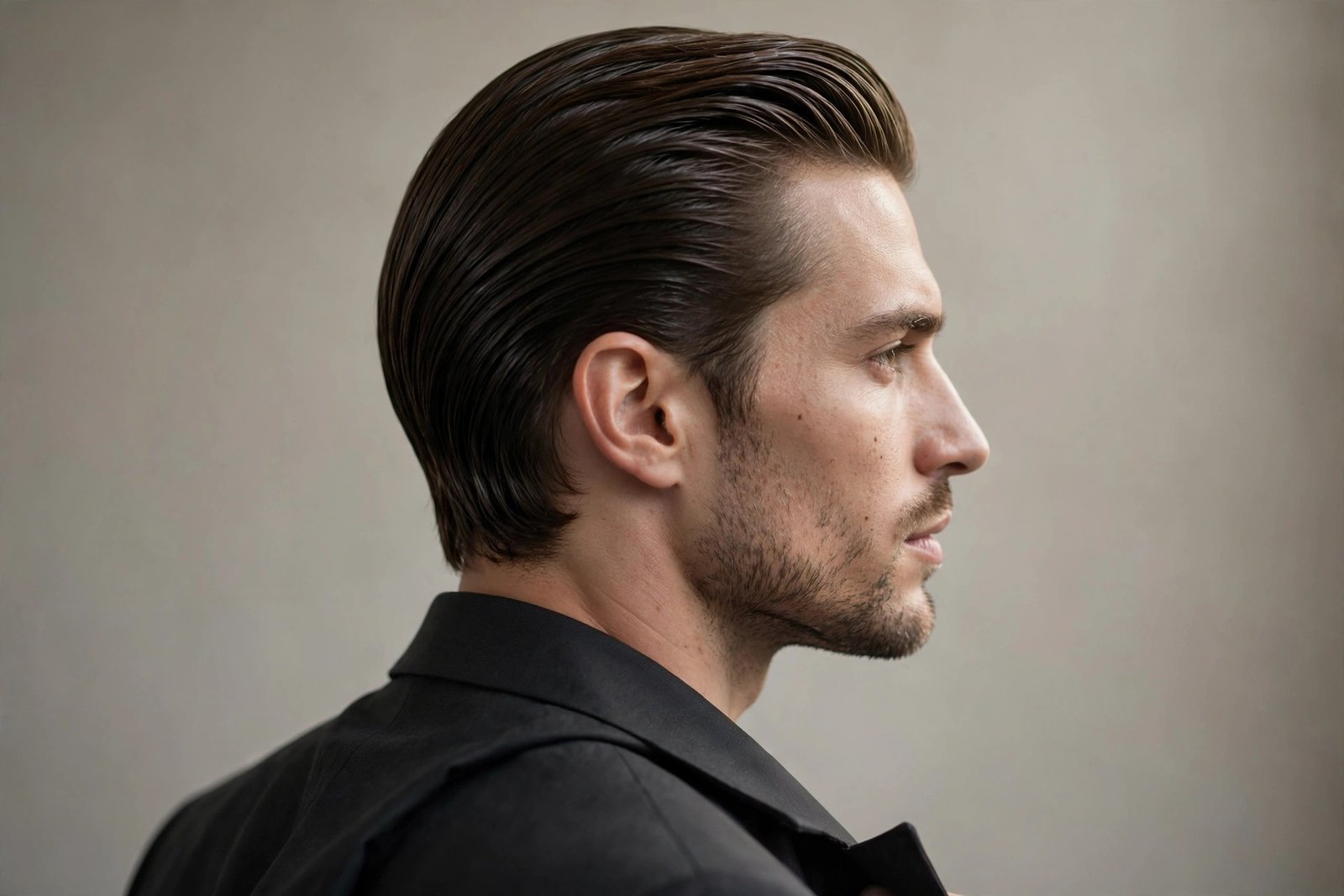
1. The Classic Side Part
If wedding hairstyles for men had a hall of fame, the classic side part would be the first inductee, and it wouldn’t even be close. This is the look your grandfather wore to his wedding, your father wore to his, and — here’s the thing — it still photographs better than almost anything else in 2026. There’s a reason it never dies: a clean side part with a defined parting line is pure geometry, and geometry photographs beautifully. It frames the face, it works with virtually every suit style ever invented, and it says “I have my life together” without saying a word. When in doubt, this is the answer. I’m not being lazy here — I’m being honest. If you showed me a groom’s face and hair type and asked me to pick blind, I’d pick the side part more often than anything else on this list.
Who does it suit? Almost everyone, which is its superpower. It flatters round faces by adding asymmetry and height, it sharpens square faces, and it gives structure to oval faces. It works on straight, wavy, and even loosely curly hair — the part just needs to be clean. The one hair type that fights it is very tight curls, where a hard part can look forced; if that’s you, skip to number nine. Length-wise you want three to five inches on top so the sweep has something to work with, with sides kept neat — tapered or faded, your call. Thinning on top? A side part is actually one of the kindest styles for it, because the sweep creates coverage and the part gives the eye a clean line to follow instead of a thinning crown to stare at.
What to tell your barber — say this verbatim: “I want a classic side part for my wedding. Keep three to four inches on top, textured enough to sweep but clean. Taper the sides and back — not a skin fade, a soft natural taper, neat around the ears and neckline. I want a defined part on my natural parting line, and I need it to hold all day for photos.” If you’ve never had a side part, ask the barber to find your natural part first — it’s where your hair wants to fall, usually visible as a subtle line. Fighting your natural part on your wedding day is a losing battle; work with it. For a deeper dive on nailing the cut itself, our guide to the side part haircut for men breaks down every variation.
Wedding-morning styling is straightforward, which is exactly what you want when you’re nervous. On towel-dried hair, work a dime-sized amount of medium-hold pomade or cream through the top — start at the roots, push everything up and over toward the part. Comb the part line clean with a fine-tooth comb, then sweep the top across. The sides get smoothed down and back. Finish with a light mist of flexible hairspray from about a foot away. Total time: under ten minutes, and it should survive the whole day because the shape is doing the work, not the product. Keep a pocket comb and a travel hairspray in your suit for one mid-day touch-up before portraits — thirty seconds, and you’re back to perfect.
Maintenance is minimal: a trim every three to four weeks keeps the part crisp, and that’s it. Variations? A hard part (where the barber razors the parting line) adds extra definition for formal weddings — just know it grows out visibly, so time it within a week of the day. A low taper instead of a fade keeps it softer and more traditional. And for evening weddings, you can push the same cut slightly sleeker with a higher-shine pomade. The honest downside: in strong wind or very humid outdoor ceremonies, the sweep can lift and separate. If you’re marrying on a clifftop in July, pack that travel hairspray and consider a slightly shorter top. But for the vast majority of weddings, this is as close to foolproof as hair gets.
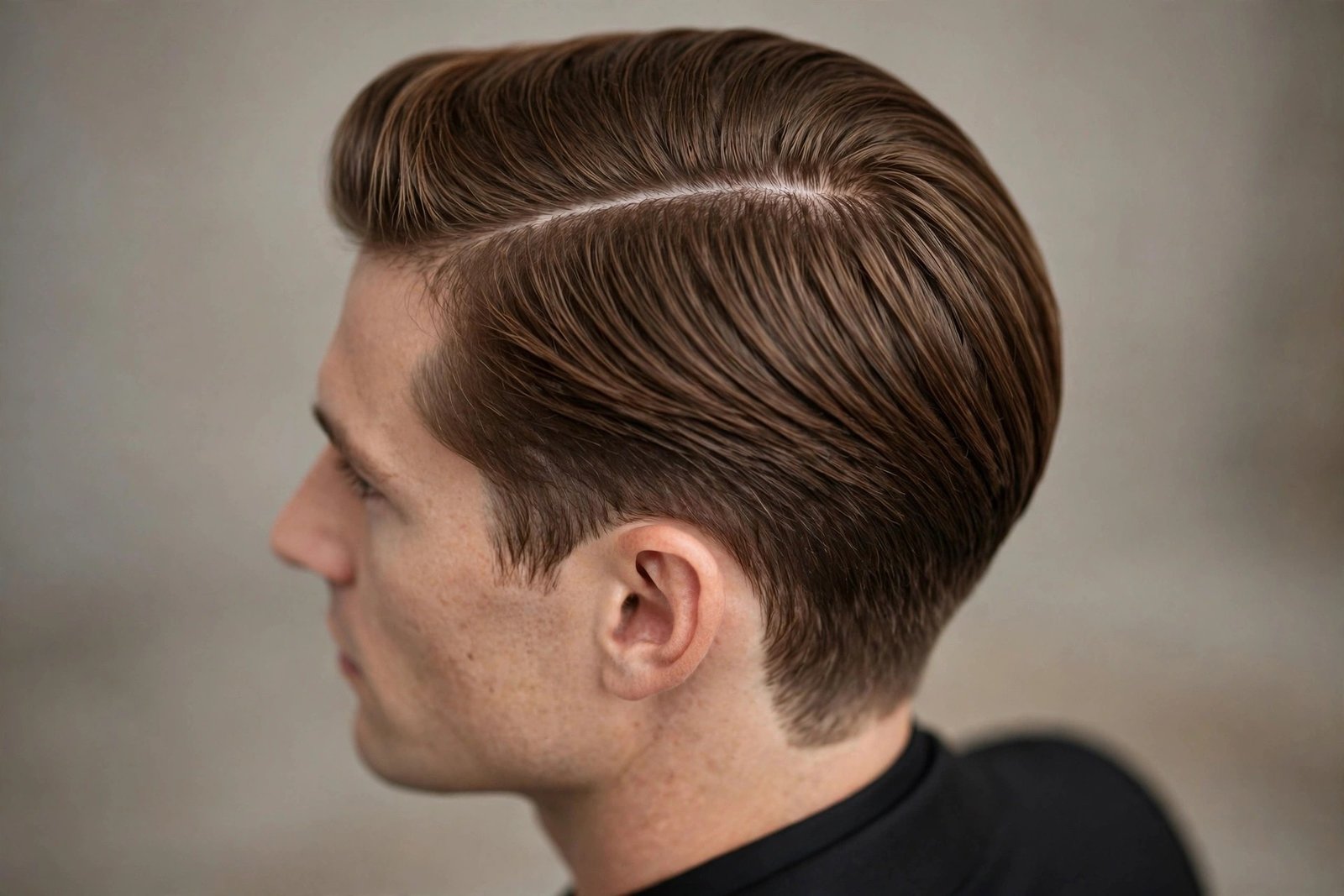
2. The Sleek Slick Back
The slick back is the side part’s cooler, slightly more dangerous cousin — and in 2026 it’s having a serious moment at weddings. Where the side part says “reliable,” the slick back says “leading man.” It’s the look of old Hollywood premieres and modern red carpets, and on a groom it carries this wonderful confidence: everything swept back, face open, nothing to hide behind. Photographers adore it because it opens up the face completely — your expressions read clearly in every shot, and there’s no fringe casting shadows over your eyes in the close-ups. I’ll be straight with you though: this is a commitment look. It puts your whole face on display, hairline included, so you need to be at peace with your hairline. If you’re self-conscious about it, the slick back will make you think about it all day, and that’s the opposite of what you want.
Who does it suit? Men with strong bone structure — defined jawlines, good cheekbones — because there’s no hair falling forward to soften anything. It works beautifully on straight and wavy hair; curly guys can pull it off too but need more length and a different product approach. You need real length on top here: four to six inches minimum, because short hair slicked back just looks like it’s giving up. The sides can go two ways: faded for a modern edge, or grown out and slicked with the top for a full classic sweep (the latter is more formal, more old-money, and honestly more striking in a tux). Face shape-wise it flatters oval and square faces most; on very round faces it can emphasize width, so ask your barber’s honest opinion.
The barber script: “Sleek slick back for my wedding. Keep five inches on top, layered just enough to lie back smoothly. I want the sides tapered and blended into the top — no harsh disconnect — neat around the ears. It needs to hold its shape all day without looking wet or crunchy.” Timing matters enormously with this cut: get it done five to seven days before the wedding, not the day before. Freshly cut hair has a spring to it that fights the slick-back; a few days of growth lets it settle into lying back naturally. This is one of those insider details barbers know and grooms don’t, and it makes a real difference. If your sides are faded, the fade itself can be fresher — fades look best in the first week — so some grooms do the full cut a week out and just a quick side cleanup two days before. Our breakdown of the slick back undercut covers the edgier version if you want more contrast.
Styling on the morning: this is a damp-hair job. After your shower, towel-dry until damp — not dripping, not dry. Work a strong-hold pomade (water-based, so it washes out easily) evenly through the top from roots to ends. Then comb everything straight back with a wide-tooth comb first, then refine with a fine-tooth comb for that glassy finish. The trick is tension: keep the comb pulling slightly back and down as you go, which trains the hair to lie flat. A shot of heat from a blow dryer on medium, directed backward, sets it — then a final thin layer of pomade smoothed over the top for shine, and a veil of strong-hold hairspray. Fifteen minutes, and you’re bulletproof until midnight.
The honest downsides: humidity is the enemy — moisture in the air reactivates product and can make the front lift or frizz, so outdoor summer weddings need the strong-hold version and a touch-up kit. Hugs will disturb it more than most styles; you’ll want that pocket comb. And if your hair is fine or thin, a slick back can expose scalp under bright lights — a thickening product or fibers at the roots solve it, but do a trial. Variations: the textured slick back (less comb-perfect, more piecey) is very 2026 and more forgiving; the side-slick (swept back and slightly to one side) suits men who aren’t ready for the full backward commitment. Get the finish right and this is the most commanding look on the list.
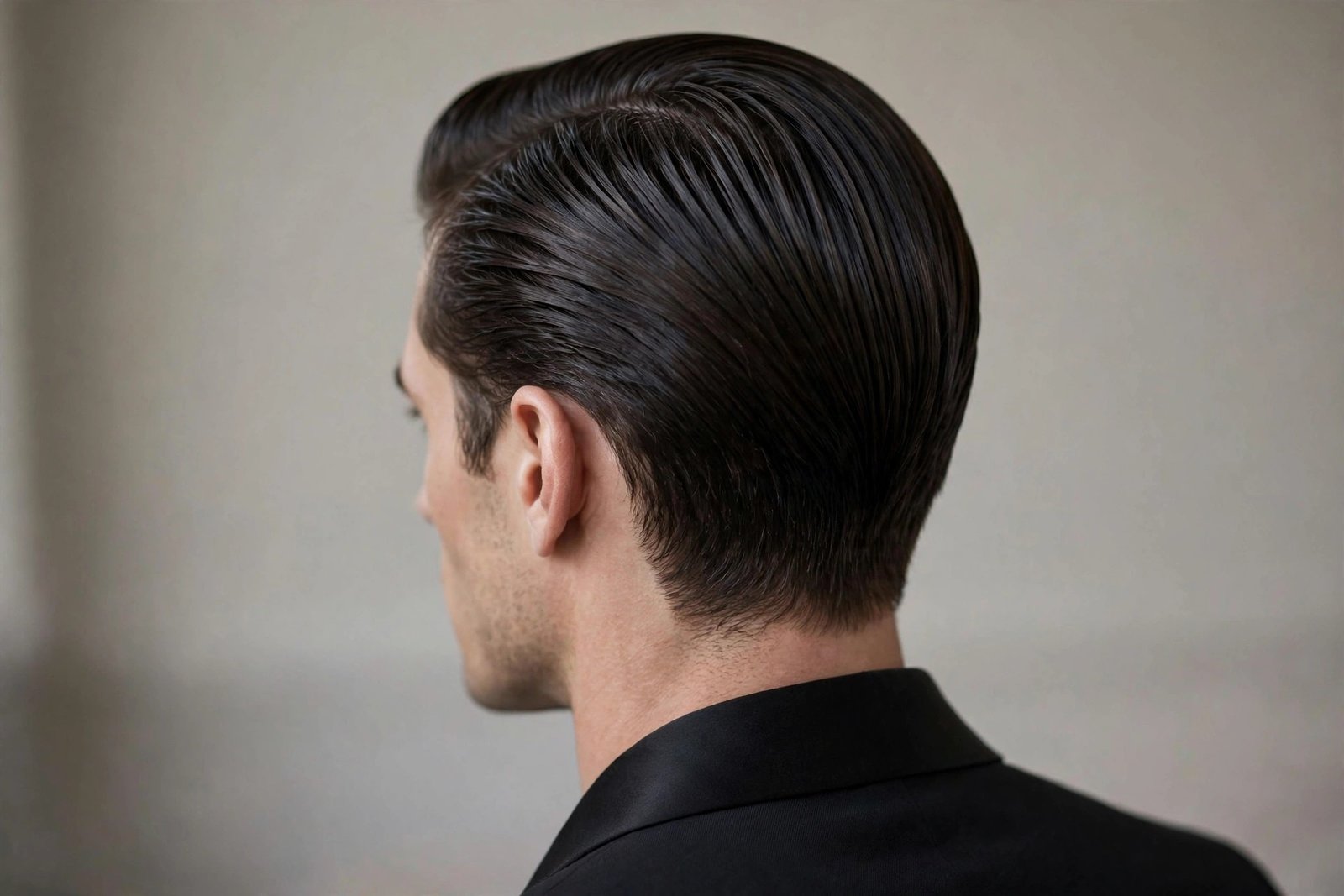
3. The Textured Quiff
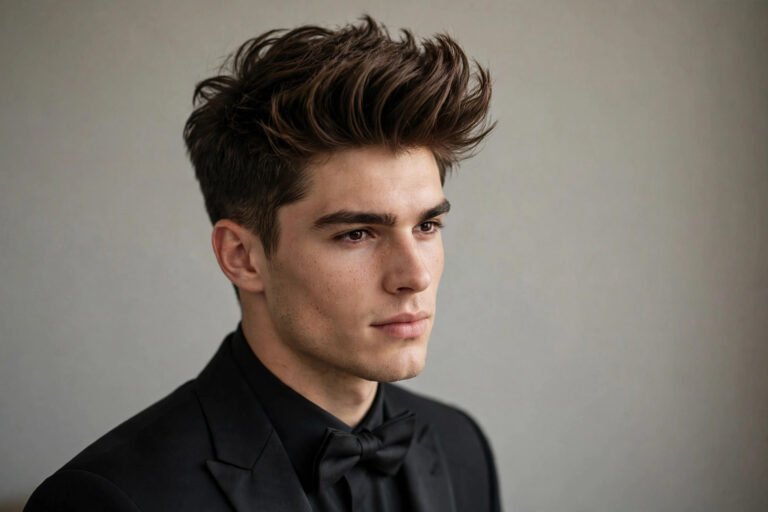
If the side part is the reliable best man and the slick back is the movie star, the textured quiff is the groom who actually enjoys being the center of attention — in the best way. It’s got height, it’s got movement, it’s got personality, and in 2026 it’s arguably the most popular wedding hairstyle for grooms under 35. The quiff takes the classic idea of volume on top and roughs it up just enough to feel modern: the front lifts up and back, the texture is visible and touchable-looking, and the whole thing has this energy that photographs like crazy. Here’s what I love about it for weddings specifically: height on top lengthens the face in photos, which is flattering on literally everyone, and the texture catches light beautifully — your hair will have dimension in pictures instead of looking like a flat dark shape.
Who does it suit? The quiff is generous. It flatters round faces by adding height, balances long faces if you keep the height moderate (don’t go full skyscraper), and sharpens softer jawlines by drawing the eye upward. It needs medium-thick hair ideally — very fine hair can do a quiff but needs volumizing product and a blow dryer, no exceptions, while very thick hair needs thinning or weight removal so it doesn’t turn into a wall. Straight and wavy hair are the natural home of the quiff; curly hair gets its own version (see number nine). Length: three to five inches on top, shorter at the crown blending forward, sides faded or tapered. This is not a style for guys who want to spend two minutes on their hair — accept the styling time or pick something else.
Barber script: “Textured quiff for my wedding. I want four inches on top with lots of texture cut in — point-cut the ends so it’s piecey, not blunt. Fade or taper the sides, mid fade is fine, blended cleanly. The front needs enough length to lift up and back. Most important: thin it out enough that it moves — I don’t want a solid block.” The texture cutting is the whole game here, so don’t let a barber give you a blunt top and call it a quiff. Ask to see the texture: the ends should look soft and separated, not like a shelf. And book the cut a week before the wedding — quiffs actually style better with a few days of growth, same as the slick back.
Wedding-morning routine: this is a blow-dryer style, full stop. On damp hair, apply a volumizing mousse or pre-styling spray at the roots. Blow-dry the top upward and backward using your fingers or a vent brush — you’re building the lift now, product comes later. Once dry, warm a matte clay or paste between your palms and work it through from roots to ends, lifting the front up and back and pulling pieces slightly apart for that textured separation. The sides get smoothed down. Lock it with a medium-hold hairspray. Twenty minutes, but the result has real architecture — it will hold its shape through the ceremony, the photos, and the dance floor. Pack a small clay tin for touch-ups; a pea-sized amount revives the texture instantly.
Honest downsides: it’s the highest-maintenance style on this list on the day itself. Wind will test it, enthusiastic hugging will test it, and if your hair is fine, the height can deflate by evening without a touch-up. It’s also not ideal for very humid outdoor weddings unless your hair holds texture well. Variations: the side-swept quiff (softer, more romantic — great if your partner’s style is soft too), the short quiff (less height, less risk, still plenty of character), and the messy-textured quiff for rustic or outdoor weddings where polish would look out of place. Done right, though, this is the style that gets you compliments from guests you haven’t seen in a decade.
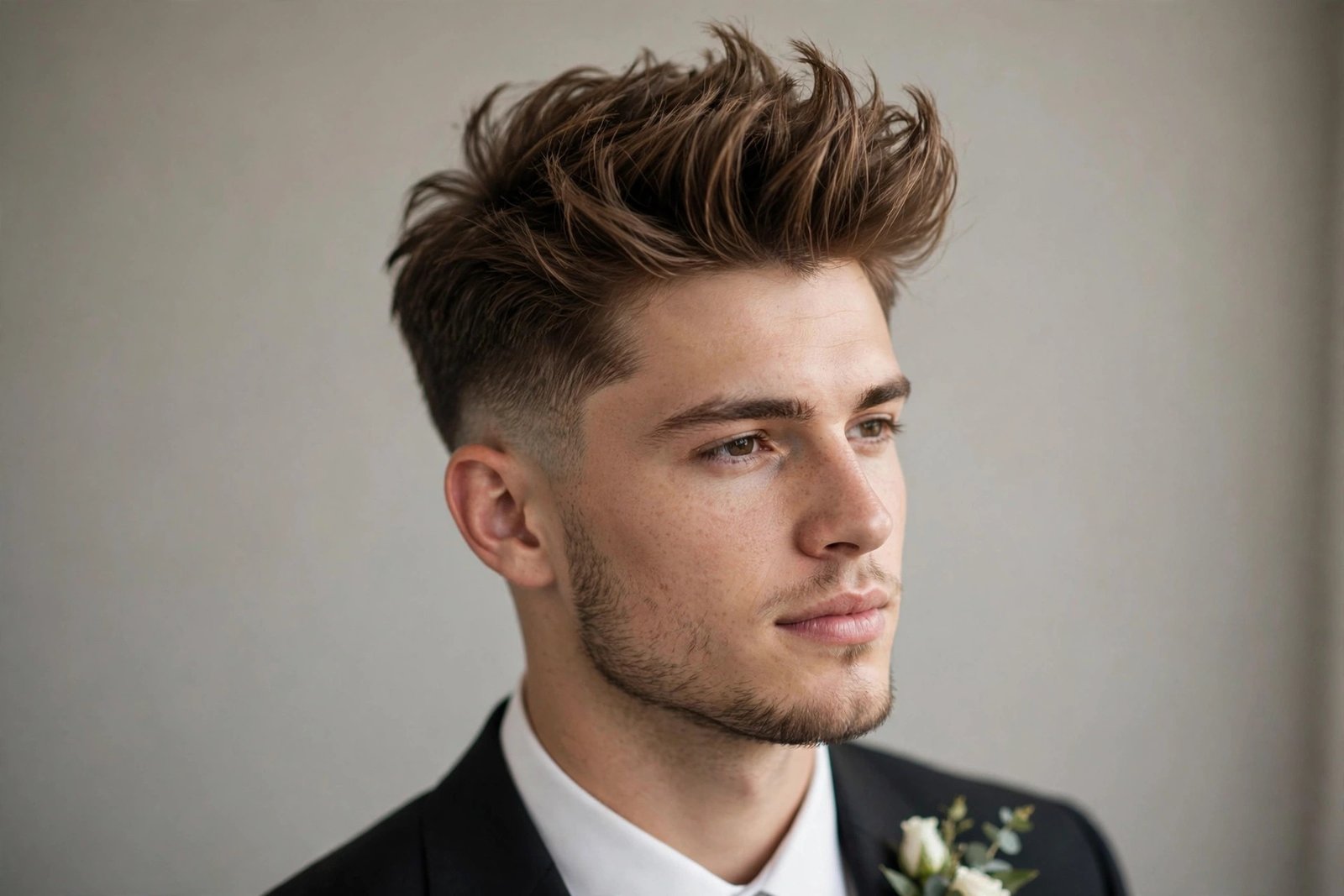
4. The Ivy League
Every wedding has that one groom who looks impossibly put-together without looking like he tried — and nine times out of ten, he’s wearing an Ivy League. This is the thinking man’s wedding haircut: short enough to be effortless, long enough on top to side-part or brush with real style, and so clean around the edges that it looks expensive from across the room. It originated, as the name suggests, in the actual Ivy League universities — the haircut of men who were expected to look sharp without appearing to care. That DNA is perfect for weddings. It says quiet confidence. It never looks like it’s trying too hard, which paradoxically makes it one of the most sophisticated choices on this list. And here’s the practical magic: it’s nearly indestructible. Hugs, wind, dancing, happy tears — the Ivy League shrugs it all off.
Who does it suit? Men who want short hair but refuse to look plain. It flatters every face shape honestly — the neatness sharpens round faces, the side-swept top softens square ones. It’s excellent for fine or thinning hair because the short length maximizes the appearance of density; there’s a reason it’s the go-to recommendation for grooms worried about thinning crowns. It works on straight, wavy, and curly hair alike (curly Ivy Leagues look fantastic — the texture does the styling for you). Athletes and active guys love it because it survives everything. The only men I’d steer away: if you have a very long face and keep the top too short, it can elongate further — keep an inch and a half on top and you’re fine.
Barber script: “Ivy League for my wedding — classic college cut. About an inch and a half on top, tapered sides and back, neat around the ears and neckline. I want to be able to side-part it or sweep it, so keep enough length on top to move. Clean and sharp, but not a buzz cut.” That’s it. It’s a simple cut, which means the barber’s precision matters more than the complexity — clean lines, even taper, no stray patches. Get it cut three to five days before the wedding; short cuts look best fresh, and this one is short enough that a week of growth starts to soften the edges.
Styling takes five minutes, which on a wedding morning when you’re already nervous is a genuine blessing. On dry or slightly damp hair, work a small amount of light cream or matte paste through the top, sweep it to your natural part, smooth the sides. Done. No blow dryer, no drama, no twenty-minute architecture project. A quick comb-through before photos and you’re set for the day. Bring nothing for touch-ups except maybe a pocket comb — though honestly, this cut looks good even slightly mussed. That’s its charm: it has a “perfectly imperfect” range where most styles have a cliff.
Downsides? It’s not a statement look. If you walked in dreaming of dramatic transformation photos, the Ivy League will feel too familiar — it’s an elevation, not a reinvention. And if your hair grows fast, the crispness fades within two weeks, so honeymoon photos will show a softer version (not a bad thing, just know it). Variations: the long Ivy League (two inches on top, more styling options, still tidy), the textured Ivy League (choppier top for younger grooms), and pairing it with a well-groomed beard for contrast — short sharp hair plus deliberate facial hair is a combination that photographs incredibly well. For the groom who wants to look like the best version of his everyday self, nothing beats it.
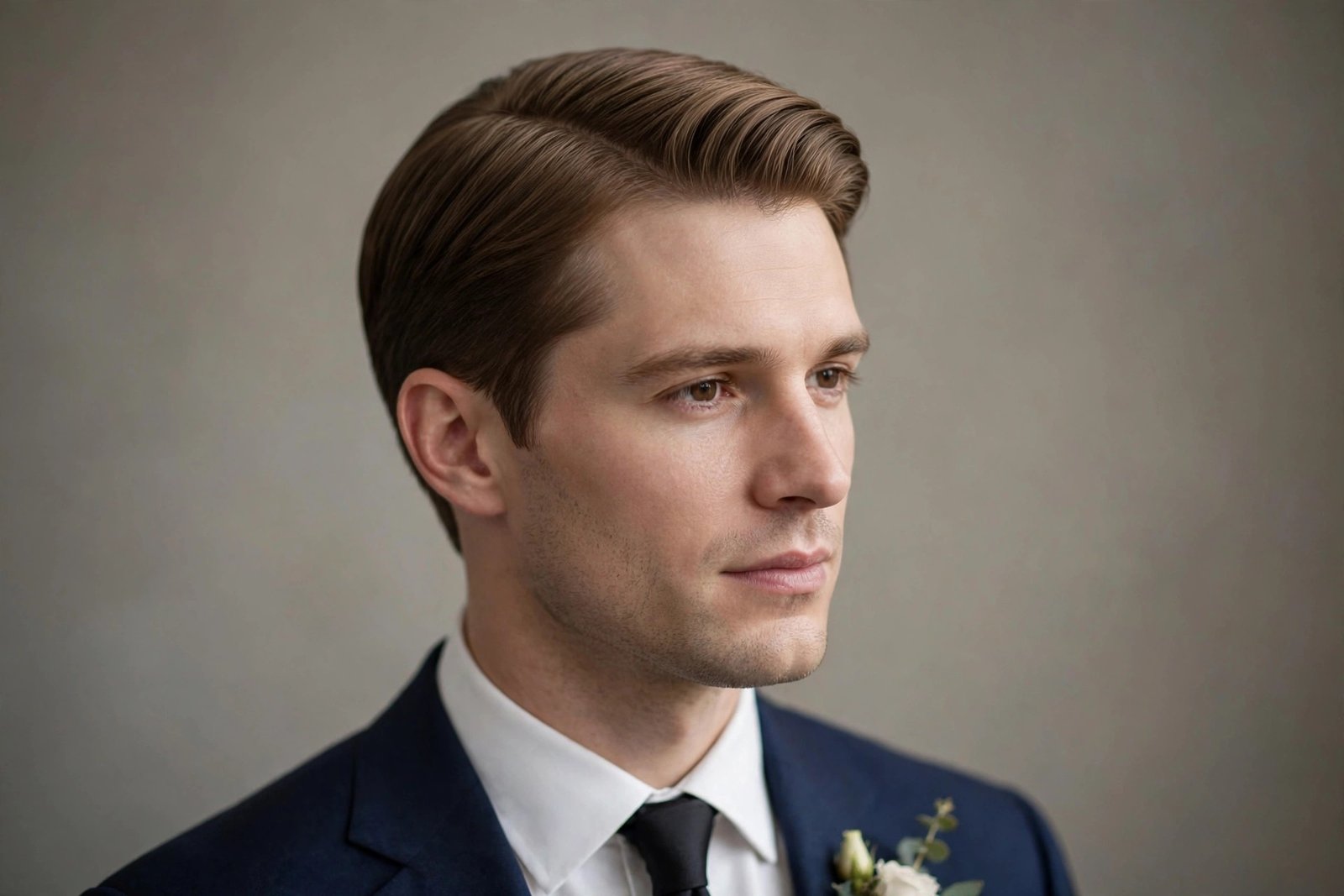
5. The Polished Pompadour
Now we’re talking drama — the good kind. The pompadour is the most romantic hairstyle on this list, and I don’t use that word lightly. There’s something about that sculpted wave of height at the front that just belongs at a wedding; it’s vintage glamour without costume vibes, Elvis without the impersonator energy. In 2026 the wedding pompadour has evolved from the greasy rockabilly version into something softer and more refined — think less “1950s diner” and more “leading man at a premiere.” The height elongates the face, the shape is unmistakable in silhouette shots, and when the light catches the curve of it during golden-hour portraits, it’s pure magic. I’ll be honest: this is a bold choice, and it takes confidence to wear. But weddings are one of the few days in life when bold is exactly right.
Who does it suit? Men with thick, straight to wavy hair — the pomp needs density to hold its architecture. Round faces benefit enormously from the height; it adds length where you want it. Square faces look powerful with it; the height balances a strong jaw beautifully. You need four to six inches at the front, graduating shorter toward the crown. Fine or thin hair struggles here — without density, the pomp collapses into a sad little wave, so be honest with your barber about what your hair can actually do. Curly hair can work with a looser, more textured interpretation. And a note on foreheads: the pomp draws every eye upward to your hairline, so if your hairline is something you’re sensitive about, this will put it center stage all day.
Barber script: “Polished pompadour for my wedding — modern, not rockabilly. I need five inches at the front, graduated back to about three at the crown, with the sides faded or tapered tight. The top needs to be cut so it sweeps up and back — layer it to support the height. I want it refined and smooth, not spiky or piece-y.” Then the critical question: ask your barber straight up, “will my hair hold this all day?” A good barber will be honest. If they hesitate, listen to them — they’d rather talk you into a quiff that works than watch a pomp die at 4 PM. Cut timing: one week before, so the top settles but the sides are still crisp. Some grooms get the sides cleaned up two days before as a separate quick visit.
Wedding-morning styling is a ritual — give it twenty-five minutes and a clear bathroom. Damp hair, volumizing pre-styler at the roots. Blow-dry the front section up and back with a round brush, building the wave — this is where the height comes from, and there’s no shortcut. Once dry and lifted, apply a medium-to-firm pomade, working it through and sculpting the front into that classic roll. Smooth the sides back. The shape should look soft and touchable, not shellacked — 2026 is about polish, not plastic. Finish with strong-hold hairspray, applied in light layers. Assign a groomsman the emergency kit: travel pomade, comb, hairspray. If anyone’s hugging is going to threaten the architecture, it’s the best man.
The honest downsides are real with this one: it’s the most weather-vulnerable style here. Wind is a genuine threat to a pompadour — an outdoor ceremony on a breezy day is a gamble. Humidity can soften the height. It also demands the most styling skill; if you’ve never blow-dried your hair with a round brush, the wedding morning is not the time to learn (get your barber or a stylist to do it, or practice twice beforehand). Variations: the short pomp (less height, less risk), the textured pomp (more modern, more forgiving), the side-parted pomp (a hybrid with the side part — extremely wedding-appropriate). When it works, nothing on this list photographs more dramatically. Just respect what it asks of you.
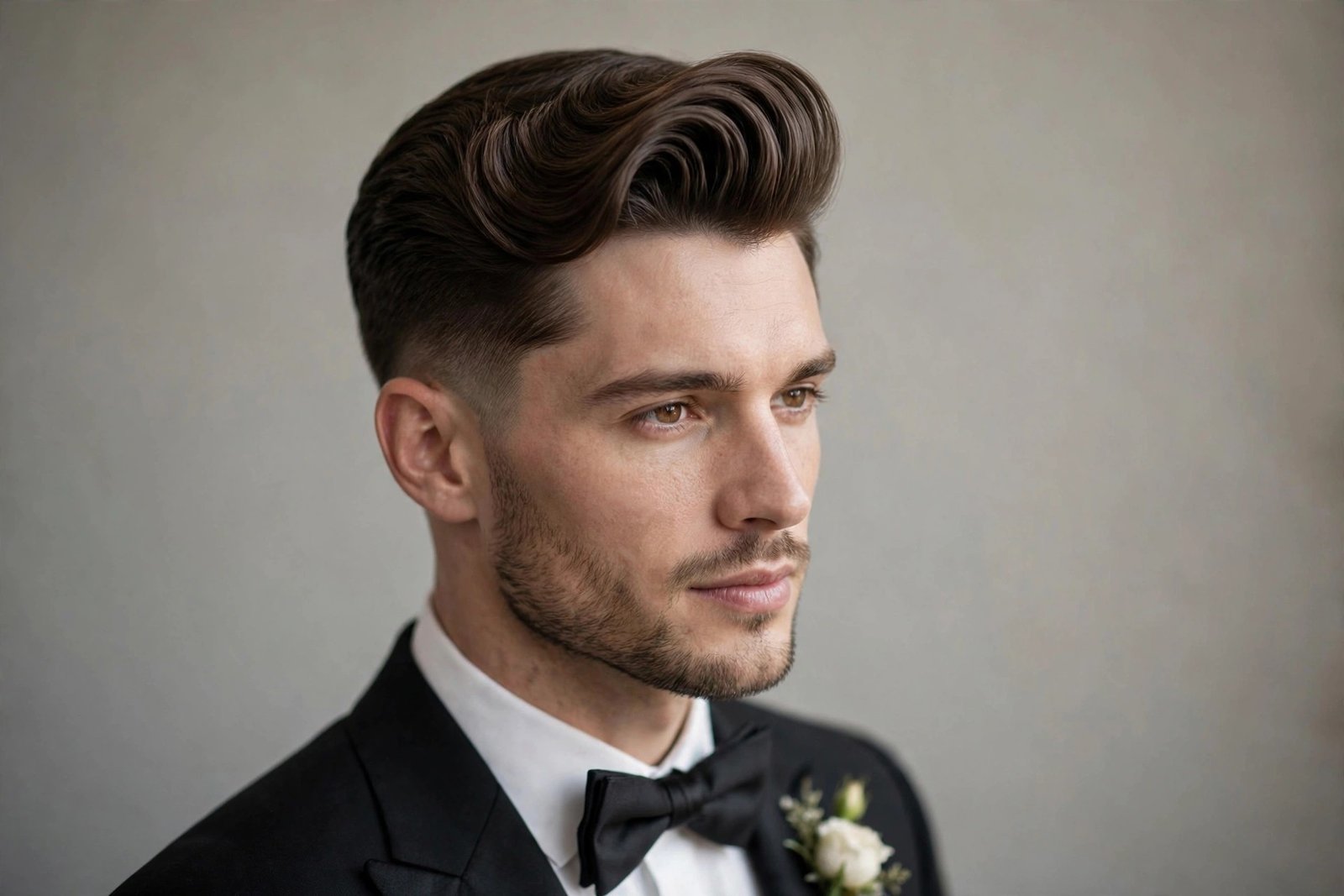
6. The Soft Taper Fade with Side Sweep
This is the haircut I’d recommend to a groom who says “I want to look amazing but I don’t want to think about my hair all day” — which, let’s be honest, is most grooms. The soft taper fade with a side sweep is the 2026 sweet spot: clean, gradual blending on the sides that melts into a naturally swept top. No harsh lines, no dramatic disconnect, just hair that looks like it was always meant to look this good. It’s the fade for men who find skin fades a bit aggressive for a wedding — and they’re right, honestly. A soft taper photographs more elegantly than a high-contrast fade; there’s no stark line for the camera to catch at an unflattering angle, just a smooth gradient that looks expensive. Barbers tell me this is quietly becoming the most-requested wedding cut of the year, and I believe it. It’s the one that pleases the groom, the photographer, and the mother-in-law simultaneously.
Who does it suit? Practically everyone, with a special nod to men with thick or coarse hair — the taper removes bulk at the sides while the length on top keeps your natural texture visible. It flatters round faces (the sweep adds asymmetry), square faces (the softness balances angles), and it’s kind to thinning hair because the gradual blend doesn’t create a harsh contrast between thick top and bare sides the way a skin fade can. Straight, wavy, curly — all welcome. The top wants two to four inches, enough to sweep naturally to one side. If your hair grows straight up at the sides like a hedgehog, tell your barber — they’ll take the taper lower and tighter to keep it controlled.
Barber script: “Soft taper fade with a side sweep for my wedding. I want a low taper — natural, blended, not a skin fade — neat around the ears and neckline. Keep three inches on top with texture, swept to my natural part. Everything should blend smoothly with no harsh lines. Clean and wedding-sharp, but soft.” Emphasize the word “soft” twice if you have to — some barbers default to aggressive fades out of habit, and you don’t want to be negotiating at the chair. For special-occasion fade thinking, our piece on drop fades for special occasions shows how fades can stay elegant. Timing: four to six days before the wedding. Tapers look best fresh-ish, and this gives the top a couple of days to relax into the sweep.
Styling is blissfully simple: on damp hair, a nickel-sized amount of light hold cream, sweep the top to the side with your fingers or a comb, smooth the tapered sides down. That’s genuinely it — eight minutes, no blow dryer required unless your hair is stubborn, in which case a quick blast in the direction of the sweep sets it. The style holds because the cut does the work: the taper keeps the silhouette clean all day, and the swept top just needs to stay roughly in place, not perfectly. A light hairspray mist for insurance, a pocket comb for portraits, and you’re done. This is the lowest-stress option on the list that still looks genuinely sharp.
Downsides are few but worth naming: it’s not a head-turner. Nobody’s going to gasp at your hair — they’ll just think you look great without quite knowing why. If you wanted drama, look at the pomp or the slick back. It also grows out faster than longer styles — by the honeymoon the taper will have softened noticeably (which actually looks fine, just less crisp). Variations: pair it with a defined hard part for extra formality, go slightly longer on top for a more romantic sweep, or ask for a textured top if your wedding leans rustic or outdoor. It’s the reliable luxury sedan of wedding hair — not flashy, never wrong.
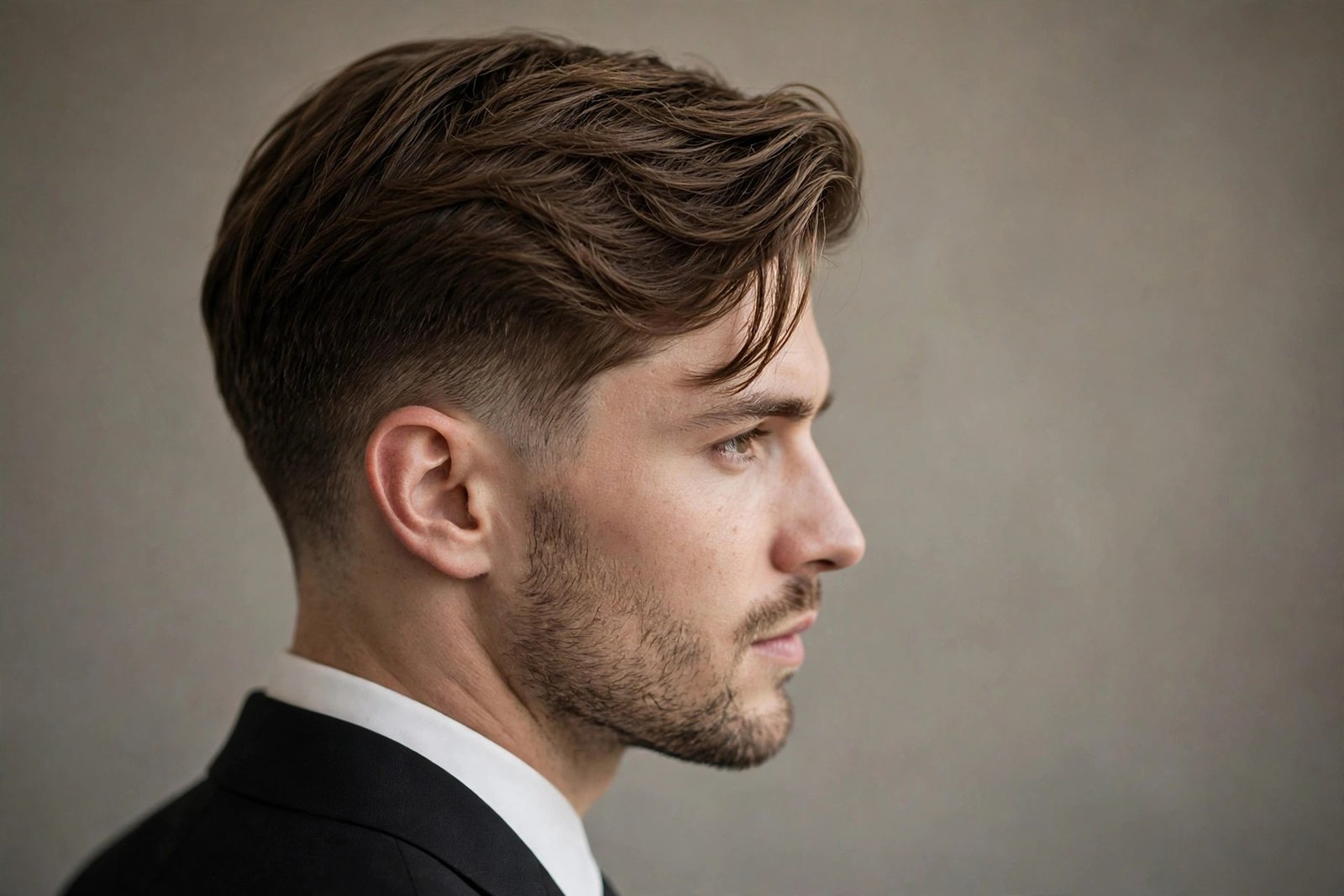
7. The Bro Flow
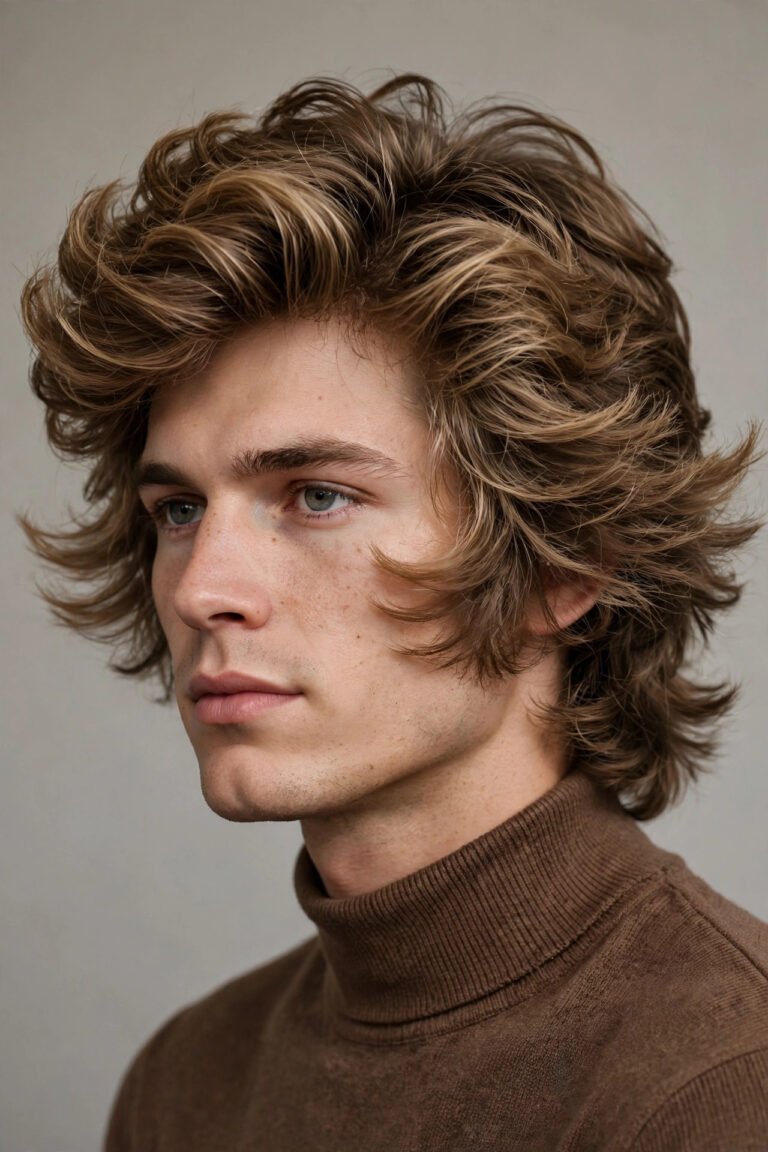
The bro flow at a wedding — hear me out. I know what you’re thinking: isn’t that the haircut of guys who own paddleboards? And yes, in its natural habitat it’s pure weekend energy. But a refined, wedding-ready flow — cleaned up, shaped, with the wildness tamed into deliberate movement — is one of the most romantic looks a groom can wear in 2026. There’s a reason it keeps showing up in wedding photography: long-ish hair with natural movement photographs like a dream. It catches wind beautifully (instead of fighting it), it frames the face softly, and in black-and-white shots it looks straight out of a film. The key word is refined. Wedding flow is not “I haven’t been to a barber in eight months” flow. It’s shaped, the ends are healthy, the shape is intentional — it just happens to move.
Who does it suit? Men with wavy or straight hair who’ve got the length — you need at least four to six inches on top, flowing back past the ears. It flatters oval and oblong faces beautifully, softens square jaws, and gives narrow faces welcome width at the sides. Thick hair is ideal; fine hair can work but needs layering to create the illusion of fullness. Curly guys: your natural texture is a flow, just shaped — own it. The honest gate here is length, and length takes time. If your wedding is less than four months away and you’re starting from a short back and sides, the flow isn’t happening — pick something that works with what you have and grow it out for the anniversary photos.
Barber script: “I want a refined bro flow for my wedding — keep the length, just shape it. Long layers through the top so it flows back naturally, clean up the ends, take weight out where it’s bulky but don’t lose the length. Tidy the sides just enough that it looks deliberate, and clean up the neckline. I want it to look groomed, not wild — wedding-ready flow.” Bring reference photos — flow is one of those styles where “longer on top” means wildly different things to different barbers. Two to three weeks before the wedding is the right time for the shaping cut; it lets the layers settle into how they naturally fall. Then a tiny cleanup of just the neckline and around the ears three days before, if needed.
Styling on the day leans into the hair’s nature rather than fighting it. On damp hair, apply a light sea-salt spray or volumizing mousse for texture, then either air-dry or blow-dry on low while pushing everything back with your fingers — you’re encouraging the natural flow direction, not forcing a shape. A tiny amount of matte cream on the ends keeps them from frizzing. The whole philosophy: controlled natural. It should look like your hair on its best day, not like a style. Time: ten minutes. Touch-ups: basically run your fingers through it and carry on — the style’s forgiveness is its superpower. Wind? The flow likes wind. Humidity? Texture spray loves it. This is the best outdoor-wedding hair on the list, full stop.
The downsides: formality ceiling. A flow, however refined, will never look as formal as a side part or slick back — at a strict black-tie wedding it can read as underdressed, so know your dress code. It also needs genuinely healthy hair; damaged, split ends ruin the effect, so the months before the wedding should include regular trims and conditioning (more on that in the routine section). And if your hair is stick-straight and fine, achieving that flowing movement takes product and effort — be realistic. Variations: the tucked flow (sides tucked behind ears for the ceremony, released for the reception — a lovely two-look trick), the half-up flow for very long hair, or pairing it with light texture on top for vineyard and garden weddings. For the right groom at the right wedding, it’s unbeatable.
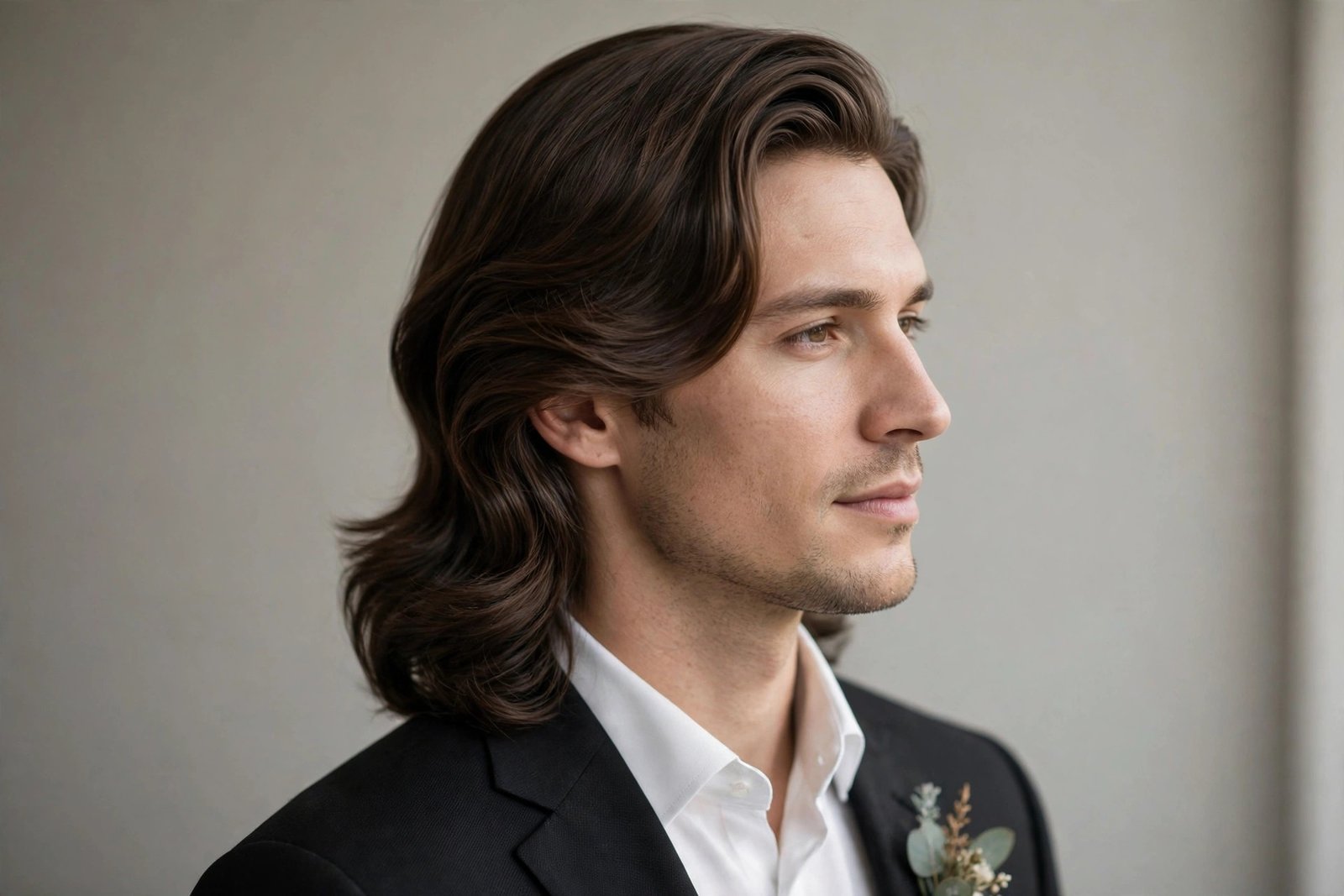
8. 360 Waves
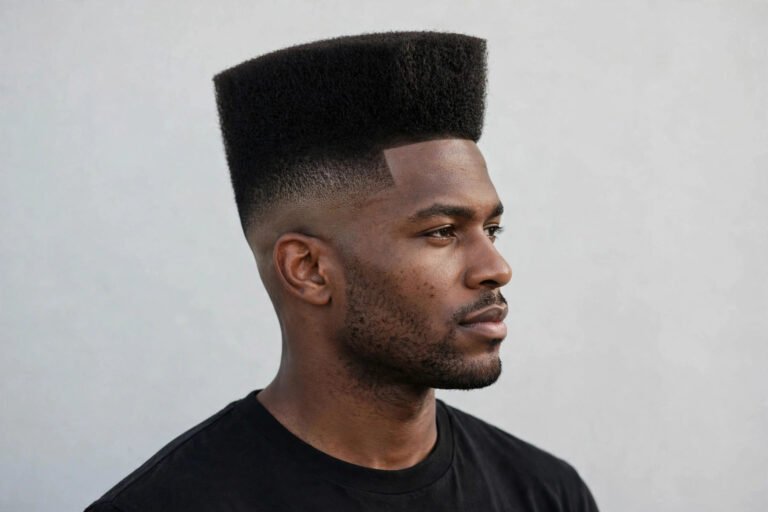
Let me tell you something about 360 waves at a wedding: they are criminally underrated. While everyone else is stressing about whether their style will hold, the groom with dialed-in waves is walking around with hair that is structurally perfect — a full crown of rippling, light-catching waves that look immaculate from every angle the photographer can find. And photographers find a lot of angles. Waves photograph with this incredible depth and shine that straight styles can’t match; in close-ups the texture is mesmerizing, and in wide shots the silhouette is clean and regal. There’s a reason waves have been a staple of formal Black men’s style for generations — they are elegance engineered into the hair itself. If you’ve got the waves, your wedding day is their coronation. Don’t you dare cut them off before the wedding.
Who does it suit? Men with coarse, coily, or wavy hair textures who can form waves — this is a texture-specific style, and that’s its strength. It flatters every face shape because the uniform wave pattern creates a clean, consistent frame. It works at various lengths, from low-cut waves to longer, deeper patterns. The prerequisite is established waves: if you’re starting from scratch, you need months, not weeks — so this section is for the men who already have them or are close. For everyone else, admire from afar and pick another number. Our full guide to 360 waves for men covers the method in depth if you’re building them for a future event.
Barber script: “Cleanup for my wedding — I want my waves sharp. Even it out all around, keep my wave length, line up the hairline and temples crisp, taper the sides and back, clean neckline. Don’t cut into the wave pattern — just sharpen everything around it.” The lineup is where wedding waves are won or lost: a razor-crisp hairline and temple line against deep waves is one of the sharpest looks in all of men’s grooming. Get the cut three to five days before — fresh enough that the lineup is crisp, with a couple of days for the top to settle. And tell your barber it’s for your wedding; a good barber takes that as a personal challenge and will be extra meticulous.
The weeks before matter more than the morning for waves. Keep up your brushing routine religiously — the compression is what keeps the pattern deep and uniform. Moisturize well; hydrated hair has that wedding-day shine, dry hair looks dull in photos. Consider a hot towel treatment or deep condition the week before for maximum luster. On the morning: brush, apply your usual moisturizer and a light pomade for sheen, brush again, lay the durag for twenty minutes while you get dressed, then remove it right before photos. The result: waves so defined they look carved. Pack a soft brush for touch-ups — a quick brush session before portraits takes thirty seconds and restores the pattern completely.
Downsides? Honestly, few — if you have the waves, this is close to the perfect wedding style: indestructible, photogenic, dignified. The main risk is a barber cutting too much and disrupting the pattern right before the day, which is why you go to your barber, not a stranger, and why you say “don’t cut into the pattern” explicitly. Humidity can cause frizz on the edges — a little extra moisturizer and the durag routine handles it. Variations: low waves with a crisp lineup (most formal), longer waves with a taper (more modern), or waves paired with a short, sculpted beard for a full regal effect. This is heritage, precision, and confidence in one style — wear it proudly.
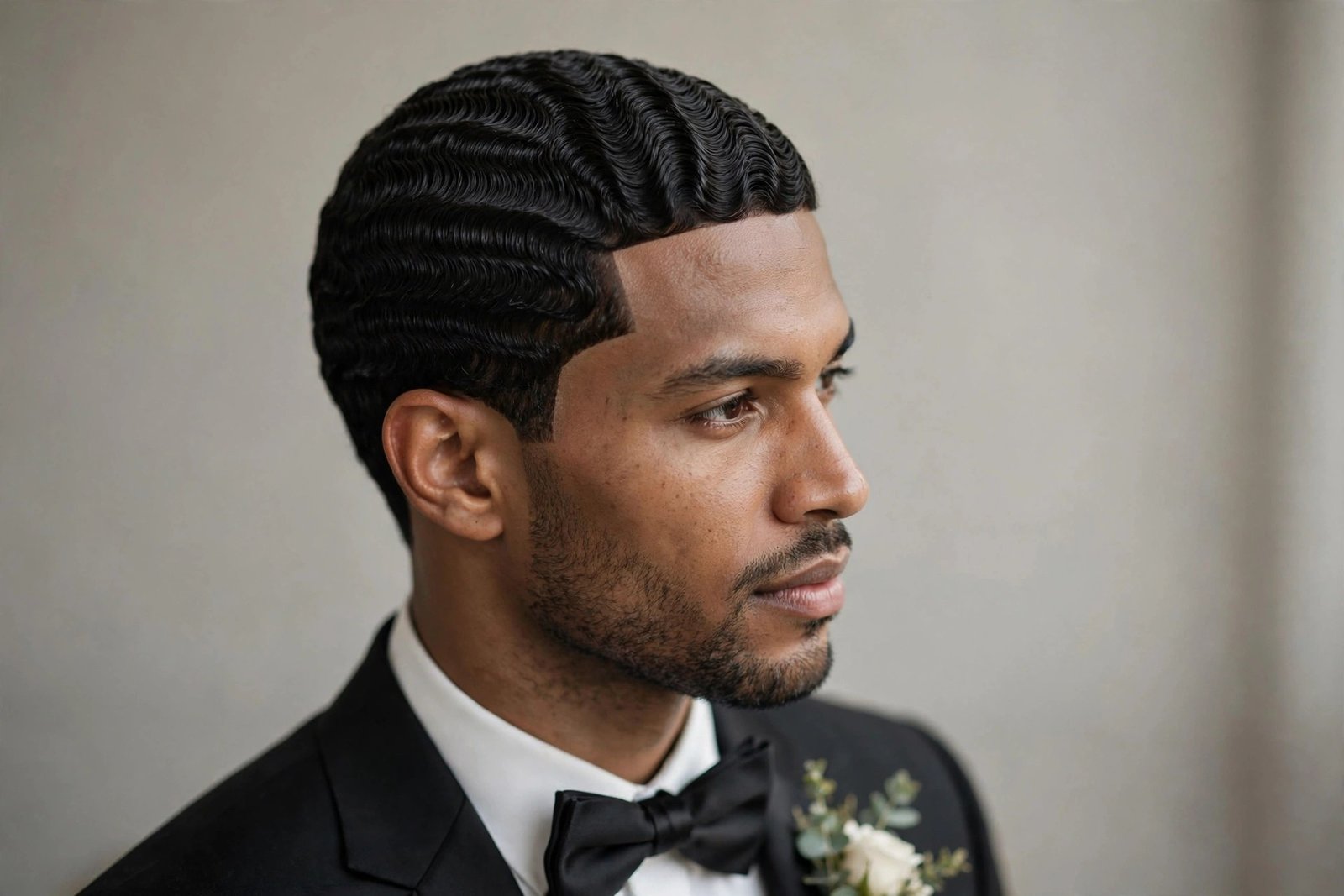
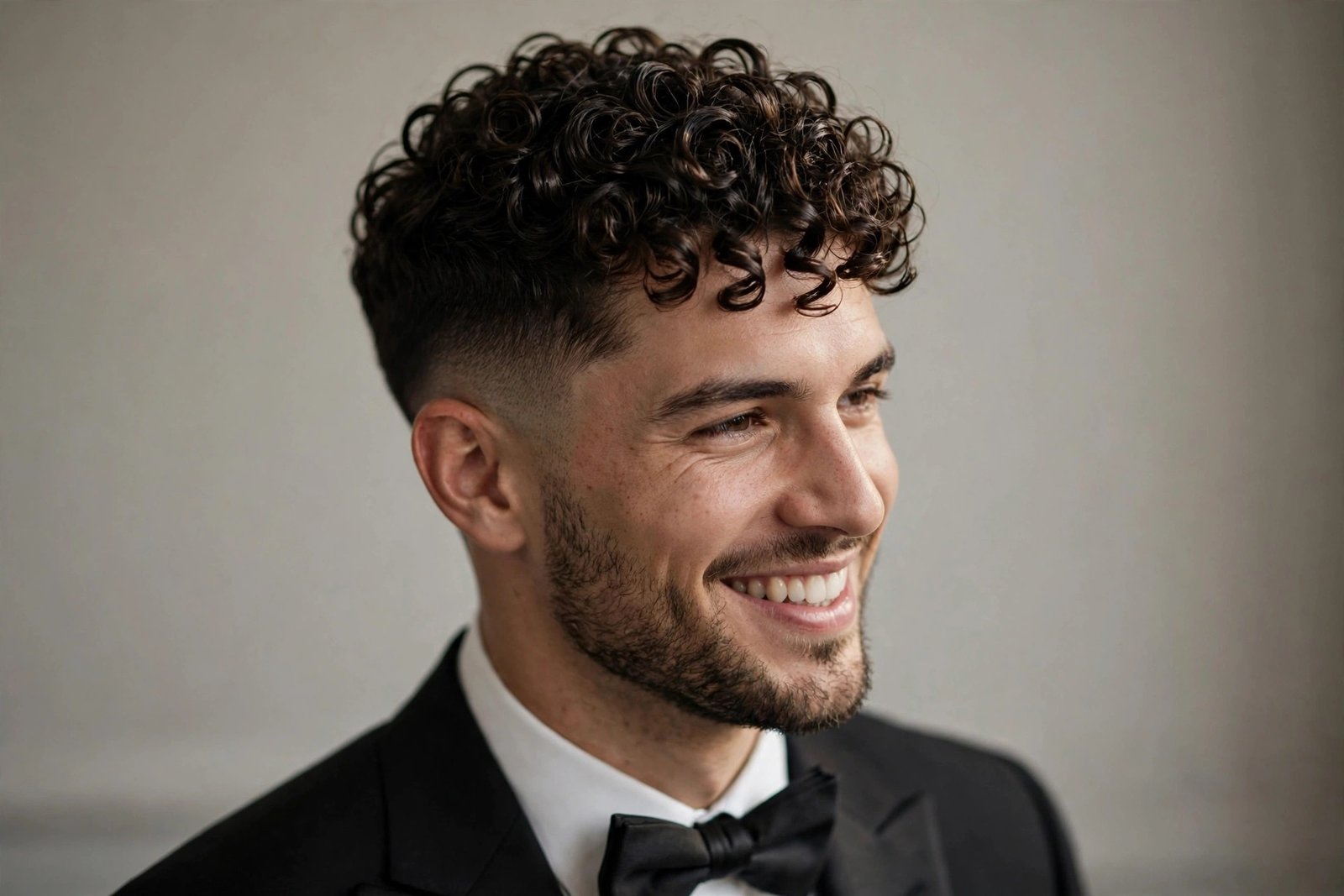
9. The Curly Taper
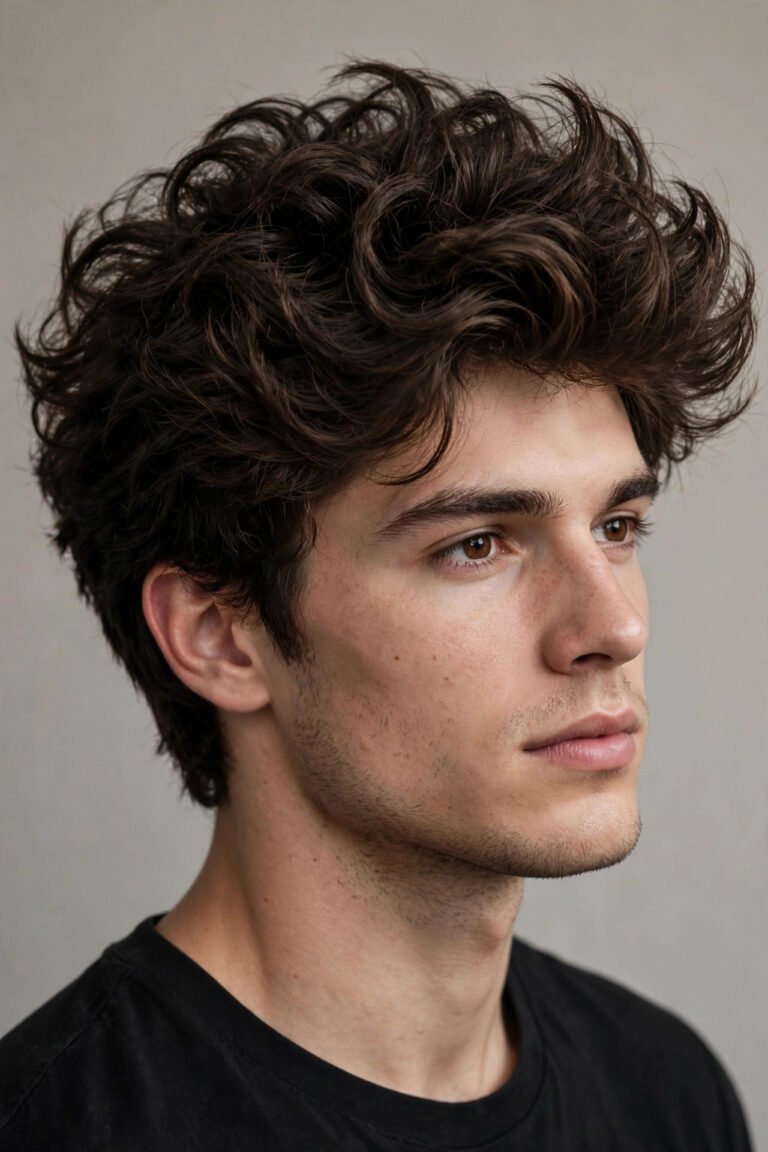
To every curly-haired groom who’s ever been told to “just straighten it for the wedding” — ignore that advice completely. Your curls are not a problem to solve; they’re the best thing about your hair, and a wedding is exactly the occasion to show them off properly. The curly taper is the answer: defined, celebrated curls on top with clean tapered sides that give the whole thing structure and intention. It’s the difference between “nice curls” and “that groom’s hair was incredible.” In 2026, texture is celebrated, not suppressed, and wedding photography loves curls — they create natural highlights and shadows, they have movement in every frame, and they give your portraits a warmth and personality that straight styles work hard to fake. I’ve seen curly grooms steal the show, and the secret was never fighting their hair. It was finally letting it do its thing, properly shaped.
Who does it suit? Men with naturally curly or coily hair — from loose waves to tight coils, the principle is the same: shape, don’t suppress. It flatters round faces (height on top lengthens), softens square faces (the texture breaks up angles), and suits oval faces effortlessly. The taper keeps the silhouette neat, which is what makes it wedding-appropriate rather than everyday-casual. Length on top depends on your curl type: enough that the curls can form their proper shape, usually two to four inches. The honest requirement: your curls need to be healthy. Dry, damaged curls frizz instead of defining, so the pre-wedding conditioning routine in the section below isn’t optional for you — it’s the whole game.
Barber script: “Curly taper for my wedding. Keep the curls on top — I want them defined and shaped, not thinned into frizz. Taper the sides and back tight and clean, blended up into the curls with no harsh line. Shape the top so the curls sit well — take length where it’s heavy but keep the curl pattern intact. Find me a barber who actually knows curly hair” — okay, that last part you say to yourself, not the barber, but it’s the most important line here. Curly hair cut dry, curl by curl, by someone who understands it, versus curly hair attacked wet with clippers by a generalist — these are different universes. Ask around, check portfolios, find the curl specialist. Your wedding is worth the search. Cut timing: one to two weeks before, because curly cuts need a few days for the curls to settle into their shaped pattern.
Styling on the morning is about definition, not control. On damp hair, apply a curl cream generously — rake it through, then scrunch upward to encourage the curl formation. If you diffuse, do it on low heat, hovering rather than blasting, until about 80% dry, then let the rest air-dry. A tiny amount of light oil on the ends adds shine and fights frizz. Then — and this is the hard part — don’t touch it. Every touch breaks up curls and invites frizz. Let it set. The tapered sides need nothing except maybe a smoothing pass. Total time: fifteen minutes plus drying. The result should look touchable and alive, each curl doing its own beautiful thing within a clean silhouette. Bring a travel curl cream for emergencies, but if the cut and condition are right, you won’t need it.
Honest downsides: humidity is the ancient enemy of curls, and an outdoor summer wedding is the boss fight. Anti-humidity curl products exist and work — test them beforehand. Wind can also disturb the definition, though the taper keeps the overall shape intact even if individual curls move. And if your curls are very tight, achieving a “defined but soft” wedding look takes a stylist who knows the texture — budget for that expertise. Variations: the curly top with a low fade (more modern edge), longer curls with just tapered sides (romantic, great for garden weddings), or a defined curl with a sharp lineup for maximum polish. Your texture is the feature — build the wedding look around it, not against it.
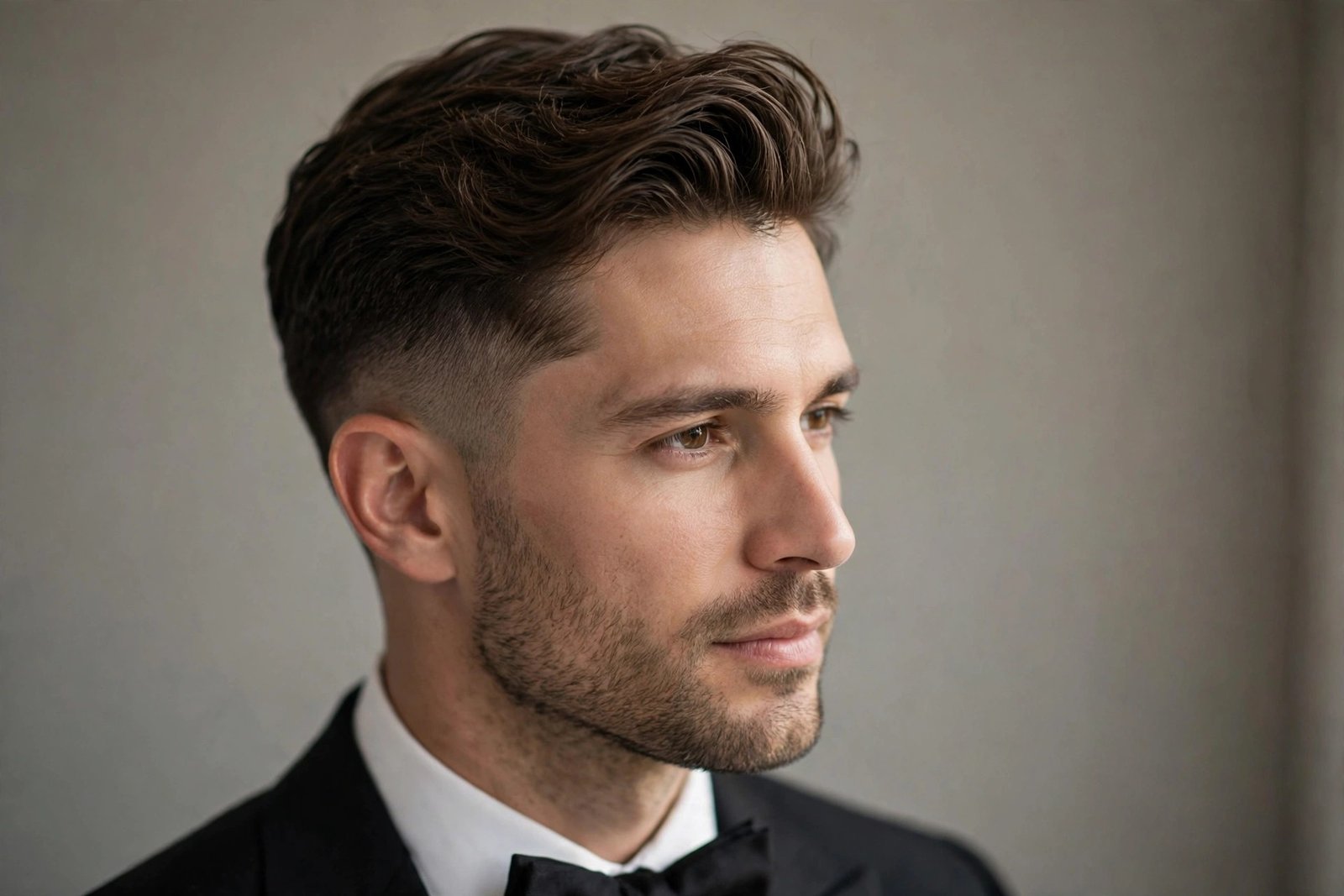
10. The Modern Comb Over
The comb over has a PR problem, and it’s completely unfair. When people hear “comb over,” they picture something sad and desperate — but the modern comb over is a different animal entirely. This is a deliberate, stylish sweep of length across the top with faded sides, worn with confidence by men who know exactly what they’re doing. Think of it as the side part’s bolder sibling: more length, more sweep, more presence. In 2026 it’s a legitimate wedding contender, especially for grooms who want coverage and polish without the stiffness of more sculpted styles. The modern version works with thinning hair rather than hiding it — the sweep creates the illusion of density, the fade keeps everything else crisp, and the overall effect is a man who looks like he owns the room. Which, on your wedding day, you do.
Who does it suit? Men with mild to moderate thinning on top — this is genuinely one of the kindest styles for it, because the directional sweep covers more scalp than hair worn any other way. It also suits men with fine hair in general, since the fade on the sides creates contrast that makes the top look fuller. Straight and wavy hair work best; the sweep needs hair that lies in a direction. Face-wise it’s versatile — the asymmetry flatters round faces, the neatness sharpens everything else. What it doesn’t suit: advanced hair loss where there’s simply not enough to sweep. Be honest with yourself here — the modern comb over is confident, not delusional. If the sweep can’t cover it, a sharp buzz or short crop worn with total confidence beats a struggling comb over every time.
Barber script: “Modern comb over for my wedding. I want enough length on top to sweep across — don’t take too much off up there. Skin or mid fade on the sides, blended up cleanly. The top should be textured so the sweep has grip and doesn’t look flat. Shape it so it sweeps naturally from my part.” The critical instruction is “don’t take too much off the top” — an overzealous barber can remove the very length the style depends on. If you’re dealing with thinning, also ask: “cut it in a way that maximizes coverage.” Good barbers know exactly what this means — longer, layered top, no harsh weight lines. Timing: five to seven days before. You want the fade fresh but the top settled.
Styling: the secret weapon here is a thickening pre-styler or volumizing mousse applied to damp hair at the roots — it gives fine hair the grip and body the sweep needs. Blow-dry in the direction of the sweep (this trains the hair and builds volume simultaneously), then apply a matte-finish clay or fiber — matte, not shiny, because shine on thinning hair highlights scalp. Sweep across with fingers for a natural finish or a comb for more polish. A light hairspray holds it without stiffness. Ten minutes. The touch-up kit matters here: a travel-size thickening spray or even a little hair fiber product can rescue the look before evening portraits if needed — keep it in the groomsmen’s emergency bag, not your pocket.
Downsides, honestly stated: wind is the nemesis — a strong gust can undo the sweep and there’s no way to be subtle about fixing it, so outdoor weddings need the strong-hold version and realistic expectations. It also requires the most honest self-assessment on this list; worn past the point your hair supports, it stops looking intentional. But worn within its limits, it’s sharp, dignified, and quietly confident. Variations: the textured comb over (choppier, more modern), the low-sheen polished version for evening formality, or pairing with a short beard — facial hair plus neat swept top is a combination that reads as deliberate and masculine in photos. Confidence makes this style; the cut just gives confidence something to stand on.
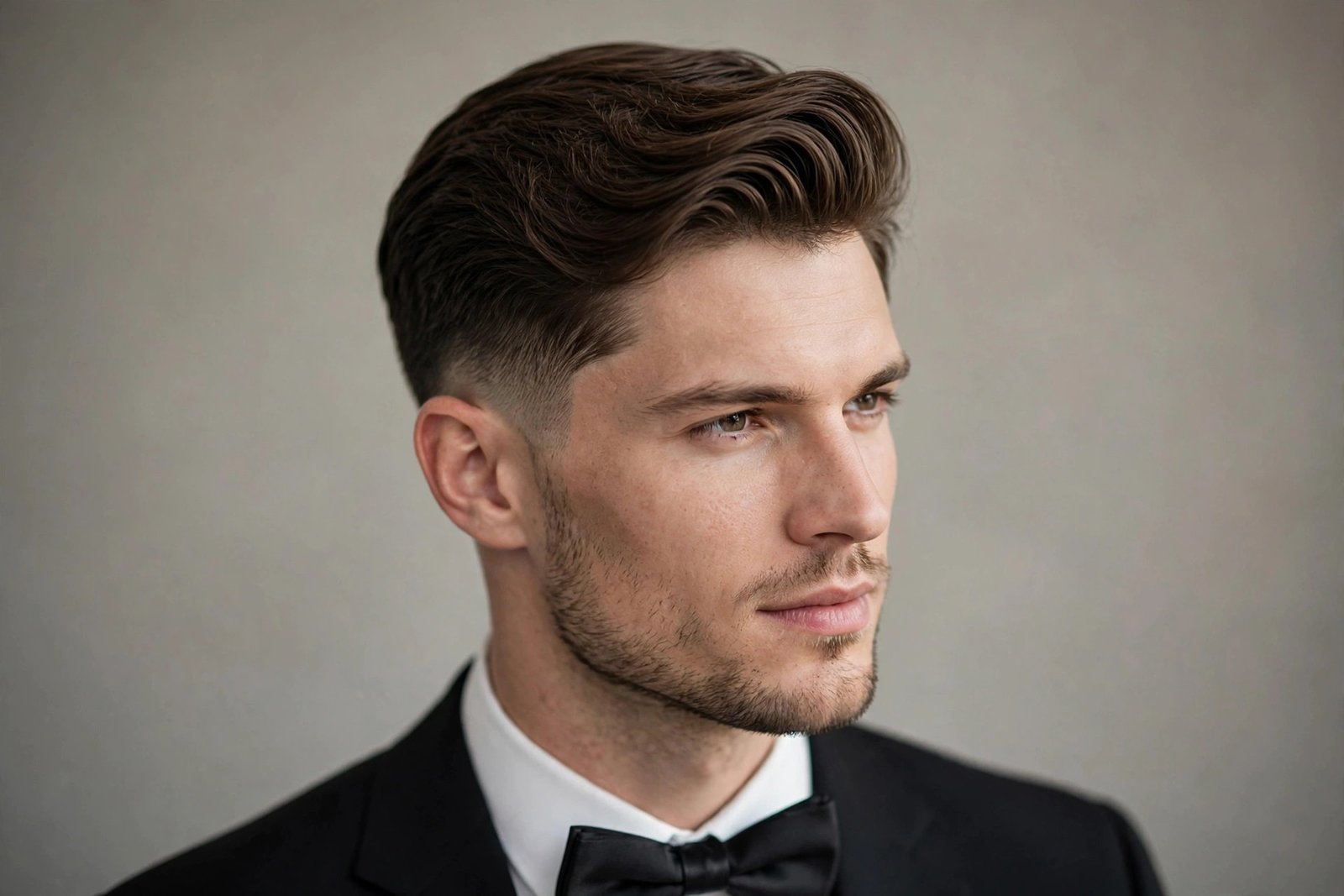
11. The Low Fade with Brushed-Back Top
Some grooms want it all: the clean modern edge of a fade, the timeless polish of hair worn back, and a style that doesn’t scream for attention but absolutely holds its own in photographs. The low fade with a brushed-back top is that compromise, and it’s a brilliant one. The low fade keeps the sides immaculate without the drama of a high skin fade — the blend starts low, near the ears, so the overall effect is neat rather than aggressive. The top, meanwhile, gets brushed back with natural texture: not slicked into submission like the full slick back, just guided backward with enough freedom to look alive. It’s the difference between a tuxedo and a perfectly tailored suit — both formal, but one of them breathes. In 2026, this “controlled natural” zone is where a huge number of stylish grooms are landing.
Who does it suit? Men who like fades but want wedding elegance rather than streetwear edge. It flatters oval, square, and heart-shaped faces; the brushed-back top adds height that benefits round faces too. Straight, wavy, and loose-curly hair all work — the brushing-back technique adapts to texture. You want three to five inches on top. It’s particularly good for thick hair, because the low fade removes bulk exactly where thick hair gets unruly (the sides), while the top keeps the glorious volume. Fine-haired grooms can wear it too, but need volumizing product to keep the brushed-back top from lying flat and exposing scalp.
Barber script: “Low fade with a brushed-back top for my wedding. Keep the fade low and soft — I want it clean, not aggressive, blended naturally. Four inches on top, textured, cut to fall back naturally. No hard part, no disconnect — everything flows. Wedding-sharp but not severe.” The “not severe” matters: you’re drawing a line between this and the harsher fade styles. A good barber will understand immediately. Timing: three to five days before — low fades look best fresh, and the top needs just a day or two to relax.
Styling is the easiest “dressed-up” routine on this list. Damp hair, light-hold cream or sea-salt spray for texture, blow-dry backward with your fingers — no brush needed, fingers give the natural finish this style wants. A small amount of matte paste worked through the ends adds definition without stiffness. The sides just get smoothed. Twelve minutes, and the result looks like you were born with great hair and a tailor. It holds well because there’s no extreme shape to maintain — the fade keeps the silhouette, the top just needs to stay generally backward. One comb-through before portraits and you’re golden all night.
The honest downside: it’s a middle-of-the-road choice, and middle-of-the-road is both its strength and its limit. It won’t photograph as dramatically as a pomp or as strikingly as waves — it’s handsome, not headlining. If your wedding style is “quiet luxury,” that’s perfect. If you wanted jaws to drop, keep reading. It also needs the fade maintained — by week two it’s a different, softer haircut, so honeymoon photos will show the relaxed version. Variations: a textured crop-top version for younger grooms, slightly more length on top for a romantic brush-back, or a mid fade instead of low for a touch more edge. It’s the safe choice that doesn’t look safe — and there’s real wisdom in that.
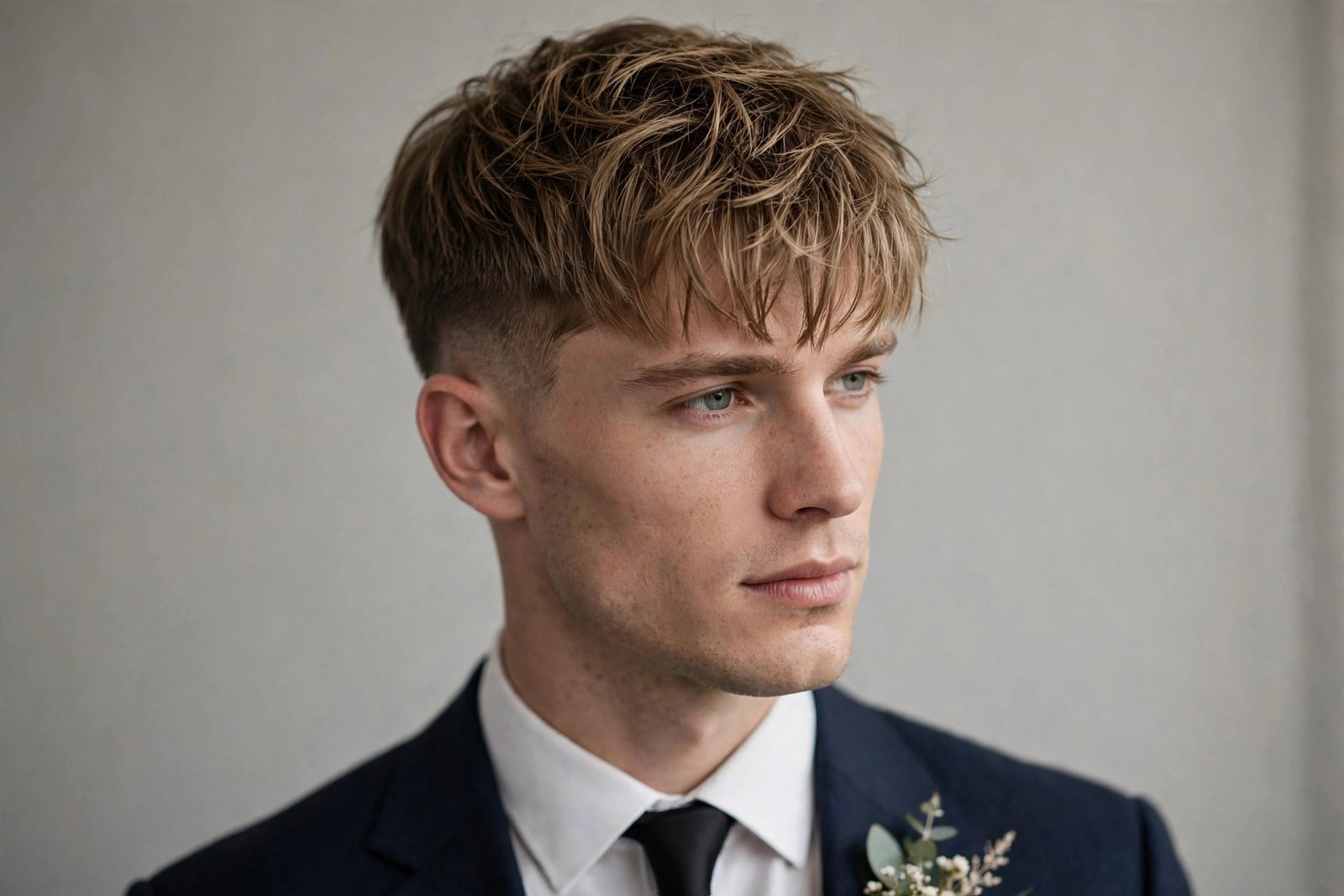
12. The Gentleman’s Crop
The gentleman’s crop — a refined, slightly longer French crop with a soft textured fringe — is the dark horse of 2026 wedding hair, and I’m including it because the grooms who wear it look fantastic. Here’s the idea: short, neat sides (tapered, not necessarily faded), with a textured top worn forward into a soft, piecey fringe. It’s youthful without being boyish, sharp without being severe, and it has this wonderful European insouciance that photographs beautifully — think of the best-dressed man at a Milan wedding. What makes it wedding-worthy is the neatness: the taper is crisp, the fringe is deliberate, the texture is controlled. It reads as fashion-forward rather than casual, which is exactly the line a modern groom wants to walk. And practically? The forward fringe is incredibly forgiving — it doesn’t depend on staying perfectly in place, because “artfully textured” is the whole aesthetic.
Who does it suit? Men with straight to wavy hair — the fringe needs hair that falls forward naturally. It’s excellent for men with larger foreheads (the fringe does beautiful camouflage work), and it flatters oval, oblong, and heart-shaped faces by adding horizontal interest that balances length. Round faces: keep the fringe textured and piecey rather than heavy and straight across, or it can widen the face. Thick hair is ideal; the weight helps the fringe sit. Fine hair can work with texturizing product. Length: two to three inches on top, long enough to bring forward with texture. It’s also a strong choice for younger grooms who want to look their age — sharp, not prematurely stuffy.
Barber script: “Gentleman’s crop for my wedding — like a refined French crop. Textured top, about two and a half inches, worn forward into a soft fringe — piecey, not blunt. Taper the sides naturally, clean around the ears. I want it sharp and deliberate, not messy — wedding version, not weekend version.” That last distinction is crucial, because the crop lives on a spectrum from “artfully undone” to “precise,” and you want the precise end for the ceremony. Ask the barber to point-cut the fringe so it has soft, separated ends rather than a hard line. Timing: five to seven days before — crops settle beautifully with a few days of growth, and the fringe falls more naturally once it’s not freshly cut.
Styling takes eight minutes and rewards a light hand. On damp hair, a small amount of matte texture cream or sea-salt spray, then push everything forward with your fingers while blow-drying on low — or just let it air-dry if your hair cooperates. Once dry, work a tiny bit of clay through the fringe pieces, pulling them slightly apart for definition. The sides get smoothed down. The golden rule: less product, more texture. Over-styled crops look fussy; the charm is in the controlled ease. It holds all day because there’s no height to collapse and no sweep to disturb — gravity is doing the styling for you. Touch-ups: none needed, honestly. Maybe a finger-comb before photos.
Downsides: the formality ceiling is real — at a very traditional or black-tie wedding, a forward fringe can read as too casual next to morning coats and top hats. Know your dress code. It’s also not ideal for very curly hair, where a forward fringe becomes a different style entirely (curly grooms: your texture-forward version exists, but it’s its own thing — see number nine). And if you’ve never worn a fringe, the wedding week is a leap — do the trial run a month out and live with it for a week. Variations: the longer textured crop (more fringe, more fashion), the crop with a low taper fade (sharper sides, more contrast), or the side-swept crop (fringe angled to one side — slightly more formal, slightly less edgy). For the modern groom, it’s a quiet triumph.
13. The Formal Top Knot
Long-haired grooms, this one’s for you — and everyone else, don’t skip this section, because the formal top knot done right is one of the most striking wedding looks a man can wear. I’m not talking about the gym top knot or the weekend warrior knot. The formal top knot is slicked, sculpted, and deliberate: hair pulled back smooth and tight into a neat knot at the crown, sides immaculate, the whole thing reading as ceremonial rather than casual. There’s a long, noble history here — the top knot has signified discipline and status in cultures from samurai Japan to Sikh tradition — and that gravity translates beautifully to a wedding. It keeps long hair completely controlled (no strands in your face during the vows, no wind chaos in outdoor photos), shows off the jawline and the suit’s neckline, and photographs with incredible clean lines. A groom with a sharp formal knot and a tailored suit looks like he stepped out of an editorial shoot.
Who does it suit? Men with long hair — you need at least six to eight inches to gather a proper knot, more for a fuller one. It flatters strong jawlines and defined bone structure, since everything is pulled back and the face is fully exposed. Oval and square faces are the natural home; round faces can work it if the knot sits high (height on top lengthens). It’s excellent for thick hair — the density makes a substantial, handsome knot. Fine long hair can work but the knot will be smaller; a little texturizing helps. The honest gate is commitment: if you’ve been growing your hair for the wedding, this is its moment. If you’re thinking of growing it out for the wedding, you needed to start a year ago.
Barber script: “Cleanup for my wedding — I’m wearing a formal top knot. Tidy the sides and back, clean up the hairline and neckline, trim any split ends but keep all the length. I need the hair healthy enough to pull back smooth — take off what’s damaged.” If your sides are significantly shorter than the top (an undercut grow-out, say), discuss whether to trim them to a consistent neat length or keep the contrast — both work, but the wedding version should look intentional. Timing: one to two weeks before for the trim; the hair should be settled, not freshly cut and flyaway. Deep-condition in the final week — smooth, healthy hair is non-negotiable for this style.
Styling on the morning: on damp hair, apply a smoothing cream or light gel from roots through the lengths — you want sleek, not crunchy. Comb everything straight back tightly and smoothly, gathering at the crown (not too low — a low knot reads casual; crown height reads formal). Twist into a knot and secure with a hair tie that matches your hair color, then pin any strays. Smooth the hairline with a touch more product and a fine-tooth comb or a soft brush. A veil of strong-hold hairspray locks it. Fifteen minutes. The result should look sculpted — every strand in place, the knot neat and compact. Assign someone to carry bobby pins and a small brush; if a strand escapes during the day, it takes ten seconds to fix.
Downsides: tension headaches are real if it’s pulled too tight — tell whoever styles it that “secure” doesn’t mean “painful,” because a headache on your wedding day is a disaster. It’s also unforgiving of unhealthy hair: split ends and frizz show mercilessly when everything’s pulled back, so the pre-wedding hair health routine is mandatory. And like the slick back, it exposes the full face and hairline — confidence required. Variations: the low formal bun at the nape (softer, very elegant — arguably more wedding-traditional), the half-up knot (top section knotted, rest flowing — romantic and striking), or the knot paired with a short, groomed beard for a powerful complete look. For the long-haired groom, this is how you honor the length on the biggest day.
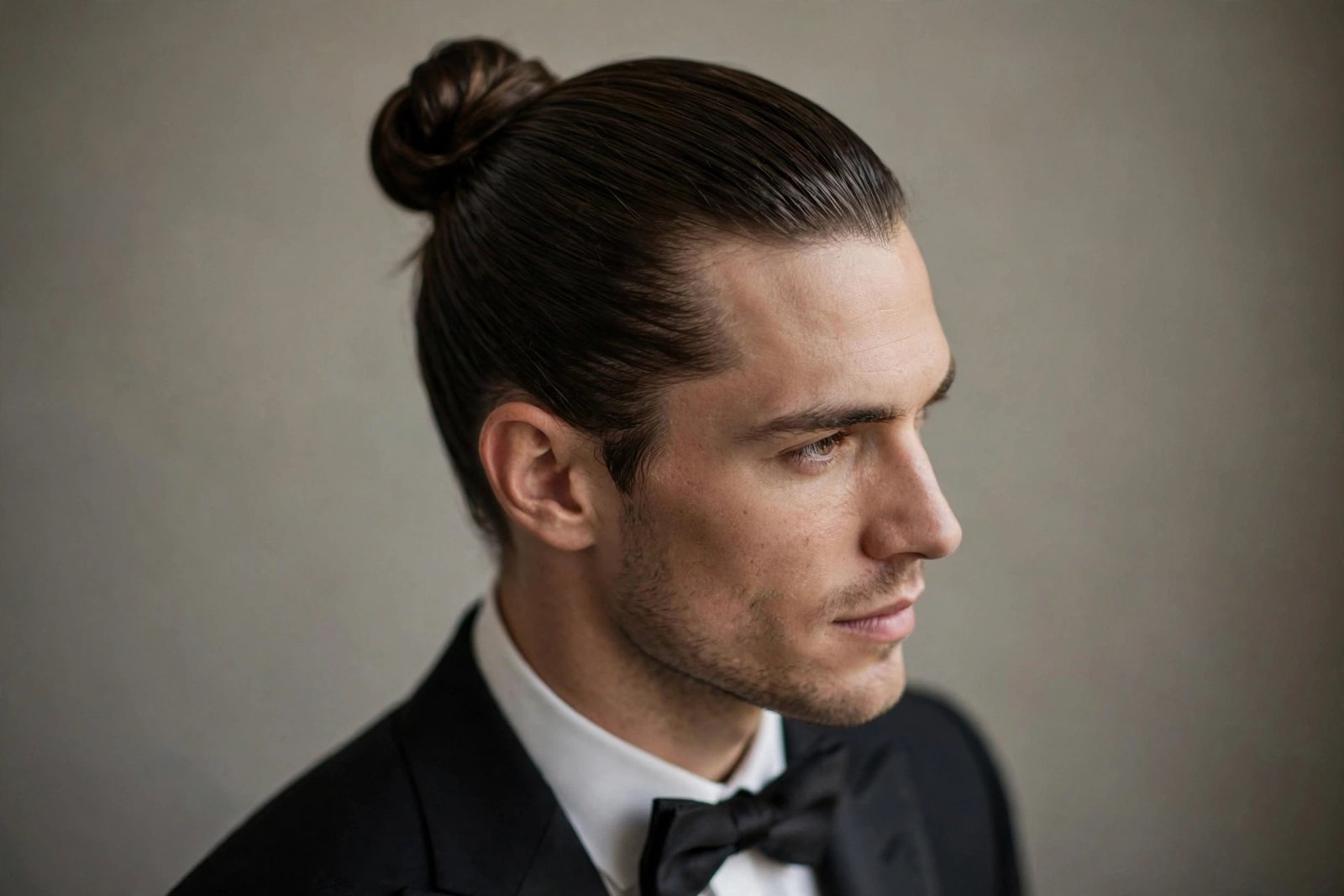
14. The Shoulder-Length Slick
There’s a specific kind of groom who walks into his wedding with shoulder-length hair slicked back and absolutely owns the room — and in 2026, more grooms are discovering this power. The shoulder-length slick is pure confidence: long hair, tamed into a smooth, controlled sweep back, radiating this wonderful old-world-meets-modern energy. It works because of the contrast — the length says free spirit, the slickness says discipline, and together they say a man who contains multitudes. In photographs it’s magnificent: the long lines of the hair create beautiful shapes in motion shots, the controlled top keeps portraits clean and formal, and in black and white it has this timeless, almost cinematic quality. This is not a style for the hesitant. It’s for the man who’s been growing his hair for years and refuses to cut it for anyone — including, gloriously, his wedding.
Who does it suit? Men with long, straight to wavy hair — shoulder length or beyond. It flatters oval and oblong faces particularly well (the length balances longer faces beautifully), suits square jaws by softening them, and gives thin faces welcome fullness at the sides. Thick hair is the dream here; the weight helps it lie smooth. Fine long hair can work but needs smoothing product and may need the sides tucked to look intentional rather than wispy. The hair must be healthy — at this length, damage is visible from across the room, so the months of conditioning beforehand are part of the style, not optional extras. And you need the personality for it: this style gets noticed, commented on, remembered. If you want to blend in, this isn’t your cut.
Barber script: “Trim for my wedding — I’m wearing it slicked back. Keep all the length, just clean up the ends, take off anything split or damaged, and shape it so it falls back evenly. Tidy around the ears and the hairline. The goal is healthy, even, intentional long hair.” Bring it in for this trim two to three weeks before — long hair needs time to settle after a cut, and freshly cut ends can look blunt and artificial when slicked. In the final week, deep-condition twice. On the day before, some long-haired grooms do a clear gloss treatment for extra shine in photos — it’s subtle, it washes out, and the camera loves it.
Styling: on damp hair, work a smoothing cream or light-hold gel through from mid-lengths to ends — the goal is sleek control without wet-look crunch (unless you’re going full wet-look, see number sixteen). Comb everything straight back with a wide-tooth comb, then refine with a denser comb for smoothness. If your hair has wave you want to suppress, a blow dryer with a paddle brush, directed backward, tames it. Tuck the sides neatly behind the ears or let them fall — behind the ears reads more formal, loose reads more romantic. A light shine spray finishes it. Fifteen minutes. The emergency kit: a small brush and smoothing cream, because long hair plus a day of hugging equals some maintenance. But the style is forgiving — even slightly loosened, it looks intentional.
Downsides: wind, obviously — long hair and outdoor ceremonies are a negotiation, so have a backup plan (the formal knot from number thirteen is the perfect plan B using the same length). It also demands the most pre-wedding hair care on this list; there’s nowhere to hide damage at this length. And the formality question: at ultra-traditional weddings, very long hair on a groom still raises eyebrows in some families — know your audience, and if grandma might faint, the slicked control goes a long way toward winning her over. Variations: the half-slick (top slicked, ends left natural), center-parted long hair tucked behind ears (beautiful for bohemian weddings), or adding subtle lowlights for dimension in photos. Worn with conviction, it’s unforgettable.
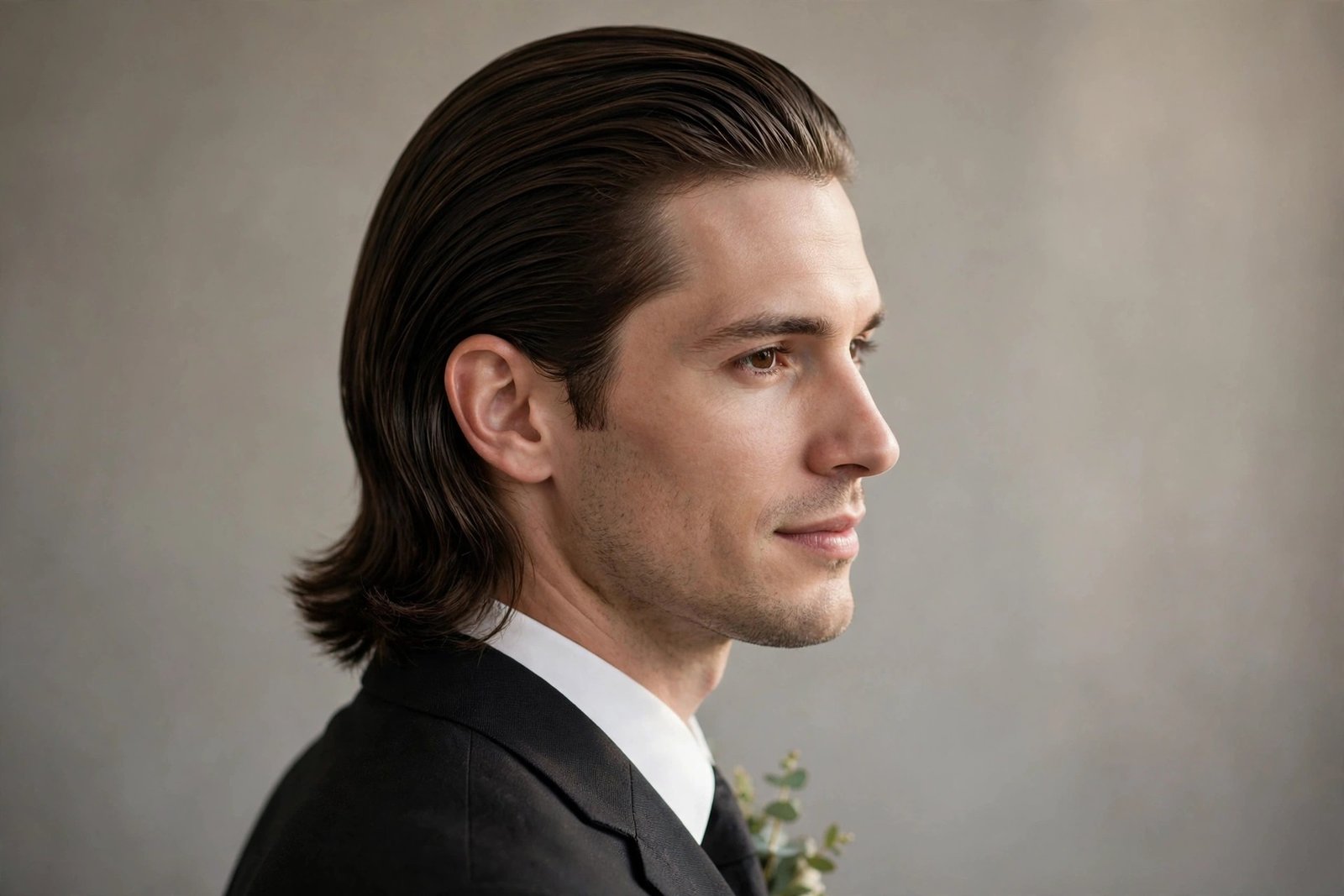
15. The Distinguished Silver Fox
Let’s address the grooms with grey hair directly, because the internet’s wedding hair advice pretends you don’t exist, and that’s absurd. Grey hair at a wedding isn’t something to apologize for or dye away in a panic — it’s a feature. A well-cut head of silver or salt-and-pepper hair on a groom is one of the most distinguished sights in all of weddings. It photographs with this incredible luminosity — grey hair catches light like nothing else — and it carries an authority and elegance that no twenty-five-year-old can fake. In 2026, the silver fox groom is having a full moment: barbers report more grooms embracing the grey than ever, and honestly, the confidence of walking down the aisle exactly as you are is the most attractive thing a groom can wear. Your partner is marrying you, silver and all. Own it.
Who does it suit? Men with grey, silver, or salt-and-pepper hair — whether it’s fully silver or just distinguished at the temples. It flatters every face shape; the styling principles are the same as any classic cut, just executed on grey hair. The key insight: grey hair has different texture — it’s often coarser, drier, and more wiry than pigmented hair, so it needs more moisture and a slightly different product approach. It also yellows with sun exposure, smoke, and some products, which dulls that beautiful silver — purple or silver-enhancing shampoo in the weeks before the wedding keeps it bright and luminous. This isn’t vanity; it’s maintenance, like polishing silver. Which, come to think of it, is exactly what it is.
Barber script: “Classic wedding cut on my grey hair — I want it sharp and distinguished. Side part (or slick back, or taper — pick your favorite from this list), neat taper on the sides, clean neckline and around the ears. And be honest with me about the texture — grey hair does what it wants, so cut it to work with the coarseness, not against it.” The texture conversation matters: wiry grey hair cut too short can stand up unpredictably; a skilled barber leaves enough length to control it. Timing: one week before, with a silver-brightening shampoo used two or three times in the final fortnight. If you color your hair, do not change your color routine right before the wedding — a color mishap two weeks out is a nightmare. Whatever you’ve been doing, keep doing it.
Styling: moisture first, always. On damp hair, a nourishing cream — grey hair drinks product, so don’t be shy. Then style as your chosen cut demands: side part, sweep, slick. A touch more product than you’d think, because coarse hair needs the control. Finish with a light shine spray — grey hair with shine looks like polished steel; grey hair matte can look dull in photos. Ten minutes. The touch-up kit: a small comb and travel cream. Grey hair holds style well once set (the coarseness is actually an advantage here — it’s stubborn in your favor), so you’ll likely need just one check before portraits.
Downsides: there really aren’t style downsides — the only “downside” is other people’s nonsense about grey hair, which you should ignore completely. Practically speaking, the yellowing issue is real but manageable with the right shampoo, and the coarseness means you can’t skip conditioning. One genuine consideration: if you’re on the fence about embracing it versus coloring, decide months out, not weeks. A last-minute dye job that goes wrong is far worse than confident silver. Variations: the silver side part (timeless), the silver slick back (commanding), the silver textured crop (modern and sharp), or salt-and-pepper with a short groomed beard — the beard-plus-silver combination is devastatingly handsome in wedding portraits. Distinguished isn’t a consolation prize. It’s the prize.
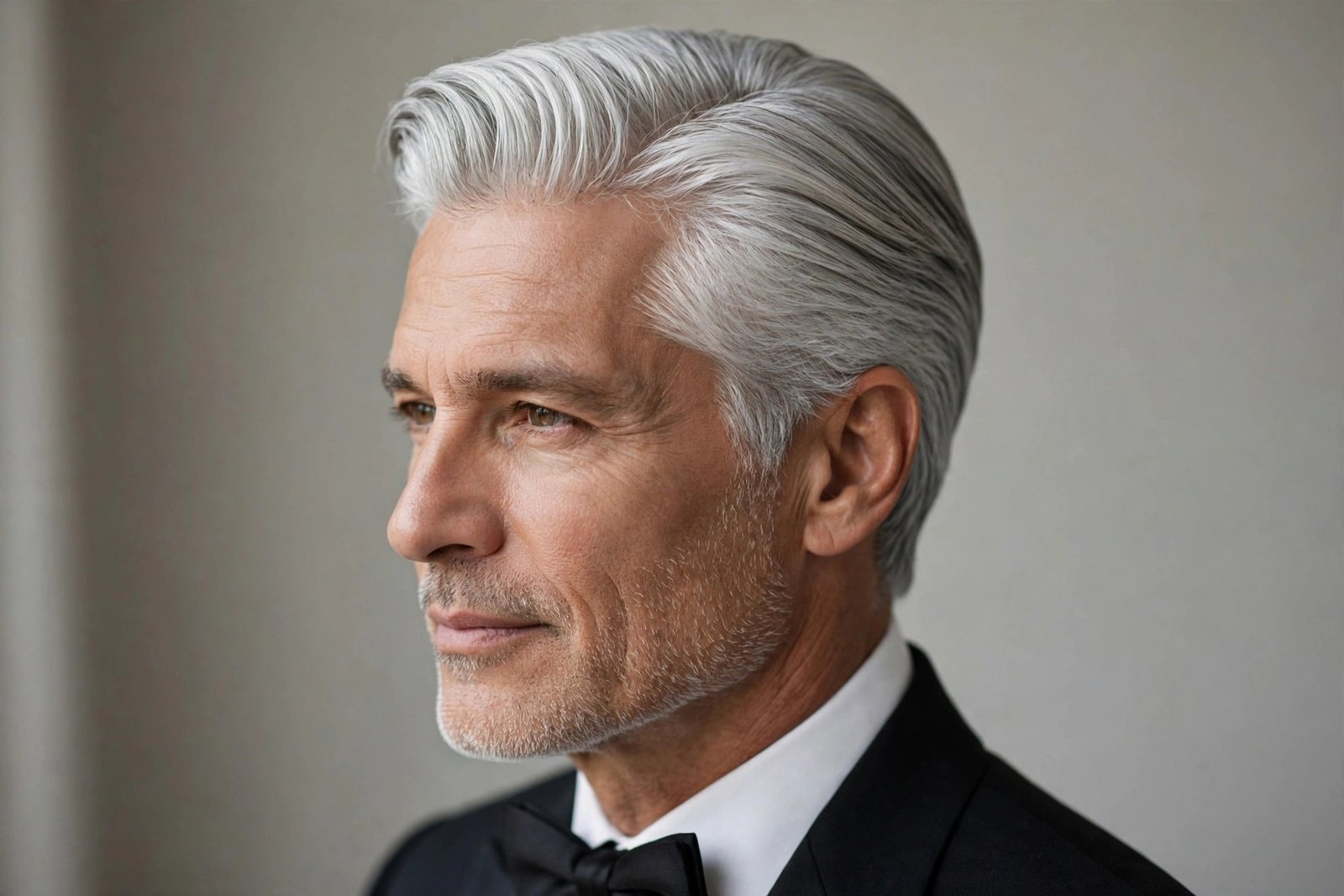
16. The High-Shine Wet Look
We end with the boldest finish on the list — the high-shine wet look. This is hair worn deliberately glossy, sculpted with shine the way others are sculpted with texture: combed back or to the side with a mirror-like finish that catches every light in the room. In 2026 it’s the choice of fashion-forward grooms, evening weddings, and men who understand that shine, done right, reads as luxury. There’s a reason luxury brands use gloss in every campaign — shine signals richness, intention, polish. On a groom in a dark suit under evening lights, the wet look is pure cinema. But I’ll be blunt: this is the highest-risk, highest-reward style here. Done right, it’s unforgettable. Done wrong — too much product, wrong hair type, daytime outdoor wedding — it reads as greasy, and there’s no coming back from that in photos.
Who does it suit? Men with thick, straight to wavy hair that can hold a sleek shape — the shine needs a smooth canvas, so very curly or frizzy hair fights it. It flatters strong features and works on oval, square, and heart-shaped faces. You need decent length on top (three to five inches) to create the sculpted shape. It’s best for evening and indoor weddings — candlelight, ballroom lighting, city rooftops at night. That’s when shine looks like luxury. In harsh midday sun, the same shine can look sweaty, so daytime outdoor weddings should skip this one unless you’re fully committed and your photographer knows how to light it. Know the venue, know the light.
Barber script: “I’m going for a high-shine wet look for my evening wedding. I need the top cut to lie smooth — minimal texture, clean lines, enough length to sculpt back or to the side. Taper the sides tight and clean. The cut needs to support a glossy finish — no choppy layers that’ll break up the shine.” The cut matters more than people think: texture-cut ends scatter light and kill the mirror effect, so ask for clean, blended lines on top. Timing: five to seven days before — you want the top settled and smooth, the sides crisp. And do a full trial run with the actual products, in the evening, in similar lighting. This is the one style where the trial isn’t optional — it’s the whole ballgame.
Styling is product science. On damp hair, apply a shine-enhancing pomade or wet-look gel generously and evenly — the evenness is everything; patchy application is what separates “luxurious” from “oily.” Comb into your chosen shape (straight back or side-swept) with a fine-tooth comb for maximum smoothness. Some grooms layer: a cream base for control, then a gloss pomade on top for the mirror finish. Set with a shine-finish hairspray. Fifteen minutes. The critical skill is quantity — start with less than you think, build up. You can always add; removing excess product on a wedding morning is a crisis. Pack blotting papers and a comb for touch-ups: if shine tips into grease by evening, a quick blot restores the luxury without a restyle.
The honest downsides, all of them: it’s the least forgiving style here. Too much product, wrong lighting, humidity, touching it with your hands — any of these can tip it from deliberate to unfortunate, and it’s hard to fix mid-day without starting over. It transfers: shine product on your partner’s dress during the first dance is a real hazard, so keep the sides (where contact happens) lighter on product. It also photographs as “a lot” — in a big bright album, the glossiest head in every photo can dominate. But for the right groom — evening wedding, right hair, trial run nailed — it’s the most striking finish available. Variations: the side-parted wet look (slightly more classic), the textured wet look (shine plus piecey texture — more modern, slightly more forgiving), or the wet-look fade (gloss top, matte faded sides — the contrast is gorgeous). Bold, luminous, unapologetic — if that’s you, this is your style.
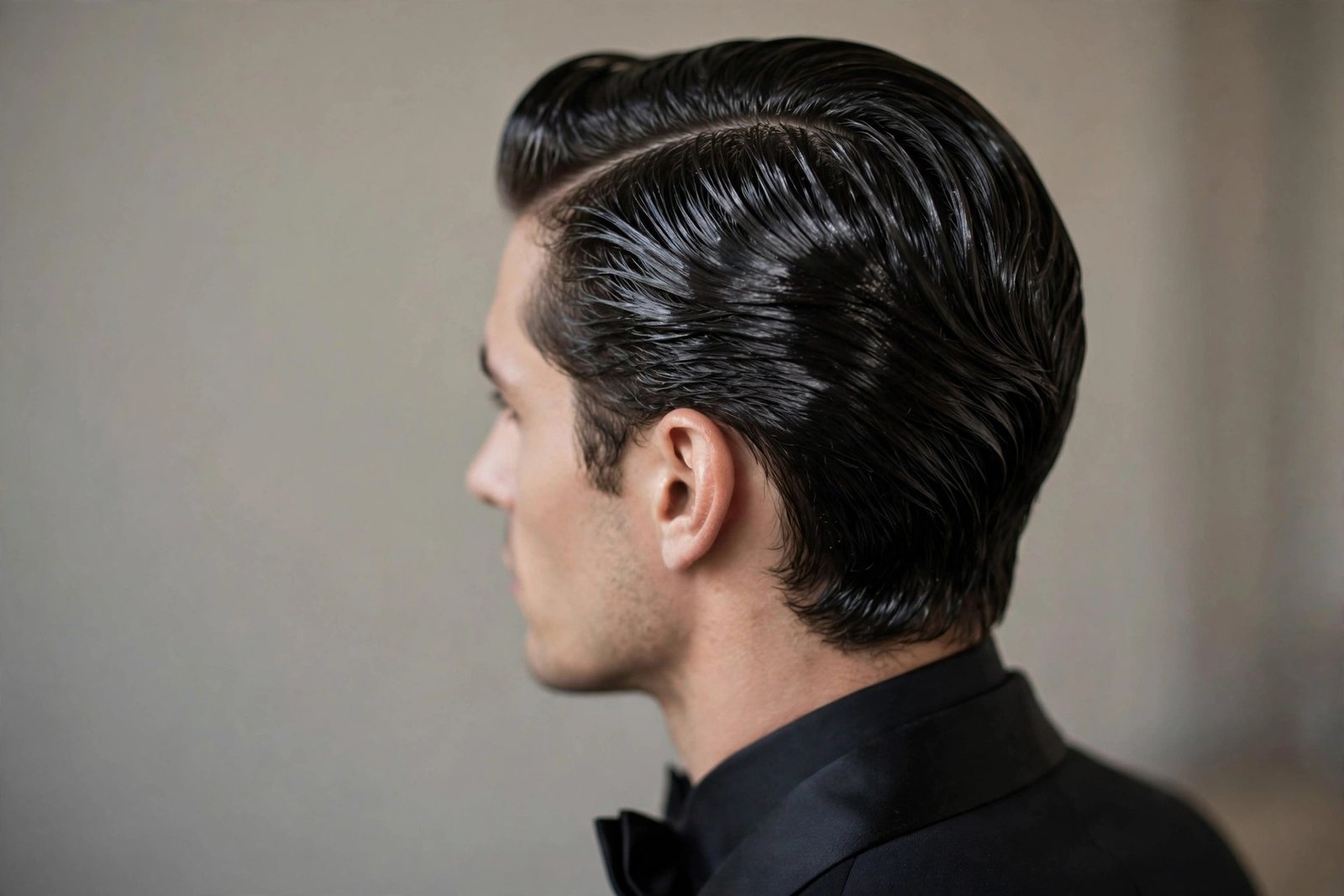
The Groom’s Hair Routine: From One Month Out to Midnight
Here’s what separates the grooms whose hair looks incredible from the ones who just got a good haircut: the routine around it. Whatever wedding hairstyles men pick from the sixteen above, a great result isn’t made on the wedding morning — it’s built over weeks. Healthy, well-prepped hair styles better, holds longer, and photographs with a richness that no product can fake on damaged hair. This section is your timeline: what to do a month out, the week before, the morning of, and how to keep it flawless until the last dance. Follow it and your hair will be the least of your worries — which, on your wedding day, is exactly where you want it.
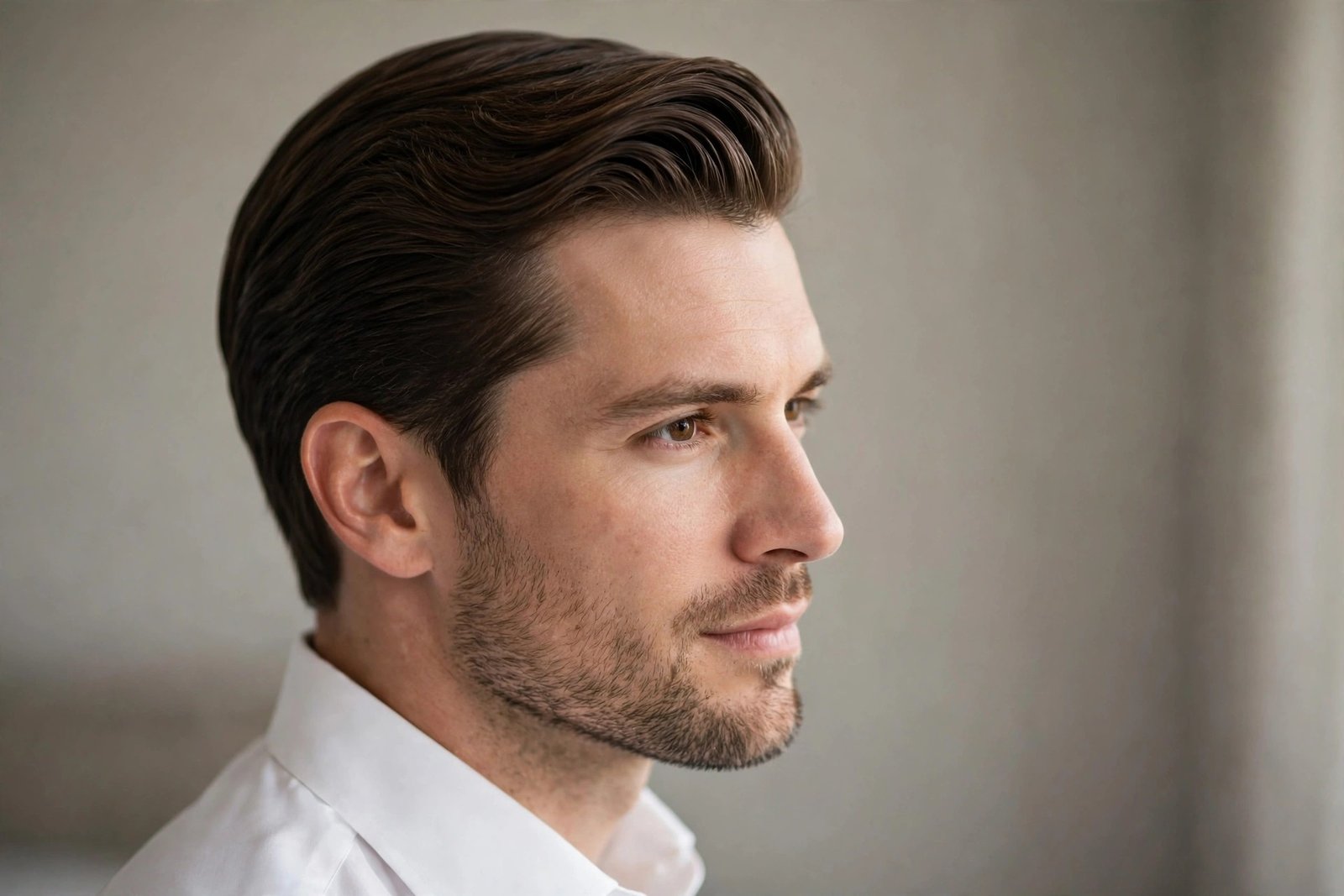
The Month-Before Plan: Build the Foundation
Four weeks out is when wedding hair is truly won, and almost nobody knows it. This is the growing and healing phase. If you’re growing length for your chosen style, stop cutting the top now — only clean up the neckline and around the ears to stay tidy. If your hair is damaged — split ends, dryness, chemical wear — this is the month to fix it, because no styling product in the world makes damaged hair look healthy in high-resolution photographs. Book a conditioning treatment or a professional deep-conditioning mask session three weeks out, then maintain with a good conditioner at home. Switch to a sulfate-free shampoo if you haven’t; it’s gentler and keeps natural oils where they belong. And start taking photos of your hair weekly in natural light — you’ll see the improvement, and you’ll have a baseline for the trial run.
This is also when you lock in your barber plan. Book three appointments right now: the trial run (four to six weeks out — if you haven’t done it yet, do it this week), the real cut (timed per your style’s guidance above, usually three to seven days before), and any touch-up (two days before, for fades and lineups). Yes, three appointments feels like a lot. It’s not — it’s the difference between hoping and knowing. At the trial run, bring reference photos of your chosen style, get the cut, style it yourself the next morning, wear it all day, and photograph it in different lights. If something’s off — the length, the shape, the way it grows — you have weeks to adjust. That’s the entire point. A trial run that reveals problems is a successful trial run.
Product shopping happens this month too, and here’s my advice: buy the exact products your barber recommends at the trial, not the ones with the best ads. Your barber has felt your hair; the internet hasn’t. You need surprisingly few things: the right styler for your look (pomade, clay, cream, or fiber), a volumizing pre-styler if your style needs lift, a flexible-hold hairspray, and a good shampoo and conditioner. That’s the whole kit. Buy travel sizes of the styler and hairspray for the emergency bag. And practice — style your hair the wedding way at least three or four times before the day. The wedding morning is not for learning; it’s for executing something your hands already know.
One more month-out task that nobody mentions: sort out your hairline and neckline philosophy. Some grooms like a natural neckline; others want it razor-clean. Decide at the trial and tell your barber to maintain it that way at every appointment. Inconsistency here is what makes hair look “off” in photos even when the cut is good. Same with facial hair — if you’re growing a beard for the wedding, the cheek and neck lines need defining at the same appointments as your haircuts. Hair and beard are one composition; groom them as one. Your photographer will capture them together in every close portrait, so they need to look like they were planned together — because they were.
The Week Before: Final Preparations
The final week is about peaking, not experimenting. Nothing new touches your hair this week — no new products, no new barbers, no “let me just try” anything. Your hair should be on a glide path to the wedding, and the week’s job is to keep it there. Get the real cut at the timed interval for your style (three to seven days before, per the guidance above). At that appointment, confirm the plan with your barber one more time: “this is the wedding cut, here’s how I’m styling it, here’s the product.” A good barber will cut with your styling routine in mind — a cut designed for blow-dry volume is different from one designed for air-dry texture, and your barber should know which one you’re doing.
Mid-week, do a deep conditioning treatment — a mask at home or a professional treatment, your call. This is the last major nourishment before the day; it gives the hair that supple, light-catching quality that reads as “healthy” in photographs. Don’t over-wash this week: every other day at most, because freshly stripped hair is harder to style and doesn’t hold as well. The day before the wedding, wash your hair — yes, the day before, not the morning of. Slightly “lived-in” hair (one day post-wash) styles better and holds longer than squeaky-clean hair for almost every style on this list. The natural oils give product something to grip. This is one of the most counterintuitive and most valuable tips in this whole guide: don’t wash your hair on your wedding morning.
Also this week: assemble the emergency kit. A small bag with travel hairspray, your styler, a pocket comb, bobby pins (even for short hair — they fix strays), blotting papers if you’re doing a shine look, and any touch-up product specific to your style. Give it to your best man or a trusted groomsman with one instruction: “guard this with your life.” You’ll use it once, maybe twice — before portraits and before the reception entrance — and each use takes under a minute. Also confirm who’s helping with styling if anyone: some grooms have their barber come to the venue (a luxury worth every penny if your style is complex), others rely on a practiced self-style. Either way, decide now, not that morning.
And sleep. I know, I know — the week before your wedding, “get sleep” is almost insulting advice. But it matters for your hair more than you’d think: stress and exhaustion show up as dullness, excess oil, and even shedding. The groom who sleeps decently the week before has better hair on the day than the one who doesn’t, all else equal. Eat reasonably, hydrate, don’t do anything drastic. Your hair is a lagging indicator of how you’ve treated yourself — the week before the wedding, treat yourself like someone whose photos will be viewed for generations. Because they will be.
Wedding-Morning Styling Script
The morning of: give yourself more time than you think you need, and protect it fiercely. Everyone will want a piece of you — the photographer, the groomsmen, your mother with “one quick thing.” Your hair needs a calm, unhurried window, so block thirty to forty-five minutes and tell everyone it’s non-negotiable. Start with a shower (body only — remember, you washed your hair yesterday). Get dressed in a button-up shirt, not a t-shirt you pull over your head — pulling fabric over finished hair is how styles die. Eat something. Drink water, not just coffee. Nerves plus caffeine plus an empty stomach is how hands shake, and you need steady hands.
Now style, following the routine for your chosen look from the sections above — you’ve practiced this three or four times, so it’s muscle memory now, not improvisation. Work methodically: product application, shaping, setting, finishing spray. Don’t rush the setting step — whether it’s blow-dryer heat or just letting product tack up, the set is what carries you through the day. Once it’s done, do the three-angle check: front in the mirror, sides with a hand mirror, back with your phone camera. Fix anything now, because “I’ll fix it later” becomes “it’s in four hundred photos.” Take a photo of the finished style in natural light and send it to your barber with a thank-you — barbers love this, and you’ll want the reference for future cuts.
Then stop touching it. This is the hardest instruction in the whole guide and the most important. Once the style is set, hands off. Every touch transfers oil, breaks product hold, and disturbs the shape. If something truly needs fixing, use the comb and the emergency kit, not your fingers. Tell your groomsmen too — the well-meaning head-rub from your best friend is a style-killer. A simple “hair’s done, hands off till photos” said with a smile does the job. And build in a buffer: finish styling at least thirty minutes before you need to leave or before the photographer starts. Rushed finishing leads to over-producting, and over-producted hair photographs stiff.
One last morning-of consideration: the weather check. If it’s unexpectedly humid, windy, or rainy, adjust now — a little extra hold product for humidity, a slightly tighter set for wind, an umbrella strategy for rain (seriously, assign someone the umbrella). The styles in this guide were chosen partly for resilience, but a two-minute weather adjustment beats hoping for the best. Your photographer will also appreciate knowing the plan — if rain forces portraits indoors, the lighting changes, and hair that looked great in sun needs to look great in shade too. Communicate. Everyone’s on your team today.
Keeping It Flawless Till the Last Dance
The ceremony is done, the photos are taken, and now comes the real endurance test: the reception. Five-plus hours of hugging, dancing, heat, and celebration. Here’s how your hair survives it looking like it belongs in the album. First, the pre-portraits touch-up: before the formal photo session (usually between ceremony and reception), take ninety seconds with the emergency kit. Comb through, revive with a tiny amount of product if needed, hairspray veil, done. This is the highest-ROI ninety seconds of your wedding day — these are the photos that get framed, so your hair should be at its absolute peak for them.
During the reception, adopt the “strategic ignorance” policy: assume your hair looks fine unless someone you trust tells you otherwise. Constant mirror-checking makes you look anxious in candids and leads to over-fixing, which is worse than the original problem. Designate one person — best man, brother, whoever — as your hair spotter, with permission to tell you if something’s genuinely off. Everyone else’s opinion is noise. If you dance hard (and you should), expect the style to relax — that’s fine, even good. Slightly loosened evening hair looks celebratory and natural in reception photos; shellacked-perfect hair at midnight looks odd, like you weren’t having fun.
The second touch-up comes before the evening’s key moments — the first dance, the speeches, the cake cutting, whatever your timeline’s photo peaks are. Thirty seconds: smooth, comb, done. Don’t restyle, just refresh. And here’s a pro tip for the dance floor: if your style has height (quiff, pomp), dance with joy but spare the head-banging — not for dignity, for architecture. If it’s an outdoor summer reception, position yourself upwind of the heaters if there are any; direct heat softens product. These are tiny things, but weddings are won on tiny things.
Finally, the end of the night. When the last dance ends and it’s just you and your partner, your hair will be a softer, more relaxed version of the morning — and that’s exactly right. It should look like the hair of a man who had the best day of his life, because that’s what it is. Take one photo together, hair however it ended up. Years from now, that slightly-mussed, utterly happy version might be your favorite picture of the whole day. The goal was never perfection at midnight. The goal was looking like yourself, at your best, in the photos that matter — and if you followed this guide, that’s exactly what you’ve got.
Frequently Asked Questions
Real questions from real grooms — the things men actually ask (or are too embarrassed to ask) about wedding-day hair, including the ones that come up whenever guys compare notes on wedding hairstyles men are wearing this year. If your question isn’t here, the answer is almost certainly “do a trial run and ask your barber,” but let’s cover the big ones properly.
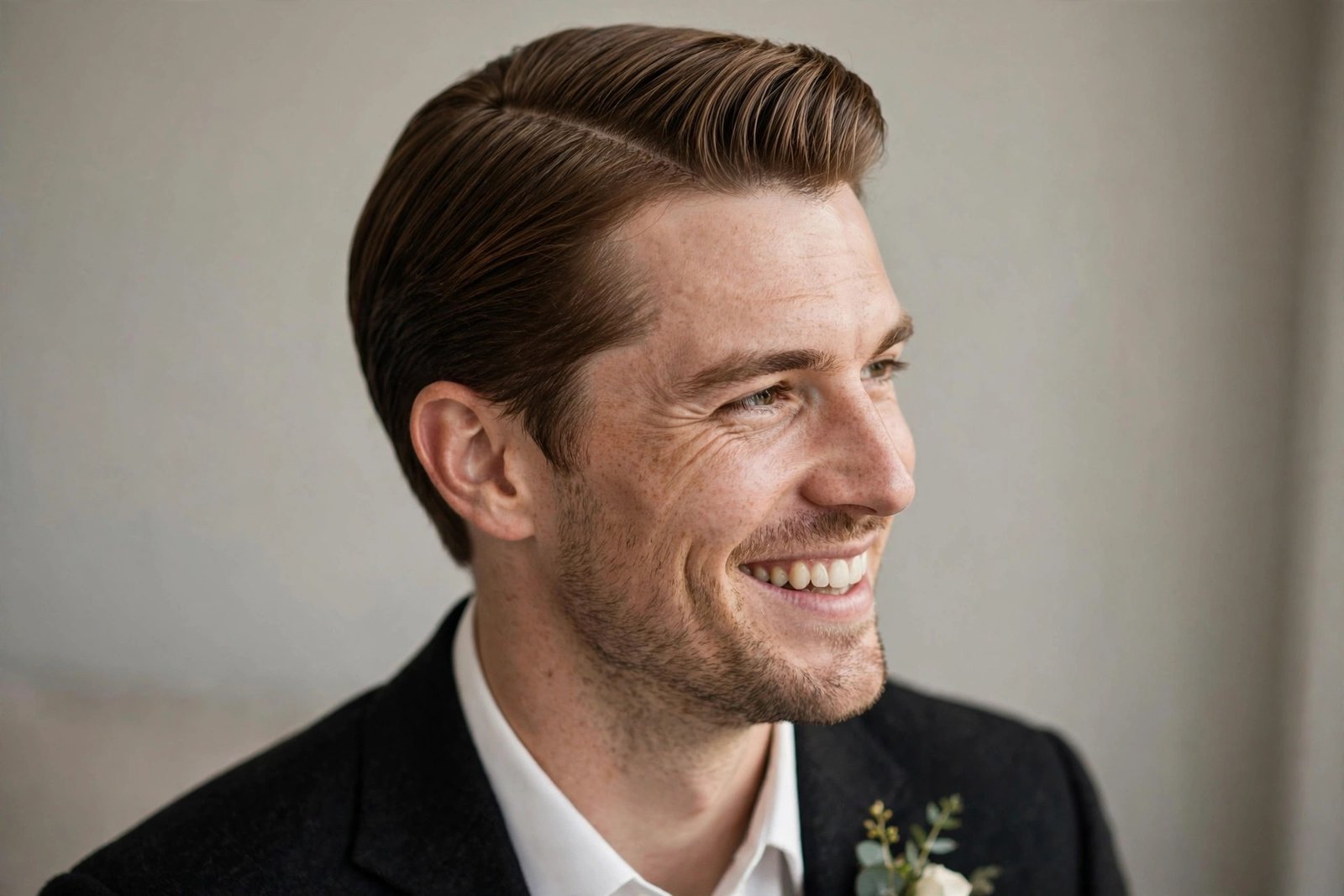
How far in advance should I get my wedding haircut?
It depends on the style, and this is why each section above gives specific timing — but the general rule is three to seven days before the wedding, never the day before and never the morning of. Here’s the reasoning: a cut needs a few days for the hair to settle into how it naturally falls, especially on top. Day-one hair has a springy, freshly-cut energy that fights styling. But fades, tapers, and lineups look best fresh, so they want the shorter end of the window. The sweet spot most barbers recommend: get the main cut five days out, then a quick cleanup of just the sides, neckline, and edges two days before if needed. And the trial run happens four to six weeks before — that’s separate, that’s the experiment, and it needs enough distance from the wedding that any mistakes grow out. Whatever you do, don’t walk into a new barber for the first time the week of your wedding. That’s gambling with the photos.
Should I try a completely new hairstyle for my wedding?
My honest answer: usually no, and here’s why. Your wedding photos are forever, and “forever” is a long time to live with an experiment. The grooms who look best are wearing elevated versions of what already suits them — the same direction, just executed better. That said, there’s a spectrum. If you’ve worn the same cut for years and want something fresher, that’s fine — pick a style that works with your current length and face, do the trial run six weeks out, live with it, and decide with real information. What you should never do is a dramatic transformation in the final two weeks: no first-time skin fades, no radical length changes, no color experiments. The risk-reward math is terrible. A wedding is the best version of you, not a different you. If the “new style” itch is strong, scratch it after the honeymoon — you’ll have great photos either way, and zero regrets.
What if it’s going to rain or be very humid on my wedding day?
First: don’t panic, and don’t change your style at the last minute — a practiced style in bad weather beats an unpracticed style in good weather every time. For humidity, the defense is product strategy: use anti-humidity or strong-hold products (test them beforehand), consider a slightly tighter set than usual, and keep the emergency kit accessible. Styles with built-in structure — side parts, tapers, waves, curly tappers with proper product — handle humidity far better than styles depending on height and airiness, so if the forecast looks brutal a week out, talk to your barber about adjusting hold, not changing the cut. For rain: umbrellas, covered photo locations, and acceptance. A few raindrops won’t ruin a well-set style; a downpour ruins everything equally, so have the indoor photo plan ready regardless. And here’s the reframe: some of the most romantic wedding photos ever taken are in rain. Wet-look shine, dramatic skies, the two of you laughing under one umbrella — lean into it.
How do I make my hairstyle last from morning to midnight?
Four pillars: the right cut, the right product, the setting step, and the touch-up kit. The cut does the heavy lifting — a style with structural integrity (clean lines, proper weight distribution) holds itself up; product just locks it. Use enough product — most men under-apply on important days out of fear of looking “done,” then wonder why it collapsed by noon. The setting step (heat from a blow dryer, or time for product to tack up) is what most home stylers skip and what makes the difference between three hours and twelve. Then the touch-up kit handles the rest: one ninety-second refresh before portraits and one thirty-second refresh before the evening’s key moments. That’s it. Also: stop touching your hair. Hands are the number one killer of wedding styles — every touch deposits oil and breaks hold. Comb, don’t finger. And assign a groomsman to guard against well-meaning head-rubs. Your hair will outlast the dance floor if you let it.
Should the groom’s hairstyle match the groomsmen’s?
No — and in 2026, deliberately not. The modern approach is coordination, not uniformity: everyone looks sharp, nobody looks identical. Here’s why matching is a bad idea: it photographs like a boy band, it ignores that different faces need different cuts, and it subtly diminishes the groom — he should stand out as the groom, not blend into a lineup. What works instead: share the dress code and the standard. “Everyone gets a fresh cut the week of, neat and wedding-appropriate” is the right instruction. If you want visual cohesion, coordinate the level of formality — if you’re in a sharp side part, the groomsmen shouldn’t show up with bedhead — but let each man wear the cut that suits him. The wedding party photos look better with natural variety, and your groomsmen will thank you for not handing them a mandated haircut. The only exception: if your groomsmen want guidance, point them to this guide and let them choose.
What hair products do I actually need for the wedding day?
Fewer than the internet wants to sell you. The essential kit: one styler matched to your look (pomade for shine and control, clay or matte paste for texture, cream for natural softness, fiber for thickening — your barber tells you which at the trial), one pre-styler if your style needs volume or heat protection, one flexible-to-strong hold hairspray for setting, and your regular shampoo and conditioner. That’s the complete list. Buy travel sizes of the styler and hairspray for the emergency bag. What you don’t need: seventeen products layered in confusion, anything you haven’t tested, or the most expensive option assuming price equals performance. Application matters more than brand — a drugstore clay applied correctly beats a luxury pomade applied wrong. And buy everything at least two weeks out so you’re practicing with the real products, not discovering on the morning that the new clay behaves differently than the old one.
I’m thinning on top — what are my best wedding options?
First, breathe: some of the sharpest wedding hairstyles men with thinning hair can choose are right here on this list, and a confident groom with a well-chosen cut outshines an insecure one with more hair every single time. Your best options: the classic side part (the sweep creates coverage and the part gives the eye a clean line), the modern comb over (designed for exactly this — directional length maximizing coverage), the textured crop or gentleman’s crop (short enough that thinning is less visible, textured enough to create density illusion), or the sharp buzz/short crop worn with total confidence (sometimes the boldest move is owning it). What to avoid: growing it long to “cover” (it does the opposite — long thin hair emphasizes scalp), the full slick back (exposes everything under bright lights), and any style requiring height you don’t have the density to build. Product strategy: thickening pre-stylers, matte finishes (shine highlights scalp — matte conceals), and hair fibers at the part or crown if needed — they’re undetectable in photos when applied right. And talk to your barber honestly at the trial; a good barber has dressed a hundred thinning grooms and knows exactly what works. This is a solved problem. For broader context on how hair itself works, Wikipedia’s overview of hair is a solid primer, and GQ’s grooming section regularly covers men’s wedding style.
Conclusion
Here’s the thing I want you to carry away from these seven thousand words: your wedding hairstyle is not a beauty project, it’s a confidence project. Every one of these wedding hairstyles men can wear with pride — from the timeless side part to the bold wet look — works for the same underlying reason: it’s a deliberate choice, executed with care, worn by a man who decided to look like the best version of himself on the most photographed day of his life. The cut matters, the product matters, the routine matters, but what matters most is that you walk in feeling like you — just sharper, surer, and ready. Nobody in that room is auditing your hair with a checklist. They’re seeing a happy groom. Give them one.
So pick your style, book that trial run, practice the routine, pack the emergency kit, and then — this is the important part — stop worrying about it. You’ve done the work. On the day, trust the preparation and be present for the actual wedding: the vows, the people who traveled to see you, the partner waiting at the end of the aisle. Years from now, when you look at the photos, you won’t be thinking about product hold or fade gradients. You’ll be thinking about how you felt. Make sure the feeling is joy — the hair will take care of itself, because you took care of it weeks ago. Congratulations, groom. Now go get married.