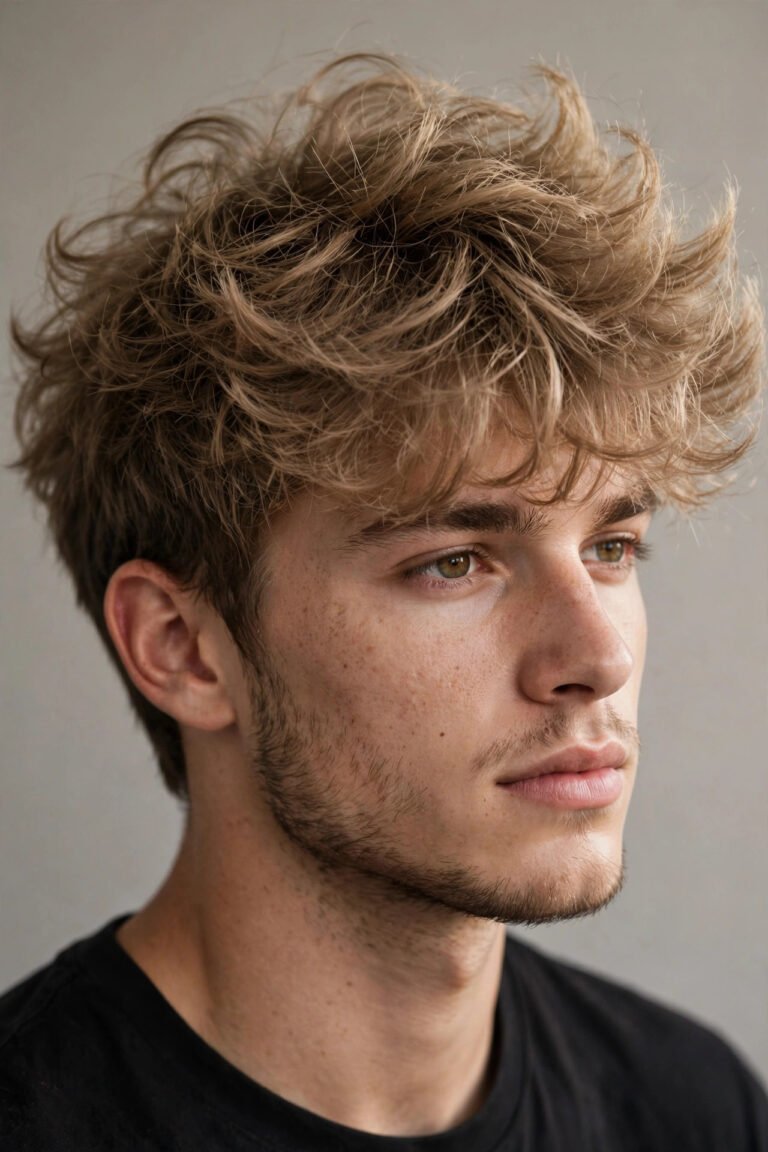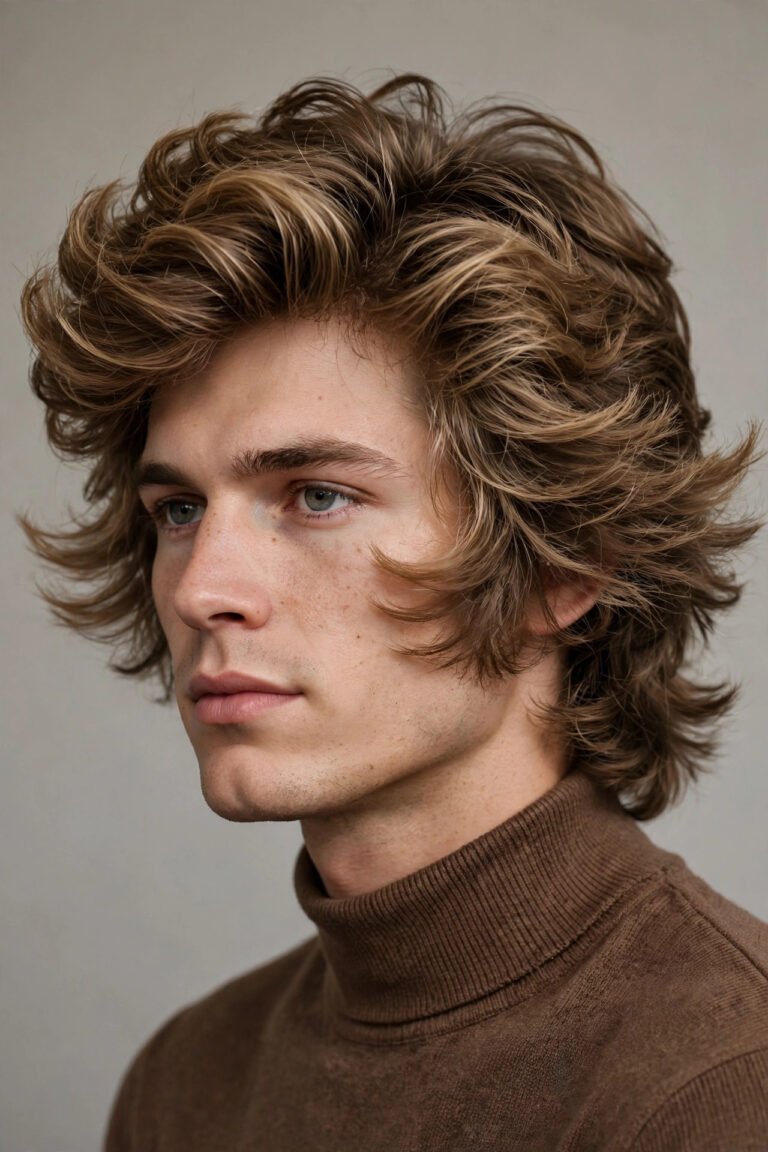
Oval Face Haircuts Men 2026: 14 Cuts That Fit the Balanced Face
Oval Face Haircuts Men 2026: The Lucky Face Shape Playbook
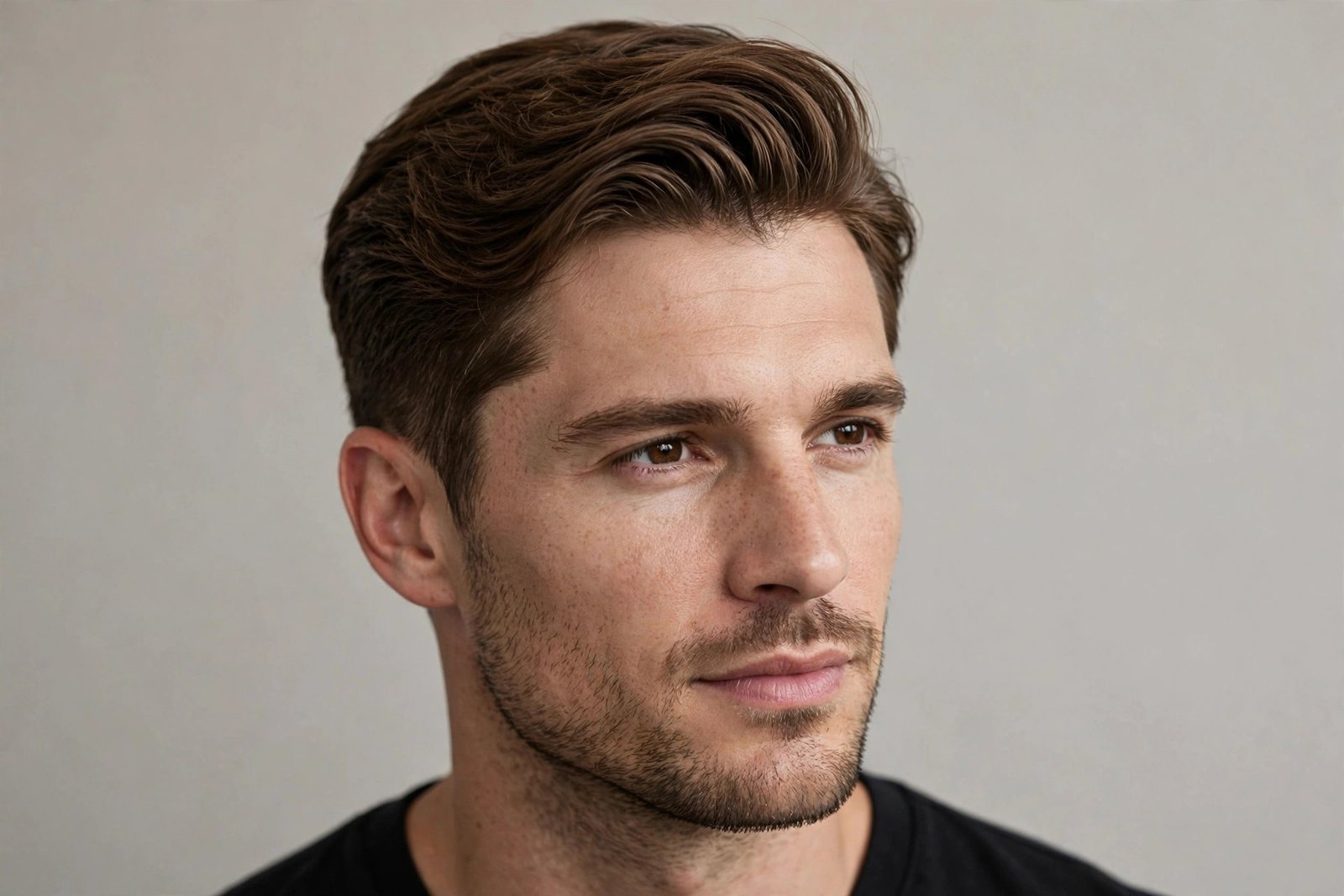
Oval face haircuts men have a luxury most guys would kill for: your face shape works with almost everything. The oval face is the balanced face — forehead, cheekbones and jaw all in pleasing proportion, the chin softly rounded rather than sharp or square. That balance means the haircut doesn’t have to fix anything. It just has to not break anything. This guide gives you 14 oval face haircuts for 2026 that respect your proportions instead of fighting them, with the exact words to say to your barber, real styling routines, honest downsides, and the mistakes that turn a gift into a curse.
Inside: how to confirm your face is truly oval (most men who think they’re oval are actually oblong — and it matters), the one golden rule every oval-faced man should tattoo on his brain, 14 cuts with full barber scripts, a maintenance routine built for balanced proportions, and answers to the questions oval-faced men ask most.
Here’s what I’ll tell you straight: the oval face is the most versatile face shape in men’s grooming, and also the most wasted. Because nearly everything “works,” most oval-faced men drift — they pick whatever’s trending, grow whatever’s easy, and end up with hair that technically fits but never flatters. The difference between a good haircut and a great one on an oval face isn’t the cut itself. It’s intent. An oval face rewards deliberate choices: the right length in the right place, volume that respects the natural balance, and edges that echo the face’s soft geometry. A random trending cut gives you a random result. A deliberate one makes people assume you were born stylish.
One more thing before we start, because barbers won’t tell you this: the oval face’s versatility is a trap for lazy barbers. When a cut “works on everyone,” your barber stops thinking. So this guide arms you with specifics — guard numbers, lengths, sectioning words, the finish to ask for. Walk in with the script from your chosen style below and you’ll get a cut that looks intentional, not accidental.
Table of Contents
- Oval Face Haircuts Men 2026: The Lucky Face Shape Playbook
- 14 Oval Face Haircuts for Men in 2026
- Styling, Maintenance & the Oval Face Advantage
- Frequently Asked Questions
- Conclusion
Is Your Face Actually Oval? The 60-Second Check
Before you claim the prize, make sure it’s yours. An oval face is longer than it is wide, with a forehead slightly wider than the chin, cheekbones as the widest point, and a jaw that tapers into a softly rounded chin. The whole outline flows — no sharp corners at the jaw, no dramatic width at the temples, no flatness at the chin. Here’s the quick test: pull your hair back, look straight into a mirror, and trace your face’s outline with your finger on the glass. If the shape is a smooth egg — wider at the cheeks, narrowing gently at both ends — that’s oval. If it’s noticeably long with a tall forehead and a narrow chin, you’re probably oblong, and length-adding cuts will make it worse. If the jaw is wide and angular, you’re square, and the soft styles below will need tweaking.
Why does this check matter so much? Because the advice for oval and oblong faces is nearly opposite. Oval faces can take height on top — oblong faces can’t afford it. Oblong faces need side volume — oval faces need only enough to keep things interesting. I’ve watched men spend years in the wrong haircut because a barber glanced at them and said “oval, you can wear anything.” “Anything” is not a haircut strategy. Know your shape, then choose like you mean it.
There’s also the question of proportions within the oval. Some ovals run long (close to oblong), some run wide (close to round). The 14 cuts below are flagged for where they help: long-leaning ovals should favor styles with side volume and controlled height; wide-leaning ovals should favor styles with height and tighter sides. Read the “who it suits” line under each style — it’s there for a reason.
The Golden Rule: Protect the Balance
Here’s the entire philosophy of oval face haircuts in one sentence: your face is already balanced, so every cut should preserve that balance, not add to it. That’s it. That’s the rule that governs all 14 styles below. An oval face doesn’t need widening, lengthening, sharpening, or softening — it needs a haircut that keeps the forehead, cheeks, and jaw in their natural harmony while adding character, texture, and intent.
In practice, this means three things. First, avoid extremes of volume in one direction. A massive tall quiff on a long-leaning oval makes the face look even longer; a super-wide afro with no height makes a wide-leaning oval look squat. Keep volume distributed. Second, respect the natural lines. The oval face has soft geometry — rounded chin, gentle jaw — so cuts with some softness in the edges (texture, layering, a lived-in finish) tend to look more expensive than razor-sharp geometric cuts. Sharp can work — the French crop proves it — but it should be a choice, not an accident. Third, the beard question is real. An oval face with a full long beard can start reading oblong; an oval face with a sharp boxed beard can start reading square. The safest beard for an oval face is medium-full with a natural, slightly rounded bottom edge that echoes the chin. It adds masculinity without rewriting the face shape.
Break the golden rule and you get the classic oval-face failure: the cut looks fine in the barber’s mirror and odd in every photo. Hair that adds length where you had balance, or width where you had harmony. Follow the rule and almost everything below becomes low-risk — which is exactly why oval-faced men should enjoy their luck instead of fearing it.
Why 2026 Is a Great Year for Oval Faces
Trends come and go, but 2026 happens to be generous to the balanced face. The year’s defining men’s trends — lived-in texture, softer finishes, the return of classic shapes with modern edges, volume that looks grown rather than constructed — all play to the oval face’s strengths. Texture and movement flatter soft geometry. The side part renaissance suits balanced proportions perfectly. Even the wilder trends (the curtain revival, the textured fringe wave) sit naturally on an oval face because there’s no harsh angle to clash with.
What 2026 doesn’t favor: the hyper-sharp skin-fade-everything era is cooling, which is good news — those aggressive fades with hard lines could make an oval face look oddly small-headed. The move toward tapers, blended fades, and natural necklines keeps the head’s proportions honest. If your current cut is a remnant of the 2022 hard-fade era, this guide is your exit ramp. And if you’re starting fresh, the 14 styles below are ordered from timeless to trend-forward, so you can pick your comfort level.
14 Oval Face Haircuts for Men in 2026
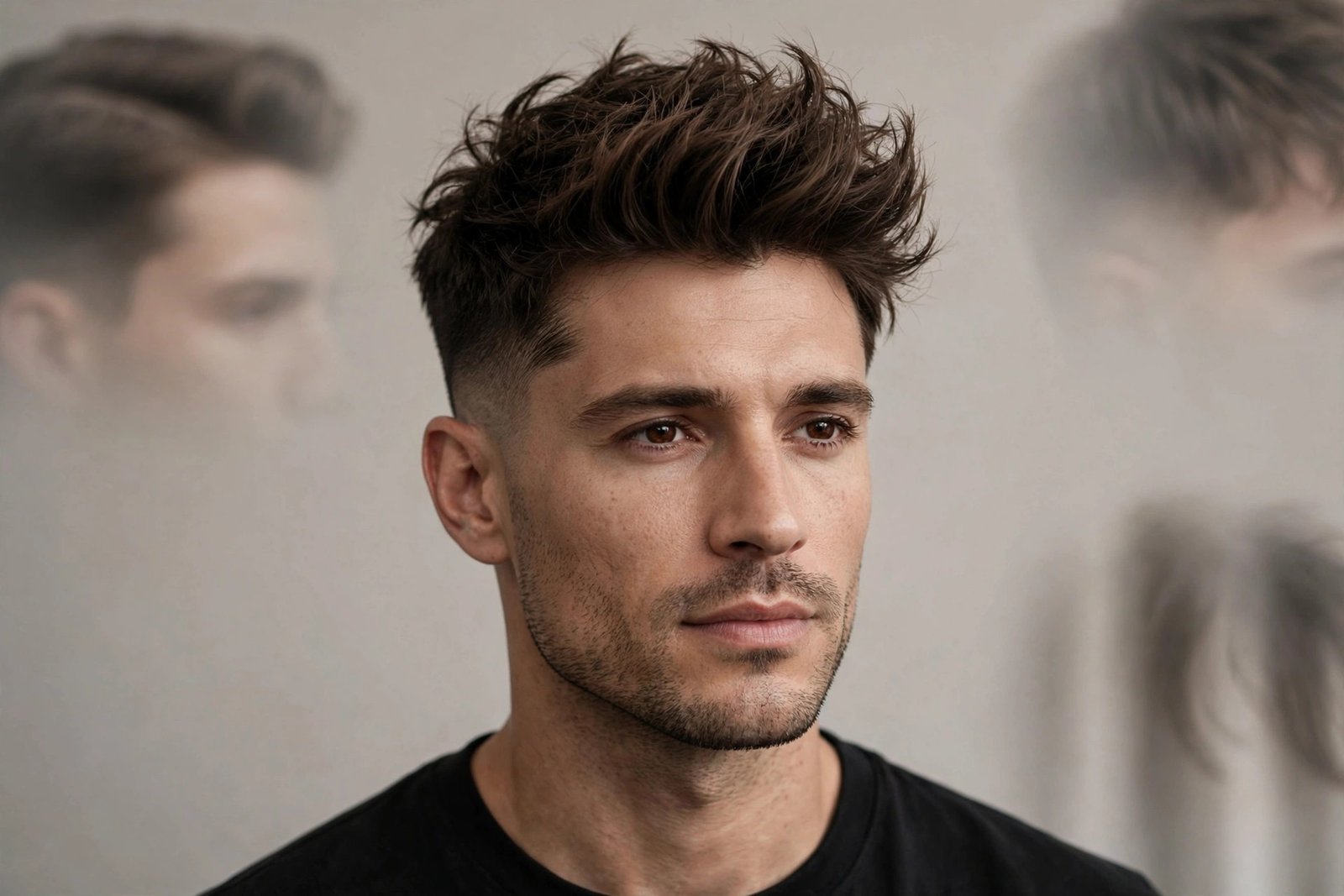
Every style in this oval face haircuts men guide follows the golden rule — it protects your balance while giving you something to work with. Each one includes who it suits best, the exact barber script (say these words), how to style it in the morning, how often to maintain it, and the honest downside nobody mentions. Pick one. Commit. Look like you meant it.
1. The Classic Side Part
The side part is the oval face’s home turf — the cut this face shape was seemingly designed for. Parted cleanly (or softly, more on that below) with 3 to 5 inches on top swept to the side and neatly tapered sides, it mirrors the face’s natural symmetry without adding drama anywhere. It’s the haircut of men who get promoted, get the table, get taken seriously — not because it’s boring, but because it looks deliberate. On an oval face, the side part does something subtle and powerful: it frames the forehead’s width perfectly and lets the cheekbones do the talking.
Who it suits: every oval face, full stop — but it’s especially kind to long-leaning ovals, since the side sweep adds a touch of horizontal movement that keeps the face from reading longer. Fine to thick hair, straight to wavy. If your hair is very curly, this becomes a different conversation (see the curly top below), but loose waves are actually ideal — they give the part a softness that looks expensive.
Barber script: “Classic side part — 3 to 4 inches on top, parted on my natural part, swept to the side with texture through the ends. Taper the sides to a number 4 or 5, blended, not a hard disconnect. I want it to look sharp but not helmet-like — point-cut the top so it moves. Natural neckline, cleaned up but not carved.”
Morning styling: towel-dry until damp, work a pea-sized amount of medium-hold cream or light pomade through the top, find your part with a comb, and sweep. Two minutes. For a softer 2026 finish, skip the comb after the initial part and use your fingers — the slightly lived-in side part reads modern; the razor part reads 2015. A quick blast of the dryer on medium heat, directed along the sweep, adds staying power if your hair is stubborn.
Maintenance: every 3 to 4 weeks to keep the taper crisp; the top can grow out gracefully for 6 to 8 weeks before it loses shape.
Honest downside: it’s so universally flattering that it can feel invisible — nobody will compliment the haircut, they’ll just think you look good. If you want your hair to be a conversation piece, pick something louder. Also, in very humid climates the part can collapse by afternoon; a light matte paste instead of cream solves it.
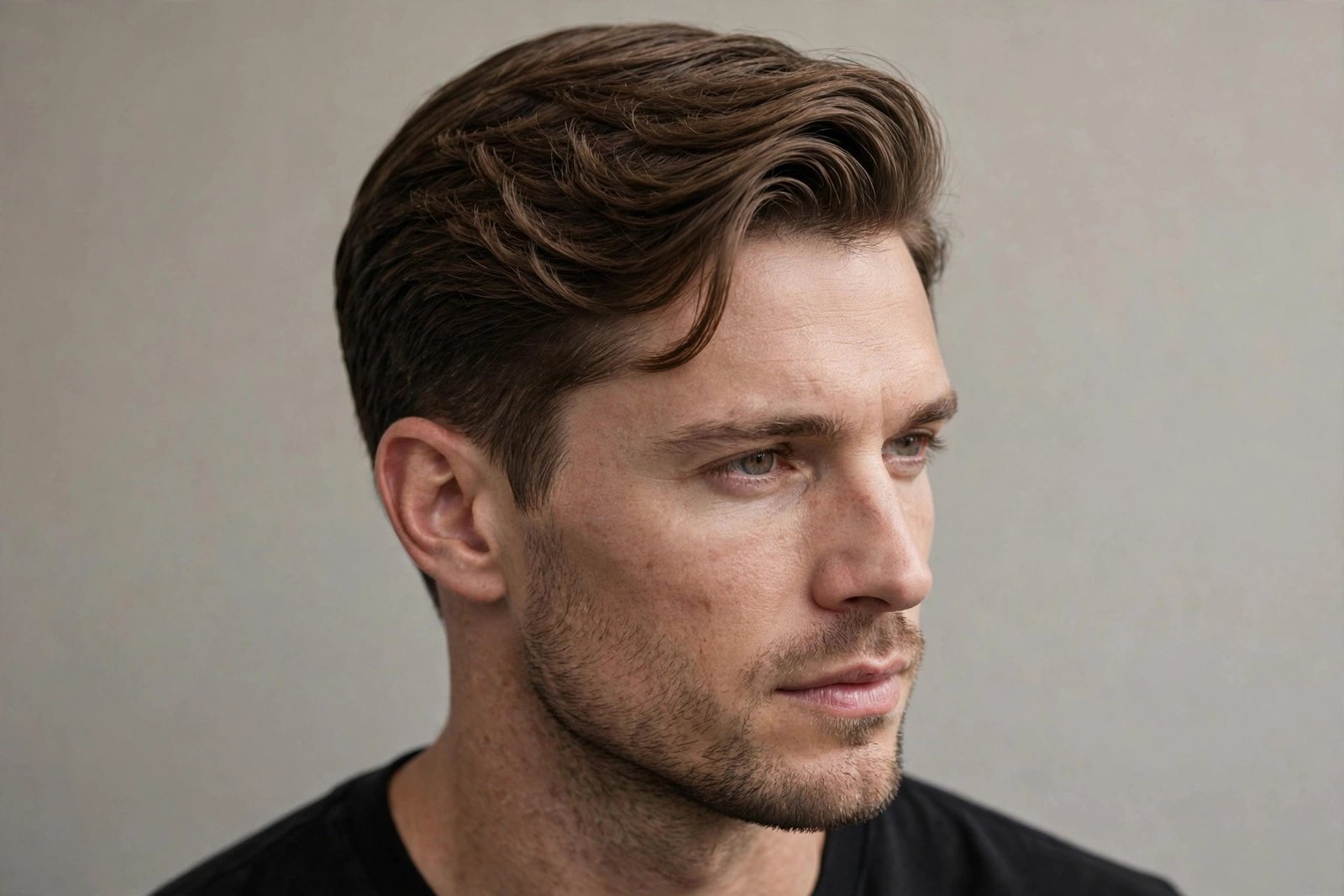
2. The Textured Quiff
If the side part is the reliable sedan, the textured quiff is the sports car you can actually daily-drive. Height and volume swept up and back, with texture through the top so it looks touchable rather than sculpted. On an oval face, the quiff is nearly foolproof — the face’s balance absorbs the height without looking elongated, and the upward movement draws the eye through the whole face instead of parking it on one feature. I’ll be honest with you: the quiff is the single most complimented men’s cut I know, and on an oval face it almost can’t miss.
Who it suits: wide-leaning ovals especially — the height lengthens the face’s appearance beautifully. Straight to wavy hair with medium density works best; very fine hair can do it with the right product but needs more effort. Needs 3 to 5 inches on top. Round-leaning oval faces should ask for a slightly taller, narrower quiff to avoid adding width.
Barber script: “Textured quiff — 4 inches on top, shorter toward the crown, lots of texture and layering through the top so it moves. Mid fade on the sides, blended up into the top with no harsh line. I want height I can push up with my fingers, not a flat wall. Point-cut everything.”
Morning styling: blow-dry the top upward and back with a vent brush — this is non-negotiable, the dryer does 70% of the work. Then work matte clay or paste through from roots to ends, pushing up and slightly back. Finish by pinching small sections for separation. Five minutes once you’ve done it a week. The pre-styler trick barbers won’t tell you: a light sea salt spray on damp hair before drying gives fine hair the grip it needs to hold height all day.
Maintenance: every 3 weeks — the fade grows out fast and the quiff’s silhouette depends on it. Top trims every 6 weeks to keep the texture fresh.
Honest downside: it’s the highest-maintenance style on this list. Skip the blow-dryer and it falls flat by 10 a.m. Wind is its natural enemy. And if you’re the wash-and-go type, this cut will punish you — be honest with yourself before choosing it.
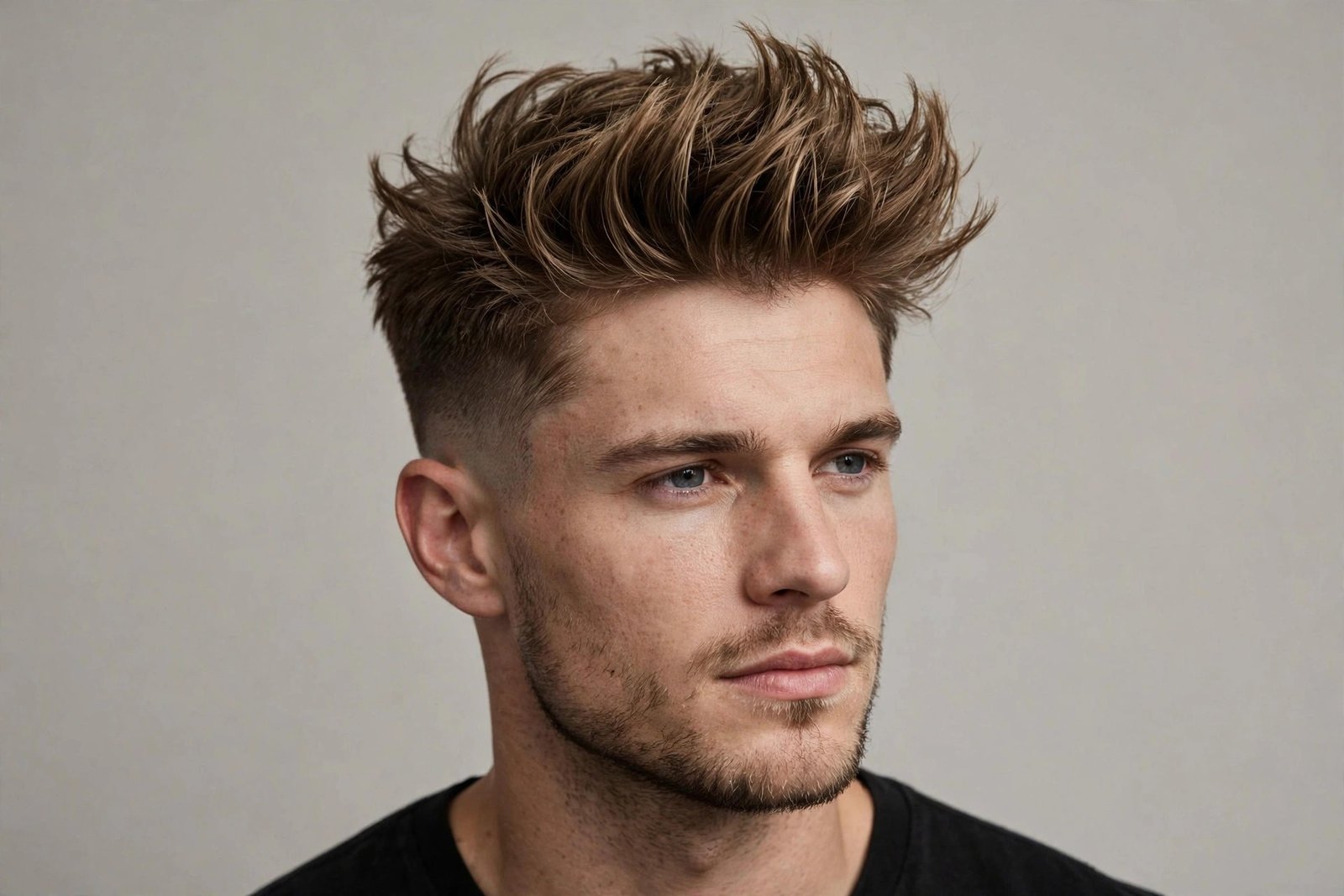
3. The Modern Pompadour
The pompadour is the quiff’s more formal older brother — bigger, smoother, more deliberate. The 2026 version isn’t the greaser wall of the 1950s; it’s a softer, textured pomp with natural movement and a fade or taper on the sides instead of slicked-back walls. On an oval face, the pompadour is magnificent because the face’s symmetry lets the volume sit like a crown rather than a disguise. This is the cut for weddings, big meetings, and nights when you want to look like the best version of yourself on purpose.
Who it suits: oval faces with medium to thick hair and at least 4 to 6 inches on top. Wide-leaning ovals get the most benefit — the height balances width beautifully. Men with strong natural volume have an unfair advantage here; fine-haired guys can still pull it off but should keep the pomp modest rather than towering.
Barber script: “Modern pompadour — 5 inches on top, graduated shorter toward the back, textured through the interior so it’s not a solid wall. Low to mid fade on the sides, blended. I want to wear it up and back with volume, but I want it to look like hair, not a sculpture. Show me how you’d dry it.”
Morning styling: blow-dry up and back with a round brush, lifting at the roots — root lift is the whole game. Apply pomade or a strong-hold cream to the mid-lengths and ends (keep product off the roots or it collapses), then shape. For the modern textured finish, finish with a light matte paste worked through the ends with your fingers. Seven to ten minutes. This is a weekend-and-events cut for most men, not a Tuesday cut — and that’s fine.
Maintenance: every 2 to 3 weeks for the fade; reshape the top every 6 to 8 weeks.
Honest downside: it demands length, product, and time — the holy trinity most men won’t sustain daily. In rain or high humidity, a big pomp can deflate dramatically; carry a travel-size paste. And here’s the thing nobody says: a pompadour on the wrong day (bad sleep, no effort) looks worse than a simpler cut done well. It’s high-reward, high-maintenance.
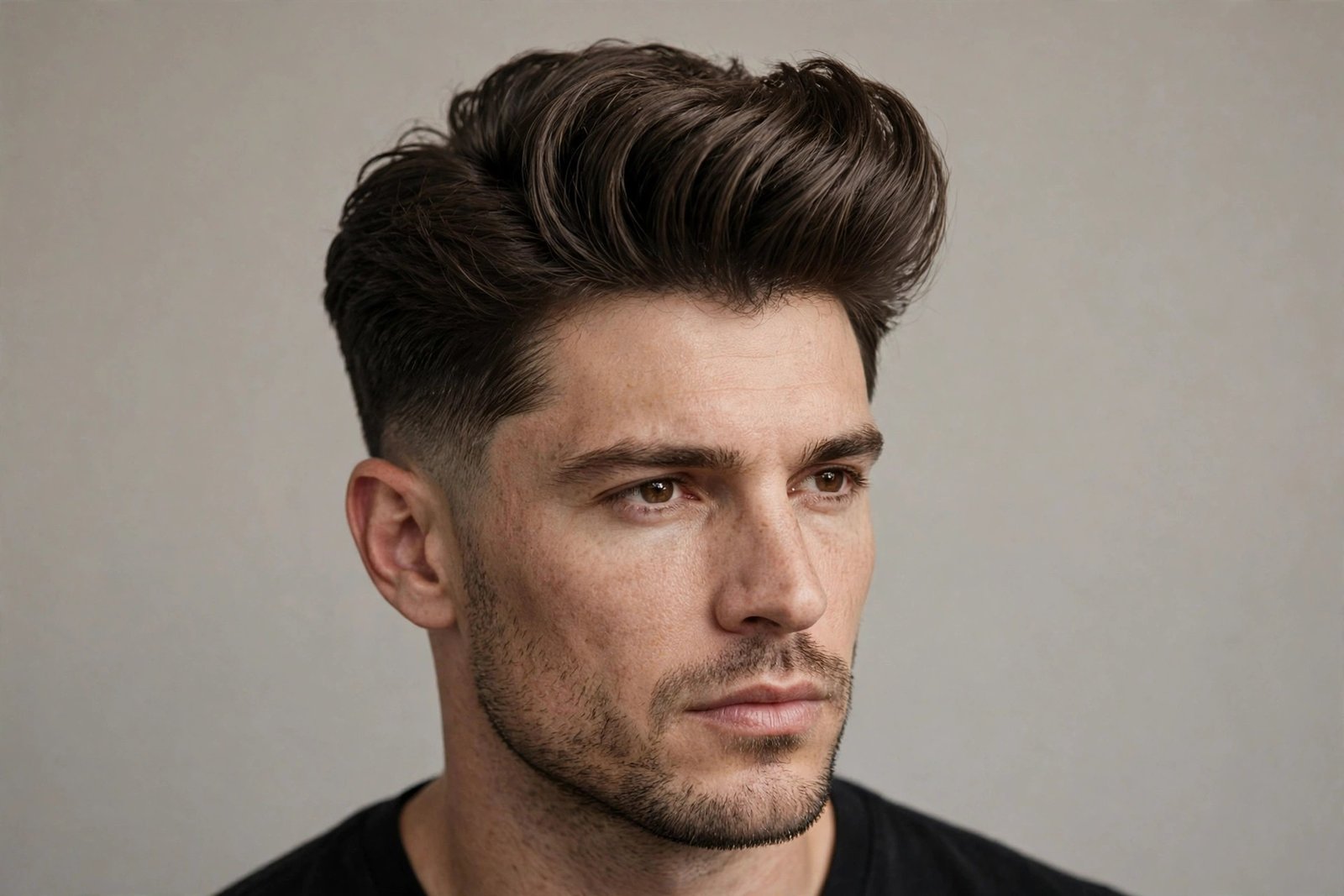
4. The Ivy League
The Ivy League is what happens when a crew cut goes to a good school: short on the sides, just long enough on top to part — usually 1 to 2 inches — with a neat, side-swept finish. It’s the thinking man’s short cut, and on an oval face it’s close to perfect because it reveals the face’s natural balance instead of hiding it. No tricks, no volume games, just clean proportions. Men who wear the Ivy League well tend to be men who have their lives together, or at least look like they do.
Who it suits: every oval face, and it’s the best short option for long-leaning ovals since it adds zero height. Great for straight or wavy hair, fine or thick. If you have a high hairline, the short top with a textured finish actually minimizes it better than longer styles that expose more forehead.
Barber script: “Ivy League — about an inch and a half on top, textured, worn with a side part. High and tight-ish fade on the sides, maybe a number 2 to 3 faded up. Keep the top long enough to move with a part, short enough that I barely have to think about it. Tidy neckline.”
Morning styling: damp hair, tiny amount of light cream or even just water, comb to the side. Ninety seconds. This is the lowest-effort style on the list that still looks intentional — the barber does the work, you just show up.
Maintenance: every 2 to 3 weeks — short cuts show growth fast, and the Ivy League’s charm is its crispness.
Honest downside: it reveals everything — face shape, hairline, head shape. On an oval face that’s usually a plus, but if you’re self-conscious about any feature, a longer cut gives you more camouflage. It’s also not a “fun” cut; nobody’s asking about your hair at parties. Quiet confidence is the whole pitch.
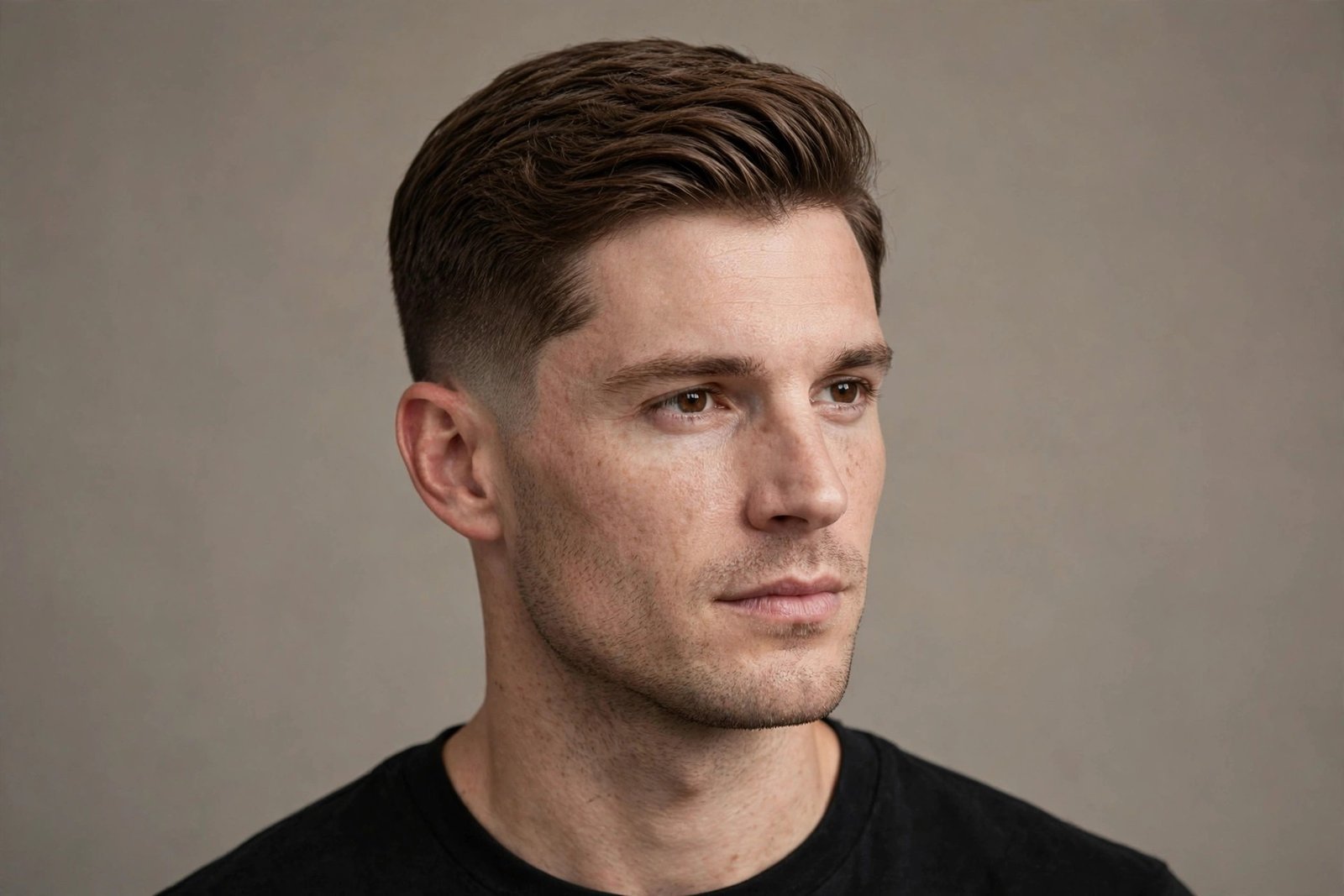
5. The French Crop
The French crop — short textured top with a straight or slightly broken fringe, faded or tapered sides — is the 2026 short-cut king, and oval faces wear it better than almost anyone. The fringe sits across the forehead, which on an oval face creates a strong horizontal line that emphasizes the face’s balanced width. It’s edgy without trying too hard, and the texture on top gives it a modern, lived-in feel that the old Caesar cut never had. For a deeper dive into short textured styles, the French crop guide breaks down every variation.
Who it suits: long-leaning ovals especially — the fringe visually shortens the forehead and balances length. Straight to wavy hair; the crop’s texture does the heavy lifting, so even fine hair looks fuller. Men with high foreheads: this is your cut.
Barber script: “French crop — 2 inches on top, heavy texture, fringe worn forward with a slightly broken edge, not a straight ruler line. Mid skin fade on the sides, blended into the top. I want it to look effortlessly messy, not bowl-cut. Texturize the fringe ends.”
Morning styling: towel-dry, small amount of matte paste or clay, push the top forward and pinch for texture. Two minutes. The crop is gloriously forgiving — bedhead actually improves it. A sea salt spray on damp hair adds grit that makes the texture pop.
Maintenance: every 3 weeks for the fade; the top can go 5 to 6 weeks.
Honest downside: the fringe needs commitment — growing it out goes through an awkward curtain phase that tests your patience. And on very round-leaning ovals, a heavy straight fringe can emphasize width; ask for a slightly textured, uneven fringe line to break it up.
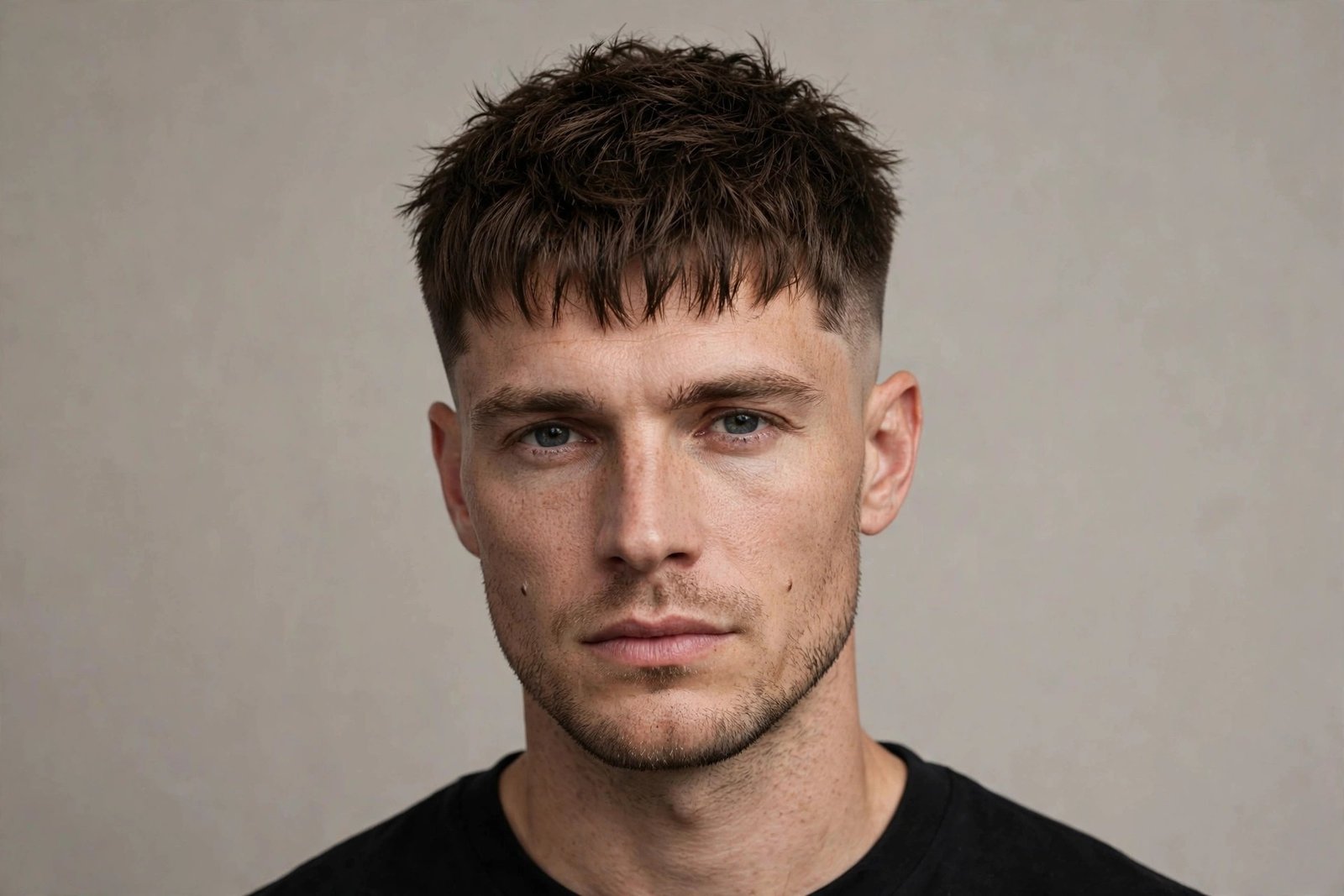
6. The Buzz Cut with Balanced Beard
The buzz cut on an oval face is a power move — it strips away everything and lets the face’s natural symmetry carry the whole look. But here’s what most buzz-cut guides miss: on an oval face, the buzz works best with a beard, because the beard adds the width and structure that very short hair removes. A clean-shaven buzz on an oval face can look a touch stark; a buzz with a well-kept medium beard looks intentional and masculine. The combination is greater than either part.
Who it suits: oval faces with good hair density and no major scalp concerns. The beard is doing real work here — if you can’t grow a decent beard, consider the Ivy League instead. Great for men who want zero morning routine and maximum edge.
Barber script: “Buzzed to a number 3 on top, faded down to a 1 or skin on the sides — one even silhouette. And shape the beard: medium fullness, natural rounded bottom edge following my jaw, cheek line cleaned up but not carved into sharp angles. The beard should echo the face, not fight it.”
Morning styling: nothing. That’s the point. Beard oil and a quick brush for the beard, 30 seconds. This is the only style on the list with a literally zero-minute hair routine.
Maintenance: buzz every 1 to 2 weeks (at home with clippers or at the shop); beard trim and shape every 2 weeks.
Honest downside: it exposes your head shape completely — bumps, asymmetry, all of it. And it grows out fast; a 3-week-old buzz is just messy short hair. The beard requirement is real: without it, many oval faces look slightly severe with a buzz. Know thyself.
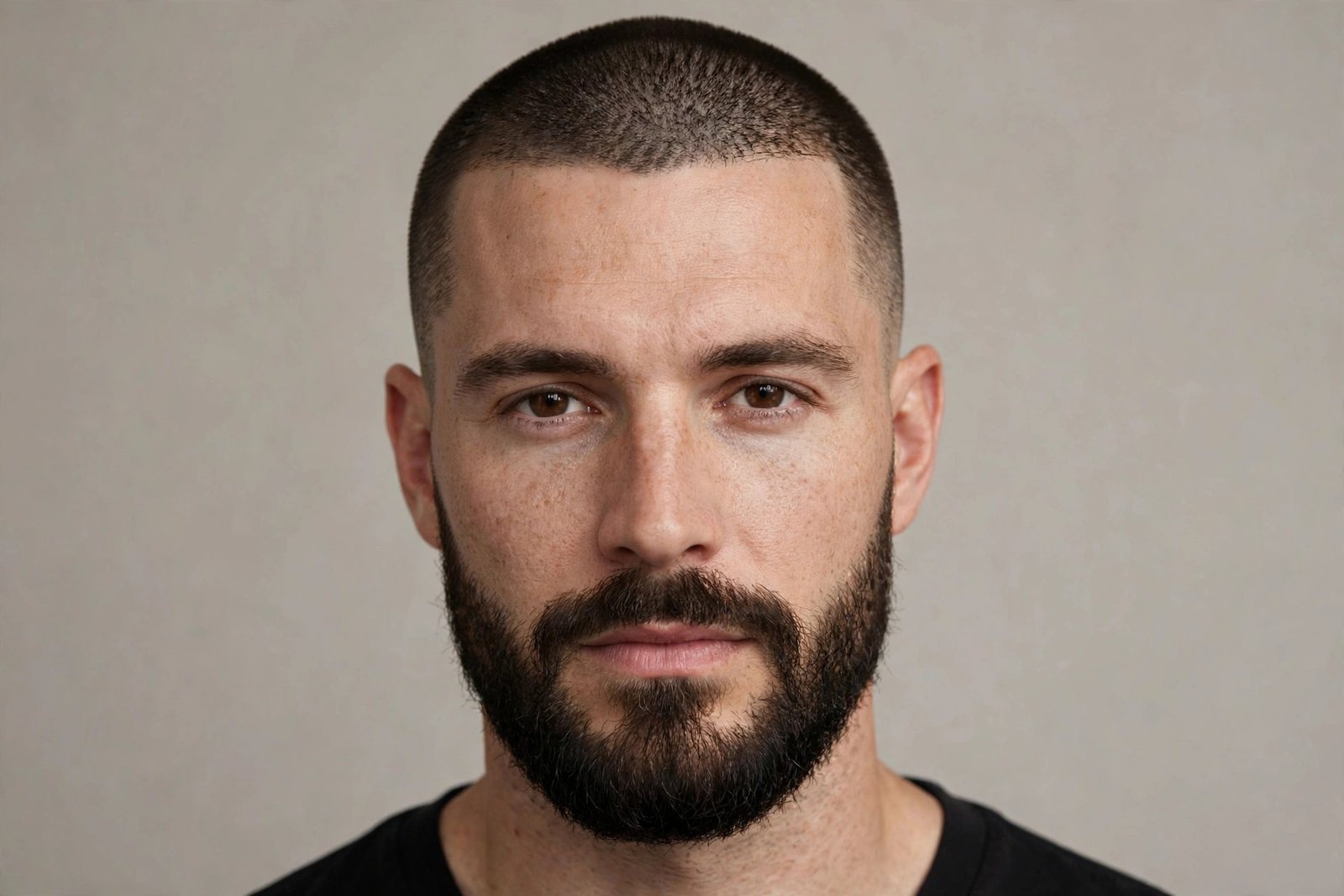
7. The Mid Fade with Volume on Top
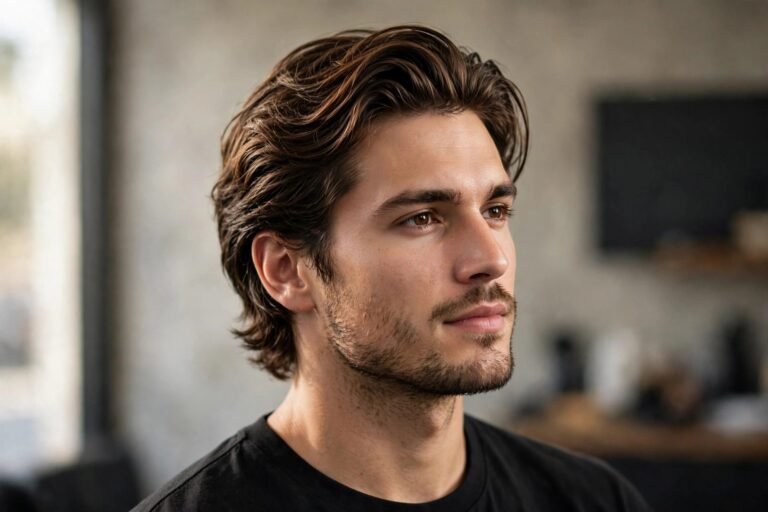
The mid fade with a voluminous textured top is the modern default for a reason — it works. The fade starts midway up the sides, creating a clean gradient that slims the sides of the head, while 3 to 5 inches of textured length on top gives you something to style. On an oval face, this is the safe-but-never-boring choice: the fade’s clean lines echo the face’s symmetry, and the top’s volume sits comfortably on balanced proportions. If you don’t know what to get, get this — then grow more adventurous from here.
Who it suits: all oval faces, all hair types except very tight curls (which need their own approach). Wide-leaning ovals benefit most — the faded sides slim the face’s width while the top adds flattering height. If your hair is very thick, the texture work on top is essential to avoid a mushroom silhouette.
Barber script: “Mid fade — start the fade halfway up, blend from skin to a 2, no hard lines. Four inches on top, heavy texture and layering, worn with volume pushed up and slightly forward. I want the transition from fade to top completely seamless. Point-cut the top, no blunt edges.”
Morning styling: blow-dry the top up for volume (3 minutes), matte clay through the top, push up and forward with fingers, pinch the ends for separation. Four to five minutes total. This cut is the reason matte clay exists — it gives grip without shine, which is exactly what textured tops need.
Maintenance: every 2 to 3 weeks — the mid fade’s gradient shows growth quickly.
Honest downside: it’s the most common men’s cut in the world right now, which means it’s also the most common bad version of itself. A rushed mid fade with a hard line looks cheap. Vet your barber — ask to see their fade work before you sit down. And the upkeep schedule is relentless; stretch it to 5 weeks and the silhouette collapses.
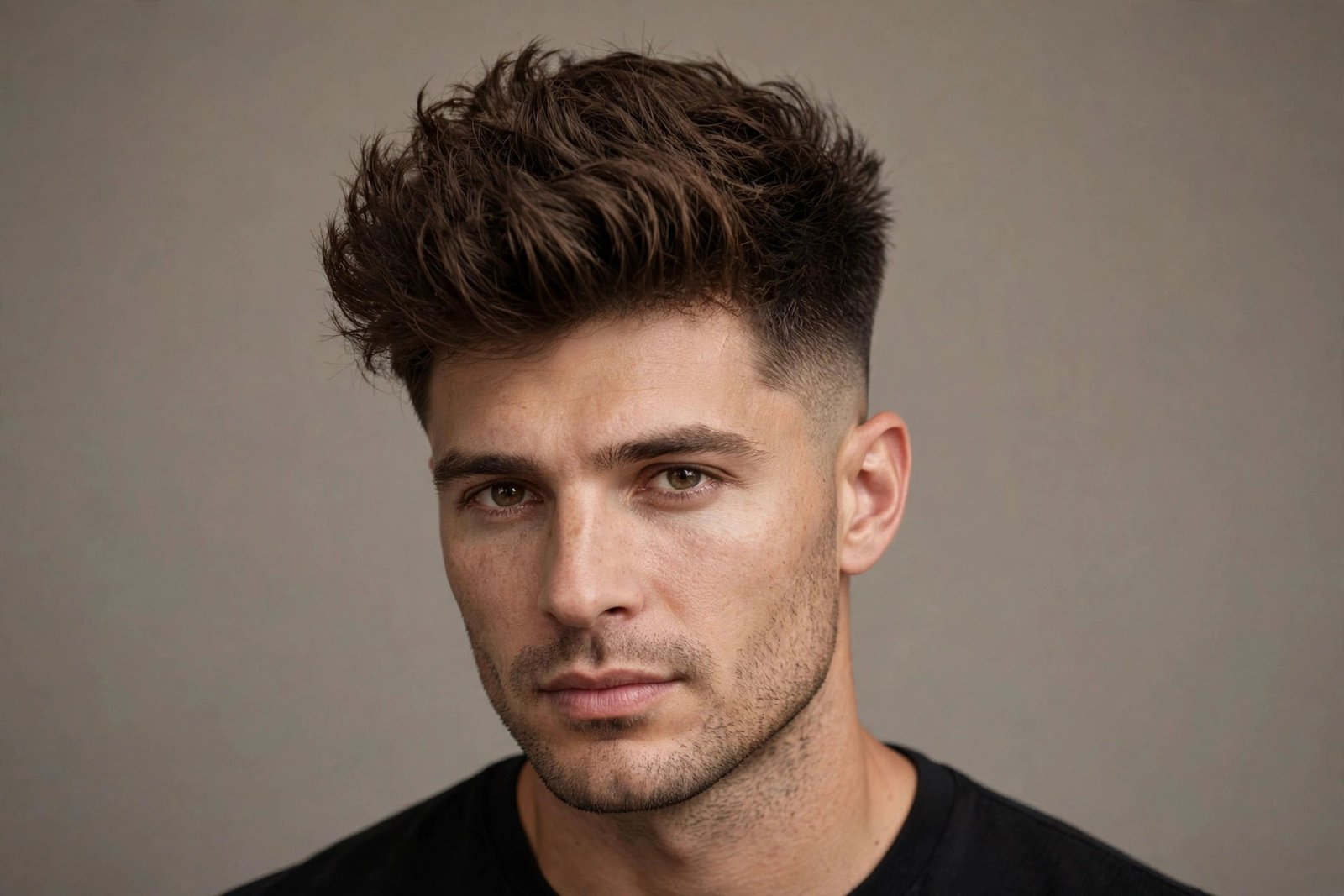
8. Curtain Bangs / The Middle Part
The curtain revival is real, and oval faces are its natural home. Hair parted down the middle (or just off-center), 4 to 6 inches long, falling to frame both sides of the face — the curtains draw a perfect frame around balanced features. On an oval face, curtains do something no other cut does: they emphasize symmetry itself. Both sides of the face get equal billing, and the eye reads the whole balanced composition. It’s romantic, a little 90s, and in 2026 it’s worn with more texture and less boy-band polish than the original.
Who it suits: oval faces with straight to wavy hair and enough density for the part to hold. Long-leaning ovals: keep the curtains slightly shorter and add texture so they don’t drag the face down. This cut needs a fairly even hairline — a strong widow’s peak fights the middle part. The middle part hairstyle guide covers the growing-out phase in detail, because yes, there’s a phase.
Barber script: “Growing into curtains — keep 5 inches on top, layered so the front pieces fall naturally to both sides of a middle part. Taper the sides and back to support the length, not a disconnect. I want the front to frame my face, not hang in my eyes. Light texture through the ends.”
Morning styling: part while damp (find your natural center — forcing a part where your hair doesn’t want one is a losing battle), blow-dry forward and to each side with a brush to train the direction, then let it fall. A light cream keeps flyaways down without stiffness. Three to four minutes once the length is trained — the first month requires patience as the hair learns the part.
Maintenance: trims every 6 to 8 weeks to keep the framing pieces at the right length; the style actually improves as it grows.
Honest downside: the awkward growing phase is real — 2 to 4 months of hair that won’t commit to the part. Wind rearranges it constantly. And it needs washing more often than shorter cuts; curtains show grease fast. But once it’s grown in and trained, it’s one of the most striking looks an oval face can wear.
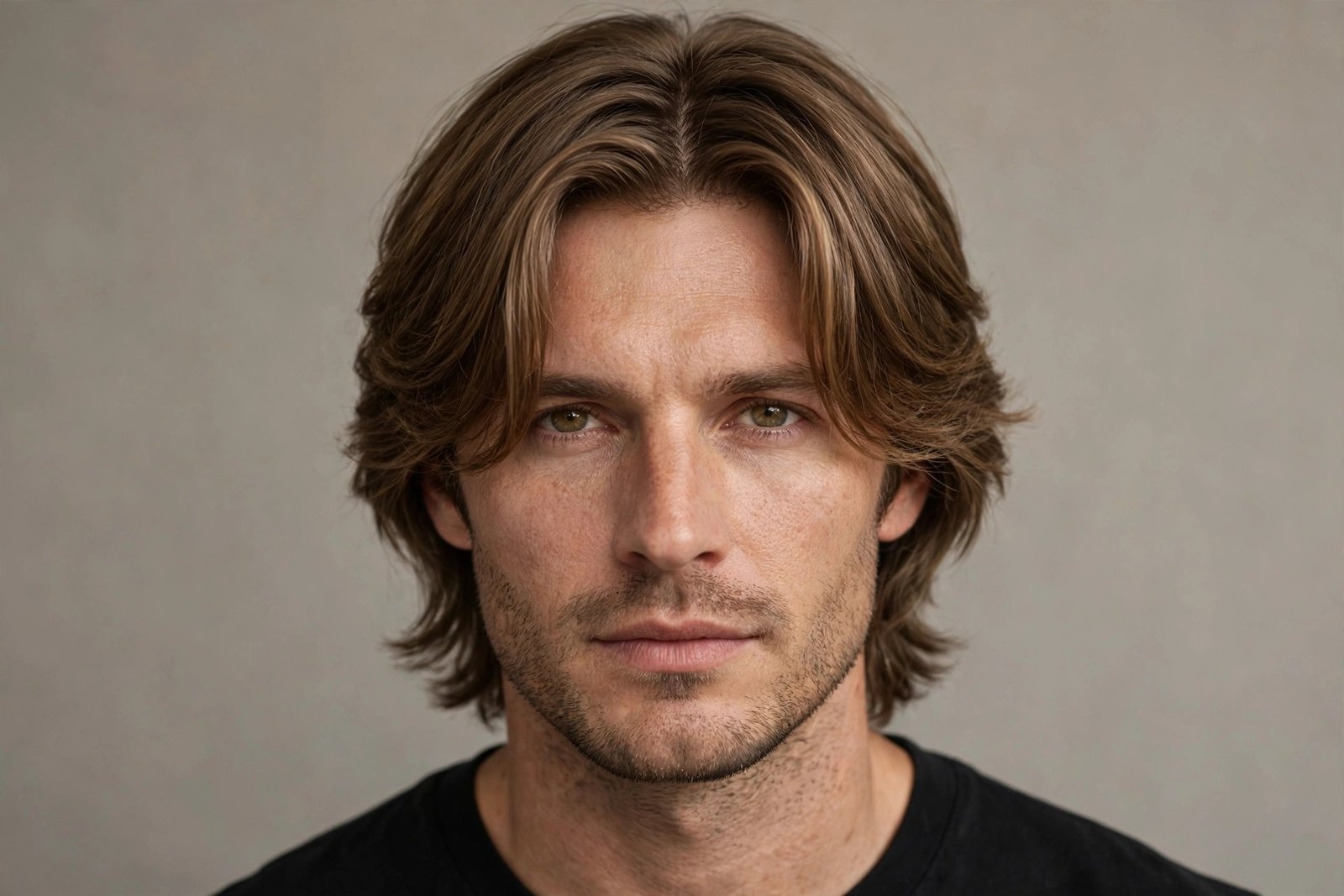
9. The Textured Fringe
Not the French crop’s short fringe and not the curtain’s long drape — the textured fringe sits in the sweet middle: 2 to 4 inches of choppy, piece-y fringe worn forward over the forehead, with texture everywhere. It’s youthful, modern, and on an oval face it adds a horizontal emphasis that keeps everything in proportion. Think K-pop influence meets barbershop practicality. The textured fringe is also the best camouflage on this list — it softens a high hairline, balances a long forehead, and gives the eyes a frame that photographs beautifully.
Who it suits: long-leaning ovals get the most value — the fringe shortens the face’s appearance. Straight to wavy hair; the choppier your natural texture, the better this looks. Younger men wear it most naturally, but there’s no age rule — a well-executed textured fringe on a 40-year-old oval face reads confident, not try-hard.
Barber script: “Textured fringe — 3 inches on top worn forward, choppy and piece-y, not a straight line across. Taper fade on the sides, low to mid. I want it to look intentionally messy, like I styled it in 30 seconds — because I will. Heavy point-cutting through the fringe.”
Morning styling: the fastest styling on this list after the buzz: damp hair, pea of matte paste, push everything forward, pinch pieces apart. Ninety seconds. The messier the better — over-styling a textured fringe defeats its purpose. A texture spray on dry hair revives second-day fringe instantly.
Maintenance: every 3 to 4 weeks; the fringe grows into the eyes fast and loses its shape.
Honest downside: forehead acne is a real side effect — fringe traps heat and oil against the skin. Wash the fringe separately if you’re prone. And in professional settings it can read young; pair it with sharp clothes if you need to balance the impression. For more fringe-forward ideas, the textured fringe collection has every variation worth knowing.
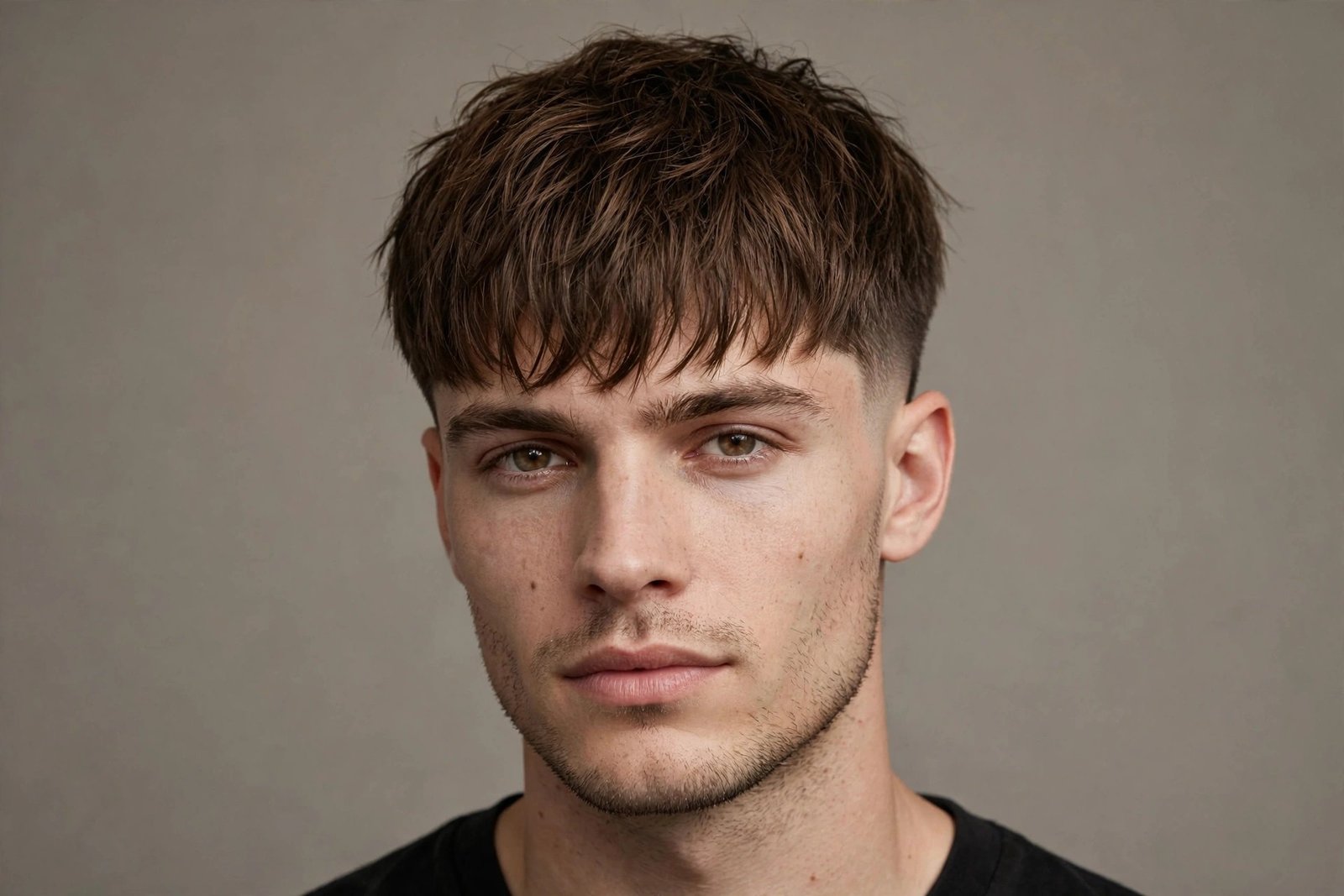
10. The Slick Back
The slick back is confidence in haircut form: everything swept straight back, sides tight, top with 4 to 6 inches of controlled flow. On an oval face it’s devastatingly effective because the style exposes the entire face — forehead, cheekbones, jaw — and an oval face has nothing to hide. The 2026 slick back isn’t the wet-look wall of the Mad Men era; it’s worn with natural texture and a satin (not glossy) finish, sides tapered rather than disconnected. It says you know exactly who you are.
Who it suits: oval faces with straight or wavy hair and medium to thick density — the style needs weight to stay back. Men with a good hairline, since everything’s on display. Wide-leaning ovals: keep the sides tight and the top’s volume moderate so you don’t add width at the temples.
Barber script: “Slick back — 5 inches on top, worn straight back with natural texture, not plastered. Taper the sides down to a 2 or 3, blended. I want it to look like my hair naturally goes back, not like I fought it. Keep some movement in the top.”
Morning styling: blow-dry straight back with a brush or fingers — direction training matters more than product here. Then a satin-finish pomade or strong cream, worked through and combed back. The comb-then-fingers sequence gives the modern finish: comb for direction, fingers for texture. Five minutes. On day two, water and a brush usually revive it without full product.
Maintenance: every 3 to 4 weeks for the taper; the top grows out well for 8 weeks.
Honest downside: it shows everything — thinning crown, uneven hairline, all of it. If your hair is starting to thin at the crown, the slick back is the worst possible choice (the comb-over’s honest cousin). It also demands consistent length; the in-between phase where the top won’t stay back tests every man’s resolve. Push through — month three is when it clicks.
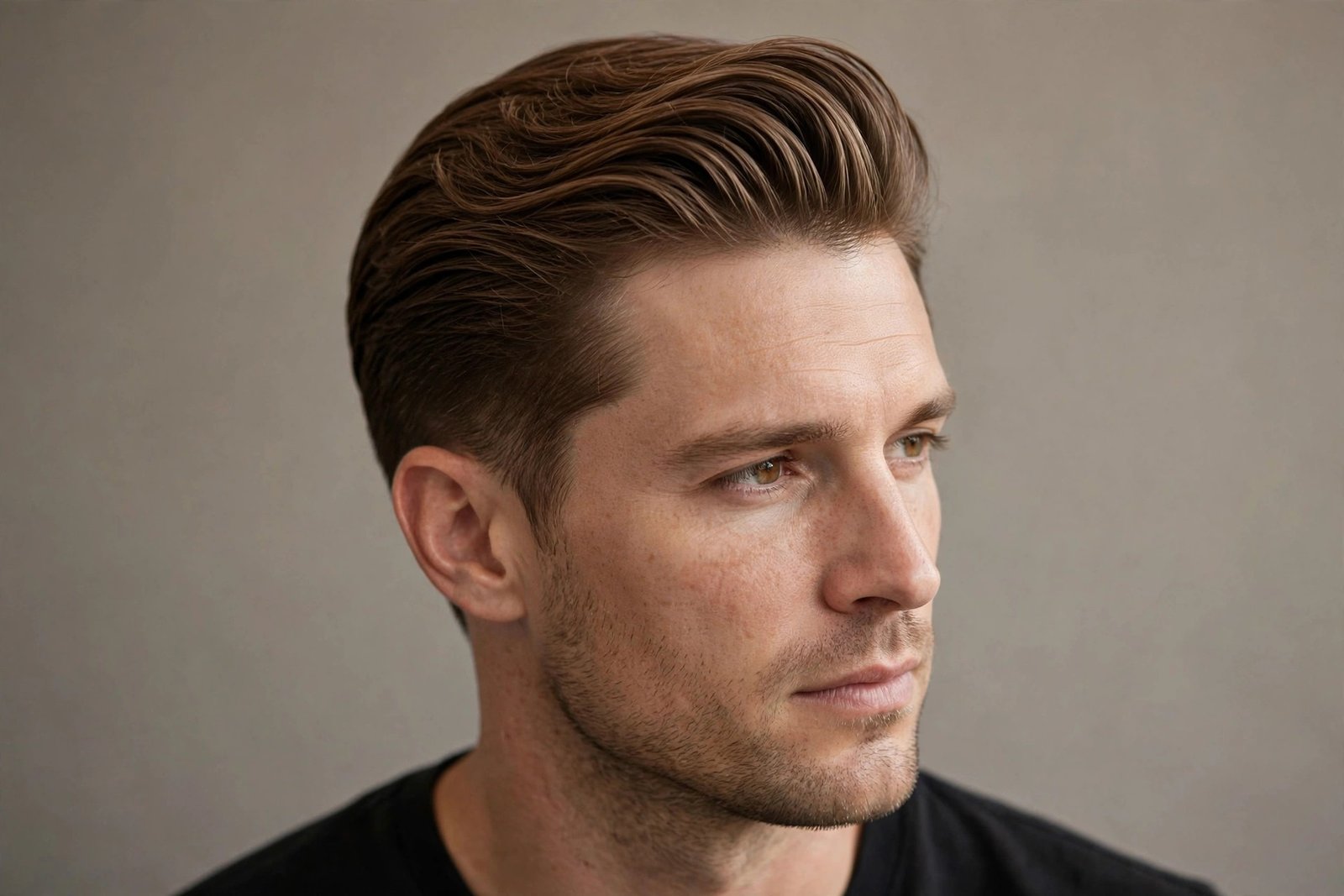
11. The Bro Flow
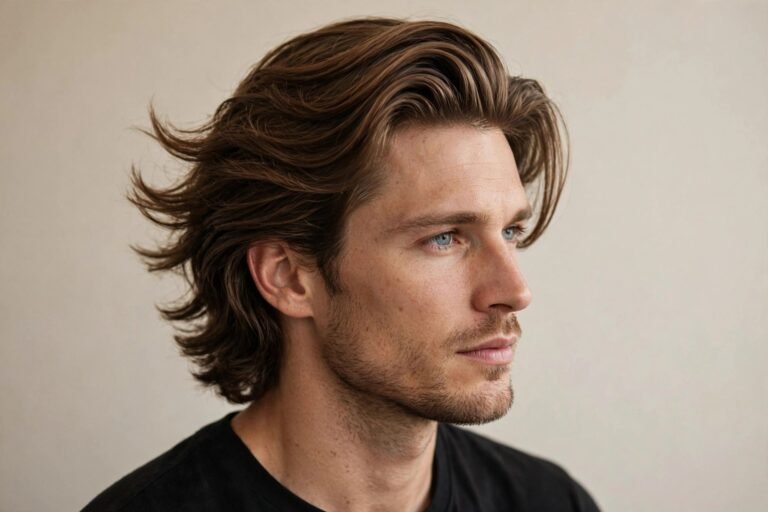
The bro flow — 4 to 7 inches of layered hair pushed back and flowing with natural movement — is the oval face’s long-hair sweet spot. It’s relaxed, masculine, and effortlessly cool in a way that shorter cuts can’t replicate. The flow’s backward movement opens up the whole face, and on balanced proportions that openness reads as confidence. This is the cut of surfers, athletes, and men who look like they have interesting weekends. The full breakdown lives in the bro flow guide if you want the long version.
Who it suits: oval faces with wavy or straight hair that has natural movement — the flow needs hair that wants to move. Thick hair is ideal; fine hair can work with layers and texture spray. Men willing to grow through 4 to 6 months of awkward stages. Long-leaning ovals should keep the flow’s volume controlled on top and let the sides have some presence.
Barber script: “Growing a bro flow — keep everything growing, but layer it so it flows back naturally. Take weight out of the interior so it doesn’t puff out, and shape the ends so it sits. Tidy the neckline but keep it natural. I want it to look like I don’t try — even though we both know I will.”
Morning styling: the flow rewards air-drying — wash, towel-dry, work a light cream or sea salt spray through, push back, done. Three minutes. The enemy is over-styling; the flow’s charm is that it looks unstudied. A wide-tooth comb on wet hair prevents tangles without killing the wave pattern.
Maintenance: trims every 8 to 10 weeks — mostly shaping and dead-end removal. The cheapest maintenance on this list.
Honest downside: the grow-out is a genuine test of character — months of hats and awkward tucks. It needs regular washing (long hair shows oil), and in wind it becomes a full-time management job. Also, be honest: the bro flow on the wrong man reads “unemployed.” Grooming elsewhere (beard neat, clothes sharp) keeps it reading intentional.
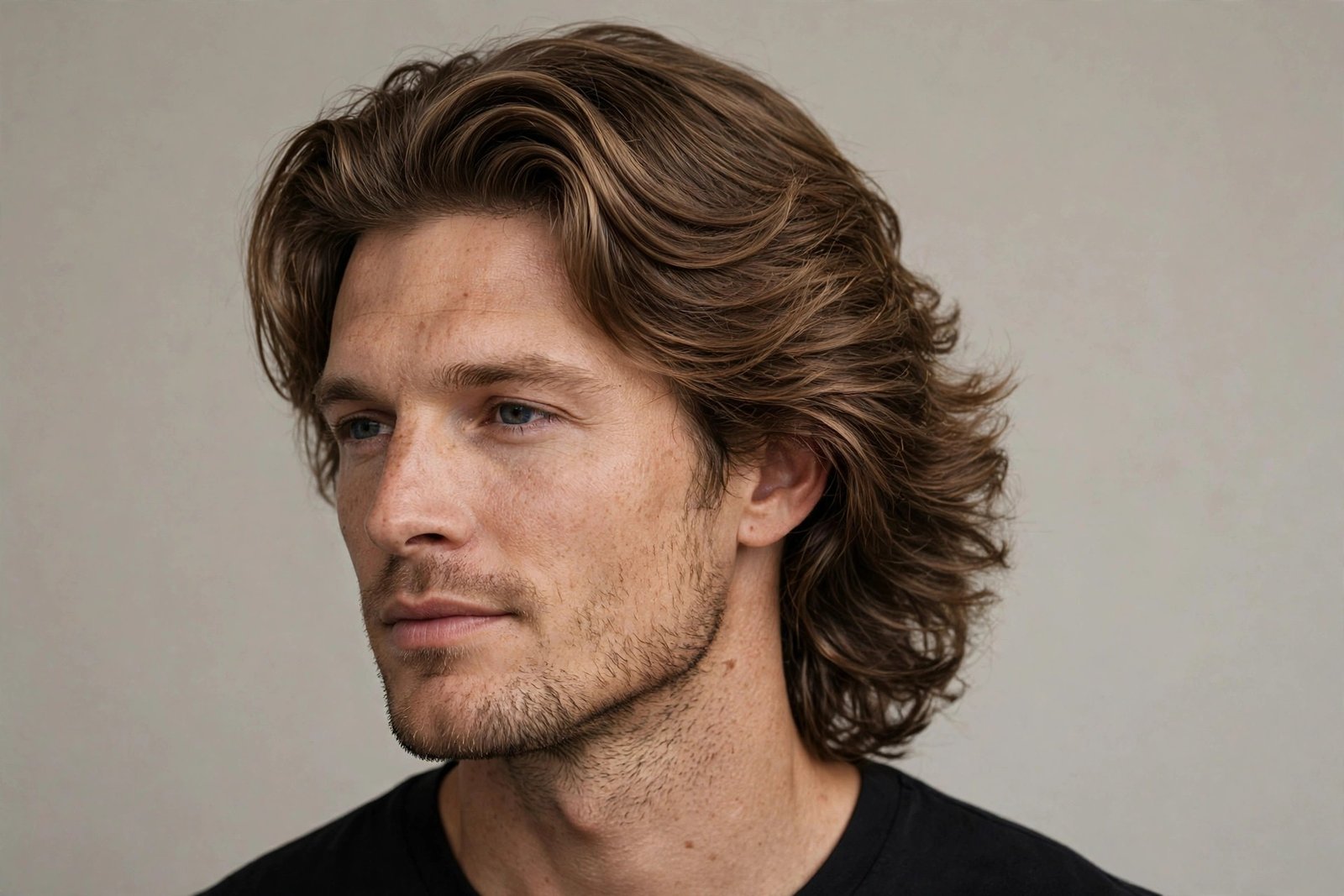
12. The Caesar Cut
The Caesar — short, even length all around with a short fringe, named for a Roman emperor and worn by everyone from George Clooney to half the NBA — is the oval face’s most underrated short option. Unlike the French crop’s textured chaos, the Caesar is neat and uniform: 1 to 2 inches everywhere, fringe cut straight across. On an oval face, the Caesar’s horizontal fringe line emphasizes the face’s balanced width, and the uniform length keeps the head’s proportions honest. It’s ancient, it’s simple, and it works.
Who it suits: long-leaning ovals especially — the fringe visually shortens the face. Straight hair shows the Caesar’s clean lines best; wavy hair gives it a softer, modern feel. Men who want short without the aggression of a skin fade.
Barber script: “Caesar cut — even all over, about an inch to an inch and a half, fringe straight across the forehead. Fade the sides slightly or keep them the same length — I’ll trust your eye, but no skin fade, I want it soft. Clean, even, Roman.”
Morning styling: wash and go, honestly. A tiny amount of light product if you want the fringe to sit, but the Caesar is designed to need nothing. One minute. This is the cut for men who view hair as a solved problem.
Maintenance: every 2 to 3 weeks — uniform short cuts show growth immediately.
Honest downside: it’s plain. There’s no texture story, no styling versatility, no drama. On the wrong man it reads “I gave up” rather than “I’m classic.” The Caesar needs confidence and good grooming elsewhere to avoid looking like a default setting. And the straight fringe is unforgiving of an uneven hairline — know your hairline before you commit.
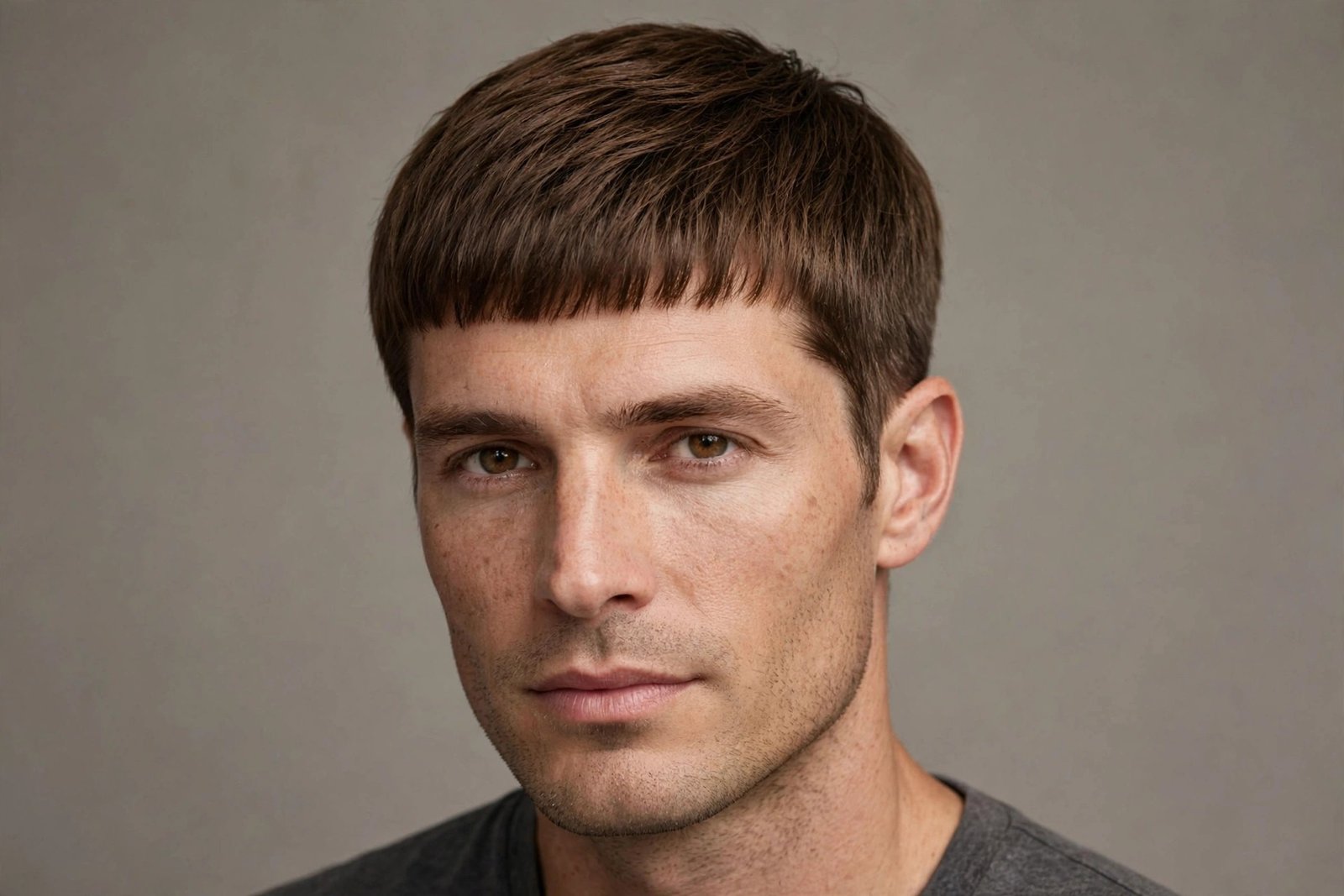
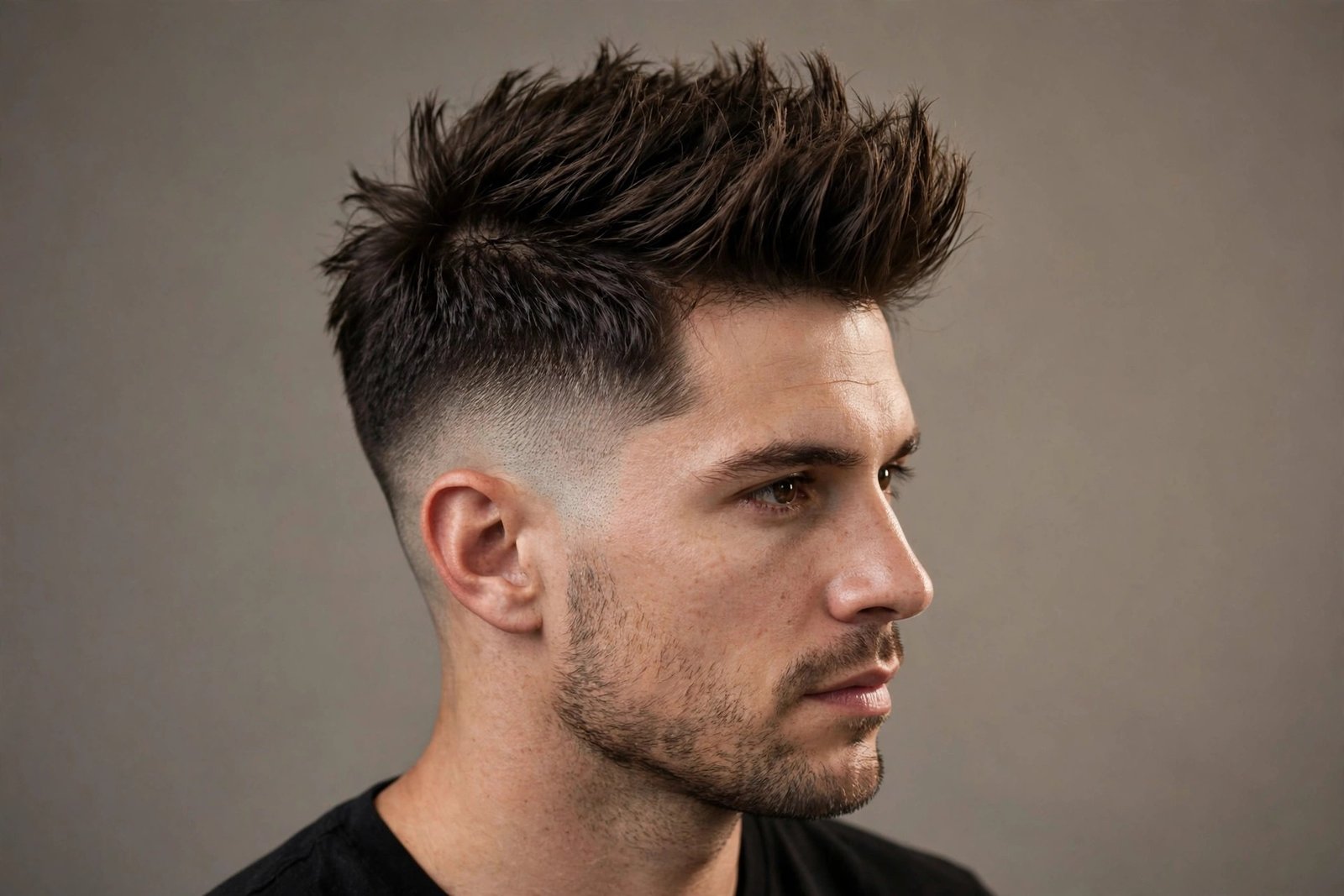
13. The Faux Hawk
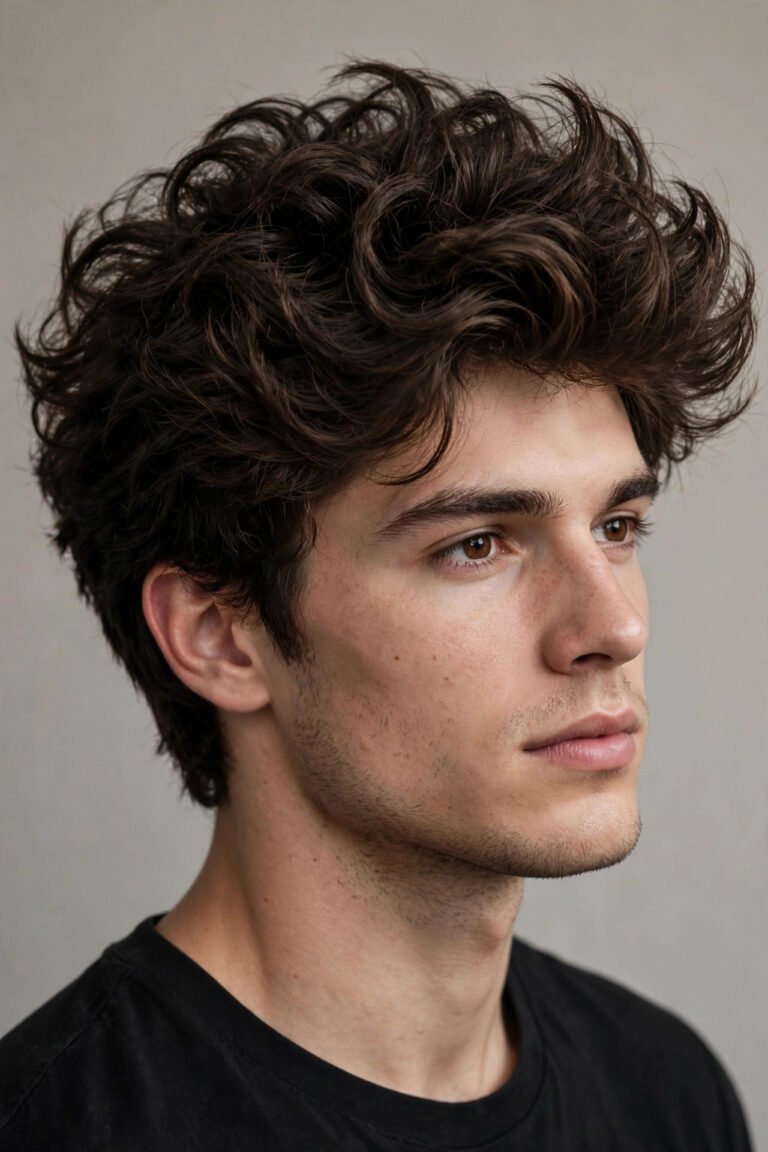
The faux hawk — volume and texture spiked or pushed toward the center, sides faded or tapered — is the oval face’s wildcard. It’s the most aggressive cut on this list, and the oval face handles it better than any other shape because the balanced proportions keep the drama in the hair where it belongs. The faux hawk adds height and attitude without the commitment (or the HR meeting) of a real mohawk. Wear it bold on weekends, tone it down with a side sweep for the office — it’s two cuts in one.
Who it suits: oval faces with straight to wavy hair and medium density. Wide-leaning ovals get a nice lengthening effect from the center height. Men under 40 wear it most naturally, but the toned-down office version has no age limit. You need 3 to 4 inches on top.
Barber script: “Faux hawk — 3 to 4 inches through the center, textured to push up and toward the middle. High fade on the sides, but keep some length so it’s not a mohawk — I want to be able to wear it down too. The top should have enough texture to spike or sweep.”
Morning styling: blow-dry the top upward toward the center, strong matte clay or paste, push everything toward the middle and pinch upward. Five minutes for the full hawk; two minutes to sweep it to the side for the office version. Strong product is non-negotiable — weak product gives you a limp faux hawk, which is the saddest of all hair outcomes.
Maintenance: every 2 to 3 weeks — the high fade grows out fast and the contrast is the whole point.
Honest downside: it’s a young man’s cut that doesn’t age gracefully past a point — know when to graduate to the textured quiff. The daily styling commitment is real, and the office version requires actual skill to pull off convincingly. Also: strong opinions. People will have them about your hair. If that bothers you, pick the side part.
14. Long Layered Flow (Shoulder Length)
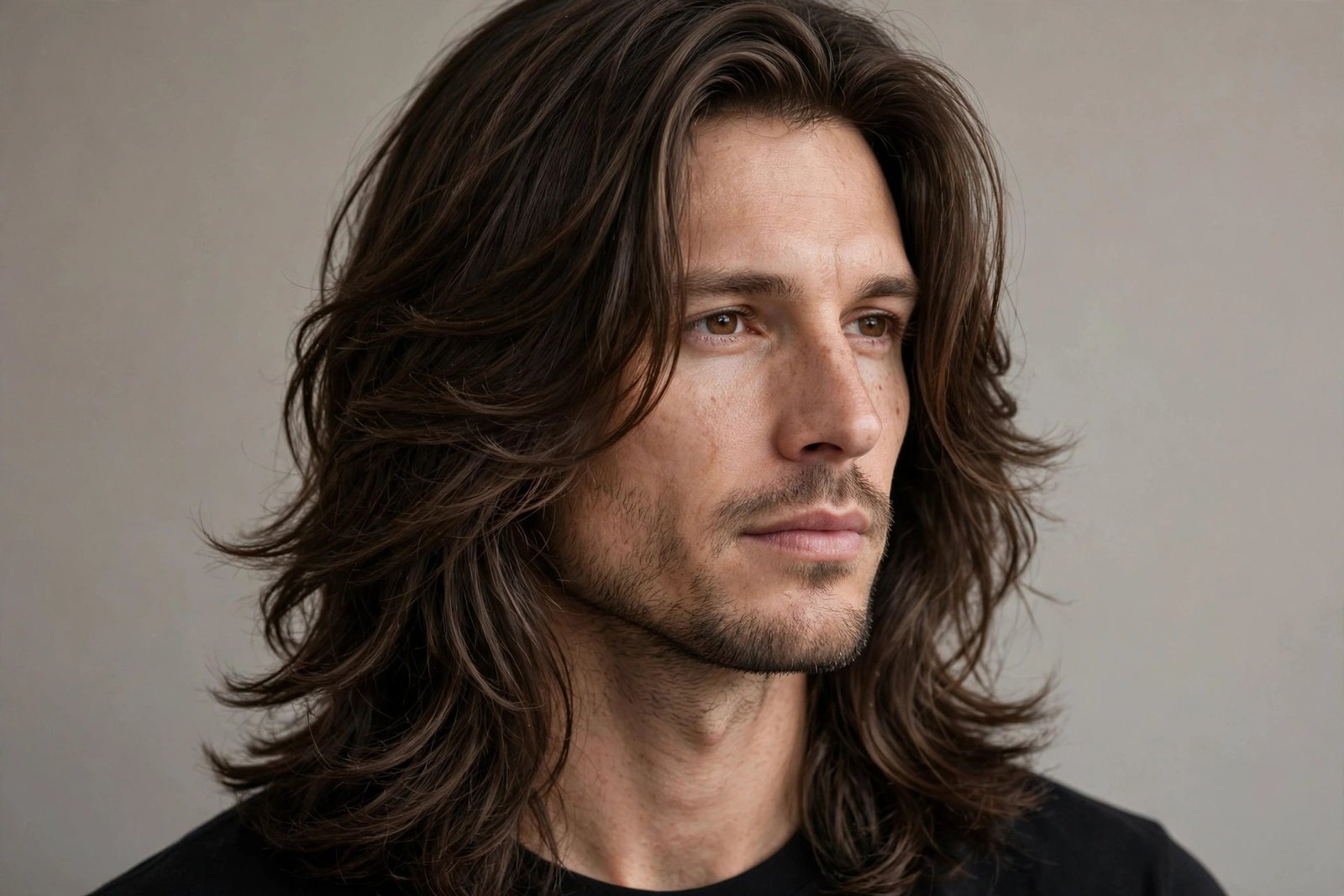
The longest option on this list — shoulder-length layered hair worn loose — is the oval face’s final boss. Long hair on an oval face is spectacular because the face’s symmetry anchors the drama of the length; where long hair can overwhelm rounder or narrower faces, the oval face holds its own. Layers keep it from hanging like a curtain, and the natural movement of longer hair softens everything. This is the cut of rock stars, artists, and men who decided that short hair was a phase. It takes a year to grow. It’s worth it.
Who it suits: oval faces with thick, healthy hair — density is everything at this length. Wavy hair is the dream texture; straight hair works with layers for movement. Men with the patience for a 12-month grow-out and the discipline for actual hair care (yes, conditioning, we’ll get there).
Barber script: “Growing to shoulder length — long layers throughout to create movement, face-framing pieces in front, weight removed from the interior so it doesn’t triangle out. Keep the ends healthy — dust them every visit. I want it to move, not hang.”
Morning styling: wash 2 to 3 times a week (not daily — long hair needs its oils), condition every wash, air-dry or diffuse. A light oil on the ends prevents the frizz that ruins long hair’s look. Brush with a wide-tooth comb when damp, never a brush on dry hair. Ten minutes on wash days, two minutes otherwise. Tie it back for workouts and sleep — friction is the enemy of long hair.
Maintenance: trims every 10 to 12 weeks — just dusting the ends and refreshing layers. The grow-out is the project; maintenance is easy.
Honest downside: a year of awkward stages, and there’s no shortcut. Long hair shows damage mercilessly — split ends, dryness, all of it. It needs real care: conditioner, occasional masks, heat protection. And culturally, long hair on men still draws comments — make sure you want the attention, because you’ll get it.
Styling, Maintenance & the Oval Face Advantage
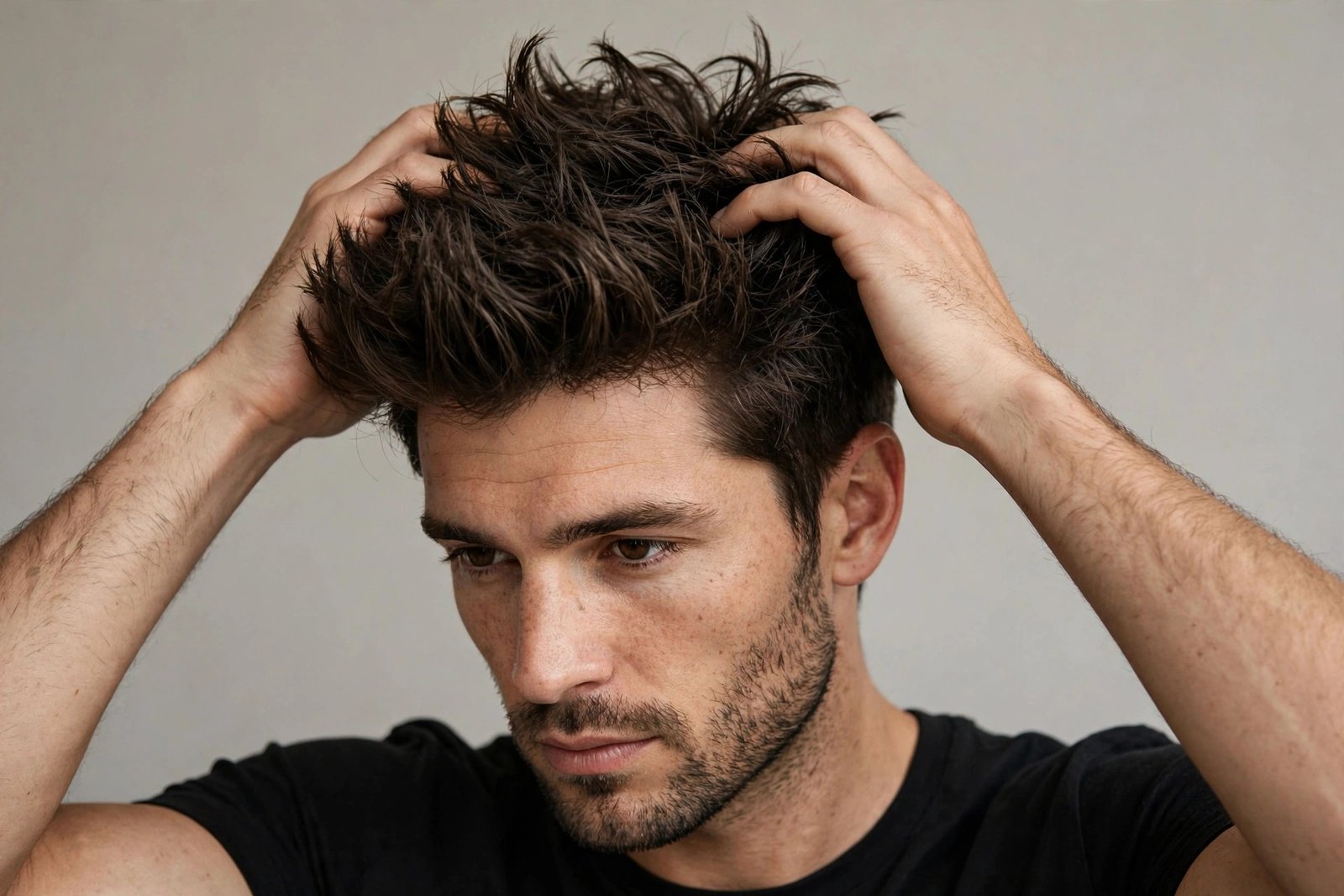
Here’s the part most haircut guides skip: the cut is 30% of the result. The other 70% is what you do every morning and how often you see your barber. Oval faces have a maintenance advantage — balanced proportions are forgiving of grow-out — but “forgiving” isn’t “immune.” This section is the routine that keeps any of these oval face haircuts men choose looking intentional instead of accidental.
The 10-Minute Morning Routine That Works for Every Cut Above
Forget 14 different routines. Nearly every style on this list runs on the same foundation: clean damp hair, heat for direction, product for hold, fingers for finish. The differences are in the details, not the sequence. Start with hair that’s damp, not dripping — towel-dry thoroughly, because product on soaking hair just slides off and styling wet hair guarantees frizz. If your cut needs volume (quiff, pompadour, textured tops), the blow-dryer is your primary tool and product is secondary; if your cut is short or forward-falling (crop, Caesar, fringe), product does the work and the dryer is optional.
The dryer technique that changes everything: dry in the direction you want the hair to go, lifting at the roots. Most men dry randomly and then wonder why the style collapses. Point the dryer’s nozzle down the hair shaft (never up into it — that creates frizz), use your fingers or a brush to guide, and finish with 10 seconds of cool air to set the shape. Heat shapes, cool sets — that’s the whole science. Two to three minutes of proper drying beats ten minutes of product wrestling.
Product order matters more than product brand: pre-styler on damp hair (sea salt spray for grip and texture, heat protectant if you’re drying hot), then dry, then the main styler (clay, paste, pomade, or cream depending on your cut), then — and only if needed — a light finishing touch. The most common mistake I see is using too much product. Start with less than you think — a pea-sized amount for short hair, a dime for longer — and add more only if the style genuinely needs it. You can always add; you can’t subtract without rewashing. Over-producted hair looks greasy by noon and no product on earth fixes that except a shower.
Finally, the finish: after product, use your fingers — not the comb — for the final shaping on every textured style. Combs create uniformity; fingers create the piece-y separation that makes 2026 cuts look modern. The comb is for direction (partings, slick backs); fingers are for character. Learn the difference and your morning routine drops to five real minutes.
Products That Earn Their Shelf Space (and the Ones That Don’t)
You need four products, maximum. Everything else is marketing. First, a matte clay or paste — the workhorse for textured styles (quiff, crop, fringe, faux hawk, mid fade tops). Matte finish, medium to strong hold, reworkable through the day. Second, a light styling cream — for the side part, Ivy League, curtains, and bro flow. Natural finish, light hold, never crunchy. Third, a sea salt spray as a pre-styler — it gives fine or flat hair the grip and texture that makes everything else work better. Fourth, a satin or classic pomade — for the slick back and pompadour, where you want controlled shine and serious hold.
What you don’t need: hairspray for daily use (it makes hair look done in the wrong way — save it for weddings and photos), gel (the 2026 textured era has no patience for wet-look crunch except in deliberate slick styles), “volumizing powders” (they work for about an hour, then turn to dust in your hair), and anything marketed with the word “extreme.” Your hair is not an extreme sport. Buy from a barbershop or a reputable brand, not the cheapest option at the drugstore — the difference between a $6 clay and a $16 clay is genuinely visible in your hair by 3 p.m.
One product note specific to oval faces: because your face shape doesn’t need visual correction, you can choose products purely for the style’s needs rather than for face-shape trickery. Round faces sometimes need extra height products; square faces sometimes need softening products. You don’t. Pick what the cut asks for and nothing more — it’s one of the quiet luxuries of the balanced face.
The Barber Schedule That Keeps Proportions Honest
The golden rule has a maintenance corollary: a cut that protects balance only protects it while the shape holds. Grow-out doesn’t just add length — it changes the silhouette, and silhouette is what the eye reads. The fades (mid fade, faux hawk sides, French crop) need attention every 2 to 3 weeks because the gradient is the style. The classic shapes (side part, Ivy League, Caesar) hold 3 to 4 weeks. The growers (curtains, bro flow, long layers) actually improve with time and need only shaping every 6 to 12 weeks.
Here’s the scheduling trick that saves money and keeps you sharp: alternate full cuts with clean-up visits. A full cut every 6 weeks with a 15-minute neckline-and-edges tidy at week 3 keeps fades and tapers looking fresh for half the cost of bi-weekly full cuts. Most good barbers offer tidy-ups cheap or free for regulars — ask. And book your next appointment when you leave the chair, not when you notice the mirror. By the time you notice, you’ve had a week of subpar hair.
Communication compounds, too. The first visit with a new barber is an interview — bring reference photos (not celebrity glamour shots; find photos of real men with your hair type), use the scripts from the styles above, and watch how they respond. A barber who asks about your routine, your growth patterns, and how much effort you’ll put in daily is a keeper. A barber who nods and reaches for the clippers in 30 seconds will give you a haircut, not your haircut. On an oval face, where the margin between “great” and “generic” is entirely in the details, the barber matters more than the cut. Choose accordingly.
Mistakes That Make an Oval Face Look Long, Wide, or Just Off
Even with the most forgiving face shape, there are ways to get it wrong. Mistake one: too much height on a long-leaning oval. A towering quiff or a big pomp on an already-long face stretches the proportions past balance into caricature. If your oval runs long, keep top volume moderate and let the sides carry some presence. Mistake two: flat, wide styles on a wide-leaning oval. A buzz with no beard, or a Caesar with zero texture, can make a wide oval look squat — the face needs a little vertical interest to stay elegant.
Mistake three is the beard mismatch. A very long, narrow beard on an oval face creates an oblong illusion; a sharply boxed, angular beard imposes square geometry on soft features. The fix is simple: keep the beard’s bottom edge softly rounded and its length proportional — for most oval faces, 1 to 2 inches of shaped beard is the sweet spot. Longer than that and the beard starts redesigning your face without permission.
Mistake four: the too-tight sides trap. Aggressive skin fades taken too high can make the head look small relative to the face — the “lollipop” effect. On an oval face, mid fades and tapers almost always look better than high skin fades, because they preserve the head’s natural width. If you love fades, keep them mid or low and blended. Mistake five: ignoring the neckline. A fuzzy, overgrown neckline ruins even the best cut’s proportions within two weeks — it’s the cheapest detail to maintain and the most visible when neglected. Clean it up weekly at home with a trimmer or book the tidy-up. Your call, but don’t skip it.
Frequently Asked Questions
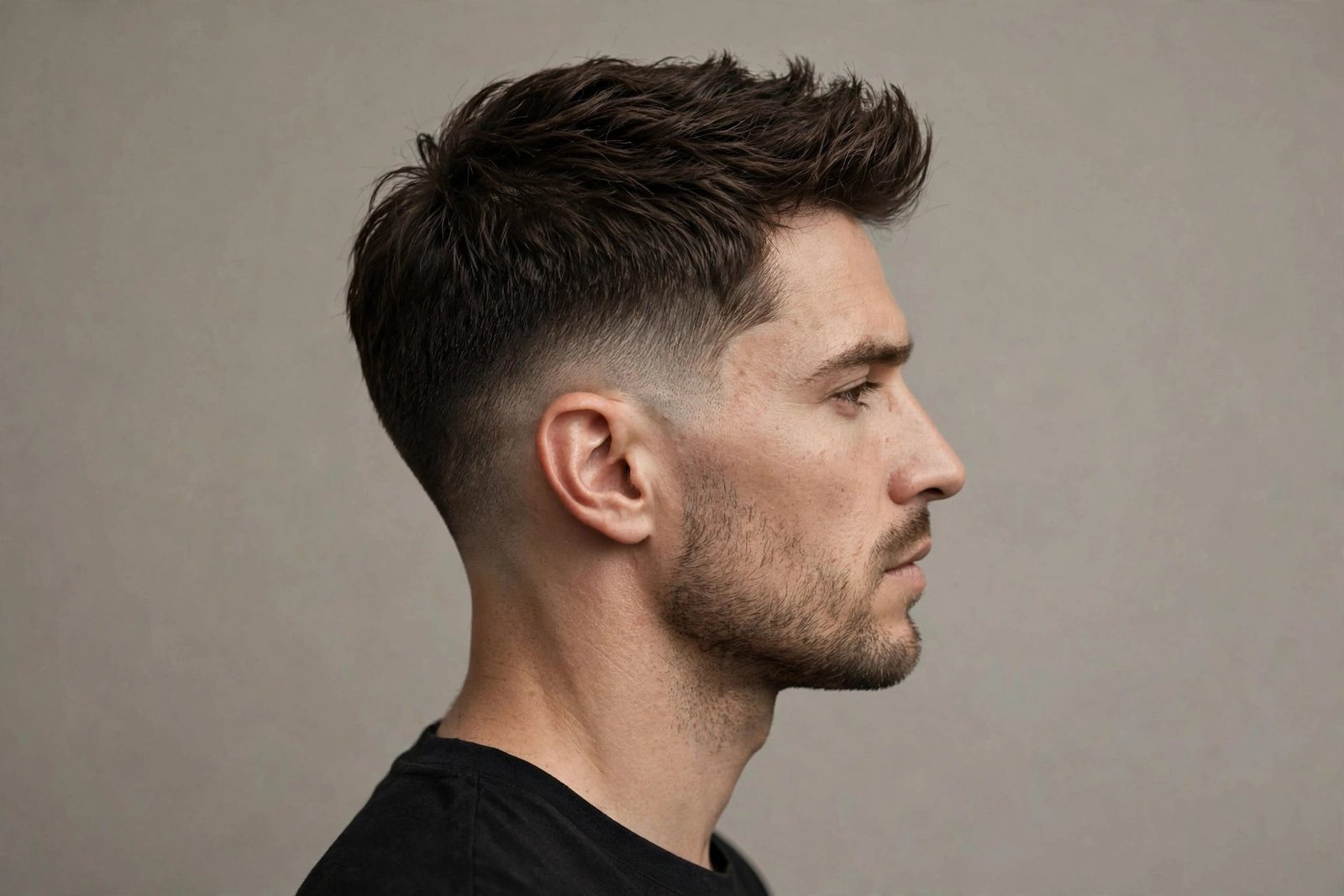
Quick answers to the questions oval-faced men actually ask — in the chair, in DMs, and in front of the mirror at 7 a.m.
What is the best haircut for an oval face male?
There’s no single “best” — that’s the oval face’s whole point. But if you want the highest-probability choice, the classic side part and the textured quiff are the two safest outstanding options: the side part for timeless polish, the quiff for modern impact. Both respect the face’s balance, suit nearly all hair types, and work in every setting from boardroom to bar. The real answer depends on your hair type, your effort budget, and whether your oval leans long or wide — long-leaning ovals should favor the side part, French crop, or textured fringe; wide-leaning ovals should favor the quiff, pompadour, or anything with height. That’s the shortlist of oval face haircuts men should start from — pick from the 14 above using the “who it suits” line, not from a trending video.
Can oval faces wear a buzz cut?
Yes — and often spectacularly, because the buzz reveals the face’s natural symmetry instead of hiding it. The caveat is the beard: a buzz on an oval face looks significantly better with a well-kept medium beard, which adds the width and structure that very short hair removes. Clean-shaven buzz on an oval face can read stark or severe. Also, know your head shape — the buzz exposes everything, including bumps and asymmetry you never knew you had. If your head shape is smooth and your beard game is decent, the buzz is one of the strongest looks an oval face can wear. If either is questionable, the Ivy League gives you 90% of the effect with insurance.
Should men with oval faces avoid any haircuts?
Avoid is a strong word — almost nothing is truly forbidden. But three categories deserve caution. First, extreme height on long-leaning ovals (towering quiffs, oversized pomps) stretches already-long proportions. Second, very long, narrow beards paired with short hair, which can make the face read oblong. Third, hyper-aggressive high skin fades that shrink the head’s apparent width and create the lollipop effect. Notice these are all about proportion extremes, not specific cuts. The golden rule covers it: if a style dramatically adds length or width in one direction, check it against your oval’s lean before committing.
Do curtains suit an oval face?
Curtains might suit the oval face better than any other shape. The middle part frames both sides of the face symmetrically, which plays directly to the oval’s balanced strengths — it’s one of the few cuts that actively showcases symmetry rather than just accommodating it. The requirements: enough density for the part to hold, a fairly even hairline (strong widow’s peaks fight the center part), and patience for the 2-to-4-month grow-out. Keep the curtain length and texture controlled if your oval leans long. Done right, it’s the most striking option on this list.
How do I know if my face is oval or oblong?
The difference is degree: both are longer than wide, but the oblong face is noticeably longer with a taller forehead and often a longer chin, while the oval keeps everything in moderate proportion. Try the finger-trace test on a mirror with your hair pulled back — a smooth egg shape is oval; a distinctly elongated egg trending toward a rectangle is oblong. Or measure: if your face length is more than about 1.5 times its width, you’re likely oblong. It matters because the advice flips — oblong faces must avoid added height and need side volume, while oval faces can take height freely. When in doubt, show your barber a straight-on photo and ask; a good barber reads face shapes all day.
What beard style suits an oval face?
The medium-full beard with a naturally rounded bottom edge — it adds masculinity and structure without rewriting the face’s geometry. Keep 1 to 2 inches of length, clean up the cheek line (but don’t carve it into sharp angles that fight the face’s softness), and let the bottom follow your jaw’s natural curve. Avoid very long narrow beards (they elongate the face toward oblong) and sharply boxed beards (they impose square angles on soft features). Stubble also works beautifully on oval faces — a 5-to-10-day stubble adds edge without changing proportions. The beard should echo the face, not redesign it.
How often should I get a haircut with an oval face?
It depends on the cut, not the face shape. Fades and short textured cuts (mid fade, French crop, faux hawk, Caesar) need every 2 to 3 weeks. Classic medium cuts (side part, Ivy League, quiff, slick back) hold 3 to 4 weeks. Growing styles (curtains, bro flow, long layers) need shaping only every 6 to 12 weeks. The oval face’s advantage is that grow-out stays flattering longer than on most shapes — balanced proportions degrade gracefully. But “graceful” has limits: use the tidy-up trick (neckline and edges at the halfway mark) to stretch any schedule without looking neglected.
Conclusion
Having an oval face is like being dealt a strong hand — it doesn’t play itself. These 14 oval face haircuts men can wear in 2026 all respect the golden rule: protect the balance, add intent. Whether you choose the timeless side part, the statement quiff, the low-effort Caesar, or the year-long commitment of shoulder-length layers, the difference between good and great is in the details — the barber script you bring, the five minutes you spend each morning, the tidy-up you don’t skip.
So pick one. Book the cut. Bring the script. And enjoy the quiet luxury of a face shape that lets the haircut be about style instead of correction — then make the style count. For broader grooming inspiration, GQ’s grooming coverage pairs well with our guides — and for general hair science, Wikipedia’s hair article is a solid starting point.