Pink Hair Women 2026: 32 Pink-a-Boo Styles & Complete Color Guide
Why Pink Hair Women Are Winning 2026
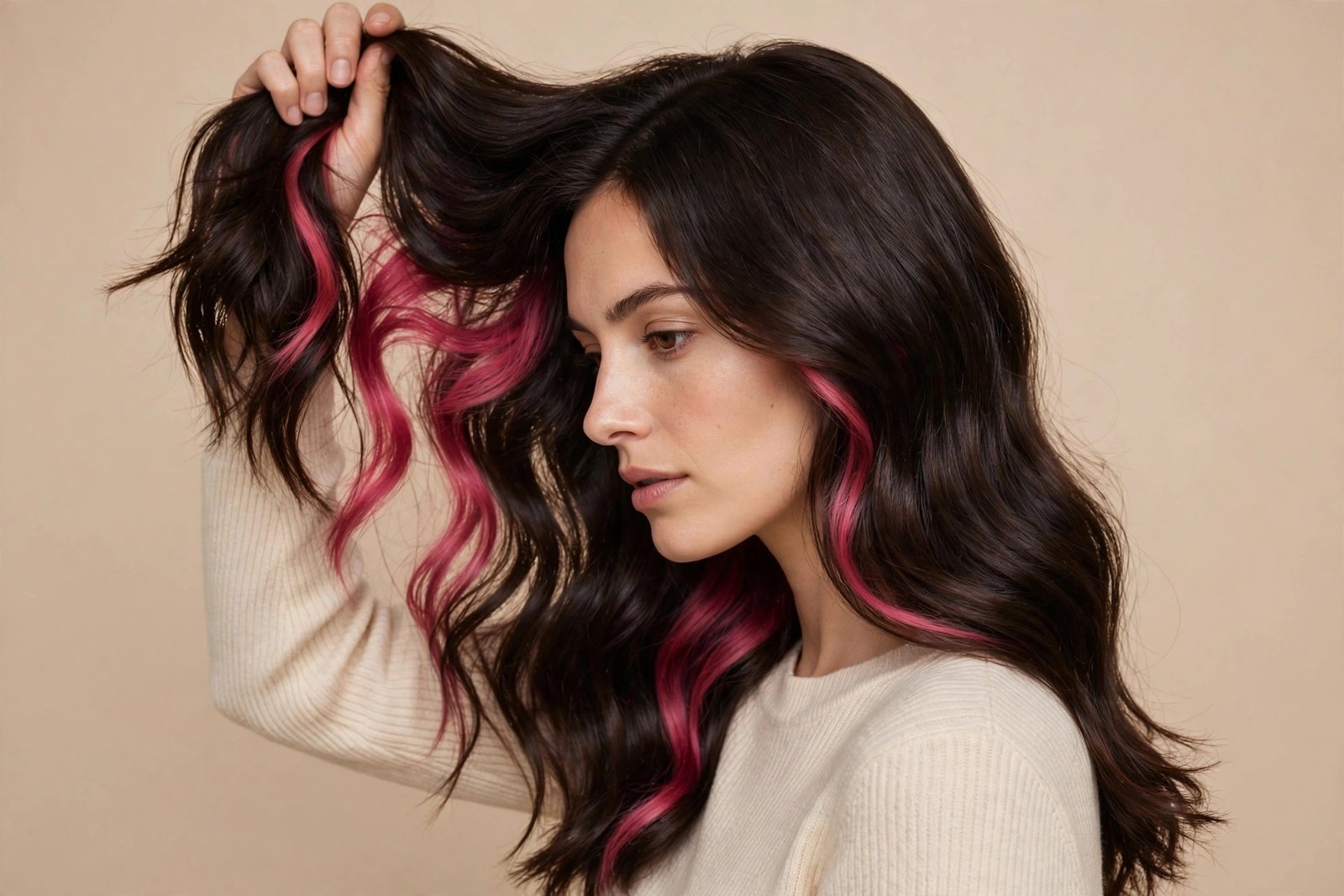
Something shifted in hair color this year, and if you’ve been anywhere near Pinterest you already felt it. The era of committing your entire head to one flat shade of pink is over. What replaced it is smarter, prettier, and honestly more fun: pink hair women are wearing in 2026 is all about placement. Chunky pink stripes tucked under a dark top layer. Dusty rose money pieces that catch the light when you turn your head. A flash of teal next to a panel of magenta. The trend even has a name now — Pinterest’s first-ever Beauty Trend Report, released in October 2026, officially crowned it “Pink-a-Boo.”
And the numbers behind it are wild. Searches for dark pink peekaboo hair are up 481% on Pinterest. Pink hair stripe is up 463%. Dusty rose pink hair climbed 198%, and pink hair dye streaks rose 190%. This isn’t a quiet micro-trend your colorist will look confused about — it’s the defining color story of the year, and salons are already booked out with clients showing the same saved photos. The reason it’s exploding is simple: pink-a-boo gives you the thrill of fantasy color without the all-in commitment. Your natural base stays. Your grow-out stays civilized. And you can hide the whole thing for a job interview and unleash it on Friday night.
I’ve watched fantasy color go through a dozen cycles, and I’ll be honest with you — this is the first pink trend I’d recommend to almost anyone. The old all-over pink was brutal: full-head bleach, root touch-ups every three weeks, and a fade that left you with patchy peach regrets. Pink-a-boo flips the math. You’re lightening maybe 10 to 20 percent of your hair — a couple of panels, a few face-framing pieces — which means less damage, less money, less time in the chair, and color that fades like a watercolor instead of a bad decision. Even brunettes who swore they’d never bleach anything can play, because the bleached sections are small enough to baby.
This guide is the complete playbook: 32 pink-a-boo styles from subtle dusty rose to full neon statement, the exact words to use with your colorist so you actually get the photo you saved, an honest breakdown of what each shade costs and how long it lasts, and the color-safe routine that keeps pink vivid instead of sad. Whether you want a whisper of rose gold or a scream of hot pink, it’s in here. Let’s find your pink.
Table of Contents
- Why Pink Hair Is 2026’s Biggest Color Story
- 32 Pink-a-Boo Styles for Women in 2026
- The Pink Hair Color-Safe Care Routine
- The 2-Wash Weekly Schedule
- Pink Hair Women: Frequently Asked Questions
- Final Word: Find Your Pink
What Is Pink-a-Boo Hair?
Pink-a-boo is the 2026 name for a simple idea: pink placed where it peeks out instead of sitting on top. Think of it as the evolution of peekaboo highlights, but with the volume turned up. Instead of the fine, blended slices of traditional peekaboo color, pink-a-boo goes chunky — wide panels of pink hidden under your natural top layer, bold stripes framing the face, or a full underlayer dyed vivid while the crown stays your own color. When your hair is down and still, you look like yourself. When you move, tie it up, or the wind catches it — surprise. That’s the whole game, and it’s why the trend photographs so well: every candid shot becomes a reveal.
The look has three main placements you’ll see across all 32 styles below. The underlayer peekaboo is the classic: the bottom third or so of your hair (or just the nape panels) goes pink while the top stays natural. Money pieces put the pink right at the front — two face-framing ribbons that brighten your whole face the way contour does. And stripes are the boldest: thick, graphic bands of pink worked through the mid-lengths or at the hairline, very 90s-revival, very deliberate. Colorists also mix in tone pairings — dusty rose with chocolate brown, hot pink with black, pink with teal for the brave — because pink-a-boo is as much about contrast as it is about the pink itself.
What it is not: a full head of pink, pastel or otherwise. That look had its moment and Pinterest has officially moved on. What replaced it is more wearable for real life — you keep your natural color as the anchor, which means your regrowth blends, your hair stays healthier, and the pink reads as an accessory rather than an identity crisis. If you’ve ever wanted fantasy color but talked yourself out of it because of the upkeep, pink-a-boo was designed for exactly you.
Why 2026 Is the Year of Pink
Every few years, hair color has a moment where the culture collectively decides to have fun again, and 2026 is that year. Pinterest naming Pink-a-Boo in its first Beauty Trend Report matters because Pinterest is where hair trends are born now — it’s the search engine of aspiration. When dark pink peekaboo hair searches jump 481% and pink hair stripe jumps 463%, that’s not a blip; that’s millions of women independently arriving at the same craving. And the craving makes sense: after years of expensive-looking neutrals and quiet luxury everything, people want color with a pulse again. Pink is the gateway — playful but not alien, bold but still pretty.
There’s also a practical reason the timing worked. Hair health is the other big 2026 conversation — bond builders, scalp care, the rejection of fried ends. All-over fantasy color was always at war with healthy hair because it demanded full-head bleaching. Pink-a-boo ends the war. You get the dopamine of vivid color while keeping 80-plus percent of your hair completely virgin. Colorists love it because it’s creative work that doesn’t destroy anyone’s hair. Clients love it because the appointment is shorter, the bill is smaller, and the grow-out doesn’t hold them hostage. Trends that are fun AND practical are the ones that actually last past spring.
The third force is the 90s and Y2K revival finally reaching color. Chunky stripes, skunk highlights, the underlayer reveal — these are all ideas that existed in 2001, back when Christina Aguilera was doing the most. What’s different now is the technique: modern placement is more deliberate, the tones are more sophisticated (dusty rose didn’t exist as a salon word back then), and the blending at the roots is seamless instead of stripey. It’s nostalgia with better technology, which is the best kind of nostalgia.
Who Does Pink Actually Suit?
Here’s the honest answer nobody on TikTok gives you: pink suits far more people than you’d think, but the SHADE has to be right. Dusty rose and muted mauve-pinks are the universal donors — they sit close enough to natural warmth that they flatter warm, cool, and neutral skin tones, and they look expensive rather than costume-y. If you have warm undertones and golden skin, lean into rose gold, strawberry, and peach-leaning pinks. If you’re cool-toned and fair, blue-based pinks — magenta, fuchsia, cotton candy — will make your skin glow instead of competing with it. Deep skin tones can carry the vivid end of the spectrum spectacularly: hot pink and magenta against rich brown or black hair is one of the most striking combinations in all of hair color.
Lifestyle matters as much as skin tone. Be real with yourself about maintenance before you pick: pastels need a refresh every 2–3 weeks and near-white pre-lightening, which is a part-time job. Dusty and dark pinks are the low-drama option — they fade gracefully and hide regrowth. Your workplace matters too, though less than it used to; a hidden underlayer peekaboo is genuinely invisible in a low bun, which is the whole point. And age is not the barrier people think it is — some of the best pink-a-boo I’ve seen is on women in their 40s and 50s who wear dusty rose panels with total confidence. The only real requirement is hair healthy enough to bleach the pink sections, and the willingness to wash your hair less often than you do now.
One more thing colorists won’t tell you unless you ask: your natural base color decides how good the pink looks more than anything. Pink over warm brown or dark blonde bases melts beautifully. Pink over very dark, almost-black hair needs the most lifting and the highest contrast to show — which looks incredible but costs more. And if your hair is heavily box-dyed, get a strand test before you dream in pink; old box color can turn pink murky or refuse to lift evenly. A ten-minute test strand saves ten weeks of regret. Always.
32 Pink Hair Women Styles for 2026
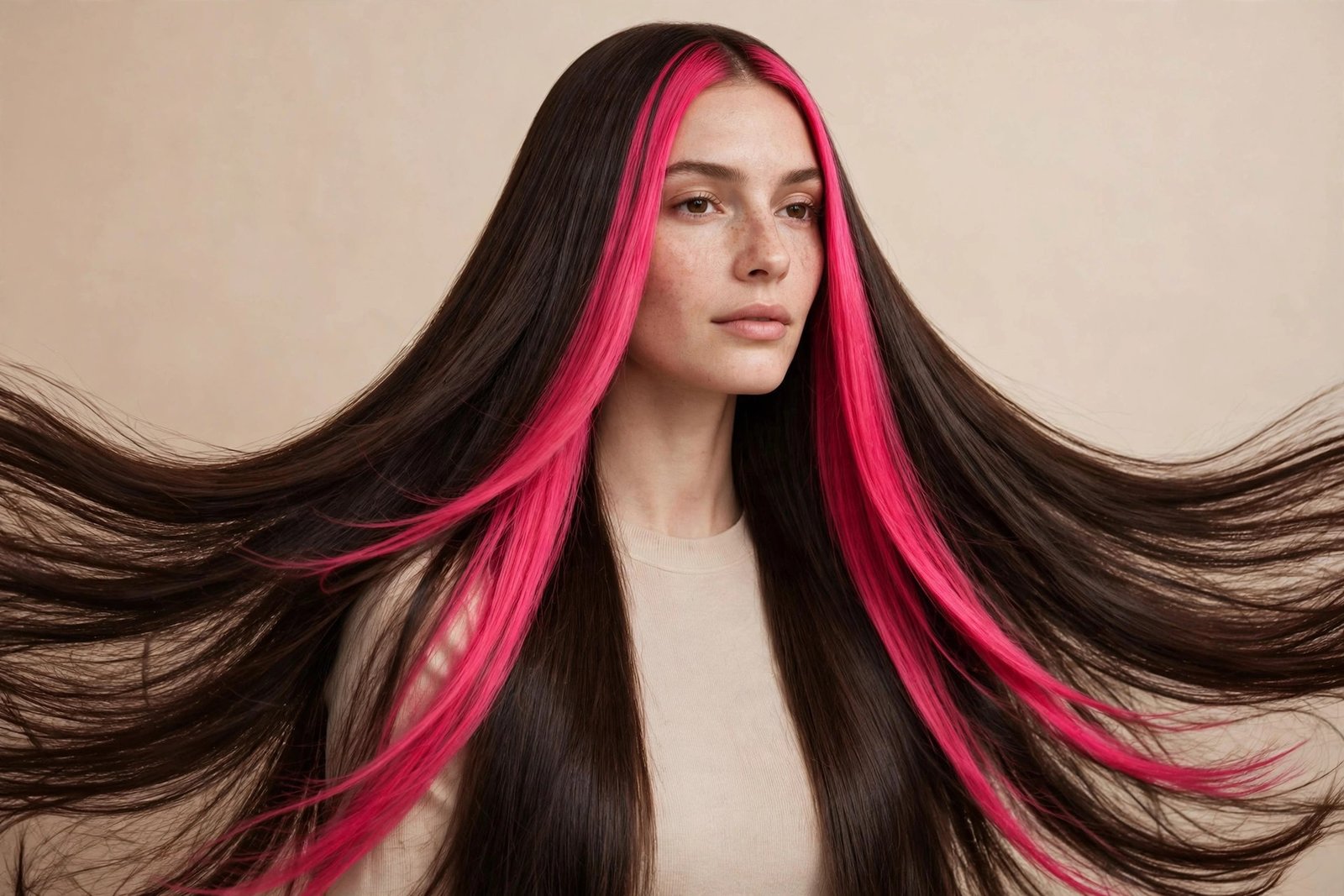
Here they are — the 32 pink-a-boo styles defining 2026, from the whisper-quiet dusty rose panels you could wear to a board meeting to the neon statements that stop traffic. Every style includes who it suits, exactly what to tell your colorist, and the honest maintenance math, because a pretty photo without a plan is just a future regret. Save your favorites and show your colorist the actual photos, not just the names.
1. The Chunky Pink Peekaboo Underlayer

This is the look that started it all, and it’s still the one I recommend first to pink beginners. The entire underlayer — roughly the bottom third of your hair, from nape to ends — is lifted and dyed a vivid pink, while the top layer stays your natural color. Worn down, you look completely “normal.” The second you put your hair up, tuck it behind your ears, or catch a breeze, there’s the pink. It’s the mullet philosophy applied to color: business on top, party underneath.
Who it suits: literally everyone with medium to long hair, because the placement does the work, not your face shape. It looks especially good on thick hair, where the hidden layer has enough density to read as a real panel of color rather than a few sad strands. Fine-haired girls can still do it — just ask for the panel to start higher, closer to the crown, so there’s enough hair to make an impact.
Colorist script: “I want a chunky pink peekaboo — lift the whole underlayer to a level 9 and do a vivid pink, keep my top layer natural with a clean part line between them.” Ask for a semi-permanent vivid (it fades softer than demi), and get them to show you where the “reveal line” sits when your hair is down — that’s the detail that separates a good peekaboo from a messy one.
Maintenance is refreshingly low: the pink lives underneath, so it fades slower (less sun, less washing friction) and regrowth is invisible. Refresh every 6–8 weeks. Honest downside: the reveal line can look harsh if your top layer is very dark and fine — ask for a soft, slightly diffused transition rather than a razor-sharp part.
2. Dark Pink Peekaboo Panels
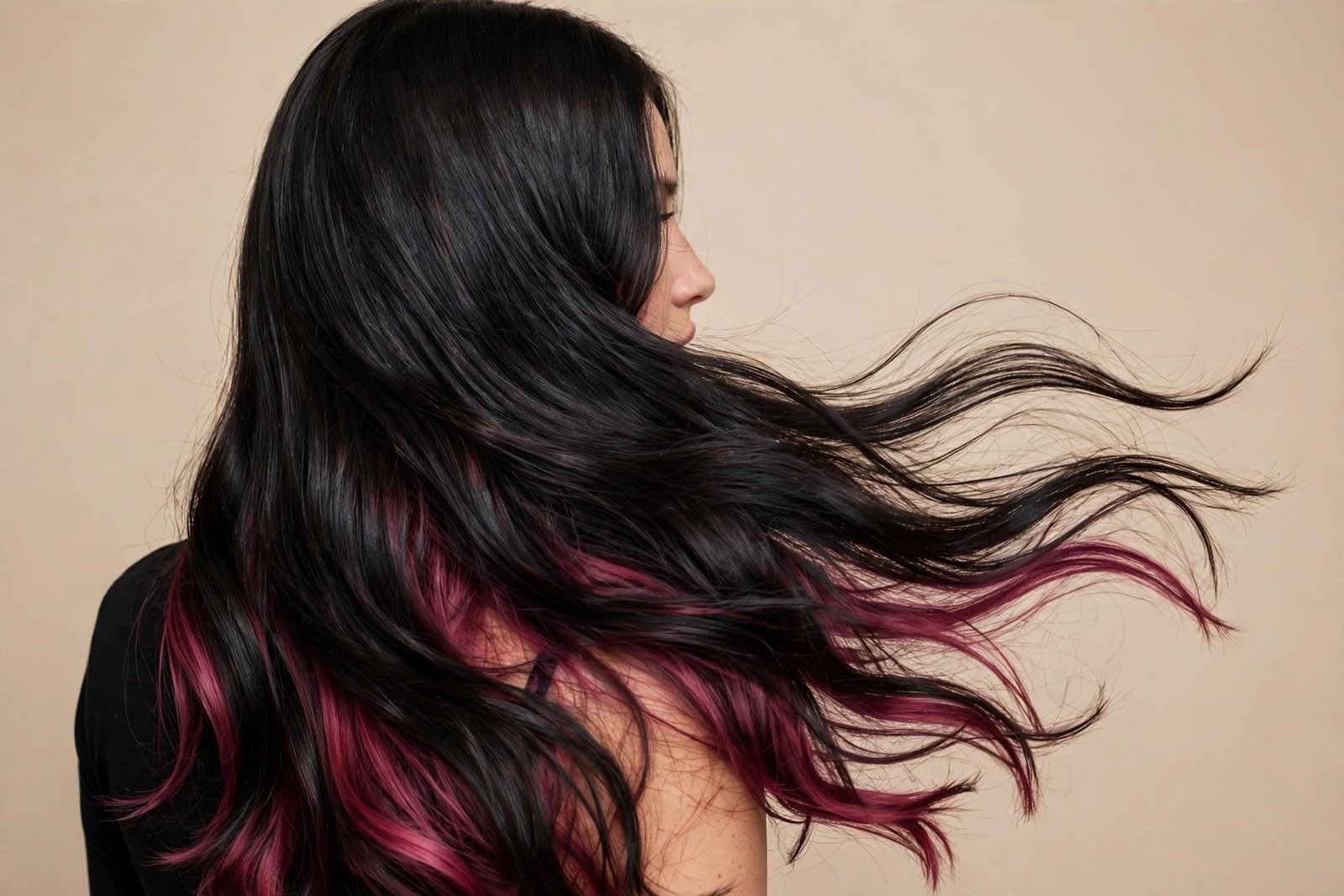
If the classic peekaboo feels a little too bubblegum for you, this is its moody older sister — and it’s the single fastest-growing search in the whole trend, up 481% on Pinterest. Instead of bright pink, the hidden panels are dyed a deep, wine-dark pink: think magenta with the lights dimmed, or the color of the inside of a cherry. Against black or deep brunette hair, it reads as this gorgeous, expensive-looking flash of color that’s somehow both subtle and dramatic.
Who it suits: dark-haired women, full stop. This is THE pink for natural level 1–4 hair because the depth of the pink harmonizes with your base instead of screaming against it. It also flatters warm and olive skin tones beautifully, and it’s the most office-friendly vivid option in this entire guide — in dim indoor light it barely reads as pink at all.
Colorist script: “Dark pink peekaboo panels — lift the underlayer to a level 7 or 8, then a deep magenta-wine pink, no pastel.” Because you’re only lifting to a 7–8 instead of a 9–10, there’s meaningfully less damage than brighter pinks, and the appointment is faster. Ask for the panels to be wide — skinny slices of dark pink disappear; you want at least two chunky panels per side.
Maintenance: this is one of the longest-lasting pinks in the guide. Darker pigment = slower visible fade, and the color melts into a dusty mauve that still looks intentional at week eight. Refresh every 7–9 weeks. Downside: on previously box-dyed black hair, lifting to an even 7 can be stubborn — insist on a test strand, and accept that the first session might land slightly deeper than the photo.
3. Dusty Rose Money Pieces
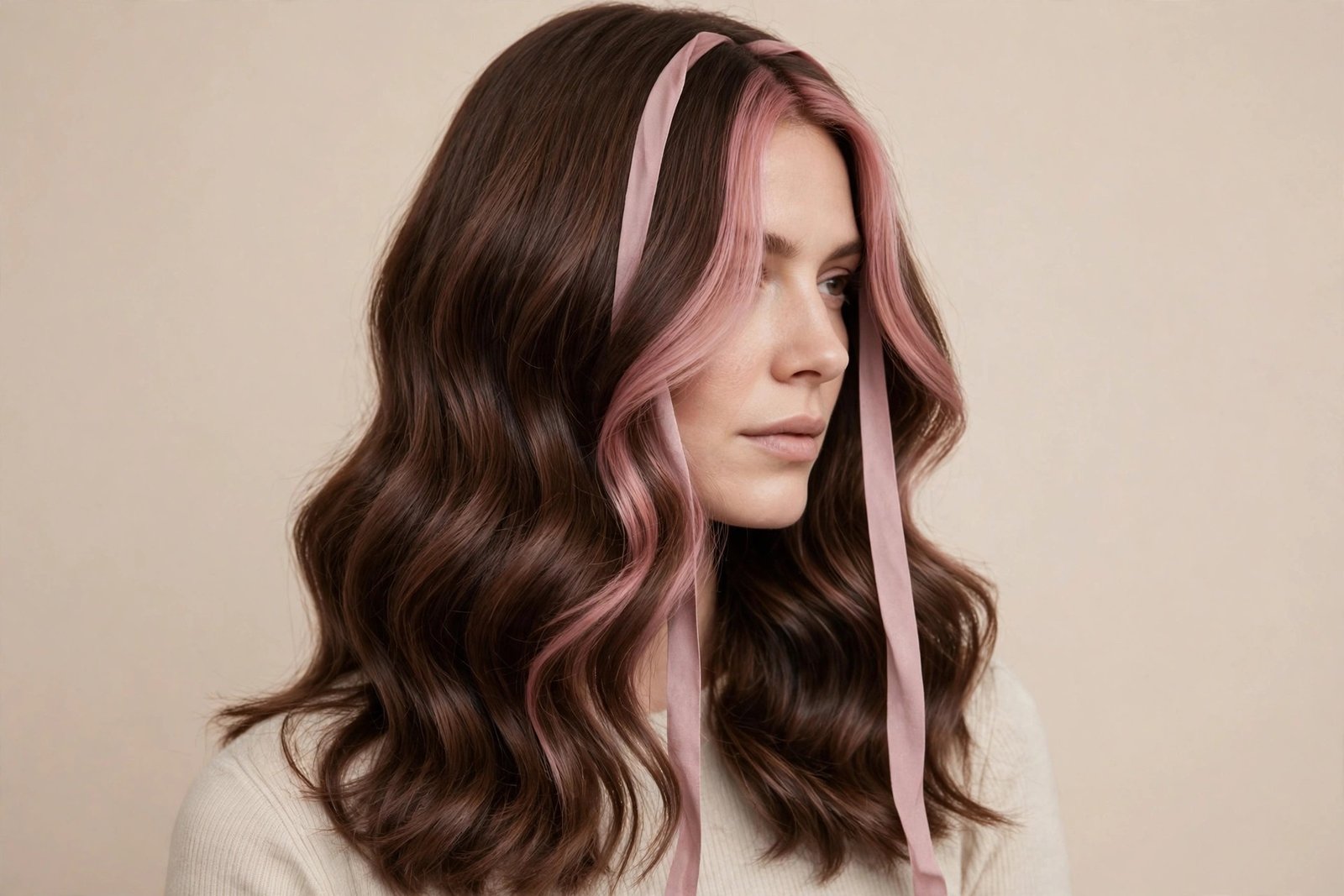
Money pieces — those face-framing ribbons of lighter color — were already the most requested salon service of the last five years. Now they’ve gone pink. Dusty rose money pieces are two soft, muted-pink ribbons right at the front hairline, and they do for your face what good lighting does for a selfie: everything looks brighter, warmer, more awake. It’s the lowest-commitment way into the pink-a-boo trend, and honestly the one I’d pick if I could only choose one style from this list.
Who it suits: everyone, but especially brunettes. Dusty rose against medium-to-dark brown hair is one of those combinations that looks like it was always meant to exist. It flatters warm, cool, and neutral skin tones, works on straight, wavy, and curly hair, and it’s the rare fantasy color that looks good in a professional headshot.
Colorist script: “Dusty rose money pieces — lift the two front sections to a level 8, then a muted mauve-pink, blended softly into my base.” If you want to go deeper on the technique, our guide to money piece highlights breaks down placement widths. Ask for the ribbons to start slightly back from the hairline so the grow-out is soft, and keep them about an inch wide — too skinny reads as a mistake, too wide reads as a statement.
Maintenance: minimal. Two small sections are cheap to refresh (often under $100) and take 45 minutes. The dusty tone fades into a pretty beige-pink that needs no emergency appointment. Downside: because they’re right at your face, they catch the most sun and the most heat styling — these two pieces will fade faster than any underlayer pink, so keep the heat protectant handy.
4. Hot Pink Face-Framing Stripes
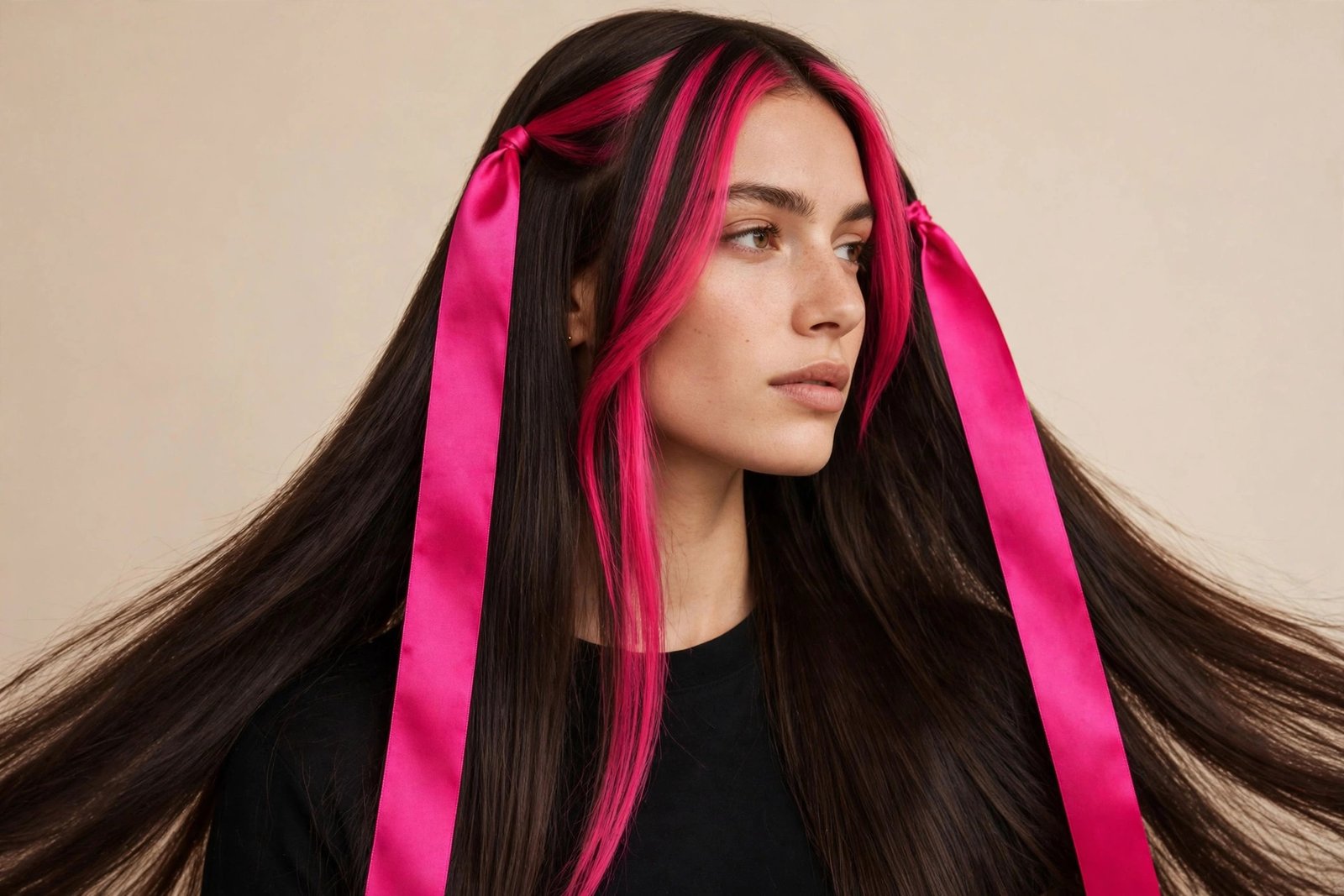
Where dusty rose money pieces whisper, these SHOUT — and that’s exactly the point. Hot pink face-framing stripes are thick, unapologetic ribbons of vivid fuchsia running down both sides of your face, and they’re the look behind that 463% surge in “pink hair stripe” searches. This is Y2K energy refined for 2026: the stripes are chunkier, the pink is more saturated, and the blending at the root is seamless instead of stripey. It’s the fastest way to change your entire look without touching 90% of your hair.
Who it suits: confident personalities and strong features — the stripes draw every eye straight to your face, so they love a good brow and a bold lip. They look incredible on dark hair (maximum contrast) and on center parts, where the symmetry does the work. If you’re shy about attention, this is not your style; if you’re tired of being overlooked, it absolutely is.
Colorist script: “Two chunky hot pink stripes, face-framing, lifted to level 9–10, vivid fuchsia semi-permanent.” Be specific about width — show a photo, because “chunky” means different things to different colorists. Ask for the stripe to follow your natural fall (where your hair actually parts and falls) rather than a geometric placement, which can look wig-like as it grows.
Maintenance: medium-high. Vivid pink at the front fades fastest (sun, face washing, heat styling), so budget a refresh every 4–5 weeks and keep a fuchsia color-depositing conditioner in the shower. Downside: vivid pink bleeds — sleep on a dark pillowcase for the first week and skip the white towels, or you’ll be doing laundry penance.
5. The Pink and Teal Split
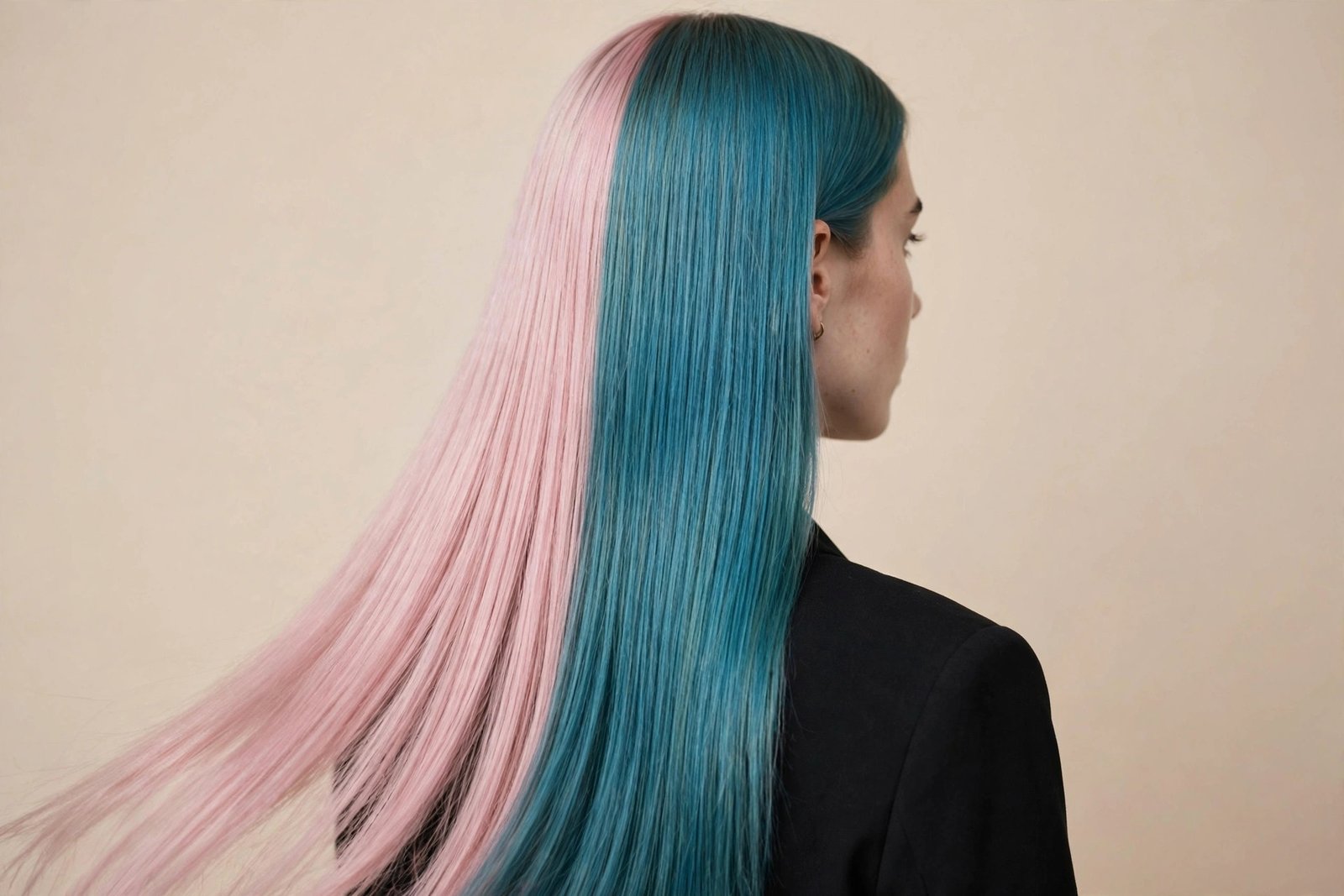
The trend report specifically called out teal pairings, and this is where that lives: a split dye with pink on one side and teal on the other. It’s the most editorial look in this guide — genuinely a two-colors-down-the-middle situation — and it shouldn’t work as well as it does. Pink and teal are near-complements, so they vibrate against each other in that way that makes people stare at your hair instead of listening to what you’re saying. Wear it center-parted for maximum symmetry, or sweep it all to one side and let the colors melt into each other.
Who it suits: the already-converted — this is not a first-fantasy-color move. It loves long, straight hair where the color division reads cleanly, and it looks phenomenal on cool skin tones. It’s also a genuinely great grow-out cheat: when the roots come in, the two-tone effect disguises the regrowth line better than any single color could.
Colorist script: “Split dye — pastel pink on one side, teal on the other, both lifted to level 10.” This is a precision job: the center part line has to be crisp, and the colors can’t bleed into each other during processing, so your colorist will likely process the sides separately with barrier cream at the part. Ask how they protect the line — if they look confused, find another colorist.
Maintenance: high, no sugarcoating. Two pastels fading at different rates means the pink goes peachy while the teal goes minty, and they need refreshing on different schedules (teal usually outlasts pink). Budget every 3–4 weeks and keep both a pink and a teal depositing conditioner. Downside: the cost — you’re paying for two full color services, and the appointment runs long. But honestly? Nothing in this guide gets more compliments.
6. Dusty Rose Balayage Melt

This is pink-a-boo for the balayage loyalists: instead of hidden panels, dusty rose is hand-painted through the mid-lengths and ends in that soft, sun-kissed balayage pattern, melting from your natural brown into muted pink. The effect is less “hidden surprise” and more “my hair just happens to turn pink at the ends in the most expensive-looking way possible.” It’s the most wearable full-distribution pink in the guide — visible all the time, shocking none of the time.
Who it suits: long-haired brunettes who already get balayage and want to evolve it. The hand-painted placement is forgiving on wavy and curly textures, where the pink peeks through the curl pattern naturally. It flatters warm skin tones especially, since dusty rose and caramel-brown are tonal cousins.
Colorist script: “Dusty rose balayage — hand-painted through the mids and ends, melted from my natural base, muted mauve-pink, no harsh lines.” If your colorist does beautiful brunette balayage work, start from our mocha balayage inspiration and ask them to shift the lightest pieces pink. Ask for the pink to start no higher than chin level — higher placement grows out stripey.
Maintenance: low-medium. Balayage grow-out is the whole point of balayage, so you’re looking at refreshes every 8–10 weeks, mostly just re-toning the pink. Downside: the pink reads muted by design, so if you were dreaming of vivid color, this will feel too quiet. It’s a “people who know, know” pink — gorgeous, but not a statement.
7. Pastel Pink Ends
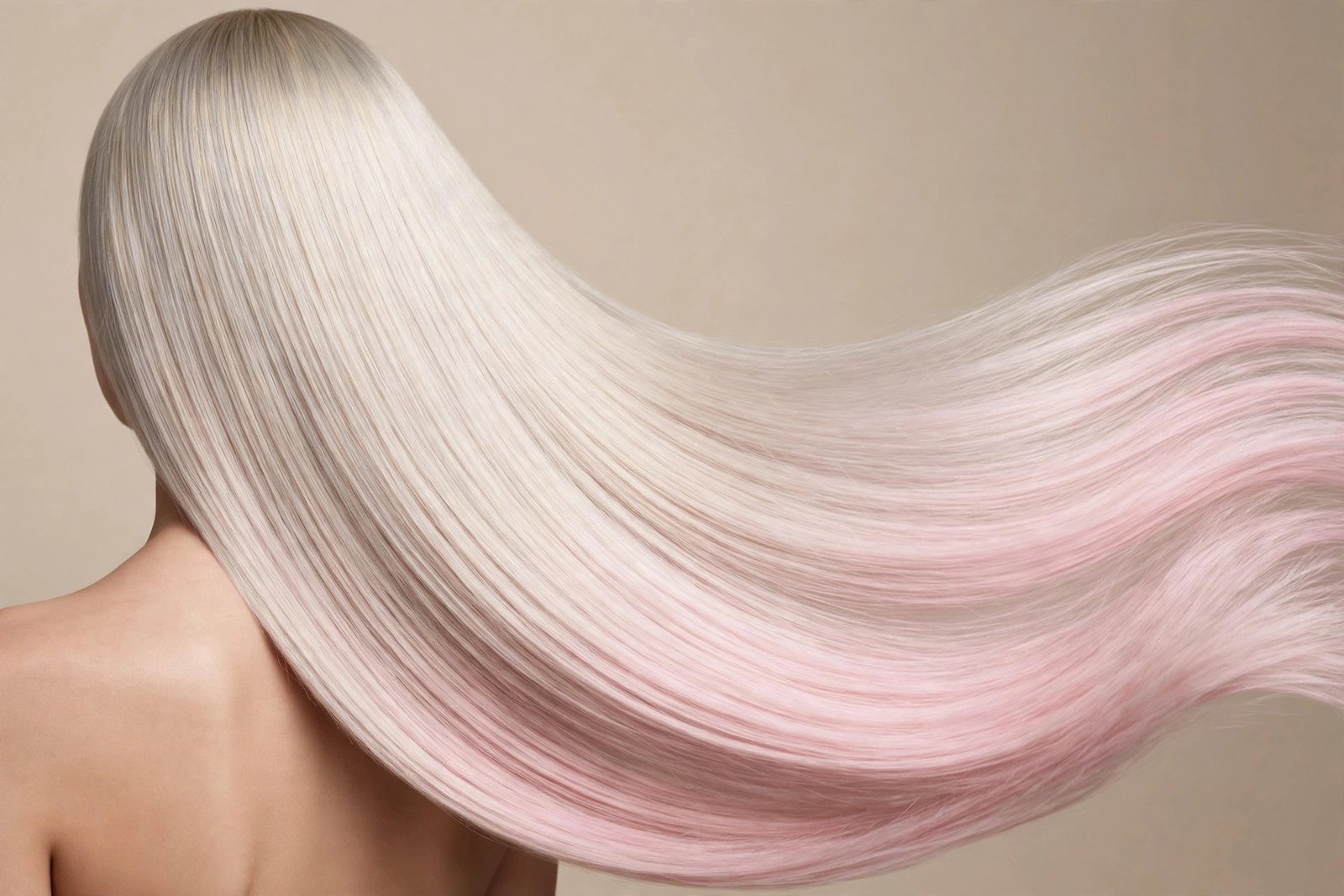
Pastel pink ends are the fairy-tale option: keep your lengths light (this works best on blondes or pre-lightened hair) and melt the last few inches into the softest baby pink. It’s ombré’s prettier younger sister — no harsh line, just hair that gradually becomes a cloud. On platinum or light blonde bases it looks genuinely ethereal, like those fantasy illustrations where the heroine’s hair fades into petals. Worn in a braid or a low ponytail, the pink ends become the entire focal point.
Who it suits: blondes first and foremost — if your ends are already light, this is nearly damage-free. It loves cool and fair skin tones, long hair (you need length for the gradient to breathe), and anyone whose aesthetic leans soft rather than edgy. It’s also a beautiful grow-out style for blondes transitioning away from all-over color.
Colorist script: “Pastel pink melt on the ends — my base stays, just the last 3–4 inches in a soft baby pink, diffused transition.” The key word is diffused: a hard line between blonde and pink looks like a dip-dye mistake. Ask for the pink to be applied on damp, pre-toned hair for the softest blend, and confirm they have a true pastel (not a vivid diluted down, which fades patchy).
Maintenance: high for a “subtle” look, which surprises people. Pastel is the fastest-fading pink there is — expect the true baby-pink to last 2–3 weeks before it goes whisper-pale. The good news: the fade is pretty (it just becomes blonder), and refreshing is a quick toner, not a re-bleach. Downside: if your ends are porous or damaged, pastel grabs unevenly and can look splotchy — get the ends healthy first.
8. Rose Gold Ribbon Streaks
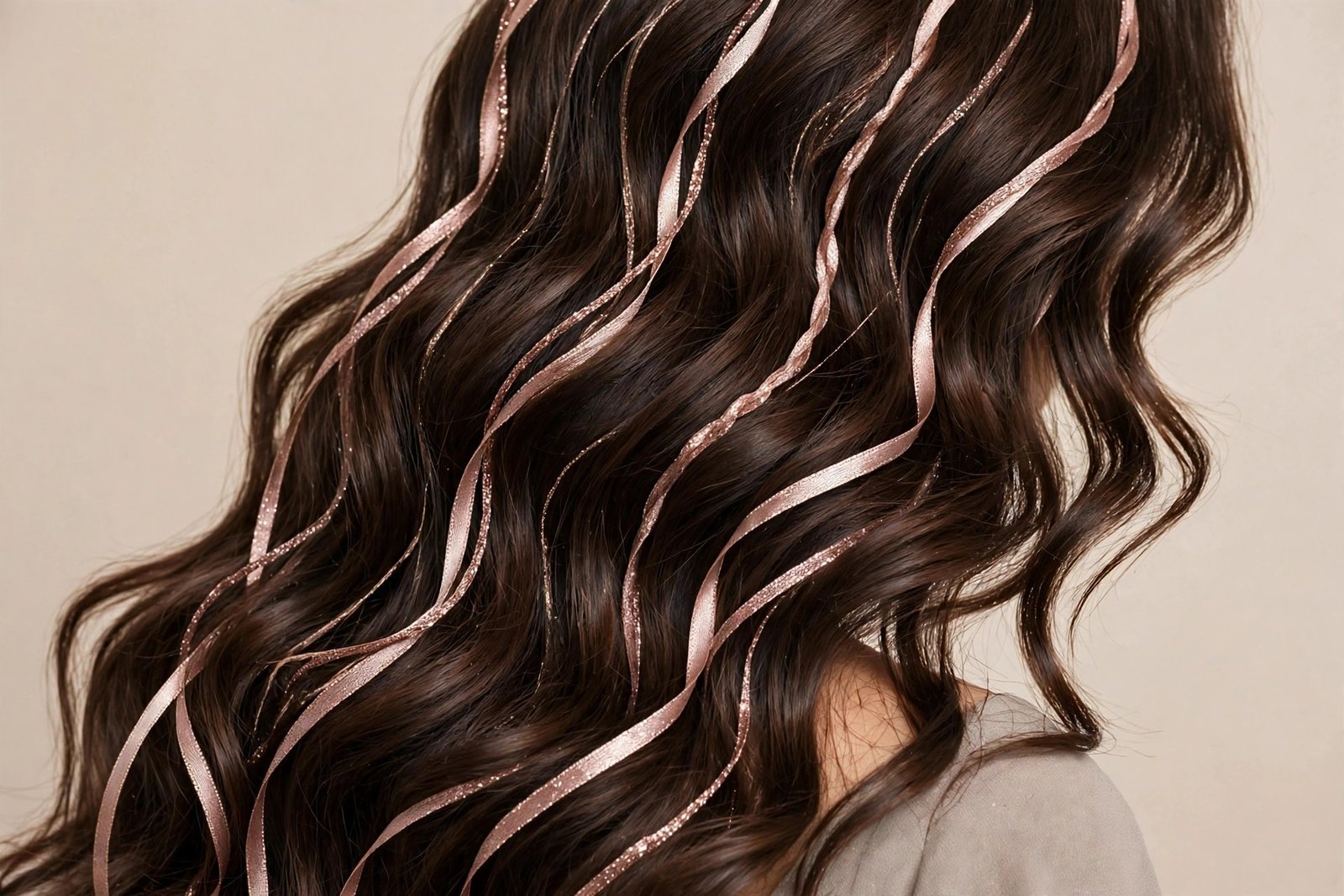
Rose gold had its massive moment a few years ago and never fully left — it just got quieter and better. Rose gold ribbon streaks are fine-to-medium ribbons of that pinky-champagne metallic tone woven through brunette waves, and they catch light like jewelry. This is the pink for people who don’t think of themselves as “pink hair people”: it reads as dimensional brunette with something special happening, not as fantasy color. In sunlight it’s unmistakably rosy; indoors it’s just really, really good hair.
Who it suits: warm-toned brunettes, especially those with existing dimension who want to push it pinker without a big swing. It loves wavy textures — every bend in the wave catches the metallic tone differently. And it’s the best pink in this guide for anyone over 40 who wants in on the trend without feeling like they’re cosplaying as a 20-year-old.
Colorist script: “Rose gold ribbons — fine weaves lifted to level 8, toned to a metallic rose gold, woven through my natural brown.” Ask for a mix of fine and medium weaves (all one size looks striped), and request that the ribbons concentrate through the mid-lengths rather than at the root, which keeps the grow-out invisible.
Maintenance: low. The metallic tone fades into a pretty warm blonde-pink that still looks deliberate, and refreshes are just re-toning every 8–10 weeks. Downside: rose gold is notoriously hard to formulate consistently — bring a photo and accept that your colorist’s version will be their interpretation, not an exact match. Also, the metallic reflect can pull slightly orange as it fades on warm bases; a purple-tinted gloss at home fixes it.
9. Magenta Hidden Panels
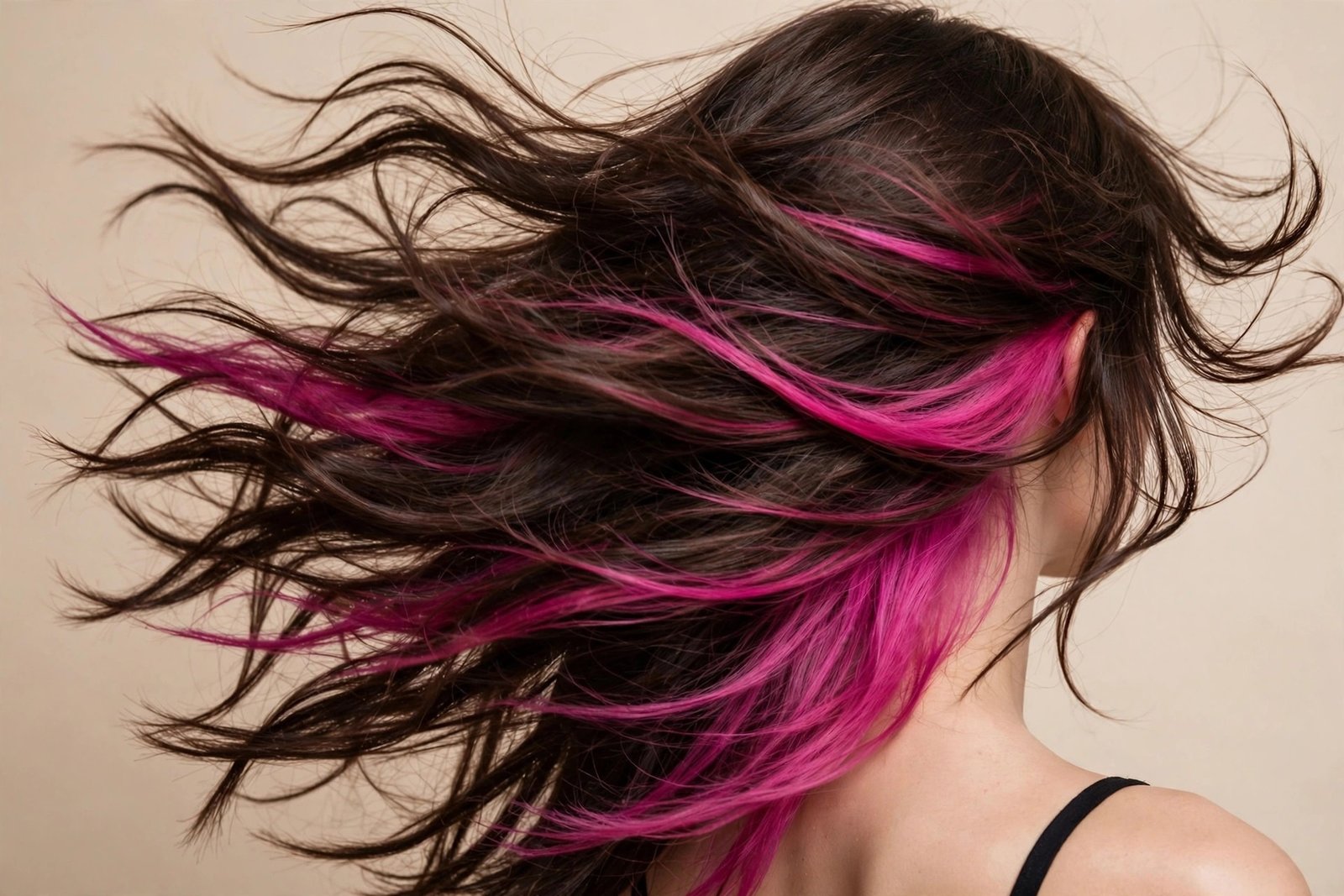
Not the whole underlayer — just panels. Magenta hidden panels are wide, vivid pink-magenta sections placed strategically: one behind each ear, one at the nape, sometimes one at the crown under the top layer. It’s peekaboo with an architect’s precision. The difference from the full underlayer is control: you decide exactly where the color lives, which means you decide exactly when it shows. Tuck your hair behind your ears and two magenta flashes appear like you planned it. Because you did.
Who it suits: medium-to-long hair, straight or wavy — the panels need enough length to hide properly. This is a great choice for thick hair that would make a full pink underlayer overwhelming; panels give you the color in measured doses. It also suits anyone who wears their hair up a lot, since every updo becomes a curated reveal.
Colorist script: “Magenta panels — one wide panel behind each ear and one at the nape, lifted to level 9, vivid magenta semi-permanent.” Ask your colorist to map the panels while your hair is styled the way you actually wear it — panels placed for down-hair look wrong in a ponytail and vice versa. Our peekaboo highlights guide has more placement ideas if you want to get creative.
Maintenance: low-medium. Small surface area means less fading and cheaper refreshes — a panel refresh is often a quick in-between service. Downside: panels can migrate. As hair grows and shifts, a perfectly placed panel can end up peeking out somewhere unexpected. Your colorist should place them with 2–3 months of growth in mind, not just day one.
10. Bubblegum Peekaboo
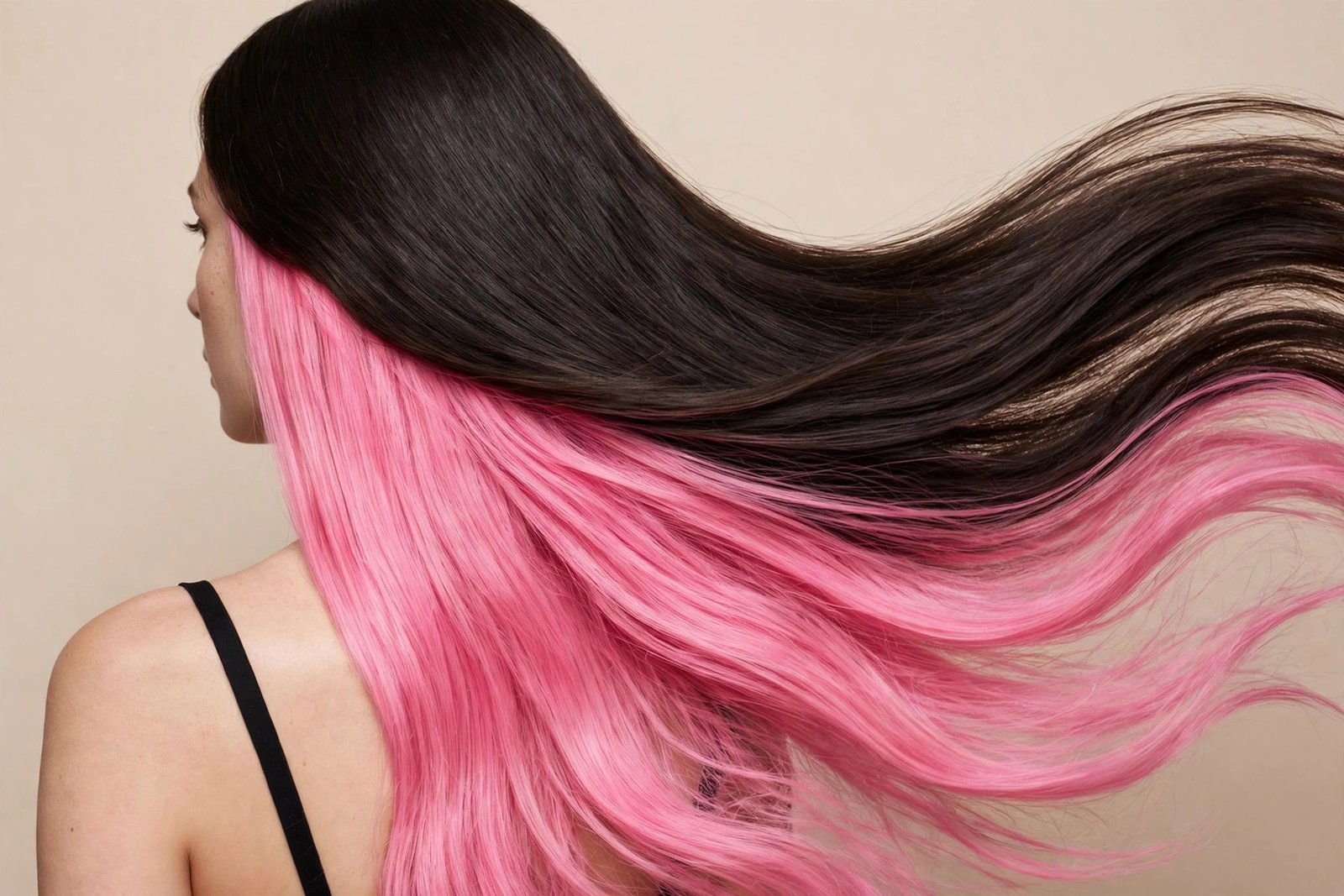
Sometimes you don’t want sophisticated. Sometimes you want the pink equivalent of popping bubblegum — sweet, loud, unapologetically fun. Bubblegum peekaboo is the classic underlayer placement in the brightest, sweetest pink in the box: that perfect mid-tone pink that’s neither pastel nor neon. It’s the shade every cartoon heroine has, and there’s a reason it’s endured through every trend cycle. It photographs insanely well, it makes everyone smile, and it has main-character energy in the best way.
Who it suits: the young at heart, regardless of actual age. It loves dark bases for maximum pop, long hair for maximum reveal, and it looks incredible in motion — ponytails, braids, windy days. Fair to medium skin tones carry it most easily, but honestly, confidence carries it further than complexion.
Colorist script: “Bubblegum pink peekaboo underlayer — lift to level 9–10, true bubblegum pink, vivid and sweet, not pastel.” The level 10 lift matters here: bubblegum over a level 8 base pulls coral instead of pink, which is pretty but not the brief. Ask for even lift — patchy bleach shows through bright pink like nothing else.
Maintenance: medium. Bubblegum is a mid-depth vivid, so it holds better than pastel but fades faster than magenta. Expect 5–7 weeks of glory, then a refresh. Downside: this pink stains. Pillowcases, shirt collars, light-colored upholstery — the first week is a crime scene. Dark bedding and a good rinse until the water runs clear are non-negotiable.
11. Soft Rose Waterfall Highlights
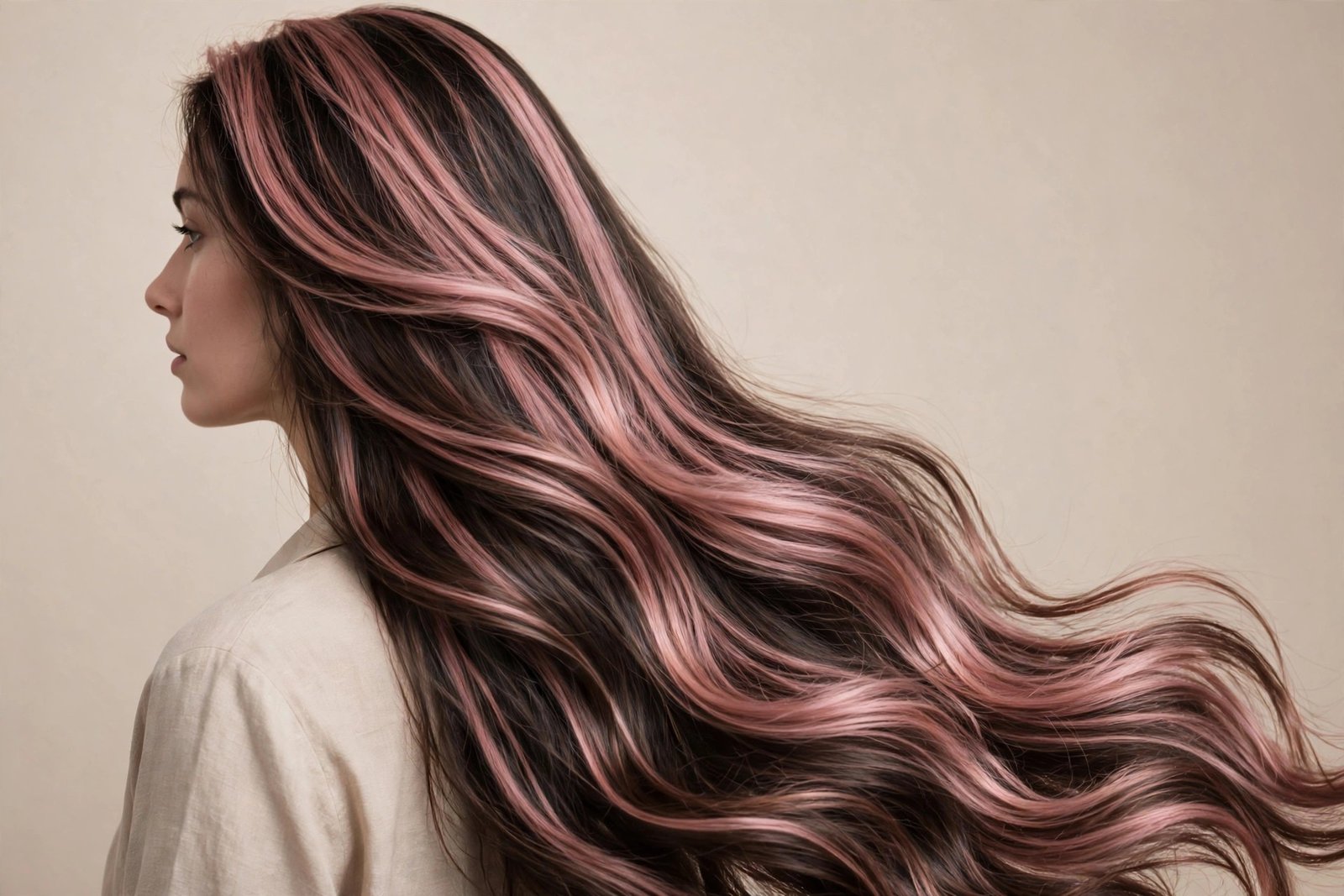
Waterfall highlights are those cascading, face-brightening ribbons that fall from the crown through the lengths like — well, a waterfall. In soft rose, they’re the most romantic pink in this guide: fine, blended ribbons of muted pink woven through your natural base so the color seems to fall through your hair rather than sit in it. There’s no harsh placement, no graphic lines, just movement and light. It’s the pink equivalent of golden hour.
Who it suits: long, layered hair — the layers are what create the waterfall effect, so one-length cuts won’t get the full magic. It flatters every skin tone because the pink is so diffused it can’t clash with anything. This is also the best pink for fine hair in the entire guide: fine ribbons add the illusion of dimension without the weight of chunky panels.
Colorist script: “Soft rose waterfall highlights — fine blended ribbons from the crown through the ends, lifted to level 8, muted rose-pink.” Ask for the ribbons to be teased or shadowed at the root so there’s zero line of demarcation. The technique matters more than the exact shade here — a good balayage artist can do this in their sleep.
Maintenance: low. Fine, blended ribbons grow out invisibly and the muted tone fades gracefully. Refresh every 8–10 weeks with just a toner. Downside: subtlety has a price — in indoor lighting, people might not even register it as pink. If you want to be SEEN in pink, pick a chunkier style. This one is for you, not for them.
12. Pink Money Pieces on Deep Brunette
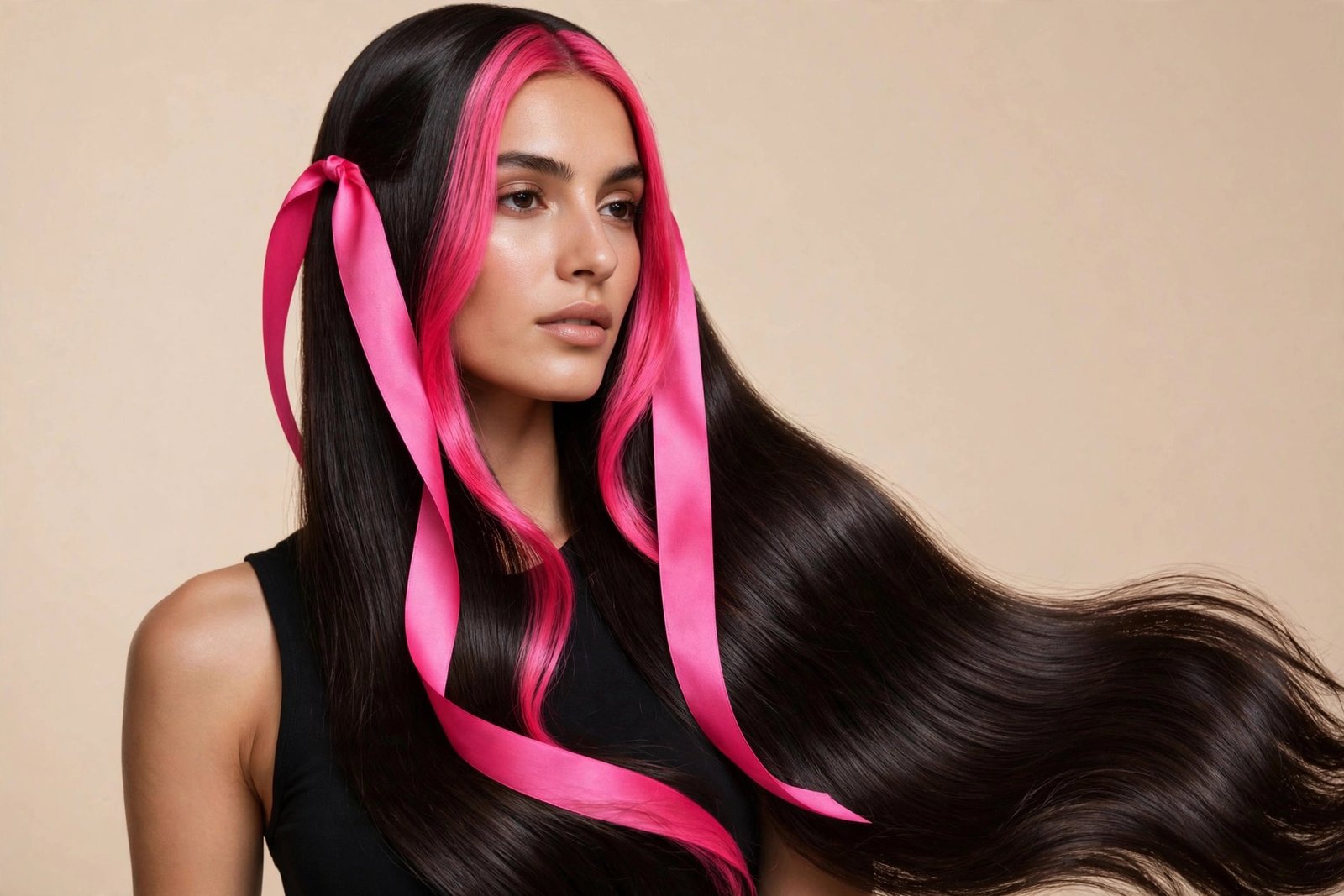
Take the money piece concept, turn the saturation all the way up, and put it on the darkest brown hair you can find. Pink money pieces on deep brunette are vivid — not dusty, not muted, VIVID — ribbons of bright pink against near-black brown, and the contrast is electric. This is the look all over Pinterest right now because it shouldn’t work on paper: the most natural base color paired with the most unnatural accent. But the dark base actually makes the pink look more expensive, like a jewel set in dark metal.
Who it suits: deep brunettes (level 2–4) who want maximum impact from minimum bleach. The contrast does the heavy lifting, so the pink can be truly vivid without needing much of it. It loves a center part and sleek styling, where the symmetry frames the face like a portrait.
Colorist script: “Vivid pink money pieces on my dark base — lift the front sections to level 9, bright pink, keep the contrast high.” Because your base is dark, the lift needs to be clean — any remaining warmth in the lifted sections will push the pink coral. Ask for a test strand to confirm the lift, and keep the pieces bold: thin vivid ribbons on dark hair can read as accidental.
Maintenance: medium. The vivid tone needs refreshing every 5–6 weeks, and the front placement catches sun and heat. But the small area keeps costs down. Downside: grow-out is visible — a dark root against a vivid pink piece shows a line. Ask for a shadowed root (a soft diffusion at the top of the piece) to buy yourself an extra few weeks.
13. Cotton Candy Underlights
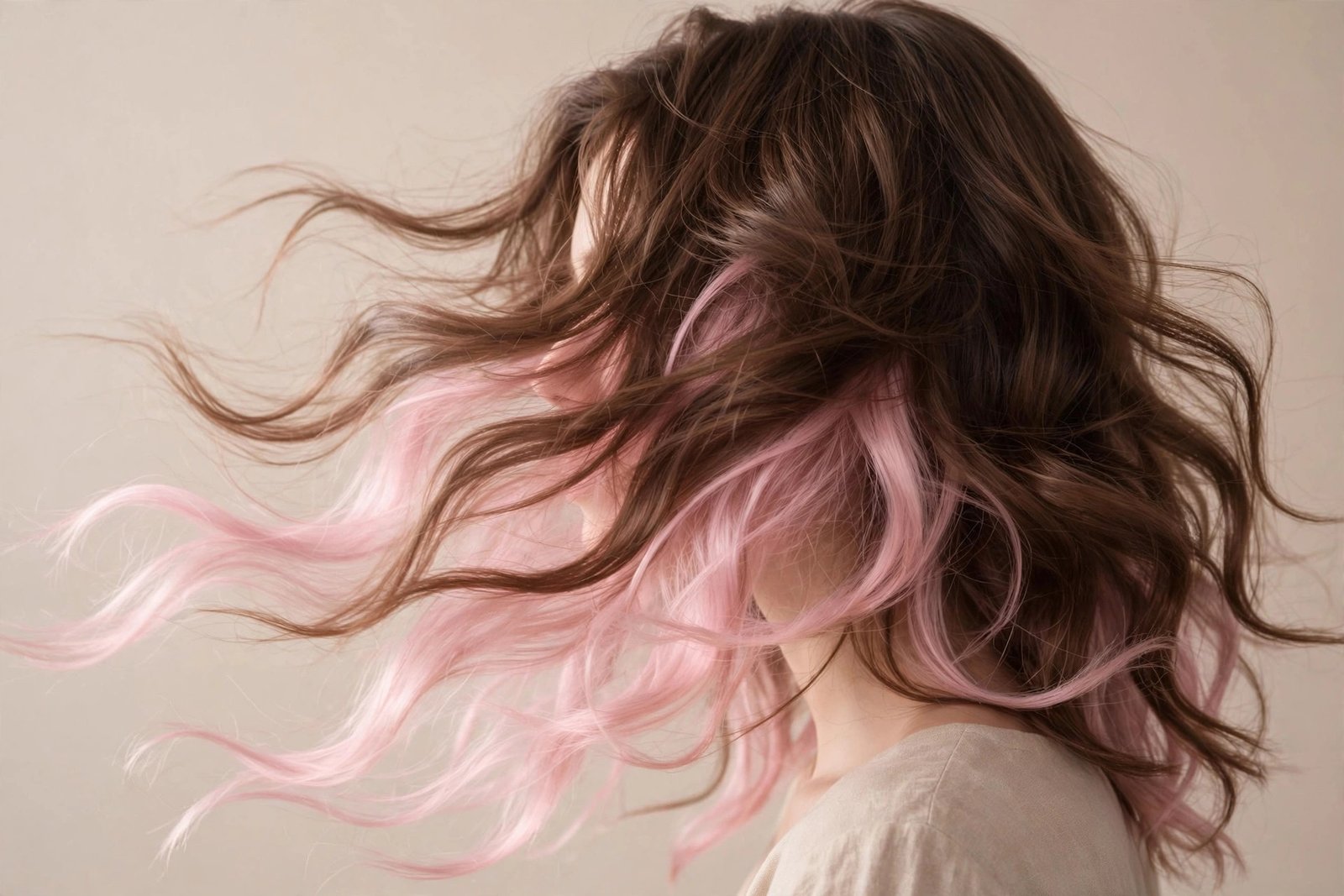
Underlights are peekaboo’s close cousin: color applied to the underneath sections so it glows through when hair moves. Cotton candy underlights use the sweetest pastel pink — that spun-sugar shade that’s equal parts pink and white — and the effect is pure softness. When your hair is still, you’re a brunette (or blonde). When it moves, it’s like someone hid candy floss under there. It’s whimsical in a way that feels joyful rather than juvenile, and it looks unreal in braids, where the pastel weaves through like ribbon.
Who it suits: medium to long hair in any texture — curls especially, because every curl reveals a flash of the pastel. It loves light to medium bases (less lifting needed) and fair to medium skin tones. This is also a lovely first pastel for anyone nervous about going light: it’s hidden, so the commitment is emotional, not visual.
Colorist script: “Cotton candy underlights — lift the underlayer to level 10, palest pastel pink.” Level 10 is non-negotiable for true pastel; anything less and you get peach. Ask your colorist to tone the lifted hair to clean white-blonde before applying the pastel — skipping the tone is why DIY pastels go muddy.
Maintenance: high, honestly. Pastel underlights fade in 2–4 weeks even hidden from the sun, because pastel pigment is just sparse. The refresh is quick (no re-bleach, just re-tone) but frequent. Downside: the level-10 lift on the underlayer is real damage on that section — keep up with bond builders and masks, or the underlayer goes gummy while the top stays perfect.
14. Fuchsia Chunky Highlights
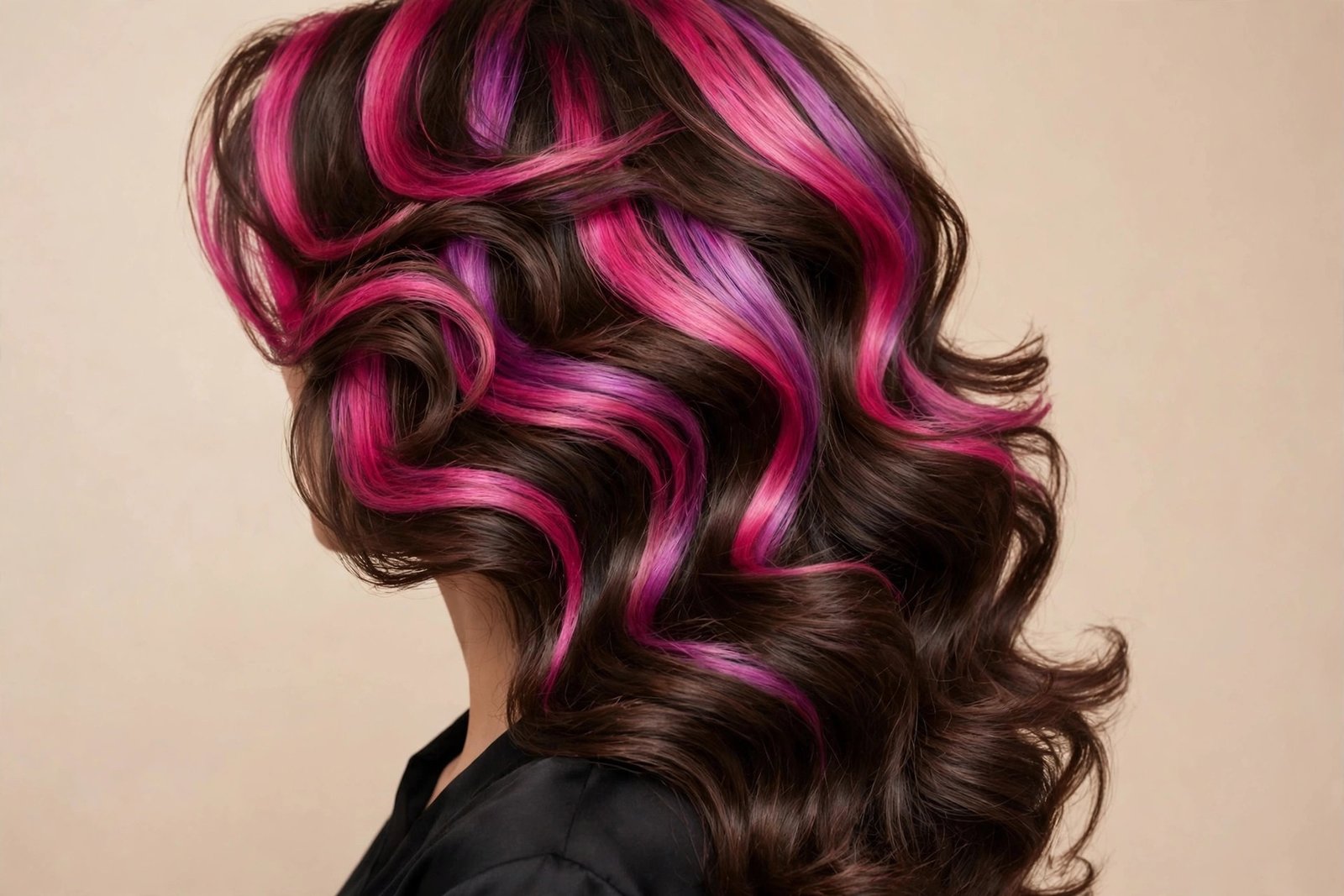
The 90s called and they’re thrilled. Fuchsia chunky highlights are thick, bold slices of vivid pink-purple worked through the top layers of dark hair — visible all the time, no hiding, no peekaboo about it. This is the stripe trend’s maximalist sibling: where stripes frame the face, chunky highlights distribute the pink through the whole head in wide, confident bands. It’s retro in the best way — think early-2000s pop star, but with 2026’s seamless root blending so it grows out like a dream instead of a regret.
Who it suits: thick, dark hair that can handle bold sections without looking sparse. It loves long layers and big, bouncy blowouts — the more movement, the better the pink reads. Personality-wise, this is for extroverts: the pink is everywhere, all the time, and it will start conversations with strangers.
Colorist script: “Chunky fuchsia highlights — wide weaves through the top and sides, lifted to level 9, vivid fuchsia.” Specify the weave size with a photo, because “chunky” ranges from half-inch to two-inch sections. Ask for a soft root shadow so the grow-out doesn’t give you a harsh line in a month.
Maintenance: medium-high. Lots of pink surface area means lots of fading surface — refresh every 5–6 weeks. But the root shadow buys you grow-out grace. Downside: this is one of the harder pinks to remove if you change your mind — fuchsia stains the hair shaft, and going back to natural requires either growing it out or a color correction. Commit with open eyes.
15. Blush Pink Ombré Tips

Ombré never really died — it just got a pink upgrade. Blush pink ombré tips take the classic dark-to-light gradient and land it in the softest, most flattering pink: blush, the shade of the inside of a seashell. The transition is long and gradual — dark roots melting through brown, then rose, then blush at the very ends. It’s the most forgiving pink in this guide for regrowth (there basically isn’t any, since your roots stay natural) and one of the prettiest in photographs, where the gradient reads like a sunset.
Who it suits: long hair — you need serious length for a proper ombré gradient, ideally past the shoulders. It flatters warm skin tones beautifully and looks stunning on wavy textures where the gradient shifts with every wave. Great for anyone growing out old color, since the pink ends disguise a multitude of grow-out sins.
Colorist script: “Blush pink ombré — keep my roots natural, gradient through the lengths to blush pink tips, long soft transition.” Ask where the gradient starts — mid-shaft is classic, but starting lower (below the chin) is more modern and grows out even better. Confirm the lightest point reaches level 9 so the blush reads pink, not peach.
Maintenance: low. Your roots are untouched, so grow-out is a non-issue; you’re just refreshing the pink tone every 6–8 weeks. Downside: the ends take the most damage (they’re the most lifted AND the oldest hair), so they need the most care — regular trims and heavy masking, or the blush goes ragged and the gradient loses its magic.
16. Cherry Blossom Peekaboo
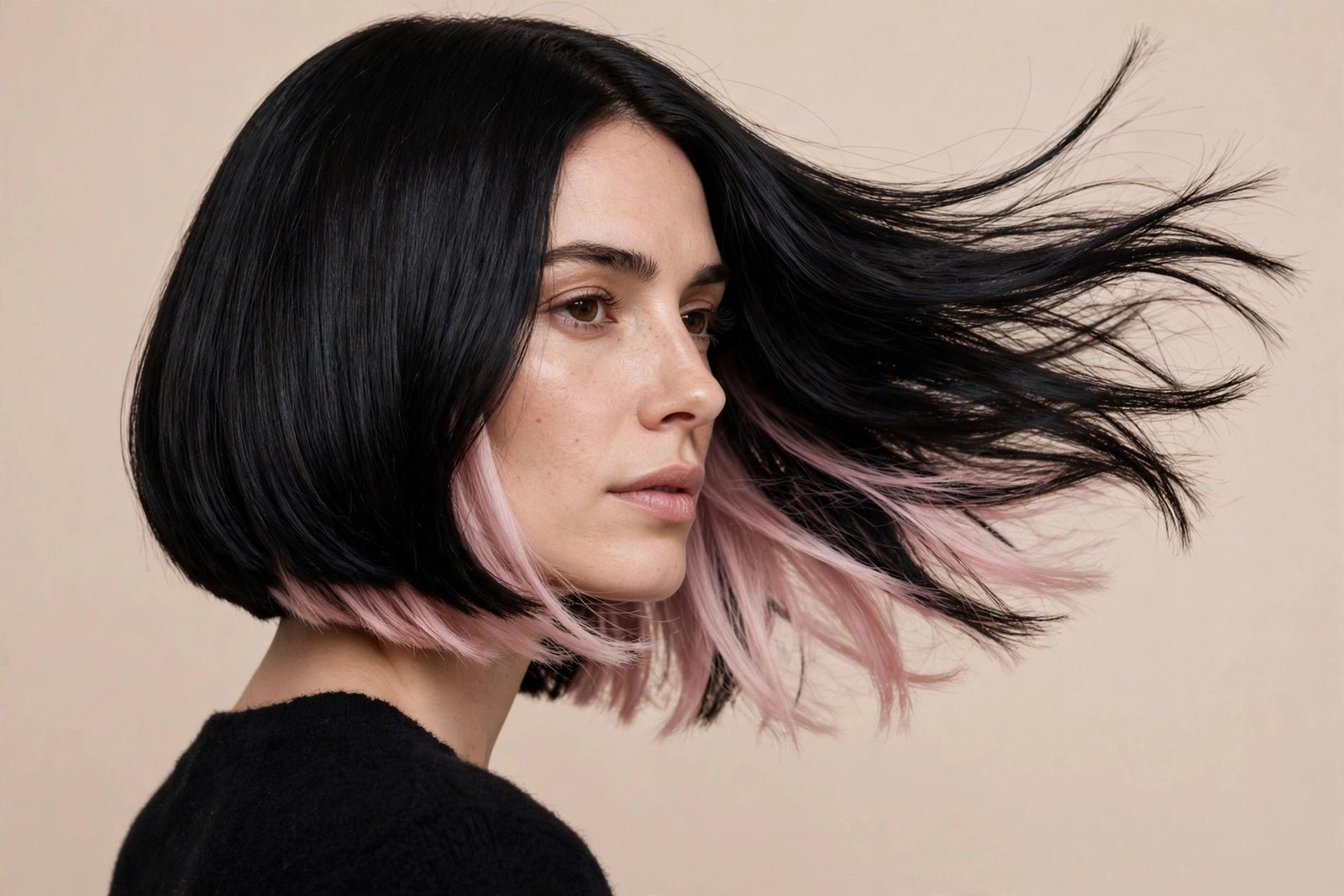
Named for the flowers, and it earns the name: cherry blossom peekaboo is the softest, most delicate pink in this guide — a pale, slightly cool pink like the petals themselves, hidden in the underlayer of dark hair. On a black bob (the iconic pairing), it’s breathtaking: sharp, graphic black on top, and then you turn your head and there’s this whisper of blossom pink. It’s the pink-a-boo trend distilled to its most elegant form, and it proves that “vivid placement” and “subtle color” aren’t opposites.
Who it suits: short to medium hair — bobs, lobs, and shoulder-length cuts show off the reveal best, because there’s less top layer to hide the color. It loves straight, sleek styling where the contrast reads crisply, and cool skin tones, which harmonize with the petal-pink tone.
Colorist script: “Cherry blossom peekaboo — underlayer lifted to level 10, palest cool pink, like cherry blossom petals.” The cool tone is the whole brief — warm lift will push it peach, so insist on proper toning to white-blonde first. On a bob, ask for the pink panel to sit just above the ends so it flashes when the bob swings.
Maintenance: medium-high. Pale cool pink fades fast (3–4 weeks) and the level-10 lift needs care. But on short hair, refreshes are quick and cheap — there’s just less hair. Downside: cool pastels are the first to go brassy-yellow as they fade on imperfectly lifted hair. A purple-pink toning conditioner between appointments keeps the blossom tone true.
17. The Pink Skunk Stripe
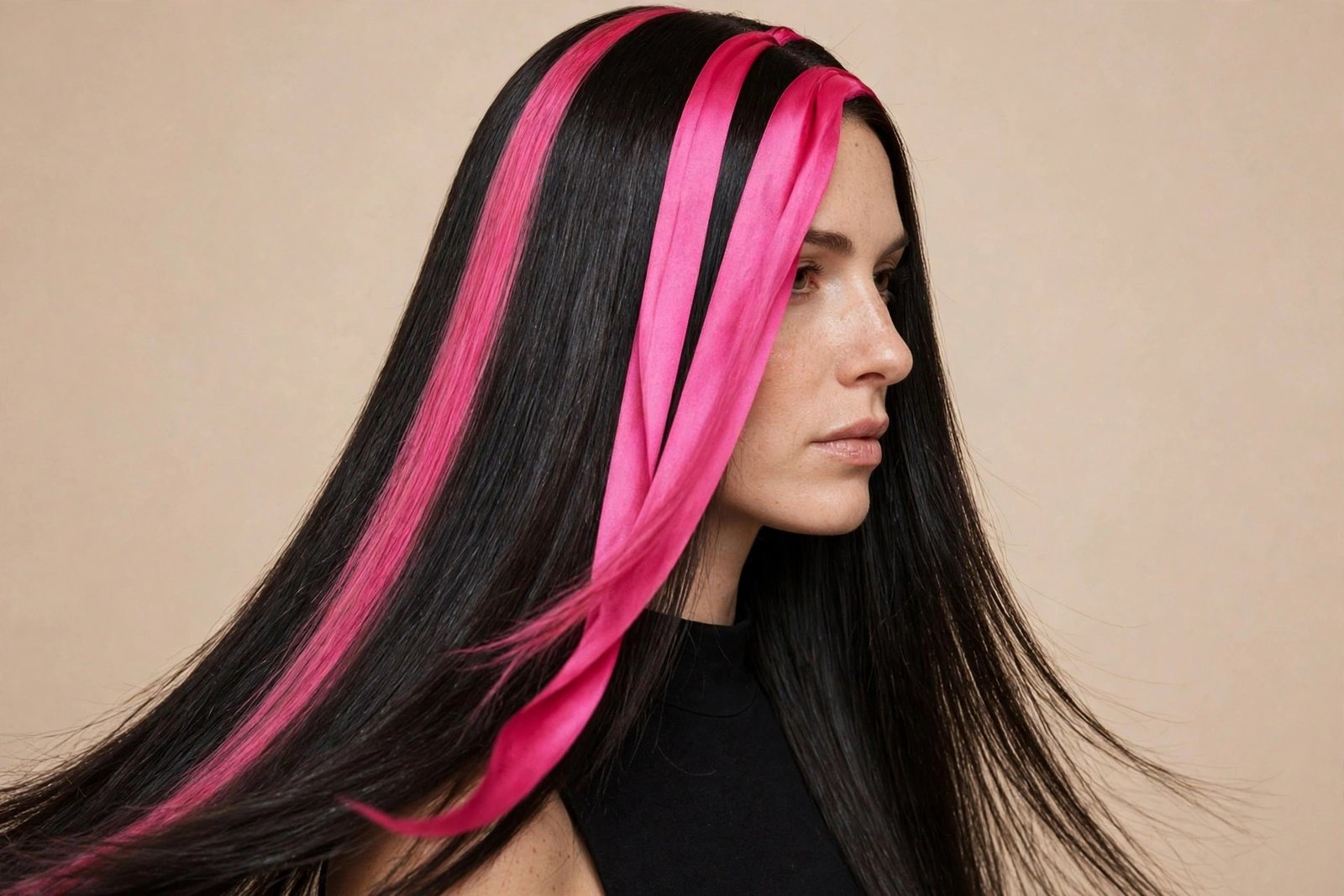
The skunk stripe — that bold, bleached stripe right at the front hairline — was the defining accent of the early 2000s, and it’s back with a pink passport. The 2026 version puts a thick ribbon of vivid pink right along the front hairline, usually on one side, against dark hair. It’s parted to fall forward over the forehead, framing one side of the face like an exclamation mark. Of all 32 styles, this is the one with the most attitude per square inch of dyed hair. It’s a tiny amount of pink doing an enormous amount of work.
Who it suits: anyone with a strong center or side part and the confidence to have one extremely visible stripe. It loves dark hair (contrast is everything here), straight or sleek-straight styling, and it looks incredible with a sharp bob or long straight lengths. This is the lowest-bleach statement in the guide — one stripe, maybe 5% of your hair.
Colorist script: “Pink skunk stripe — one thick ribbon at the front hairline, lifted to level 9, vivid pink.” Placement precision is everything: the stripe should start right at the part and fall naturally forward. Ask your colorist to cut the stripe section first (a triangular section at the hairline) so the placement is intentional, not accidental.
Maintenance: low-medium. One small section is cheap to refresh, but it’s front and center, so fading shows immediately — every 4–5 weeks. Downside: there’s nowhere to hide a bad skunk stripe. If the lift is uneven or the tone is off, it’s the first thing everyone sees. Choose your colorist like the stripe depends on it, because it does.
18. Dusty Rose Root Melt
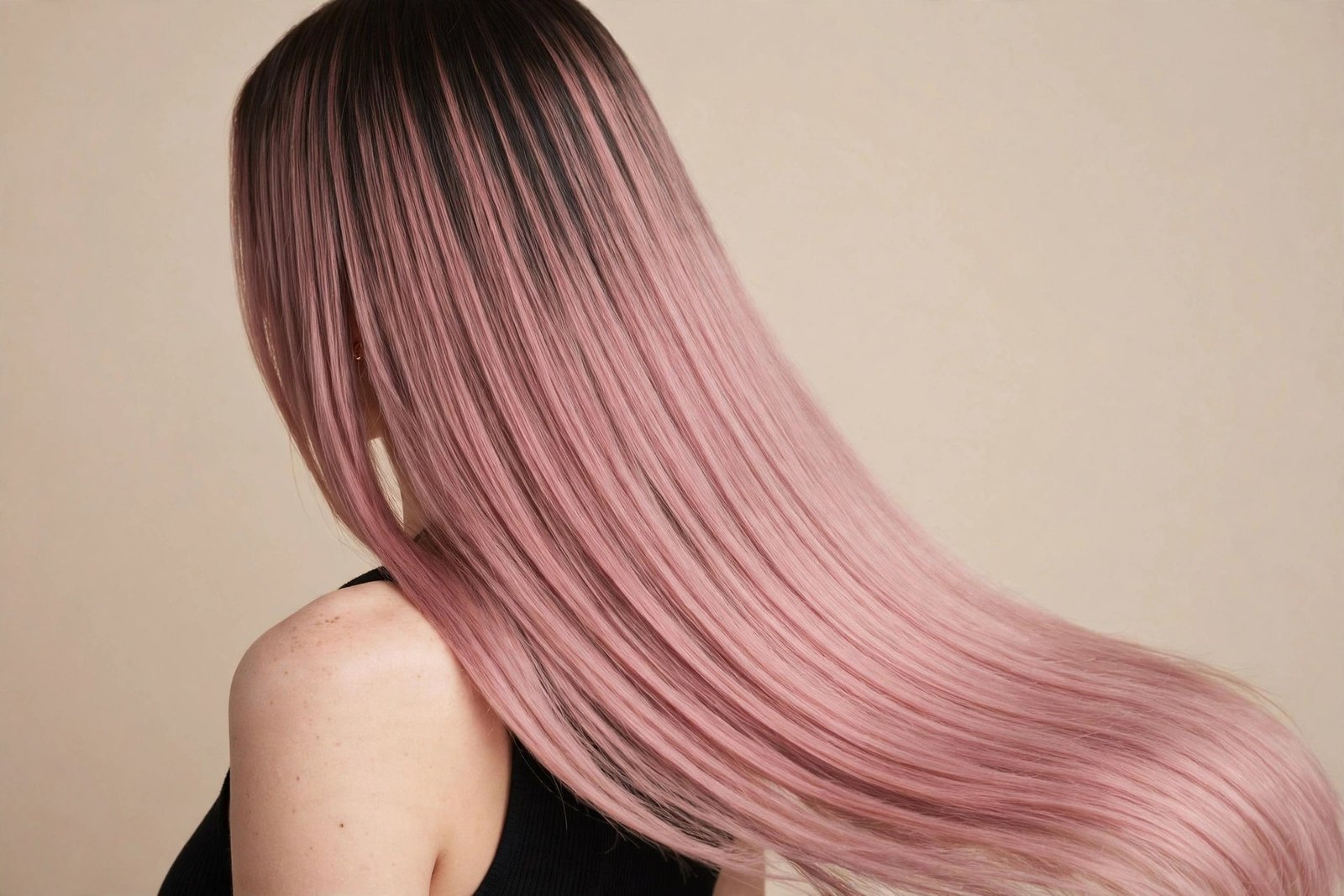
A root melt takes your natural (or natural-looking) root color and melts it into the fashion shade with zero line — and in dusty rose, it’s the smoothest operator in this guide. Your roots stay deep and natural, then gradually, almost imperceptibly, the hair becomes dusty rose through the lengths. There’s no “where does the pink start” moment; it just… happens. It’s the pink for minimalists, for people who want the trend without any single part of their hair screaming about it.
Who it suits: anyone growing out color, anyone with a busy schedule, anyone who hates visible regrowth with a passion. It works on all lengths past the chin and all textures, and it’s the most forgiving pink for imperfect hair — the soft blend disguises uneven porosity beautifully.
Colorist script: “Dusty rose root melt — keep my natural root, melt into dusty rose through the lengths, no lines anywhere.” The melt zone (where root becomes pink) is the technical heart of this style — ask your colorist to show you exactly where it sits, and request it lower rather than higher if you’re between choices. Lower melts grow out invisibly; high melts grow out visibly.
Maintenance: the lowest in this guide. Honestly. Your roots are natural, the blend is seamless, and the dusty tone fades into something that still looks like expensive brunette. Refresh the tone every 8–12 weeks, or don’t — the fade-out is graceful. Downside: if you want visible, obvious pink, this will bore you. It’s a background singer, not a lead vocalist.
19. Pink Halo Highlights

Halo highlights are a ring of color placed around the crown — like a halo sitting under the top layer — and in pink, they’re pure magic in motion. Worn down, you see flashes of pink at the part and around the face. Worn half-up (the signature styling for this look), the top section pulls back to reveal a full ring of pink circling your head like a crown. It’s the most “designed” peekaboo in the guide: every angle was considered, and it shows.
Who it suits: medium to long hair — you need enough length for the halo to encircle properly. It loves half-up styles, high ponytails, and buns, so if you’re an updo person, this was made for you. The all-around placement means it looks good from every angle, which makes it a favorite for anyone photographed often.
Colorist script: “Pink halo — a ring of pink panels around the crown under the top layer, vivid or dusty depending on my base.” Ask your colorist to place the halo while your hair is in the half-up style you’ll actually wear, so the reveal is calibrated. The halo should sit about an inch below the part line all the way around — too high and it shows when you don’t want it to.
Maintenance: medium. Multiple panels mean a longer appointment, but each panel is small, so fading is slow and refreshes are straightforward. Downside: the grow-out is multidirectional — panels growing out around a curve can look scattered at month three. Book the refresh before it gets there, around week 6–7.
20. Neon Pink Peekaboo Bangs

Bangs are already a commitment; neon pink bangs are a declaration. This style dyes just the fringe — curtain bangs, bottleneck bangs, or a full fringe — in electric neon pink while the rest of the hair stays natural. It’s the smallest surface area in the entire guide with arguably the biggest visual impact, because bangs frame your entire face. Every photo of you becomes a pink photo. It’s bold, it’s fun, and it’s weirdly practical: if you hate it, bangs grow out faster than any other section.
Who it suits: bang wearers, obviously — and this is a great excuse to finally get them. It loves straight or slightly wavy fringes where the color reads cleanly, and it suits oval, heart, and long face shapes where bangs already work. Fair skin makes neon pink glow; deeper skin makes it pop. Everybody wins.
Colorist script: “Neon pink bangs — just the fringe, lifted to level 10, electric neon pink.” Bangs need the cleanest lift on your head because they’re front and center — any patchiness shows. Ask for the neon to be applied on freshly lightened, well-toned hair, and request a slightly deeper root on the fringe so the grow-out doesn’t give you a pink headband effect.
Maintenance: medium-high. Bangs get washed more (they touch your forehead), styled with heat more, and touched more — all of which fade neon fast. Expect 3–4 weeks of true neon, then a refresh. Downside: neon pink + forehead = potential staining on skin for the first few days. A thin layer of barrier cream along the hairline before application prevents the pink forehead situation.
21. Strawberry Pink Melt

Strawberry pink is what happens when pink and warm blonde have a baby: a golden, peachy-pink that’s closer to a fruit than a fashion color. As a melt — roots natural, lengths flowing into strawberry — it’s the warmest, most natural-looking pink in this guide. On blondes and light brunettes, it reads less like “I dyed my hair pink” and more like “my hair just does this.” It’s sunset hair, harvest hair, the pink that people who claim they don’t like pink end up loving.
Who it suits: blondes and light brunettes first — the warm base is what makes strawberry sing. It loves warm and golden skin tones, wavy and curly textures where the warm tones shift in the light, and anyone whose wardrobe leans earthy and warm. If your closet is full of camel, cream, and terracotta, this is your pink.
Colorist script: “Strawberry pink melt — warm golden-pink through the lengths, melted from my natural base.” On a blonde base, this barely needs lifting — often just a toner — which makes it one of the least damaging pinks here. For placement inspiration on blonde bases, our lived-in blonde guide shows the kind of soft, grown-out melt this builds on.
Maintenance: low. Warm pinks fade into warm blonde, which still looks like an expensive color — there’s no ugly phase. Refresh the tone every 8–10 weeks. Downside: on cool skin tones, strawberry can pull orange and clash. Know your undertone before you commit — if silver jewelry suits you better than gold, pick a cooler pink from this guide instead.
22. The Pink Peekaboo Lob
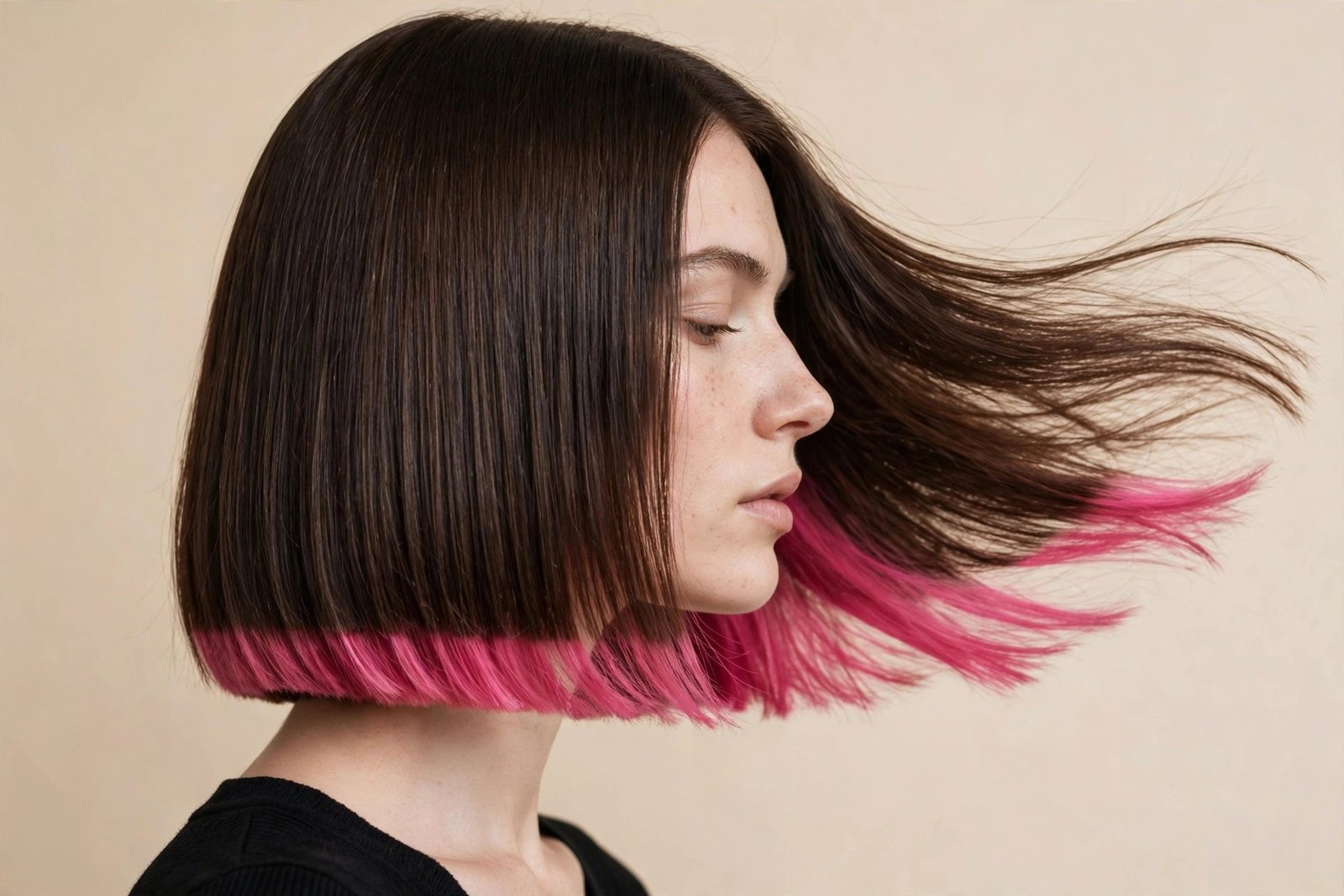
The lob (long bob) is the haircut that refuses to die, and the pink peekaboo lob is its 2026 update: a sharp, collarbone-grazing cut with a vivid pink underlayer that flashes at the ends and underneath. The geometry of the lob makes the reveal architectural — when the blunt ends swing, the pink appears in a clean, graphic line. It’s the most fashion-editor look in this guide: precise, deliberate, and cool without trying too hard.
Who it suits: straight to wavy hair — the blunt lob needs some sleekness to show off the line. It flatters oval, round, and heart face shapes (the length elongates), and it loves dark bases where the pink underlayer contrasts crisply. This is a fantastic choice for fine hair, too: the blunt cut creates density, and the hidden color adds interest without weight.
Colorist script: “Pink peekaboo lob — cut first to collarbone length, then vivid pink underlayer, blunt ends.” Order matters: cut, then color, so the pink panels align with the finished shape. Ask for the underlayer to start high enough that it shows at the ends when the lob moves — on a blunt cut, a too-low panel stays permanently hidden.
Maintenance: low-medium. The lob needs trims every 6–8 weeks to keep the line sharp anyway, so fold the pink refresh into the same appointment. Downside: blunt ends + bleached underlayer = the ends need babying. The underlayer takes the most mechanical stress (it’s underneath, rubbing against clothes), so keep it conditioned or the pink ends go wispy.
23. Rose Quartz Ribbon Highlights

Rose quartz is pink with the saturation turned down and the luminosity turned up — a translucent, gemstone pink that looks like light passing through the stone. As ribbon highlights woven through long hair, it’s the most luminous pink in this guide: the ribbons seem to glow from within, especially in sunlight. Unlike opaque vivid pinks that sit ON the hair, rose quartz looks like it’s IN the hair. It’s subtle from across the room and mesmerizing up close — the kind of color that makes people lean in.
Who it suits: light to medium bases — the translucency needs a light canvas, so blondes and light brunettes get the truest effect. It loves long, straight or loosely waved hair where light travels down the ribbon, and cool to neutral skin tones. This is the connoisseur’s pink: people who notice it really notice it.
Colorist script: “Rose quartz ribbons — medium weaves lifted to level 9, translucent pink toner, not opaque.” The word translucent is doing the work — it tells your colorist you want a sheer wash, not a vivid fill. Our honey blonde balayage inspiration shows the ribbon technique on similar bases. Ask for the ribbons to vary in width so the effect is organic, not striped.
Maintenance: medium. Sheer color fades faster than opaque (there’s just less pigment), so expect 4–6 weeks before the glow dims — but the fade is pretty, melting into a soft blush-blonde. Downside: this is the most technique-dependent pink in the guide. A heavy-handed colorist will make it opaque and kill the translucency. Vet their portfolio for sheer, luminous work first.
24. Electric Pink Curtain Stripes
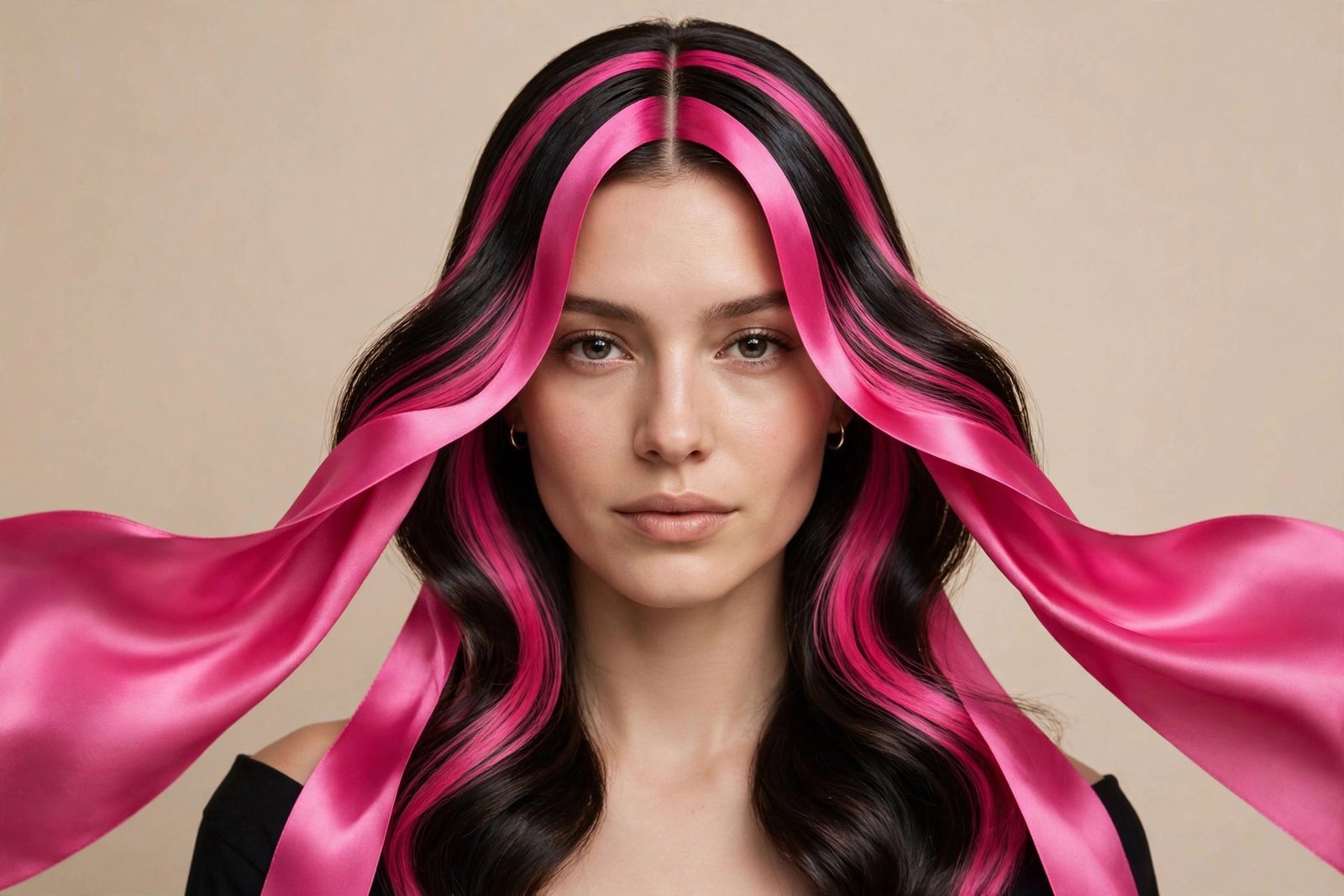
Curtain bangs had their era; now the curtain placement gets the pink treatment. Electric pink curtain stripes are two vivid pink ribbons that start at a center part and sweep outward along the face like curtains — wider and softer than face-framing stripes, more integrated than money pieces. The center part is essential: it’s what creates the symmetrical drape that makes this look so striking. In motion, the stripes swing with your face-framing layers like pink stage curtains. It’s dramatic, it’s symmetrical, it’s deeply photogenic.
Who it suits: center-part wearers with medium to long hair and face-framing layers — the stripes need those layers to blend into. It loves dark bases (contrast again), oval and oblong faces (the curtain width adds horizontal balance), and anyone who styles with a round brush or big waves, which amplifies the drape.
Colorist script: “Electric pink curtain stripes — center part, two wide ribbons sweeping back from the face, lifted to level 9, vivid electric pink.” Ask your colorist to cut the face-framing layers first so the pink follows the layer pattern. The stripes should start at the part and widen as they descend — narrow at the root, wide at the ends, like an actual curtain.
Maintenance: medium. Vivid + front placement = 4–6 week refresh cycle, but the wider, softer shape grows out more gracefully than skinny stripes. Downside: this look lives or dies by the center part. If you usually wear a side part, you’ll be restyling daily to keep the symmetry — be honest about your actual habits before committing.
25. Pink Peekaboo Curls

Curls and peekaboo color were made for each other, and I’m slightly offended it took until 2026 for this to trend properly. Pink peekaboo curls hide vivid pink in the underlayers of curly or coily hair, and every curl becomes a little reveal — the pink flashes in the spaces between curls as you move, like lights twinkling through leaves. It’s the most dynamic pink in this guide because curly hair never sits still, which means the pink never sits still either. Straight-haired girls have to work for the reveal; curls do it automatically.
Who it suits: curly, coily, and wavy hair of all lengths — the more texture, the better the effect. It loves vivid pinks (the curl shadows add depth that keeps bright color from looking flat) and it’s genuinely protective-friendly: the bleached sections are underneath, shielded from sun and friction by the curl canopy.
Colorist script: “Pink peekaboo on my curls — vivid pink panels in the underlayer, placed to show through the curl pattern.” Crucial: your colorist must place the panels on DRY, styled curls, not wet stretched hair — curl shrinkage moves everything, and panels placed wet end up in the wrong zip code. Ask for a curl-by-curl or panel placement from a stylist experienced with textured hair.
Maintenance: medium. Curly hair’s wash routine (less frequent washing, more conditioning) actually preserves pink beautifully — this might be the longest-lasting vivid pink in the guide in practice. Downside: bleach and curls are a delicate combination. The bleached underlayer needs extra moisture or the curl pattern loosens there, creating a texture mismatch. Deep condition like it’s your job.
26. Smoked Ash-Pink Pieces
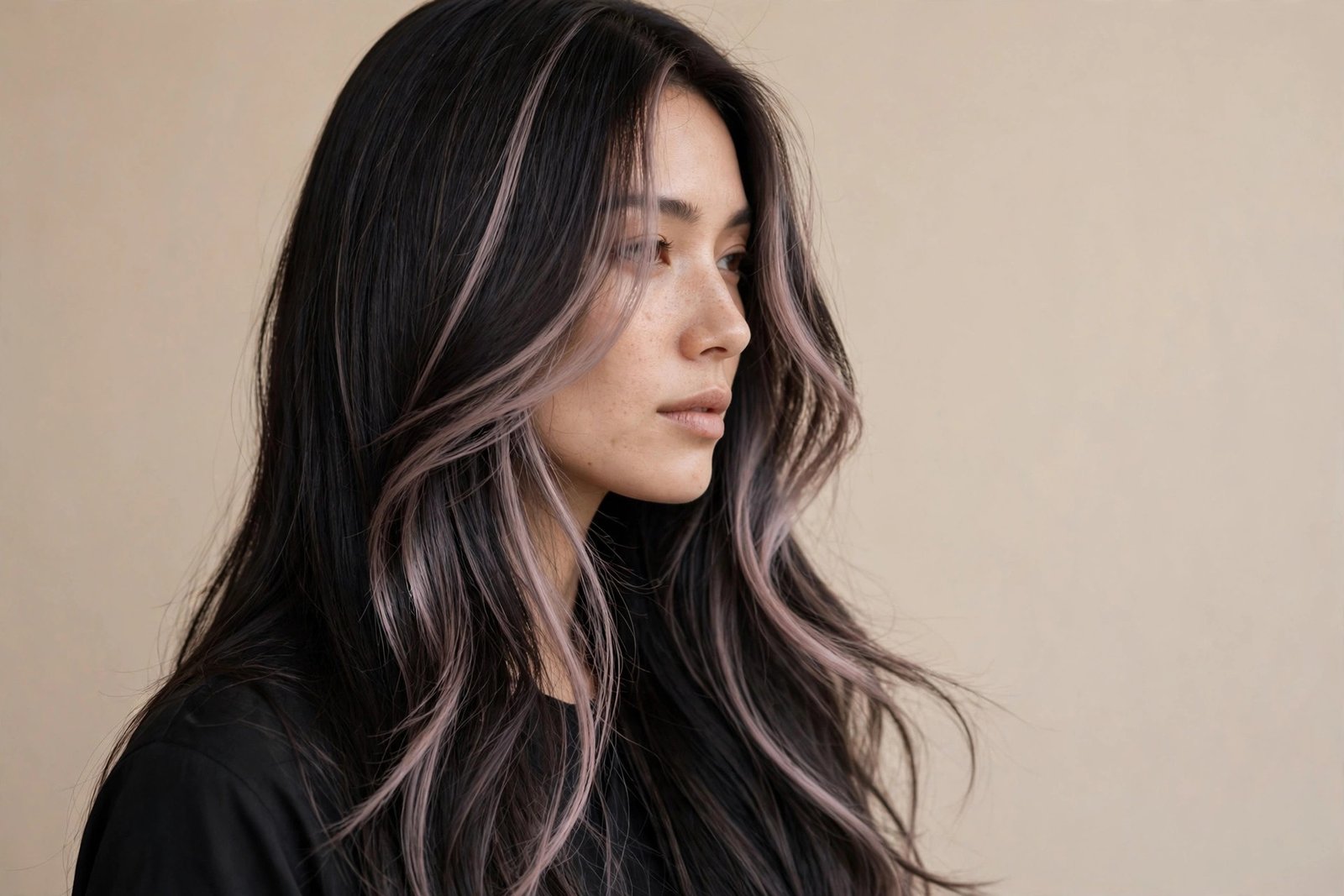
Not all pink wants to be noticed. Smoked ash-pink pieces are pink filtered through a gray lens — muted, cool, almost taupe with a pink undertone, like pink seen through cigarette smoke (the chic kind, not the sad kind). Woven as face-framing pieces or scattered panels through dark hair, they read as expensive dimension first and pink second. This is the pink for the quiet luxury girl who still wants in on the trend — it’s there if you know to look, and it photographs like a dream in natural light.
Who it suits: cool-toned everything — cool skin, ashy natural hair, wardrobes full of black, gray, and navy. It loves dark bases where the smoky contrast reads clearly, and straight or sleek hair where the cool tone looks deliberate rather than dull. If vivid pinks make you feel like you’re wearing a costume, this is your entry point.
Colorist script: “Smoked ash-pink pieces — lift to level 8, tone to a cool muted pink with a gray base, face-framing and scattered.” The gray base is the key instruction — without it, you just get dusty rose. Ask your colorist to formulate with a smoky/ash pink toner rather than diluting a vivid, which gives a truer smoked effect.
Maintenance: low-medium. Cool muted tones fade into a soft greige-pink that still looks intentional, and the subtlety means fading is nearly invisible. Refresh every 7–9 weeks. Downside: ash tones are the quickest to go “dull” rather than “faded” — if your hair is porous, the smoke can turn muddy. A clear gloss at home between appointments keeps it luminous.
27. The Ponytail-Reveal Peekaboo
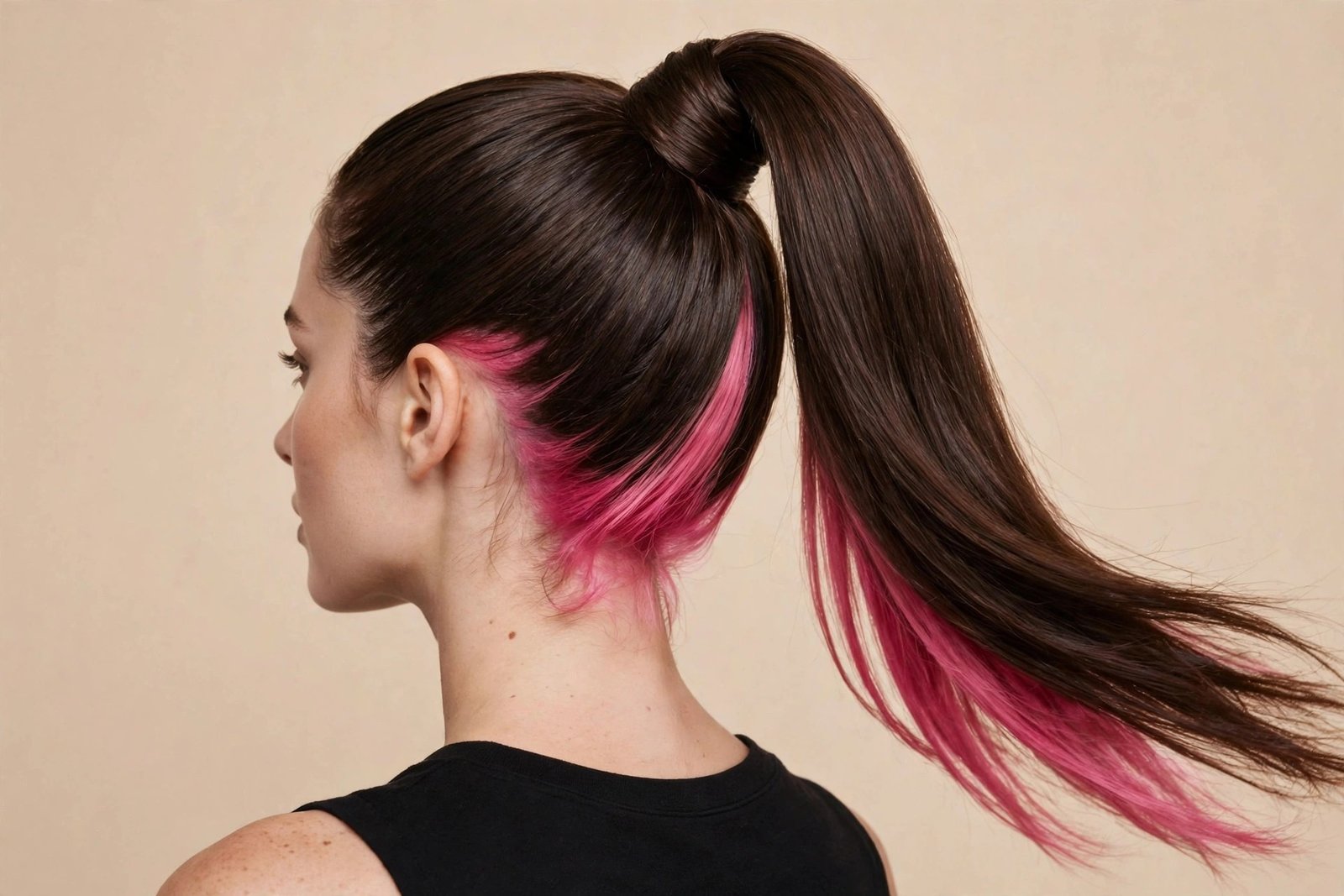
This one is engineered for a single moment: the ponytail. The ponytail-reveal peekaboo places vivid pink panels specifically in the nape and lower sides — the exact zones that get exposed when hair goes up — while keeping everything else natural. Down, you’re a brunette. Up, you’re a revelation. It’s the most strategic placement in this guide, designed backwards from the hairstyle instead of forwards from the color. Gym girls, dancers, anyone who lives in a pony: this is your pink.
Who it suits: anyone who wears ponytails, buns, or braids regularly — the more updos, the more payoff. It works on all lengths that reach a ponytail and all textures. It’s also the best pink for athletes and active lifestyles, since the color lives where sweat and sun hit least.
Colorist script: “Peekaboo panels placed for ponytails — vivid pink at the nape and lower sides, mapped while my hair is up.” Have your colorist actually put your hair in a ponytail during the consultation and mark the reveal zones — this is the one style where placement truly can’t be eyeballed on loose hair. Ask for the panels to extend slightly beyond the ponytail line so there’s no awkward gap.
Maintenance: low. Nape panels are the most protected pink on your head — minimal sun, minimal heat styling, minimal washing friction. They hold color longer than any other placement here. Downside: if you rarely wear your hair up, you paid for pink nobody sees. Be honest about your actual styling habits — this style punishes optimism.
28. Magenta Money Pieces on Black Hair
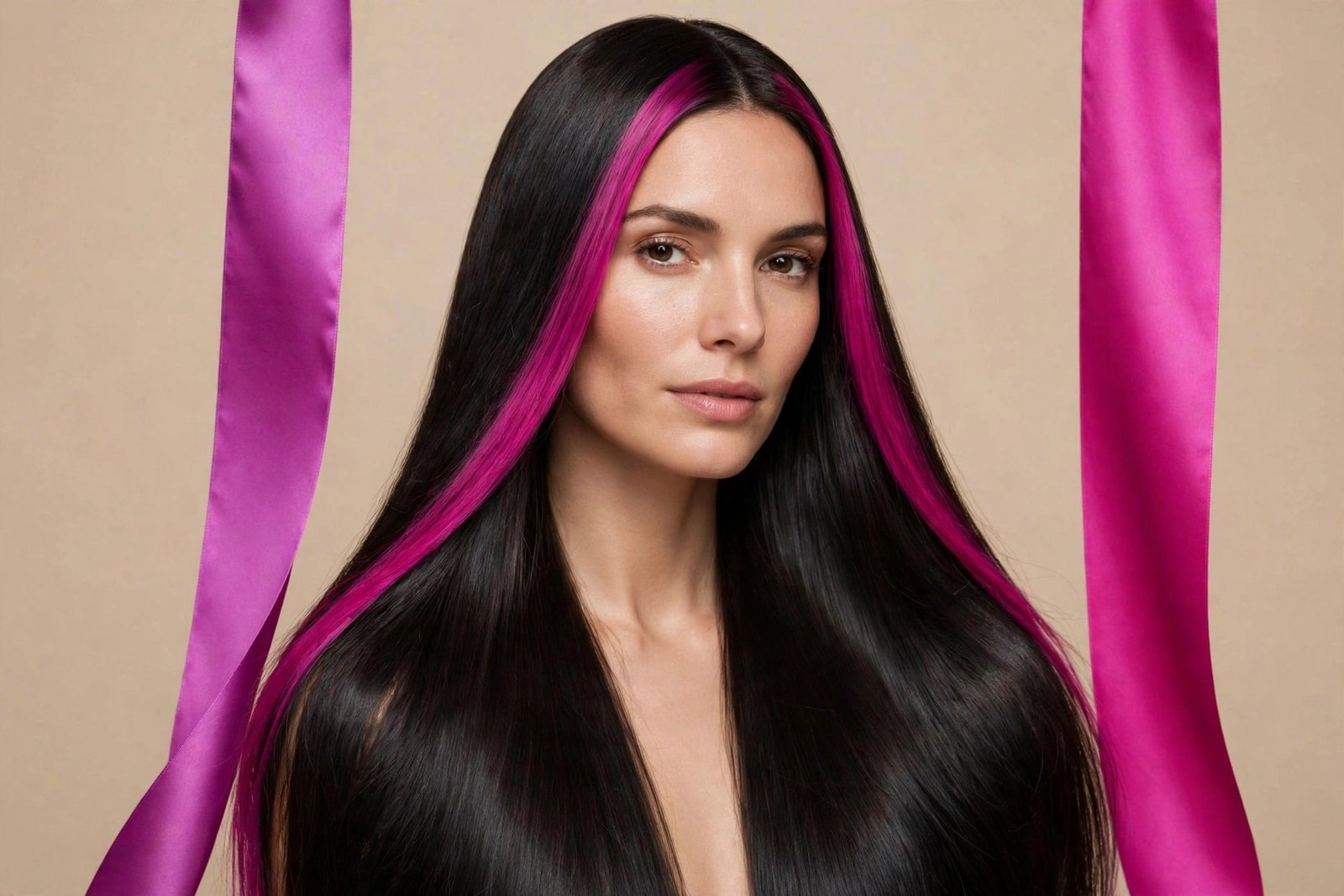
Maximum contrast, minimum hair dyed. Magenta money pieces on black hair are two ribbons of the most vivid pink-purple against the darkest base — and the effect is genuinely showstopping. Black hair makes every color next to it look more saturated, so magenta here looks more electric than the same magenta on brown. It’s the color equivalent of neon signage at midnight. And because it’s just two front pieces, the appointment is short, the damage is minimal, and the impact is enormous.
Who it suits: natural black or near-black hair — this specific contrast is the whole point. It loves sleek, straight styling where the ribbons read as graphic lines, center parts for symmetry, and bold personal style. Deep skin tones with black hair carry this like royalty; fair skin with black hair gets a striking Snow-White-meets-punk effect.
Colorist script: “Magenta money pieces on black — lift the two front sections to level 9, vivid magenta, keep my black base untouched.” Black hair lifting to 9 is a serious lift — it may take two sessions if your hair is resistant, and your colorist should be honest about that upfront. Ask for bond builder in the lightener; this is non-negotiable on dark hair.
Maintenance: medium. Vivid + front placement needs refreshing every 5–6 weeks, but it’s a small area. Downside: the lift on black hair is the most aggressive in this guide relative to the amount of pink you get. If your hair is fine or fragile, consider the dusty rose version instead — same placement, half the lift.
29. Pink Dip-Dye Ends
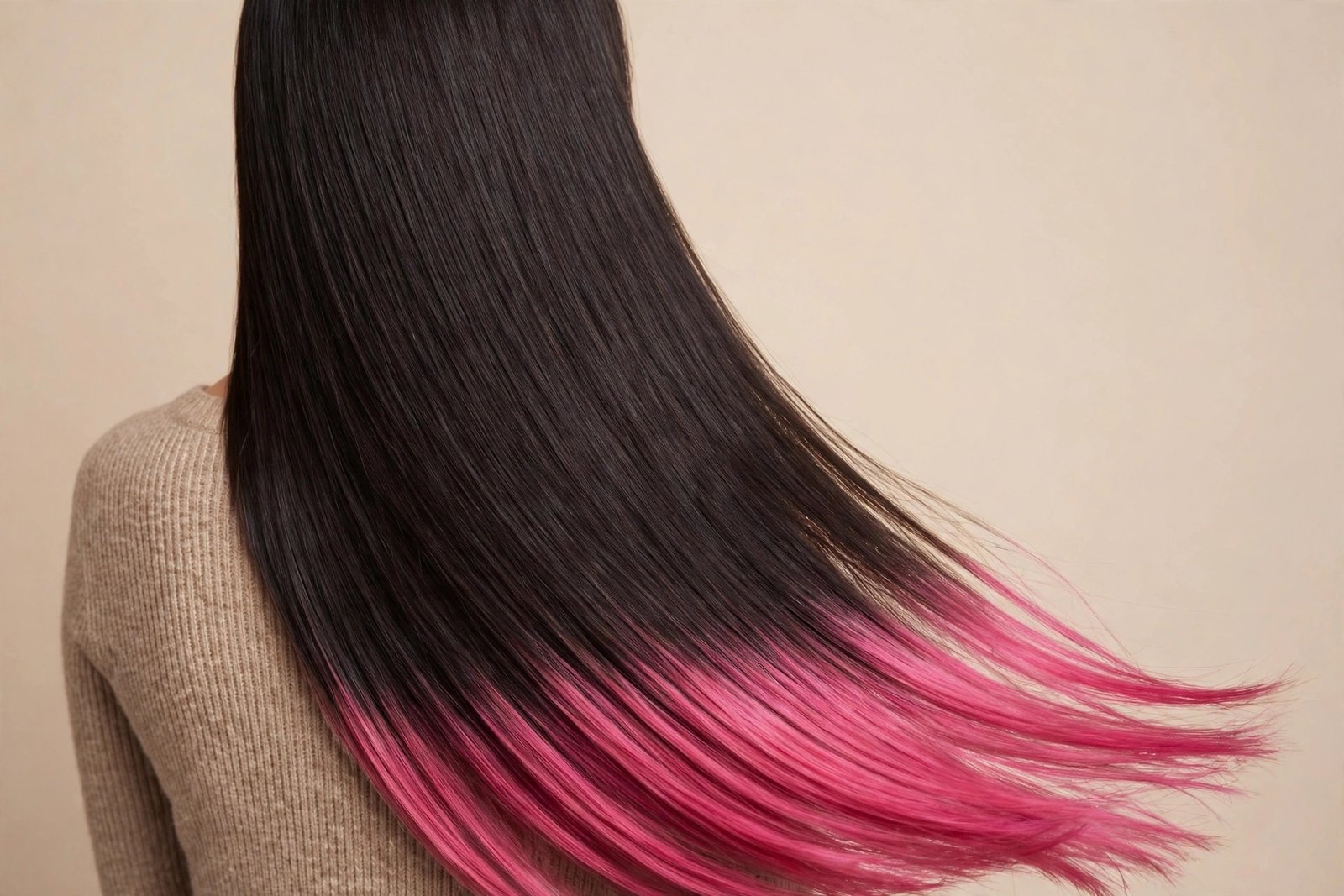
Dip-dye is exactly what it sounds like: the ends look dipped in pink, with a relatively defined line where the color starts. The 2026 version keeps the line but softens it just slightly — a controlled, deliberate color-block at the ends rather than the harsh DIY line of 2012. In vivid pink on dark hair, it’s graphic and cool and a little bit rebellious; in pastel on light hair, it’s sweet and dreamy. Either way, it’s the easiest pink to do and the easiest pink to remove — when you’re done, you just trim the ends.
Who it suits: long hair — the longer the better, since the dipped section needs room to make its statement. It works on all textures and it’s the best “try pink for a month” option in the guide, because the exit strategy is a haircut. Great for teens and first-timers, and for anyone whose workplace tolerates color that can be tucked away.
Colorist script: “Pink dip-dye on the ends — last 3–4 inches, vivid pink, softened line.” Even a salon dip-dye benefits from a slightly diffused transition — ask your colorist to backcomb or feather the line so it doesn’t look like you literally dipped it (even though, conceptually, you did).
Maintenance: low. Ends only, no roots involved, no grow-out line — you refresh the pink when you feel like it or trim it off when you don’t. Downside: the ends are the oldest, most porous hair, so they grab pink unevenly and fade fastest. And a dip-dye line, even softened, is a commitment to that exact length until you trim — growing it out looks intentional, but only if the line stays clean.
30. Rosewood Low-Light Dimension

Here’s the plot twist: pink doesn’t have to be lighter than your base. Rosewood low-lights weave DEEPER, pinker-brown ribbons through medium-brown hair — adding shadow and dimension in a rosewood tone that’s part brunette, part pink. It’s the only style in this guide that darkens rather than lightens, which means zero bleach, zero damage, and color that literally cannot fade ugly because it’s deeper than what was there. In sunlight, the rosewood flashes pink; indoors, it’s just the richest, most dimensional brunette you’ve ever seen.
Who it suits: medium brunettes who want pink with absolutely no bleach — this is the answer for the bleach-averse. It loves warm skin tones, long layers where the dimension can unfold, and anyone whose hair is too fragile for lightening but whose heart wants pink. It’s also the most professional-friendly pink here: nobody’s HR department has ever objected to rosewood.
Colorist script: “Rosewood low-lights — deeper pink-brown ribbons through my base, demi-permanent, no lightener.” Because there’s no lift, the appointment is fast and gentle. Ask for the low-lights to be concentrated underneath and through the mids (where dimension shows most) rather than at the crown, which can look stripey with dark ribbons.
Maintenance: the lowest in the guide, genuinely. Demi-permanent low-lights fade so gradually you might not notice, and there’s no regrowth line because nothing was lifted. Refresh every 10–12 weeks if you even bother. Downside: on dark hair, the pink barely registers — this is a medium-brunette-and-lighter game. And if you wanted VIVID pink, this will feel like ordering a cocktail and getting a mocktail. Lovely, but not the brief.
31. Pink and Lavender Duet
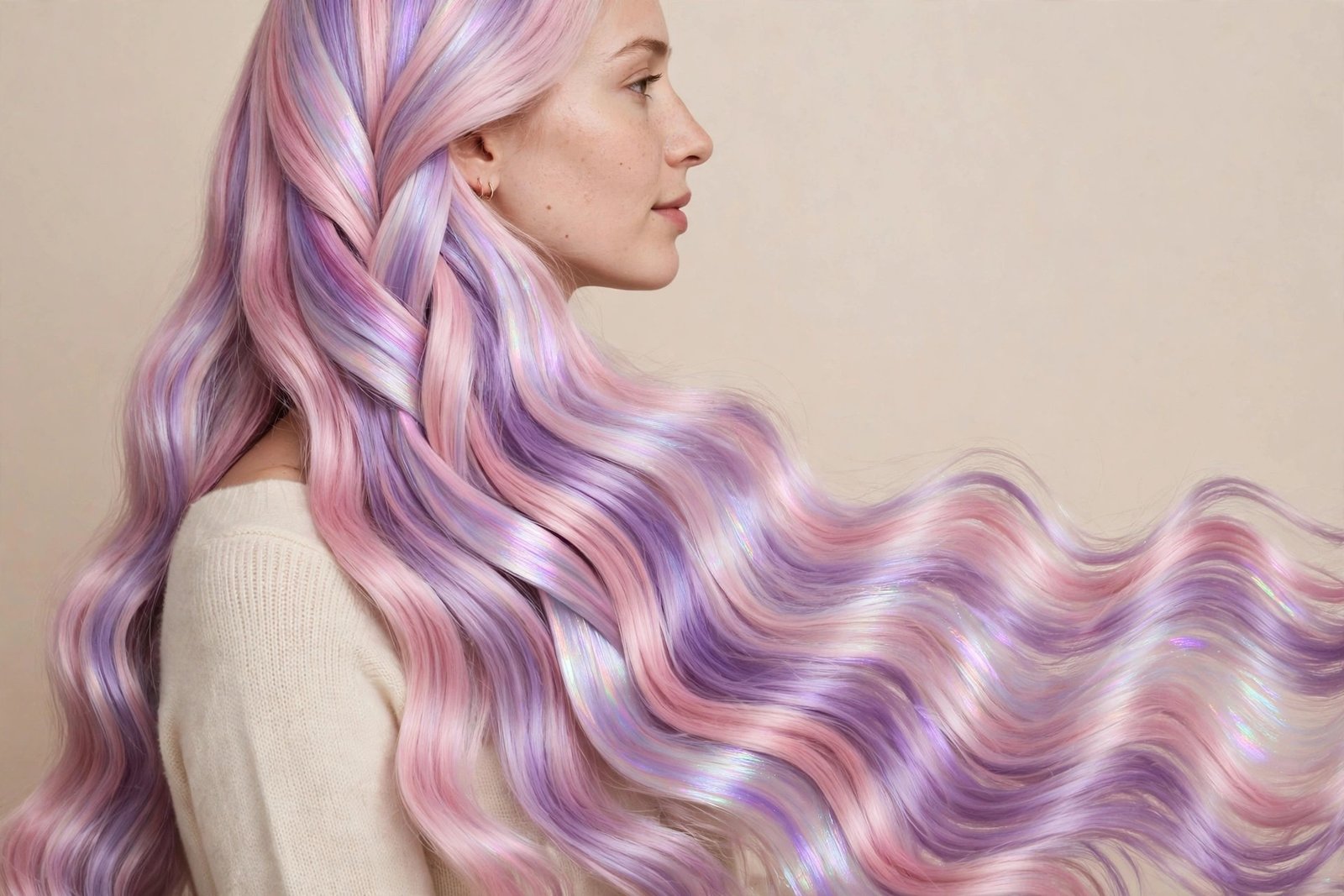
Two pastels are better than one. The pink and lavender duet alternates panels of soft pink and soft lavender through the hair — sometimes as peekaboo underlayers, sometimes woven through the lengths — creating this iridescent, opalescent effect where the colors shift as you move. It’s the dreamiest look in the guide, all fairy-tale and no edge, and it does something no single color can: the lavender makes the pink look pinker, and the pink makes the lavender look more lavender. They’re better together.
Who it suits: light bases — this needs level 10 underneath to keep both pastels true, so blondes and the already-lightened get the best version. It loves long hair where the alternating panels have room to play, cool and fair skin tones, and anyone whose aesthetic is soft, romantic, and a little bit magical.
Colorist script: “Alternating pink and lavender panels — underlayer or woven, both lifted to level 10, true pastels.” Ask your colorist how they’ll keep the panels from bleeding into each other during processing — foils or separated processing are essential, because pink + lavender + bleed = muddy mauve everywhere. Request the panels be wide enough to read as distinct colors, not a blend.
Maintenance: the highest in the guide, no contest. Two pastels, both fading fast, at slightly different rates — you’re refreshing every 2–3 weeks to keep the duet distinct. Downside: as they fade, pink goes peach and lavender goes gray, and the combination can look unintentional fast. This is a high-maintenance relationship. Gorgeous, but high-maintenance.
32. The Statement Pink Panel
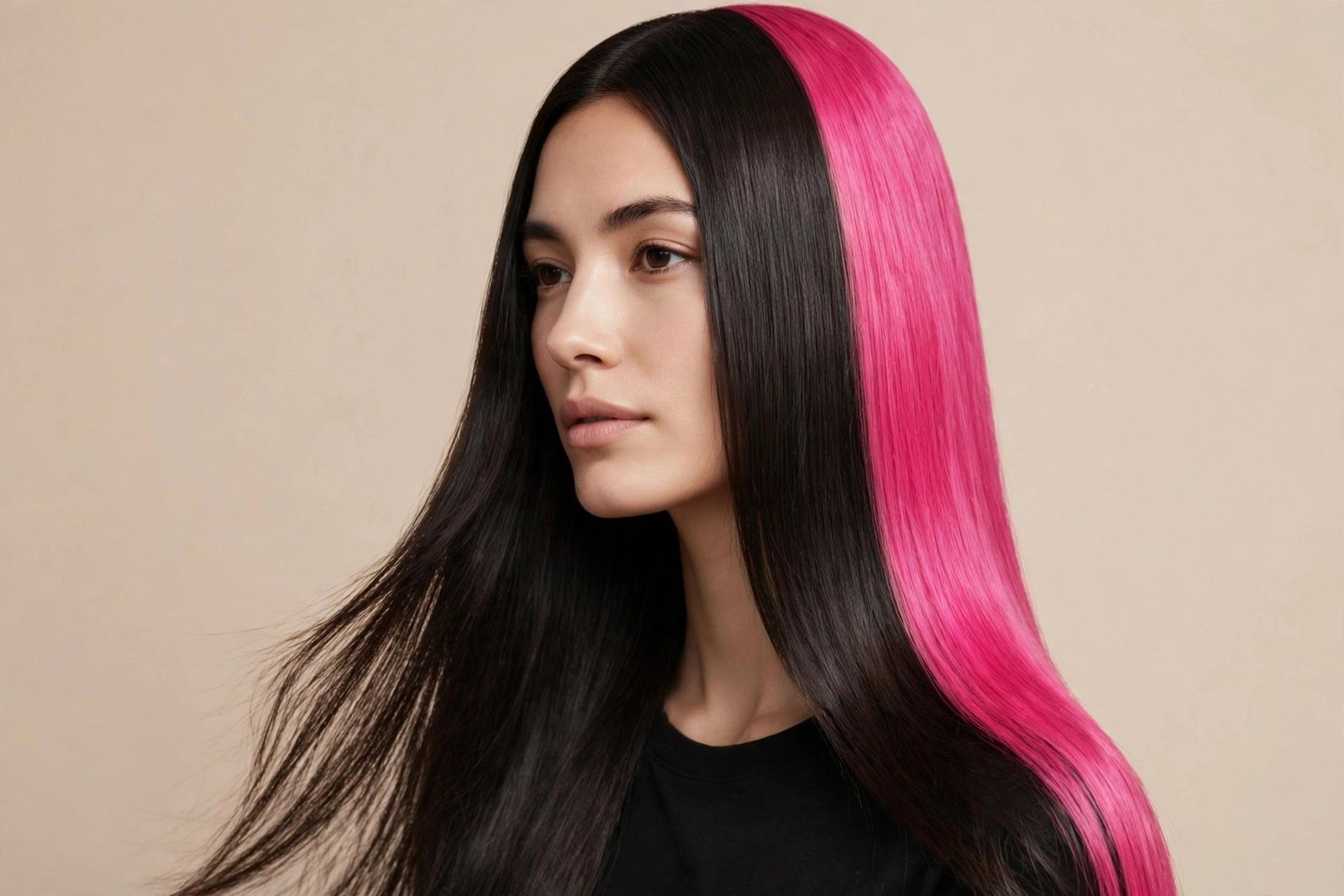
We end with the boldest minimalism in the guide: ONE panel. A single, wide, vivid pink panel — usually at the side, falling over one shoulder — against otherwise completely natural hair. It’s the fashion-editor’s version of pink-a-boo: less is more, one perfect thing done perfectly. The asymmetry is the point. It draws the eye, it photographs like a dream, and it says “I thought about this” in a way that all-over color never could. Sometimes the strongest statement is the most restrained one.
Who it suits: anyone with a good side part and the confidence to be asymmetrical. It loves long, sleek hair where the single panel reads as a graphic element, dark bases for contrast, and strong personal style — this is a look with opinions. It’s also the smartest choice for anyone testing whether they like being “a person with pink hair,” because it’s one panel, not an identity.
Colorist script: “One wide statement panel — side placement, lifted to level 9–10, vivid pink, about two inches wide.” Placement consultation is everything: have your colorist section it while your hair is styled normally, because a panel that looks perfect on loose hair can disappear behind your ear the second you tuck. Ask for it to sit forward enough to stay visible.
Maintenance: low-medium. One panel is the cheapest vivid refresh in the guide — a 30-minute appointment. Downside: a single panel shows grow-out and fading more obviously than distributed color, since there’s nothing else to distract the eye. Keep it fresh (every 5–6 weeks) or it goes from “statement” to “leftover” fast. But when it’s fresh? Nothing in this guide turns more heads per dyed inch.
The Pink Hair Color-Safe Care Routine
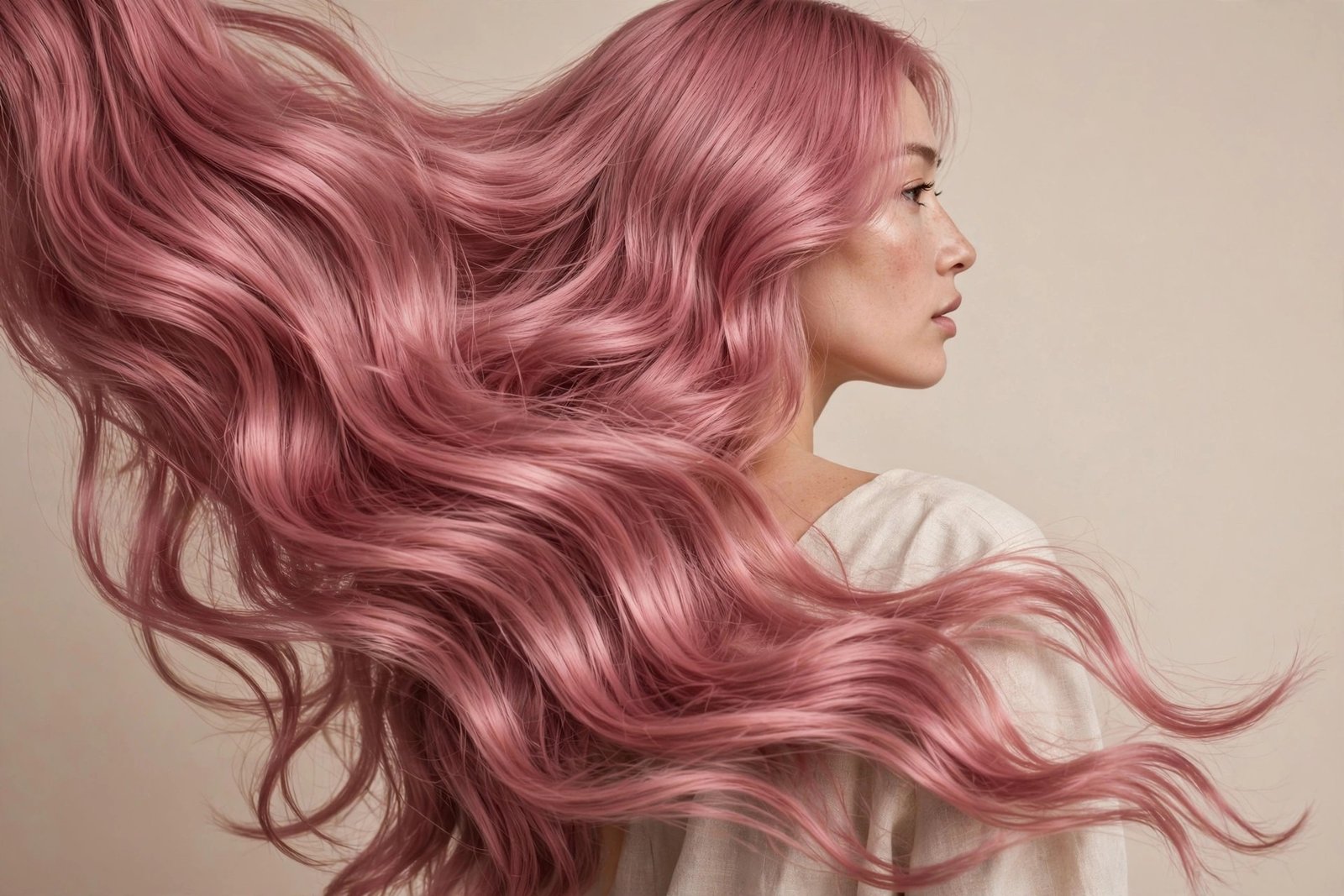
You picked your pink. Your colorist nailed it. Now comes the part that decides whether it lasts six weeks or sixteen days: the routine. Pink is a direct dye — it sits on the hair shaft rather than inside it, which means every wash, every hot shower, every blast of sun is slowly rinsing it down the drain. The good news is that pink-a-boo placements are naturally easier to maintain than all-over color (less surface area, much of it hidden), and a few non-negotiable habits will double your color’s life. This is the exact routine I’d hand you in the salon chair — the one that keeps pink hair women vibrant for weeks instead of days.
The 2-Wash Weekly Schedule
Wash your hair twice a week. That’s it — that’s the headline. Every wash strips some pink, so fewer washes equals longer color, full stop. I know this is the hardest habit to change, especially if you’re a daily washer, but pink hair is the lifestyle change that makes converts. Your scalp adjusts in about two weeks: the oil production calms down once it stops being stripped daily, and dry shampoo becomes your best friend on days three and four.
When you do wash, water temperature matters more than you’d think. Hot water opens the hair cuticle and lets color molecules escape — it’s the fastest way to fade pink that exists. Wash in lukewarm water, and if you can stand it, do the final rinse cool. You don’t need an ice bath; just turn the heat down from “lobster” to “comfortable.” Your pink will thank you with an extra week or two of vibrancy, and honestly your skin will too.
Technique matters as well: shampoo the roots and scalp only, where the oil actually lives. Let the lather run down over the pink lengths as you rinse rather than scrubbing the color itself — the pink sections don’t need direct shampooing, they’re not dirty, they’re just along for the ride. And always, always follow with conditioner on the mid-lengths and ends. On pink hair, conditioner isn’t optional moisture — it’s armor. If your ends feel dry after washing, you’re either washing too hot, washing too often, or skipping the mask you should be doing weekly.
Between washes, dry shampoo is your secret weapon — but use it right. Apply it at night before bed, not in the morning; it needs hours to absorb oil properly, and overnight application means you wake up with fresh-feeling roots instead of a powdery film. Focus on the roots and crown (your natural hair, mostly), and keep it away from the pink sections themselves, where powder can dull the color. A silk or satin pillowcase does quiet work too: less friction means less color rubbed off onto fabric and less breakage on the bleached sections.
The Products That Actually Matter
Let me save you money: you do not need a twelve-product pink hair routine. You need four things, and the order of importance might surprise you. Number one, by a mile, is a color-depositing conditioner or mask in your pink shade. This is the single product that separates pink that lasts four weeks from pink that lasts eight. Every time you condition, you’re topping up the pigment — it’s like a mini color refresh in the shower. Use it every wash, leave it on for the full recommended time (usually 5–10 minutes, not the 30 seconds most people do), and keep a second, deeper mask version for weekly use.
Number two is a sulfate-free, color-safe shampoo. Sulfates are excellent cleansers and terrible color preservers — they strip direct dyes aggressively. Switch to a sulfate-free formula and you’ll see the difference in the shower drain within a week: dramatically less pink swirling away. It doesn’t need to be expensive; it just needs to say sulfate-free and color-safe. Use a small amount — color-safe shampoos are concentrated, and over-applying just means more rinsing, which means more fading.
Number three is a heat protectant, used every single time heat touches your hair — no exceptions, no “just a quick straighten.” Bleached-then-pinked hair is more heat-sensitive than virgin hair, and heat doesn’t just damage it, it actively fades the color: high temperatures literally cook the dye molecules. Keep tools at or below 180°C (350°F), work in small sections so one pass is enough, and embrace heatless styling when you can. Your pink’s lifespan is directly proportional to how rarely you roast it.
Number four is a UV protectant spray. Sun is pink’s silent killer — UV breaks down dye molecules even when you’re not washing, and one unprotected beach day can take magenta to peach. Spray it on like sunscreen whenever you’ll be outside for a while, and wear a hat for long exposure. This is the product everyone skips and then wonders why their pink died in July. Don’t skip it. For the science of why dye fades the way it does, the hair coloring entry on Wikipedia is a solid primer on how direct dyes interact with the hair shaft.
The 4–6 Week Salon Refresh
Here’s what nobody tells you before your first fantasy color: the appointment isn’t the finish line, it’s the starting line. Pink needs refreshing, and planning for it upfront is the difference between always-great hair and a cycle of gorgeous-to-faded-to-panic. For most pink-a-boo styles, book your refresh at 4–6 weeks — not when the color is gone, but when it’s starting to soften. Refreshing fading color is quick and cheap; resurrecting dead color is a full re-do.
What a refresh actually involves depends on your placement. For underlayer and panel peekaboos, it’s usually just a toner or gloss re-application over the existing lift — no re-bleaching, 45 minutes, a fraction of the original cost. For money pieces and stripes, same story: re-tone the lifted sections, refresh the pink, done. The lift only needs redoing when your regrowth reaches the pink zone, which for hidden placements can be months. This is the economic superpower of pink-a-boo: the expensive part (bleach) is infrequent, and the frequent part (tone) is cheap.
Between salon visits, a pigmented gloss or color-depositing mask at home bridges the gap beautifully — many of my clients stretch to 8 weeks with diligent home toning. And here’s the insider truth worth repeating: the second application of pink always lasts longer than the first. The hair shaft, once stained, grabs pigment more eagerly the next time. So if your first round faded faster than expected, don’t despair and don’t blame your colorist — the refresh is when your pink truly settles in for the long haul.
What to Do When It Fades (Because It Will)
All pink fades. Every shade, every brand, every head of hair — it’s the nature of direct dye. The question isn’t whether, it’s how gracefully. And here’s the reframe that will save your sanity: pink fading isn’t failure, it’s a gradient. Vivid pink melts into dusty pink, which melts into blush, which melts into a warm stain that’s honestly still pretty. The goal was never permanent pink — it was a beautiful fade journey with no ugly phase. Styles chosen well (dusty, dark, and warm pinks) fade like watercolors. Pastels and neons have a shorter pretty-window, which is the trade for their initial drama.
When the fade starts looking tired rather than pretty, you have three moves. Move one: the home refresh — a color-depositing conditioner in a slightly deeper shade than your current fade, left on for 10–15 minutes, which can buy you 2–3 more weeks. Move two: the tone shift — ask your colorist to transition the faded pink into something new rather than re-doing the same shade. Faded pink takes rose gold beautifully, and faded magenta makes a gorgeous base for a deeper wine. Some of the best color I’ve ever seen started as a “failed” fade. Move three: the graceful exit — if you’re done with pink, a color remover plus a natural toner takes most pinks out cleanly, especially the lighter shades. Vivid fuchsia and magenta stain more stubbornly and may need growing out or a corrective toner, which is worth knowing before you choose them.
What NOT to do: don’t try to fix fading pink by washing more (it accelerates the fade), don’t crank up the heat styling to “make it look better” (it cooks out more color), and don’t box-dye over it in a panic (box dye over faded fantasy color is how you get mud). Patience and pigment — that’s the whole fix. For ongoing inspiration on managing creative color gracefully, Byrdie’s hair color coverage regularly features colorist advice on fade management and tone transitions.
Sun, Pools, and Holidays: Pink’s Enemies
Pink hair and summer have a complicated relationship. The two great destroyers of pink are UV radiation and chlorine, and a beach holiday serves both at once. Chlorine is the worse of the two — a single unprotected swim can strip weeks of color in an afternoon, and on lightened pink hair it can also deposit a greenish cast that’s genuinely hard to fix. Salt water is gentler than chlorine but still dehydrating, which makes color fade faster. None of this means you can’t swim — it means you swim strategically.
The pre-swim ritual: saturate your hair with clean water first (wet hair absorbs less pool water — it’s like a sponge that’s already full), then apply a leave-in conditioner or a light oil through the lengths as a barrier. If you’re a serious swimmer, a swim cap is the only real protection; fashion swim caps exist now, and your pink is worth it. After swimming, rinse immediately with clean water — don’t let chlorine sit — and follow with your color-depositing conditioner to replace what was lost. Keep a travel-size of it in your beach bag; future you will be grateful.
For sun: UV protectant spray is the baseline, reapplied like sunscreen, plus a hat for long exposure. This matters even on cloudy days and even in winter — UV is UV. And if you’re planning the big tropical holiday, time your color appointment for the week BEFORE you go (fresh color survives the trip better than month-old color) and book your refresh for the week after you return. Your colorist has seen a thousand post-holiday fades; there’s no judgment, only a toner with your name on it.
Pink Hair Women: Frequently Asked Questions

Everything you’re still wondering about pink hair, answered straight — no salon-speak, no sugarcoating. These are the questions I hear most, from the bleach question everyone asks first to the money question everyone asks last.
Will I need bleach to get pink hair?
Almost certainly — unless your hair is already very light. Pink is a fantasy color: it doesn’t lift your natural pigment, it only stains what’s there. On medium-to-dark hair, pink dye without pre-lightening shows as a faint warm sheen in sunlight and almost nothing indoors. Your colorist will lift the pink sections to a level 8–9 pale yellow (level 10 for pastels). Here’s the good news about pink-a-boo: you’re only bleaching the underlayer, money pieces, or stripes — maybe 10–20% of your head — not a full-head lift. That means less damage, less chair time, and a kinder grow-out. If you’re a natural level 6+ brunette, a high-lift dusty rose can sometimes skip full bleach. Always do an elasticity and strand test first, and be honest about box dye — it’s the number-one reason pink turns murky.
How long does pink hair dye last?
Most pinks hold true vibrancy for 4–8 weeks: pastels and dusty rose fade fastest (2–4 weeks), deeper magenta and fuchsia last 6–8. The fade is a gradient, not a cliff — vivid melts into dusty, then into a soft blush, which honestly still looks intentional. Washing habits decide everything. Hot water, daily washing, and sulfate shampoos can halve that life. Cool-to-lukewarm water, washing twice a week, and a color-depositing conditioner in your shade will stretch it dramatically. Colorists won’t tell you this, but the second application always lasts longer than the first — porous hair grabs pigment better once it’s been stained. Silk pillowcases and UV protectant spray matter too: sun is pink’s silent killer, and one unprotected beach weekend can take you from magenta to peach.
Is pink hair bad for my hair?
The pink dye itself is surprisingly gentle — most pinks are direct dyes with no ammonia and no developer; they stain rather than restructure the hair. Any damage comes from the bleaching needed to get there. That’s exactly why pink-a-boo is good news: you’re lightening a few panels or pieces, not your whole head, so 80–90% of your hair never touches bleach. The lightened sections do need real care — protein-moisture balance, weekly masks, heat protectant every time you style. I’ll be honest: if your hair is already breaking from past bleaching, pink won’t fix anything, and color looks patchy on damaged hair. Get the integrity back first — bond-building treatments and a trim of the worst ends — then go pink. Healthy hair holds color more evenly and for longer.
What should I ask my colorist for the pink-a-boo look?
Bring three photos: your goal shot, one showing the tone you want (dusty vs. hot), and one showing the placement (underlayer vs. money pieces vs. stripes). Then use words colorists actually understand: ask for ‘chunky pink panels on the underlayer,’ ‘a dark pink peekaboo,’ or ‘dusty rose money pieces.’ Describe the effect you want — ‘visible when I move my hair but hidden when it’s down’ gets you a true peekaboo; ‘framing my face’ gets you stripes. Ask whether they recommend semi- or demi-permanent color, and what level they’ll lift to (8 for dusty tones, 9–10 for pastels). Ask about maintenance upfront: how often you’ll need a refresh and what to take home — a good colorist hands you a color-depositing conditioner and a wash schedule. Get the price in writing before they mix, since fantasy color is often quoted per panel.
What’s the difference between dusty rose, hot pink, and pastel pink?
They’re three different commitments. Dusty rose is the most wearable — a muted, mauve-leaning pink that reads almost neutral indoors and glows in sunlight. It flatters warm and cool skin tones, forgives imperfect bleaching, and fades gracefully into a soft beige-pink. Hot pink (fuchsia, magenta) is the statement — high-contrast, needs level 9–10 pre-lightening, announces itself across the room, and stains pillowcases; it fades fastest and needs the most upkeep. Pastel pink is the most fragile — it needs near-white hair to show at all, looks ethereal for about two weeks, and demands constant refreshing. My honest take: if this is your first fantasy color, start dusty. It lets you test whether you actually like living with pink before you commit to the maintenance of the brighter shades.
Can brunettes get pink highlights without full bleach?
You can get a version of it, but manage expectations. On unbleached brunette hair, pink dye alone shows as a warm pinkish glow in direct light and almost nothing indoors — some people love this subtle ‘rose brunette’ effect, but it’s not the Pinterest peekaboo. For true visible pink stripes or panels, those sections must be lifted first — but only those sections. Two chunky panels or a money-piece lift is a fraction of the damage and cost of full-head bleaching. If you’re strictly anti-bleach, ask about a high-lift dusty rose gloss, which can give medium-brown hair a visible rosy cast. One honest warning: black box-dyed hair and pink are enemies. Going pink over box dye usually means a color remover plus a test strand first, and sometimes the answer is ‘not yet.’ The test strand is your best friend — ten minutes of testing saves ten weeks of regret.
How do I stop pink hair from fading so fast?
Wash twice a week max, in cool-to-lukewarm water, with a sulfate-free color-safe shampoo — and shampoo mostly the roots, letting the lather run over the pink lengths rather than scrubbing them. Condition every wash with a pink color-depositing conditioner or mask: this tops up pigment each time and is the single biggest difference between pink that lasts four weeks and pink that lasts eight. Turn heat tools down to 180°C/350°F or lower, always use a heat protectant, and air-dry when you can. Wear UV protectant spray in the sun, and rinse hair with clean water plus a leave-in before swimming — chlorine can strip pink in a single swim. Refresh the tone at home with a pigmented gloss between salon visits, and book your toner refresh at weeks 4–6 rather than waiting until the color is gone.
How much does pink hair cost at a salon?
It depends on placement. A pink gloss or a few money pieces on pre-lightened hair runs about $80–$150. Chunky peekaboo panels with a bleaching step are typically $150–$300, depending on your city and how much hair is lifted. Full creative color — multiple pinks, teal pairings, an all-over melt — can reach $300–$500+. The refresh is cheaper: a toner and gloss touch-up at weeks 4–6 is usually $60–$120, since the heavy lifting is already done. What nobody budgets for is the take-home care: a good color-depositing conditioner, sulfate-free shampoo, and UV spray add $50–$80 upfront — but they can double your color’s life, making them the cheapest money you’ll spend. Always ask exactly what’s included in the quote: ‘bleach, tone, color, treatment, and cut’ versus ‘color only’ are very different appointments.
Final Word: Find Your Pink
If there’s one thing I want you to take from this guide, it’s that pink in 2026 is not the commitment it used to be. You don’t have to bleach your whole head. You don’t have to become “a pink hair person.” You can be a brunette with a secret, a blonde with strawberry ends, a black-haired woman with two magenta ribbons that change your whole face. Pink-a-boo is fantasy color on your terms — visible when you want it, invisible when you don’t, and kinder to your hair than any pink trend before it.
Start where your courage is. Dusty rose if you want pretty with training wheels. Hot pink stripes if you’re done being subtle. The teal split if you want the most complimented hair in every room you enter. More pink hair women are choosing smart placement over all-over color this year than ever before — join them. Bring your three photos to the colorist, use the words from the scripts above, buy the color-depositing conditioner before you leave the salon, and wash less than you think you need to. Do those things and your pink won’t just look like the Pinterest photo on day one — it’ll still look good on day forty. Now go find your pink. It’s been waiting for you.