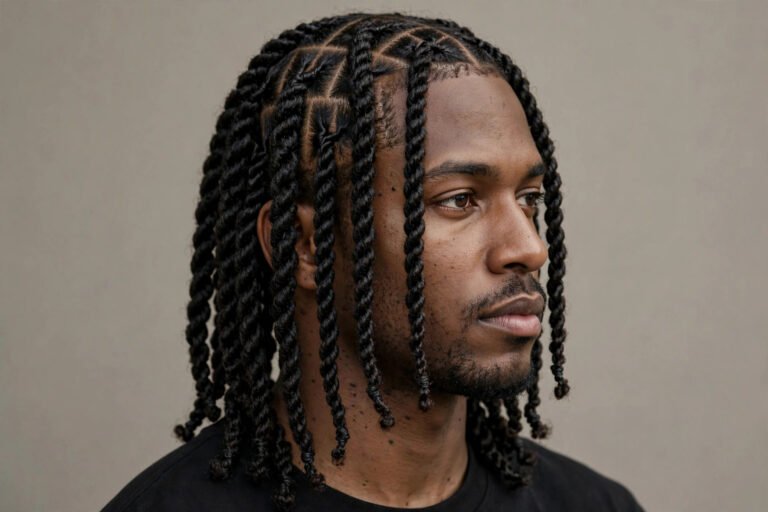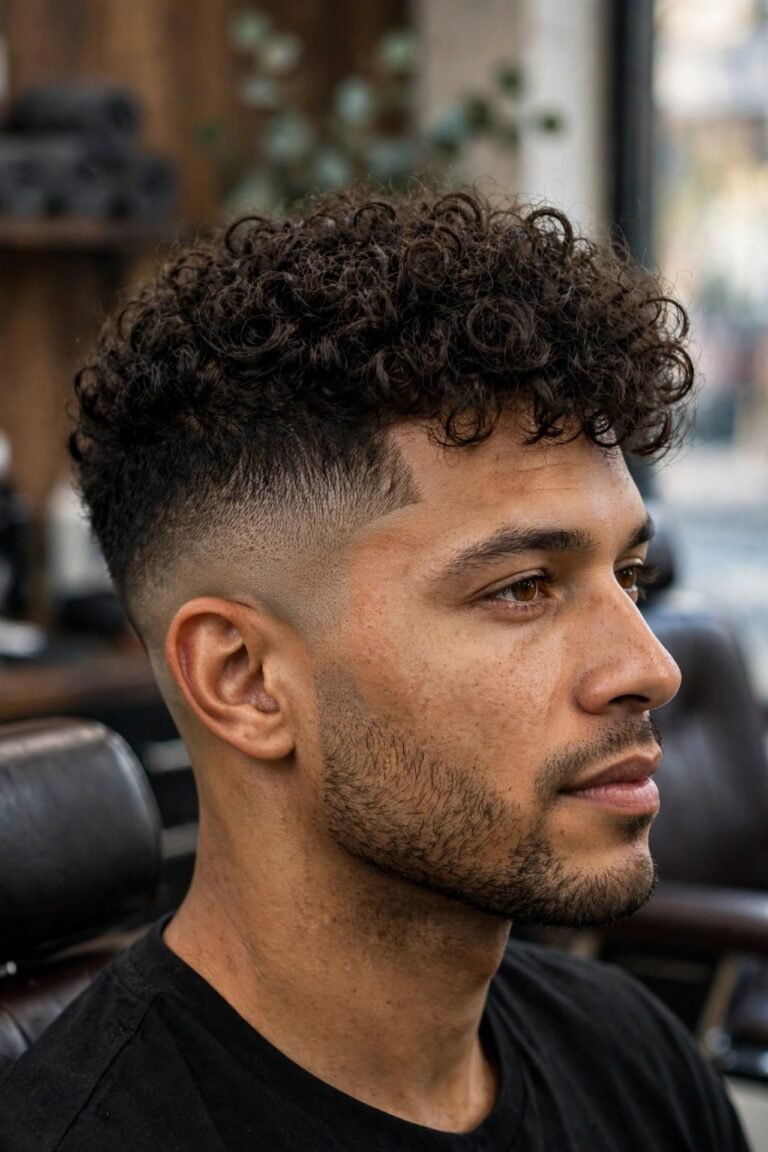
Curly Fringe Men 2026: 36 Styles & Complete Styling Guide
The Curly Fringe Is 2026’s Texture Answer (And Every Curl Guy Is Wearing It Forward)
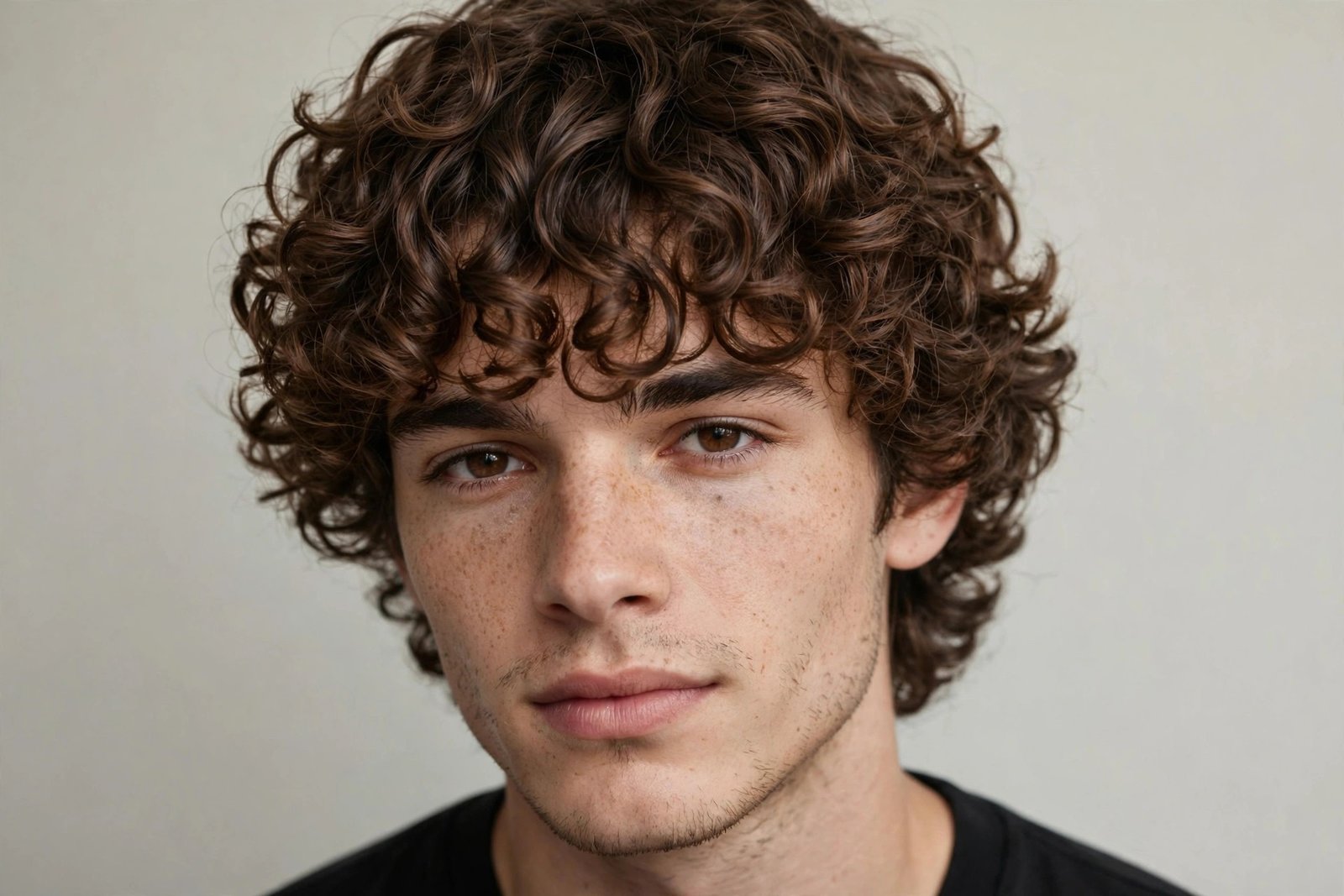
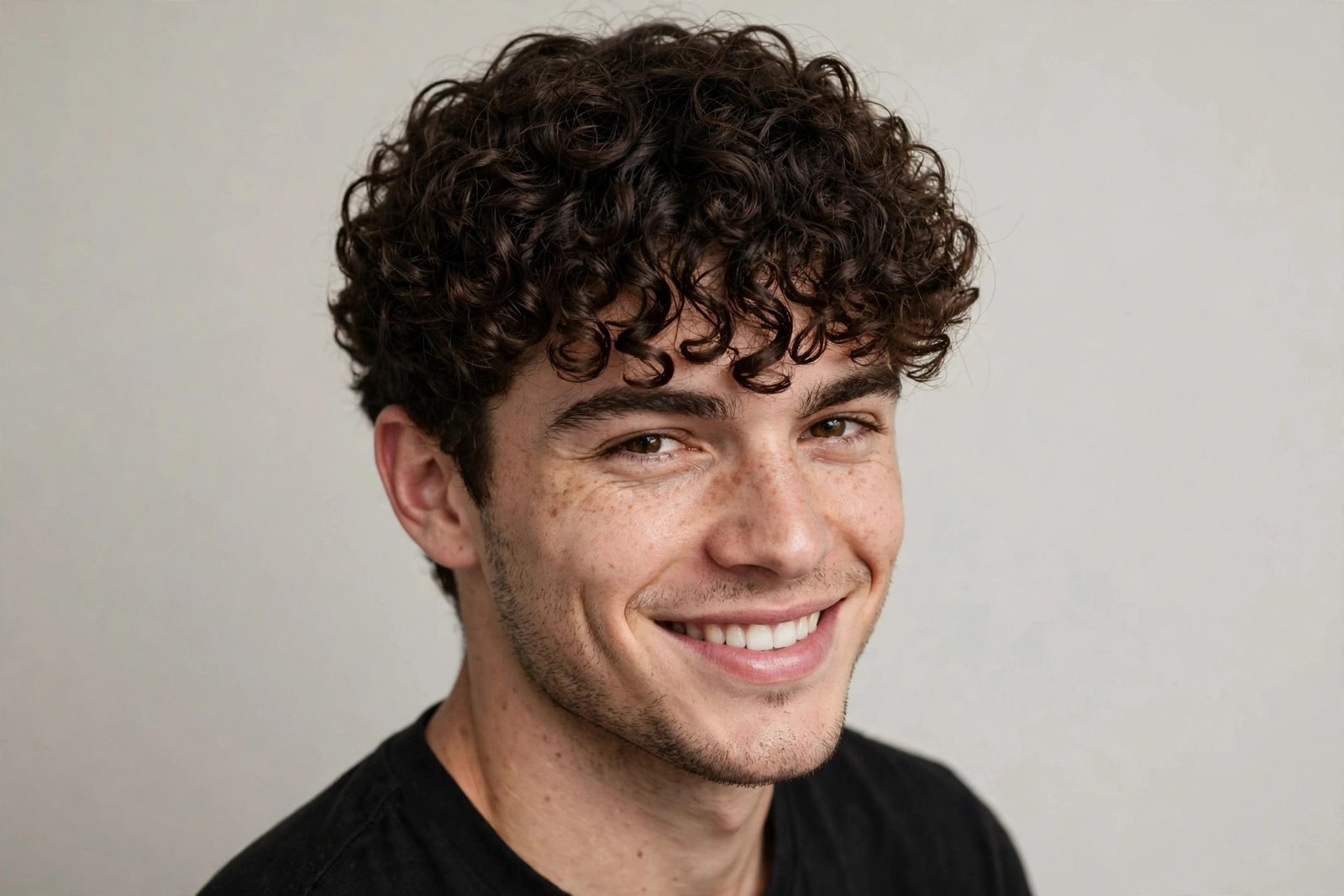
Here’s the thing nobody told curly guys for decades: the curly fringe men are rocking in 2026 isn’t a trick, a technique, or a workaround. It’s just your natural curls, falling forward, on purpose. After years of being told to fight the frizz, stretch the coils, or chop everything into a buzz, men with curly and wavy hair finally have a trend that says the exact opposite — let the curls do what curls do, and wear them right on the forehead. Pinterest’s 2026 men’s trend data calls it plainly: texture is king this year. And the curly fringe is the crown.
Now, before we go one inch further, we need to clear up the confusion that’s costing guys the wrong haircut at barbershops everywhere. This article is NOT about the textured fringe. We already have a full guide on textured fringe haircuts for men, and that one is about a cutting technique — point cutting, slicing, thinning — used mostly on straight or wavy hair to manufacture the look of texture. What you’re reading now is something different entirely: NATURAL curly and wavy hair worn forward as a fringe. No scissors faking texture. No straight-hair illusions. Your actual curl pattern, styled forward. If a barber’s technique creates the texture, that’s the other article. If your DNA created the texture, you’re in the right place.
Why is this exploding in 2026? Two forces collided. First, the culture finally caught up: the broccoli cut, the TikTok wavy fringe, the entire Gen Z embrace of big, unapologetic texture — curls stopped being a problem to solve and became a feature to show off. Second, the techniques got better. Barbers learned to cut curls dry, curl by curl, instead of soaking them straight and guessing where they’d land. Diffusers got smarter. Curl creams stopped being a women’s-aisle product. The result is a style that’s simultaneously the easiest cut a curly guy can maintain (the curls ARE the style) and one of the sharpest looks walking around right now.
I’ve put together 36 distinct curly fringe styles in this guide — not 36 tiny variations of the same cut, but genuinely different directions: fades, tapers, long, short, tight coils, loose waves, edgy, professional. For each one you’ll get who it suits, exactly what to tell your barber, how to style it on a Tuesday morning, and the honest downside nobody else will mention. Plus a complete styling routine and the answers to every question guys actually ask. Let’s get into it.
Table of Contents
- The Curly Fringe Is 2026’s Texture Answer
- Curly Fringe vs Textured Fringe: Know the Difference
- Why 2026 Is the Year of the Curly Fringe
- Who Suits a Curly Fringe (And Who Should Tweak It)
- 36 Curly Fringe Styles for Men in 2026
- The Curly Fringe Styling Routine: Complete Care Guide
- Frequently Asked Questions
- Conclusion
Curly Fringe vs Textured Fringe: Know the Difference (Read This Before Your Barber Visit)
I’ll be blunt: more than half the bad curly-fringe haircuts I’ve seen started as a communication failure. The guy asked for a “curly fringe,” the barber heard “fringe with texture,” and out came the thinning shears on naturally curly hair — which is roughly the worst thing you can do to curls. So let’s nail the distinction, because everything in this article depends on it.
A curly fringe starts with hair that’s naturally curly (type 3A to 3C) or wavy (type 2A to 2C) and wears the front of that natural texture forward onto the forehead. The curls are the style. Your barber’s job is to shape the silhouette around what your hair already wants to do — not to fight it, not to fake it. The cutting approach is dry cutting, curl-by-curl shaping, and a light hand. Products enhance the curl pattern that’s already there: curl cream, light gel, sea salt spray for waves.
A textured fringe, the subject of our separate textured fringe guide, is the reverse. It starts with straight or slightly wavy hair and uses scissor techniques — point cutting into the ends, slicing, deliberate chunkiness — to create the appearance of texture. There, the texture is manufactured. Here, the texture is inherited. A guy with naturally curly hair doesn’t need point cutting; he needs a barber who respects the curl.
Here’s the practical test. If you woke up, did nothing, and your hair already curls — you’re a curly fringe candidate. If your hair is straight and a barber needs to “add texture” with scissors or product to get the look — that’s the other lane. Some guys live between the two (true 2B waves), and honestly, either guide works for them. But know which one you’re buying before you sit in the chair, because the cutting philosophy is completely different.
Why 2026 Is the Year of the Curly Fringe
Trends don’t come from nowhere, and the curly fringe didn’t. The 2026 men’s trend guides — Perfect Corp’s analysis, The Style Avenue’s roundup, and the Fresha booking data showing what guys are actually requesting in chairs — all point the same direction: texture over sleekness, natural over manufactured. The curly fringe is the purest expression of that. While straight-haired guys need techniques to fake texture, curly guys are the texture trend. The style meets the moment with zero pretending.
Social media did the heavy lifting. The broccoli cut made big curls mainstream cool. The wavy fringe trend put millions of views behind the exact move this article teaches: hair worn forward, texture celebrated. What used to get curly guys teased in school hallways now gets them saved to Pinterest boards. That cultural flip matters more than any product launch, because it changed the goal from “hide the curls” to “show the curls.”
And the craft caught up with the culture. Dry cutting for curls went from niche curly-hair salons to mainstream barbershops. Barbers started training on curl patterns the way they train on fades. The Curly Girl Method’s principles — no sulfates, no brushing dry curls, scrunch don’t rub — crossed over into men’s routines without the branding baggage. If you’d tried a curly fringe five years ago, your barber would have cut it wet and you’d have walked out with a surprise. In 2026, the odds of a great result are genuinely high, which is why the style’s popularity isn’t just hype — it’s sustainable.
Who Suits a Curly Fringe (And Who Should Tweak It)
The honest answer: almost every curly-haired guy can wear a curly fringe. The dishonest answer, the one bad barbers give, is that one shape fits all. It doesn’t. The fringe is the most face-framing real estate you own, and the silhouette around it — the sides, the top height, the fringe length — is what makes it flatter or fight your features.
Round faces do best with height on top and controlled sides. A curly fringe with a mid fade or a taper, some lift at the crown, and curls that fall forward rather than puffing outward — that combination lengthens the face visually and keeps everything balanced. What round faces should avoid is the full-puff, no-fade version where width piles onto width. Oval faces have it easiest; nearly every style in this guide works, so pick by vibe and lifestyle. Square faces are flattered by softer, slightly longer fringes that break up the forehead line and take the edge off a strong jaw — the longer, messier variations in this guide were basically designed for you.
Long, narrow faces need one adjustment: don’t let a heavy fringe plus flat sides make the face look even longer. The fix is easy — ask for some volume or texture at the sides (a taper rather than a skin fade), and keep the fringe from hanging too far down the forehead. Diamond and heart-shaped faces suit a curly fringe beautifully because the width at the forehead balances a narrower chin — lean into styles with some width at the temples. As for curl type: looser waves (2A-2C) get the effortless, flowy fringes; defined curls (3A-3C) get the headline looks of this guide; tight coils (4A-4C) get stunning sculpted fringes with a shape-up — each with its own section below. Whatever your curl type, the rule is the same: cut dry, cut curl by curl, and never let anyone thin your curls into frizz.
36 Curly Fringe Styles for Men in 2026
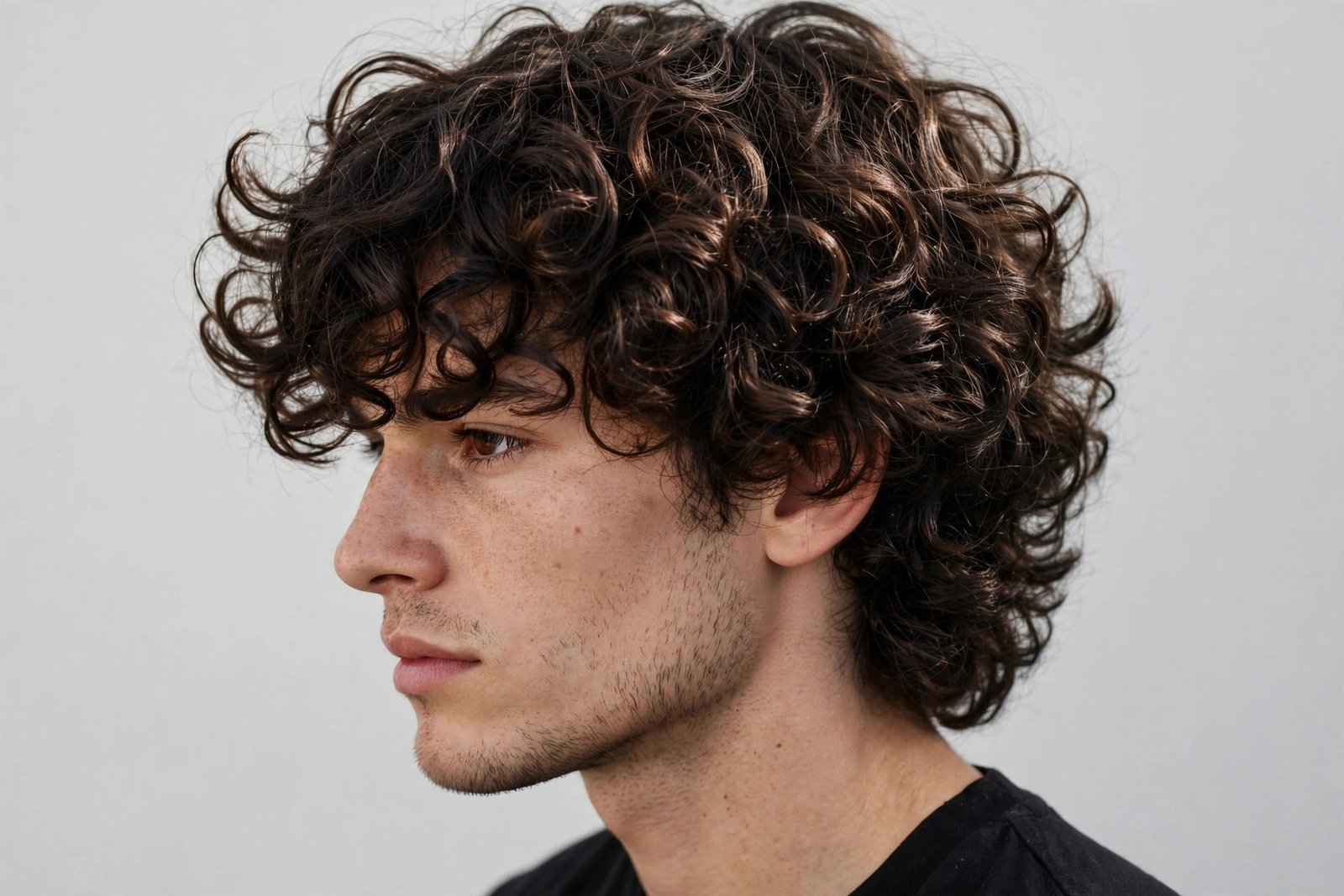
Thirty-six styles. That’s a lot, so here’s how to use this section without drowning: skim the names, stop at the ones that make you think “wait, that could be me,” and read those properly. Every style below tells you what it is, who it flatters, the exact script for your barber, the morning routine, and the honest downside. Bookmark the page. Your barber will thank you for showing up with a reference photo instead of hand gestures.
1. The Classic Curly Fringe
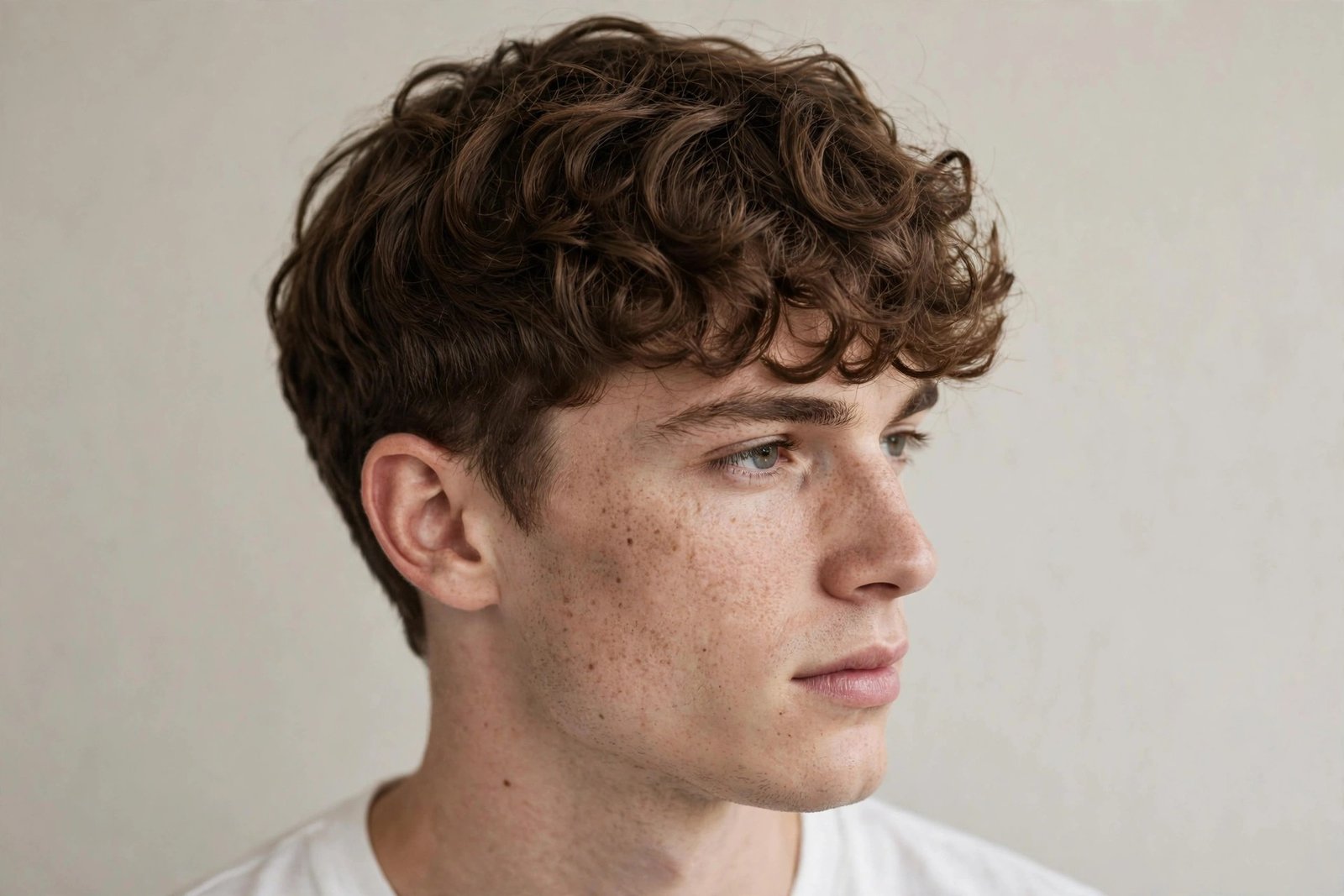
This is the foundation — the cut everything else in this guide is a variation of. The classic curly fringe keeps the top at 4 to 6 inches with the curls worn forward onto the forehead, sides slightly shorter but not faded, everything blended so the whole head reads as one soft, curly shape. No harsh lines, no gimmicks. If you’ve never had a fringe before and your curls have always been worn back or cropped short, start here. It suits every face shape, every curl type from 2C to 4A, and every dress code from office to streetwear, which is exactly why it never really goes out of style.
The barber script is simple: “Four to six inches on top, worn forward as a fringe, sides scissor-cut a touch shorter and blended, no fade. Cut it dry, curl by curl.” That last part matters more than the length number. A dry cut lets the barber see where each curl actually lands, because curls spring up when they dry and a wet cut is basically guesswork with consequences. If your barber looks confused when you say “dry cut,” that’s your sign to find a curl-trained barber, not to compromise.
Maintenance is refreshingly low. Morning routine: dampen the fringe, scrunch in a little curl cream, done. Trims every 5 to 6 weeks keep the shape; the fringe grows out forgivingly because curls hide uneven growth like nothing else. The honest downside? It’s the safe choice, and safe can read as plain if your personal style is bolder. It also needs that minimum 4-inch length, so very short-haired guys have to endure a grow-out phase. But as a first curly fringe, nothing beats it for risk versus reward.
2. Curly Fringe with Low Taper
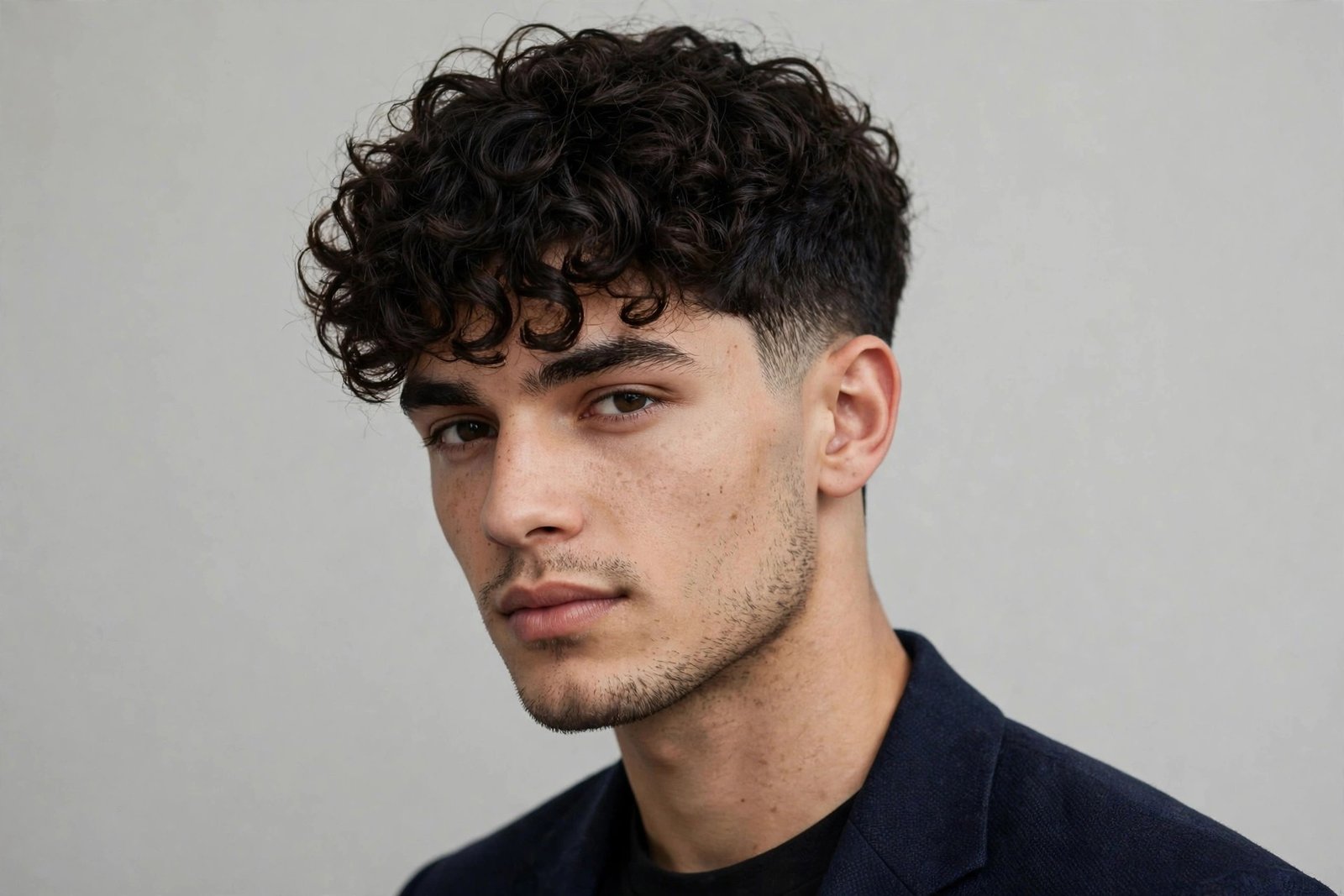
The low taper is the curly fringe’s best friend in a professional setting. Everything above the ears stays curly and full — the fringe does its thing — while the hairline at the neck and around the ears gets a clean, gradual taper that keeps the cut looking intentional for weeks. It reads polished without reading corporate, which is a narrow lane that this cut nails. Oval, square, and heart-shaped faces all do well here; the taper’s clean edges balance the fringe’s softness beautifully.
Barber script: “Curly fringe on top, four to five inches, worn forward. Low taper at the neckline and around the ears — gradual, not a fade. Keep the curls dry-cut.” Emphasize “taper, not fade” because some barbers default to fading everything, and a fade changes the whole character of this cut. The taper should be whisper-subtle, just enough to look crisp at the edges.
Styling takes three minutes: curl cream through damp hair, push the fringe forward with your fingers, let the curls clump naturally. The taper itself needs a touch-up every 2 to 3 weeks to stay sharp, which is the main maintenance cost — the top can happily go 6 weeks. Honest downside: on very tight 4B/4C coils, the taper’s edge can blur faster as hair grows, so you’ll visit the barber more often. And if you love big dramatic volume, the taper’s restraint might feel too quiet. But for a guy who needs to look sharp at work and cool everywhere else, this is the move.
3. Tight Coil Fringe
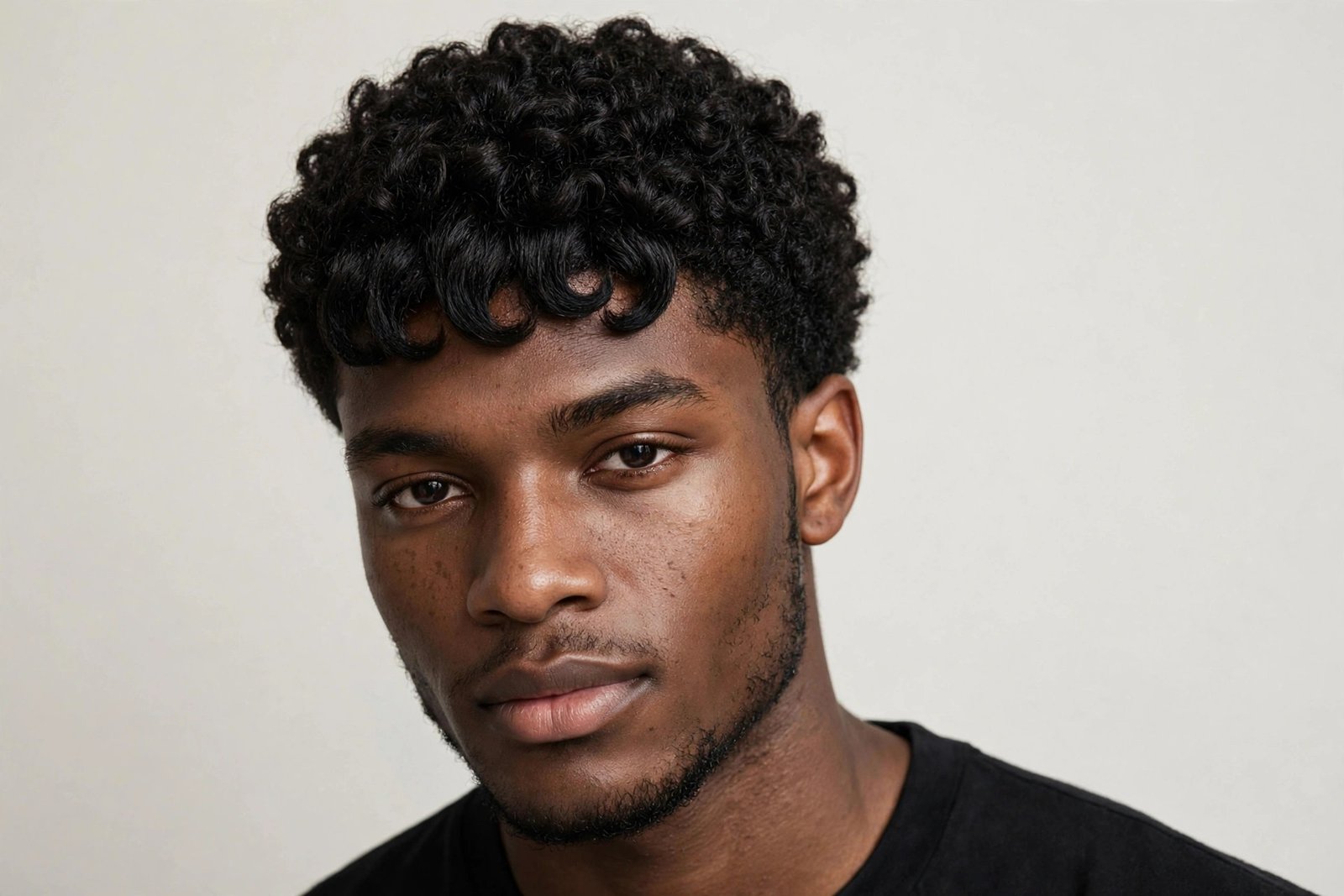
For the 4A to 4C crowd, this is the cut that proves coils belong in the fringe conversation. The tight coil fringe keeps the front coils at 2 to 4 inches of visible length (remember, that’s 4 to 6 inches stretched) and wears them forward in a sculpted, defined fringe while the crown stays fuller and rounder. It has presence — this is not a shy haircut. It suits round and square faces particularly well because the forward coils soften and frame, and it looks extraordinary on darker skin tones with a crisp shape-up at the hairline.
Barber script: “Tight coils worn forward as a fringe, keep the shape rounded and full on top, shape-up at the front hairline. Pick it out, don’t comb it flat, and cut it dry.” A barber who works with coily hair regularly is non-negotiable here — the wrong hands will either cut it wet (disaster) or reach for clippers on top (worse). Ask specifically about their experience with type 4 hair before you sit down.
The routine is about definition and moisture: leave-in conditioner, then a curl-defining cream or light butter, applied to damp hair in sections. A pick at the roots gives the fringe its lift; never rake through the coils with a fine comb. Sleep in a satin bonnet or on a satin pillowcase — cotton will rob the moisture overnight and you’ll wake up to frizz that takes twenty minutes to fix. Deep condition weekly; coils are thirsty by nature and a dry fringe is a frizzy fringe. Honest downside: this is the highest-maintenance fringe in the guide in terms of product and nighttime routine. Skip the bonnet for a week and you’ll know. But the payoff — a sculpted coil fringe done right — turns heads like nothing else here.
4. Loose Wave Fringe
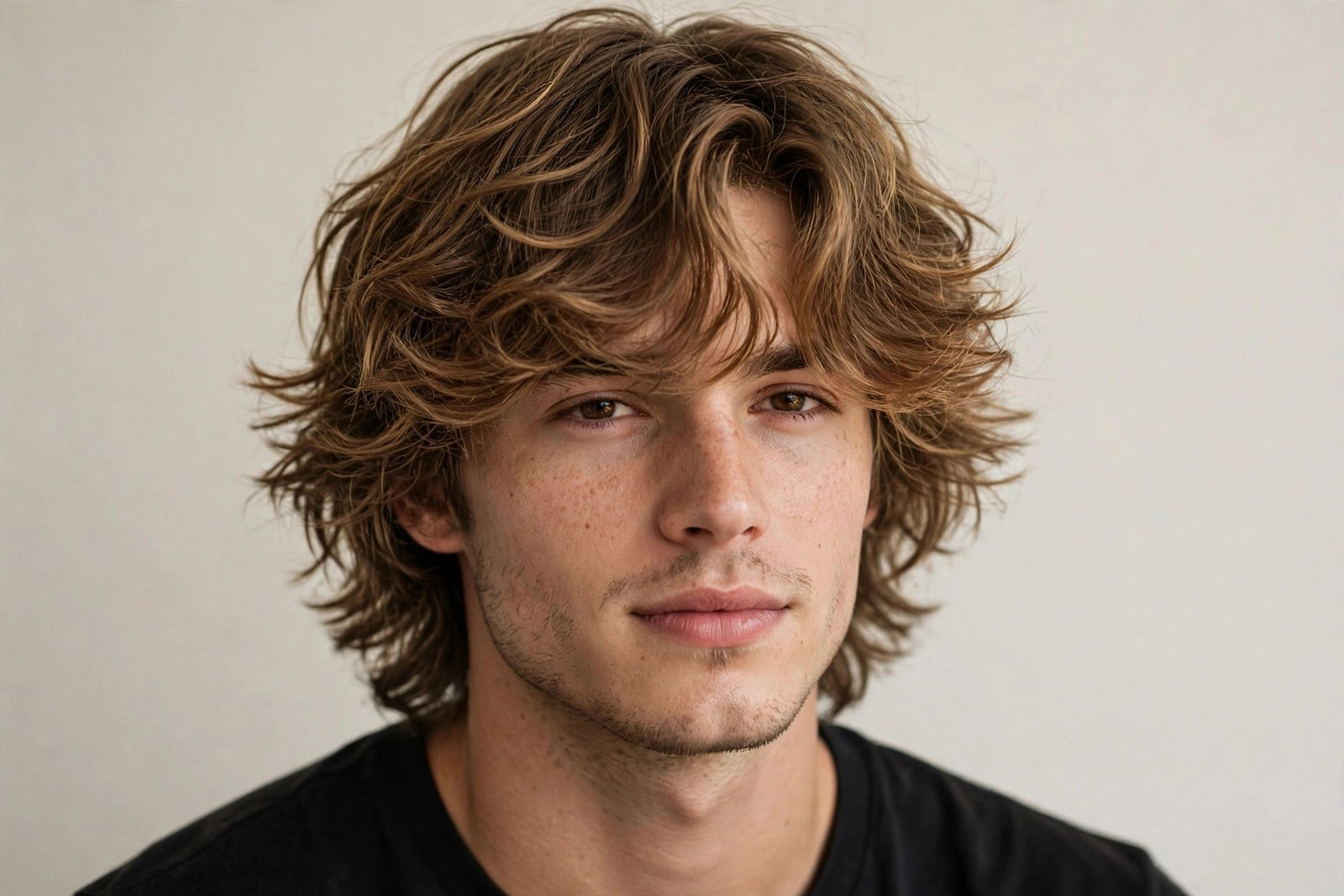
Not everyone has springs for curls, and the loose wave fringe is the proof that you don’t need them. Built for type 2A to 2C waves, this cut wears the front waves forward in that effortless, just-came-from-somewhere-better look. It’s the most low-key style in this guide — the fringe reads as movement rather than curls, which makes it perfect for guys who want the trend without the volume. Oval and long faces love it because the waves add width without height, and it photographs beautifully in natural light.
Barber script: “Wavy fringe, five to six inches on top, worn forward and natural. Long layers so the waves can move, sides blended with scissors — no harsh fade.” Waves need length to show their pattern, so resist the urge to go shorter than five inches; chopped waves just look messy instead of wavy. Ask for long layers rather than blunt ends — layers let each wave bend instead of hanging flat.
Styling is almost embarrassingly easy: sea salt spray on damp hair, scrunch forward, air dry. That’s the whole routine. Waves are the lowest-maintenance texture in this guide, but they have one quirk — they fall flat by day two or three, so a light mousse refresh on second-day hair keeps the fringe alive. Honest downside: if your waves are very fine, humidity can erase the whole look by afternoon, and this style has the least “wow” of any in the guide. It’s quiet confidence, not a statement. For guys who hate fussing with their hair, though, that’s exactly the point.
5. Curly Fringe with Mid Fade
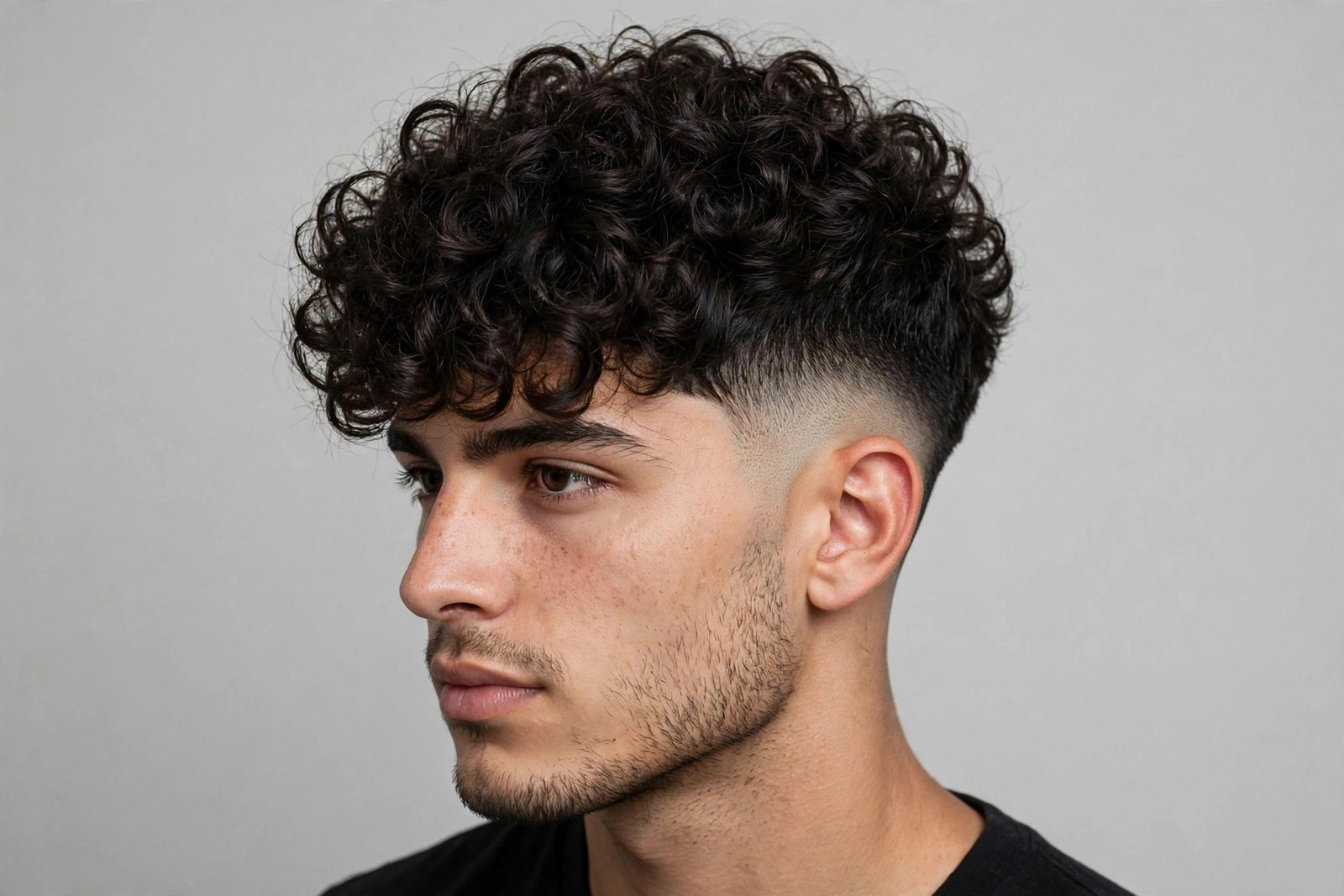
The mid fade plus curly fringe is the 2026 sweet spot between edge and wearability. The curls stay big and expressive on top — 4 to 6 inches worn forward — while the sides graduate cleanly from skin to length starting at the temple. It’s the cut you see on athletes and musicians, and there’s a reason: the contrast makes the curls look curlier and the whole head look sharper. Round faces benefit most because the fade’s clean sides slim the silhouette while the top adds height, but it genuinely works across face shapes.
Barber script: “Curly fringe on top, five inches, worn forward. Mid fade on the sides — start it at the temple, blend up into the curls. Dry cut on top, curl by curl.” The transition zone where fade meets curl is where this cut lives or dies. Ask the barber to blend with scissors rather than clipper-over-comb into the curls, because clippers can chew up the bottom curls and leave a visible line. Bring a photo. This is one of those cuts where “mid fade” means different things to different barbers.
Morning routine: dampen, curl cream, scrunch forward, and you’re done — the fade does the heavy lifting of looking sharp even when the curls are having an average day. Fade maintenance every 2 to 3 weeks keeps it crisp; let it grow past 4 weeks and the contrast softens into something closer to style number one, which honestly still looks fine. Honest downside: fades are a commitment to regular barber visits, and the grow-out phase between appointments can look scruffy if you’re particular. Also, if your curls are very fine, a hard fade can make the top look thin by comparison — ask for a lower-contrast blend in that case.
6. Long Curly Fringe
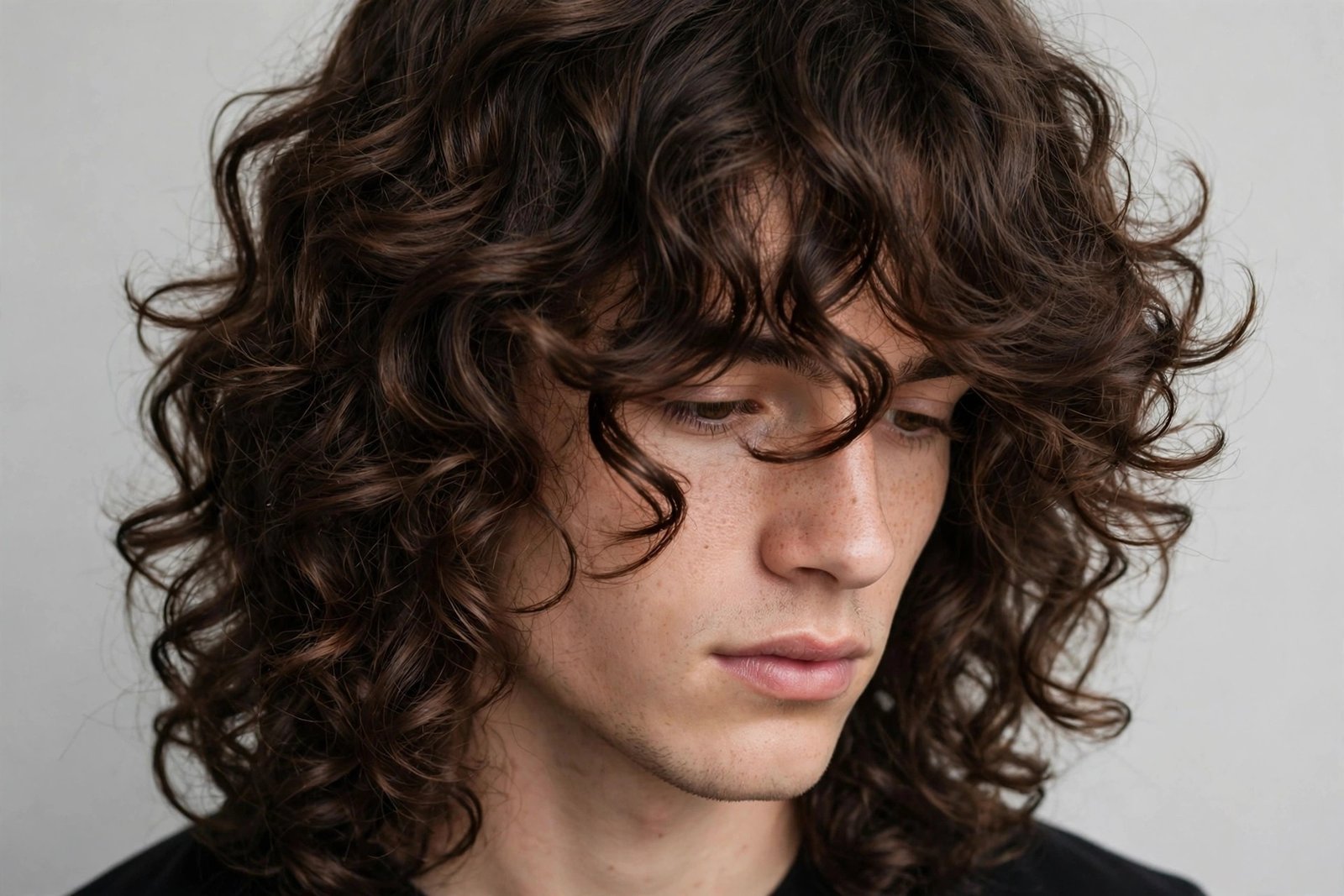
When the fringe goes past the eyebrows and starts flirting with the cheekbones, you’re in long curly fringe territory — and it’s a whole different energy. This is the romantic, dramatic, main-character version of the trend: 6 to 9 inches of curl worn forward, moving when you move, with the kind of presence that shorter cuts can’t touch. It suits oval and square faces best, and it needs a certain confidence to pull off because people will notice your hair before they notice you. That’s not a bug; it’s the feature.
Barber script: “Grow the fringe long — seven to eight inches in front, worn forward over the forehead. Shape it dry so the curls sit where they’ll actually live, layers to keep it from getting heavy. Keep some length at the sides for balance.” This is almost always a grow-out project rather than a single appointment: you’ll need 4 to 6 months of growth from a medium cut. The shaping appointments along the way matter — ask for dusting trims that maintain the shape without losing length.
Styling needs a bit more intention: curl cream plus a light hold gel, applied in sections, then diffused or air-dried. The weight of long curls actually helps — gravity pulls them into place better than short curls behave. The nighttime routine matters more here: pineapple the hair (loose high ponytail) or use a bonnet, because long curls tangle overnight like nothing else. Honest downside: wind is your enemy, eating is an event, and summer humidity turns long curls into a full-time job. It also reads casual — this is not a boardroom cut. But if your life allows drama, nothing in this guide delivers it like the long fringe.
7. Short Choppy Curly Fringe
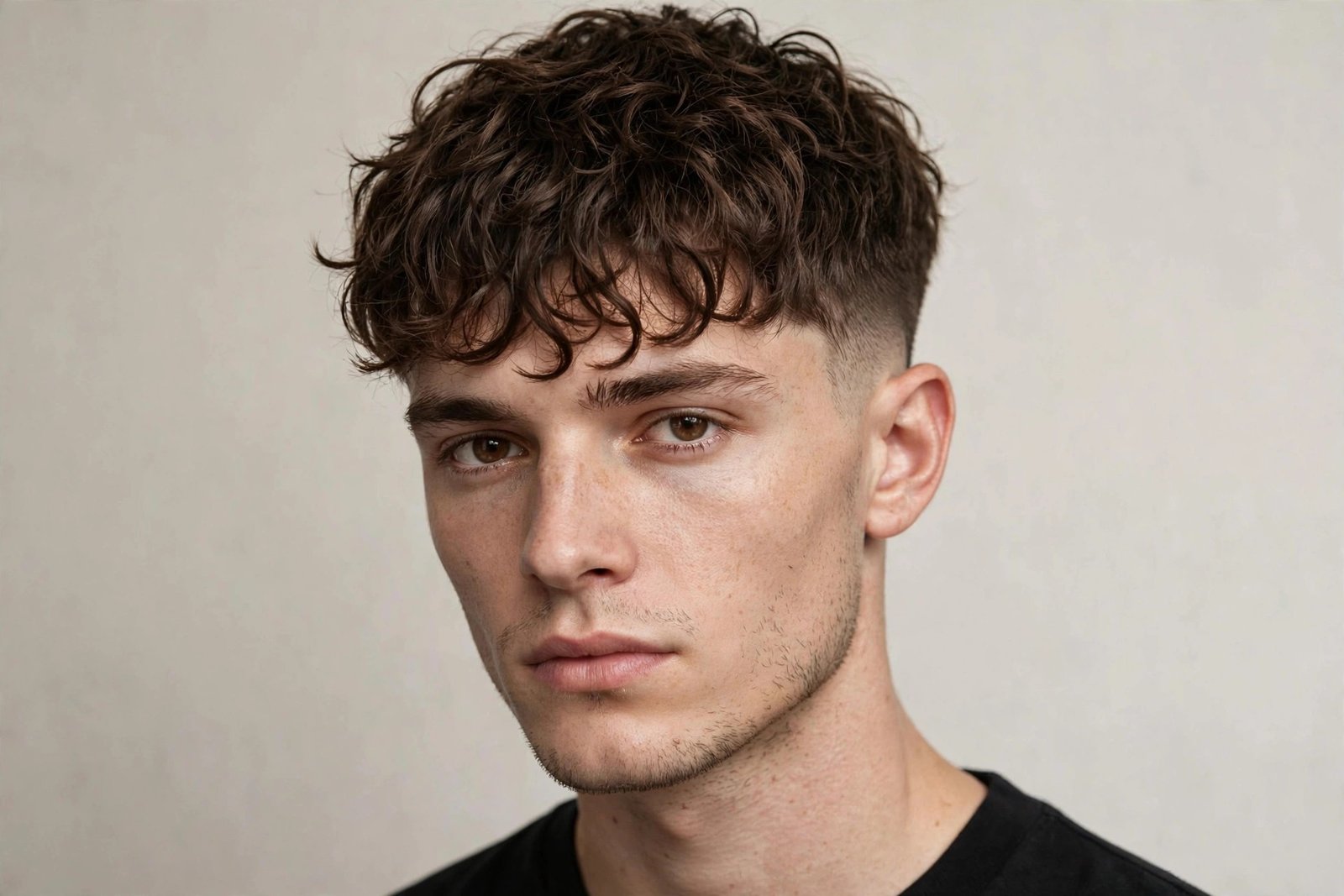
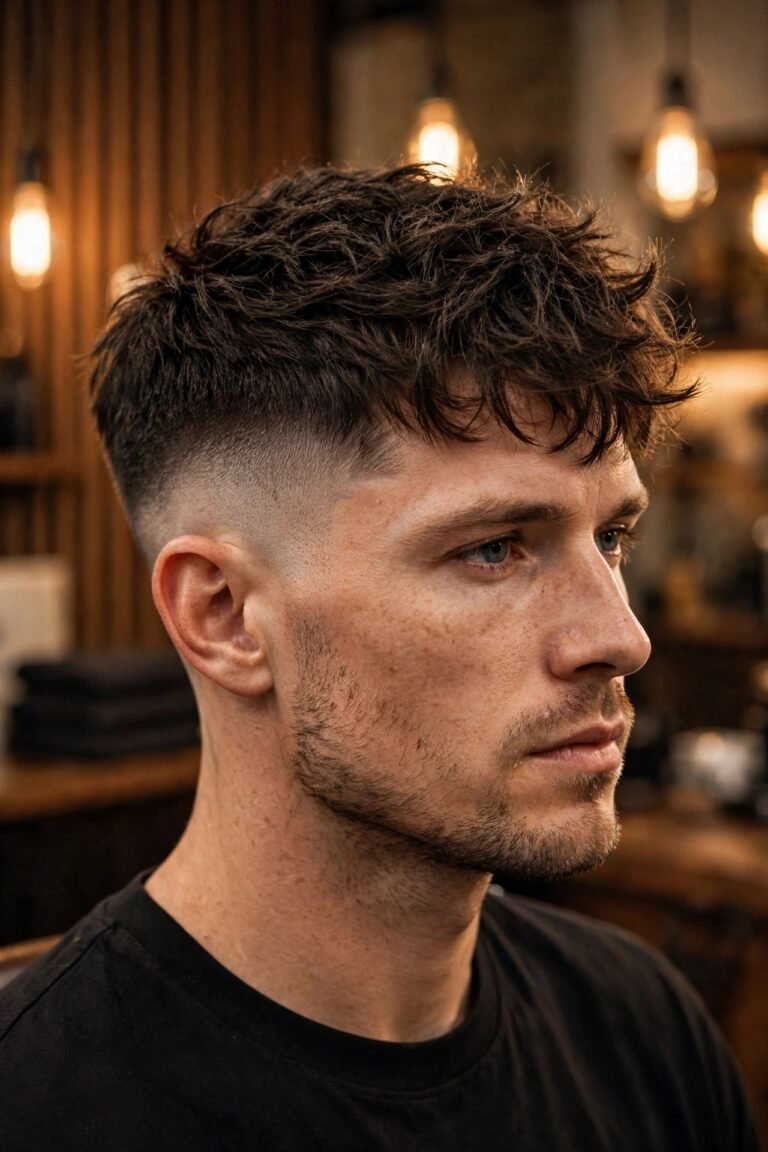
Short, choppy, and completely unbothered — this is the curly fringe for guys who want the trend in its most wearable, lowest-commitment form. The top sits at 3 to 4 inches with deliberately uneven, choppy ends, the fringe just kissing the forehead. It has an edge the classic version doesn’t: a bit of attitude, a bit of texture, the kind of cut that looks good slightly messy. It flatters square and oval faces, works on curl types 2C through 3C, and it’s the easiest entry point if you’re nervous about a fringe.
Barber script: “Short curly fringe, three to four inches, choppy textured ends, worn forward. Cut it dry so the length lands right.” The choppiness should come from the natural curl separation, not from aggressive point cutting — a good barber shapes curl by curl and lets the texture happen. Keep the sides short but not skin-faded; a number 2 or 3 guard blended up keeps the proportions right without the maintenance of a fade.
The morning routine is thirty seconds: wet your hands, run them through the fringe, maybe a pea of curl cream, walk out. This is genuinely a wash-and-go cut, and it looks better slightly imperfect — over-styling ruins it. Trims every 4 weeks keep the choppiness from growing into shapelessness. Honest downside: at this length, a bad curl day is very visible because there’s nowhere for the curls to hide, and tight 4-type coils may not have enough length at 3 inches to read as a fringe rather than a crop. But as a low-risk first step into fringe territory, it’s nearly perfect.
8. Curly Fringe with Drop Fade
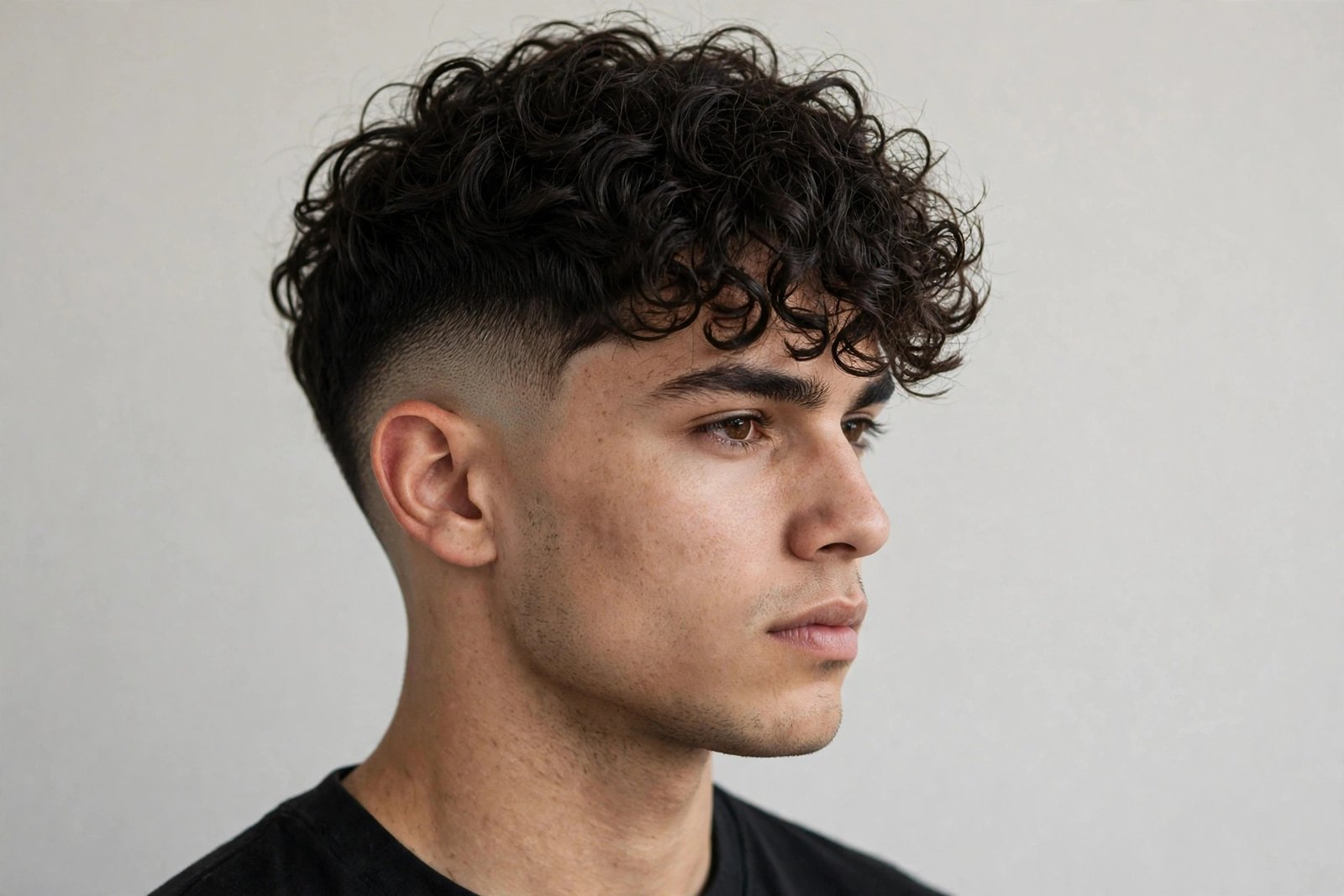
The drop fade is the connoisseur’s fade — instead of running straight around the head, the fade line dips down behind the ear, following the skull’s natural curve. Paired with a curly fringe, it creates a silhouette that’s custom-fit rather than cookie-cutter. The curls stay full and forward on top while the fade carves a clean arc around them. It’s a favorite for round and diamond faces because the dropped line visually narrows the sides, and it photographs like a dream from every angle.
Barber script: “Curly fringe on top, five inches, forward. Drop fade on the sides — let it dip behind the ear, not a straight mid fade. Blend the top of the fade into the curls with scissors.” Not every barber does drop fades well; it’s a precision cut. Ask to see their fade work or check their portfolio before committing. The blend point where the drop meets the fringe is the money detail — it should melt, not step.
Styling mirrors the mid fade version: curl cream, scrunch forward, done. The drop fade needs refreshing every 2 to 3 weeks, and because the line is curved, grow-out looks messier than a straight fade’s grow-out — you’ll notice it sooner. Honest downside: it’s the fussiest fade in this guide to maintain, and a mediocre drop fade looks worse than a mediocre regular fade. But when it’s done right, it’s the sharpest silhouette in the entire article. High ceiling, slightly higher maintenance.
9. The Broccoli Cut
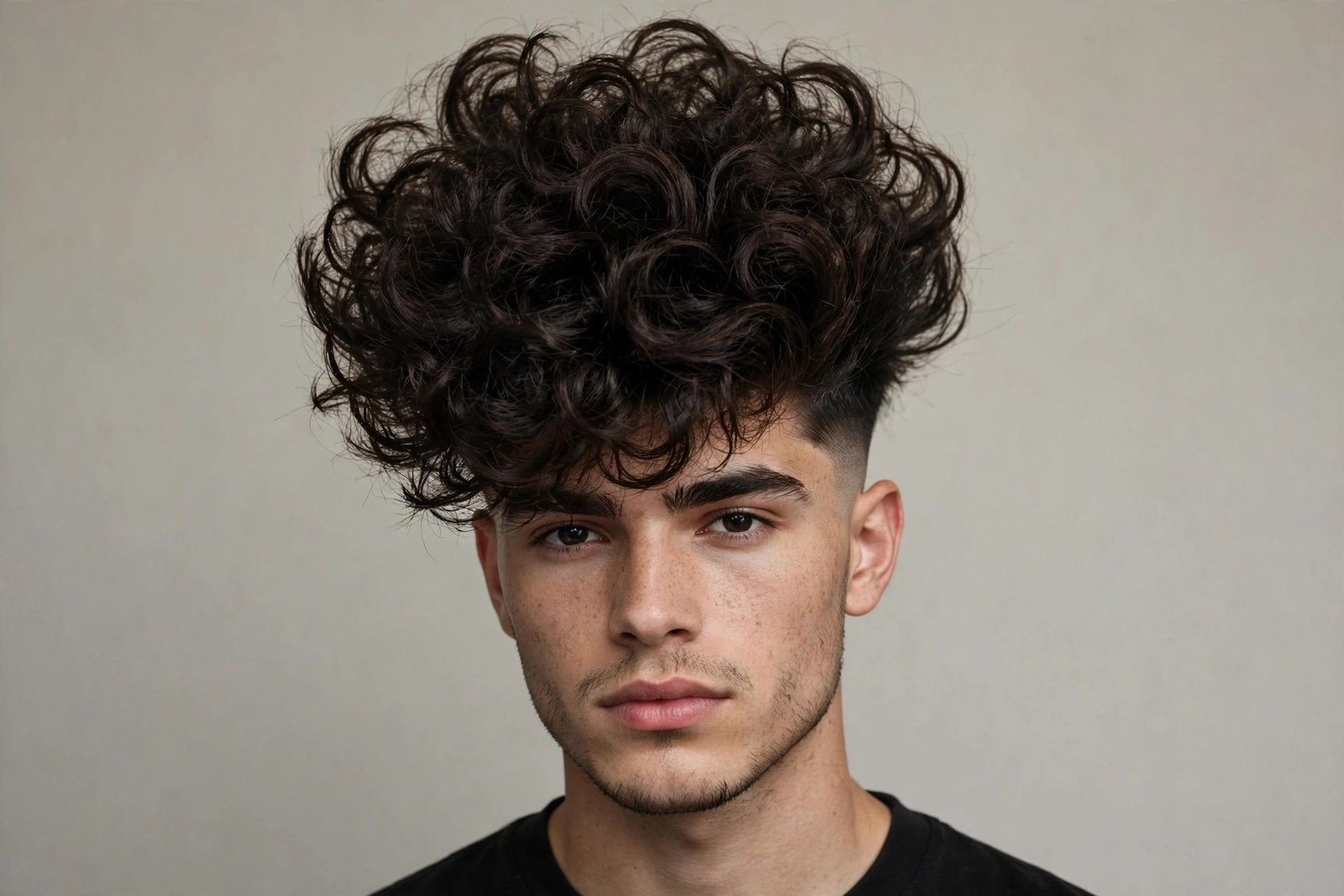
Let’s address the elephant: the broccoli cut is the reason half the guys reading this are here. The Gen Z phenomenon — massive curly volume on top, tight faded sides, the whole thing resembling its vegetable namesake — is technically a curly fringe pushed to maximum drama. Whether the curls are natural or permed (and let’s be honest, a huge percentage are permed), the formula is the same: big textured top worn forward, clean sides, zero subtlety. It suits oval and long faces, younger guys, and anyone whose personal style runs loud.
Barber script: “Broccoli cut — maximum volume on top, six inches, worn forward and up, tight fade on the sides, maybe a 1 to 0. Texture on top if my hair needs it.” If your curls are natural, say so and ask for dry cutting. If they’re not curly enough for the look, this is the one style in the guide where a perm is the honest path — a texture perm on the top gives straight-haired guys the broccoli silhouette. Own it; half the broccoli cuts on social media are permed.
Styling is about volume: mousse or volumizing foam on damp hair, diffuse upside down for maximum lift, then a light texture powder at the roots. This is the highest-volume routine in the guide and it shows — expect 10 minutes, not 3. Honest downside: it’s the most polarizing cut here. People over 30 will have opinions. It needs the most product, the most styling time, and permed versions need redoing every 2 to 3 months. It’s also the trendiest, which means it dates fastest. But in 2026, nothing says “I have great hair and I know it” quite like a well-executed broccoli cut.
10. Curly Curtain Fringe
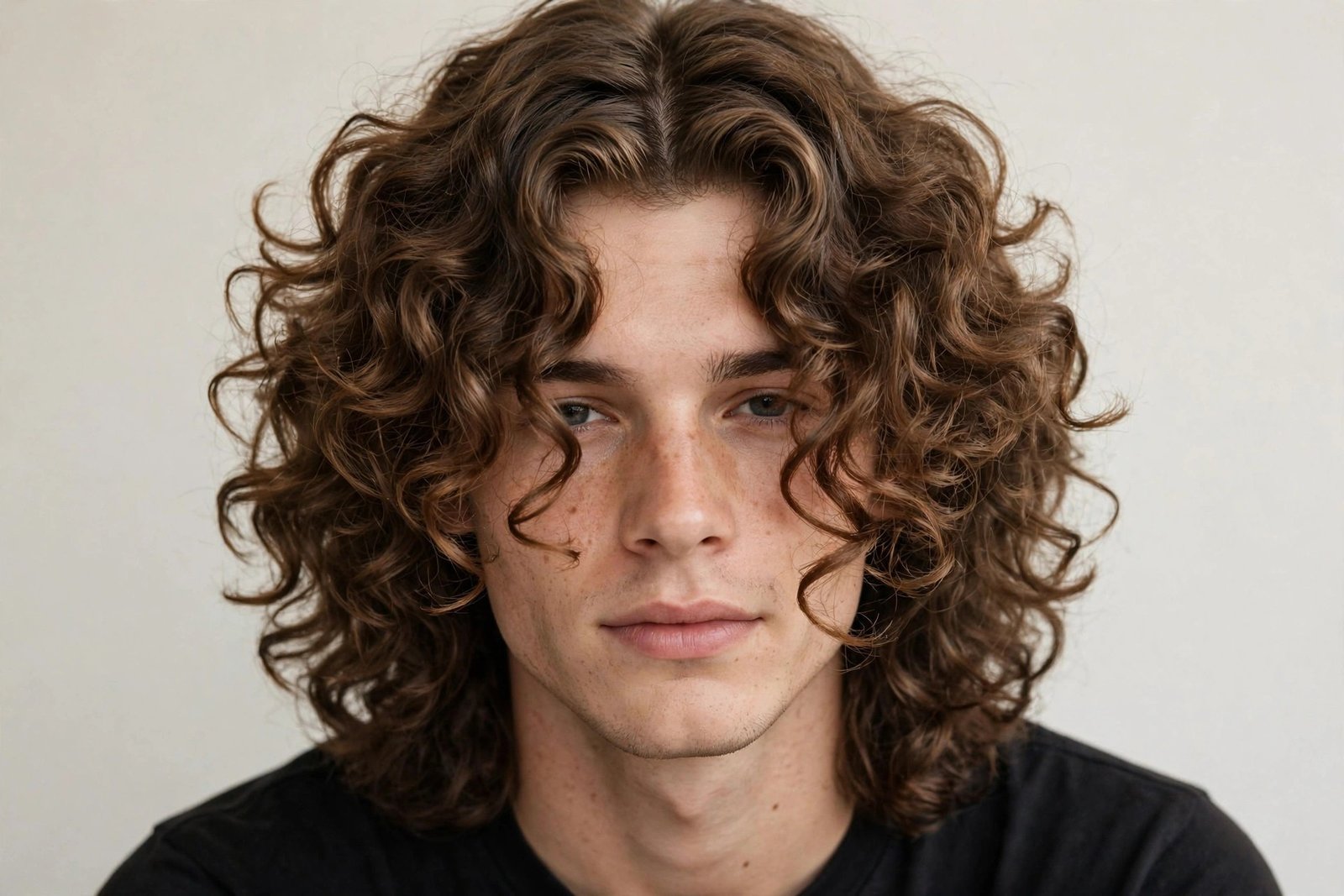
The curtain fringe takes the classic 90s middle part and runs it through curly hair — the front curls part in the center (or just off-center) and fall forward on both sides of the forehead like curtains. It’s softer and more romantic than a straight-across fringe, and on curls it has this wonderful cascading quality that straight hair can’t replicate. It flatters heart-shaped and diamond faces beautifully because the side-falling curls balance wider cheekbones, and it suits guys who find a full fringe too heavy on the forehead.
Barber script: “Curly curtain fringe — six inches in front, middle part, curls falling forward on both sides. Long layers, dry cut, keep the part natural rather than razor-sharp.” The part should follow your natural growth pattern; forcing a center part against your hair’s will is a losing battle. Ask the barber to cut with your natural part in place, not combed artificially straight.
Styling: after applying curl cream, use your fingers to establish the part while the hair is damp, then scrunch each side forward. The curls will do the curtaining on their own. This style actually improves over the day as the curls settle — it’s one of the few that looks better at 5pm than 8am. Honest downside: wind destroys the part in seconds, and if your hair has a strong natural side part, fighting it daily gets old. It’s also not ideal for very windy climates or active lifestyles. But for the right face and the right vibe, it’s the most elegant fringe in this guide.
11. Curly Fringe with Skin Fade
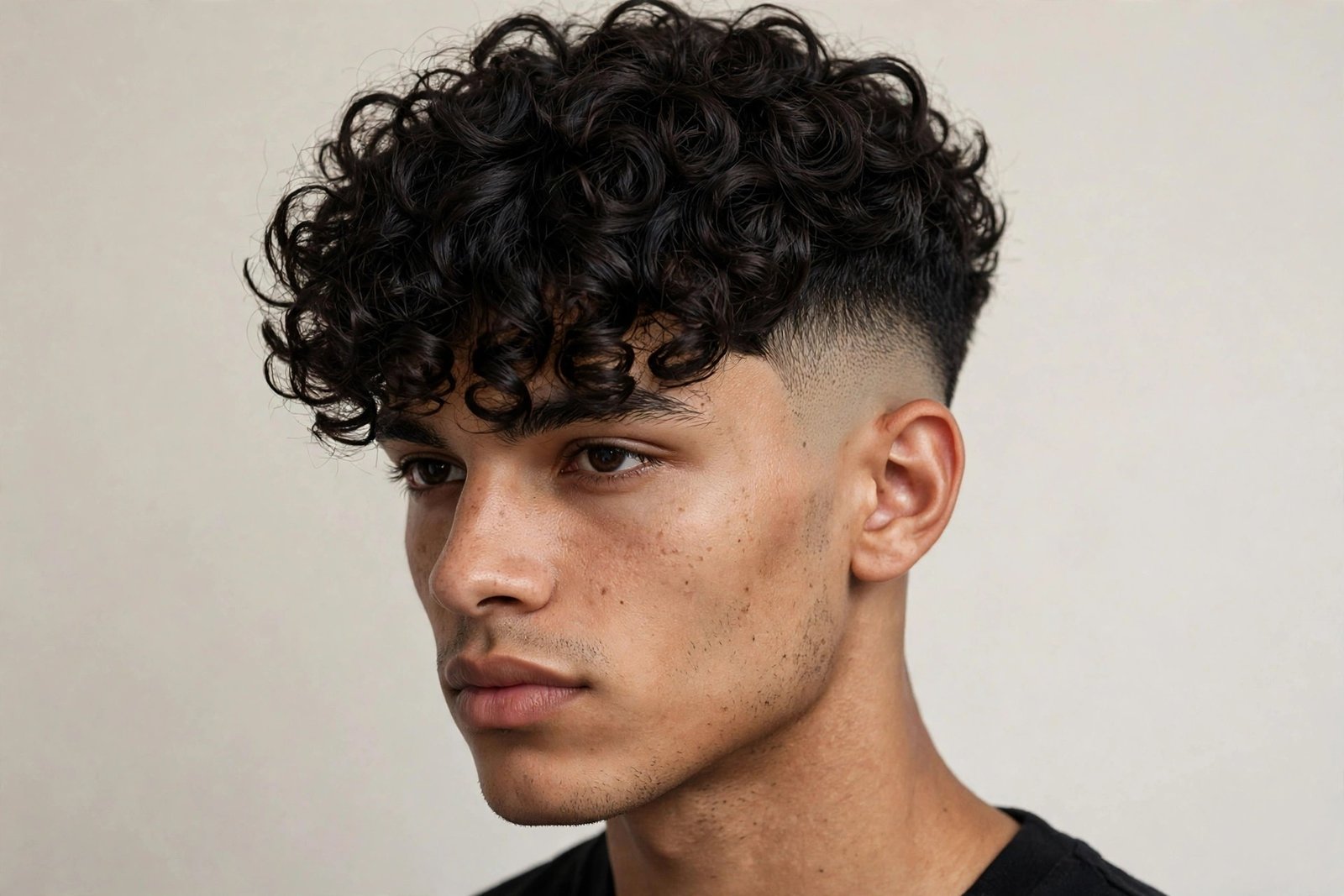
Maximum contrast, zero apologies. The skin fade takes the sides down to bare skin while the curly fringe stays full and forward on top — the boldest silhouette in this guide. The curls look enormous by comparison, the fade looks surgical, and the whole head reads as deliberately designed. It suits confident dressers, oval and square faces, and anyone who wants their hair to be a statement. This is not a cut for blending in.
Barber script: “Curly fringe on top, five to six inches, worn forward. Skin fade on the sides — take it to zero, high or mid depending on what suits me. Scissor-blend the transition so the curls aren’t chewed up.” Specify where the fade starts (high, mid, or low) because “skin fade” alone is ambiguous and the placement changes the look dramatically. The transition into the curls is everything — a harsh line looks accidental, a melted blend looks expensive.
Morning routine is quick on top (curl cream, scrunch) but the fade demands discipline: every 10 to 14 days for a touch-up, or the skin grows into stubble and the contrast dies. That’s the real cost of this cut — it’s a barber-relationship haircut. Honest downside: the grow-out is the least forgiving here. Two weeks past due and it looks neglected, not relaxed. And the extreme contrast can make fine curls look thinner on top. But if you keep the appointments, nothing in this guide looks sharper.
12. Curly Shaggy Fringe
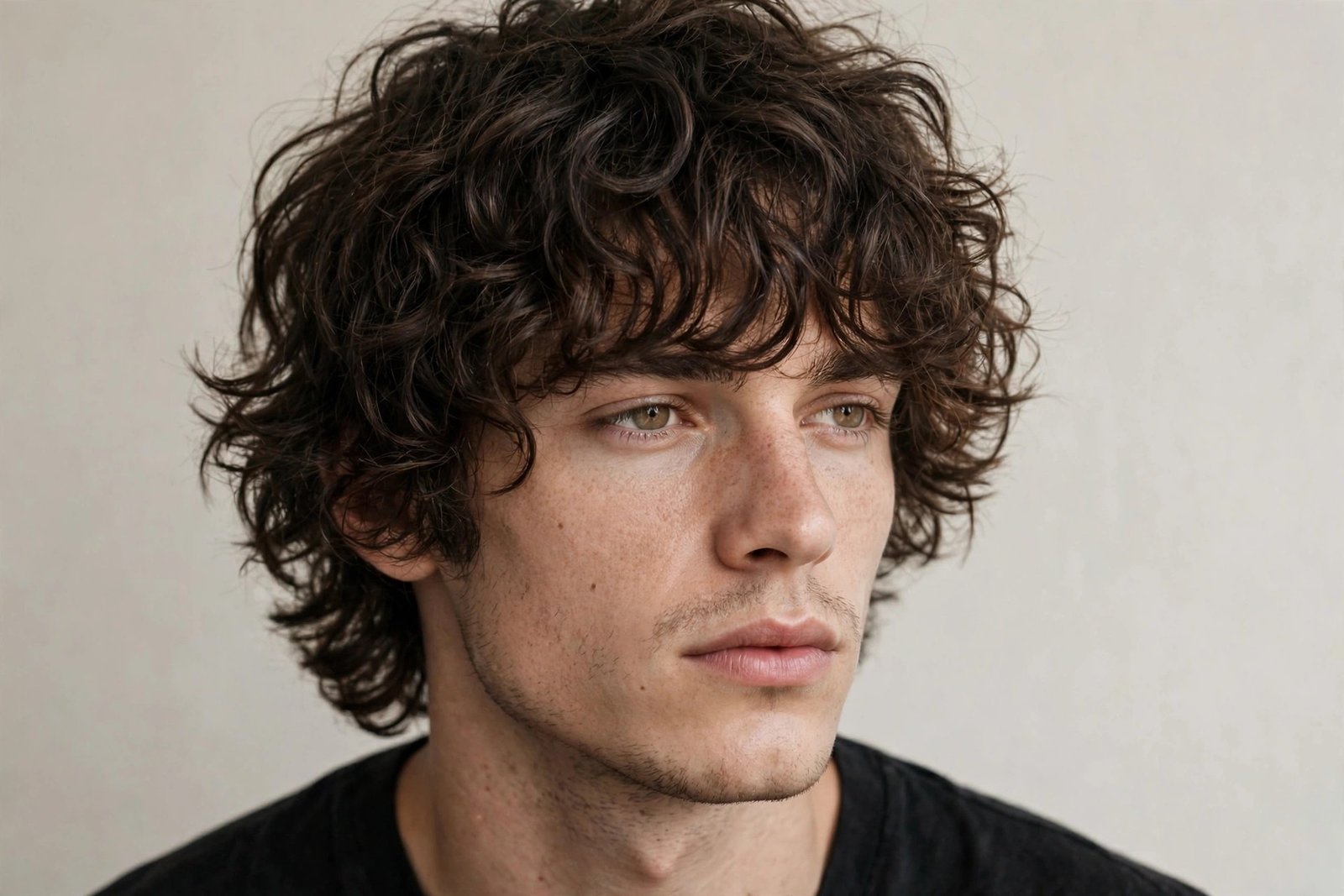
The shag never really died; it just waited for curls to get their moment. The curly shaggy fringe layers the whole head — top, sides, fringe — into a tousled, rock-and-roll silhouette where the fringe is just the front of one continuous cascade of texture. It’s the most “effortless cool” style here, the one that looks like you don’t care (even though the layering is doing quiet work). It suits oval and long faces, creative types, musicians, and anyone allergic to clean lines.
Barber script: “Curly shag — layers all over, fringe at five inches worn forward into the shag. I want movement and piece-y texture, not a blunt shape. Dry cut.” The layering is the whole cut; a barber who just cuts one length and calls it a shag has missed the point. Ask for the layers to be cut to encourage the curls to separate into pieces rather than one solid mass.
Styling rewards laziness: sea salt spray or light mousse, scrunch, air dry, maybe shake it out. The shag looks better slightly undone — perfection is the enemy. It grows out beautifully, arguably better than it starts, because the layers just get more interesting. Trims every 6 to 8 weeks. Honest downside: it’s the least “sharp” cut in the guide. In conservative offices it can read as unkempt rather than styled, and very tight coils can puff into a shape that’s more afro than shag without careful layering. Know your room before you commit.
13. Curly Edgar Fringe
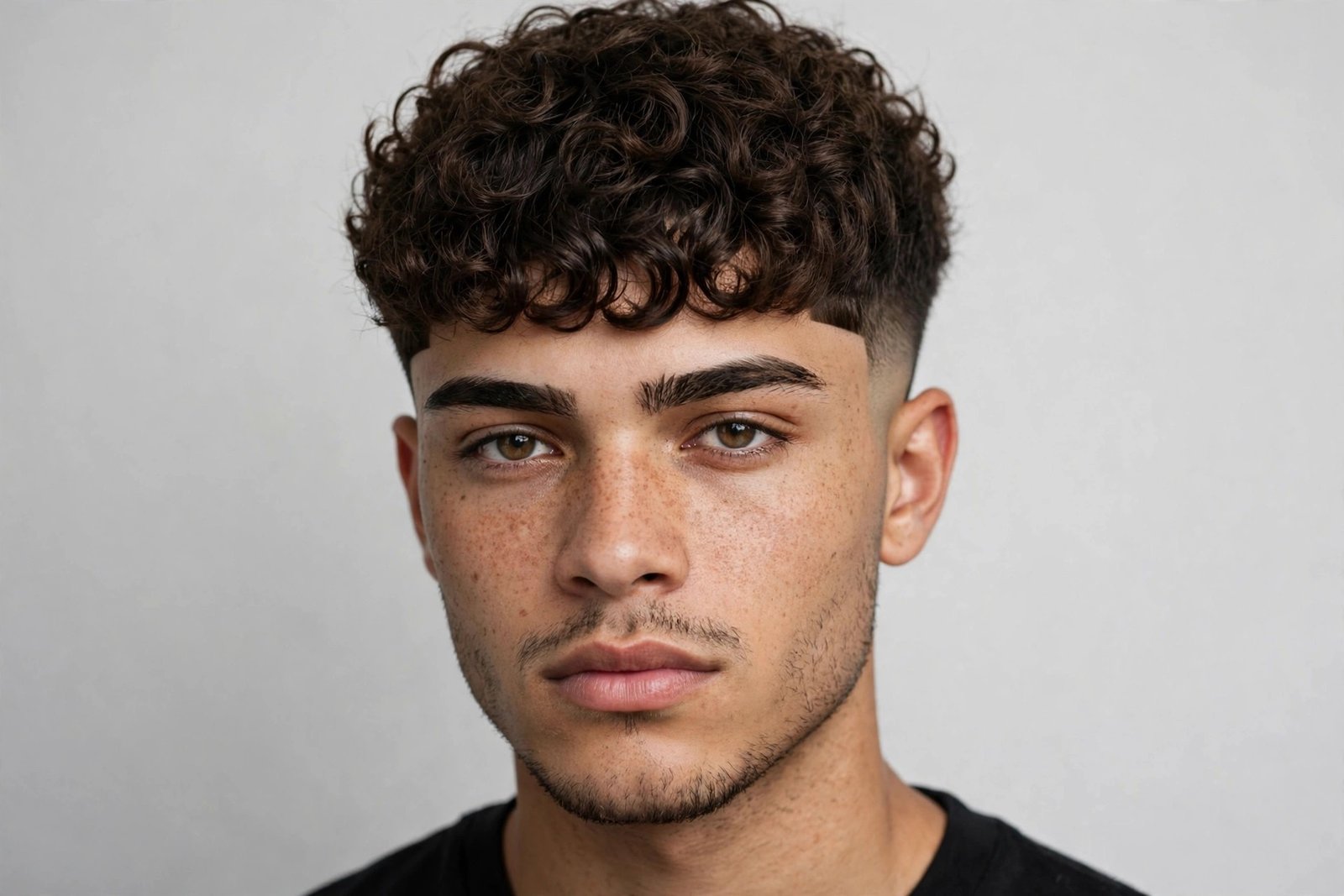
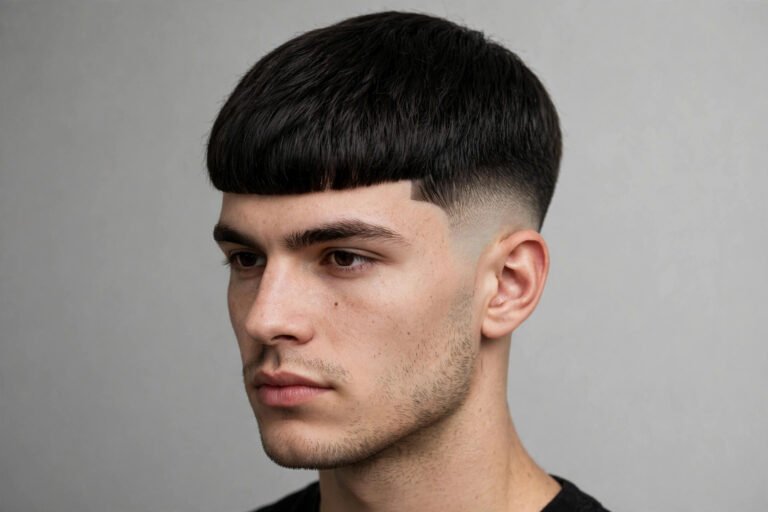
The Edgar — that straight-across, blunt fringe with faded sides — gets a curly makeover here, and honestly the curls improve it. Where the classic Edgar’s straight fringe can look severe, the curly version has a softness in the texture that takes the edge off while keeping the bold, graphic hairline. The fringe sits straight across the forehead at eyebrow level, the curls giving it a rich, dimensional finish. It suits oval and long faces (the horizontal line shortens the face visually), younger guys, and streetwear aesthetics.
Barber script: “Edgar with curly texture — fringe cut straight across at the eyebrows, worn forward, curls defined. Fade on the sides, mid or high. Keep the fringe line clean.” The straight-across line on curls is tricky — it has to be cut dry, curl by curl, following each curl’s natural end point, or the line will jump unevenly as the curls spring. This is advanced barbering; don’t hand it to a trainee.
Styling needs definition: curl cream plus a touch of gel, scrunched forward, then each front curl arranged so the line reads clean. It’s a 5-minute routine with a fussy finish — the line is the whole look, so it has to sit right. Honest downside: the Edgar is a love-it-or-hate-it cut with strong cultural associations, and the straight-across line on curls needs daily attention to stay crisp. Grow-out is awkward too — there’s no graceful middle phase. But as a bold, graphic statement, it’s unmatched in this guide.
14. Curly Messy Fringe
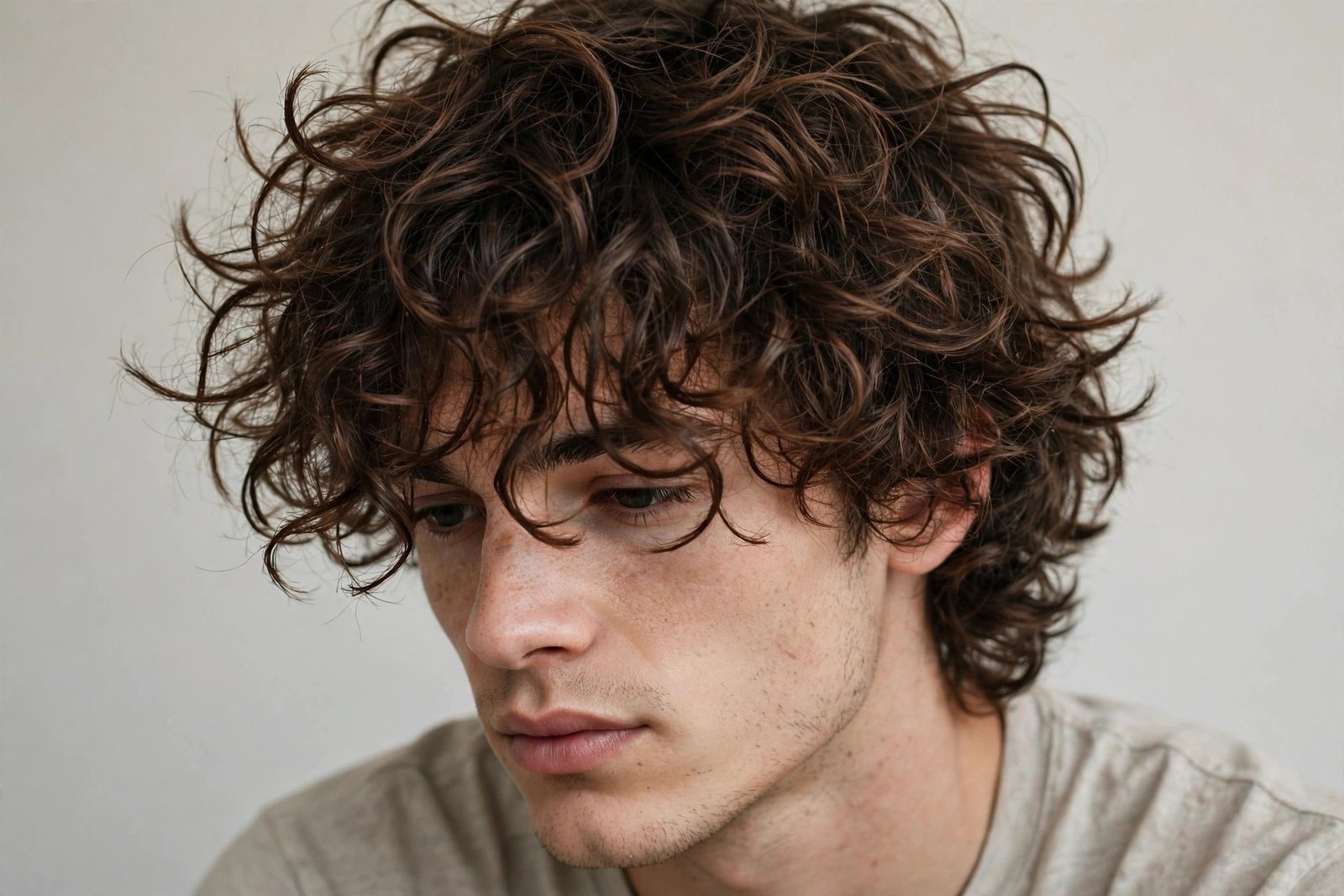
The messy fringe is the art of looking like you didn’t try — while trying just enough. Curls fall forward in a deliberately disheveled arrangement: some pieces on the forehead, some flicking sideways, nothing too neat. It’s the weekend version of the classic fringe, and it’s wildly popular because it flatters almost everyone and forgives almost everything. Bad curl day? It’s a messy fringe — that’s the point. It suits every face shape and every curl type, and it’s the most forgiving style in this entire guide.
Barber script: “Messy curly fringe, four to five inches, textured ends, worn forward and tousled. Sides natural or lightly tapered — keep it easy.” The cut itself is close to the classic; the messiness comes from styling, not scissors. Ask for slightly uneven, piece-y ends rather than a clean line, because clean lines fight the messy finish.
Styling is where the magic happens: matte texture powder or light clay on dry hair, worked through the fringe with your fingers, pushing curls in different directions. The goal is controlled chaos — every piece intentional, none of them matching. Thirty seconds, genuinely. Honest downside: “messy” is a fine line and “unkempt” is on the other side of it. Without the right product it can slide from stylish-messy to actually-messy by evening. And in formal settings it can read as careless. But for daily life, it’s the highest reward-to-effort ratio in this guide.
15. Curly Fringe with Temple Fade
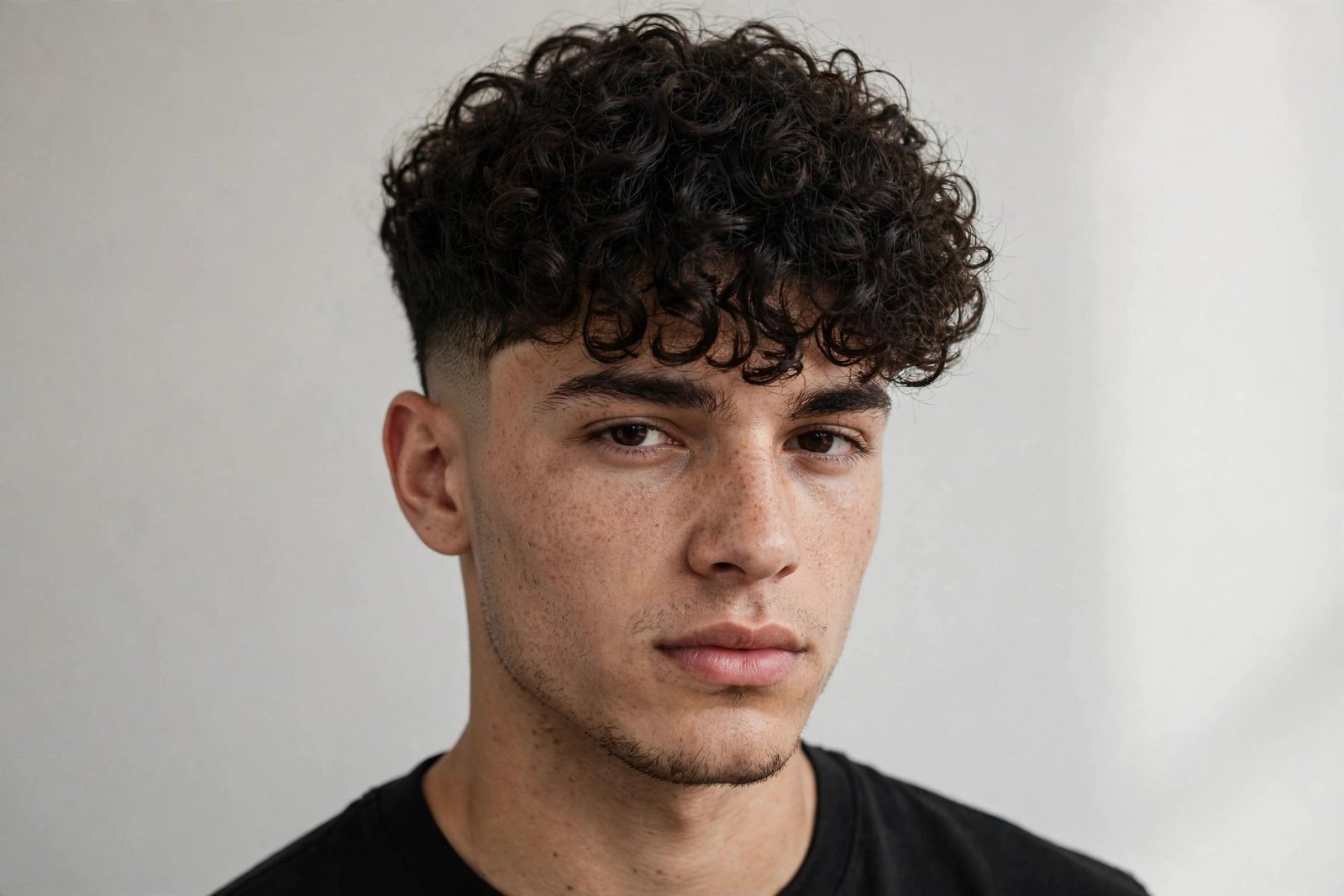
The temple fade — also called the Brooklyn fade — keeps the fade tight and local: just the temples and sideburns, fading to skin in a small, precise zone while everything else stays full. With a curly fringe on top, it’s the surgical strike of fades: all the sharpness, none of the commitment. The curls stay big, the temples stay crisp, and the contrast is concentrated exactly where the eye goes. It suits round and square faces, and it’s a favorite in Black barbershop culture where the temple fade is already a staple.
Barber script: “Curly fringe on top, five inches, forward. Temple fade only — just the temples and sideburns to skin, keep everything else full. Line up the front hairline.” The lineup is part of this cut’s DNA; ask for it crisp. And specify “temple fade, not a full fade” — some barbers will keep fading upward out of habit.
Maintenance is the temple zone every 1 to 2 weeks (it grows out visibly fast at skin level), while the top goes 6 weeks easy. Morning styling is the standard curl cream routine. Honest downside: the temple fade’s small faded zone means grow-out is very noticeable — a week overdue and the crispness is gone. It’s also a subtle cut; if you want drama, the full fades deliver more. But as a sharp, low-drama upgrade to a full curly head, it’s elite.
16. Curly Blowout Fringe
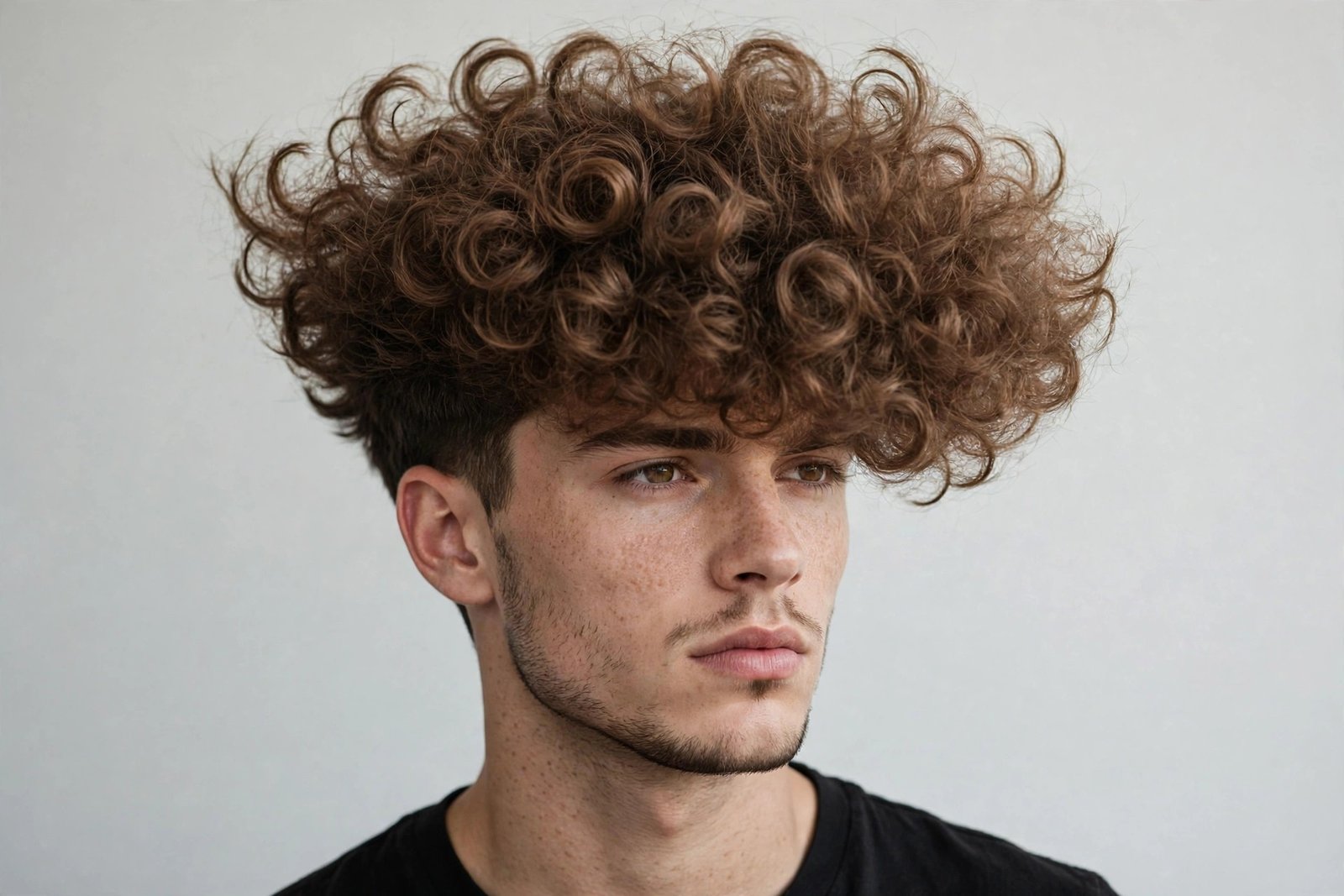
The curly blowout takes your natural texture and stretches it into maximum volume — curls picked out and blown forward into a big, rounded, cloud-like fringe. It’s the 2026 evolution of the classic blowout taper, but instead of straight hair blown back, it’s curls blown forward. The result is enormous presence: a halo of texture framing the face. It suits oval and long faces (the width balances length), and it looks phenomenal on type 3 curls with good density.
Barber script: “Length on top for a curly blowout — six inches, worn forward and picked out for volume. Taper the sides, keep the shape rounded.” The cut needs enough length for the blowout to have body; too short and it just looks puffy. Ask the barber to shape it with the volume in mind — the silhouette should be rounded, not boxy.
Styling is the event: apply curl cream and a volumizing mousse to damp hair, then blow-dry with a diffuser or a concentrator nozzle while lifting the roots — or pick the roots out with an afro pick for maximum height, then smooth the fringe forward. This is a 10 to 15-minute routine, the longest in the guide, and it needs refreshing — second-day blowouts fall flat without a pick refresh. Honest downside: it’s high-effort, humidity-sensitive, and the volume can overwhelm smaller faces or finer hair. It’s also not a windy-day cut. But when it’s done and the light hits it, nothing else in this guide has this much presence.
17. Defined Ringlet Fringe
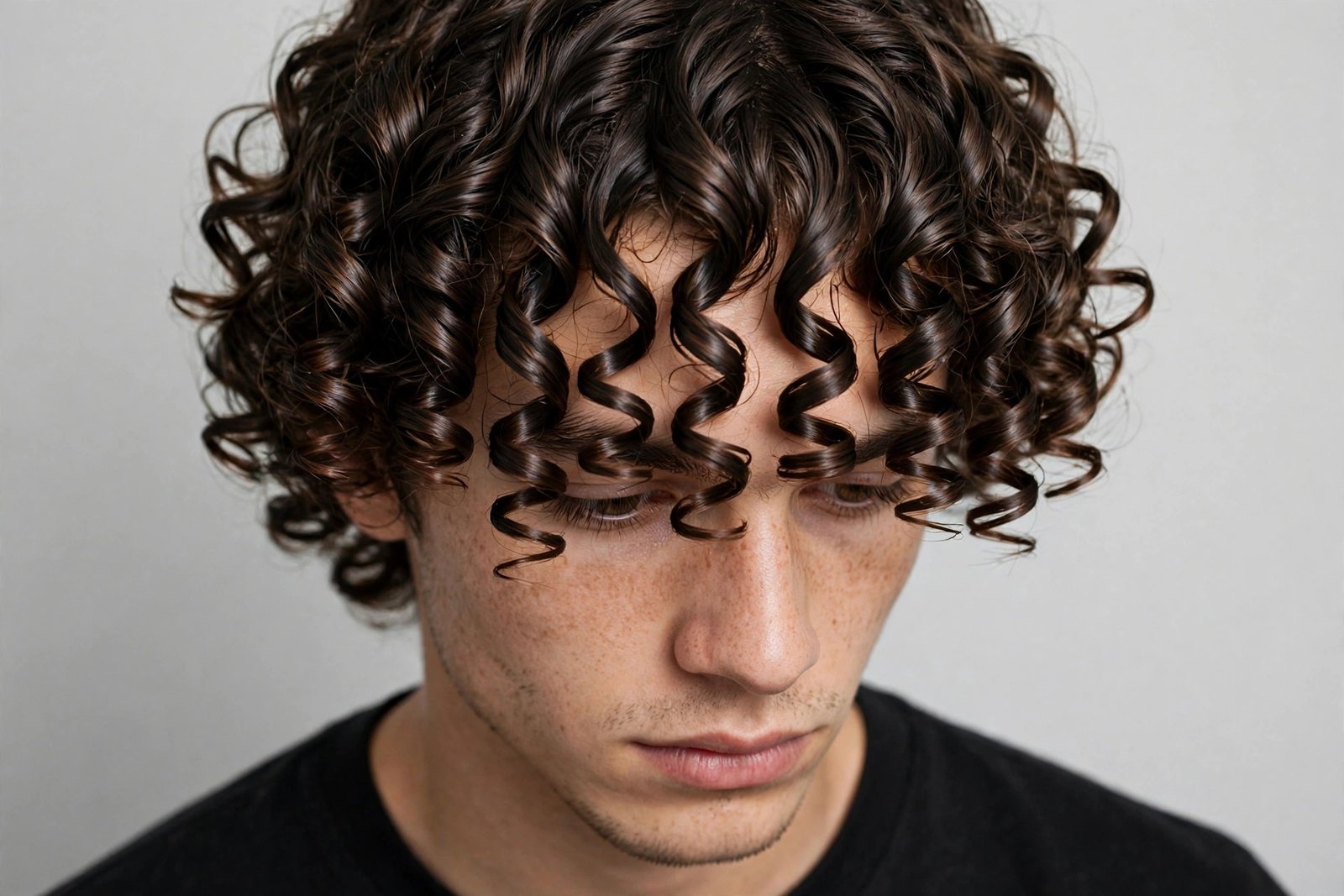
Some guys have ringlets — those perfect, glossy spirals — and the defined ringlet fringe is the cut that treats them like the luxury they are. Each curl is encouraged to form its own distinct spiral, falling forward in a fringe of individual ringlets with visible separation and shine. It’s the most “precious” style in this guide, in the best way: cherubic, striking, unforgettable. It suits oval and heart-shaped faces, and it demands healthy, well-moisturized hair — damaged curls can’t form ringlets.
Barber script: “Defined ringlet fringe — I want each curl to spiral individually, worn forward. Cut dry, curl by curl, no thinning, no razoring. Just shape the silhouette.” The cardinal rule: nothing that disrupts the curl pattern. No thinning shears, no razors, no over-layering. The barber is essentially a curator, trimming the ends of each ringlet so the spirals sit at the right length.
The routine is all about definition: leave-in conditioner, curl-defining cream, then finger-coil any curls that need encouragement while damp. Scrunch with a microfiber towel, diffuse or air dry — and then don’t touch it. Touching dry ringlets is how they become frizz. This style lives or dies on hair health: weekly deep conditioning is mandatory, and heat styling is the enemy. Honest downside: it’s the most weather-sensitive style here — one humid day can undo the definition — and it needs genuinely healthy curls to work. But on the right head, it’s the most beautiful fringe in this guide, full stop.
18. Curly Fringe with Burst Fade
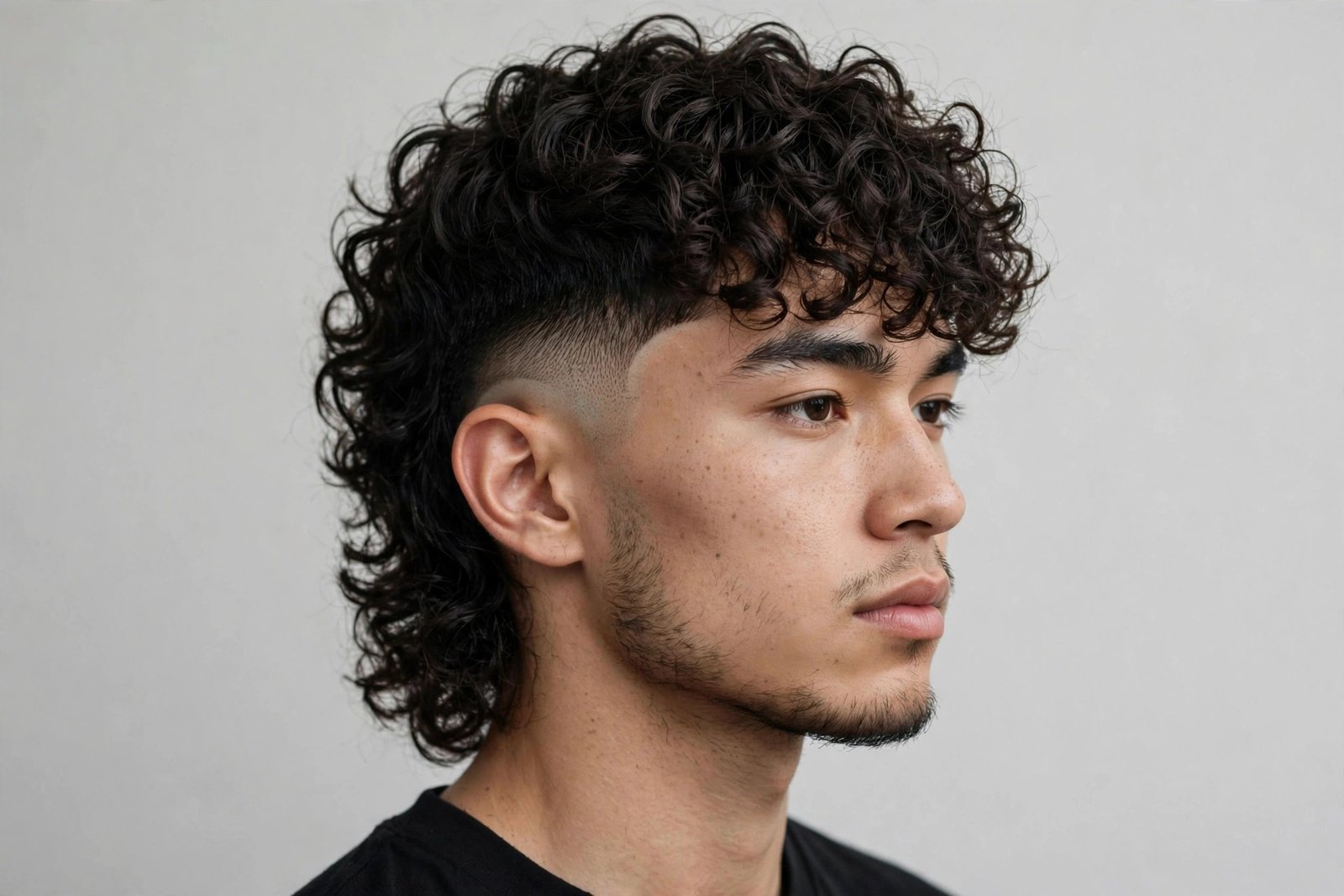
The burst fade arcs around the ear in a perfect semicircle, leaving length at the neckline — and with a curly fringe on top, it’s one of the most dynamic silhouettes in modern barbering. The eye travels from the full curly fringe, down the curved fade, to the longer back, in one continuous flow. It’s a favorite for mohawk-adjacent styles and mullets, but as a standalone with a fringe it’s got its own identity: sculptural, modern, a little bit futuristic. It suits oval and diamond faces and guys who like their cuts to have architecture.
Barber script: “Curly fringe on top, five inches, forward. Burst fade around the ears — clean arc, keep some length at the back. Blend into the curls carefully.” The burst’s curve is the hard part; it needs a barber with real clipper control. Ask to see their burst fade work specifically. The back length is your choice — it can connect to a longer back for a mullet feel or stay neat.
Styling is standard curl cream and scrunch; the fade does the visual work. Touch-ups every 2 to 3 weeks keep the arc crisp — a grown-out burst fade loses its geometry fast and just looks like a messy fade. Honest downside: it’s a distinctive, trendy cut that not every workplace loves, and the curved grow-out is unforgiving. It’s also one of the harder fades to execute, so barber quality matters enormously. But the silhouette — that perfect arc under a cloud of curls — is genuinely special.
19. The 90s Heartthrob Curly Fringe
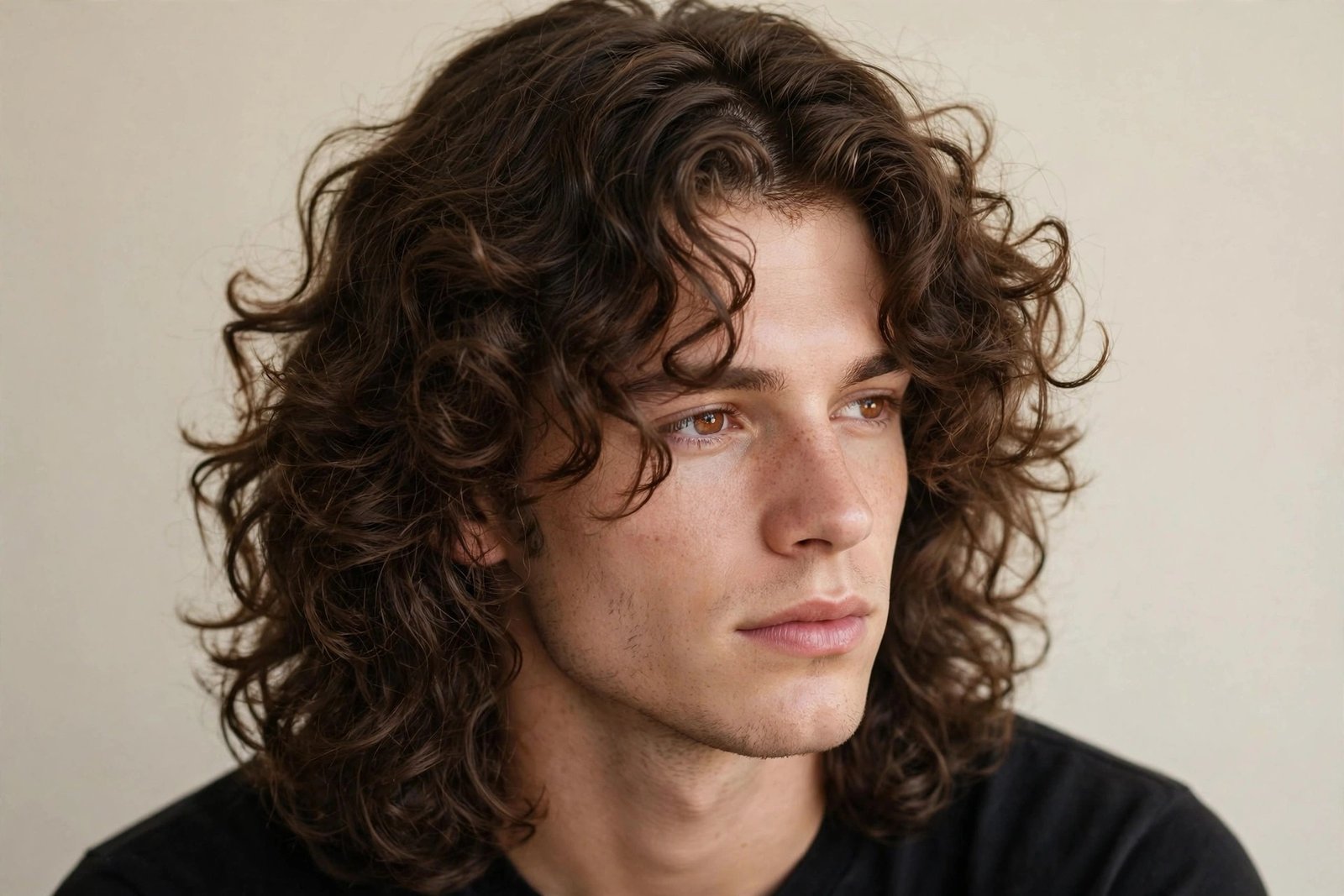
Think young DiCaprio meets natural curls: the 90s heartthrob fringe is longer, softer, and more romantic than anything else in this guide. Six to seven inches of curl worn forward with a loose center or off-center part, the front pieces long enough to move, the whole thing reading as effortlessly swoon-worthy. It’s nostalgia done right — not costume, just the best parts of the era filtered through 2026. It suits oval and square faces, and it has a universal appeal that crosses age groups in a way trendier cuts don’t.
Barber script: “90s-inspired curly fringe — six to seven inches in front, soft center part, curls falling forward naturally. Long layers, dry cut, keep it soft with no harsh lines.” The softness is the brief: no fades, no sharp edges, no graphic lines. The sides should be scissor-cut and blended, long enough to tuck or flow. This is a grow-out friendly cut — it only gets better with length.
Styling: curl cream, finger-part while damp, scrunch and let it fall. The heartthrob fringe looks best with a little movement, so don’t over-define — let some pieces do their own thing. It’s a 3-minute routine that reads as 30. Honest downside: the length means it’s the least practical for active lifestyles — sports, wind, helmets all fight it. And it needs that 6-inch minimum, so it’s a grow-out commitment. But for sheer romantic impact, it’s in a class of its own.
20. Curly Fringe with High Taper
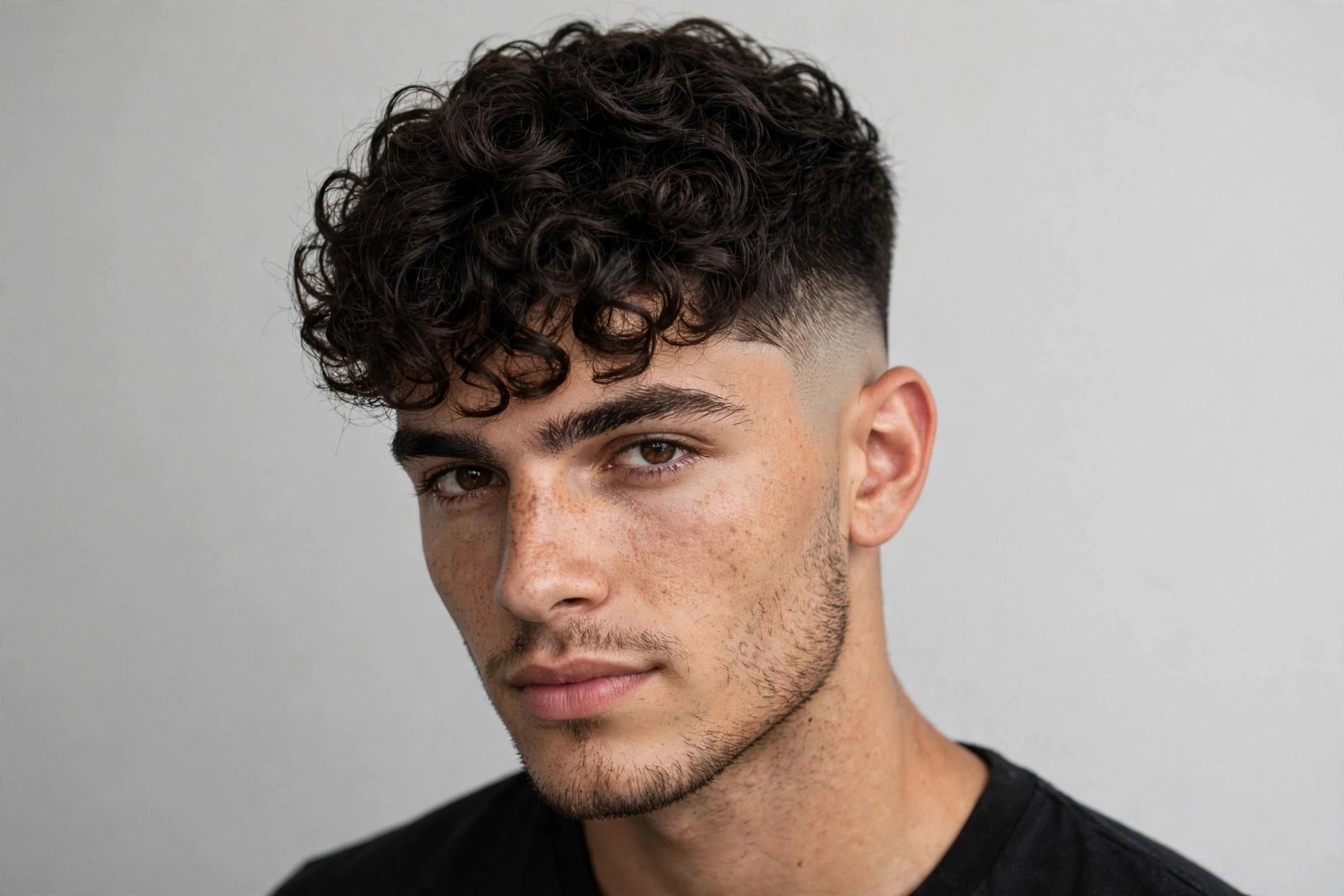
The high taper starts the taper up near the temples rather than at the neckline, creating a longer, cleaner transition zone that makes the curly top look even bigger by comparison. With the fringe worn forward, the effect is striking: crisp, architectural sides flowing into a cloud of curls. It’s sharper than the low taper, more wearable than a skin fade — the middle path for guys who want edge without the every-two-week skin fade commitment. It suits square and oval faces particularly well.
Barber script: “Curly fringe on top, five inches, forward. High taper — start it up at the temples, gradual blend, not a skin fade. Keep the curls full.” The word “taper” is doing important work here; make sure the barber doesn’t convert it into a high fade, which is a different, harsher cut. The transition should be gradual over an inch or two, melting into the curls.
Morning routine is the standard curl cream scrunch; the taper needs a refresh every 2 to 3 weeks. The grow-out is more forgiving than a skin fade’s because there’s no bald line to betray you — it just softens. Honest downside: on very fine hair, the high taper can expose scalp in the transition zone, so dense hair wears this best. And it’s a fairly “done” look — if your style is more relaxed, the low taper (style 2) fits better. But for sharp-without-severe, the high taper is the answer.
21. Coily Fringe with Shape-Up
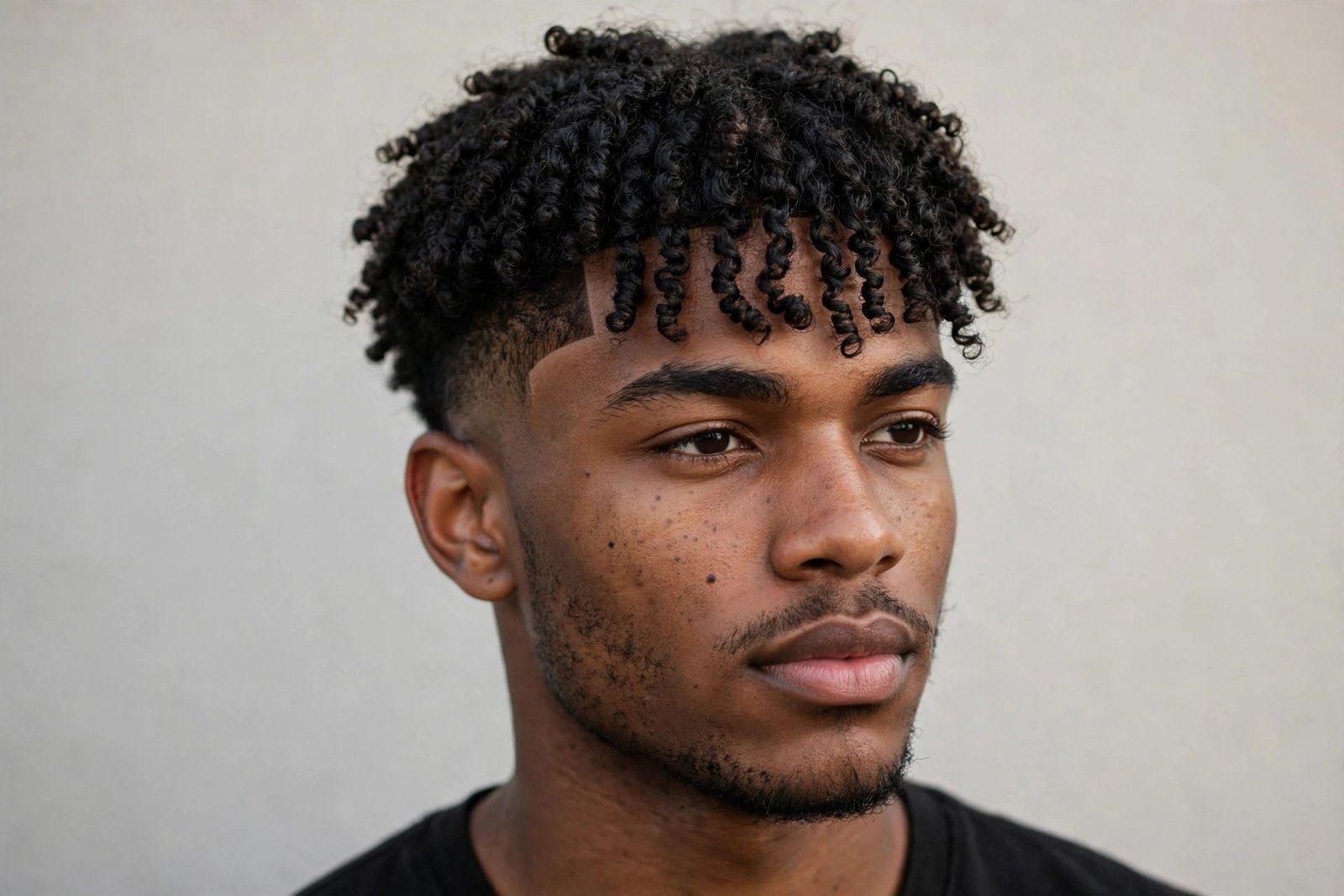
For type 4 coils, the shape-up changes everything. The coily fringe with a shape-up pairs forward-worn coils with a razor-crisp hairline — sharp corners, clean edges, the geometric frame that makes the texture pop. It’s the Black barbershop classic applied to the fringe trend, and the contrast between the organic coils and the architectural hairline is one of the sharpest looks in men’s grooming, period. It suits every face shape; the shape-up is universally flattering.
Barber script: “Coily fringe, coils worn forward, shape-up on the front hairline — sharp and clean. Taper or fade on the sides as I like. Cut the coils dry.” The shape-up is precision work — find a barber known for lineups, because a wobbly hairline ruins the whole effect. Specify whether you want the corners squared or rounded; squared is sharper, rounded is more natural.
The coil routine applies: leave-in, curl cream or butter, pick the roots, bonnet at night. The shape-up needs refreshing every 1 to 2 weeks — it’s the highest-frequency maintenance in this guide, but each visit is quick. Honest downside: the lineup grows out visibly within days, so this cut owns your barber’s chair. And an over-aggressive shape-up can push the hairline back over time — tell your barber to enhance your natural line, not redraw it. Done right, though, it’s flawless.
22. Curly Fringe and Beard Combo
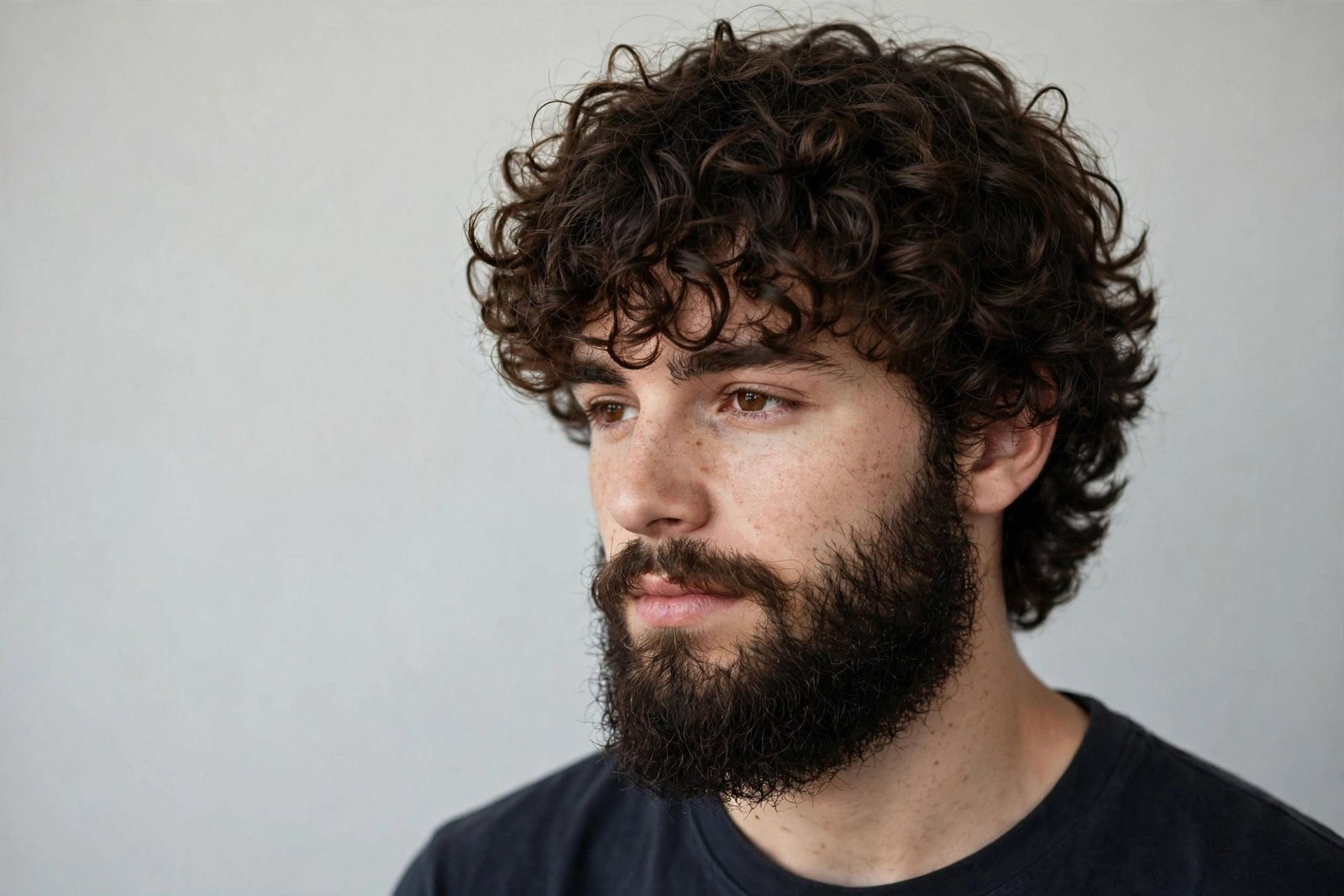
Hair doesn’t exist in a vacuum, and the curly fringe plus a well-kept beard is one of the strongest full-face combinations a man can wear. The softness of the curls on the forehead balanced against the structure of a beard creates a frame that flatters almost every face — the beard adds jaw definition while the fringe softens the forehead. It’s masculine without being harsh, stylish without trying too hard. It suits square and oval faces best, and it’s the go-to for guys in their late 20s and 30s who want the trend with some maturity.
Barber script: “Curly fringe on top as usual — five inches, forward. And shape the beard to match: clean cheeks, defined neckline, blend the sideburns into the hair.” Get both done in the same appointment by the same barber; the transition between sideburn and hair is where combo cuts succeed or fail. Ask for the beard’s cheek line to be natural rather than razor-sharp — sharp cheek lines grow out stubbly and obvious.
You’re now maintaining two textures: curl cream for the fringe, beard oil and a boar brush for the beard. It’s maybe 5 minutes total, but it’s daily — beards don’t take days off. Trim the beard every 2 to 3 weeks, the fringe every 5 to 6. Honest downside: it’s the most total maintenance in this guide when you count both, and a patchy beard will undermine the whole effect — if your beard has big gaps, this combo isn’t for you yet. But when both are on point, it’s the most complete look here.
23. Curly Fringe with Mid Taper
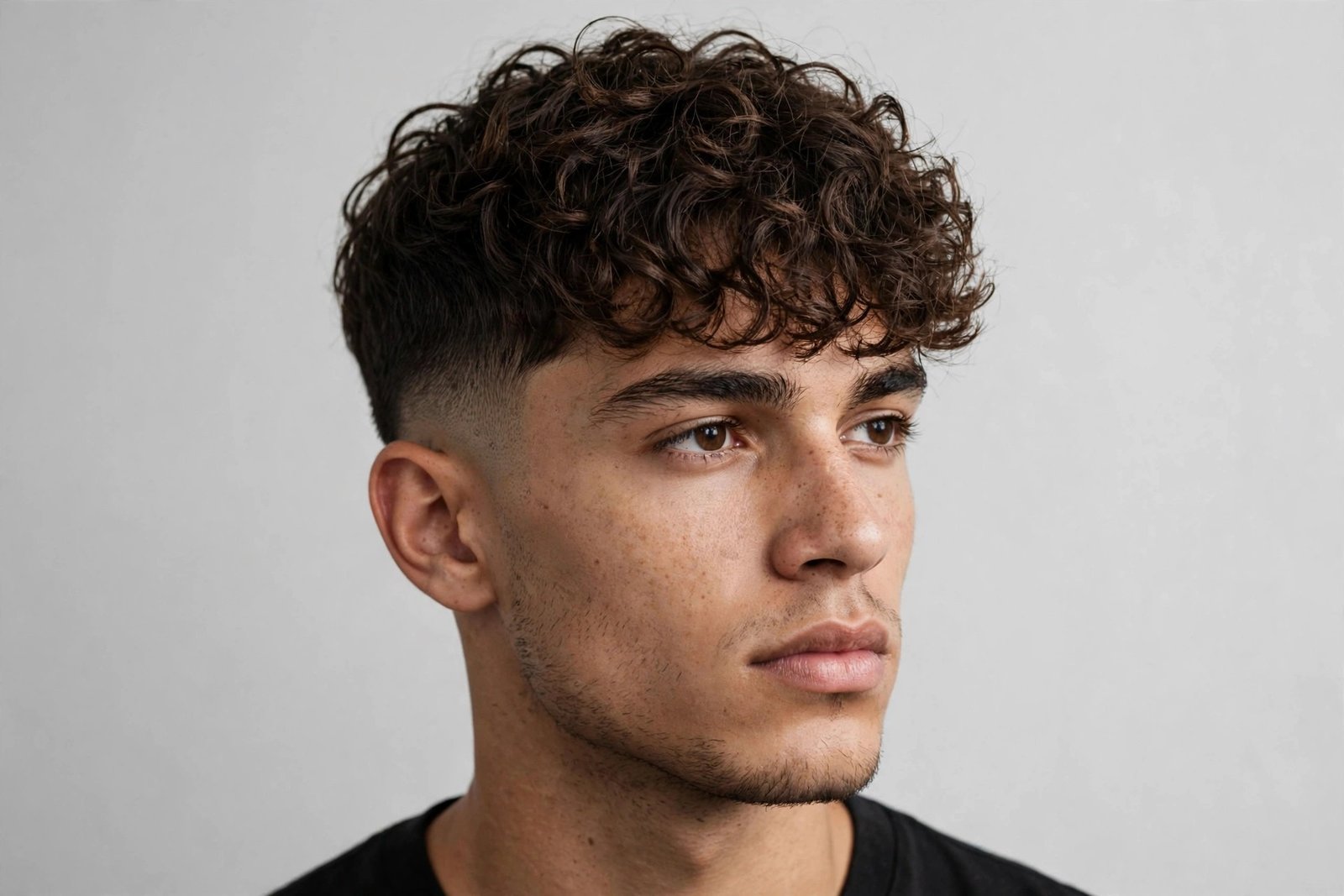
If the low taper is the quiet professional and the high taper is the sharp dresser, the mid taper is the everyman — the balanced, no-wrong-answers version. Starting halfway up the sides, it gives the curly fringe a clean frame without the drama of a fade or the subtlety of a low taper. It’s the cut I’d recommend to a friend who asked for “just make it look good” — it works on every face shape, every curl type, every age. The versatility is the point.
Barber script: “Curly fringe on top, five inches, forward. Mid taper on the sides — start it mid-way, gradual, blend into the curls. Nothing extreme.” This is the hardest cut to get wrong, which makes it the safest recommendation in the guide. Even an average barber can execute a mid taper well, and the proportions are forgiving.
Styling is the standard routine; maintenance is a taper refresh every 3 weeks and a top trim every 6. It grows out gracefully — the mid taper softens into something that still looks intentional. Honest downside: it’s so balanced it can feel unexciting if you crave edge. There’s nothing here that makes a statement; it’s a great haircut, not a conversation piece. But “great haircut, zero risk” is exactly what most guys actually need, and this delivers it.
24. The Surfer Curly Fringe
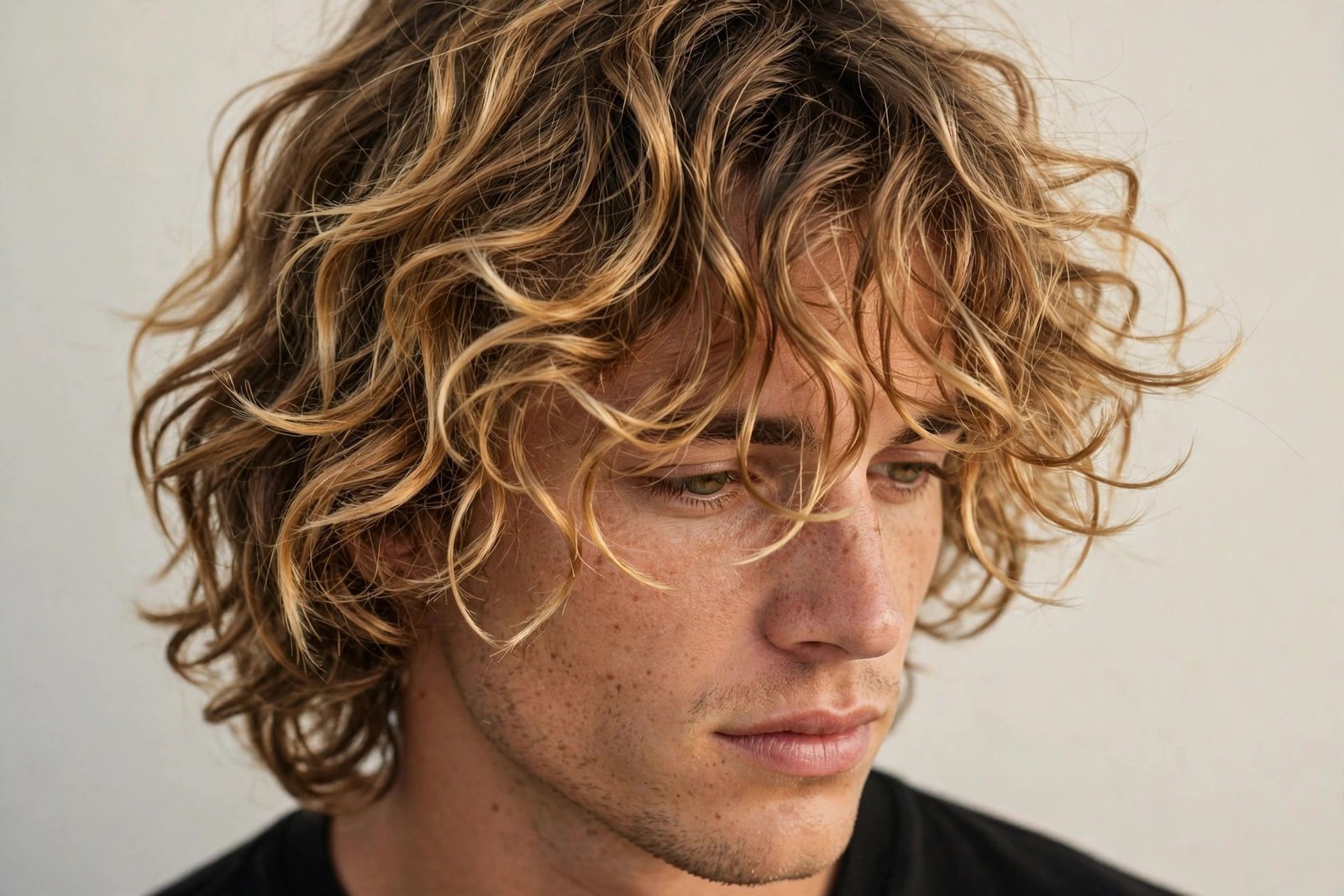
The surfer fringe is what happens when curls meet salt water and sunshine: longer, looser, sun-kissed, with that windswept texture that looks like a permanent vacation. The fringe falls forward in wavy, piece-y sections, the overall length runs 6 to 8 inches, and the whole thing has a golden, lived-in quality. It’s the most lifestyle-specific cut in this guide — it belongs on beaches, in coastal towns, on guys whose wardrobe is mostly linen. It suits oval and long faces and wavy-to-curly types 2B through 3B.
Barber script: “Surfer-style curly fringe — seven inches, long layers, worn forward and piece-y. Keep it natural, no fade, sides long enough to flow. Dry cut.” The layers are essential; without them, long waves hang flat instead of moving. If you want the sun-kissed part, ask about subtle balayage or just let summer do it — but go to a colorist who understands curly hair, because bleach on curls needs care.
Styling is sea salt spray and sunshine, literally. Scrunch damp hair with salt spray, let it air dry, maybe tousle. It’s the lowest-effort long style here. Honest downside: without actual beach lifestyle it can look like costume, and sun plus salt is brutal on curl health — you’ll need more deep conditioning than any other wavy style. Chlorine is the enemy. But if your life is anywhere near the water, nothing looks more right.
25. Curly Fringe with Undercut
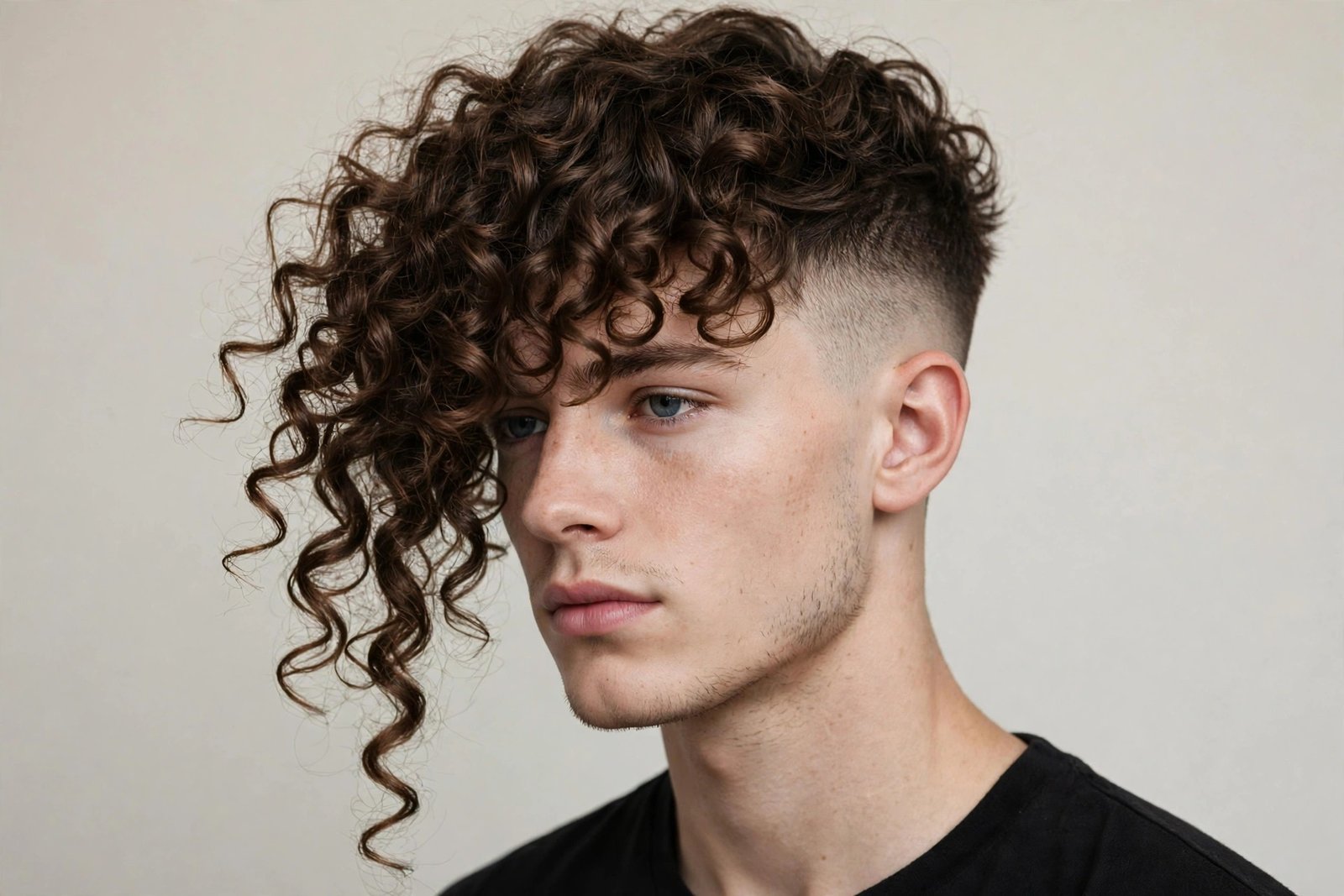
The undercut disconnects the top from the sides completely — one length up top, short all around, with a visible line where they meet instead of a blend. With a curly fringe, the effect is dramatic: a waterfall of curls pouring forward over a cliff of short sides. It’s bold, it’s architectural, and it’s not for the faint of heart. It suits oval and square faces, confident dressers, and guys who like their hair to have a clear concept.
Barber script: “Disconnected undercut — keep the top long, six inches, curly fringe forward. Sides short with clippers, number 2 or 3, with a hard disconnect line, no blending.” The disconnect line is the design feature; make sure it’s placed where you want it — higher reads edgier, lower reads safer. And know that growing out a disconnect is awkward; there’s no graceful transition.
Styling the top is standard curl care; the sides need nothing. The disconnect itself needs re-cutting every 3 to 4 weeks or the line softens and the effect dies. Honest downside: it’s the least versatile cut here — you can’t really style it any other way, the grow-out is rough, and it reads very “fashion” in conservative settings. It’s also unforgiving on thinning hair; the contrast exposes scalp. But as a statement cut, the undercut plus curly fringe is genuinely striking.
26. Puffy Curly Fringe
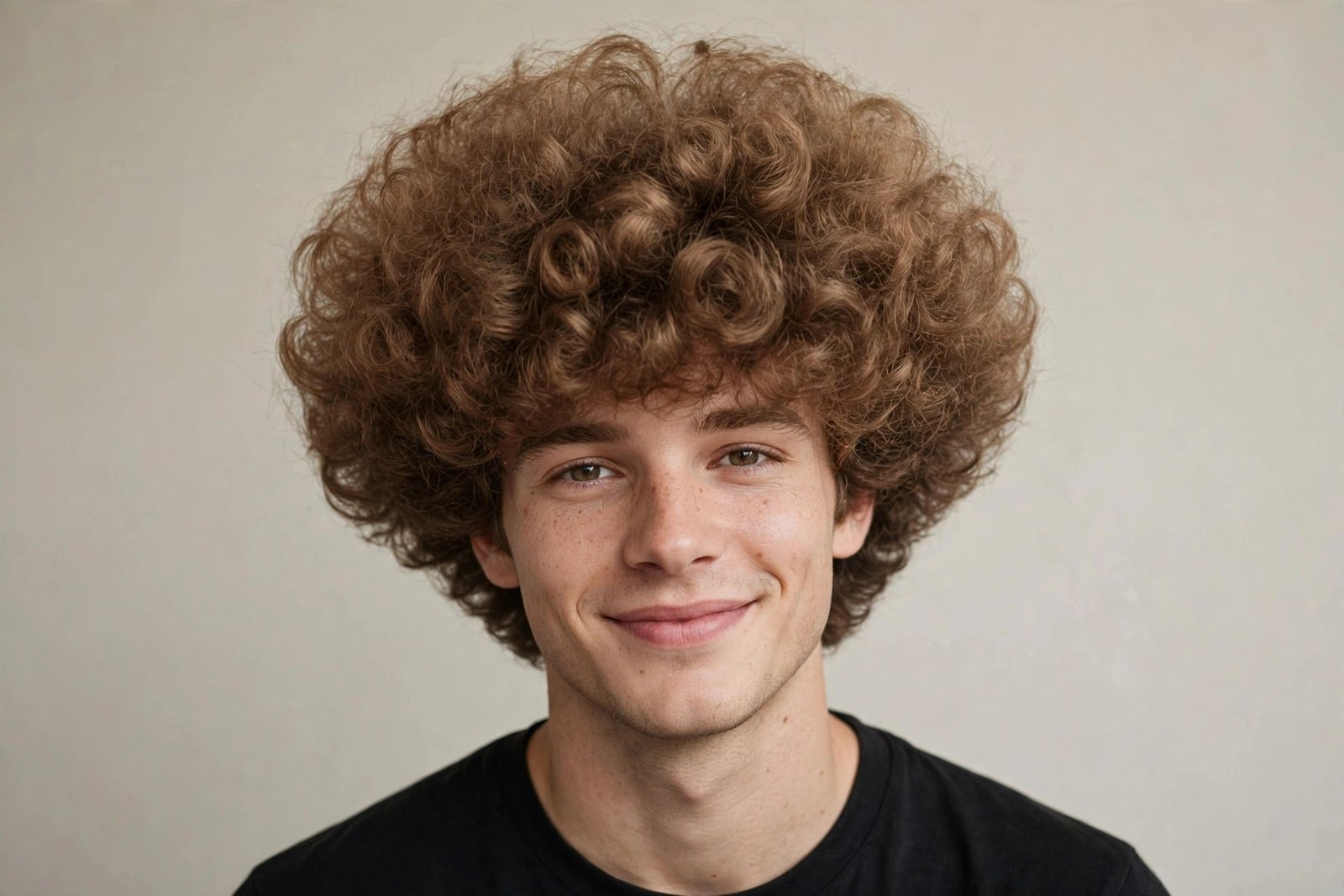
The puffy fringe leans into volume instead of fighting it: the curls are encouraged to expand into a rounded, cloud-like fringe with real presence. Where other styles define and separate, this one celebrates the puff — soft, touchable, joyful. It’s the most fun style in this guide, with a youthful energy that suits round and heart-shaped faces beautifully (the roundness echoes the face in a flattering way). It works best on type 3 curls with good density; fine hair can’t build the puff.
Barber script: “Rounded curly fringe with volume — I want it full and puffy, not flat. Shape it dry into a rounded silhouette, keep the sides a bit full too for balance.” The silhouette is everything; a barber who thins it out to “control” the volume has destroyed the brief. The shape should be deliberate — rounded, even, intentional — not just uncut.
Styling: volumizing mousse on damp hair, diffuse with your head flipped for maximum lift, then pick the roots gently. Avoid heavy creams and oils — they deflate the puff. This is a 5 to 8-minute routine. Honest downside: humidity is the mortal enemy of the puff, wind turns it into chaos, and it’s the least “serious” look here — great for creative fields, tough for boardrooms. But there’s something wonderful about a cut that refuses to apologize for volume.
27. Curly Fringe Mullet
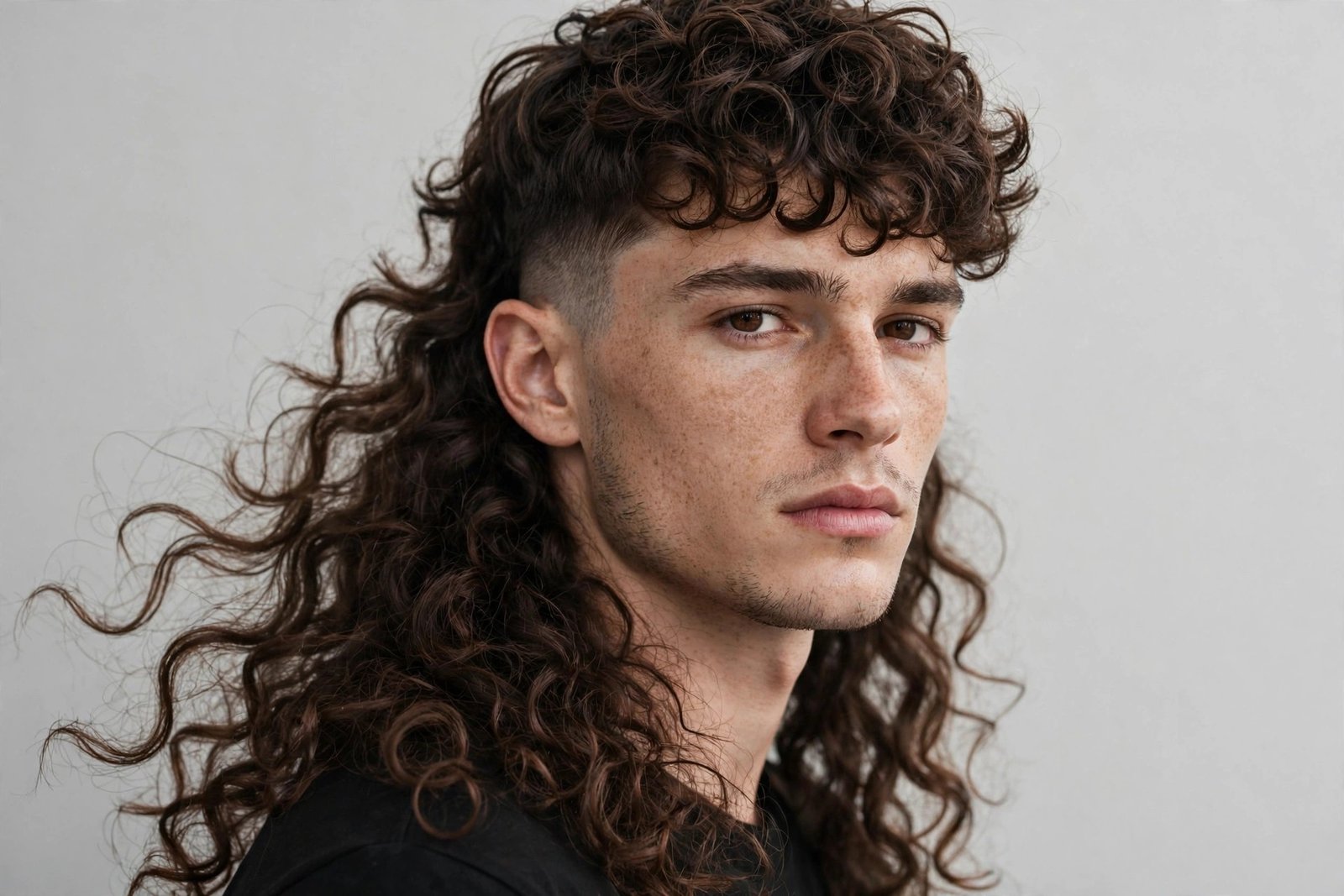
Business in the front, party everywhere: the curly mullet keeps the fringe short and forward while the back flows long and curly. On curls, the mullet is genuinely magnificent — the texture gives it a wild, romantic quality that straight mullets can’t touch. It’s had a full cultural rehabilitation and in 2026 it’s a legitimate style choice, not an irony. It suits oval and long faces, musicians, skaters, and anyone whose personality is bigger than a standard cut.
Barber script: “Curly mullet — fringe forward at four inches, sides short, back long and curly, at least six inches. Blend the transition so it flows, don’t disconnect it.” The modern curly mullet should flow, not step — the 80s version’s harsh lines are gone. Ask for the back to be layered so the curls cascade rather than clump.
The fringe styling is standard; the back needs the same curl care — cream, scrunch, don’t neglect it just because it’s behind you. The back grows out fine (it’s supposed to be long), but the fringe and sides need trims every 5 to 6 weeks to keep the proportions. Honest downside: it’s still a mullet, and some people will never get past that. Certain professional settings are closed to it. The grow-out from a mullet to anything else is a project. But if your vibe is big, the curly mullet delivers like nothing else.
28. Curly Fringe with Hard Part
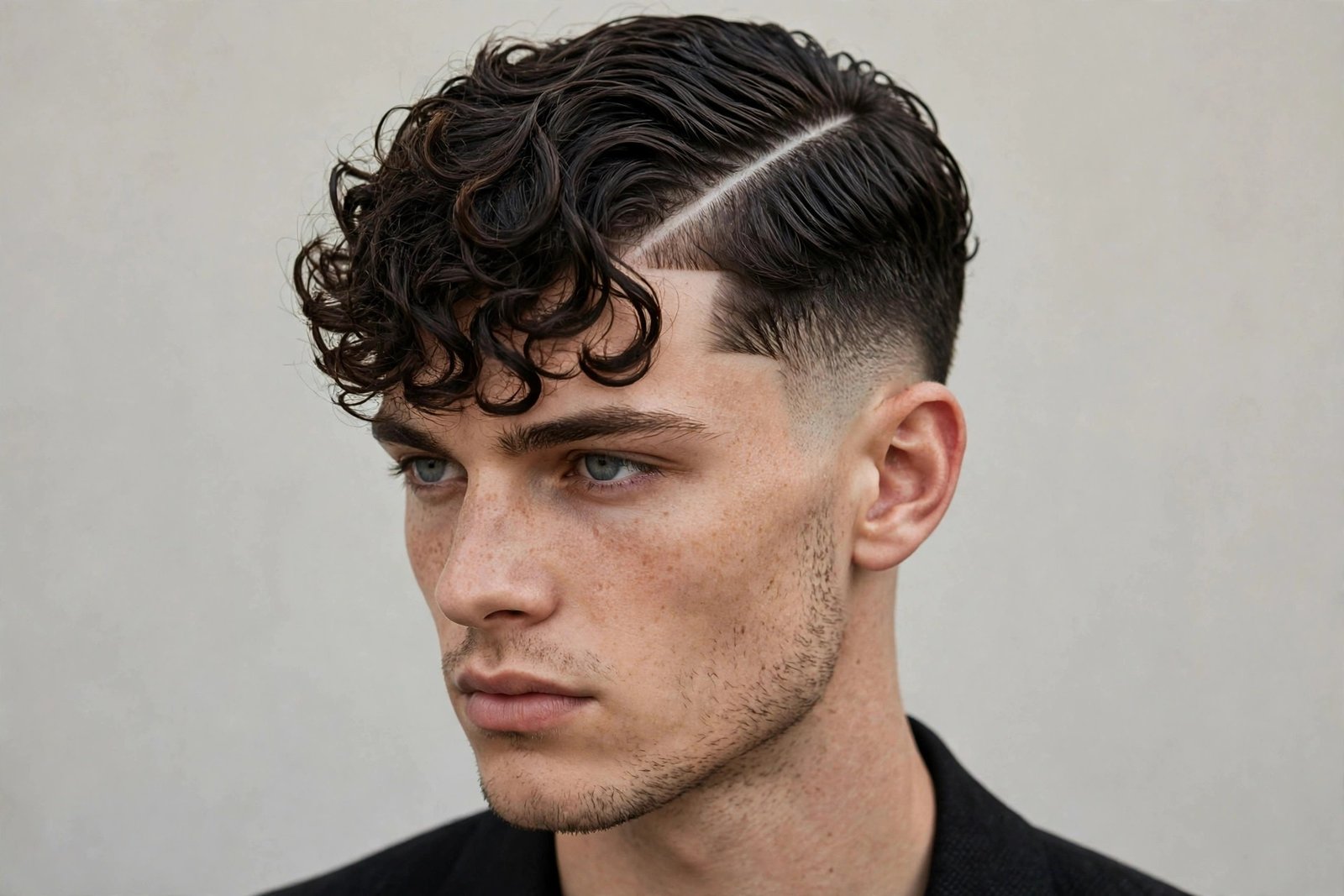
The hard part — a shaved line defining the part — is usually a slicked-back move, but paired with a curly fringe it creates a fascinating tension: razor-sharp geometry on one side, wild organic curls on the other. The fringe sweeps forward from the part line, the curls doing their thing while the part keeps everything anchored and intentional. It’s tailored meets untamed, and it suits square and oval faces, professionals who want edge, and guys who like precision.
Barber script: “Curly fringe with a hard part — shave the part line in on my natural part, curls swept forward from it, five inches. Taper the sides.” The part placement should follow your natural growth; a hard part carved against the grain looks forced and grows out weird. Ask the barber to mark it with trimmers, not a razor, for a cleaner grow-out.
Styling: establish the part on damp hair with your fingers, apply curl cream, sweep the fringe forward from the line. The hard part needs re-carving every 2 weeks or it softens into a regular part — that’s the maintenance tax. Honest downside: the hard part is a strong, specific look that not everyone loves, and as it grows out it can look messy rather than soft. It’s also one more thing to maintain. But the contrast — that crisp line against the curls — is genuinely distinctive.
29. Asymmetric Curly Fringe
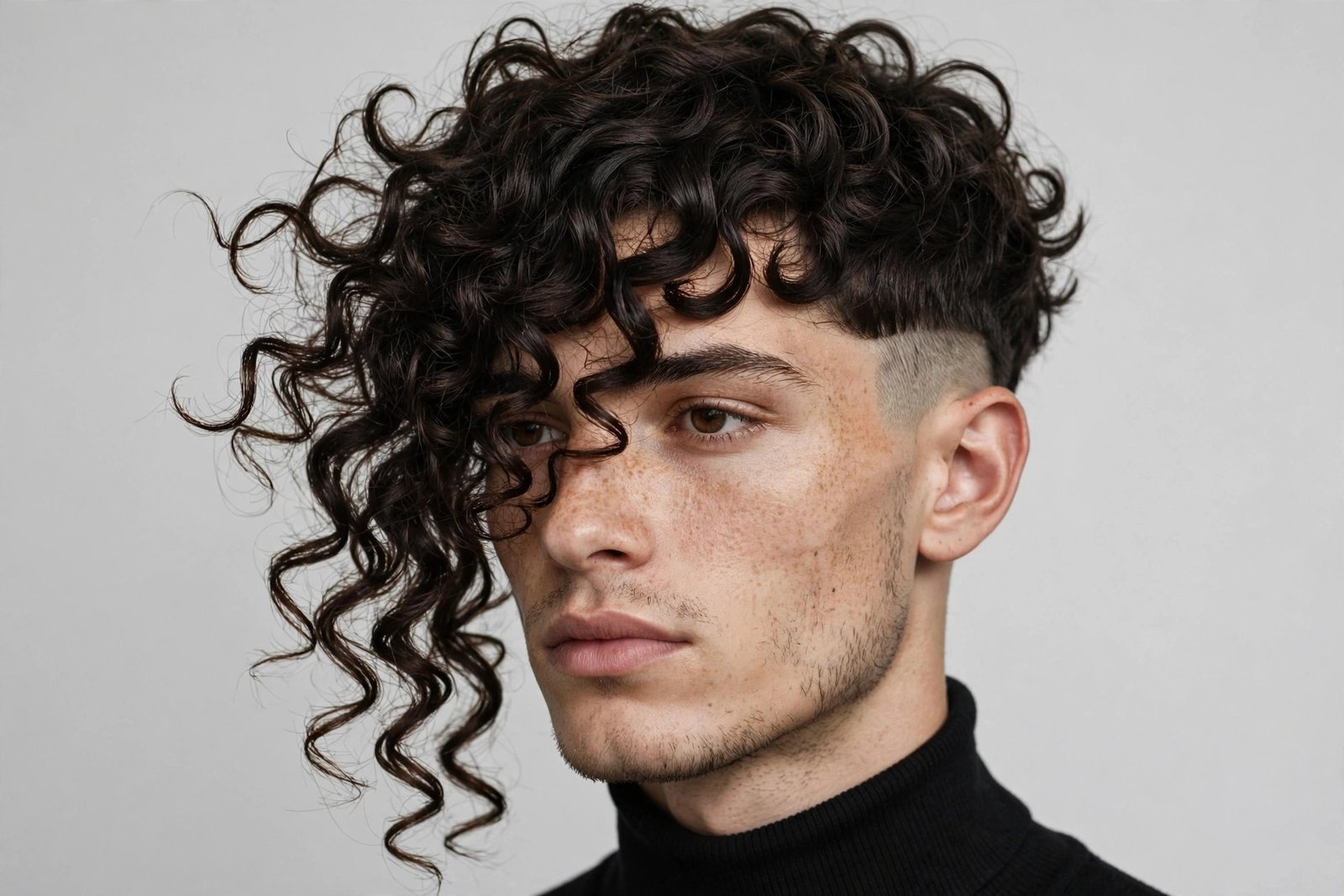
Why should the fringe be even? The asymmetric curly fringe sweeps longer on one side, shorter on the other — a diagonal, editorial line through the curls that turns the fringe into a design element. It’s the most fashion-forward style in this guide, the one that looks like it came off a runway. It suits oval and heart-shaped faces (the diagonal breaks up symmetry beautifully), creative professionals, and anyone bored of even lines.
Barber script: “Asymmetric curly fringe — longer on the left, sweeping diagonally shorter to the right, about a two-inch difference. Cut it dry so the asymmetry lands where it’ll actually sit.” The asymmetry has to be cut into the dry curls with the natural fall accounted for; wet-cut asymmetry is a gamble. Start subtle — you can always go more dramatic next time.
Styling means arranging the sweep daily: curl cream, then guide the longer side across with your fingers while damp. It takes a minute of intention — this isn’t a shake-and-go cut. Honest downside: it’s high-concept and not for every room; conservative offices will raise eyebrows. The asymmetry also needs more frequent trims (every 4 weeks) to keep the diagonal crisp as it grows. But if your style is artistic, nothing here expresses it like the asymmetric fringe.
30. Curly Fringe with Low Fade
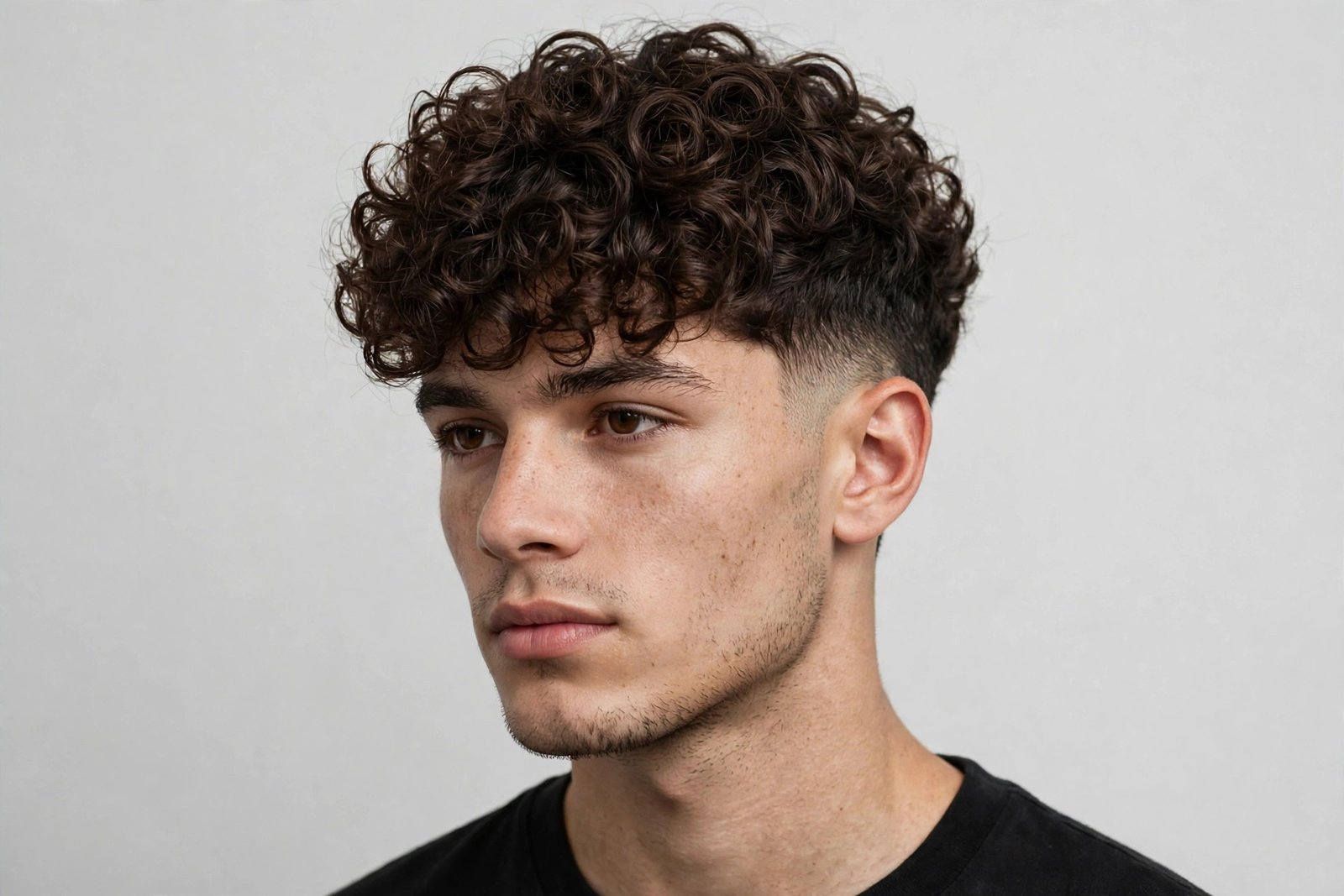
The low fade is the fade for guys who don’t want to look like they have a fade — it stays down near the neckline and ears, keeping the overall impression full and curly while adding just enough clean structure at the edges. With the fringe forward on top, it’s the most natural-looking faded option in this guide: polished but not severe, modern but not trendy. It suits every face shape and every age, and it’s the fade I’d recommend to a first-timer.
Barber script: “Curly fringe on top, five inches, forward. Low fade — keep it low, just around the ears and neckline, blend up gently. Dry cut on the curls.” Emphasize “low” twice if needed; barbers love to creep fades upward. The blend should be soft and gradual — this cut’s whole identity is subtlety.
Morning routine is standard; the low fade needs a touch-up every 3 weeks, and it grows out more gracefully than higher fades because there’s less contrast to betray. Honest downside: if you want your fade to be noticed, this isn’t it — it’s deliberately quiet. Guys who love the drama of a skin fade will find it boring. But as the “looks good, low drama, works everywhere” faded option, it’s the smartest pick in the guide.
31. The TikTok Wavy Fringe
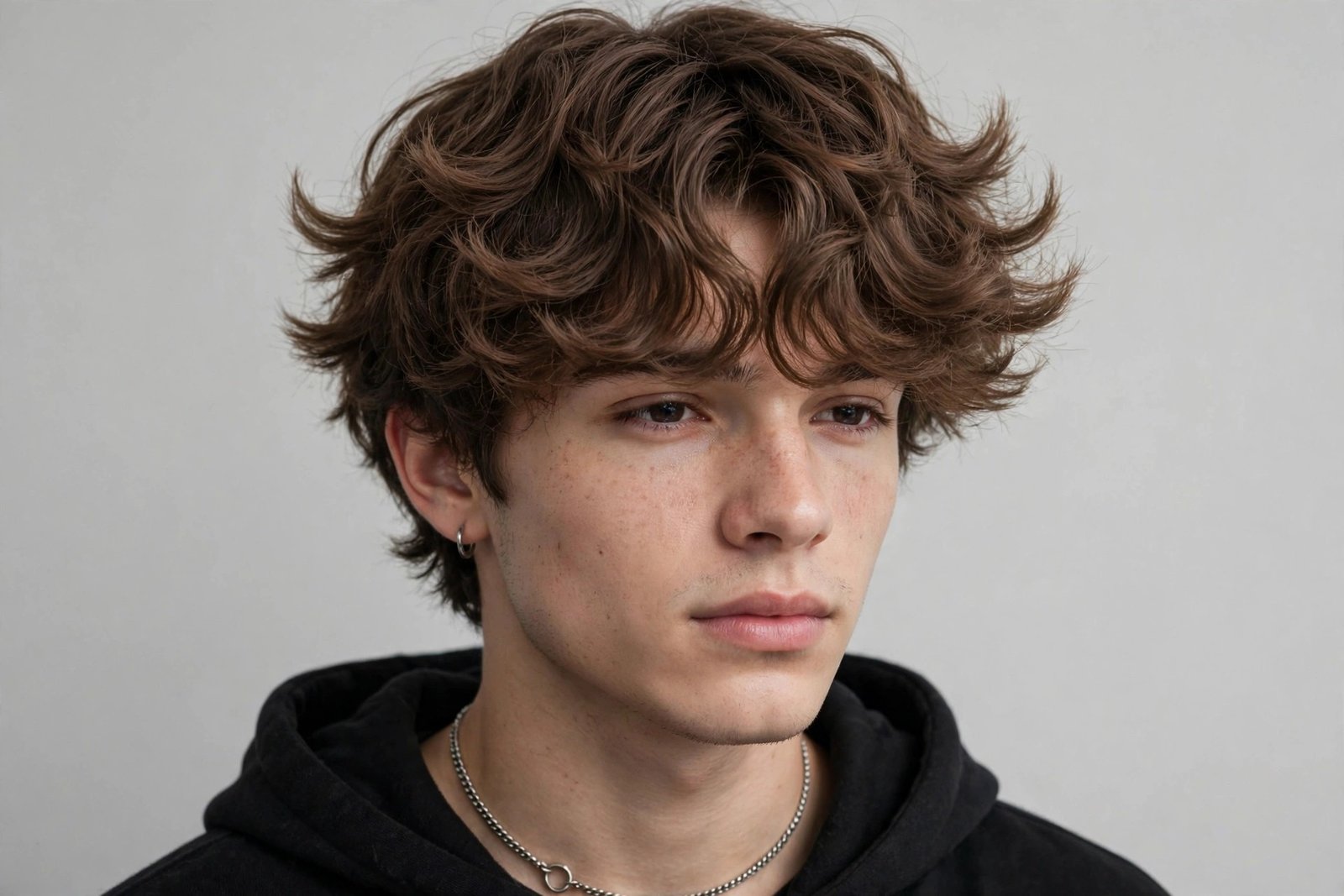
You know the hair. The fluffy, textured, perfectly-imperfect wavy fringe that’s launched a thousand thirst traps — the TikTok wavy fringe is the internet’s favorite haircut, and it earned the fame. It’s essentially a wavy-to-curly fringe at 5 to 6 inches with maximum texture, often achieved with a texture perm on straighter hair, worn forward in that coveted fluffy curtain. It suits oval and heart-shaped faces, younger guys, and the entire e-boy-to-soft-boy aesthetic spectrum.
Barber script: “TikTok wavy fringe — fluffy texture on top, five to six inches, worn forward. I want that piece-y, separated texture. Taper or fade on the sides.” If your hair isn’t wavy enough naturally, ask about a texture perm — it’s extremely common for this look and lasts 2 to 3 months. Show the barber a video, not just a photo; the movement is the point.
Styling is texture-focused: sea salt spray or texture powder on dry hair, worked through with fingers, pieces separated and arranged. It’s a 3-minute routine with a fussy finish — the “effortless” look takes effort. Honest downside: it’s the most trend-dependent cut here; when the trend moves on, this dates fast. Permed versions need upkeep and damage management. And it has a specific age/aesthetic lane — it looks odd on guys whose style doesn’t match. But in 2026, it’s still the most recognizable cool-haircut on the internet.
32. Curly Fringe with Twists
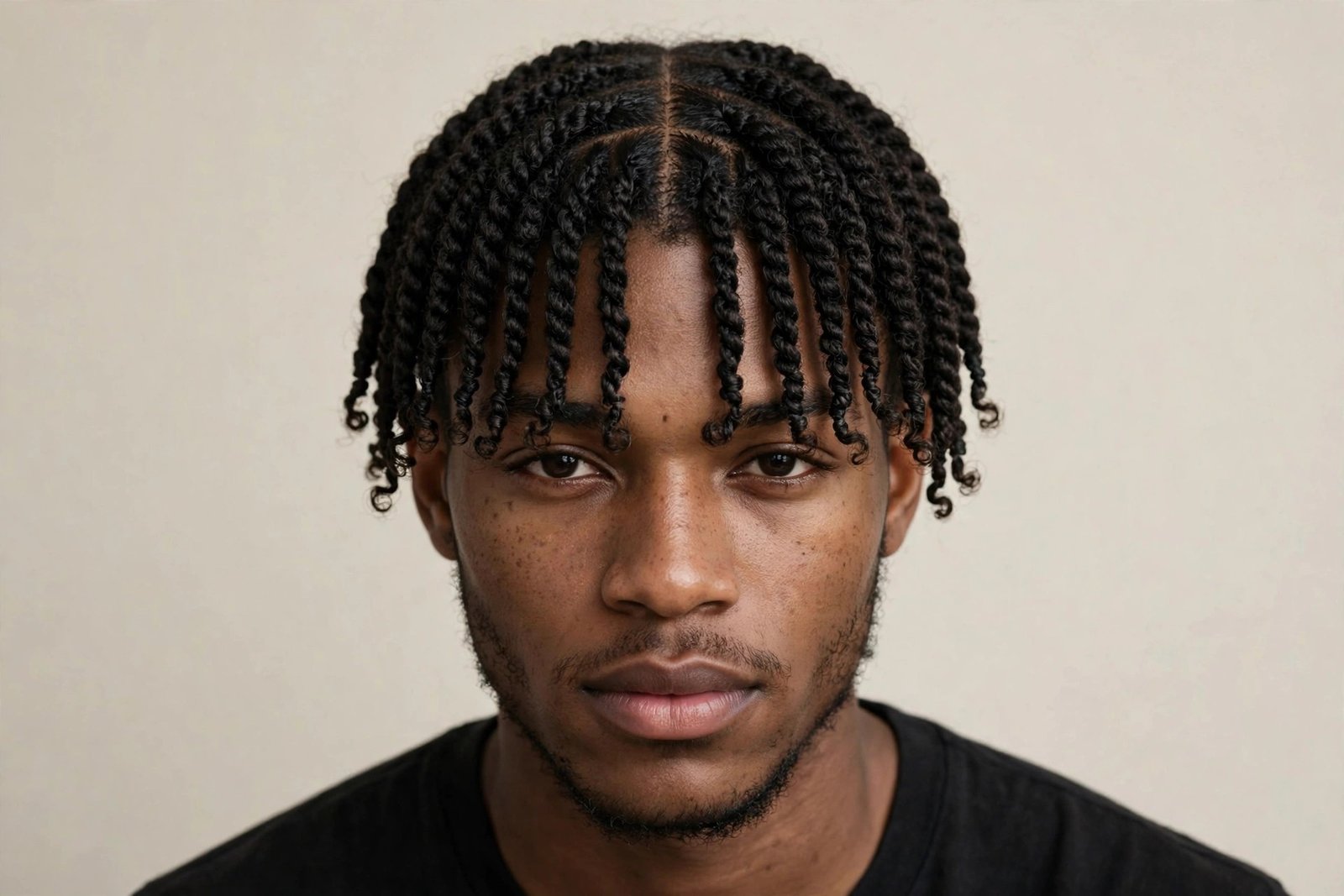
Two-strand twists worn forward as a fringe — this is where protective styling meets the fringe trend, and it’s stunning. The front twists fall onto the forehead in defined, rope-like sections while the rest of the head carries the twist pattern. It’s a favorite for type 4 hair because twists protect the ends while looking sharp, and the fringe placement keeps it current. It suits every face shape and it has a cultural richness that elevates it beyond just a haircut.
Barber script: this one’s more stylist than barber — “Two-strand twists all over, front twists worn forward as a fringe, about four inches in front. Clean up the hairline and nape.” Find someone experienced with twists; the parting pattern and twist tension determine how long it lasts and how it looks. Fresh twists should never hurt — pain means too much tension.
Maintenance is refreshingly hands-off: twists last 2 to 4 weeks, nighttime bonnet keeps them neat, light oil on the scalp prevents dryness. The morning routine is essentially nothing — maybe arrange the front twists. Honest downside: installation takes hours, not minutes, and it’s a salon service with real cost. As twists age they frizz at the roots, and there’s a point where they need redoing. But for weeks of zero-effort great hair, twists are unbeatable.
33. Wet-Look Curly Fringe
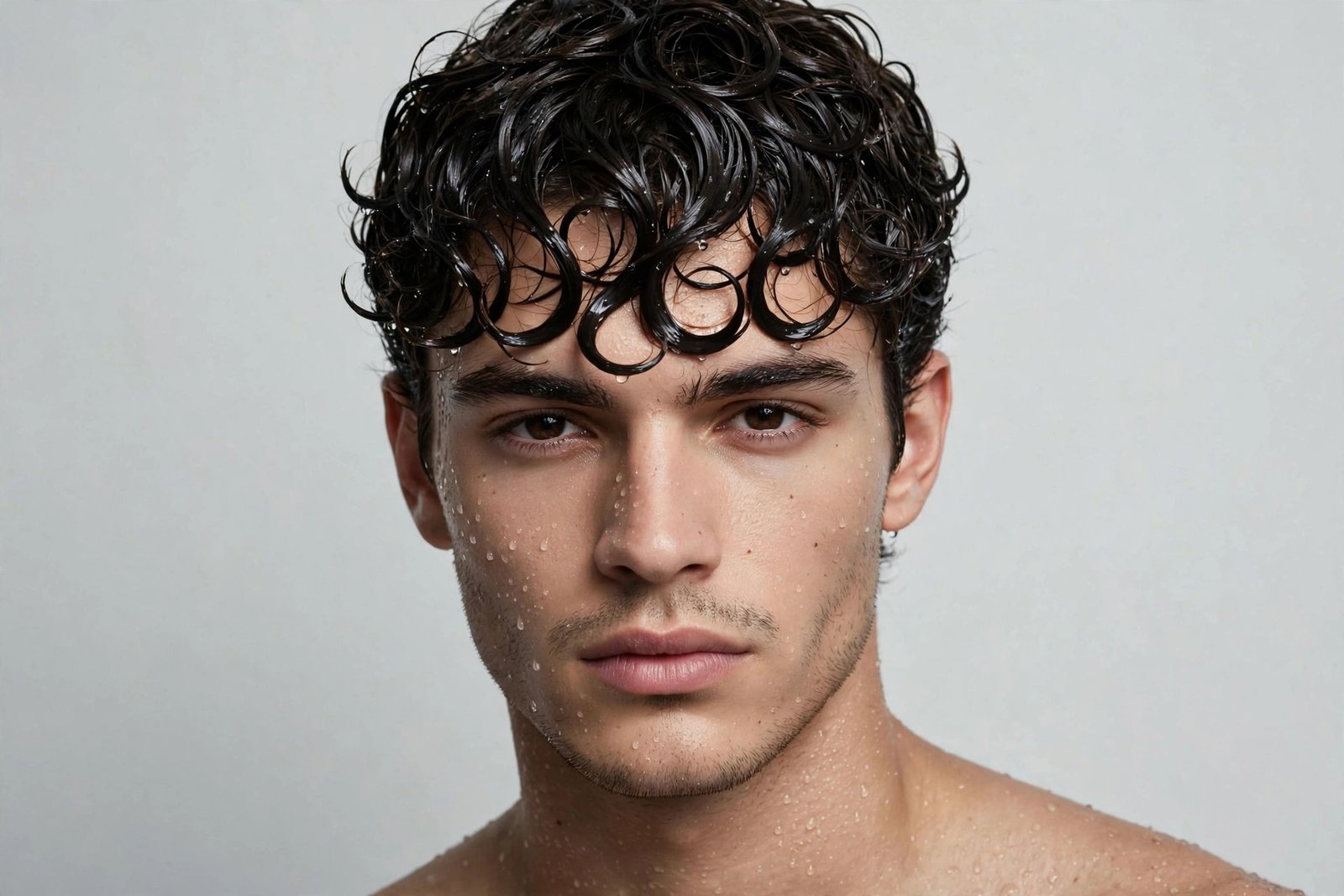
The wet look takes the curly fringe and finishes it with high-shine product for that just-out-of-the-ocean gloss — defined, sleek, deliberate. It’s the evening version of the trend: the same curls, but polished into something red-carpet ready. The gel or gloss defines every curl and holds the fringe in a sculpted arrangement. It suits oval and square faces, night-outs, events, weddings — anywhere you want the curls to look intentional and luxe.
Barber script: “Curly fringe cut for a wet-look finish — five inches, defined ends, dry cut. I’ll be styling it with gel.” The cut itself is close to the classic; the wet look is a styling choice, not a cut. But ask for clean, defined ends — ragged ends won’t hold the glossy finish.
Styling: leave-in conditioner, then a strong-hold gel or wet-look cream, applied generously to damp hair and scrunched forward. Don’t touch it while it dries — the cast is what creates the glassy finish. Once dry, you can scrunch out the crunch lightly for softness with shine, or leave the cast for maximum gloss. Honest downside: it’s a special-occasion look, not a daily driver — all-day gel gets uncomfortable and attracts dust. Heavy gels can dry curls out with daily use. But for the nights that matter, the wet-look curly fringe is pure drama.
34. Curly Fringe with Dreadlocks Blend
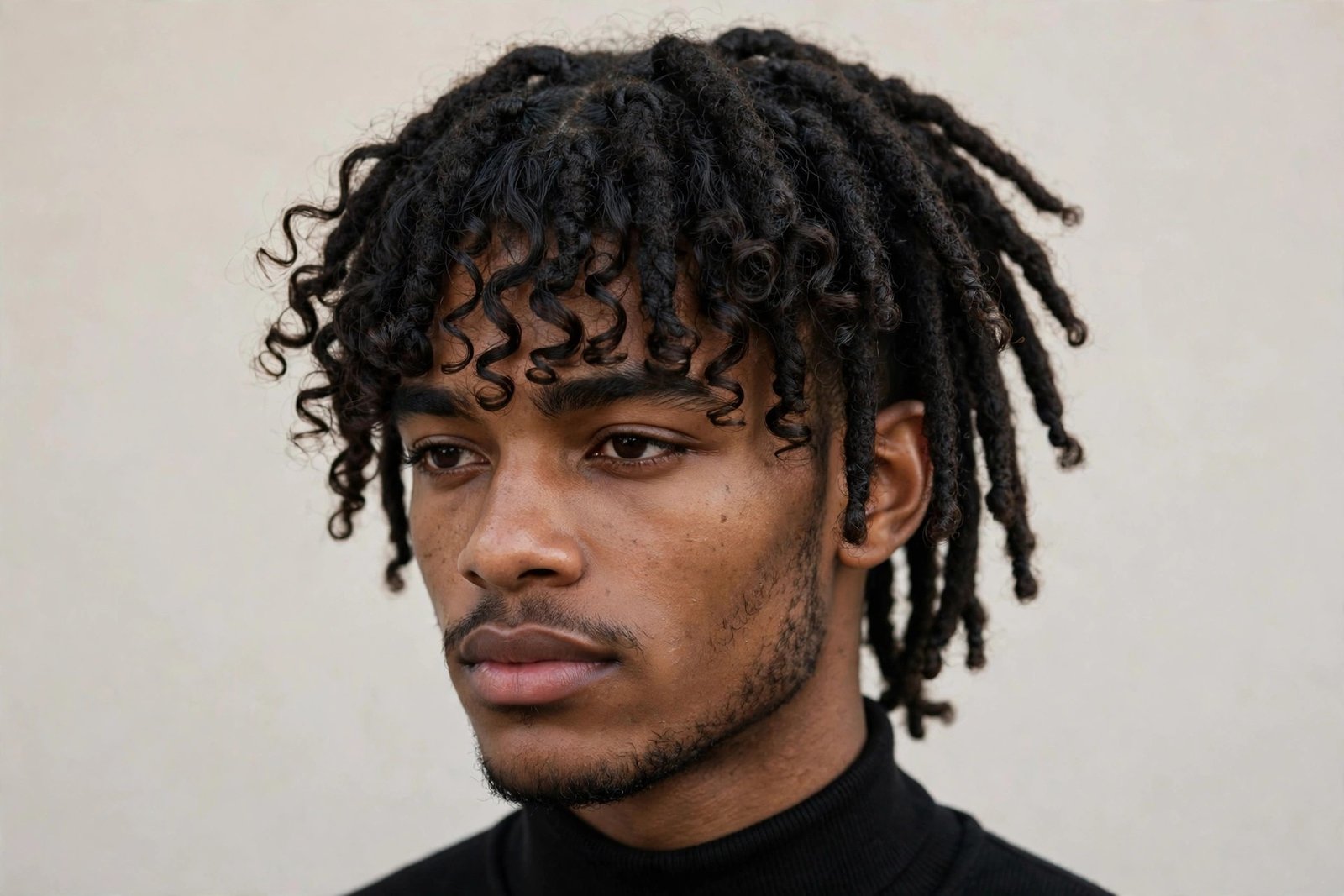
This is the wild card: dreadlocks or locs worn forward and blended with loose curls at the front to create a fringe. The locs provide the length and weight, the curly fringe softens the hairline and frames the face — a fusion that’s equal parts protective style and fashion statement. It’s uncommon, it’s striking, and on the right person it’s unforgettable. It suits oval and long faces, and it carries deep cultural significance — wear it with understanding, not as a costume.
Stylist script: “Locs with a curly fringe blend — I want the front locs or loose curls worn forward onto the forehead, framing the face. Keep the locs maintained, tidy the front.” This needs a loctician, not a regular barber — someone who understands both loc maintenance and face-framing. The front can be freeform curls, finger coils, or thinner locs; discuss what suits your loc stage.
Maintenance follows loc care: retwists every 4 to 6 weeks, moisture for the loose front curls, bonnet at night. The fringe portion needs the curl routine — cream, definition — while the locs need their own care. Honest downside: it’s the most specialized style here, requiring a skilled loctician and real commitment. It’s not a casual experiment. But as a fusion of two powerful traditions, it’s in a league of its own.
35. Curly Pixie-Edge Fringe
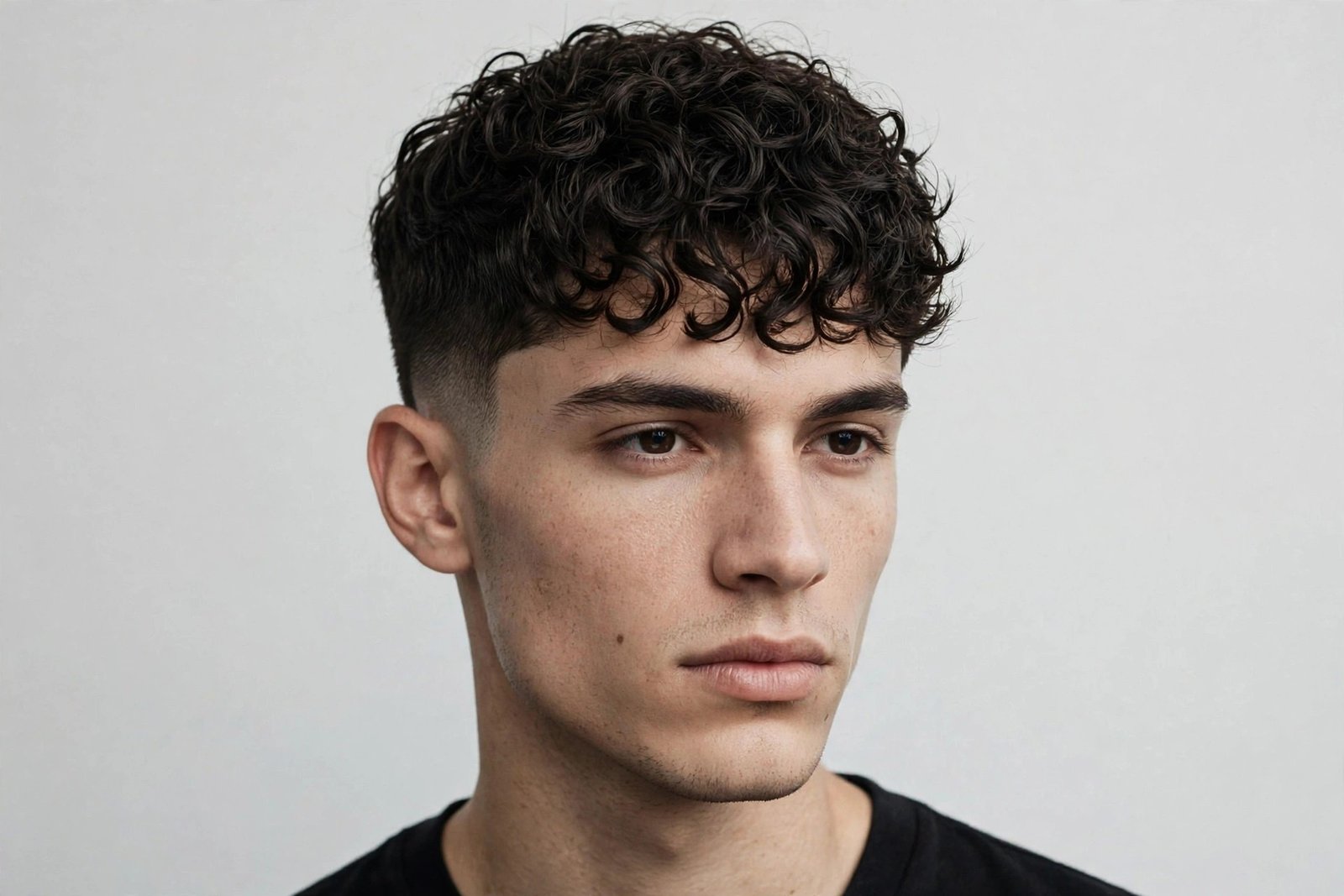
Short all over, with the fringe as the only real length: the curly pixie-edge keeps the top at 2 to 3 inches of curl worn forward, the edges tapered tight, the whole thing minimal and architectural. It’s the most low-maintenance fringe in this guide — there simply isn’t enough hair to misbehave. It suits square and oval faces, minimalists, athletes, and guys who want the fringe idea in its most stripped-down form.
Barber script: “Short curly fringe — two to three inches on top, worn forward, tight taper on the edges. Keep it minimal and clean.” At this length the curl pattern matters enormously — tight curls will read as texture, looser waves may not read as a fringe at all. Be honest with your barber about what your hair does at 2 inches.
Styling is nearly nothing: a dab of curl cream on damp hair, push forward, done. Twenty seconds. Trims every 3 to 4 weeks keep the edges sharp. Honest downside: it’s the least dramatic fringe here — at 2 inches, it’s a hint of a fringe, not a statement. And looser curl types may find it just looks like a short crop. But for maximum ease with a nod to the trend, it’s perfect.
36. The Grown-Out Curly Fringe
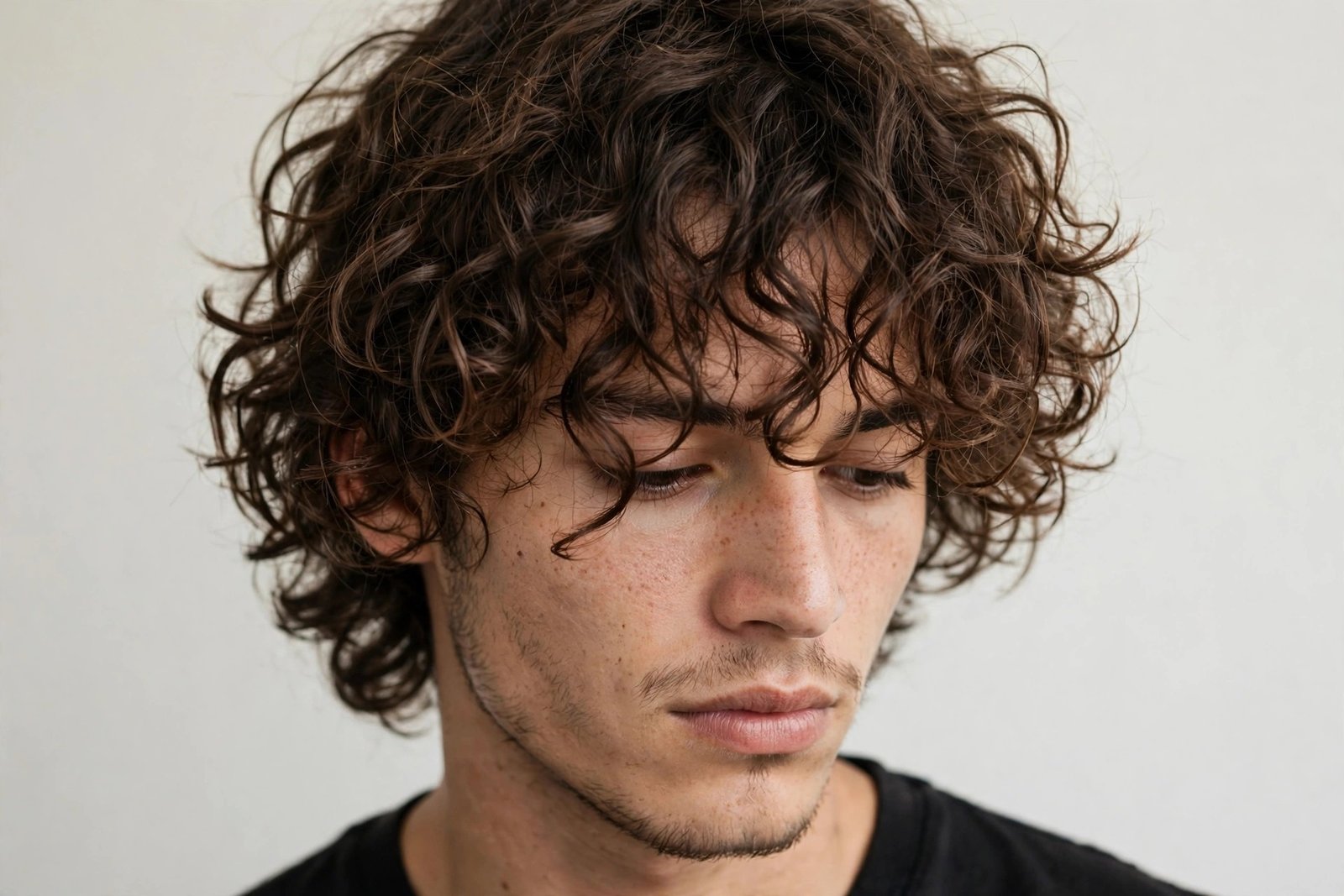
Here’s a secret: some of the best curly fringes aren’t cut as fringes at all — they’re just grown out. The grown-out curly fringe is what happens when you stop fighting the grow-out phase and let 7-plus inches of curl fall forward naturally. It’s the most organic style in this guide: no harsh lines, no defined shape, just your hair doing what it wants at length. It suits oval and square faces, free spirits, and guys who’ve given up on barbers (affectionately).
Barber script: “I’m growing it out — just dust the ends, keep the shape balanced, no real cut. I want the front falling forward naturally.” The key word is “dust” — you’re maintaining health, not shape. Visit every 8 to 10 weeks for end-dusting and shape checks. A good grow-out barber knows when to cut and when to leave it alone.
Styling is the long-hair curl routine: cream, scrunch, air dry or diffuse, bonnet or pineapple at night. The length means more product and more detangling time — budget 10 minutes. Honest downside: the grow-out journey includes awkward phases, and at full length it’s the highest-maintenance daily routine here. Wind, hats, and hoods are constant negotiations. But there’s an authenticity to the grown-out fringe that no fresh cut can replicate — it looks like you, uninterrupted.
The Curly Fringe Styling Routine: Your Complete Care Guide

A curly fringe lives or dies on routine — not a complicated one, but a consistent one. The good news: once the habits are in place, the daily part takes less time than making coffee. The bad news: skip the habits and the fringe will tell on you by noon. This section is the complete playbook — washing, daily styling, nighttime, and the weekly treatments that separate great curls from average ones. Follow it for two weeks and it becomes automatic.
The Wash Day Foundation
Everything starts in the shower, and the first rule of curly fringe care is the one most guys break: stop washing your hair every day. Curls need their natural oils — daily shampooing strips them, and stripped curls frizz. For most curl types, washing 2 to 3 times a week is the sweet spot; wavy types can go 3, coily types often do best at 1 to 2. On non-wash days, just rinse with water or skip the shower-head-on-hair entirely.
When you do wash, use a sulfate-free shampoo — sulfates are the harsh detergents that turn curls into straw. Massage the shampoo into the scalp with your fingertips (nails are the enemy), let the suds run through the lengths as you rinse, and don’t pile your hair on top of your head to scrub it. That piling is how tangles are born. Follow with conditioner, and here’s where guys need to change their habits: leave the conditioner in for 3 to 5 minutes, detangle with your fingers or a wide-tooth comb while it’s in, and rinse with cool water to seal the cuticle. Cool rinses genuinely reduce frizz — it’s not a myth.
Once a week, swap the regular conditioner for a deep conditioning mask. Leave it on for 15 to 20 minutes — under a shower cap if you’re fancy, or just while you do the rest of your shower routine. This weekly treatment is the single highest-impact habit in curly hair care. Dry, brittle curls are almost always under-conditioned curls, and a weekly mask fixes more problems than any styling product ever will. If your fringe has been frizzy lately, don’t buy a new product — do a mask first and see.
The 5-Minute Morning Routine
Here’s the daily routine that works for most curly fringe styles in this guide. Start with damp — not dripping, not dry — hair. If it’s wash day, you’re already there. If not, mist the fringe with a spray bottle or dampen your hands and run them through. Curls style best damp; styling dry curls is how you get frizz and breakage.
Apply product in this order: leave-in conditioner first (a dime-sized amount for the fringe area), then curl cream (another dime), scrunched upward and forward into the curls. The scrunching motion matters — you’re encouraging the curl pattern, pushing the hair up into its natural coil rather than pulling it down. For wavy types, swap the curl cream for sea salt spray or light mousse. For a more defined, longer-lasting hold, add a small amount of light gel after the cream — the “cream then gel” combo is the backbone of defined curls.
Now dry it. Air drying is the gentlest and works fine if you have 20 minutes. If you don’t, use a diffuser on low heat and low speed, cupping the curls upward — never blast curls with direct high heat, which is a frizz machine. Beauty editors at Byrdie have been preaching the low-heat diffuser gospel for years, and they’re right. The fringe specifically should be diffused forward, lifting at the roots so it doesn’t plaster to the forehead. Once dry, hands off. Touching dry curls breaks up the curl clumps and invites frizz. If you must adjust, do it with the tiniest bit of oil on your fingertips.
Second-day hair is where the routine pays off. Don’t rewash — mist the fringe lightly, scrunch in a pea of curl cream to reactivate yesterday’s product, and diffuse for a minute if needed. Most curly fringes look better on day two than day one because the curls have settled. By day three or four, a silk bonnet refresh or a full wash resets the cycle. The guys with the best curly fringes aren’t styling harder — they’re refreshing smarter.
Nighttime: Protecting the Fringe While You Sleep
Here’s what nobody tells guys starting a curly fringe: the night matters as much as the morning. Cotton pillowcases absorb moisture from your hair all night and create friction that frizzes the fringe by morning. The fix is simple — a satin or silk pillowcase, or a satin bonnet. It feels like a small thing; the morning difference is enormous. This one change can cut your styling time in half.
For longer fringes, the “pineapple” method works wonders: gather the hair into a loose, high ponytail on top of your head before sleep. It keeps the curls from being crushed and preserves the fringe’s shape. For shorter fringes, the bonnet alone is enough. And if you shower at night, don’t go to bed with soaking wet curls — damp is fine, dripping wet against a pillowcase is a recipe for flat, weirdly-shaped morning hair.
The nighttime routine also includes what NOT to do: don’t brush dry curls before bed (it breaks the curl pattern and guarantees morning frizz), don’t sleep with heavy product buildup (it transfers to the pillowcase and back), and don’t skip the bonnet because you’re tired — future-you at 7am will not forgive present-you. Two minutes at night saves ten in the morning. That’s the trade, and it’s worth it.
Products That Actually Matter (And the Ones That Don’t)
The curly hair product aisle is overwhelming, so here’s the honest shortlist. You need four things: a sulfate-free shampoo, a good conditioner, a curl cream, and a satin bonnet or pillowcase. That’s the core kit. Everything else is situational. A light hold gel helps definition and longevity. Sea salt spray or mousse suits wavy types. Deep conditioning masks handle the weekly treatment. Leave-in conditioner bridges wash day and styling.
What you don’t need: most of the shelf. Expensive doesn’t mean better in curl care — some of the best curl creams are drugstore staples. If you want to understand the actual science behind frizz and porosity, the Wikipedia overview of hair structure explains cuticles better than most product marketing ever will. Avoid anything with heavy silicones if you’re going sulfate-free (they build up without sulfates to remove them), avoid drying alcohols high on ingredient lists, and be skeptical of anything promising “miracle” results. Curls respond to consistency and moisture, not marketing.
Application matters more than brand. Less product than you think — start with a dime-sized amount and add more only if needed. Product on soaking wet hair dilutes; product on dry hair sits on top. Damp is the window. And layer light to heavy: leave-in, then cream, then gel. Reverse the order and the heavy product blocks the light ones from reaching the hair. Get the layering right and even mid-range products perform like premium ones. For more on building a full curly routine beyond the fringe, our guide to the best curly hairstyles for men covers the broader playbook.
Frequently Asked Questions
Every question below is one guys actually ask — in barbershop chairs, in comment sections, in DMs. Straight answers, no fluff.
Is a curly fringe the same as a textured fringe?
No, and confusing them is the fastest way to get the wrong haircut. A curly fringe is for men with naturally curly or wavy hair who let their real curls fall forward onto the forehead as the fringe. A textured fringe is a cutting technique (point cutting, slicing, thinning) used mostly on straight or wavy hair to create the illusion of texture that isn’t naturally there. Curly fringe men work with their natural curl pattern; textured fringe guys get a texture that’s built in with scissors. If you want the full breakdown of the other style, read our textured fringe guide — but know which one you’re asking for before you sit in the chair.
How long does my hair need to be for a curly fringe?
You need at least 3 to 4 inches of length on top, measured when the curls are stretched out, not in their coiled state. Tighter curl types (3C to 4C) shrink dramatically, so a barber might measure 2 inches of visible curl that is actually 4 inches of hair. Most of the 36 styles in this guide work best with 4 to 6 inches on top. If your curls are shorter than 3 inches, grow them out for 6 to 8 weeks before the cut. Trying to force a fringe on too-short curls just gives you a crop with aspirations — wait for the length.
How do I get my barber to cut a curly fringe correctly?
Three rules: insist on a dry cut (curls behave differently wet and dry, and a wet cut is where disasters happen), bring 2 to 3 reference photos from this guide, and use the barber script we give for each style. The single most important instruction is to cut curl by curl, following the natural fall of each curl rather than pulling the hair straight. If your barber reaches for the thinning shears on your curls, stop him — that’s how frizz happens. And if your barber has never cut curly hair dry before, find one who has; this is not the cut to be someone’s first experiment. Pairing the fringe with a fade? Our curly fade ideas guide covers the fade side in depth.
How do I style a curly fringe every morning without it taking forever?
The whole routine takes under 5 minutes once your hair is trained. Dampen the fringe, apply a dime-sized amount of curl cream, scrunch the curls upward and forward, then either air-dry or diffuse on low heat for 2 to 3 minutes. The night before, a silk or satin bonnet keeps the fringe from flattening while you sleep. Weekly deep conditioning is what separates a sharp curly fringe from a frizzy one. The full routine is detailed in the styling section above — but the daily version is genuinely just damp, cream, scrunch, go.
Does a curly fringe suit round or square faces?
Yes, with the right adjustment. Round faces suit a curly fringe with height on top and tighter sides (like a mid fade or taper), which lengthens the face visually. Square faces are flattered by a softer, longer curly fringe that covers some of the forehead and softens the jawline. The only face shape that needs real caution is a very long, narrow face — a heavy fringe plus no side height can make it look longer, so ask for volume at the sides. For taper-specific pairing ideas, see our curly hair taper fade combinations.
Can I straighten a curly fringe or wear it back sometimes?
You can, but commit to one identity at a time. A blowout with a brush can stretch a curly fringe into a textured fringe look for a day, and several of these cuts have enough length to push back for a different vibe. Constant switching back and forth with daily heat will damage your curl pattern over time, so keep heat styling to special occasions and always use a heat protectant. If you find yourself straightening more than wearing it curly, you might be in the wrong guide — the textured fringe lane might suit you better.
How often should I get a curly fringe trimmed?
Every 4 to 6 weeks for the fringe itself, every 2 to 3 weeks if the cut has a fade or taper on the sides that needs to stay sharp. Curly fringes grow out more forgivingly than straight fringes because the curls camouflage uneven growth, so you can stretch maintenance trims to 6 weeks if your style is a longer, messier variation. Never trim the fringe yourself when it’s wet — dry it first, then trim curl by curl. And never let anyone “even it up” with thinning shears; on curls, that’s not evening, that’s frizzing.
Conclusion
Thirty-six styles, one big idea: your curls were never the problem. The curly fringe works in 2026 because it finally stops asking curly-haired men to apologize for their texture and starts building the haircut around it. Whether you go for the sharp contrast of a skin fade, the romance of the long fringe, the ease of the messy version, or the statement of the broccoli cut, the formula underneath is the same — natural curls, worn forward, cut dry, treated with respect.
So pick your style, screenshot the barber script, book the appointment, and give the routine two weeks to become habit. Your curls have been waiting for this trend their whole life. For the record, this guide pairs naturally with our broader curly coverage — from everyday curly styles for men to fade combinations — because once the fringe converts you, the rest of your hair deserves the same respect. Now go show your forehead who’s boss.