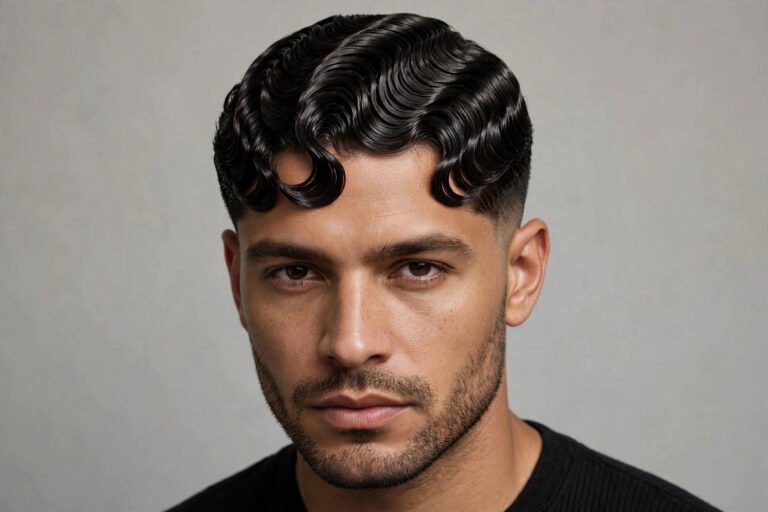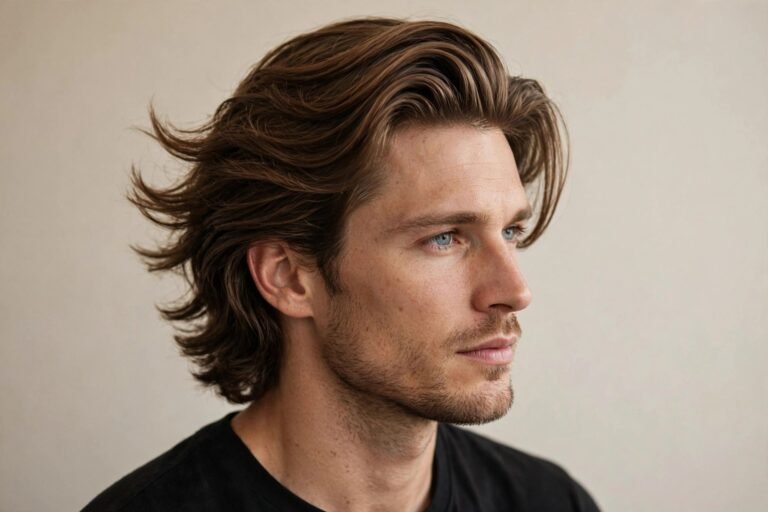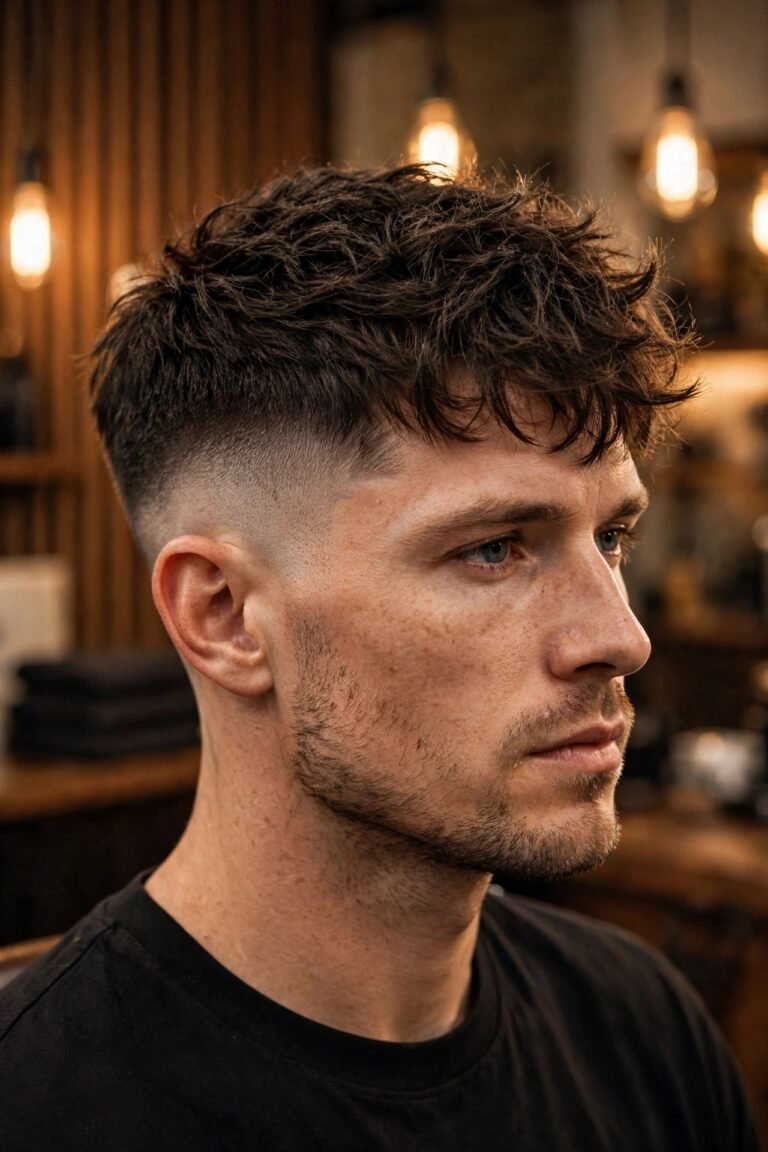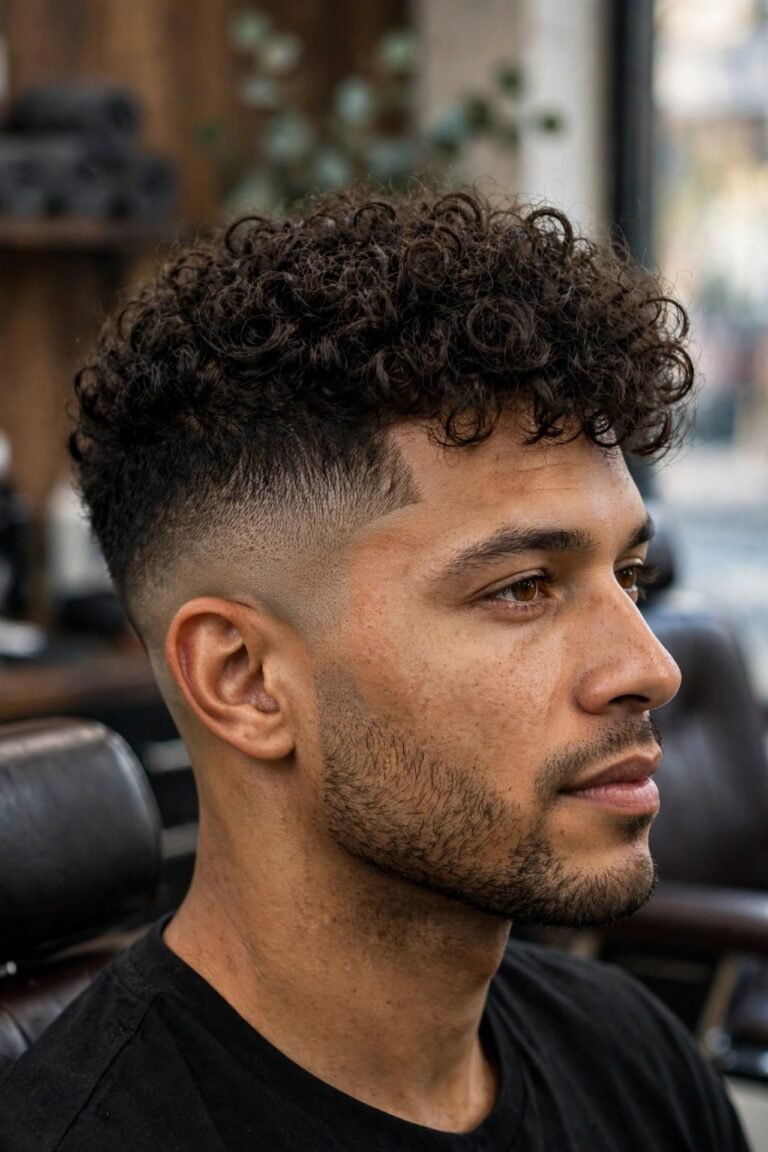
Edgar Cut Men 2026: 28 Sharp Styles, Variations & Honest Barber Advice
The Edgar Cut: Why This Blunt-Fringe Fade Owns 2026
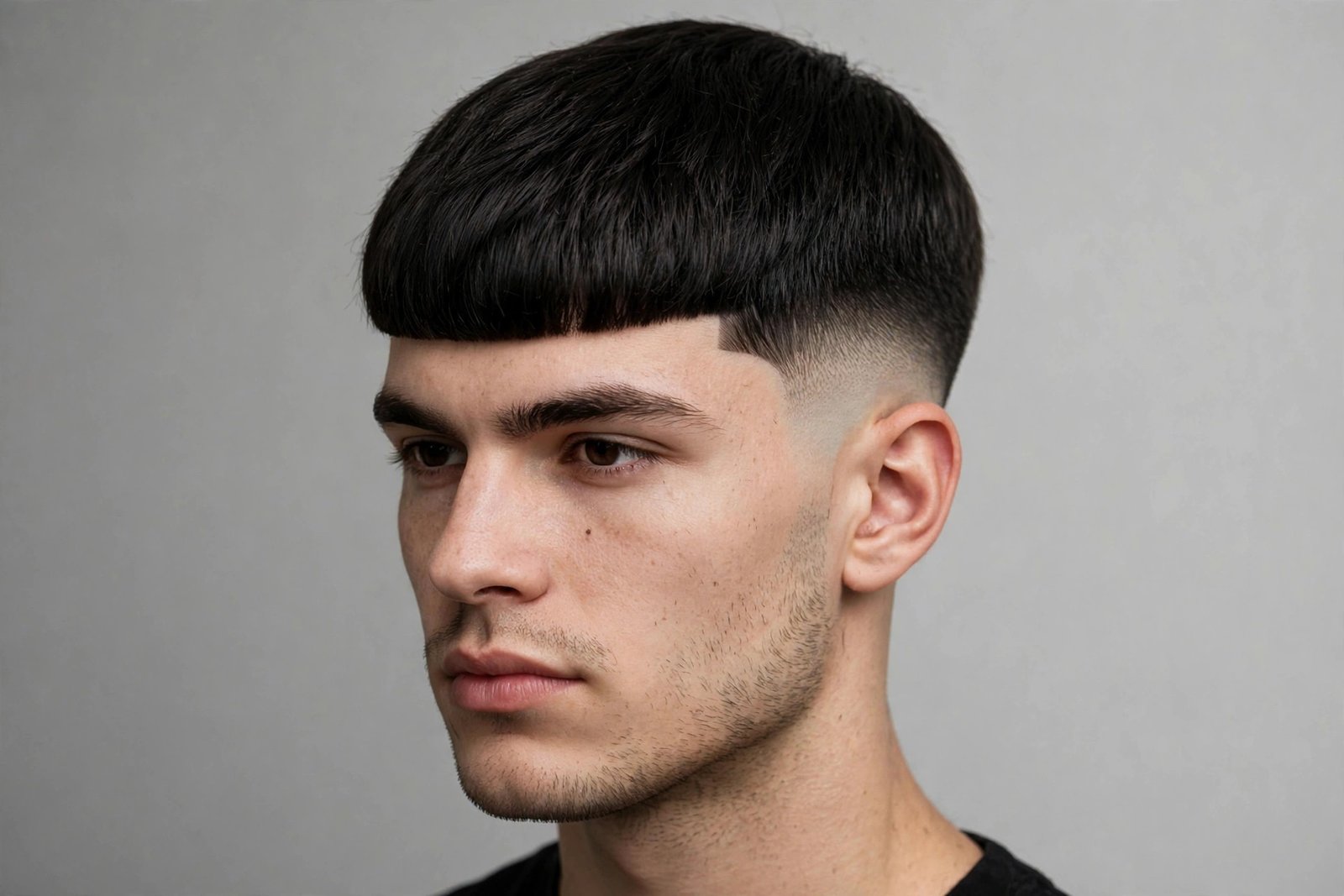
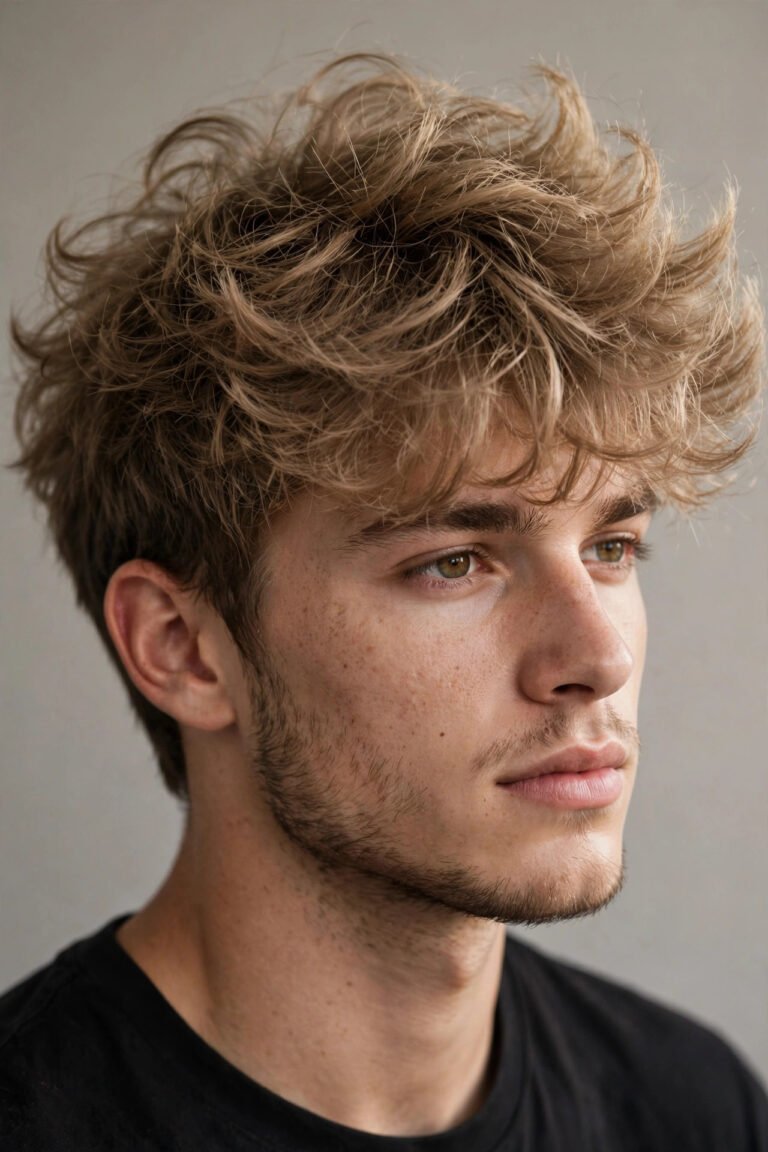
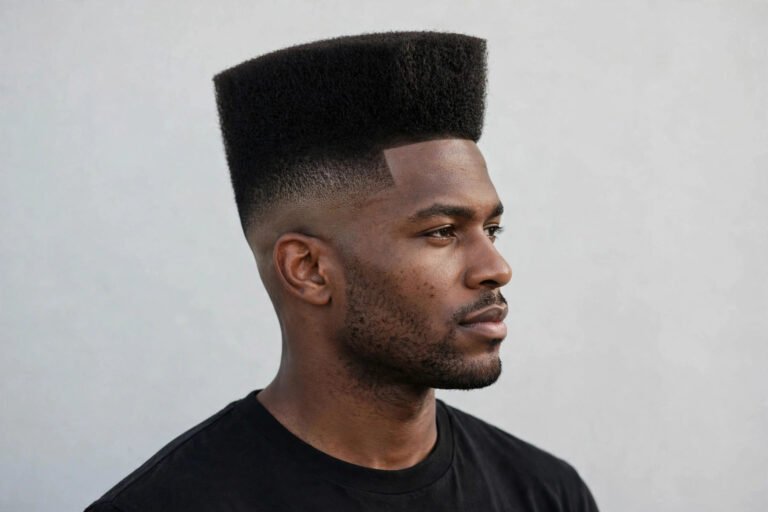
There are haircuts you notice, and then there are haircuts you can’t stop noticing. The Edgar cut men are wearing in 2026 belongs firmly in the second category. One glance and you know exactly what you’re looking at: that heavy, ruler-straight fringe sitting low across the forehead, the top full and forward, the sides melted down into a fade so clean it looks drawn on. It’s aggressive. It’s precise. It has the kind of silhouette that reads from across the street. And love it or hate it, nobody walks past an Edgar without forming an opinion.
I’ll be honest with you — when this cut first blew up, I thought it was a flash trend with a six-month shelf life. A bowl cut in a fade’s clothing, I told myself, destined for the same graveyard as every other viral haircut. I was wrong. The Edgar survived because it’s not actually one cut; it’s a whole family of cuts. The blunt fringe is the signature, sure, but what happens around it — the fade height, the texture, the length, the line-up — changes the entire personality. The version a college kid wears to a party and the version a guy wears to a creative agency job interview are technically the same haircut. They just don’t look like it.
What keeps the Edgar cut men keep choosing, year after year, is how it photographs. This is a cut built for the front camera. The straight fringe creates a hard horizontal line that frames the eyes, the fade gives the head shape definition, and the whole thing looks intentional in a way most haircuts don’t. Barbers won’t tell you this, but half the battle of a great haircut is whether it still looks deliberate in a mirror selfie — and the Edgar passes that test better than almost anything else on this site.
So this is the full breakdown: 28 distinct Edgar cut styles for 2026, from the classic single-guard version to fluffy grown-out takes, curly adaptations, fade variations, and hybrids I genuinely didn’t expect to like. Each one comes with who it suits, exactly what to tell your barber, how to style it at home, and the honest downsides nobody puts on Instagram. If you’re going to commit to the fringe, do it with your eyes open.
Table of Contents
- The Edgar Cut: Why This Blunt-Fringe Fade Owns 2026
- What Is the Edgar Cut, Really
- 28 Sharp Edgar Cut Styles for Men in 2026
- Edgar Cut Men: Styling Routine & Maintenance Guide
- Frequently Asked Questions
- Conclusion
What Is the Edgar Cut, Really
Strip away the memes and the Edgar cut men are obsessed with is beautifully simple: a short-to-medium top worn forward, a blunt fringe cut straight across the forehead, and faded or tapered sides. The fringe is the non-negotiable part. Everything else is negotiable. The top can be two inches or five. The sides can be a skin fade, a taper, even a scissor-cut taper for the cautious. The back can be faded high or kept soft. But that heavy horizontal fringe line across the forehead — that’s the Edgar. Remove it and you’re wearing a crop; keep it and you’re wearing the statement.
The cut’s roots run through the bowl cut, which is the comparison everyone makes and almost everyone gets slightly wrong. A bowl cut is one length all the way around, a helmet of hair with no transition. The Edgar takes that same forward-falling top and collides it with modern barbering: the fade on the sides, the crisp line-up, the deliberate texture. It’s the bowl cut after it learned discipline. The look picked up serious momentum in Latin American barbershop culture and among young Latino communities in the US before exploding globally on TikTok and Instagram, where its photogenic silhouette did the rest of the marketing.
The name itself is one of barbering’s best stories. It’s widely attributed to Edgar Martinez, the Seattle Mariners legend — fans getting his portrait or jersey number shaved into their heads, the look spreading, and the cut becoming “the Edgar” along the way. Is that etymology airtight? Barbers argue about it the way they argue about everything. But the story stuck, and in 2026 the name is as recognizable as the silhouette. Say “Edgar” in any barbershop on earth and the clippers practically reach for themselves.
Why the Edgar Cut Is Exploding in 2026
Three things happened at once. First, the fade got boring. After a decade of every guy on the block wearing some version of a mid fade with a textured top, the Edgar arrived with a completely different geometry — that hard horizontal fringe line was something nobody else was doing, and contrast is what trends are made of. Second, short-form video made it unstoppable. The Edgar is a haircut that reveals itself in one second: fringe, fade, done. It doesn’t need a 360-degree turn or good lighting to read. It reads in a thumbnail. In the attention economy, that’s a superpower.
Third — and this is the one people underestimate — the Edgar is genuinely low-skill to maintain compared to what it looks like. A pompadour that sharp takes fifteen minutes and a tutorial video. An Edgar takes a blow-dryer, a dab of clay, and five minutes. Guys discovered that the cut looks like high effort while demanding medium effort, and that ratio is irresistible. Barbers started recommending it to clients who wanted to look deliberate without becoming product people, and the cut spread from the chronically-online crowd to regular guys who just wanted to look sharp.
The 2026 version of the Edgar is also softer than the 2022 version, and that’s why it’s surviving. The early viral Edgars were severe: buzzed sides, fringe cut with a ruler, zero texture. What you’re seeing now is texture, movement, length on top, grown-out versions that look expensive rather than aggressive. The cut matured. It kept the signature and sanded down the edges, which is exactly what a trend has to do to become a staple. The Edgar cut men are getting in 2026 isn’t a meme anymore — it’s a menu.
Who the Edgar Cut Suits (and Who Should Think Twice)
Let’s do the honest version, because the dishonest version is “it suits everyone!” and that’s how you end up with a haircut you resent. The Edgar is kindest to oval and square faces. The straight fringe draws a line across the forehead that makes strong jawlines look stronger — it’s practically engineered for guys with defined bone structure. Heart-shaped faces get a good deal too, since the fringe fills out a wider forehead and balances a narrower chin. If that’s you, the Edgar is close to a cheat code.
Round faces can wear it, but the fringe needs managing: keep it slightly shorter and a touch narrower than the full wide version, and push the fade higher to create vertical lines that lengthen the face. Long, narrow faces go the other way — keep the fringe fuller and heavier, and don’t let the barber take the sides too high, or you’ll add height where you don’t need it. Hair type matters as much as face shape: thick, straight to wavy hair is the dream canvas. Very curly hair works beautifully with texture (there’s a whole section on it below). Thin or fine hair is the real caution zone — that heavy blunt fringe needs density, and I’ll say more about that in the FAQs.
And the lifestyle check, because nobody asks this and everybody should: the Edgar is a commitment to a fringe on your forehead every single day. If you play contact sports, work in a hard hat, or live in a humid climate without air conditioning, that fringe will test you. It’s also a loud haircut socially — people will comment, especially the first week. If you like blending in, this isn’t your cut. If you like walking into a room and having your hair do the talking before you open your mouth, welcome aboard.
28 Edgar Cut Men Styles for 2026: Sharp Variations & Honest Barber Advice
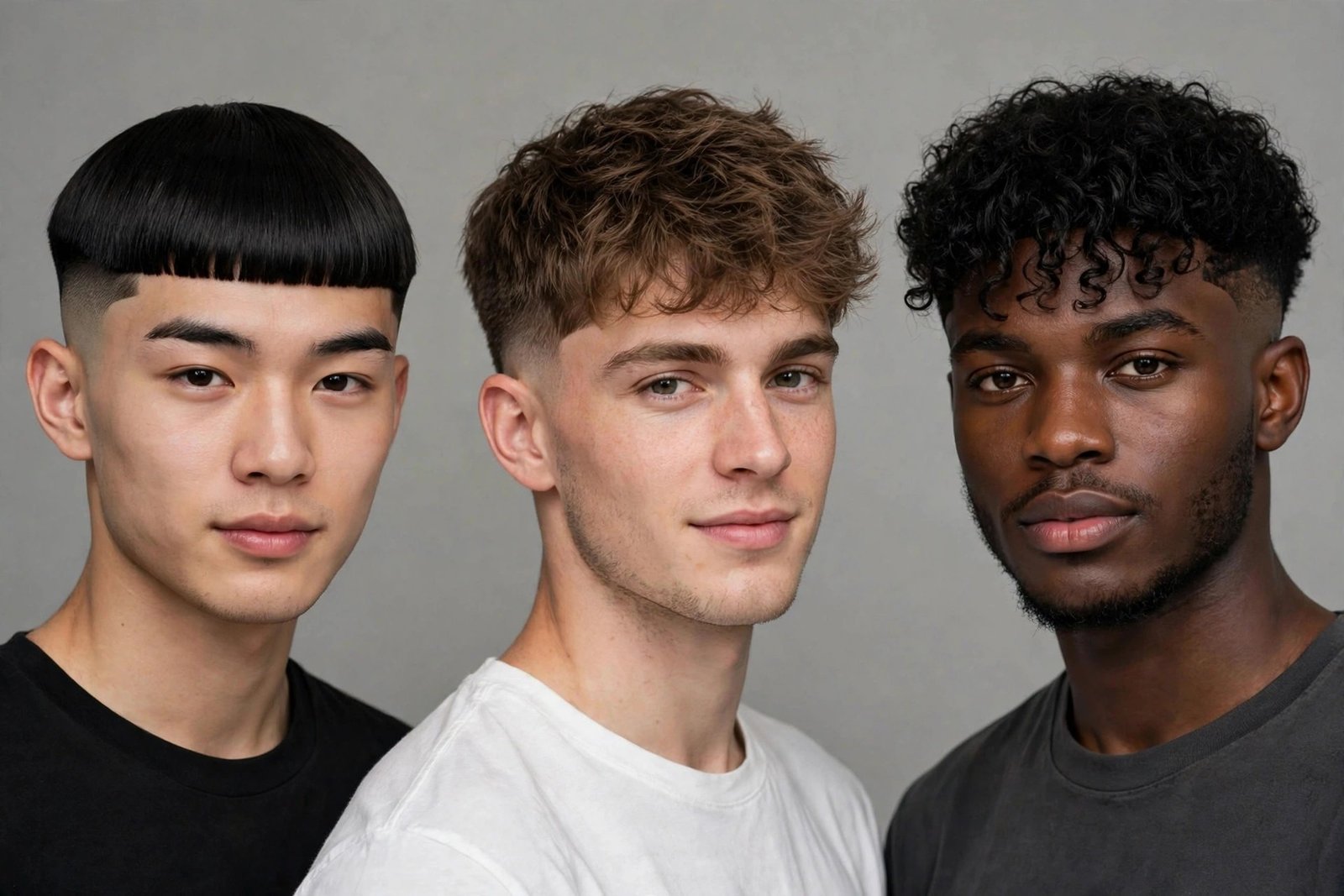
Here’s the full menu — 28 ways to wear the Edgar in 2026, from the textbook classic to versions your barber might not have a name for yet. For every style you get the look, who it flatters, the exact barber script, the home styling routine, and the downside nobody mentions. Find the one that matches your hair, your face, and the amount of effort you’ll honestly put in.
1. The Classic Single Guard 1 Edgar
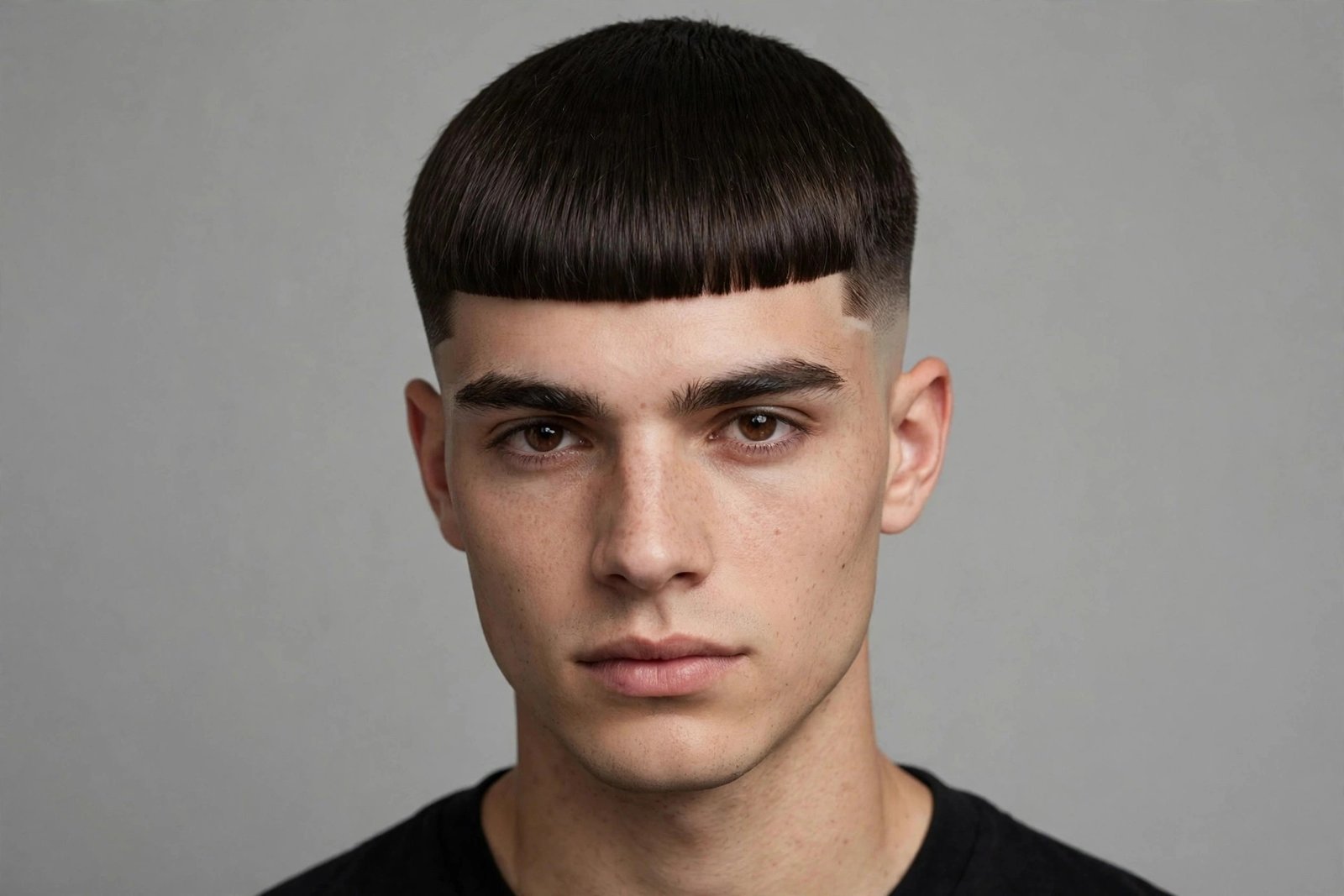
This is the one that started it all — the textbook Edgar, the cut every other version on this list is measured against. The top is kept at a uniform short-to-medium length and worn straight forward, the fringe is cut blunt and heavy across the forehead with zero apologies, and the sides go down to a single guard 1 fade that melts from the fringe line into skin. There’s no texture, no softness, no ambiguity. It’s geometry as a haircut, and when it’s fresh it looks like it was cut by a machine with opinions.
Who it suits: this is the Edgar for thick, straight hair and strong jawlines. The bluntness of the fringe demands density — every strand needs to show up — and the sharp contrast between the heavy top and the tight sides flatters oval and square faces best. If your hair is wavy, your barber can still pull it off, but you’ll be fighting the fringe every morning to keep that ruler-straight line. Curly guys should skip straight to the curly Edgar below instead of forcing this one.
The barber script: “Edgar, classic version. Keep the top full and forward, fringe blunt straight across, no texture. Sides single guard 1 fade, high, blended clean into the fringe line. Crisp line-up on the hairline and temples.” Bring a photo anyway — “classic” means different things in different shops, and one reference image eliminates the guesswork. Ask the barber to cut the fringe slightly longer than you think you want; it always looks shorter once it’s dry and sitting on the forehead.
Styling it at home is almost insultingly simple, which is part of the appeal. Towel-dry, blow-dry the fringe straight down with a vent brush, and press it flat with a pea-sized amount of matte clay. Done. The whole routine is under three minutes. Maintenance is where the classic Edgar asks for commitment: the line-up needs refreshing every 10 to 14 days to stay crisp, and the full cut every three weeks. Let it slide and it stops looking classic — it starts looking grown out. The honest downside: this version is the loudest on the list. It photographs beautifully and turns heads, but it’s also the version most likely to get a reaction from your grandmother. If you want the Edgar with the volume turned down, keep scrolling.
2. The Fluffy Edgar With Texture
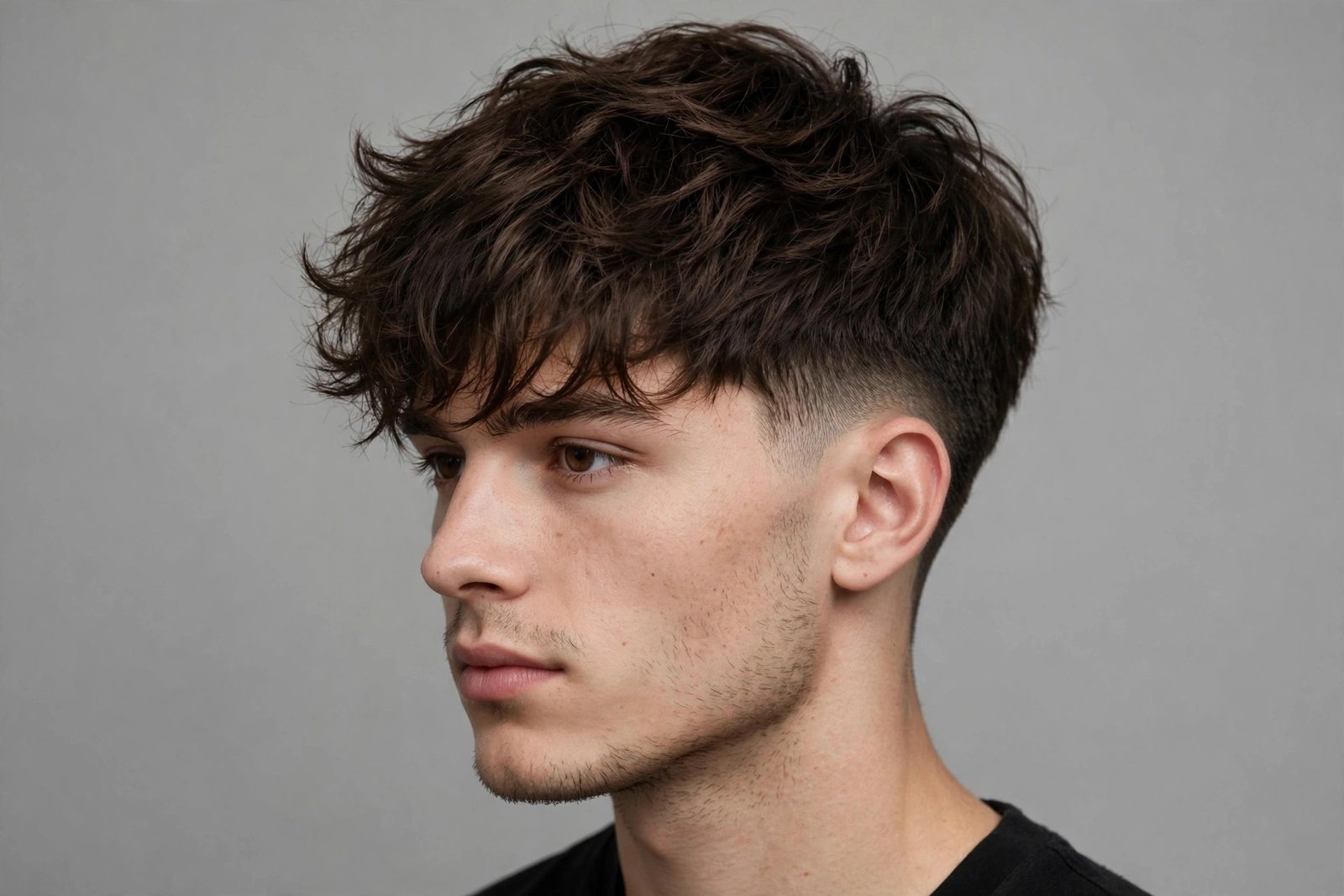
If the classic Edgar is a suit, the fluffy Edgar is the same guy in a really good jacket — same DNA, much more relaxed. The top is left longer, three to five inches, and the fringe gets point-cut and textured so it falls forward with movement instead of sitting like a shelf. The sides are still faded, but often a mid fade rather than a skin-tight high fade, which softens the whole silhouette. The result keeps the Edgar’s signature forward-falling fringe but trades severity for something that looks touchable, modern, and honestly more expensive.
Who it suits: this is the most forgiving Edgar on the list. The texture hides a multitude of sins — slightly wavy hair, a cowlick at the hairline, hair that’s not quite thick enough for the blunt version all behave better with length and movement. Round faces benefit from the added height on top, and guys who found the classic too aggressive usually land here. It’s also the best Edgar for anyone whose workplace has opinions about haircuts, because from a distance it reads as “stylish textured crop” rather than a statement.
The barber script: “Edgar, but fluffy — keep three to five inches on top, fringe forward with texture, point-cut the ends so it moves. Mid fade on the sides, not too high. I want the fringe line visible but soft.” The key word is texture. If your barber reaches for thinning shears and starts removing bulk from the fringe, stop them — thinning shears on an Edgar fringe create wispy ends that expose the forehead. Point cutting with regular shears is the move. Ask for the fade to be blended a touch softer than the classic; the contrast should feel like a gradient, not a cliff.
Home styling takes five minutes and a blow-dryer. Dry the top forward and slightly up at the roots for volume, then let the fringe fall naturally — a small amount of matte paste worked through the mid-lengths gives definition without stiffness. Sea salt spray on damp hair before drying adds the kind of lived-in texture that makes this version look intentional. Maintenance is gentler than the classic: four to five weeks between cuts works fine, and the grow-out phase actually looks good. The downside is the daily effort — skip the blow-dryer and the fluffy Edgar collapses into a flat, sad fringe. This version needs its five minutes. Pay them and it pays you back.
3. Edgar With Skin Fade Sides
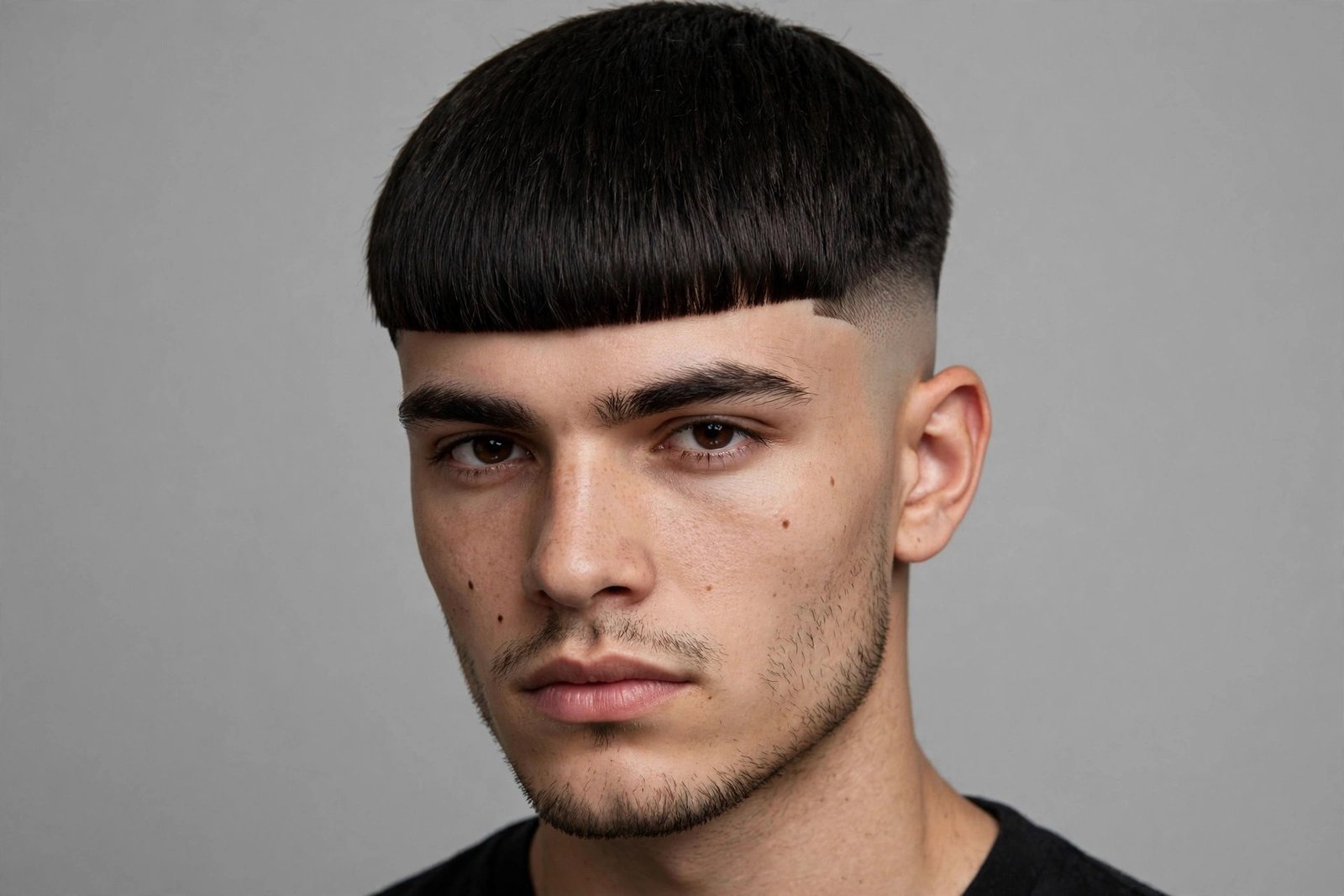
This is the contrast maximalist’s Edgar. Everything about the top stays the same — heavy fringe, full forward length — but the sides are taken all the way down to skin, bald at the bottom, fading up into the fringe line. The effect is dramatic: the head looks sculpted, the fringe looks heavier by comparison, and the whole cut has the kind of sharpness that makes people assume you have a standing weekly appointment. It’s the version you see in barbershop Instagram reels, usually shot in dramatic lighting, usually with a fresh line-up gleaming.
Who it suits: guys with thick, dark hair get the most out of this, because the skin fade against dense dark hair creates maximum visual contrast — the fade practically glows. It flatters oval, square, and diamond faces, and it’s particularly good on guys with strong temples and hairlines, since the skin fade puts the hairline on full display. Fair warning for lighter or thinner hair: a skin fade on fine blonde hair can look washed out rather than sharp, because there’s less contrast to work with. And if your scalp has scars, moles, or discoloration you’re self-conscious about, the skin fade will showcase them.
The barber script: “Edgar with a skin fade — bald on the sides up to about here” (point to where you want the fade to start, usually just above the ear), “blend it up into the top, keep the fringe heavy and blunt.” Specify whether you want the fade high, mid, or low — high is the classic pairing, but a mid skin fade is slightly more wearable. Ask for the transition to be seamless; a skin fade with a visible line where the clippers stopped looks cheap, and the whole point of this version is that it looks expensive. A straight razor finish on the hairline and neckline completes it.
At home, the top styling is standard Edgar protocol: blow-dry forward, matte product, done. The sides need nothing — that’s the beauty of a skin fade, there’s nothing to style. But the maintenance schedule is the most demanding on this list. A skin fade shows growth in days, not weeks. To keep it looking like the photos, you’re looking at a line-up every week and a full cut every two to three weeks. Some guys learn to touch up the neckline themselves with clippers; most just make friends with their barber’s booking app. The honest downside is cost and time — this is a high-maintenance relationship disguised as a simple haircut. Gorgeous, but it owns your calendar.
4. The Taper Edgar
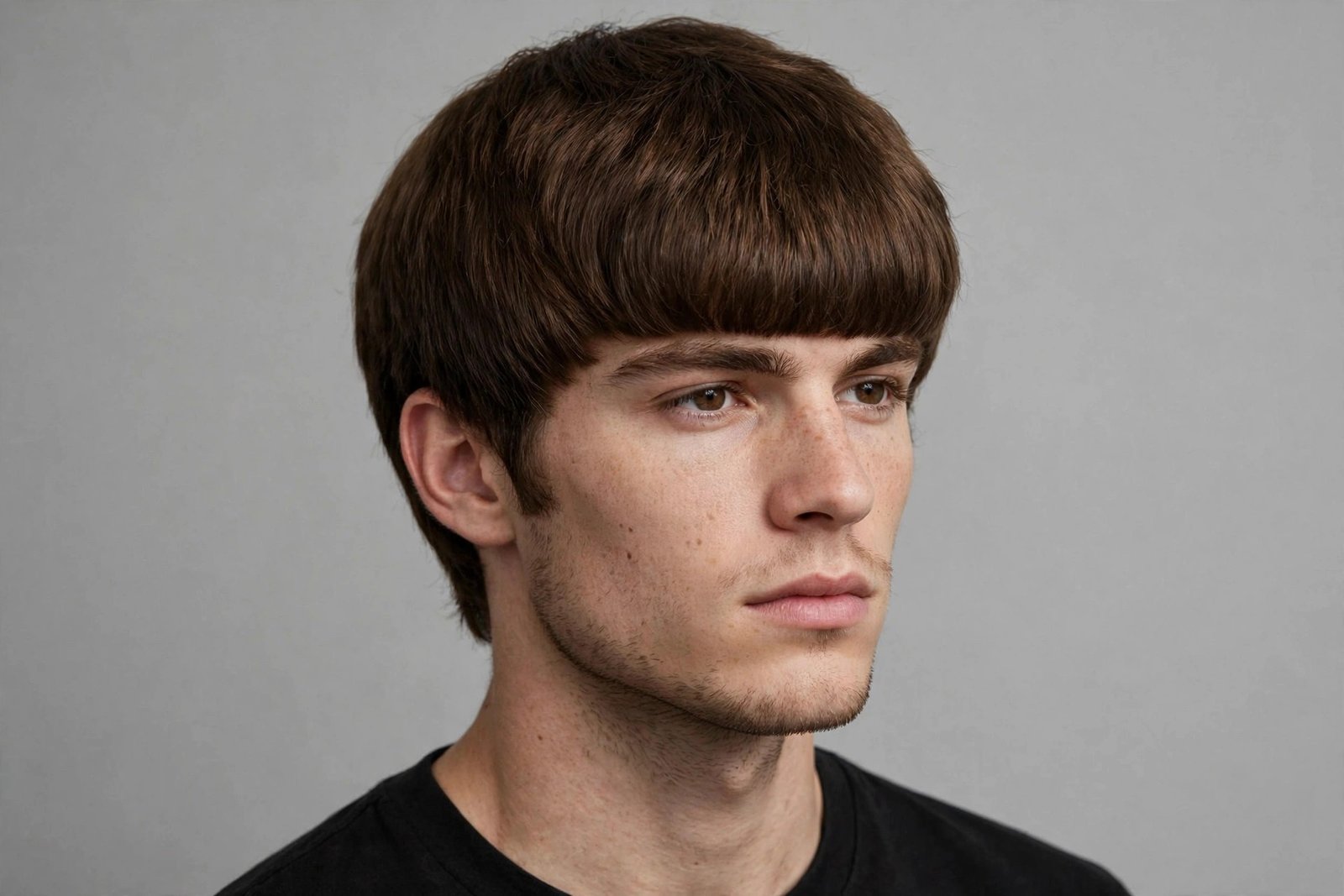
The taper Edgar is the diplomat of the family — all the Edgar attitude on top, none of the aggression on the sides. Instead of a fade that melts to skin, the sides and back are tapered: gradually shortened with scissors and clippers, keeping a natural hairline at the nape and around the ears. The fringe stays heavy and forward, the top stays full, but the perimeter of the cut looks grown-in and natural rather than carved. It’s the Edgar you wear to meet your partner’s parents, to a job interview, to any room where a skin fade would start a conversation you don’t want to have.
Who it suits: this is the entry-level Edgar, and I mean that as a compliment. If you’re Edgar-curious but not ready for the full commitment, start here. It suits virtually every face shape because the softer sides don’t add visual harshness, and it works on hair that’s too fine for the high-contrast versions. Older guys — and by older I mean anyone past the age where a skin fade feels like a costume — find this version dignified without being boring. It’s also the smart pick for wavy or unruly hair, since the taper gives the sides some weight to behave.
The barber script: “Edgar on top — heavy fringe forward — but taper the sides instead of fading. Keep it natural around the ears and the neckline, scissor work, no skin.” Be explicit about the word taper, because many barbers will default to a fade if you just say “short on the sides.” Ask them to keep enough length on the sides that it looks like hair, not stubble — the taper should read as a haircut, not as a fade that chickened out. The fringe can be as blunt or as textured as you like; the taper pairs well with either.
Home styling is the standard five-minute Edgar routine, and the grow-out is the most graceful of any version here — a taper grows out looking like a slightly longer haircut, not like a mistake. You can stretch cuts to five or six weeks comfortably. The downside? It’s the least dramatic Edgar. If you wanted the head-turning, jaw-dropping version, the taper will feel like a compromise — because it is one, a deliberate and smart one, but a compromise. It also doesn’t photograph with the same punch as the high-contrast versions. Know what you’re trading and you’ll love it; expect fireworks and you’ll be underwhelmed.
5. Edgar With Curly Top
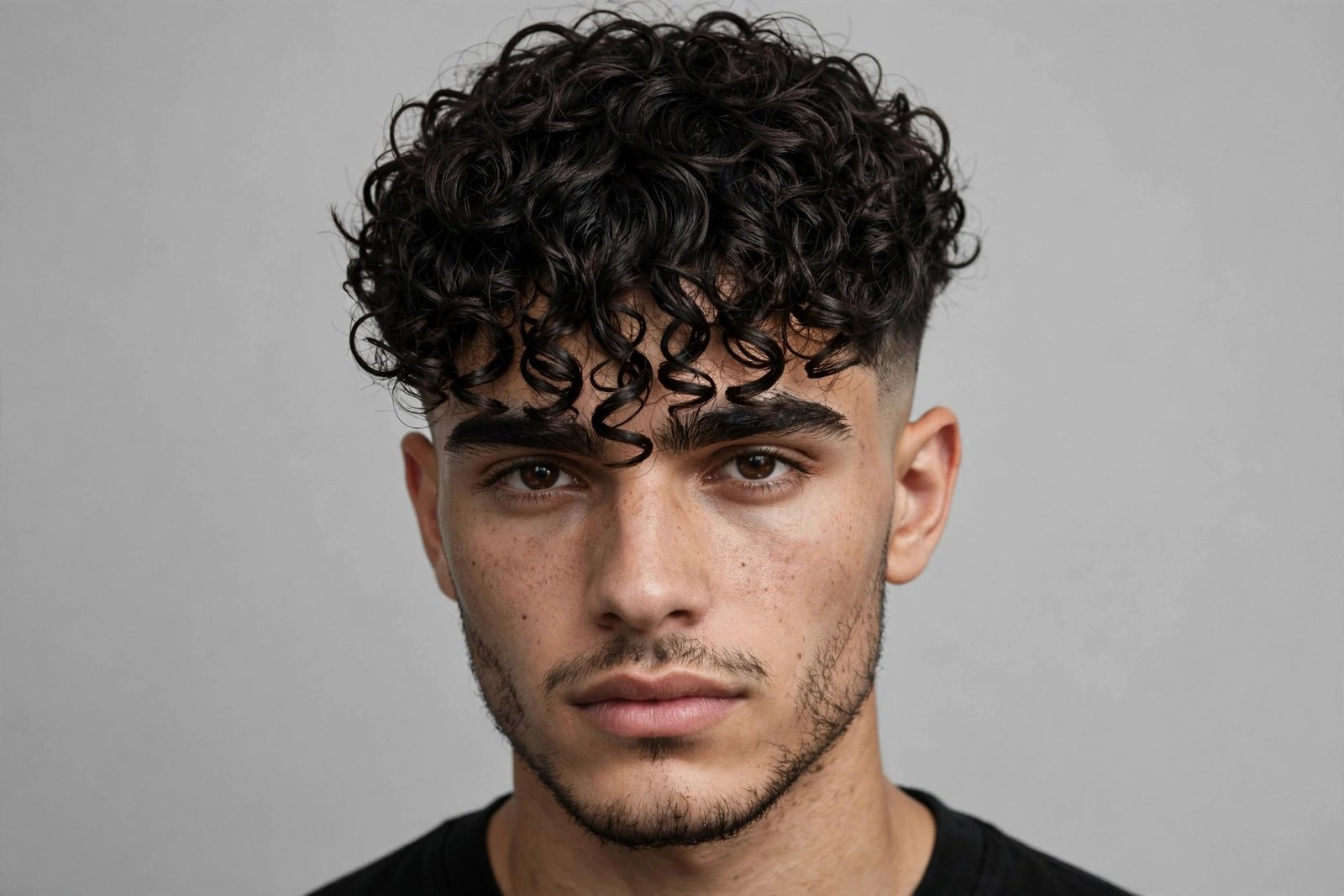
Now we’re talking. The curly Edgar takes the cut’s signature — fringe falling over the forehead — and lets curls do what curls do best: create volume, texture, and movement that straight hair can only dream of. The fringe isn’t a flat shelf here; it’s a cascade of curls and coils sitting low on the forehead, with the sides faded tight to keep the silhouette clean. Done right, it’s the most distinctive version of the Edgar — nobody else’s looks quite like yours, because nobody else has your curl pattern.
Who it suits: anyone with natural curls, coils, or tight waves who’s tired of cuts that fight their texture. The Edgar is one of the rare statement cuts that works with curls instead of against them. Face-shape rules still apply — oval and square faces are the sweet spot — but the volume of the curls gives round faces some helpful height too. The one requirement is length: you need enough curl on top to fall forward over the forehead, which usually means growing the top out for a few months if you’re starting from short. Patience is part of the process.
The barber script: “Edgar, but keep my curls — I want the fringe falling forward over the forehead, faded tight on the sides.” The critical instruction: the fringe must be cut dry or with the curls in their natural state, because curly hair shrinks dramatically when it dries. A barber who cuts your curls wet to forehead length will hand you a fringe that springs up to mid-forehead when dry, and you’ll both be sad. Ask for the curls to be shaped and textured rather than blunt-cut — a blunt line on curls looks chunky and unnatural. Find a barber who’s comfortable with curly hair; this is non-negotiable.
Home styling is about definition, not control. Apply curl cream or light leave-in conditioner to damp hair, scrunch the fringe forward, and either diffuse or air-dry — skip the blow-dryer brush routine, which just creates frizz on curls. A tiny amount of light hold product keeps the fringe in place without crunch. Refresh curls on day two with a water spray rather than re-washing. The downside is unpredictability: humidity, sleep, and weather all have opinions about your fringe, and some mornings it will do what it wants. Curly Edgar wearers learn to love the chaos. If you need your hair to look identical every day, this isn’t your version — but if you can embrace some beautiful variance, it’s unbeatable.
6. The Wavy Edgar
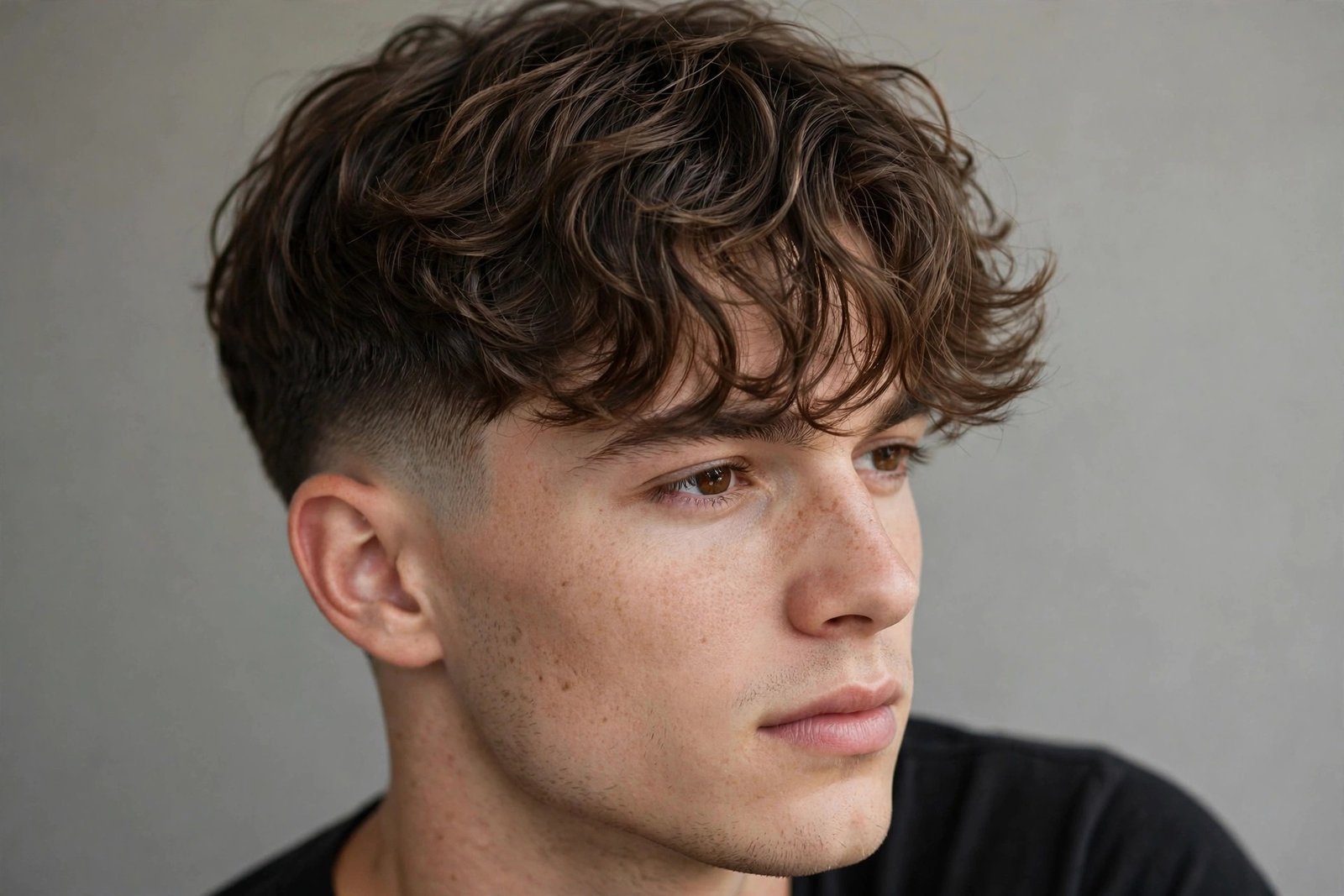
The wavy Edgar sits in the sweet spot between the sharp classic and the wild curly version. Natural waves give the fringe movement and a slightly tousled edge — the line across the forehead is still there, still unmistakably Edgar, but it bends and flows instead of sitting flat. The sides are faded clean, the top falls forward, and the whole thing has an effortless quality that the blunter versions can’t fake. It’s the version that looks like you woke up cool, even on the mornings you definitely didn’t.
Who it suits: guys with natural wave — the 2A to 2C crowd — who’ve been fighting their texture into submission for years. Stop fighting it; the wavy Edgar weaponizes it. It suits most face shapes, and the wave’s natural volume is kind to both round faces (height) and long faces (width at the fringe). It’s also a strong pick for medium-density hair, because waves create the illusion of fullness that straight fine hair can’t. If your waves are inconsistent — straight at the roots, wavy at the ends — your barber can work with that; the fringe area is where it matters most.
The barber script: “Edgar with my natural wave — keep the length on top, fringe forward, and don’t cut the wave out of it. I want the fringe line soft with movement. Fade on the sides, mid to high.” Ask the barber to cut the fringe with the wave pattern in mind, slightly longer than a straight-hair version, because waves eat length. Point cutting the ends enhances the natural separation. And tell them how you actually wear it — if you air-dry, say so, because a cut designed for blow-dried styling behaves differently on air-dried waves.
Home styling: sea salt spray is this version’s best friend. Spray on damp hair, scrunch the fringe forward, and let it air-dry or diffuse — the goal is enhanced natural wave, not manufactured texture. A pea of matte cream defines the ends without weighing them down. On good hair days this takes three minutes; on rebellious days, a quick pass with the blow-dryer tames the fringe into submission. Maintenance runs four to five weeks between cuts. The honest downside: wavy hair has moods, and the fringe will occasionally flip outward or part itself in ways you didn’t authorize. A bad wave day on an Edgar is more visible than on most cuts, because the fringe is the whole show. Keep a little product in your bag and you’ll survive.
7. Edgar With Mid Fade
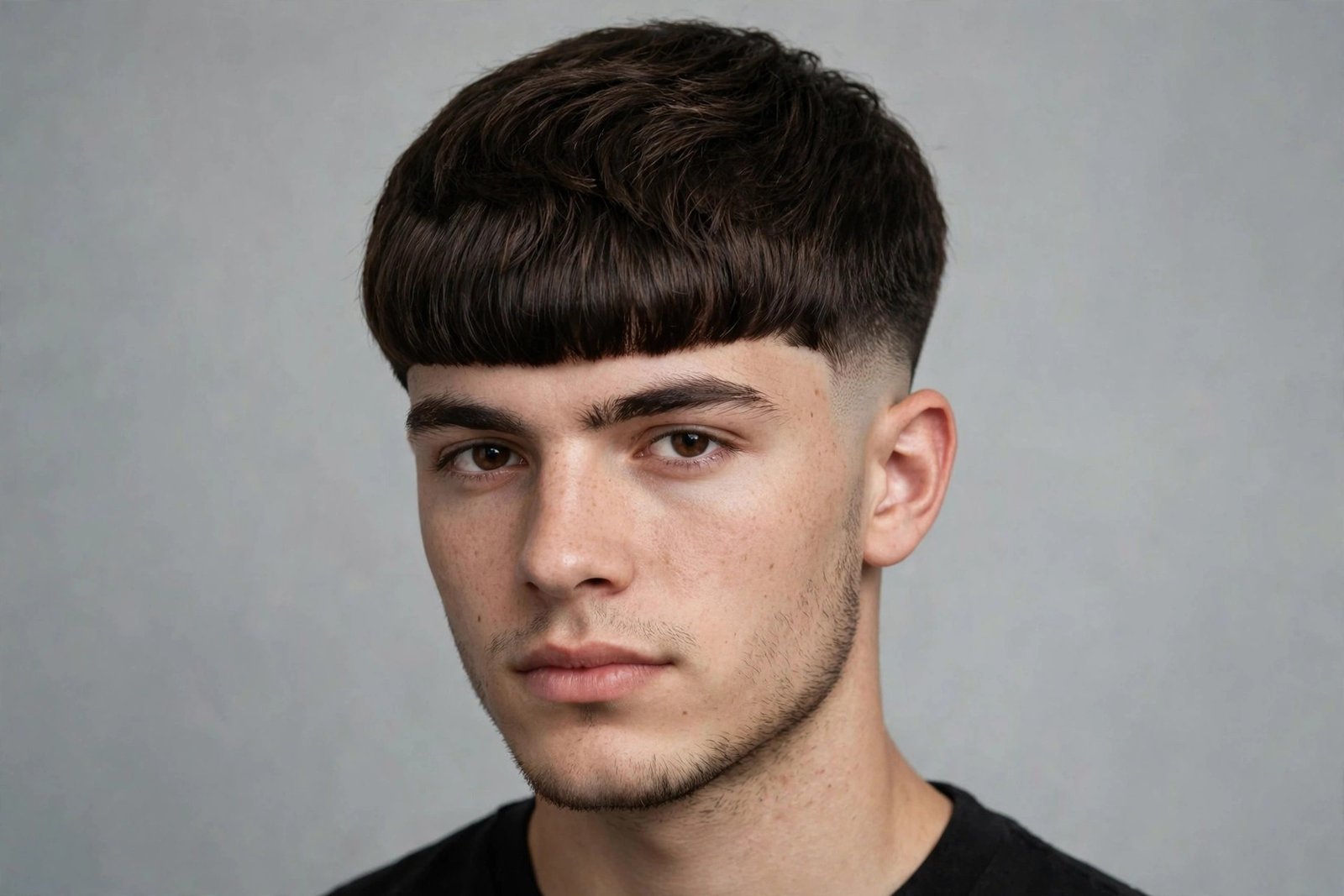
The mid fade Edgar is the Goldilocks of the high-contrast family — not as severe as the high skin fade, not as soft as the taper, sitting right in the balanced middle. The fade starts around the temple, blending down through the midsection of the sides, which keeps the head shape looking proportionate while still delivering that sharp Edgar contrast. The fringe stays heavy and forward. It’s the version barbers recommend most often, because it flatters the widest range of head shapes and it’s the hardest to get wrong.
Who it suits: almost everyone, honestly. The mid fade doesn’t exaggerate head shape the way a high fade can — high fades can make long heads look longer and round heads look rounder, while the mid fade just… behaves. It’s particularly good for guys trying the Edgar for the first time, because if you hate it, the grow-out is manageable, and if you love it, you can go higher next time. All hair types work here, though thick straight hair shows off the blend best.
The barber script: “Edgar, mid fade on the sides — start the fade around the temple, blend it clean, keep the top full with the fringe forward and blunt.” That’s genuinely the whole conversation, plus a photo. The one detail worth specifying: how tight you want the bottom of the fade. A mid fade can go down to skin at the bottom or stop at a short guard — skin at the bottom looks sharper, a guarded bottom grows out more gracefully. Pick your priority. Ask for the blend to be seamless through the parietal ridge (the corner where the top meets the sides); that’s where cheap fades show their seams.
Home styling follows the standard Edgar routine — forward, dry, matte product — and maintenance is the reasonable middle ground: line-up every two weeks, full cut every three to four. The grow-out doesn’t punish you the way a skin fade does. The downside is more philosophical than practical: the mid fade Edgar is the safe choice, and safe choices don’t turn heads the way the extreme versions do. It’s handsome, balanced, and correct — and if you’re the kind of guy who wants his haircut to start conversations, you might find it slightly too well-behaved. For everyone else, it’s close to perfect.
8. The Long Fringe Edgar
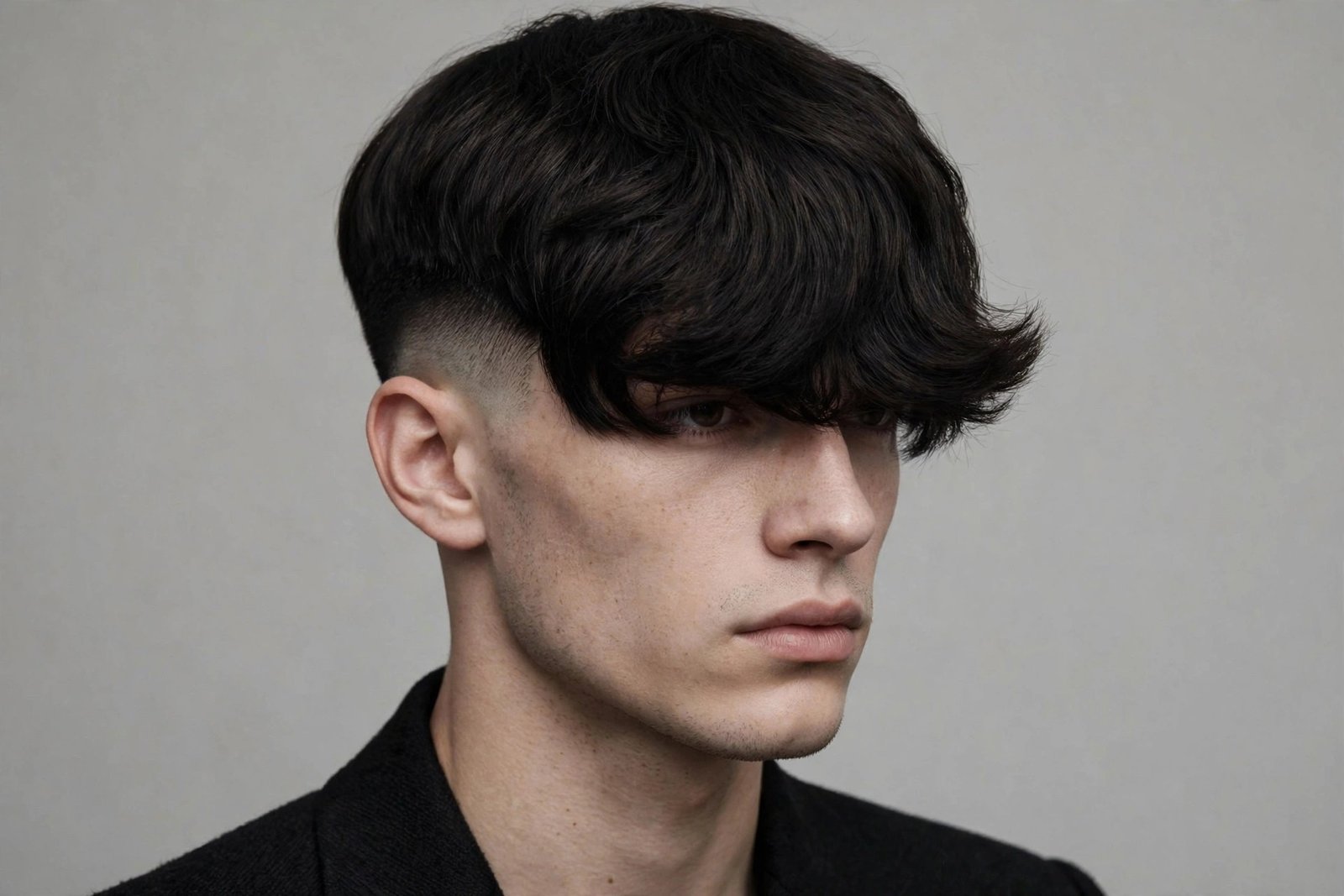
The long fringe Edgar takes the cut’s signature feature and turns the volume all the way up. Instead of the fringe sitting just at or above the eyebrows, it drapes lower — brushing the eyelids, sometimes grazing the cheekbones at the corners — creating a dramatic curtain of hair that moves when you move. The sides stay faded tight for contrast, and the effect is part high-fashion editorial, part rock star, entirely committed. This is not a haircut for the hesitant. It’s for the guy who wants the fringe to be the first thing anyone notices and the last thing they forget.
Who it suits: this version loves thick, straight hair — you need real density for a long fringe to look lush rather than stringy. It flatters longer faces beautifully, because the low fringe shortens the forehead visually, and it gives oval faces a striking, model-like quality. Round faces should approach with care: a very long, wide fringe can emphasize width, so keep it slightly narrower. The lifestyle question is real here — a fringe at eyelid level will get in your way. If you can’t handle hair touching your face, you’ll last about three days.
The barber script: “Edgar, but keep the fringe long — I want it sitting at the eyelids, heavy, falling straight forward. Fade the sides high and tight.” Specify the exact fringe length by pointing at your own forehead; “long” is subjective and you don’t want to discover the difference after the scissors stop. Ask the barber to keep weight in the fringe — no thinning, minimal layering — because a long fringe needs density to drape properly. The corners of the fringe can be left slightly longer to frame the eyes, which is where the editorial drama comes from.
Home styling needs a bit more intention than the shorter versions. Blow-dry the fringe forward and down with tension — a paddle brush or vent brush works — and use a light-hold product to keep it in place without stiffness. Too much product and a long fringe goes stringy; too little and it won’t behave. You’ll be pushing it back unconsciously all day at first; that’s normal and it settles. Maintenance: the fringe needs trimming every three weeks to hold its length, or it crosses from dramatic into “can’t see.” The honest downside is the daily negotiation with your own face — eating, wind, workouts, all of it involves the fringe. Guys who love this version describe the fringe as a feature, not a bug. Make sure you’re one of them before you commit.
9. Edgar With Textured Fringe
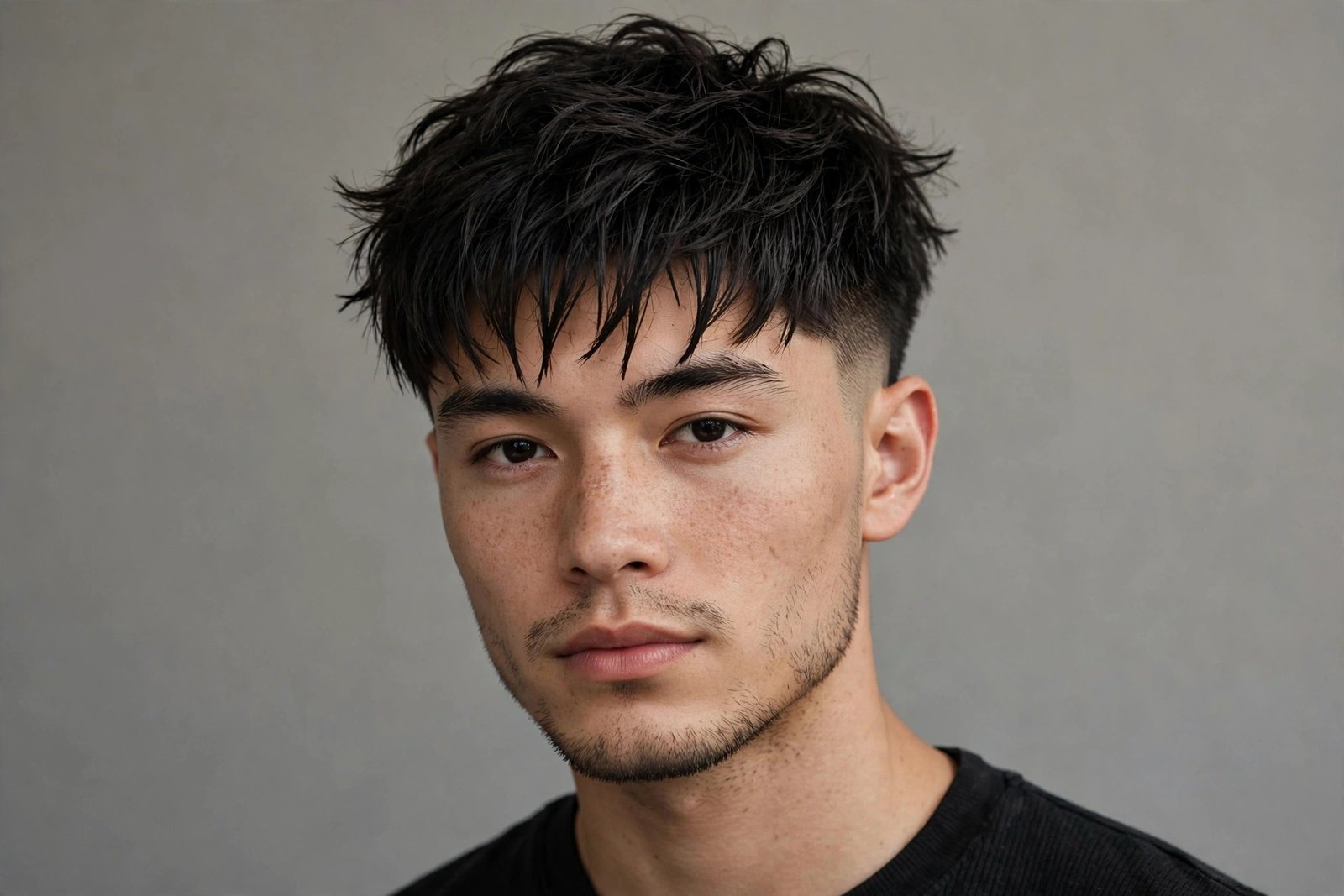
The textured fringe Edgar is what happens when the classic grows up and gets a personality. The fringe still falls forward and still reads unmistakably as Edgar, but instead of a single blunt line, the ends are point-cut, sliced, and separated into piece-y texture. It catches light differently, moves differently, and photographs with a kind of dimensional richness the flat versions can’t match. In 2026, this is arguably the definitive Edgar — the version that shows up most in barbershop portfolios and on guys who clearly have a barber they trust.
Who it suits: this is the great democratizer. Texture makes the Edgar work on hair types the classic rejects — slightly wavy hair, medium-density hair, hair with a stubborn cowlick at the hairline all behave better when the fringe is piece-y rather than blunt. It suits every face shape on the list, and it’s the version I recommend most to first-timers, because it looks intentional even on day one and it forgives styling mistakes. If your fringe flips a little or sits unevenly, texture makes it look like a choice.
The barber script: “Edgar with a textured fringe — keep it forward and heavy, but point-cut and slice the ends so it has movement. I don’t want a blunt line.” Watch the technique: point cutting (snipping into the ends vertically) and slicing (sliding the shears through sections) are the right tools; thinning shears are the wrong one and will give you wispy, see-through ends. Ask for the texture concentrated in the last inch of the fringe — the body of the fringe should stay full, with the piece-y-ness living at the ends. Pair it with whatever fade height you like; texture plays well with all of them.
Home styling is where this version shines. Work a small amount of matte paste or clay through dry fringe, pinching sections to enhance the separation — the whole thing takes two minutes and looks deliberately styled. Sea salt spray on damp hair before drying adds grit and separation for free. It air-dries better than any other Edgar version, which makes it the lowest-effort option on this list for guys who hate the blow-dryer. Maintenance runs four weeks comfortably. The downside is subtle: textured fringes can look messy rather than textured if the cut grows out too long, and the line between “piece-y” and “unkempt” is about ten days. Keep your appointments and it’s flawless.
10. The Bowl Edgar Throwback
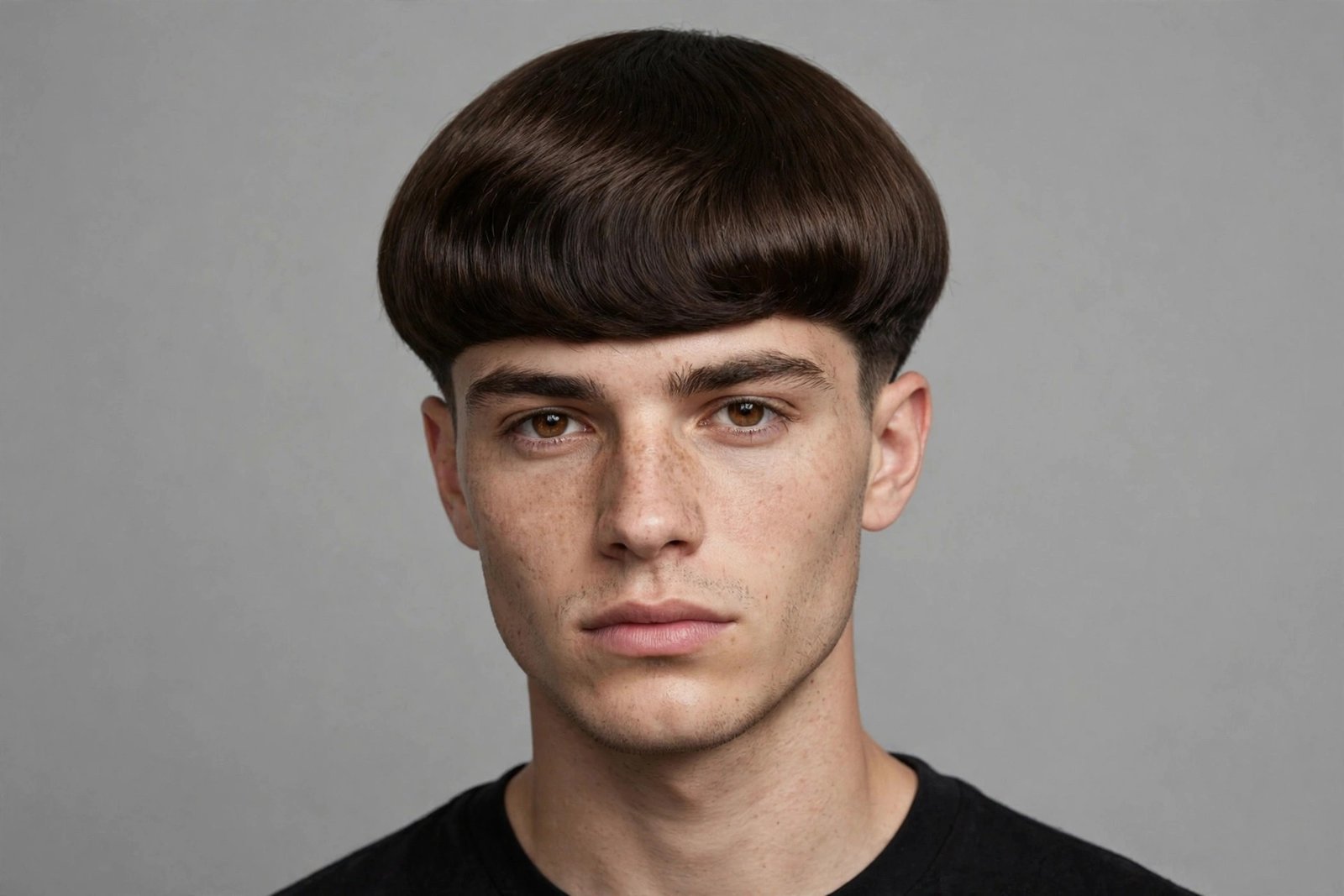
Every Edgar is a little bit bowl cut, but the throwback leans into it on purpose. This version keeps the rounded, helmet-like silhouette of the classic bowl — the top and fringe form one continuous curved mass — and then applies just enough modern barbering (a low taper on the sides, a cleaned-up neckline, a sharper fringe line) to keep it from looking like a childhood photo. It’s nostalgic without being costume, retro without being ironic. And in 2026, with Y2K and 90s references cycling back through fashion, it feels weirdly current.
Who it suits: guys with thick, straight hair and a sense of humor about their own head. The rounded silhouette flatters square and oval faces, and it does something lovely for prominent foreheads — the continuous curve minimizes rather than emphasizes. It needs confidence more than any face shape, though, because people will say “bowl cut” and you need to be the kind of person who smiles and says “exactly.” It’s also a surprisingly good pick for younger guys; the throwback reads playful rather than severe.
The barber script: “I want the Edgar with a bowl influence — keep the top rounded and continuous, fringe heavy all the way around the front, and just taper the sides low to keep it modern. Don’t fade it high; I want the bowl silhouette.” The key is restraint on the sides: a low taper or even just a scissor cleanup preserves the rounded mass, while a high fade would break the silhouette and turn it back into a standard Edgar. Ask the barber to cut the fringe in a slight curve following the forehead rather than a dead-straight line — that curve is what separates throwback from classic.
Styling is minimal: blow-dry forward following the round shape, a touch of light product for control, and let the silhouette do the work. It grows out into a genuinely cool longer shape, so maintenance is relaxed at five to six weeks. The honest downside is the meme factor — this is the version most likely to get bowl-cut jokes, and the line between “fashion throwback” and “mom cut my hair in 1997” is thinner than anyone admits. It also doesn’t suit professional environments as easily as the subtler versions. Wear it with conviction or don’t wear it at all.
11. Edgar With Low Fade
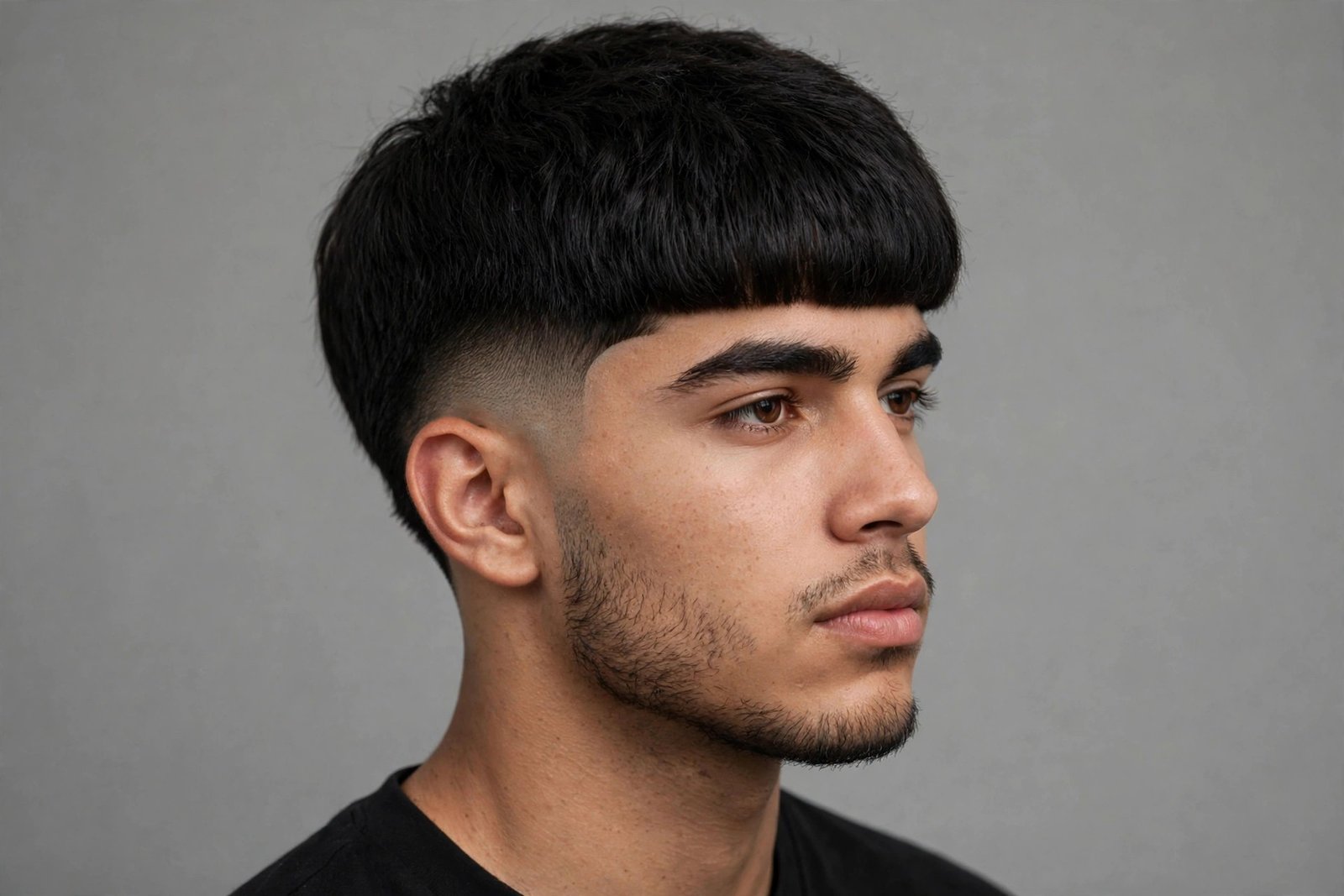
The low fade Edgar keeps the drama on top and the subtlety on the sides. The fade starts low — just above the ear — and blends down, leaving most of the side hair at a respectable length while the fringe and top carry the full Edgar identity. It’s the thinking man’s Edgar: all the signature, none of the shouting. From the front it’s unmistakable; from the side it’s just a clean, well-executed haircut. That duality is exactly why guys who need to look sharp in multiple contexts keep choosing it.
Who it suits: professionals, students, anyone whose life includes rooms where a high skin fade would raise eyebrows. The low fade is kind to longer head shapes (it doesn’t add the vertical emphasis of a high fade) and it works beautifully on thick hair, where the weight on the sides balances the heavy fringe. It’s also the most forgiving fade for grow-out — a low fade growing out just looks like slightly longer hair, not like a haircut falling apart. If maintenance discipline isn’t your strong suit, this version forgives.
The barber script: “Edgar on top, full fringe forward, but keep the fade low — start it just above the ear and blend down. I want clean sides without the high contrast.” Specify the bottom guard or whether you want skin at the very bottom; a low fade to skin still looks sharp while growing out gracefully. Ask the barber to keep the transition smooth through the temple area — low fades can look abrupt if the blend is rushed, and the whole point of this version is polish. The fringe can be blunt or textured; the low fade pairs happily with either.
Home styling is standard Edgar protocol, and honestly the sides need nothing. Maintenance is the easiest of the faded versions: four to five weeks between cuts, line-ups optional rather than mandatory. The downside is impact — or the relative lack of it. The low fade Edgar is handsome and correct and will never embarrass you, but it won’t stop traffic either. It’s the version you get when you want the Edgar’s identity without its volume. For a lot of guys that’s exactly right. Just don’t expect strangers to ask about your haircut.
12. The Choppy Edgar
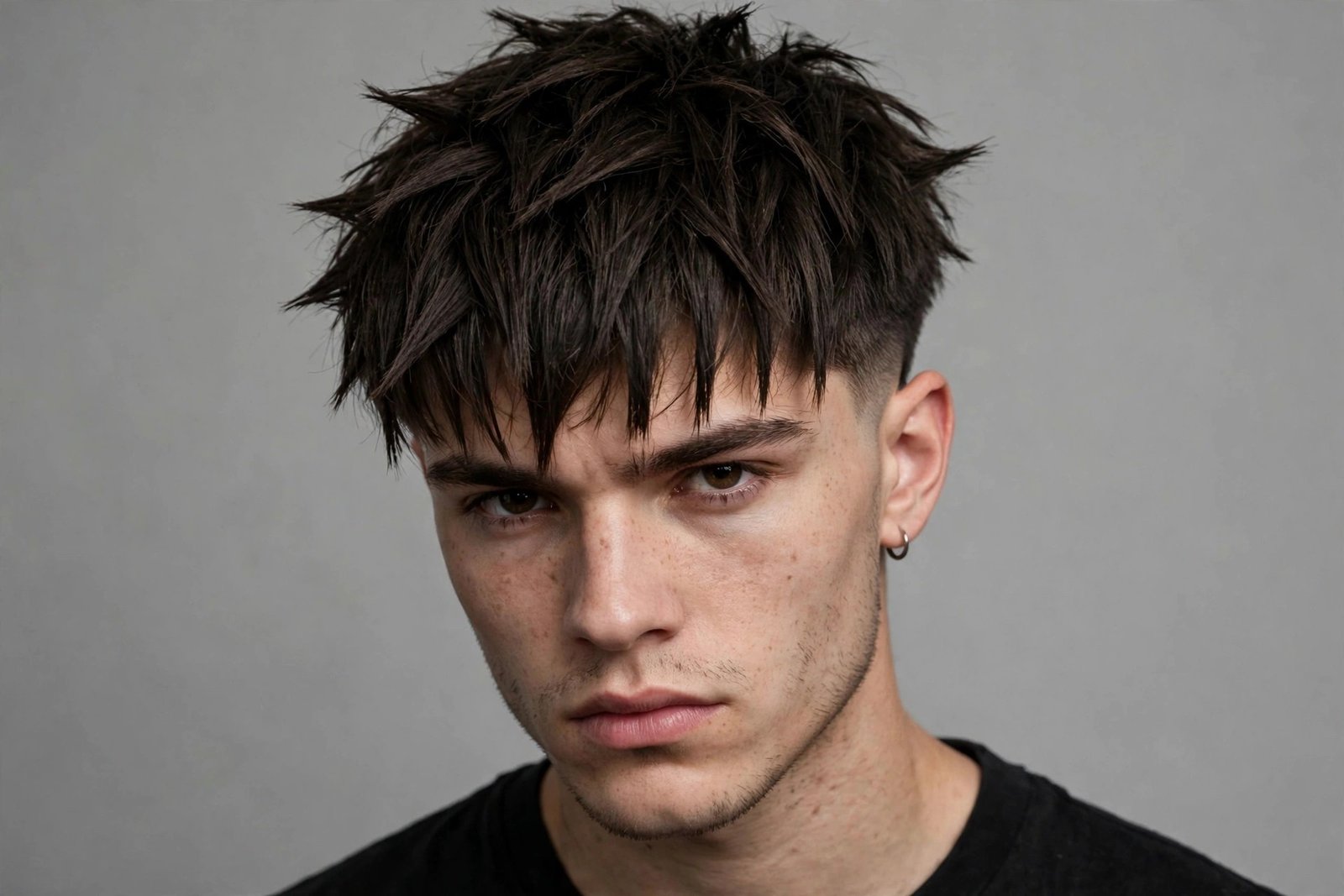
The choppy Edgar is texture turned up past eleven. The fringe is cut with aggressive, visible separation — chunky pieces, varied lengths, ends that look almost jagged — creating a fringe with real attitude and dimension. The top gets the same treatment, all piece-y layers falling forward, while the sides stay faded clean to frame the chaos. It’s the Edgar for guys who found the textured version too polite. There’s nothing polite about this one. It looks like the haircut equivalent of a leather jacket.
Who it suits: thick hair is almost mandatory — choppy cutting on thin hair just looks thin, and there’s nowhere to hide. It loves straight to wavy textures; the chops enhance natural separation. Face-wise it’s versatile, though the added texture width at the fringe slightly widens, so very round faces should keep the chops narrower. Age-wise it skews young and creative — musicians, designers, guys in industries where a haircut can have opinions. It’s also fantastic for hiding a high hairline, because the varied fringe lengths break up the forehead line completely.
The barber script: “Edgar, but chop it up — I want aggressive texture in the fringe, chunky pieces, varied lengths. Razor or deep point cutting, not thinning shears.” The technique matters enormously here: a razor or deep point-cutting creates the soft, separated ends this version needs, while thinning shears create frizz and wispy-ness. Ask the barber to cut the fringe at multiple lengths deliberately — the variation is the design, not a mistake. Keep the sides faded tight; the contrast between chaotic top and clean sides is what makes it work.
Home styling is pure texture play: matte clay or paste, worked through dry hair, pinching and twisting sections to define the chops. It takes three minutes and looks better slightly imperfect — over-styling kills it. It air-dries well, which is a genuine blessing. The downside is the grow-out: choppy layers growing out unevenly can cross from “intentionally choppy” to “needs a haircut” faster than other versions, so you’re on a three-to-four-week cycle. And be honest with yourself about your hair — if it’s not thick, the chops will expose that. This version rewards density and punishes its absence.
13. Edgar With Buzzed Sides
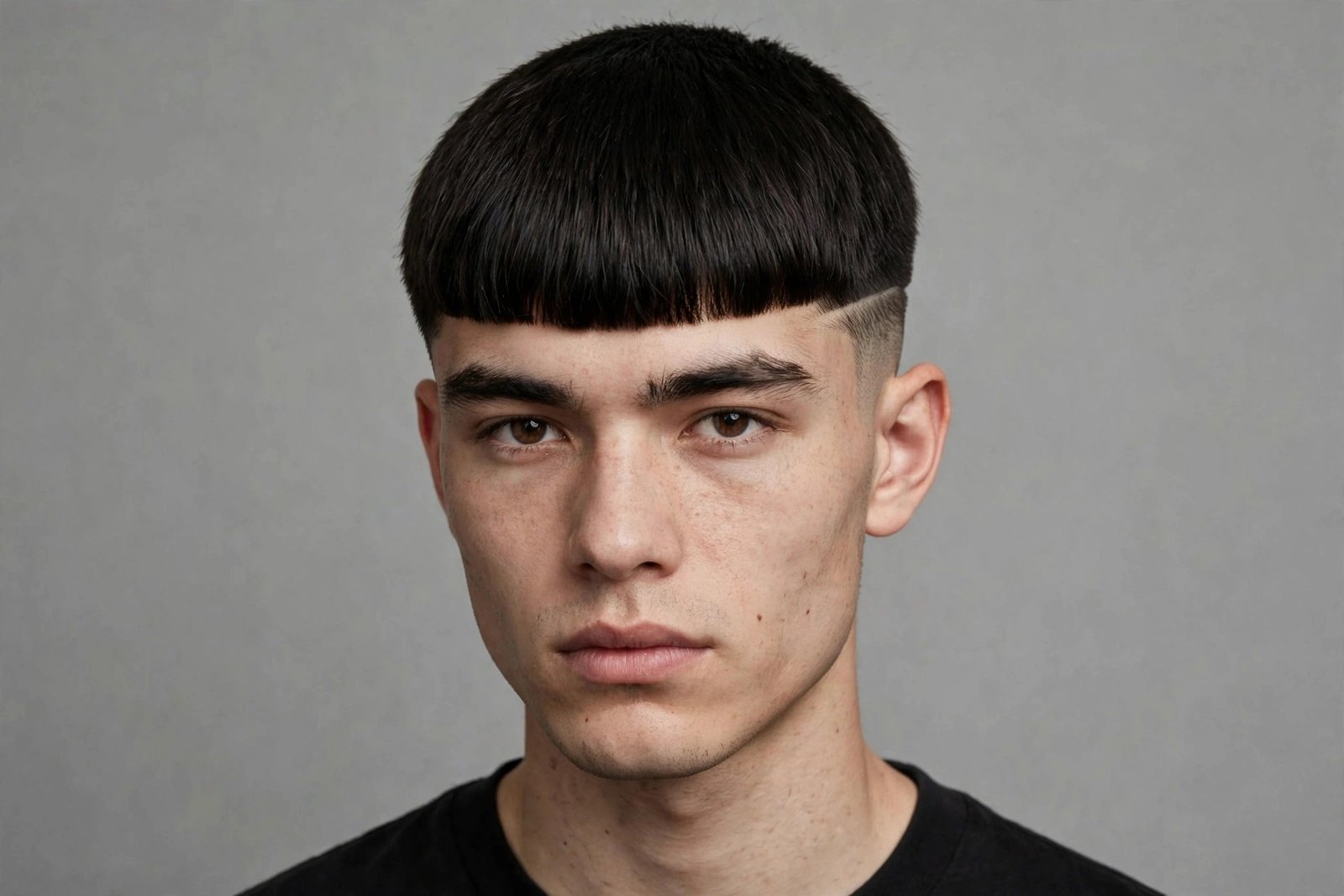
No fade, no blend, no transition — just buzzed sides meeting a full Edgar top at a hard line. The buzzed-sides Edgar is the most brutalist version of the cut: one uniform short length on the sides and back (usually a 1 or 2 guard all over), colliding with the heavy forward fringe and full top. There’s no gradient to soften the meeting point, which gives the whole head a stark, architectural quality. It’s the Edgar stripped to its essence, and it’s not trying to be liked. It’s trying to be noticed.
Who it suits: this is a confidence cut, full stop. It flatters strong, symmetrical head shapes — the buzzed sides put your skull architecture on display, so it rewards good bone structure and punishes lumps and asymmetry. Thick, dark hair creates the strongest contrast. It’s popular with athletes and guys who like their grooming minimal but their statements maximal. Fair warning: there’s no hiding a bad buzz line, and head shape surprises (flat spots, ridges) that a fade would disguise become visible. Know your head before you commit.
The barber script: “Edgar on top, full fringe forward — but instead of a fade, just buzz the sides and back with a [1 or 2] guard, one length, no blend. I want the hard line where it meets the top.” The guard choice is the whole decision: a 1 guard is severe and high-contrast, a 2 guard is slightly more forgiving. Some barbers will want to soften the transition line; tell them no — the hard disconnect is the design. Ask for the buzz to go high enough that the top’s silhouette stays clean, usually to just below where the top length begins.
Home styling couldn’t be simpler — the sides need nothing, ever, and the top gets the standard forward routine. Maintenance is interesting: the buzzed sides show growth fast, but touching them up at home with your own clippers is genuinely easy (one guard, whole head sides), which makes this the most DIY-friendly Edgar. The honest downside is the severity. The hard line between buzz and top is a lot — it reads aggressive, even confrontational, in a way the faded versions don’t. It’s also the least versatile: you can’t soften it for occasions, because there’s no gradient to grow into. What you see is what everyone gets, every day.
14. The Grown Out Edgar
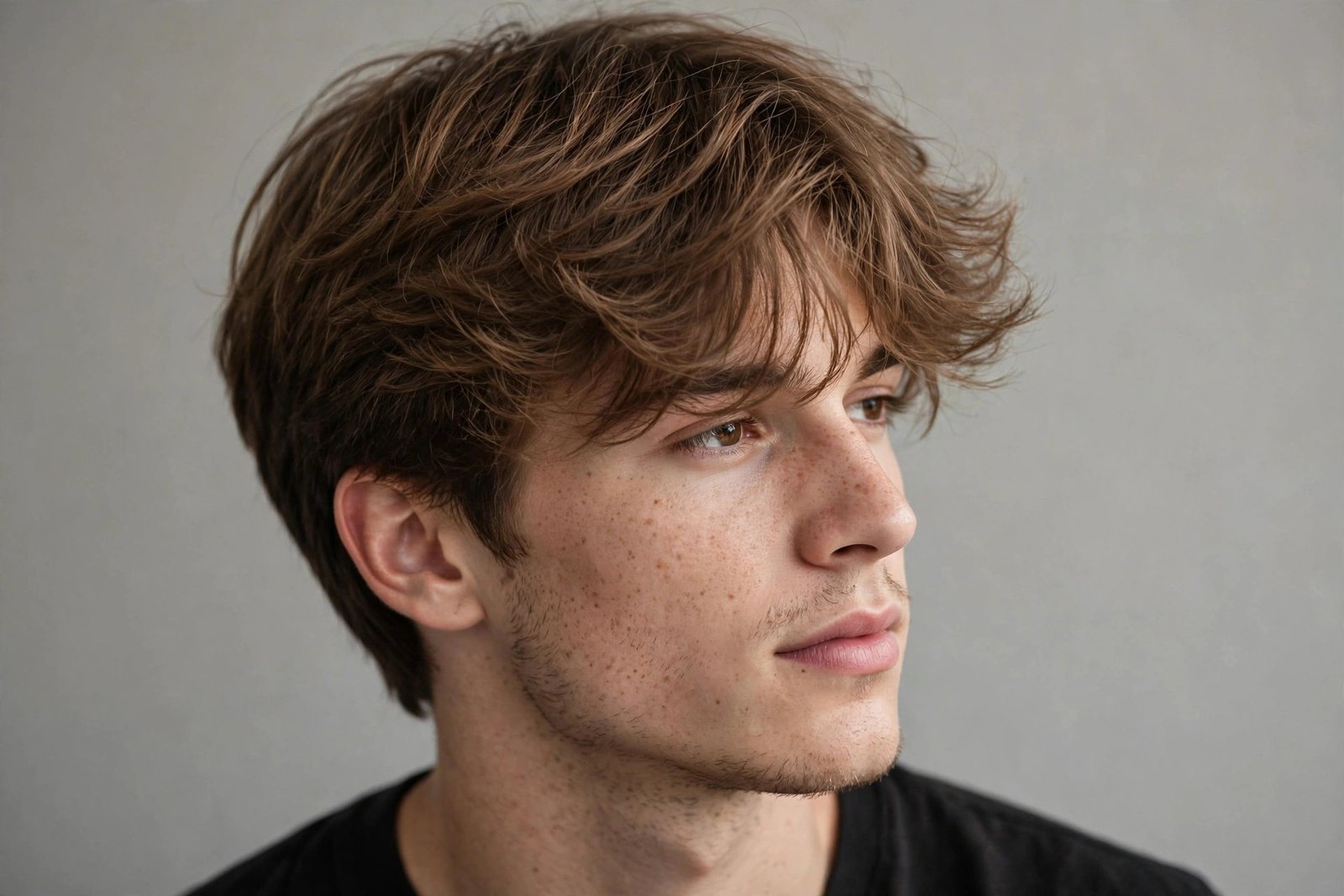
Here’s a secret the barbershop won’t advertise: the grown-out Edgar might be the best-looking version of all. When the sharp lines soften, the fade grows into a natural taper, and the fringe gains length and movement, the Edgar transforms from a statement into something almost romantic — a full, forward-falling cut with soft edges and real flow. It’s the version you see on guys who got the Edgar three months ago and accidentally discovered something better. In 2026, the intentional grown-out Edgar — cut to look like this from day one — is having a genuine moment.
Who it suits: almost everyone, which is the beautiful irony. The softened edges flatter round faces (no harsh lines widening), long faces (the fuller fringe shortens), and every face in between. It works on wavy and straight hair, medium to thick density, and it’s the most age-versatile Edgar — it looks as natural on a 35-year-old as a 20-year-old. If you tried the sharp Edgar and found it too much, the grown-out version is your second chance. If you never tried the Edgar because it looked too severe, this is your entry point.
The barber script: “I want an Edgar, but cut it like it’s already grown out — keep length everywhere, soft fringe forward with movement, sides tapered not faded, nothing too sharp.” You’re asking the barber to skip the severity and go straight to the softness: longer fringe (eyebrow to eyelid), textured ends, sides that blend rather than contrast. Bring a photo of a grown-out Edgar specifically, because if you just say “Edgar,” you’ll get the sharp version and spend two months growing into what you actually wanted.
Home styling leans into the softness: blow-dry forward with volume at the roots, light product (cream rather than clay), and let it move. It air-dries beautifully, making it one of the lowest-effort versions day to day. Maintenance is the most relaxed on this list — six to eight weeks between cuts, and the grow-out just keeps looking good. The downside is identity: at a certain point of growth, is it still an Edgar or just a forward-falling cut with a fringe? Purists will say you’ve left the reservation. And if what you wanted was the sharp, head-turning Edgar, this will feel like a different haircut wearing its clothes. Know which one you’re actually after.
15. Edgar With Drop Fade
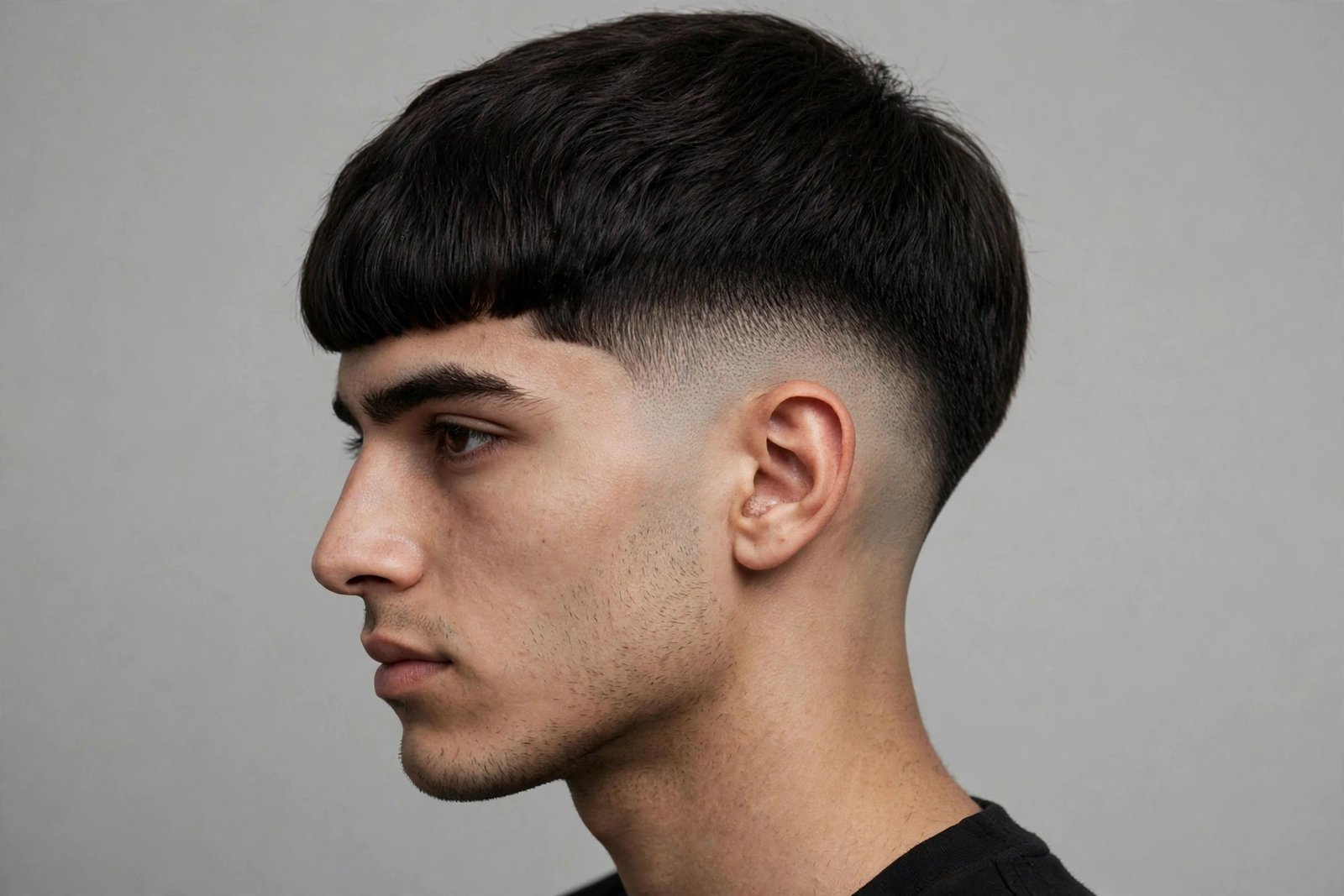
The drop fade Edgar is the connoisseur’s choice — a fade that doesn’t go straight across but drops down behind the ear, following the natural curve of the head. The effect is subtle in photos and striking in person: the fade line arcs like a parenthesis around the ear, creating a rounded, sculpted look that straight-across fades can’t replicate. Paired with the heavy Edgar fringe up top, it’s a study in contrasts — architectural precision on the sides, bold weight on top. Barbers love cutting this one because it shows off actual skill.
Who it suits: the drop fade is famously flattering on round and square faces, because the curved fade line softens angularity and adds the illusion of a more oval head shape. It works on all hair types, though the drop is most visible on darker, thicker hair where the gradient reads clearly. It’s a great pick for guys who want a fade with more artistry than the standard straight version — the kind of detail that other guys notice and ask about. If you’ve ever had a barber compliment your own fade choice, this is probably why.
The barber script: “Edgar on top, and I want a drop fade on the sides — let it drop behind the ear, follow the head shape, don’t take it straight across.” Not every barber does a clean drop fade, so this is one where you vet the shop: check their portfolio for curved fades before you sit down. Specify how low you want the drop to go and whether the bottom goes to skin. The fringe stays standard Edgar — heavy, forward, blunt or textured — because the artistry is all happening on the sides.
Home styling is the usual Edgar routine; the drop fade needs nothing from you. Maintenance mirrors other faded versions: line-up every two weeks, full cut every three to four. The honest downside is barber dependence — a bad drop fade looks worse than a bad straight fade, because the curve draws the eye. A wobbly drop line is very visible. This version ties you to a skilled barber, and switching shops is riskier than with simpler cuts. Find your person and stay loyal; the drop fade rewards loyalty.
16. The Messy Edgar
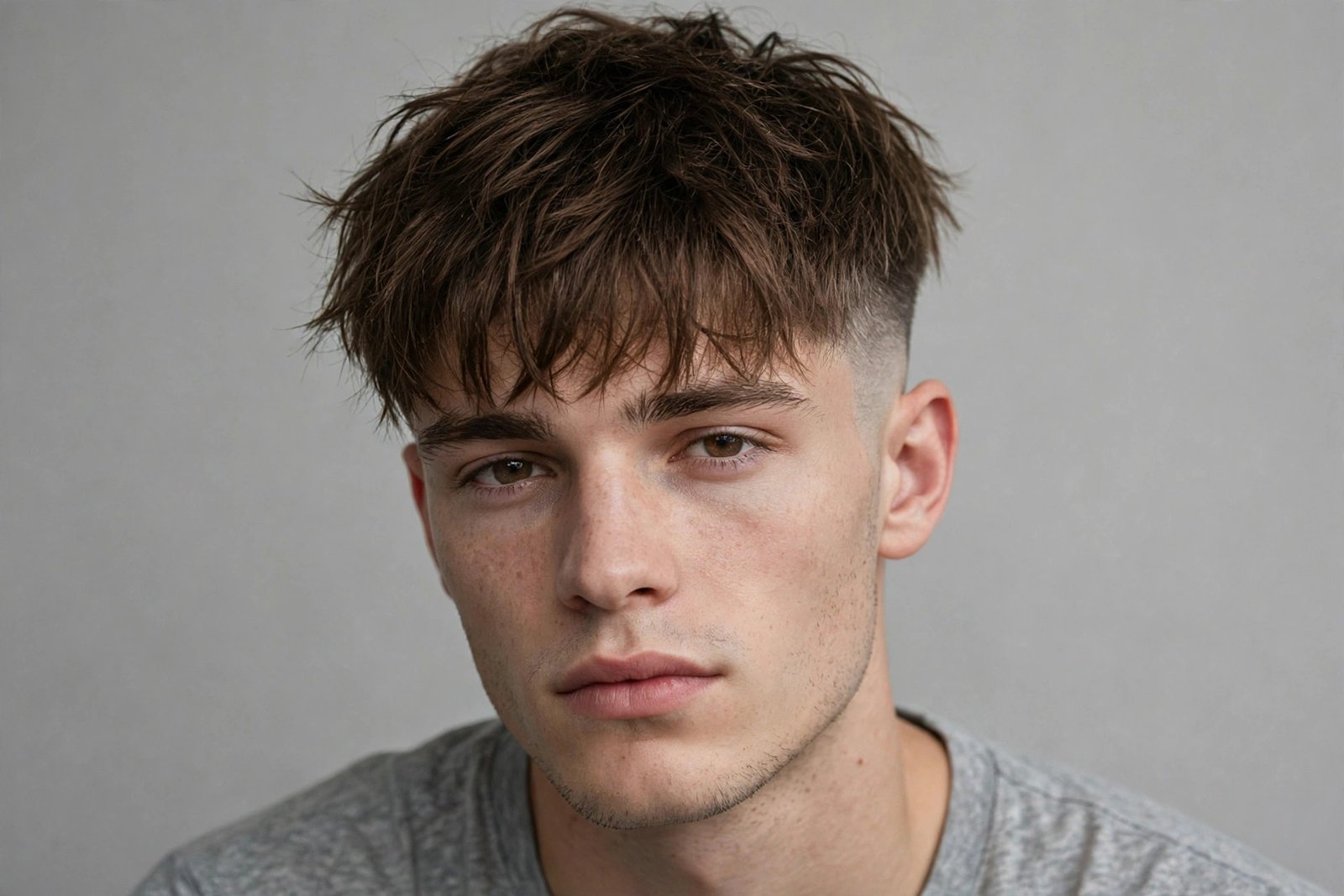
The messy Edgar shouldn’t work, and that’s exactly why it does. Take the most precise haircut on the menu — the ruler-straight fringe, the carved fade — and deliberately unmake it: tousled top, fringe falling in imperfect pieces, texture that looks like you ran your hands through it and meant it. The sides stay faded clean, which keeps the whole thing from reading as “didn’t bother,” and the contrast between the undone top and the precise sides is where the magic lives. It’s controlled chaos, and in 2026 it might be the coolest version on this list.
Who it suits: guys with natural texture — waves, cowlicks, hair that refuses to sit still — who’ve been at war with their own head for years. The messy Edgar calls a truce: your hair’s rebellion becomes the style. It suits most face shapes, skews young and creative, and it’s genuinely excellent for fine-to-medium hair, because the tousled pieces create volume and separation that flat styling can’t. If your hair has never once done what you told it to, stop telling it and start here.
The barber script: “Edgar, but I want it messy — heavy texture through the top and fringe, piece-y ends, nothing blunt or perfect. Fade the sides clean so the top looks intentional.” The cut needs real texture work — point cutting, slicing, maybe razor work — through the entire top, not just the fringe. The fringe should be cut with deliberate unevenness: varied lengths that fall naturally. And emphasize the clean sides, because the messy top only reads as style when the perimeter is sharp. Messy top plus messy sides equals actually messy.
Home styling is gloriously low-skill: sea salt spray or texture powder on damp-to-dry hair, scrunch and tousle forward, done. It takes ninety seconds and looks better when you don’t overthink it. It air-dries into itself, making it the ultimate low-effort Edgar. The downside is the fine line between “artfully messy” and “bedhead” — and that line is mostly product and the clean fade. Skip the product and skip the line-up, and the messy Edgar stops being a style and starts being a cry for help. It also doesn’t suit formal contexts; this is not the version for the boardroom.
17. Edgar With Hard Part Line
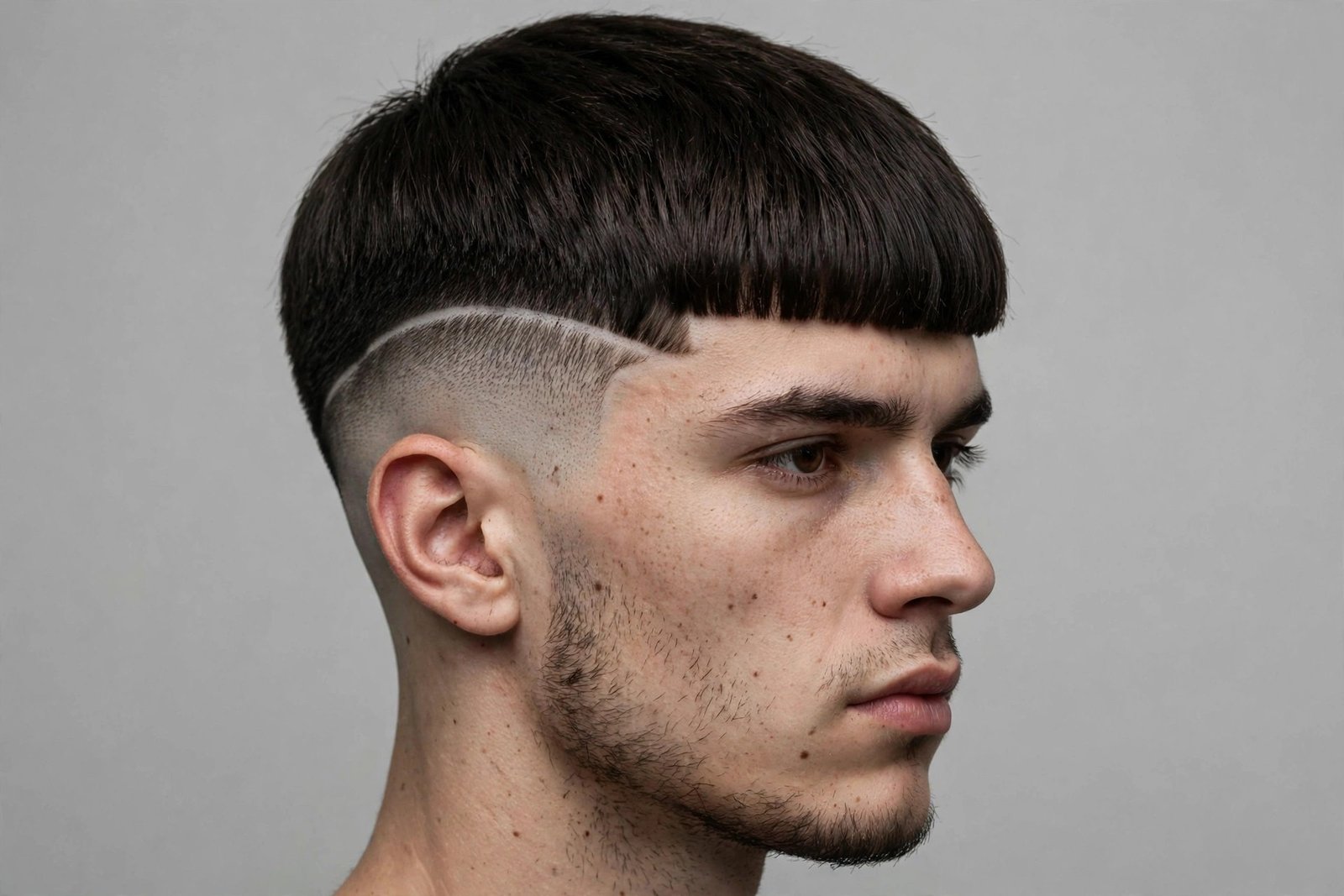
The hard part Edgar adds one razor-sharp detail to the classic formula: a shaved line — a hard part — carved into the side, usually where the top meets the fade. It’s a small addition with outsized impact. The line draws the eye, frames the top, and gives the whole cut a graphic, designed quality that the standard Edgar doesn’t have. Think of it as the Edgar’s signature accessory: the cut is the outfit, the hard part is the watch. In 2026, with barbershop artistry at an all-time high, this detail is everywhere.
Who it suits: anyone who wants their Edgar to have one more talking point. The hard part works on all face shapes and hair types — it’s a detail, not a structure — though it’s most visible on darker hair where the shaved line contrasts sharply. It skews bold and fashion-forward; this is not a subtle addition. Guys in creative fields, nightlife, sports — anywhere a little extra edge is an asset. If your style is otherwise minimal, the hard part gives your haircut the personality your wardrobe doesn’t.
The barber script: “Classic Edgar, and carve a hard part line on [left/right] side where the top meets the fade. Keep it clean and straight.” Placement is worth discussing: the traditional spot is at the natural part line, arcing back from the temple, but some barbers place it lower in the fade for a subtler effect or add a second parallel line for more drama. One line is classic; two is a statement. Ask for it to be carved with a straight razor or trimmer, and confirm the width — a thin line looks sharp, a wide one looks like a landing strip.
Home styling is standard Edgar; the hard part needs nothing from you day to day. But maintenance is the catch: a hard part grows out in about a week to ten days, going from razor-sharp to fuzzy to invisible. To keep it crisp, you need it re-carved every one to two weeks — many barbers will do it as a quick standalone service between cuts. The honest downside is the upkeep treadmill combined with the commitment: a hard part is very visible, very deliberate, and it grows out visibly. It’s also one more thing that can go wrong — a wobbly or misplaced line is hard to unsee. Choose your barber well.
18. The Thick Hair Edgar
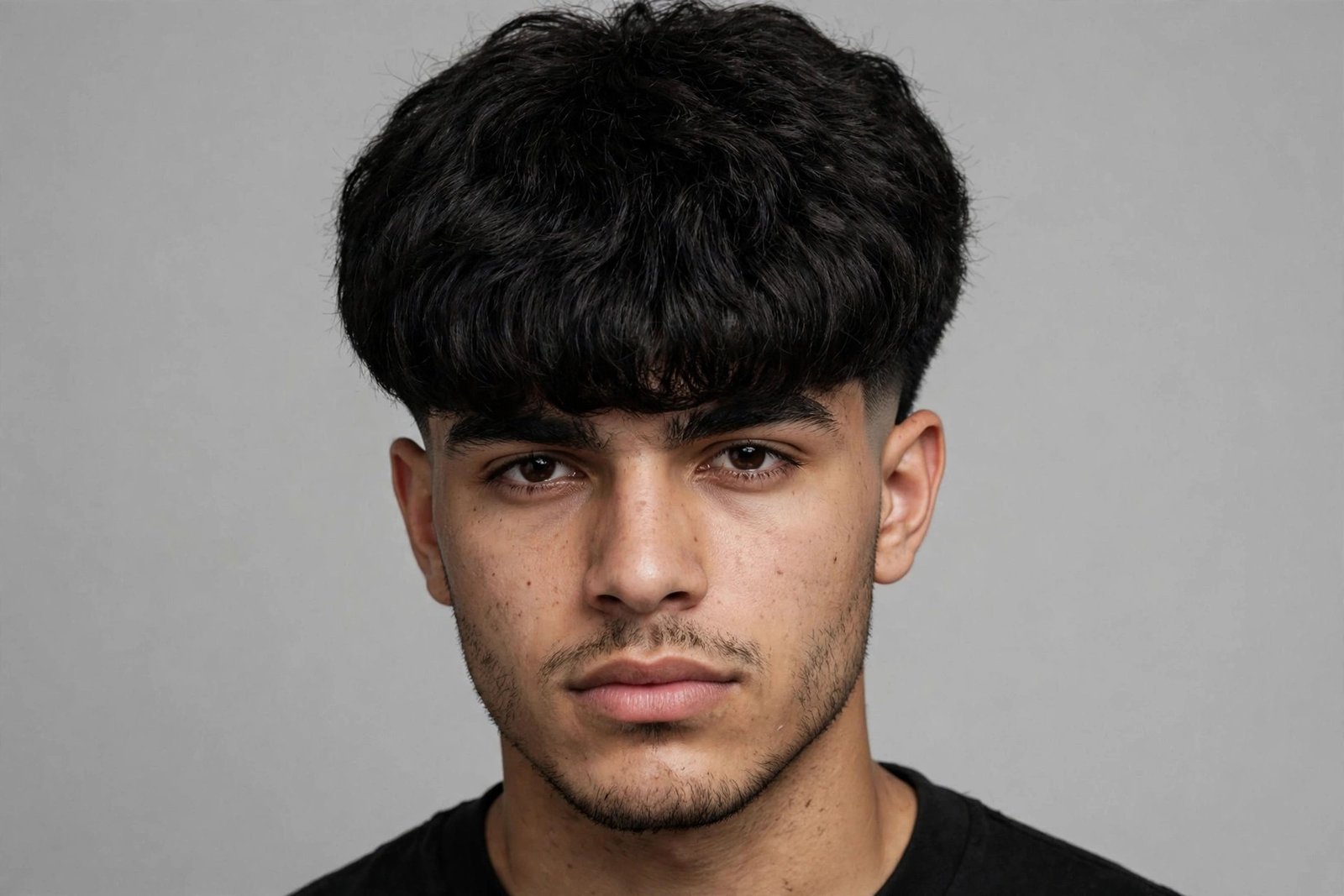
Some guys don’t choose the Edgar — their hair chooses it for them. If you’re blessed (or cursed) with genuinely thick, dense hair, the Edgar is one of the few statement cuts that uses all of it instead of fighting it. The thick-hair Edgar keeps serious weight on top: a dense, heavy fringe with real presence, full sides-to-top transition, and a fade that has to work hard to contain the volume. It’s the most substantial version of the cut — when this fringe falls forward, it falls with authority.
Who it suits: the thick-haired, obviously — this is your home turf. Density is the entire prerequisite; without it, you’re just doing the classic Edgar. It flatters oval, square, and heart faces, and the sheer weight of the fringe does beautiful things for guys with larger foreheads. The volume on top adds height, which helps rounder faces. One caution: very thick hair plus a heavy fringe equals real weight on the forehead, which some guys find physically annoying. If you’ve never worn your hair forward, the sensation takes getting used to.
The barber script: “Edgar, but keep the weight — I want the fringe thick and heavy, don’t thin it out. Take the bulk down underneath so it sits right, but keep the density on top. High fade on the sides.” The key technique is undercutting the bulk: removing weight from underneath the top while preserving the dense surface, so the fringe lies flat instead of puffing up. This is skilled work — a barber who just thins the whole thing will destroy what makes it special. Ask specifically about internal weight removal versus surface thinning; the right answer is internal.
Home styling needs product with real hold — thick hair laughs at light creams. Blow-dry the fringe forward with tension to keep it flat, then work a firm-hold matte clay through. In humidity, thick Edgars can swell impressively; an anti-frizz product or a quick pass with a flat iron on the fringe (yes, really) keeps it disciplined. Maintenance every three to four weeks, with the bulk underneath needing attention before the length does. The downside is the daily battle with volume — thick hair wants to expand, and the Edgar wants it flat. You’ll win most days with heat and product, but it’s a negotiation, not a given. The payoff is a fringe with more presence than anyone else’s.
19. Edgar With Temple Fade
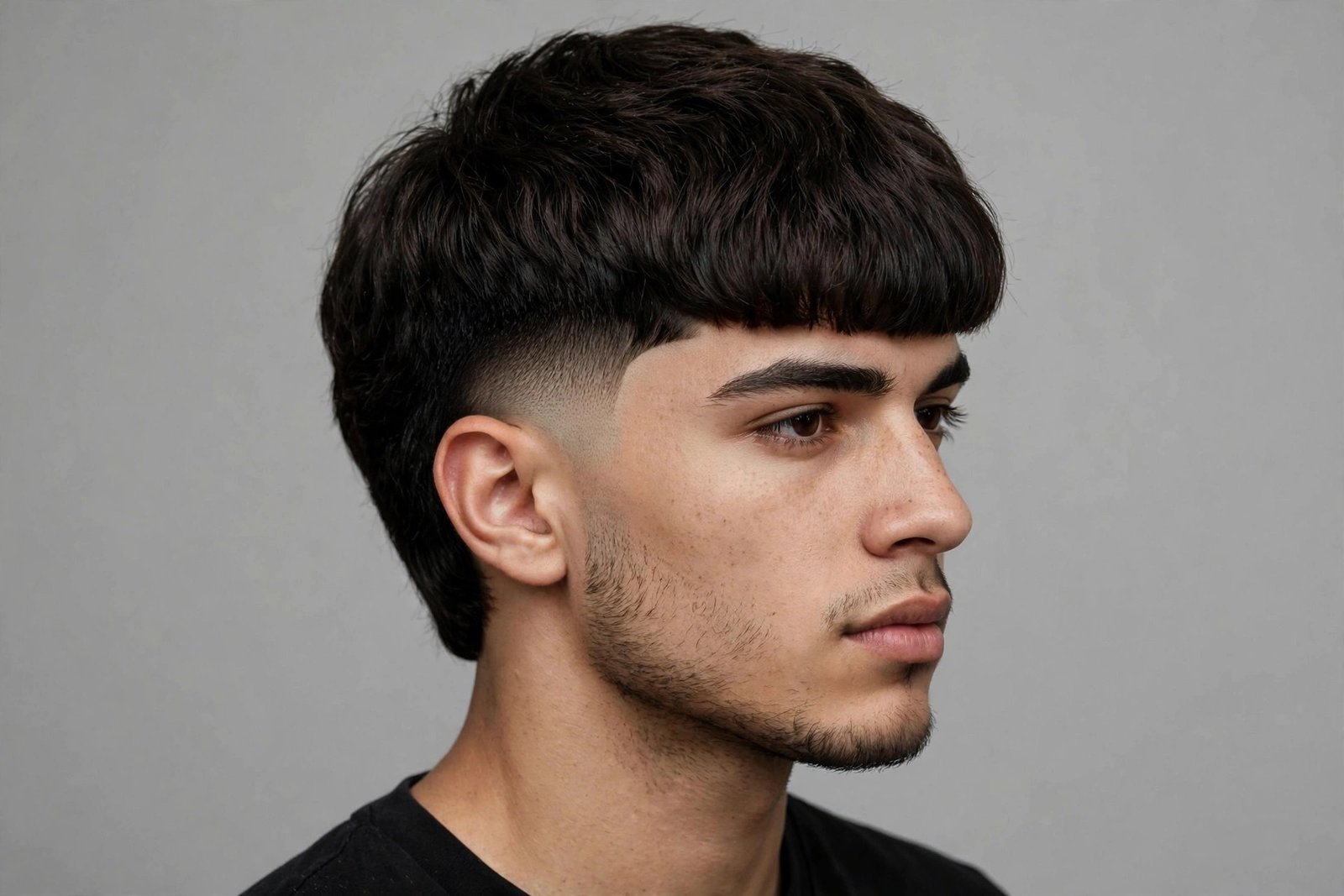
The temple fade — sometimes called the Brooklyn fade — is surgical: the fade exists only at the temples and sideburns, blending the hairline into skin in a tight, precise zone while the rest of the sides stay relatively full. Pair it with an Edgar top and you get a fascinating hybrid: the bold forward fringe up top, and at the temples, this immaculate little gradient that looks like jewelry for your hairline. It’s a detail person’s Edgar — the kind of cut where other guys lean in for a closer look.
Who it suits: guys with strong hairlines and defined temples, because the temple fade puts that whole area under a spotlight. It flatters most face shapes, and it’s particularly smart for anyone whose hairline is slightly uneven — the fade can be shaped to create symmetry. It works on all hair types. The temple fade Edgar skews stylish and current; it’s big in barbershop culture and among guys who treat their haircut as craft. If you appreciate the details, this is your version.
The barber script: “Edgar on top, full fringe forward — but instead of a full fade, just do a temple fade: blend it tight at the temples and sideburns, keep the rest of the sides fuller.” Be clear that you want the sides kept at length — some barbers hear “fade” and go to town. The temple fade zone is small, roughly from the sideburn up past the temple, and the blend should be seamless. Ask for the hairline itself to be lined up crisp; the temple fade plus a sharp line-up is the combination that makes this version sing.
Home styling is standard Edgar up top; the temples need nothing. Maintenance is moderate — the temple fade grows out in two to three weeks, but because the zone is small, a quick touch-up is fast and cheap. The honest downside is subtlety to the point of invisibility: from most angles, this reads as an Edgar with slightly neat temples, and the artistry is only visible up close. If you want your haircut’s details to be appreciated, you’ll be showing people your temples a lot. It’s also the version most dependent on a crisp line-up — without it, the temple fade just looks like short sideburns.
20. The Edgar Mullet Hybrid
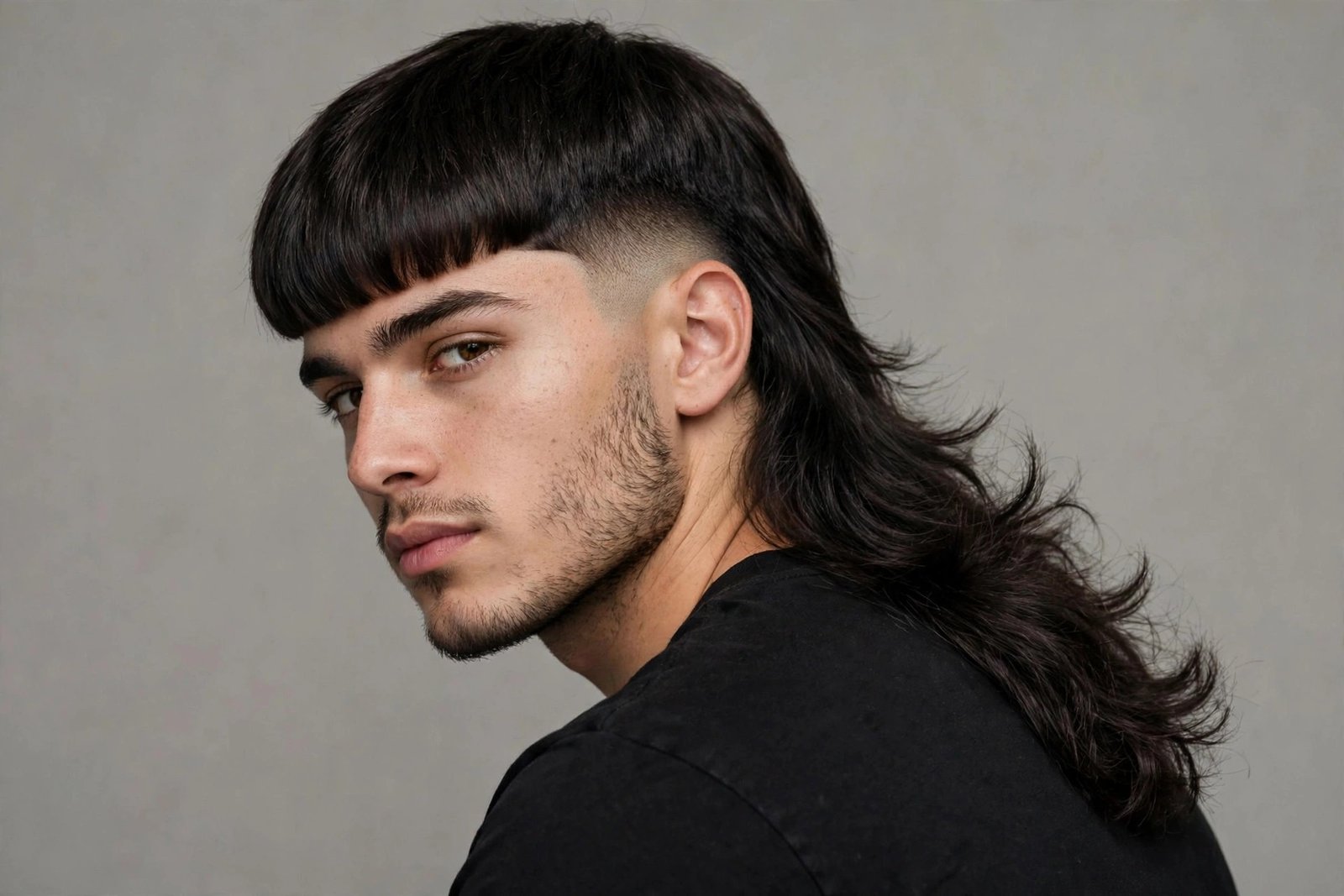
Business in the front, party in the back — except the business is a blunt Edgar fringe and the party is a flowing mullet, and somehow the combination absolutely rips. The Edgar mullet hybrid keeps the signature heavy fringe and faded temples up front, then lets the back grow long and free. It’s two haircuts in a trench coat, and in 2026 — with the mullet’s full cultural rehabilitation complete — it’s one of the most photographed hybrids in barbershops. It shouldn’t work. It works.
Who it suits: the bold, the young, the creatively employed. This is a high-commitment, high-visibility cut that polarizes rooms — people will have opinions, and you need to enjoy that. It flatters oval and oblong faces (the back length balances), and it needs decent density throughout, because a wispy mullet back undermines the whole enterprise. It’s also a genuinely good pick for guys growing their hair out who want to keep the front sharp while the back does its thing — the hybrid makes the awkward phase look intentional.
The barber script: “Edgar in the front — heavy fringe, faded temples — but leave the back long, mullet style. I want the disconnect between the short front and the long back to be visible.” Specify the back length: just past the collar is the wearable version, shoulder length is the full commitment. Discuss the transition — a harsh disconnect (faded sides straight into long back) is the modern version; a softer blend is the retro one. And be clear about the top: the Edgar fringe is what separates this from a standard mullet, so don’t let the barber soften it.
Home styling is two routines in one: the front gets the standard Edgar treatment (forward, dry, matte product), the back gets left alone or enhanced with a little texture cream. It air-dries fine. Maintenance is split — the front needs the Edgar schedule (three to four weeks), the back just needs occasional trims to keep the ends healthy. The honest downside is professional viability: this is the least office-friendly version on the list by a mile. It’s also a grow-out commitment — once the back is long, you’re in it for months. And you’ll hear “mullet” constantly. If that bothers you, the hybrid will be a long, annoying year.
21. Edgar With Faded Back
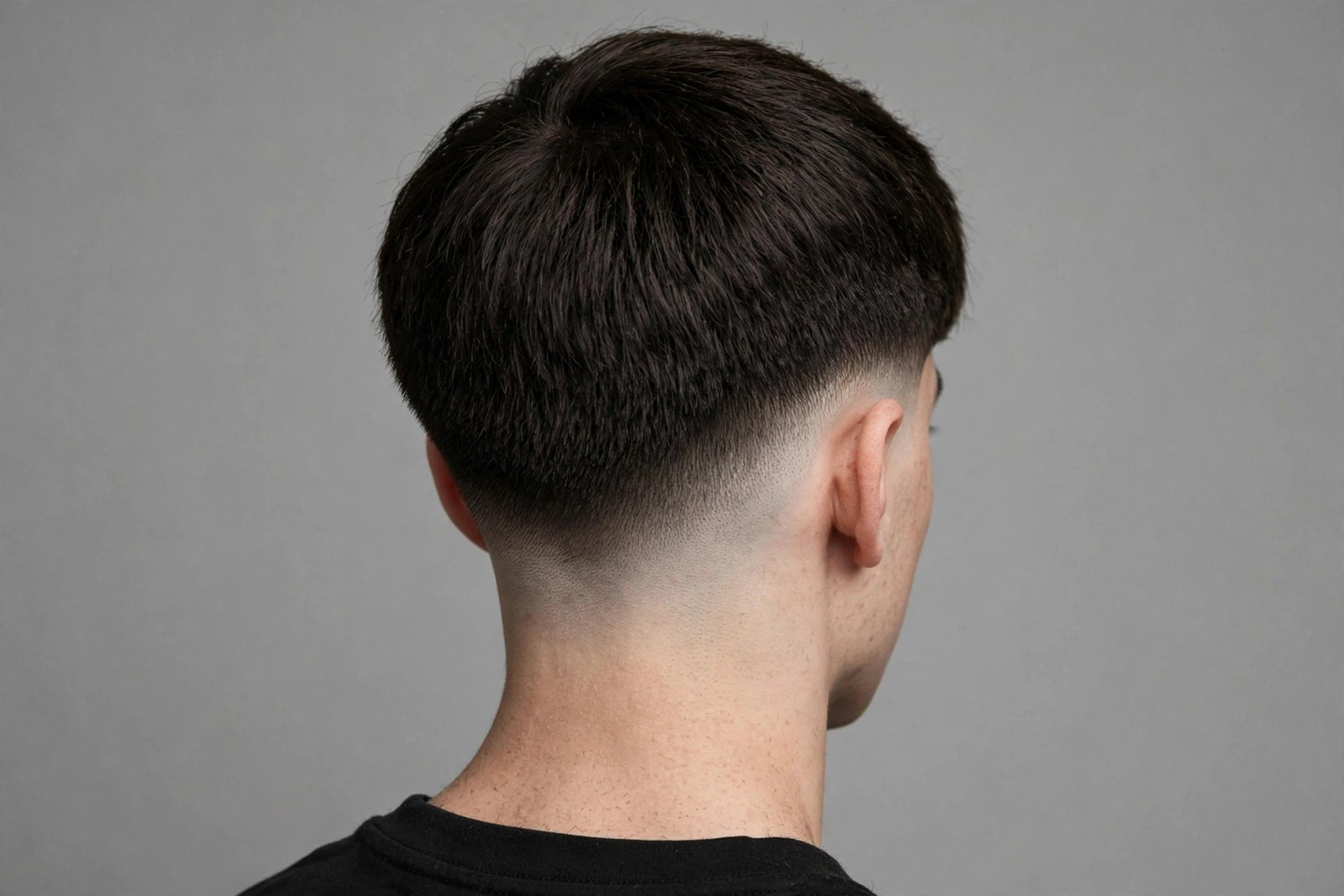
Everyone talks about the fringe and the sides, but the back of the Edgar matters more than people think — it’s what the world sees when you walk away. The faded-back Edgar gives the rear the same attention as the front: a clean fade running down the back to a crisp neckline, so the cut looks finished from every angle. It’s the difference between a haircut and a hairstyle — the kind of 360-degree polish that separates a good Edgar from a great one. In photos it barely registers; in person, walking past someone, it’s everything.
Who it suits: everyone, honestly — there’s no face shape or hair type that objects to a clean back. It’s particularly valuable for guys with cowlicks or unruly growth patterns at the nape, because a proper fade tames what scissors can’t. It’s also the version for anyone who wears collared shirts or suits regularly: a clean faded neckline against a collar looks a hundred times sharper than a fuzzy one. If you’ve ever caught your reflection in a shop window from behind and winced, this is the fix.
The barber script: “Edgar up top, and make sure the back is faded clean — I want it sharp from behind, not just the front. Taper or fade the neckline, no bulk at the nape.” Many barbers focus 90% of their effort on the front of an Edgar; saying this out loud reallocates their attention. Specify whether you want a squared or tapered neckline — squared looks sharper and more deliberate, tapered looks softer and grows out better. Ask them to check the back with a hand mirror before you leave; a good barber will offer, but it never hurts to ask.
Home styling ignores the back entirely — you can’t reach it and you don’t need to. Maintenance follows the standard faded-Edgar schedule, with the neckline needing cleanup every two to three weeks (a quick neckline cleanup is often cheap or free between cuts — ask your barber). The downside is purely logistical: you can’t see the back yourself, so you’re entirely dependent on the barber’s diligence and your willingness to check with a mirror. A neglected Edgar back — fuzzy neckline, uneven fade — undoes the front’s good work. It’s the version that rewards a barber you trust with the parts of your head you can’t see.
22. The Side Swept Edgar
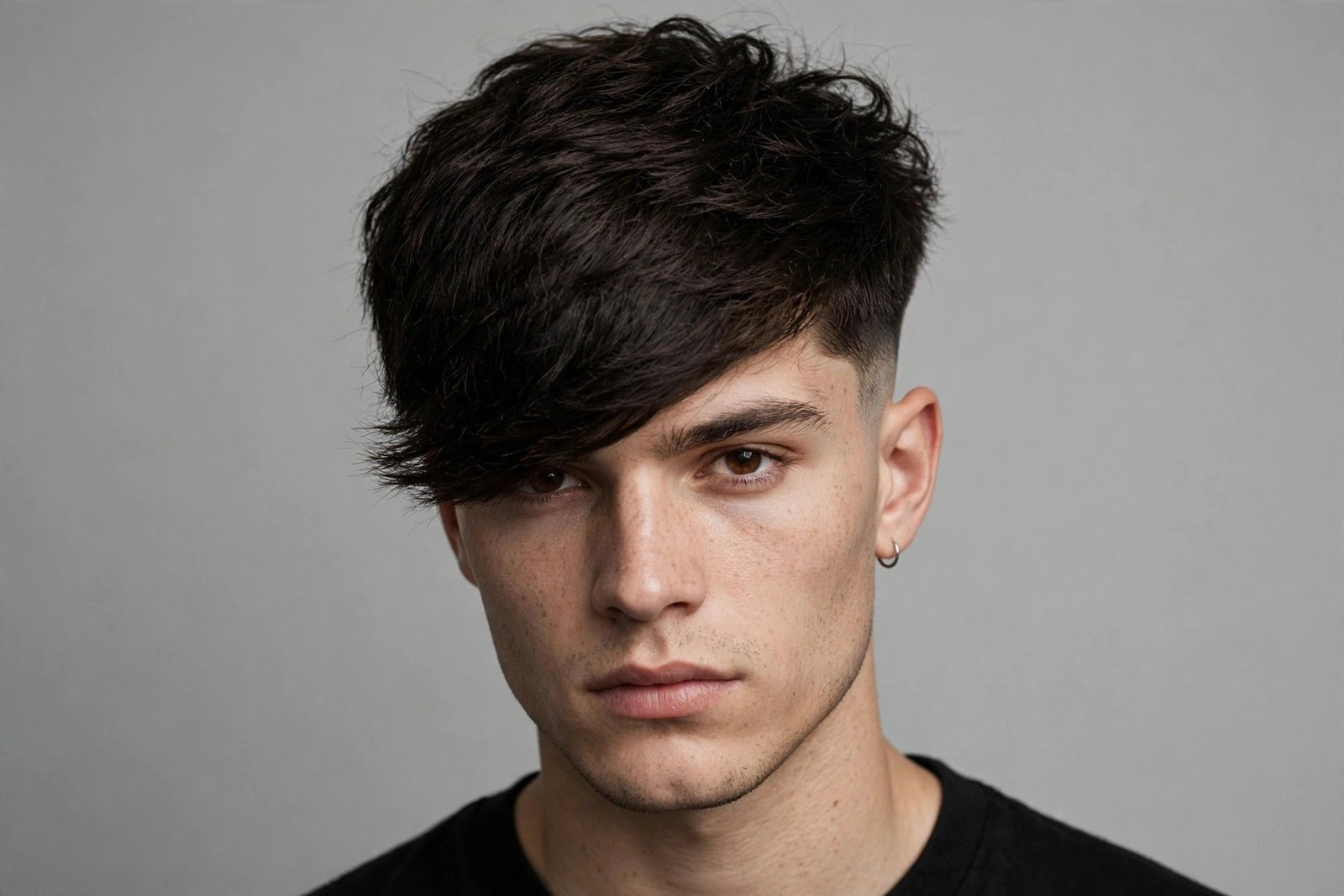
The side-swept Edgar breaks the cut’s cardinal rule — the fringe doesn’t go straight forward, it sweeps to one side — and the rule-breaking is exactly the point. The heavy fringe is still there, still unmistakably Edgar in its weight and presence, but it’s directed diagonally across the forehead, creating an asymmetric line with real dynamism. The sides stay faded, the top stays full, and the whole thing has a windswept, editorial energy the straight versions can’t touch. It’s the Edgar for guys who like the cut’s boldness but not its rigidity.
Who it suits: this is the best Edgar for anyone with a strong natural part or a cowlick that fights a straight fringe — instead of battling your growth pattern, you recruit it. It flatters most face shapes, and the diagonal line is particularly kind to round faces, because asymmetry breaks up width. It’s also the most versatile Edgar for styling: on lazy days you can wear it forward like a standard Edgar, on deliberate days you sweep it. Two haircuts for the price of one, and nobody needs to know.
The barber script: “Edgar, but I want the fringe cut to sweep to the [left/right] — keep it heavy, but angle the fringe line so it falls diagonally. Fade the sides as usual.” Direction matters, so pick your side (most guys sweep away from their natural part, but either works). Ask the barber to cut the fringe slightly longer on the side it sweeps toward — the length differential is what makes the sweep sit naturally instead of fighting back to center. And cut it dry or styled in the swept direction if possible; a fringe cut straight and then swept behaves differently than one cut to sweep.
Home styling: blow-dry the fringe in the sweep direction with a vent brush, using a little more product than the straight version — the sweep needs hold to stay swept. A side part comb on damp hair sets the direction before drying. It takes an extra minute over the standard routine. The downside is the daily recommitment: the sweep needs to be re-established every morning, and in wind or humidity it migrates back toward center. It’s also slightly less iconic — the straight-across fringe is the Edgar’s signature, and angling it softens the statement. You gain versatility and lose a little of the punch. Most guys find it a fair trade.
23. Edgar With Bleached Fringe
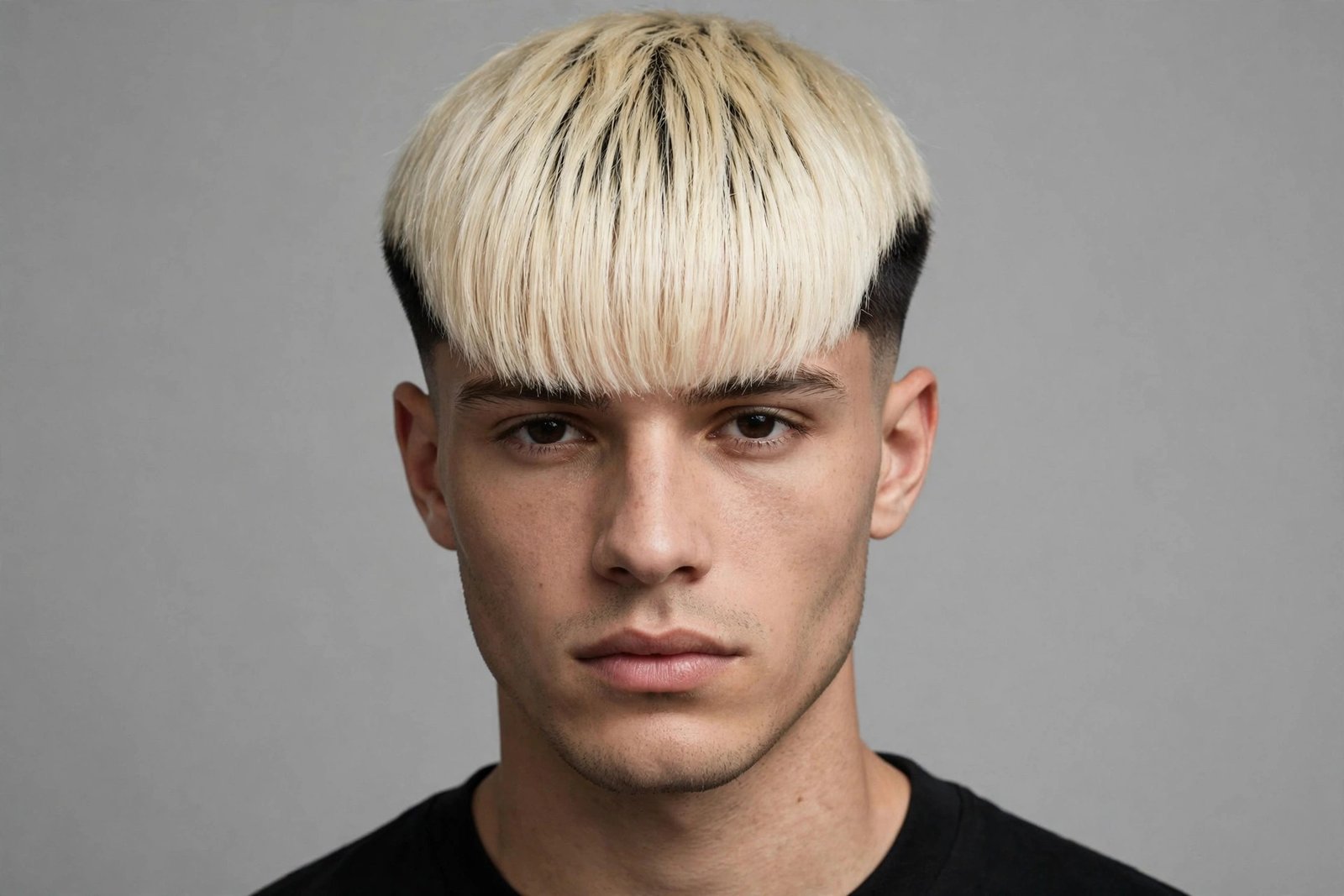
Color changes everything. The bleached-fringe Edgar keeps the cut’s architecture — heavy forward fringe, faded sides — but lifts the fringe to platinum, silver, or ash blonde while the sides stay dark. The contrast is electric: the light fringe practically glows against the dark fade, and the Edgar’s signature horizontal line becomes impossible to ignore. It’s the version that gets photographed at festivals, that shows up in street-style roundups, that makes people cross the street to ask where you got it done. In 2026, with color work fully mainstream in men’s barbering, this is the maximalist’s choice.
Who it suits: the bold and the patient — bold because a bleached fringe is a billboard, patient because bleach is a commitment. It flatters most face shapes (the cut underneath does the flattering; the color does the shouting), and it’s most striking on darker natural hair, where the contrast is extreme. Skin tone matters more here than with any other version: platinum against very pale skin can wash out, while warmer blondes flatter more complexions. Talk to a colorist, not just a barber — this is color work, and it deserves a colorist’s eye.
The barber script is actually two scripts. To the colorist: “Bleach just the fringe and top to [platinum/ash blonde/silver], keep the faded sides my natural color. I want a clean line where the color meets the fade.” To the barber: “Edgar cut, heavy fringe forward, faded sides — and preserve the color separation.” The order matters: color first, then cut, so the barber shapes the already-colored hair. Ask about toner — raw bleach goes yellow, and the difference between brassy and platinum is a toner appointment. Discuss maintenance upfront, because this is the highest-maintenance version on the list by far.
Home styling is standard Edgar plus color care: purple shampoo once or twice a week to kill brassiness, deep conditioning regularly because bleach is thirsty work, and heat protectant before the blow-dryer. The fringe will need re-bleaching every four to six weeks as roots grow in — the dark root against the blonde fringe is actually a cool look for about two weeks, then it just looks grown out. The honest downside is damage and cost: bleach compromises hair health, the upkeep is relentless and expensive, and growing it out means months of two-tone awkwardness. It’s the most dramatic version and the most demanding. Go in with your eyes open and your colorist on speed dial.
24. The Straight Hair Edgar
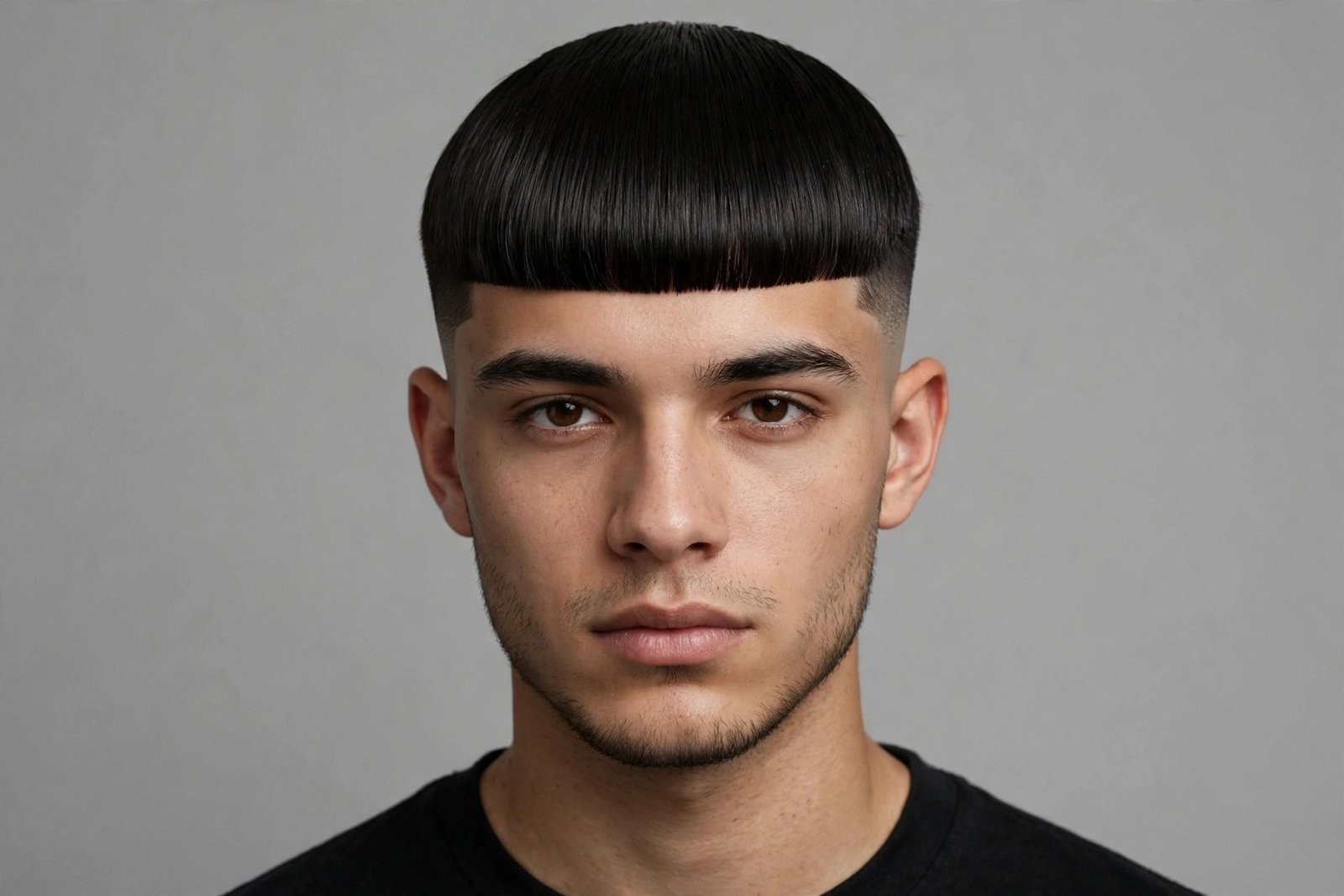
This is the Edgar in its purest form: pin-straight hair, cut with absolute precision, the fringe a perfect horizontal line, the top sleek and controlled, the fade immaculate. No texture, no movement, no apologies — just the cut’s geometry executed flawlessly. On the right head with the right hair, it’s the sharpest thing in this entire article. There’s a reason the most viral Edgar photos in history are straight-hair versions: the camera loves clean lines, and straight hair delivers them better than any other texture.
Who it suits: guys with naturally straight, medium-to-thick hair — the canvas the cut was designed for. The precision flatters angular faces beautifully; the clean lines echo strong bone structure. It needs density: straight fine hair can look limp in this version, because there’s no texture to fake fullness. It’s also the most formal Edgar — the sleekness reads polished and deliberate, making it the version most likely to survive a conservative workplace. If your hair is naturally straight and you’ve been wearing it in forgettable cuts, this is your wake-up call.
The barber script: “Edgar, precision cut — I want the fringe dead straight across, clean lines everywhere, no texture. High fade, sharp line-up.” Precision cutting is a specific skill; the fringe must be cut with the hair dry and in its natural fall, because straight hair shows every millimeter of unevenness. Ask the barber to check the fringe line from multiple angles — straight-on, slightly above, slightly below — because a line that looks straight from one angle can wave from another. This is the version where you want the fussiest barber in the shop, the one other barbers ask for advice.
Home styling is about maintaining the sleekness: blow-dry the fringe straight down with tension (a paddle brush is ideal), and use a light smoothing product — too much and it goes greasy, too little and flyaways ruin the line. A flat iron on the fringe takes thirty seconds and delivers the glass-like finish that makes this version pop; it’s the one Edgar where heat-styling beyond the blow-dryer is worth it. Anti-frizz serum in humidity is non-negotiable. Maintenance every three weeks to keep the lines crisp. The downside is the unforgiving nature of precision: straight hair shows everything — uneven growth, a bad night’s sleep, humidity, a cowlick you forgot about. This version demands perfection from your hair every day. When it delivers, nothing beats it. When it doesn’t, everyone can tell.
25. Edgar With Burst Fade
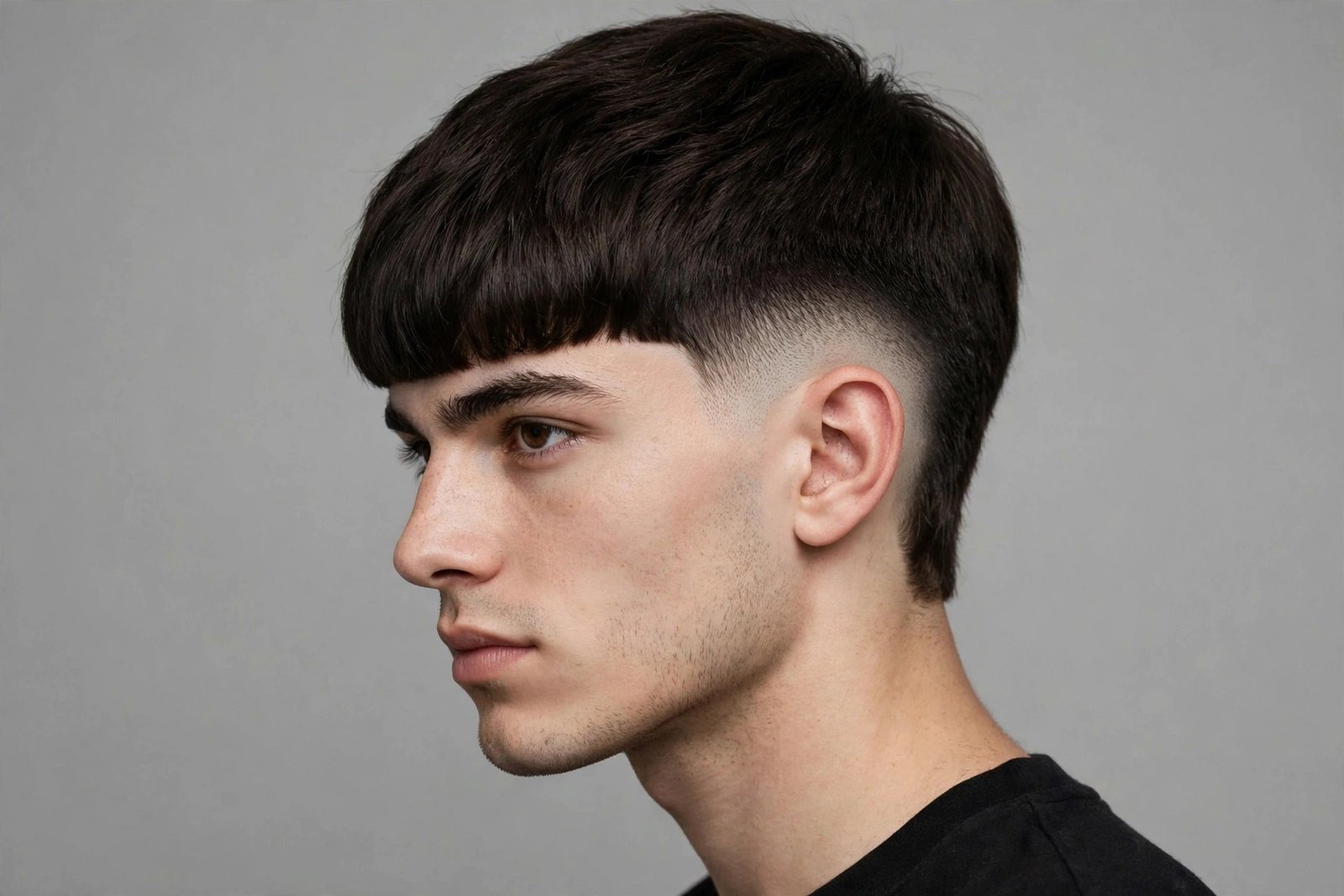
The burst fade is pure barbershop theater: the fade radiates outward from behind the ear in a semicircular burst, like a sunrise, leaving the hairline at the nape intact while the area around the ear melts to skin. Combine it with an Edgar top and you get a cut that’s traditional from the front — heavy fringe, full top — and a work of art from the side. The burst is one of the most technically impressive fades in the book, and pairing it with the Edgar’s bold fringe creates a cut with two personalities: statement in front, craftsmanship in profile.
Who it suits: guys who want their fade to be a conversation piece. The burst is most dramatic on thicker, darker hair where the radial gradient reads clearly, and it flatters round and square faces — the curved burst softens the head shape beautifully. It’s big in barbershop culture and among guys who follow barbering as a craft; if you have opinions about fades, you already know whether you want this. It’s also smart for anyone growing out the back — the burst fade keeps the nape hairline natural, which gives you options.
The barber script: “Edgar on top, heavy fringe forward — and a burst fade on the sides, radiating from behind the ear. Keep the nape natural.” The burst fade is advanced work; vet the barber’s portfolio for actual burst fades before committing, because a bad burst looks like a mistake rather than a design. Specify the burst’s size — a tight burst hugs the ear, a wider one extends further — and whether the center goes to skin. The top stays standard Edgar; all the artistry is in the sides. Ask the barber to show you the burst with a hand mirror from multiple angles before you leave.
Home styling is standard Edgar up top; the burst needs nothing. Maintenance is the familiar faded-Edgar rhythm: line-up every two weeks, full cut every three to four. The honest downside is the specificity: the burst fade is a niche detail that most people won’t name, even if they notice something looks great. You’re paying (in barber skill and upkeep) for artistry that registers subconsciously. It’s also the hardest fade to grow out gracefully — the radial shape goes through an awkward phase. But for the fade connoisseur, there’s nothing else like it. It’s the version you get when you’ve had every other Edgar and you want the one nobody else has.
26. The Short Crop Edgar
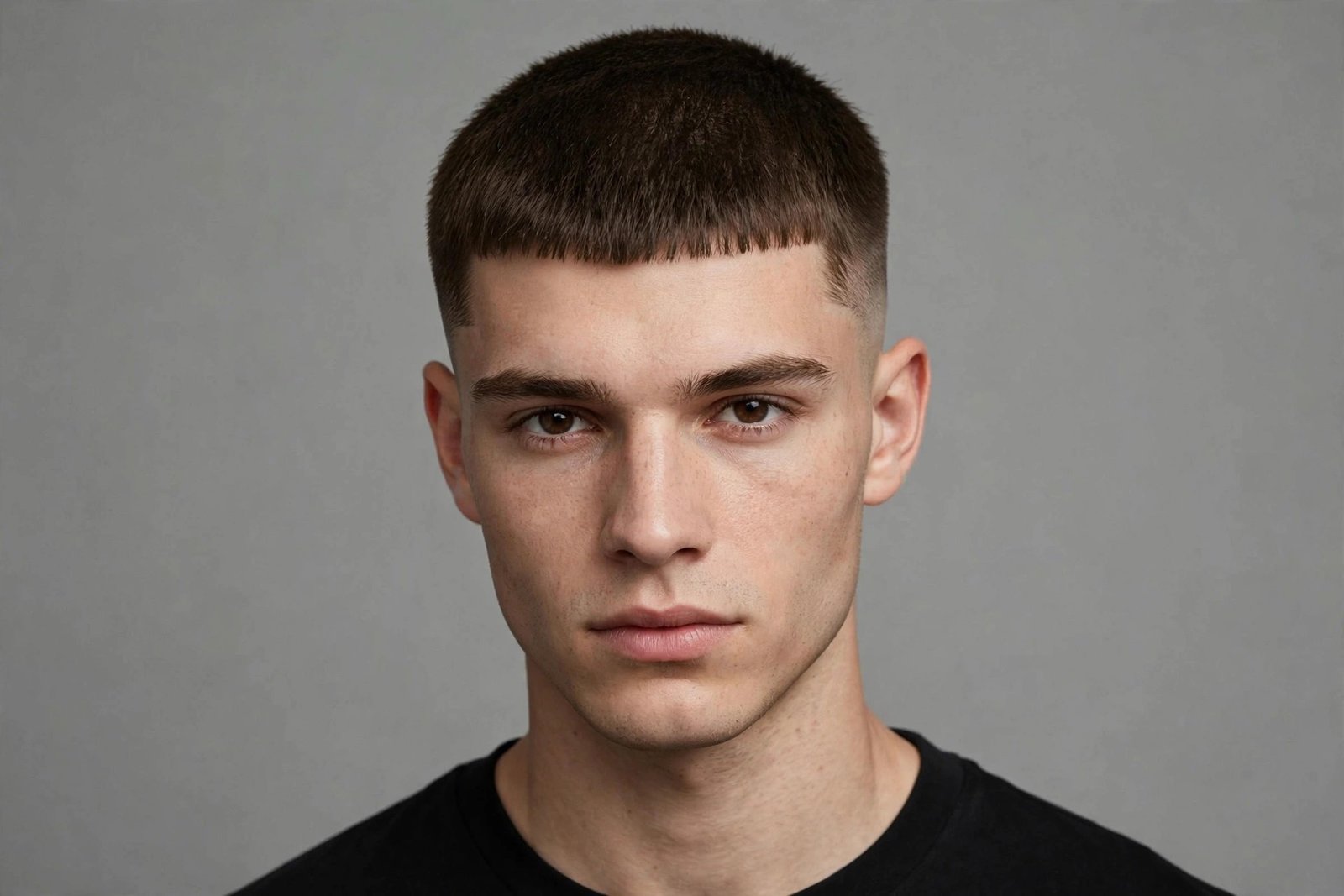
The short crop Edgar distills the cut to its minimum viable form: a compact, short top — think one to two inches — with the fringe cut tight across the forehead, and faded sides. It’s the Edgar for guys who want the identity without the length, the statement without the styling time. Everything that makes the Edgar the Edgar is present — the forward fringe, the contrast, the attitude — just compressed into a smaller, tighter package. It’s also the most practical version here by a wide margin.
Who it suits: athletes, military-adjacent guys, anyone whose lifestyle punishes long hair — helmets, hard hats, wind, sweat. The short length flatters smaller facial features (a long fringe can overwhelm a petite face; the short version doesn’t), and it works on most hair types including thinner hair, because there’s less fringe to look wispy. It’s the best Edgar for hot climates, full stop — less hair on the forehead means less sweat and less sticking. If the long versions sounded like a maintenance nightmare, this is your answer.
The barber script: “Short Edgar — keep the top one to two inches, fringe short and tight across the forehead, faded sides. I want the Edgar silhouette but compact.” The fringe length is the key decision: too short and it stops reading as Edgar and starts reading as a standard crop; the fringe needs enough length to sit visibly on the forehead. Ask the barber to keep the fringe line crisp — at this length, the blunt line is doing most of the stylistic work. A mid or high fade both pair well; pick based on how much contrast you want.
Home styling is the fastest on this list: towel-dry, a dab of product, push the fringe forward with your fingers, walk out the door. No blow-dryer required — at this length, air-drying works fine. Two minutes, tops. Maintenance is frequent but cheap: the short length shows growth quickly, so every two to three weeks, but the cuts are fast and simple. The downside is the reduced drama — the short crop Edgar is handsome and practical, but it doesn’t have the presence of the longer versions. It’s also less forgiving of head shape, because there’s less hair to sculpt with. Think of it as the Edgar’s efficient younger brother: less impressive, more reliable, always on time.
27. Edgar With Defined Line Up
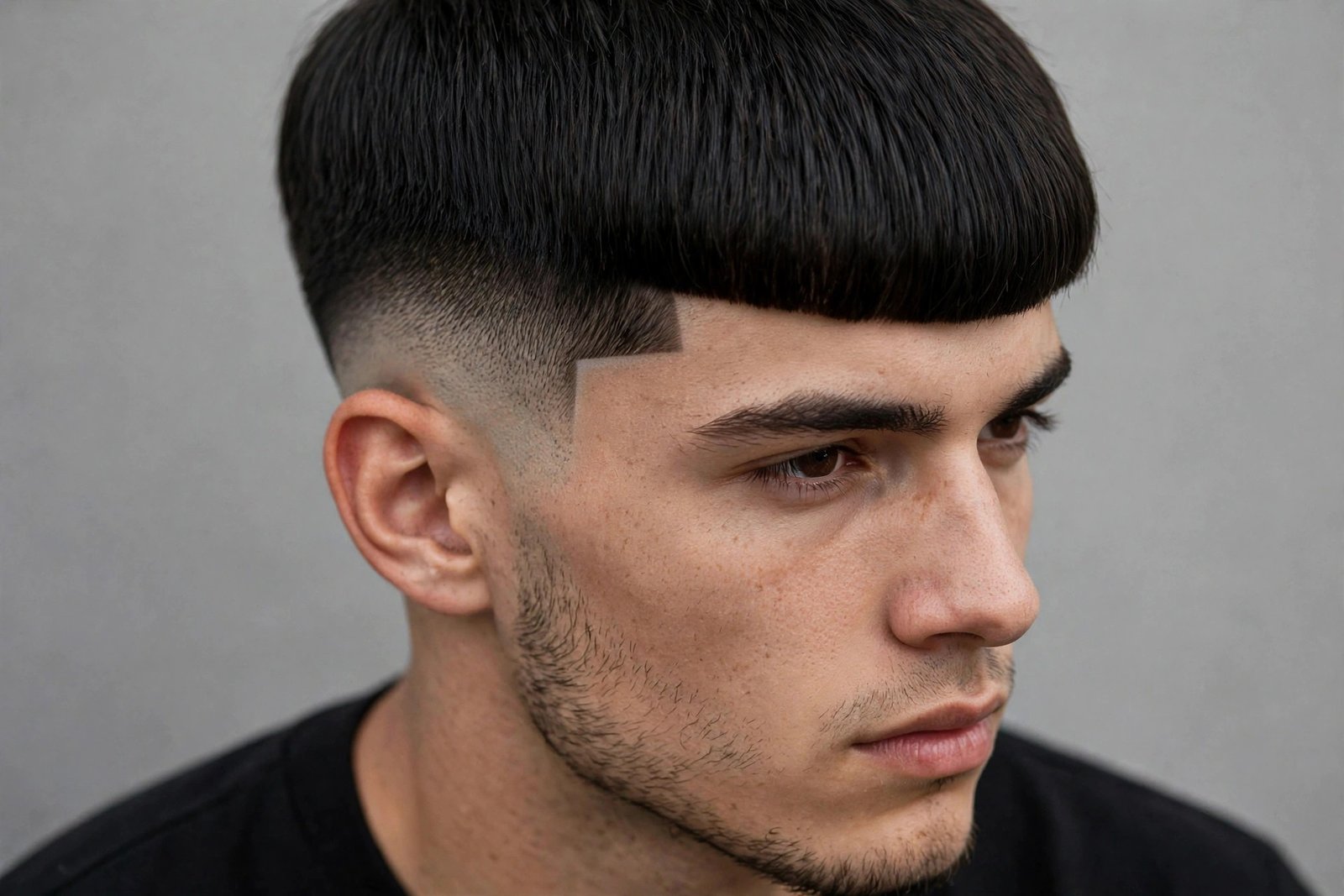
The line-up — the crisp, razor-sharp shaping of the hairline, temples, and forehead corners — is the detail that makes an Edgar look expensive. The defined line-up Edgar puts that detail center stage: the hairline is carved with geometric precision, the temples are squared with intention, and the corners where the fringe meets the sides are sharp enough to look drawn. It’s the difference between a haircut and a finish. Barbers will tell you the line-up is the last five minutes of the cut; this version argues it’s the most important five minutes.
Who it suits: guys with a hairline worth framing — strong, reasonably straight, no significant recession. I’ll be direct: if your hairline is receding notably, a harsh line-up draws attention to exactly what you’re trying not to showcase, and you’d be better served by a softer version. For everyone else, the defined line-up flatters all face shapes and works with any Edgar variation underneath — it’s a finish, not a structure, so it layers onto the classic, the textured, the curly, all of them. It’s particularly transformative on darker hair, where the carved line contrasts dramatically with skin.
The barber script: “Edgar as usual, but I want the line-up razor sharp — square the temples, clean up the hairline, define the corners. Take your time on the finish.” The tool matters: a straight razor gives the sharpest line-up, trimmers are faster but slightly softer. Ask which they’ll use — for this version, you want the razor. Discuss the temple shape: squared temples look bold and modern, slightly rounded temples look natural. And be honest about your hairline: a good barber will tell you if your hairline won’t hold a sharp line-up, and you should listen.
Home styling is standard Edgar; the line-up needs nothing day to day. But the maintenance is relentless — a sharp line-up lasts seven to ten days before softening, which means weekly touch-ups to keep the defined look. Many barbers offer quick line-up-only appointments; use them. The honest downside is the treadmill: this version’s entire identity is crispness, and crispness is perishable. Let it slide two weeks and you don’t have a “defined line-up Edgar” anymore — you just have an Edgar. It’s also the version most affected by barber skill; a wobbly line-up is worse than no line-up. Commit to the schedule or choose a version that forgives.
28. The Edgar Pompadour Blend
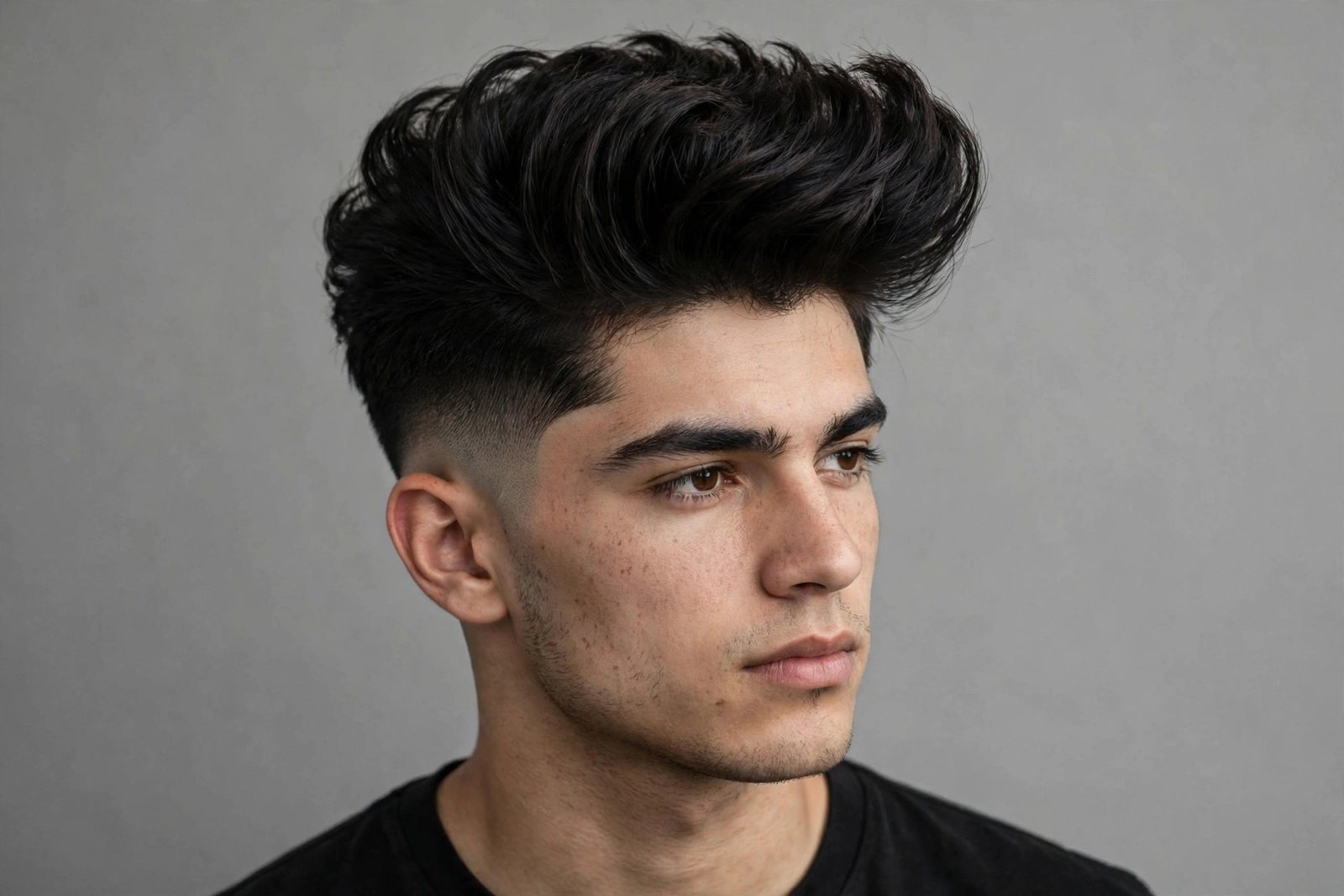
The final entry is the wild card: the Edgar pompadour blend takes the cut’s heavy fringe and sweeps it up and back into pompadour-like volume, keeping the faded sides and the Edgar’s DNA while borrowing the pomp’s height and drama. The fringe doesn’t fall forward — it rises, sculpted up and slightly back, creating a silhouette that’s part Edgar, part rockabilly, entirely its own thing. It’s the version for the guy who’s had the standard Edgar, loved it, and is ready for what’s next. In 2026, as the Edgar matures, hybrids like this are where the interesting work is happening.
Who it suits: guys with the length and the patience — you need three to five inches on top minimum, and the styling takes longer than any other version here. It flatters longer and rounder faces (the height lengthens and slims), and it needs medium-to-thick hair with some natural body; fine flat hair won’t hold the volume. It’s the most formal Edgar — the sculpted height reads polished and deliberate, making it the version most likely to work at a wedding. If you’ve ever looked at a pompadour and thought “too retro” and at an Edgar and thought “too street,” this is your middle ground.
The barber script: “I want an Edgar base — faded sides, full top — but cut the fringe long enough to sweep up into volume, pompadour style. Keep the Edgar weight in front, just directed upward.” The length distribution matters: the front needs the most length (for the sweep), graduating slightly shorter toward the crown. Ask the barber to cut it with the intended styling in mind — this is a cut designed around the blow-dryer, and cutting it without that context produces the wrong shape. Bring a photo; “pompadour blend” is not standard vocabulary in every shop.
Home styling is the full production: blow-dry the front up and back with a round brush or vent brush for volume, then work a strong-hold product through — this is the one Edgar where a higher-shine product works, because the pomp heritage likes a little polish. It takes eight to ten minutes, the longest routine on this list. Pre-styler plus post-styler (a blow-dry cream, then a clay or pomade) gives the best hold. Maintenance every three to four weeks. The honest downside is the daily effort and the identity question: at what point is this just a pompadour with faded sides? Purists will argue you’ve left Edgar territory entirely. But hybrids are where haircuts evolve, and this one earns its place — it’s the Edgar all grown up, looking back at where it came from.
Edgar Cut Men: Styling Routine & Maintenance Guide
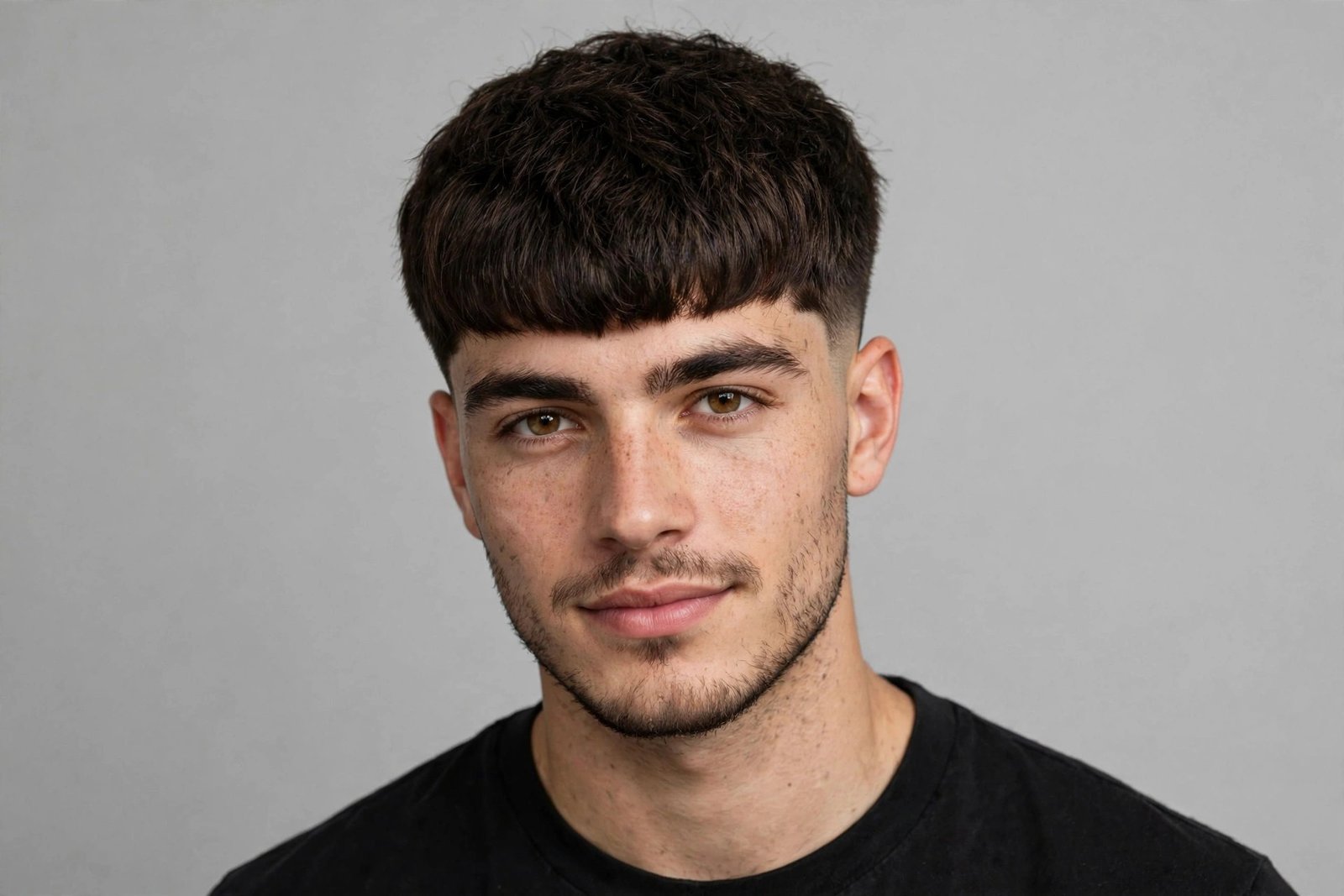
Here’s the truth about the Edgar that the viral videos skip: the cut is only half the haircut. The other half is the five minutes you spend every morning, and whether you spend them determines whether you look like the photo or like the photo’s tired cousin. The good news is that the routine is simple, repeatable, and — once it’s muscle memory — genuinely fast. This is the complete guide: the daily routine, the products that actually work, the maintenance schedule, and how to handle the grow-out without panic.
The Five-Minute Daily Routine
Start with damp hair — either fresh from the shower or misted with a spray bottle, because the Edgar styles best from damp, not wet and not dry. Work a pea-sized amount of product through the top (more on product choice below), then blow-dry the fringe forward and down. The technique: aim the dryer down the hair shaft from roots to ends, using a vent brush or just your fingers to guide the fringe flat against the forehead. The downward airflow is what keeps the fringe disciplined; drying upward or sideways is how you get the flip that ruins the line.
Once the fringe is 90% dry, press it into place. A final blast of cool air from the dryer sets the shape — heat styles, cool air locks, and that little detail is what separates a fringe that holds all day from one that gives up by lunch. Finish with the smallest additional touch of product if needed, pressing the fringe flat with your palms. That’s it. Five minutes, and the order matters: product, heat forward, cool set. Do it in that order every day and the Edgar becomes automatic.
On days you can’t be bothered — and those days will come — the shortcut version is damp fringe, fingers, a dab of product, air-dry while you do everything else. It won’t be as sharp, but a textured or grown-out Edgar survives this fine. The classic blunt version doesn’t; it needs the dryer. Know which version you’re wearing and calibrate your effort. And keep a travel-size product in your bag: the fringe is the first thing to misbehave in wind, rain, or helmet situations, and a thirty-second bathroom fix saves the whole day.
Products That Actually Work (and What’s a Waste of Money)
For most Edgar versions, the answer is a matte clay or matte paste with medium to firm hold. Matte matters because shine on a heavy fringe reads greasy fast — the fringe sits on skin, picks up oil, and anything glossy amplifies that. Clay gives texture and separation with a dry finish; paste gives slightly more pliability. Use less than you think: a pea-sized amount, warmed between the palms, worked through the mid-lengths and ends. The most common Edgar styling mistake is too much product, which makes the fringe heavy, stringy, and sad.
Sea salt spray is the secret weapon for the textured, wavy, and messy versions — sprayed on damp hair before drying, it adds grit and separation that makes texture look intentional. A light blow-dry cream or pre-styler protects the hair from heat and adds control for the longer versions. What you don’t need: high-shine pomades (wrong finish for every Edgar except the pompadour blend), heavy waxes (too much weight, too much shine), and most “volumizing” mousses (they create the wrong kind of volume — puffy rather than directed). Keep the arsenal small: one matte styler, one salt spray, done.
For the curly Edgar, swap the whole kit: curl cream or light leave-in conditioner instead of clay, applied to soaking damp hair, scrunched forward. For the bleached Edgar, add purple shampoo twice a week and a weekly deep-conditioning mask — bleach maintenance is non-negotiable. And whatever your version, a heat protectant is cheap insurance if you blow-dry daily. Your hair will thank you in six months when it’s still healthy enough to hold the cut.
Barber Visits: The Schedule That Keeps It Sharp
The Edgar runs on a rhythm, and the rhythm depends on your version. High-contrast versions — skin fade, buzzed sides, defined line-up — need a line-up touch-up every one to two weeks and a full cut every three weeks. Mid-fade and textured versions stretch comfortably to three to four weeks for the full cut, with line-ups optional. Taper, grown-out, and low-fade versions go four to six weeks. The bleached version adds color maintenance every four to six weeks on top of the cutting schedule.
Book the line-up touch-ups as standalone appointments — most barbers offer them cheaper and faster than full cuts, and they’re the highest-value fifteen minutes in grooming. The line-up is what makes the Edgar look expensive; everything else can slide a few days, but a fuzzy hairline undoes the whole effect. Between appointments, resist the urge to trim the fringe yourself. DIY fringe trims are how good Edgars die — the line goes crooked, you try to fix it, it gets shorter, and suddenly you’re wearing a different haircut. Leave the fringe to the professional.
Find a barber who actually cuts Edgars regularly, not one who’s willing to try. Check their portfolio for fringes and fades specifically — the Edgar is a fringe-first cut, and barbers who specialize in scissor work over clipper work sometimes struggle with the precision the fringe demands. Once you find your person, stay loyal: the Edgar evolves with your barber’s understanding of your hair, and the third cut is always better than the first. Tipping well and rebooking before you leave keeps you in the chair you want.
Growing It Out or Moving On
Every Edgar ends one of two ways: you grow it out or you cut it off. Growing out is the easier path — the Edgar’s grow-out is genuinely one of the better ones in men’s haircuts. The fringe gains length and softness, the fade melts into a taper, and for a few months you’re wearing what this article calls the grown-out Edgar, which looks intentional. The awkward phase hits around month three to four, when the fringe is too long to sit flat but too short to push back. Push through it — by month five you can transition into a textured crop, a French crop, or a longer forward style without ever looking unkempt.
Cutting it off is simpler: any short cut erases the Edgar instantly. A buzz cut fade is the clean reset; a textured fringe keeps some of the forward energy while dropping the severity. The one transition to avoid is growing the sides out while keeping the fringe short — that inverts the Edgar’s proportions and looks like a mistake rather than a plan. Whatever you do next, keep the fringe and the sides moving in the same direction: both growing, or both going short.
And if you’re on the fence about getting the Edgar at all, here’s the honest math: it’s a medium-maintenance cut with high visual payoff, a two-to-four-week barber rhythm, and a grow-out that won’t punish you. The guys who regret the Edgar are the ones who wanted a wash-and-go cut — that’s never been what this is. The guys who love it are the ones who enjoy the five-minute morning ritual and the way the cut photographs. Know which group you’re in, pick your version from the 28 above, and bring the photo. Your barber will handle the rest.
Edgar Cut Men: Frequently Asked Questions
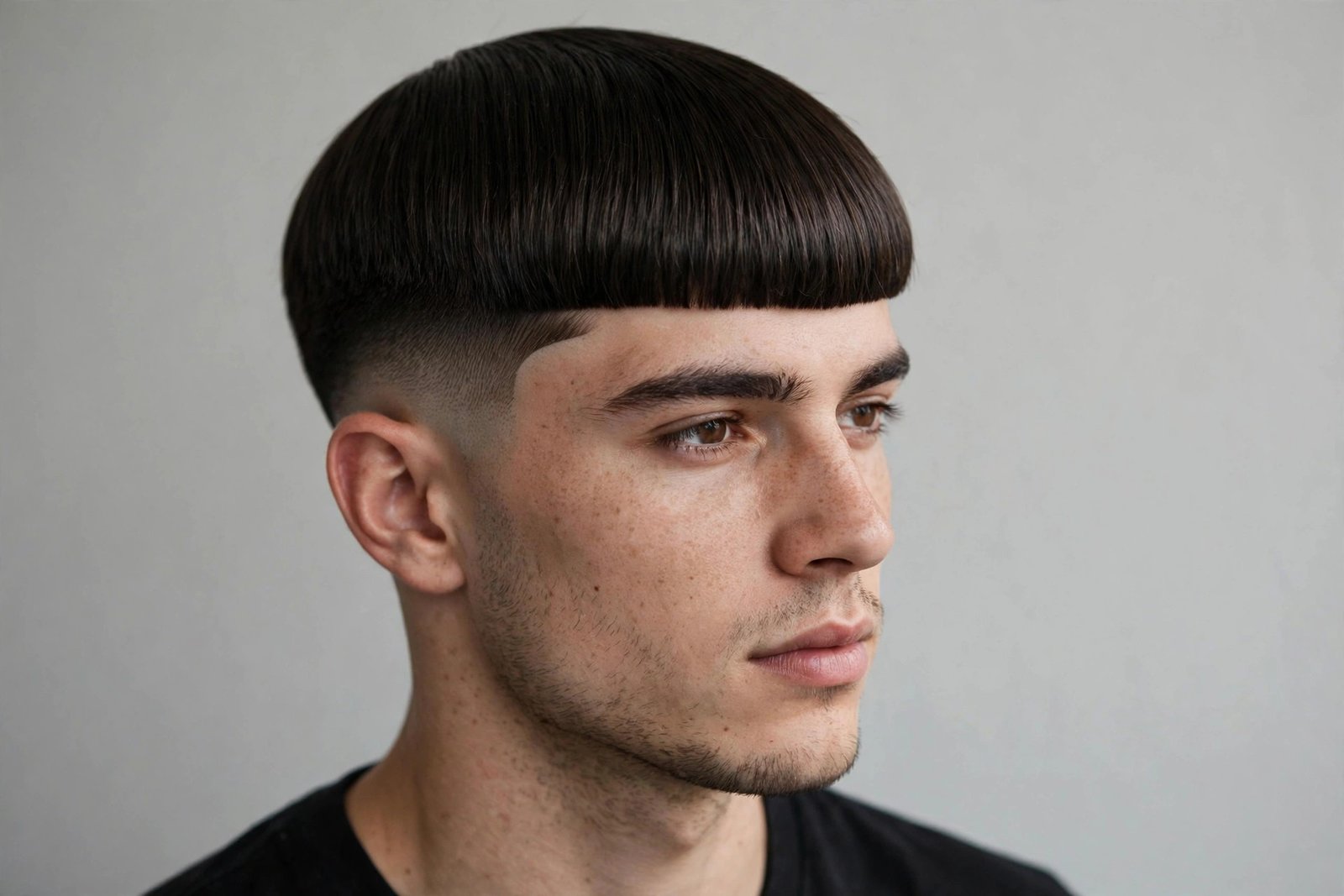
Straight answers to the questions every guy asks before committing to the fringe — no fluff, no sales pitch, just what you need to know.
What exactly is an Edgar cut?
The Edgar cut is a bold men’s haircut built around one unmistakable feature: a heavy, blunt fringe cut straight across the forehead, like a sharp curtain of hair. The top stays full and relatively straight while the sides and back are taken down with a high fade or taper — skin fade for maximum contrast, or a softer taper for something more wearable. It grew out of the bowl cut, refined through barbershop culture and Latin American street style, and the name is widely tied to the baseball player Edgar Martinez, whose jersey inspired fans who’d ask for ‘the Edgar.’ In 2026 it’s one of the most recognizable cuts on the planet — and one of the most requested in my barber’s chair.
What face shape suits the Edgar cut best?
The Edgar loves strong bone structure. Oval and square faces wear it best, because the straight fringe emphasizes a defined jawline instead of fighting it. Heart-shaped faces do well too — the heavy fringe balances a wider forehead. Round faces need caution: a wide, low fringe can make a round face look rounder, so ask for a slightly shorter, narrower fringe and a higher fade to add vertical lines. Long, narrow faces should keep the fringe fuller and avoid going too high on the sides, since extra height on top stretches the face further. When in doubt, bring your barber three photos of guys with a face shape like yours — that settles the debate faster than any theory.
How do I ask my barber for an Edgar cut?
Bring photos — seriously, this is the one cut where a picture beats a thousand words, because ‘Edgar’ means different things to different barbers. In words, say: ‘Heavy blunt fringe straight across the forehead, full length on top, high fade on the sides — skin fade if you want it sharp, taper if you want it wearable.’ Mention the guard number for the sides (a 1 guard on top of the fade is classic), and ask for a crisp line-up along the hairline and temples. If your barber has never cut one, the photos do the teaching. And be honest about your styling effort — a good barber will adjust the fringe length to match how much work you’ll actually do each morning.
How long does an Edgar cut last before it needs a touch-up?
The sharp, red-carpet version lasts about two to three weeks. The line-up around the hairline and temples softens first — that’s the detail that makes the Edgar look expensive, so many guys book a quick line-up touch-up every one to two weeks between full cuts. The fade grows out noticeably by week three, and the fringe starts falling into your eyes by week four, which is your sign to sit back in the chair. If you stretch it to five or six weeks without a touch-up, it drifts into fluffy grown-out territory — which honestly looks great too, just different.
Does the Edgar cut work on curly hair?
Absolutely — some of the best Edgars I’ve seen are on curly hair. Curls give the fringe natural volume and texture, so you get that heavy forehead line with movement built in. The one rule: the sides still need to be faded tight, because curly volume everywhere kills the contrast that defines the cut. Ask your barber to texture the fringe rather than blunt-cut every curl the same length, and use a light curl cream instead of heavy wax so the curls stay defined. It’s slightly more maintenance than a straight-hair Edgar, but the payoff is a version nobody else in the room will have.
Is the Edgar cut high maintenance?
It’s medium maintenance, and I’ll be honest — the fringe is the whole job. Mornings take about five minutes: dampen the fringe, blow-dry it straight down and slightly forward, and press it flat with a small amount of matte clay or paste. If you skip the blow-dryer, the fringe flips and lifts, and the cut loses its signature edge. The faded sides need a line-up every one to two weeks to stay crisp. So it’s not a wash-and-go haircut, but it’s not a full production either. Five minutes and the right product is the entire routine.
Will the Edgar cut work on thin or fine hair?
I’ll be straight with you: the Edgar is a density-hungry cut. That heavy blunt fringe needs real hair to look sharp — on thin or fine hair, the fringe can look wispy and expose scalp, which is the opposite of the bold look you’re after. If your hair is on the thinner side, you have options: keep the fringe shorter and slightly textured rather than long and blunt, ask your barber to avoid thinning shears on the fringe line, or consider a textured fringe cut instead, which fakes fullness better. A good barber will tell you honestly whether your hair can carry it — and you should let them.
Can I get an Edgar cut with longer hair on top?
Yes, and the longer-top Edgar is one of the strongest versions of the cut in 2026. Keeping three to five inches on top gives you the fluffy, grown-out Edgar: the fringe drapes forward with natural movement while the faded sides keep the silhouette clean. It needs a bit more daily work — longer fringe needs heat and product to behave — but it buys you versatility, because you can push it up, sweep it to the side, or let it hang forward. Tell your barber you want ‘Edgar with length on top, keep the fringe forward’ and bring a photo of the exact drape you like.
Conclusion
Twenty-eight versions, one signature: the fringe. That’s the whole story of the Edgar cut men are wearing in 2026 — a single bold idea, executed twenty-eight different ways, each one tuned to different hair, different faces, different lives. The classic is still the classic for a reason. The textured and fluffy versions are where most guys actually land. The curly, wavy, and grown-out takes prove the cut is bigger than its meme origins. And the hybrids — the mullet, the pompadour blend, the bleached fringe — are where it’s going next.
My honest advice, after all of this: pick the version that matches the effort you’ll actually put in, not the version that photographs best. The sharpest Edgar in the world looks worse than a mediocre one if you won’t do the five minutes. Bring three photos to your barber — not one, three, so they can see the range of what you like. Be honest about your hair’s density, your face shape, and your mornings. A good barber will steer you to the right number on this list, and you’ll walk out with a cut that looks like it was always yours.
The Edgar isn’t subtle, it isn’t safe, and it isn’t for everyone — and that’s precisely why it works. In a sea of identical fades, it’s a haircut with a point of view. If you’re ready to make the fringe your signature, the chair is waiting. For more fringe-forward ideas, check out the Caesar cut and the blowout taper — and if you want the full story on where the Edgar came from, the history of hair is a deeper rabbit hole than you’d expect. See you in the chair.