Two Strand Twists Men 2026: 15 Styles, Starter Guide & Full Care Routine
Two Strand Twists Men 2026: The Complete Twist Guide
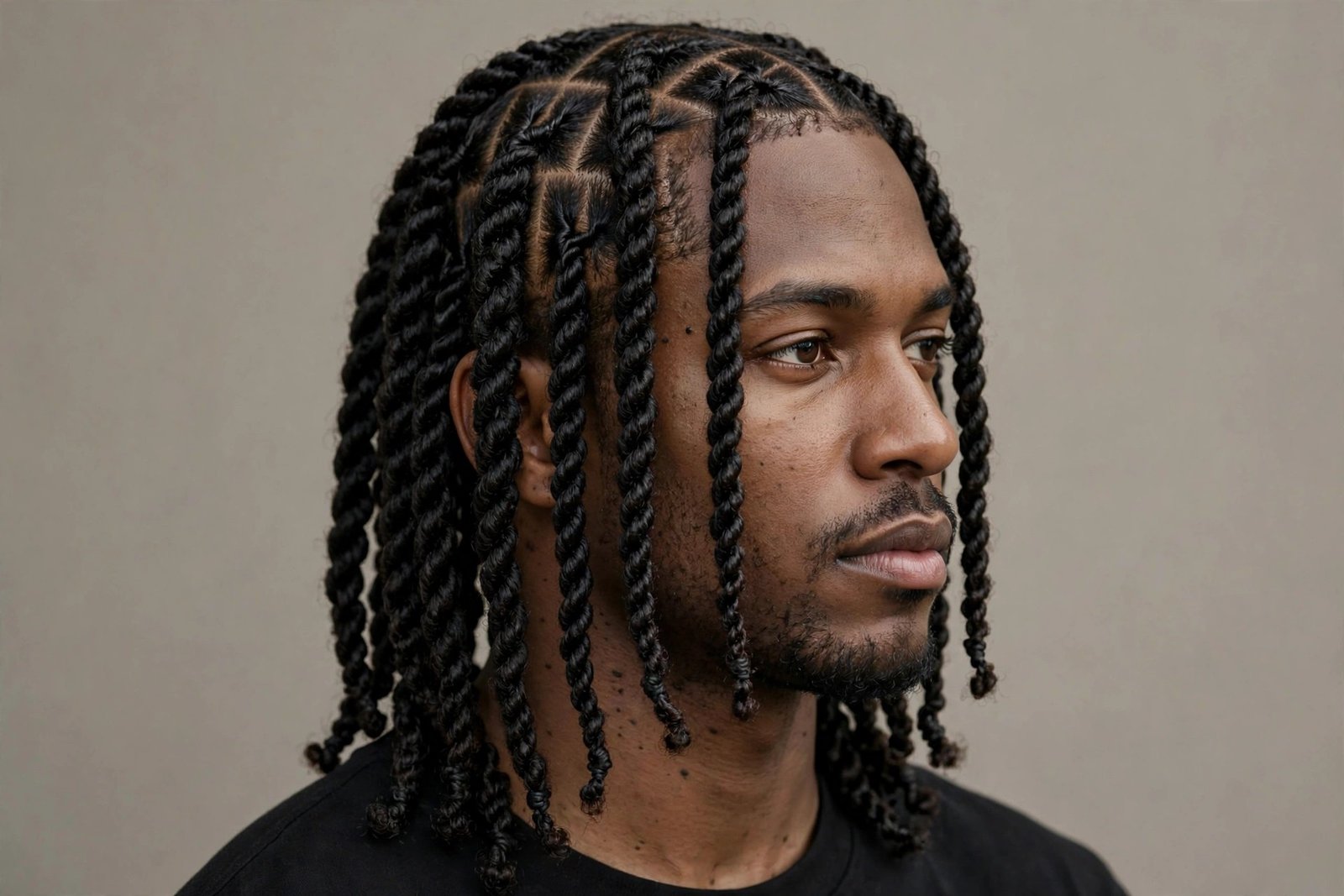
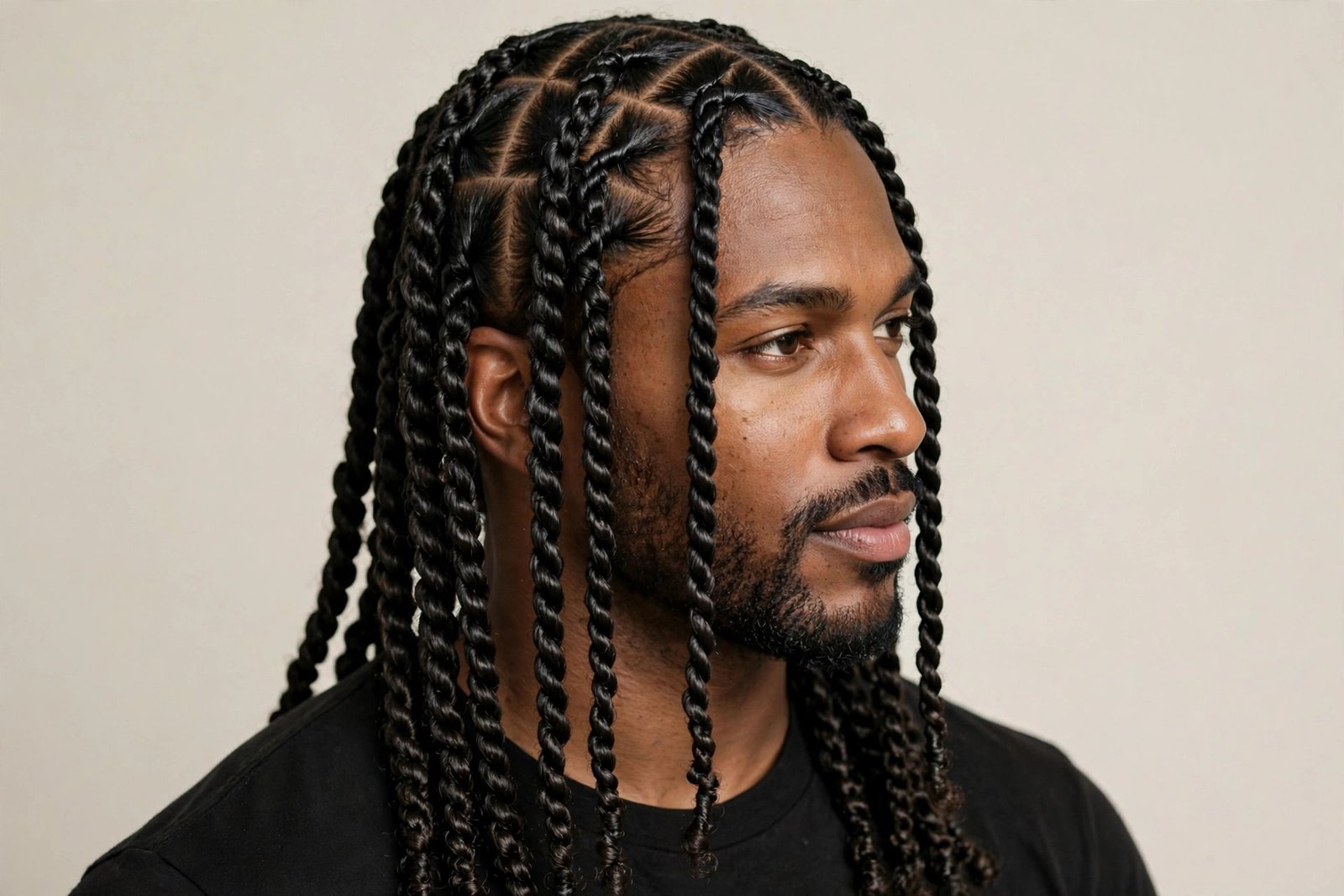
Two strand twists men are wearing in 2026 represent one of the smartest moves in modern grooming: a style that’s protective, low-maintenance, endlessly versatile, and — let’s be honest — looks fantastic on almost everyone who grows it out right. Two simple strands of hair, twisted rope-style around each other, repeated across the whole head. That’s the entire technique. And yet the range of what you can do with it — from sharp short starter twists to waist-grazing (well, shoulder-grazing) statement lengths — is genuinely wild. This guide covers the full journey: 15 two strand twist styles for men in 2026, the exact process for starting them, the wash-day routine that keeps them healthy for months, and the honest answers to every question guys actually ask before twisting up.
Inside: what twists are and what they aren’t (no, they are not automatically dreads), the hair length and type you actually need, step-by-step styling for all 15 looks, the night routine that doubles their lifespan, products that work versus products that waste your money, and how to grow twists out through every awkward stage without quitting at month three.
I’ll be honest with you: most twist advice online falls into two camps — barbershop shorthand that’s too vague to act on, and natural-hair blogs written for a different head of hair than yours. This guide sits in the middle. I’ve spent years watching guys start twists, abandon them at the frizzy phase, then come back six months later wishing they’d stuck it out. The difference between twists that look crisp for months and twists that look tired in three weeks is almost never talent — it’s the boring fundamentals: clean parts, the right products, a durag at night, and the patience to let month two do its thing. Get those right and the rest is just enjoying the ride.
Table of Contents
- Two Strand Twists Men 2026: The Complete Twist Guide
- 15 Two Strand Twist Styles for Men in 2026
- Starter Guide, Wash Day & Long-Term Care
- Frequently Asked Questions
- Conclusion
What Two Strand Twists Actually Are (and Aren’t)
The technique is beautifully simple: take a small section of hair, divide it into two subsections, and twist them around each other from root to tip, like a rope. Do that across the whole head in clean, consistent sections and you have two strand twists. The twist pattern holds textured hair together far longer than loose styling, which is why twists double as a protective style — your ends stay tucked, your hair stays stretched, and you stop manipulating it daily.
What they are NOT: dreads, automatically. This is the #1 confusion, and it deserves a straight answer. Twists only become locs if you let them — if you never untwist, never retwist, and let the sections matt together over many months. Maintained twists (retwisted every 4–8 weeks, washed on schedule, taken down when you’re done) will never lock up. Millions of men wear twists as a temporary protective style, take them down in 2–4 months, and enjoy the glorious twist-out that follows. So if someone told you twists = commitment to dreads, they told you wrong. Twists are a chapter, not a life sentence — though plenty of guys love the chapter enough to start another.
What hair type works: twists thrive on type 3 and 4 hair — curls, coils, and kinks that grip each other. The coilier the hair, the longer twists hold without unraveling. Looser textures (2C–3A) can absolutely wear twists, but they’ll need a twisting butter or gel with hold, and they’ll frizz faster — expect a 2–3 week crisp window instead of 4–6. Straight hair genuinely struggles here; the twists slide apart within days. If your texture is on the looser end, the curly hair guide has companion styles that may hold better for you.
Why Twists Are Everywhere in 2026
Walk through any city this year and you’ll see them: athletes, artists, guys at the office, guys at the gym. Twists hit a sweet spot that few styles manage — they read as intentional and polished (clean parts, uniform sections) while requiring almost zero daily effort. You wake up, take off the durag, shake, and go. In a year when everyone is tired of high-maintenance routines, that’s a powerful pitch.
The versatility is the real story. Short twists with a sharp lineup look clean enough for client meetings. Medium twists pulled into a top knot read creative and current. Long twists with a fade are pure statement. One install, three vibes, just by styling differently — and the same set of twists evolves in character as it grows, from crisp week-one definition to that lived-in, fuller look at week six that honestly has its own charm. Barbers won’t tell you this, but some guys prefer their twists at week four over week one. The style ages like a good pair of jeans.
There’s also the growth factor. Twists are one of the best styles for actually growing your hair out, because they keep ends protected and stop you from touching your hair all day. Guys who couldn’t get past the awkward stage with loose hair routinely grow 4–6 inches in twists without noticing, because the style carries them through the phases where they’d normally cut it all off. If growing long hair is the goal, twists aren’t just a style — they’re the vehicle.
Who Do Two Strand Twists Suit — Hair Length, Face & Lifestyle
Minimum length: you need about 2–3 inches of hair to start twists, and more is easier. At 2 inches you’ll get short, chunky starter twists (style 2 below). At 4+ inches the options open up dramatically. Below 2 inches, the sections won’t hold a twist — wait it out with a 360 waves routine or a short crop while you grow.
Face shapes: twists flatter nearly everyone because the silhouette is adjustable. Round faces do best with height on top — medium or long twists, or short twists with a fade that keeps the sides tight. Oblong faces benefit from medium-length twists that add width at the sides. Square faces look great with twists at almost any length; the texture softens the jawline. The lineup does heavy lifting here — a crisp edge-up frames any face.
Lifestyle check: twists are genuinely low-effort, but they ask for three commitments — a durag or bonnet every night (non-negotiable), washing on schedule even though it feels risky the first time, and retwisting or professional maintenance every 4–8 weeks. If you swim daily, twists can still work (rinse with clean water after), but chlorine-heavy routines demand more washing. If you wear helmets constantly (motorbike, construction), expect faster frizz at the crown — a durag under the helmet helps enormously.
Who should reconsider: if your hair is very fine and straight-leaning, twists will unravel fast and frustrate you. And if you absolutely cannot stand anything touching your head at night, the durag requirement will break you — twists without night protection last about a third as long. For braided alternatives with similar protective benefits, cornrows and braided styles for men are worth a look.
15 Two Strand Twist Styles for Men in 2026
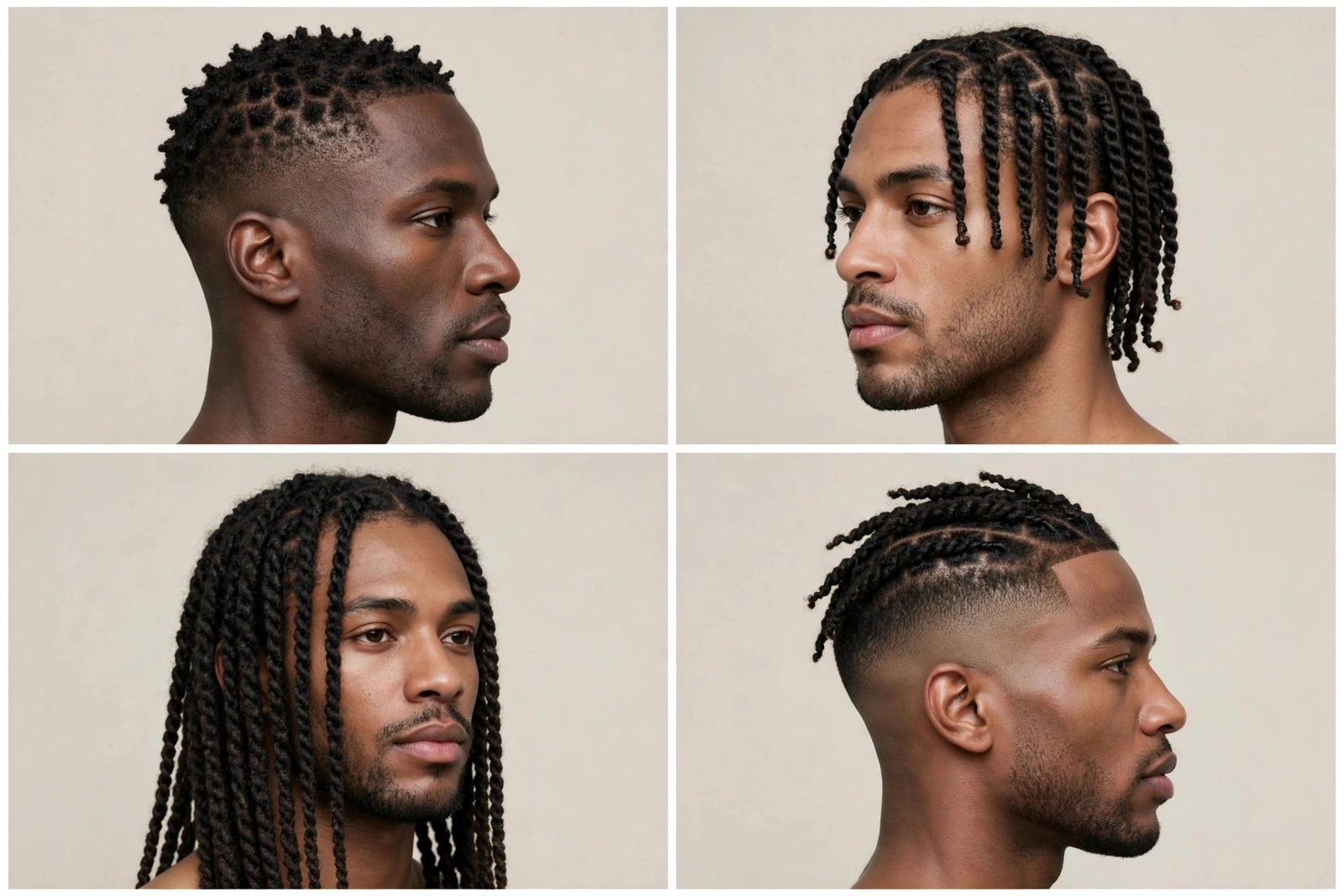
All 15 styles below work with real twist technique — clean parts, two strands twisted rope-style, proper night care. Each includes who it suits, how to get it installed, the styling reality, maintenance, and the mistake that ruins it.
1. Classic Medium Two Strand Twists
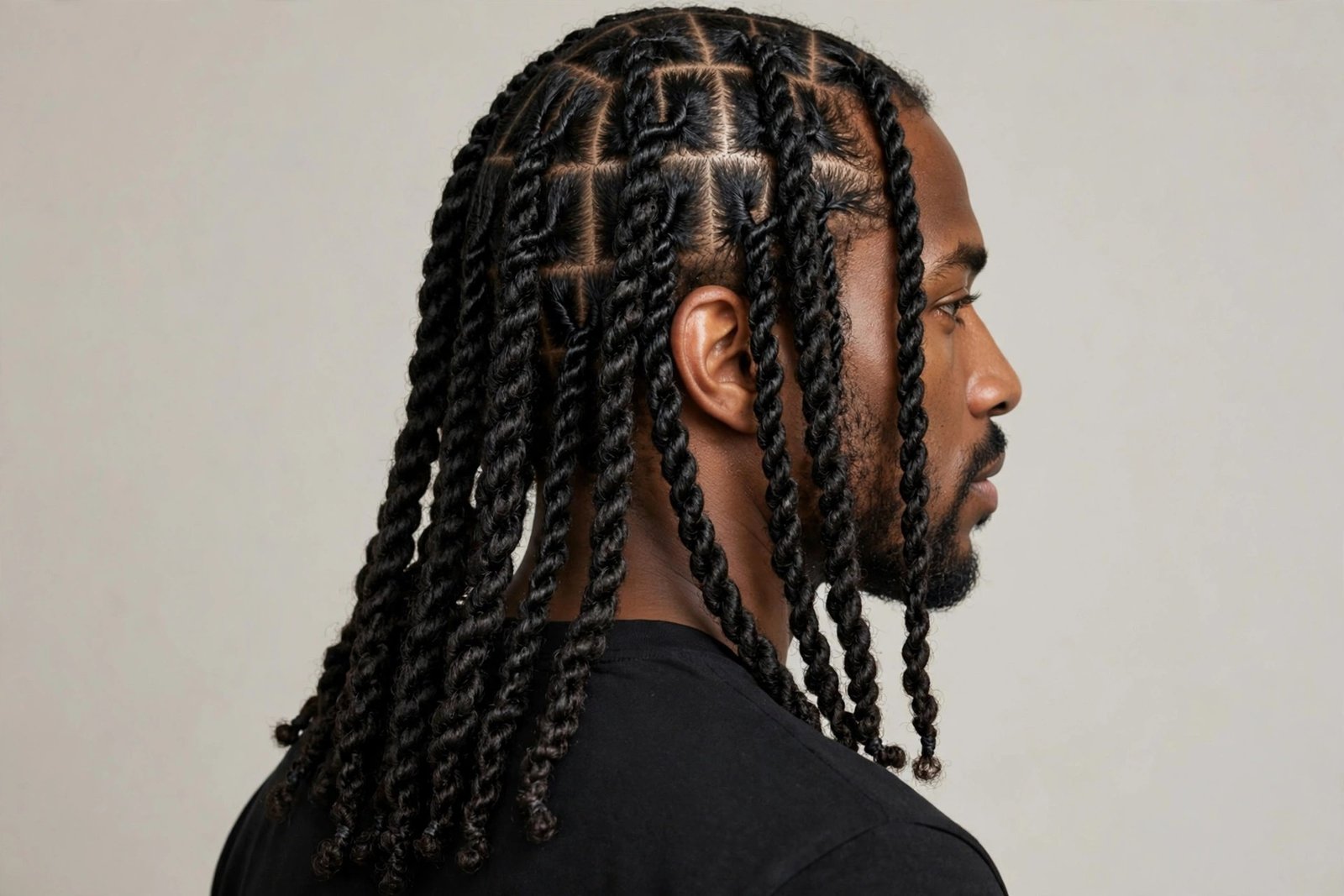
The gold standard: medium-length twists (4–6 inches of hair), medium-sized sections, clean parts, worn loose and free. This is the style most guys picture when they say “I want twists” — balanced, versatile, and flattering on nearly everyone. It sits right in the sweet spot: long enough to style multiple ways, short enough to install in a single afternoon.
Who it suits: type 3C–4C hair at 4–6 inches; every face shape; the perfect first-twists choice because it shows you the full experience — the crisp phase, the growth, the twist-out payoff.
How to get it: at the barber or loctician, ask for “medium two strand twists, clean parts, about [finger-width] sections.” A full head takes 2–4 hours depending on density. DIY is genuinely doable — section with a rat-tail comb, apply twisting butter to each section, and twist from root to tip keeping even tension. Your first self-install will be uneven; that’s normal, and it still looks good.
Styling (3 minutes daily): remove the durag, shake gently, maybe pick the roots for volume. That’s the whole routine. For variety, pull the front half into a loose top knot, or sweep everything to one side. A light oil sheen on the parts keeps it looking fresh between washes.
Products: twisting butter or cream for install, light oil (jojoba or grapeseed) for sheen, durag for nights. Maintenance: retwist the hairline and nape every 2–3 weeks (the sections that show frizz first); full retwist every 6–8 weeks. Total lifespan: 2–4 months per install.
Mistake to avoid: installing on dirty, product-heavy hair. Twists grip best on clean, lightly conditioned hair — start with a fresh wash and the twists hold twice as long.
Pro tips & variations: The medium twist is your laboratory — wear it loose for a month, then experiment with half-up styles and top knots to find your favorite silhouette before your next install. Variation: triangle parts instead of square parts give a more modern, geometric look that photographs beautifully. If your twists feel too uniform and “done,” rough up the roots slightly with your fingers at week three — a little lived-in texture at the roots makes the whole head look more natural while the lengths stay defined.
2. Short Starter Twists
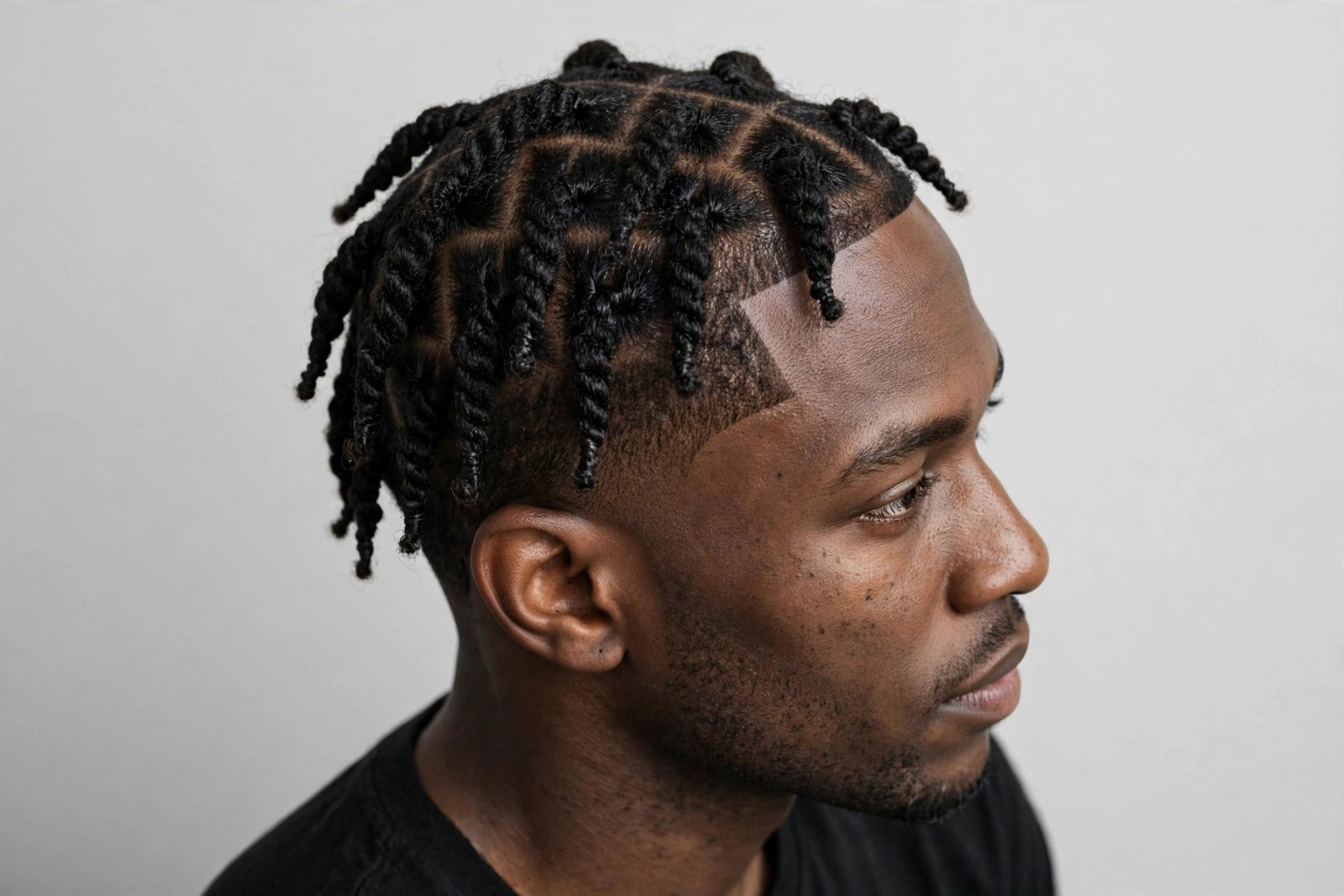
The entry point: 2–3 inches of hair twisted into short, chunky sections. Starter twists are how most twist journeys begin — you don’t wait a year to grow length, you twist what you have and let the style grow with you. They look sharp, intentional, and honestly great, especially paired with a crisp lineup and fade.
Who it suits: guys at 2–4 inches of growth; anyone impatient to start (most of us); round and square faces benefit from the height short twists add.
How to get it: ask for “starter twists, chunky sections” — with short hair, bigger sections hold better than tiny ones. Use a product with real hold (a twisting gel or butter with grip) because short hair unravels fastest. Expect 1–2 hours for install.
Styling (2 minutes): durag off, pick the roots lightly, go. Short twists are the lowest-effort style on this list. Keep the lineup fresh — the edge-up does half the visual work here.
Products: twisting gel or firm-hold butter, edge control for the hairline, durag. Maintenance: lineup touch-up every 1–2 weeks; retwist every 3–4 weeks (short twists frizz faster); take down or transition to medium twists at 3–4 months as length grows.
Mistake to avoid: sections too small. On short hair, micro-sections unravel in days — go chunky, and the twists survive.
Pro tips & variations: Starter twists are a growth strategy disguised as a style — every month they get longer, and by month four you’ll be choosing between keeping them short or transitioning to style 1. Take a photo at install day and another at month three; the growth will shock you and it’s the best motivation to keep going. Variation: pair with a mid fade from day one so the silhouette stays sharp while the top grows — the fade handles the “growing out” awkwardness for you.
3. Long Two Strand Twists
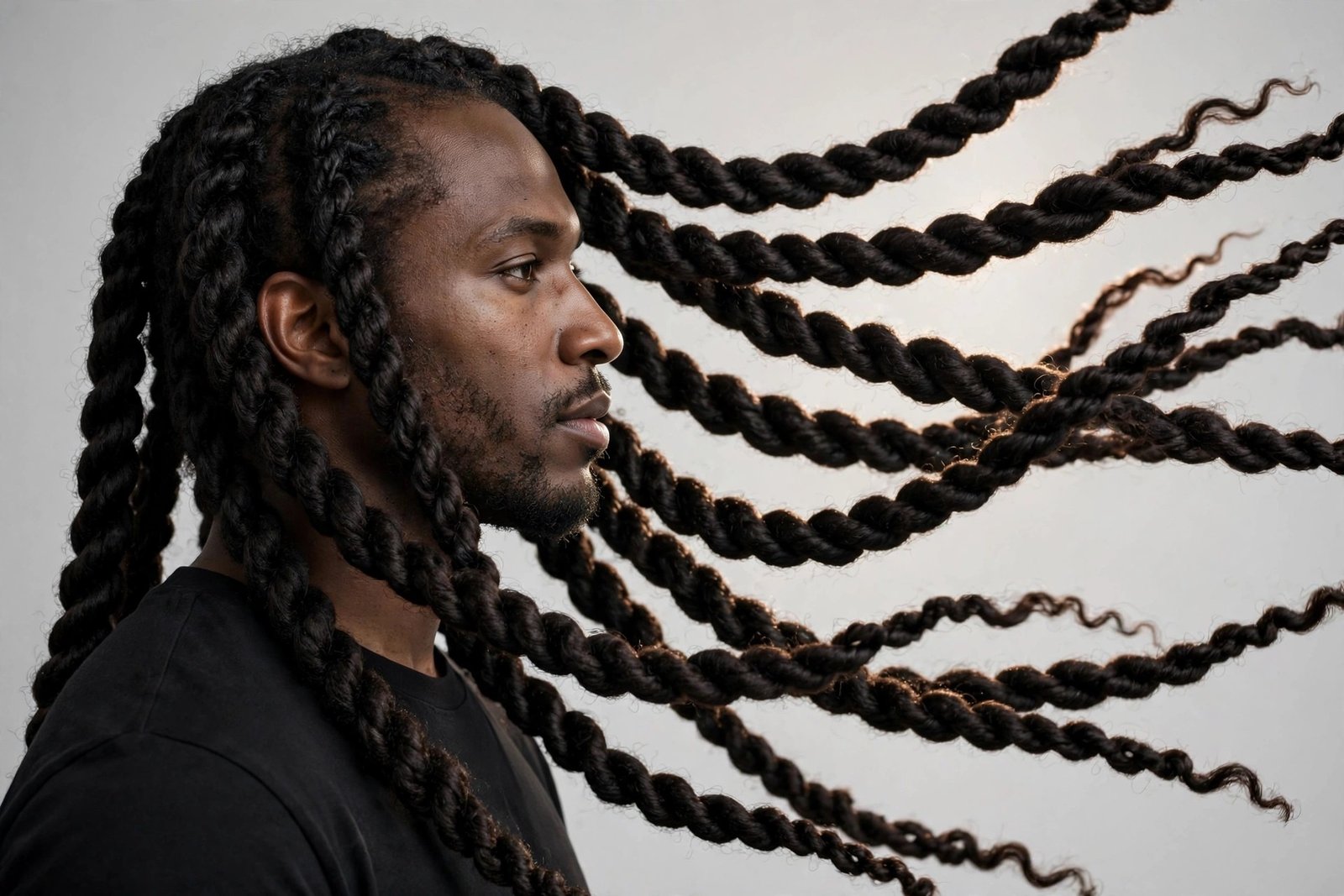
The statement: 8+ inches of hair in twists that move, swing, and get noticed. Long twists are a commitment — install takes 4–6 hours — but the payoff is one of the most striking silhouettes in men’s hair. They read confident, artistic, and completely unbothered.
Who it suits: guys who’ve grown through the medium phase (or started with length); thick, dense hair handles the weight best; oval and oblong faces wear the length beautifully.
How to get it: honestly, see a loctician for your first long install — the sectioning consistency matters more at length, and uneven long twists tangle. Ask for medium sections (too small = endless install time and fragile twists; too big = heavy). Budget a full afternoon.
Styling (5 minutes): the versatility explodes at length — wear loose, half-up, full top knot, low ponytail, or swept to one side. A loose low ponytail is the practical daily default; loose is the weekend look. Rotate styles to avoid tension in one spot.
Products: twisting butter, light oil for the lengths (long twists drink moisture), durag or bonnet (a bonnet fits long twists better). Maintenance: retwist roots every 4–6 weeks; deep-condition monthly; trim any thinning ends at takedown. Lifespan: 3–4 months.
Mistake to avoid: wearing them in the same tight ponytail every day — constant tension in one spot causes breakage at the tie point. Rotate your styles.
Pro tips & variations: Long twists and satin pillowcases are best friends — cotton steals moisture overnight and long twists have the most moisture to lose. Sleep with them loosely braided into 2–4 big plaits inside a bonnet; morning takedown gives you waves within the twists that look incredible. Variation: dye the tips (style 11) for contrast without committing the roots — long twists show color better than any other length. If the weight bothers your neck by month two, that’s normal — switch to more updos and the weight distributes better.
4. Two Strand Twists with Fade
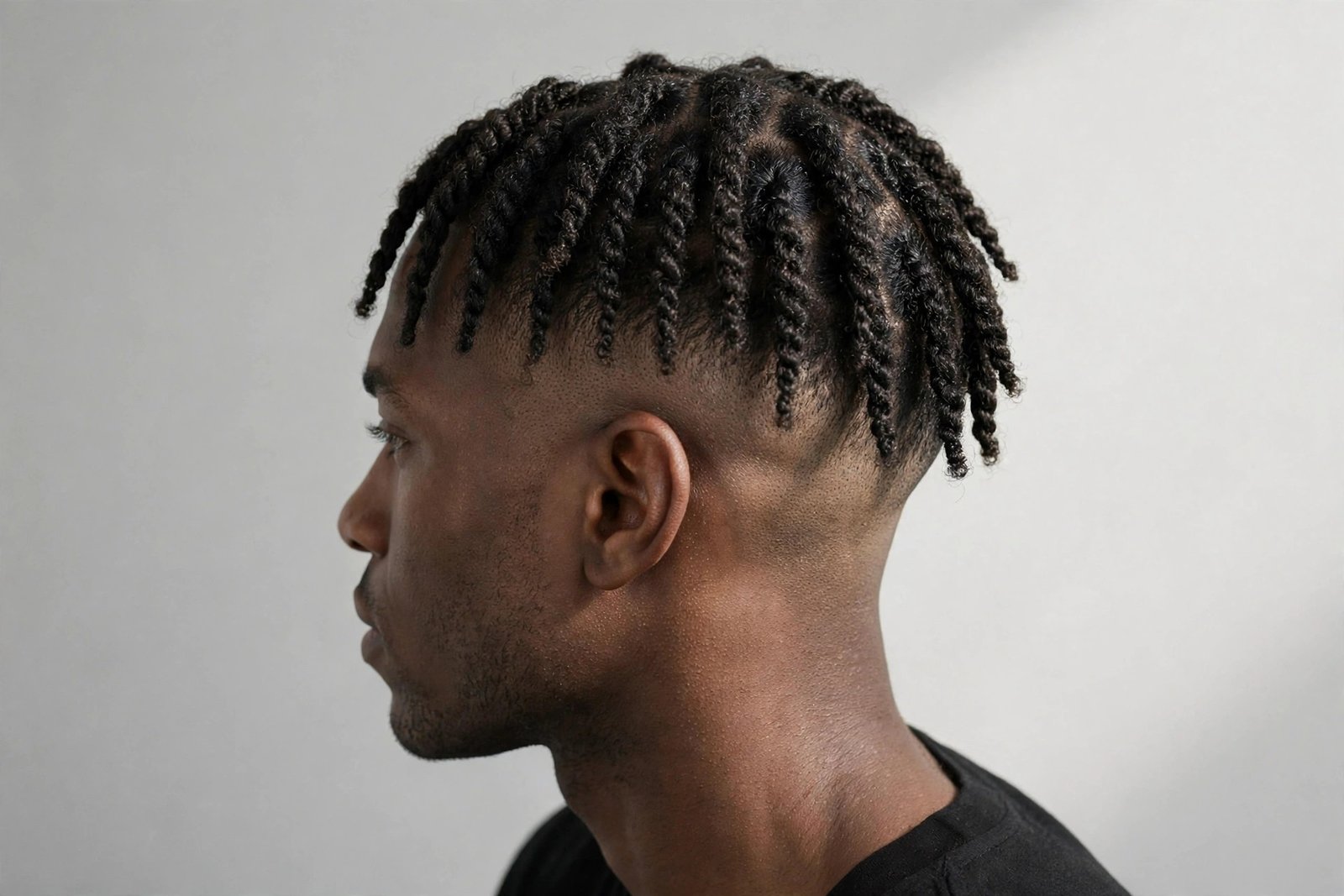
The modern classic: twists on top, fade on the sides. The fade gives twists a frame and a contrast that makes the whole style look sharper and more deliberate. It’s the most popular twist variation for a reason — the clean sides make the twists look intentional even at week six when the roots are doing their own thing.
Who it suits: everyone, genuinely — the fade adapts to every face shape (low fade for round faces, mid/high for oblong); great for professional settings where full twists might read too casual.
How to get it: tell your barber “twists on top, [low/mid/high] fade on the sides — and twist first, fade second, so the blend line is clean.” The order matters: installing twists first lets the barber fade right up to the twist perimeter. Budget 2–3 hours total.
Styling (3 minutes): same as classic twists on top; the fade needs nothing daily. Keep a brush handy for the fade’s edges if you like them laid.
Products: twisting butter for the top, standard fade upkeep. Maintenance: fade touch-up every 2–3 weeks (the fade shows growth fastest); retwist the top every 4–6 weeks. The fade keeps the whole style looking fresh between twist appointments.
Mistake to avoid: fading too high on your first go. Start with a low or mid fade — you can always go higher next time, but you can’t un-cut a high fade while the twists grow.
Pro tips & variations: The fade is your style’s clock — when the fade starts looking grown out, the whole head reads “overdue” even if the twists are fine. A 15-minute fade cleanup between full appointments keeps everything looking intentional. Variation: a drop fade follows the head’s curve and looks custom; a burst fade around the ears is bolder. Ask your barber to keep the fade’s top edge slightly soft where it meets the twists — a harsh line against soft twists looks disconnected.
5. High Top Two Strand Twists
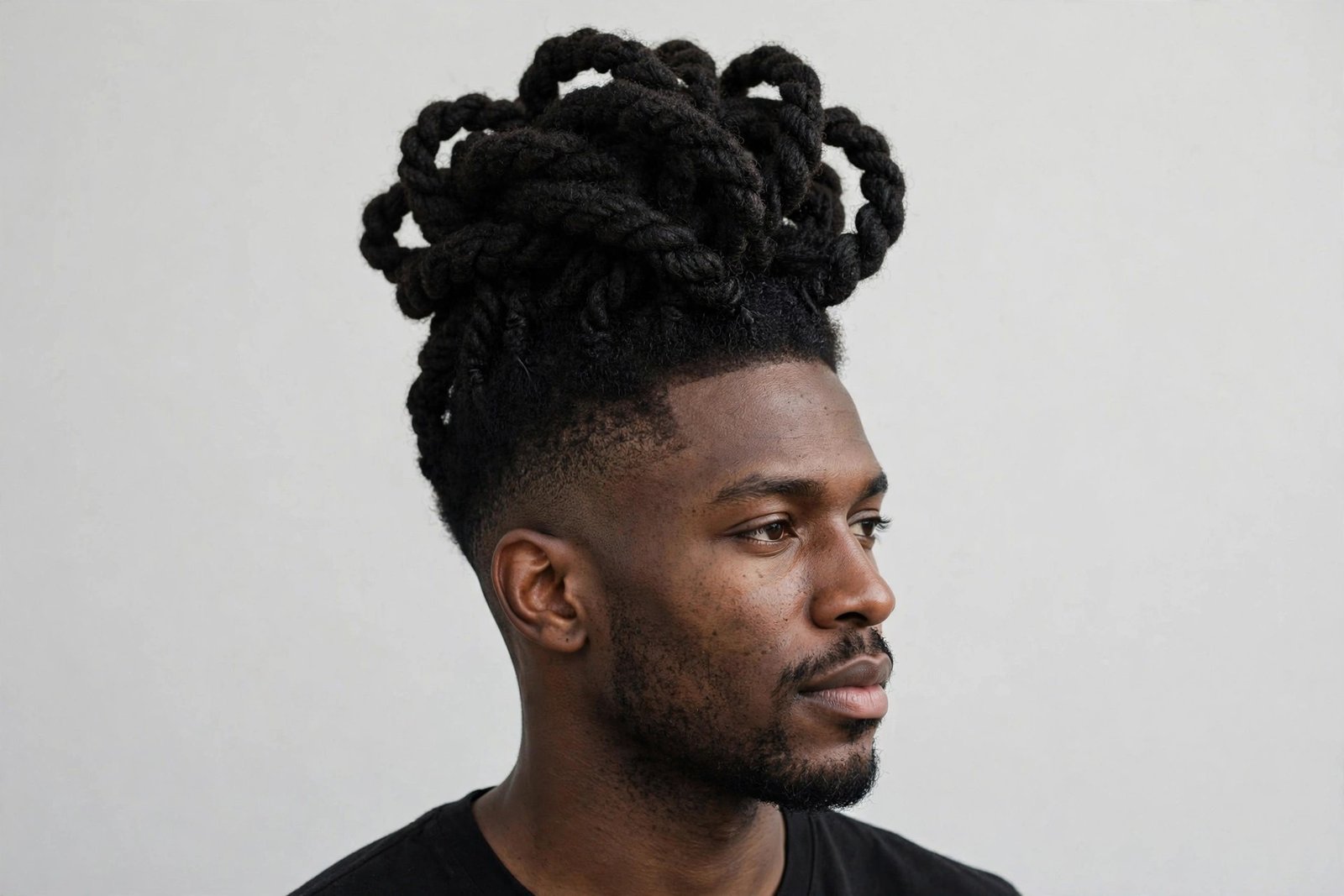
Volume as a statement: twists concentrated on top with height, tapered or faded sides. The high-top twist silhouette — full, proud, architectural — has roots in decades of Black hair culture and still turns heads. It’s bold in the best way: unapologetic volume worn with precision.
Who it suits: guys who want presence; round faces (the height slims); thick dense hair that can support the volume; anyone who likes their hair to arrive before they do.
How to get it: “High-top twists — keep 5–7 inches on top, taper or fade the sides, twist the crown in medium sections.” The top needs enough length for the twists to stand with volume rather than flop. A pick at the roots after install builds the height.
Styling (5 minutes): pick the roots for lift, shake the twists outward, and let the silhouette do the talking. A light oil sheen keeps it from looking dry at volume. On flat days, a hair pick is faster than product.
Products: twisting butter, hair pick, light oil. Maintenance: sides cleaned up every 2–3 weeks; retwist the top every 4–6 weeks; the height compresses over time — re-pick roots weekly.
Mistake to avoid: product overload. Heavy product at the roots collapses the lift that makes this style work — keep roots light, product on the lengths.
Pro tips & variations: The high top lives or dies on root lift, and root lift is 90% technique: pick the roots while the twists are slightly damp, lifting straight up, and let them set. Never pick dry twists aggressively — you’ll frizz the roots into a halo. Variation: a flat-top-inspired squared silhouette (cut the twist ends level) is the boldest version; a rounded silhouette is more wearable daily. If your twists are heavy enough to pull the style flat by afternoon, your sections are too big — medium sections hold height better than jumbo ones.
6. Two Strand Twists with Undercut
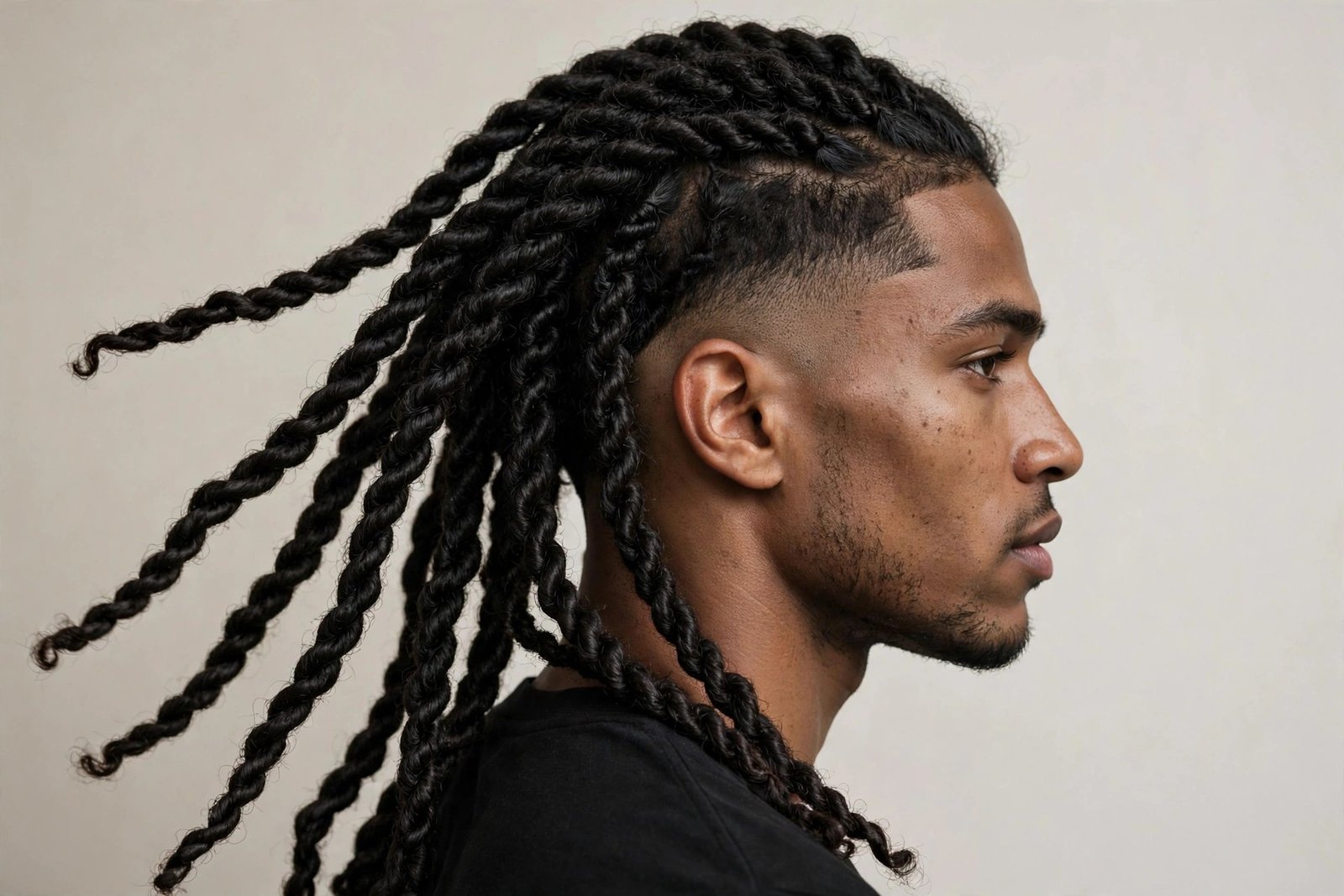
Maximum drama: a full head of twists up top against a disconnected undercut. Where the fade (style 4) blends, the undercut contrasts — one length on the sides, twists flowing over it. It’s edgier, bolder, and unmistakably intentional.
Who it suits: confident dressers; thick hair (the contrast needs density on top); oval and oblong faces; guys who want their twists to make an entrance.
How to get it: “Disconnected undercut — clip the sides to [guard length], leave the top long, twist the top in medium sections.” The disconnect line should be clean and deliberate, not accidental. This one’s better at a barber than DIY — the undercut line needs a steady hand.
Styling (4 minutes): wear the twists swept back over the undercut for the full contrast, or to the side for a softer read. The undercut needs nothing. A durag keeps the disconnect crisp overnight.
Products: twisting butter, light oil. Maintenance: undercut re-cut every 2–3 weeks (regrowth blurs the disconnect fast); retwist top every 4–6 weeks.
Mistake to avoid: letting the undercut grow past a month. The whole style is the contrast — once the sides grow out, it reads as an overgrown mess, not an undercut.
Pro tips & variations: The undercut grows out with zero grace — there is no “growing it out nicely” phase, so commit to the re-cut cycle or choose the fade instead. Variation: leave the undercut slightly longer (a #3–#4) for a softer contrast that’s more forgiving between cuts. Styling tip: define the twists with a little oil while damp after washing, then don’t touch them — the contrast between precise sides and free twists is the entire point, and fussy styling ruins it.
7. Chunky Jumbo Two Strand Twists
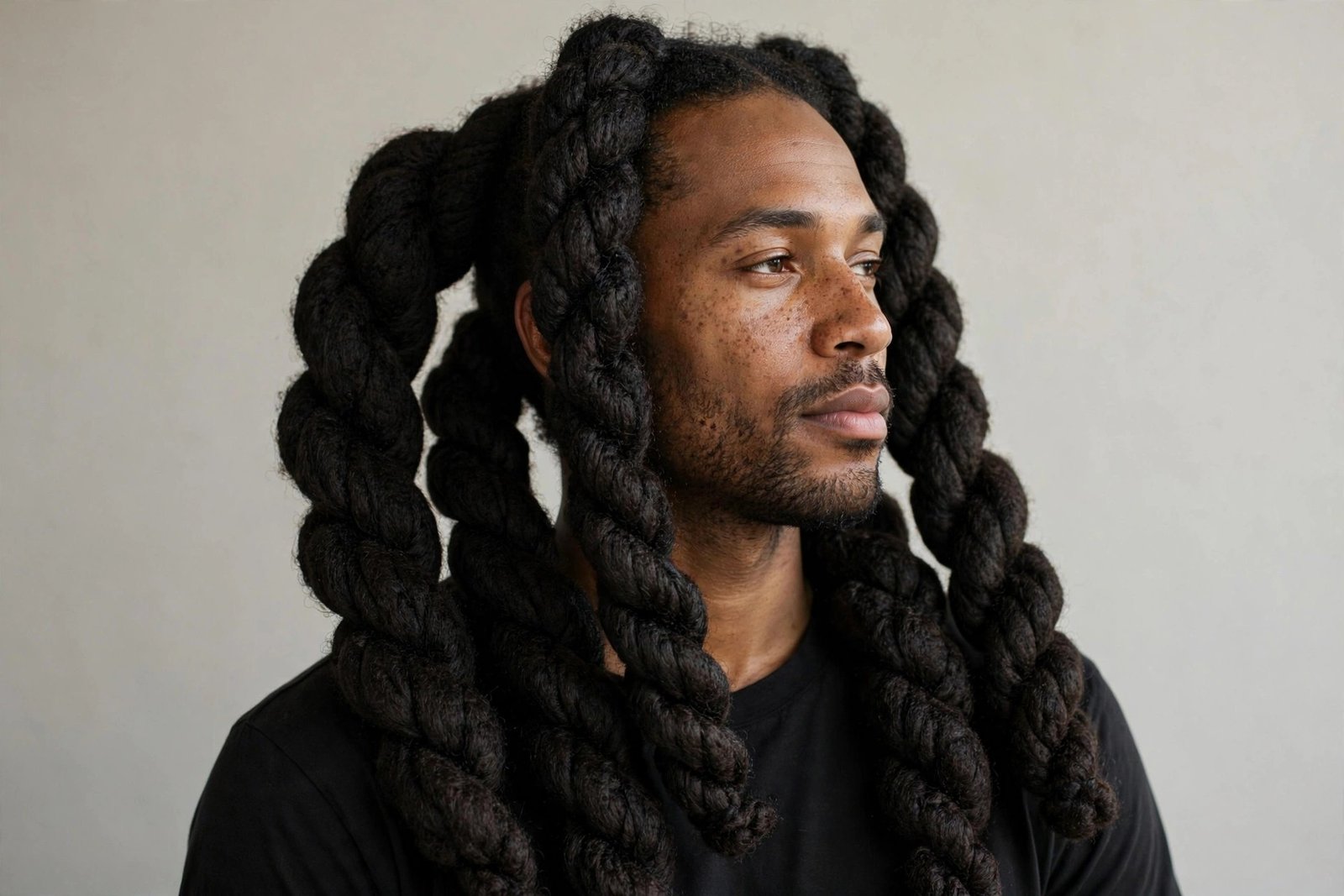
Big, bold, and fast: jumbo twists use large sections for a chunky rope effect. They install in half the time of medium twists (1–2 hours), make a louder visual statement, and have a relaxed, artistic energy. Fewer twists, more presence.
Who it suits: thick dense hair (jumbo sections need hair to fill them); guys who want fast installs; anyone who likes a bolder, less “neat” aesthetic; great for the gym — fewer twists to manage.
How to get it: “Jumbo twists — big sections, about two fingers wide.” Use a butter with good hold; jumbo twists unravel easier than medium ones because there’s less twist-per-inch gripping. Take your time at the roots — that’s where jumbos loosen first.
Styling (2 minutes): shake and go. Jumbos look best slightly undone — don’t over-neaten them. Pull half up for variety, or let them hang free.
Products: firm-hold twisting butter, light oil, durag (essential — jumbos frizz fast without night protection). Maintenance: retwist roots every 2–3 weeks (jumbos show root frizz earliest); lifespan 6–10 weeks — shorter than medium twists.
Mistake to avoid: expecting jumbos to last as long as medium twists. They won’t — bigger sections loosen faster. Plan for a shorter cycle and enjoy the ride.
Pro tips & variations: Jumbos are the best “weekend install” — start Saturday morning, done by lunch, great hair by dinner. They’re also the most forgiving for beginners: big sections are easier to part evenly and twist consistently than small ones. Variation: mix one or two accent-colored jumbos (temporary color wax) for personality without commitment. If a jumbo starts unraveling at the root, don’t wait — re-twist that one section immediately. One loose jumbo pulls its neighbors loose.
8. Micro Two Strand Twists
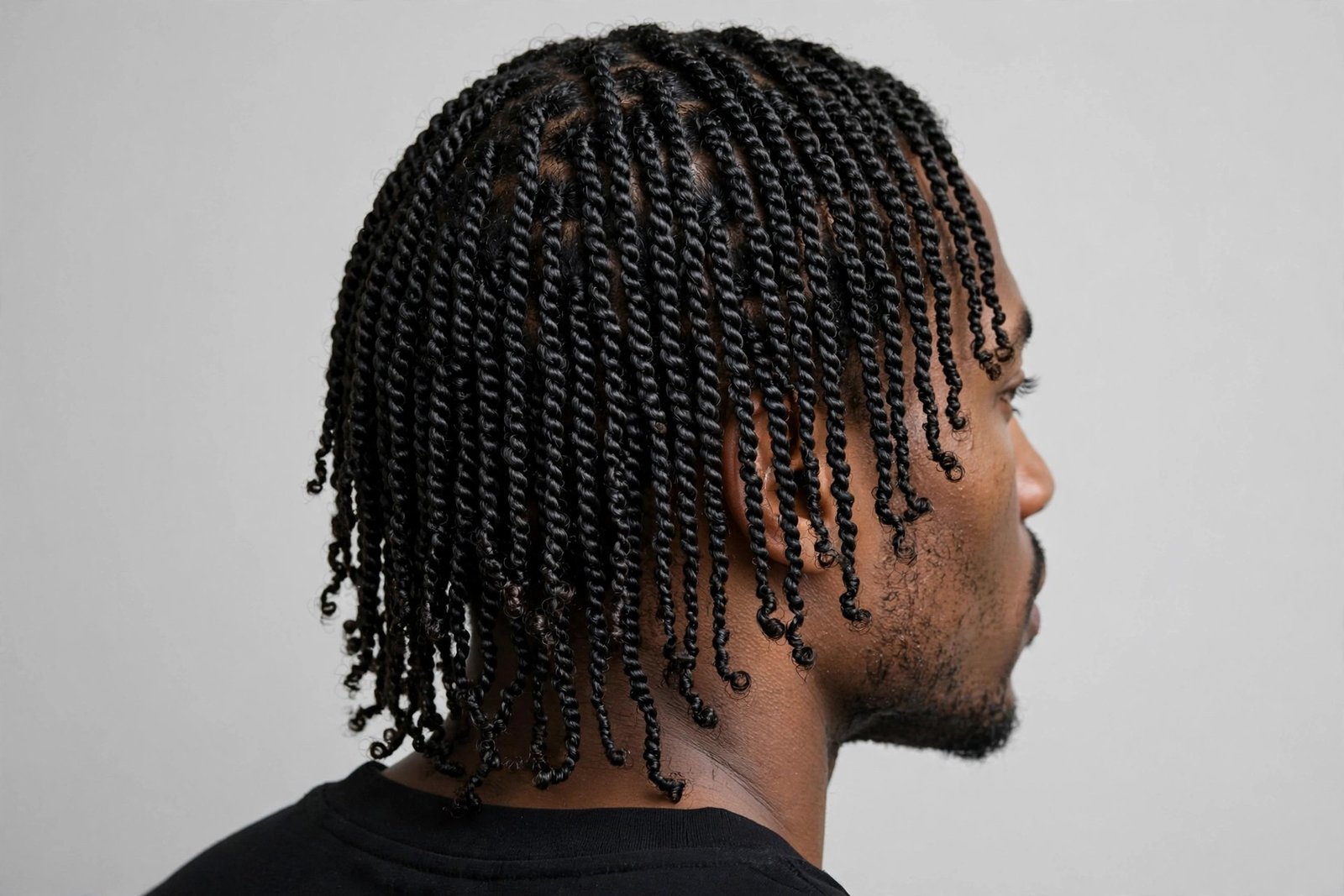
The precision option: tiny sections, dozens of fine twists, maximum definition. Micro twists look incredibly detailed and last the longest of any twist size — but the install is a genuine time investment (5–8 hours), so go in with snacks and a plan.
Who it suits: patient guys; fine-to-medium density hair (micros add visual fullness); anyone who wants twists that last 3–4 months; great under hats and helmets — they compress neatly.
How to get it: see a professional — micro-sectioning a full head evenly is genuinely hard DIY. Ask for “micro twists, small consistent sections.” Bring entertainment; you’ll be there a while. The per-twist cost is low but the hour count is real.
Styling (4 minutes): micros style like loose natural hair — they move and fall in detailed waves. Wear loose, pull back, or gather into a low ponytail. They take styles beautifully because the small sections bend easily.
Products: light twisting cream (heavy butter weighs micros down), light oil, durag. Maintenance: retwist hairline every 3–4 weeks; full retwist at 8–10 weeks; lifespan 3–4 months — the longest-wearing twists.
Mistake to avoid: heavy products. Micros drown in thick butters — the twists go limp and collect buildup. Light products only.
Pro tips & variations: Micro twists are the marathon runners of the twist world — the install is long, but you get months of the lowest-maintenance hair of your life in return. They’re also the best twist size for active guys: they fit under swim caps, helmets, and durags without bulk. Variation: micros make the most dramatic twist-outs (style 15) — the definition is unreal. Warning: takedown takes as long as install. Budget a full evening, work in sections with conditioner, and never rush it — rushing micro takedown causes breakage.
9. Two Strand Twist Top Knot & Updos

Twists go up: the top knot, the half-up, the full bun. Once your twists reach medium length, updos unlock a second wardrobe for the same install — same twists, completely different energy. The top knot reads creative and sharp; the full bun reads relaxed and artistic.
Who it suits: medium to long twists (need enough length to gather); gym-goers and anyone who wants hair off the neck; great for hot weather and workouts.
How to get it: no special install — this is a styling option for styles 1, 3, and 5. Gather the twists loosely (never tight), twist the gathered mass once around itself, and pin or tie. For the half-up, gather just the front half. Loose is the look — tight updos cause tension breakage.
Styling (3 minutes): gather, loosely twist, secure with a scrunchie or a couple of pins — never a thin elastic, which snaps twists. Let a few twists fall free around the face for softness.
Products: satin scrunchie, bobby pins, light oil for the gathered roots. Maintenance: same as your base twists; rotate updo positions so tension doesn’t concentrate in one spot.
Mistake to avoid: the same tight bun every single day. Constant tension in one spot thins the hairline and breaks twists at the tie point — rotate positions and keep it loose.
Pro tips & variations: The pineapple (a loose high ponytail) is the updo’s nighttime cousin — it’s also how you should sleep in twists, so you’re practicing while you rest. Variation: two space buns for personality, a low bun at the nape for formal settings, or a half-up top knot that keeps twists flowing behind. If your updo gives you a headache, it’s too tight — loosen it until the headache test passes. Your edges will thank you in five years.
10. Two Strand Twists with Temple Fade
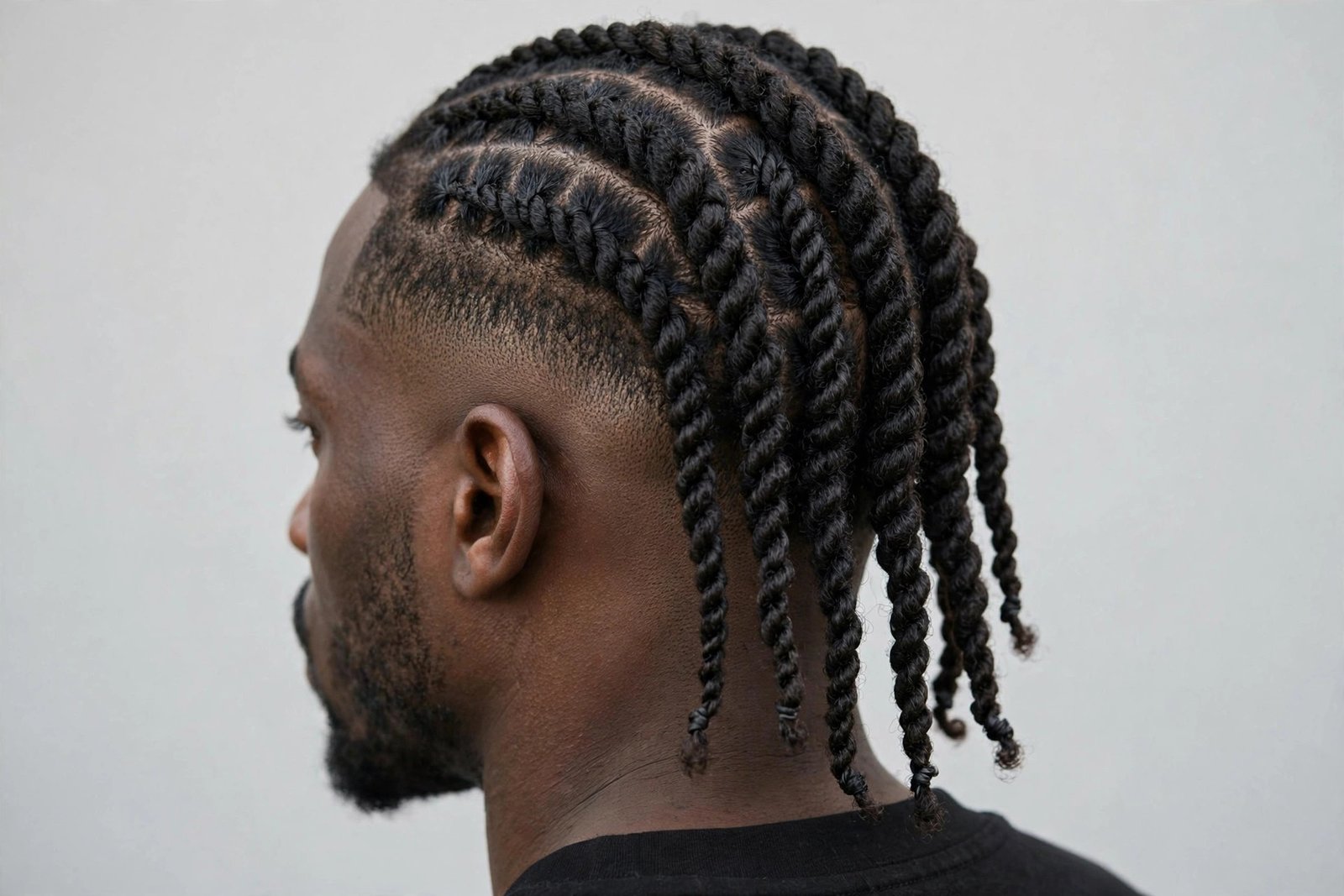
Surgical precision: full twists on top and back, with the fade concentrated at the temples and sideburns. The temple (temp) fade sharpens the hairline and frames the face while leaving the twists’ fullness intact everywhere else. It’s subtle from the front, striking in profile.
Who it suits: guys who want edge without losing length; square and oval faces (the temple fade sculpts the hairline beautifully); anyone whose workplace side-eyes full fades.
How to get it: “Twists all over, temple fade at the hairline and sideburns — keep the length everywhere else.” The barber twists first, then carves the temple fade into the hairline. The blend should melt from skin to twist with no harsh line.
Styling (3 minutes): standard twist routine; the temple fade needs nothing daily. Keep the hairline crisp — the fade’s sharpness is the style’s signature.
Products: twisting butter, edge control for the hairline (optional but sharp), durag. Maintenance: temple fade touch-up every 2 weeks (it grows out visibly fast); retwist every 4–6 weeks.
Mistake to avoid: letting the temple fade grow out. Two weeks of growth blurs the sharpness that defines this style — it’s a high-frequency touch-up style.
Pro tips & variations: The temple fade is the detail guy’s twist style — from across the room it reads as classic twists, up close it’s precision work. That’s its charm. Variation: pair with a sharp lineup for maximum hairline architecture, or keep the lineup natural for a softer read. If your barber isn’t confident with temple fades, don’t push it — a bad temple fade is worse than none. This is a “find the right barber” style, not a “any barber” style.
11. Dyed & Colored Two Strand Twists
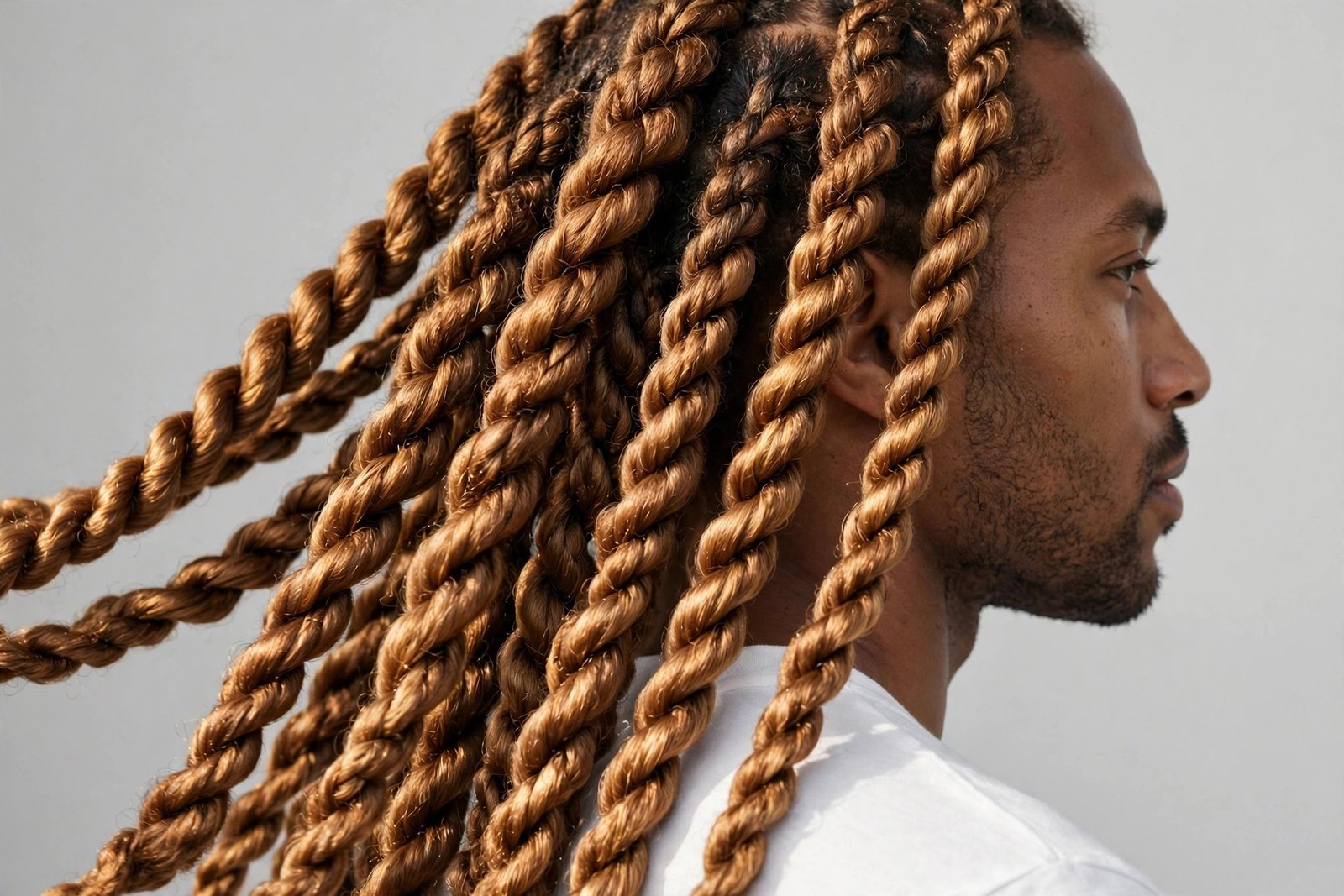
Twists take color beautifully: the twist pattern creates natural dimension, with each rope catching light differently. Whether it’s a full head of honey-blonde twists, jet black with burgundy tips, or subtle brown dimension, color on twists looks richer than on loose hair — the texture does half the work.
Who it suits: anyone wanting a change without a new cut; medium to long twists show color best; warm skin tones glow with honey and copper, cool tones with ash and platinum.
How to get it: color BEFORE twisting, not after — dye on loose hair, then install twists on the colored hair. Coloring twisted hair gives patchy results because the dye can’t penetrate the rope evenly. See a colorist for bleach work; semi-permanent color is safe DIY.
Styling (4 minutes): same as your base twists, plus color-care: sulfate-free shampoo always (sulfates strip color fast), and a color-depositing conditioner every few washes to refresh the tone.
Products: sulfate-free shampoo, color-safe conditioner, light oil. Maintenance: refresh color every 6–8 weeks (roots show); deep-condition more often — colored hair is thirstier.
Mistake to avoid: bleaching and twisting in the same week. Bleached hair is fragile; give it 1–2 weeks of conditioning before the tension of twisting.
Pro tips & variations: The twist pattern is a color multiplier — even a subtle all-over brown looks dimensional in twists because light hits each rope differently. You don’t need dramatic color to get a dramatic effect. Variation: color just the tips (dip-dye effect) for contrast with zero root maintenance; or do an underlayer of color that peeks through when twists move. Temporary color wax is the commitment-free trial — it washes out in 1–2 shampoos and lets you test-drive a shade before the real thing.
12. Two Strand Twists with Beard Combo

The full package: twists up top, beard below. The combination is one of the strongest looks in men’s grooming — textured hair and a groomed beard frame the face completely, and the two textures play off each other beautifully. It’s masculine, current, and endlessly complimented.
Who it suits: guys who can grow a decent beard (even a short boxed beard works); the combo balances long twists especially well; every face shape — the beard adds structure where twists add softness.
How to get it: grow both simultaneously — twists protect the hair while the beard fills in. Tell your barber to shape the beard to complement the twists: keep the beard’s lines clean where the twists are textured. The cheek line and neckline do the visual work.
Styling (6 minutes): twist routine plus beard routine — brush the beard, apply beard oil, keep the lines sharp. The two routines are separate but the payoff is combined.
Products: twisting butter, beard oil, beard brush, durag. Maintenance: beard shape-up every 1–2 weeks; twist retwist every 4–6 weeks. The beard needs more frequent attention than the twists.
Mistake to avoid: neglecting the beard because the twists look good. An unkempt beard drags down great twists — the combo only works when both are maintained.
Pro tips & variations: Balance is everything: big voluminous twists pair best with a fuller beard, while short neat twists pair with a shorter boxed beard. If one is dramatically bigger than the other, the face looks top- or bottom-heavy. Variation: a faded beard (graduated from the sideburns) mirrors a faded twist style for a cohesive, architectural look. Keep the mustache slightly narrower than the beard’s width — it keeps the mouth area clean and lets both textures read clearly.
13. Side-Swept Two Strand Twists
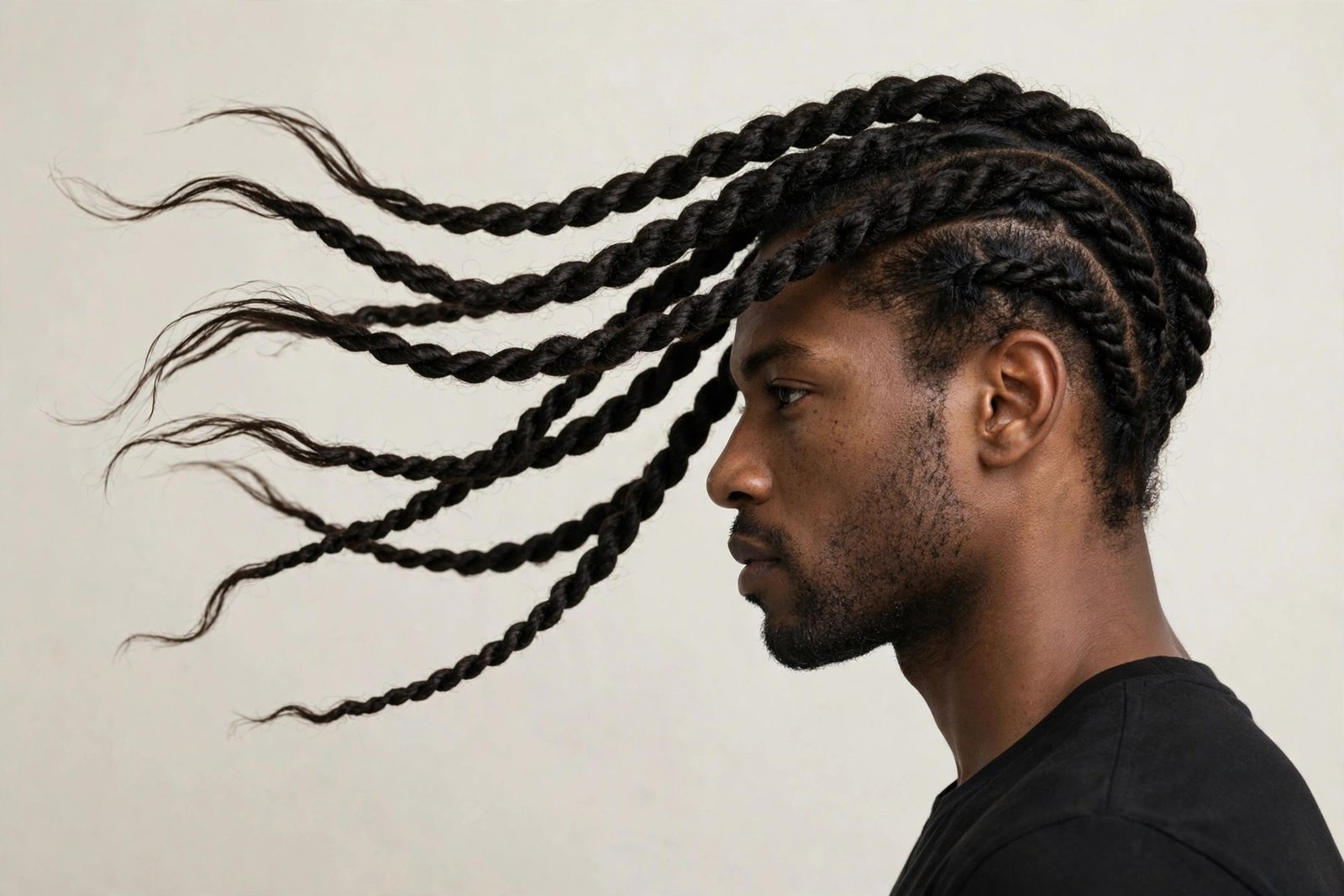
Directional flow: medium twists worn swept to one side for an asymmetric, editorial silhouette. It’s the same install as classic twists — the difference is entirely in the styling — but the side sweep changes the whole character: more movement, more sophistication, less symmetry.
Who it suits: medium-length twists (4–7 inches — need enough length to sweep); oval and oblong faces; guys who want a dressier twist look for evenings and events.
How to get it: install classic medium twists, then train the direction: after install, sweep all twists to your chosen side while damp and let them set. Wear them swept for a week and the roots learn the direction. A side part in the sectioning (twist the front sections with a slight diagonal) helps.
Styling (4 minutes): sweep damp twists to the side, smooth the top layer with oiled palms, let set. A light-hold cream on the top layer keeps the sweep in place without stiffness.
Products: twisting butter, light oil, light-hold cream for the sweep. Maintenance: same as classic twists; re-train the sweep direction after each wash for the first month.
Mistake to avoid: fighting your natural growth direction permanently. If your crown grows strongly to the left, sweep left — working with the growth pattern beats fighting it daily.
Pro tips & variations: The side sweep is a styling skill, not a cut — which means you can switch between swept and centered whenever you want. That’s the beauty of it: one install, two personalities. Variation: a deep side sweep (dramatic, editorial) versus a soft diagonal (wearable daily). For events, pin one side’s twists behind the ear — it opens the face and looks intentional. If the sweep collapses by afternoon, your twists are too short for the style — it needs that 4+ inches to hold direction.
14. Two Strand Twists with Sharp Line-Up
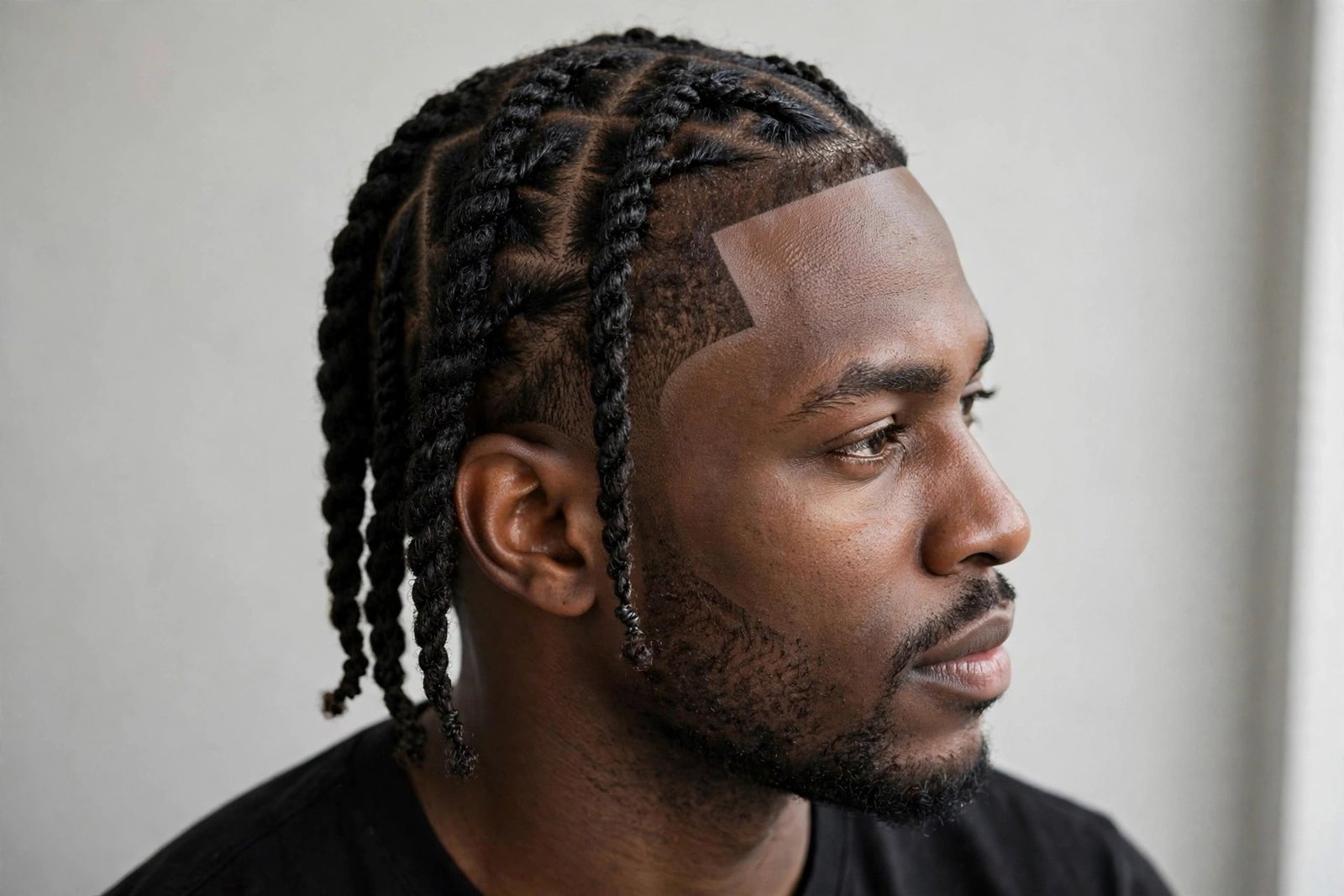
Architecture meets texture: full twists with a razor-sharp lineup framing the forehead, temples, and sideburns. The lineup is the frame; the twists are the art. This combination is why barbershop photos go viral — the contrast between geometric edges and organic texture is visually irresistible.
Who it suits: anyone with a hairline worth framing; short and medium twists show the lineup best; the sharpest professional look on this list when the lineup is fresh.
How to get it: twists installed first, lineup carved second — always in that order. Tell your barber “crisp lineup, don’t push the hairline back.” A good barber enhances your natural hairline; a rushed one recedes it. This is worth paying for.
Styling (3 minutes): twist routine; the lineup needs edge control only if your hairline frizzes. Mostly it’s maintenance, not styling.
Products: twisting butter, edge control (optional), durag — the durag’s compression actually helps keep the lineup crisp. Maintenance: lineup touch-up every 7–10 days — this is the highest-frequency maintenance on the list, but each touch-up is 10 minutes.
Mistake to avoid: letting a barber push your hairline back for “sharpness.” A lineup should follow your natural hairline, not relocate it. Speak up — it’s your hairline.
Pro tips & variations: The lineup is a perishable good — day one it’s art, day ten it’s a memory. Budget for the touch-up cycle before you commit; the style only works when the edges are fresh. Variation: a natural (uncarved) hairline with just cleaned-up edges is lower-maintenance and ages better for guys worried about long-term hairline health. Between appointments, a little edge control and a toothbrush (yes, really) keeps the hairline tidy — barbers have used this trick forever.
15. The Two Strand Twist-Out
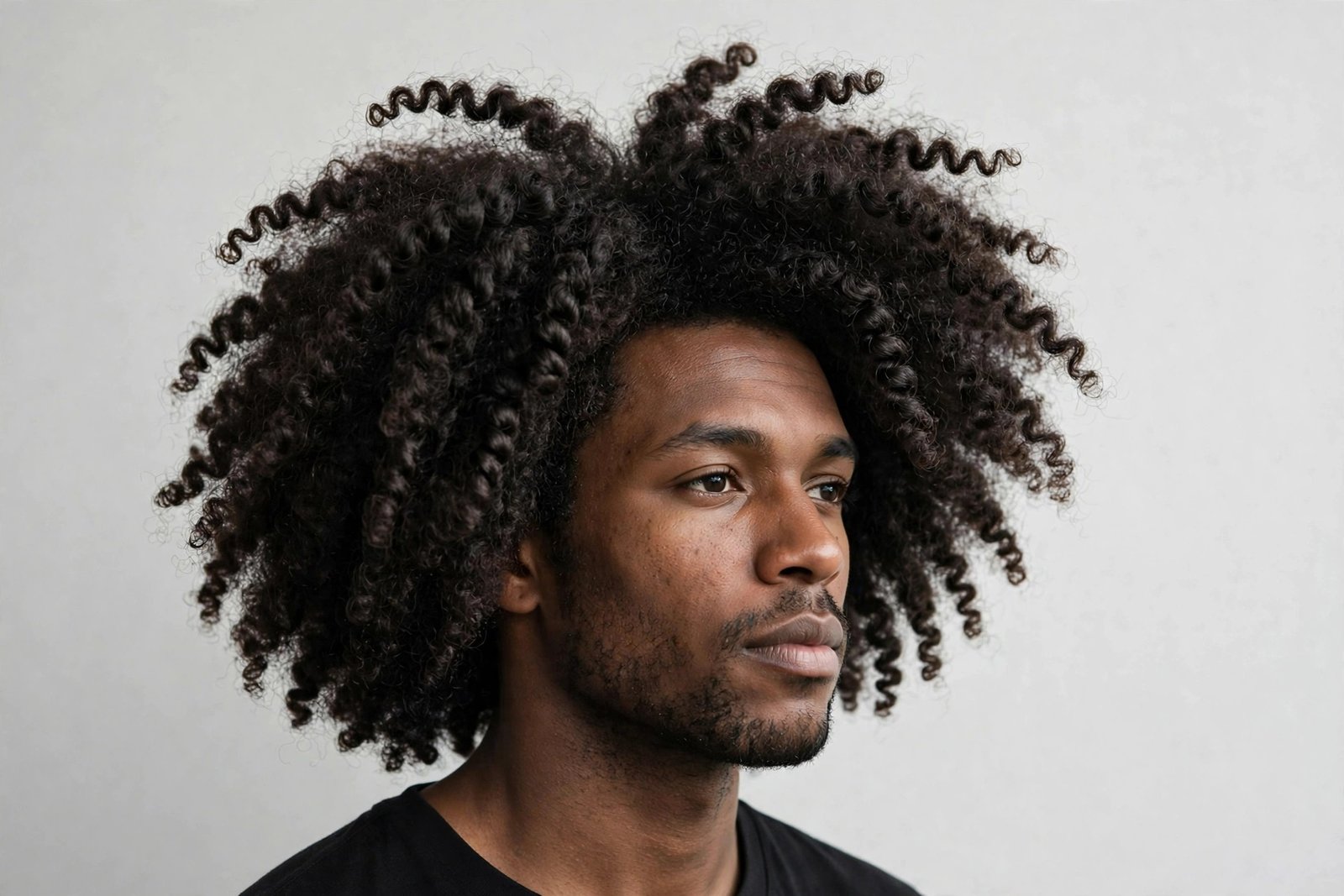
The grand finale: untwisting your twists to reveal defined, stretched curls with incredible volume. The twist-out is the reward for months of protective styling — hair that’s longer, healthier, and styled into one of the best-looking natural styles that exists. Many guys wear the twist-out longer than the twists themselves.
Who it suits: everyone at takedown time — it’s the natural conclusion of any twist install; type 3–4 hair gets the most defined results; the fuller your twists were, the bigger the twist-out.
How to get it: on takedown day, coat each twist in oil, untwist gently from tip to root (never yank), then separate each untwisted section into 2–3 pieces for volume. Pick the roots for lift. The whole process takes 1–2 hours — put on music and enjoy it.
Styling (5 minutes daily): twist-outs last 1–2 weeks with night care — pineapple at night, pick the roots in the morning, refresh with a light mist of water and leave-in. It’s a style with its own lifespan, not just a takedown method.
Products: oil for takedown (reduces frizz dramatically), leave-in conditioner, pick, satin bonnet. Maintenance: re-pineapple nightly; when the definition fades after 1–2 weeks, either re-twist sections or enjoy the big-textured final days.
Mistake to avoid: untwisting dry twists without oil. Dry takedown = frizz explosion and breakage. Oil every twist before you touch it — this single step determines whether your twist-out is defined or a halo.
Pro tips & variations: Here’s what nobody tells you: the twist-out is often better than the twists. The definition, the volume, the way it moves — it’s the payoff for all that patience, and it photographs like nothing else. Variation: untwist only the front half for a twist/twist-out hybrid (twists in back, defined curls framing the face). If your twist-out is too big, separate less; too flat, separate more and pick the roots aggressively. And take photos — you’ll want to remember this hair.
Starter Guide, Wash Day & Long-Term Care
The Starter Process: Installing Your First Set of Twists
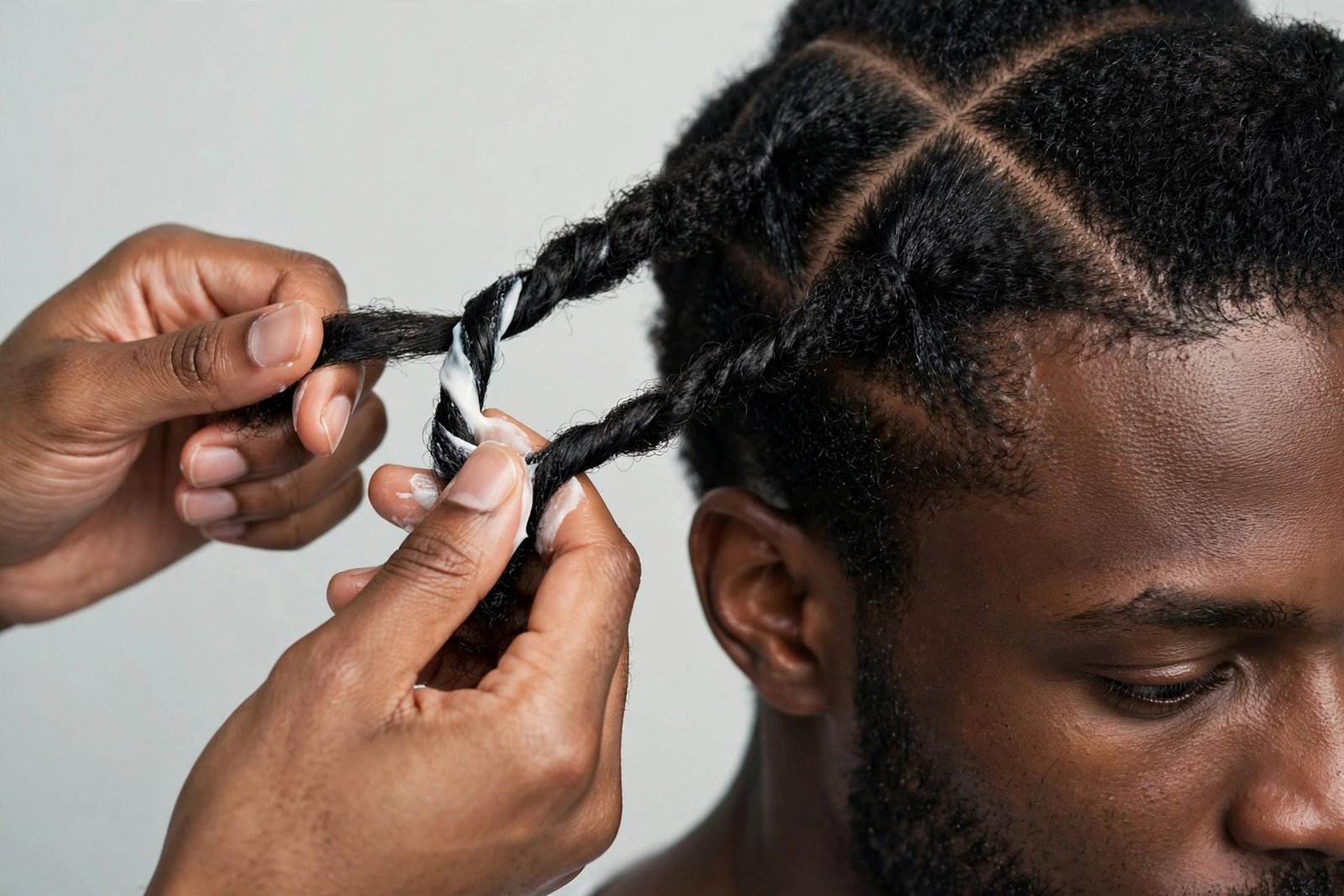
Your first install sets the tone for everything, so let’s walk it properly. Start with freshly washed, conditioned, and fully detangled hair — twists grip clean hair best, and detangling beforehand prevents the matting that ruins installs. Work in four quadrants (split the head front-to-back and ear-to-ear) and twist one quadrant at a time, clipping the rest away. This keeps you organized and stops sections from drying out mid-install.
For each twist: part a clean section with a rat-tail comb (the part is the foundation — wobbly parts make the whole head look messy), apply a nickel-sized amount of twisting butter from root to tip, split the section into two equal strands, and twist them around each other keeping even, firm tension all the way down. Here’s the technique detail that matters: twist the two strands around each other in one direction while simultaneously twisting each individual strand in the same direction — this “twist on twist” locks the rope so it doesn’t unravel. Seal the ends by twirling the last inch between your fingers or with a tiny bit of gel.
Keep your sections consistent in size — inconsistency is the #1 visual flaw in DIY installs. Use the comb’s tail as a measuring guide. Your arms will ache (twisting a full head is a workout — take breaks), and your first install will take twice as long as you expect. That’s normal. Budget 3–5 hours for medium twists on your first go, put on a long playlist or a series, and settle in. The result won’t be salon-perfect, and honestly? It doesn’t need to be. Slightly imperfect twists still look great, and you’ll be shocked how much better install #2 goes.
After install: don’t wash for at least a week — let the twists set. Wear your durag the very first night (start the habit immediately), and resist the urge to re-twist everything on day two because it doesn’t look like the reference photo. Week-one twists always look a little stiff; they relax into themselves by week two. For deeper technique on sectioning and parting that applies across protective styles — the parting fundamentals used in braided styles translate directly: clean parts are a universal skill.
Wash Day for Twists (Without Unraveling Everything)
The first wash is scary — every new twist wearer is convinced the twists will dissolve in the shower. They won’t, if you wash right. Wash every 1–2 weeks: scalp health matters more than twist longevity, and a clean scalp grows better hair. The technique: dilute your sulfate-free shampoo in an applicator bottle with water (about 1:3 ratio), and apply it directly to the scalp in the parts between twists. Massage the scalp with your fingertips — not nails — working the lather through the parts. Let the suds run down the twists as you rinse; don’t scrub the twists themselves.
Follow with conditioner the same way — focus on the scalp and let it rinse through. Some guys skip conditioner on wash day and do a separate deep-condition every 3–4 weeks; either works. The critical step is drying: squeeze (don’t wring) each twist with a microfiber towel, then let them air-dry completely — or sit under a hooded dryer for 30–45 minutes. Twists that stay damp develop mildew smell, and that’s a problem you never want. Never go to bed with wet twists. Ever.
After washing, your twists will look frizzier — accept it. A light retwist of just the hairline and nape after wash day restores the crisp look in 20 minutes without redoing the whole head. This “wash + edge retwist” combo is the maintenance rhythm that keeps twists looking fresh for months: full wash every 1–2 weeks, edge touch-up after each wash, full retwist every 4–8 weeks. Once you internalize this cycle, twists become genuinely effortless — the most common regret is not the style, it’s that guys didn’t learn this rhythm sooner and gave up at week three thinking twists “weren’t for them.”
For product science on why sulfate-free matters for textured hair, the basics of hair structure explain how harsh cleansers strip the cuticle; for styling inspiration across textures, Byrdie’s hair guides cover protective styling well.
Products: What Two Strand Twists Actually Need
The product list for twists is refreshingly short — which is good, because the twist industry will happily sell you twelve products you don’t need. Here’s the honest kit. Twisting butter or cream: the install product — provides grip and moisture. Butters (shea-based) suit coarser hair; creams suit finer textures. One jar lasts multiple installs. Light oil (jojoba, grapeseed, or sweet almond): seals moisture and adds sheen — applied to the twists weekly and to the scalp as needed. Leave-in conditioner: the moisture foundation, applied before twisting and refreshed on dry-feeling twists. Sulfate-free shampoo: for wash days. Edge control: optional, for the hairline.
What you DON’T need: heavy waxes (they build up and attract lint — the dreaded “twist lint” comes from waxy products), strong-hold gels for the whole head (they flake), and any product promising “6-month hold” (twists need retwisting; no product changes that). The minimalist kit — butter, oil, leave-in, shampoo — outperforms the maximalist shelf every time. Your wallet and your twists both benefit.
The buildup problem: twists accumulate product and lint over weeks — it’s unavoidable. The signs are dull-looking twists, a coated feeling, and white residue in the parts. The fix is a clarifying wash (a sulfate-free clarifying shampoo, or a diluted apple cider vinegar rinse before shampooing) every 4–6 weeks. Don’t clarify every wash — it’s stripping — but a monthly reset keeps the twists clean underneath. If your twists smell musty despite washing, that’s trapped moisture or buildup, and a clarifying wash plus thorough drying solves it.
The Night Routine: Protecting Your Twists While You Sleep
This is the section that determines whether your twists last three weeks or three months, so read it twice. Every single night: put on a durag, bonnet, or satin scarf before bed. Cotton pillowcases are twist killers — they absorb moisture, create friction, and frizz your twists while you sleep. Satin or silk lets the twists glide. This one habit matters more than any product you buy.
The technique: gather long twists loosely (a loose pineapple or 2–4 big loose braids), then cover with the durag or bonnet. Short twists just need the covering. In the morning, remove the covering, shake gently, and go — most mornings need zero additional styling. If the roots look flat, a quick pick restores volume. If the twists feel dry, a light mist of water mixed with leave-in (in a spray bottle) refreshes them in seconds.
The pineapple method deserves its moment: gather all twists into a loose high ponytail with a satin scrunchie — loose enough that there’s no tension on the hairline. It preserves the twist pattern overnight and gives you root volume in the morning. For very long twists, two loose braids inside a bonnet work better than a pineapple (less weight pulling). Travel with a durag in your bag — hotel pillowcases are the enemy, and a durag weighs nothing. Guys who skip night protection consistently get half the lifespan from their twists. It’s the highest-ROI habit in this entire guide.
Retwisting & the Maintenance Schedule
Retwisting is refreshing existing twists rather than reinstalling — you take down individual twists (or just work the roots) and re-twist them. The full cycle: Weeks 1–2: crisp phase, just night care and maybe a scalp oil. Weeks 3–4: roots start frizzing — retwist the hairline, temples, and nape (the visible zones), 20–30 minutes. Weeks 4–6: first wash-day edge retwist. Weeks 6–8: full-head retwist or professional maintenance appointment. Months 2–4: repeat the cycle; at takedown, assess — reinstall, or enjoy the twist-out.
To retwist a section: apply a small amount of twisting butter to the roots, re-part if needed, and twist the new growth into the existing twist, blending downward. You don’t need to take the whole twist apart — just refresh the root area and smooth it into the length. A full-head retwist takes 1–2 hours once you’re practiced (versus 3–5 for a fresh install), which is why maintaining beats reinstalling.
When to take them down: 2–4 months is the sweet spot. Beyond 4 months, the new growth starts matting at the roots regardless of maintenance, and takedown becomes difficult and breakage-prone. If your roots are matting, it’s past time — take them down, enjoy the twist-out, and reinstall fresh. There’s no prize for the longest install; there’s only healthy hair. Set a takedown date when you install, and honor it.
Growing Them Out: The Awkward Stages (and Surviving Them)
Here’s the truth about growing twists long: months 2–4 of growth include an awkward phase where the twists are too long to be short and too short to be long, the roots are doing their own thing, and you question every decision. Everyone goes through it. The guys with great long twists aren’t the ones who skipped the awkward phase — they’re the ones who didn’t cut during it.
Survival strategies: updos are your best friend during the awkward stage — a top knot or half-up style hides uneven growth beautifully. A fresh lineup or fade touch-up makes the whole head look intentional even when the twists are mid-transition. Hats and durags (worn out, not just for sleep) buy you weeks of not thinking about it. And remember: the awkward stage is temporary, but the length is permanent. Every long-twist photo you admire went through exactly this.
Trim the ends at each takedown — not the length, just the thinning ends. Twists protect ends well, but the very tips still wear over months. A quarter-inch dusting every takedown keeps the ends thick, and thick ends make the next install look fuller. Think of it as compound interest for your hair: small trims now, dramatically better twists later. The awkward-stage guide for loose hair (awkward stage hairstyles) has more styling tricks that work while twists grow — many of the camouflage techniques translate.
Frequently Asked Questions
How long do two strand twists last?
A professional install lasts 2–4 months with proper maintenance — night protection, washing every 1–2 weeks, and retwisting the roots every 4–8 weeks. Medium twists hit the full 3–4 months; jumbo twists run shorter (6–10 weeks) because the big sections loosen faster; micro twists can push past 4 months. The biggest lifespan factor isn’t the twist size, though — it’s the night routine. Guys who durag every night routinely double the crisp lifespan versus guys who don’t. Past 4 months, root matting makes takedown difficult regardless of how good the twists look, so plan your takedown date at install and honor it.
Will two strand twists turn into dreads?
Only if you let them — twists don’t lock by themselves. They become locs only through months of neglect: no retwisting, no takedown, letting sections matt together at the roots. Maintained twists (retwisted every 4–8 weeks, washed on schedule, taken down at 2–4 months) will never lock. This is the most common fear and the most unfounded — millions of men wear twists as a temporary protective style, take them down, and enjoy the twist-out. If you WANT them to eventually loc, that’s a separate journey (starter locs use similar technique), but casual twists maintained normally stay twists.
How long does my hair need to be to start twists?
About 2–3 inches minimum — enough hair to grip and twist without unraveling. At 2 inches you’ll get short starter twists (chunky sections hold best at this length); at 4+ inches the full range opens up. Below 2 inches, sections won’t hold a twist — grow it out first. The coilier your texture, the shorter you can start (coily hair grips at 2 inches; looser curls may need 3). If you’re growing from a fade, the awkward grow-out months are exactly what starter twists are for — twist at 2–3 inches and let the style grow with you instead of suffering through the in-between loose.
How often should I wash two strand twists?
Every 1–2 weeks. Scalp health drives hair growth, and a dirty scalp under twists is a recipe for itch, buildup, and odor. The fear that washing unravels twists is overblown — washing correctly (diluted shampoo applied to the scalp in the parts, no scrubbing the twists themselves, thorough drying afterward) keeps twists intact. The non-negotiable part is drying: twists must dry COMPLETELY after washing — squeeze with a microfiber towel, then air-dry fully or use a hooded dryer. Damp twists left overnight develop mildew smell. Wash on schedule, dry thoroughly, and your twists and scalp both thrive.
Do two strand twists damage your hair?
Done right, twists are one of the least damaging styles — they’re genuinely protective: ends stay tucked, daily manipulation stops, and breakage drops. Damage comes from mistakes, not the style: twists installed too tight (tension headaches and thinning edges are the warning signs), left in too long (past 4 months the roots matt and takedown causes breakage), taken down dry without oil (frizz and snapped ends), or worn in the same tight updo daily (tension breakage at the tie point). Avoid those four mistakes and twists grow your hair healthier than loose styling. If your edges are thinning, the twists are too tight or too heavy — loosen up and give the hairline a break.
Can I swim with two strand twists?
Yes, with prep. Before swimming, wet your twists with clean water and apply leave-in conditioner — saturated hair absorbs less chlorine and salt water. After swimming, rinse immediately with clean water; shampoo that evening if it was a chlorinated pool. Twists handle occasional swimming fine; daily competitive swimming demands more washing and faster retwist cycles, but it’s workable. Never leave chlorine or salt to dry in your twists — the crystals dehydrate the hair and the twists go from defined to straw-like. A swim cap over twists is awkward but effective for frequent swimmers. The through-line: water isn’t the enemy, dried-in chemicals are.
What’s the difference between two strand twists and twist-outs?
Two strand twists are the installed style — the rope-twisted sections worn as-is for weeks or months. A twist-out is what happens when you UNTWIST them: the revealed curls are stretched, defined, and voluminous, forming a completely different style. Think of twists as the protective phase and the twist-out as the payoff phase — one install gives you both. The twist-out lasts 1–2 weeks on its own with pineapple night care, and many guys consider it the best-looking part of the whole journey. You don’t choose between them; you get the twists for months, then the twist-out as the grand finale before your next install.
Conclusion
Two strand twists are that rare style that asks almost nothing and gives back enormously: a few hours of install for months of wake-up-and-go hair, protection that actually grows your hair, and a range — from sharp short starters to flowing long twists to the glorious twist-out finale — that keeps the style interesting the entire time. The fundamentals are boring and they work: clean install on clean hair, a durag every night, wash on schedule, retwist the roots before they ask, and take them down at 2–4 months like you promised yourself you would.
Pick the style that matches where your hair is right now, not where you wish it was — starter twists at 2 inches are a beginning, not a compromise, and every long-twist photo you admire started exactly there. Commit to the night routine from day one, survive the awkward middle without reaching for the clippers, and let month three surprise you. Your twists will teach you patience, and then they’ll reward it with the best hair of your life. Twist up — 2026 is waiting.