36 Curly Shag Haircuts for Men 2026: Textured Ideas & Styling Guide
The curly shag is the haircut that finally lets curls do what they want to do. Born in the rock-and-roll seventies, rebuilt for the texture-obsessed 2020s, the shag is a layered cut built on controlled chaos: shorter, piece-y layers through the crown, longer disconnected ends, and a fringe that falls where it falls. On curly and wavy hair it is arguably the most flattering silhouette in men’s grooming right now, because it works with the curl pattern instead of fighting it.
In 2026 the men’s curly shag has fully broken out of niche-barbershop territory. Search interest for curly shag variations keeps climbing, celebrity barbers are posting shag transformations weekly, and the cut has absorbed everything around it — fades, mullets, wolf cuts, curtain bangs. The result is a family of styles, not a single look. Some are tight and office-safe. Some are full rock-star. All of them share the same DNA: layers that create movement, volume where you want it, and a grown-in edge that looks better on day ten than day one.
This guide covers 36 distinct curly shag variations for men in 2026. For each one you get the full breakdown: what the cut actually is, which face shapes and curl types it flatters, the exact language to use in the barber chair, a step-by-step styling routine, the products that make it work, and how to maintain it between cuts. After the 36 ideas, there is a dedicated styling masterclass, a maintenance and care section, and a FAQ that answers the questions barbers hear every day about this cut.
1. The Classic Curly Shag
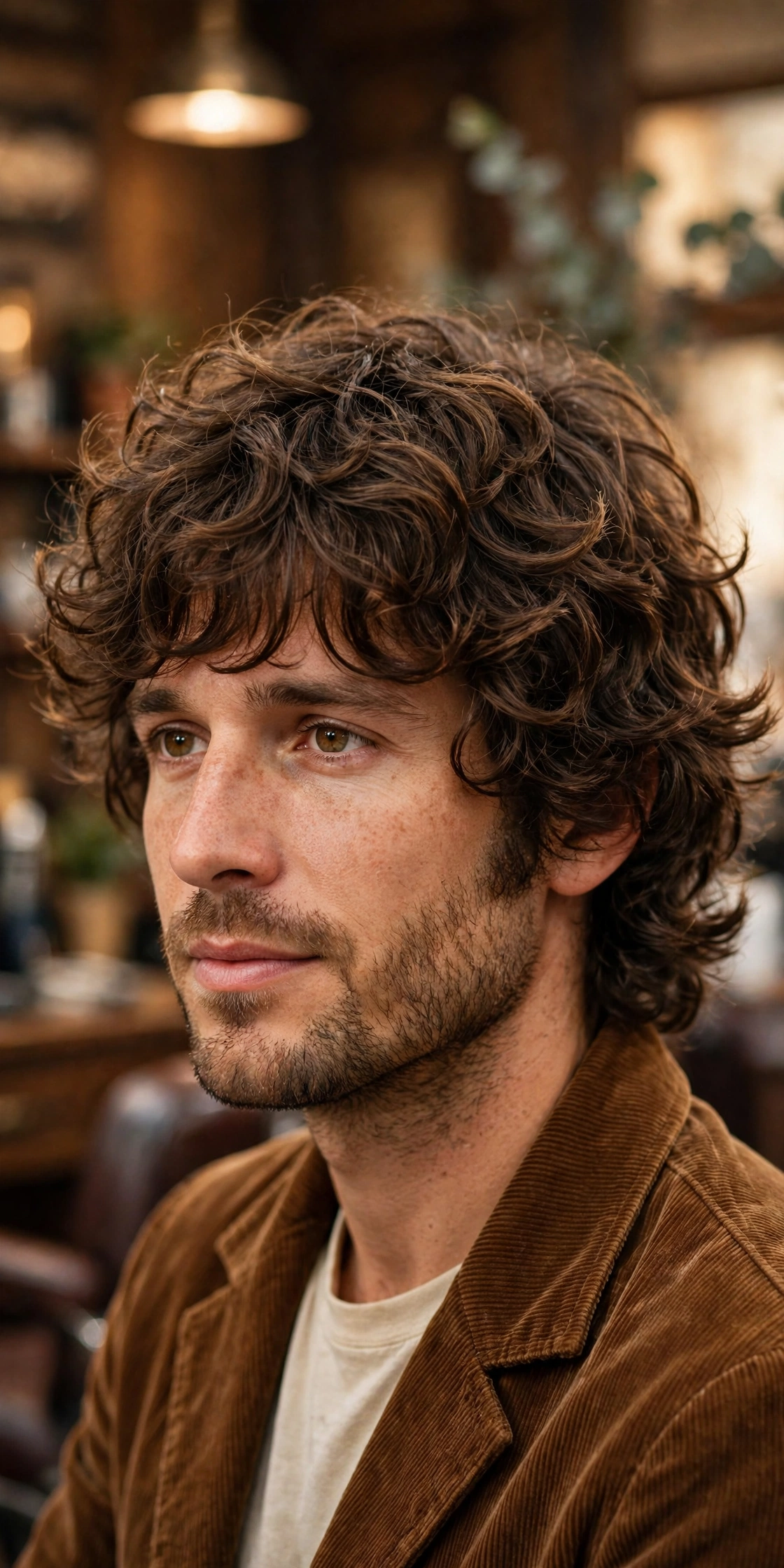
The classic curly shag is the blueprint everything else is built from: medium length all over, heavy layering through the top and crown, tapered ends that flick outward, and a soft fringe that blends into the sides. The layers are cut to follow the natural curl pattern, so each curl clump sits in its own pocket of space instead of stacking into a triangle. What it is, in one sentence: a 1970s rock cut re-engineered for modern curl care.
It suits oval, square, and heart-shaped faces best, because the volume at the sides balances a strong jaw or a narrow chin. Curl-wise it is ideal for 2C to 3B patterns — hair with enough spring to hold the layer separation but not so tight that the layers collapse into each other. Men with very fine hair should ask for fewer, longer layers so the cut does not look wispy.
In the barber chair, say: “A classic shag, medium length, heavy layers through the crown, keep the fringe soft and blended, taper the ends but don’t thin them out.” Bring a reference photo — shags are interpreted differently by every barber, and the photo removes the guesswork. Ask for dry-cutting or curl-by-curl cutting if your barber offers it; cutting curls dry is the only reliable way to see where each layer will actually fall.
Styling is wash-and-go with intention. On damp hair, rake a curl cream through from roots to ends, then scrunch upward to encourage the clumps. Diffuse on medium heat, low speed, cupping sections upward — or air-dry if you have the time. Finish with a pea-sized amount of light oil on the ends to kill frizz without flattening the layers. Products: a moisturizing curl cream as the base, a light hold gel if your curls need definition help, and a silk or satin pillowcase to protect the shape overnight. Maintenance: trim every 8 to 10 weeks to keep the layers from growing into a uniform mass, and deep-condition every two weeks because layered ends dry out faster than blunt ones.
2. The Modern Textured Shag

The modern textured shag takes the classic silhouette and sharpens it with 2026’s texture obsession: point-cut ends, razor-finished layers, and deliberate separation between curl clumps. Where the classic shag is soft and rounded, the modern version is piece-y and architectural — you can see the individual layers working. It reads younger and edgier, the difference between a vintage record and a remaster.
This is the shag for men who want edge without going full mullet. It flatters angular faces (square, diamond) because the broken-up texture softens sharp cheekbones, and it works across 2B to 3C curl patterns. It is also one of the best shag options for thick hair, since the texturizing removes bulk without removing length.
Tell your barber: “Modern textured shag — I want visible separation in the layers, point-cut the ends, razor texture through the mid-lengths, keep the perimeter messy.” Ask them to cut vertically into the ends rather than straight across; that is what creates the piece-y finish. If your hair is very thick, ask for internal layering (shorter layers hidden underneath) so the top does not mushroom.
Style on damp hair with a sea salt spray at the roots for grit, then a matte clay or paste worked through the mid-lengths — not the roots — to define separation. Twist a few key pieces around your finger while damp to create intentional chunks, then diffuse or air-dry. Avoid heavy creams here; they glue the texture back together. Products: sea salt spray, matte texturizing clay, and a light dry shampoo for second-day revival. Maintenance: trims every 6 to 8 weeks, because textured ends grow out visibly faster than soft layers. Refresh the texture between cuts with a barber willing to do a quick dry-texture pass.
3. The Short Curly Shag
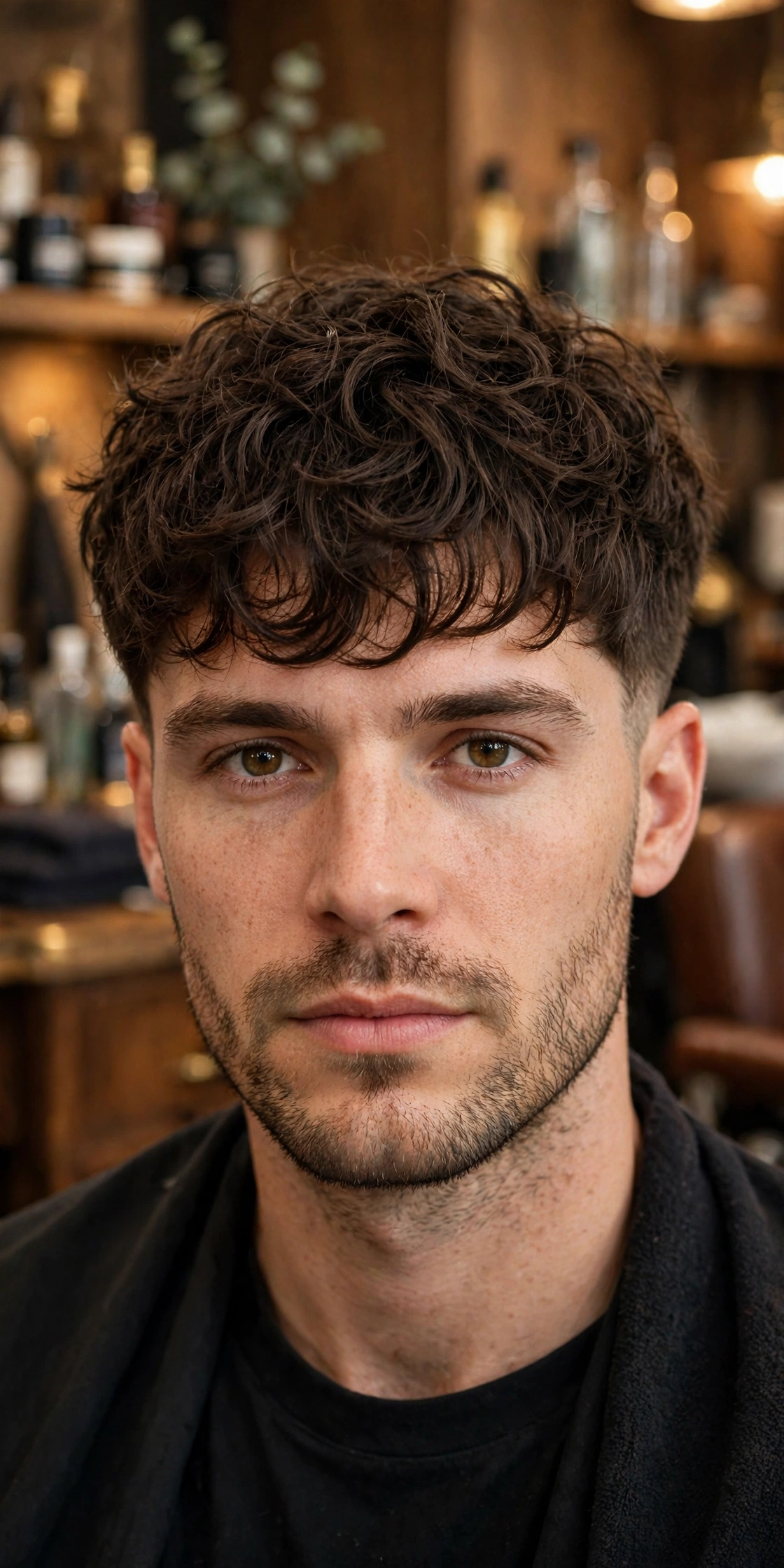
The short curly shag proves the cut does not require length. Sitting between 2 and 4 inches on top with tapered or faded sides, it keeps the shag’s signature — choppy crown layers and a tousled fringe — in a compact, low-maintenance package. Think of it as the shag’s younger sibling: same attitude, half the styling time.
This is the entry point for men trying a shag for the first time, and it suits nearly every face shape because the proportions are easy to adjust. Round faces benefit from extra height on top; long faces should keep the crown closer and let the fringe fall forward. It works for 2A through 3B curls, and it is the best shag variation for active lifestyles — gym, helmets, hats all survive it.
Ask your barber for “a short shag — 3 inches on top with choppy layers, textured fringe, and a low taper on the sides, nothing disconnected.” The key phrase is “nothing disconnected”: a short shag should flow, not have harsh lines between the top and sides. Ask for the fringe to be point-cut so it sits naturally instead of forming a shelf.
Styling takes three minutes. Work a small amount of curl cream through damp hair, push the fringe forward with your fingers, and let it air-dry or hit it with a diffuser for two minutes. A dab of matte paste on dry hair adds definition to the crown pieces. Products: lightweight curl cream, matte styling paste, and a boar-bristle brush used only on dry hair to fluff the roots. Maintenance: this one grows out fast — book every 4 to 6 weeks to keep the shape crisp, and it is an easy cut for barbers to maintain because there is less hair to manage.
4. The Long Curly Shag
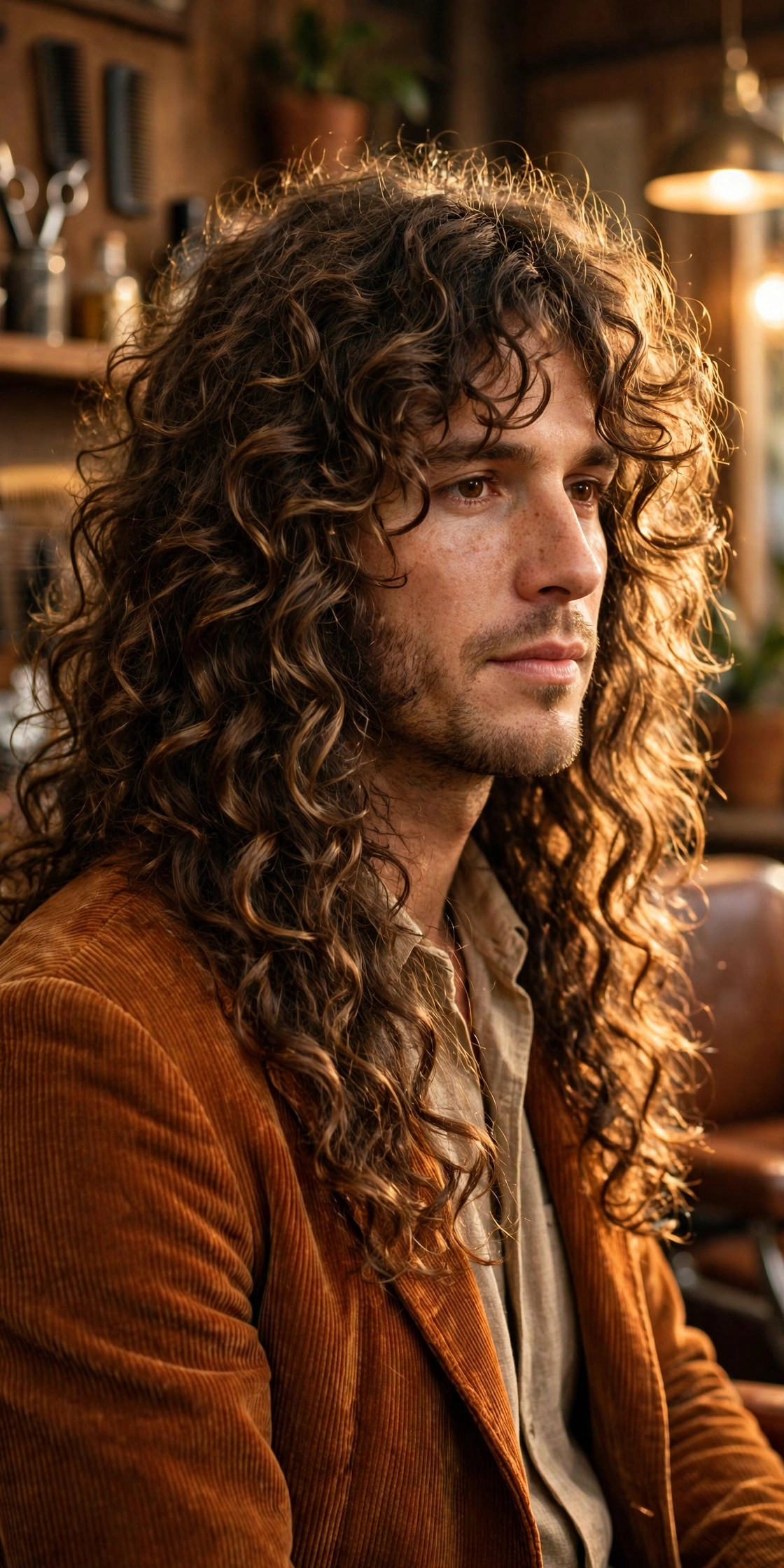
The long curly shag is the full statement: hair falling past the ears to the shoulders, built on long cascading layers that let each curl ribbon hang at its own length. This is the 1970s album-cover shag, and in 2026 it is back with better products and better curl knowledge behind it. It is not a cut you stumble into — it is a commitment, and it rewards the commitment.
It suits oval and long faces beautifully, since the vertical length is balanced by width through the mid-lengths. Men with 2C to 3C curls get the best version; tighter coils can work too but need the layers cut longer to avoid a rounded afro-shag hybrid (which is its own look, covered below). Avoid this if your hair is very fine — long layers on fine curls go stringy fast.
In the chair, the language matters more here than anywhere: “Long shag, collarbone length, long layers starting at the chin, face-framing pieces in front, keep all the length in the back.” Insist on no thinning shears through the lengths — thinning destroys curl clumps and creates frizz on long hair. Ask for the layers to be cut with the head tilted forward so the front pieces frame correctly when you stand upright.
Styling long shags is about moisture management. Use a leave-in conditioner on soaking-wet hair, then a curl-defining cream, then a hard-hold gel cast — the “sandwich” method. Scrunch, then diffuse upside down for root volume or air-dry in a loose pineapple. Once fully dry, scrunch out the gel cast with oiled hands. Products: leave-in conditioner, curl cream, strong-hold gel, and a microfiber towel or cotton T-shirt for plopping. Maintenance: trims every 10 to 12 weeks (dusting the ends only), deep-condition weekly, and sleep in a satin bonnet or on a satin pillowcase — long layered curls tangle overnight and the friction undoes your styling work.
5. The Curly Shag with Bangs
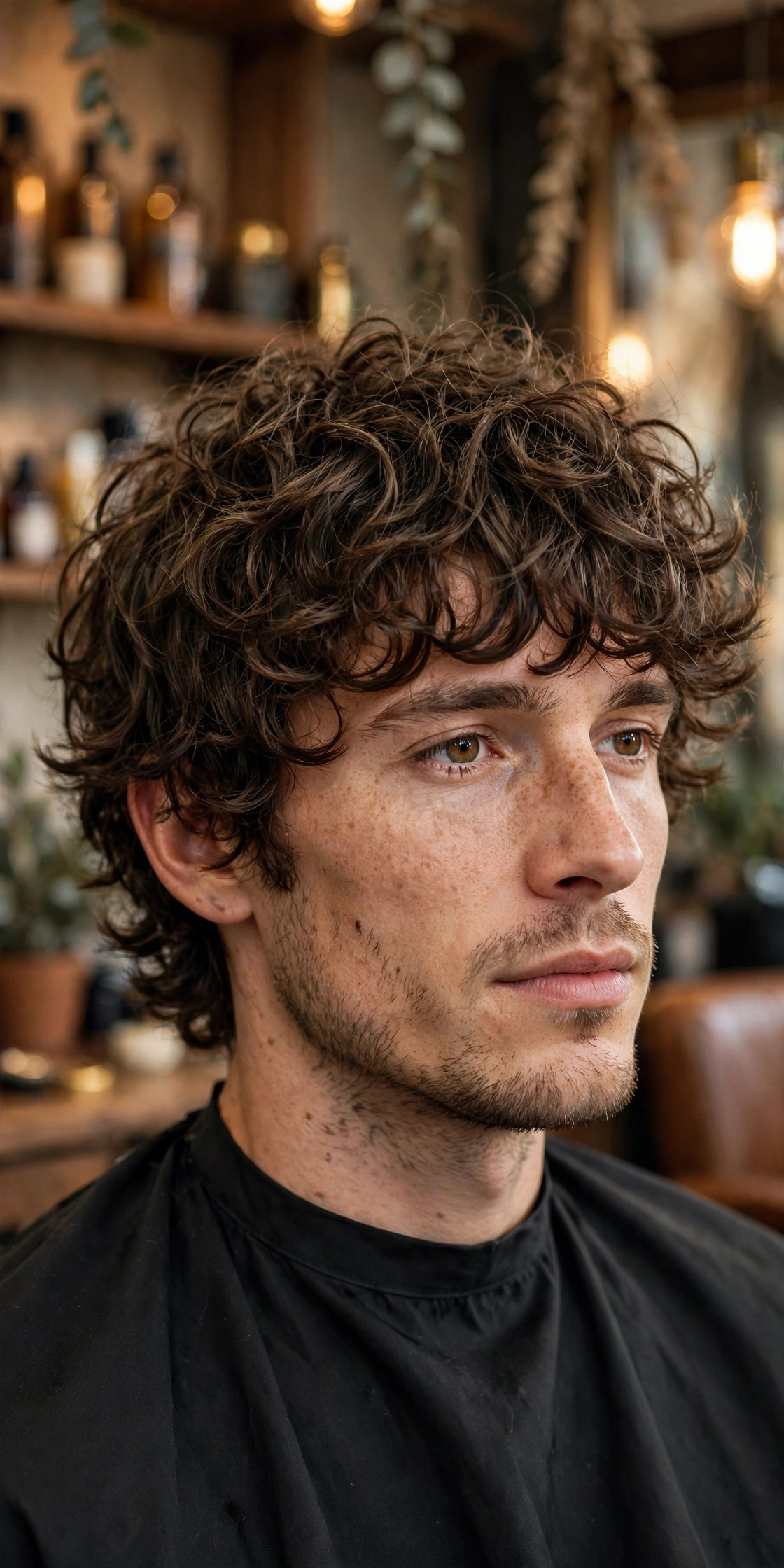
Bangs are the shag’s natural partner — the cut was practically invented for a fringe — and on curly hair they do something magical: they break up the forehead, add frame to the face, and give the whole cut its signature silhouette. The curly shag with bangs keeps the fringe at eyebrow to eyelash length, cut to curl up naturally rather than hang straight.
This suits high foreheads, long faces, and anyone who wants the most recognizable version of the shag. It works for 2B through 3C curls; the key variable is shrinkage — curly bangs spring up significantly, so they must be cut longer than they will be worn. Men with very tight coils should go for a longer, heavier bang to account for maximum shrinkage.
Tell your barber: “Shag with a curly bang — cut the fringe dry at the length it will sit, not the length it hangs wet, and keep it piece-y, not blunt.” This is the single most important instruction in this entire guide: wet curly bangs look twice as long as dry ones, and barbers who cut them wet always cut too much. Ask for the bang to be cut curl-by-curl if possible.
Style the bangs first, separately from the rest. On damp hair, apply curl cream to the fringe, then coil each section around your finger in the direction you want it to fall. Diffuse the bangs first on low heat — they dry fastest and set the tone for the whole cut. Never brush curly bangs dry; finger-fluff only. Products: a defining curl cream, a small amount of gel just on the fringe for hold, and a diffuser attachment you actually use. Maintenance: bang trims every 3 to 4 weeks (many barbers do fringe trims cheap or free between full cuts), because curly bangs grow out of shape faster than any other part of the cut.
6. The Curly Shag Mullet
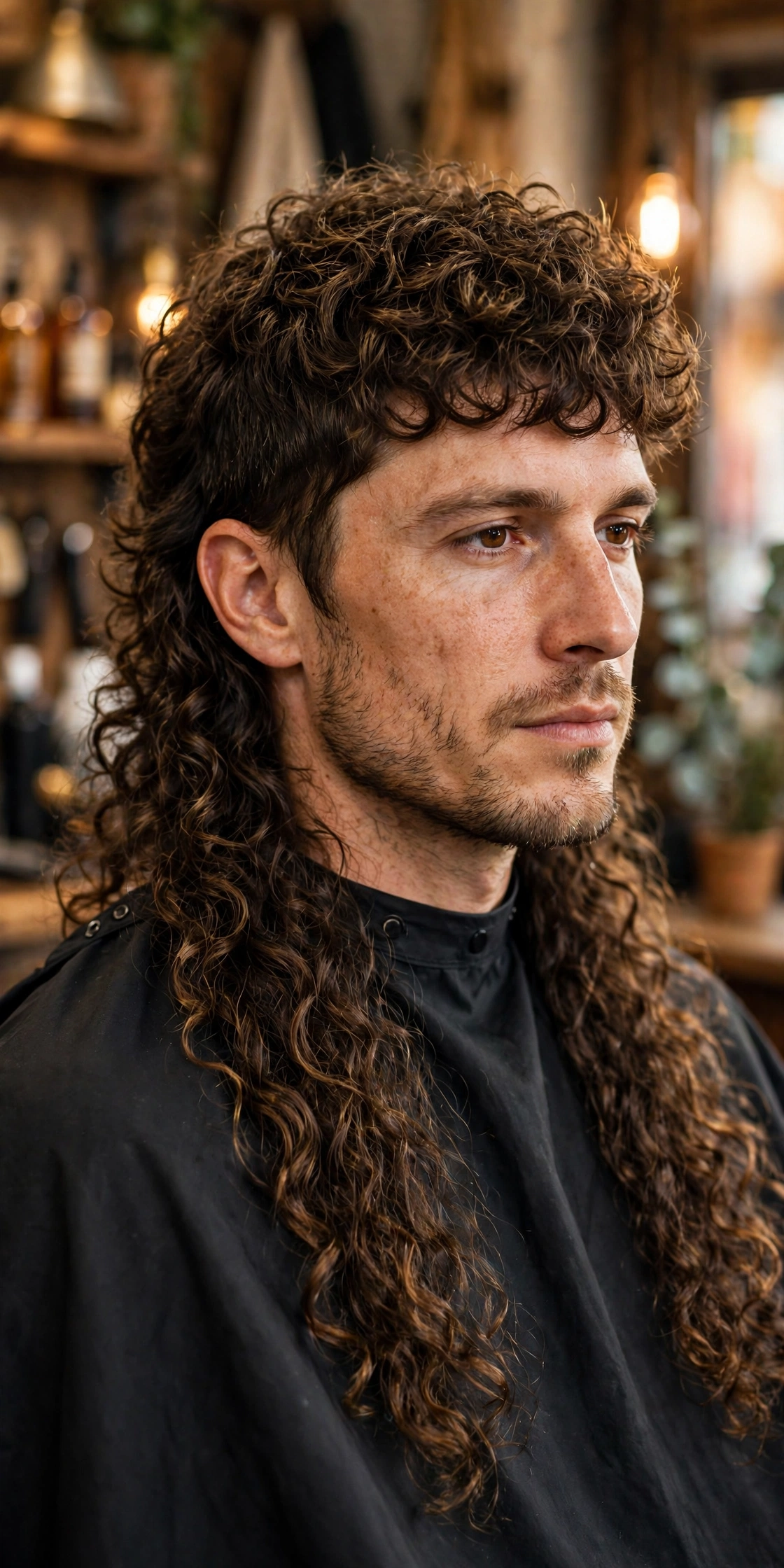
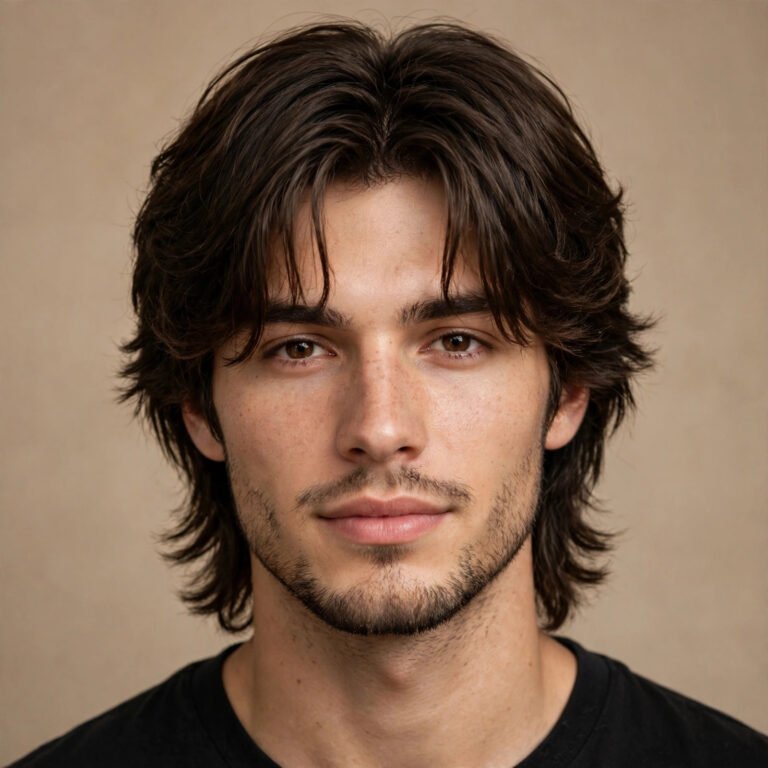
The curly shag mullet — sometimes called the “mullet shag” or “shullet” — is where the two great layered cuts of the decade merge. It keeps the shag’s textured crown and fringe but extends the back into genuine mullet length, creating a dramatic short-front, long-back silhouette powered entirely by curls. In 2026 this is one of the most requested hybrid cuts in barbershops, and on curly hair it looks intentional rather than ironic.
It suits oval, square, and diamond faces — the face shapes that can carry strong silhouettes. The volume on top balances the length at the back. It needs 3A to 3C curls (or strong waves) to get the right texture contrast; straighter hair makes it look like a costume. This is a confident cut — it draws eyes, so wear it like you mean it. For a deeper dive into the mullet side of the family, see our guide to the messy mullet for men.
In the chair: “Shag mullet — short textured layers on top and crown, keep the fringe, and leave the back long past the collar, blended not disconnected.” The word “blended” is doing heavy lifting: a disconnected mullet-shag looks like two haircuts glued together. Ask for the sides to be layered into both the top and the back so the whole thing flows.
Styling splits into two zones. The top gets curl cream and finger-coiling for definition; the back gets leave-in conditioner and a wide-tooth comb, left to hang in natural ribbons. Diffuse the crown for volume, let the back air-dry for length. Products: curl cream for the top, leave-in conditioner for the back, and a flexible-hold gel to keep the crown pieces separated. Maintenance: the top needs trimming every 6 weeks while the back grows — tell your barber “top only” on maintenance visits, and condition the back heavily since long curly ends are the first to dry out.
7. The Curly Wolf Cut Shag
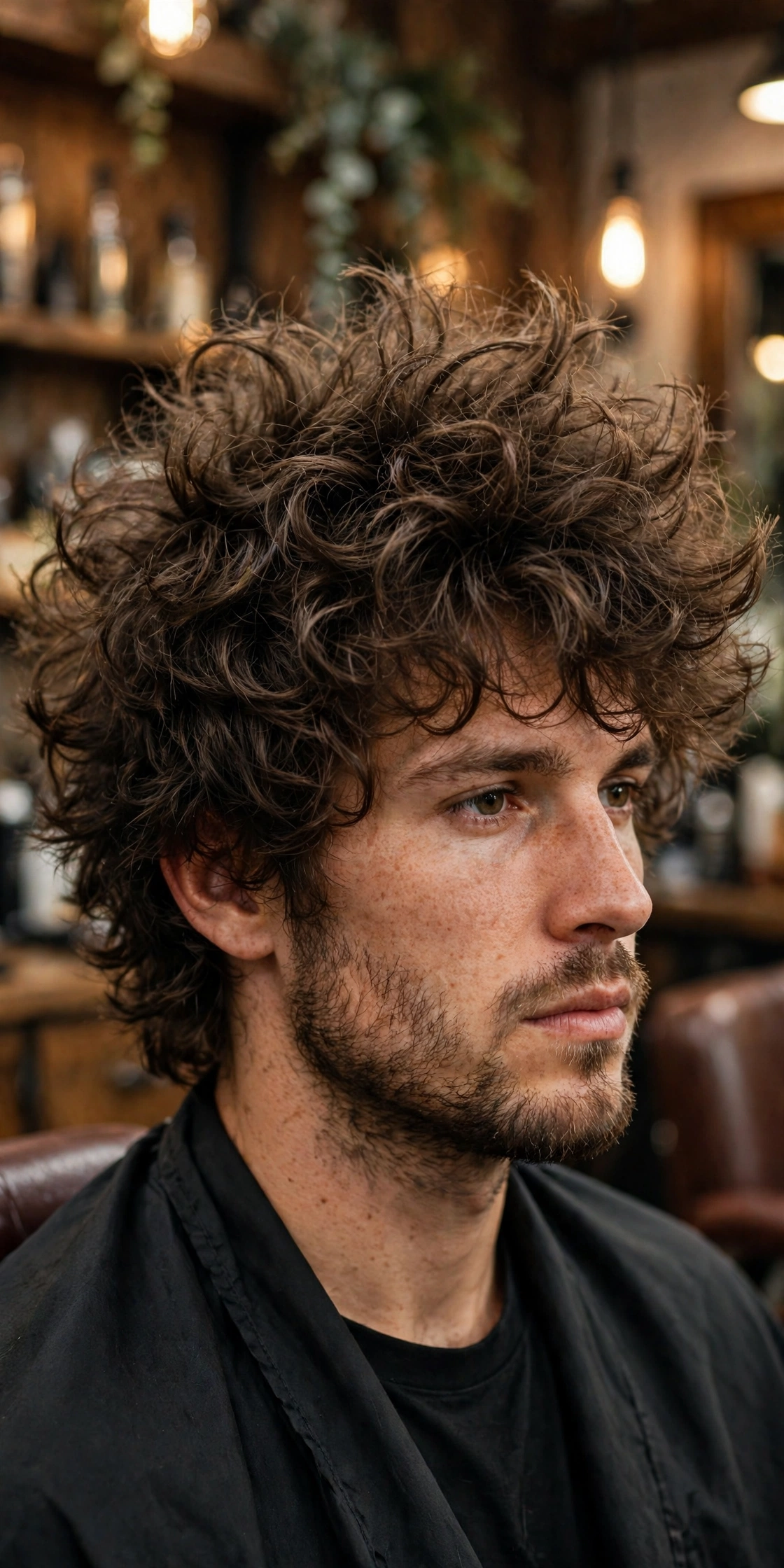
The curly wolf cut shag is the shag’s wilder cousin, and in 2026 the two have essentially merged into one spectrum. The wolf cut pushes the shag’s DNA further: even shorter, choppier crown layers, even more volume on top, and a more dramatic taper toward the ends. On curly hair the difference between a shag and a wolf cut is a matter of degree — the wolf is the shag turned up to eleven.
This is the cut for men who want maximum volume and do not mind standing out. It flatters round and square faces because the height on top elongates, and it is spectacular on 3A to 3C curls where the texture does half the styling work. It is less forgiving on fine or thin hair — the choppy layers need density to look full rather than sparse.
Ask for: “Wolf cut shag — really short choppy layers through the crown, lots of volume on top, tapered ends, keep the fringe heavy.” Bring photos of both shags and wolf cuts so the barber can calibrate how far toward “wolf” you want to go. Ask for the crown layers to be cut shortest at the very top of the head — that is what creates the signature lift.
Styling is about amplifying what the cut gives you. Apply mousse (not cream) to damp roots for lift, then curl cream through the lengths. Flip your head upside down and diffuse on high heat, low speed, scrunching upward — gravity plus heat equals volume. Finish with a texturizing spray at the roots, never a heavy oil. Products: volumizing mousse, light curl cream, and a root-lifting spray. Avoid heavy butters and oils on the crown; they collapse the height this cut is built for. Maintenance: trims every 6 to 8 weeks, because the short crown layers grow out of proportion quickly. This cut looks best slightly grown in, so do not over-trim — let it live a little.
8. The Tapered Curly Shag
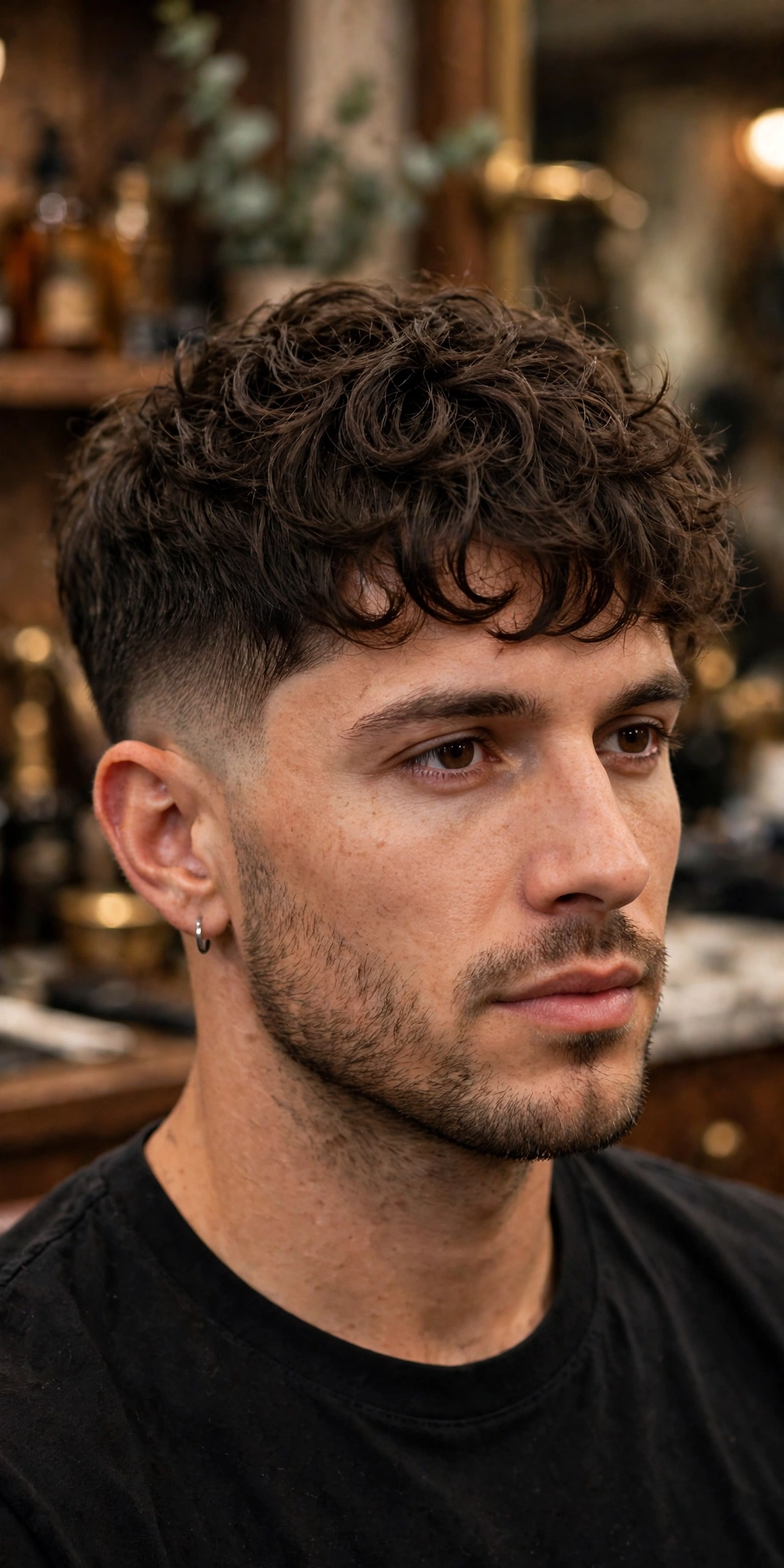
The tapered curly shag is the diplomat of the family: it keeps the shag’s layered top and fringe but cleans up the sides and back with a gradual taper, bridging the gap between a full shag and a conventional men’s cut. The taper is scissor-cut or clipper-tapered from the temples down, fading from the shag’s texture into neat, short sides. It is the shag you can wear to a client meeting.
This suits professional men, and it flatters square and oval faces by keeping the sides tight while the top does the talking. It works for 2B to 3B curls; the taper itself is curl-agnostic since the sides are kept short. If your workplace has opinions about hair, this is the shag variation least likely to trigger them.
In the chair: “Curly shag on top — layered, textured, fringe forward — with a low scissor taper on the sides and back, blended into the top, nothing harsh.” Specify “scissor taper” if you want to keep some texture in the sides, or “clipper taper” for a cleaner finish. The taper should start low (around the ears) so the shag keeps its characteristic width through the mid-head.
Styling focuses on the top. Apply curl cream to the layered top, finger-coil the fringe, and diffuse or air-dry. The tapered sides need almost nothing — a touch of matte paste if they frizz, otherwise leave them. The contrast between the neat sides and the textured top is the whole point, so do not over-style the sides into competing texture. Products: curl cream for the top, a light matte paste for the sides, and a boar-bristle brush to smooth the taper on dry hair. Maintenance: the taper grows out in 2 to 3 weeks — book a quick taper cleanup between full cuts, or learn to maintain the neckline yourself with clippers. Full shag reshaping every 8 weeks.
9. The Curly Shag with Undercut
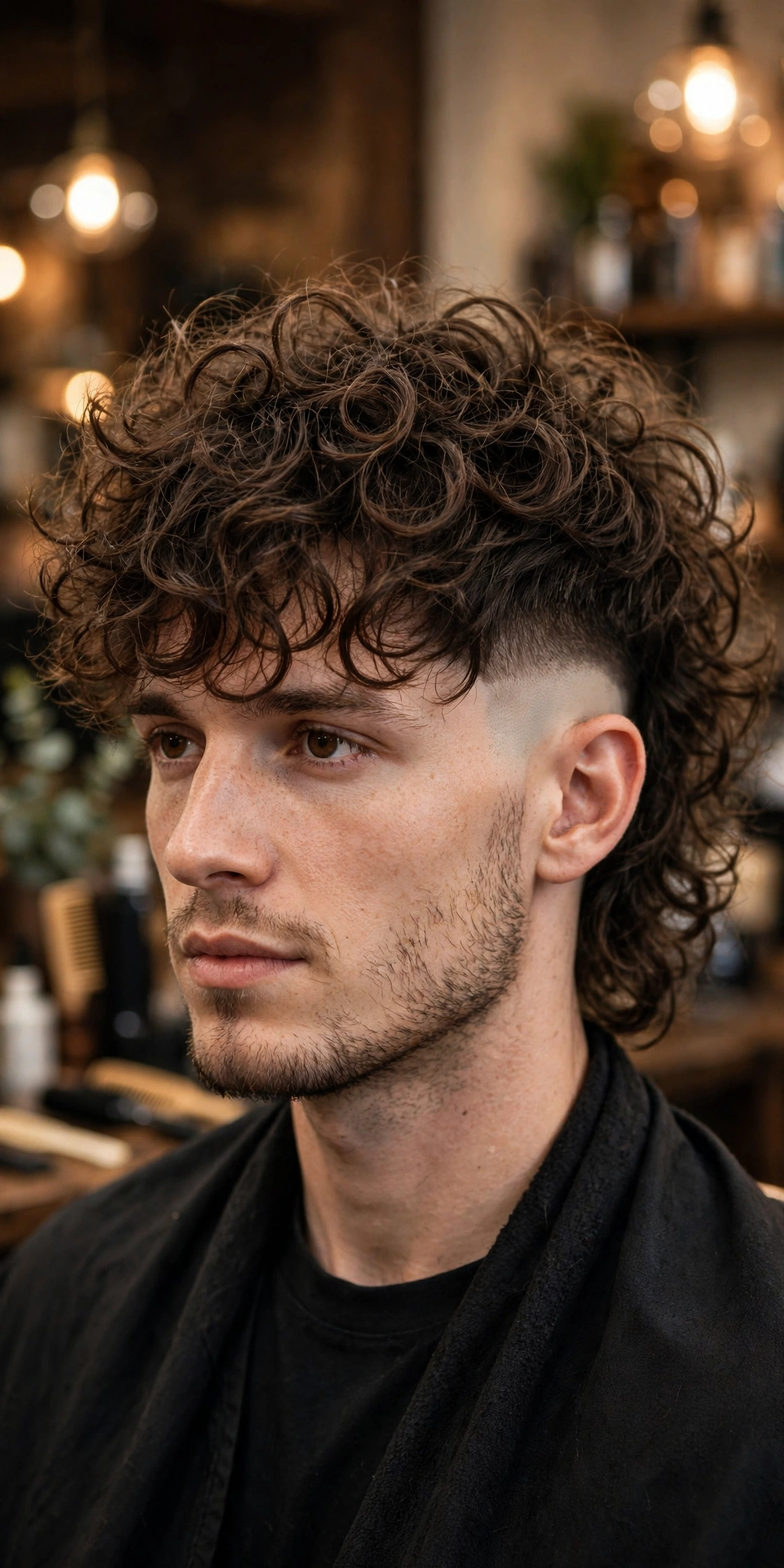
The curly shag with undercut takes the taper concept to its extreme: the sides and back are cut to one short, uniform length (or faded), while the entire top is left long and layered in full shag glory. The contrast is dramatic — a curtain of curls spilling over a clean undercut — and it is one of the boldest ways to wear the cut in 2026.
This suits men with strong bone structure (square, diamond, oval faces) who want the shag’s texture with a sharper frame. It needs decent density on top — 2C to 3C curls ideal — because the top carries the entire visual weight of the cut. It is also practical: the undercut removes bulk and heat, making it a smart summer shag.
Tell your barber: “Disconnected curly shag — undercut the sides and back to a [number] guard, leave the top long with shag layers, and keep the disconnect sharp, not blended.” Unlike the mullet-shag, here you WANT the disconnect — the hard line between the undercut and the top is the style. Decide the undercut length in advance (a 2 or 3 guard is the sweet spot for most).
Styling is all top. The undercut needs nothing beyond occasional smoothing. On the top, use the full routine: leave-in, curl cream, gel cast, diffuse. The weight of the long top over the short sides creates natural volume at the disconnect line — enhance it by diffusing the roots upward. Products: leave-in conditioner, curl cream, strong-hold gel for the top; a light pomade to slick the undercut if you ever wear the top tied back. Maintenance: the undercut needs re-cutting every 2 to 3 weeks to stay sharp (this is a 10-minute barber visit), while the top gets layered every 8 to 10 weeks. Growing out an undercut is awkward, so commit to the maintenance or choose the tapered version instead.
10. The Curly Shag with Fade
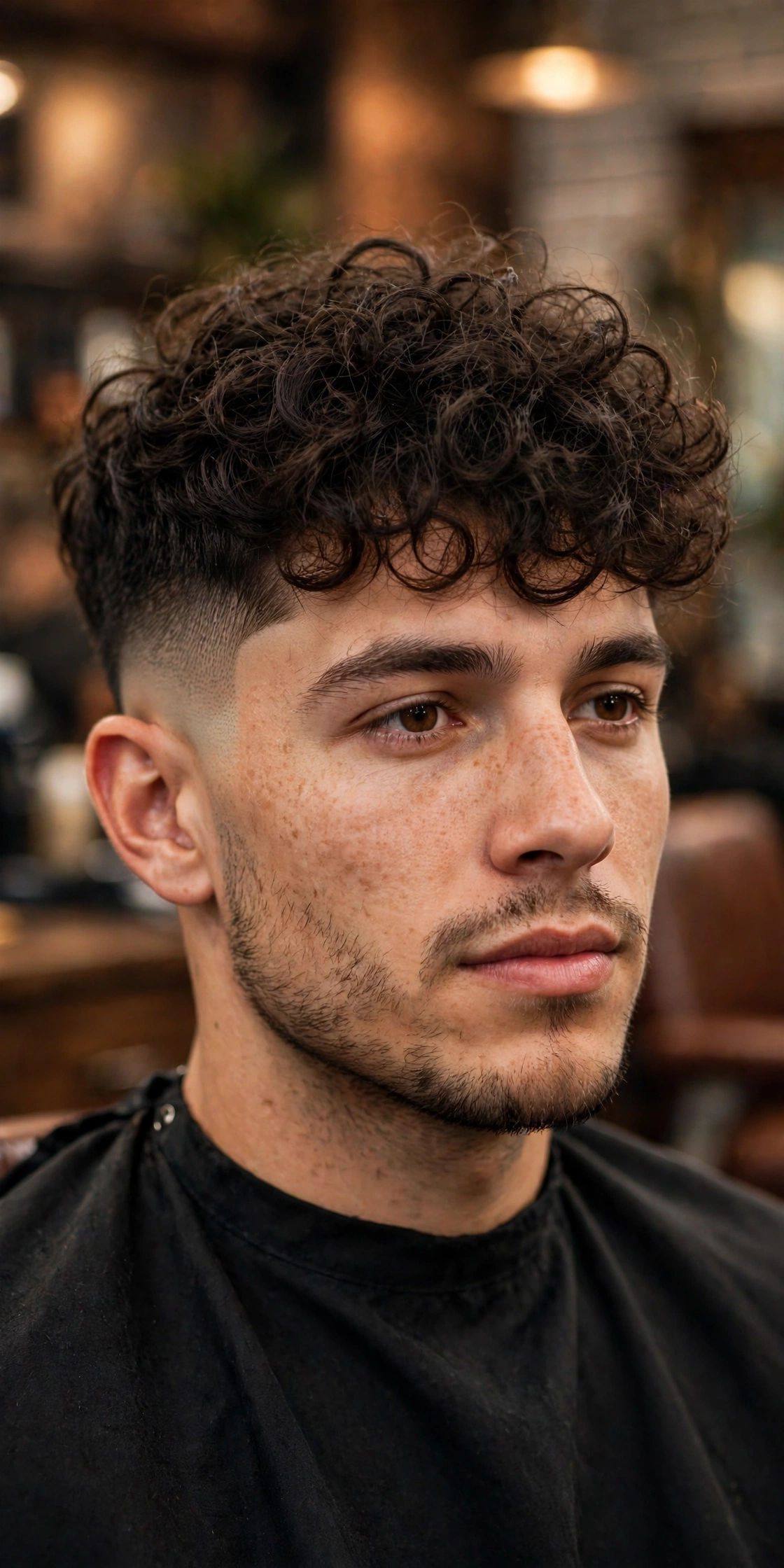
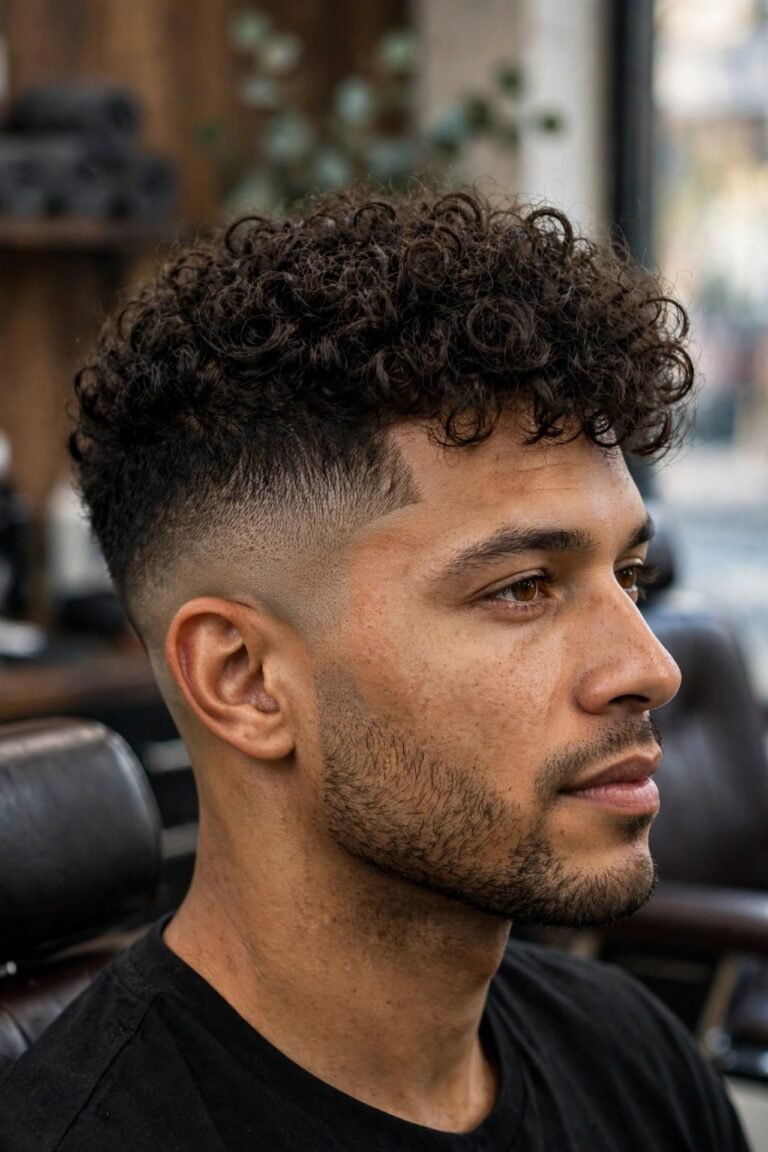
The curly shag with fade is the undercut’s more refined sibling: instead of one uniform short length on the sides, the fade graduates smoothly from skin (or near-skin) at the bottom to the shag’s full texture on top. It is the most barbershop-current way to frame a curly shag, and it photographs beautifully because the gradient draws the eye upward into the curls.
This flatters virtually every face shape — the fade is the most adjustable element in men’s cutting, and a good barber will tune its height to your head. High fades elongate round faces; low fades keep long faces balanced. It works with any curl type on top, since the fade handles the sides independently. This is the shag variation most often requested by men under 30 in 2026.
In the chair: “Curly shag on top with a [low/mid/high] fade on the sides — keep the transition smooth, and leave enough length on top for the layers to read as a shag, not just curly hair with a fade.” The last clause matters: some barbers will cut the top too short and you lose the shag entirely. Specify a minimum top length (3+ inches) and ask for the layers to be visible.
Styling mirrors the tapered shag: full curl routine on top, minimal product on the fade. Keep the fade moisturized — faded curly hair at the hairline can look ashy or dry, so a light oil on the faded area every few days keeps it looking intentional. Products: curl cream and gel for the top, light hair oil for the fade line, and sunscreen on the scalp if you go skin-fade in summer (seriously — faded scalps burn). Maintenance: fades grow out in 2 weeks flat. Budget for a fade refresh every 2 to 3 weeks; the shag top can go 8 weeks. This is the highest-maintenance shag variation in terms of barber visits, but each visit is quick.
11. The Messy Curly Shag

The messy curly shag is less a distinct cut and more a philosophy: the shag cut with styling that leans all the way into undone. The layers are there, the shape is there, but the finish is deliberately tousled — curls going in different directions, pieces falling where they want, zero visible effort. It is the “I woke up like this” shag, except there is actually a method behind it.
This suits creative, casual styles and flatters oval and heart-shaped faces where a little asymmetry adds character. It works best on 2B to 3A hair — curl patterns loose enough to separate into individual messy pieces. Very tight coils tend to clump rather than separate, which gives a different (also good) result, but not the piece-y mess this look wants.
Ask your barber for “a shag cut for messy styling — lots of point-cutting, uneven ends on purpose, layers that can fall in different directions.” The cut needs built-in irregularity; a too-perfect shag cannot be styled messy convincingly. Ask them to show you which pieces are meant to fall forward versus to the side, so you know the cut’s intended chaos map.
The styling method is counterintuitive: you create the mess deliberately. On damp hair, apply a small amount of matte paste (not cream), then twist random sections in alternating directions — some toward the face, some away. Rough-dry with a diffuser, shaking the roots with your fingers as you go. Then — the key step — pull a few pieces out of place on purpose once dry. It should look accidental but every piece was placed. Products: matte paste or clay as the primary styler, sea salt spray for grit, and dry shampoo at the roots on day two to keep the mess from collapsing into grease. Maintenance: trims every 8 weeks; the mess hides grow-out well, which is the practical advantage of this variation.
12. The Defined Curls Shag
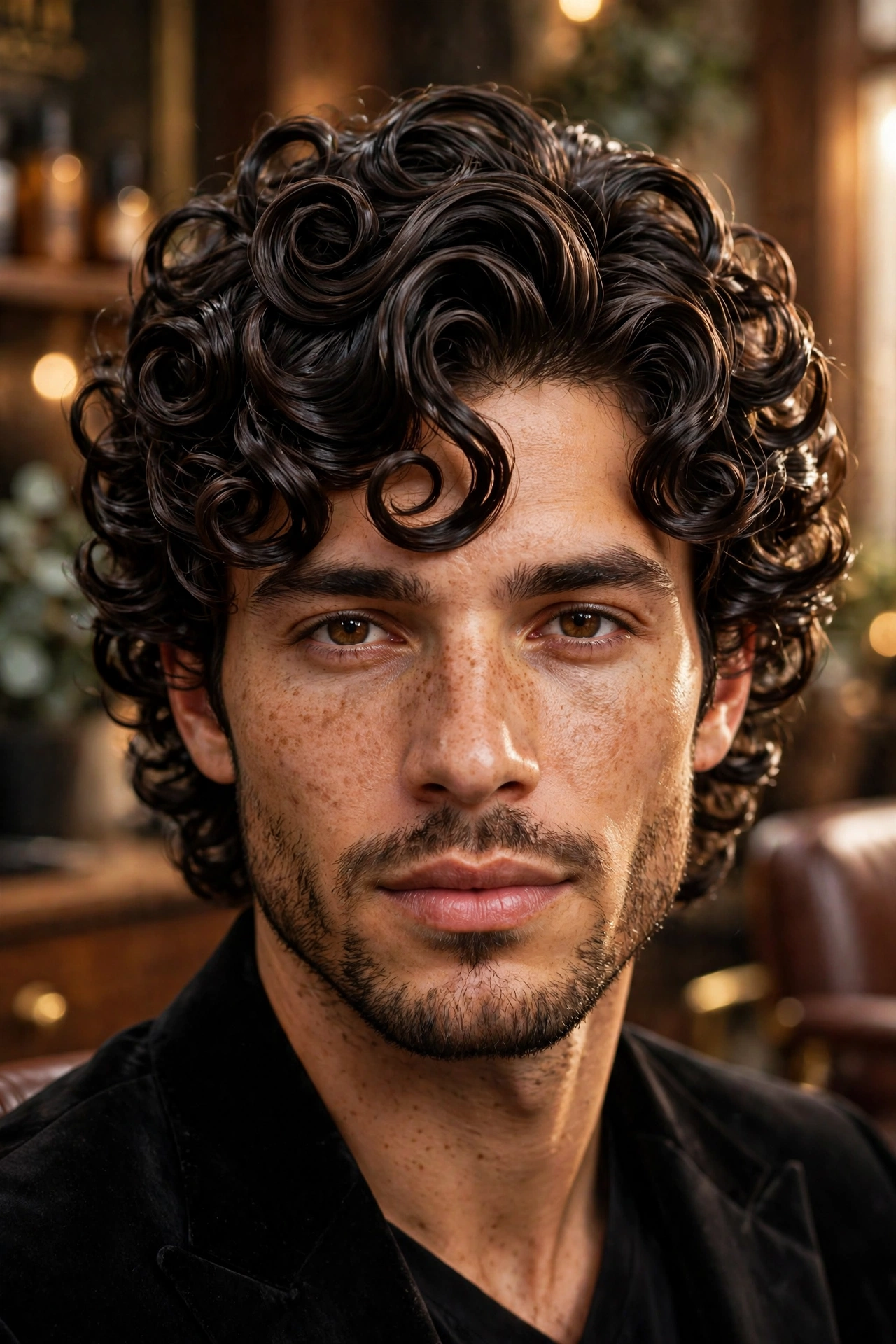
The defined curls shag is the messy shag’s opposite: same layered cut, but every curl is separated, spiraled, and placed with intention. This is the red-carpet version — glossy, sculpted curls with visible layer structure, the kind of shag that photographs like a product ad. It takes more effort, but the payoff is a cut that looks expensive.
It suits formal occasions, photoshoots, and men who enjoy the ritual of styling. It flatters all face shapes because the definition creates clean lines the eye can follow. It is at its best on 3A to 3C curls, where the natural spiral is tight enough to hold definition all day. Looser waves can achieve it too but need stronger hold products.
The cut itself is a standard shag — tell your barber “classic shag, but cut it so the layers are clean enough for defined styling — no razor texture, clean scissor work.” Defined styling needs clean layer edges; razor-textured ends frizz when you try to coil them precisely. Ask for the layers to be cut slightly longer than a messy shag, since defined curls show length more honestly.
Styling is a ritual. On soaking-wet hair: leave-in, then curl cream raked through in sections, then finger-coil EVERY section — wrap each curl clump around your finger from root to tip, in the direction of its natural spiral. Apply gel over the coils with praying hands, then diffuse on low heat without touching until 100% dry. Scrunch out the cast with oiled hands. This takes 20 to 30 minutes; there is no shortcut. Products: leave-in conditioner, rich curl cream, strong-hold gel, and a hair oil for cast-breaking. For maximum fluff and volume between defined styles, our fluffy hair guide for men covers the techniques that transfer directly. Maintenance: trims every 8 to 10 weeks, deep-condition weekly — defined styling uses more product and more heat, so the hair needs more care in return.
13. The Curly Shag with Curtain Bangs

Curtain bangs — the center-parted fringe that frames both sides of the face — meet the curly shag in one of 2026’s most wearable combinations. The shag’s layers are cut to flow outward from a middle part, with the front pieces curving away from the face like curtains. On curly hair the effect is softer and more romantic than the straight-hair version, because the curls add natural movement to the frame.
This is exceptionally flattering for square and round faces: the center part creates a vertical line that elongates, while the curved front pieces soften the jaw. It works for 2A to 3B curls; the curtain needs enough length to curve, so this is a medium-to-long shag variation. Men with strong curl shrinkage should keep the front pieces longer than they think.
In the chair: “Curly shag with curtain bangs — center part, face-framing layers starting at the cheekbones, curving outward, blended into the shag.” Ask the barber to cut the curtain pieces dry, with your hair in its natural center part — cutting curtains on a side part and then switching to center guarantees asymmetry. The shortest curtain piece should hit around the cheekbone; shorter looks choppy, longer loses the curtain effect.
Styling starts with the part. On damp hair, create a clean center part with a comb, then apply curl cream and finger-coil the two front sections AWAY from the face — this trains the curtain direction. Diffuse the front pieces first, holding them away from the face as they dry. A round brush and blow dryer can refine the curve on special occasions, but daily styling should stay heat-minimal. Products: curl cream, a light mousse for the front pieces (mousse gives curtain bangs their airy curve), and a flexible hairspray to hold the part on windy days. Maintenance: curtain pieces grow out of shape in 4 to 6 weeks — they are the highest-maintenance part of this cut. Many men learn to dust the curtain ends themselves between barber visits.
14. The Curly Shag with Fringe

Distinct from the bang version (section 5), the fringe here is worn forward and full — a heavier, straighter-across curtain of curls that sits on the forehead as the cut’s boldest feature. Where bangs blend, a fringe declares. It is the shag’s most face-transforming element: it shortens long faces, hides high foreheads, and gives the whole cut a youthful, mod-adjacent energy.
Best for long, oval, and heart-shaped faces — the horizontal line of the fringe visually shortens the face. It needs 2C to 3B curls with enough weight to sit forward rather than spring straight up; very tight coils will need extra length and weight to hold a forward fringe. This is also the fringe that pairs best with glasses — the curls sit above the frames and the combination is consistently sharp.
Barber language: “Full curly fringe — heavy, worn forward, cut dry to sit at eyebrow length, textured ends, blended into the shag layers at the temples.” Emphasize “worn forward” — some barbers default to sweeping curly fringes to the side. Ask for the fringe to be cut in its natural fall, with your head in a neutral position, not tilted back (tilting back makes the barber cut it too short).
Style the fringe as its own project. Dampen, apply a small amount of curl cream just to the fringe, and finger-coil the pieces in the direction they will sit — mostly straight down with slight separation. Diffuse on low heat, pressing the fringe gently against the forehead with the diffuser cup (this trains it to lie forward rather than spring up). Do not rake the fringe upward at the roots — that creates a bouffant, not a fringe. Products: curl-defining cream, a pea of gel on the fringe ends for separation, and a silk scarf or durag for 10 minutes after styling to set the fringe flat (an old barber trick that works). For more fringe-focused cutting and styling detail, see our curly fringe guide for men. Maintenance: fringe trims every 3 to 4 weeks without fail — a grown-out curly fringe falls into the eyes and the whole cut loses its shape.
15. The Wavy Shag (2A-2C Hair)
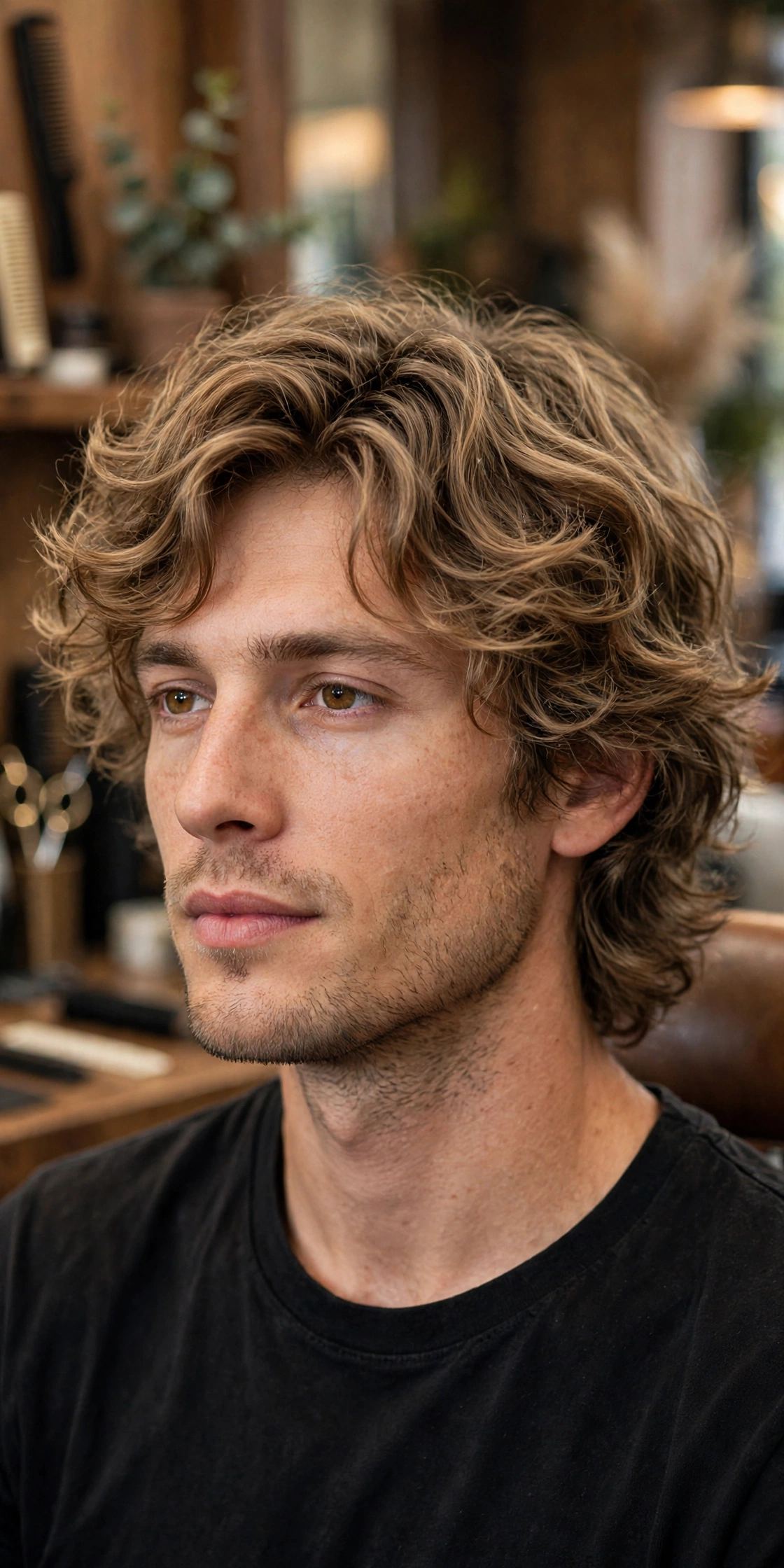
Not every shag wearer has true curls, and the wavy shag deserves its own entry because the technique is different. On 2A to 2C hair, the shag’s layers create the wave rather than following it — the cut manufactures movement that the hair would not produce on its own. The result is a softer, beachier shag: less spiral, more flow, with the layers doing the visual work.
This is the most versatile shag across face shapes, because the softer texture does not add as much width as true curls. It is also the best shag for men transitioning from straight hair — the layering teaches the hair to move. The challenge is hold: waves fall flat faster than curls, so the styling has to build in grit and texture.
Tell your barber: “Shag for wavy hair — I need the layers to CREATE movement, so go shorter through the crown than you would for curly hair, and add plenty of texture through the ends.” Wavy hair needs more aggressive layering to achieve the shag silhouette; conservative layers disappear. Ask for point-cutting throughout — blunt ends on wavy hair look heavy and kill the wave.
Styling is about encouragement. On damp hair, spray sea salt spray generously from roots to ends, then scrunch upward — really work it in, wavy hair needs physical persuasion. Apply a light mousse over the top for hold, then diffuse upside down or air-dry while scrunching every 10 minutes (the “plopping and scrunching” cycle). Once dry, break up the waves with your fingers and finish with a texturizing spray. Products: sea salt spray (the hero product for this hair type), light mousse, texturizing spray, and dry shampoo for day-two grit. Avoid heavy creams and oils — they pull waves straight. Maintenance: trims every 6 to 8 weeks; wavy shags show grow-out as limpness rather than shape loss, so refresh when the movement dies.
16. The Tight Coils Shag (4A-4C Hair)
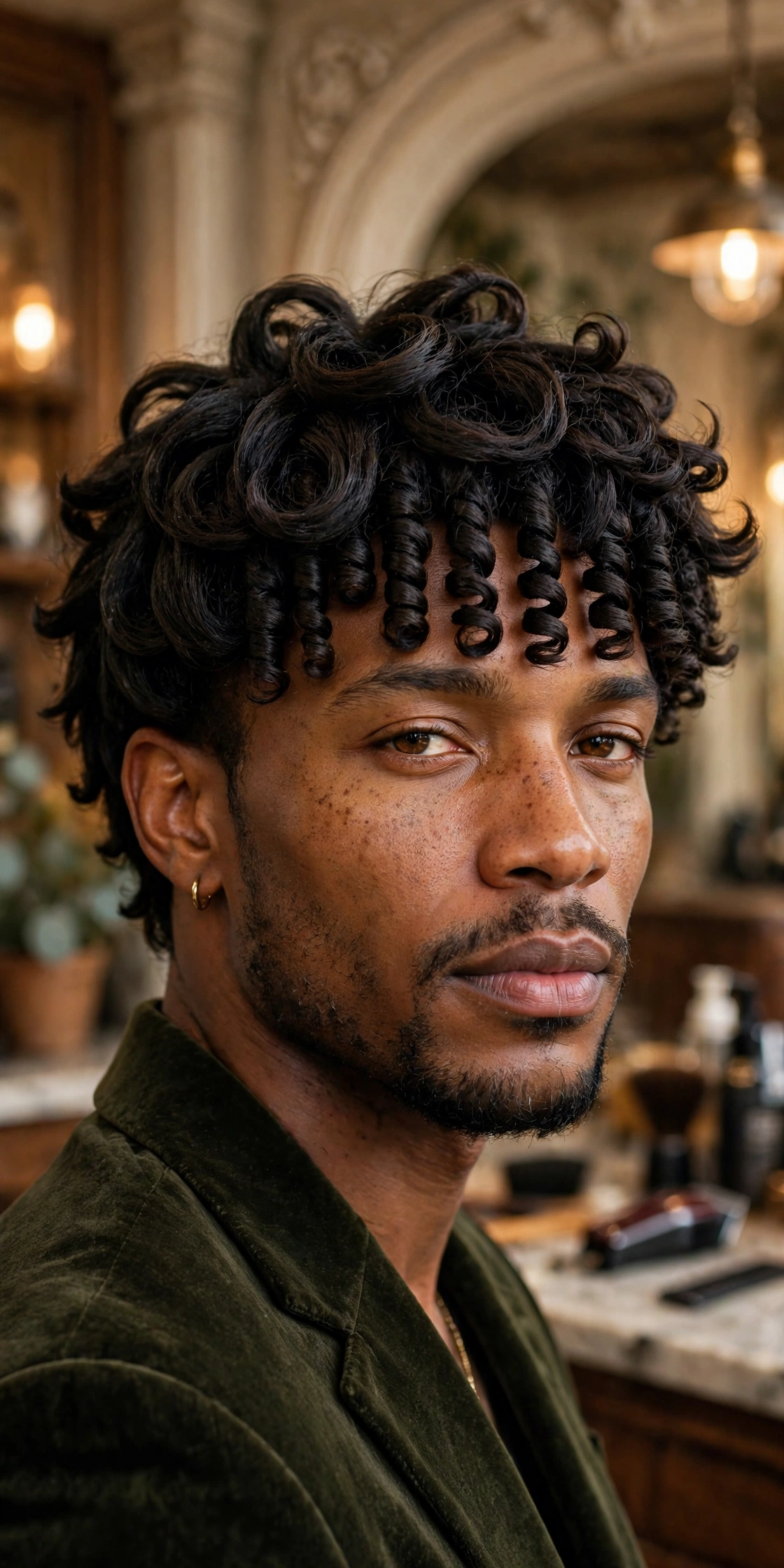
The tight-coils shag is one of the most striking variations in this guide and one of the least covered elsewhere. On 4A to 4C hair, the shag’s layers create a sculpted, architectural silhouette — a rounded, full shape with visible layer separation and a fringe that coils at the forehead. It is bold, regal, and completely distinct from the looser-curled versions.
It suits oval, square, and diamond faces, where the full silhouette balances strong features. The key technical consideration is shrinkage: 4A-4C hair can shrink 50 to 75 percent, so the cut must be planned at the stretched length and executed with the shrinkage in mind. This is a cut that demands a barber experienced with coily hair — curl-by-curl dry cutting is not optional here, it is the only safe method.
In the chair, be explicit: “Shag on coily hair — cut it dry, in its natural shrunken state, with the layers planned for shrinkage. I want a defined shape with a fringe, not a uniform rounded cut.” Ask the barber to stretch-test sections (gently pulling a coil to show its true length) before deciding layer lengths. Discuss the silhouette first — rounded, elongated, asymmetrical — because the shape is the style on this hair type.
Styling is moisture-first, always. The LOC or LCO method (liquid, oil, cream — in whichever order your hair prefers) on damp hair, section by section. Twist or shingle the coils for definition, focusing on the fringe and the outer silhouette. A hooded dryer or diffuser on low heat sets the shape; air-drying works but takes hours at this density. Products: water-based leave-in, a sealing oil (jojoba or grapeseed), and a rich curl-defining cream or butter. This hair type drinks product — budget accordingly. Maintenance: trims every 8 to 12 weeks (coily hair shows shape loss slower), deep-condition every wash day, and protect the shape at night with a satin bonnet — the silhouette is the style, and friction is its enemy.
17. The Curly Shag for Thick Hair
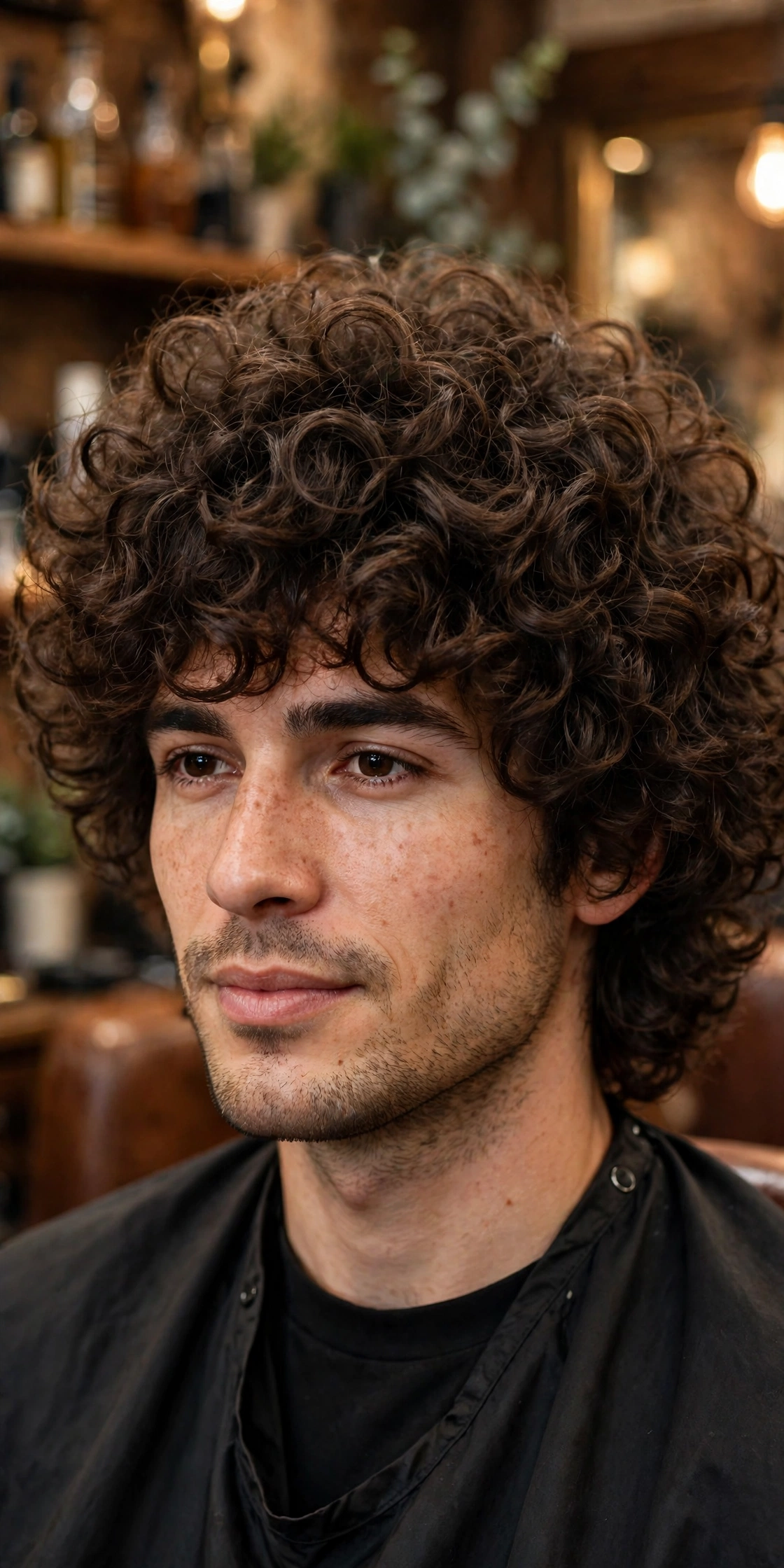
Thick curly hair and shags are a natural match — the cut was designed to manage volume — but thickness changes the technique. On dense hair, a standard shag can turn into a triangle: flat at the roots, enormous at the ends. The thick-hair shag counters this with internal layering, strategic weight removal, and longer top layers that let the crown lie closer to the head.
This suits men whose hair has always been “too much” — the ones barbers reach for thinning shears on (do not let them). It flatters round and square faces especially, because controlling the side volume slims the silhouette. All curl types from 2C to 4A can work; the variable is density, not pattern.
The barber conversation is technical: “Shag for very thick hair — I need internal layers to remove weight, longer layers on top so the crown sits down, and NO thinning shears on the ends.” Thinning shears on thick curly hair create frizz that no product can fix — the cut ends look shredded instead of textured. Ask for “slide cutting” or “channel cutting” if your barber knows the techniques; both remove bulk while keeping the curl clumps intact. The under-layers should be significantly shorter than the top layers — that hidden structure is what prevents the triangle.
Styling thick shags is about distribution. Section the hair into four quadrants and apply product to each separately — raking cream through all at once leaves the under-layers dry and frizzy. Use more product than you think; thick hair absorbs it. Diffuse in sections, lifting at the roots, and do not be afraid of a strong-hold gel — thick hair can handle it. Products: a rich leave-in, a strong curl cream, hard-hold gel, and a wide-tooth comb for detangling in the shower only. For volume-control techniques that complement this cut, our fluffy hair guide has transferable methods. Maintenance: trims every 8 weeks; thick hair grows out into bulk quickly, and the internal layers need refreshing to keep doing their job.
18. The Curly Shag for Fine Hair
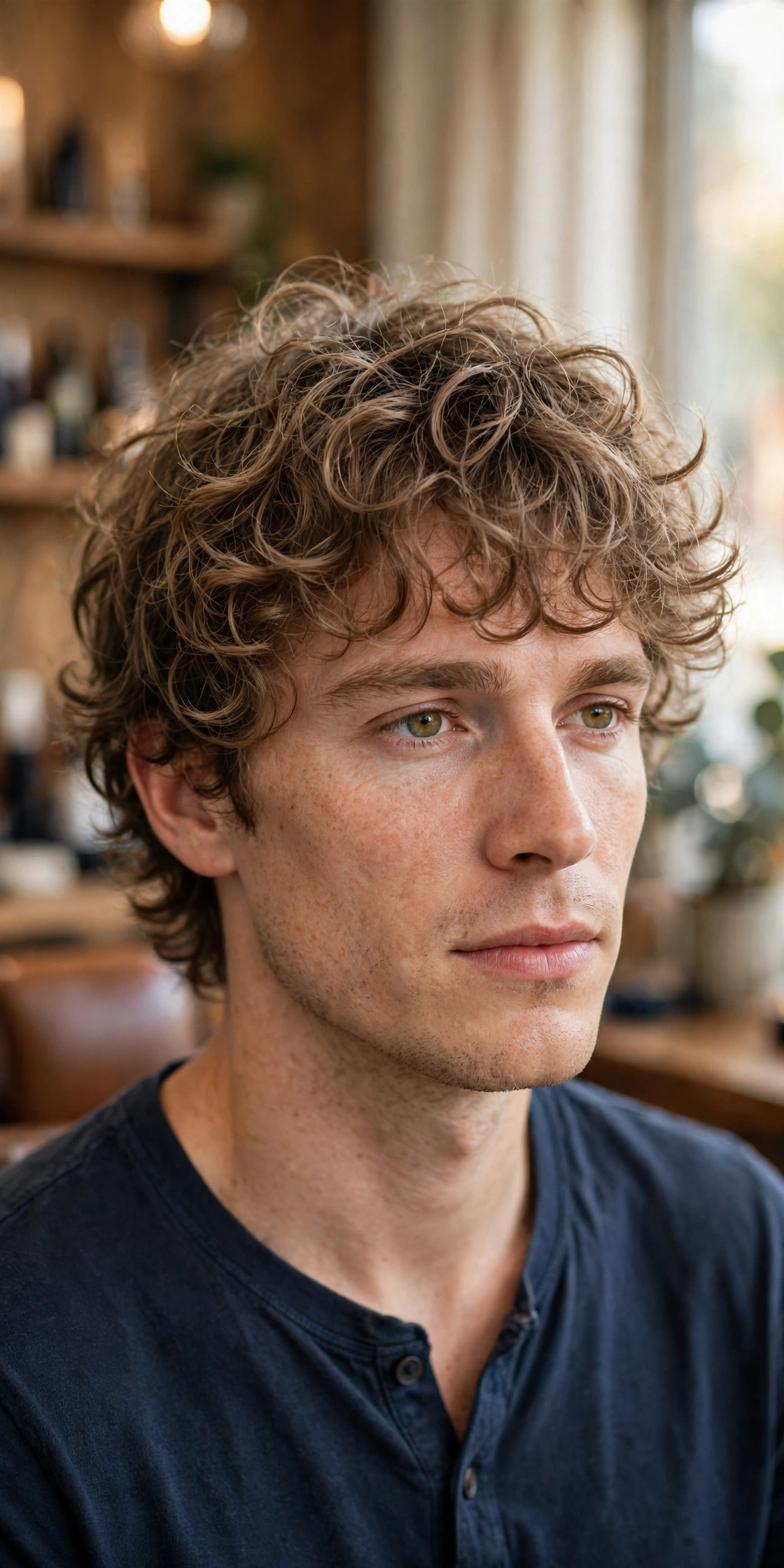
Fine curly hair presents the opposite challenge: not enough density to fill the shag’s silhouette. The fine-hair shag adapts with fewer, longer layers, blunt-ish ends that preserve visual weight, and styling that builds the illusion of fullness. Done right, it is one of the most transformative cuts for fine curls — the layers create movement that makes the hair look thicker than it is.
It suits oval and heart-shaped faces, where the softer silhouette does not overwhelm delicate features. It works for 2A to 3A curls; tighter patterns on fine hair are rare but the same principles apply. The enemy is over-layering — every layer removed is density lost, and fine hair cannot spare it.
Tell your barber: “Shag for fine hair — keep the layers long and few, preserve as much weight at the ends as possible, and cut for fullness, not texture.” Ask them to avoid razor work entirely — razors shred fine ends and make them look thinner. The layers should start no higher than the cheekbones, and the overall shape should stay closer to the head than a standard shag. Think “shag suggestion” rather than “shag explosion.”
Styling builds body from the roots. Apply a volumizing mousse to damp roots only — never the ends, which need weight. Flip upside down and rough-dry with a diffuser on medium heat, focusing on the roots; the ends can air-dry. Once dry, use a root-lifting spray and gently backcomb (tease) the crown with a fine-tooth comb, then smooth the top layer over it. This hidden scaffolding doubles the apparent volume. Products: volumizing mousse, root-lifting spray, a light texturizing powder for the crown, and absolutely no heavy oils or butters. Maintenance: trims every 6 to 8 weeks — fine ends split faster and split ends on fine hair are immediately visible. Protein treatments monthly help fine curls hold their structure.
19. The Curly Shag with Highlights
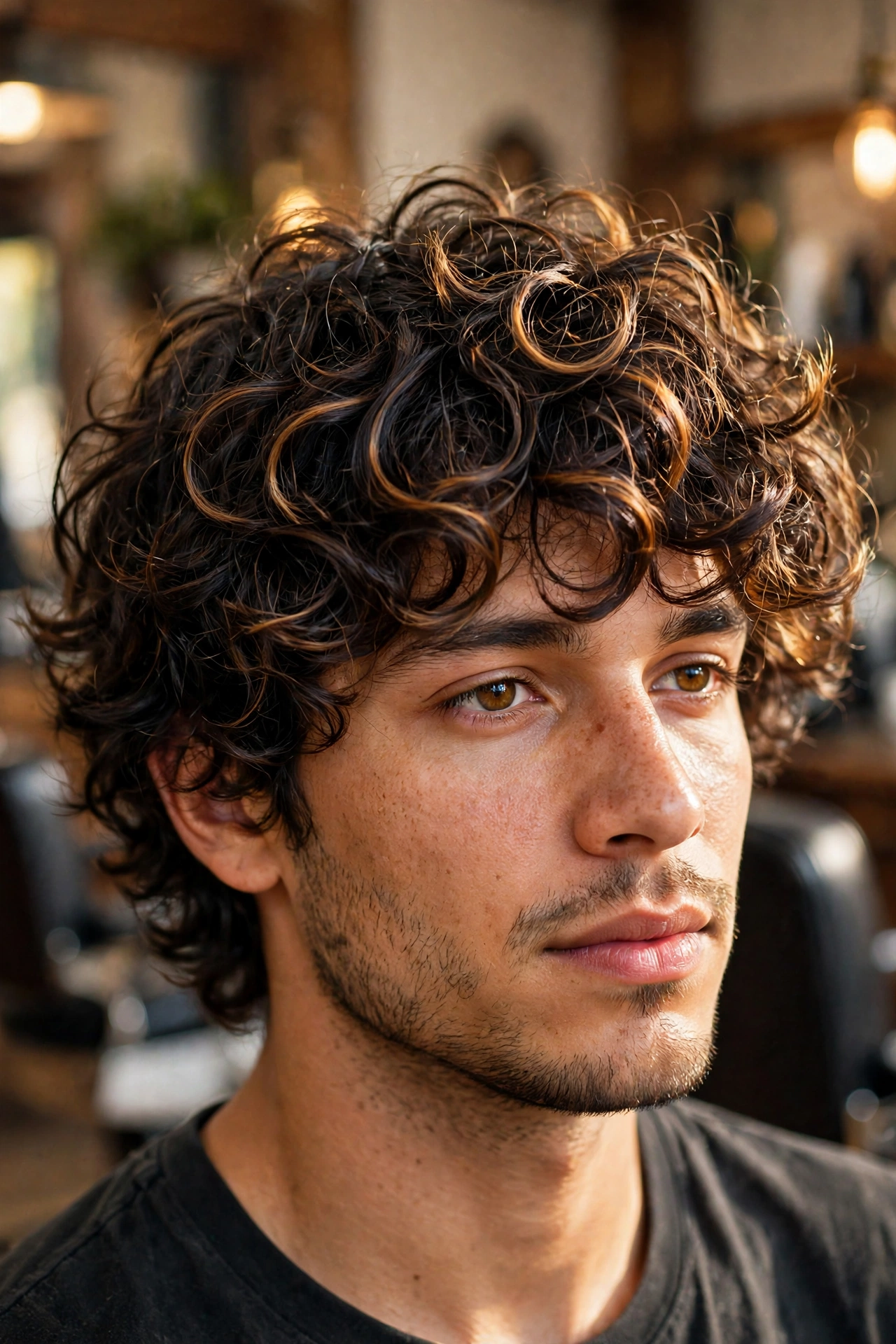
Highlights on a curly shag are a cheat code for dimension. The shag’s layers already create depth; adding lighter pieces through the mid-lengths and ends makes every layer visible, turning the cut into a 3D object. In 2026 the move is natural, sun-kissed highlighting — caramel, honey, or copper ribbons painted through the curls — not chunky 2000s streaks.
This suits anyone who wants their shag to photograph better and look more expensive. It is especially effective on dark hair (levels 2 to 4), where the contrast is dramatic, and it flatters all face shapes because the highlights can be placed to contour — lighter pieces around the face brighten, darker underneath slim. All curl types work; the paint is applied to follow the curl pattern.
At the salon (highlights are colorist territory, not barber), ask for “balayage or pintura highlights to enhance a curly shag — hand-painted, following the curl clumps, focused on the mid-lengths and ends, nothing at the roots.” Pintura is the curly-specific highlighting technique where color is painted onto individual curls dry — it is the gold standard for this cut. Bring a photo of the highlight density you want; “natural” means different things to different colorists.
Styling highlighted shags is about shine. Color-treated curls are drier, so up the moisture: leave-in plus cream plus a shine-enhancing oil on the ends. Diffuse as normal, then finish with a glossing spray — the light catching the highlights is the entire point. Products: color-safe sulfate-free shampoo, a weekly hair mask, curl cream, and a silicone-free shine oil. Maintenance: gloss or toner refresh every 6 to 8 weeks (highlights on curls fade faster because the raised cuticle releases color), trims every 8 to 10 weeks, and UV protection in summer — sun bleaches highlights into brassiness.
20. The Bleached Curly Shag

The bleached curly shag is the statement-maker: the full shag silhouette rendered in platinum, silver, or icy blonde. It is high-contrast, high-maintenance, and unmissable — the haircut equivalent of turning the volume to maximum. In 2026 bleached texture is firmly mainstream in men’s grooming, and the shag’s layers show off bleach better than any other cut because every layer catches light differently.
It suits confident dressers and flatters oval, square, and diamond faces — the bold color needs strong features to anchor it. It works on 2B to 3B curls; the bleaching process loosens curl patterns slightly, so very tight coils may drop a full curl type. Be honest about your hair’s health: bleach on already-damaged curls is a recipe for breakage, and no cut looks good broken.
This is a two-appointment job: cut first, bleach second (or bleach then cut — ask your colorist’s preference). Tell the colorist: “Full bleach to a level 10 platinum, and I need a bond-builder in the formula — my curls have to survive this.” Olaplex or K18 in the bleach is non-negotiable for curly hair. Discuss the target tone (platinum, silver, ash) because the toner determines the final look more than the bleach does.
Styling bleached curls is damage management disguised as styling. Protein-moisture balance is everything: alternate protein treatments and deep moisture masks weekly. Style with the gentlest products — creamy leave-ins, no harsh gels, minimal heat. Diffuse on the lowest heat setting or air-dry exclusively. Purple shampoo once a week keeps the tone icy; overuse it and the hair goes lavender-grey. Products: bond-building treatment (used weekly), purple shampoo, ultra-moisturizing leave-in, and a heavy curl cream — bleached hair needs richer products than virgin hair. Maintenance: root touch-ups every 4 to 6 weeks (the regrowth line on a shag is very visible), trims every 6 to 8 weeks to remove bleach-damaged ends, and accept that this is the most expensive variation on this list to maintain.
21. The Curly Shag with Beard
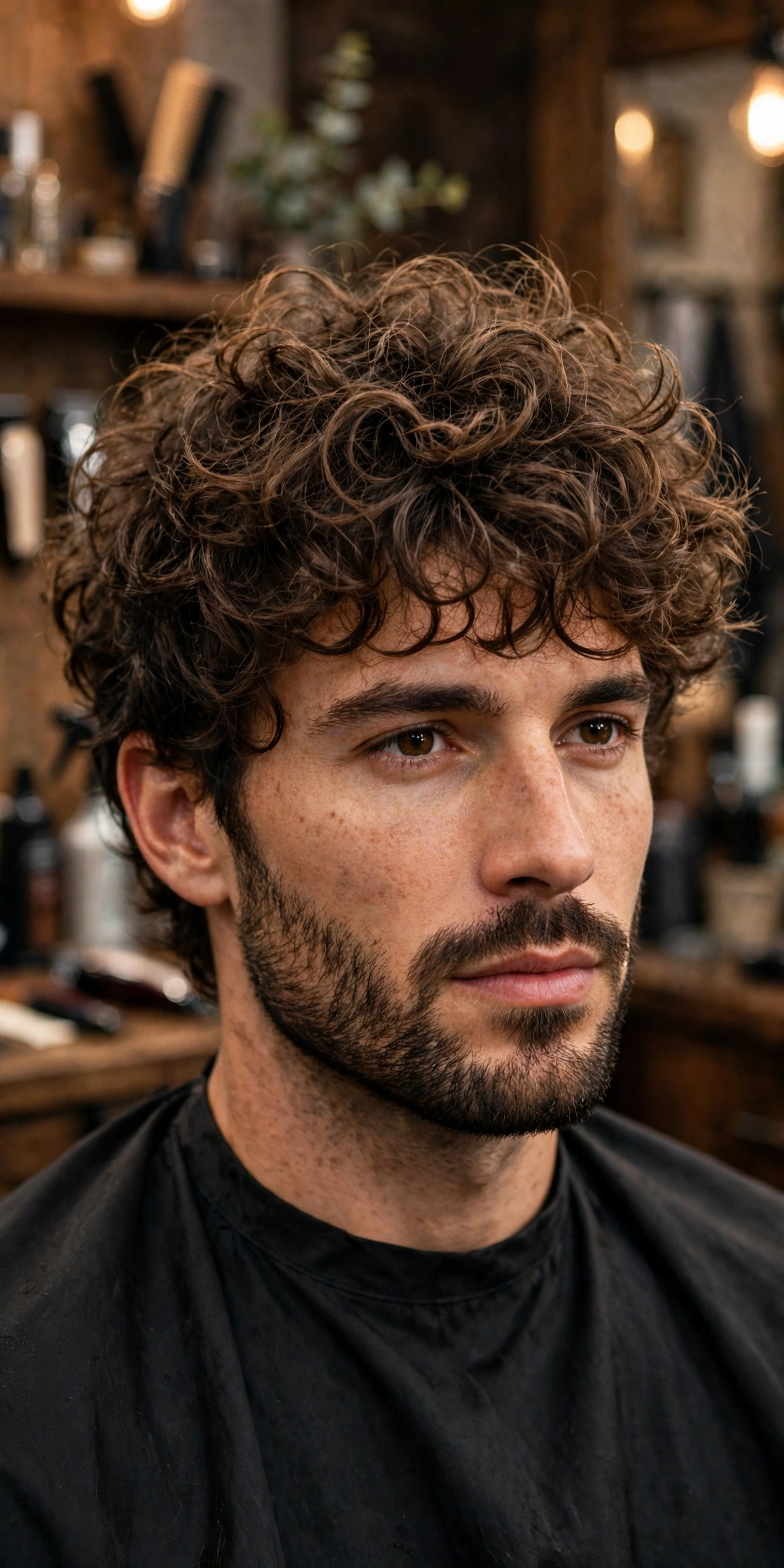
The curly shag with a beard is about the conversation between the two textures: the shag’s wild, layered curls on top meeting a deliberate, shaped beard below. When both are groomed with intention, the combination is one of the strongest looks in men’s grooming — the contrast between controlled facial hair and free head hair creates a balance that reads as effortlessly masculine.
It suits square, oval, and oblong faces — the beard adds width and weight to the jaw, balancing the shag’s volume on top. The key is proportion: a massive shag plus a massive beard overwhelms; a massive shag plus a neat, shaped beard harmonizes. Match the energy — if the shag is wild, the beard should be tidy, and vice versa. All curl types work; the beard is independent of the hair texture.
You need two specialists or one very good barber. For the hair: any shag variation from this guide. For the beard: “shaped to complement the shag — clean cheek lines, defined neckline, length that balances the hair volume.” Ask the barber to look at both together before cutting either — the silhouette is one unit. The transition at the sideburns matters most: the shag’s sides should flow into the beard’s top without a harsh line or an awkward gap.
Styling is a two-front routine. Hair gets the standard shag routine for your variation. The beard gets washed (beard wash, not head shampoo), conditioned, and oiled daily, then brushed with the grain and shaped with a blow dryer on low heat if needed. Keep the mustache trimmed above the lip — it is the detail people notice. Products: your shag styling products plus beard oil, beard balm for shaping, and a boar-bristle beard brush. Maintenance: beard trims every 1 to 2 weeks (beards grow out of shape fast), hair trims per your shag variation’s schedule. The neckline is the weekly battleground — keep it clean and the whole combination looks sharp.
22. The Professional Curly Shag
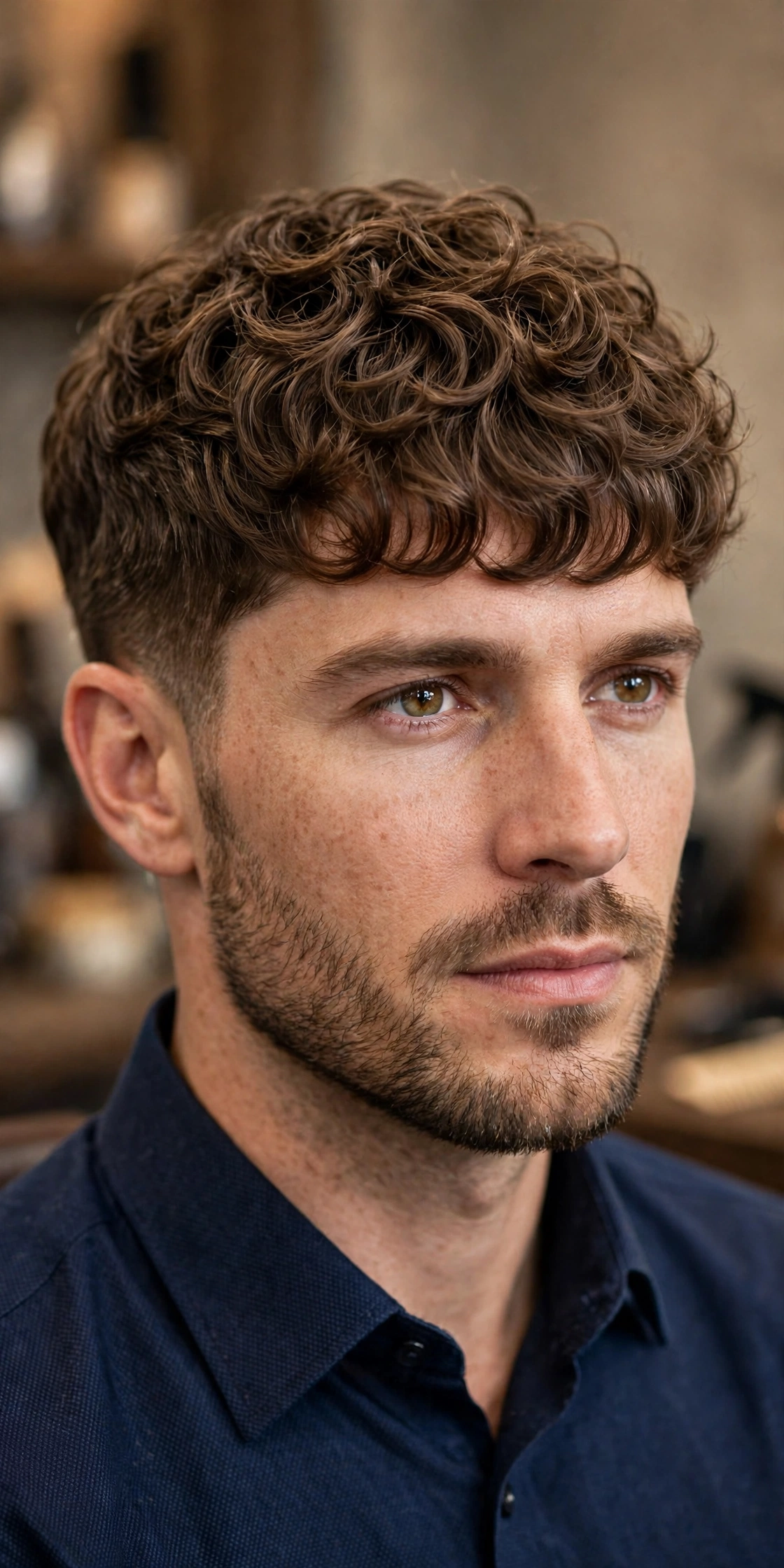
The professional curly shag answers the question every office worker with curls asks: can I wear a shag to work? Yes — with the right variation. The professional shag keeps the layered structure but disciplines it: medium-short length, controlled volume, a neat fringe that stays off the forehead, and tapered sides that read as intentional. It is the shag in a blazer.
It suits conservative workplaces and flatters oval, square, and heart-shaped faces — the shapes that carry a neat silhouette well. It works for 2A to 3A curls; tighter patterns can work but need the length kept shorter to stay tidy. The goal is texture that looks deliberate, not texture that looks like you just rolled out of bed.
In the chair: “A professional shag — layered but controlled, fringe above the eyebrows, tapered sides, overall shape neat enough for an office. I want the texture visible but disciplined.” Show your barber a photo AND mention your workplace — a good barber will calibrate the wildness to your dress code. Ask for the layers to be cut slightly longer and less choppy than a fashion shag; the restraint is what makes it office-safe.
Styling is the difference between this and every other shag here. Apply curl cream to damp hair, then comb the fringe into place with a wide-tooth comb — yes, comb, not fingers — for a controlled finish. Diffuse on low heat, directing the hair in its final direction (no upside-down volume tricks). Finish with a light-hold pomade or cream to keep flyaways down through the day. The look should be “groomed texture,” not “bedhead.” Products: smoothing curl cream, light-hold pomade or styling cream, and an anti-frizz serum for humid commutes. For broader workplace grooming standards, established men’s grooming guides cover the finishing details that complete the look. Maintenance: trims every 5 to 6 weeks — a professional shag cannot afford to look grown out. This is the one variation where over-maintaining beats under-maintaining.
23. The Curly Shag for Round Faces
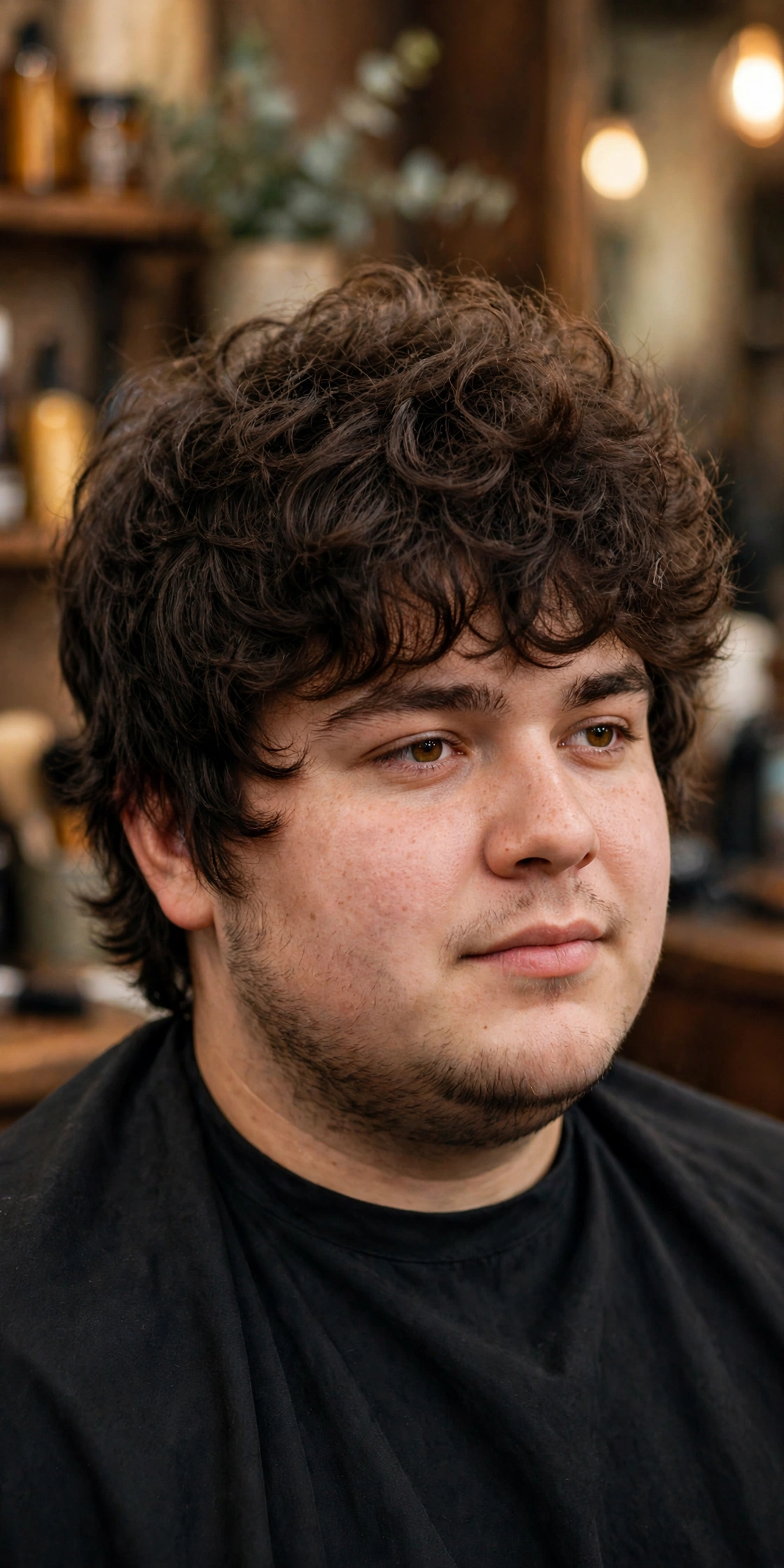
Round faces need what the shag does best: vertical emphasis and strategic volume placement. The round-face shag is cut to add height at the crown while keeping the sides close, creating the illusion of length. The fringe is worn forward or to the side — never straight across at full width, which emphasizes roundness — and the overall silhouette aims for oval.
The principles: height on top (crown layers cut shorter to stack upward), minimal width at the cheeks (sides layered close or tapered), and length past the chin somewhere in the cut (a longer back or longer front pieces draw the eye down). It works for 2B to 3C curls; the curl pattern matters less than the silhouette discipline.
Tell your barber: “Shag cut to elongate a round face — volume and height on top, keep the sides tight through the cheek area, fringe forward or swept, and some length below the chin.” Ask them to check the silhouette from the front, not just the side — barbers default to profile checks, but round-face correction is a front-view job. The crown is the priority: ask for the shortest layers at the very top of the head.
Style for height. Apply mousse to damp roots at the crown, then diffuse upside down focusing on the crown — lift, hold, heat. Once the crown is set, smooth the sides down with a light cream (the opposite of the crown treatment). The contrast — tall top, flat sides — is what elongates. A deep side part also helps by breaking the face’s symmetry. Products: volumizing mousse for the crown, smoothing cream for the sides, and a root spray for day-two height revival. Avoid: one-length styling all over (it widens), center parts (they emphasize roundness), and heavy oils at the crown (they collapse height). Maintenance: trims every 6 to 8 weeks; the crown height is the first thing grow-out kills.
24. The Curly Shag for Square Faces
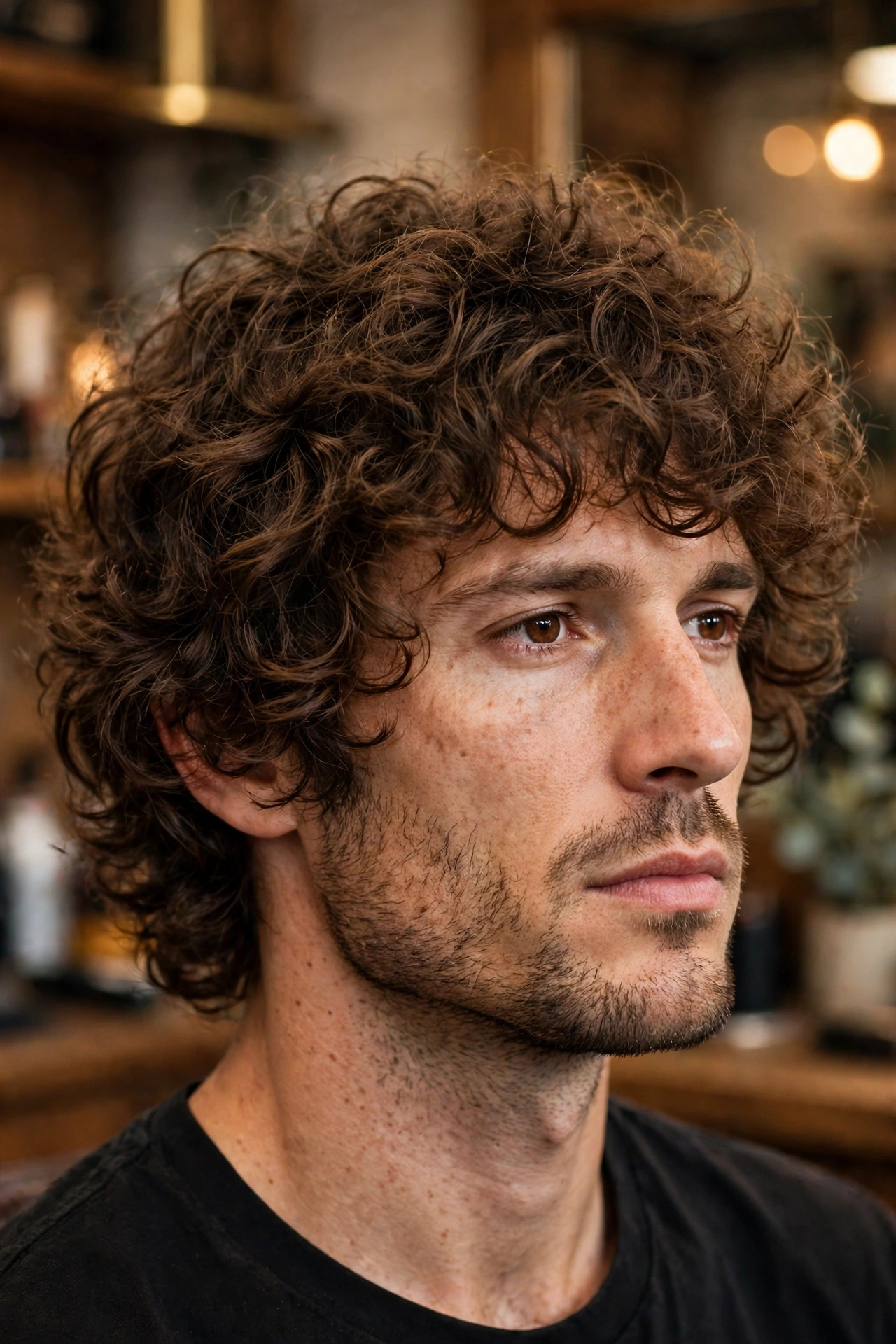
Square faces — strong jaw, broad forehead, angular lines — pair beautifully with the shag’s softness. The strategy here is the inverse of the round face: add width and softness at the sides to balance the jaw’s angles, keep the crown moderate (too much height elongates an already-strong face), and let the fringe soften the forehead. The shag’s natural texture is inherently softening, which is why this combination works so well.
It flatters the classic square face and works across 2A to 3C curls. The width should sit at cheekbone level — layers that flick outward at the cheeks counterbalance a wide jaw. A curtain bang or side-swept fringe breaks up the forehead’s width. Avoid: buzzed sides with a tall top (it exaggerates the jaw), and severe center parts (they emphasize symmetry and angles).
In the chair: “Shag to soften a square face — keep width through the cheeks, moderate height on top, fringe to break up the forehead, sides with some fullness, not tight.” Ask the barber to leave the perimeter fuller than they normally would — the instinct with square faces is to clean up the sides, but for this variation fullness is the feature. The jaw will still read as strong; the hair just stops it from reading as severe.
Styling emphasizes the sides. Apply curl cream throughout, then diffuse the side sections outward — cup them in the diffuser and push away from the face to encourage the outward flick. Keep the crown styling moderate: volume, not height. Finger-coil the fringe pieces to fall softly across the forehead. Products: curl cream, a medium-hold gel for the side pieces (they need to hold their outward direction), and a light oil to keep the ends soft — soft ends read as softer angles. Maintenance: trims every 8 weeks; the side fullness grows out into width that eventually overwhelms, so this variation needs its perimeter managed more than its crown.
25. The Curly Shag for Oval Faces
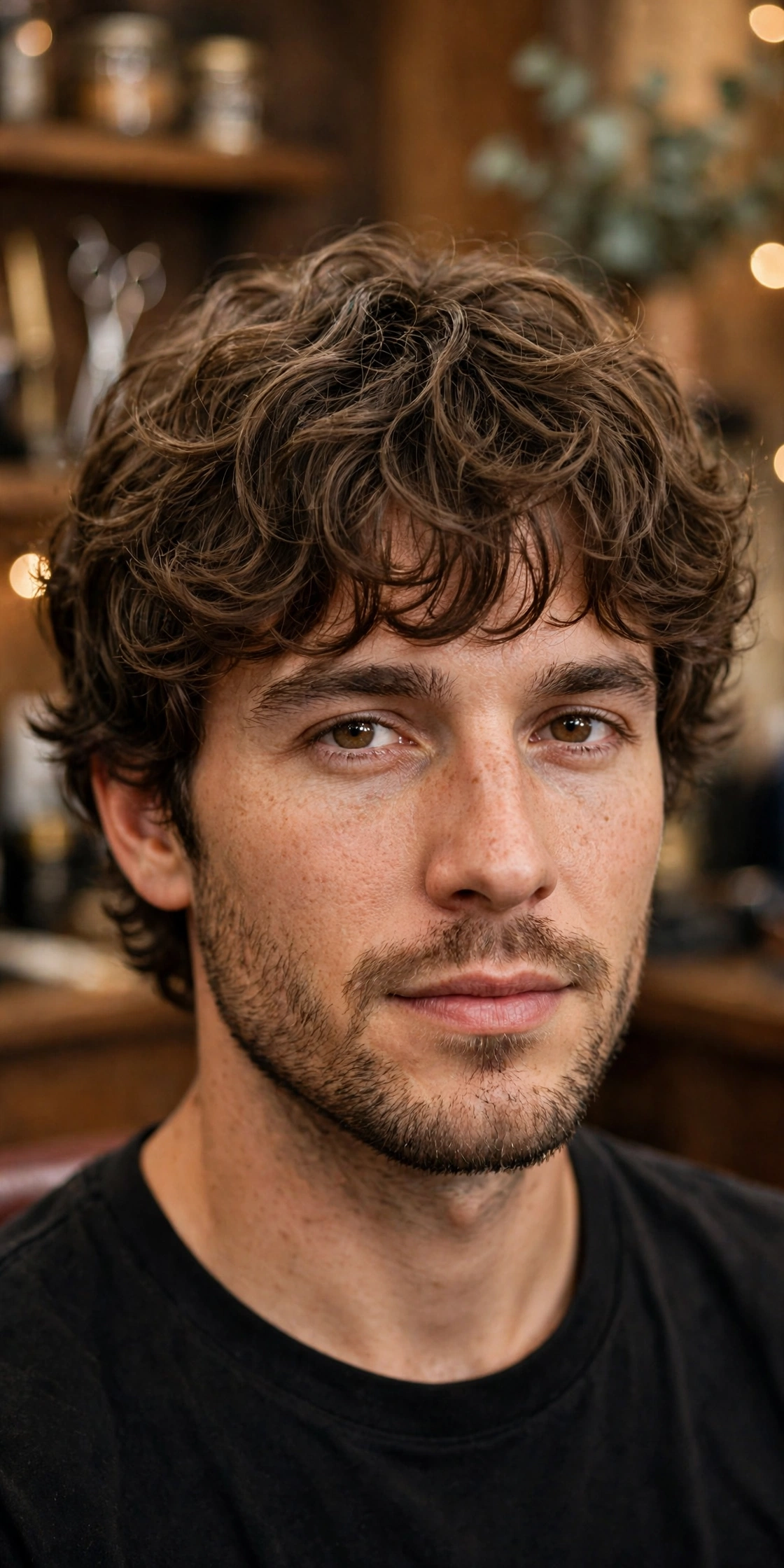
Oval faces are the shag’s easiest canvas — balanced proportions mean almost any variation works, so the oval-face shag is about choosing the version that matches your personality rather than correcting anything. This section is the “dealer’s choice” shag: the classic proportions, worn with confidence, tuned to your curl pattern and lifestyle.
Because nothing needs correcting, the decisions are aesthetic. Want edge? Go textured or wolf-cut. Want polish? Go professional or defined-curls. Want drama? Go long or bleached. The oval face carries all of them. The only real guidance: keep the overall balance — if you add extreme volume on top, keep the sides from going equally wide, or the face gets lost in hair.
In the chair, the conversation is refreshingly simple: pick your favorite variation from this guide and ask for it straight. The one instruction worth giving: “Keep the proportions balanced — I don’t need correction, just the cleanest version of this cut.” Barbers love oval faces because they can execute the reference photo faithfully without adaptation.
Styling follows whichever variation you chose — there is no oval-specific routine. The advantage is flexibility: you can rotate between messy and defined styling without the cut fighting you, because the base proportions are neutral. Products: whatever your chosen variation calls for. If you want one universal oval-face tip: a middle part works on oval faces when it fails on round and square ones, so the curtain-bang and center-part variations are all available to you. Maintenance: per your chosen variation. The oval-face shag is the lowest-drama entry on this list — enjoy it.
26. The Curly Shag for Long Faces
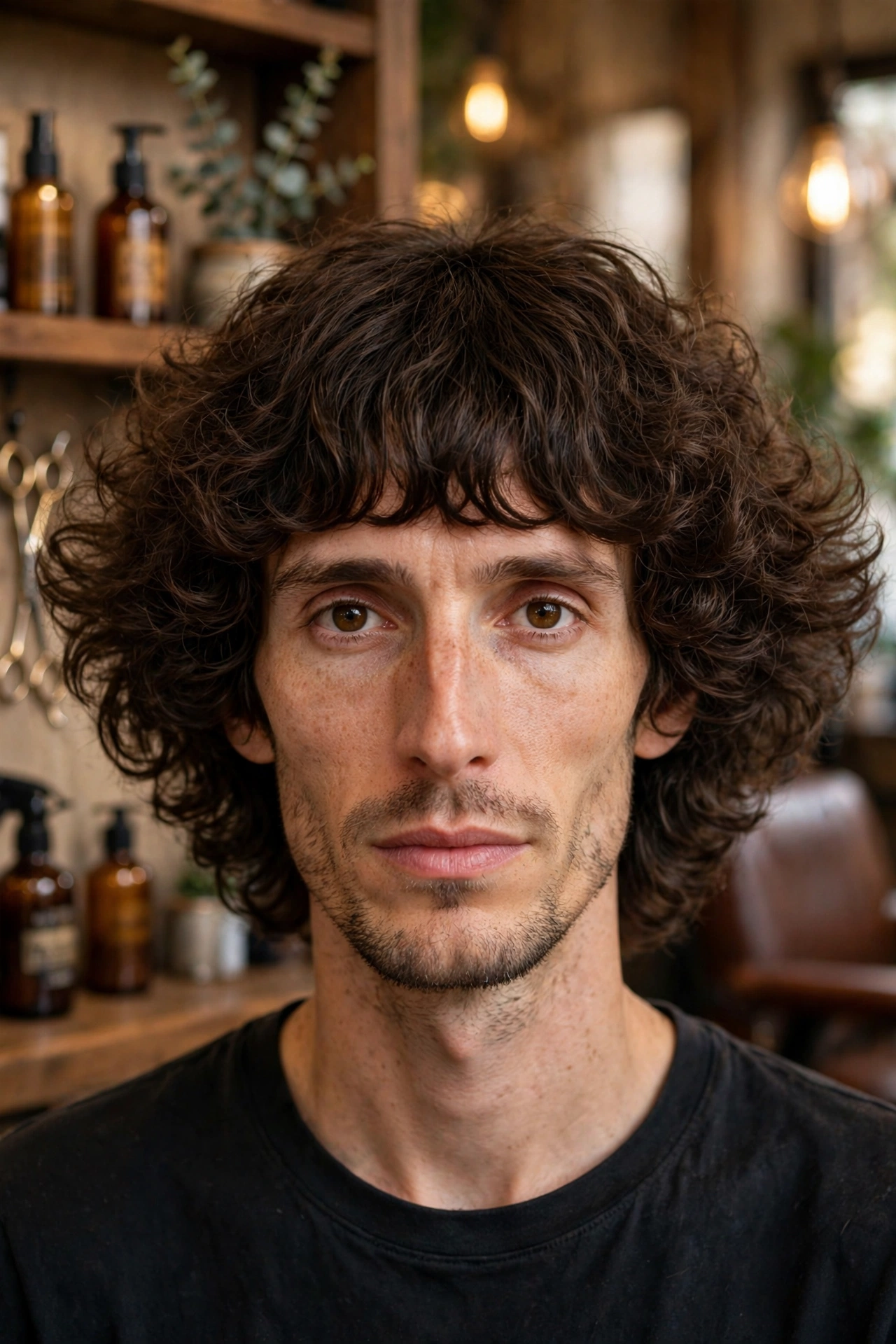
Long (oblong) faces need the shag to do width work: add volume at the sides, keep the crown controlled, and use the fringe to visually shorten the forehead. The long-face shag is cut wide rather than tall — the silhouette expands horizontally, countering the face’s vertical emphasis. Done right, it is transformative; the face looks balanced in a way it never does with height-adding cuts.
The rules: fringe is nearly mandatory (it shortens the forehead, the longest zone of the face), sides stay full through the cheeks and temples, crown height stays moderate. It works for 2B to 3C curls — the curl volume at the sides is doing the corrective work, so curlier is actually easier here. Avoid: tall crowns, top knots paired with shags, and anything that adds vertical inches.
Tell your barber: “Shag for a long face — I need width at the sides, not height on top. Full fringe, sides left full through the temples, crown kept close.” Ask them to check the front view for the width-to-length ratio — you want the hair’s silhouette approaching oval. The fringe should hit at eyebrow level; longer shortens more, but past the eyes it becomes impractical.
Style for width. Apply curl cream, then diffuse the side sections outward and slightly forward — the goal is a halo of texture around the face, not a tower above it. Keep the roots at the crown smooth: apply product there and press down gently while diffusing on low heat. A side part adds asymmetrical width that further breaks up the face’s length. Products: curl cream, a light mousse applied to the sides only (for side volume without crown volume), and a flexible hairspray to hold the fringe in place. Avoid root-lifting sprays at the crown entirely — they work against this variation’s entire purpose. Maintenance: trims every 6 to 8 weeks; the sides are the priority — when they grow flat, the face looks long again.
27. The Shoulder-Length Curly Shag
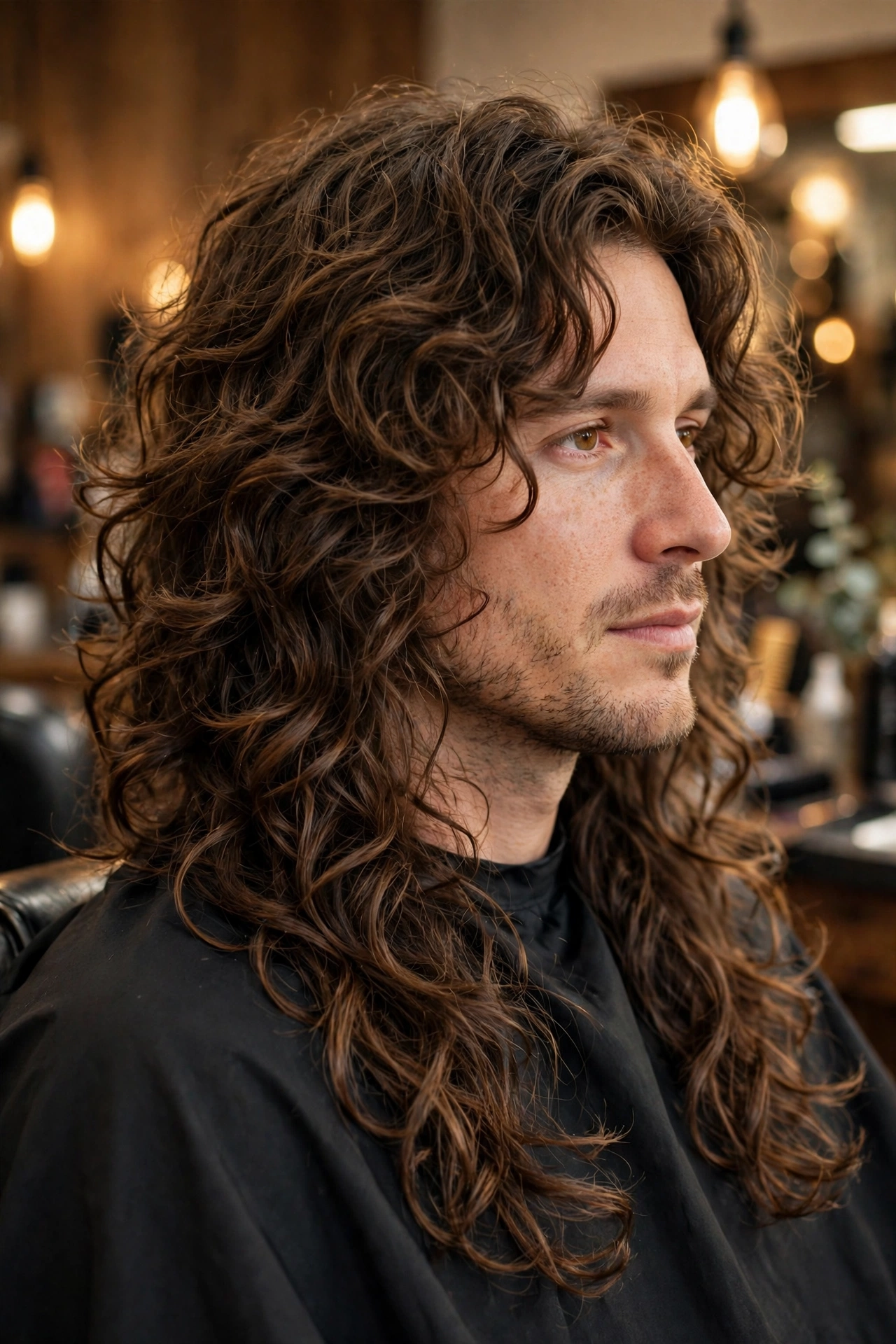
The shoulder-length curly shag occupies the sweet spot between the medium shag and the long shag: hair that brushes the shoulders, with layers engineered to keep the weight distributed so it does not collapse into a triangle. It is the most requested long-ish shag length in 2026 — long enough to feel dramatic, short enough to remain manageable.
It suits oval, square, and heart-shaped faces, and it is ideal for 2C to 3B curls with medium to high density. The length gives the layers room to cascade, and the shoulder acts as a natural shelf that the curls bounce off — a happy accident of anatomy that makes this length photograph beautifully. Fine hair can work at this length but needs the ends kept blunt to preserve weight.
In the chair: “Shoulder-length shag — longest layers brushing the shoulders, face-framing starting at the chin, internal layers for movement, keep the ends full.” The critical instruction is about the bottom third: ask the barber to layer the ends enough that they do not form a shelf, but not so much that they go wispy. This is the length where a barber’s layering skill is most visible — choose your barber accordingly.
Styling is the long-hair routine scaled down: leave-in on soaking-wet hair, curl cream raked through, gel cast, scrunch, diffuse or air-dry. The shoulder length dries faster than truly long hair, so this is the practical person’s long shag. Pineapple at night to protect the layers. Products: leave-in conditioner, curl cream, medium-hold gel, and a satin pillowcase. Maintenance: trims every 10 weeks, dusting the ends to prevent the shelf effect. This length is forgiving of slightly overdue cuts — the layers hide grow-out well — which is part of its appeal.
28. The Curly Shag Bob
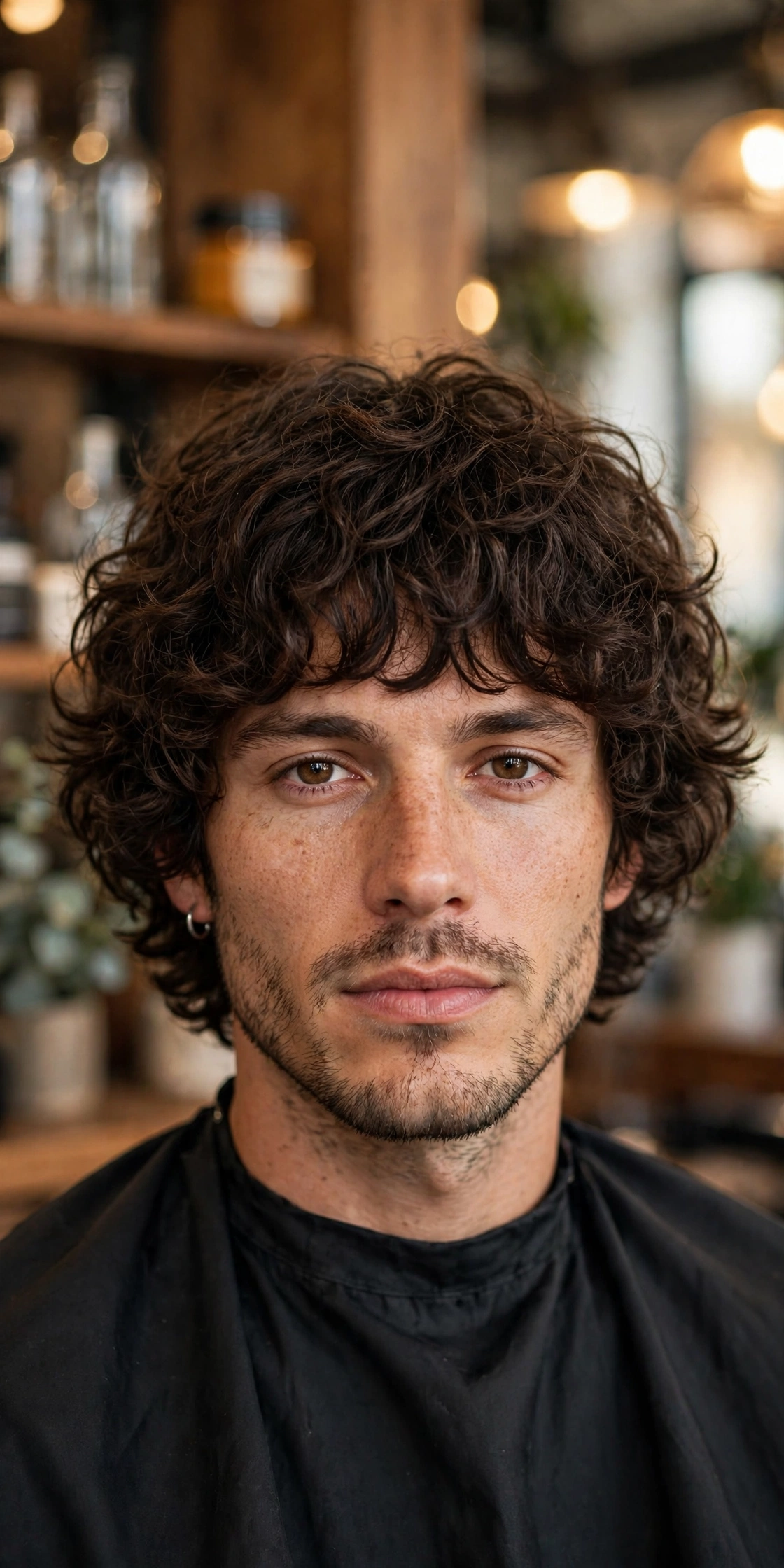
The curly shag bob — jaw to chin length, rounded silhouette, heavy shag layering — is the boldest short statement on this list. It takes the bob’s iconic shape and injects it with shag texture: choppy ends, a tousled fringe, and layers that keep it from ever looking prim. On men in 2026 it reads as fashion-forward and artistic, the haircut of someone with opinions about design.
It suits oval, heart, and diamond faces — the shapes that can carry a strong jawline-length silhouette. It needs 2B to 3B curls with good density; the bob’s rounded shape requires enough hair to fill it. This is not a shy cut — it frames the entire face, so it draws attention to facial features. Wear it if you want to be looked at.
Tell your barber: “Curly shag bob — jaw-length, rounded shape, heavy shag layers, textured fringe, ends point-cut for movement.” The shape is everything: ask the barber to cut the perimeter first (establishing the bob’s line) and then layer into it. The back should be slightly shorter than the front — that forward angle is what keeps it modern rather than retro. This is adjacent to the mop top for men in spirit, but the shag layering makes it lighter and more textured.
Styling is wash-and-wear with polish. Curl cream on damp hair, finger-coil the front pieces, diffuse the crown for lift and let the perimeter air-dry for a natural fall. The bob’s shape does the work — your job is just definition and frizz control. A light oil on the ends keeps the perimeter from looking dry, which is the bob’s main risk. Products: curl cream, light gel for the fringe, hair oil for the ends, and a pick for root lift if the crown falls flat. Maintenance: trims every 5 to 6 weeks — the bob’s precise perimeter grows out visibly, and this is the one shag that cannot hide neglect. Book the trim before you need it.
29. The Curly Shag with Side Part

The side-part curly shag is the quiet sophisticate: the shag’s texture organized around a deep side part, creating an asymmetrical silhouette that is both classic and contemporary. The part gives the cut structure — one side fuller, one side sleeker — while the layers keep it from ever looking stiff. It is the shag for men who like a little architecture with their chaos.
It suits square, round, and heart-shaped faces — the asymmetry breaks up symmetrical width and adds a diagonal line that flatters. It works for 2A to 3B curls; the part needs enough length on top to drape, so this is a medium-length variation. It is also the most adaptable shag for changing contexts: the same cut reads casual when tousled and sharp when the part is clean.
In the chair: “Curly shag with a deep side part — part it [left/right] at [location], layers that fall with the part, fuller on the heavy side, sleeker on the short side.” Find your natural part first (comb damp hair straight back and see where it splits) and tell the barber — fighting the natural part is a daily styling battle you will lose. Ask for the layers to be cut with the part in place, since layer behavior changes with part position.
Styling centers on the part. On damp hair, create the part with a comb, then apply curl cream and style each side according to its role: the heavy side gets volume (diffuse upward, finger-coil for definition), the short side gets smoothness (press down, light cream only). A touch of pomade along the part line keeps it defined through the day. Products: curl cream, light pomade for the part line, and a tail comb for part precision. Maintenance: the part needs re-establishing every wash — it is a styling commitment, not a cut-and-forget. Trims every 7 to 8 weeks; ask the barber to check the part’s balance as it grows.
30. The Curly Shag with Middle Part
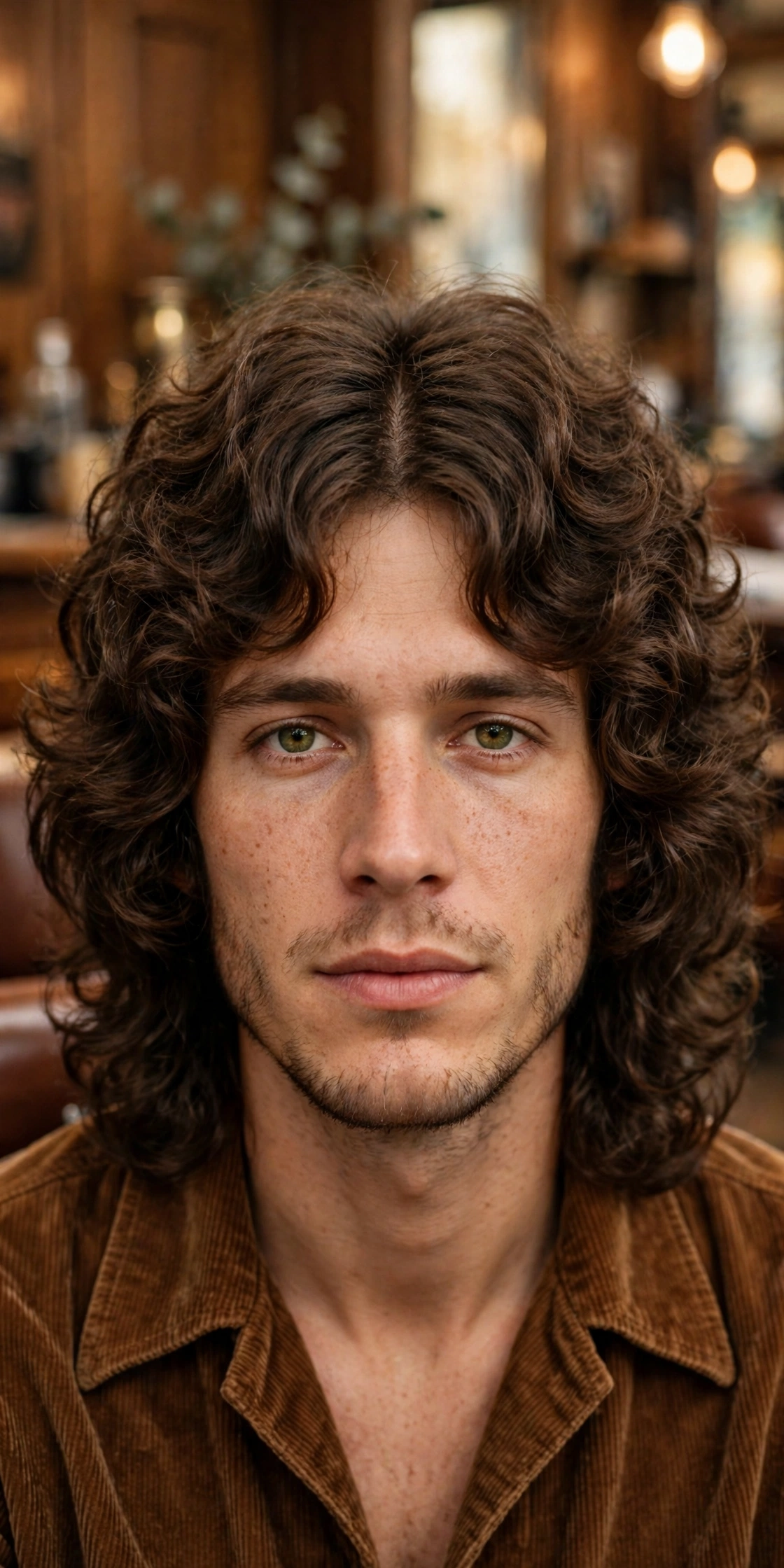
The middle-part curly shag is symmetry as a statement: hair parted dead center, layers falling evenly on both sides, the face framed like a portrait. On curly hair it has a 1970s-rock purity to it — think the classic album-cover silhouette — and in 2026 it is the choice of men who want the shag’s most iconic geometry.
It suits oval and diamond faces best — the symmetry needs balanced features to anchor it. It is less forgiving on asymmetrical faces (most faces are slightly asymmetrical; a middle part reveals it). It works for 2B to 3C curls with medium length; the two sides need enough weight to hang evenly. This is the variation most dependent on the cut’s precision — uneven layers are immediately visible in a center part.
Tell your barber: “Curly shag with a center part — I need the layers perfectly even on both sides, cut with the part in place.” Emphasize symmetry twice; barbers cut asymmetrically by habit (most clients have side parts). Ask them to check the lengths on both sides with your head level — even a slight head tilt during cutting creates visible imbalance in a middle part. The fringe, if any, should split evenly or be curtain-style.
Styling is about training the part. On damp hair, part dead center with a comb, then apply product and finger-coil the front sections symmetrically — mirror each coil on the opposite side. Diffuse with the part held in place; some men use two small clips at the part line while air-drying to train stubborn hair. The part will drift during the day — carry a pick to reset it. Products: curl cream, flexible-hold gel (the symmetry needs hold), and small clips for part training. Maintenance: trims every 6 to 8 weeks with explicit symmetry checks. This variation shows grow-out as asymmetry, so do not stretch the trim interval.
31. The Wet-Look Curly Shag
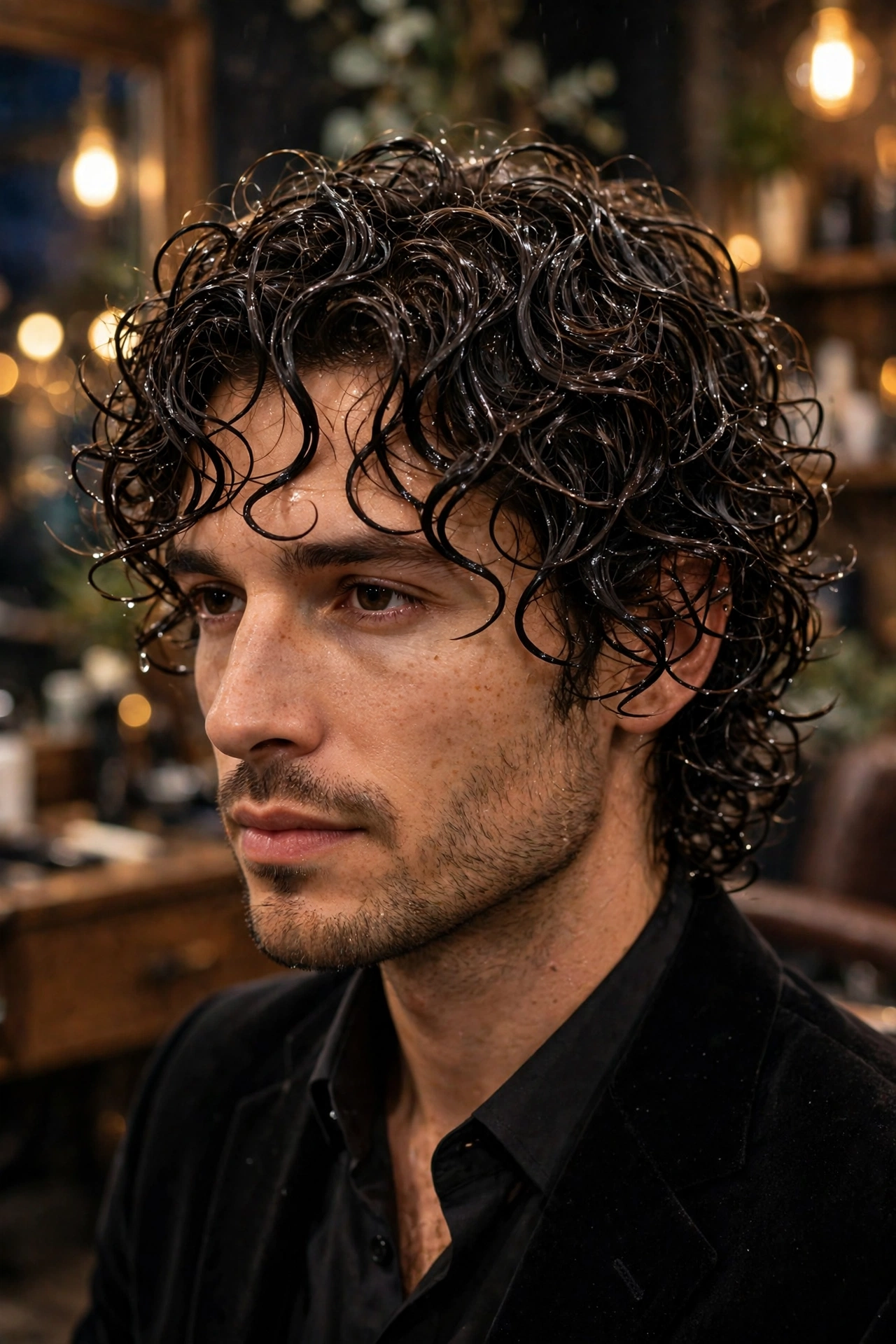
The wet-look curly shag styles the cut’s texture with high-shine, saturated products for a just-out-of-the-water finish. The layers are the same as any shag — the difference is entirely in the styling: glossy, defined, piece-y curls that catch light like water. It is evening hair, event hair, the shag dressed for after dark.
It suits the same faces as the classic shag (oval, square, heart) since the cut underneath is standard — the wet look is a styling choice, not a different cut. It works best on 2C to 3B curls where the definition holds the shine; looser waves lose the wet effect as they dry and frizz. This is not a daily look for most men — it is a sometimes look, deployed for maximum impact.
The cut: ask for a standard medium shag with clean layers (the wet look needs defined layer edges to read properly). Then the styling routine: on damp hair, apply a generous amount of strong-hold gel — more than you think, this look is product-heavy by design. Comb through with a wide-tooth comb for even distribution, then finger-coil key pieces. Do NOT scrunch out the cast fully — leave a slight cast for the wet sheen, breaking it only partially with oiled hands. Finish with a shine spray or a tiny amount of oil over the top.
Products: strong-hold gel (the foundation), a shine-enhancing serum or spray, and a spray bottle of water for touch-ups — the wet look revives with water, not more product. Warning: this look transfers — it will leave product on collars, pillows, and anyone you hug. Wear it out, not to bed. Maintenance: the cut follows standard shag timing (8 weeks), but clarify twice as often — wet-look styling uses heavy product that builds up, and buildup kills curl pattern. A clarifying shampoo every 2 to 3 weeks is mandatory for regular wet-look wearers.
32. The Curly Shag with Headband
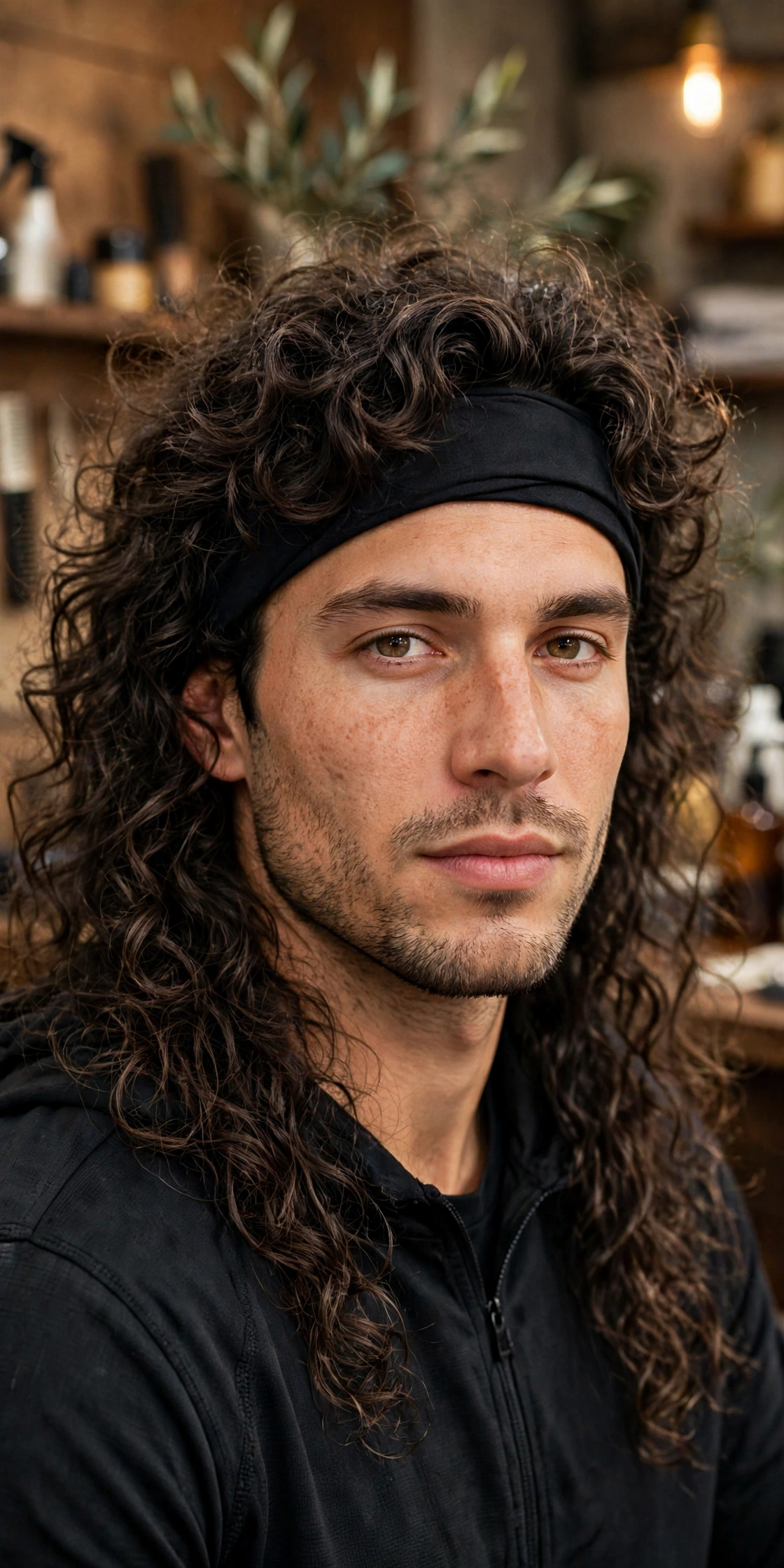
The headband curly shag is a styling variation that deserves its place because it solves a real problem: what to do with a shag on day three, at the gym, or when the fringe will not cooperate. Pushing the front back with a headband (or bandana, or hat) transforms the shag’s silhouette — the layers cascade back, the face opens up, and the cut reads completely differently. It is the shag’s alter ego.
It suits all face shapes — the pulled-back front is universally flattering — and all curl types. It is particularly useful for growing-out phases: when the fringe hits the awkward in-between length, the headband hides the transition entirely. Athletes, musicians, and anyone who works with their hands will use this weekly.
There is no special cut — any medium-to-long shag from this guide works. The technique: place the headband 1 to 2 inches behind the hairline (not right at it — that looks like a sweatband), and let the front layers fall naturally over and around it. For bandanas, fold into a 2-inch strip and tie at the nape. The back layers stay free — the contrast between the controlled front and the wild back is the look.
Styling is minimal: the headband does the work. Apply a light curl cream to the lengths, push back, place the band, and go. For the gym, a moisture-wicking athletic band; for style, a plain black or patterned fabric band. Products: whatever your base shag needs, plus the band itself — invest in a few, because they stretch out. Maintenance: none beyond your base shag’s schedule. This is a free variation — no extra cuts, no extra products, just a five-dollar accessory that doubles your styling options.
33. The Surfer Curly Shag
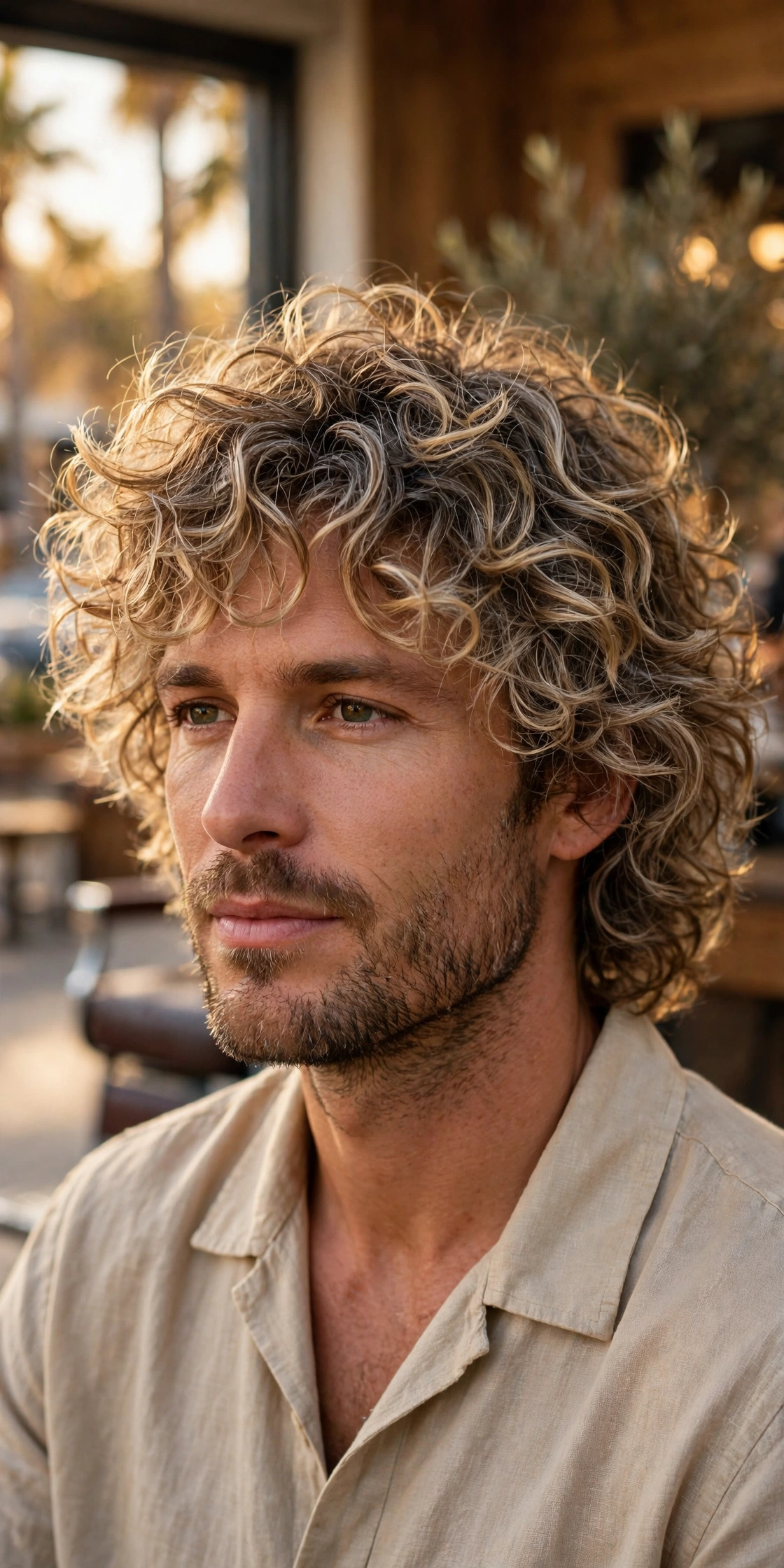
The surfer curly shag is the beach incarnation: sun-lightened, salt-textured, grown-out layers that look shaped by wind and water rather than scissors. It is longer, looser, and more undone than the standard shag — the layers blend into each other, the ends are piece-y from environmental texture, and the whole thing radiates a permanent-holiday energy.
It suits oval, square, and heart-shaped faces, and it is the natural endpoint for 2A to 2C wavy-curly hair left to grow with shag layering. The aesthetic needs length — below the ears minimum, shoulders ideal — and it needs the right attitude: this cut looks wrong with a suit and right with literally everything else.
In the chair: “Surfer shag — grow-out friendly, long blended layers, no harsh lines, ends textured like they’ve seen salt water.” Ask for the layers to be cut longer and more blended than a standard shag; the surfer version should barely read as “layered” and more as “naturally varied.” If you actually surf or swim, mention it — chlorine and salt change the hair’s behavior and the barber should know.
Styling mimics the ocean: sea salt spray on damp hair, scrunched in aggressively, then air-dried — never diffused to perfection, the slight frizz is part of the look. A tiny amount of matte paste on the ends adds the piece-y separation. Sun-lightening happens naturally if you are outdoors; otherwise, a few hand-painted highlights accelerate it. Products: sea salt spray (used generously), matte paste, and a UV-protectant spray — sun is the aesthetic but also the damage. Maintenance: trims every 10 to 12 weeks; this is the most grow-out-friendly shag on the list. Deep-condition regularly — salt, sun, and chlorine are brutal on curls, and the look requires hair that is dry-styled but not dry-damaged.
34. The Rocker Curly Shag
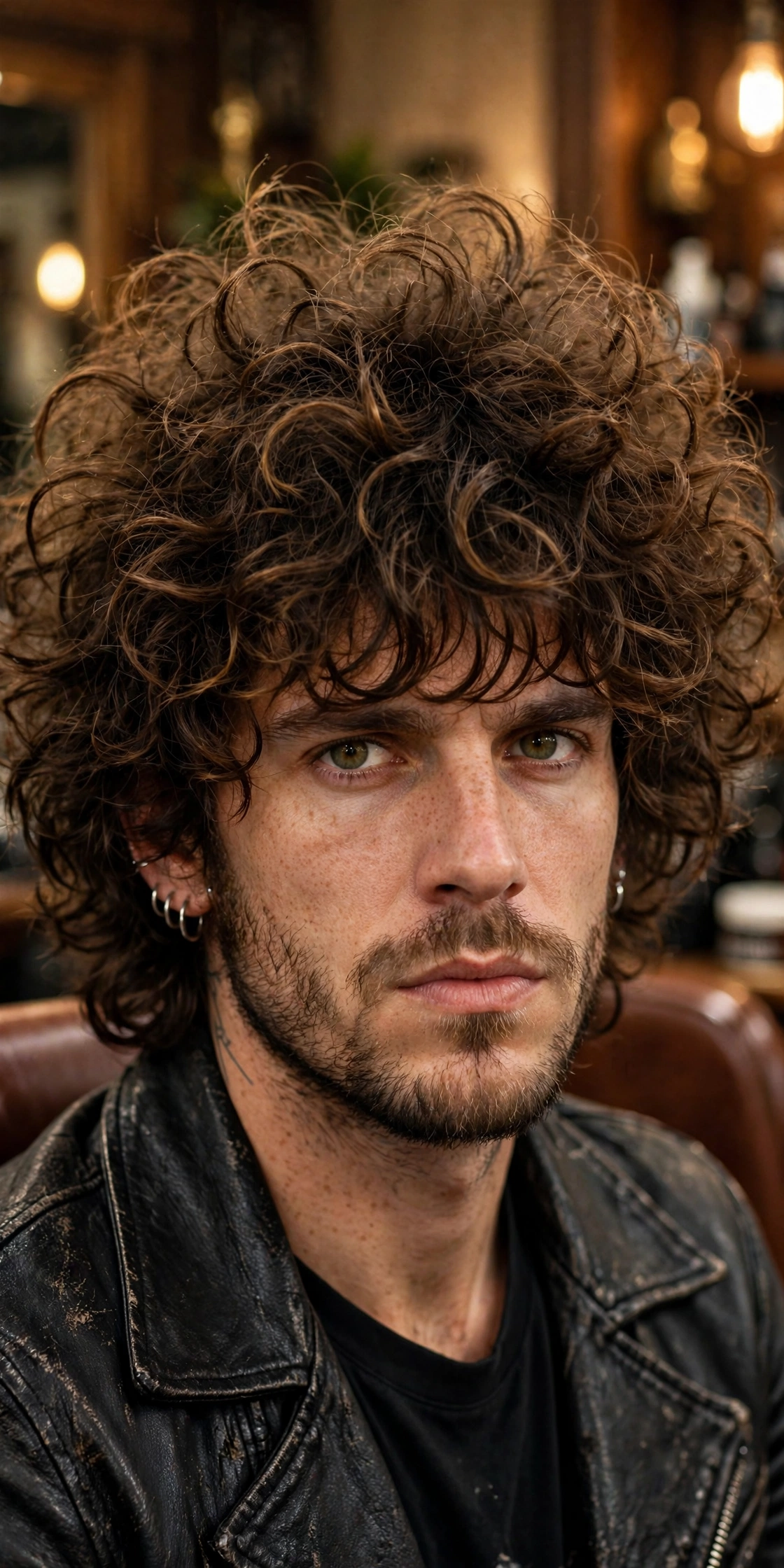
The rocker curly shag goes back to the source: the 1970s original, worn with modern products and zero irony. It is bigger, wilder, and less blended than the contemporary shag — choppy layers, a heavy fringe, volume everywhere, and an attitude that says the hair is the outfit. This is the shag as it was meant to be worn: loud.
It suits men with the personality to carry it — the cut draws constant attention — and flatters oval, square, and diamond faces where the big silhouette has strong features to play against. It needs 2C to 3C curls with real density; the rocker shag is a volume cut and thin hair cannot fake it. This is also the best shag for musicians and performers, for obvious reasons.
Tell your barber: “Full rocker shag — big, choppy, 70s. Short layers on top, long everywhere else, heavy fringe, don’t blend it too much — I want to see the layers.” The phrase “don’t blend it too much” is the key differentiator from the modern shag; the rocker version celebrates visible layer steps. Bring reference photos from the era (or modern rock musicians) — the vibe is specific and photos communicate it instantly.
Styling maximizes volume. Mousse at the roots on damp hair, curl cream through the lengths, then diffuse upside down on high heat — the most aggressive drying of any variation here. Once dry, shake the roots violently with your fingers (seriously — the messier the roots, the better this looks), then pick out the crown with an afro pick for maximum lift. Finish with a texturizing spray, never anything smoothing. Products: volumizing mousse, curl cream, texturizing spray, and an afro pick — the rocker shag’s essential tool. Maintenance: trims every 8 weeks to keep the choppy layers distinct; let it grow too long and it becomes the surfer shag, which is fine, but it is a different cut.
35. The Curly Shag with Tapered Sides
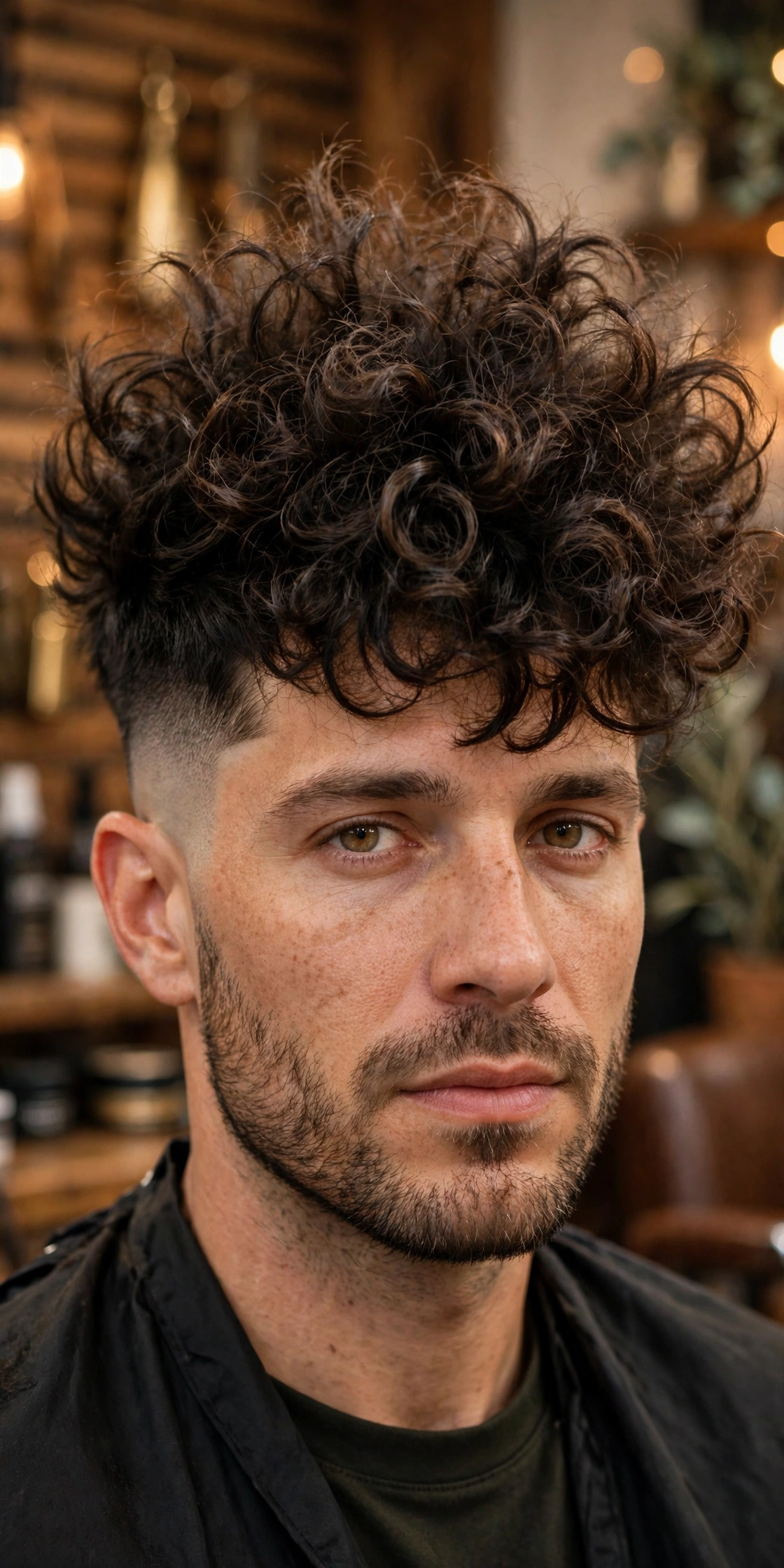
Distinct from the tapered shag of section 8 (which keeps shag texture in the sides), this variation tapers the sides down to short, neat curls while the top explodes in full shag volume — maximum contrast between a controlled perimeter and a wild crown. It is the architectural shag: the sides are the frame, the top is the art.
It suits square, oval, and diamond faces — the neat sides sharpen the jawline while the voluminous top adds drama. It works for 2B to 3C curls on top; the sides just need to be taperable. This is a popular choice for men who love big hair but need the edges to look sharp — the taper keeps it from reading as unkempt.
In the chair: “Big curly shag on top with tapered sides — take the sides down short and neat, keep ALL the volume and length on top, and make the transition clean.” Specify how the taper should meet the top: a smooth blend for subtlety, or a harder line for drama. The top needs to be long enough (4+ inches) to contrast with the short sides — if the top is too short, the whole thing just looks like a curly crop.
Styling is two-zone. Sides: a touch of matte paste, smoothed down — they should look intentional and quiet. Top: the full volume routine — mousse at roots, cream through lengths, upside-down diffusing, root shake. The contrast only works if both zones are styled for their role; a voluminous top with frizzy sides looks accidental, not architectural. Products: volumizing mousse and curl cream for the top, matte paste for the sides, and edge control for the hairline if needed. Maintenance: the sides need tapering every 3 to 4 weeks to hold the contrast; the top goes 8 weeks. This is a two-rhythm cut — budget for both.
36. The Statement Curly Shag
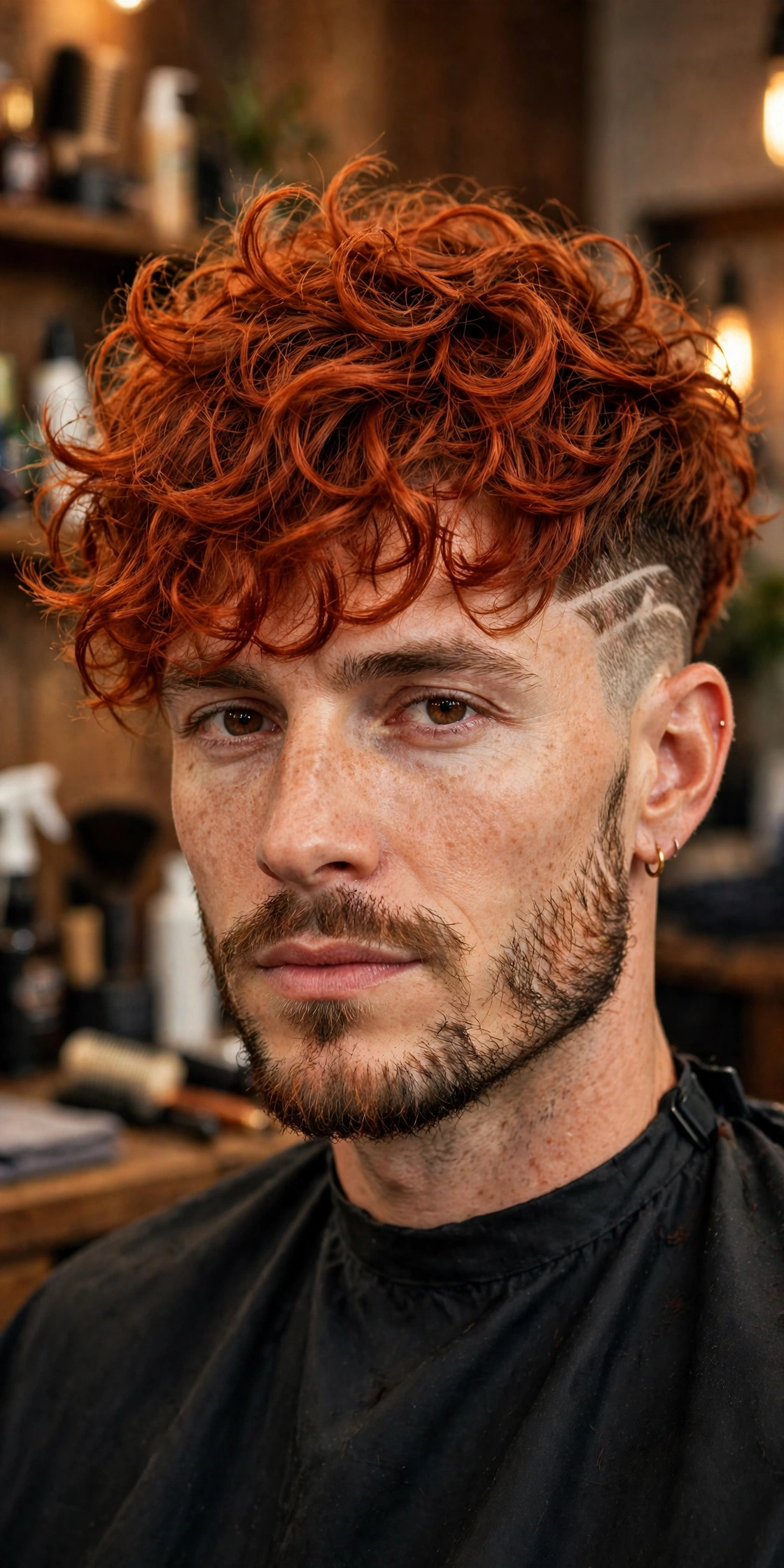
The statement curly shag is the category for everything that breaks the rules: vivid color, shaved designs in the taper, asymmetrical lengths, a single bleached streak through the fringe — the shag as canvas. It is not one cut but a philosophy: take any variation from this guide and add the element that makes it unmistakably yours.
It suits anyone whose style is already bold — the hair should match the wardrobe, not fight it. Face shape and curl type follow the base variation you choose; the statement element is independent. The only requirement is commitment: statement details need maintenance, and a faded statement looks neglected rather than edgy.
In the chair, this is a collaboration, not an order. Bring references, describe the effect you want (“I want the shag but with a bleached fringe streak” / “shag with a shaved line design on the taper”), and let the barber advise on feasibility. Discuss maintenance BEFORE committing — a design that needs weekly upkeep and a lifestyle that allows monthly visits is a bad combination. For color statements, see a colorist; for structural statements (designs, asymmetry), a barber with clipper-art or creative-cutting experience.
Styling follows the base variation, plus care for the statement element: color-safe products for dyed sections, edge control for designs, extra UV protection for vivid colors. Products: your base routine plus whatever the statement needs — this is the one variation where the product list is truly custom. Maintenance: statement elements fade, grow out, or blur faster than the cut itself — plan touch-ups on the statement’s schedule, not the haircut’s. A monthly design refresh with an 8-week cut reshape is typical. The statement shag is the most personal cut on this list, and the most rewarding when it is maintained with intention.
How to Style a Curly Shag
Every variation in this guide shares the same foundational routine — master this, and you can style any of the 36. Start with soaking-wet hair: curly shags are styled wet, always. Water is the primary styling product; everything else locks in what the water sets. After washing with a sulfate-free shampoo, do not towel-dry aggressively — squeeze excess water with a microfiber towel or cotton T-shirt, leaving the hair dripping damp.
Apply products in order of weight: leave-in conditioner first (the moisture base), then curl cream (the definition layer), then gel or mousse (the hold layer). The amount matters less than the distribution — work each product through in sections, raking with fingers or a wide-tooth comb to ensure every curl clump is coated. Miss the under-layers and they frizz by noon; this is the most common styling mistake with shags.
Now set the shape. For volume: flip upside down and scrunch upward, then diffuse on medium heat and low speed, cupping sections in the diffuser bowl. For definition: finger-coil key sections around your finger in their natural spiral direction, then diffuse without touching until fully dry. For a middle ground: scrunch, then diffuse normally, then finger-coil just the front pieces that frame the face. Never touch the hair while diffusing until it is 100% dry — touching creates frizz, and patience here is the difference between good and great results.
Once dry, break the gel cast (if you used gel) by scrunching with hands coated in a drop of hair oil — the crunch transforms into soft, touchable definition. Fluff the roots with an afro pick or your fingers for volume. Finish with a light oil on the ends only, never the roots. The whole routine takes 15 to 25 minutes once practiced; the first attempts take longer, and that is normal.
For second-day hair: do not re-wet fully. Mist with a water-conditioner mix in a spray bottle, smooth the frizzy pieces with a dab of cream, and re-scrunch. A satin bonnet or pineapple overnight preserves the style dramatically — most shag wearers get 2 to 3 days per wash with proper nighttime protection. For foundational curly hair care science behind these techniques, NaturallyCurly remains the most thorough free resource on curl typing and moisture methods.
Maintenance & Care
A curly shag is a living cut — it looks best when maintained on rhythm, not rescued in crisis. The trim schedule depends on your variation: short and precise shags (bob, fringe, fade combinations) need attention every 4 to 6 weeks; medium classic shags go 8 to 10 weeks; long and surfer shags stretch to 10 to 12. Book the next appointment before leaving the barbershop — the best-maintained hair belongs to men with standing appointments.
Between cuts, the work is moisture and protection. Deep-condition every 1 to 2 weeks — layered ends are older hair (further from the scalp’s natural oils) and dry out first. Clarify monthly to remove product buildup, which is the silent killer of curl definition; if your curls suddenly go limp and frizzy simultaneously, buildup is the likely culprit, not damage. Trim split ends when you see them — on a layered cut, splits travel upward and destroy the layer structure.
Nighttime protection is non-negotiable for shag wearers. Cotton pillowcases create friction that undoes a day’s styling and breaks the fragile ends. Switch to satin or silk pillowcases, or wear a satin bonnet — the pineapple method (a loose high ponytail) works for medium-to-long shags. In the morning, the difference between protected and unprotected sleep is the difference between a 5-minute refresh and a full re-style.
Seasonal adjustments matter. Summer brings humidity (anti-humectant products, stronger hold) and UV (protectant sprays, hats). Winter brings dry indoor air (richer creams, more frequent deep-conditioning, a humidifier if you are serious). Swimming — pool or ocean — demands a pre-soak with clean water and conditioner, because dry hair absorbs chemicals like a sponge and wet, conditioned hair absorbs far less. The curly shag rewards consistent, simple care far more than occasional intensive treatments.
Frequently Asked Questions
What is a curly shag haircut for men?
A curly shag is a layered haircut designed for curly and wavy hair, featuring shorter, textured layers through the crown, longer ends, and usually a fringe or face-framing pieces. The layers follow the natural curl pattern so each curl clump has room to spring, creating movement and volume instead of a heavy, triangular shape. It is based on the 1970s shag but updated with modern curl-cutting techniques like dry cutting and curl-by-curl layering.
Is the curly shag still trendy in 2026?
Yes — the curly shag is one of the defining men’s cuts of 2026. It has absorbed surrounding trends (wolf cuts, mullets, curtain bangs, fades) into a broad family of variations, which keeps it fresh rather than dated. Barbers report it among their most requested texture cuts, and its versatility across curl types, face shapes, and formality levels gives it staying power beyond a single trend cycle.
What curl type works best with a shag?
The shag is most straightforward on 2C to 3B curls, where the pattern is defined enough to show off layers but loose enough to style easily. That said, this guide includes dedicated variations for wavy hair (2A-2C) and tight coils (4A-4C) — the cutting technique changes, but the shag’s principles work across the full curl spectrum. The key is a barber who cuts for your specific pattern, ideally dry.
How do I ask my barber for a curly shag?
Use the formula: variation name + length + layer description + fringe plan + what to avoid. Example: “A classic curly shag, medium length, heavy layers through the crown, soft fringe at eyebrow length, and please don’t thin out the ends.” Always bring reference photos — “shag” means different things to different barbers. Ask whether they cut curls dry; if they only cut wet, find a curl-specialist barber for this cut.
How long does my hair need to be for a curly shag?
The minimum is about 2 to 3 inches on top for a short shag, but the cut truly comes alive at 4+ inches when the layers have room to stack and move. Remember shrinkage: curly hair springs up significantly when dry, so the wet length in the chair will look much shorter worn. Discuss the dry, worn length with your barber — not the wet length — and when in doubt, start longer; you can always take more off.
How do I style a curly shag at home?
On soaking-wet hair, apply leave-in conditioner, then curl cream, then gel or mousse, working each through in sections. Scrunch upward to encourage curl clumps, then diffuse (upside down for volume, right-side up for control) until 100% dry without touching. Scrunch out the gel cast with oiled hands, fluff the roots, and finish with oil on the ends only. The full routine takes 15 to 25 minutes; second-day refresh needs only a water mist and a dab of cream.
What products work best for a men’s curly shag?
The core four: a sulfate-free shampoo, a moisturizing leave-in conditioner, a curl-defining cream, and a hold product (gel for definition, mousse for volume). Add a light hair oil for finishing and frizz control, a deep-conditioning mask for weekly use, and a sea salt spray or texturizing product if you prefer undone texture. Avoid heavy waxes and oil-based pomades — they collapse the layers and kill curl formation.
Can I get a curly shag with a fade or undercut?
Absolutely — the shag-fade and shag-undercut hybrids are among 2026’s most requested combinations. The fade or undercut handles the sides while the shag’s layers own the top, giving you the texture with a sharper frame. Be aware these are the highest-maintenance variations: the fade or undercut needs refreshing every 2 to 3 weeks while the top goes 8 weeks, so budget for two different appointment rhythms.
How often should I trim a curly shag?
Short, precise variations (bob, heavy fringe, fade combinations) need trims every 4 to 6 weeks. Classic medium shags go 8 to 10 weeks. Long and surfer variations stretch to 10 to 12 weeks. The fringe or bang area usually needs attention before the rest — many barbers offer quick fringe trims between full cuts. Do not stretch intervals hoping the cut will “grow into something” — shags grow out into shapelessness, not into new styles.
Does a curly shag work for professional office settings?
Yes, with the right variation. The professional curly shag (variation 22 in this guide) keeps the layered structure but disciplines it: controlled volume, neat fringe above the eyebrows, tapered sides. Style it with combed placement rather than tousled texture, and keep the trim interval tight at 5 to 6 weeks. In conservative industries, the tapered or short shag variations read as intentional and groomed rather than fashion-forward.