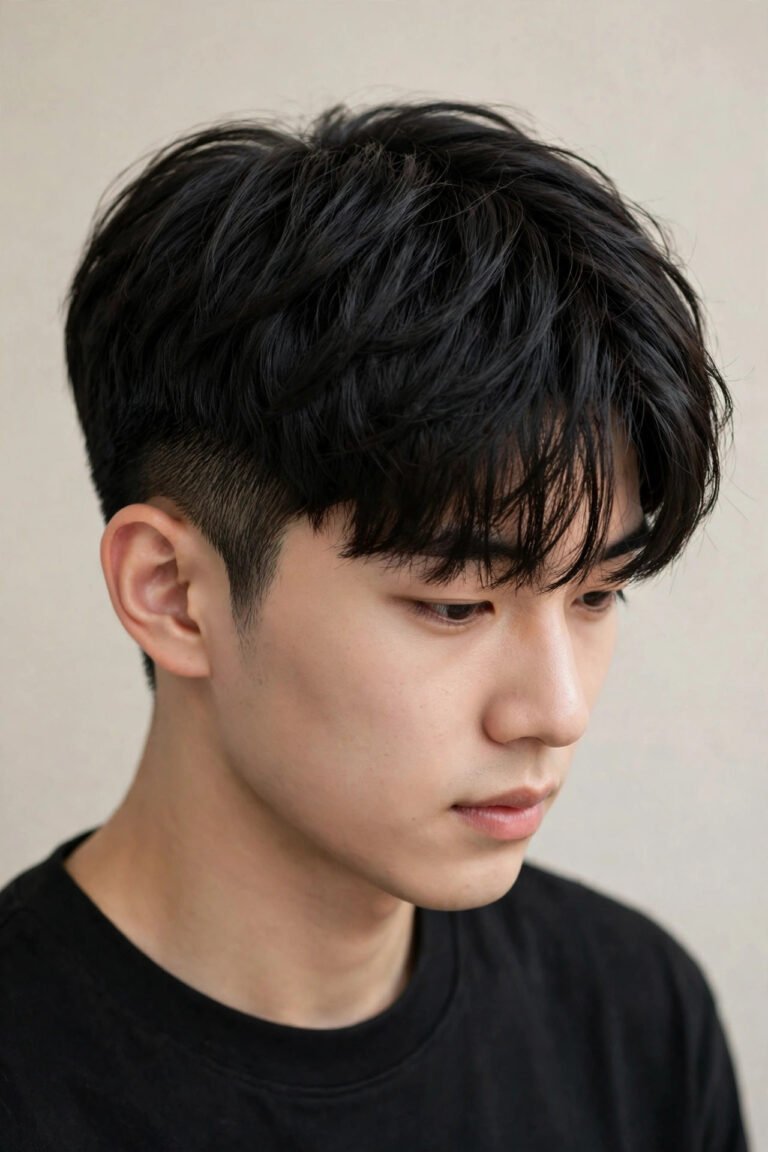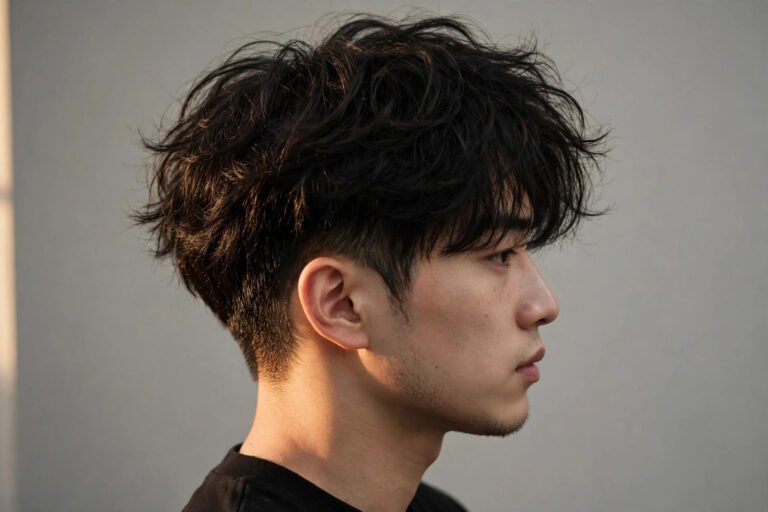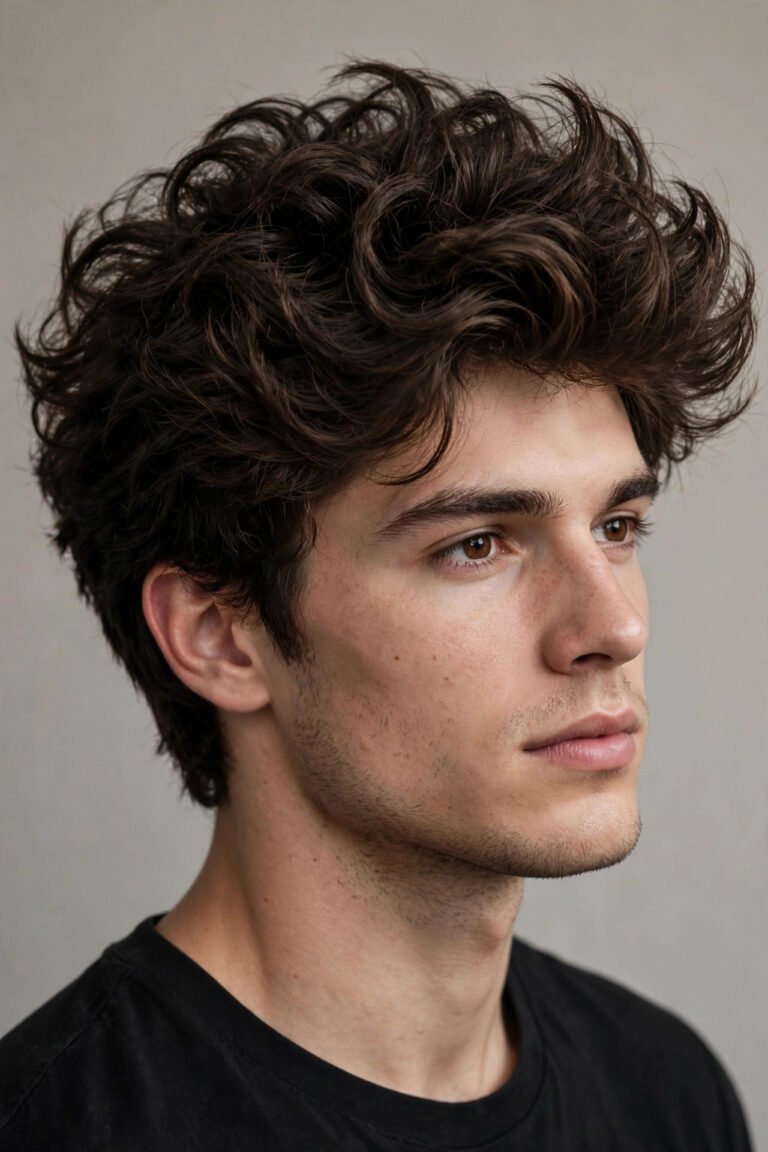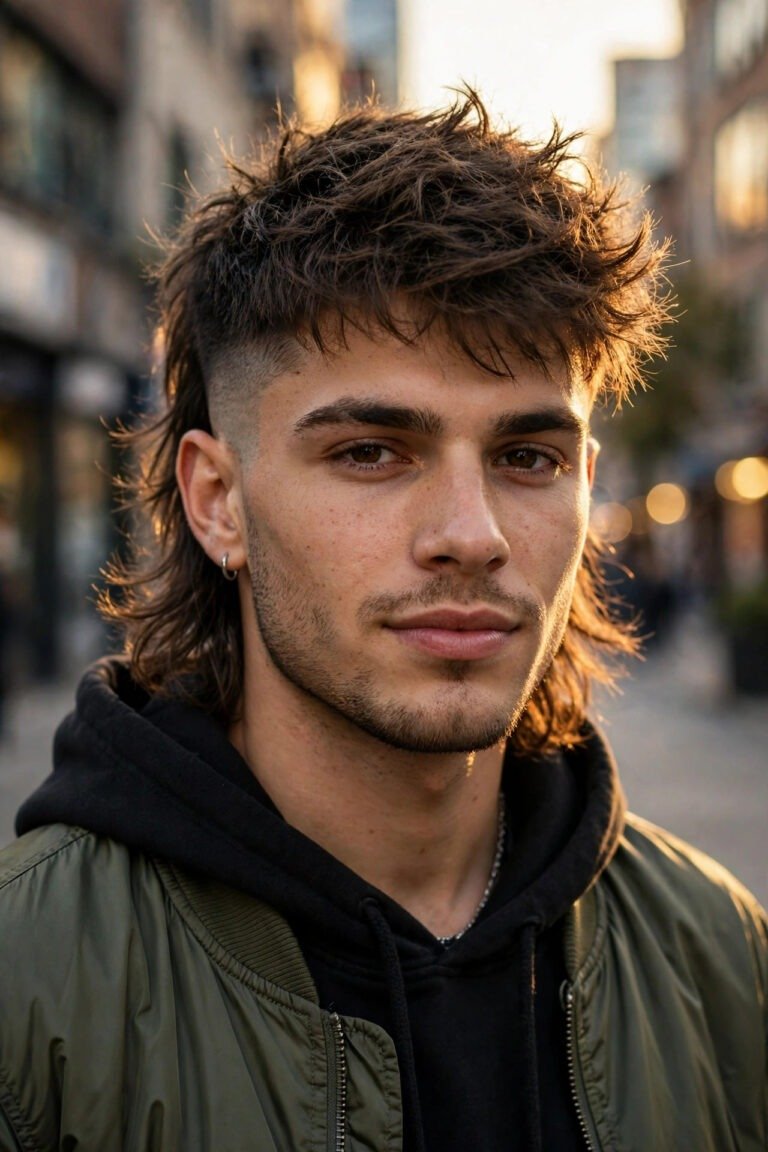
Curly Wolf Cut Men 2026: 36 Wild, Textured Styles
The curly wolf cut men are searching for in 2026 is the wildest, most expressive haircut of the year — a shaggy, layered cut with heavy volume at the crown, choppy texture through the lengths, and a mullet-length back that lets natural curls do exactly what they want to do. It is the cut that turned the wolf cut from a social-media curiosity into the most searched men’s hairstyle on the planet, and the curly version is the one that wears it best, because curls were made for the wolf cut’s disconnected layers. In this guide you will find 36 curly wolf cut styles for 2026, each with a barber-ready script, honest styling advice, and the maintenance truth nobody tells you at the chair.
Whether you wear tight ringlets, loose waves, soft coils, or curls that fall somewhere in between, there is a curly wolf cut in this list built for you. We cover every length — short and stacked, medium and shaggy, long and flowing — alongside every finish, from low taper blends and skin-fade sides to soft disconnected layers and beard blends. Every style below follows the same proven structure: who it suits, exactly what to tell your barber (guard numbers and layer placement included), how to style it in under five minutes, and how often you will need a cleanup. Let us find your version.
What Is a Curly Wolf Cut
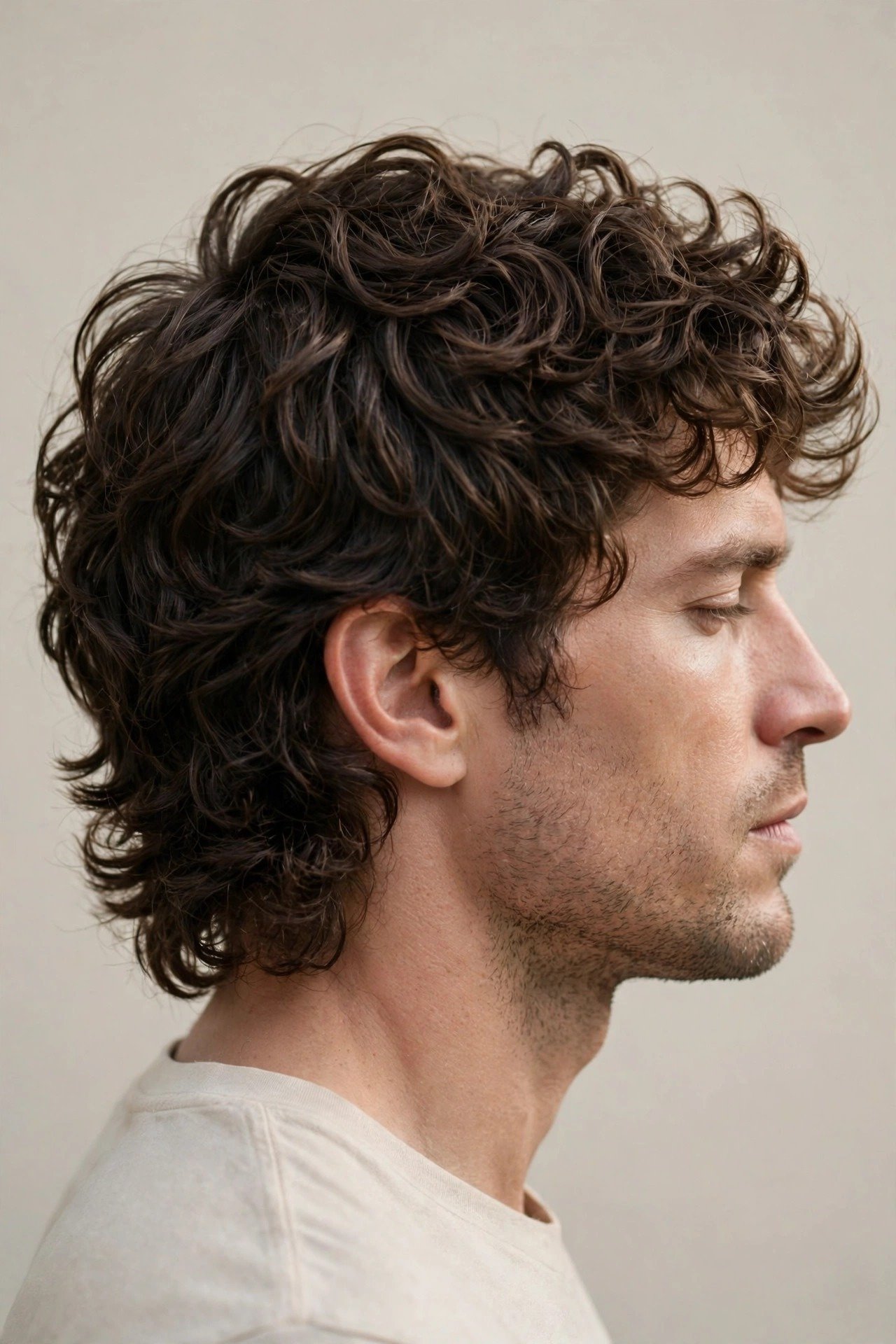
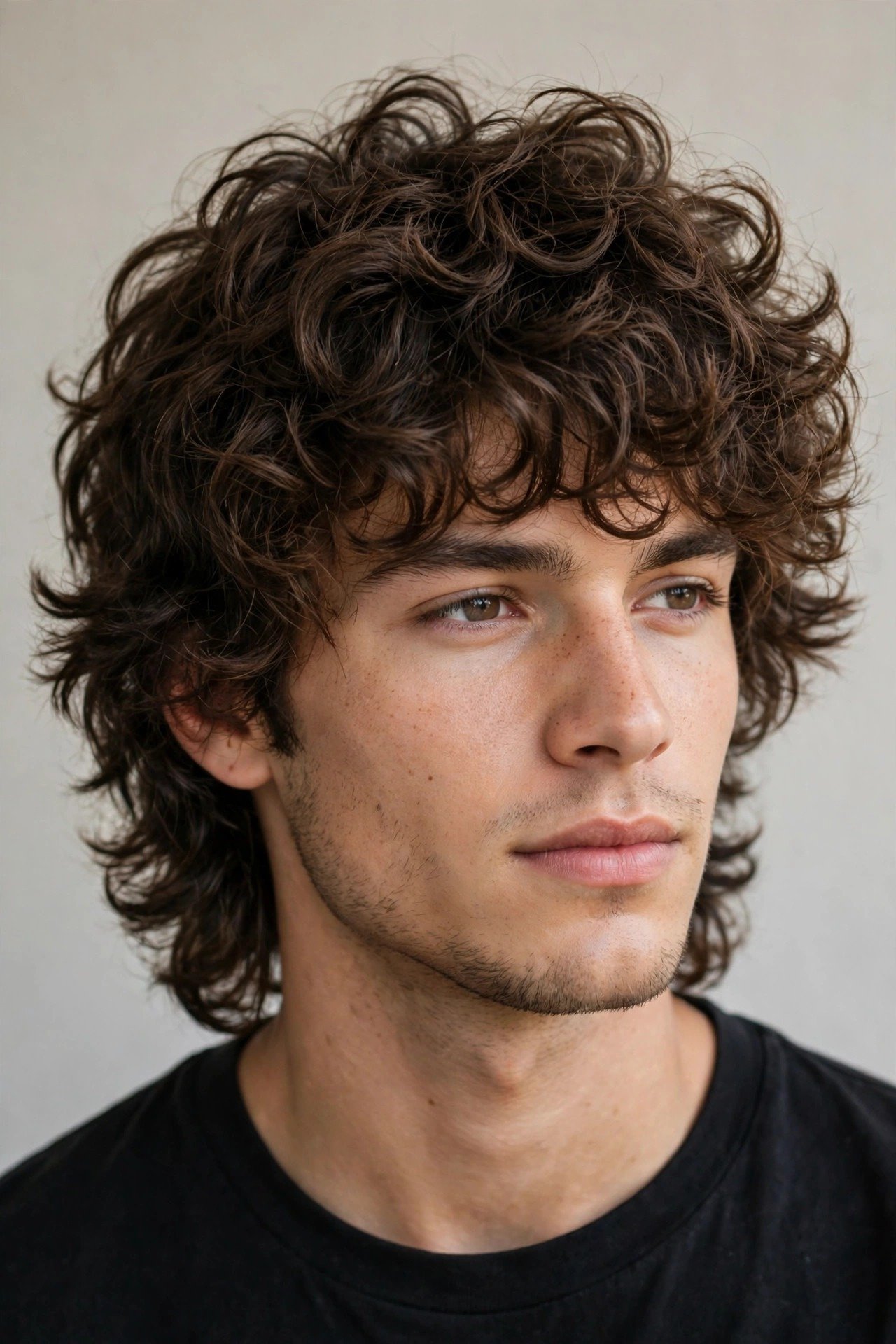
A curly wolf cut is a men’s haircut that combines the shag and the mullet into one layered, deliberately messy shape: short, stacked layers at the crown for volume, choppy disconnected layers through the sides and back, and length that runs past the collar at the nape, all cut to follow the hair’s natural curl pattern. Unlike a regular layered cut, which blends everything into a smooth shape, the wolf cut keeps the layers visible — the crown is full and lifted, the ends are wispy and separated, and the back is long enough to move. The curls are not fought or straightened; they are the whole point, because each curl catches light differently and gives the cut its wild, lived-in texture.
The mechanics are simple once you see them. The barber cuts the crown short — usually two to four inches — with heavy internal layering so the curls stack upward instead of falling flat, then leaves the back longer, three to five inches or more, with point-cut ends so the curls separate instead of clumping into a solid shelf. The sides are kept shorter than the back but longer than a fade, usually clipped to a number 2 or 3 guard or scissor-cut to follow the curl, and the fringe is shaped to fall forward, to the side, or into a curtain depending on the version you choose. The neckline is left long and textured rather than squared, which is what gives the wolf cut its signature shaggy silhouette from every angle.
What makes the curly wolf cut so forgiving is that it is built around your curl pattern, not against it. The layered structure removes the bulk that makes curly hair grow into a triangle, while the long back and wispy ends let the curls fall where they naturally want to fall. Change the length and you change the entire haircut: a short wolf cut reads sharp and modern, a long one reads wild and free, a tapered one reads clean and deliberate, and a mullet blend reads bold and unapologetic. That is why this guide carries 36 versions of the same foundation. The curly wolf cut also photographs exceptionally well, since the layered curls catch light differently from every angle, which is one reason it keeps going viral. And because the shape is deliberately messy, it always looks intentional even on days when the curls are doing their own thing.
Why the Curly Wolf Cut Is Dominating 2026

The curly wolf cut’s dominance in 2026 is no accident — it sits at the exact intersection of the year’s biggest men’s hair trends. According to the Pinterest 2026 Men’s Trend Report, searches for “soft wolf cut men” are up 1,154% year over year, and searches for “modern wolf cut men” are up 553%, which tells you exactly where the momentum is: men want softer, longer, more textured cuts, and the wolf cut is the purest expression of that shift. The wolf cut is now pulling in 2.24 million monthly searches worldwide, making it the most searched haircut on the planet heading into 2026, and the curly version is leading the charge because it is the one that looks most natural.
The second force behind the comeback is the texture revival itself. According to Expert Hairstylist’s roundup of the 30 men’s hair trends for 2026, the year’s defining direction is more length on top, more texture, more movement, and sides that are tapered low rather than shaved high — a description that could have been written about the wolf cut itself. The Right Hairstyles’ guide to wolf cuts for men makes the same point from the styling side: the cut’s choppy layers, volume at the crown, and messy finish are exactly what curly hair needs to look deliberate instead of accidental. The textured tops of 2026 need a cut that celebrates texture, and the curly wolf cut does.
The third reason is pure practicality. A curly wolf cut is one of the most forgiving cuts a curly-haired man can wear. It flatters round, square, oval, and oblong faces because the height at the crown and the fringe direction can be adjusted to balance proportions. It handles thick, fine, tight, loose, and coily curls alike, because the layered structure works the same way whatever grows on top. It grows out gracefully, since a shaggy shape always ages better than a hard skin fade. And it scales from a five-minute morning routine to a high-gloss evening finish with nothing more than a product swap. When one cut serves that many needs, it stops being a trend and becomes the default.
1. The Classic Curly Wolf Cut
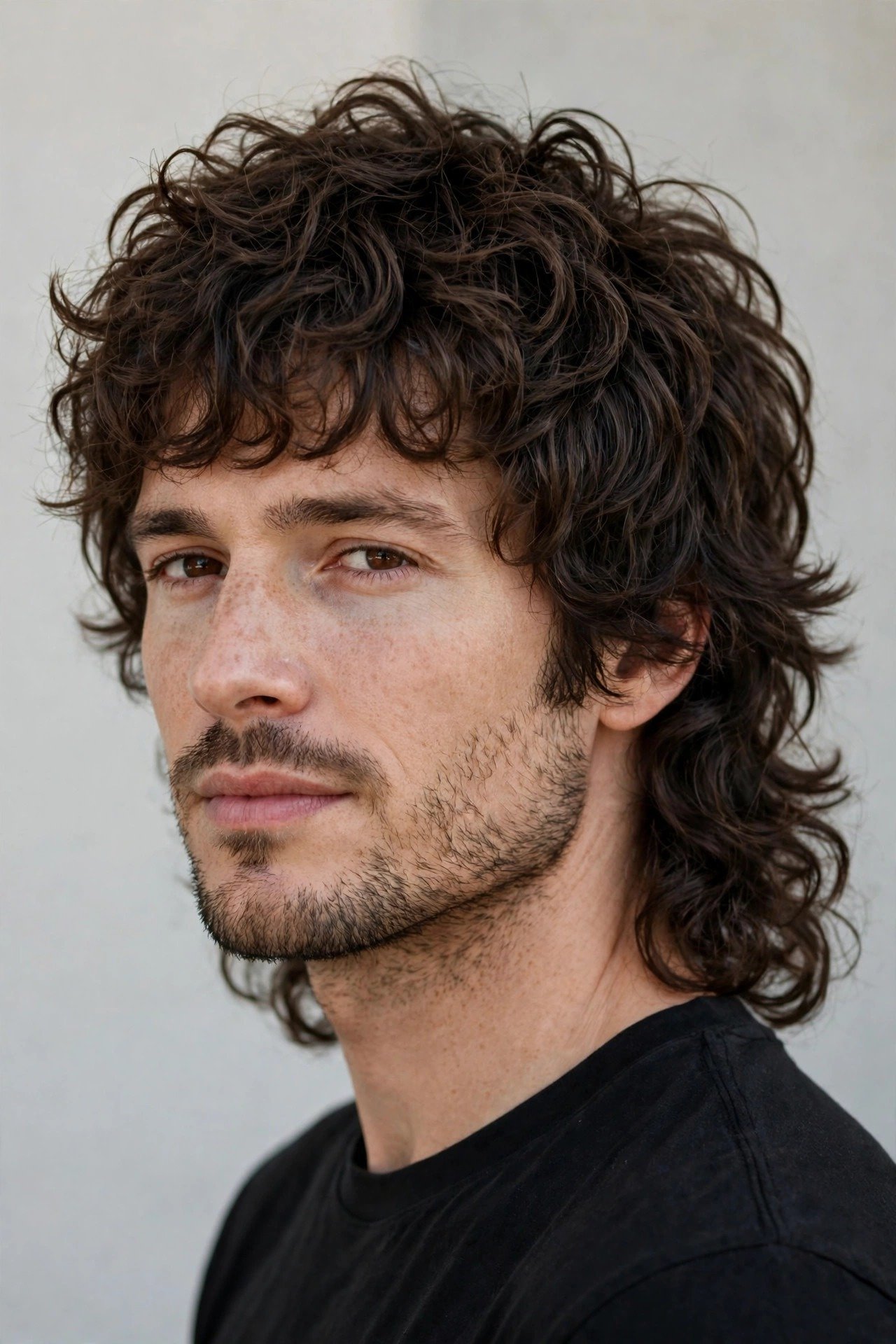
The classic curly wolf cut is the purest form of the cut and the safest first choice. The crown is kept at a medium length — usually three to four inches — layered so the curls stack upward with real volume, while the back runs past the collar with choppy, point-cut ends and the sides are kept shorter but still long enough to show curl. This is the version your barber recommends when you say “give me the wolf cut but keep it wearable.” It suits every face shape and every curl type, and it is the most forgiving of the 36 styles here if you are trying a wolf cut for the first time.
Barber script: ask for a wolf cut cut dry or barely damp so your curl pattern is visible while they work, with the crown left three to four inches and heavily layered, the back left long enough to brush the collar, and the sides scissor-cut or clipped to a number 2 or 3 guard. Request disconnected layering — never a smooth blend — because a blended cut kills the shagginess that makes the wolf cut work. Tell your barber you want the ends point-cut so the curls separate, and the fringe left long enough to fall forward naturally. The neckline should stay long and textured, not squared.
Styling routine: apply curl cream or leave-in conditioner to damp curls, scrunch upward, and let them air-dry — never brush curly hair dry. Five minutes, no dryer required — the layers do the visual work. Maintenance: trim every five to six weeks; the wolf cut grows out more gracefully than any fade, and a weekly neckline tidy with a trimmer keeps the back looking deliberate between visits.
2. Soft Curly Wolf Cut
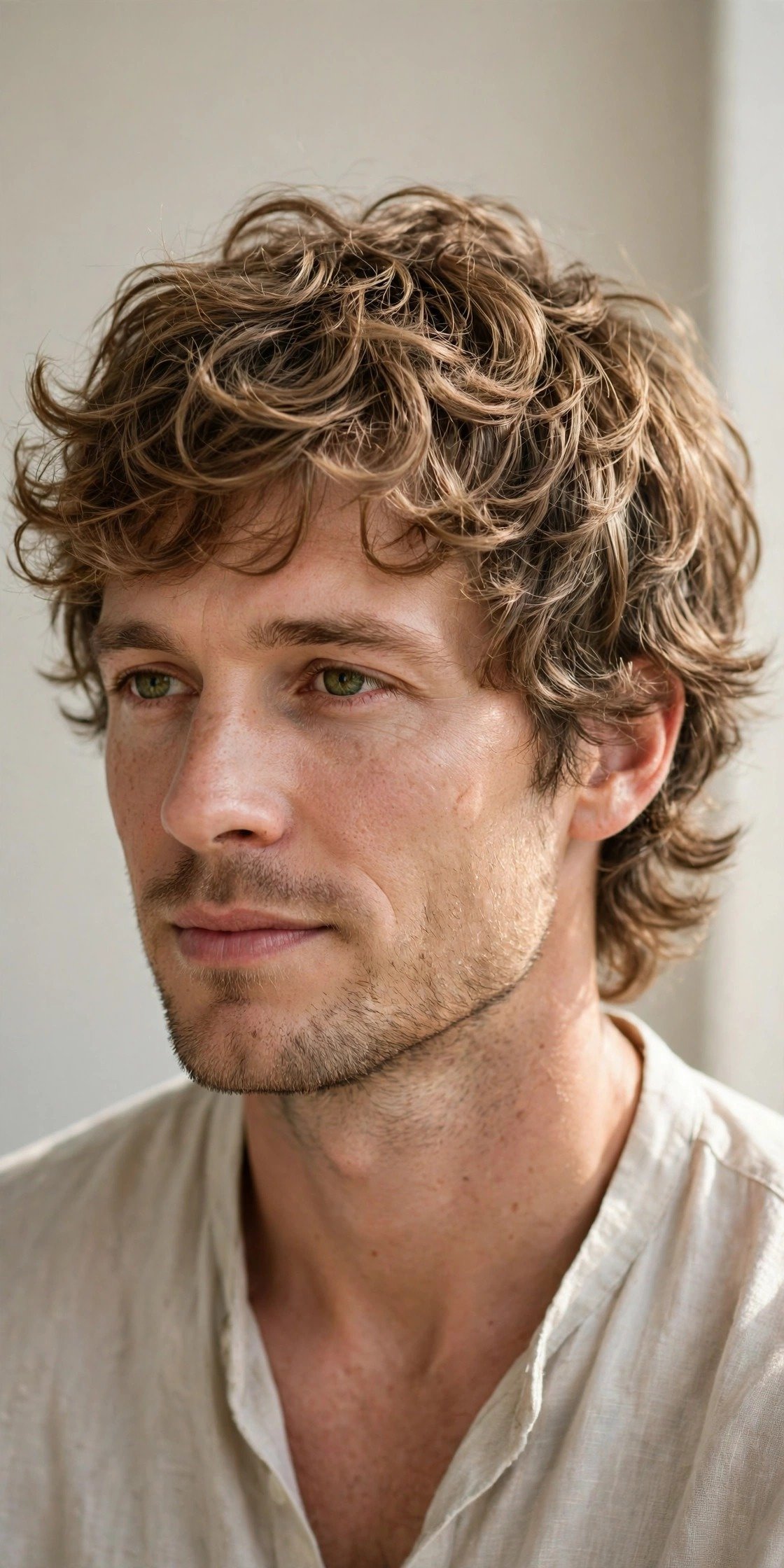
The soft curly wolf cut is the gentlest version of the cut, and the one the trend data says men are searching for most. Instead of heavy, dramatic layers, the crown is layered softly so the curls fall in gentle, wispy pieces, the back is kept just past the collar, and the sides are tapered low so the whole shape reads as relaxed rather than rebellious. It suits loose waves and soft curls best and flatters every face shape, and it is the best entry point for men who love the wolf cut’s texture but find the full shaggy version too bold for work or family occasions.
Barber script: ask for a soft wolf cut with the crown left three to four inches, layered gently rather than chopped, and the back left just past the collar with point-cut ends. Request the sides tapered low — a number 2 or 3 guard at the bottom stepping up softly — so the blend is visible but the wolf shape still reads. Tell your barber you want the fringe soft and wispy, broken up rather than cut straight across, and the neckline left natural and textured. For the soft finish in more depth, our Korean two block guide shows how a soft, textured top pairs with clean short sides.
Styling routine: a small amount of curl cream scrunched through damp hair is the entire routine — let it air-dry and the soft waves form on their own. Maintenance: every five to six weeks; the soft wolf cut hides growth better than any other version, so you can stretch a few extra days between appointments without the cut falling apart. This is the wolf cut for men who want the trend with the least drama.
3. Short Curly Wolf Cut
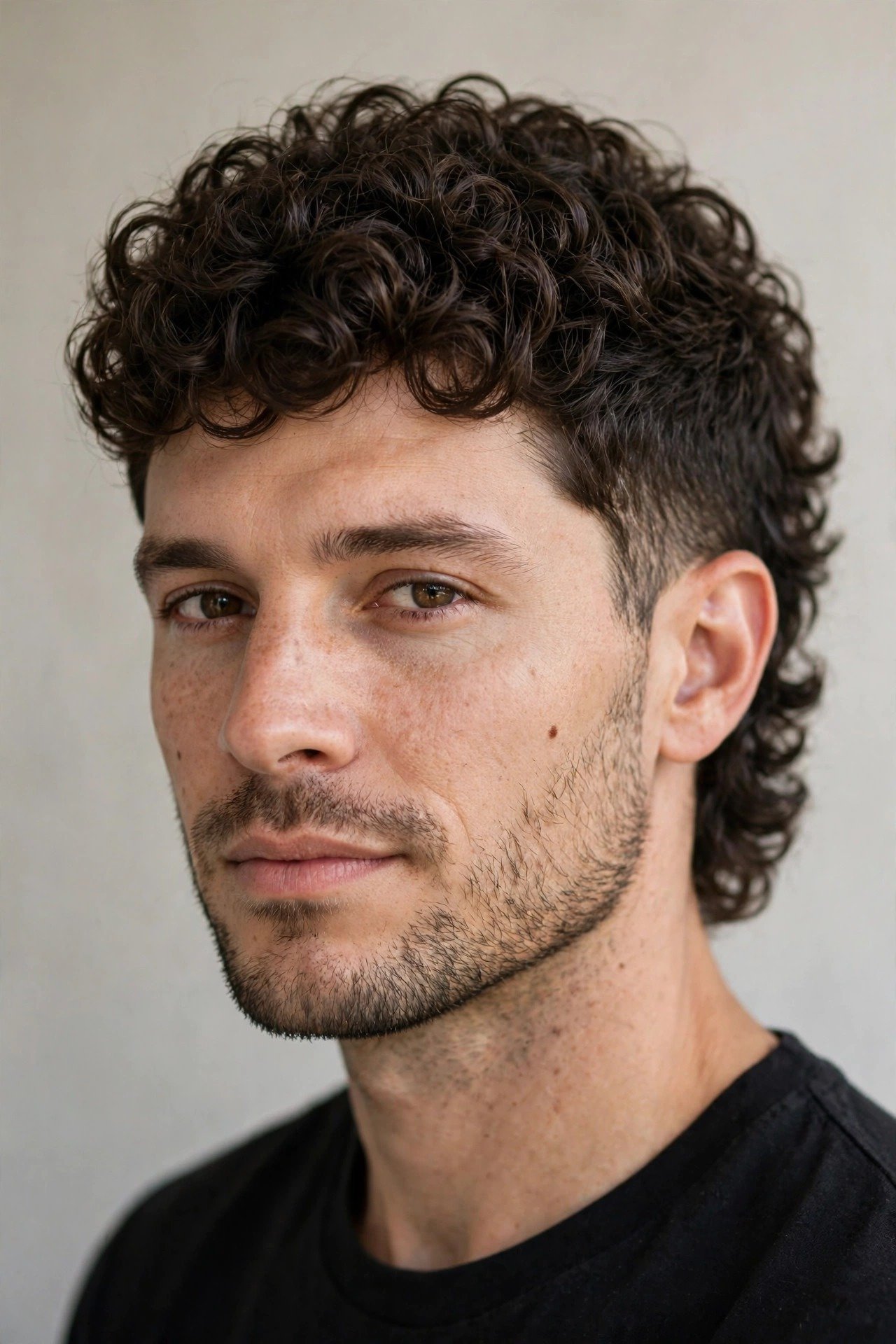
The short curly wolf cut is the sharpest, most modern version of the cut: roughly three inches of curl stacked into a rounded, layered crown, the back just brushing the collar, and the sides tapered to a number 2 or 3 guard. It is the version for men who want the wolf cut’s attitude without the length — all of the texture and volume, none of the mullet commitment. It suits tight curls and medium-density hair best, where the stacked crown holds its shape, and it flatters square and diamond faces, because the rounded crown softens strong angles while the short sides keep everything crisp.
Barber script: ask for a short wolf cut with about three inches of curl on top, stacked in layers through the crown, the back just touching the collar, and the sides tapered to a number 2 or 3. Tell your barber to cut it dry so they can see where each curl falls, which stops the shape from widening into a triangle. Request the ends point-cut for separation and the fringe left long enough to fall forward. Keep the neckline short and tidy so the short wolf shape reads as deliberate, not grown-out.
Styling routine: curl cream on damp hair, scrunched and left to air-dry, is the entire routine — the short length means the curls form fast and hold all day. Maintenance: every four to five weeks; the short wolf cut needs its crown reshaped regularly or the layers collapse into bulk. This is the wolf cut for men who want maximum texture with minimum length.
4. Long Curly Wolf Cut
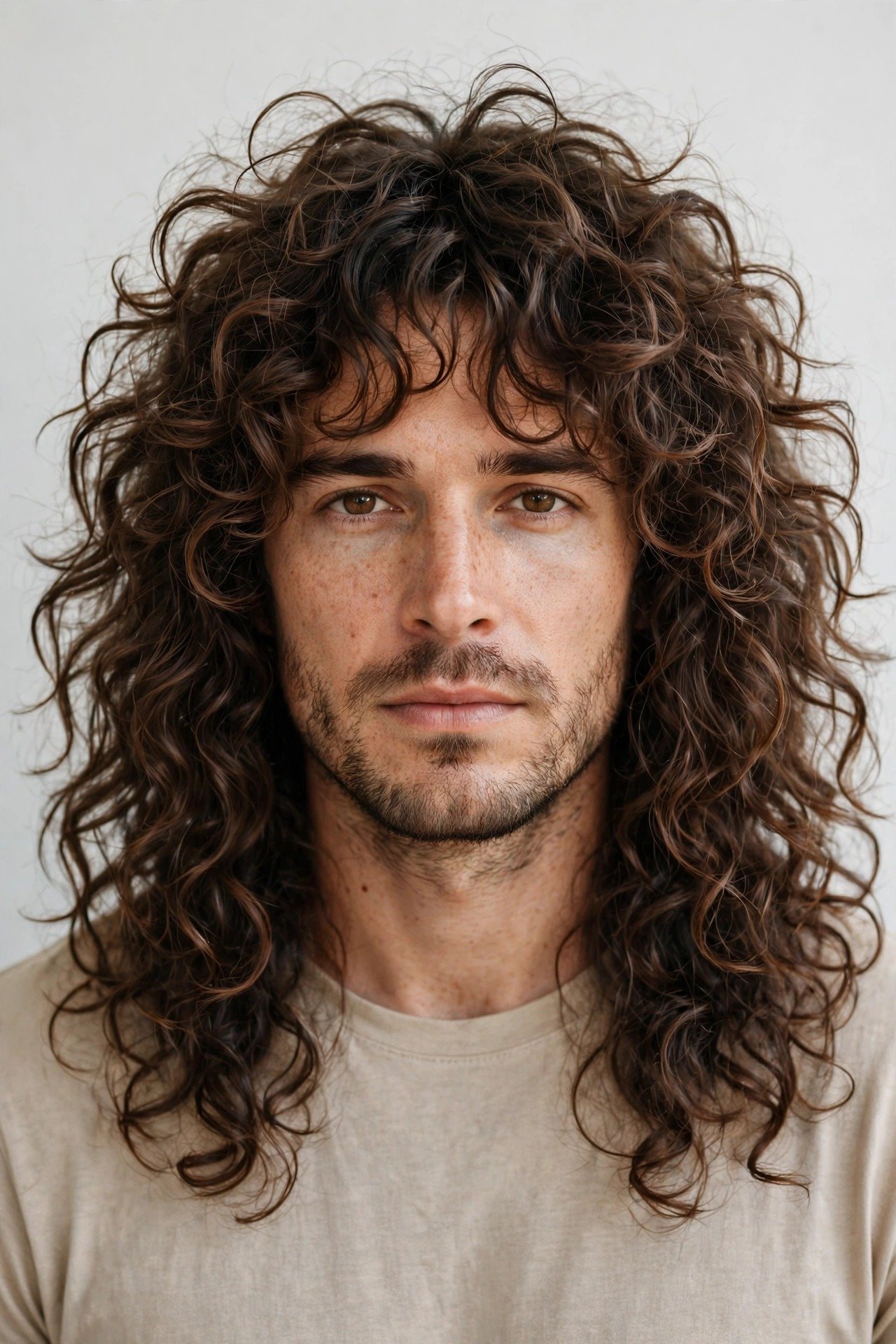
The long curly wolf cut is the flowing, confident version: shoulder-length curls with heavy shaggy layers, a full crown, and a back that moves when you do. The length gives you styling options no short cut can match — wear it loose and wild for the weekend, tied back for the gym, or swept to the side for the office — while the layers guarantee the head never looks heavy or triangular. It suits thick and wavy-curly hair best, where the length has real material to work with, and it flatters oval and square faces, where the flowing length adds character without adding width.
Barber script: ask for a long wolf cut with the crown left four to five inches and the back left past the shoulders, cut with heavy internal layering so the curls separate instead of clumping. Tell your barber you want the layers disconnected, not blended, and the ends point-cut so they stay wispy. Request the sides scissor-cut to follow the curl, never clipped short, so the long shape stays balanced. Ask for the crown to be thinned slightly if your hair is thick, so the long top does not puff up into a helmet.
Styling routine: sea-salt spray on damp curls, scrunched and left to air-dry, is the entire routine — the length does the work either way. Maintenance: the crown needs reshaping every six to eight weeks, while the back can go longer between trims. This is the wolf cut for men who want their hair to look like it has somewhere better to be.
5. Curly Wolf Cut with Low Taper
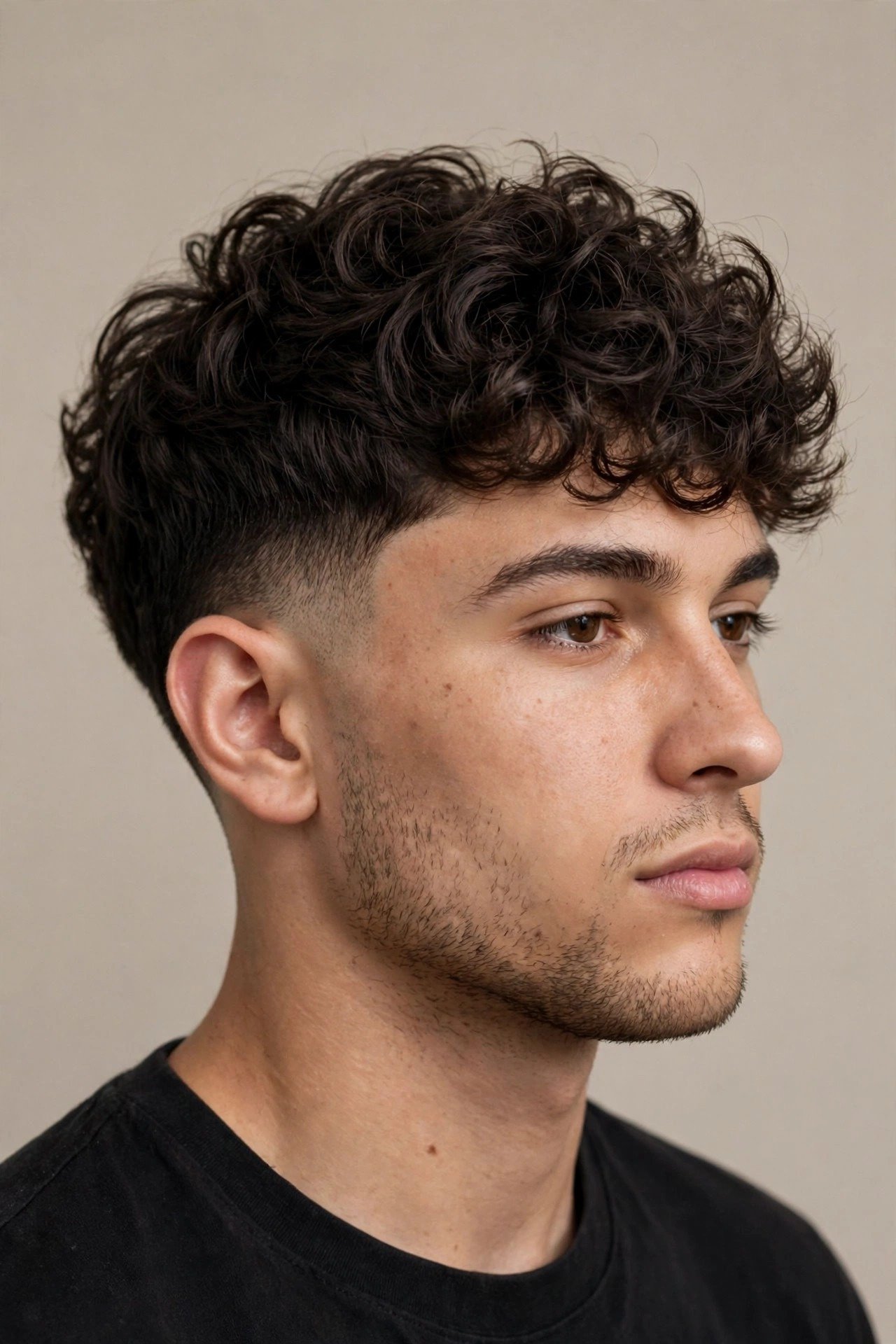
The low taper curly wolf cut is the cleanest version of the cut: the sides are tapered low — shortest at the sideburns and neckline, blending gently upward into the layered curls — so the wolf cut’s wild top sits over a tidy, deliberate base. It is the balanced version — noticeable enough to read as a designed haircut, conservative enough for the office — and it is the one barbers reach for when a client says “wolf cut, but make the sides look neat.” It suits every curl type and flatters every face shape, and it is the best version for men who want the wolf cut without the shaggy sides.
Barber script: ask for a wolf cut with a low taper — a number 0 or 1 guard at the very bottom, stepping up through 2 and 3 as the taper climbs — with the crown left three to four inches and heavily layered. Tell your barber you want the taper low and slow, so the blend is visible but the wolf shape still reads as a separate, shaggy top. Request a tapered neckline and clean sideburns, and keep the fringe forward and piecey. For the low taper pairing in more depth, our low taper fade guide covers the conservative taper in full.
Styling routine: curl cream scrunched through the damp top is the entire routine — the low taper needs no styling at all. Maintenance: every four weeks for the taper, six weeks for the crown shaping. This is the wolf cut for men who want a visible blend without committing to a high fade or a shaggy side.
6. Curly Wolf Cut with Skin Fade
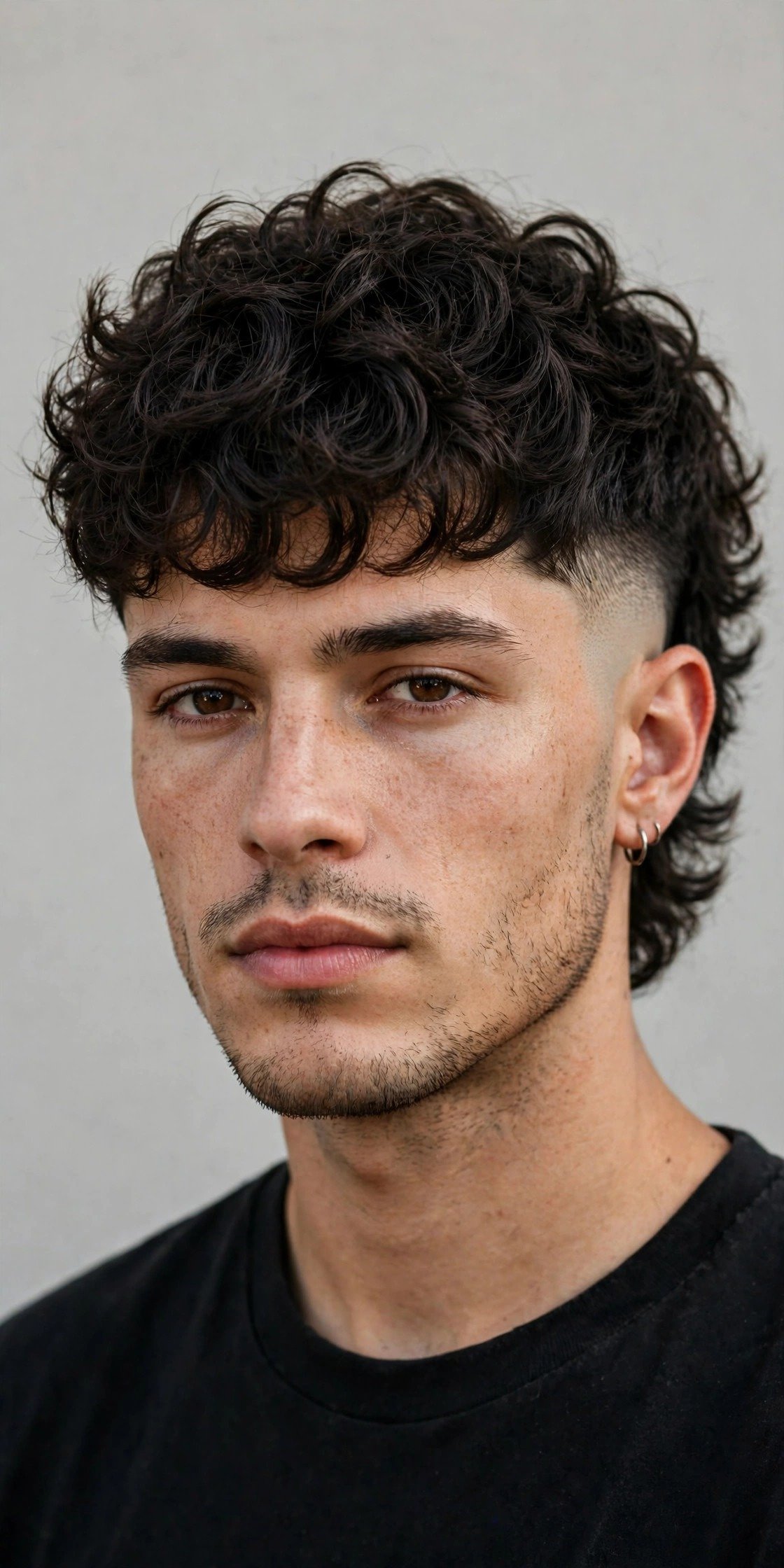
The skin fade curly wolf cut is the most graphic version of the cut: the sides fade down to bare skin below the layered crown, while the long curly top sits above them in full contrast. The result is the most dramatic wolf cut on this list — the skin sides make the curls look even denser and more deliberate by comparison. It suits thick hair best, where the top has real material to contrast against the skin, and it flatters oval, square, and diamond faces. This is the version for men who love fade work and want the wolf cut’s personality at full volume.
Barber script: ask for a wolf cut with the sides faded to skin — a foil shaver at the very bottom, stepping up through guards 0, 1, and 2 into the crown — with the top left three to five inches and heavily layered. Tell your barber you want the skin fade to stop cleanly below the crown, so the curls read as a separate, shaggy block. Request a tapered neckline and clean sideburns, and be explicit about where you want the fade’s highest point. Keep the back long enough that the wolf shape survives the fade.
Styling routine: a small amount of curl cream worked through the damp top, scrunched and left to air-dry, is the entire routine. The skin sides need no styling. Maintenance: every two to three weeks to keep the skin blend crisp — this is the most demanding wolf cut to maintain, so commit to the chair time before you commit to the cut. Sharp, modern, and unmistakably barber-crafted.
7. Curly Wolf Cut with Undercut Sides

The undercut curly wolf cut is the boldest disconnected look on this list — and the wolf cut’s layers are what make it wearable. The top is left long, four inches or more, with the sides cut very short and disconnected, no blend between the curls and the sides. Normally that disconnection reads as harsh; the wolf cut softens it by giving the short sides a clean, even finish below the layered crown, so the top stays dramatic while the base stays tidy. It suits thick, curly hair best and flatters oval and square faces.
Barber script: ask for an undercut wolf cut with the sides clipped short — number 1 guard — with a clean disconnect line where the long curly top begins, and four or more inches on top. Tell your barber you want the disconnect to read as a deliberate step, not a mistake, so the line should be cut crisply at the parietal ridge. Request a tapered neckline, since the undercut’s sharpness demands an equally clean back, and keep the back long enough to carry the wolf shape.
Styling routine: the top is worn loose and natural with curl cream scrunched through damp hair — the disconnect means the curls need real definition to stay in place. Maintenance: the disconnect line grows out fast, so book every three to four weeks. This is the wolf cut for men who want drama on top and precision everywhere else.
8. Curly Wolf Cut with Curtain Fringe

The curtain fringe curly wolf cut is the romantic version: a longer curly top parted down the middle, with the fringe falling in soft curls on either side of the forehead, over a shaggy layered back that keeps the whole shape wild. It is the K-drama hero cut crossed with a rock shag, and it works because the centre part frames the face symmetrically while the long back stops the length from looking shaggy. It suits loose curls and waves best, where the curtains fall naturally, and it flatters oval and square faces beautifully, since the parted fringe softens strong features.
Barber script: ask for a wolf cut with the top left four to five inches, cut with long layers so it parts naturally down the middle, and the sides kept long enough to show curl. Tell your barber you want a true curtain — the fringe long enough to reach the eyebrows on both sides, with the ends point-cut so they curve softly instead of hanging straight. Request the back left long and layered, so the curtains are the only long thing at the front. Ask them to cut the top following your natural part, not against it.
Styling routine: part the damp top down the middle with your fingers, add a small amount of curl cream, and let it air-dry — or diffuse the fringe outward for a fuller curtain. Five minutes, and the curtains do the work. Maintenance: every five to six weeks; the fringe needs a trim to stay out of the eyes, and the crown needs reshaping to keep its volume. This is the wolf cut for men who want the full romantic effect.
9. Curly Wolf Cut with Messy Fringe

The messy fringe curly wolf cut is the cut’s most honest version: it looks like you did nothing, because you almost did. The crown is cut with heavy point-cut texture and styled — or rather, unstyled — with deliberate randomness. Curls fall where they fall, and the whole thing reads as effortless in the way only a good haircut can fake. The long shaggy back stays neat enough below the crown, which is what keeps “messy” from reading as “neglected.” The contrast between the controlled shape and the wild curls is the entire trick, and it is the version most social-media styling actually relies on.
Barber script: ask for a textured cut made for messiness — “I want to wear it messy” is a complete instruction that tells your barber to cut more internal texture and keep the perimeter clean. The crown should be three to four inches with heavy point-cutting, and the fringe left long enough to fall over the forehead. For the sides, request a number 2 or 3 guard or a scissor-cut that follows the curl, and a long, textured neckline to match the relaxed mood. Keep the back long so the wolf shape stays readable.
Styling routine: sea-salt spray on damp hair, scrunch, and walk away — or a tiny amount of curl cream scrunched through dry curls. Maintenance: every five to six weeks; this is the best grow-out of any wolf cut, since messiness only improves with length. For men who hate spending time on their hair but refuse to look like they gave up, this is the answer.
10. Curly Wolf Cut with Side-Swept Fringe

The side-swept fringe curly wolf cut is the soft, romantic version: a longer curly fringe swept diagonally across the forehead, over a shaggy layered back that keeps the head wild. The diagonal sweep adds movement and asymmetry, which flatters nearly every face shape — it softens strong jawlines, shortens long foreheads, and gives the whole cut a relaxed, approachable feel. It suits loose curls and waves best, where the fringe falls naturally to the side, and it is one of the most versatile versions on this list for men who want length without commitment.
Barber script: ask for a wolf cut with the fringe left three to four inches, cut with long layers so it sweeps diagonally across the forehead. Tell your barber you want the fringe to fall to your preferred side naturally — they should cut it following your curl pattern, not against it. Request the sides kept long enough to show curl, and a long textured neckline to match the fringe’s soft mood. Keep the back long so the wolf silhouette stays visible from behind.
Styling routine: a small amount of curl cream through the damp fringe, pushed in the direction of the sweep, is the entire routine — no dryer needed unless you want extra lift. Maintenance: every five to six weeks; the fringe needs a trim to stay out of the eyes, and the crown needs reshaping to keep its volume. This is the wolf cut for men who like a little romance in their haircut.
11. Curly Wolf Cut with Textured Fringe

The textured fringe curly wolf cut is the detail-driven version: the fringe is point-cut into distinct, separated curls that fall forward in pieces rather than as a solid curtain, over a shaggy layered back that keeps the whole head moving. The texture is the point — every curl is visible, every end is separated, and the fringe reads as designed rather than grown. It suits tight and medium curls best, where the point-cutting creates real separation, and it flatters long and oblong faces beautifully, since the forward fringe shortens the forehead visually while the layered back adds structure.
Barber script: ask for a wolf cut with a textured fringe — three to four inches on top, heavily point-cut for separation — and a long, layered back. Tell your barber you want the fringe broken up, not blunt — the wolf cut’s charm is its softness, and a solid fringe would fight it. Request the sides scissor-cut to follow the curl and the neckline left long and textured. For the textured-top pairing in more depth, our textured crop guide shows how point-cut texture pairs with a short forward top.
Styling routine: a fingertip of curl cream scrunched through the damp fringe is the entire top routine — no comb, no dryer. Maintenance: every five weeks; the fringe needs a trim to stay above the eyes, and the crown needs reshaping to keep its separation. This is the wolf cut for men who want to look current without looking like they tried.
12. Curly Wolf Cut with Volume on Top
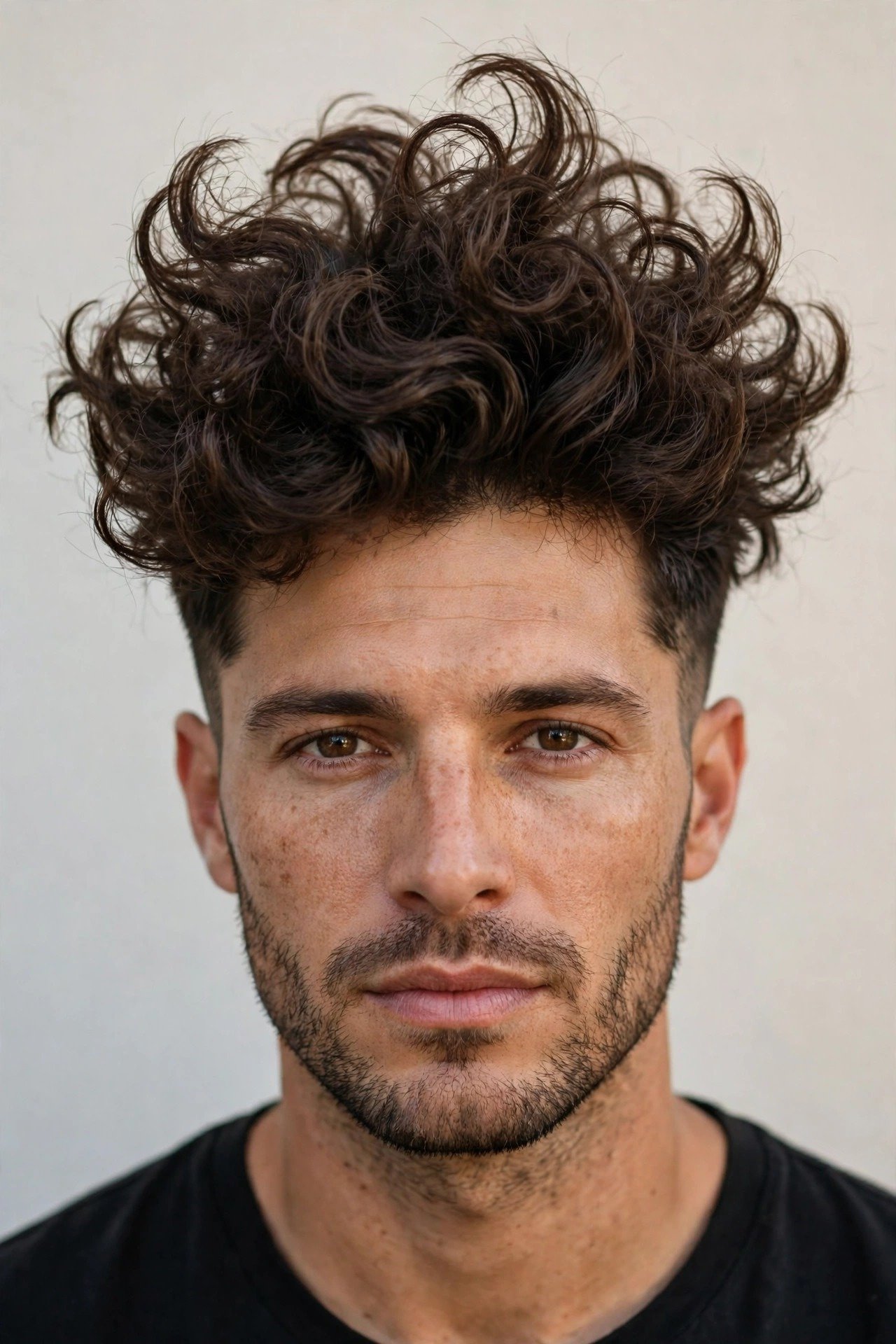
The high-volume curly wolf cut is the boldest silhouette on this list: thick curls lifted up with a blow-dried, voluminous finish, sitting over a shaggy layered back that keeps the base wild. The volume gives the top real presence — it reads confident, groomed, and deliberate from across the room — while the long back stops the whole head from looking top-heavy. It suits thick, curly hair best, where the volume holds its shape, and it flatters round and square faces, because the vertical lift lengthens the face while the layered back keeps everything balanced.
Barber script: ask for a high-volume top with four to five inches on top, cut with long layers and internal texture so the curls lift without bulk. Tell your barber you want volume, not just length — the cut should be shaped to stand up with a diffuser. Request the sides kept long enough to show curl, and a long textured neckline. Ask for the crown to be cut so the curls lift forward and up, not flat against the head, and keep the back long to balance the volume.
Styling routine: this is the one version where the diffuser earns its keep. Dry the top upward with a diffuser, working a volumizing mousse through damp curls first, then lock it with a light curl cream. Maintenance: trim every five weeks; volume needs the crown to stay shaped or the whole shape goes soft. This is the wolf cut for men who want to be noticed walking into a room.
13. Curly Wolf Cut for Thick Hair
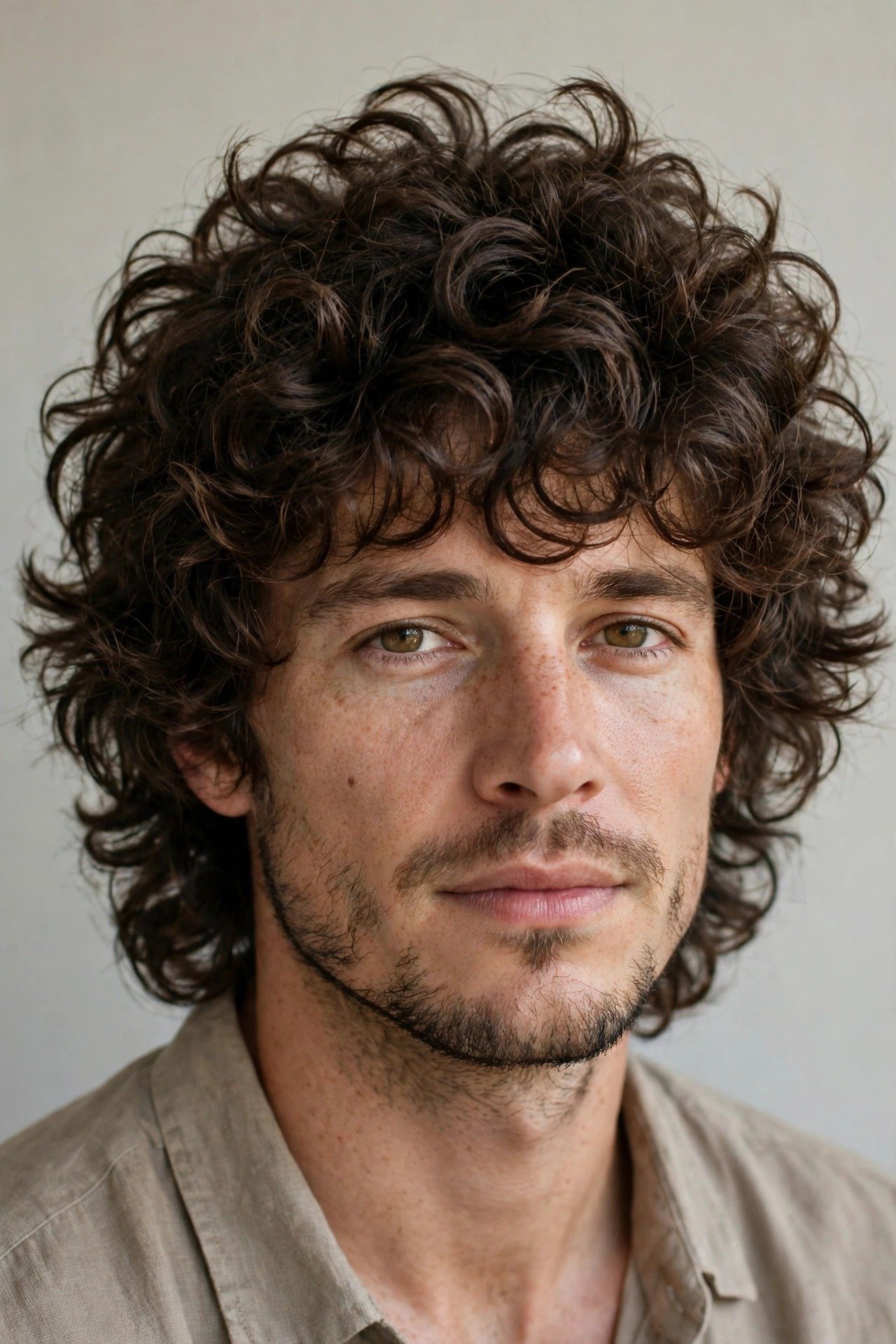
Thick hair is both the wolf cut’s best friend and its biggest challenge — there is plenty of material for texture and volume, but without internal weight removal the crown mushrooms instead of moving, and the back can look bulky instead of shaggy. The thick-hair version solves both problems: the barber removes weight from inside the crown while keeping the length, so the curls sit down and separate, and the back is layered heavily so the density transitions cleanly. The result is the most impressive wolf cut of any hair type — the density that fights you in every other cut becomes the whole point here.
Barber script: ask for a layered crown with heavy internal texture and thinning through the middle, about three to four inches on top, over a long, layered back. The critical instruction is “take the weight out” — say it explicitly, because a barber who cuts a thick crown like a fine crown will leave you with a helmet. Request the layers disconnected, not blended, taking extra care at the crown where thick curls tend to stick out, and keep the back long and point-cut so the wolf shape stays readable.
Styling routine: a light leave-in conditioner under your curl cream keeps the texture controlled without looking product-heavy. Maintenance: every five to six weeks, since thick hair shows growth fastest. Done right, thick hair produces the most impressive wolf cut of any hair type — the density that fights you in every other cut becomes the whole point here.
14. Curly Wolf Cut for Fine Hair
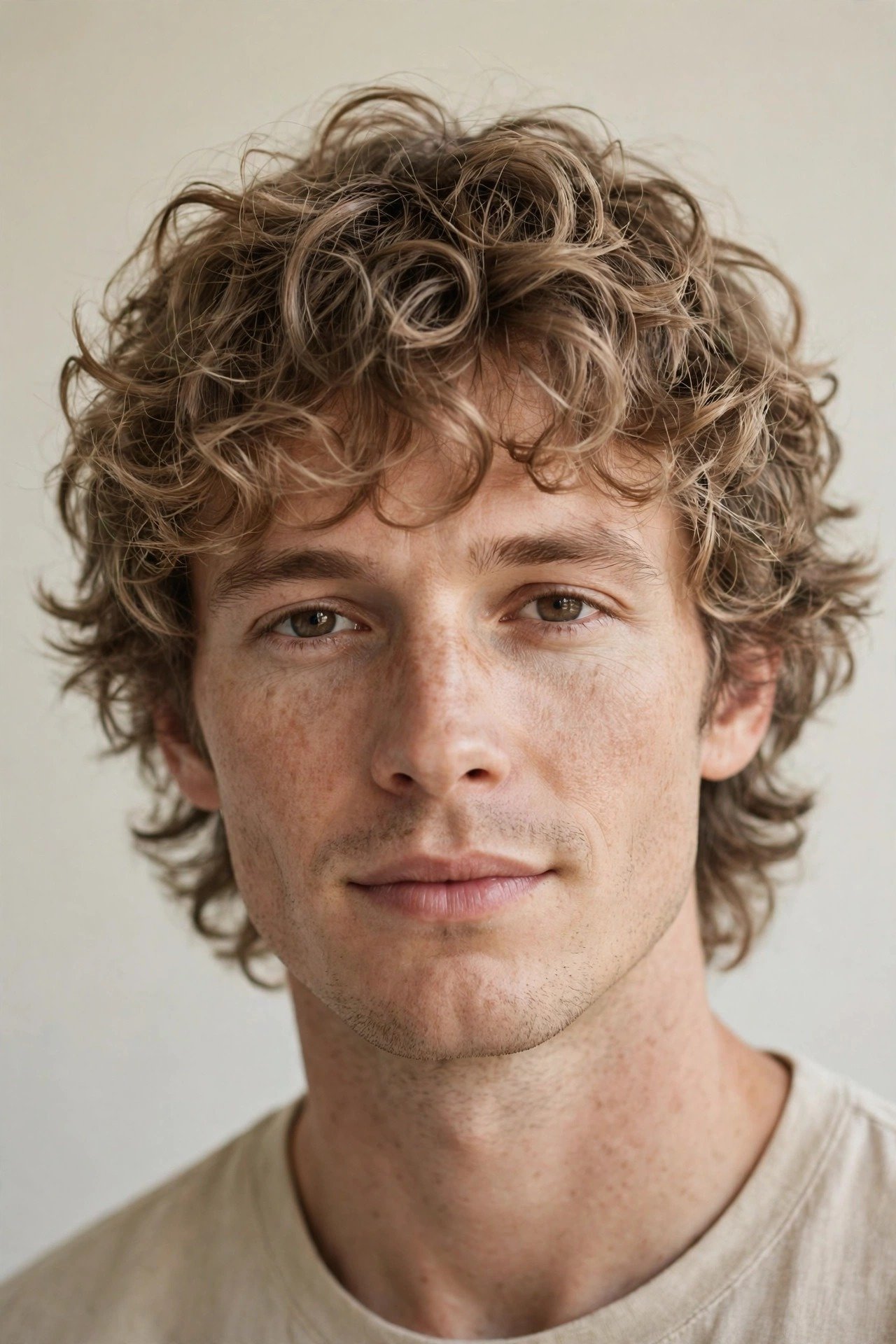
Fine hair gets the biggest transformation from a wolf cut of any hair type. The problem with fine hair is that solid, one-length cuts lie flat and expose the scalp; the solution is separation — when the crown is point-cut into distinct curls, each curl casts a tiny shadow on the one behind it, and the eye reads that light-and-shadow play as density. The long back adds the second half of the illusion: a shaggy, layered shape gives the head visual structure, so the face looks balanced even where the crown is light. A good wolf cut can make fine curls look twice as thick as they are.
Barber script: ask for a layered crown cut specifically for fine hair — “light, airy texture, do not thin it out” — because over-thinning fine hair is the classic mistake that makes it look thinner. About three inches on top is the sweet spot: enough length for separation, not so much that it goes limp. The back should be left long and layered, so all the visual weight lives in the shape. Request a long, textured neckline and a clean, soft finish at the edges.
Styling routine: sea-salt spray is your best friend — mist it on damp hair before styling to add grip and body, then finish with a small amount of curl cream. Avoid heavy creams and oils on the crown, which weigh fine curls down and undo the illusion. Maintenance: every five weeks. This is the version that turns a hair insecurity into a non-issue — and the wolf cut is the frame that makes it work.
15. Curly Wolf Cut for Tight Curls

Tight curls and the wolf cut are a better match than most people assume. Keeping tight curls longer on top while layering the crown heavily removes the triangle-shaped bulk that makes curly cuts look heavy, and the long back gives the ringlets a defined direction — the curls get a clear shape on top, the layered back keeps everything shaggy, and the whole head reads as one sculpted form. The key is length: three to four inches on top lets tight curls form proper ringlets, while the back stays long enough that the curls have room to spring.
Barber script: ask for a wolf cut with the top left three to four inches and cut curl-by-curl with scissors, never thinned with a razor. Tell your barber the curls should be shaped to spring toward your part side. Request the back left long and layered, with the ends point-cut so the ringlets separate. Ask for a soft, natural finish at the edges rather than a hard lineup, because tight curls do not respect razor lines the way straight hair does.
Styling routine: apply curl cream or leave-in conditioner to damp curls and let them air-dry — never brush tight curls dry. The back needs no styling, only upkeep. Maintenance: trim every five to six weeks, with the crown reshaped at five weeks. This is the wolf cut for men who let their natural texture do the talking.
16. Curly Wolf Cut for Loose Waves
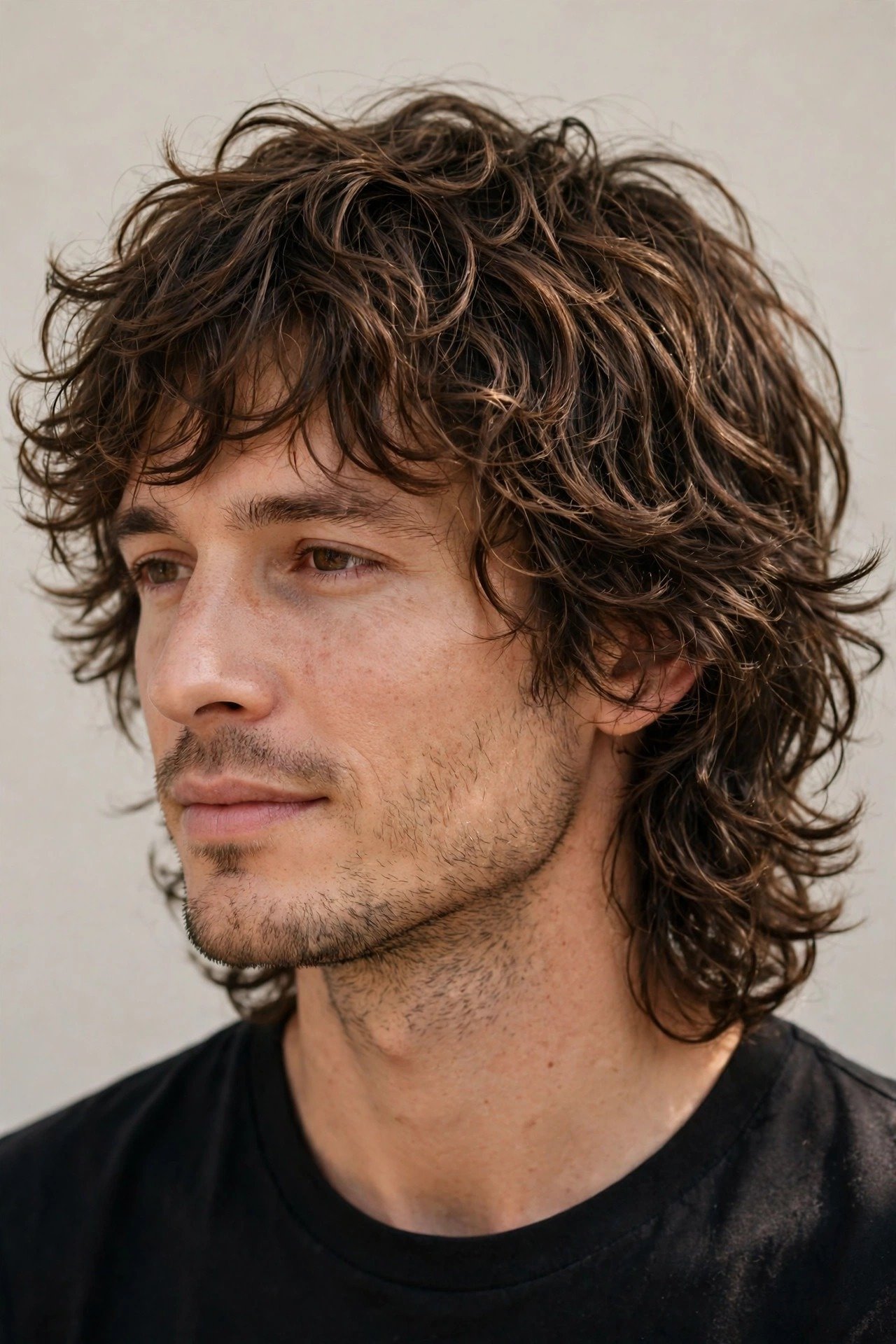
Loose waves are the wolf cut’s most effortless partner: the waves give the crown natural movement with almost no product, and the long layered back gives the whole look its shaggy structure. The crown is kept three to five inches so the waves can form, swept to the side or forward in whatever direction they naturally fall. The layers then tie the bottom half together, and because wavy hair grows with natural texture, the top looks organic rather than engineered. This version suits medium-density hair best and flatters every face shape.
Barber script: ask for a wolf cut with the crown left three to five inches, cut with long layers that follow your wave pattern — tell your barber to cut it dry or barely damp so the waves are visible while they work. Request the back left long and layered, with the ends point-cut so the waves separate. Ask them to shape the crown to follow your wave direction rather than forcing a rigid part; a natural finish suits wavy hair better than a sculpted one.
Styling routine: sea-salt spray on damp hair, scrunched and left to air-dry, is the entire top routine — the waves do the work. Maintenance: every six weeks; wavy hair hides growth better than straight hair, so this is one of the most forgiving versions to maintain. If your waves are strong, this may be the easiest great-looking wolf cut you will ever wear.
17. Curly Wolf Cut for Coily Hair

Coily hair takes the wolf cut somewhere no other texture can go: tight, springy coils stacked into a rounded, sculpted crown, with a long layered back that gives the coils room to move. The layers are what make it work — without them, coily hair grows into a single dense mass; with them, each coil gets its own space and the whole shape reads as designed. It suits medium to thick coily hair best and flatters oval and square faces, because the sculpted crown balances strong features while the long back keeps the silhouette wild.
Barber script: ask for a wolf cut cut on dry, stretched coils so your barber can see the true length, with the crown left three to four inches and layered coil-by-coil. Tell your barber you want the back left long and layered, with the ends shaped — never razored — so the coils keep their spring. Request a soft, natural finish at the edges and a long, textured neckline, because coily hair does not respect hard lines. Ask them to shape the crown to your head, not to a template.
Styling routine: leave-in conditioner and a light curl cream, applied to damp coils and left to air-dry, is the entire routine — never brush coily hair dry. Maintenance: every six to eight weeks; coily hair hides growth well, so this is one of the most forgiving versions to maintain. This is the wolf cut for men whose coils deserve a shape as bold as they are.
18. Curly Wolf Cut with Highlights
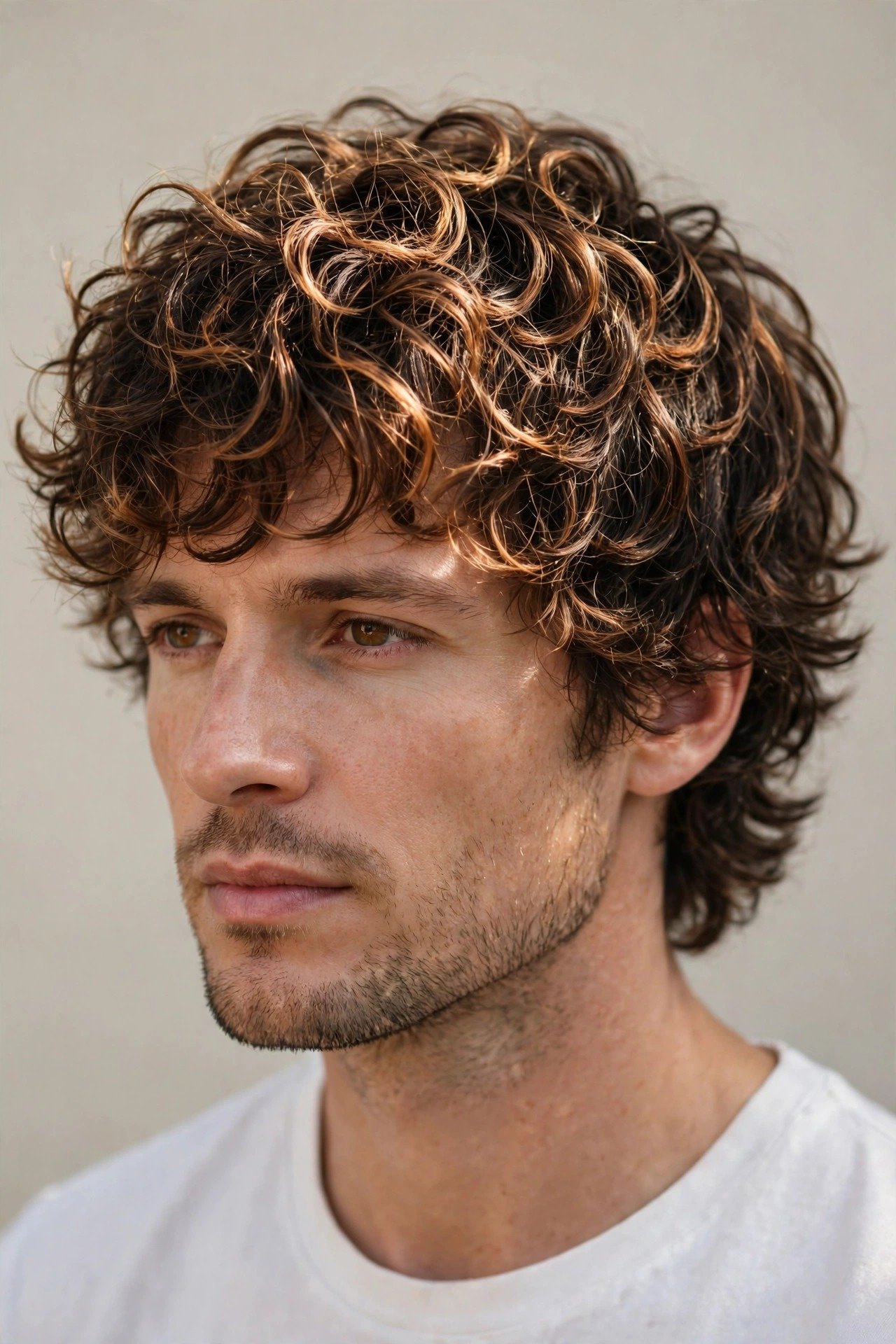
Highlights are the wolf cut’s secret weapon: because the cut is all layers, every highlight sits on a different layer and catches the light differently, so the whole head shimmers with depth that a solid colour can never match. Sun-kissed highlights through the crown and the long back make each curl visible, give the shaggy shape dimension, and make the wolf cut look expensive even on a lazy day. It suits every curl type and flatters every face shape, and it is the best version for men who want their wolf cut to look lit from within.
Barber script: ask for a wolf cut first, then tell your colourist you want sun-kissed highlights painted through the crown and the back — freehand balayage, not foils — so the colour follows the layers. Request the highlights concentrated at the ends and around the face, where the light hits first, and kept subtle: two shades lighter than your base is the sweet spot. Tell your barber to point-cut the ends after colouring, so the highlights separate with the curls.
Styling routine: curl cream on damp hair, scrunched and left to air-dry, is the entire routine — the colour does the visual work. Maintenance: the cut needs a trim every five to six weeks, while the highlights need a refresh every eight to ten weeks. This is the wolf cut for men who want their texture to glow.
19. Curly Wolf Cut with Blonde Balayage

Blonde balayage on a curly wolf cut is the high-contrast version: soft blonde melting through a dark base, concentrated at the ends of the layers, so the curls look sun-bleached at the tips and deep at the roots. The effect is pure summer — the long back glows, the crown shimmers, and the whole cut reads as effortless even though the colour is entirely deliberate. It suits dark brown and black hair best, where the contrast is strongest, and it flatters every face shape, since the lightness around the face brightens the whole look.
Barber script: ask for a wolf cut first, then request a blonde balayage painted freehand through the crown and back, with the blonde heaviest at the ends and softest at the roots. Tell your colourist you want a lived-in blend, not a sharp line — the balayage should melt, not stripe. Request the ends point-cut after colouring so the blonde separates with the curls, and keep the back long so the gradient has room to show.
Styling routine: curl cream on damp hair, scrunched and left to air-dry, is the entire routine — the balayage does the visual work. Maintenance: the cut needs a trim every five to six weeks, while the balayage grows out softly and needs a refresh only every ten to twelve weeks. This is the wolf cut for men who want summer in their hair all year.
20. Curly Wolf Cut with Copper Tones
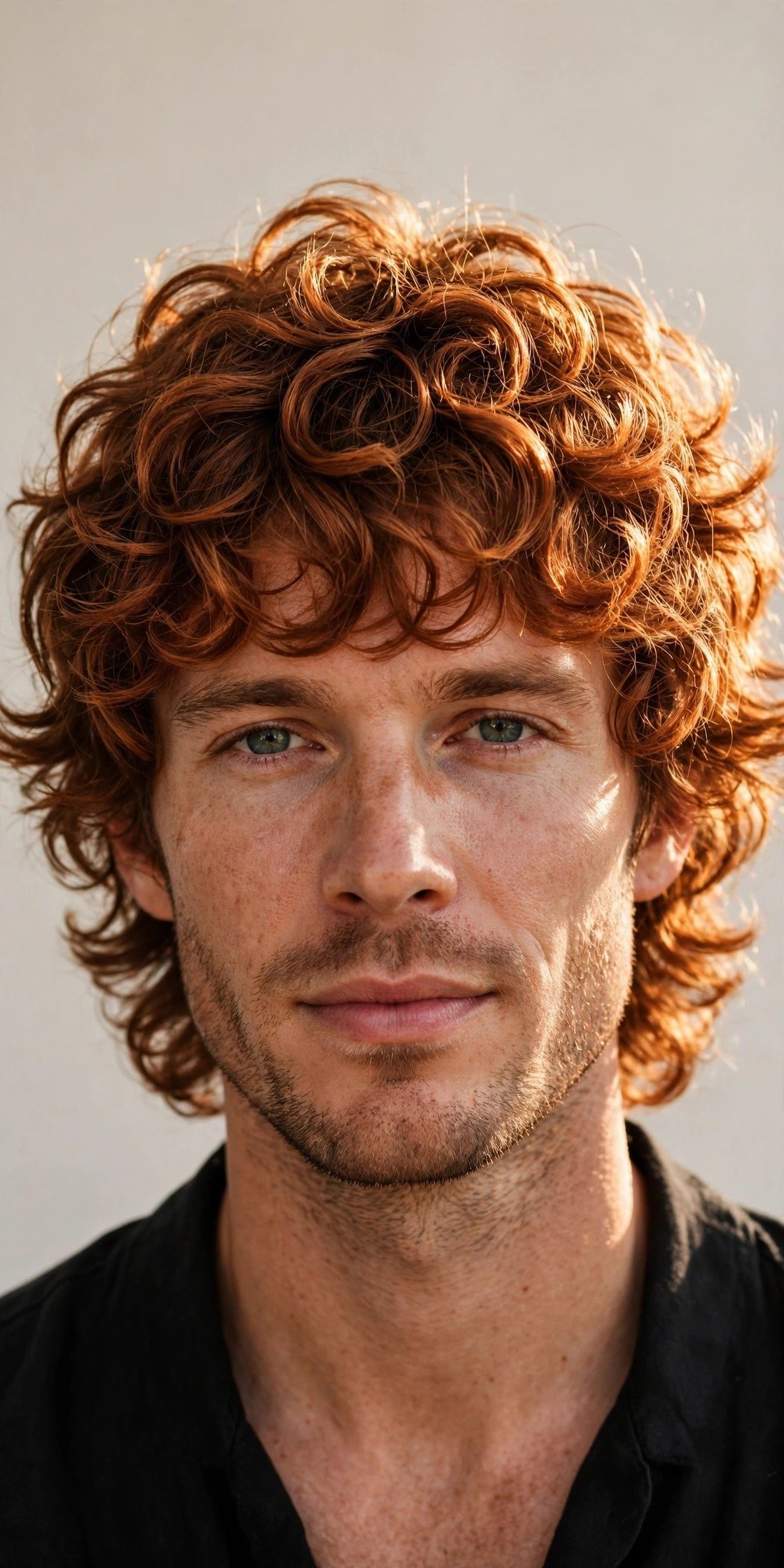
Copper tones turn the curly wolf cut into a statement: warm, rich copper woven through the layers makes every curl glow, gives the shaggy shape a fiery depth, and makes the whole cut look deliberate in a way no natural shade can match. It suits fair to medium skin best, where the warmth complements the complexion, and it flatters every face shape, since the colour draws the eye to the texture rather than the outline. This is the version for men who want their wolf cut to be noticed before they say a word.
Barber script: ask for a wolf cut first, then request a copper tone — a rich, warm copper all over, or copper balayage through the crown and back for a softer effect. Tell your colourist you want the copper to follow the layers, concentrated at the ends where the light hits. Request the ends point-cut after colouring so the copper separates with the curls, and keep the back long so the colour has room to glow.
Styling routine: curl cream on damp hair, scrunched and left to air-dry, is the entire routine — the copper does the visual work. Maintenance: the cut needs a trim every five to six weeks, while copper fades faster than most colours and needs a gloss refresh every four to six weeks. This is the wolf cut for men who like their hair with a point of view.
21. Curly Wolf Cut with Curtain Bangs

The curtain bangs curly wolf cut is the face-framing version: long curly bangs parted in the middle, falling on both sides of the forehead in soft, separated strands, over a shaggy layered back that keeps the whole head wild. The bangs do the framing work — they soften the forehead, draw the eye to the eyes, and give the cut a romantic, almost cinematic quality — while the long back provides the wolf cut’s signature edge. It suits loose curls and waves best, where the bangs fall naturally, and it flatters oval and heart-shaped faces.
Barber script: ask for a wolf cut with the bangs left four to five inches, cut with long layers and point-cut ends so they fall in separated strands rather than a solid curtain. Tell your barber you want the bangs long enough to reach the eyebrows, with the option to part them in the middle or sweep them to one side. Request the back left long and layered, and a long textured neckline. Keep the crown layered so the bangs blend into the top instead of sitting apart from it.
Styling routine: a small amount of curl cream through the damp bangs, parted where you like it, and left to air-dry — the strands do the work. Maintenance: every five to six weeks; the bangs need a trim to stay out of the eyes, and the crown needs reshaping to keep its volume. This is the wolf cut for men who live on camera.
22. Curly Wolf Cut Mullet Blend

The mullet blend curly wolf cut is the comeback story of 2026: short on the front and crown, long at the back, with the wolf cut’s layers tying the whole shape together. The classic mullet’s problem was always the disconnect — the back seemed unrelated to the front — and the wolf cut solves it from the crown, giving the short sections heavy layering that makes the long back look deliberate rather than accidental. It suits loose curls and waves best and flatters oval and square faces. This is the version for men who like the joke and the haircut in equal measure — and in 2026, the joke is that it genuinely looks great.
Barber script: ask for a mullet-blend wolf cut with the front and crown kept short — two to three inches — the sides scissor-cut to follow the curl, and the back left long, four to six inches, with heavy layers through the ends. Tell your barber you want the modern version: soft, textured, and wearable, not the harsh eighties original. Request a long, textured neckline that flows into the mullet’s length. For the short-top side of this look, our mid taper fade guide shows how a mid-height blend pairs with a short textured top.
Styling routine: the crown needs only a touch of curl cream scrunched through damp hair; the back needs sea-salt spray and a scrunch for texture. Maintenance: the crown needs reshaping every five weeks, and the back needs a trim every six to eight weeks to keep its shape. This is the wolf cut for men who are done apologising for liking the mullet.
23. Curly Wolf Cut Shag Blend

The shag blend curly wolf cut is the rock-and-roll version: choppy, disconnected layers through the whole head, a full crown, wispy ends everywhere, and a finish that looks like it was styled by a wind machine. It is the wolf cut taken to its logical extreme — the shag is the wolf cut’s parent, after all — and it works because the curls give the choppy layers something to hold onto. It suits thick and medium curls best and flatters every face shape, and it is the best version for men who want their hair to look like a lifestyle, not a haircut.
Barber script: ask for a shag-blend wolf cut with heavy, choppy layers through the crown and back, cut with a razor or point-cutting to create maximum separation. Tell your barber you want the ends wispy, not blunt — the shag’s charm is its feathered finish, and a solid perimeter would fight it. Request the back left long and layered, the sides scissor-cut to follow the curl, and a long, textured neckline. Keep the fringe long and broken up.
Styling routine: sea-salt spray on damp hair, scrunched and left to air-dry, is the entire routine — the shag does the work. Maintenance: every six to eight weeks; the shag hides growth better than any other wolf cut, so this is the most forgiving version to maintain. This is the wolf cut for men who want their hair to look like it has a record collection.
24. Curly Wolf Cut with Middle Part

The middle part curly wolf cut is the softer sibling of the curtain: a longer curly top parted down the centre, falling evenly on both sides, over a shaggy layered back that keeps the shape from going shaggy at the front. Where the curtain is dramatic and face-framing, the middle part is calm and balanced — the symmetry does the work, and the long back provides the contrast. It suits loose curls best, where the part stays clean, and it flatters oval and heart-shaped faces, since the even fall on both sides balances the forehead and jaw.
Barber script: ask for a wolf cut with the top left four to five inches, cut with long layers so it parts naturally down the middle, and the back left long and layered. Tell your barber you want the part to sit at your natural centre, not forced, and the ends point-cut so they fall softly instead of hanging as a solid shelf. Request a long, textured neckline and clean sideburns, and keep the sides long enough to show curl so the middle part is the only neat feature on the head.
Styling routine: part the damp top down the middle with your fingers, add a small amount of curl cream, and let it air-dry — or diffuse each side outward for a fuller finish. Maintenance: every five to six weeks; the top needs a trim to keep its layers, and the crown needs reshaping to keep its volume. This is the wolf cut for men who want symmetry and calm.
25. Curly Wolf Cut with Side Part

The side part curly wolf cut is the timeless classic, rebuilt with a wolf cut’s wild back. The crown is parted cleanly to one side and swept over with controlled neatness, the back is left long and layered, and the whole head looks like one considered design. It suits loose curls and waves best and flatters every face shape, and it is the version that works in the most settings — finance, law, teaching, weddings — without ever looking out of place. The wolf cut keeps it from feeling dated; the part keeps it from feeling casual.
Barber script: ask for a side part wolf cut with three to four inches on top, cut so the curls fall naturally from the part without fighting it — your barber should locate your natural part first. The back should be left long and layered, with the ends point-cut so the curls separate. Tell your barber you want the whole look to read as one piece — the part, the layers, and the neckline should all feel like the same haircut, not three separate decisions. If you want extra polish, ask for a hard part shaved in at the part line, and keep the neckline long and textured.
Styling routine: sweep the crown over from the part with a small amount of curl cream — matte for modern, a touch of shine for classic. Maintenance: trim every five to six weeks; the wolf cut grows out gracefully and the side part hides growth well. This is the wolf cut for men who want one haircut that works everywhere, every day, with no exceptions.
26. Curly Wolf Cut with Disconnected Layers

The disconnected layers curly wolf cut is the most architectural version of the cut: the crown and the back are cut as two distinct layers with a visible step between them, so the shape reads as designed rather than grown. The disconnect gives the curls a clear direction — short and stacked on top, long and flowing at the back — and the contrast between the two lengths is the entire point. It suits thick curls best, where the step has real material to work with, and it flatters oval and square faces, because the defined layers frame strong features.
Barber script: ask for a wolf cut with disconnected layers — the crown left three to four inches and heavily layered, the back left long with a visible step where the two lengths meet. Tell your barber you want the step to read as a deliberate design, not a mistake, so the line should be cut crisply. Request the ends point-cut so the curls separate, and keep the neckline long and textured so the disconnect flows into the back. Ask them to cut the crown dry so the step sits exactly where your curls fall.
Styling routine: curl cream scrunched through damp hair, with the crown pushed up and the back left loose, is the entire routine — the disconnect does the visual work. Maintenance: every five weeks; the step softens fast as it grows, so this version needs the most regular reshaping. This is the wolf cut for men who want their haircut to look like architecture.
27. Curly Wolf Cut with Tapered Neckline
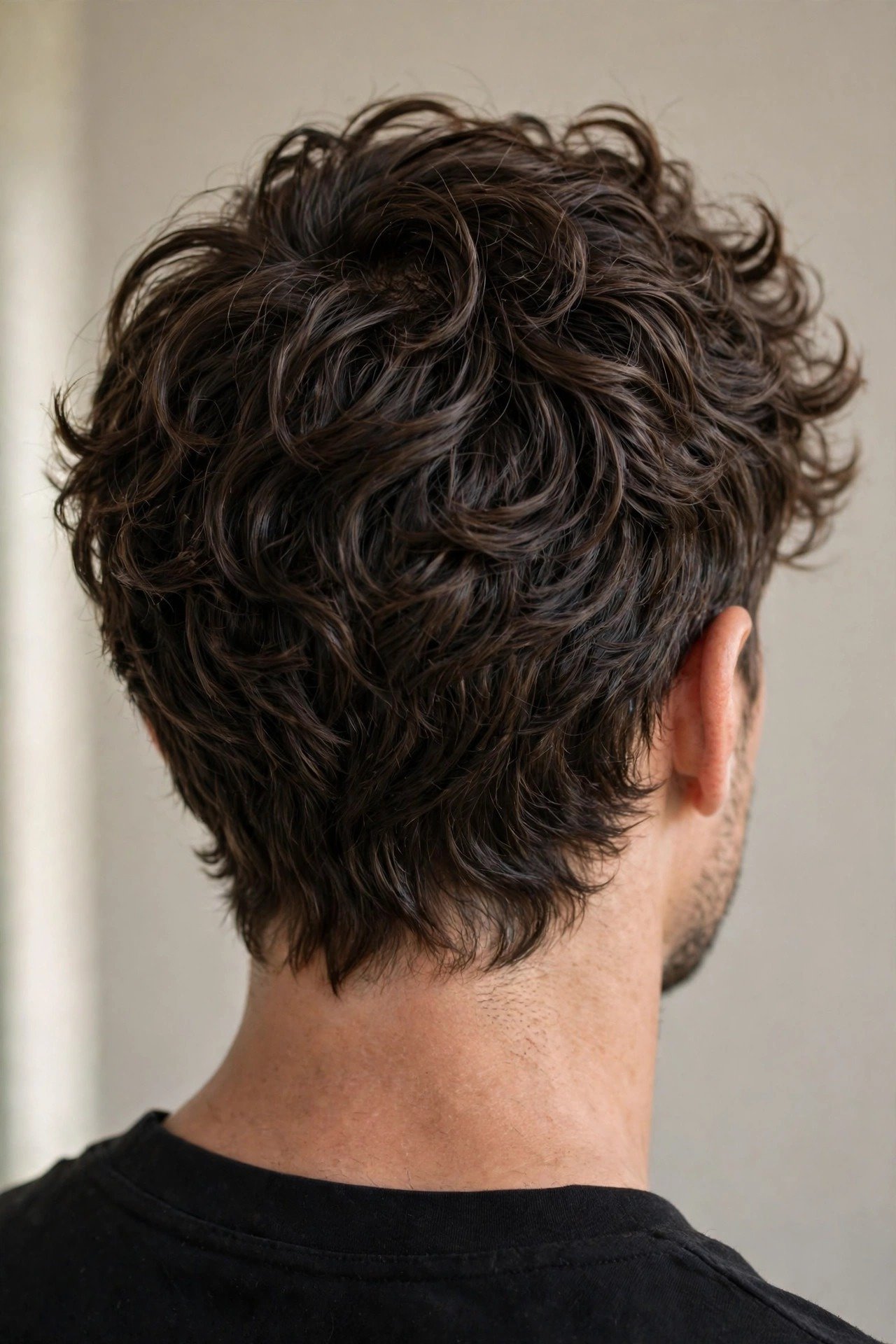
The tapered neckline is the detail that separates a good wolf cut from a great one: instead of a squared-off block at the nape, the hair at the back of the neck is tapered down to a soft, natural finish that follows the hairline. Paired with a long, layered back, it creates one continuous, gentle gradient all the way around the head — no hard edges anywhere. This version suits every curl type and every face shape, and it is the best option for men who hate the feeling of a squared neckline growing out into a visible block.
Barber script: ask for a wolf cut with a tapered neckline — explicitly say “tapered, not squared” — so your barber blends the nape down with graduated guards instead of cutting a straight line. The back should be left long and layered, with the ends point-cut so the curls separate. Tell your barber you want the neckline to follow your natural hairline, fading out softly rather than ending in a hard edge, and the crown kept layered so the wolf shape flows into the taper. The top can be any length; three to four inches with heavy layers is the versatile default.
Styling routine: the crown needs only a quick scrunch with curl cream; the neckline needs no styling at all — that is the point of tapering it. Maintenance: the tapered neckline grows out far more gracefully than a squared one, so you can stretch to six weeks between cuts. This is the wolf cut for men who notice the details, and for men whose barbers do too.
28. Curly Wolf Cut with Beard Blend
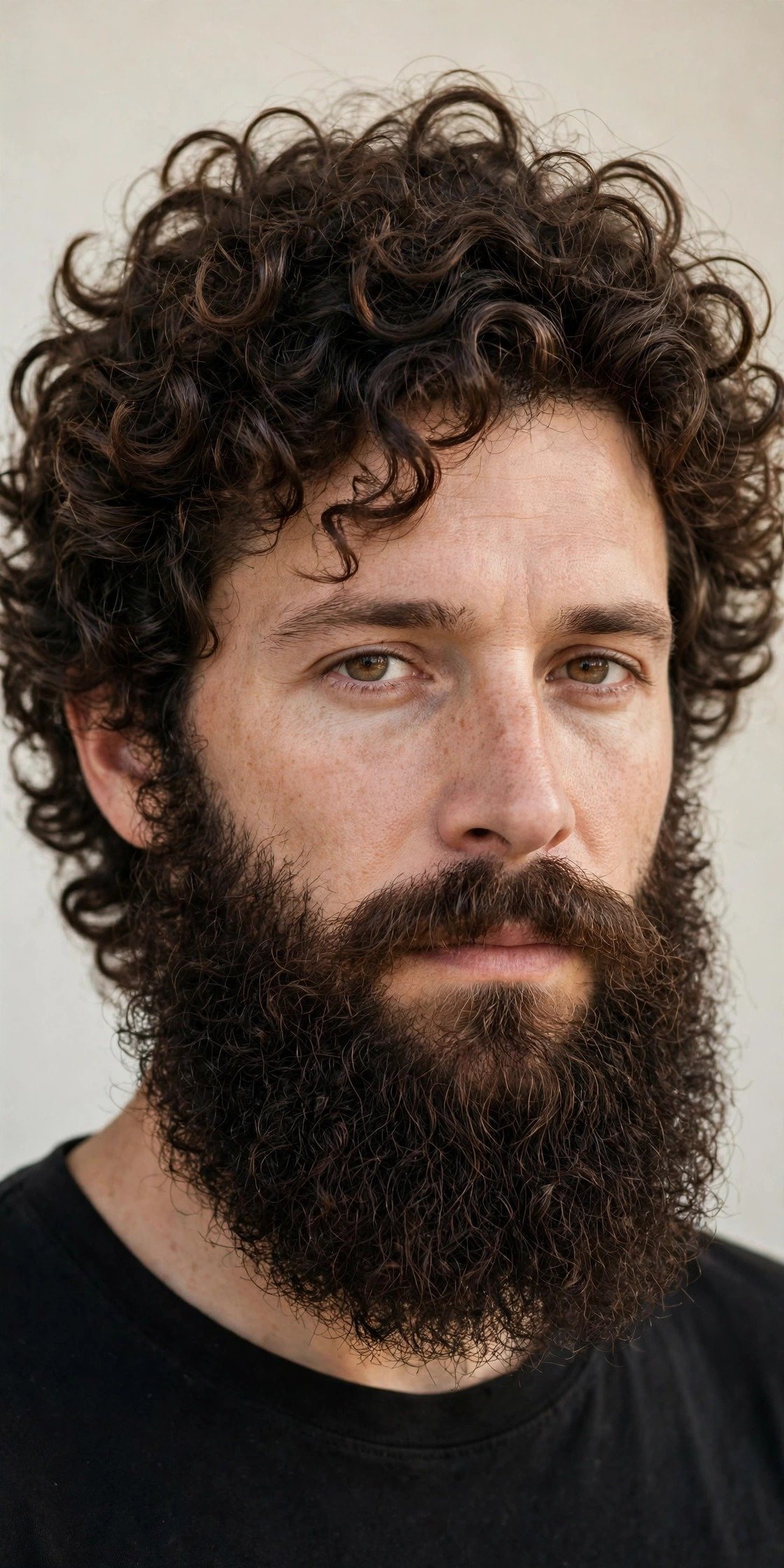
The beard blend curly wolf cut is the complete-package version: the shaggy sides do not stop at the sideburn — they continue down through the sideburns and melt into the beard, so there is no line, no step, and no awkward gap between the haircut and the beard. One continuous gradient runs from the top of the head to the bottom of the beard, and that invisible join is what makes the whole look read as deliberate and expensive. It suits men with even beard growth best and flatters square and oval faces, where the beard adds jaw definition to match the wolf cut’s wild lines.
Barber script: ask for a wolf cut on the head, then tell your barber to carry the blend through the sideburns into the beard, starting with a number 2 guard at the top of the beard and stepping down to full beard length by the jawline. Ask for a clean, natural cheek line and a neckline shaped just above the Adam’s apple. Request the crown layered heavily, the back left long and point-cut, and keep the hair at the back short enough that the shape stays visible above the beard’s top edge.
Styling routine: scrunch curl cream through the damp crown, then run two drops of beard oil through the beard and brush it downward so the blend reads as one surface. Maintenance: trim every five weeks; the wolf cut grows out gracefully, and a weekly cheek-line cleanup with a trimmer keeps the beard edge sharp between visits.
29. Curly Wolf Cut with Short Boxed Beard

The short boxed beard curly wolf cut is the precision instrument of the list: a short beard, half an inch to an inch, shaped into clean, straight lines at the cheeks and jaw, with the wolf cut’s shaggy layers softening the top edge into the haircut. It is the most structured short-beard look available, and the wolf cut is what makes it work — without the layered crown, a boxed beard can look stamped on; with it, the beard looks grown, not drawn. It suits men with strong jawlines best and flatters square and oval faces, and it is the best short-beard option for professional settings.
Barber script: ask for a short boxed beard — uniform length, usually a number 2 or 3 guard on the beard — with straight, defined cheek lines and a sharp jawline edge. The head should be a wolf cut with the crown layered heavily and the back left long. For the connection, request a blend from a number 1 guard at the sideburn into the beard’s length, so the box’s top edge melts into the layers rather than sitting as a hard corner. Ask for the neckline to be shaped just above the Adam’s apple, and keep the back long enough to carry the wolf shape.
Styling routine: a drop of beard oil and a boar-bristle brush each morning keeps the boxed shape reading clean. The cheek lines need a trimmer pass every few days to stay razor-sharp — this is the one version where daily edge maintenance is part of the deal. The crown needs only a quick scrunch with curl cream. Maintenance: full barber visit every four to five weeks. This is the wolf cut for men who like straight lines and sharp edges.
30. Curly Wolf Cut with Stubble Blend
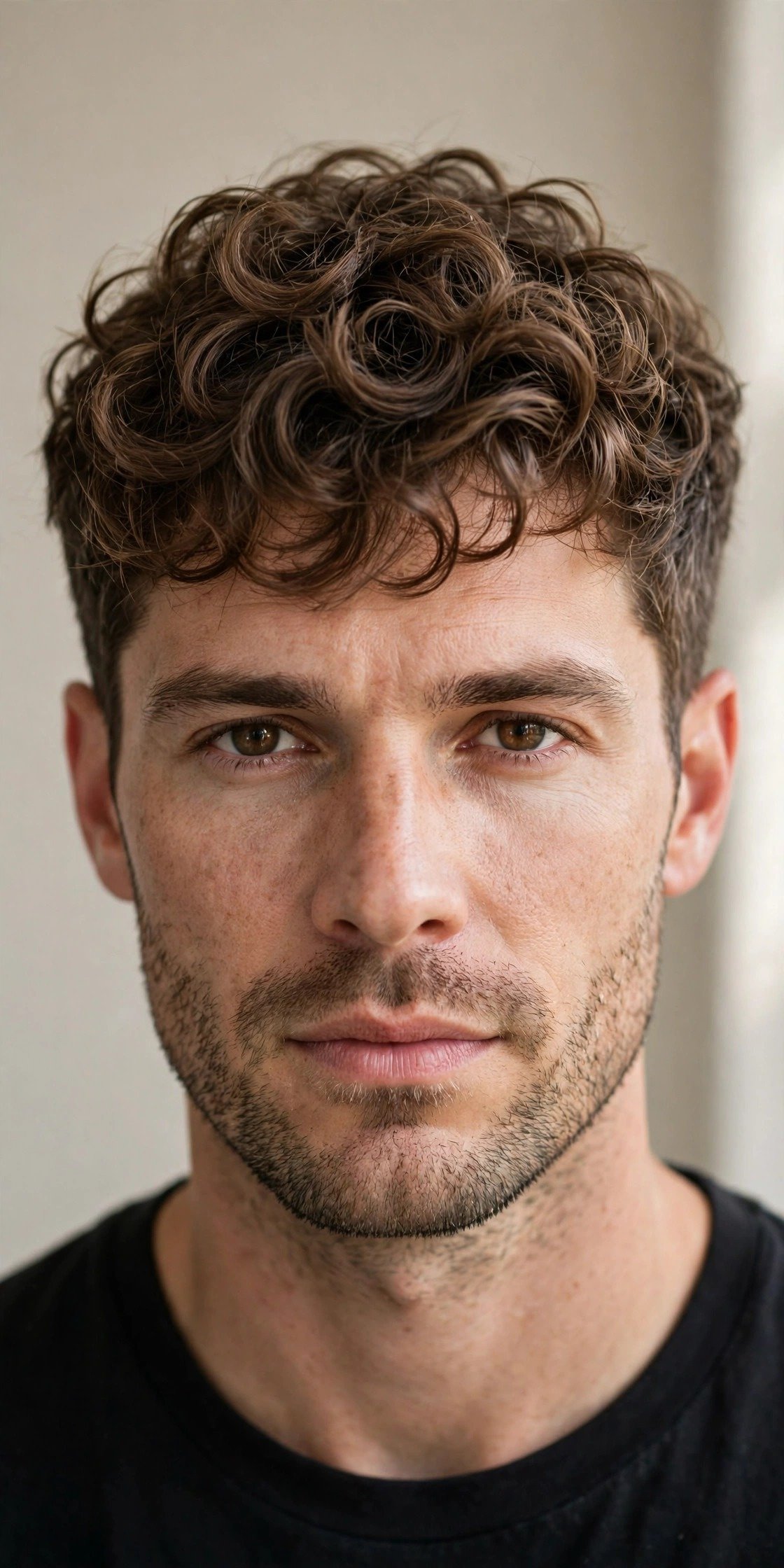
The stubble blend is the wolf cut for men who do not want a beard — just the suggestion of one. The haircut’s shaggy sides taper down through the sideburns into a short stubble, usually a number 0 or 1 guard, so the whole head reads as one continuous gradient from styled curls to five o’clock shadow. It is the lowest-commitment version on this list and one of the most flattering, because stubble adds jaw definition and maturity without the maintenance of a real beard. It suits nearly every face shape and is the best option for men whose beard growth is patchy, since stubble hides patchiness better than any longer length.
Barber script: ask for a wolf cut on the head, then request the stubble blend: the sideburn area tapered down to a number 0 or 1 guard, continuing into stubble of the same length across the jaw and cheeks. Ask for the stubble to be kept uniform — a single guard length everywhere, not longer on the chin. Specify a clean neckline, since stubble with a messy neckline looks like laziness rather than style, and keep the back long so the wolf shape stays visible.
Styling routine: none, beyond washing your face. The stubble needs a trimmer pass every two to three days to hold its length — let it grow past three days and it stops being stubble and starts being an unkempt beard. Maintenance: barber visit every four to five weeks for the crown; the stubble itself is a two-minute job at home. This is the wolf cut for men who want the look with almost no beard at all.
31. Curly Wolf Cut for Round Faces
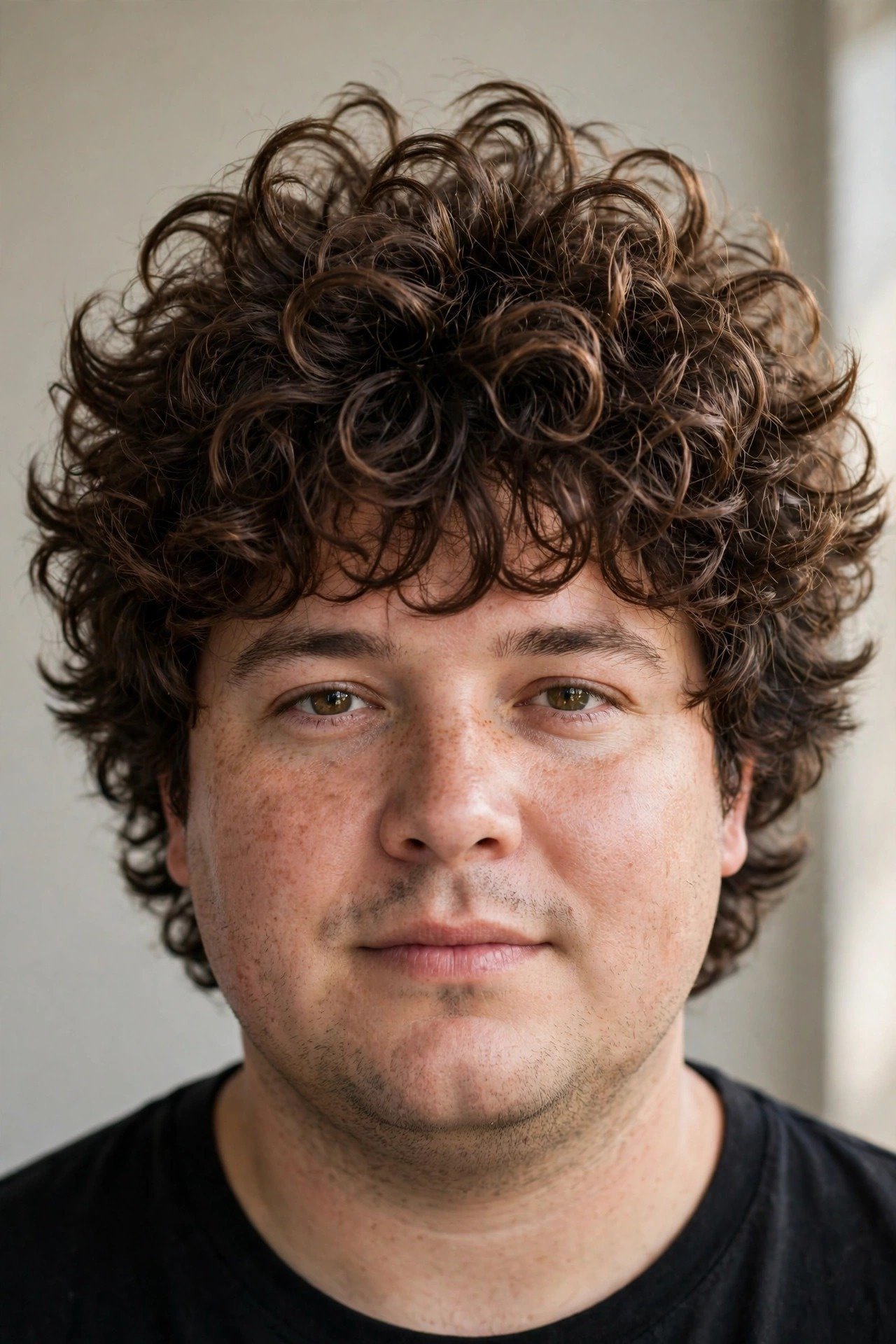
Round faces get the biggest lift from a wolf cut of any face shape. The problem with a round face is that width and length are nearly equal, so a flat cut makes the face look wider; the solution is height — when the crown is layered to stand up, the eye reads the extra vertical inches as length, and the face looks longer and leaner. The long back adds the second half of the illusion: length below the jaw draws the eye downward, away from the cheeks. A good wolf cut can make a round face look oval, and that is no small thing.
Barber script: ask for a wolf cut with maximum height at the crown — three to four inches, layered to stand up — and the back left long and layered to add vertical length. Tell your barber you want the sides kept close, scissor-cut or tapered to a number 2 guard, so the width stays controlled. Request the fringe swept up or to the side, never straight down, since a heavy fringe shortens the face. Ask them to keep the crown’s volume forward, not wide.
Styling routine: volumizing mousse at the roots, diffused upward, then curl cream to define the curls — the height is the whole point, so do not flatten it. Maintenance: every five weeks; the crown’s height collapses fast as it grows. This is the version that turns a round face into a balanced one — and the wolf cut is the frame that makes it work.
32. Curly Wolf Cut for Square Faces
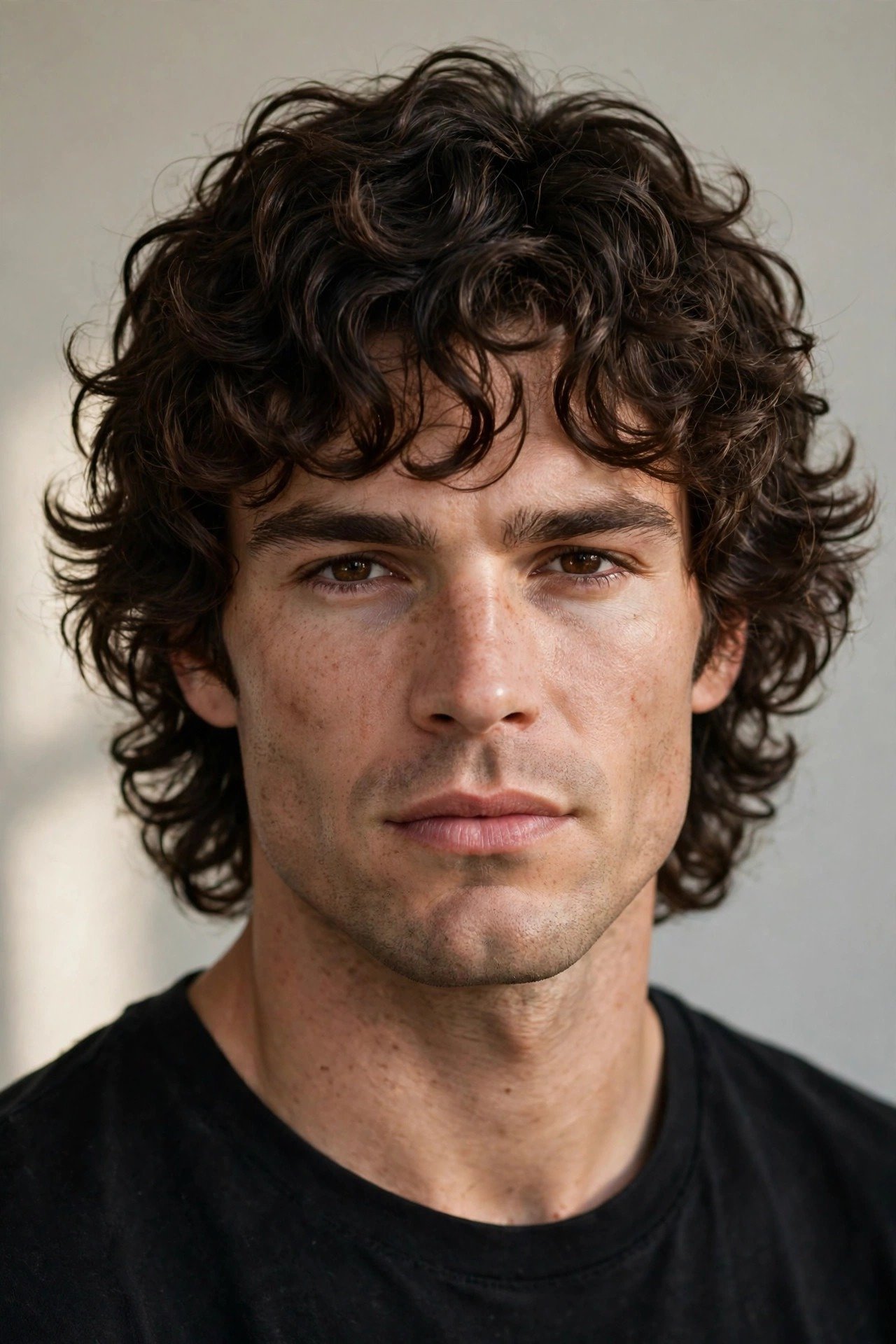
Square faces and the wolf cut are a natural match: the strong jawline gives the cut something to echo, and the soft, layered curls give the jaw something to soften. The crown is layered to add height without width, the back is left long and shaggy to balance the jaw’s angles, and the fringe is kept soft and broken up so nothing on the head competes with the jawline. It suits every curl type and is the most forgiving version for men with strong, angular features, because the wolf cut’s messiness is the perfect counterweight to a square face’s precision.
Barber script: ask for a wolf cut with the crown layered for height, the back left long and shaggy, and the fringe kept soft and piecey. Tell your barber you want the sides scissor-cut to follow the curl, not clipped tight, so the shape stays soft around the jaw. Request the ends point-cut so the curls separate, and keep the neckline long and textured. Ask them to avoid hard lines anywhere — a square face has enough angles already, and the wolf cut should soften them, not add more.
Styling routine: curl cream scrunched through damp hair, left to air-dry, is the entire routine — the softness is the point. Maintenance: every five to six weeks; the crown needs reshaping to keep its height, and the back needs a trim to keep its shaggy shape. This is the wolf cut for men whose jawline does the talking and whose hair does the softening.
33. Curly Wolf Cut for Oval Faces
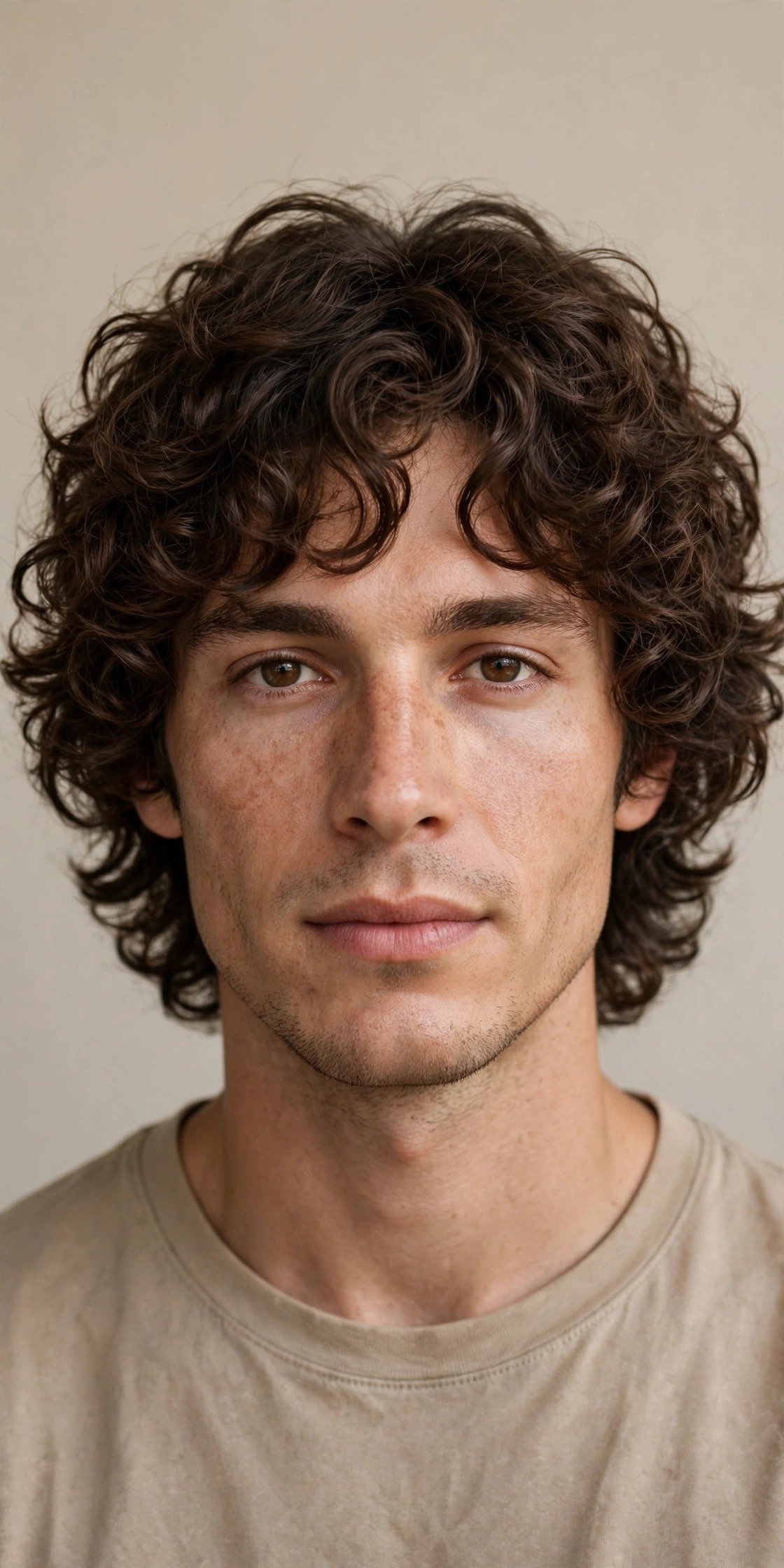
Oval faces can wear every version of the wolf cut, which is both a blessing and a problem — with no proportions to correct, the choice is purely about personality. The oval-face version leans into that freedom: a balanced crown, medium length all over, layers that fall where they fall, and a back that is long enough to show the wolf shape without dominating it. It suits every curl type and is the most versatile version on this list, because an oval face lets the cut be exactly what it is — wild, textured, and unapologetic — with nothing to hide and nothing to fix.
Barber script: ask for a balanced wolf cut — three to four inches on top, heavily layered, the back just past the collar, and the sides scissor-cut to follow the curl. Tell your barber you want the classic proportions, since your face needs no correction: height at the crown, length at the back, softness at the fringe. Request the ends point-cut so the curls separate, and keep the neckline long and textured. Ask them to cut it dry so the layers sit exactly where your curls fall.
Styling routine: curl cream scrunched through damp hair, left to air-dry, is the entire routine — an oval face needs no styling tricks. Maintenance: every five to six weeks; the balanced shape hides growth well. This is the wolf cut in its purest form, worn by the face shape that needs nothing from it but attitude.
34. Curly Wolf Cut with Wet Look Finish
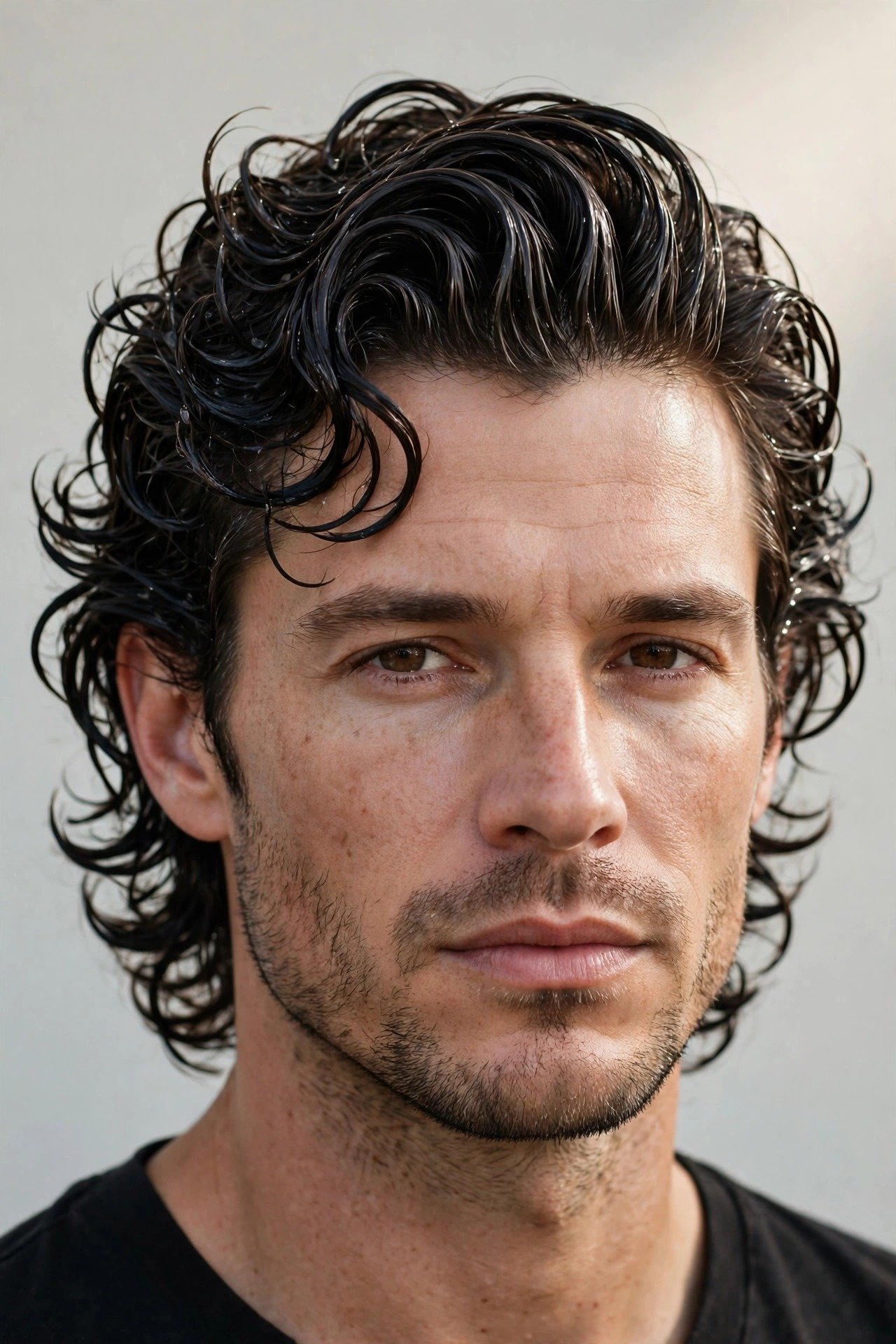
The wet look curly wolf cut is the evening version: the curls combed back or over with a high-shine finish, the long back gleaming under evening light, and the whole head reading as one polished, deliberate shape. It is the most glamorous combination on this list, and it works because the shine unifies everything — the crown and the back all reflect light the same way, so the layers read as even more seamless than they already are. It suits thick curls best, where the shine holds, and it flatters oval and square faces. This is the version for weddings, dates, and nights when the photos matter.
Barber script: ask for a wolf cut and a crown of four to five inches, cut with enough weight to sweep back cleanly — tell your barber you want a wet look finish so they leave the length the shine needs. Request the back left long and layered, and a long, textured neckline. Ask them to cut the crown so the curls lie flat when swept back, since a crown that sticks up will break the wet look’s smooth surface. Keep the ends point-cut so the shine does not turn the curls into a solid sheet.
Styling routine: apply a shine pomade or gel to damp curls and comb them back or over in long strokes; let it set without touching it. Maintenance: the crown needs a trim every five weeks, and the wet look itself is a same-day style — it washes out overnight, so this is a special-occasion finish rather than a daily one. High gloss, high impact.
35. Curly Wolf Cut with Matte Finish
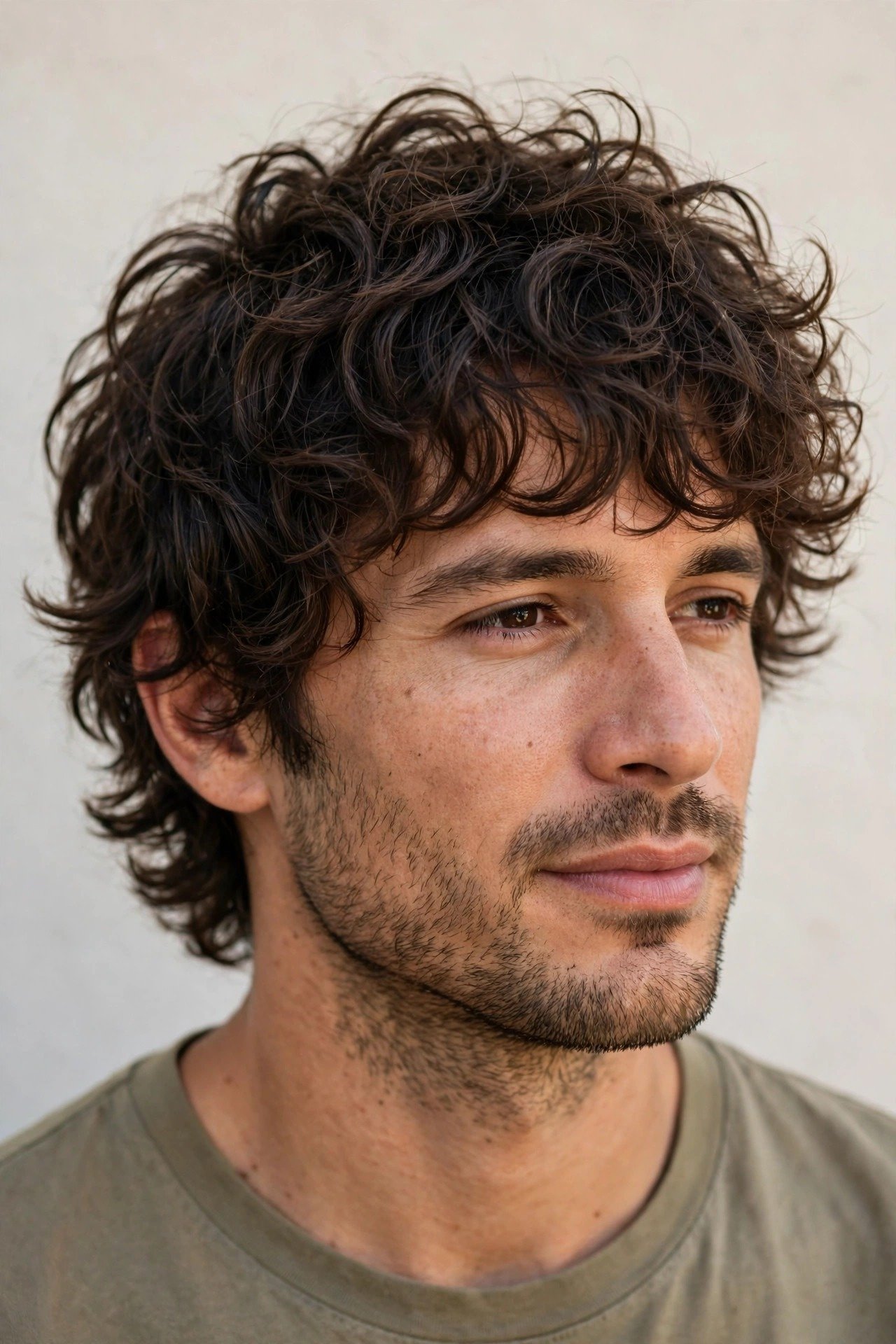
The matte finish curly wolf cut is the daytime default of 2026: textured curls with zero shine, a long layered back, and a finish that looks conditioned but never glossy. Matte is the year’s defining grooming direction — movement over rigidity, natural over sculpted — and the wolf cut is its perfect partner, because the layers themselves provide all the structure the look needs, so no shine is required to make it read as finished. It suits every curl type and every face shape, and it is the most versatile version on this list: the same cut works at the office, the gym, and dinner without a single adjustment.
Barber script: ask for a wolf cut — the crown layered heavily, the back left long — with a matte finish, which signals your barber to cut texture you can wear dry. Tell your barber you want the ends point-cut so the curls separate naturally, and the neckline left long and textured. Request a light matte product at the finish, not a shine pomade — the curls should look natural, not coated. Keep the sides scissor-cut to follow the curl so the matte finish stays soft all over.
Styling routine: a small amount of curl cream on damp hair, scrunched and left to air-dry, is the entire routine. Maintenance: every five to six weeks for the crown, longer for the back. This is the wolf cut for men who want to look polished without looking polished — the 2026 default, and the version most men will end up wearing daily.
36. Curly Wolf Cut with Flow

The flow curly wolf cut is the relaxed, athletic version: medium-length curls flowing back naturally over the ears, with a long layered back underneath that keeps the head from looking overgrown. The flow’s charm is its movement — curls that look like they belong on a surfboard or a ski slope — and the wolf cut is what makes it wearable off the mountain, giving the crown heavy layers while the back stays free. It suits loose curls and waves best and flatters oval and square faces, where the flowing length adds character without adding width.
Barber script: ask for a wolf cut with the crown and back left four to five inches, cut with long layers so the curls flow back naturally. Tell your barber you want the flow, not a mullet — the back should be long enough to move, not long enough to hang. Request the sides scissor-cut to follow the curl, not clipped short, so the flow’s relaxed mood stays intact, and keep the neckline long and textured so it follows the flow’s natural fall.
Styling routine: sea-salt spray on damp curls, scrunched and left to air-dry, is the entire routine — the flow does the work. Maintenance: every five to six weeks; the flow hides growth well, so this is one of the most forgiving versions to maintain. This is the wolf cut for men who want their hair to look like it has somewhere better to be.
How to Style and Maintain a Curly Wolf Cut at Home

The morning routine for a curly wolf cut takes under five minutes, and it starts with the curls. Apply curl cream or leave-in conditioner to damp hair, scrunch upward from the ends toward the roots, and let the curls air-dry — never brush curly hair dry, because brushing breaks the curl pattern into frizz. If you want volume, diffuse the crown on low heat for thirty seconds, pointing the airflow upward; if you want the relaxed look, skip the dryer entirely and let the cut do the work. The long back needs no styling — that is the point of paying a barber for the layers.
For the sides and back, the routine is maintenance, not styling. Once a week, run a trimmer along the neckline and around the ears to keep the edges crisp — a wolf cut’s layers hide growth well, but its lines do not. If your wolf cut is paired with a beard, add two or three drops of beard oil through the beard and brush downward so the blend from the sideburns reads as one smooth surface. The single most common mistake is over-applying product on top: a heavy, greasy finish weighs the curls down and makes the crown look disconnected from the back, while a light curl cream keeps the whole head reading as one design. Start with less product than you think you need.
At the barbershop, the consultation is where the cut is won or lost, so walk in with specifics. Name the structure first — wolf cut, low taper wolf cut, or skin-fade wolf cut — then the length, then the finish, in that order. Bring a reference photo from the thirty-six styles above; “like number five but with a lower taper” is worth a thousand words of description. Mention your curl behaviour — “it sticks up at the crown,” “it gets puffy when it grows,” “my curls fall to the left” — because a good barber adjusts the layering and the length to compensate. And book your next appointment before you leave: skin-fade sides need refreshing every two to three weeks, standard wolf cuts every five to six. A wolf cut is a barber-relationship haircut, not a twice-a-year one.
The last home-care rule is the simplest: wash less, condition more. A curly wolf cut’s layered crown looks best on second-day hair, when the natural oils give it grip, so shampoo every two to three days and rinse with water in between. Use a light conditioner on the crown only, never on the short sides, and keep heat styling to the days you need real volume. Treat the curls like fabric — gentle handling, light product, and a trim before the layers collapse — and the cut will look as sharp on day thirty as it did on day one.
Frequently Asked Questions
What is a curly wolf cut?
A curly wolf cut is a men’s haircut that combines the shag and the mullet into one layered, deliberately messy shape: short, stacked layers at the crown for volume, choppy disconnected layers through the sides and back, and length that runs past the collar at the nape, all cut to follow the hair’s natural curl pattern. Unlike a regular layered cut, which blends everything into a smooth shape, the wolf cut keeps the layers visible, so the curls catch light differently and give the cut its wild, lived-in texture. It is the most searched men’s haircut of 2026.
What is the difference between a curly wolf cut and a shag?
The difference is the back and the attitude. A shag is a unisex cut with even, feathered layers all over the head and a soft, rounded silhouette. A wolf cut takes the shag’s layers and adds a mullet’s length at the back, a stacked crown, and a wilder, more deliberate messiness, so the shape reads as edgier and more modern. If you want soft and even, choose the shag; if you want volume on top, length at the back, and a shape that looks designed to be wild, choose the wolf cut.
What is the difference between a curly wolf cut and a mullet?
The difference is the crown and the layers. A mullet is defined by its contrast: short on top and long at the back, with little layering in between, so the two lengths read as separate zones. A wolf cut adds heavy layering through the crown and the back, so the short and long sections blend into one shaggy shape instead of two disconnected ones. If you want a hard contrast between front and back, choose the mullet; if you want a layered, textured shape that flows from crown to nape, choose the wolf cut.
Which face shape suits a curly wolf cut?
Almost every face shape suits a curly wolf cut, which is a big part of its popularity. Round faces benefit from a wolf cut with height at the crown, which adds the illusion of length. Square faces can wear almost any version, since the layered curls soften a strong jawline. Long or oblong faces are balanced by a wolf cut with a curtain or side-swept fringe, which avoids adding more vertical length. Oval faces, as usual, can wear everything. The universal rule is to let the crown height and the fringe direction work against your face’s proportions, not with them.
How long should my hair be on top for a curly wolf cut?
A curly wolf cut works with almost any top length, from a short cut of three inches to a long top of five inches or more. The most versatile range is three to four inches: long enough to layer, stack, and style forward, into a curtain, or to the side with texture, but short enough to manage in five minutes each morning. Shorter crowns of three inches suit short wolf cuts and tapered versions, while longer crowns of four to five inches suit curtains, flows, and long wolf cuts. Tell your barber which crown you want before they start cutting, since the crown length shapes the whole haircut.
How often do I need a curly wolf cut touched up?
A curly wolf cut lasts five to six weeks before the crown starts to lose its shape visibly. Skin-fade sides need refreshing every two to three weeks to stay sharp, because the shortest section shows growth fastest. Standard wolf cuts last five to six weeks comfortably, and shag blends stretch to eight weeks, since the shaggy shape hides growth well. The back can usually go six to eight weeks between trims, depending on length. Many barbers offer quick side cleanups between full cuts, which is the cheapest way to keep a wolf cut looking fresh.
Can I do a curly wolf cut at home?
You can maintain a curly wolf cut at home, but creating one from scratch is genuinely difficult. The layers require a clean section at the crown, graduated lengths, a steady hand, and — hardest of all — a view of the back and sides of your own head, where the wolf shape lives. What works well at home is upkeep: a trimmer with guards 1 to 3, a mirror setup that shows the sides, and weekly touch-ups of the neckline and sideburns. For the initial cut and for reshaping the crown, see a barber; then maintain their lines at home between visits.
What products do I need for a curly wolf cut?
Three products cover every version: a curl cream or leave-in conditioner for definition and moisture, a sea-salt spray for wavy and messy tops, and a volumizing mousse for extra lift at the crown. Tight curls benefit from a heavier curl cream; loose waves need only sea-salt spray; a wet look requires a shine pomade. Start with one curl cream and one bottle of sea-salt spray, then expand once you know which finish you wear daily. The long back needs no product at all beyond conditioner.
Does a curly wolf cut work with straight hair?
A wolf cut works with straight hair, but it looks and behaves differently. Straight hair needs heavier point-cutting and texturizing to create the separation that curls make naturally, and it usually needs sea-salt spray or a light styling product to hold the shaggy shape. The result is a softer, more feathered wolf cut rather than a wild curly one. If your hair is straight and you want the full wolf effect, ask your barber for extra internal texture and consider a soft perm to give the layers something to hold onto.
Is the curly wolf cut still in style for 2026?
More than ever. According to the Pinterest 2026 Men’s Trend Report, searches for “soft wolf cut men” are up 1,154% year over year, and searches for “modern wolf cut men” are up 553%, so the cut is not just in style — it is the fastest-growing men’s cut of the year. The wolf cut is also pulling in 2.24 million monthly searches worldwide, making it the most searched haircut on the planet. Unlike novelty cuts that age in months, the wolf cut has classic bones: layered texture and natural movement are simply flattering, and as long as barbers keep evolving the crown and the finish, this cut is not going anywhere.
Conclusion
The curly wolf cut is the rare haircut idea that improves everything it touches: the curls look more deliberate, the crown looks more voluminous, and the face looks more considered, all from a single layered shape that lets natural texture lead. The 36 styles above cover every length, every finish, and every curl type, so the only real decision left is which version matches your face, your curls, and the amount of time you want to spend in front of the mirror. Pick two or three favourites, screenshot them, and bring them to your barber — a picture plus the vocabulary in this guide turns a vague request into a precise one.
Start with the classic if you are unsure: a curly wolf cut with a layered crown or a low taper is the safest entry point, and you can go bolder, longer, or shorter next time once you know how the layers feel on your head. Whatever you choose, keep the maintenance honest — a wolf cut is a relationship with your barber, not a twice-a-year event. Get both right, and the curly wolf cut will do what the best haircuts always do: make you look like the most deliberate version of yourself, every single day of 2026.