
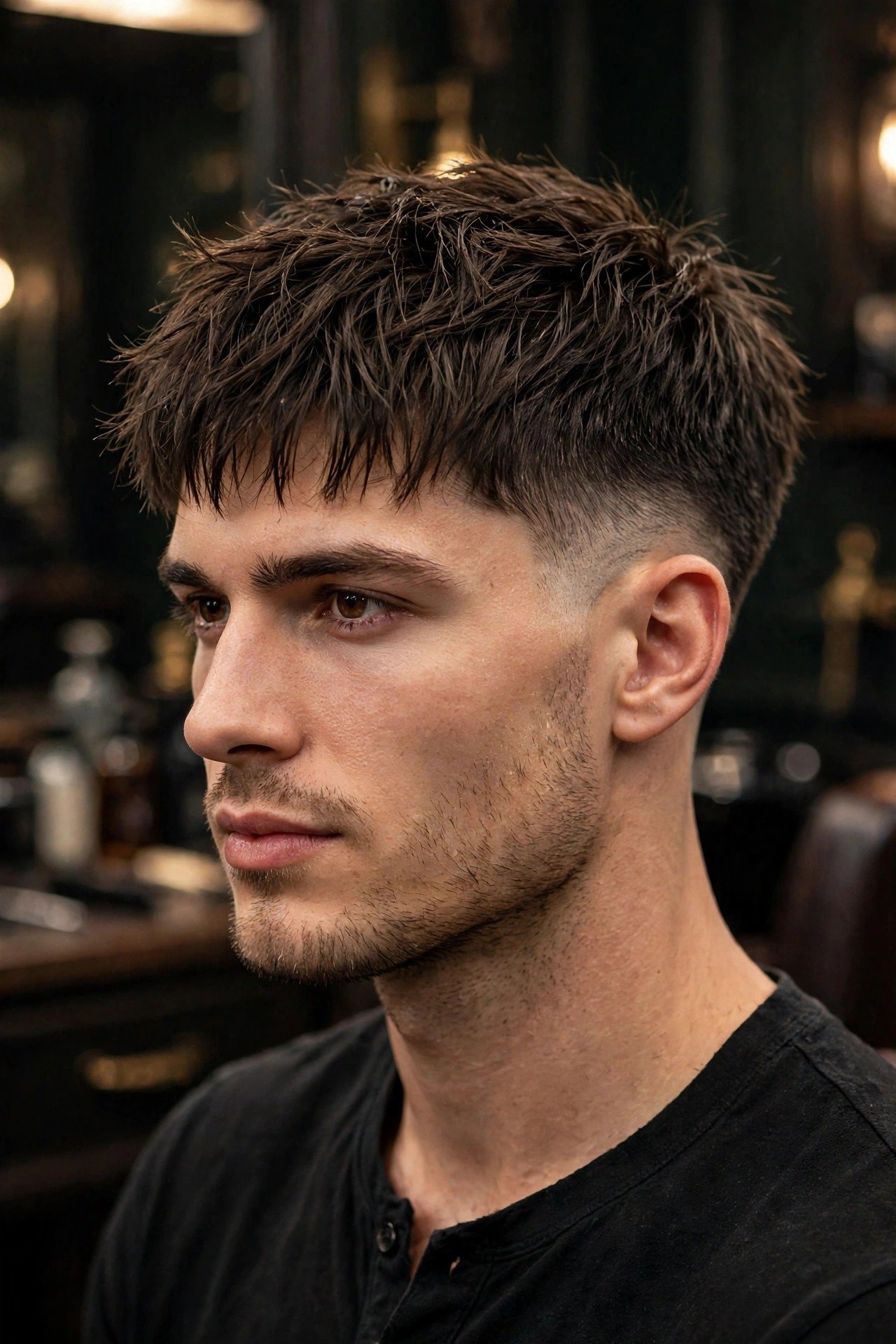
Textured Crop Men 2026: 36 Modern, Clean & Effortless Styles
The textured crop men are asking for in 2026 is the rare haircut that is simultaneously the safest choice in the barbershop and the most fashionable one. Short on the sides, choppy and full of movement on top, finished in minutes with a fingertip of product — it is the style that ended the debate about whether a man can look sharp without trying hard. And the numbers back it up: Perfect Corp’s “Trending New Haircut Styles for 2026” roundup names the textured crop the number one trending men’s cut of the year, sourced from Pinterest’s own trend data. When the biggest platform in hair inspiration crowns your haircut, it stops being a trend and becomes the default.
If you have been watching men’s hair this year, you have felt the textured crop coming. It has been building for seasons — through the French crop wave, the messy-fringe era, the fade-everything years — and 2026 is the year it fully owns the barbershop. In this guide, I break down what the textured crop actually is, why every major trend report names it a defining cut of 2026, how to style it at home in under five minutes, and — the main event — thirty-six distinct textured crop styles for men, each photographed and broken down with cut details, face-shape advice, and styling products. Find two or three versions that match your hair type, screenshot them, and bring them to your barber.
What Is a Textured Crop?

The textured crop is defined by one idea: separation. Hair on top is left long enough to show movement — typically one to three inches — and cut with techniques that break it into distinct, piece-y sections rather than a solid block. Point cutting, slicing, and razor work remove weight internally so the top sits with natural, touchable texture instead of lying flat or puffing up. The sides and back are kept short and clean — a fade, a taper, or an even scissor cut — which creates the contrast that makes the textured top look intentional. The fringe, if there is one, is short and broken up rather than blunt. Nothing about the cut is precious; everything about it is deliberate.
That deliberate messiness is what separates the textured crop from its cousins, and barbers hear these confused constantly. The Caesar cut is the textured crop’s straighter sibling: it shares the short top and forward direction, but the Caesar keeps a cleaner, more structured fringe line, while the textured crop breaks the fringe up and lets the top move freely. If you want the same low-maintenance philosophy in a more polished package, our guide to modern Caesar cut styles for men covers the sharper end of the family. The French crop is closer — short top, fringe, faded sides — but it is typically worn messier and with a skin fade, while the textured crop is the broader, more versatile category that contains it. Think of the textured crop as the umbrella: every French crop is a textured crop, but not every textured crop is a French crop.
The cut works across nearly every hair type because its mechanics are about technique, not texture. Straight hair gives you the cleanest, most architectural version — the point-cut ends separate crisply and the fringe lies with precision. Wavy hair is arguably the natural home of the textured crop, since waves create the movement the cut wants with almost zero styling effort. Curly and coily hair gives you a rich, sculptural top that the short sides make look intentional rather than wild. Fine hair benefits enormously because the texture creates the illusion of density — separated pieces catch light and shadow in a way a solid cut never can. Thick hair is tamed by the internal weight removal, so the top holds its shape instead of mushrooming. There are very few men’s cuts this democratic, which is one reason the trend data keeps pointing at it.
Length is the main dial your barber turns. The short textured crop keeps the top around an inch — crisp, minimal, almost architectural. The classic version sits at one and a half to two and a half inches, the sweet spot where texture really shows. The long textured crop pushes three inches or more on top, giving you fringe options and styling versatility at the cost of a little more morning effort. The sides are the second dial: a taper for the subtle professional version, a mid fade for balance, a skin fade for contrast, or an even scissor cut for the timeless take. Knowing which combination you want before your appointment — “two inches on top, textured, low fade” — is the single most useful thing you can tell your barber.
Why the Textured Crop Is Trending in 2026
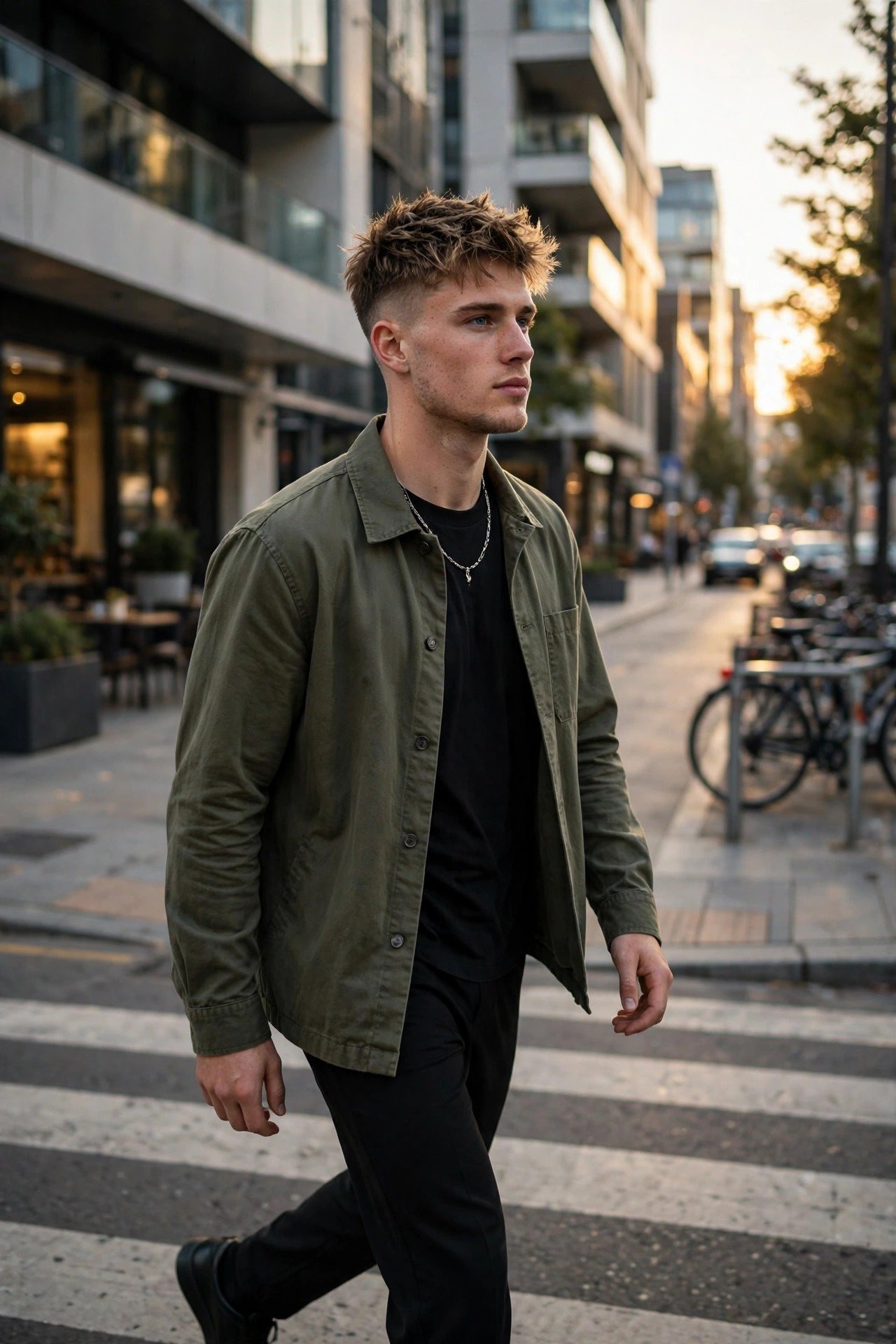
The textured crop’s dominance in 2026 is not a vibe or a guess — it is documented across the year’s major men’s grooming reports. Perfect Corp’s “Trending New Haircut Styles for 2026” places the textured crop at number one, calling it clean, stylish, and low effort, with short sides and a layered top that create movement and dimension — and crucially, the ranking is sourced from Pinterest data, which is where 2026’s hair trends are actually decided. When the platform that turns reference photos into barbershop appointments names your cut the top trend, the trend is no longer emerging. It has arrived.
The market research tells the same story from a different angle. Accio’s “Trending Man Haircut Styles for 2026” report names the textured crop as an enduring top trend, valued for its short, effortless, low-maintenance nature, and describes it as a “minimum effort, maximum result” style — the exact phrase barbers keep using when clients ask for something that looks expensive but costs nothing in the morning. The report places it alongside the mini mullet as one of the two defining silhouettes of the year, driven by social media and celebrity adoption. And the search data backs the hype: menhaircuts.net’s 2026 stats report shows the textured crop sitting in Google’s top trending US haircut searches, while Pinterest’s 2026 Men’s Trend Report documents the broader surge in textured, fuller tops that the crop rides on.
The deeper engine is 2026’s grooming direction, which is unmistakable across every report: matte over shiny, movement over rigidity, low-effort wear over product-heavy sculpting. Men are done with cuts that look good for three days and then need a restyle. The textured crop looks good for three weeks. It grows out clean because the top is layered and the texture keeps its character as it lengthens; it needs no blow dryer, no round brush, no twenty-minute routine. A fingertip of matte clay, worked through dry hair, and you are done. In a year when barbers report clients asking for less styling time, haircuts that grow out clean, and styles that work for work and weekends, the textured crop answers all three in a single appointment.
There is also a generational story. The cut simultaneously satisfies the executive who wants to look current without looking young, and the twenty-two-year-old who wants texture without a high-maintenance routine. It is appropriate for all ages, suits all hair types, and flatters nearly every face shape once the fringe length and fade height are tuned — which is why the trend has depth rather than hype. The 2026 version is simply the best version yet: softer texture replaces harsh choppiness, low fades and tapers replace aggressive skin fades for the mainstream, and natural movement replaces stiffness. It is the haircut the entire men’s market converged on, and it is not giving up the crown anytime soon.
How to Style a Textured Crop
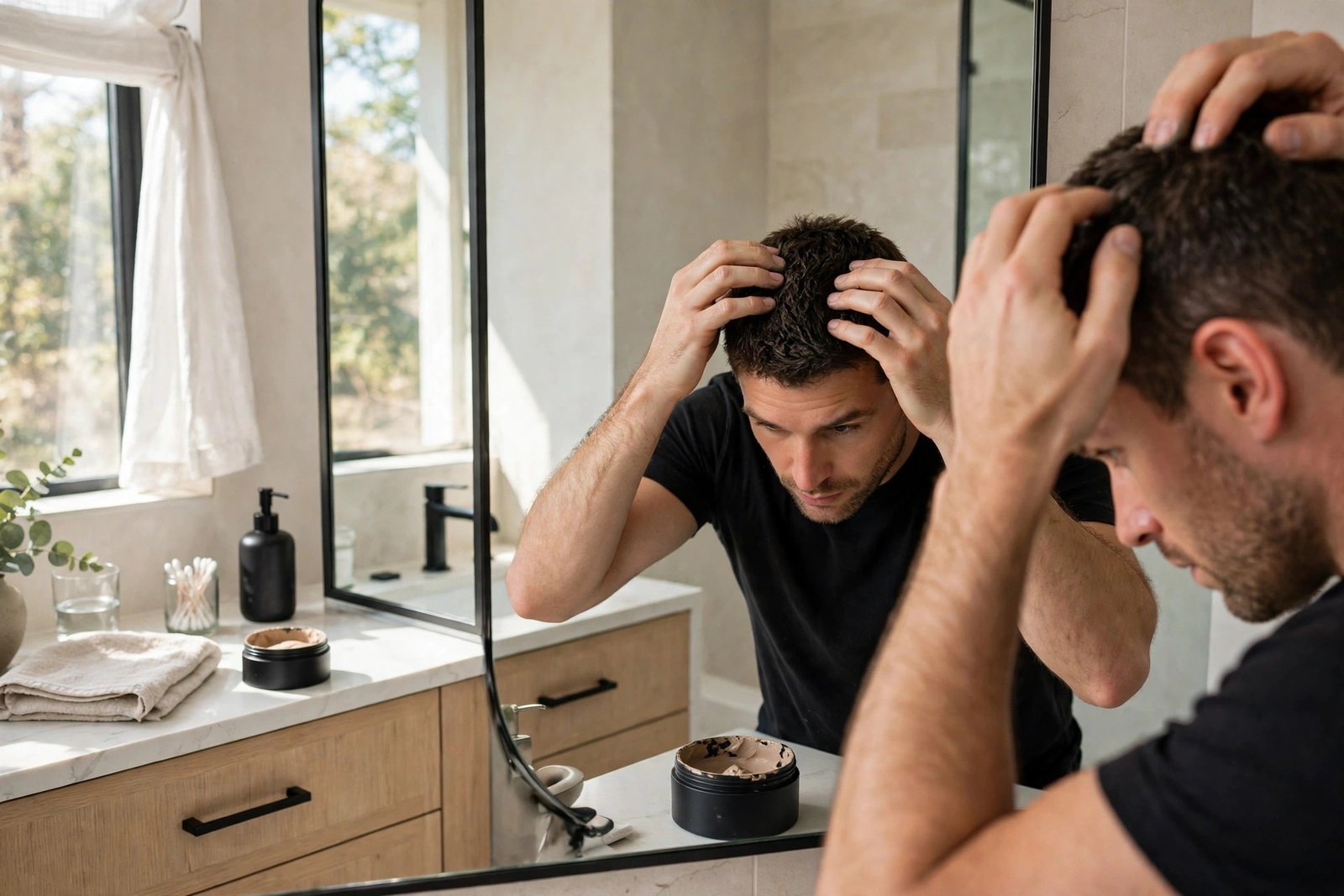
Here is the entire daily routine for a textured crop: towel-dry your hair until it is damp, not dripping. Warm a pea-sized amount of matte clay or texture paste between your palms. Work it through the dry top with your fingers, pushing the hair forward and pinching individual pieces to create separation. Run what is left on your hands through the fringe so the ends break up instead of sitting in a solid sheet. Walk out the door. That is genuinely it — three to five minutes, no comb, no heat tools. The cut does the architectural work; the product just adds definition.
Product choice matters more than technique. Matte clay is the default for 2026 — it gives hold and texture without shine, which matches the year’s grooming direction exactly. If your hair is fine, a sea salt spray misted on damp hair before the clay adds grip and the illusion of density through the top. If your hair is thick or coarse, a light cream keeps the texture from puffing up while still looking natural. What to avoid: high-shine gels and heavy waxes, which drag the textured crop backward into greasy territory and kill the matte, modern finish. Less product is always better than more — you can add a second pea-sized touch, but you cannot subtract an overloaded top without rewashing.
Drying is optional and directional. Air-drying works perfectly for wavy and curly textured crops and gives the most natural result — scrunch the top gently with a towel and let the texture do its thing. If you want extra control on straight hair, hit the top with a blow dryer on medium heat for thirty seconds, pointing the airflow forward and down — never up and back, which fights the cut’s entire architecture. Some men like to finish with a light mist of texture spray for separation, but that is a bonus step, not a requirement. The textured crop is one of the few men’s cuts that genuinely qualifies as wash-and-go.
At the barbershop, the consultation is where the cut is won or lost, so walk in with specifics. Say “textured crop” first, then describe the two dials: top and sides. For the top, specify length — “about two inches, heavily textured” — and direction — forward, messy, or swept. For the sides, name the finish: low taper for the subtle professional version, mid fade for balance, skin fade for contrast, or scissor-tapered for the classic. Mention your hair’s behavior — “it sticks up at the crown,” “my fringe lies flat,” “it gets puffy when it grows” — because a good barber adjusts the internal texture to compensate. Bring a reference photo from the thirty-six ideas below; “like number four but with a lower fade” is worth a thousand words of description.
Face-shape tuning is straightforward. Round faces gain definition when the top carries a little extra height and the sides are faded tighter, adding angles where the face is soft. Long or oblong faces are balanced by keeping the top flatter and the fringe slightly longer, which shortens the forehead visually. Square faces — the textured crop’s natural best friend — can wear almost any version, since the strong jawline echoes the cut’s confident geometry. Heart-shaped faces do well with a fuller, piece-y fringe that softens a wider forehead. Oval faces, as usual, can wear everything. The universal rule: the top should never be so long that it overwhelms the face, or so short that the texture disappears — proportion is what separates a textured crop from a buzz cut with ambition.
36 Textured Crop Ideas for Men in 2026
Below are thirty-six textured crop variations, each photographed and broken down so you know exactly what to ask for. I have ordered them from the most timeless to the most adventurous, so you can stop scrolling when you hit your comfort level — or keep going if you are feeling bold.
1. The Classic Textured Crop
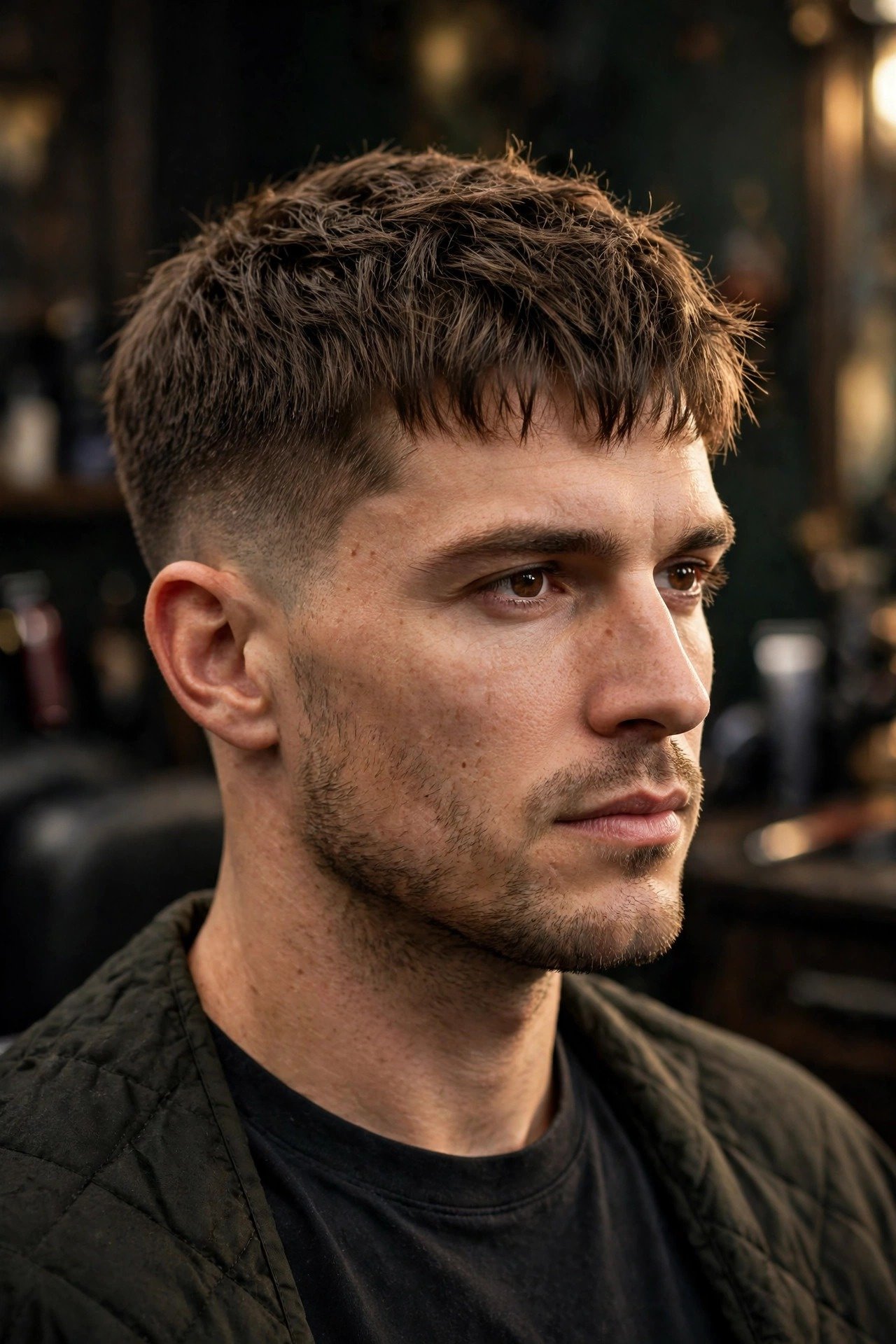
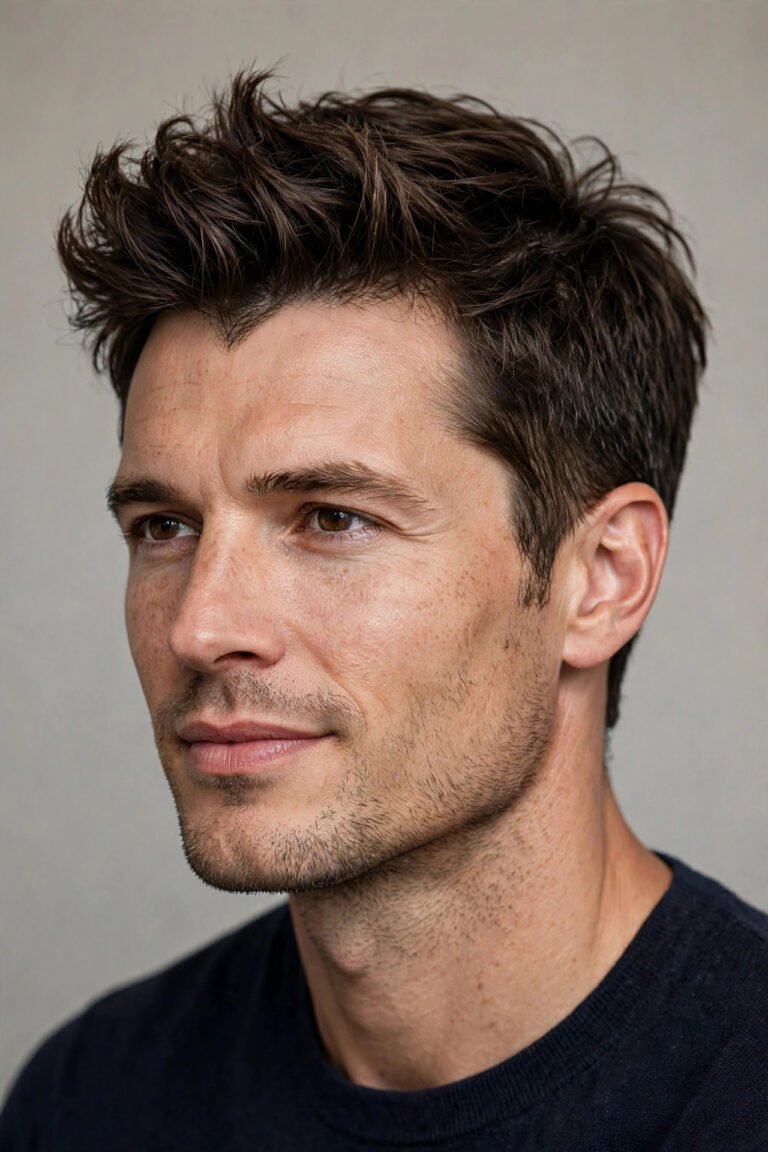
The one that started the revival, and still the version barbers recommend first. The classic textured crop keeps the top at one and a half to two and a half inches, cut with point-cutting and slicing so the ends separate into distinct, touchable pieces. The sides are tapered or cut to a uniform short length — no dramatic fade, no hard contrast — and the fringe is short, broken up, and worn forward. What makes the 2026 version different from the crop’s earlier incarnations is the finish: the texture is softer and more organic, the edges less harsh, the overall impression effortless rather than styled-to-death. This is the version for men who want the trend’s DNA without any fashion risk.
It suits every face shape and nearly every hair type, which is why it works as the universal entry point. Straight hair wears it crispest, wavy hair wears it most effortlessly, and fine hair gets the biggest payoff because the texture manufactures density. Maintenance is a trim every four to five weeks to keep the top’s shape; the sides can go longer since there is no sharp fade to lose its edge. Ask your barber for a textured crop with a scissor-tapered finish and specify your top length — “about two inches, heavily textured” is the magic sentence. Style with a pea-sized amount of matte clay through dry hair, pushing forward and pinching pieces for separation. If you have never worn a textured crop, start here — everything else on this list is a variation of this idea.
2. Textured Crop With Low Fade

The low fade keeps the textured crop’s approachable soul while adding just enough modern edge. The fade starts low — just above the ear — and blends subtly into the textured top, so the overall impression is clean and professional with a hint of sharpness. This is the office-safe textured crop, the one that works in finance and law and still looks right on the weekend. It suits straight and fine hair particularly well, where the low fade adds definition without exposing too much scalp, and it flatters round faces by adding subtle angles at the sides. The low fade is also the most forgiving fade to grow out, since there is less faded area to lose its shape.
Ask your barber for a true low fade — not a taper, a genuine fade, just starting low — with a one-and-a-half to two-inch textured top and a broken-up fringe. Maintenance is every three weeks to keep the fade fresh, though the top can stretch longer. Style with light matte paste, worked through with your fingers and pushed forward. Men who want the same low-maintenance fade philosophy with even less on top should also look at our buzz cut with beard guide, which explores the shortest end of the fade spectrum. The low-fade textured crop is the quiet achiever of this list — it never shouts, and it never looks wrong.
3. Textured Crop With High Fade

The high fade version is the boldest mainstream take on the textured crop. The fade climbs high up the sides — well above the temple — creating maximum contrast with the textured top, which gets to be the undisputed star of the show. The effect is dramatic and architectural: the tight sides frame the face while the choppy top provides all the movement and personality. This is the version you see on athletes and in street-style photography because it photographs beautifully and reads as confident from across the room. It is the textured crop turned up to its most expressive mainstream setting.
It flatters square and oval faces best, since the high contrast adds structure, and it suits straight to wavy hair where the top’s texture can stand up against the tight sides. The trade-off is maintenance: a high fade needs refreshing every two to three weeks to keep its crispness, so budget for more frequent barber visits. Ask your barber for a high fade blended into a two-to-three-inch textured top, with the fringe kept short and piece-y. At home, style with matte clay for definition and keep the top forward — the contrast is the whole point, so do not let the top grow so long it swallows the fade. This is the textured crop at its most confident; wear it like you mean it.
4. Textured Crop With Skin Fade

The skin fade takes the contrast dial to its maximum. The sides go down to bare skin — usually as a mid or high fade — while the top stays thick, textured, and full of movement. The result is the most graphic version of the textured crop: the bald sides make the top look even denser and more deliberate by comparison. This is the version for men who love fade work and want the textured crop’s personality at full volume. It is sharp, modern, and unmistakably barber-crafted — nobody mistakes a skin-fade crop for an accident.
It suits thick hair best, where the top has real material to contrast against the skin, and it flatters oval, square, and diamond faces. Fine hair can work too, but ask your barber to keep the fade slightly lower so the top does not look thin by comparison. Maintenance is the most demanding on this list — every two weeks to keep the skin blend crisp — so commit to the chair time before you commit to the cut. Ask for a skin fade (specify mid or high) with a two-inch textured top, and be explicit about where you want the fade’s highest point. Style with matte clay, forward and separated. Pair it with a short beard and the whole look becomes one of 2026’s most requested combinations.
5. Textured Crop With Mid Fade

The mid fade is the Goldilocks setting — not as conservative as the low fade, not as aggressive as the high. The fade starts around the temple and blends smoothly into the textured top, giving you clean contrast without the drama. This is the most popular fade pairing with the textured crop in barbershops right now, simply because it works on the most heads and suits the most situations. It is the version your barber probably pictures when you say “textured crop with a fade” without specifying further. Balanced, current, and endlessly wearable.
It suits every face shape and every hair type, which is why it is the default recommendation. Ask your barber for a mid fade with a two-inch textured top and a broken-up fringe, and specify whether you want the fade to go to skin or stop at a shadow — “to skin” is sharper, “shadow” grows out more forgivingly. Maintenance is every three weeks. Style with matte clay or paste, forward and pinched for separation. If you are choosing your first faded textured crop and cannot decide between low and high, choose this one — it is the safest way to get the fade experience without committing to either extreme.
6. Textured Crop With Taper Fade
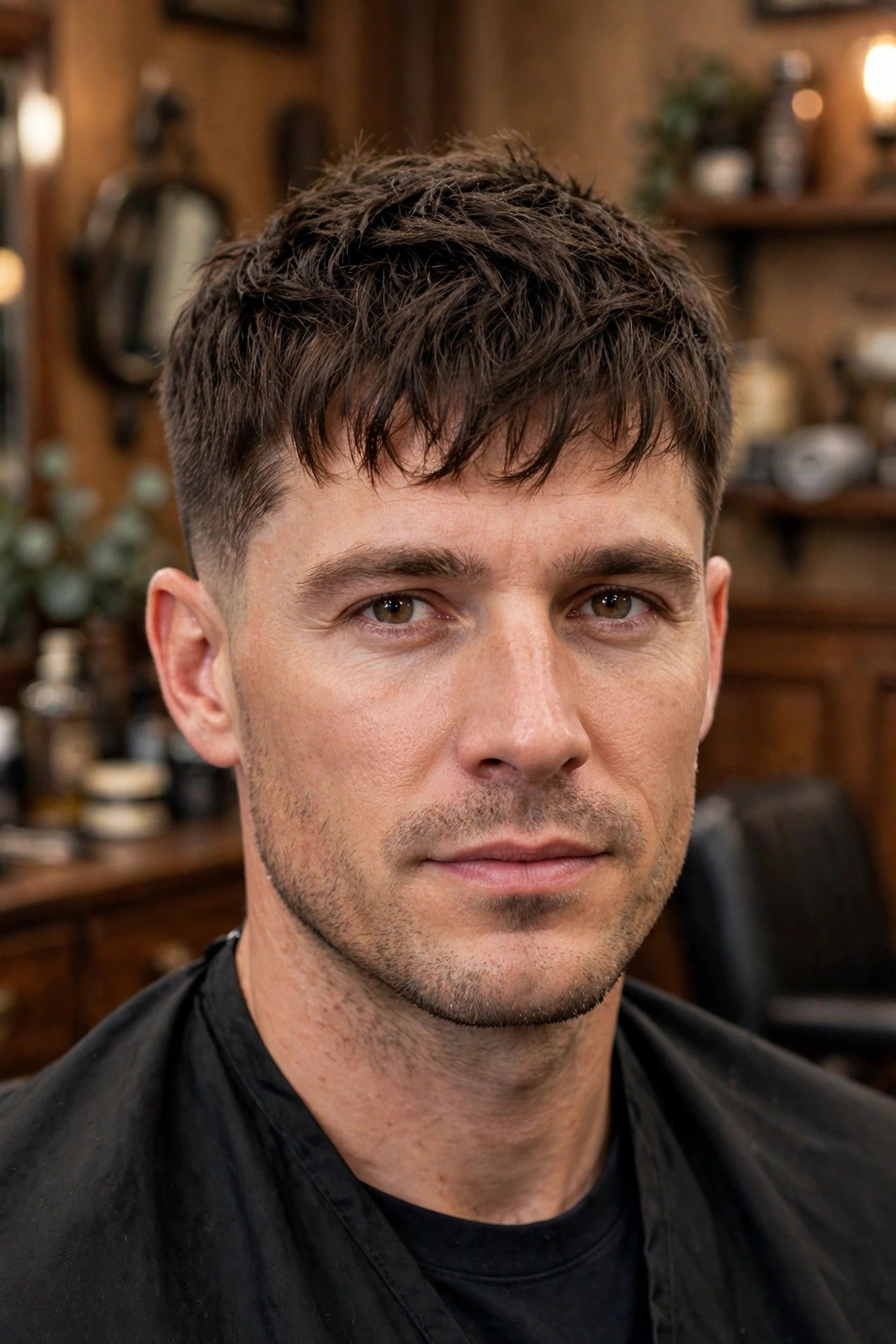
The taper fade is the quiet professional of the textured crop family. Instead of a dramatic fade up the sides, the hair is softly tapered — shortest at the sideburns and neckline, blending up into natural length above the ear. The result keeps the textured crop’s signature top and silhouette but whispers instead of shouts, which makes it the best version for offices, client-facing roles, and men over thirty-five who want trend-aware hair without the fade-culture edge. It is the version that never looks out of place, anywhere.
It suits straight and wavy hair particularly well and flatters every face shape, though it is especially good on longer faces where a high fade would add unwanted vertical emphasis. Ask your barber for a natural taper — “tapered, not faded” — with a two-inch textured top, and specify a clean neckline. Maintenance is every three to four weeks, the most forgiving on this list. Style with light matte paste or even just a touch of cream, pushed forward. Men growing out a fade often land here as the transitional sweet spot, and plenty of them stay — the taper-fade textured crop is one of those rare cuts that looks better the longer you wear it.
7. Choppy Textured Crop
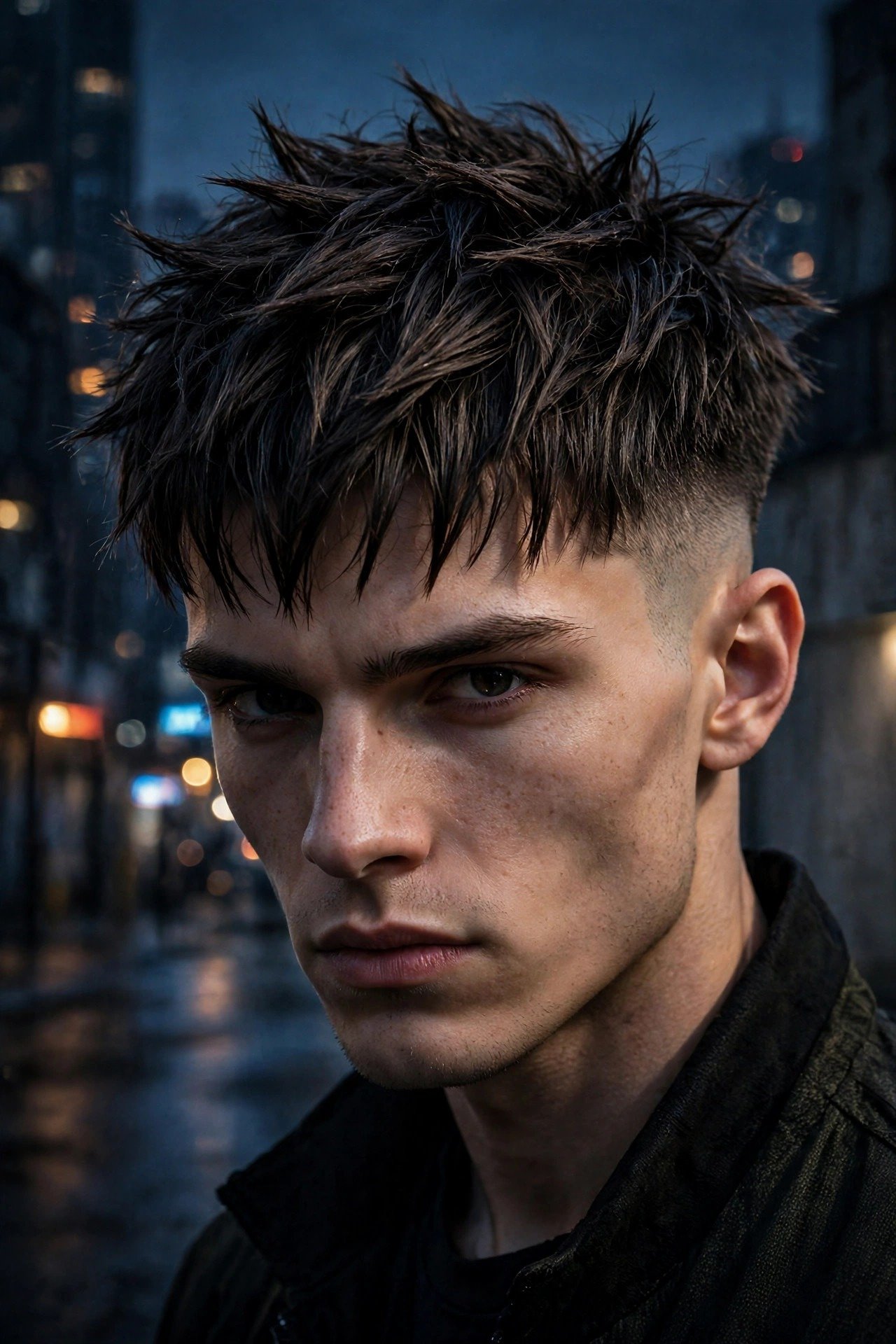
The choppy textured crop takes the cut’s defining feature — separation — and pushes it to the edge. The top is cut with aggressive razor work and deep point-cutting that creates chunky, visibly separated pieces with real attitude. This is not the soft, blended texture of the classic version; it is jagged, piece-y, and unapologetic. The sides are usually a mid fade that keeps the overall shape clean while the top does all the talking. It is the version for men who want their haircut to have a point of view.
It suits thick and wavy hair best, where the choppiness has real material to work with, and it flatters oval, square, and heart-shaped faces. Fine hair can wear a softer version — ask your barber to keep the choppiness shallow rather than deep. The key instruction is “razor it, break it up, make it piece-y” — show your barber the photo and let them interpret the aggression level. Style with matte clay, and this time use more product than usual: warm a generous pea-sized amount, work it through the dry top, and twist individual pieces between your fingers to emphasize the separation. It needs a trim every three to four weeks to keep the chunks from growing into a blob. This is the textured crop for men who dress with intention and want their hair to match.
8. Messy Textured Crop
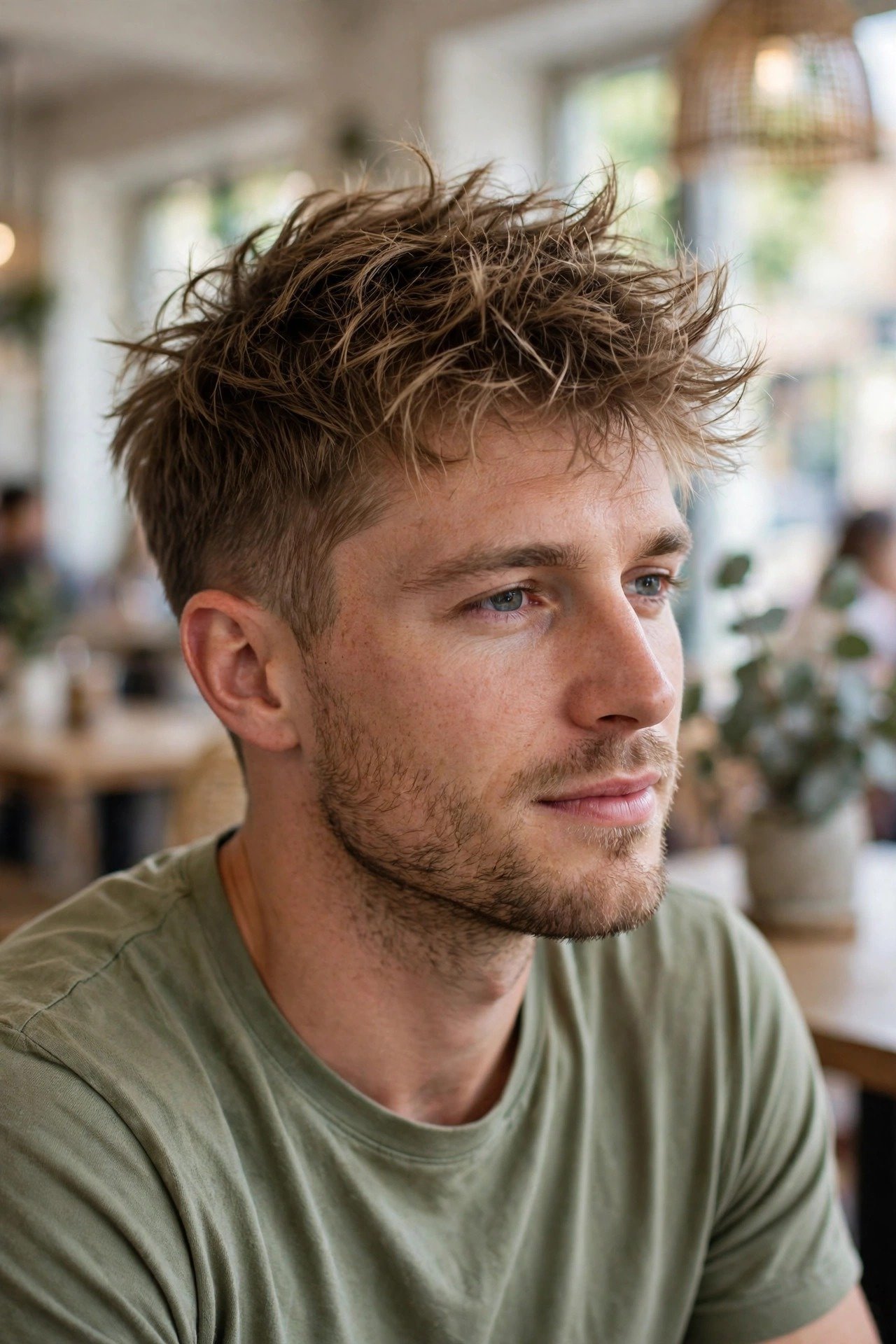
The messy textured crop is the cut’s most honest version: it looks like you did nothing, because you almost did. The top is cut with the same point-cut texture as the classic, but it is styled — or rather, unstyled — with deliberate randomness. Pieces fall where they fall, the fringe breaks in different directions, and the whole thing reads as effortless in the way only a good haircut can fake. The sides stay neat with a low taper or fade, which is what keeps “messy” from reading as “neglected.” The contrast between the controlled sides and the wild top is the entire trick.
It suits wavy and thick hair best, where the mess has natural material, and it flatters every face shape because the irregularity breaks up facial symmetry in a flattering way. Ask your barber for a textured crop cut for messiness — “I want to wear it messy” is a complete instruction that tells them to cut more internal texture and keep the perimeter clean. Style with sea salt spray on damp hair, scrunch, and walk away — or with a tiny amount of matte paste scrunched through dry hair. It is the lowest-effort version on this list and the best grow-out of any textured crop, since messiness only improves with length. For men who hate spending time on their hair but refuse to look like they gave up, this is the answer.
9. Textured Crop With Forward Fringe
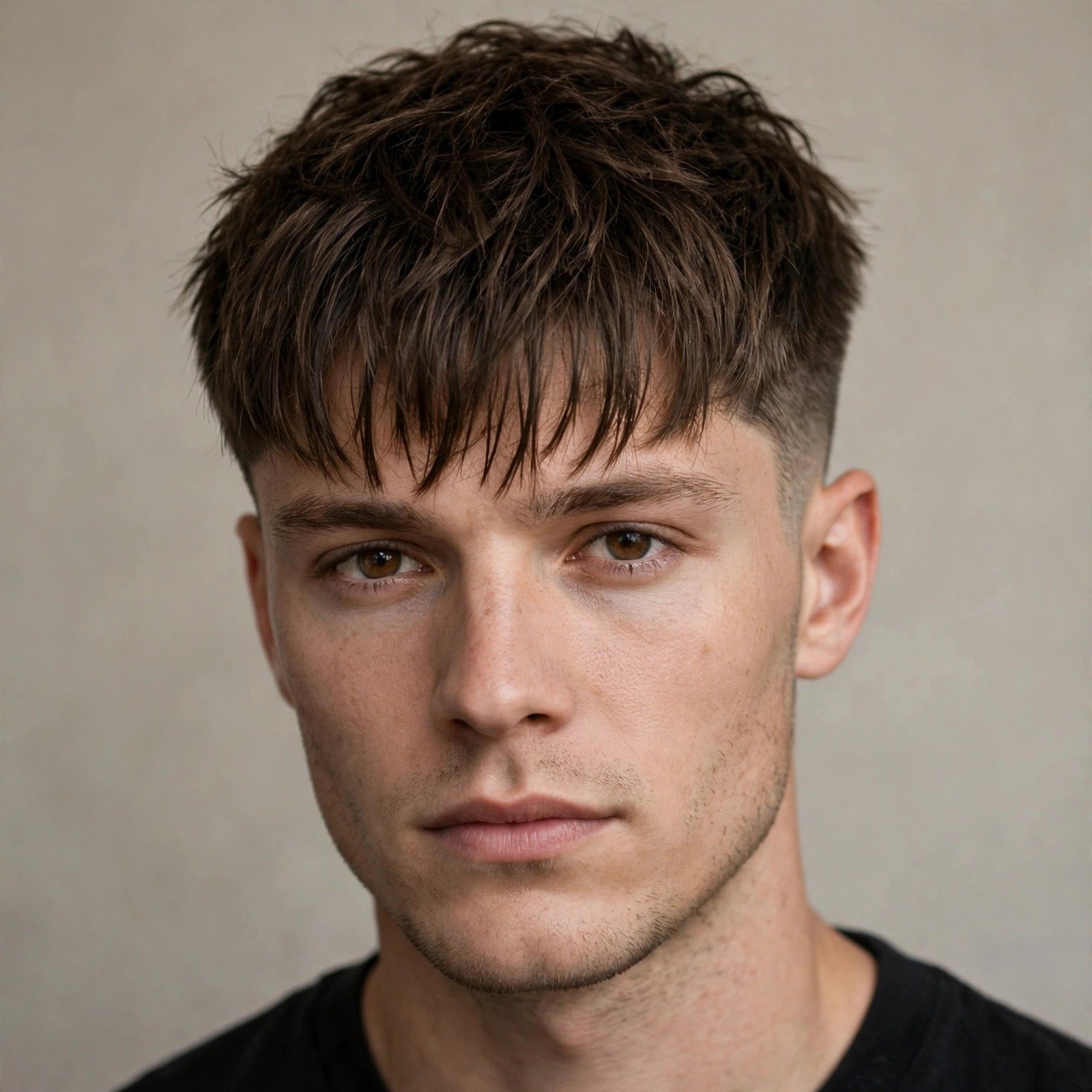
The forward-fringe version leans into the textured crop’s most distinctive feature: hair that moves toward the face. The fringe is left longer — grazing the eyebrows — and cut with broken-up, piece-y ends so it falls forward in separated sections rather than a solid curtain. The top behind it stays textured and full, and the sides are typically a mid fade that keeps the silhouette tight. This is the version with the most personality in the fringe area, and it is having a major moment in 2026 as part of the broader fringe revival across men’s hair.
It suits straight and wavy hair best, where the fringe falls naturally forward, and it flatters long and oblong faces beautifully — the fringe shortens the forehead visually and balances vertical length. It also works well for men with high hairlines or thinning at the temples, since the forward direction creates coverage. Ask your barber for a textured crop with a longer forward fringe — “eyebrow-grazing, piece-y, forward” — and be clear you want it broken up, not blunt. Style with a small amount of matte paste, pushing the fringe forward and separating the ends with your fingertips. It needs a fringe trim every three weeks to stay above the eyes. This is the textured crop for men who want the fringe to be the feature, not the afterthought.
10. Short Textured Crop
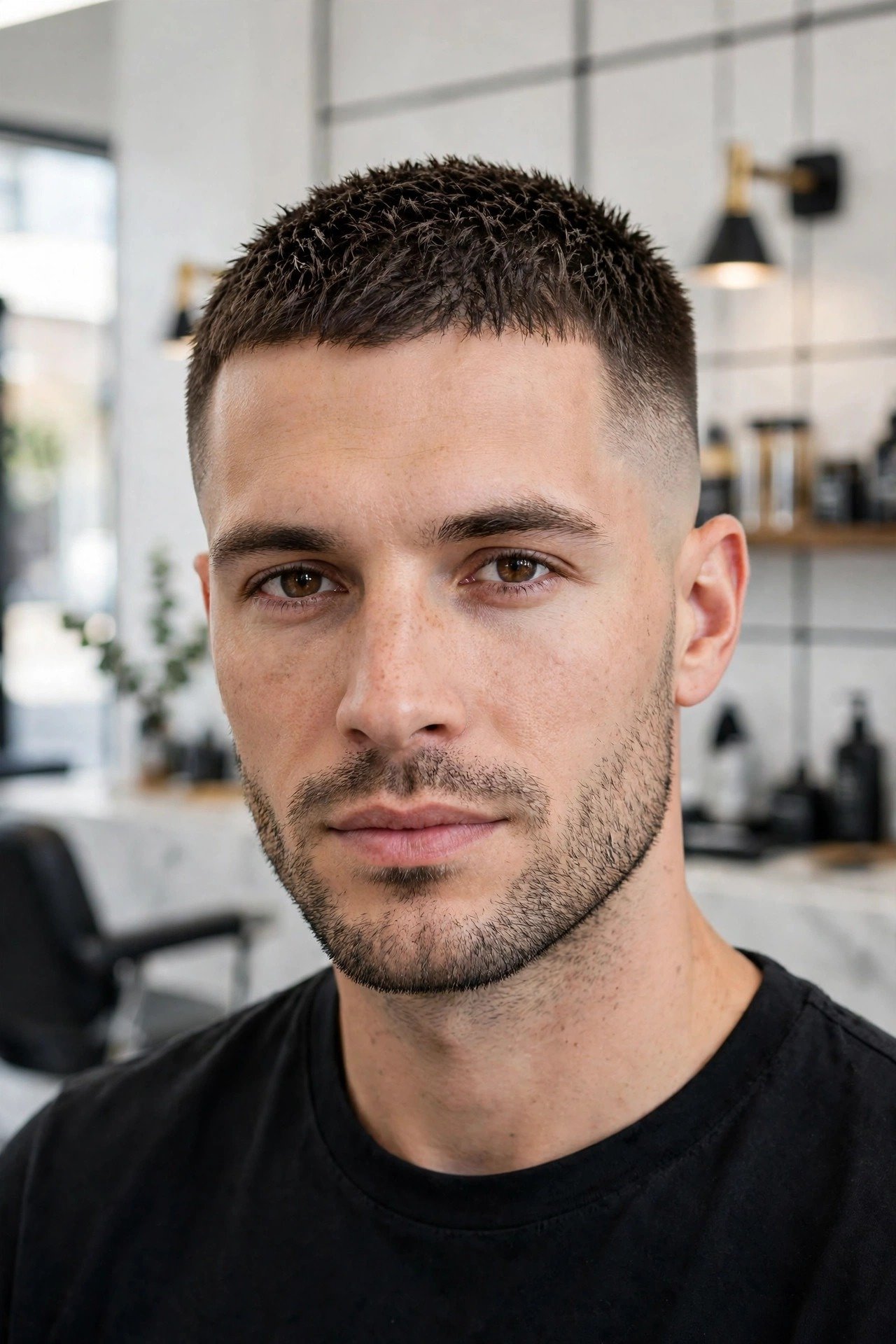
The short textured crop is the minimalist’s answer: all of the texture, almost none of the length. The top sits at about an inch, cut with fine point-cutting so even at this length the ends separate and catch light. The sides are usually a low or mid skin fade that keeps everything tight and architectural. The result is crisp, clean, and almost sculptural — the texture becomes a detail you notice up close rather than a feature you see across the room. It is the version for men who want the trend with the least possible hair.
It suits every hair type and every face shape, and it is the best textured crop for men with very busy lifestyles or physically demanding jobs — there is simply nothing to maintain. It also suits men with thinning hair, since the short, textured top minimizes contrast between thin and full areas. Ask your barber for “a textured crop, but short — about an inch on top, textured, with a fade” and specify the fade height. Style with a tiny amount of matte clay — less than you think — worked through with your palms. It needs a cut every three weeks to stay sharp, but the daily routine is under a minute. This is the textured crop distilled to its essence.
11. Long Textured Crop
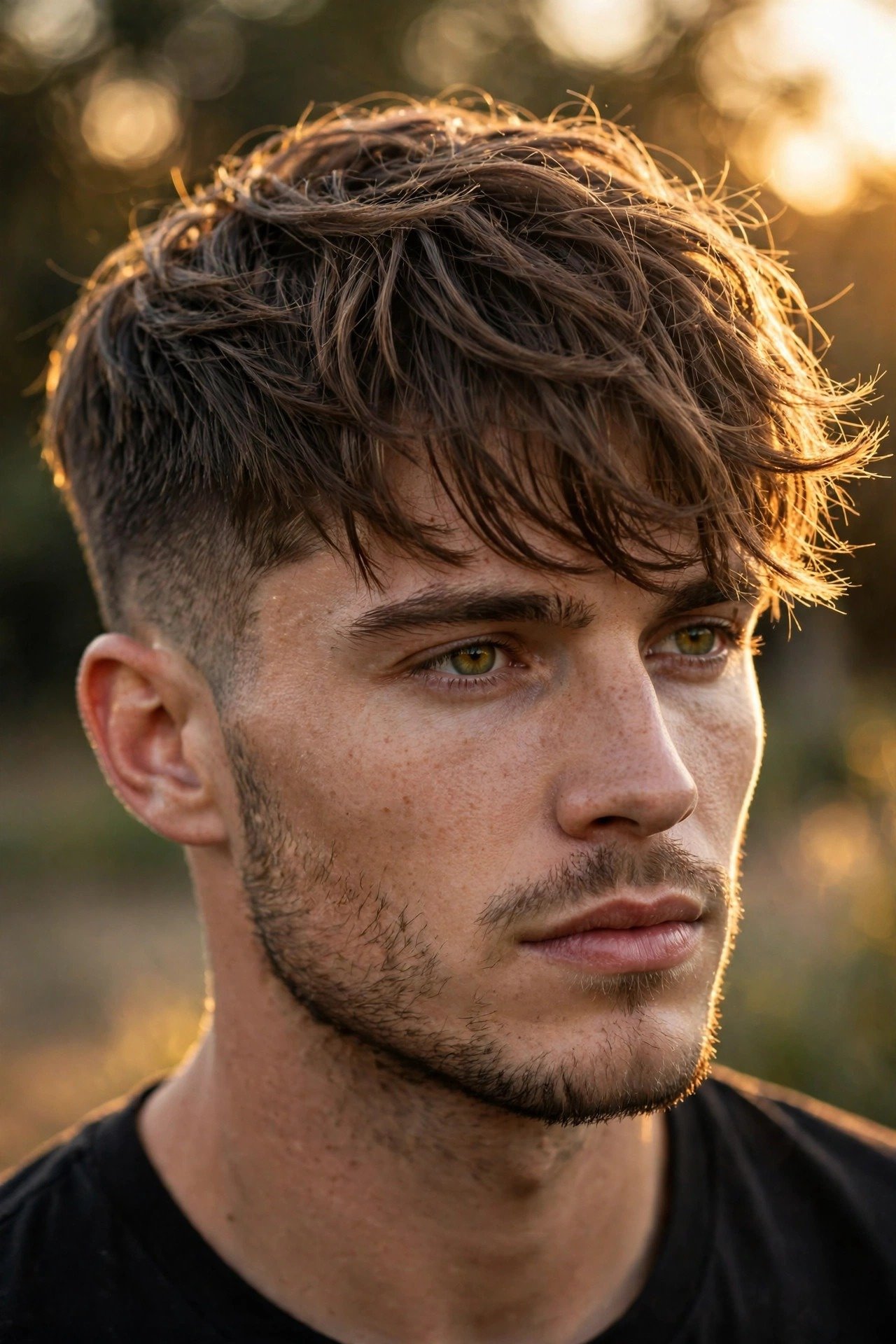
The long textured crop stretches the formula to its limit: three inches or more on top, with the texture getting room to really move. The fringe can be swept forward, pushed to the side, or worn messy; the top has enough length to show waves, curls, or dramatic separation. The sides stay short — a taper or low fade — to keep the silhouette cropped rather than shaggy. This is the version with the most styling versatility, and the one that blurs the line between a crop and a longer textured style. It is the textured crop for men who want options.
It suits thick, wavy, and curly hair best, where the length has natural character, and it flatters oval, square, and heart-shaped faces. Fine hair can work if the texture is cut internally for support. Ask your barber for a long textured crop — “three inches on top, heavily textured, keep the sides tight” — and discuss fringe direction, since that is where the versatility lives. Style with matte clay for definition or sea salt spray for natural movement; this is the one version where a blow dryer earns its keep, adding volume on days you want it. It needs a trim every four to five weeks. For men who like to change their look without changing their cut, the long textured crop is the most rewarding version on this list.
12. Textured Crop for Thick Hair
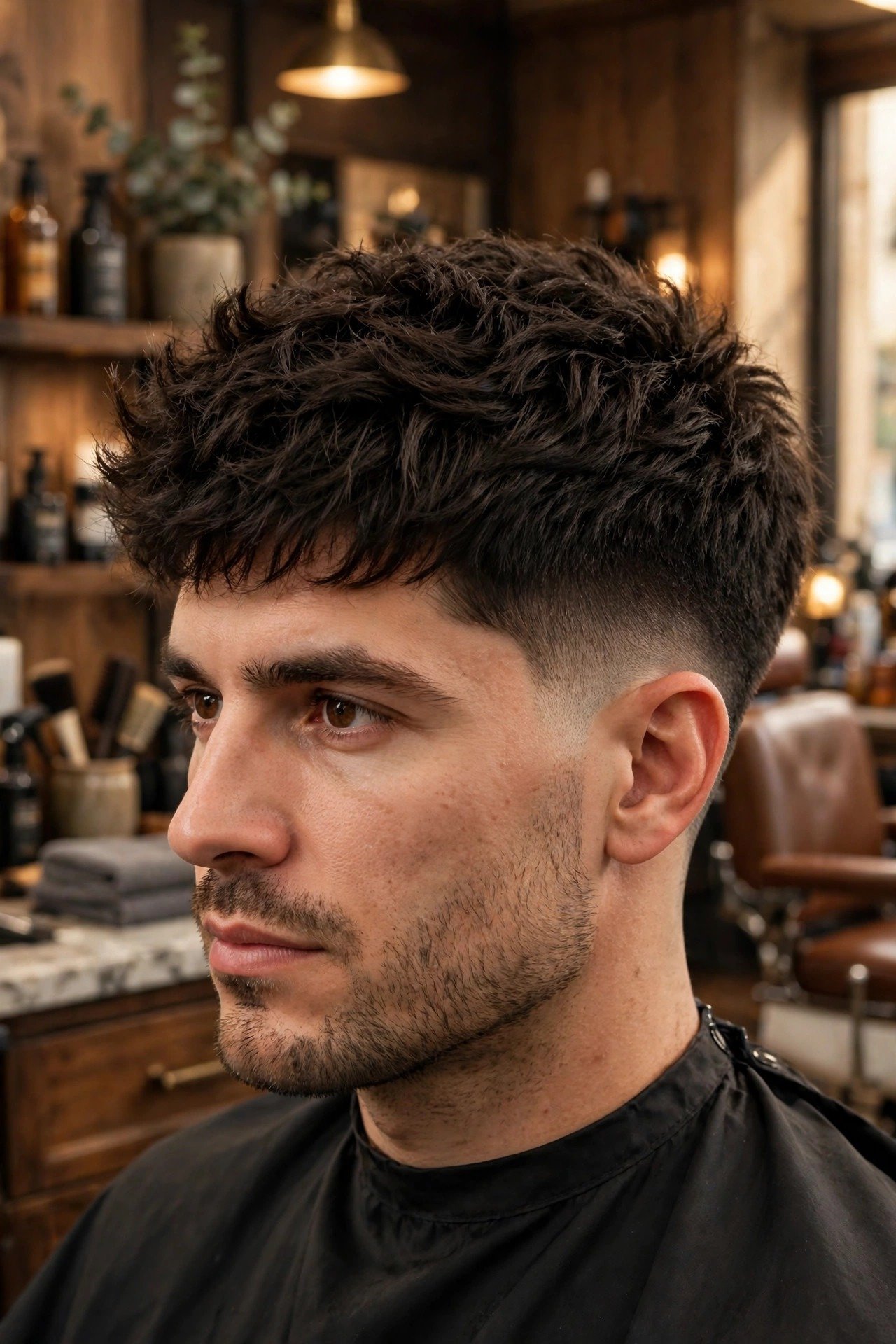
Thick hair is both the textured crop’s best friend and its biggest challenge — there is plenty of material for texture, but without internal weight removal the top mushrooms instead of moving. The thick-hair version solves this with aggressive internal layering: the barber removes weight from inside the top while keeping the length, so the texture sits down and separates instead of puffing up. The result is a dense, rich crop with incredible dimension — the kind of hair that makes other men ask who cuts it. The sides are usually a mid fade that contains the volume.
The critical instruction is “take the weight out” — say it explicitly, because a barber who cuts a thick top like a fine top will leave you with a helmet. Ask for a textured crop with heavy internal texture and thinning through the crown, about two inches on top, with a mid fade. At home, a light cream or leave-in conditioner under your matte clay keeps the texture controlled without looking product-heavy. It needs a trim every three to four weeks, since thick hair shows growth fastest. Done right, thick hair produces the most impressive textured crop of any hair type — the density that fights you in every other cut becomes the whole point here.
13. Textured Crop for Fine Hair

Fine hair gets the biggest transformation from a textured crop of any hair type. The problem with fine hair is that solid, one-length cuts lie flat and expose the scalp; the solution is separation. When the top is point-cut into distinct pieces, each piece casts a tiny shadow on the one behind it, and the eye reads that light-and-shadow play as density. A good textured crop can make fine hair look twice as thick as it is — it is genuinely the best haircut architecture for the job. The sides stay short with a low fade so all the visual weight lives on top.
The technique matters more than the length here. Ask your barber for a textured crop cut specifically for fine hair — “light, airy texture, do not thin it out” — because over-thinning fine hair is the classic mistake that makes it look thinner. About an inch and a half on top is the sweet spot: enough length for separation, not so much that it goes limp. At home, sea salt spray is your best friend — mist it on damp hair before styling to add grip and body, then finish with a small amount of matte clay. Avoid heavy creams and oils, which weigh fine hair down and undo the illusion. This is the version that turns a hair insecurity into a non-issue.
14. Curly Textured Crop

The curly textured crop lets your natural texture do the heavy lifting. Instead of fighting curls into submission, this version shapes them: about two inches on top, with the curls cut to sit in defined, separated coils, and the sides faded short so the curls have a clean frame. The curls ARE the texture — no point-cutting theatrics needed — which makes this one of the most natural-looking versions on the list. It is the textured crop for men whose hair already has the movement everyone else is trying to manufacture.
Ask your barber for a curly crop with the curls cut dry or stretched, since curly hair shrinks dramatically and wet-cutting leads to surprises. Specify faded sides — a mid fade is the classic pairing — and a fringe that sits just above the eyebrows when dry. At home, the routine is curl care, not styling: leave-in conditioner or curl cream on damp hair, scrunch, and let it air-dry. Matte clay can be used sparingly for definition, but heavy products crush curls. It needs a trim every four to five weeks to keep the shape. For curly-haired men tired of cuts that fight their texture, the curly textured crop is the one that finally works with it.
15. Wavy Textured Crop

If the textured crop has a natural home, it is wavy hair. Waves provide exactly what the cut wants — movement, separation, organic flow — with almost no intervention. The wavy version keeps the top at two to two and a half inches so the waves have room to form, textures the ends lightly to enhance the wave pattern, and keeps the sides tight with a taper or low fade. The result is the most effortlessly good-looking version on this list: it looks styled when you did nothing and incredible when you spent three minutes on it.
Ask your barber for a textured crop that works with your wave pattern — “enhance the waves, do not cut against them” — and mention which way your waves naturally fall so the texture supports rather than fights them. A mid taper is the ideal side finish, keeping things neat without the fade-culture edge. At home, sea salt spray on damp hair is practically made for this cut: it amplifies the waves and adds the matte finish 2026 demands. Finish with a touch of clay if you want more definition. It needs a trim every four weeks. Wavy-haired men sometimes do not realize how lucky they are — this cut is the proof.
16. Textured Crop for Straight Hair

Straight hair gives you the most architectural version of the textured crop — the one where every cut line is visible and the texture reads as precision. The point-cut ends separate crisply, the fringe lies with clean intention, and the overall impression is sharp and deliberate. The trade-off is that straight hair shows every flaw, so this version demands the most skilled cutting: the texture has to be cut in, because straight hair will not create it on its own. Find a barber who understands point-cutting deeply — this is not the version for a rushed fifteen-minute cut.
Ask for a textured crop with fine, detailed point-cutting — “I want to see the separation” — about two inches on top with a low or mid fade. The fringe is where straight hair shines: it can be worn forward with crisp separated ends that look almost graphic. At home, matte clay is essential — straight hair needs product to hold the texture, or it falls flat by noon. A blow dryer pointed forward for thirty seconds on damp hair gives the texture a head start. It needs a trim every three to four weeks. Done well, the straight-hair textured crop is the sharpest, most precise version on this list — the tailored suit of textured crops.
17. Textured Crop With Beard
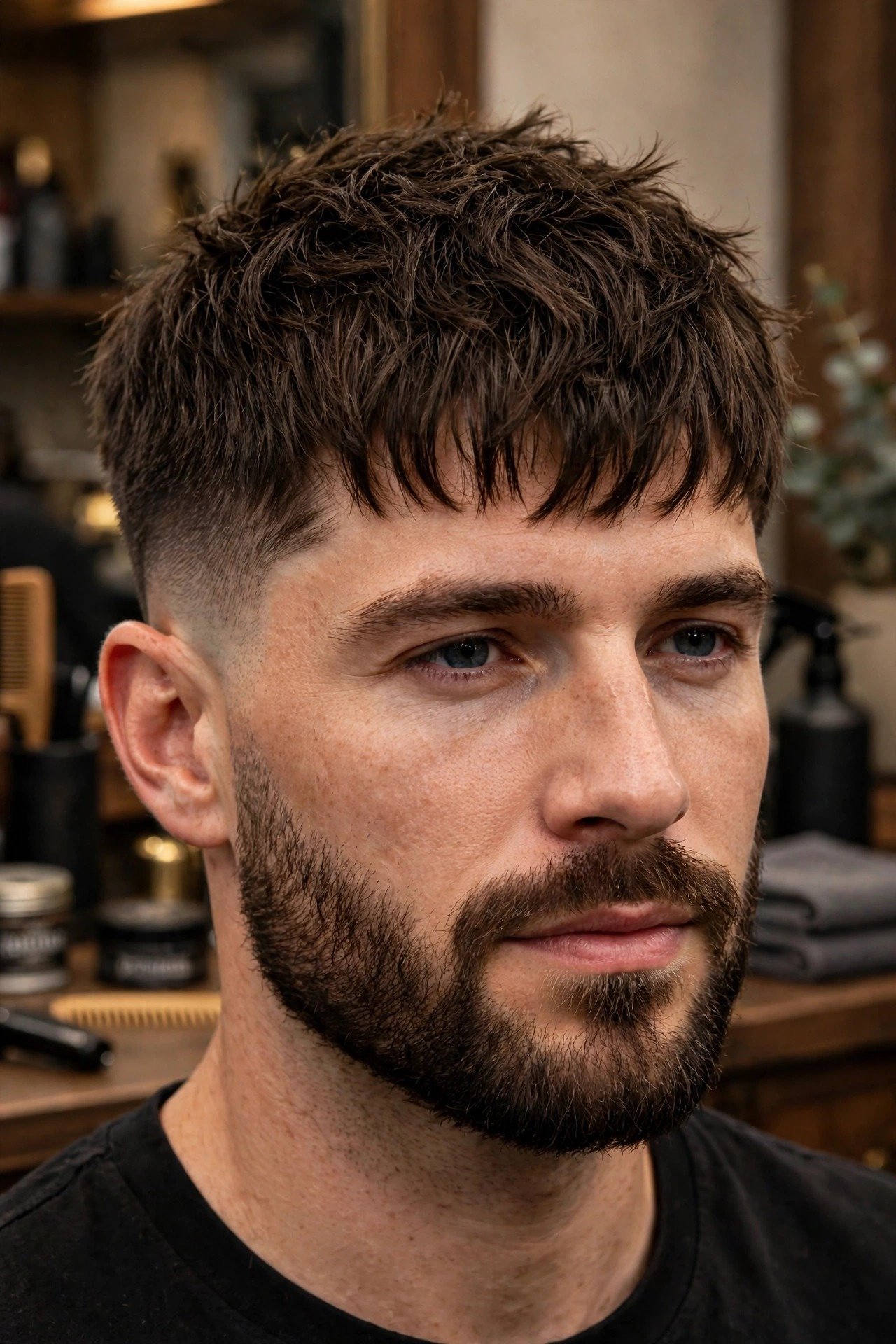
The textured crop with a beard is one of 2026’s most requested full looks, and the pairing logic is simple: the crop’s clean sides and the beard’s fullness balance each other perfectly. The short, neat sides of the crop make the beard look intentional rather than lazy, while the beard gives the face the weight and masculinity the short cut takes away. The fade should blend into the beard through the sideburns — ask your barber to connect them seamlessly, with no harsh line where the cut meets the beard. The top stays textured and forward, the beard stays groomed and shaped.
The beard length is the variable: a short boxed beard keeps the look sharp and professional, while a fuller beard pushes it rugged. Either way, the cheek lines should be clean and the neckline defined — a textured crop with a neglected beard just looks confused. For the full breakdown of the pairing, our buzz cut with beard guide covers beard grooming discipline in depth, and the same rules apply here: oil daily, trim the neckline every few days, keep both on the same schedule. This is the textured crop at its most masculine — the cut says sharp, the beard says substance, and together they say finished.
18. Textured Crop With Stubble
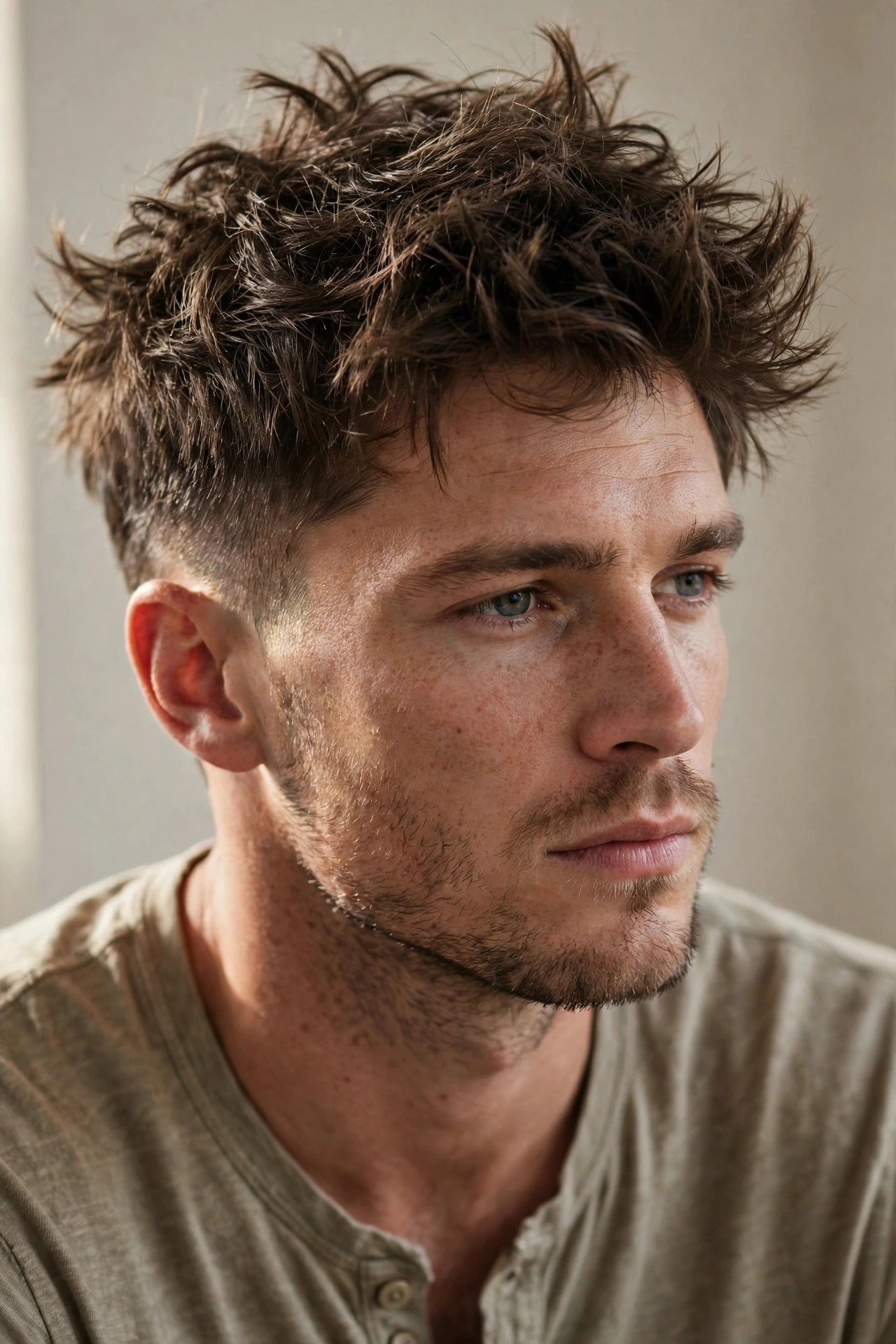
If the full beard is the formal pairing, stubble is the casual one. A textured crop with a few days of stubble reads as effortlessly rugged — the deliberate texture on top against the raw texture on the face. It is the weekend version of the bearded crop: less maintenance, more edge, the same balance. The stubble should be even and intentional — three to five days of growth, kept tidy at the neckline and cheek lines — not the accidental stubble of a man who forgot to shave.
This pairing suits every face shape and works best with the messier textured crop variations, where the top’s casual energy matches the stubble’s. Ask your barber to keep the crop’s sides neat — the contrast between groomed hair and rugged stubble is the whole point. Maintain the stubble with a trimmer every two to three days at a consistent guard length, and keep the neckline clean. It is the lowest-maintenance version of the crop-plus-facial-hair formula, and for men who cannot or will not grow a full beard, it delivers ninety percent of the effect with ten percent of the effort.
19. Textured Crop With Line Up

The line up — the sharp, boxed hairline across the forehead with precise edges at the temples — turns the textured crop into a statement of precision. The contrast is the point: the top stays textured and organic while the perimeter is razor-sharp, architectural, almost drawn on. It is the most deliberate-looking version on this list, the one that says you care about the details. The sides are usually a mid or high fade that continues the crisp geometry.
This version demands a barber with a steady hand and a sharp blade — the line up is unforgiving, and a wobbly edge ruins the effect. Ask for a textured crop with a boxed line up: “crispy edges, sharp corners, keep the hairline natural” — and be clear you do not want the hairline pushed back, which is the classic line-up mistake. It suits straight and wavy hair best, where the hairline is well-defined. Maintenance is weekly edge-ups if you want it permanently crisp, or every two to three weeks with the full cut. Style the top with matte clay as usual. For men who treat their hairline as a feature, the line-up textured crop is the sharpest tool in the box.
20. Textured Crop With Hard Part

The hard part brings old-school barbering precision to the textured crop’s modern texture. A clean, shaved line is cut or razored into one side, and the textured top is swept to the opposite side — structure meets movement in a single haircut. It is the most dapper version on this list, the one that works in a suit without losing the crop’s contemporary edge. The sides are typically a low or mid fade that keeps the part as the visual anchor.
Ask your barber for a textured crop with a hard part — specify which side, and whether you want it razored (sharper, shorter-lived) or clipper-cut (softer, longer-lived). The top should be long enough to sweep — two to two and a half inches — with texture that supports the directional flow. It suits straight and wavy hair best; curly hair fights the part. Style with matte clay or a light pomade, sweeping the top away from the part and pinching for separation. The part needs re-cutting every two to three weeks to stay crisp. This is the textured crop for men who want vintage precision with modern texture — the best of both eras.
21. Textured Crop With Undercut
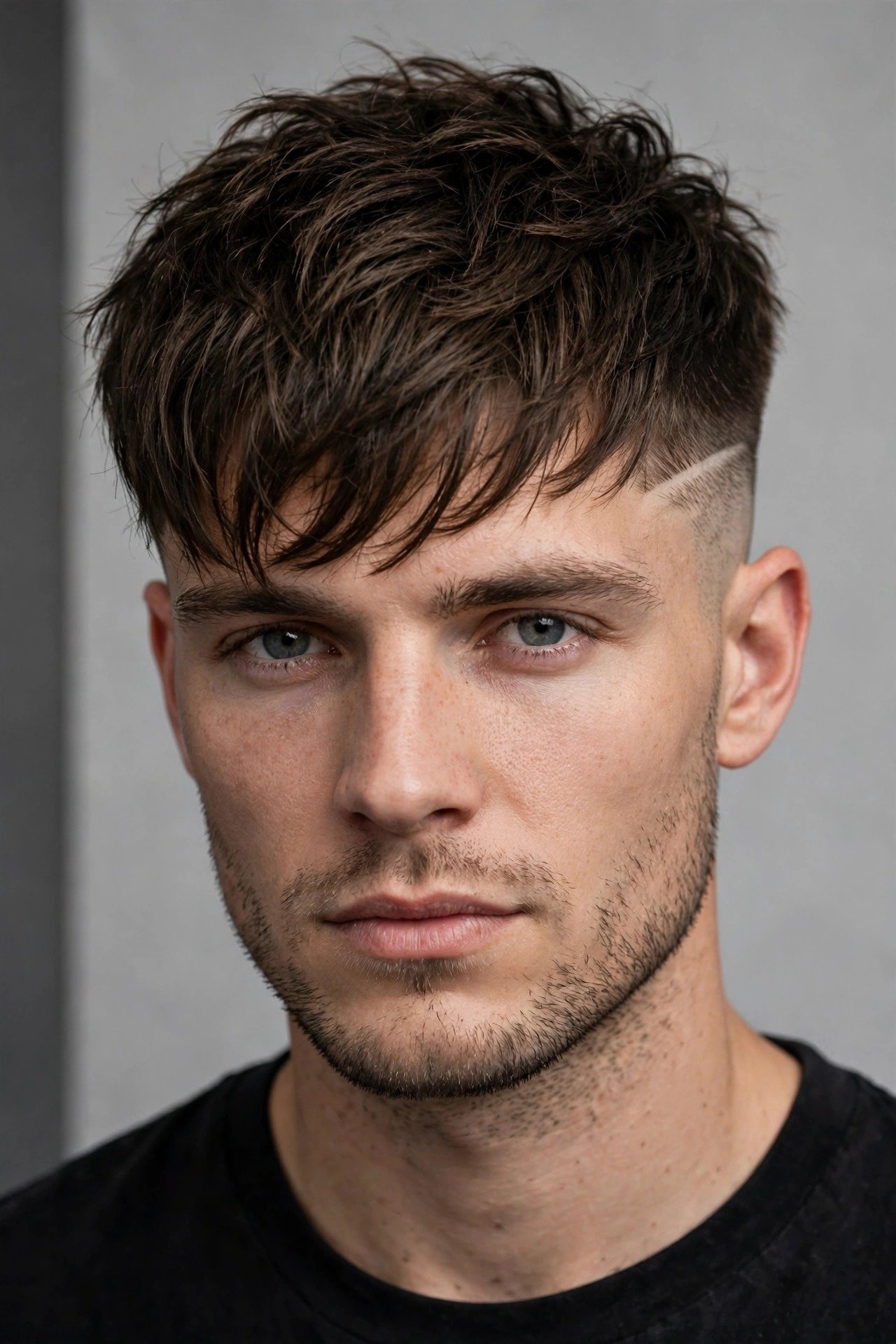
The undercut version disconnects the textured top from the short sides with a clean, visible line — no blend, no fade, just a deliberate separation. The top stays long and textured, usually two and a half to three inches, while the sides are clipped to a uniform short length. The effect is bold and graphic: the disconnect makes the top look even fuller and more dramatic by comparison. It is the most fashion-forward version on this list, the one with the strongest silhouette.
It suits thick and straight hair best, where the disconnect reads cleanest, and it flatters oval and square faces. The grow-out is the consideration: the disconnect loses its edge as the sides grow, so this needs a trim every two to three weeks to stay sharp. Ask your barber for a disconnected undercut with a textured top — “no blend, clean line, keep the top long” — and specify the side length. Style with matte clay, pushing the top forward or to the side to show the disconnect. For men who want their textured crop to make a statement rather than a suggestion, the undercut version delivers.
22. Disconnected Textured Crop
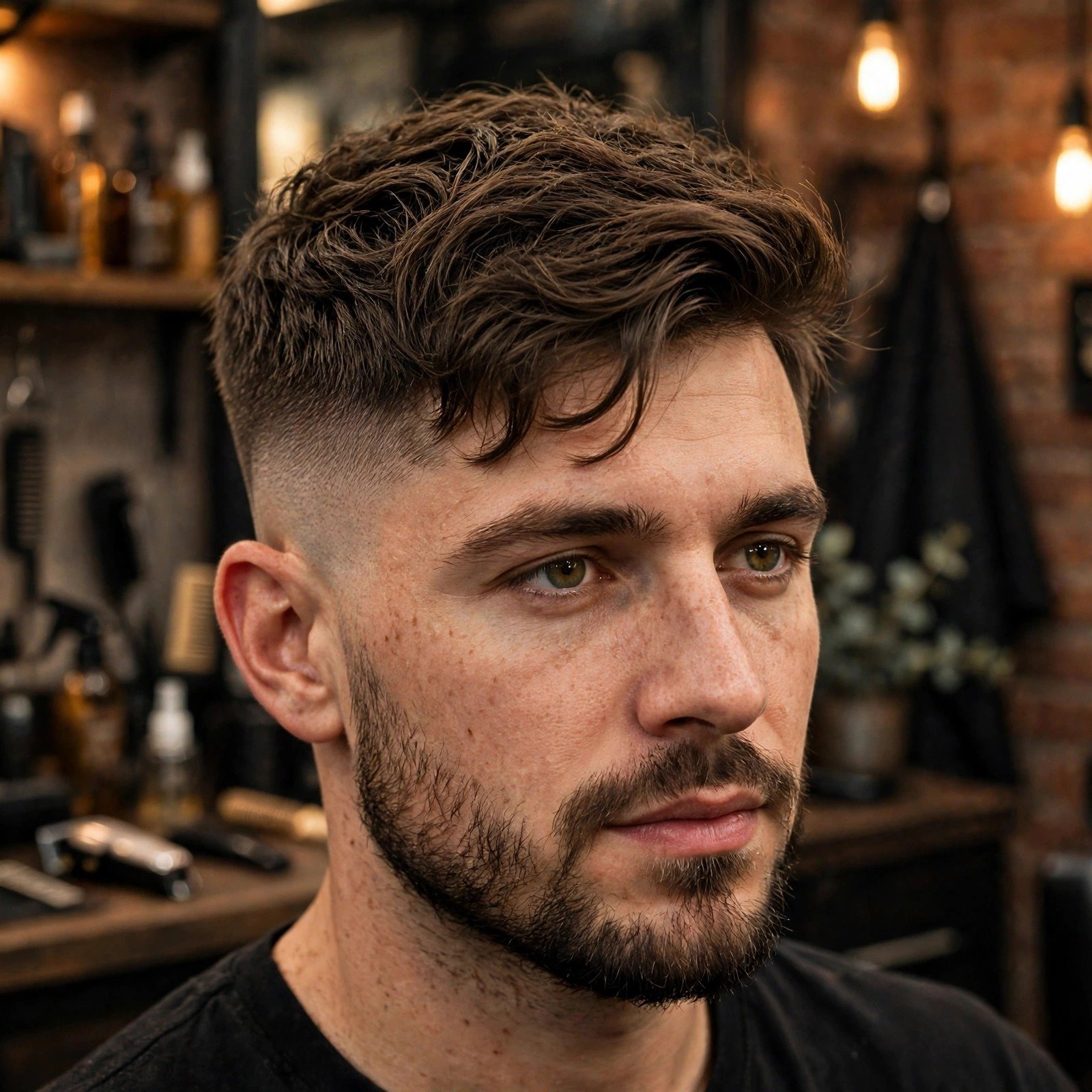
Close cousin to the undercut version, the disconnected textured crop uses the same principle — a visible line where the long top meets the short sides — but keeps the disconnect subtler and more wearable. The sides might be slightly longer than a true undercut, or the disconnect might sit lower, softening the drama while keeping the graphic interest. It is the undercut’s more approachable sibling: still bold, still deliberate, but easier to wear to work on Monday.
It suits straight to wavy hair and flatters most face shapes, though it is especially good on oval faces where the disconnect adds visual interest. Ask your barber for a “soft disconnect” — the phrase tells them you want the line without the severity — with a two-and-a-half-inch textured top. Style with matte clay, and experiment with pushing the top in different directions; the disconnect looks different swept forward versus to the side, giving you two haircuts in one. Maintenance is every three weeks. This is the textured crop for men who want edge they can dial up or down.
23. Spiky Textured Crop
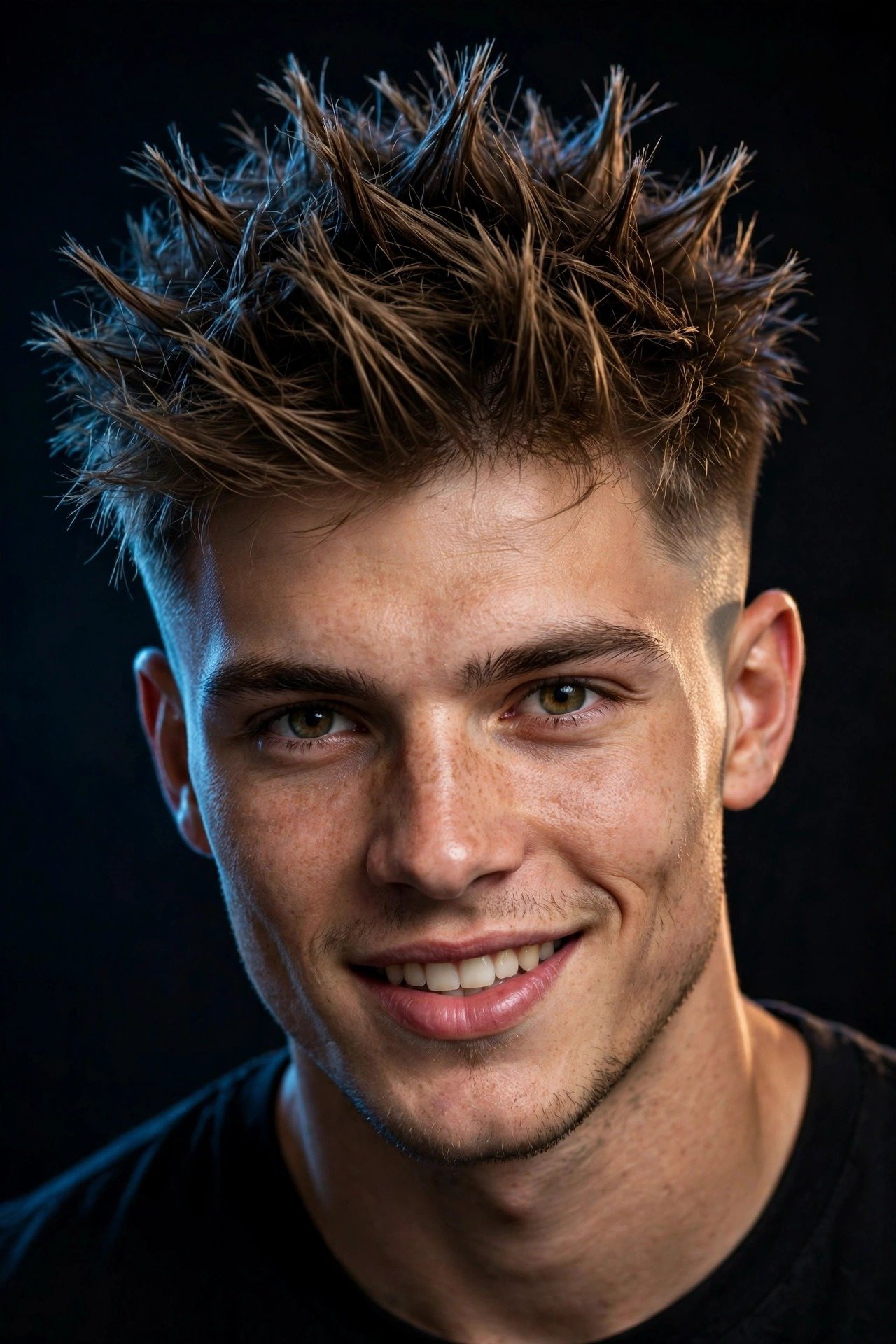
The spiky textured crop is the 2026 rehabilitation of the nineties spike — same energy, completely different execution. Instead of gelled, uniform spikes, the 2026 version uses matte product and piece-y texture to create separated, touchable points that look organic rather than sculpted. The spikes are irregular in height and direction, which is what separates them from the boy-band original. The sides are a mid skin fade that keeps the silhouette modern. It is the most playful version on this list.
It suits straight and thick hair best, where spikes hold their shape, and it flatters round and oval faces — the vertical texture adds height and angles. Ask your barber for a textured crop cut for spikiness — “short enough to spike, textured enough to separate” — about an inch and a half on top. Style with matte clay or a fiber product: warm it up, work it through the dry top, and pinch and twist small sections upward. Less product than the nineties version — the goal is definition, not armor. It needs a trim every three weeks. For men who grew up on spikes and want the grown-up version, this is it — nostalgia without the time machine.
24. Textured Crop With Side Sweep
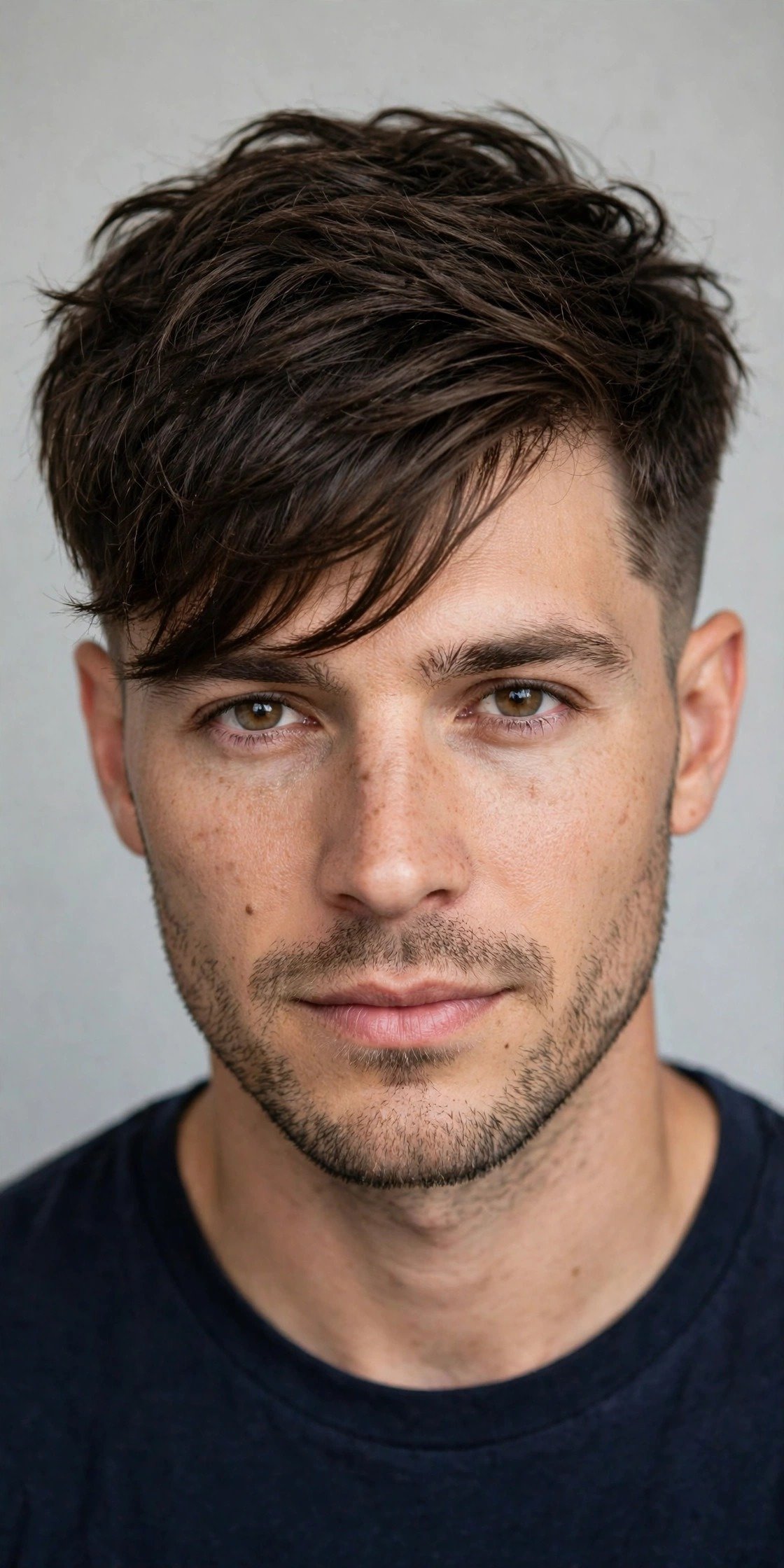
The side sweep softens the textured crop’s forward energy by redirecting it diagonally. The top is textured as usual but worn swept to one side, creating an asymmetric, flowing line that feels more relaxed and romantic than the forward versions. The fringe becomes a side-swept feature rather than a straight-across one. The sides stay neat with a low fade or taper. It is the most versatile styling of the crop — the same cut can be worn forward on Monday and swept on Tuesday.
It suits wavy and straight hair best, where the sweep holds naturally, and it flatters square and heart-shaped faces — the diagonal line softens strong angles. Ask your barber for a textured crop with enough length to sweep — “two and a half inches, textured, I want to wear it to the side” — and identify your natural growth direction, since sweeping with the grain is effortless and against it is a fight. Style with matte clay, sweeping the top diagonally and pinching for separation. It needs a trim every four weeks. This is the textured crop for men who want one cut and many moods.
25. Textured Crop for a Receding Hairline
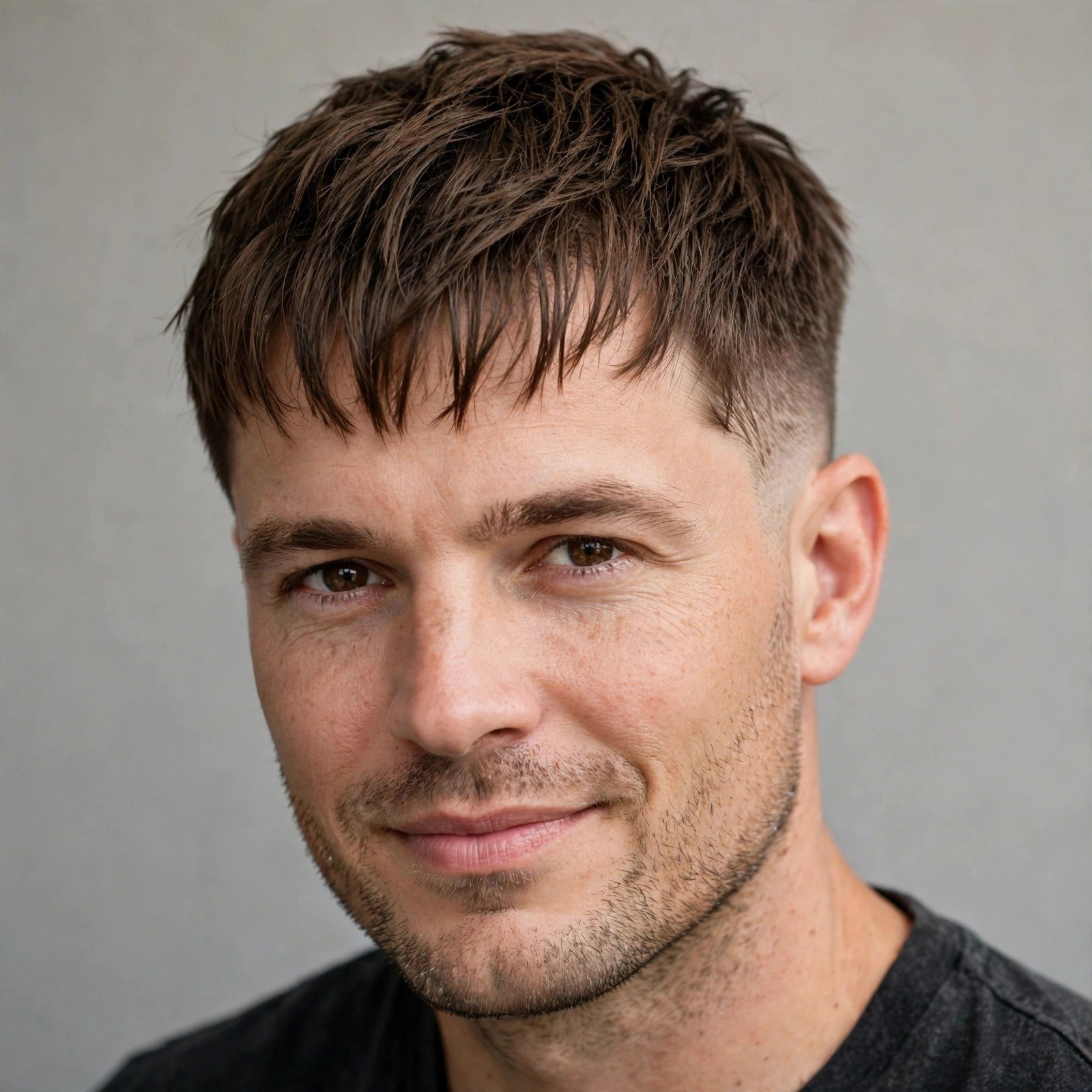
The textured crop is one of the best haircuts for a receding hairline, and the reason is direction. Everything on top moves forward, which means the hair naturally covers the temples where recession shows first. The texture breaks up the hairline so there is no harsh line drawing the eye to it, and the short sides keep the overall look clean and intentional. It is not camouflage — it is architecture that happens to be flattering. Many barbers recommend this as the first cut to try when the hairline starts moving.
Ask your barber for a textured crop with the fringe kept slightly longer at the corners — “forward, textured, with coverage at the temples” — and a low or mid fade that does not expose too much scalp. The key is keeping the top long enough to direct forward: an inch and a half minimum. Style with matte clay, pushing everything forward and slightly toward the center. Avoid slicking back or spiking up, which expose exactly what you want covered. It needs a trim every three to four weeks. For men in the early stages of recession, this cut buys years of confidence — and when the time comes for shorter options, our buzz cut with beard guide covers the next step with the same honesty.
26. Textured Crop for Older Men
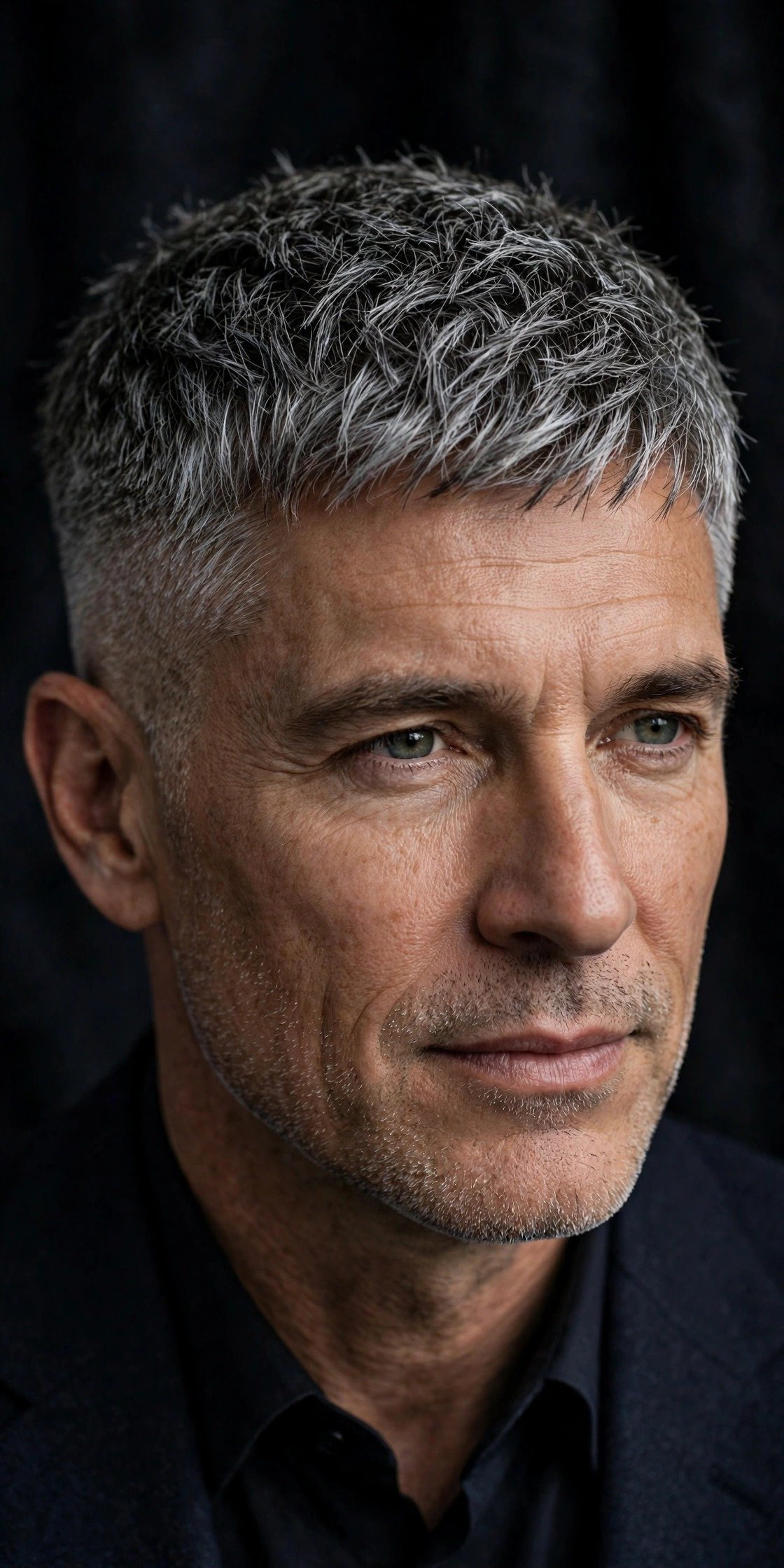
The textured crop is ageless, but the older-man version tunes it for distinction. The top stays textured but slightly neater — less mess, more control — and the sides are a classic taper rather than a skin fade, which reads as refined rather than trendy. A little gray in the texture is an asset, not a flaw: the separated pieces catch light differently and the salt-and-pepper effect adds dimension no product can fake. This is the version for men who want to look current without looking like they are chasing youth.
Ask your barber for a “grown-up textured crop” — the phrase communicates everything: texture without chaos, a taper without edge, a fringe that sits rather than flops. About two inches on top is ideal. Style with a light cream or matte clay, neater than the younger versions — comb it once with your fingers and leave it. It needs a trim every four weeks. The textured crop on older men has a particular power: it says you pay attention without saying you try hard, which is exactly the right message at any age.
27. Textured Crop for Teenagers

The textured crop is the dominant haircut among teenage boys in 2026, and it is easy to see why: it looks great with zero skill, survives hats and helmets, and photographs well for the social feeds where teenage style is decided. The teenage version leans into the messier, more expressive end — longer fringe, more separation, often a mid or high fade for contrast. It is the cut that says you know what is current without needing a tutorial to wear it.
For parents booking the appointment: ask for a textured crop with a mid fade and a fringe that can be worn forward or messy — “like the ones all over social media” is genuinely useful direction for a barber who cuts teenagers all day. The maintenance conversation matters: this cut needs a trim every three to four weeks to stay sharp, and the daily routine is a fingertip of matte clay, which most teenagers can manage. It suits every hair type teenagers have, which is why it has become the default. The textured crop is the rare teenage trend with actual staying power — it is a real haircut, not a meme.
28. Textured Crop With Blonde Highlights
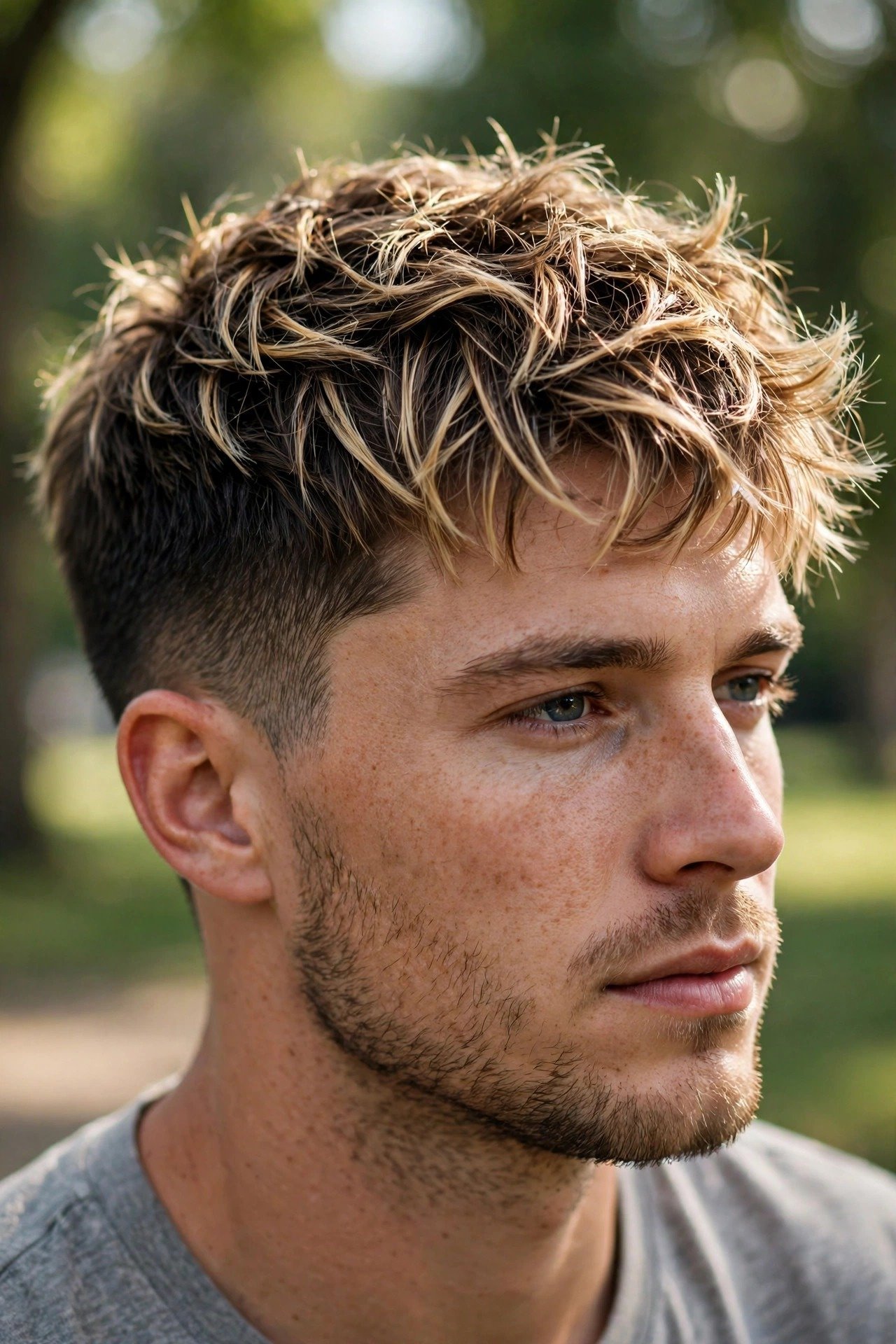
Blonde highlights turn the textured crop’s separation into a light show. When the top is highlighted — whether sun-kissed balayage, chunky nineties pieces, or subtle babylights — each separated piece catches light differently, and the texture becomes three-dimensional in a way a solid color never achieves. The highlights emphasize exactly what makes the crop special: the movement, the pieces, the depth. The sides stay natural and short, which makes the highlighted top pop even more by contrast.
This is a two-appointment commitment: the cut first, then the color, ideally with a colorist who understands men’s texture. Ask for highlights that follow the texture — “piece-y, dimensional, not stripes” — in a tone that suits your skin: warm golds for warm skin, ash tones for cool. Maintenance is the consideration: highlights need toning every six to eight weeks and the top needs trims every four, so budget accordingly. Style with matte clay and consider a purple shampoo once a week to keep blonde tones clean. For men who want their textured crop to be unmistakable, highlights are the loudest upgrade on this list.
29. Textured Crop With Dyed Tips
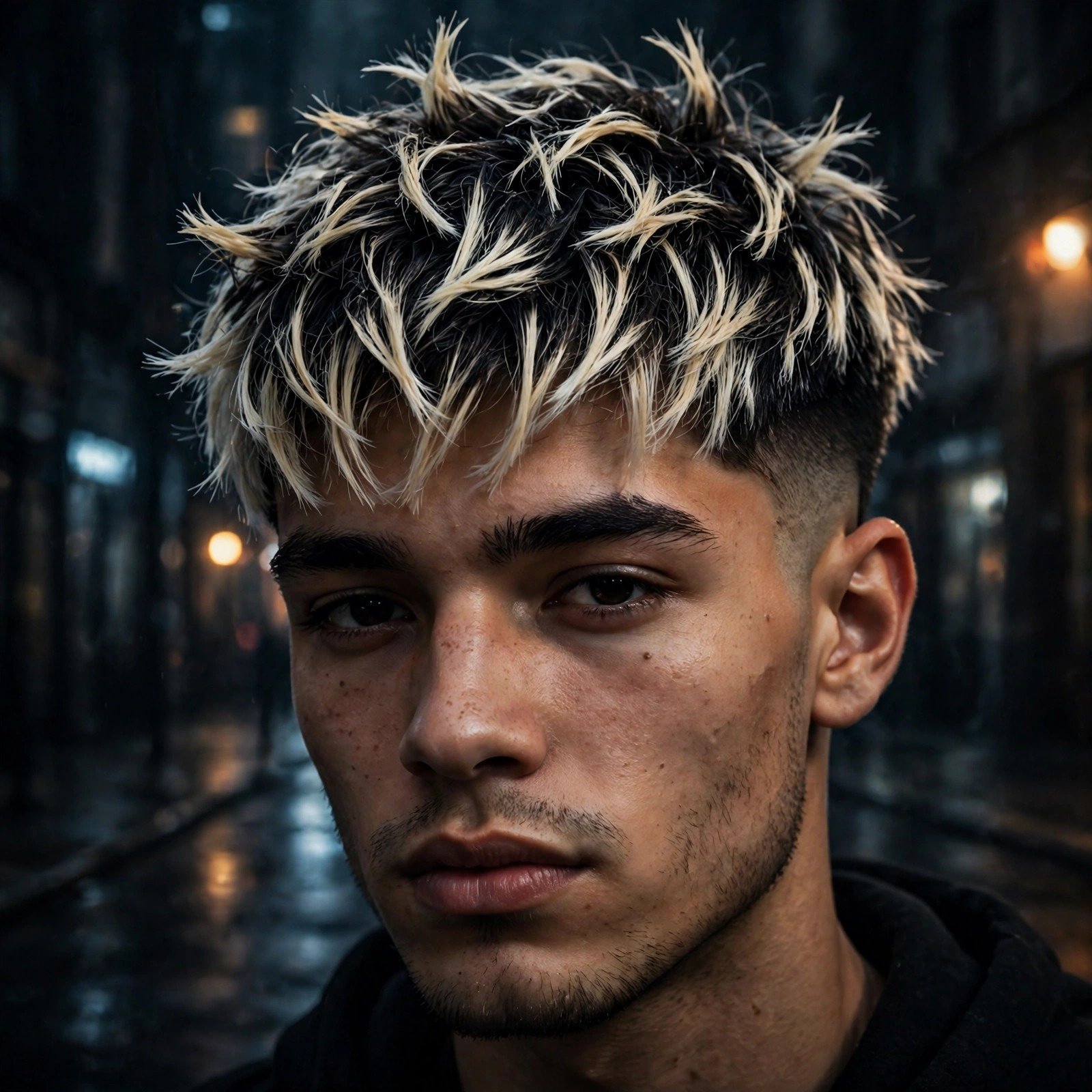
Dyed tips — bleached or colored ends on a darker base — give the textured crop a graphic, fashion-forward edge. The color sits exactly where the texture is: on the separated ends, so every piece shows the contrast between the dark root and the light tip. It is the most eye-catching color version on this list, the one that turns the crop into a statement. Platinum tips are the classic, but 2026 is seeing everything from copper to pastel on textured tops.
Ask your colorist for bleached or colored tips on a textured crop — “just the ends, keep the roots dark” — and make sure the cut’s texture is in place first, since the color follows the pieces. Maintenance is real: tips need re-bleaching every six to eight weeks as they grow out, and bleached hair needs conditioning to stay healthy. Style with matte clay as usual; the texture does the color’s work for it. This is the version for men who treat their hair as self-expression — it is bold, it is fun, and on a textured crop it looks intentional rather than accidental.
30. Textured Crop With Hair Design

A shaved design — a line, a geometric pattern, a subtle motif carved into the faded side — turns the textured crop into wearable art. The design lives in the fade, usually above the ear or at the nape, where the short hair becomes a canvas. The textured top stays classic, which is what makes the design work: the contrast between the traditional crop and the unexpected detail is the entire appeal. It is the most personalized version on this list — no two are exactly alike.
This demands a barber who does design work regularly — ask to see their portfolio, because freehand clipper art is a genuine skill. The design can be as subtle as a single curved line or as bold as a full geometric pattern; discuss placement and scale before the clippers touch your head. Maintenance is weekly if you want it permanently crisp, since designs blur as hair grows — many men get the design refreshed between full cuts. Style the top normally with matte clay. For men who want their haircut to be one of one, the designed textured crop is the most individual version here.
31. Textured Crop With Drop Fade
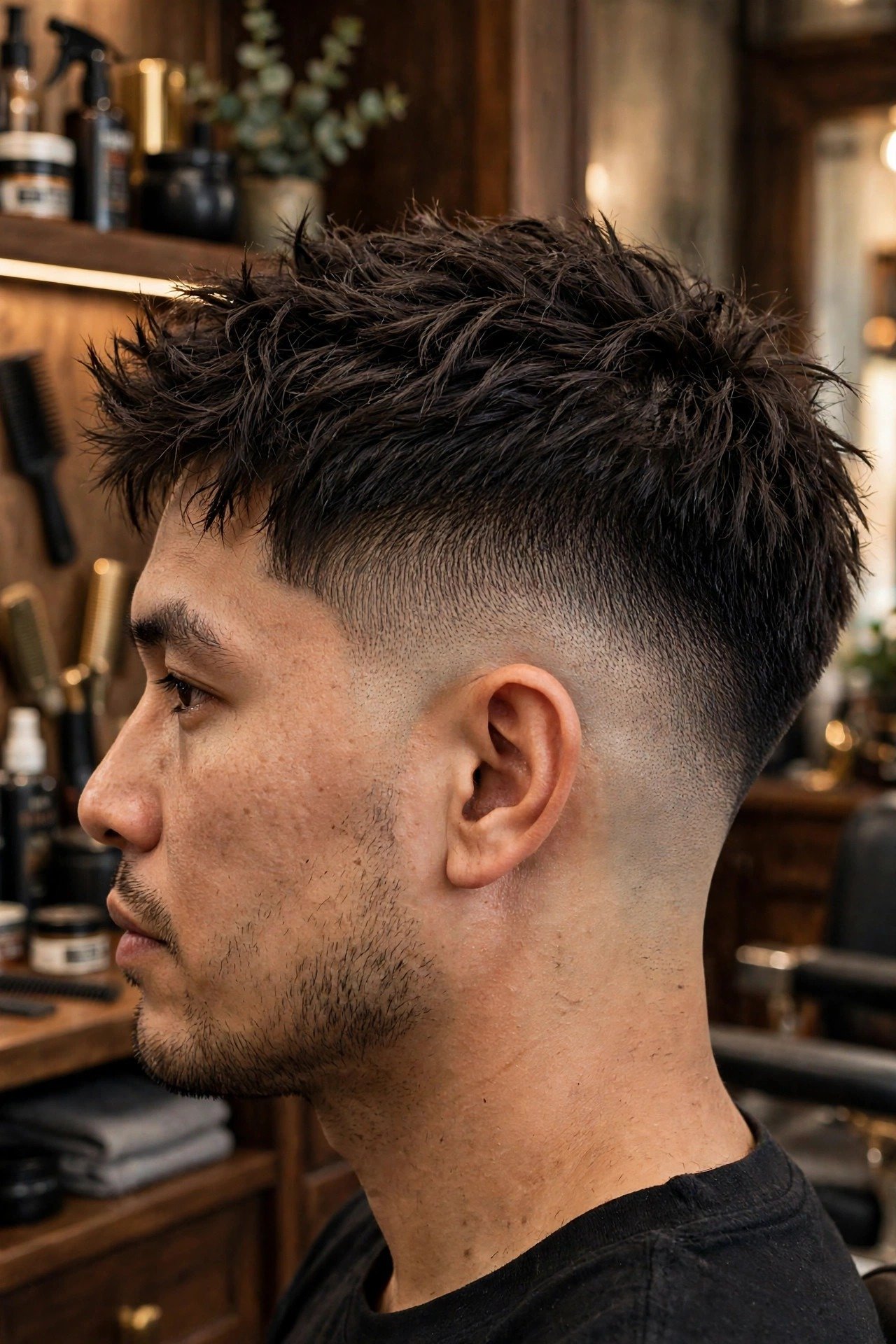
The drop fade adds a curved, sculptural line to the textured crop’s sides. Instead of the fade following a straight horizontal line around the head, it drops — curving down behind the ear before rising back up — creating a rounded, contoured shape that follows the head’s natural curvature. The effect is more organic and custom than a standard fade, like the difference between off-the-rack and tailored. The textured top stays classic, letting the fade’s curve be the detail.
It suits round and oval faces best, since the curved fade line adds flattering contour, and it works with every hair type. Ask your barber for a textured crop with a drop fade — “drop it behind the ear” — and specify the fade’s lowest point, since the drop depth is the variable. It needs a trim every three weeks to keep the curve crisp. Style the top with matte clay as usual. The drop fade is one of those details other men notice without knowing why the cut looks so good — it is the connoisseur’s fade choice for the textured crop.
32. Textured Crop With Burst Fade
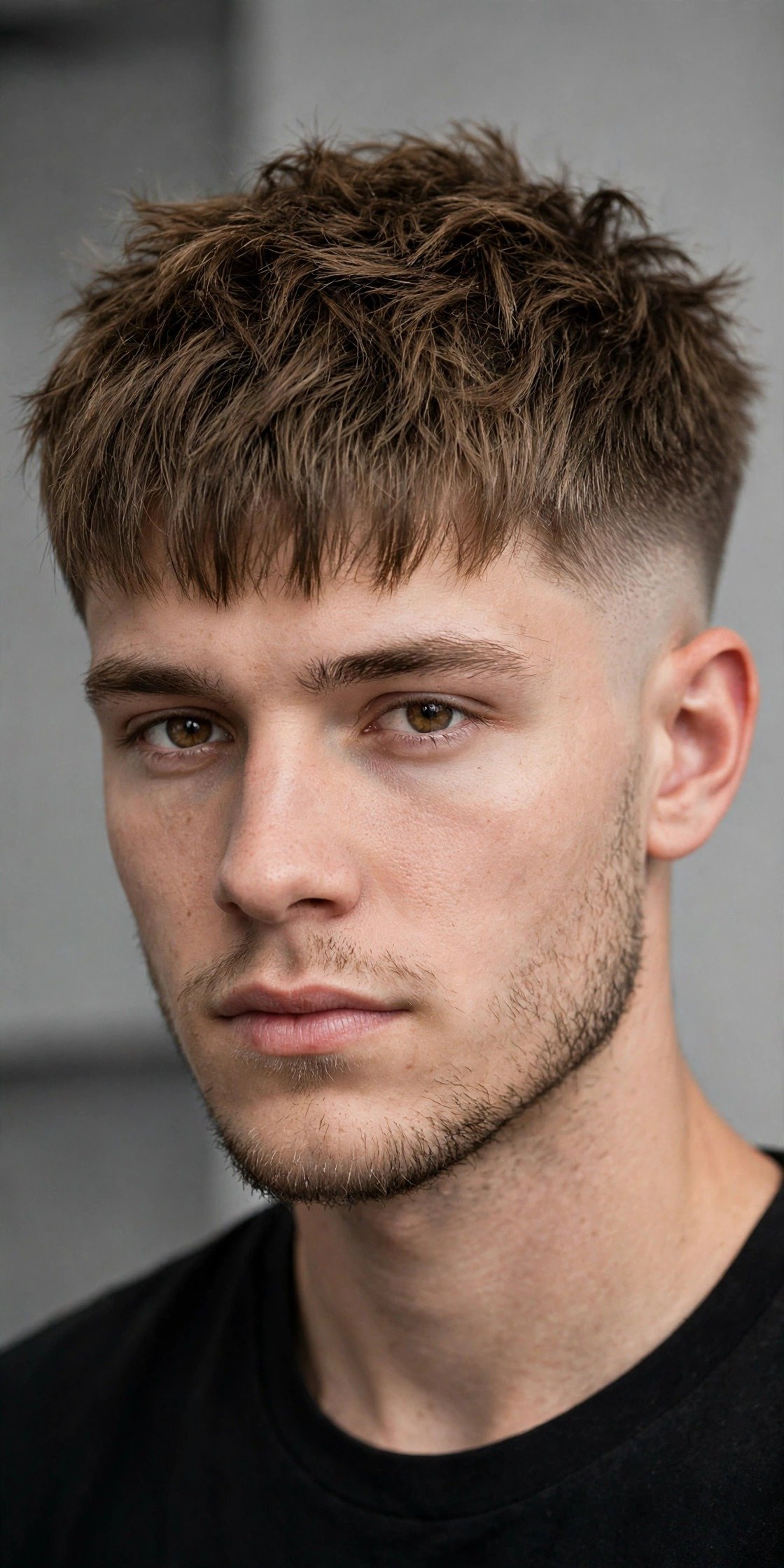
The burst fade brings its signature rounded shape — the fade “bursts” outward around the ear in a semicircular blend — to the textured crop. It is the most distinctive fade silhouette on this list, curving around the ear rather than running straight back, which gives the cut a modern, almost futuristic geometry. The textured top stays full and choppy, and the contrast between the organic top and the sculpted burst is what makes it work. This is the version for men who want their fade to be a feature.
It suits straight and wavy hair best and flatters oval, square, and diamond faces. Ask your barber for a textured crop with a burst fade — “burst it around the ear” — and be clear about how tight you want the burst, since it can range from subtle to dramatic. It needs a trim every two to three weeks to keep the curve defined. Style the top with matte clay, forward and separated. The burst fade has been climbing in 2026 alongside the textured crop itself, and the combination is one of the year’s freshest pairings.
33. Textured Crop With Temple Fade
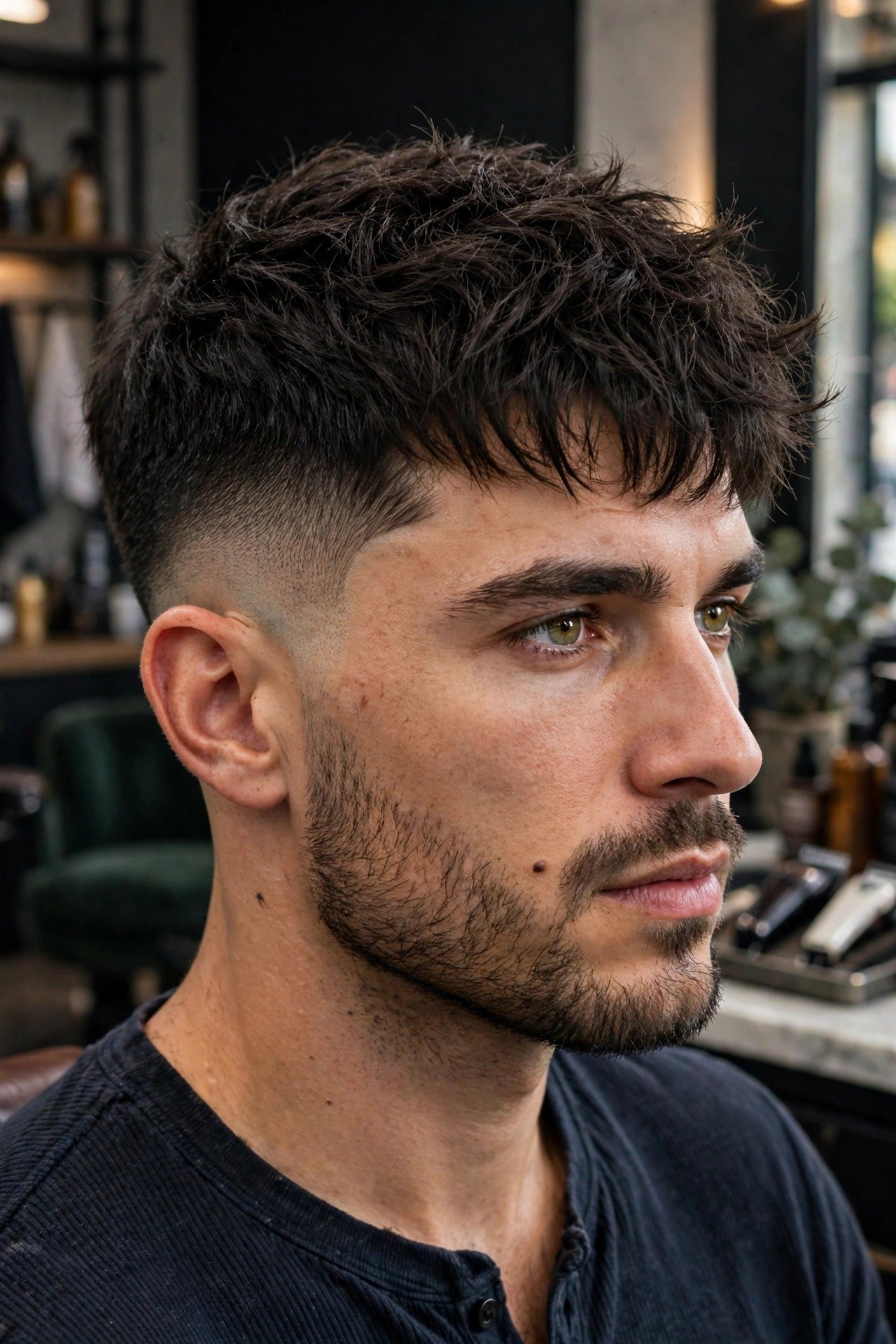
The temple fade is the precision detail added to the textured crop: the fade concentrates on the temple zone — that strip where the hairline meets the face — tapering it down clean while the rest of the sides stay fuller. It is the smallest intervention with the biggest payoff, sharpening the cut’s frame without changing its character. The textured top stays exactly as it would in the classic version; only the temples get the treatment. For the full breakdown of the technique, our temple fade guide for men covers the variables in depth.
It suits every face shape and works as an addition to almost any textured crop variation on this list — think of it as an upgrade rather than a standalone version. Ask your barber to “add a temple fade” to your textured crop, specifying to-skin or shadow, and confirm the neckline gets cleaned up to match. It needs a touch-up every two weeks to stay crisp, though the touch-up itself takes ten minutes. Style normally with matte clay. This is the textured crop for men who believe the details are the design.
34. Textured Crop With Buzzed Sides
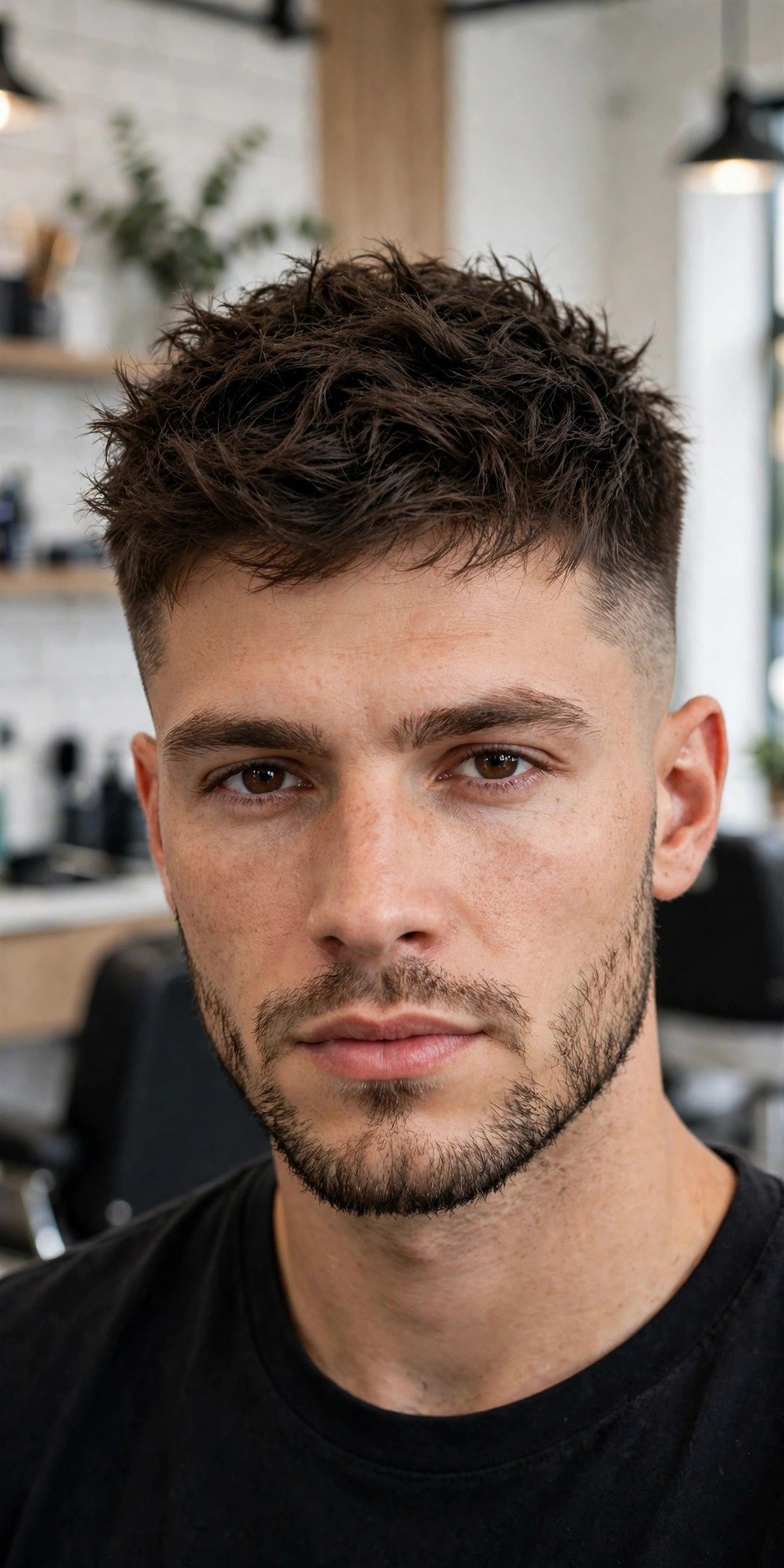
Buzzed sides strip the fade away entirely: the sides and back are clipped to a uniform short length — a number two or three guard — while the top stays long and textured. No blend, no gradient, just a clean, honest contrast between the buzzed perimeter and the textured crown. It is the most low-maintenance side finish on this list and the most striking in its simplicity. The uniform sides make the top look even more deliberate by comparison.
It suits thick hair best, where the contrast is strongest, and it flatters square and oval faces. The grow-out is the most forgiving of any faded version — uniform short sides grow evenly and can be touched up at home with clippers between barber visits. Ask your barber for a textured crop with buzzed sides — “number two on the sides, no fade, keep the top textured” — and specify the guard. Style the top with matte clay as usual. For men who want maximum contrast with minimum maintenance, buzzed sides are the smartest choice on this list.
35. Textured Crop With Caesar Fringe

The Caesar-fringe version borrows the Caesar cut’s signature — a straighter, more structured fringe line — and sets it on a textured crop’s top. The fringe is cut more horizontally and deliberately than the typical broken-up crop fringe, while the crown behind it stays textured and full. The result is a fascinating hybrid: the graphic precision of the Caesar in front, the organic movement of the crop behind. It is the most structured fringe on this list, and our Caesar cut guide covers the full version for men who want to go further in that direction.
It suits straight hair best, where the fringe line stays crisp, and it flatters oval, square, and heart-shaped faces — the horizontal fringe balances longer faces beautifully. Ask your barber for a textured crop with a Caesar-style fringe — “straighter across, more structured, but keep the top textured” — and specify the fringe length, usually at or just above the eyebrows. Style with a small amount of matte paste, pushing the fringe forward and keeping the line clean. It needs a fringe trim every three weeks. This is the textured crop for men drawn to the Caesar’s precision but unwilling to give up texture.
36. The Effortless Everyday Textured Crop

The last version on this list is the one most men will actually wear: the everyday textured crop, tuned for real life. The top is textured but not aggressively so — enough separation to look intentional, not so much that it needs daily styling heroics. The sides are a clean taper that grows out gracefully. The fringe is short enough to never need attention. It is the version that looks good on day one and day twenty-one, in the office and on the weekend, with product and without. Every other version on this list is a specialization; this one is the foundation.
Ask your barber for “a textured crop I do not have to think about” — the most honest brief in barbering, and one every good barber knows how to execute: medium texture, clean taper, wearable fringe. About two inches on top. Style with whatever you have — clay, paste, or nothing at all on the days you cannot be bothered. It needs a trim every four to five weeks, the most forgiving schedule here. If you read all thirty-six versions and felt overwhelmed, choose this one. The everyday textured crop is the reason the cut is number one in 2026: it is the haircut that fits into a man’s life instead of demanding he fit into it.
Frequently Asked Questions
What is a textured crop haircut?
A textured crop is a short men’s haircut defined by separation: the top is left one to three inches long and cut with point-cutting, slicing, or razor work so it breaks into distinct, piece-y sections instead of a solid block. The sides and back are kept short — a fade, taper, or even scissor cut — and the fringe is short and broken up rather than blunt. The result is a clean, modern cut with natural movement that takes minutes to style.
How do I ask my barber for a textured crop?
Say “textured crop” first, then specify the two dials: top length and side finish. For the top, give a length and a direction — “about two inches, heavily textured, worn forward.” For the sides, name the finish — low taper for subtle, mid fade for balance, skin fade for contrast. Mention how your hair behaves, and bring a reference photo from the thirty-six ideas above. “Like number five but with a lower fade” tells your barber everything.
Is the textured crop good for thin or fine hair?
It is one of the best cuts for fine hair. The separated, piece-y top creates light-and-shadow play that the eye reads as density, making fine hair look noticeably thicker. Ask your barber for light, airy texture and specifically say not to thin it out — over-thinning fine hair is the classic mistake. Pair the cut with sea salt spray for grip and a small amount of matte clay, and avoid heavy creams that weigh it down.
What is the difference between a textured crop and a French crop?
The French crop is essentially a specific type of textured crop: short top, fringe, and usually a skin fade, worn messier. The textured crop is the broader category — it includes the French crop but also covers longer tops, taper finishes, side sweeps, and dozens of other variations. If someone says “French crop,” they mean one version; “textured crop” is the whole family. Every French crop is a textured crop, but not every textured crop is a French crop.
How long does a textured crop take to style each morning?
Three to five minutes. Towel-dry until damp, warm a pea-sized amount of matte clay between your palms, work it through the top with your fingers pushing forward, and pinch a few pieces for separation. No comb, no heat tools. It is one of the few men’s cuts that genuinely qualifies as wash-and-go, which is a major reason it dominates 2026’s trend reports.
What products do I need for a textured crop?
One essential: a matte clay or texture paste. That covers ninety percent of textured crop styling. Two useful extras: sea salt spray for fine or wavy hair (adds grip and body on damp hair before the clay), and a light cream for thick or coarse hair (keeps the texture controlled). Avoid high-shine gels and heavy waxes, which kill the matte, modern finish that defines the 2026 textured crop.
Does the textured crop suit a receding hairline?
Yes — it is one of the best cuts for a receding hairline. Everything on top moves forward, so the hair naturally covers the temples where recession shows first, and the broken-up texture means there is no harsh hairline drawing the eye. Keep the top at least an inch and a half long so there is enough hair to direct forward, ask your barber for slightly longer coverage at the corners, and avoid slicking back or spiking up.
How often should I get a textured crop trimmed?
Every three to five weeks depending on the version. Skin fades and high fades need refreshing every two to three weeks to stay crisp; taper and scissor-cut versions stretch to four or five. The top itself grows out gracefully because the texture keeps its character as it lengthens — the sides are always what bring you back to the chair first.
Can I wear a textured crop with a beard?
Absolutely — it is one of 2026’s most requested combinations. The crop’s clean sides make the beard look intentional, while the beard gives the face the weight the short cut removes. Ask your barber to blend the fade into the beard through the sideburns with no harsh line, keep the beard’s cheek lines clean and the neckline defined, and maintain both on the same trim schedule so they grow out evenly.
Why is the textured crop trending in 2026?
Three forces converged. First, the data: Perfect Corp’s 2026 roundup names it the number one trending men’s cut from Pinterest data, and Accio’s market report calls it an enduring top trend with “minimum effort, maximum result” appeal. Second, the grooming direction: 2026 favors matte over shiny, movement over rigidity, and low-effort wear — the textured crop is the perfect vessel. Third, the practicality: it looks good for weeks, suits all hair types and ages, and takes three minutes to style. A cut that satisfies the data, the aesthetic, and the lifestyle does not stay a trend for long — it becomes the default.
Conclusion
The textured crop earned its place at the top of 2026 for the simplest reason a haircut can: it works. It works on straight hair and curly hair, on thick heads and fine ones, on teenagers and on men in their fifties. It works in the three minutes you have on a Tuesday morning and in the photographs you will keep for years. It asks almost nothing of you — a fingertip of matte clay, a trim every month — and gives back a look that is sharp, current, and unmistakably intentional. That is a rare transaction in men’s grooming, and it is why every major trend report this year points at the same cut.
Thirty-six versions is a lot of choice, so here is how to use them. If you have never worn a textured crop, start with the classic or the everyday version — they are the foundation everything else builds on, and they will teach you what your hair does with texture. If you know your hair, pick the version built for it: the fine-hair crop, the curly crop, the thick-hair crop. If you know your life, pick the version built for that: the low fade for the office, the skin fade for the statement, the messy crop for the mornings you cannot be bothered. Screenshot two or three, bring them to your barber, and use the vocabulary from this guide — taper, fade, fringe, texture — to turn a vague request into a precise one.
And then enjoy the easiest good-hair era of your life. The textured crop men are wearing in 2026 is not a trend you chase; it is a standard you settle into. Get the cut, learn the three-minute routine, and get on with everything else. Your hair has never been less of a problem — or looked better for it.
6 Comments