
Wispy Bob Women 2026: 32 Soft, Airy Styles
The wispy bob is the softest, lightest haircut of 2026 — a chin-length bob with feathered ends, airy layers, and a fringe that separates instead of sitting as a solid curtain, so the whole shape floats rather than hangs. It is the bob for women who love short hair but hate stiff, structured shapes, and it has surged to the top of every salon request list this year because it does what no other bob can: it makes fine hair look full, thick hair look light, and every face look softer. In this guide you will find 32 wispy bob styles for 2026, each with a stylist-ready script, honest styling advice, and the maintenance truth nobody tells you at the chair.
Whether you wear straight hair, soft waves, natural curls, or hair that falls somewhere in between, there is a wispy bob in this list built for you. We cover every shape — classic and chin-length, angled and inverted, blunt and layered — alongside every finish, from curtain bangs and face-framing layers to caramel balayage and mushroom brown. Every style below follows the same proven structure: who it suits, exactly what to tell your stylist (length, layer placement, and fringe included), how to style it in under five minutes, and how often you will need a trim. Let us find your version.
What Is a Wispy Bob
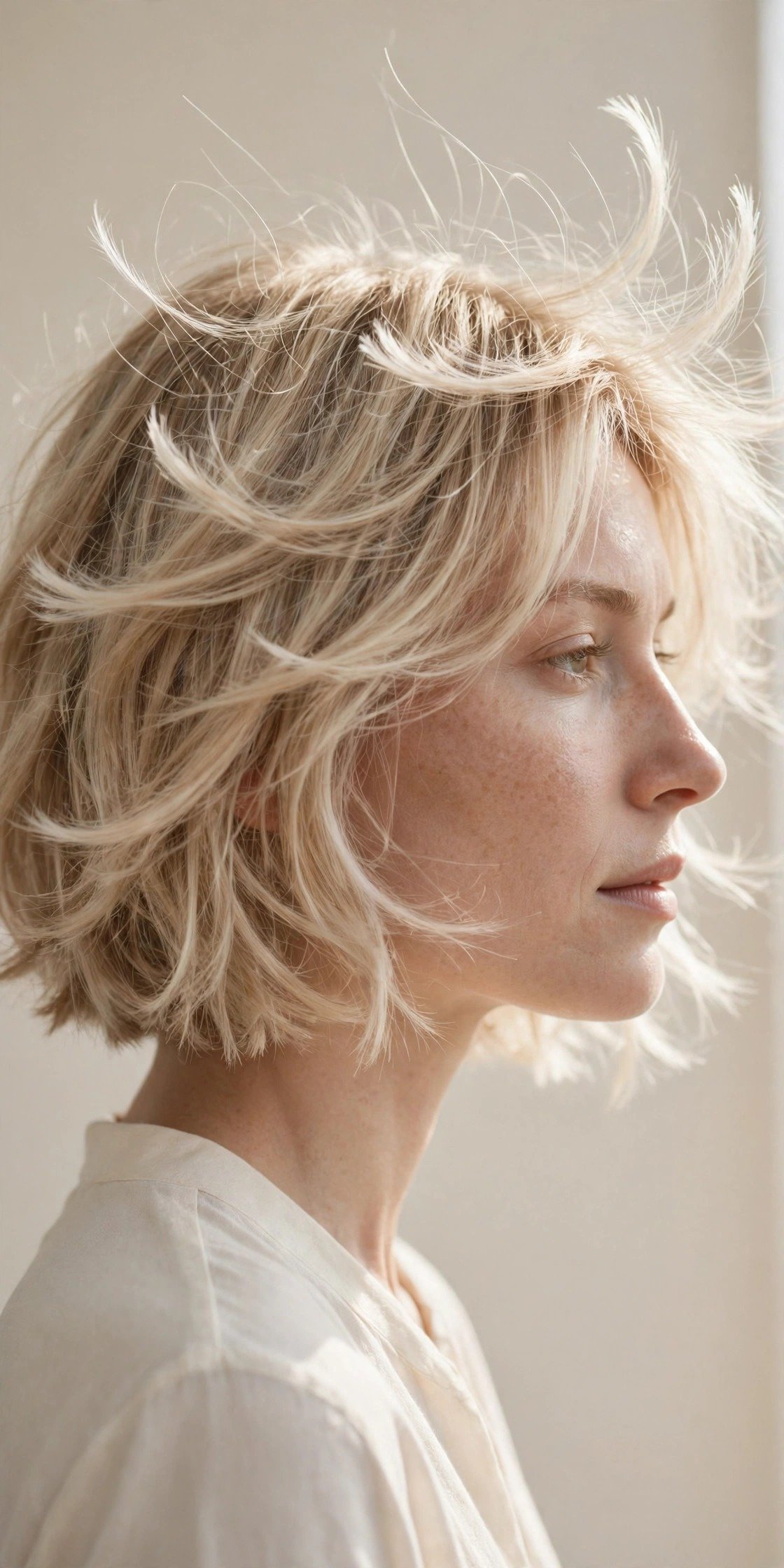
A wispy bob is a women’s haircut in which a classic bob — usually chin-length to shoulder-length — is cut with feathered, point-cut ends and soft internal layers, so the hair looks light, airy, and full of movement instead of solid and heavy. Unlike a blunt bob, which ends in one clean, straight line, the wispy bob’s ends are broken up into fine, separated pieces that flutter and move, and the fringe — when there is one — is cut the same way, so it separates into soft strands across the forehead rather than sitting as a heavy curtain. The result is a bob that looks effortless, lived-in, and soft from every angle.
The mechanics are simple once you see them. The stylist cuts the bob to chin length or just below, then point-cuts the ends — snipping vertically into the hair rather than straight across — so each strand ends at a slightly different length and the perimeter looks feathered instead of blunt. Soft internal layers are added through the crown and sides to remove weight and create movement, and the fringe is point-cut the same way so it falls in separated wisps. The back is kept light and airy too, with the nape tapered or undercut slightly so the bob never looks bulky from behind.
What makes the wispy bob so versatile is that it is a frame, not a finished picture. The wispy structure is neutral — soft, flattering on nearly every face shape, and easy to grow out — while the details are where the personality lives. Change the fringe and you change the entire haircut: a wispy fringe reads romantic, curtain bangs read effortless, a side sweep reads polished, and no fringe at all reads clean and modern. That is why this guide carries 32 versions of the same foundation. The wispy bob also photographs exceptionally well, since the feathered ends catch light differently from every angle, which is one reason it keeps going viral. And because the shape is deliberately soft, it always looks intentional even on days when the hair is doing its own thing.
Why the Wispy Bob Is Dominating 2026

The wispy bob’s dominance in 2026 is no accident — it sits at the exact intersection of the year’s biggest hair trends. According to the Pinterest 2026 Beauty Trend Report, searches for short layered bob haircuts are up 571%, searches for textured French bobs are up 338%, and searches for shag bobs are up 214%, which tells you exactly where the momentum is: women want softer, more relaxed bobs, and the wispy bob is the purest expression of that shift. The bob has dominated hair trends for the past two years, and the 2026 versions — lighter, airier, and more textured than ever — keep it firmly at the top.
The second force behind the comeback is the softness revival itself. According to SSBCrack News’ report on the bob’s 2026 staple status, the year’s defining direction is softer, more relaxed cuts replacing anything too structured or overly styled, with the long layered bob up 622% and the French bob with a fringe up 394%. The Wedding Edition’s coverage of the bridal bob moment makes the same point from the styling side: the message of 2026 is that softer, more relaxed cuts are replacing anything too structured. The wispy bob is that message in haircut form.
The third reason is pure practicality. A wispy bob is one of the most forgiving cuts a woman can wear. It flatters round, square, oval, and heart-shaped faces because the length and fringe direction can be adjusted to balance proportions. It handles fine, thick, straight, wavy, and curly hair alike, because the feathered structure works the same way whatever grows on top — fine hair looks fuller, thick hair looks lighter, and curly hair looks shaped instead of triangular. It grows out gracefully, since a feathered perimeter always ages better than a blunt line. And it scales from a five-minute morning routine to a high-gloss evening finish with nothing more than a product swap. When one cut serves that many needs, it stops being a trend and becomes the default.
1. The Classic Wispy Bob

The classic wispy bob is the purest form of the cut and the safest first choice. The bob is kept at chin length, the ends are point-cut so they feather softly instead of ending in a blunt line, and light internal layers through the crown give it movement without removing length. This is the version your stylist recommends when you say “give me a bob but keep it soft.” It suits every face shape and every hair type, and it is the most forgiving of the 32 styles here if you are trying a wispy bob for the first time.
Stylist script: ask for a chin-length bob with the ends point-cut for a feathered finish, light internal layers through the crown for movement, and a soft, natural perimeter — no blunt line anywhere. Request the back kept light at the nape, tapered slightly so the bob never looks bulky from behind. Tell your stylist you want the ends to separate naturally, not sit as a solid shelf, and the fringe — if you want one — point-cut into soft wisps. The shape should float, not hang.
Styling routine: apply a light mousse or texturizing spray to damp hair, blow-dry with a round brush for a soft bend, or let it air-dry for a more relaxed finish. Five minutes, no heavy product required — the feathered ends do the visual work. Maintenance: trim every six to eight weeks; the wispy bob grows out gracefully, and a weekly tidy of the nape keeps the back looking deliberate between visits.
2. Wispy Bob with Bangs
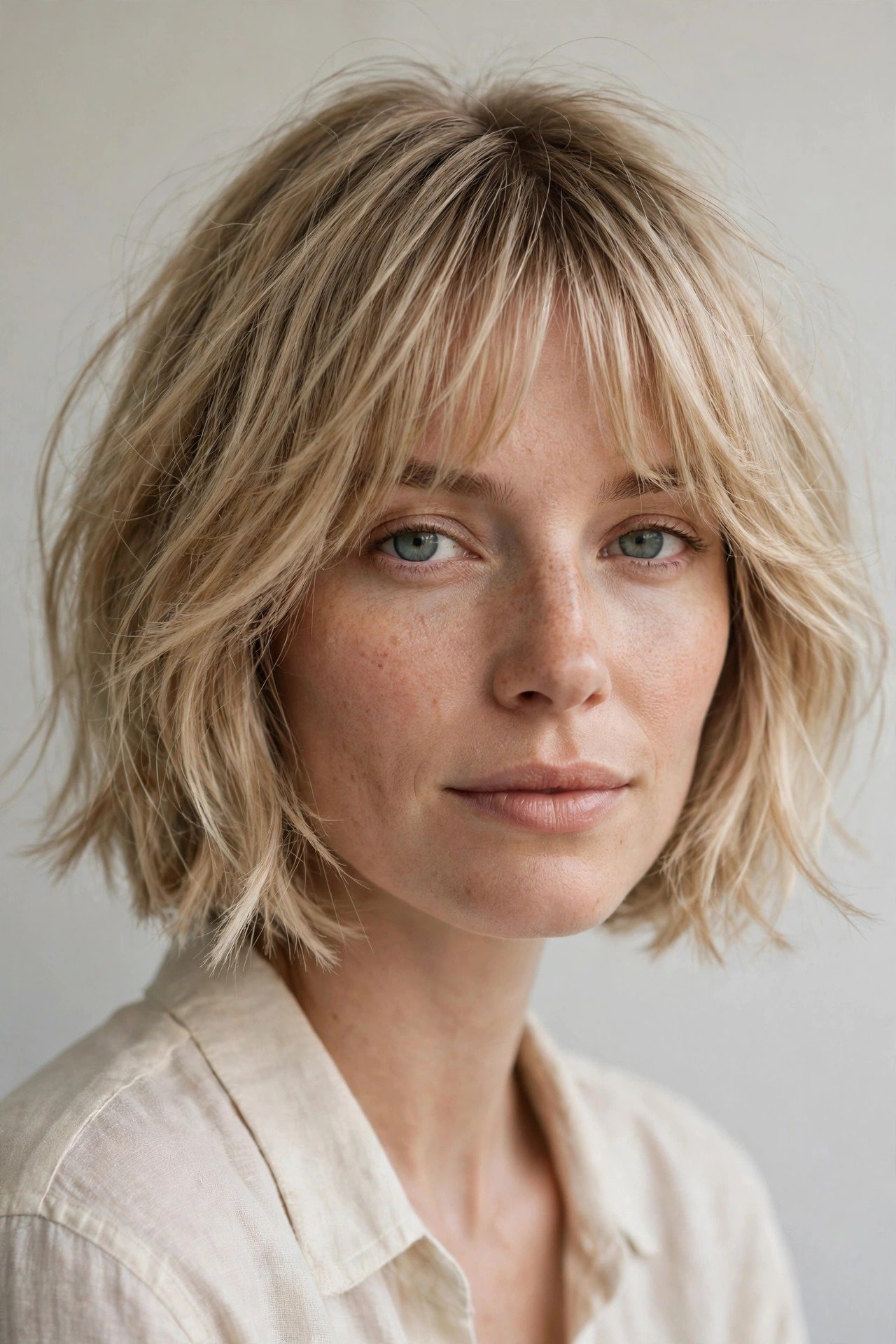
The wispy bob with bangs is the romantic version: a chin-length bob with a soft, airy fringe that separates into fine strands across the forehead, so the whole face is framed in lightness. The bangs are the point — they soften the forehead, draw the eye to the eyes, and give the bob a gentle, approachable quality that a bang-less bob can never match. It suits straight and slightly wavy hair best, where the bangs fall naturally, and it flatters oval and heart-shaped faces beautifully, since the wispy fringe softens the forehead without hiding it.
Stylist script: ask for a chin-length wispy bob with a soft fringe cut to eyebrow length, point-cut so it separates into wisps rather than sitting as a solid curtain. Tell your stylist you want the bangs light and airy — they should be able to see your forehead through them. Request the ends of the bob feathered the same way, and the back kept light at the nape. Ask them to cut the fringe dry or barely damp so it sits exactly where it will live.
Styling routine: a small amount of light cream through the damp fringe, parted where you like it, and a quick round-brush blow-dry — the strands do the work. Maintenance: every six weeks; the fringe needs a trim to stay out of the eyes, and the bob needs reshaping to keep its feathered ends. This is the wispy bob for women who want the full romantic effect.
3. Wispy Wavy Bob

The wispy wavy bob is the effortless version: soft natural waves through a chin-length bob, with feathered ends that let the waves move freely instead of weighing them down. The waves give the bob its body — no styling required, because the texture is already there — while the wispy ends keep the whole shape light and airy. It suits naturally wavy hair best, where the waves form on their own, and it flatters every face shape, and it is the best version for women who want a bob that looks styled when it is not.
Stylist script: ask for a chin-length wispy bob cut to follow your wave pattern — tell your stylist to cut it dry or barely damp so the waves are visible while they work. Request the ends point-cut so the waves separate, and light internal layers through the crown to remove weight. Tell your stylist you want the waves to fall where they naturally fall, not forced into a rigid shape, and the back kept light at the nape so the waves have room to move.
Styling routine: sea-salt spray on damp hair, scrunched and left to air-dry, is the entire routine — the waves do the work. Maintenance: every six to eight weeks; wavy hair hides growth better than straight hair, so this is one of the most forgiving versions to maintain. If your waves are strong, this may be the easiest great-looking wispy bob you will ever wear.
4. Wispy French Bob

The wispy French bob is the Parisian version: a short bob, usually between the lips and chin, with a delicate wispy fringe and soft texture that reads as effortlessly chic. It is the bob that looks like it was cut in a Paris salon and styled in thirty seconds, because it was — the French bob’s charm is its imperfection, and the wispy version leans into it fully. It suits straight and slightly wavy hair best and flatters oval and square faces, since the short length highlights the cheekbones while the wispy fringe softens the forehead.
Stylist script: ask for a French bob — short, between the lips and chin — with a wispy fringe that breaks across the forehead in separated strands. Tell your stylist you want the ends point-cut, not blunt, so the bob looks slightly imperfect rather than sculpted. Request the back kept light and the nape tapered, so the short shape stays airy. Ask them to cut the fringe following your natural texture, not against it, and keep the overall finish soft and lived-in.
Styling routine: a small amount of texturizing spray on damp hair, scrunched and left to air-dry, is the entire routine — the French bob does the work. Maintenance: every five to six weeks; the short length needs regular reshaping or the wispy ends lose their definition. This is the wispy bob for women who want Parisian chic without the Paris flight.
5. Wispy Chin-Length Bob

The wispy chin-length bob is the precise version: a bob that ends exactly at the chin, with feathered ends that skim the jawline and airy layers that keep the shape light. The chin length is the point — it frames the jaw, highlights the cheekbones, and gives the whole head a clean, deliberate silhouette — while the wispy ends stop it from looking severe. It suits straight and slightly wavy hair best and flatters oval and heart-shaped faces, since the chin length draws the eye to the jawline and the feathered ends soften it.
Stylist script: ask for a bob cut to exactly chin length, with the ends point-cut for a feathered finish and light internal layers for movement. Tell your stylist you want the length to skim the chin, not sit above or below it, and the perimeter soft — no blunt line anywhere. Request the back kept light at the nape, tapered slightly so the bob never looks bulky from behind. Ask them to check the length with your head level, not tilted, since chin length changes with posture.
Styling routine: blow-dry with a round brush for a soft bend under, or let it air-dry for a more relaxed finish — either way, the chin length does the work. Maintenance: every six weeks; chin length grows out visibly, so this version needs the most regular trims. This is the wispy bob for women who want precision with softness.
6. Wispy Angled Bob
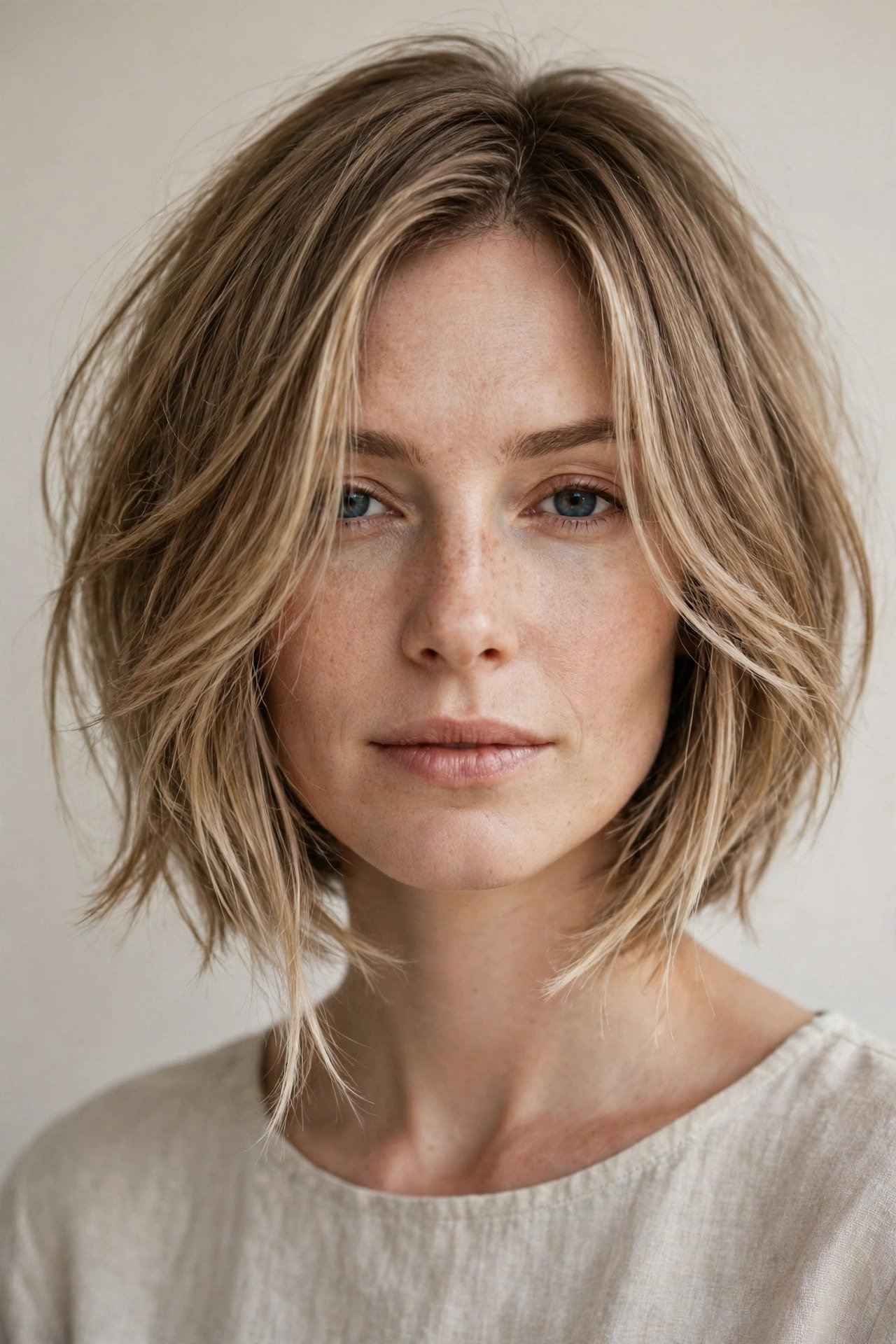
The wispy angled bob is the face-framing version: shorter at the back, longer at the front, with the front pieces reaching the collarbone or just below, so the bob frames the face in a soft, diagonal line. The angle is the point — it elongates the face, highlights the jawline, and gives the bob a modern, directional feel — while the wispy ends keep the whole shape light and airy. It suits straight and wavy hair best and flatters round and square faces, since the longer front pieces slim the face visually.
Stylist script: ask for an angled bob — shorter at the back, longer at the front — with the front pieces reaching the collarbone, and the ends point-cut for a feathered finish. Tell your stylist you want the angle gentle, not dramatic, so the bob reads as soft rather than sharp. Request light internal layers through the crown for movement, and the back kept light at the nape. Ask them to cut the front pieces to follow your jawline, not against it.
Styling routine: blow-dry the front pieces forward and under with a round brush for a soft bend, or let them air-dry for a more relaxed finish. Maintenance: every six weeks; the angle needs reshaping to stay visible as it grows. This is the wispy bob for women who want their bob to do the contouring.
7. Wispy Inverted Bob

The wispy inverted bob is the voluminous version: stacked layers at the back that graduate upward, giving the crown lift and fullness, with longer, softer pieces at the front that frame the face. The inversion is the point — the stacked back creates volume where fine hair needs it most, while the wispy front keeps the whole shape light and airy. It suits fine and medium hair best, where the stacking adds real fullness, and it flatters oval and round faces, since the volume at the back balances the face’s proportions.
Stylist script: ask for an inverted bob with stacked layers at the back, graduated so the crown has lift, and longer front pieces that frame the face. Tell your stylist you want the ends point-cut for a feathered finish, not blunt, so the stacked shape stays soft. Request the nape tapered lightly so the stack never looks bulky, and the front pieces kept long enough to reach the chin. Ask them to check the stack from the side, since the graduation is what makes or breaks this cut.
Styling routine: blow-dry the back upward with a round brush for volume, then smooth the front pieces forward — the stack does the work. Maintenance: every six weeks; the stacked back needs reshaping to keep its lift. This is the wispy bob for women who want volume without teasing.
8. Wispy Blunt Bob
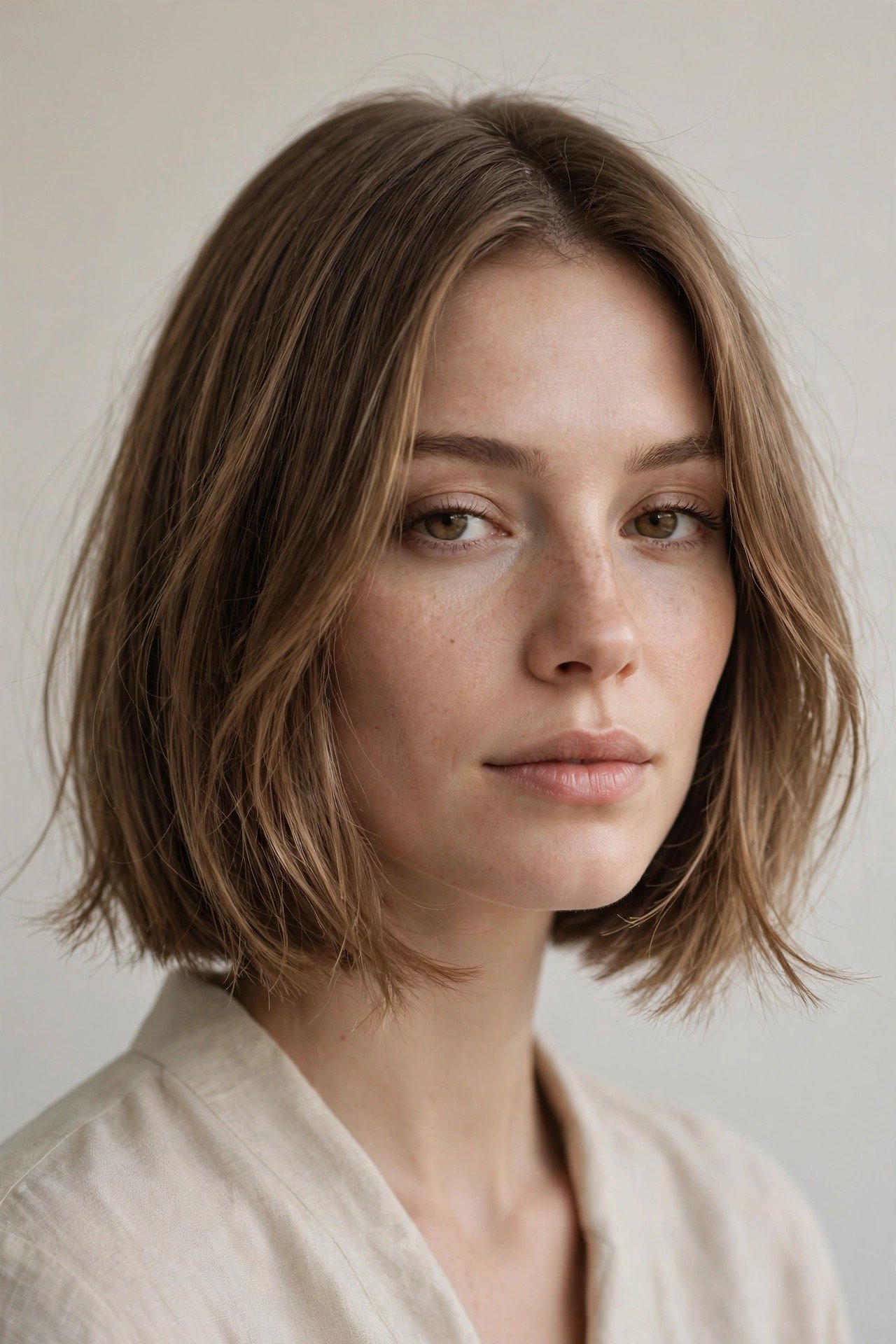
The wispy blunt bob is the contradiction that works: a blunt bob’s clean, graphic shape, softened by wispy, feathered ends that stop it from looking severe. The perimeter reads as one deliberate line from a distance, but up close the ends separate into fine, airy pieces that move and flutter. It suits straight hair best, where the blunt line stays crisp, and it flatters oval and square faces, since the clean shape highlights strong features while the wispy ends soften them. This is the version for women who want structure with softness.
Stylist script: ask for a blunt bob — one clean length, usually chin-length — with the ends point-cut just enough to feather them, so the line reads as blunt from a distance and wispy up close. Tell your stylist you want the softness in the ends only, not in the shape: the bob should still read as one deliberate line. Request the back kept clean and the nape tapered lightly. Ask them to cut the ends dry so the feathering sits exactly where it will live.
Styling routine: blow-dry straight with a paddle brush for a sleek finish, or add a soft bend with a round brush — either way, the blunt shape does the work. Maintenance: every six weeks; the blunt line grows out visibly, so this version needs regular trims. This is the wispy bob for women who want a graphic shape with a soft edge.
9. Wispy Layered Bob
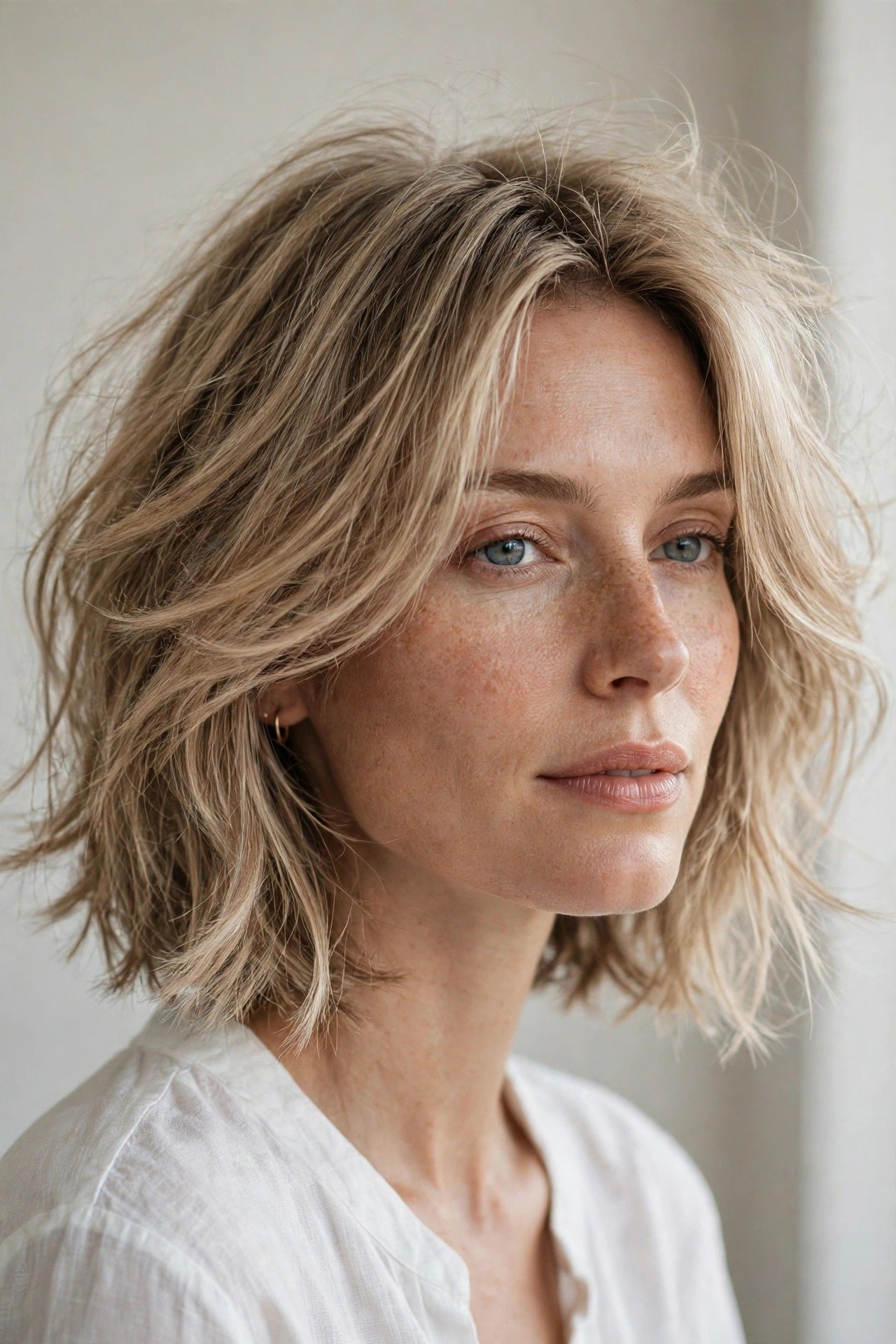
The wispy layered bob is the movement version: soft internal layers through the whole bob that give it bounce, swing, and life, so the hair moves when you do instead of sitting as one solid shape. The layers are the point — they remove weight, create separation, and let the feathered ends flutter — while the chin-length perimeter keeps the whole shape recognisably a bob. It suits thick hair best, where the layers remove the bulk that makes bobs look heavy, and it flatters every face shape, since the movement softens everything it touches.
Stylist script: ask for a chin-length bob with soft internal layers through the crown and sides, point-cut ends for a feathered finish, and a light, airy perimeter. Tell your stylist you want the layers to create movement, not remove length — the bob should still read as chin-length from the outside. Request the back kept light at the nape, and the layers graduated so the crown has lift. For the layered pairing in more depth, our long layered bob guide shows how soft layers pair with a longer bob.
Styling routine: a light mousse on damp hair, blow-dried with a round brush for bounce, or left to air-dry for a more relaxed finish. Maintenance: every six to eight weeks; the layers hide growth well, so this is one of the most forgiving versions to maintain. This is the wispy bob for women who want their hair to move.
10. Wispy Bob with Curtain Bangs

The wispy bob with curtain bangs is the face-framing version: long, soft bangs parted in the middle, falling on both sides of the forehead in separated strands, over a chin-length bob with feathered ends. The curtain bangs do the framing work — they soften the forehead, highlight the cheekbones, and give the bob a romantic, almost cinematic quality — while the wispy ends keep the whole shape light. It suits straight and wavy hair best, where the bangs fall naturally, and it flatters oval and heart-shaped faces.
Stylist script: ask for a chin-length wispy bob with curtain bangs — long bangs, parted in the middle, reaching the cheekbones on both sides, point-cut so they fall in separated strands. Tell your stylist you want the bangs to blend into the bob’s front pieces, not sit apart from them. Request the ends feathered the same way, and the back kept light at the nape. Ask them to cut the bangs following your natural part, not against it.
Styling routine: part the damp bangs down the middle with your fingers, add a small amount of light cream, and blow-dry them outward for a soft curtain — or let them air-dry for a more relaxed finish. Maintenance: every six weeks; the bangs need a trim to stay out of the eyes, and the bob needs reshaping to keep its feathered ends. This is the wispy bob for women who want the full romantic effect.
11. Wispy Bob with Side-Swept Bangs
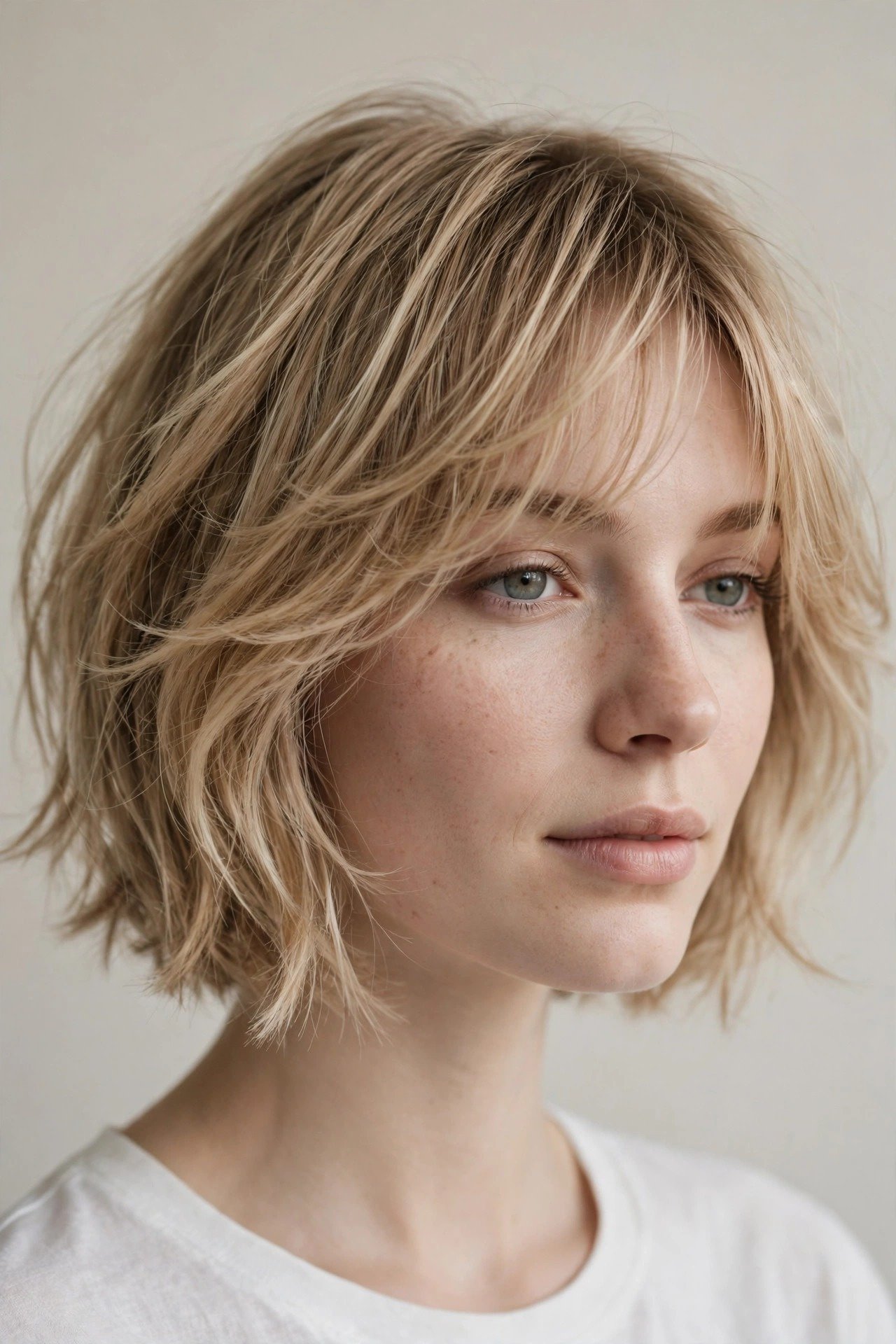
The wispy bob with side-swept bangs is the polished version: a soft fringe swept diagonally across the forehead, over a chin-length bob with feathered ends that keeps the whole shape light. The diagonal sweep adds movement and asymmetry, which flatters nearly every face shape — it softens strong jawlines, shortens long foreheads, and gives the whole cut a relaxed, approachable feel. It suits straight and slightly wavy hair best, where the fringe falls naturally to the side, and it is one of the most versatile versions on this list for women who want bangs without commitment.
Stylist script: ask for a chin-length wispy bob with side-swept bangs — the fringe left long enough to sweep across the forehead, point-cut so it separates into soft strands. Tell your stylist you want the bangs to fall to your preferred side naturally, following your hair’s growth direction. Request the ends of the bob feathered the same way, and the back kept light at the nape. For the side-swept pairing in more depth, our curtain bangs guide shows how soft bangs frame the face.
Styling routine: a small amount of light cream through the damp fringe, pushed in the direction of the sweep, and a quick round-brush blow-dry — the strands do the work. Maintenance: every six weeks; the fringe needs a trim to stay out of the eyes, and the bob needs reshaping to keep its feathered ends. This is the wispy bob for women who like a little polish in their haircut.
12. Wispy Bob with Face-Framing Layers
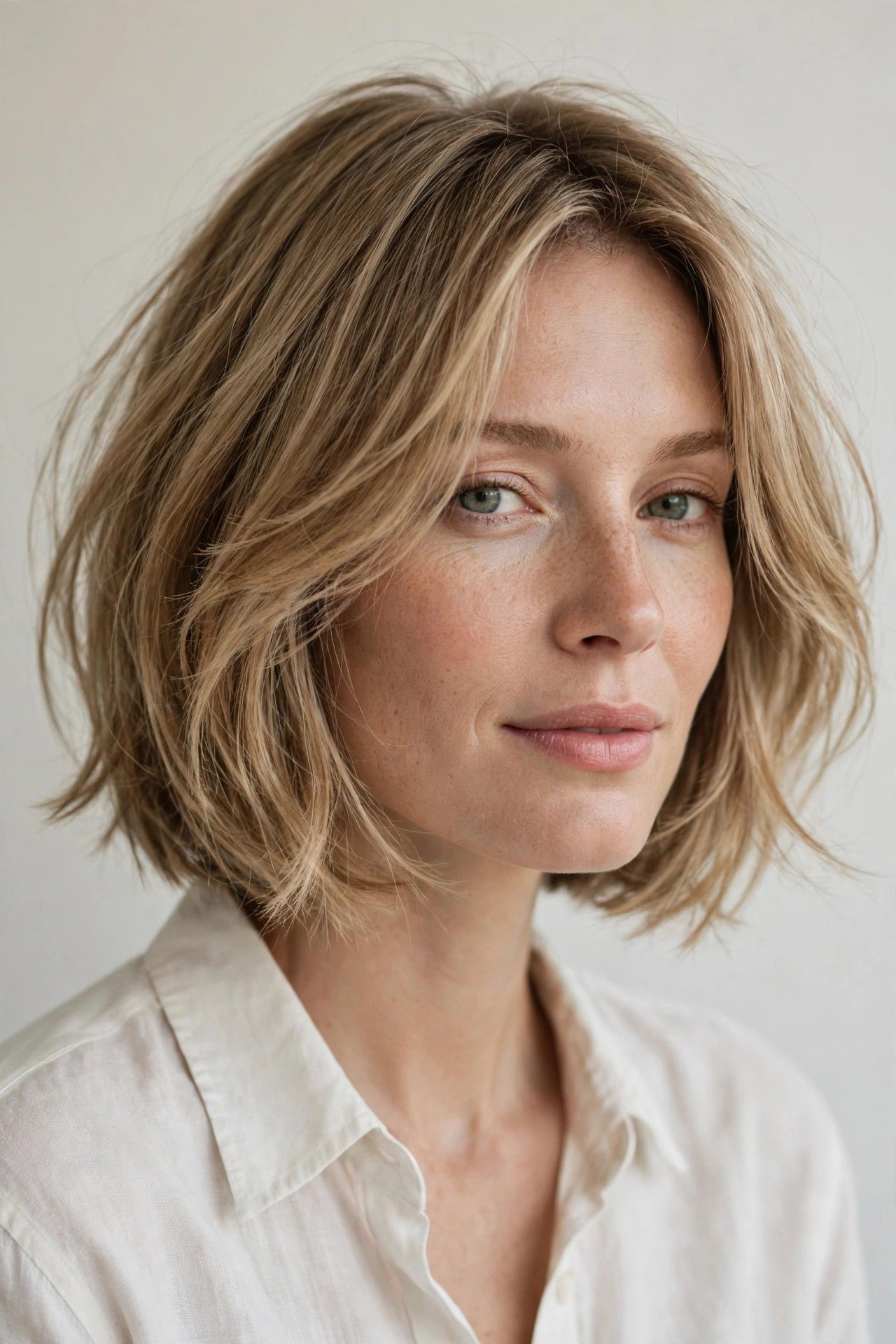
The wispy bob with face-framing layers is the contouring version: soft layers that start at the cheekbones and fall past the jawline, framing the face in a gentle, flattering line while the rest of the bob stays chin-length and airy. The layers do the contouring work — they highlight the cheekbones, slim the jawline, and draw the eye to the eyes — while the wispy ends keep the whole shape light. It suits every hair type and flatters every face shape, and it is the best version for women who want their bob to do the work of contouring makeup.
Stylist script: ask for a chin-length wispy bob with face-framing layers starting at the cheekbones, point-cut so they fall in soft, separated strands. Tell your stylist you want the layers to frame the face, not cover it — they should highlight your features, not hide them. Request the ends of the bob feathered the same way, and the back kept light at the nape. Ask them to cut the layers following your face shape, with the shortest layer at your best feature.
Styling routine: blow-dry the face-framing pieces forward and under with a round brush for a soft bend, or let them air-dry for a more relaxed finish. Maintenance: every six weeks; the layers need reshaping to stay at the right length as they grow. This is the wispy bob for women who want their haircut to flatter them from every angle.
13. Wispy Bob for Fine Hair

Fine hair gets the biggest transformation from a wispy bob of any hair type. The problem with fine hair is that solid, one-length cuts lie flat and expose the scalp; the solution is separation — when the bob is point-cut into distinct pieces, each piece casts a tiny shadow on the one behind it, and the eye reads that light-and-shadow play as density. The feathered ends add the second half of the illusion: a soft, broken-up perimeter looks fuller than a solid line. A good wispy bob can make fine hair look twice as thick as it is.
Stylist script: ask for a chin-length bob cut specifically for fine hair — “light, airy texture, do not thin it out” — because over-thinning fine hair is the classic mistake that makes it look thinner. Chin length is the sweet spot: enough length for separation, not so much that it goes limp. Request the ends point-cut for a feathered finish, light internal layers for movement, and a soft, natural perimeter. Ask your stylist to keep the back light, not stacked, so the fullness stays where it belongs.
Styling routine: volumizing mousse at the roots, blow-dried with a round brush for lift, then a light texturizing spray through the ends — the volume is the whole point, so do not flatten it. Maintenance: every six weeks; the feathered ends need regular reshaping or the illusion collapses. This is the version that turns a hair insecurity into a non-issue — and the wispy bob is the frame that makes it work.
14. Wispy Bob for Thick Hair

Thick hair is both the wispy bob’s best friend and its biggest challenge — there is plenty of material for texture and volume, but without internal weight removal the bob mushrooms instead of moving, and the ends can look bulky instead of feathered. The thick-hair version solves both problems: the stylist removes weight from inside the bob while keeping the length, so the ends sit down and separate, and the perimeter is point-cut heavily so the density transitions cleanly. The result is the most impressive wispy bob of any hair type — the density that fights you in every other cut becomes the whole point here.
Stylist script: ask for a chin-length bob with heavy internal texture and thinning through the crown, point-cut ends for a feathered finish, and a light, airy perimeter. The critical instruction is “take the weight out” — say it explicitly, because a stylist who cuts a thick bob like a fine bob will leave you with a helmet. Request the back kept light at the nape, taking extra care where thick hair tends to stick out, and the layers graduated so the crown has lift without bulk.
Styling routine: a light leave-in conditioner under your mousse keeps the texture controlled without looking product-heavy. Maintenance: every six to eight weeks, since thick hair shows growth fastest. Done right, thick hair produces the most impressive wispy bob of any hair type — the density that fights you in every other cut becomes the whole point here.
15. Wispy Bob for Curly Hair

Curly hair and the wispy bob are a better match than most people assume. Keeping curls at chin length while point-cutting the ends removes the triangle-shaped bulk that makes curly bobs look heavy, and the feathered finish gives the curls a defined edge — the curls get a clear direction, the wispy ends keep everything light, and the whole head reads as one sculpted form. The key is length: chin length lets curls form proper ringlets, while the feathered ends stop them from clumping into a solid shelf.
Stylist script: ask for a chin-length bob with the ends point-cut, cut curl-by-curl with scissors, never thinned with a razor. Tell your stylist the curls should be shaped to fall toward your part side. Request light internal layers to remove weight, and a soft, natural finish at the edges rather than a hard line, because curls do not respect razor lines the way straight hair does. Ask them to cut it dry or barely damp so the curl pattern is visible while they work.
Styling routine: apply curl cream or leave-in conditioner to damp curls and let them air-dry — never brush curly hair dry. Maintenance: trim every six to eight weeks, with the ends reshaped at six weeks. This is the wispy bob for women who let their natural texture do the talking.
16. Wispy Bob for Wavy Hair

Wavy hair is the wispy bob’s most effortless partner: the waves give the bob natural movement with almost no product, and the feathered ends give the whole look its lightness. The bob is kept at chin length so the waves can form, falling in whatever direction they naturally fall. The wispy ends then tie the bottom half together, and because wavy hair grows with natural texture, the bob looks organic rather than engineered. This version suits medium-density hair best and flatters every face shape.
Stylist script: ask for a chin-length wispy bob cut to follow your wave pattern — tell your stylist to cut it dry or barely damp so the waves are visible while they work. Request the ends point-cut so the waves separate, and light internal layers to remove weight. Ask them to shape the bob to follow your wave direction rather than forcing a rigid shape; a natural finish suits wavy hair better than a sculpted one.
Styling routine: sea-salt spray on damp hair, scrunched and left to air-dry, is the entire routine — the waves do the work. Maintenance: every six to eight weeks; wavy hair hides growth better than straight hair, so this is one of the most forgiving versions to maintain. If your waves are strong, this may be the easiest great-looking wispy bob you will ever wear.
17. Wispy Bob for Straight Hair

Straight hair is the wispy bob’s natural home — the cut was designed for hair that falls cleanly, and it shows. The chin-length bob falls neatly forward, the point-cut ends create separation that straight hair cannot make on its own, and the light internal layers provide the movement that keeps the whole head from looking flat. It suits every face shape, and it is the easiest hair type to maintain in a wispy bob, because straight hair does exactly what the stylist tells it to do.
Stylist script: ask for a chin-length bob with the ends heavily point-cut for a feathered finish — straight hair needs the point-cutting, or it will sit as a solid shelf — and light internal layers for movement. Tell your stylist you want the ends broken up, not blunt, and the perimeter soft. Request the back kept light at the nape. If your straight hair is very fine, ask for a little extra texture at the crown so the bob does not lie flat.
Styling routine: a light mousse on damp hair, blow-dried with a round brush for a soft bend, is the entire routine — straight hair takes product cleanly and holds the shape all day. Maintenance: every six weeks; straight hair shows the feathered ends crisply, so the bob stays looking sharp longer than wavy hair does. This is the wispy bob in its original, purest form.
18. Wispy Bob with Honey Blonde Highlights

Honey blonde highlights are the wispy bob’s secret weapon: because the cut is all feathered ends and soft layers, every highlight sits on a different layer and catches the light differently, so the whole head shimmers with depth that a solid colour can never match. Honey blonde woven through the bob makes each strand visible, gives the airy shape dimension, and makes the wispy bob look expensive even on a lazy day. It suits every hair type and flatters every face shape, and it is the best version for women who want their bob to look lit from within.
Stylist script: ask for a wispy bob first, then tell your colourist you want honey blonde highlights painted through the bob — freehand balayage, not foils — so the colour follows the layers. Request the highlights concentrated at the ends and around the face, where the light hits first, and kept subtle: two shades lighter than your base is the sweet spot. Tell your stylist to point-cut the ends after colouring, so the highlights separate with the layers.
Styling routine: a light mousse on damp hair, blow-dried with a round brush, is the entire routine — the colour does the visual work. Maintenance: the cut needs a trim every six weeks, while the highlights need a refresh every eight to ten weeks. This is the wispy bob for women who want their texture to glow.
19. Wispy Bob with Copper Brown
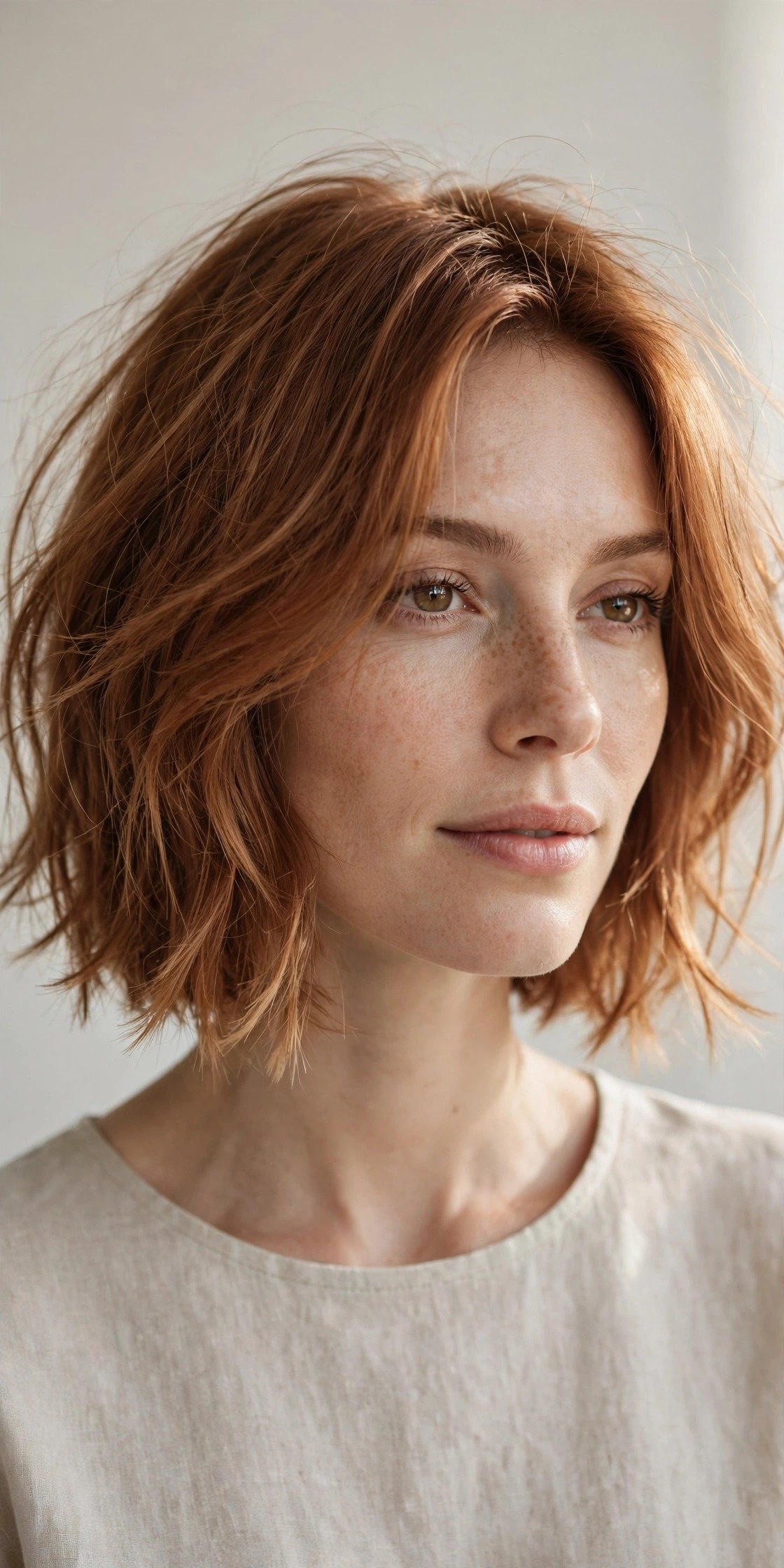
Copper brown turns the wispy bob into a statement: warm, rich copper woven through the feathered layers makes every strand glow, gives the airy shape a fiery depth, and makes the whole cut look deliberate in a way no natural shade can match. It suits fair to medium skin best, where the warmth complements the complexion, and it flatters every face shape, since the colour draws the eye to the texture rather than the outline. This is the version for women who want their bob to be noticed before they say a word.
Stylist script: ask for a wispy bob first, then request a copper brown tone — a rich, warm copper all over, or copper balayage through the layers for a softer effect. Tell your colourist you want the copper to follow the layers, concentrated at the ends where the light hits. Request the ends point-cut after colouring so the copper separates with the layers, and keep the back light so the colour has room to glow.
Styling routine: a light mousse on damp hair, blow-dried with a round brush, is the entire routine — the copper does the visual work. Maintenance: the cut needs a trim every six weeks, while copper fades faster than most colours and needs a gloss refresh every four to six weeks. This is the wispy bob for women who like their hair with a point of view.
20. Wispy Bob with Espresso Brown
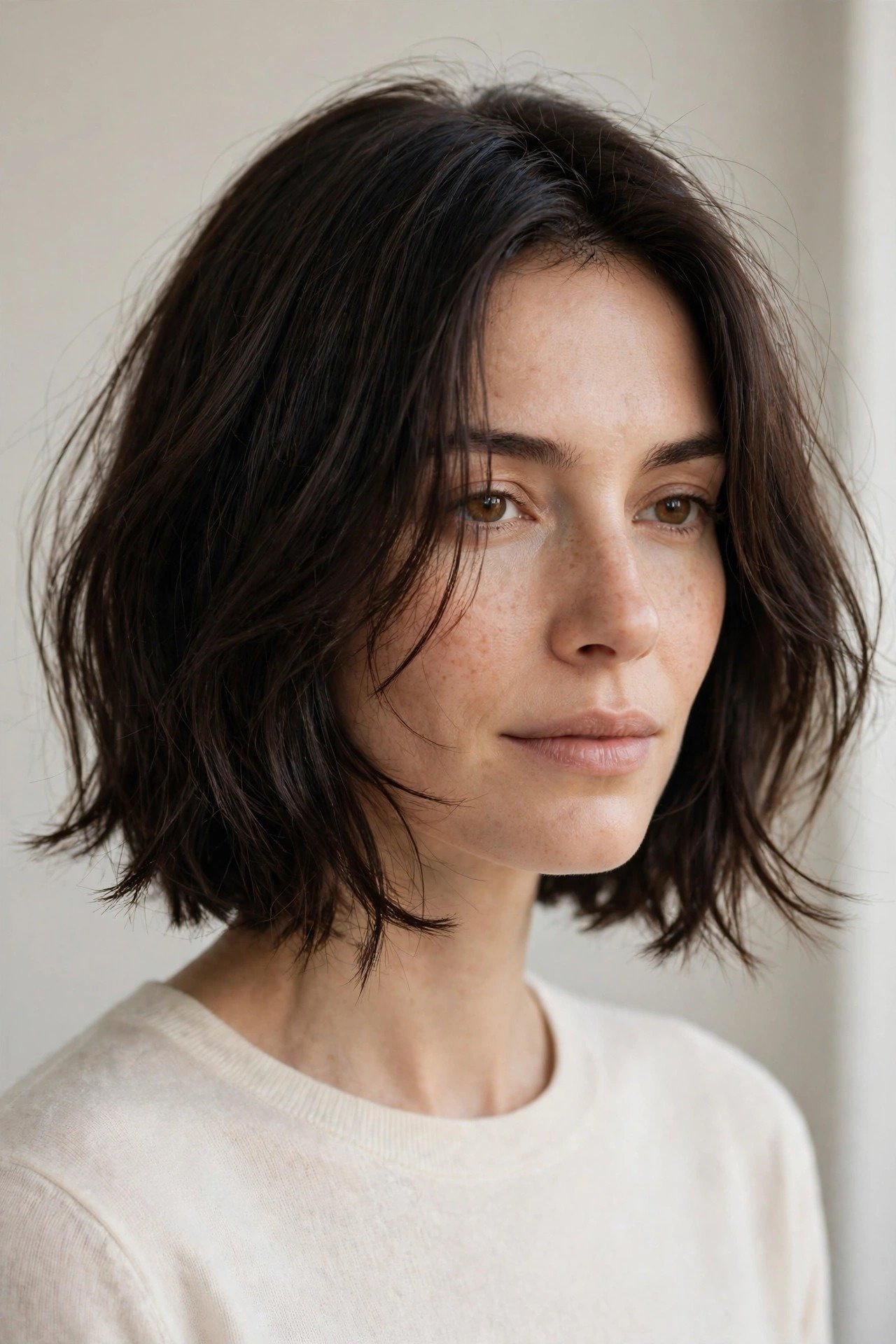
Espresso brown is the wispy bob’s most sophisticated colour: a deep, rich brown that makes the feathered ends look even softer by contrast, gives the bob a glossy, expensive depth, and makes the whole shape read as polished and deliberate. It suits every skin tone, since the depth flatters warm and cool complexions alike, and it flatters every face shape, since the dark colour draws the eye to the shape rather than the outline. This is the version for women who want their bob to look like quiet luxury.
Stylist script: ask for a wispy bob first, then request a deep espresso brown — a rich, cool brown all over, with the ends point-cut after colouring so the feathering stays visible. Tell your colourist you want the colour to add depth, not darkness: the bob should still read as soft, not solid. Request a gloss finish so the espresso catches the light, and keep the back light so the shape stays airy.
Styling routine: a light mousse on damp hair, blow-dried with a round brush for a soft bend, is the entire routine — the espresso does the visual work. Maintenance: the cut needs a trim every six weeks, while the espresso needs a gloss refresh every six to eight weeks to stay rich. This is the wispy bob for women who want depth without drama.
21. Wispy Bob with Strawberry Blonde

Strawberry blonde is the wispy bob’s sunniest colour: a soft, warm blonde with a hint of copper that makes the feathered ends glow, gives the airy shape a golden warmth, and makes the whole cut look like late-afternoon light. It suits fair skin best, where the warmth complements the complexion, and it flatters every face shape, since the lightness around the face brightens the whole look. This is the version for women who want their bob to feel like summer, whatever the season.
Stylist script: ask for a wispy bob first, then request a strawberry blonde tone — a soft, warm blonde with copper undertones, all over or as a balayage through the layers. Tell your colourist you want the colour to follow the layers, concentrated at the ends where the light hits. Request the ends point-cut after colouring so the strawberry separates with the layers, and keep the back light so the colour has room to glow.
Styling routine: a light mousse on damp hair, blow-dried with a round brush, is the entire routine — the strawberry does the visual work. Maintenance: the cut needs a trim every six weeks, while the strawberry needs a gloss refresh every six to eight weeks. This is the wispy bob for women who want warmth in their hair all year.
22. Wispy Bob with Mushroom Brown
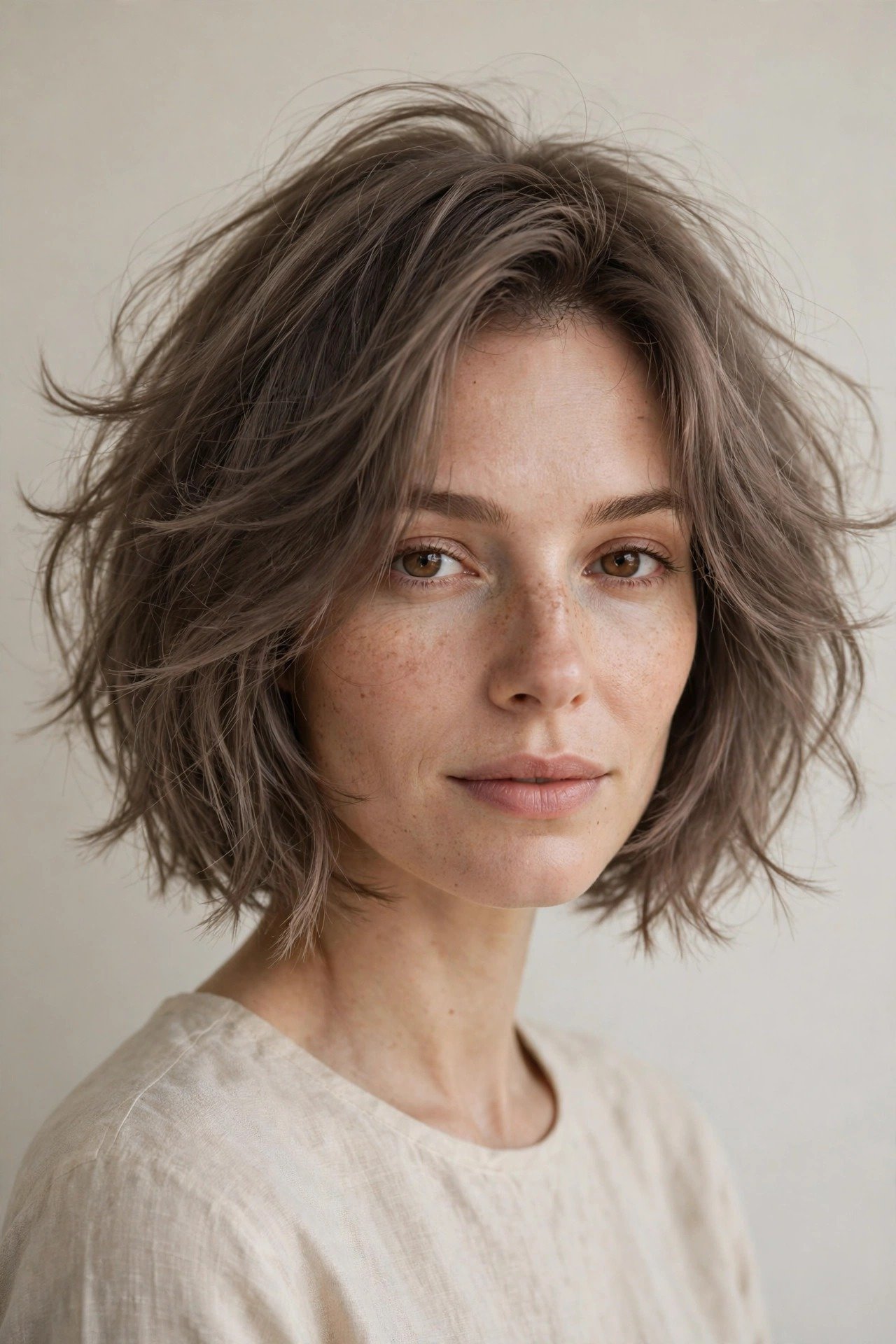
Mushroom brown is the wispy bob’s coolest colour: an ashy, muted brown with cool undertones that makes the feathered ends look even softer, gives the bob a modern, understated depth, and makes the whole shape read as effortlessly current. It suits cool skin tones best, where the ash complements the complexion, and it flatters every face shape, since the muted colour draws the eye to the shape rather than the shade. This is the version for women who want their bob to look expensive without trying.
Stylist script: ask for a wispy bob first, then request a mushroom brown tone — a cool, ashy brown all over, with the ends point-cut after colouring so the feathering stays visible. Tell your colourist you want the colour muted, not flat: the bob should still read as dimensional, not one solid shade. Request a gloss finish so the mushroom catches the light, and keep the back light so the shape stays airy.
Styling routine: a light mousse on damp hair, blow-dried with a round brush for a soft bend, is the entire routine — the mushroom does the visual work. Maintenance: the cut needs a trim every six weeks, while the mushroom needs a toner refresh every six to eight weeks to stay cool. This is the wispy bob for women who want modern without loud.
23. Wispy Bob with Caramel Balayage

Caramel balayage on a wispy bob is the high-contrast version: soft caramel melting through a darker base, concentrated at the ends of the layers, so the bob looks sun-kissed at the tips and deep at the roots. The effect is pure warmth — the feathered ends glow, the crown shimmers, and the whole cut reads as effortless even though the colour is entirely deliberate. It suits dark brown and black hair best, where the contrast is strongest, and it flatters every face shape, since the lightness around the face brightens the whole look.
Stylist script: ask for a wispy bob first, then request a caramel balayage painted freehand through the layers, with the caramel heaviest at the ends and softest at the roots. Tell your colourist you want a lived-in blend, not a sharp line — the balayage should melt, not stripe. Request the ends point-cut after colouring so the caramel separates with the layers, and keep the back light so the gradient has room to show.
Styling routine: a light mousse on damp hair, blow-dried with a round brush, is the entire routine — the balayage does the visual work. Maintenance: the cut needs a trim every six weeks, while the balayage grows out softly and needs a refresh only every ten to twelve weeks. This is the wispy bob for women who want summer in their hair all year.
24. Wispy Bob with Textured Ends

The textured-ends wispy bob is the detail-driven version: the ends are point-cut into distinct, separated pieces that move independently, so the bob reads as designed rather than grown. The texture is the point — every strand is visible, every end is separated, and the perimeter reads as feathered rather than solid. It suits straight and wavy hair best, where the point-cutting creates real separation, and it flatters long and oblong faces beautifully, since the textured ends soften the jawline visually while the bob adds structure.
Stylist script: ask for a chin-length bob with heavily textured ends — point-cutting through the last inch of hair, so each strand ends at a different length. Tell your stylist you want the ends broken up, not blunt — the wispy bob’s charm is its softness, and a solid perimeter would fight it. Request light internal layers for movement and the back kept light at the nape. For the textured pairing in more depth, our Italian bob guide shows how textured ends pair with a voluminous bob.
Styling routine: a light texturizing spray on damp hair, scrunched and left to air-dry, is the entire routine — the texture does the work. Maintenance: every six weeks; the textured ends need regular reshaping or they lose their separation. This is the wispy bob for women who want to look current without looking like they tried.
25. Wispy Bob with Flipped Ends

The flipped-ends wispy bob is the playful version: the ends flipped outward with a round brush, so the bob kicks out at the perimeter in a soft, retro-inspired flick. The flip is the point — it adds movement, personality, and a touch of sixties glamour to an otherwise modern cut — while the wispy ends keep the whole shape light and airy. It suits straight and slightly wavy hair best, where the flip holds its shape, and it flatters oval and square faces, since the outward flick widens the jawline visually in a flattering way.
Stylist script: ask for a chin-length wispy bob with the ends cut to flip — point-cut so they separate, and long enough to turn outward without collapsing. Tell your stylist you want the flip soft, not sharp: the ends should kick out gently, not curl into a full wave. Request light internal layers for movement and the back kept light at the nape. Ask them to show you the flip with a round brush before you leave, so you can recreate it at home.
Styling routine: blow-dry the ends outward with a round brush, flipping the brush away from the face as you dry — the flip is a two-minute job once you know the motion. Maintenance: every six weeks; the flip needs the ends at exactly the right length to work. This is the wispy bob for women who like a little retro in their modern cut.
26. Wispy Bob with Middle Part

The middle part wispy bob is the balanced version: a chin-length bob parted down the centre, falling evenly on both sides, with feathered ends that keep the whole shape light. The symmetry is the point — it frames the face evenly, highlights both cheekbones equally, and gives the bob a calm, considered quality — while the wispy ends stop it from looking severe. It suits straight hair best, where the part stays clean, and it flatters oval and heart-shaped faces, since the even fall on both sides balances the forehead and jaw.
Stylist script: ask for a chin-length wispy bob with the part at your natural centre, not forced, and the ends point-cut so they fall softly instead of hanging as a solid shelf. Tell your stylist you want the bob to fall evenly on both sides, with light internal layers for movement. Request the back kept light at the nape, and the front pieces cut to frame the face symmetrically.
Styling routine: part the damp bob down the middle with your fingers, add a small amount of light cream, and blow-dry each side under with a round brush — or let it air-dry for a more relaxed finish. Maintenance: every six weeks; the middle part needs the bob at exactly the right length to stay balanced. This is the wispy bob for women who want symmetry and calm.
27. Wispy Bob with Deep Side Part
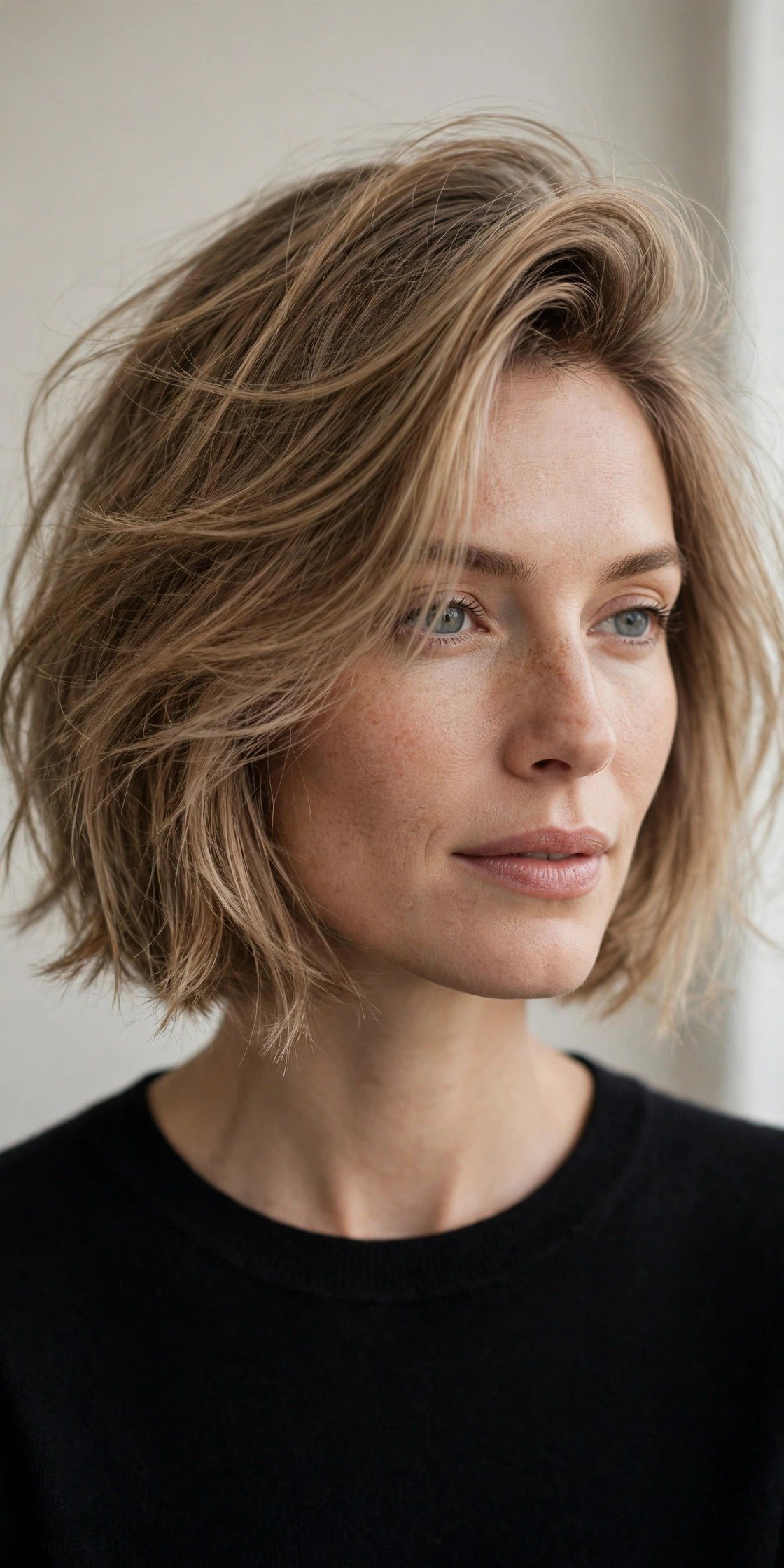
The deep side part wispy bob is the dramatic version: the bob parted far to one side, so most of the hair sweeps across the forehead in a soft, voluminous wave, while the smaller side tucks neatly behind the ear. The asymmetry is the point — it adds volume, movement, and a touch of old-Hollywood glamour to an otherwise modern cut — while the wispy ends keep the whole shape light. It suits straight and wavy hair best and flatters round and square faces, since the deep sweep slims the face visually.
Stylist script: ask for a chin-length wispy bob with a deep side part — the part set well to one side, with the longer side swept across the forehead. Tell your stylist you want the sweep soft and voluminous, not flat, so the bob reads as glamorous rather than severe. Request the ends point-cut for a feathered finish and light internal layers for movement. Ask them to cut the shorter side to tuck neatly behind the ear.
Styling routine: blow-dry the longer side across the forehead with a round brush for volume, then tuck the shorter side behind the ear — the asymmetry does the work. Maintenance: every six weeks; the deep part needs the bob at exactly the right length to stay balanced. This is the wispy bob for women who want drama with their softness.
28. Wispy Bob with Shag Layers
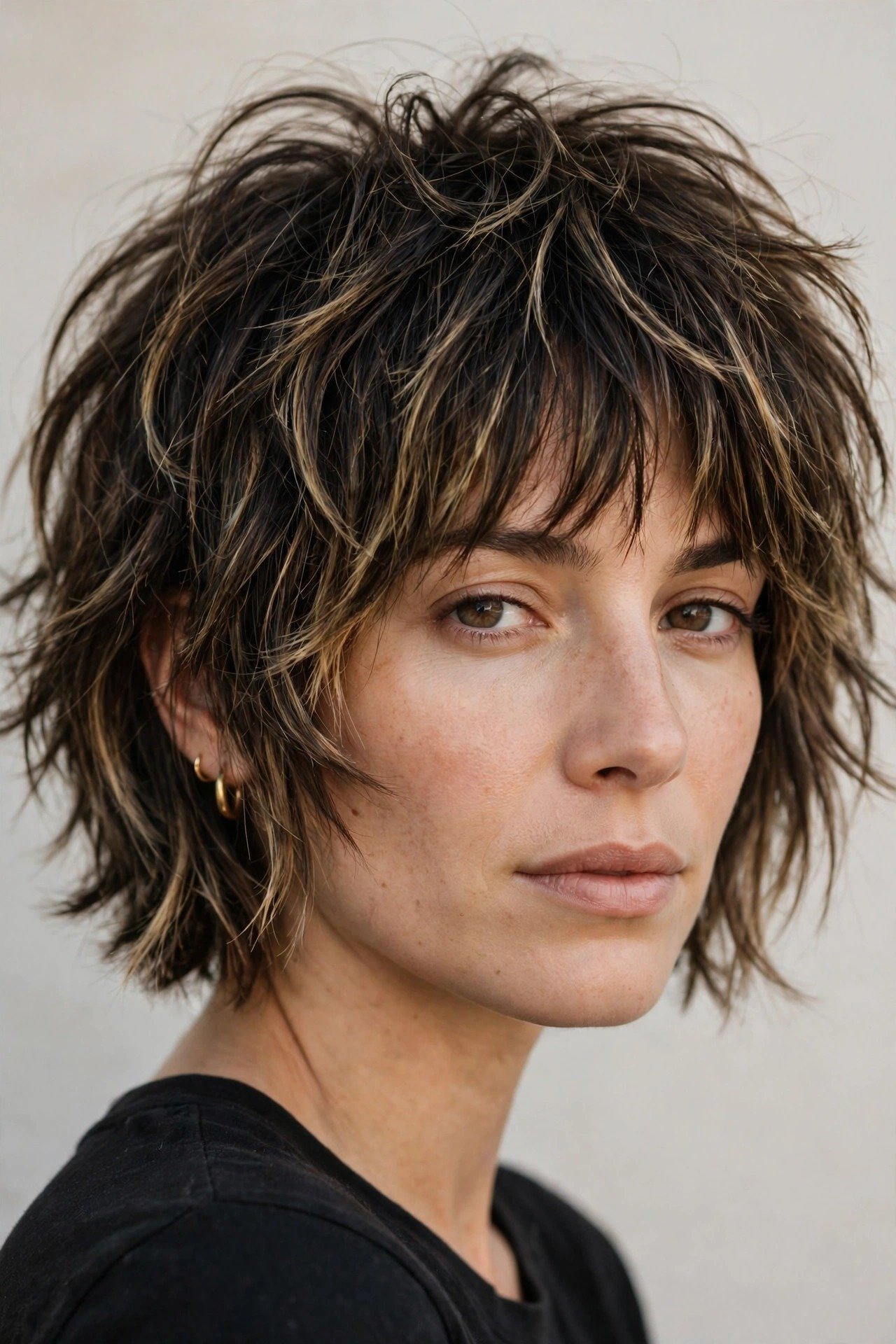
The shag-layers wispy bob is the rock-and-roll version: choppy, disconnected layers through the whole bob, a full crown, wispy ends everywhere, and a finish that looks like it was styled by a wind machine. It is the wispy bob taken to its logical extreme — the shag is the wispy bob’s wilder cousin, after all — and it works because the feathered ends give the choppy layers something to hold onto. It suits thick and medium hair best and flatters every face shape, and it is the best version for women who want their hair to look like a lifestyle, not a haircut.
Stylist script: ask for a shag-layered wispy bob with heavy, choppy layers through the crown and sides, cut with point-cutting to create maximum separation. Tell your stylist you want the ends wispy, not blunt — the shag’s charm is its feathered finish, and a solid perimeter would fight it. Request the back kept light at the nape, the crown layered for lift, and a long, soft fringe if you want one. Keep the overall finish relaxed and lived-in.
Styling routine: sea-salt spray on damp hair, scrunched and left to air-dry, is the entire routine — the shag does the work. Maintenance: every six to eight weeks; the shag hides growth better than any other wispy bob, so this is the most forgiving version to maintain. This is the wispy bob for women who want their hair to look like it has a record collection.
29. Wispy Bob with Undercut Nape
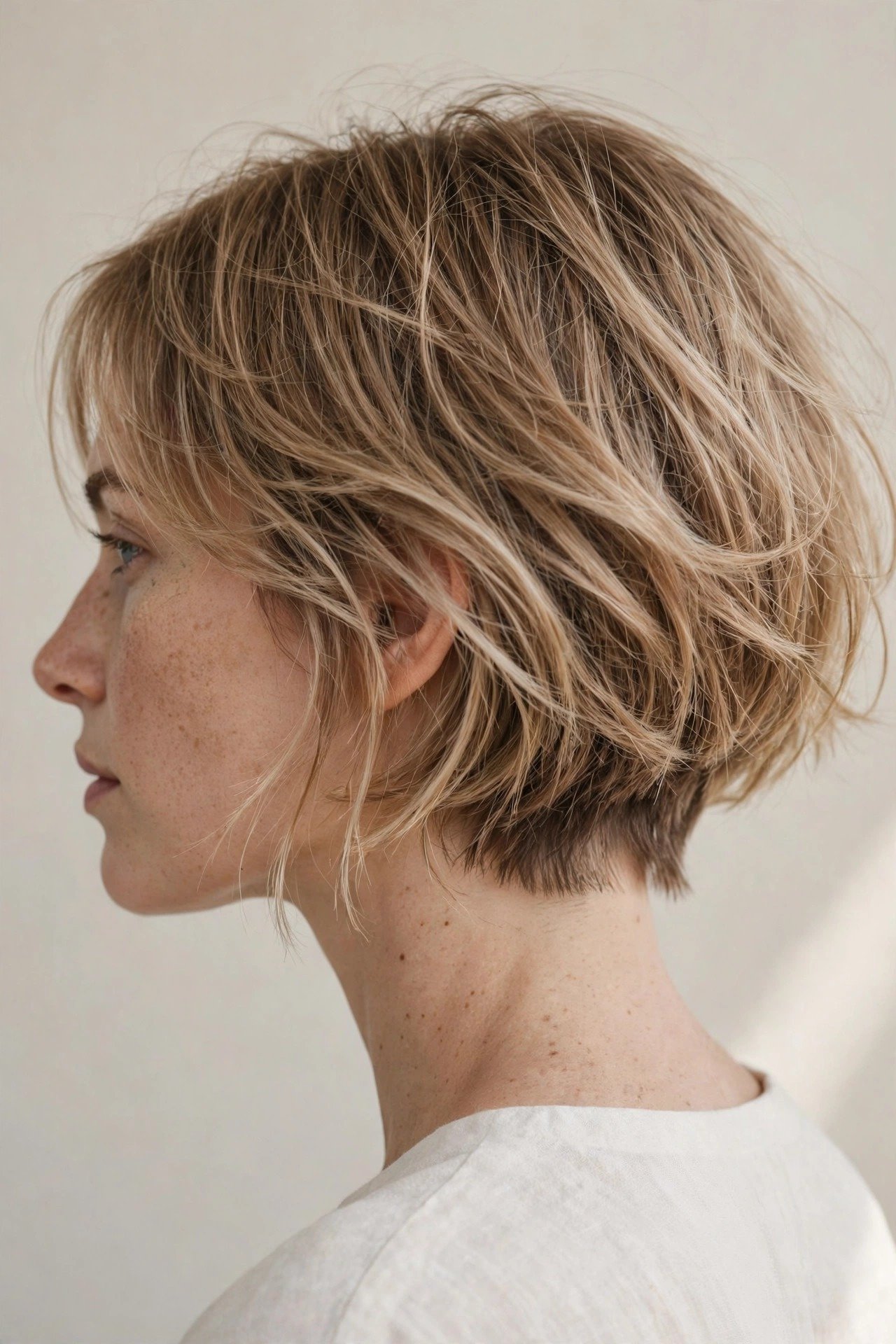
The undercut nape wispy bob is the hidden-edge version: a short undercut at the nape, hidden beneath soft, airy bob layers that fall over it, so the bob looks classic from the front and surprising from the back. The undercut is the point — it removes bulk where thick hair needs it most, keeps the nape cool in summer, and gives the bob a modern edge — while the wispy layers keep the whole shape soft. It suits thick hair best, where the undercut removes the most bulk, and it flatters every face shape, since the hidden detail changes nothing about the front view.
Stylist script: ask for a chin-length wispy bob with an undercut nape — the hair at the nape clipped short, hidden beneath the bob’s longer layers. Tell your stylist you want the undercut subtle, not shaved to skin, so it reads as a texture detail rather than a statement. Request the ends point-cut for a feathered finish and light internal layers for movement. Ask them to show you the undercut from behind, so you know exactly how much is hidden.
Styling routine: the bob needs only a light mousse and a round-brush blow-dry; the undercut needs no styling at all — that is the point of hiding it. Maintenance: the undercut needs a trim every four weeks to stay neat, while the bob itself lasts six to eight. This is the wispy bob for women who like a secret in their haircut.
30. Wispy Bob for Round Faces
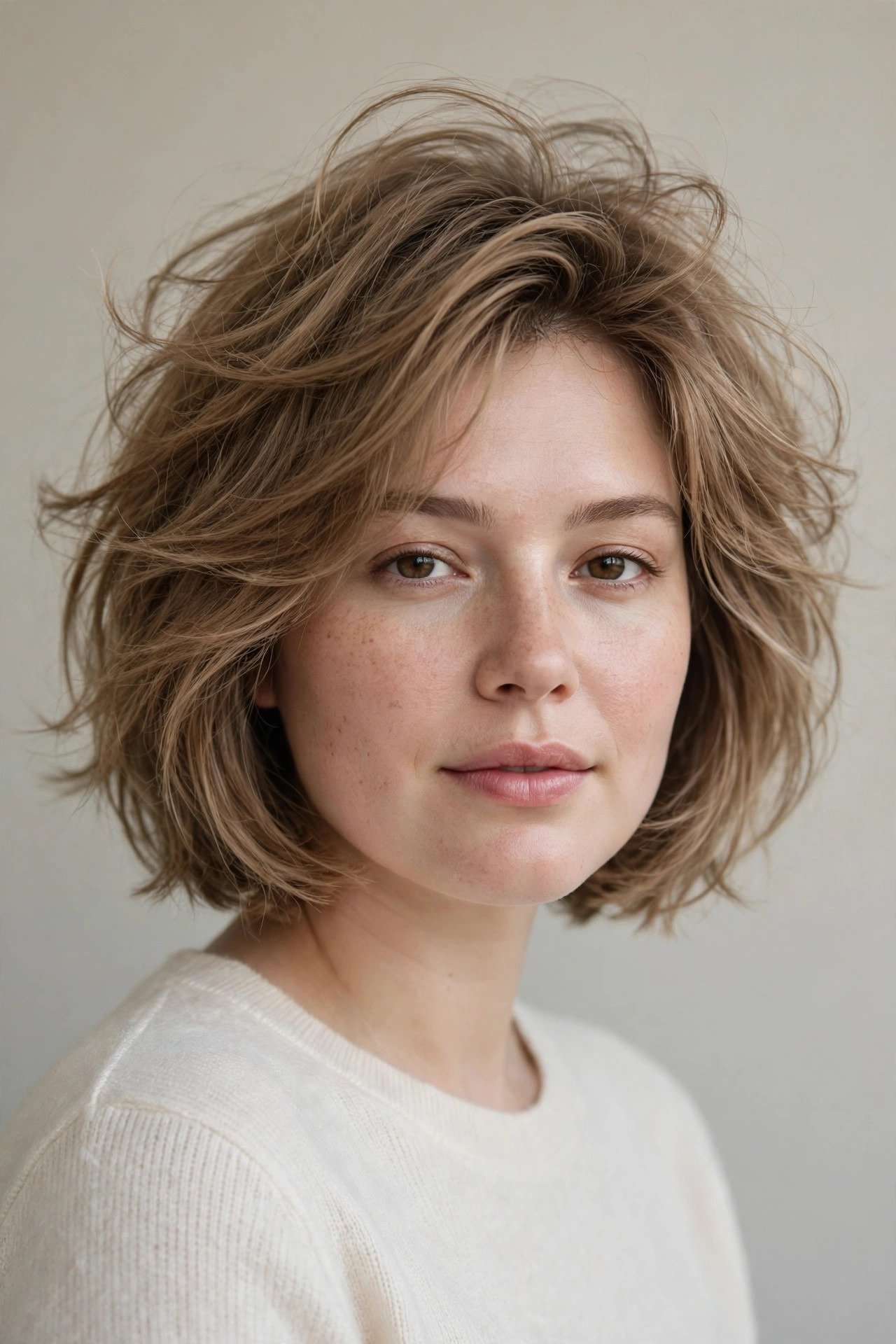
Round faces get the biggest lift from a wispy bob of any face shape. The problem with a round face is that width and length are nearly equal, so a flat bob makes the face look wider; the solution is height and length — when the crown is layered to stand up and the front pieces are kept long, the eye reads the extra vertical inches as length, and the face looks longer and leaner. The wispy ends add the second half of the illusion: a soft, broken-up perimeter looks lighter than a solid line. A good wispy bob can make a round face look oval, and that is no small thing.
Stylist script: ask for a wispy bob with height at the crown — light internal layers, blow-dried upward — and front pieces kept long, reaching the collarbone. Tell your stylist you want the sides kept close, not wide, so the width stays controlled. Request the fringe swept up or to the side, never straight down, since a heavy fringe shortens the face. Ask them to keep the bob’s volume on top, not at the sides.
Styling routine: volumizing mousse at the roots, blow-dried upward with a round brush, then a light texturizing spray through the ends — the height is the whole point, so do not flatten it. Maintenance: every six weeks; the crown’s height collapses fast as it grows. This is the version that turns a round face into a balanced one — and the wispy bob is the frame that makes it work.
31. Wispy Bob for Oval Faces
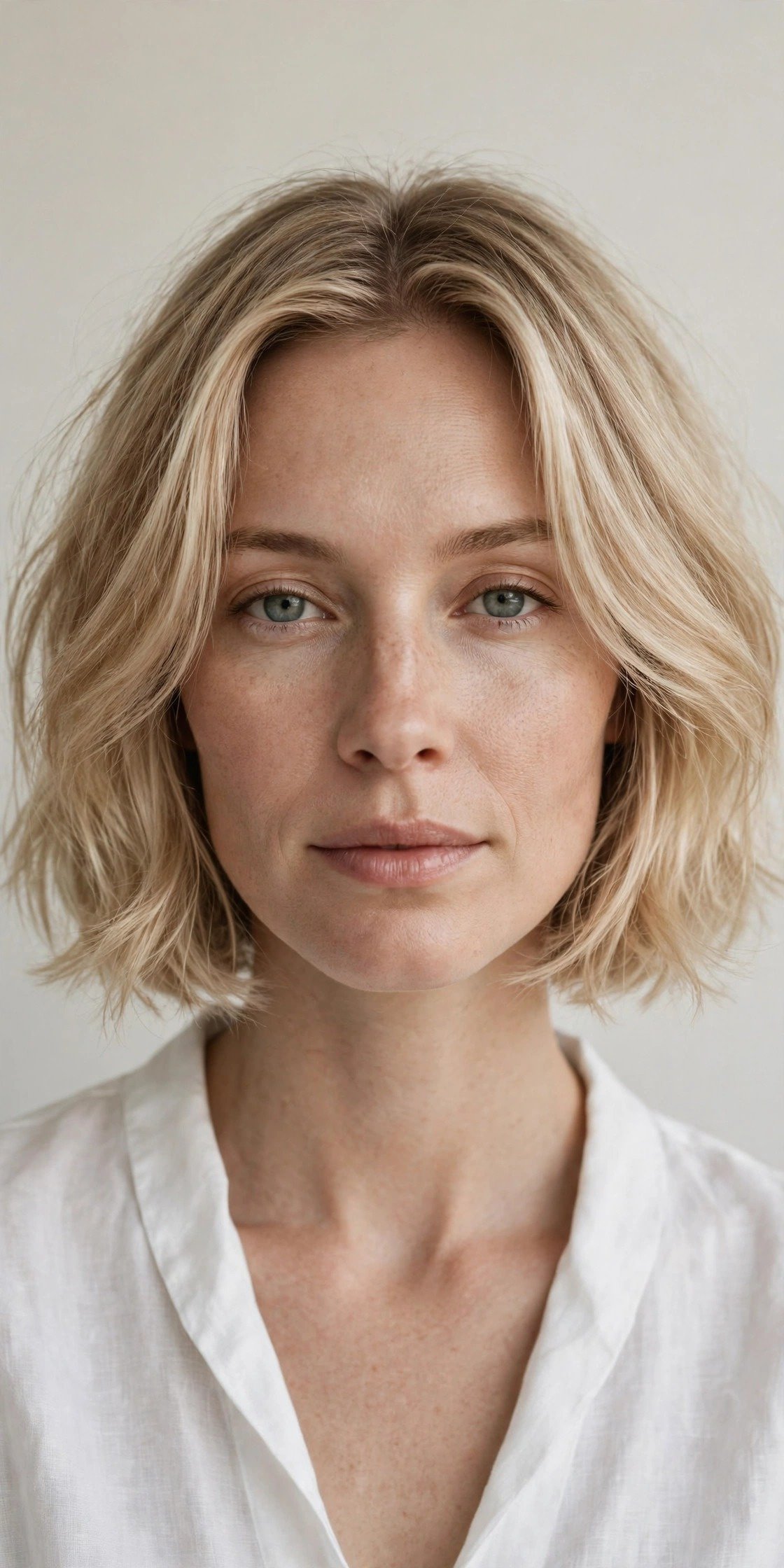
Oval faces can wear every version of the wispy bob, which is both a blessing and a problem — with no proportions to correct, the choice is purely about personality. The oval-face version leans into that freedom: a balanced chin-length bob, medium layers all over, feathered ends that fall where they fall, and a fringe that is optional rather than necessary. It suits every hair type and is the most versatile version on this list, because an oval face lets the cut be exactly what it is — soft, airy, and unapologetic — with nothing to hide and nothing to fix.
Stylist script: ask for a balanced wispy bob — chin length, light internal layers, point-cut ends, and a soft, natural perimeter, since your face needs no correction. Tell your stylist you want the classic proportions: height at the crown, lightness at the ends, softness at the fringe. Request the back kept light at the nape, and the ends point-cut so they separate naturally. Ask them to cut it dry so the layers sit exactly where your hair falls.
Styling routine: a light mousse on damp hair, blow-dried with a round brush, is the entire routine — an oval face needs no styling tricks. Maintenance: every six to eight weeks; the balanced shape hides growth well. This is the wispy bob in its purest form, worn by the face shape that needs nothing from it but attitude.
32. Wispy Bob with Wet Look Finish
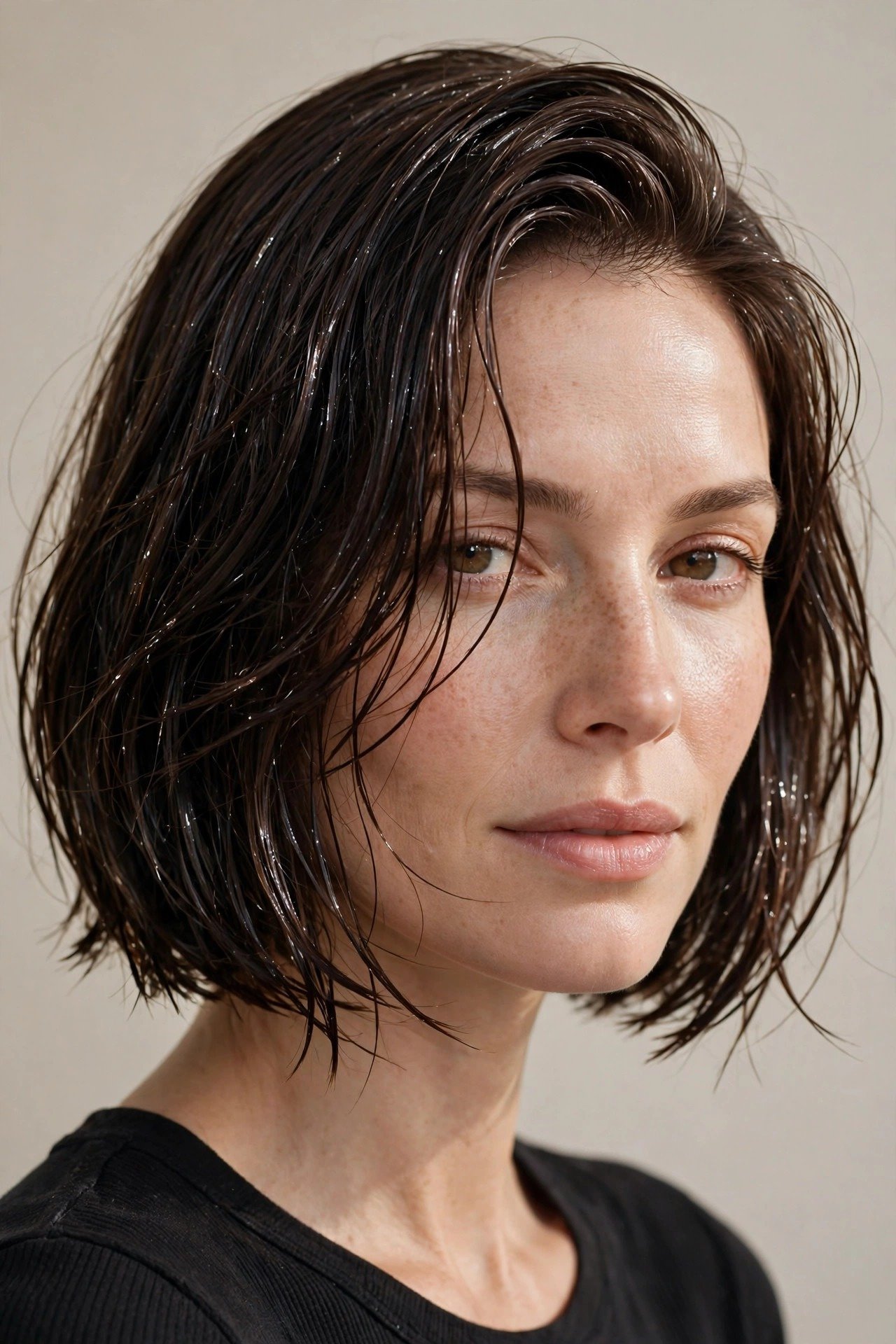
The wet look wispy bob is the evening version: the bob combed smooth with a high-shine finish, the feathered ends gleaming under evening light, and the whole head reading as one polished, deliberate shape. It is the most glamorous combination on this list, and it works because the shine unifies everything — the crown and the ends all reflect light the same way, so the layers read as even more seamless than they already are. It suits straight hair best, where the shine holds, and it flatters oval and square faces. This is the version for weddings, dates, and nights when the photos matter.
Stylist script: ask for a wispy bob and a chin-length cut with enough weight to sweep smooth — tell your stylist you want a wet look finish so they leave the length the shine needs. Request the ends point-cut so the shine does not turn the bob into a solid sheet, and the back kept light at the nape. Ask them to cut the crown so the hair lies flat when swept smooth, since a crown that sticks up will break the wet look’s smooth surface.
Styling routine: apply a shine serum or gel to damp hair and comb it smooth in long strokes; let it set without touching it. Maintenance: the bob needs a trim every six weeks, and the wet look itself is a same-day style — it washes out overnight, so this is a special-occasion finish rather than a daily one. High gloss, high impact.
How to Style and Maintain a Wispy Bob at Home
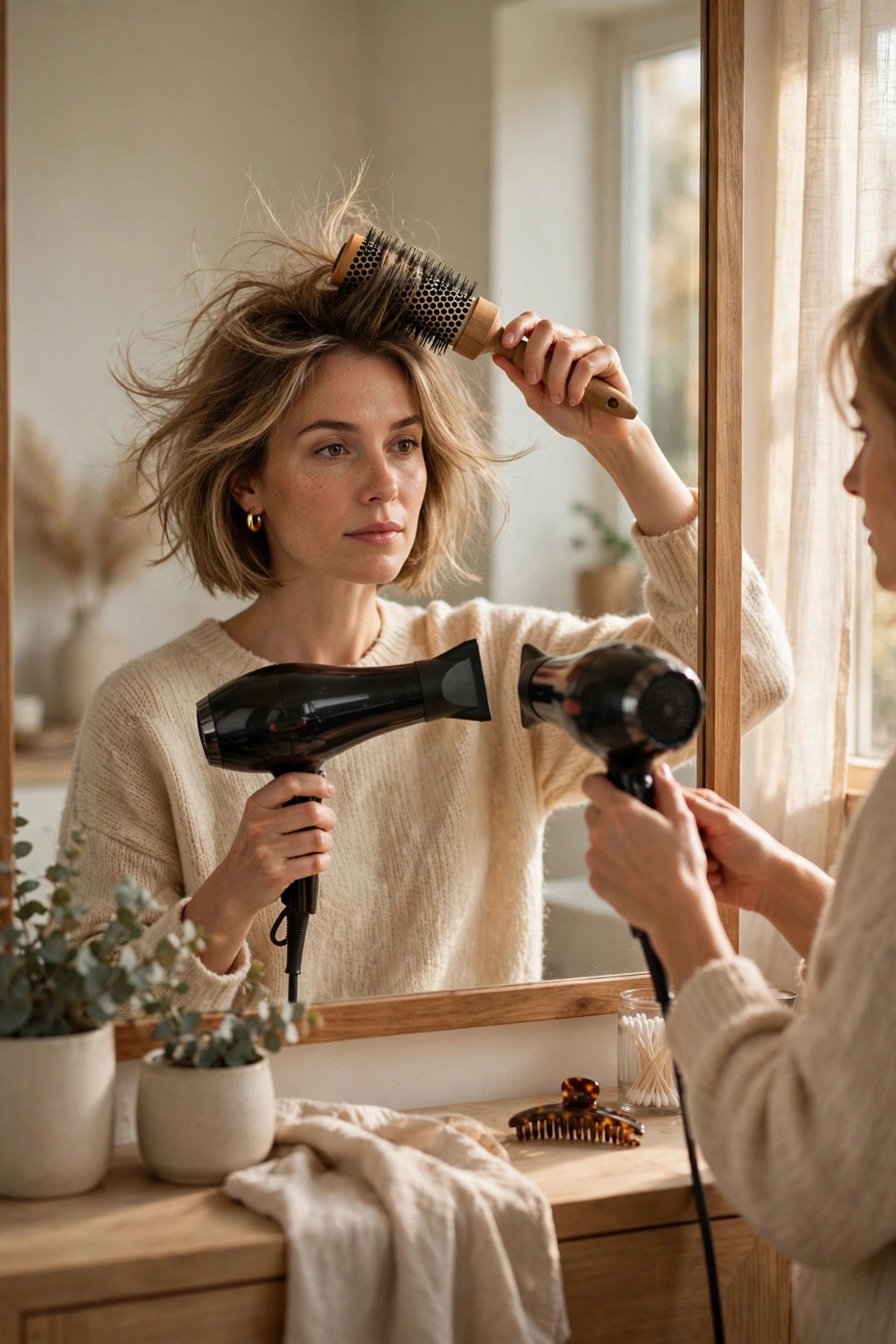
The morning routine for a wispy bob takes under five minutes, and it starts with the ends. Apply a light mousse or texturizing spray to damp hair, blow-dry with a round brush for a soft bend under, or let it air-dry for a more relaxed finish — never brush the bob dry with a paddle brush, because that flattens the feathered ends into a solid shelf. If you want volume, lift the crown with the round brush as you dry; if you want the relaxed look, skip the dryer entirely and let the cut do the work. The nape needs no styling — that is the point of keeping it light.
For the fringe and face-framing pieces, the routine is maintenance, not styling. Once a week, check the fringe length in the mirror — a wispy fringe grows out fast, and a fringe that reaches the eyes stops being wispy and starts being a curtain. If your bob is paired with colour, use a colour-safe shampoo and a weekly gloss or toner to keep the shade rich. The single most common mistake is over-applying product: a heavy, greasy finish weighs the feathered ends down and makes the bob look disconnected from the crown, while a light mousse keeps the whole head reading as one design. Start with less product than you think you need.
At the salon, the consultation is where the cut is won or lost, so walk in with specifics. Name the structure first — wispy bob, angled wispy bob, or inverted wispy bob — then the length, then the fringe, in that order. Bring a reference photo from the thirty-two styles above; “like number five but with curtain bangs” is worth a thousand words of description. Mention your hair’s behaviour — “it flips out at the ends,” “it goes flat at the crown,” “my waves fall to the left” — because a good stylist adjusts the layering and the length to compensate. And book your next appointment before you leave: short bobs need reshaping every five to six weeks, standard wispy bobs every six to eight. A wispy bob is a stylist-relationship haircut, not a twice-a-year one.
The last home-care rule is the simplest: wash less, condition more. A wispy bob’s feathered ends look best on second-day hair, when the natural oils give them grip, so shampoo every two to three days and rinse with water in between. Use a light conditioner on the ends only, never on the crown, and keep heat styling to the days you need real volume. Treat the ends like fabric — gentle handling, light product, and a trim before the feathering collapses — and the cut will look as soft on day thirty as it did on day one.
Frequently Asked Questions
What is a wispy bob?
A wispy bob is a women’s haircut in which a classic bob — usually chin-length to shoulder-length — is cut with feathered, point-cut ends and soft internal layers, so the hair looks light, airy, and full of movement instead of solid and heavy. Unlike a blunt bob, which ends in one clean, straight line, the wispy bob’s ends are broken up into fine, separated pieces that flutter and move, and the fringe is cut the same way, so it separates into soft strands across the forehead rather than sitting as a heavy curtain.
What is the difference between a wispy bob and a blunt bob?
The difference is the ends and the feeling. A blunt bob ends in one clean, straight line, so the perimeter reads as sharp, graphic, and deliberate. A wispy bob’s ends are point-cut into fine, separated pieces, so the perimeter reads as soft, feathered, and light. If you want a graphic, architectural shape, choose the blunt bob; if you want softness, movement, and a bob that looks effortless, choose the wispy bob.
What is the difference between a wispy bob and a layered bob?
The difference is where the softness lives. A layered bob gets its movement from internal layers cut through the whole head, while its ends can still be blunt. A wispy bob gets its softness from the ends themselves — point-cut, feathered, and separated — with layers as a supporting detail rather than the main event. Many wispy bobs are layered too, but the feathered ends are what make a bob wispy. If you want movement through the whole head, choose a layered bob; if you want lightness at the perimeter, choose the wispy bob.
Which face shape suits a wispy bob?
Almost every face shape suits a wispy bob, which is a big part of its popularity. Round faces benefit from a wispy bob with height at the crown and long front pieces, which add the illusion of length. Square faces can wear almost any version, since the feathered ends soften a strong jawline. Long or oblong faces are balanced by a wispy bob with a fringe, which avoids adding more vertical length. Oval faces, as usual, can wear everything. The universal rule is to let the length and the fringe direction work against your face’s proportions, not with them.
How long should my hair be for a wispy bob?
A wispy bob works at almost any bob length, from a short French bob at lip length to a longer bob at the shoulders. The most versatile range is chin length: long enough to frame the face and show the feathered ends, but short enough to manage in five minutes each morning. Shorter bobs of lip to chin length suit French and blunt versions, while longer bobs of chin to shoulder length suit layered, wavy, and inverted versions. Tell your stylist which length you want before they start cutting, since the length shapes the whole haircut.
How often do I need a wispy bob touched up?
A wispy bob lasts six to eight weeks before the ends start to lose their feathered shape visibly. Short French and chin-length versions need reshaping every five to six weeks, because the short length shows growth fastest. Standard wispy bobs last six to eight weeks comfortably, and shag-layered versions stretch to eight weeks, since the shaggy shape hides growth well. The fringe needs a trim every three to four weeks to stay out of the eyes. Many salons offer quick fringe trims between full cuts, which is the cheapest way to keep a wispy bob looking fresh.
Can I do a wispy bob at home?
You can maintain a wispy bob at home, but creating one from scratch is genuinely difficult. The feathered ends require point-cutting at the right angle, the layers require a clean section at the crown, and — hardest of all — a view of the back and sides of your own head, where the bob’s shape lives. What works well at home is upkeep: a round brush, a hairdryer, and weekly checks of the fringe length. For the initial cut and for reshaping the ends, see a stylist; then maintain their lines at home between visits.
What products do I need for a wispy bob?
Three products cover every version: a light mousse for volume and hold, a texturizing spray for the feathered ends, and a sea-salt spray for wavy and messy finishes. Fine hair benefits from a volumizing mousse at the roots; curly hair needs curl cream; a wet look requires a shine serum. Start with one light mousse and one bottle of texturizing spray, then expand once you know which finish you wear daily. The nape needs no product at all.
Does a wispy bob work with curly hair?
Yes, and it is one of the best options for curly hair. Keeping curls at chin length while point-cutting the ends removes the triangle-shaped bulk that makes curly bobs look heavy, and the feathered finish gives the curls a clean edge. The key is length: chin length lets curls form proper ringlets, while the wispy ends stop them from clumping into a solid shelf. Ask your stylist to cut curl-by-curl with scissors, never thinned with a razor, and to keep the edges soft and natural rather than razor-sharp.
Is the wispy bob still in style for 2026?
More than ever. According to the Pinterest 2026 Beauty Trend Report, searches for short layered bob haircuts are up 571%, searches for textured French bobs are up 338%, and searches for shag bobs are up 214%, so the bob is not just in style — it is the defining haircut family of the year. The 2026 versions — lighter, airier, and more textured than ever — keep it firmly current. Unlike novelty cuts that age in months, the wispy bob has classic bones: a chin-length shape with soft, feathered ends is simply flattering, and as long as stylists keep evolving the fringe and the finish, this cut is not going anywhere.
Conclusion
The wispy bob is the rare haircut idea that improves everything it touches: the hair looks lighter, the face looks softer, and the whole head looks more considered, all from a single feathered shape that lets natural texture lead. The 32 styles above cover every length, every finish, and every hair type, so the only real decision left is which version matches your face, your hair, and the amount of time you want to spend in front of the mirror. Pick two or three favourites, screenshot them, and bring them to your stylist — a picture plus the vocabulary in this guide turns a vague request into a precise one.
Start with the classic if you are unsure: a wispy bob at chin length with a soft fringe is the safest entry point, and you can go bolder, shorter, or longer next time once you know how the feathered ends feel on your head. Whatever you choose, keep the maintenance honest — a wispy bob is a relationship with your stylist, not a twice-a-year event. Get both right, and the wispy bob will do what the best haircuts always do: make you look like the most deliberate version of yourself, every single day of 2026.