90s Blowout Men 2026: 36 Voluminous, Retro Styles
The 90s blowout men are asking for in 2026 is not a costume version of the past, it is a polished revival of the voluminous, healthy, blown-back hair that defined a generation of heartthrobs, and it works because it makes almost any hair type look thicker, taller, and more deliberate. Think lift at the roots, soft movement through the lengths, a slight wave or flip at the ends, and a finish that looks touchable rather than stiff or shellacked. Fashionuer lists the 90s Blowout Revival among the Gen Z haircuts for guys that are everywhere in 2026, and the reason is simple: it photographs beautifully, it suits straight, wavy, and curly hair, and it gives a man instant presence without demanding a complicated routine or a dramatic change to his length.
This guide covers thirty-six distinct ways to wear the look, from the classic blown-back shape to tapered, faded, curly, long, and messy interpretations, so you can find the version that fits your face, your hair texture, and your lifestyle. If you already love the tapered side of this family, our blowout taper guide breaks down the cleaner, sharper cousin of this style in detail, while the flow haircut guide is the best next read if you want the same movement with longer, looser hair through the back. Use this article as your shortlist, take your favourite version to the barber, and keep the styling steps beside each style as your morning routine.
What Is a 90s Blowout
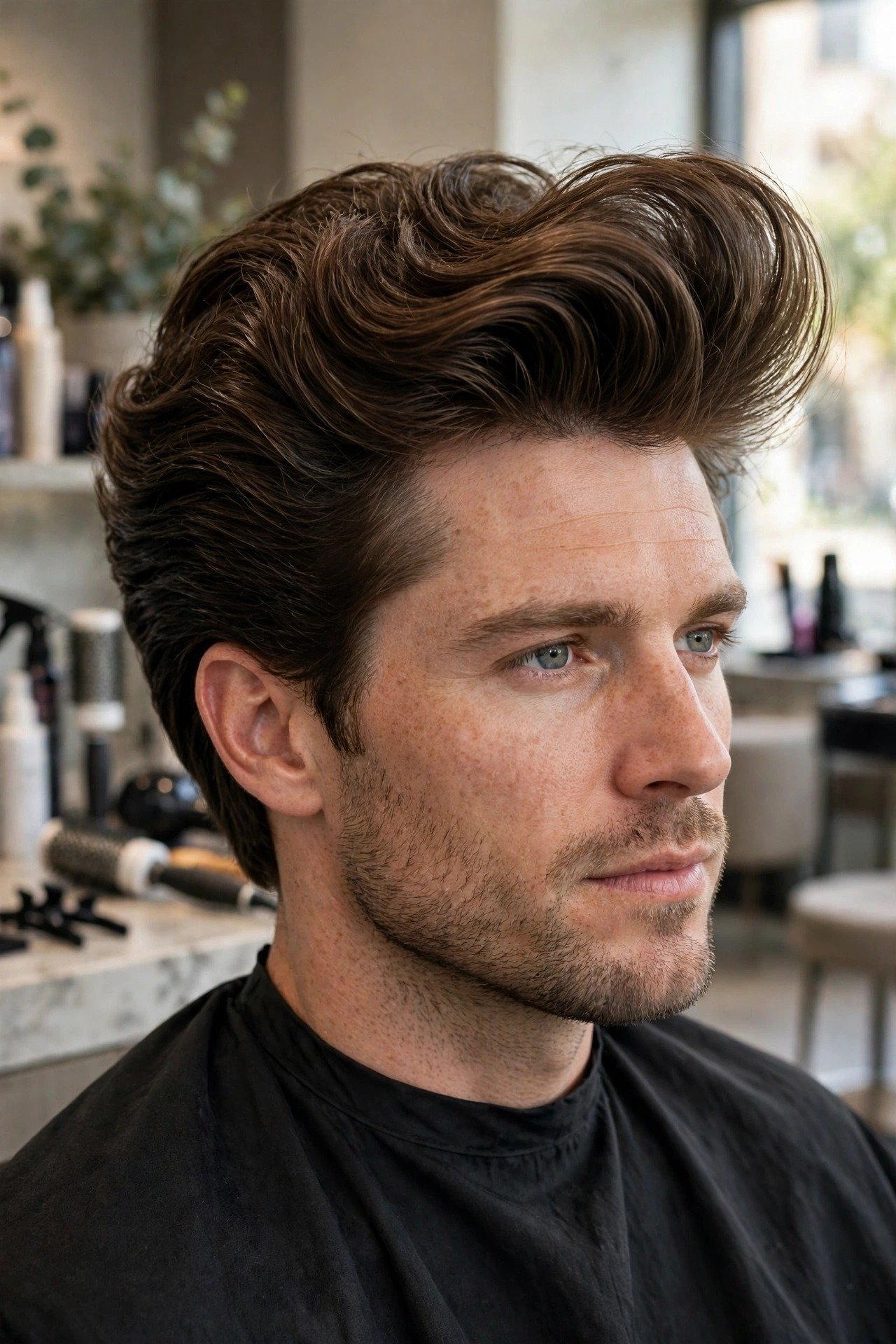
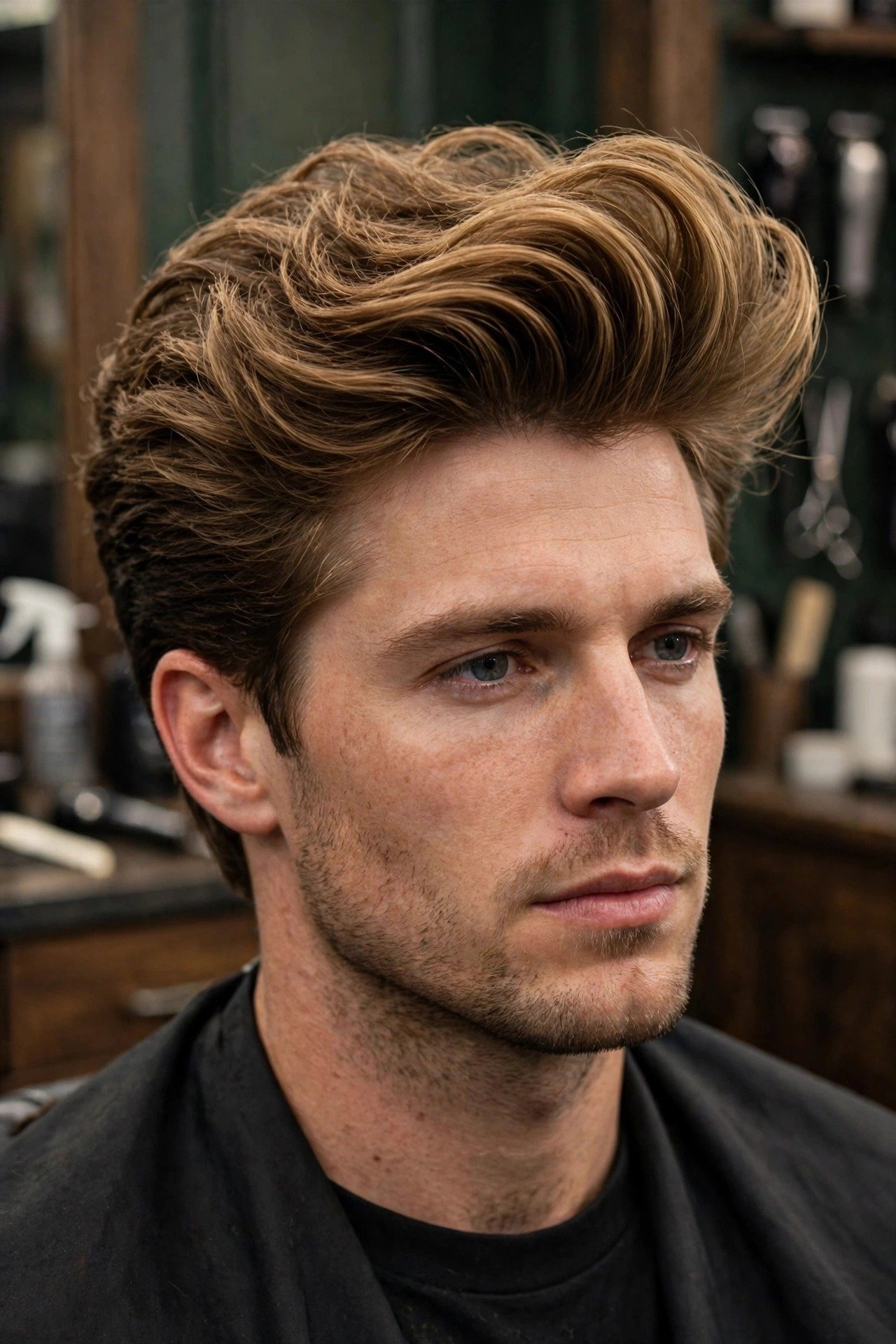
A 90s blowout is a voluminous, blow-dried hairstyle in which the hair is lifted away from the scalp at the roots, directed backwards or to the side, and finished with soft bend, wave, or a gentle flip at the ends. The top is left long enough to move, usually three to six inches, while the sides and back are kept shorter but not necessarily faded, so the silhouette stays full rather than tight. The defining feature is the air in the style: the hair does not lie flat against the head, it rises, separates into clean, flowing sections, and catches light across the crown and front. That lift is created with a hair dryer, a round brush, and a light styling product, not with heavy gel or a helmet of hairspray.
The original 90s version belonged to film stars, boy-band singers, and television heartthrobs, whose hair looked effortlessly thick and healthy even under studio lights. Barbers today recreate that shape with modern tools and lighter products, so the result feels fresh rather than dated. The cut underneath matters as much as the styling: layered ends remove bulk without thinning the look, a textured crown helps the hair hold its shape, and a clean neckline keeps the volume from looking untidy. When the cut and the blow-dry work together, the style holds its height for hours, moves naturally when you walk, and still looks good when it relaxes by the evening.
What separates a true 90s blowout from a generic blow-dried style is intention. The front is styled up and back, the parting is soft rather than razor sharp, and the ends turn outward or under with a deliberate flick that echoes the decade without copying it exactly. It is not a pompadour, which is taller and more sculpted, and it is not a slick back, which is flatter and shinier. The blowout sits between those two ideas: polished enough for a wedding or an office, relaxed enough for a weekend, and versatile enough to be worn neat in the morning and tousled by the afternoon. That balance is why it has returned so strongly.
Why the 90s Blowout Is Dominating 2026
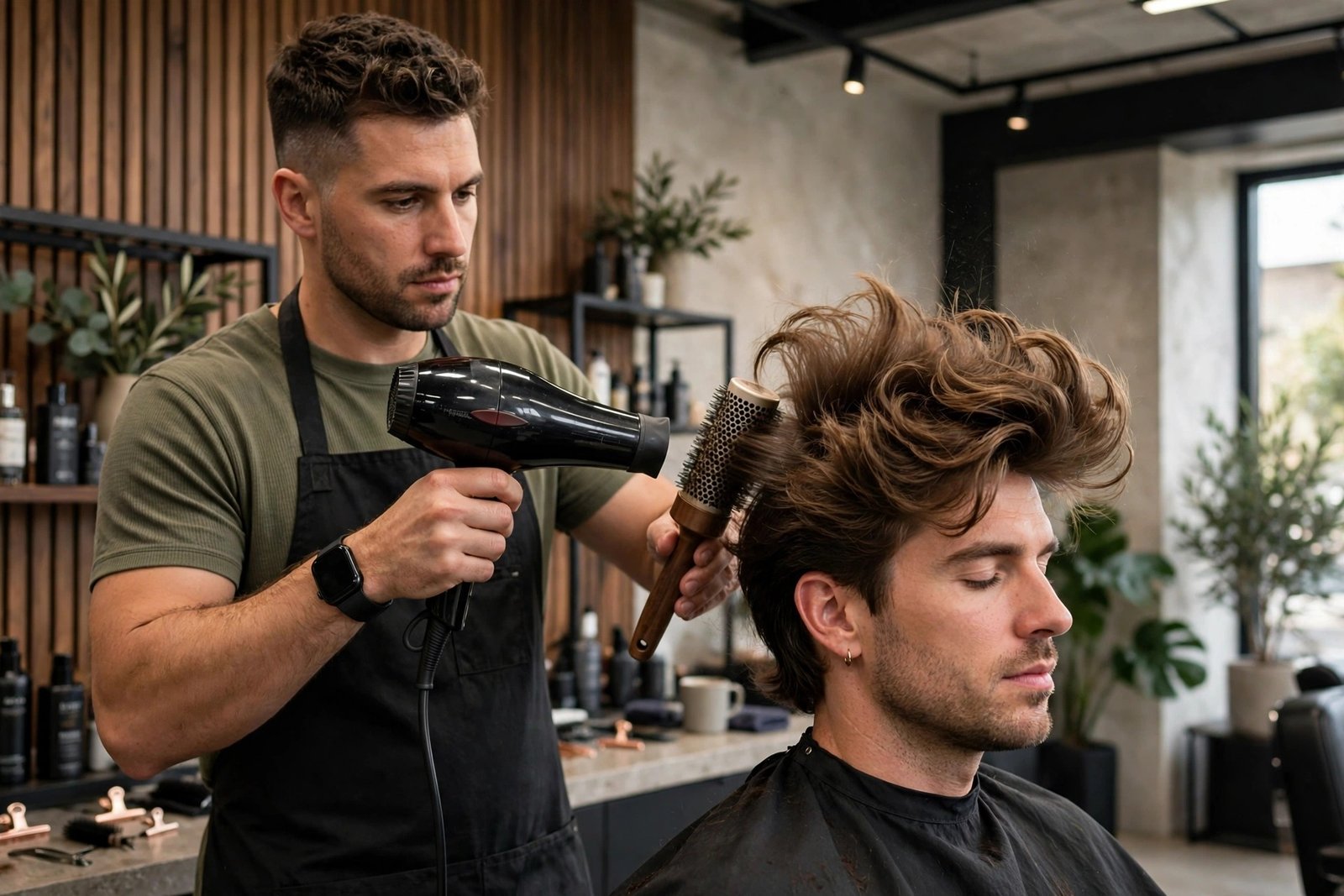
The 90s blowout is dominating 2026 because it answers almost everything men are asking from a haircut right now. After years of tight fades and very short crops, many men want their hair back: length they can see, volume they can feel, and a style that looks expensive without looking overworked. The blowout delivers all three, and it does it on hair that is growing out, which means the awkward in-between stage becomes a style in itself rather than something to hide under a cap. Social media has accelerated the trend, with barbers posting transformation videos where flat, lifeless hair becomes full, bouncy, and camera-ready in a single blow-dry, and those clips are shared because the before-and-after difference is so dramatic.
Fashion is also on its side. The wider 90s revival in clothing, from relaxed denim and oversized shirts to clean sneakers and vintage watches, pairs naturally with fuller hair, and the blowout completes that silhouette in a way a buzz cut never could. Gen Z wearers love it because it feels retro without feeling like a costume, while older men love it because it reminds them of the hair they had at their best, restyled with better products and a more flattering cut. HaircutInspiration updated its modern blowout guide in October 2026, reflecting how many barbers now list the blowout as a core service rather than a special request, and salons report that clients arrive with saved photos of the style more often than any other long men’s cut this year.
There is a practical reason too: the blowout is forgiving. It works on straight hair that needs volume, wavy hair that needs direction, curly hair that needs control, thick hair that needs shape, and fine hair that needs the illusion of density. It grows out gracefully, it can be dressed up or down with a change of product, and it suits round, oval, square, and oblong faces when the height and parting are adjusted correctly. In a year when men want one haircut that works for work, weddings, dates, and everyday life, the 90s blowout is the rare style that genuinely does all of it, and that versatility is why it is not a passing fad but the defining men’s hairstyle of 2026.
1. The Classic 90s Blowout
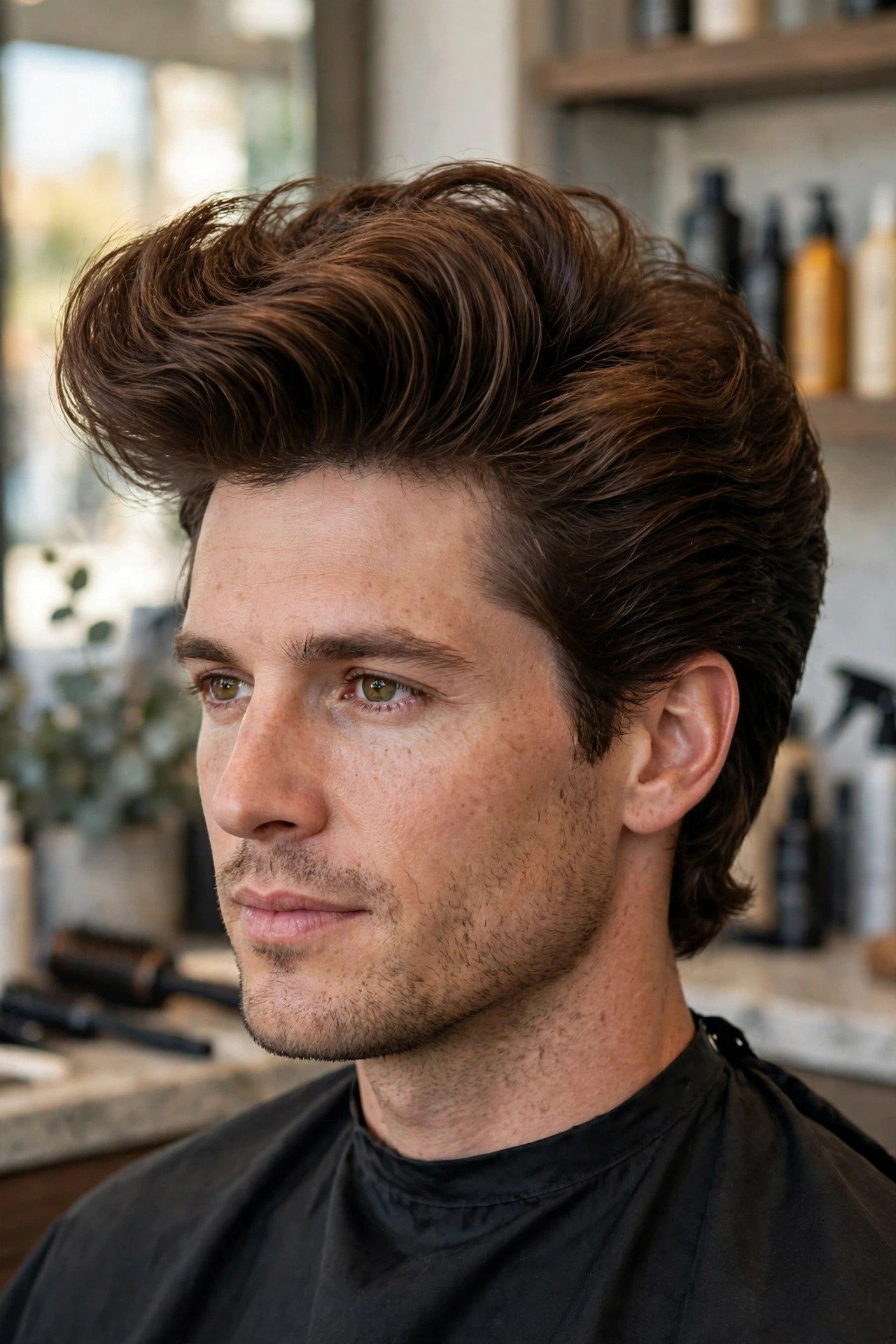
The classic 90s blowout is the purest version of the trend, and it suits almost every man who has medium-length hair on top and wants a timeless, confident look. The hair is kept around four to five inches long, layered lightly so it moves, with the sides short enough to stay tidy but long enough to blend into the volume above. It flatters oval and square faces best, because the height lengthens the face and the softness around the forehead keeps the shape from looking severe. Ask your barber for a layered blowout cut with a natural, tapered neckline and no harsh fade, so the silhouette stays full and vintage rather than modern and sharp.
To style it, wash with a volumising shampoo, towel dry until damp, and work a golf-ball amount of mousse or a light blow-dry cream through the roots. Use a large round brush and a medium-heat dryer, lifting each section up and back from the scalp, rolling the brush through the ends to create that signature flick. Keep the dryer moving so the hair does not overheat in one spot, and finish with a cool shot of air to lock the shape in place. A pea-sized amount of matte paste, warmed between the palms and brushed lightly through the top, adds hold without stiffness or shine.
Maintenance is straightforward, which is part of the classic version’s appeal. Wash every two to three days, use a light conditioner only on the ends, and refresh the volume on day two with a little dry shampoo at the roots followed by thirty seconds with the dryer. Trim every four to five weeks to keep the layers fresh and the ends from splitting, and avoid heavy waxes that weigh the front down. With that routine, the classic blowout looks polished in the morning, relaxed by the afternoon, and still intentional when you run your fingers through it at night.
2. Blowout with Mid Taper
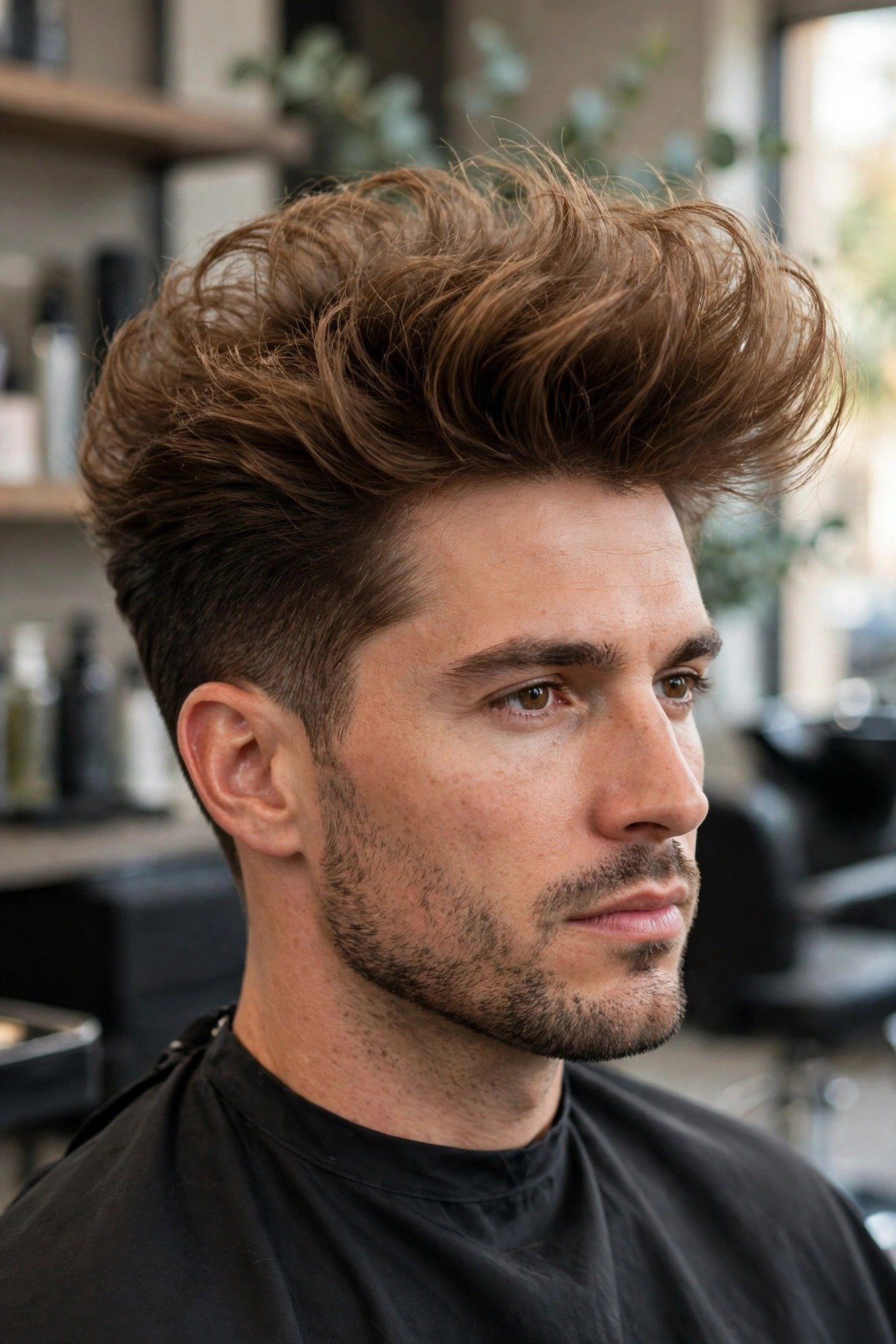
The blowout with a mid taper is the smartest choice if you love volume on top but want the sides to look clean and deliberate. The taper begins around the middle of the head, gradually shortening toward the ears and neckline without the stark contrast of a skin fade, so the style keeps its retro fullness while looking sharp from every angle. It suits men with thick hair especially well, because the taper removes bulk where it is not needed and lets the top do all the talking. Ask your barber for a mid taper on the sides and back, blended carefully into a layered top of four to five inches, with the front left long enough to blow back.
Styling follows the classic blow-dry method, with one extra detail: keep the sides neat by directing the dryer downward over the tapered sections, then switch to the round brush for the top. Apply a volumising spray at the roots before drying, lift the front up and back in sections, and roll the ends under or outward depending on how much flick you want. A matte clay gives the best finish here, because it holds the height without adding shine that would fight the clean taper. Use a small amount, work it from roots to mid-lengths, and leave the ends light so they keep their movement.
This version is ideal for work and formal occasions, because the taper keeps it tidy even as the top softens through the day. Book a taper clean-up every two to three weeks if you want the sides to stay crisp, or stretch to four weeks if you prefer a slightly softer grow-out. Wash with a gentle shampoo, avoid over-conditioning the roots, and use a wide-tooth comb rather than a fine comb so the volume is not flattened. The mid taper blowout is the balanced middle ground, and for many men it becomes the version they never change.
3. Blowout with Low Taper
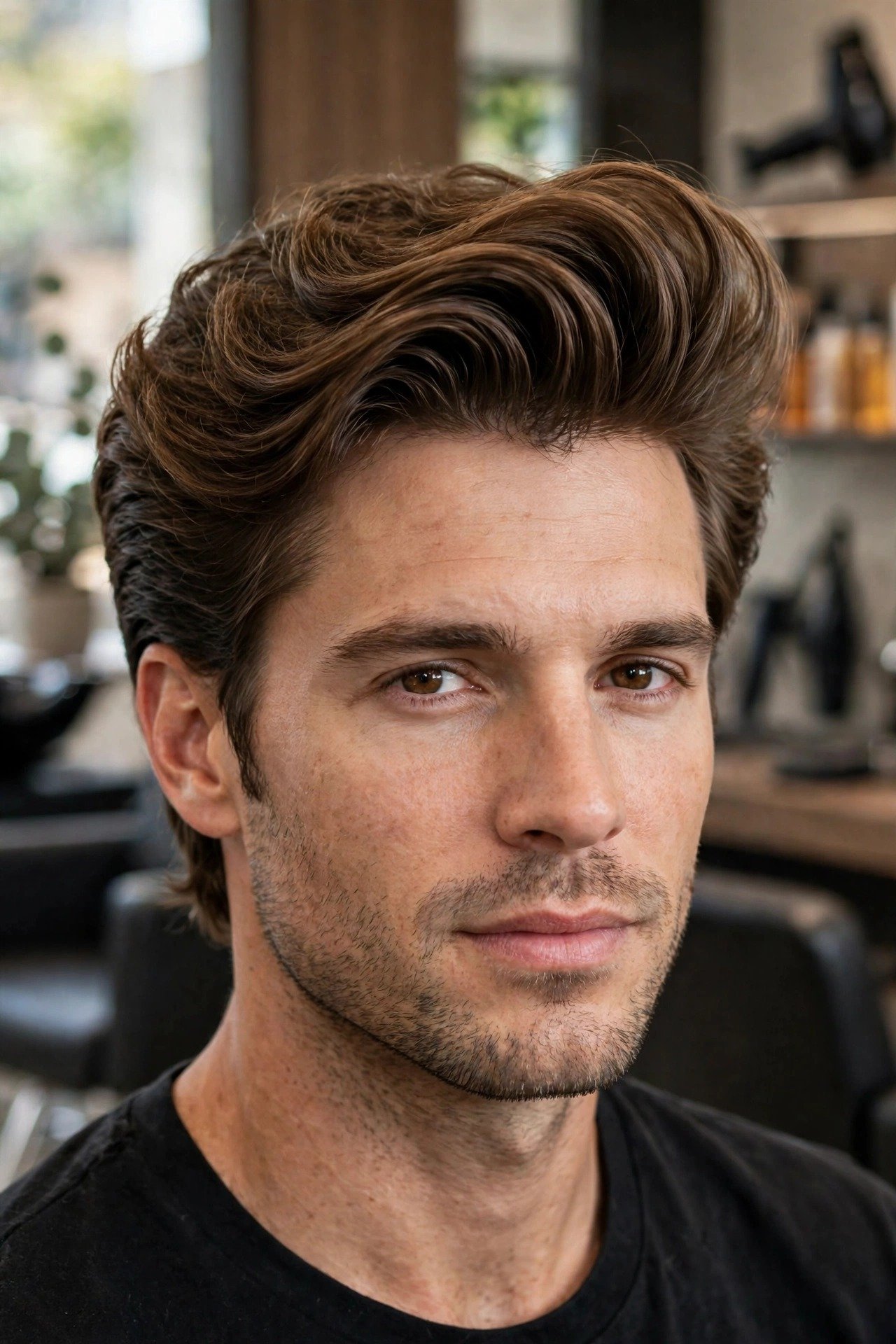
The blowout with a low taper is the most subtle, most grown-up interpretation of the style, and it is perfect for men who want volume without a visible contrast on the sides. The taper sits low, just above the ears and around the nape, so from the front the hair looks almost entirely classic and full, while from the side it still reads clean and well groomed. It suits older men, professionals, and anyone whose workplace prefers a conservative cut, because the change is felt more than seen. Ask your barber for a low taper using a number 2 or 3 guard at the bottom, blending upward into scissor-cut sides, with the top left long and layered for blow-drying.
Style this version with a lighter hand than a faded blowout, because the goal is softness, not structure. After washing, apply a leave-in volumiser or a light mousse, then blow-dry the top up and back with a round brush, keeping the heat moderate and the brush strokes smooth. Let the sides dry naturally or with a quick downward pass of the dryer, so they stay flat and do not puff out. Finish with a cream rather than a clay, smoothing a small amount over the surface to tame flyaways while preserving the natural shine and movement of the hair.
The low taper grows out more gracefully than any other tapered version, so it is the lowest-maintenance choice in this list. A trim every five to six weeks is usually enough, and the taper can be refreshed at the same appointment without an extra visit. Use a sulfate-free shampoo if your hair is dry, condition the mid-lengths and ends, and sleep on a silk or satin pillowcase to reduce frizz overnight. If you want a blowout that whispers rather than shouts, this is the one to ask for, and it pairs beautifully with both casual and formal clothing.
4. Blowout with Skin Fade
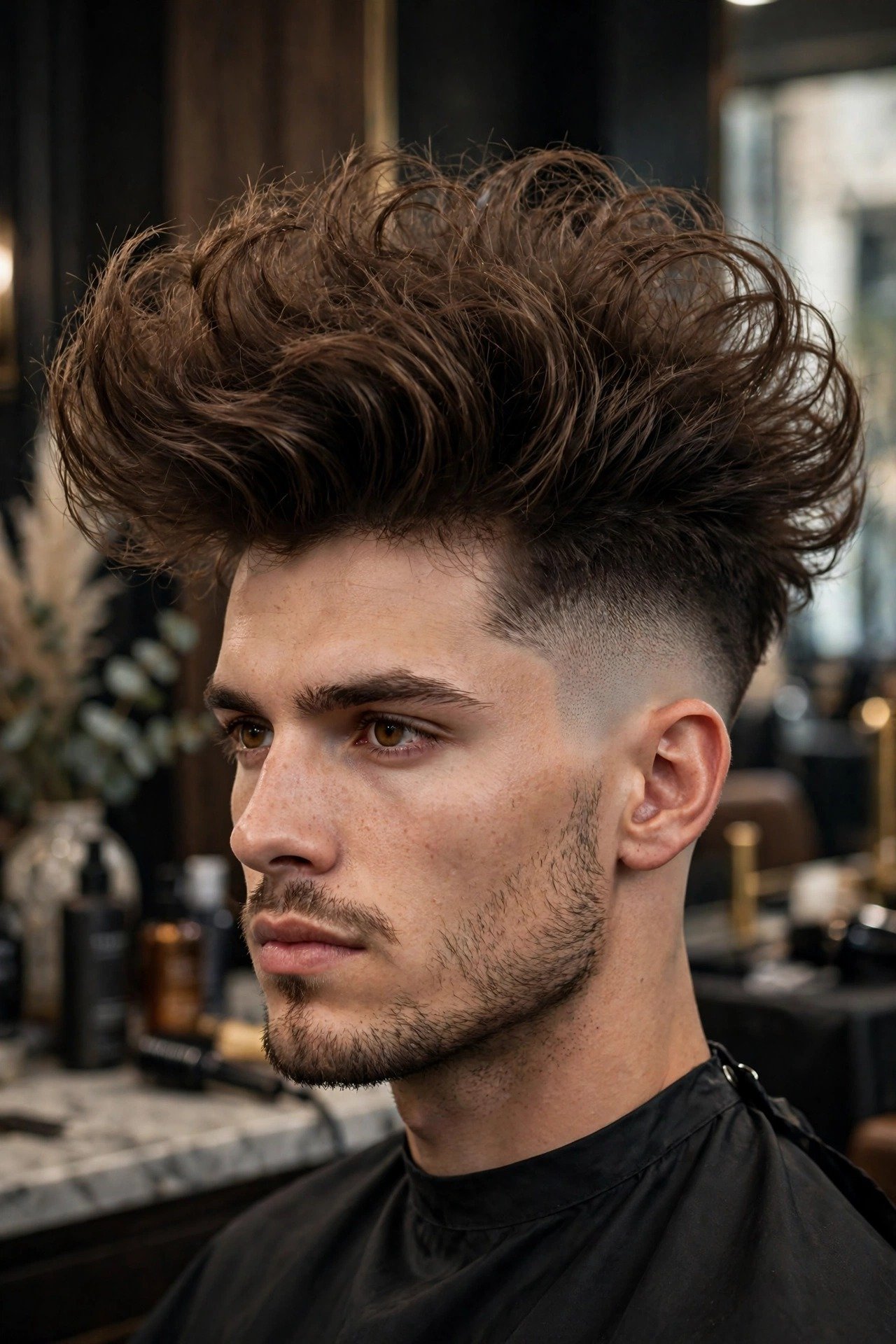
The blowout with a skin fade is the boldest, most modern take on the 90s shape, and it suits confident men who want maximum contrast between a huge, flowing top and razor-clean sides. The fade is taken down to the skin around the ears and nape, usually with a foil shaver or a zero guard, then blended up into the longer top, so the volume above looks even bigger by comparison. It flatters square and oval faces, and it works brilliantly on thick hair that can hold real height. Ask your barber for a mid or high skin fade, blended with a number 1 or 2 guard through the transition, and a heavily layered top of four to six inches that can be blown back with serious lift.
Styling needs a strong foundation, because the top has to stand up to the sharpness of the fade. Use a volumising mousse or a blow-dry spray with heat protection, then dry the hair in sections with a large round brush, pulling each section up and back and holding it until it cools slightly. The front should be the tallest point, with the crown slightly lower so the shape flows backwards. Finish with a strong-hold matte clay or a fibre paste, applying it root to tip and then shaping the ends with your fingers so the flick stays visible and the texture does not collapse.
The trade-off for this drama is upkeep: the skin fade needs a refresh every two weeks to stay sharp, and the top needs daily styling to earn its contrast. Keep the faded area moisturised, avoid heavy oils that can clog the skin, and wash the top with a volumising shampoo so it never looks limp next to the crisp sides. If you are willing to commit to the barber chair and the morning blow-dry, no version in this guide turns heads quite like the skin fade blowout, especially in photos and under evening light.
5. Textured Fringe Blowout
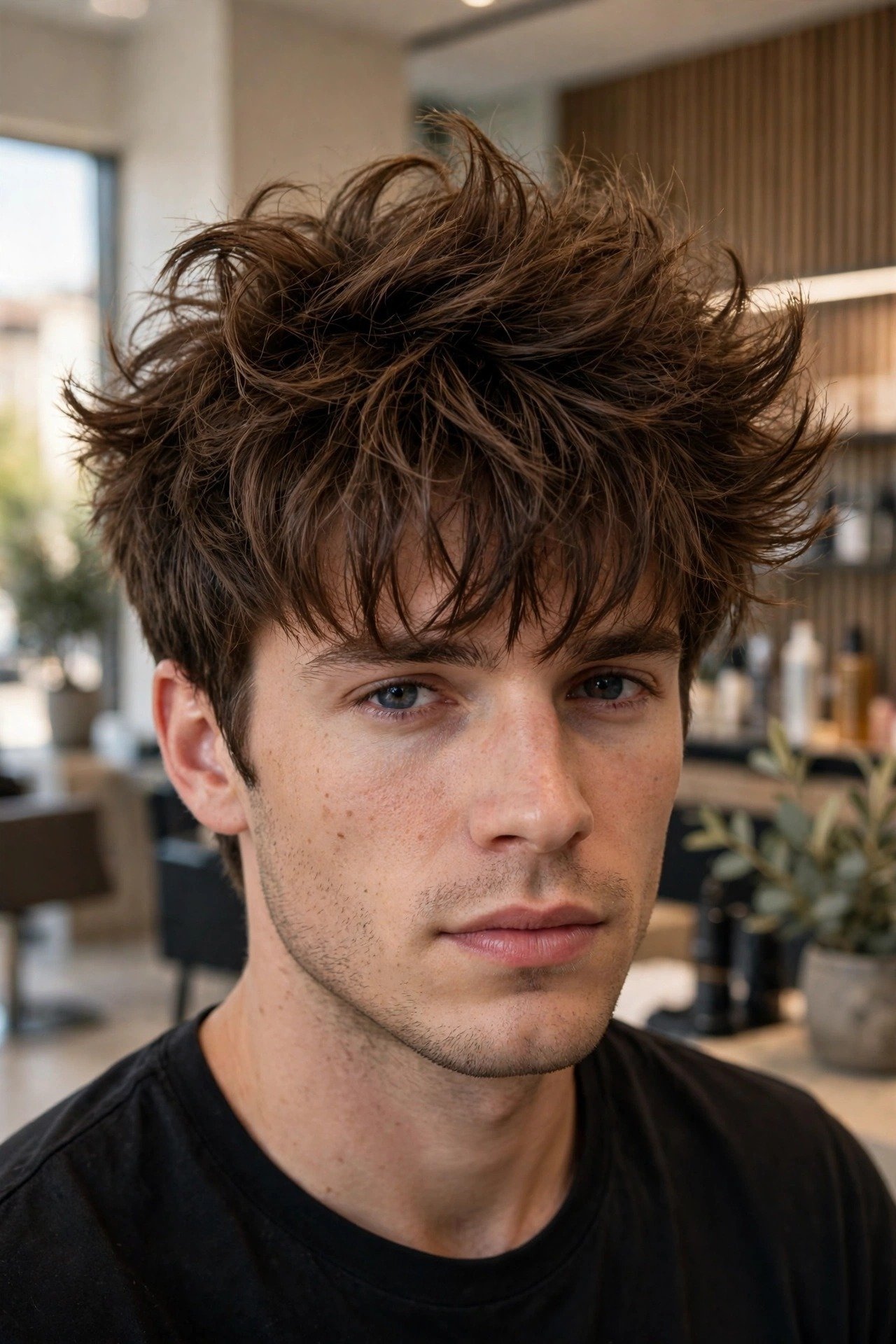
The textured fringe blowout is the best option for men who like the volume of a blowout but do not want all of their hair pushed away from the face. The front is cut into a choppy, textured fringe that falls loosely over the forehead, while the crown and sides are blow-dried with lift so the whole style still feels airy and full. It suits men with a larger forehead, a long face, or strong features that benefit from softening, and it works on straight and wavy hair alike. Ask your barber for a textured fringe with point-cut ends, a layered top, and sides that are tapered or lightly faded, keeping enough length at the front to style forward and to the side.
To style it, apply a sea salt spray or a light mousse to damp hair, then blow-dry the crown up and back while directing the fringe forward and slightly to one side with your fingers or a vent brush. Use the round brush only on the top and crown, and let the fringe keep its natural, piecey texture rather than smoothing it flat. A small amount of matte paste, pinched through the ends of the fringe, creates separation and definition without making the hair look spiky or stiff. The result should look effortless, as if the volume happened naturally and the fringe simply fell into place.
Maintenance is easy, because the fringe hides a growing fringe line and the texture disguises uneven growth. Trim the fringe every three to four weeks so it stays above the eyebrows, and keep the crown trimmed every five weeks to preserve the lift. Avoid heavy gels, which clump textured ends together, and refresh the style with a little water and a quick blow-dry rather than a full wash every morning. This is the blowout for men who want volume with a younger, more relaxed edge.
6. Wavy Blowout
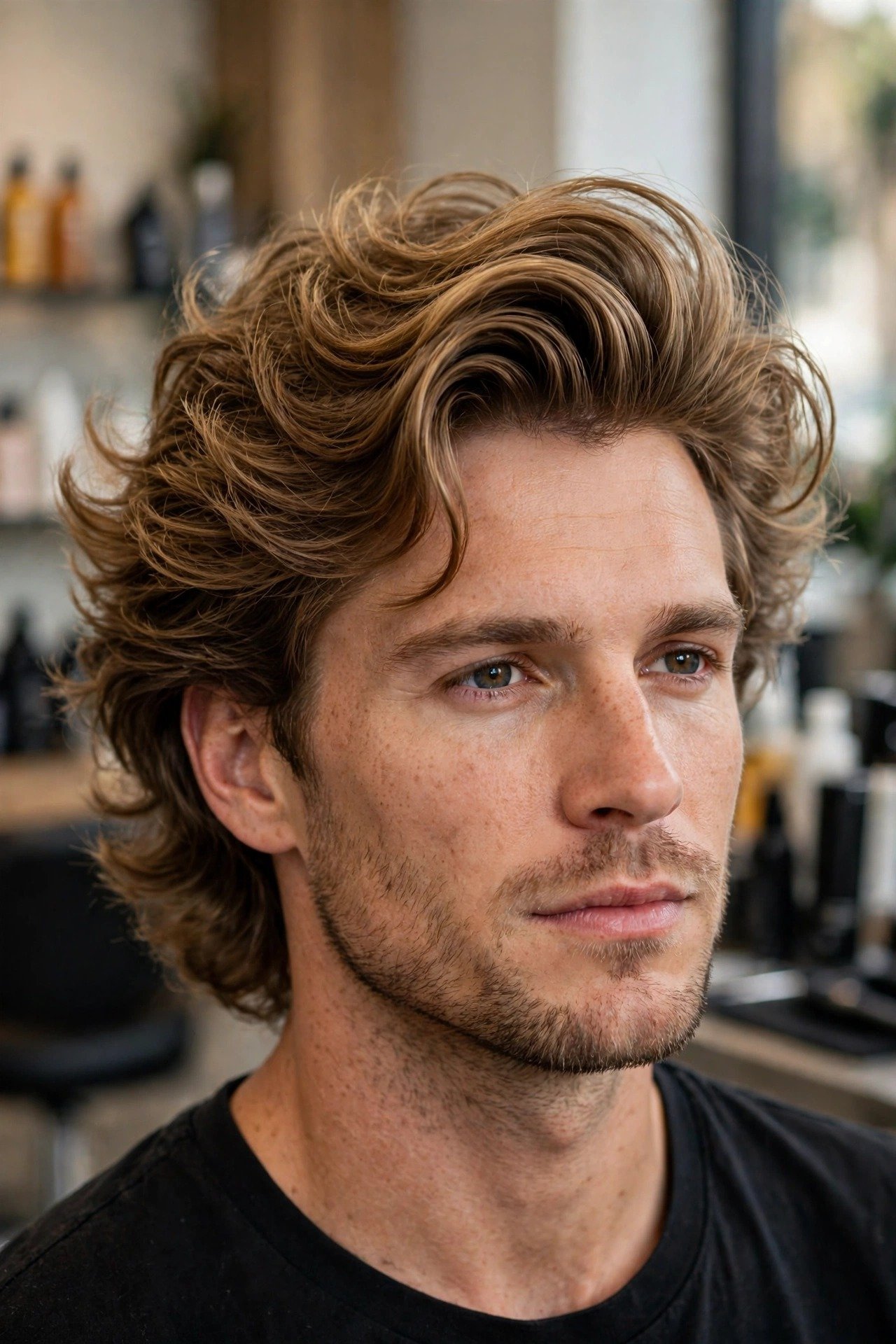
The wavy blowout is where the 90s style feels most natural, because the hair already wants to move and the blow-dry simply enhances what is there. Natural waves give the style built-in texture, soft bends through the lengths, and a flick at the ends that straight hair has to be coaxed into, so the result looks lived-in from the first minute. It suits men with medium-thick, wavy hair and an oval or heart-shaped face, and it is forgiving on days when you have less time to style. Ask your barber for long layers that follow your wave pattern, a soft taper on the sides, and no thinning shears through the wave, so the natural movement is preserved rather than cut away.
Styling starts with a curl-enhancing or volumising cream applied to damp hair, then a diffuser or a round brush on low heat, lifting the roots and encouraging the wave to form as it dries. Do not brush wavy hair when it is dry, because that turns waves into frizz; instead, use your fingers to shape the front back and to the side, and let the ends fall where they naturally flick. A pea-sized amount of light pomade or a sea salt spray adds definition and hold, and a final cool blast from the dryer sets the wave without flattening it. The aim is controlled movement, not perfect smoothness.
Care for this version with a moisturising shampoo and conditioner, because wavy hair dries out faster than straight hair and needs hydration to keep its shape. Trim every five weeks to remove split ends and keep the layers balanced, and sleep with the hair loosely tied or on a silk pillowcase to protect the wave overnight. On non-wash days, mist the hair with water, scrunch gently, and blow-dry the roots for two minutes to revive the volume. The wavy blowout is the easiest way to make natural texture look intentional and expensive.
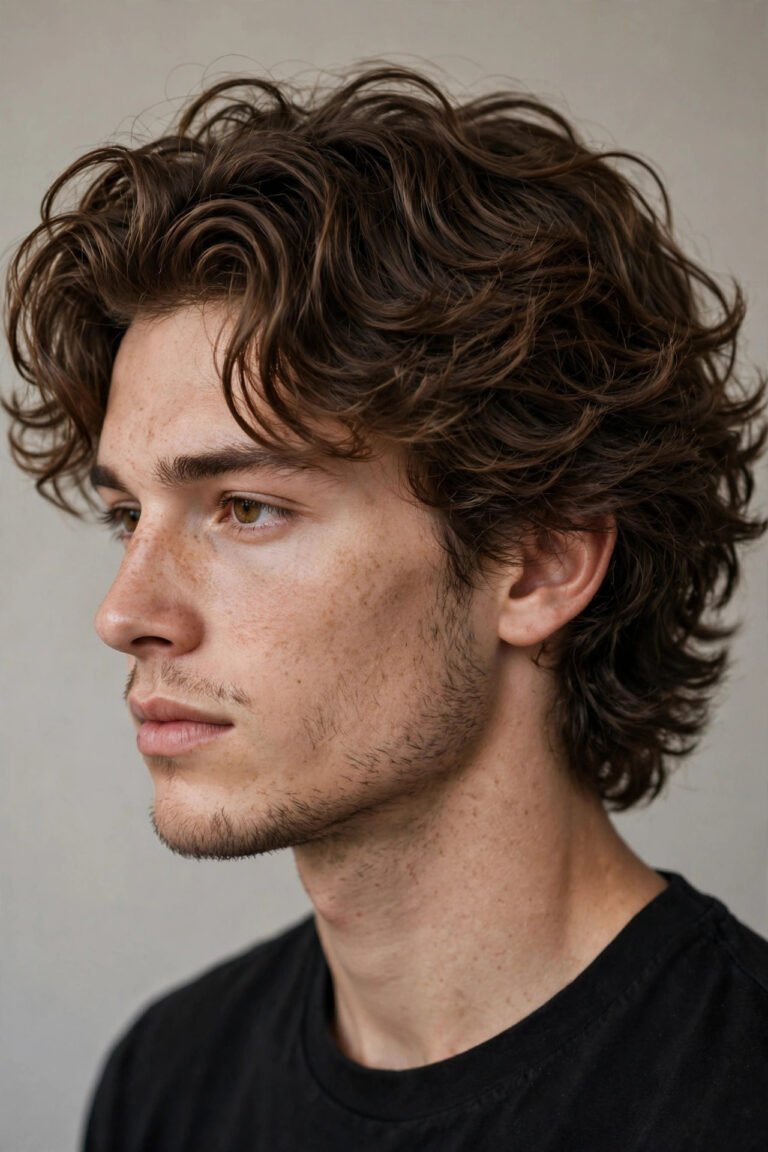
7. Curly Blowout
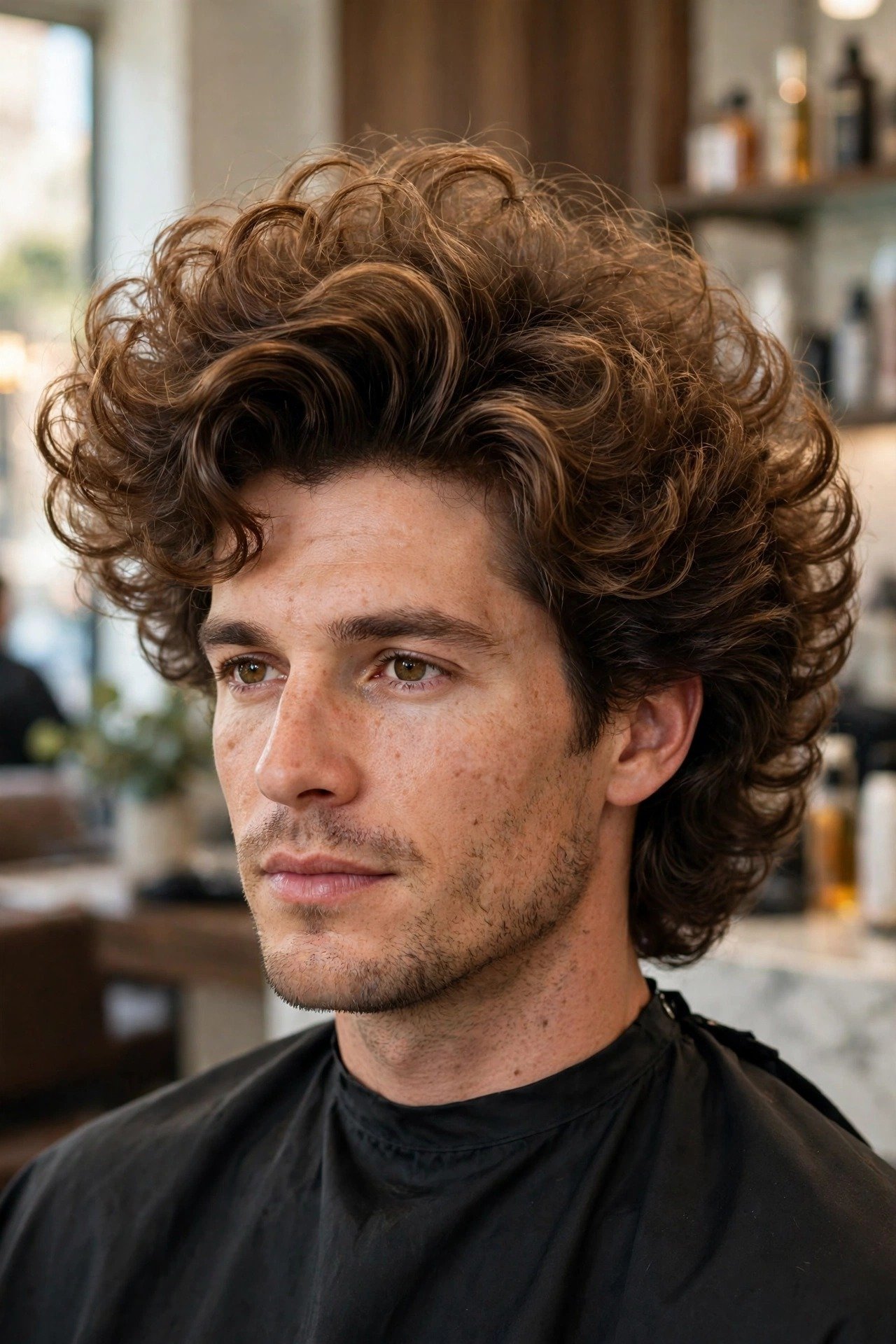
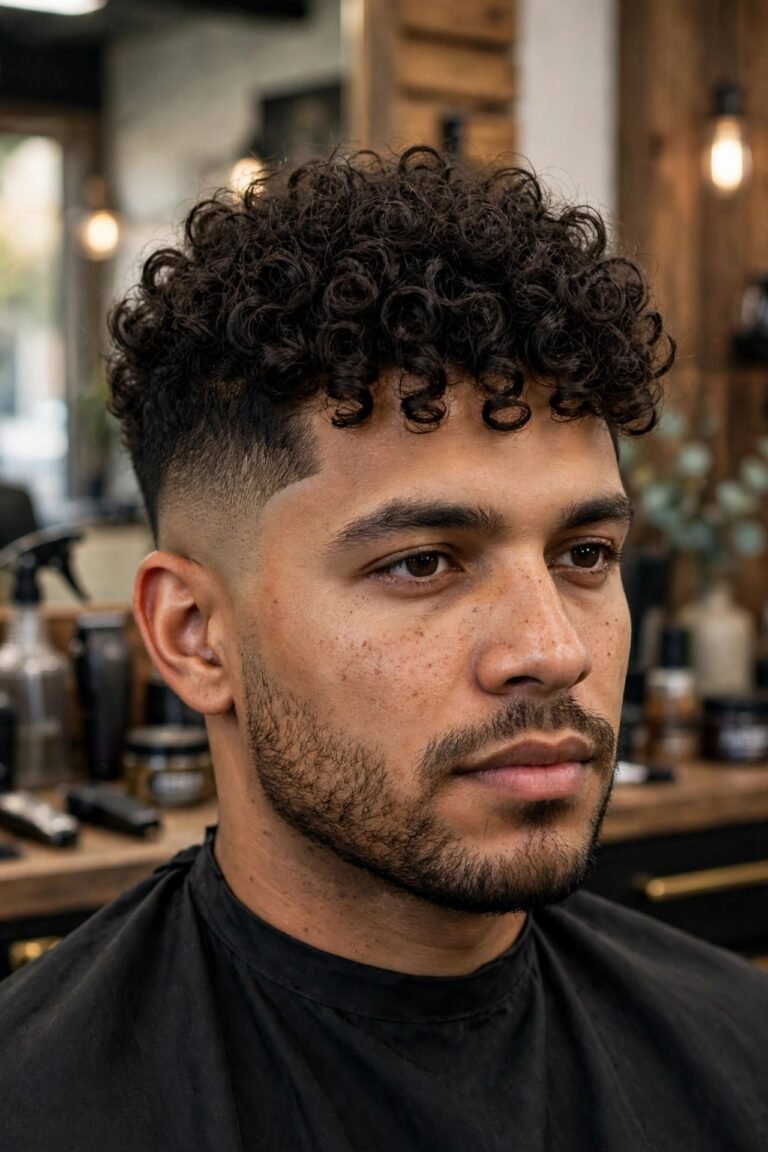
The curly blowout proves that the 90s look is not only for straight hair, because curls bring their own volume and the blow-dry gives them direction and polish. The hair is stretched gently as it dries, so the curls open into soft, bouncy waves with height at the roots and a rounded, full silhouette that looks healthy and deliberate. It suits men with naturally curly or coily hair who want a larger, more styled shape without straightening their hair completely. Ask your barber for long layers that respect your curl pattern, a tapered back and sides that keep the shape balanced, and a cut that is done with the curls in their natural, dry state wherever possible.
To style it, apply a leave-in conditioner and a curl cream to wet hair, then use a diffuser on low heat, lifting the roots with your fingers and drying in sections until the hair is about eighty percent dry. For more stretch and a true blowout finish, follow with a round brush on medium heat, pulling each section up and back and letting it cool before you release it. A light oil or a curl-defining cream, smoothed over the surface at the end, adds shine and controls frizz without weighing the curls down. Avoid a fine-tooth comb, which breaks the curl pattern and creates unwanted volume in the wrong places.
Curly blowouts need moisture more than anything else, so use a sulfate-free shampoo, a rich conditioner, and a weekly deep-conditioning treatment to keep the hair soft and elastic. Trim every six weeks to prevent the shape from becoming triangular, and refresh the style between washes with a water mist and a little leave-in cream rather than a full restyle. This version takes more patience than a straight blowout, but the payoff is a full, sculptural shape that no other hair type can copy, and it looks outstanding in photographs.
8. Long Blowout
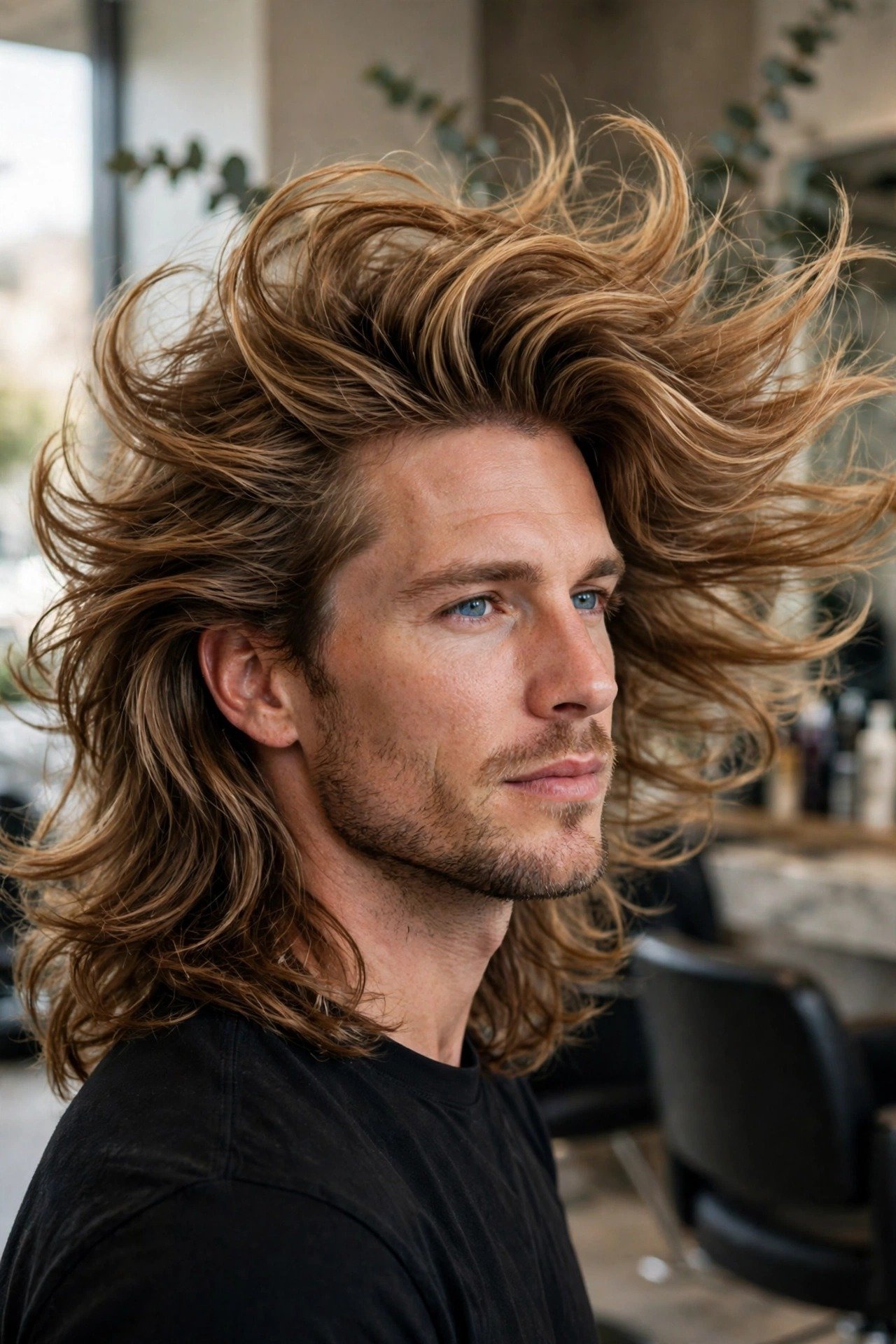
The long blowout is the most dramatic version in this guide, and it suits men who have grown their hair past the collar and want it to look styled rather than simply long. The length allows for real flow: the hair moves when you turn your head, the ends flick outward, and the volume at the crown gives the whole shape a heartthrob quality that shorter versions cannot match. It suits oval and oblong faces, thick hair, and men who are comfortable with a longer morning routine. Ask your barber for long layers through the back and sides, a face-framing layer at the front, and a clean neckline that keeps the length from looking untidy as it grows.
Styling a long blowout takes time, but the method is simple. Apply a volumising mousse from roots to mid-lengths, then blow-dry in sections with a large round brush, lifting the roots and rolling the brush through the lengths so the ends turn under or outward. Work from the back to the front, and let each section cool for a few seconds before moving on, because cooling is what locks the shape in. Finish with a light serum on the ends to add shine and prevent frizz, and use a wide-tooth comb to shape the front back from the face without flattening the volume you have just created.
Maintenance for long hair is about health as much as shape, so condition every wash, use a heat protectant every time you blow-dry, and trim the ends every six to eight weeks to keep them from splitting. Sleep with the hair loosely tied in a low ponytail or a braid to prevent tangling, and wash every two to three days rather than daily so the natural oils can protect the lengths. The long blowout is a commitment, but for men who love the 90s silhouette at full length, it is the most rewarding version of all.
9. Short Blowout
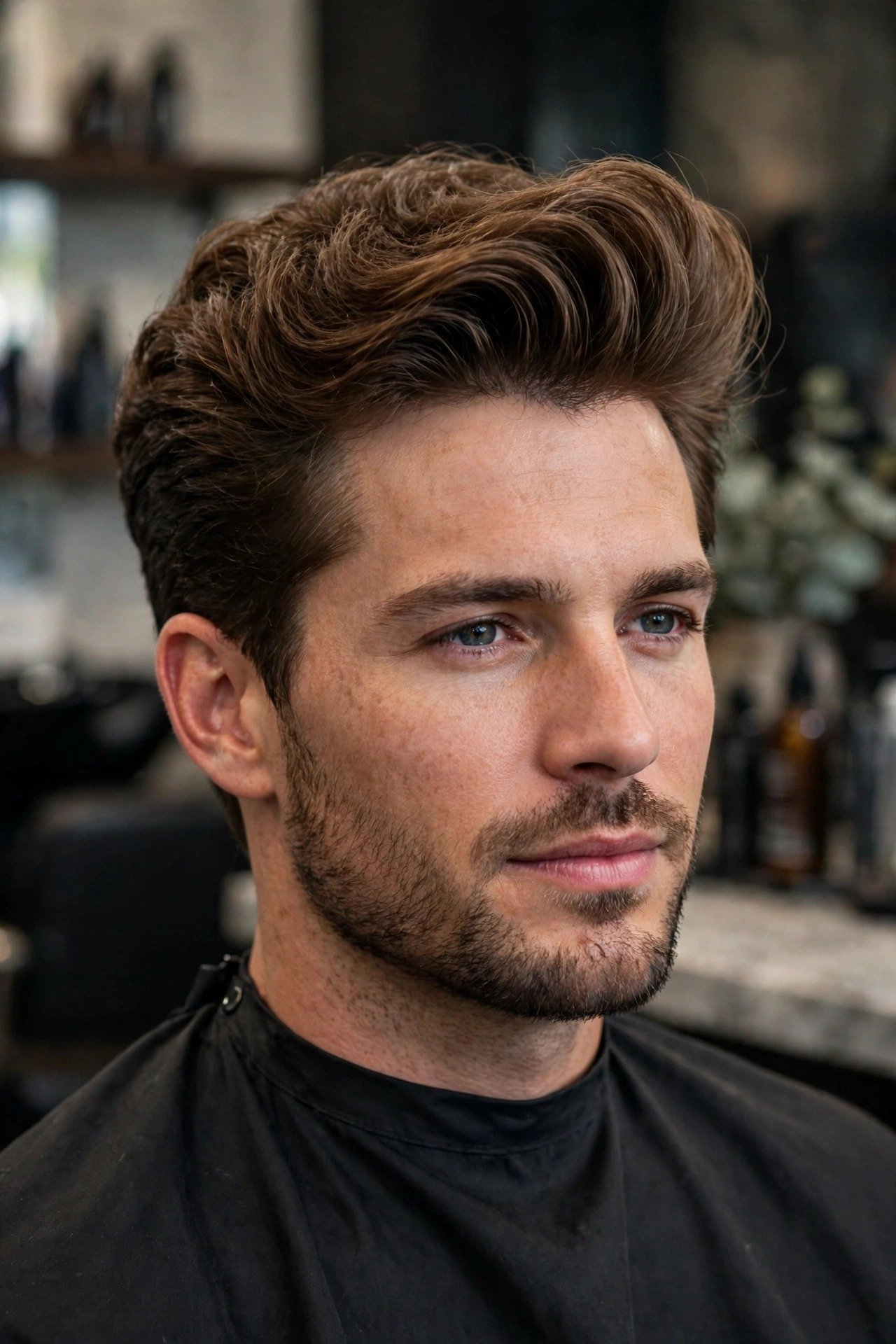
The short blowout is the low-commitment entry point to the trend, and it suits men who want the 90s volume without growing their hair long. The top is kept around two to three inches, just long enough to lift and sweep back, while the sides are short and tidy, so the whole style takes only a few minutes to create and holds its shape easily. It flatters round faces, because the height adds length, and it works well for fine hair, because the short lengths are easier to volumise. Ask your barber for a short layered top with a textured finish, a number 2 or 3 guard on the sides blended into the top, and a front that is left slightly longer than the crown.
Styling is quick: apply a small amount of volumising mousse or a blow-dry cream to damp hair, then use a vent brush or a small round brush to lift the front up and back while drying on medium heat. Keep the dryer close to the roots for the first minute, then shape the ends with your fingers, adding a tiny amount of matte paste for hold and texture. The finish should look neat but not stiff, with visible lift at the front and a clean, natural line through the sides. A quick cool shot at the end helps the short lengths stay in place all day.
The short blowout is the easiest version to maintain, needing only a trim every three to four weeks to keep the proportions right. It is ideal for the gym, for travel, and for men who do not want a long styling routine, and it still reads unmistakably as a 90s blowout because of the lift and the swept-back direction. Wash daily if needed, use a light product, and you will have a style that looks deliberate with almost no effort, which is exactly why so many men start here before growing into a longer version.
10. Blowout with Curtain Fringe
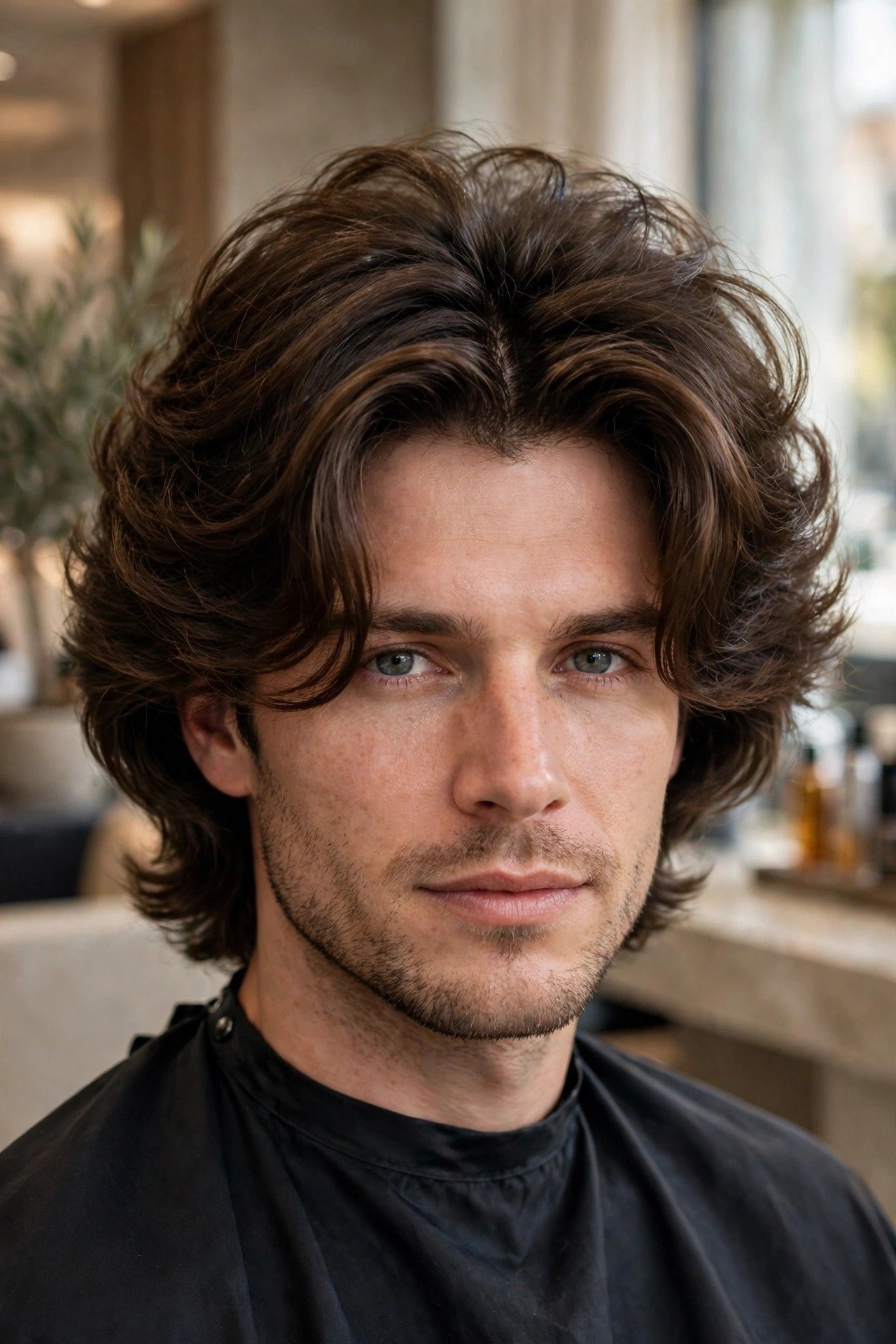
The blowout with a curtain fringe is one of the most recognisable 90s looks, because the centre part and the two soft wings of hair framing the face are pure heartthrob. The curtains fall to the cheekbones or jawline, the crown is lifted and blown back, and the sides blend into the fringe so the whole shape feels flowing and symmetrical. It suits oval, square, and heart-shaped faces, and it works on straight and wavy hair that can hold a centre part. Ask your barber for a middle part with face-framing layers, a layered top that can be blown back and outward, and sides that are long enough to connect with the curtain length.
To style it, create the centre part while the hair is damp, then apply a volumising spray at the roots and blow-dry each side away from the part with a round brush, rolling the ends outward so the curtains flick away from the face. Lift the crown as you dry it, so the top does not sit flat between the two sides, and use your fingers to adjust the curtains until they sit evenly. A light cream or a matte paste, applied sparingly to the ends, keeps the curtains separated and defined without making them stiff or sticky, and a little texturising spray adds movement.
This version needs regular trims to keep the curtains at the right length, ideally every four weeks, because once they grow past the jawline they lose their shape and start to look like a longer flow cut. Wash with a volumising shampoo, avoid heavy conditioners at the roots, and use a wide-tooth comb to reset the part each morning. If you want the most authentically 90s silhouette in this guide, the curtain-fringe blowout is the one to choose, and it photographs beautifully from the front.
11. Side-Swept Blowout
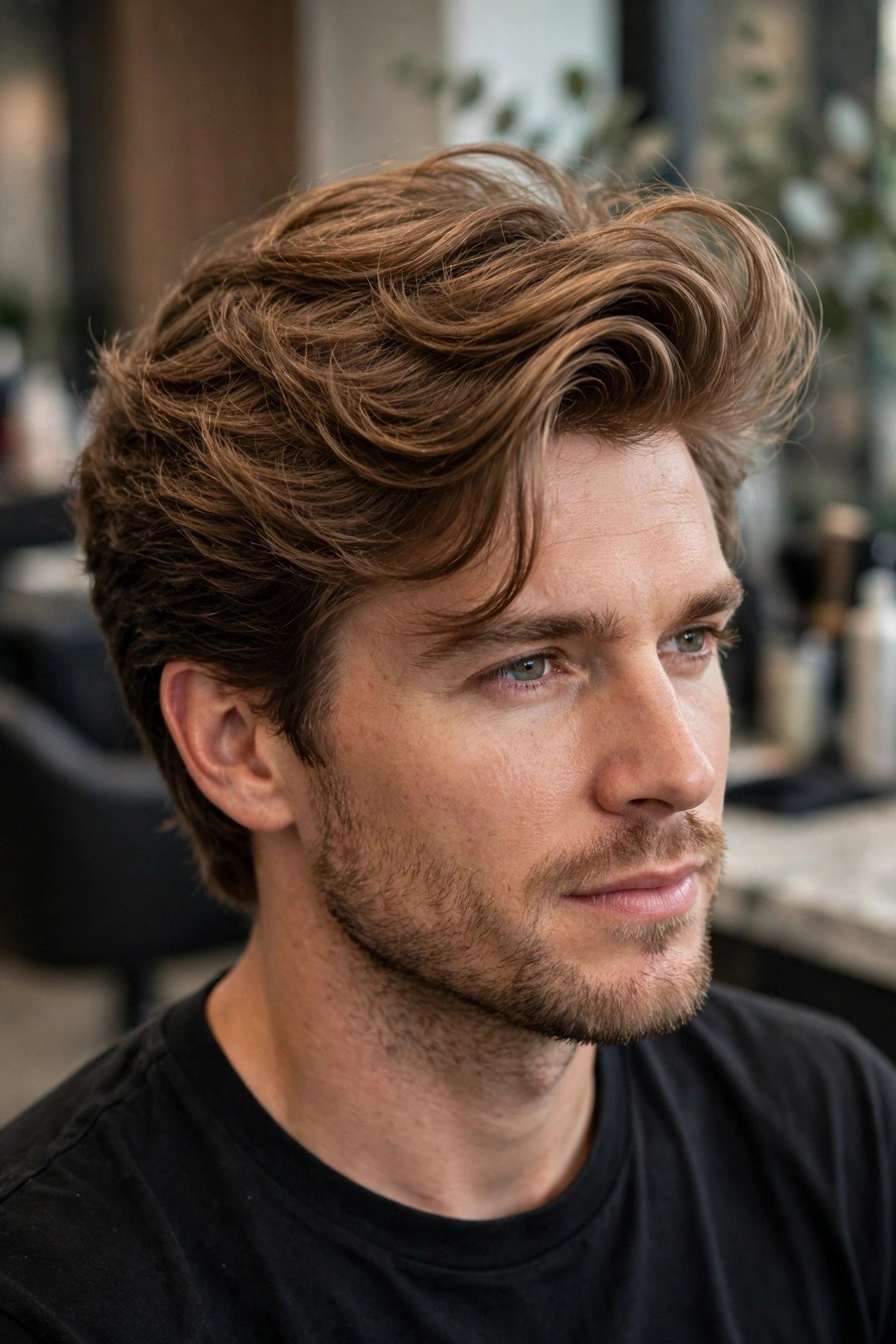
The side-swept blowout is the most versatile and most forgiving version, because the deep side part and the sweeping direction suit almost every face shape and hair type. The hair is blown up and across, creating a long, flowing line from the part to the opposite side, with volume at the crown and a soft flick at the ends. It suits men with a strong jaw, a round face that needs asymmetry, or a cowlick that naturally falls to one side, and it works on straight, wavy, and thick hair. Ask your barber for a side part with a layered top, the front left longest, and sides that are tapered or faded to support the sweep without competing with it.
Styling starts by finding your natural part while the hair is damp, then applying a volumising mousse and blow-drying the hair in the direction of the sweep with a round brush. Lift the roots at the part first, because that is where the height comes from, then roll the brush through the lengths so the ends turn under slightly. A medium-hold pomade or a matte clay, worked through the top and brushed into place, gives the sweep its staying power, and a final brush with a vent brush smooths the surface without flattening the volume. The result should look polished but still soft and movable.
Maintenance is simple: trim every four to five weeks, keep the part clean by combing it in while the hair is damp, and refresh the sweep on day two with a little water and a quick blow-dry. This version is ideal for the office, because it looks neat and professional, and it is equally good for evenings, because the volume and the sweep give it a romantic, 90s quality. If you can only choose one blowout and you want it to work everywhere, choose the side-swept version.
12. Messy Blowout
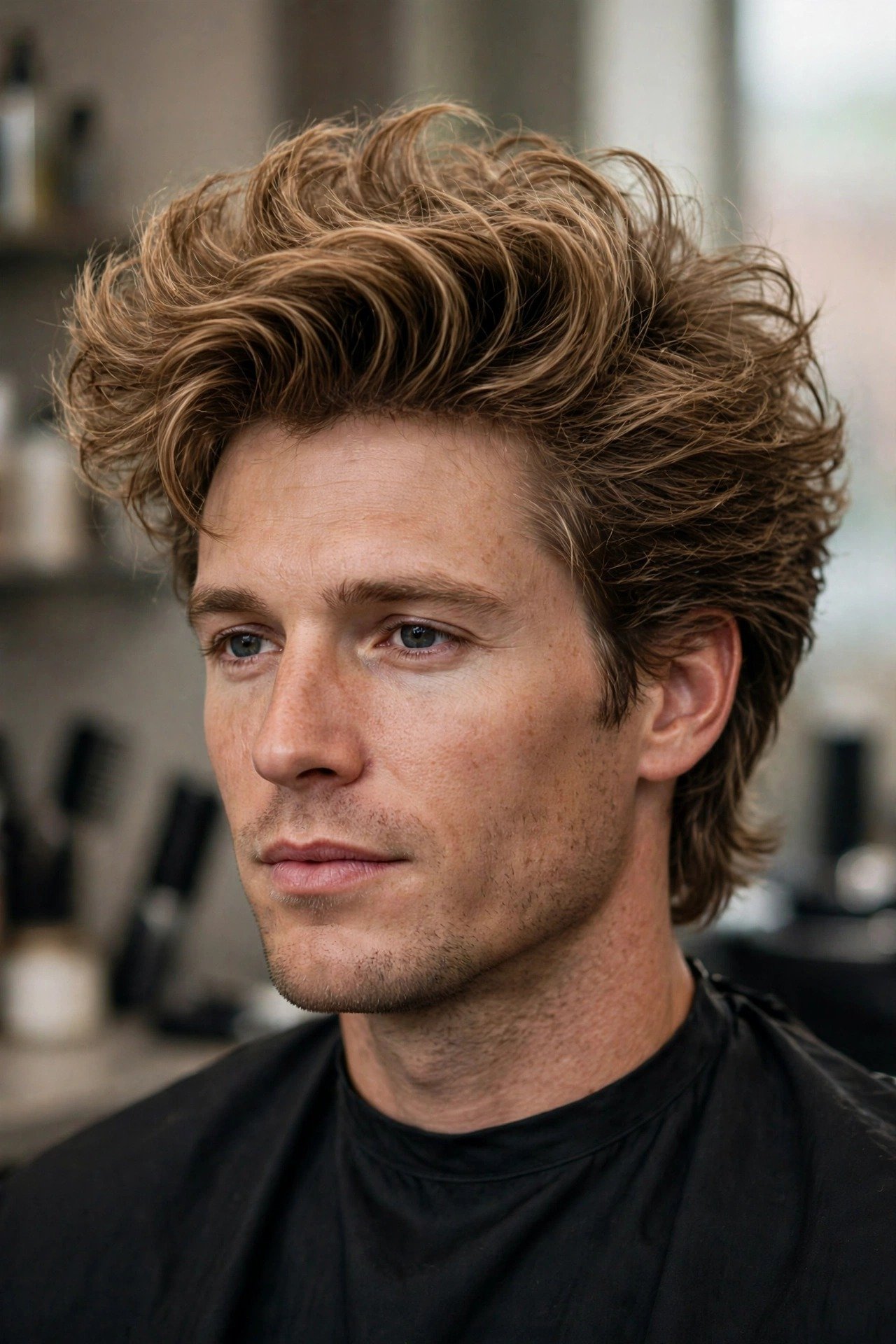
The messy blowout is the relaxed, undone cousin of the classic style, and it suits men who want volume and movement without looking like they spent an hour in front of the mirror. The hair is layered and textured so it falls into natural, piecey sections, with lift at the roots and a deliberately imperfect finish that looks effortless and cool. It suits younger men, creative professionals, and anyone with wavy or thick hair that naturally wants to move in different directions. Ask your barber for a heavily textured, layered cut with point-cut ends, a soft taper on the sides, and no blunt lines, so the hair has permission to be messy without looking untidy.
To style it, apply a sea salt spray or a texturising mousse to damp hair, then blow-dry with your fingers instead of a brush, scrunching and lifting the roots as you go. Use a low or medium heat and stop when the hair is about ninety percent dry, letting the last of the moisture air-dry so the texture stays natural. A small amount of matte paste, rubbed between the palms and pinched through random sections, creates definition and separation, and a light mist of texturising spray adds grit and hold. The key is to stop before the style looks finished, because the mess is the point.
This version is the most forgiving when it grows out, because the texture hides uneven lengths and the messy finish disguises a missed trim. A cut every five to six weeks is enough, and you can skip a wash day by using dry shampoo at the roots and a quick finger-style. Avoid heavy products that clump the pieces together, and do not over-brush the hair, because brushing is what turns a messy blowout into a flat, frizzy one. Wear it with casual clothes and it looks like the best version of a weekend, every day.
13. Slicked-Back Blowout
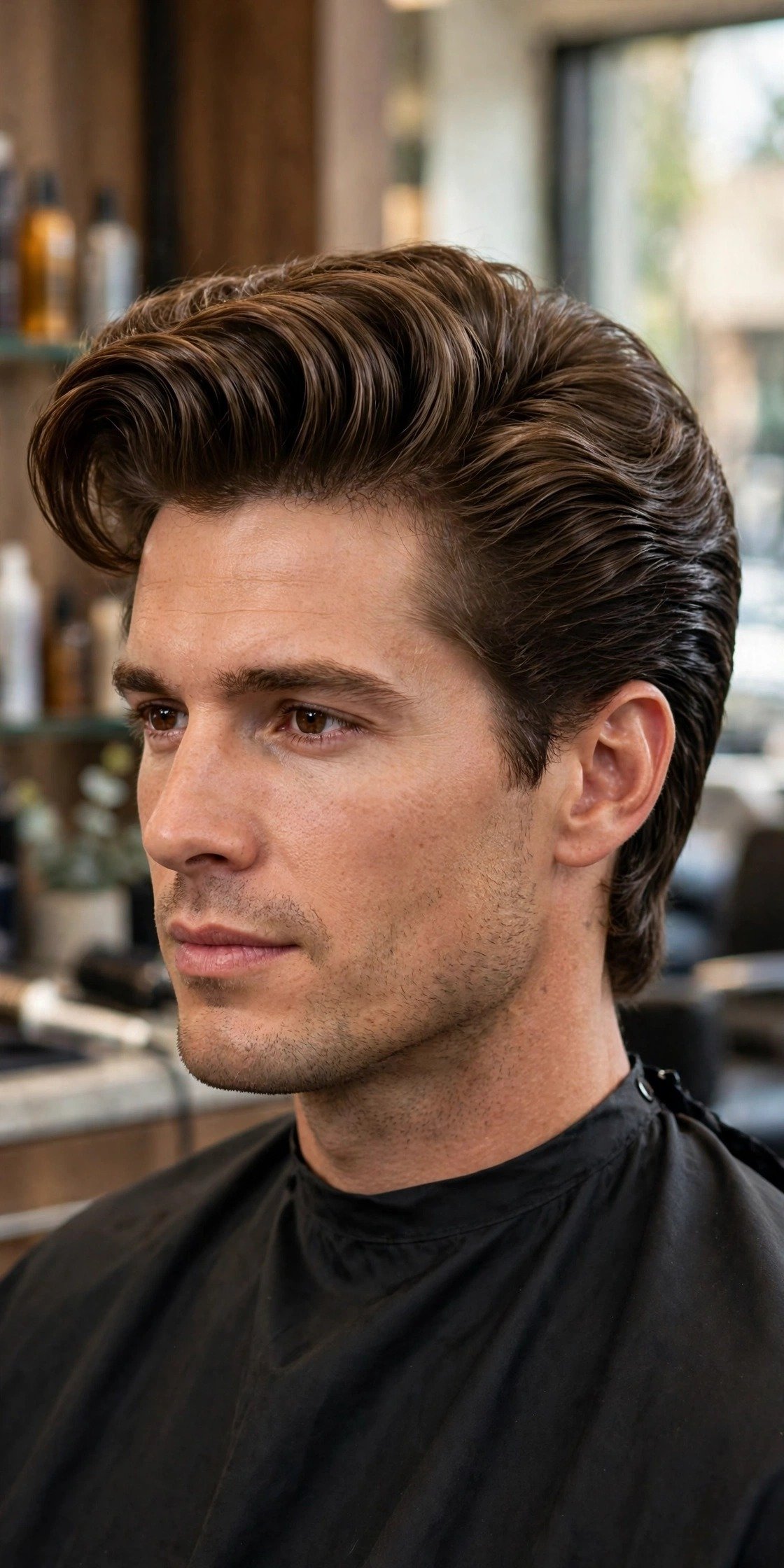
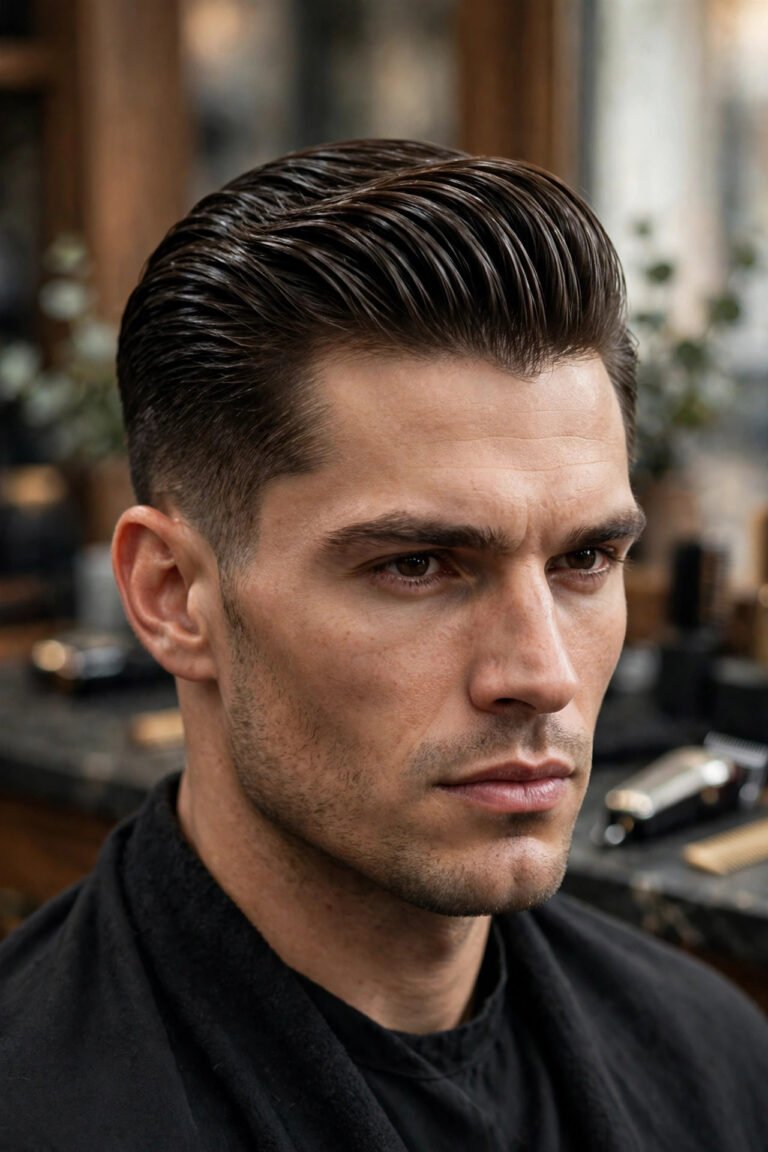
The slicked-back blowout combines the volume of a blowout with the polish of a classic slick back, and it suits men who want a sharper, more formal version of the 90s look. The hair is blown up and back with real height at the front, then smoothed over the crown so the surface looks clean and controlled, with the ends flicking gently at the back. It flatters square and oval faces, thick hair, and men who wear suits or tailored clothing regularly. For a closer look at the flatter, shinier side of this family, see our slick back guide, which breaks down the product and finish choices that separate a true slick back from this fuller blowout version. Ask your barber for a layered top of four to five inches, tapered sides, and a clean neckline.
Styling needs a pomade or a strong-hold cream rather than a matte paste, because the finish should have a soft sheen. Apply a volumising mousse first, blow-dry the hair up and back with a round brush to build height, then work a small amount of pomade through the top from front to back, smoothing the surface with a comb or a brush. Keep the sides neat by directing them backward as they dry, and use a light hairspray to lock the shape without making it crunchy. The front should stay lifted, not flattened, so the style reads as a blowout first and a slick back second, with movement still visible in the ends.
Maintenance is moderate: trim every four weeks to keep the shape, wash with a clarifying shampoo once a week if you use pomade daily, and use a light conditioner to keep the hair soft enough to restyle. This version is excellent for weddings, formal events, and evenings out, because it looks intentional and expensive under any light. If you want a blowout that can walk into a boardroom and a party on the same day, the slicked-back version is the one to master.
14. Blowout with Quiff
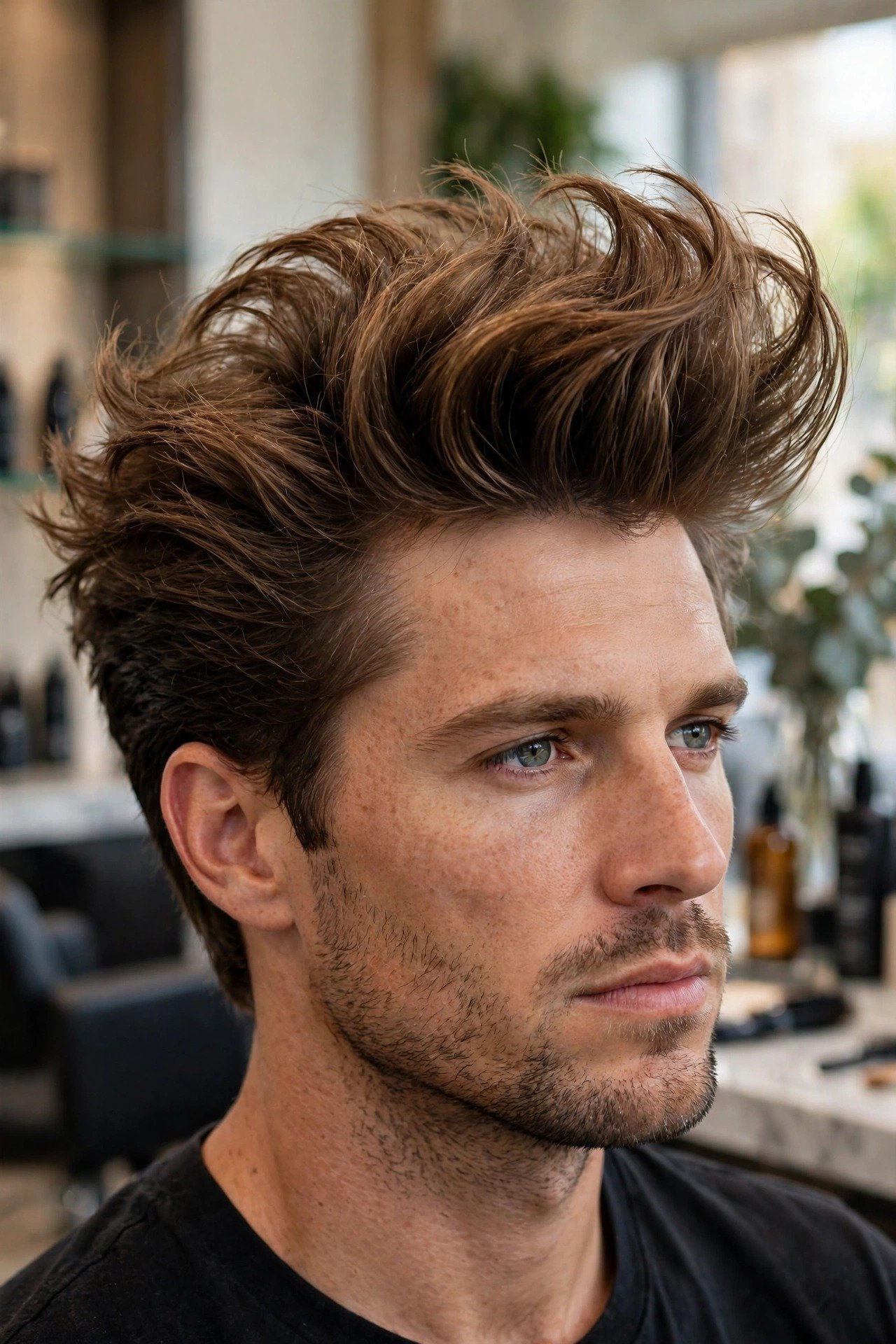
The blowout with a quiff takes the height of the classic style and pushes it even further at the front, creating a tall, sculpted wave that is the focal point of the whole haircut. The quiff rises from the forehead, curves gently backward, and blends into the blow-dried volume behind it, so the silhouette is taller and more dramatic than a standard blowout. It suits men with a round or square face, because the extra height lengthens the face, and it works best on thick, straight or wavy hair that can hold its shape. Our pompadour guide explains the taller, more structured cousin of this look if you want even more height. Ask your barber for a quiff cut with a long front, shorter crown, and tapered sides.
To style the quiff, apply a volumising mousse and a heat protectant to damp hair, then blow-dry the front upward and backward with a round brush, rolling the brush under at the ends to create the curve. Hold each section for a few seconds after drying so it cools in the lifted position, and build the quiff in two layers: the lower layer for structure, the upper layer for texture and movement. Finish with a strong-hold matte clay, applying it from the roots upward and shaping the front with your fingers, then set the shape with a light mist of hairspray. The quiff should look full and deliberate, never stiff or helmet-like.
The quiff blowout needs the most daily styling time in this guide, usually ten to fifteen minutes, and a trim every three to four weeks to keep the front at the right length. Use a volumising shampoo, avoid heavy oils that flatten the quiff, and practise the blow-dry technique a few times until the motion feels natural. Once you have it, this is the version that gets compliments, because the height is visible from across the room and the retro reference is unmistakable.
15. Blowout Mullet
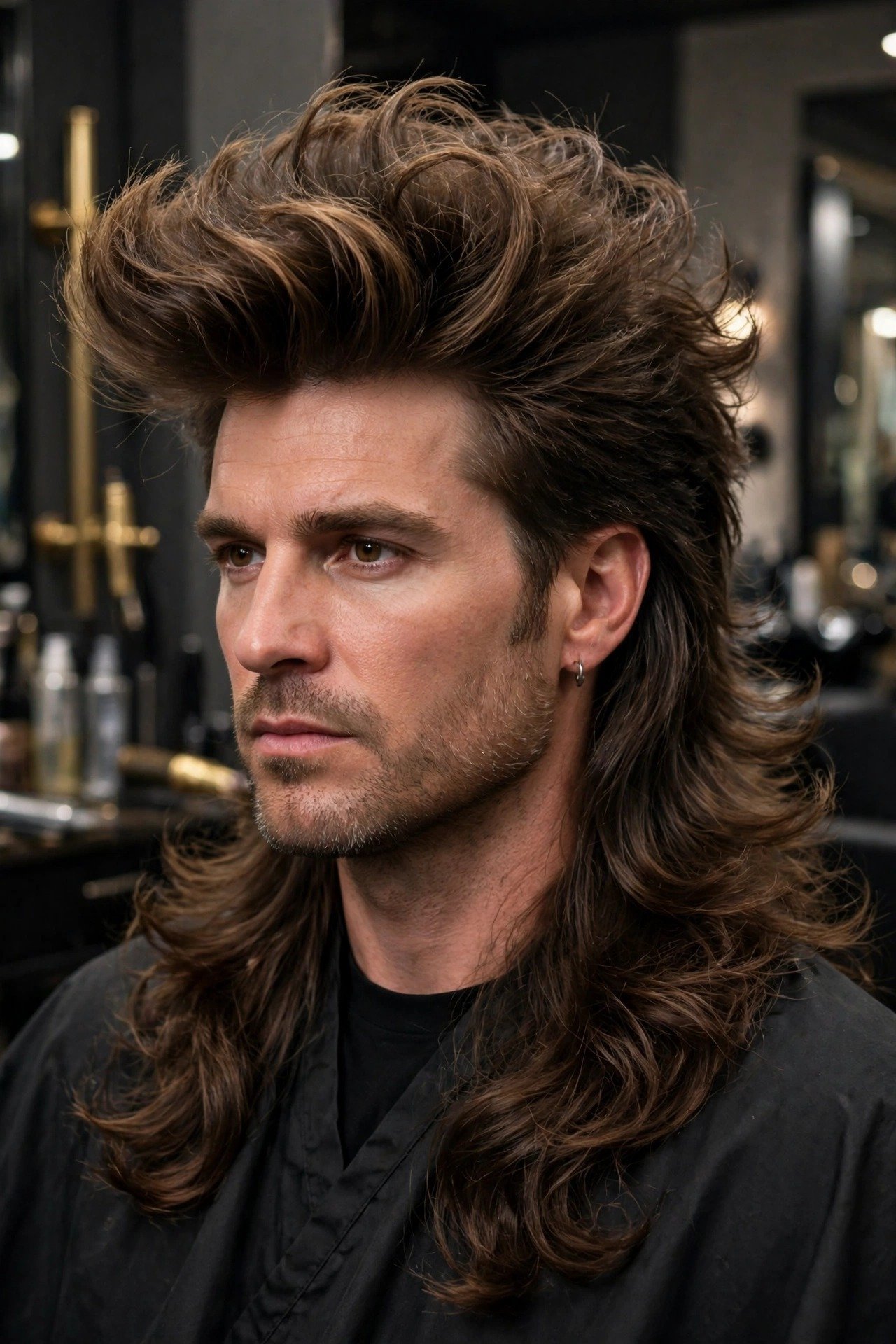
The blowout mullet is the boldest retro statement in this guide, combining the volume of a 90s blowout on top with the longer, flowing length of a mullet at the back. The front and crown are blown up and back with full lift, while the back grows longer, flicking outward at the nape in a way that is pure 90s and completely unapologetic. It suits confident men, oval and oblong faces, and thick or wavy hair that can carry the length without looking thin. Ask your barber for a modern mullet with a layered top, a soft taper on the sides, and a back that is left long but shaped, not blunt, so the flow looks intentional rather than grown out by accident.
Styling is a two-part job: blow-dry the top with a round brush, lifting the roots and rolling the ends back, then blow-dry the back sections outward and downward so the length flicks away from the neck. Apply a volumising mousse to the top and a light cream to the back, because the back needs smoothness more than height. A matte paste through the top and a little serum on the ends of the mullet keeps both parts looking healthy and connected. Use your fingers to separate the back sections so the length moves freely and does not clump together.
Maintenance means regular trims to the top every four weeks and a shaping trim to the back every six weeks, so the mullet keeps its flow without becoming straggly. Wash with a gentle shampoo, condition the back lengths, and use a heat protectant every time you blow-dry. This is not a subtle style, and it is not for everyone, but for men who love the 90s and want to wear it at full volume, the blowout mullet is the most fun version in the whole list.
16. Blowout with Undercut
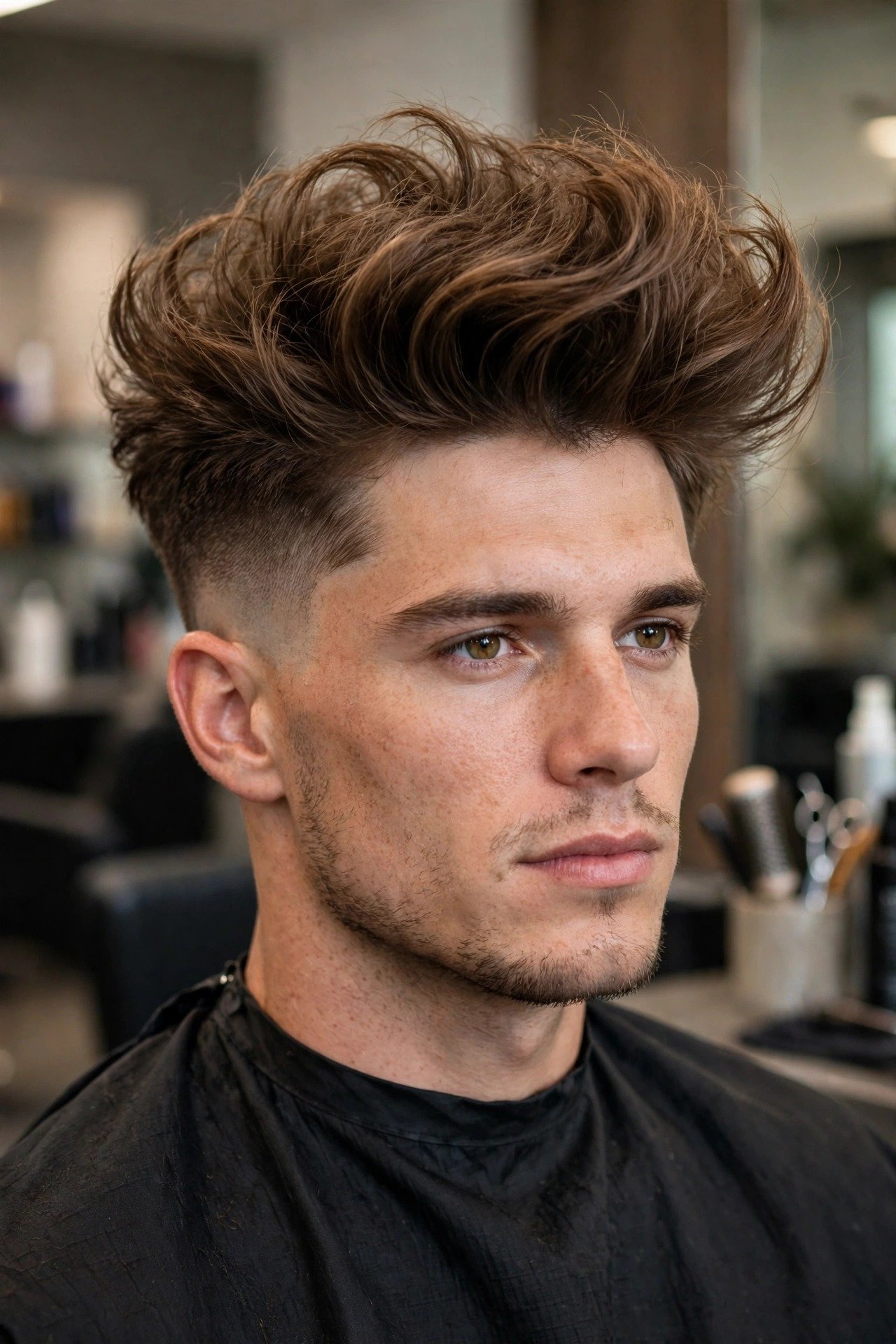
The blowout with an undercut is the most graphic version of the style, because the long, voluminous top sits above sides that are cut very short with a clear, disconnected line. The contrast makes the top look even fuller, and the sharp edge gives the retro volume a modern, edgy frame that works well for fashion-forward men. It suits square and oval faces, thick hair, and men who like a bold, high-contrast haircut. Ask your barber for an undercut using a number 1 or 2 guard on the sides and back, disconnected from the top with no blending, and a layered top of four to six inches that can be blown back with serious height and movement.
Styling the undercut blowout is straightforward once the cut is right. Apply a volumising mousse to the damp top, blow-dry it up and back with a large round brush, and keep the sides dry and flat so the disconnection stays visible. Use a strong-hold matte clay or a fibre paste to shape the top, working from the roots and lifting the front as you go, and leave the ends textured rather than smoothed, so the volume looks natural above the sharp sides. A light hairspray helps the top hold its height through the day, especially if your hair is fine or prone to falling flat.
The undercut needs frequent upkeep, because the short sides grow out quickly and the line softens within two weeks. Book a sides-only clean-up every two weeks and a full cut every four weeks to keep the contrast crisp. Wash the top with a volumising shampoo, keep the undercut area clean and moisturised, and avoid heavy products on the sides that would make them look greasy next to the matte top. If you want a blowout with real attitude, this is the version to choose.
17. Heartthrob Blowout
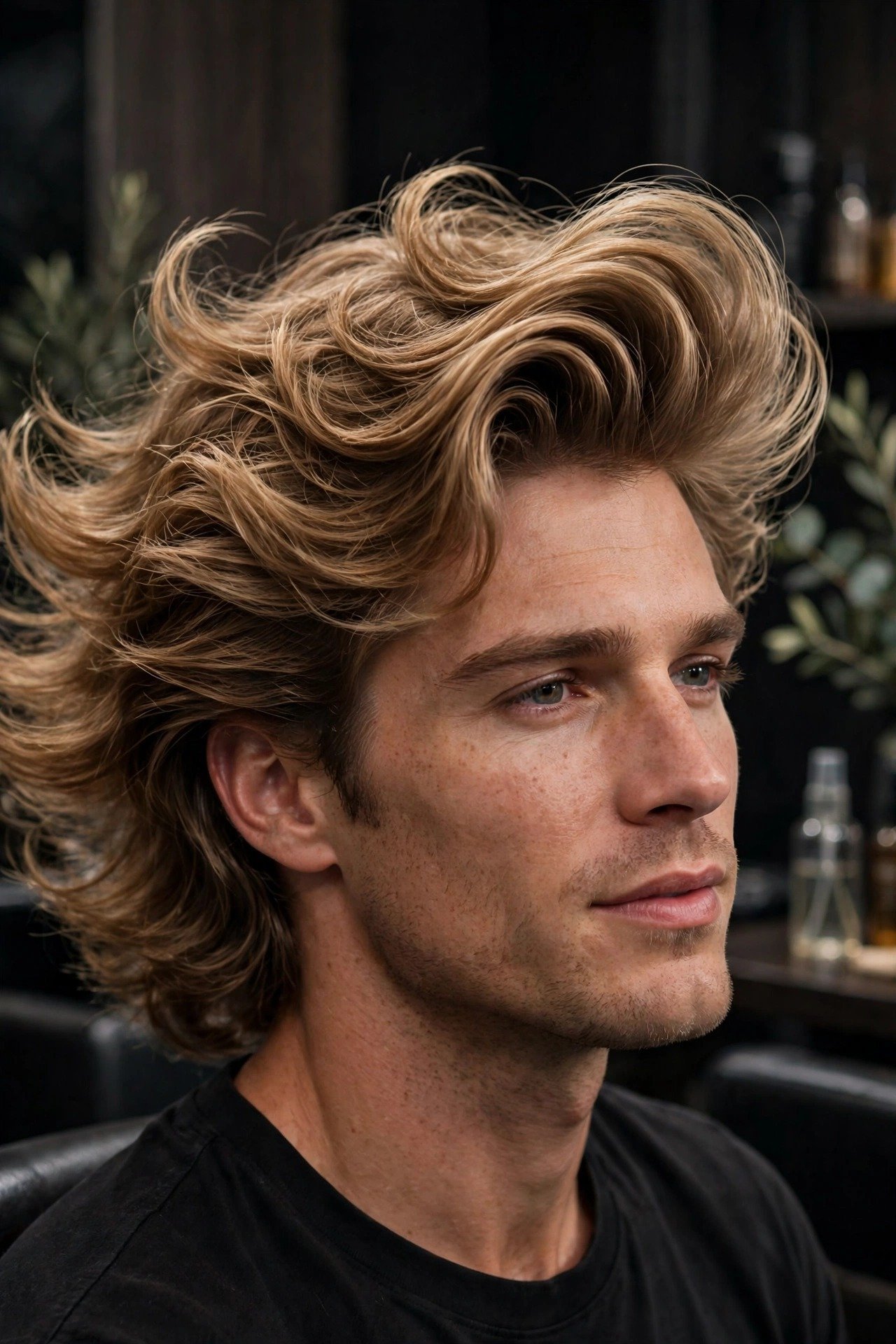
The heartthrob blowout is the softest, most romantic version of the trend, and it is the one most directly inspired by the 90s film stars and pop singers who made the look famous. The hair is full and touchable, with a gentle centre or side part, soft waves through the lengths, and ends that flick outward just enough to frame the face without looking styled to within an inch of its life. It suits men with a warm smile, an oval or heart-shaped face, and medium-thick hair that moves naturally. Ask your barber for a soft layered cut with no harsh lines, a front that falls to the eyebrows when pulled forward, and sides that are long enough to blend into the volume rather than being faded short.
Styling should be gentle: use a volumising mousse and a light cream, blow-dry with a large round brush on medium heat, and lift the hair up and back in soft sections rather than pulling it tight. Let the ends turn naturally, and use your fingers rather than a comb to shape the front, so the finish stays soft and a little imperfect. A pea-sized amount of light pomade, warmed in the palms and brushed through the mid-lengths, adds shine and control without stiffness, and a final tousle with the fingers gives the style its heartthrob ease. The goal is hair that looks like it simply grew that way, only better.
Maintenance is easy, because the softness hides growth and the layers keep their shape for weeks. Trim every five weeks, condition regularly to keep the hair shiny and healthy, and avoid over-washing, which strips the natural oils that give this version its softness. Wear it with a relaxed shirt or a smart jacket and it works everywhere, from a date to a family gathering, because the heartthrob blowout is less a haircut and more a feeling: confident, warm, and effortlessly charming.
18. Voluminous Blowout with Middle Part
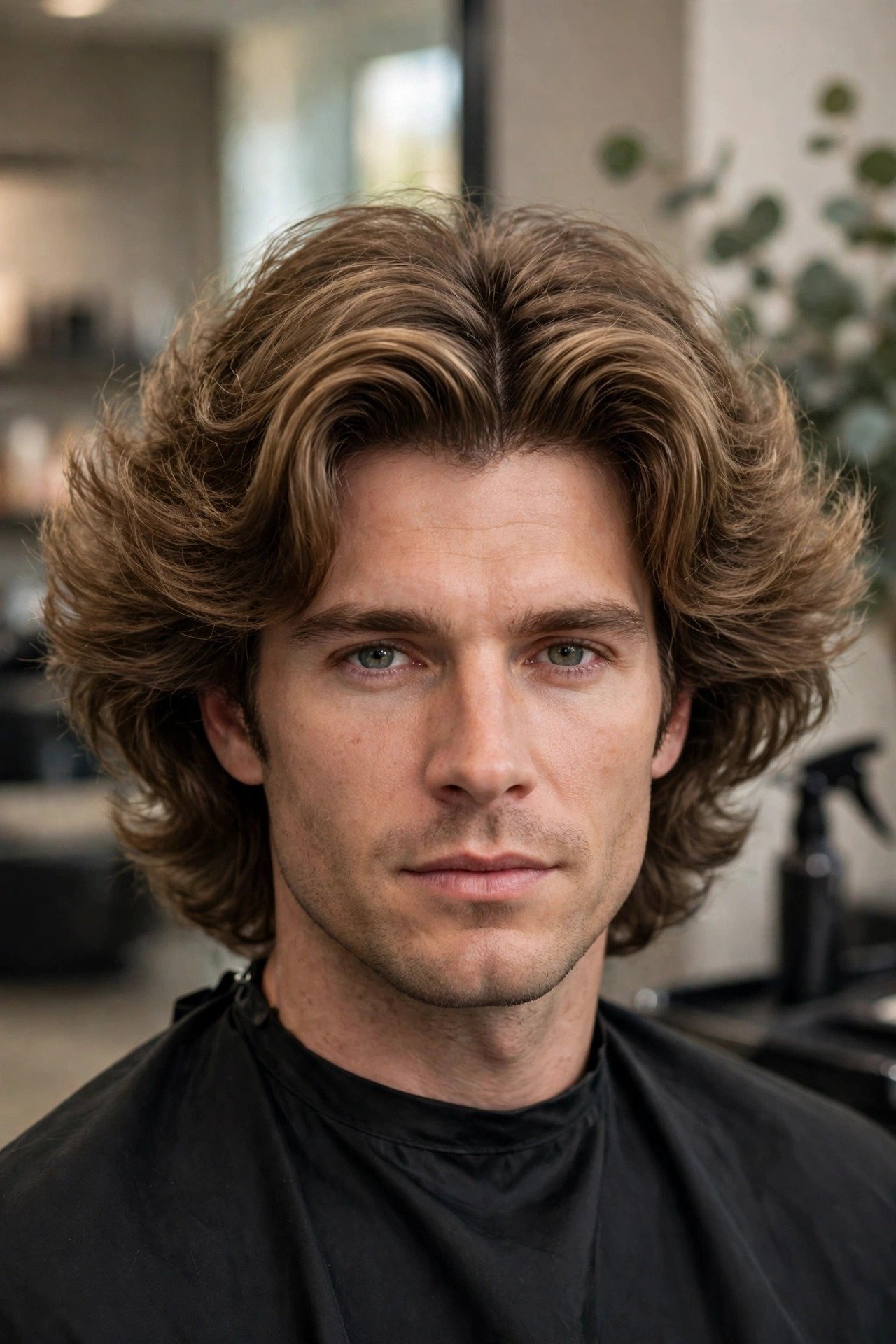
The voluminous blowout with a middle part is the symmetrical, high-impact version of the style, and it suits men who want maximum fullness and a clean, balanced silhouette. The hair is parted precisely in the centre, blown up and outward on both sides, and finished with a rounded, almost sculptural shape that frames the face evenly. It flatters oval and square faces best, because the symmetry draws attention to the eyes and the cheekbones, and it works on thick, straight or wavy hair that can hold volume on both sides. Ask your barber for a centre part with balanced layers on each side, a layered crown for lift, and sides that are tapered just enough to keep the shape from widening too much.
To style it, part the hair while it is damp and apply a volumising spray at the roots on both sides. Blow-dry each side away from the part with a round brush, rolling the ends outward so the hair opens up like a fan, and lift the crown last so the top has height without a visible ridge. Use a matte clay or a light paste, applying it evenly to both sides so the volume stays balanced, and check the symmetry in the mirror from the front and the side. A cool shot of air at the end locks the shape, and a light texturising spray adds separation without breaking the symmetry.
This version needs a steady hand and a little patience, because an uneven part or an uneven dry will show immediately. Trim every four weeks to keep the layers balanced, and practise the parting until it feels natural. The reward is a style that looks polished, confident, and unmistakably 90s, with a symmetry that photographs beautifully and suits both formal and casual occasions. If you love a clean, centred look, this is your blowout.
19. Blowout with Textured Top
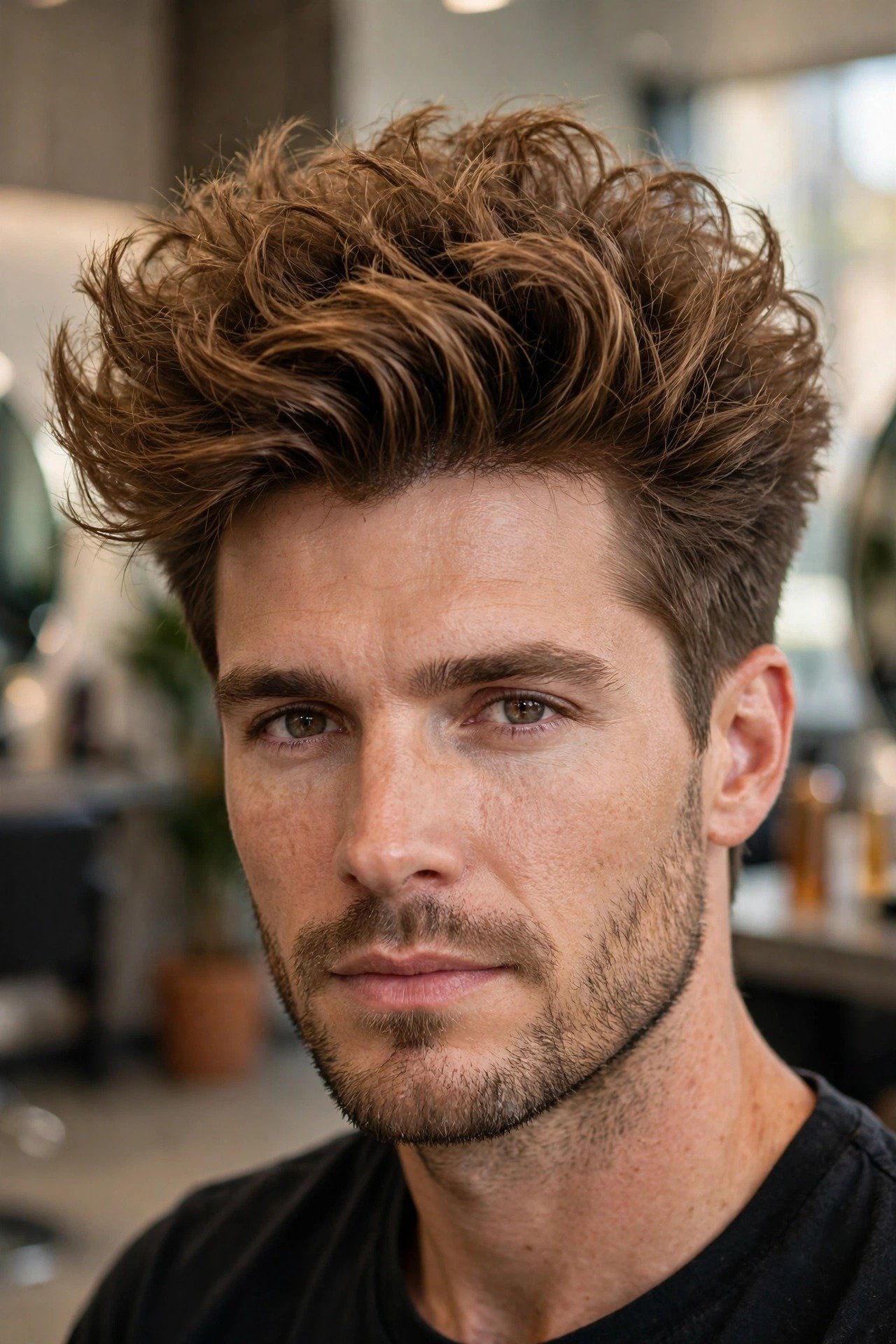
The blowout with a textured top is the modern, piecey version of the classic style, and it suits men who want volume with visible definition rather than a smooth, uniform surface. The top is cut with lots of texture, so the hair separates into clean, individual pieces that catch the light and show movement from every angle. It suits men with thick hair that can look heavy when it is cut blunt, and it works well for straight and wavy textures. Ask your barber for a textured top with point cutting and thinning through the bulk, a layered crown, and tapered sides that let the texture on top stand out without competition from the sides.
Styling starts with a texturising mousse or a sea salt spray on damp hair, then a blow-dry with a round brush, lifting the roots and rolling the ends in different directions so the pieces do not all fall the same way. Use your fingers to separate the top into sections as it dries, and finish with a matte paste, pinching small pieces together to create definition. The texture should look deliberate, not accidental, with each piece visible but still part of a cohesive, voluminous shape. A light hairspray, misted from a distance, holds the pieces without gluing them together.
Maintenance is straightforward: trim every four to five weeks to refresh the texture, because textured ends grow out faster than blunt ends and lose their definition. Wash with a volumising shampoo, avoid heavy conditioners on the top, and refresh the texture on day two with a little dry shampoo and a quick finger-style. This version is ideal for men who like to run their hands through their hair, because the texture invites touch and still falls back into place.
20. Feathered Blowout
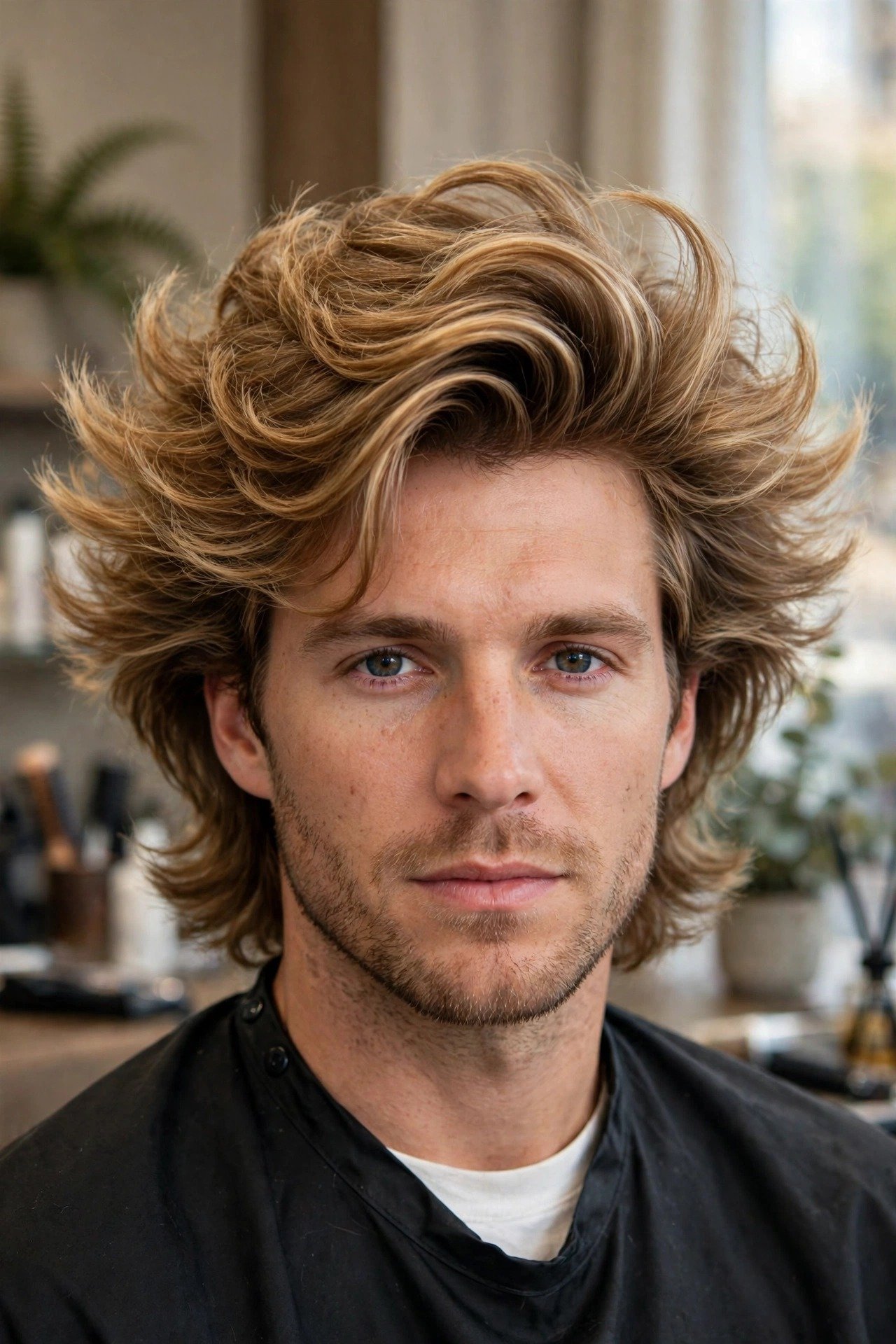
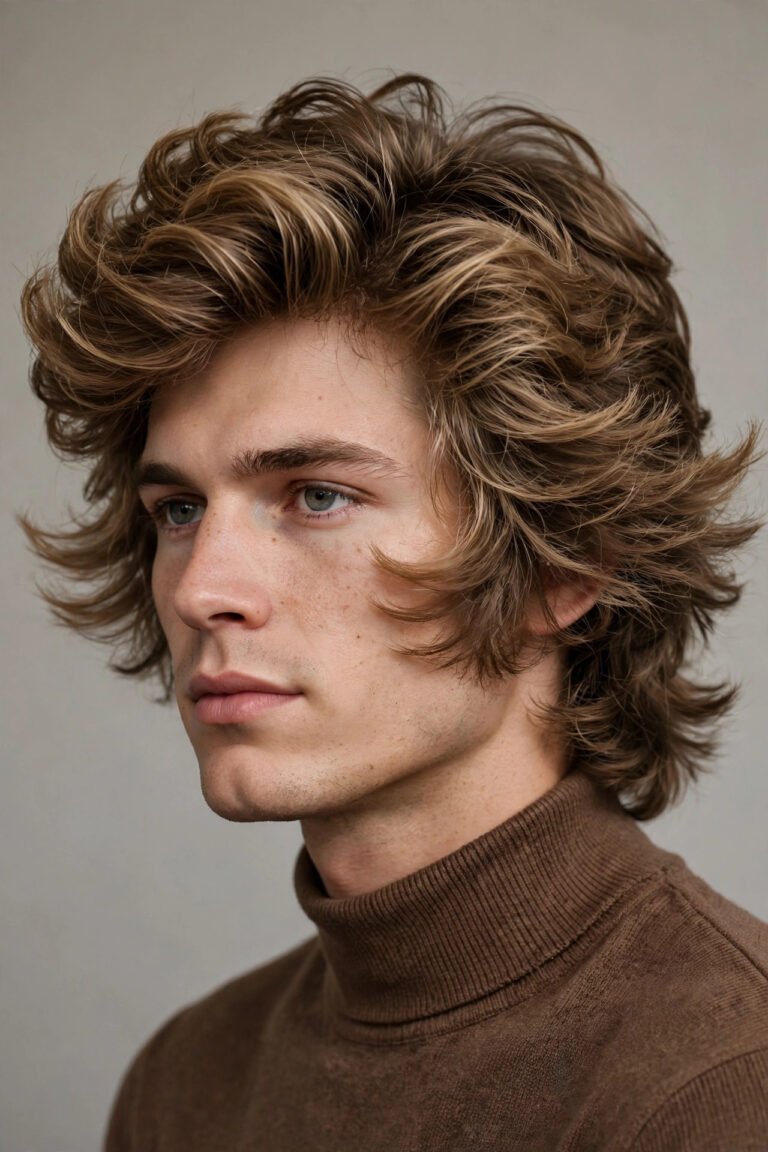
The feathered blowout is the lightest, airiest version in this guide, and it takes its name from the soft, feather-like layers that fall away from the face. The hair is cut into long, wispy layers that are blow-dried outward, so the ends flick and flutter rather than sitting in a solid mass, and the whole style feels weightless even though it has real volume. It suits men with fine to medium hair, because the feathering creates the illusion of fullness, and it flatters oval and oblong faces. Ask your barber for a feathered cut with long layers, a soft fringe that blends into the sides, and a razor or point-cut finish on the ends so they stay light and airy.
To style it, apply a volumising mousse to damp hair and blow-dry with a large round brush, rolling each section outward so the feathered ends flick away from the face. Keep the heat moderate and the brush strokes smooth, because the feathering is easily flattened by too much heat or too much product. Finish with a very light cream or a shine spray, smoothing the surface with your fingers and letting the ends stay separated and feathery. The result should move when you walk, with the layers opening and closing like feathers, and it should never look stiff or overworked.
The feathered blowout needs a trim every four to five weeks to keep the layers fresh, and it benefits from a lightweight conditioner that does not weigh the ends down. Avoid heavy waxes and oils, which clump feathered ends together, and use a wide-tooth comb rather than a brush when the hair is dry. This is the blowout for men who want a soft, romantic, almost 70s-meets-90s finish, and it looks especially good on hair with natural movement.
21. Blowout with High Fade
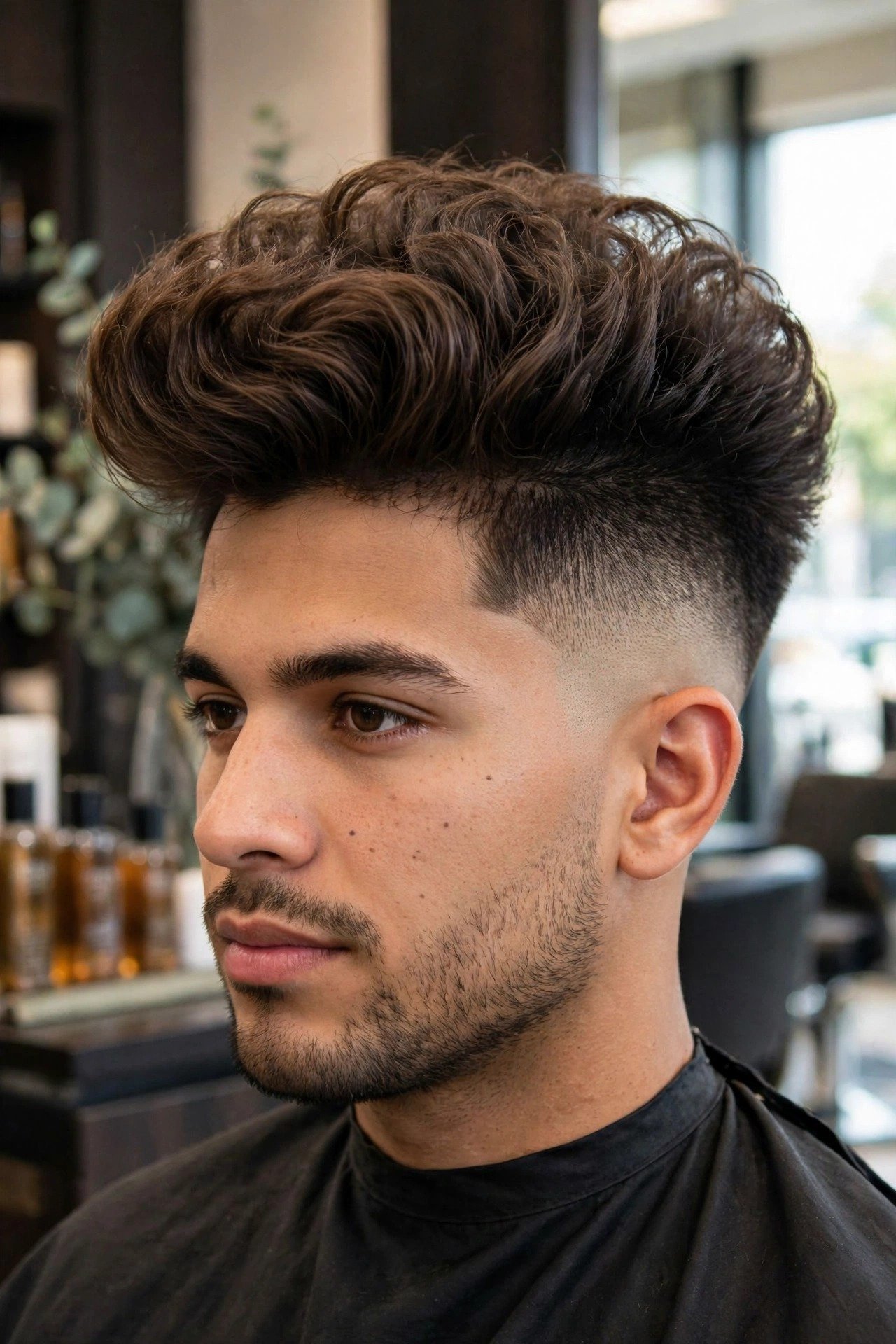
The blowout with a high fade is the sharpest, most fashion-forward version, because the fade starts high on the head, close to the crown, and creates a strong, clean line between the short sides and the long, voluminous top. The contrast is dramatic, the top looks taller by comparison, and the whole style has a modern, editorial quality that stands out in a crowd. It suits confident men with a square or oval face, thick hair, and a willingness to visit the barber often. Ask your barber for a high fade blended with a number 1 guard at the bottom, a tight blend through the transition, and a layered top of four to six inches that can be blown back with maximum lift.
Styling needs volume from the roots up, so apply a volumising mousse and a blow-dry spray to damp hair, then dry the top in sections with a large round brush, pulling each section up and back and holding it until it cools. The front should be the highest point, with the crown flowing backward, and the sides should be left alone so the fade stays crisp and visible. Finish with a strong-hold matte clay, working it through the roots and shaping the ends with your fingers, and use a light hairspray to keep the height through the day. The high fade does the sharpening, so the top can stay soft and full.
The high fade grows out quickly, so book a fade refresh every ten to fourteen days and a full cut every four weeks. Keep the faded skin moisturised, wash the top with a volumising shampoo, and avoid heavy products that would flatten the volume next to the sharp sides. If you want a blowout that looks like it came straight from a barber’s Instagram page, the high fade version is the one to ask for, and it pairs perfectly with streetwear and smart-casual outfits alike.
22. Blowout for Thick Hair
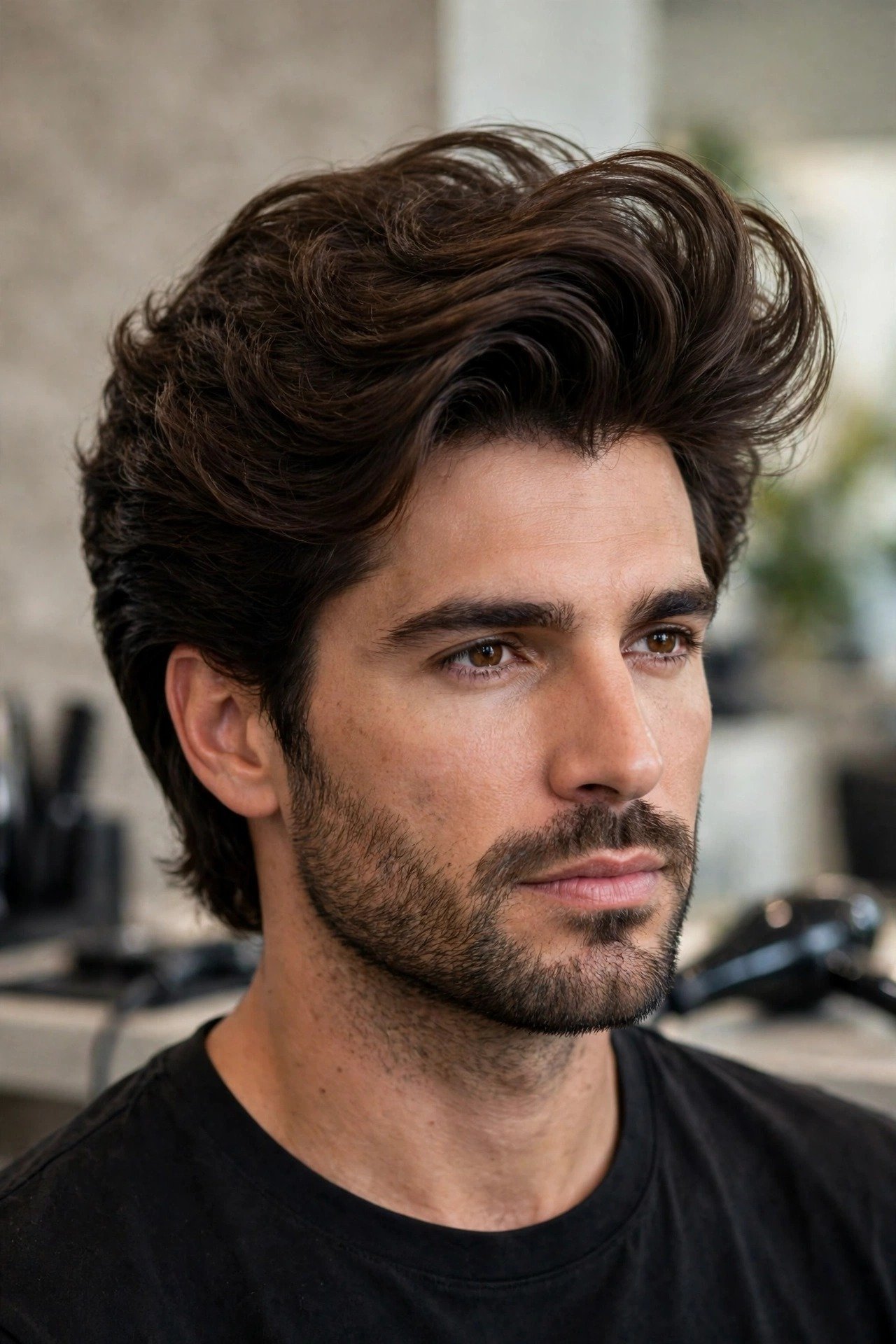
The blowout for thick hair is designed to turn density from a problem into an advantage, because thick hair holds volume naturally and the blow-dry gives that volume a shape. The cut removes bulk where it is not needed, usually through the sides and the interior layers, while leaving enough length on top to blow back with real height and movement. It suits men who have always struggled with hair that looks heavy or puffy, because the right layering and the right blow-dry technique make thick hair look intentional rather than unruly. Ask your barber for a layered blowout cut with internal thinning, a tapered back and sides, and a top that is long enough to direct backward without springing up.
Styling thick hair starts with a volumising shampoo and a light conditioner, because heavy conditioners weigh thick hair down before you even begin. Apply a blow-dry cream or a mousse to damp hair, then dry in sections with a large round brush, lifting the roots and rolling the ends back. Work slowly, because thick hair takes longer to dry, and use medium heat rather than high heat so the outside does not dry before the inside. Finish with a matte clay or a fibre paste, applying it in small amounts and building up, because too much product at once will flatten the volume you have just created.
Maintenance for thick hair means a trim every four weeks to keep the bulk under control, and a regular deep-conditioning treatment to keep the hair soft and manageable. Use a wide-tooth comb, avoid over-brushing when the hair is dry, and sleep on a satin pillowcase to reduce frizz. With the right cut and a little patience in the morning, thick hair makes the best blowout of all, because the volume is real, not created, and it lasts all day without collapsing.
23. Blowout for Fine Hair
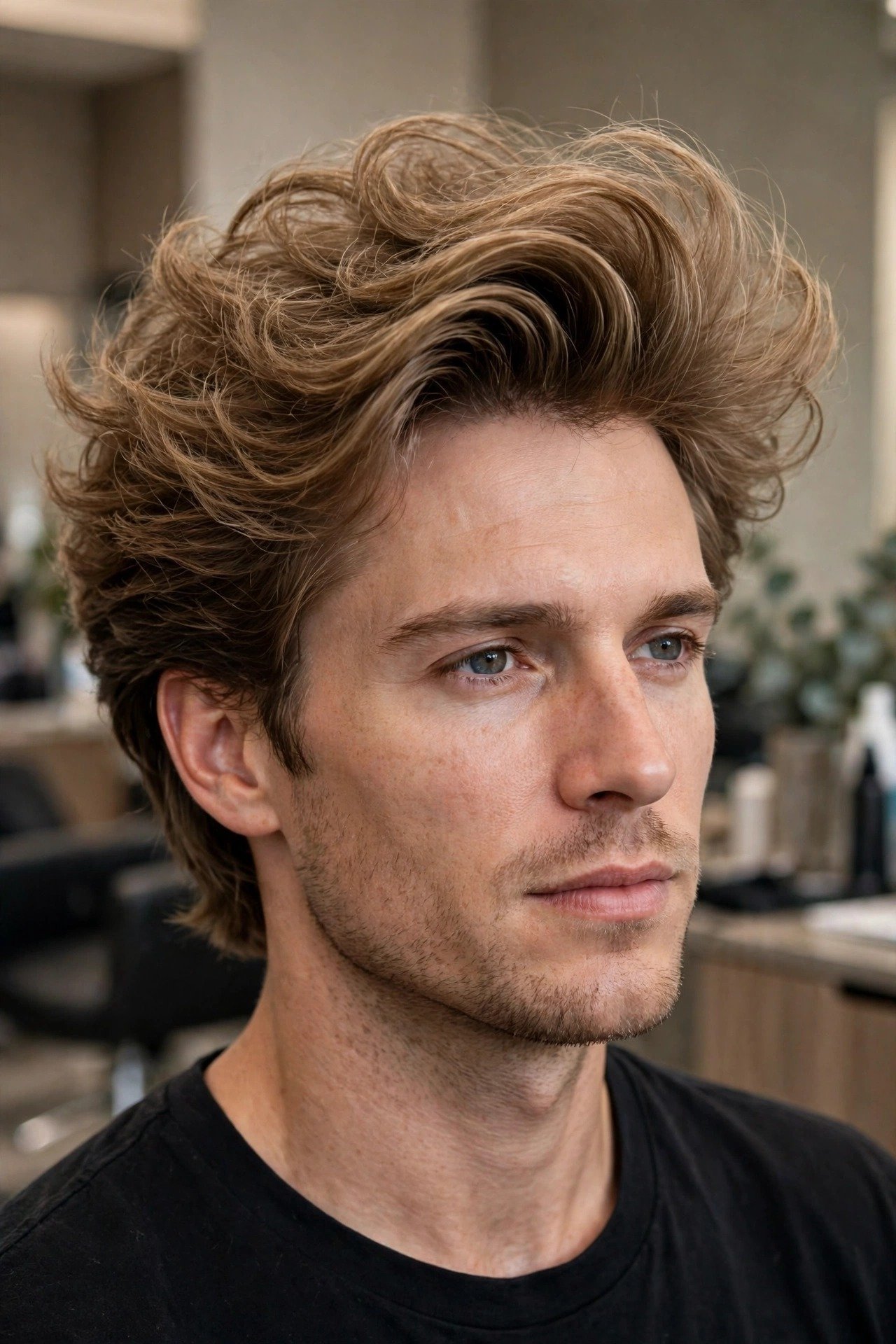
The blowout for fine hair is the most transformative version in this guide, because it uses lift, layering, and the right products to make thin hair look twice as thick. The cut is kept shorter and more layered than other versions, so the hair does not hang flat under its own weight, and the blow-dry is focused entirely on the roots, where the illusion of density is created. It suits men with fine, straight hair who have always wanted more volume, and it works best on oval and round faces where the added height balances the shape. Ask your barber for a layered blowout with short, textured layers, a soft taper on the sides, and no heavy thinning, which would make fine hair look even thinner.
Styling fine hair is all about the foundation: use a volumising shampoo, skip conditioner on the roots, and apply a volumising mousse or a root-lift spray to damp hair before you pick up the dryer. Blow-dry the hair upside down for the first minute to create root lift, then switch to a round brush and dry the top up and back in small sections. Use a cool shot at the end to set the lift, and finish with a very light matte powder or a tiny amount of paste, because heavy products are the enemy of fine hair and will flatten it within an hour. Less product, more technique, is the rule here.
Maintenance is simple but important: wash every one to two days, because fine hair shows oil quickly and oil flattens volume, and trim every four weeks to keep the layers fresh. Use a dry shampoo on day two to revive the roots, avoid sleeping on a cotton pillowcase that creates frizz, and be gentle when you brush, because fine hair breaks easily. Done right, the fine-hair blowout looks full, healthy, and completely natural, and no one will guess how little hair is actually doing the work.
24. Blowout with Flow
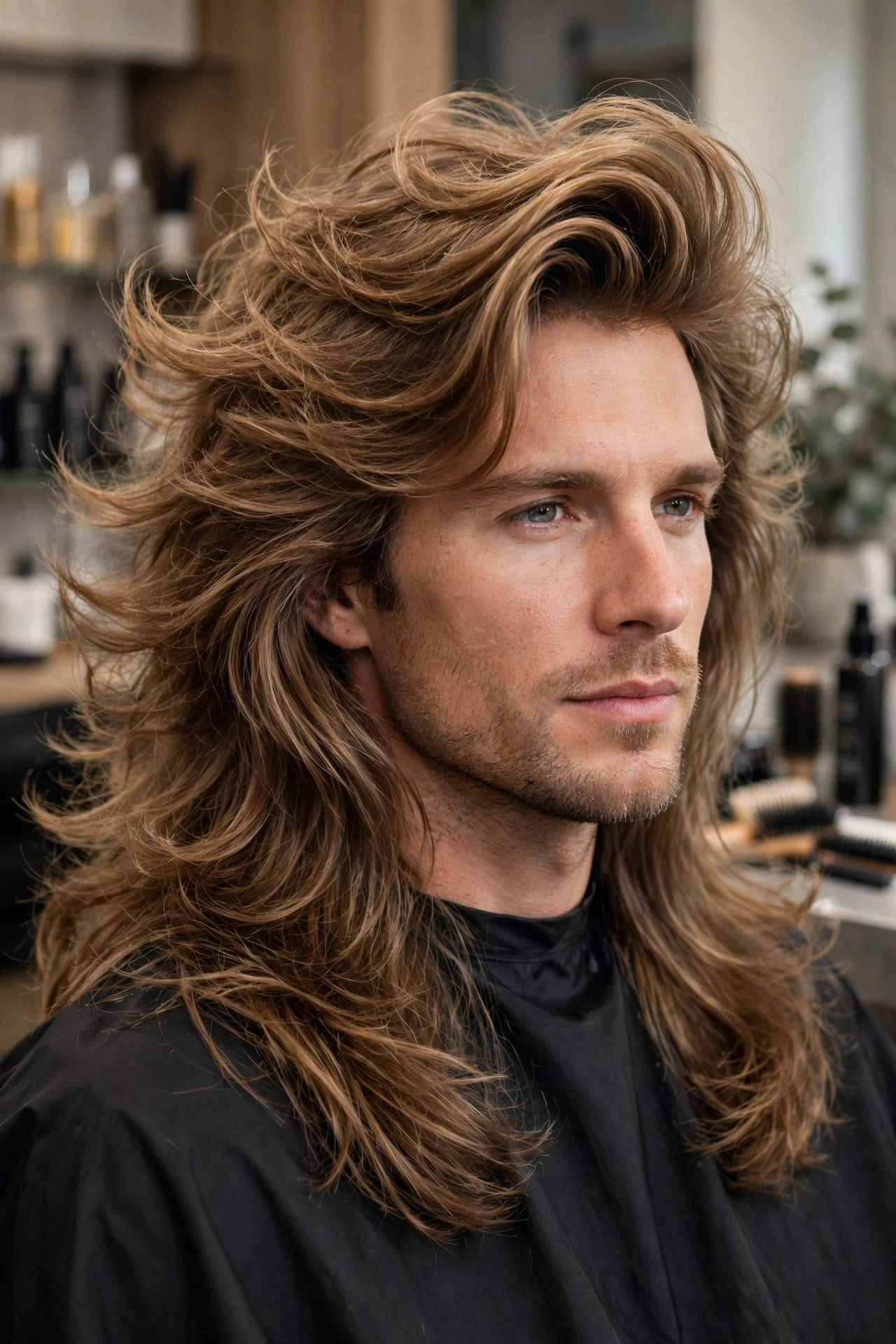
The blowout with flow combines the volume of a blowout on top with the longer, looser movement of a flow cut through the back and sides, and it suits men who love length but want it to look styled. The hair is longer than a classic blowout, usually past the ears and toward the collar, and it is blow-dried back so the flow moves as one piece rather than falling forward into the face. It suits oval and oblong faces, thick and wavy hair, and men who play sport or spend time outdoors, because the flow looks natural in motion. The external guide at https://haircutinspiration.com/the-blowout-haircut-what-why-how/ explains the blowout fundamentals that make this longer version work, from root lift to the flick at the ends. Ask your barber for a flow cut with long layers, a blowout top, and a shaped neckline.
Styling the flow blowout starts with a volumising mousse on the top and a light cream on the lengths, then a blow-dry with a large round brush, lifting the roots and rolling the lengths back and outward. Let the back dry naturally for the last few minutes, so the flow keeps its softness, and use your fingers to shape the front back from the face. A light serum on the ends adds shine and prevents the longer hair from looking dry, and a matte paste through the top keeps the volume from collapsing under the weight of the length. The result should look like a blowout that decided to keep growing, in the best way.
Maintenance for this version is about keeping the longer hair healthy: condition every wash, use a heat protectant, trim the ends every six weeks, and wash every two to three days. Tie the hair loosely at night to prevent tangling, and use a wide-tooth comb rather than a brush on the longer sections. The blowout with flow is the most relaxed, most wearable long version in this guide, and it suits men who want volume without giving up their length.
25. Blowout with Side Part
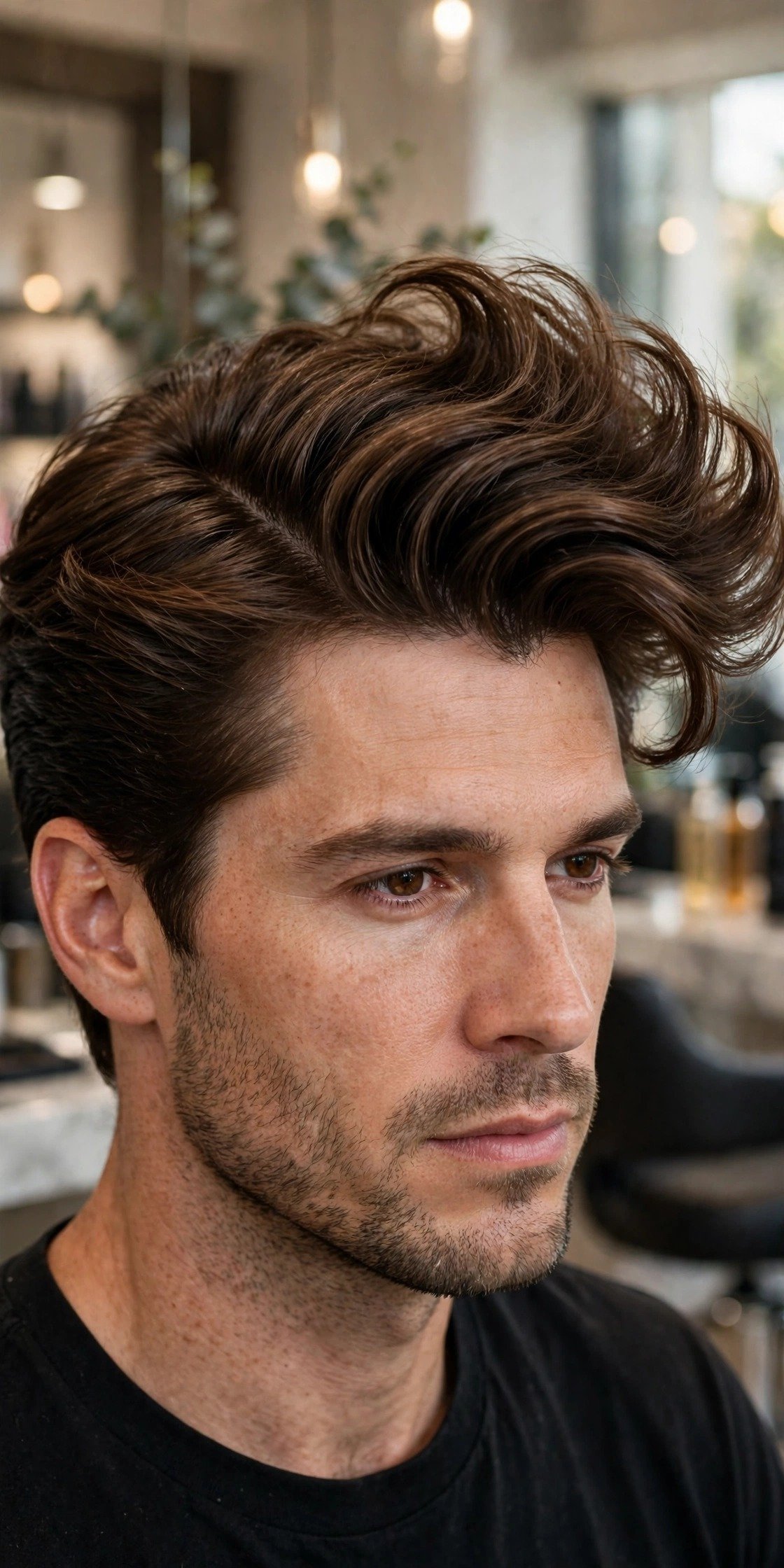
The blowout with a side part is the most classic, most gentlemanly version of the style, and it suits men who want a neat, defined parting with all the volume of a blowout. The part is created with a comb while the hair is damp, the longer side is blown up and across with height, and the shorter side is kept neat and close, so the whole style looks intentional and well groomed. It suits almost every face shape, and it works on straight, wavy, and thick hair. Ask your barber for a side part with a layered top, the front left longest on the parted side, and sides that are tapered or faded to support the part without hiding it.
To style it, find your natural part and comb it in while the hair is damp, then apply a volumising mousse and blow-dry the longer side up and across with a round brush, lifting the roots at the part for height. Dry the shorter side downward and backward so it stays neat, and use a medium-hold pomade or a matte clay to set the part and smooth the surface. A vent brush helps to polish the finish without flattening the volume, and a light hairspray keeps the part in place through the day. The result should look sharp from the front and full from the side, with the part as a clean, confident line.
Maintenance is easy: trim every four weeks, keep the part clean by combing it in each morning, and wash with a volumising shampoo so the top never looks flat. This version is ideal for work, weddings, and formal events, because the side part reads as classic and trustworthy, while the blowout volume keeps it from looking old-fashioned. If you want a blowout that will never go out of style, the side-part version is the safest and smartest choice.
26. Tousled Blowout
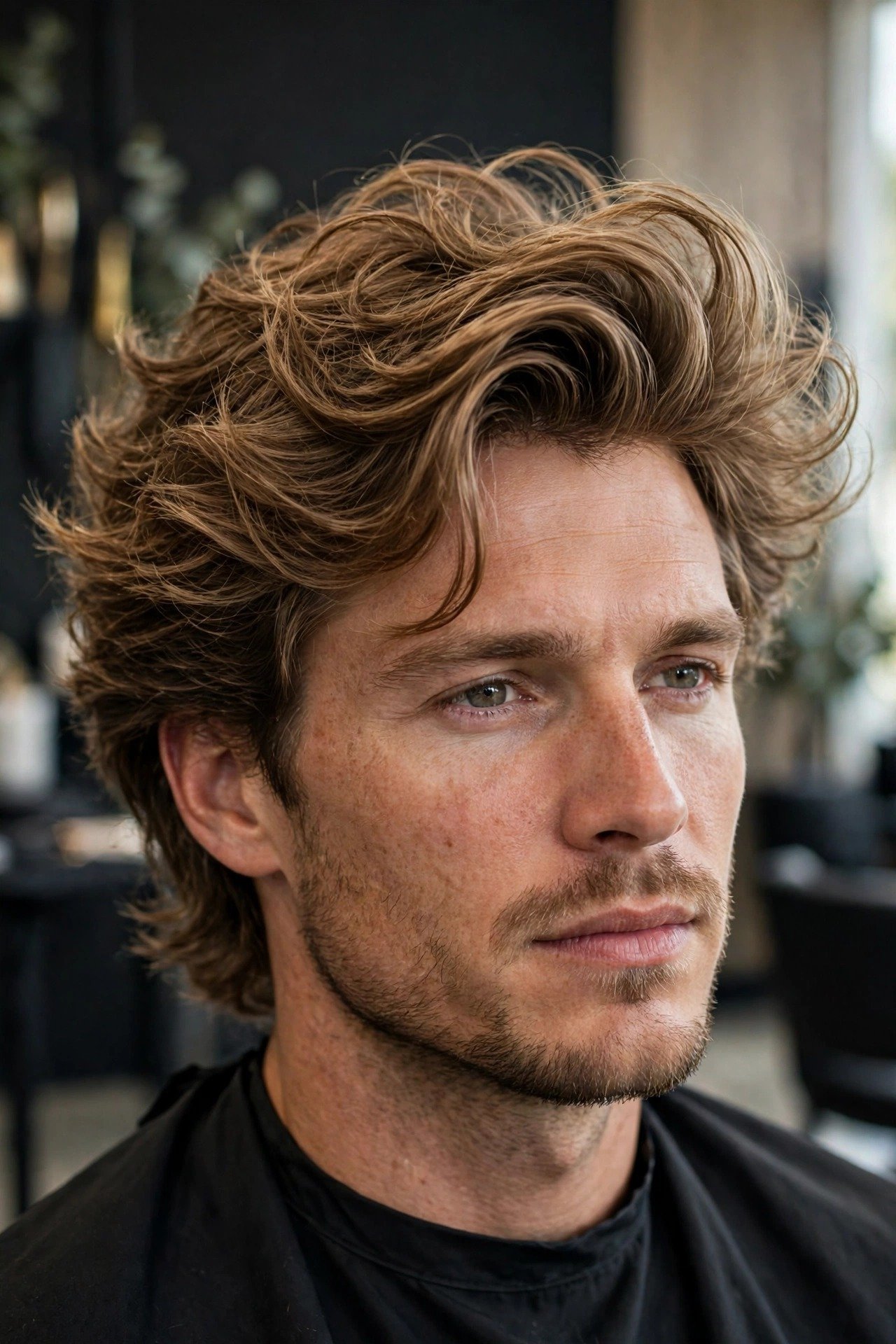
The tousled blowout is the carefree, wind-blown version of the style, and it suits men who want volume that looks like it happened by accident rather than by design. The hair is layered and textured, blow-dried with the fingers rather than a brush, and finished with a tousled, piecey texture that moves in different directions and catches the light beautifully. It suits wavy and thick hair best, and it flatters oval and square faces where the softness balances strong features. Ask your barber for a tousled cut with choppy layers, a textured fringe, and sides that are tapered but not too short, so the tousled top has something to fall against.
Styling is deliberately loose: apply a sea salt spray or a texturising mousse to damp hair, then blow-dry with your fingers, lifting and scrunching the roots and letting the lengths fall where they want to. Stop when the hair is almost dry, and use a small amount of matte paste, pinched through random sections, to create separation and hold. Do not comb the hair after drying, because combing removes the tousle, and do not use too much product, because the style needs to stay light and movable. The finish should look like you have just come in from a breezy day, only better.
This version grows out gracefully, because the tousled texture hides uneven lengths and the finish is forgiving. Trim every five weeks, wash every two to three days, and refresh the tousle on day two with a little water, a sea salt spray, and a quick finger-dry. Avoid heavy gels and shiny pomades, which fight the matte, tousled finish, and enjoy the fact that this is the blowout that takes the least effort to look like the most fun.
27. Blowout with Waves and Volume
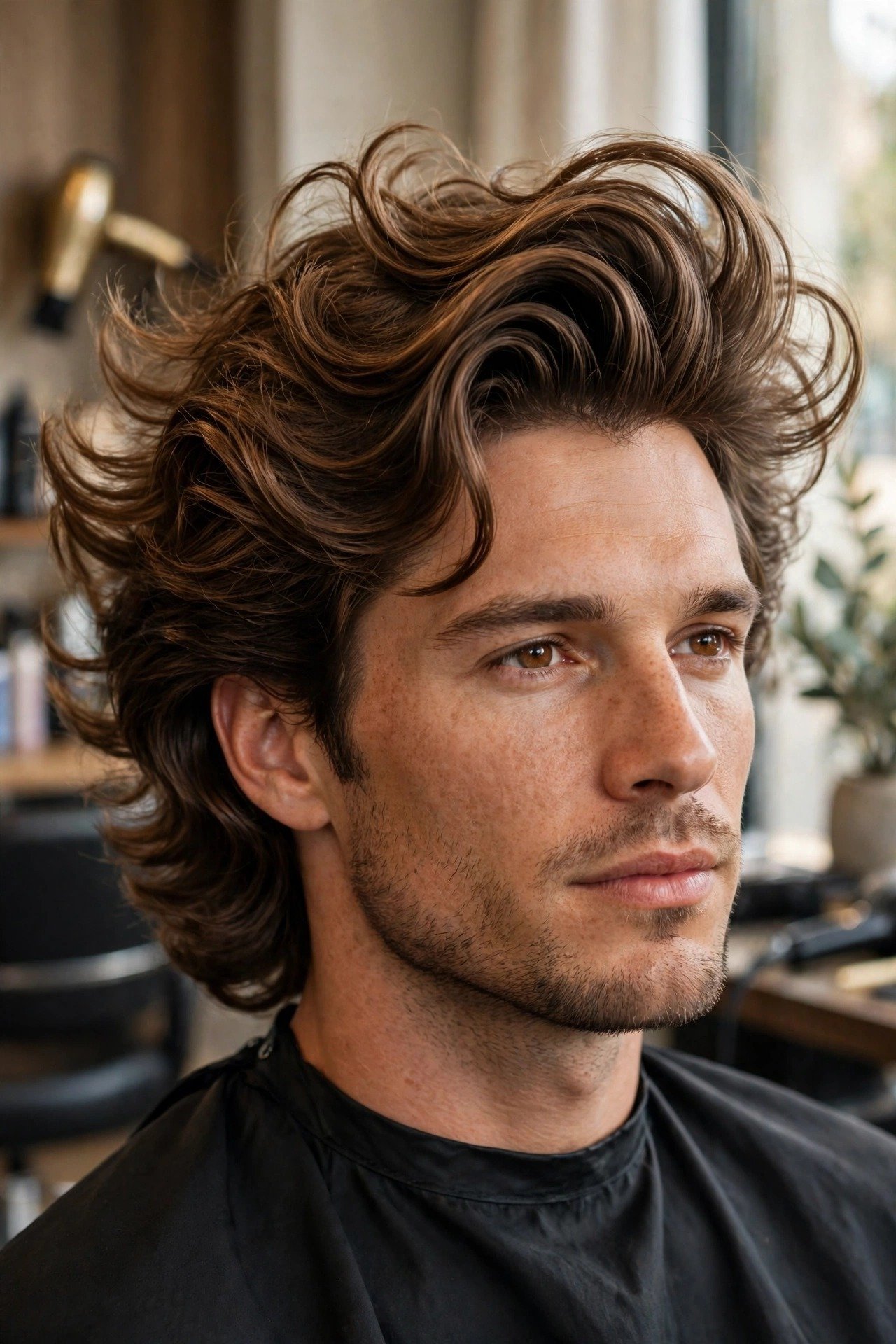
The blowout with waves and volume is the fullest, most textured wavy version in this guide, and it is designed for men whose natural waves want to be celebrated rather than tamed. The waves are enhanced by the blow-dry, the volume is built at the roots, and the ends are left to flick and curl naturally, creating a shape that is both polished and wild. It suits men with medium-thick, wavy hair and an oval or heart-shaped face, and it looks outstanding in natural light. Fashionuer highlights the 90s Blowout Revival in its guide to Gen Z haircuts at https://fashionuer.com/beauty/hair/gen-z-haircuts-for-guys/ as a voluminous, blown-back style with lift at the roots and a slight wave at the ends, which is exactly the shape this version delivers. Ask your barber for long layers that follow your wave, a soft taper, and no thinning through the wave pattern.
To style it, apply a curl-enhancing cream or a volumising mousse to damp hair, then blow-dry with a diffuser on low heat, lifting the roots with your fingers and encouraging the waves to form. For more definition, follow with a round brush on the top sections only, rolling the ends outward so the waves open up. Finish with a sea salt spray or a light pomade, scrunching the waves gently to add texture without creating frizz, and let the hair air-dry for the last few minutes so the waves set naturally. The aim is volume with movement, not volume with stiffness.
Care for wavy hair with a moisturising shampoo and conditioner, a weekly deep treatment, and a trim every five weeks to keep the layers balanced. Sleep on a silk pillowcase, avoid brushing the waves when they are dry, and refresh them with a water mist and a little leave-in cream. This version is the most natural-looking blowout in the guide, because the waves do half the work and the blow-dry simply makes them look their best.
28. Blowout with Layered Ends
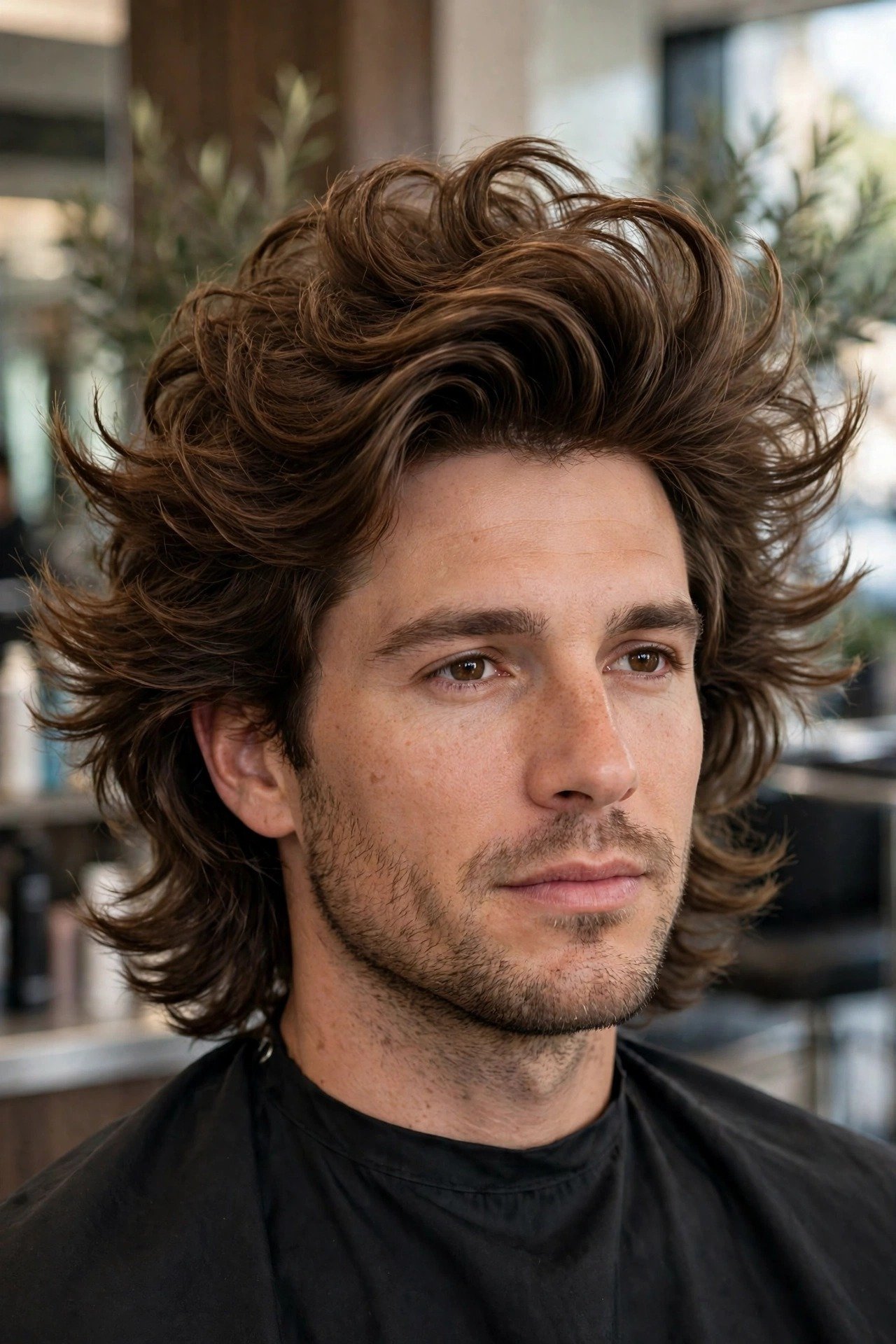
The blowout with layered ends is the most detailed, most barber-crafted version, because the layers are the star of the show. The hair is cut into visible, graduated layers that are blow-dried outward, so each layer flicks at a slightly different length and the whole style has depth, movement, and a feathered edge. It suits men with thick hair that needs shaping, and it flatters square and oval faces where the layered ends soften the jawline. Ask your barber for a layered blowout with graduated ends, a textured crown, and sides that are tapered to let the layers on top stand out, with the front left long enough to flick back.
Styling layered ends takes a little more time, because each layer needs to be dried separately to show its shape. Apply a volumising mousse to damp hair, then blow-dry in sections with a round brush, rolling each layer outward and letting it cool before you move to the next. Use a light cream on the ends to define the layers without weighing them down, and a matte paste through the crown to keep the volume lifted. The result should look like a series of soft, overlapping waves, each one visible, each one contributing to the overall fullness of the style.
Maintenance means a trim every four weeks to keep the layers sharp, because layered ends lose their definition quickly as they grow. Condition the ends regularly, use a heat protectant, and avoid heavy products that would glue the layers together. This version is ideal for men who love the craft of a good haircut and want a blowout that shows off the barber’s skill, because the layers are visible from every angle and they make the hair look thicker, healthier, and more expensive.
29. Blowout with Frosted Tips
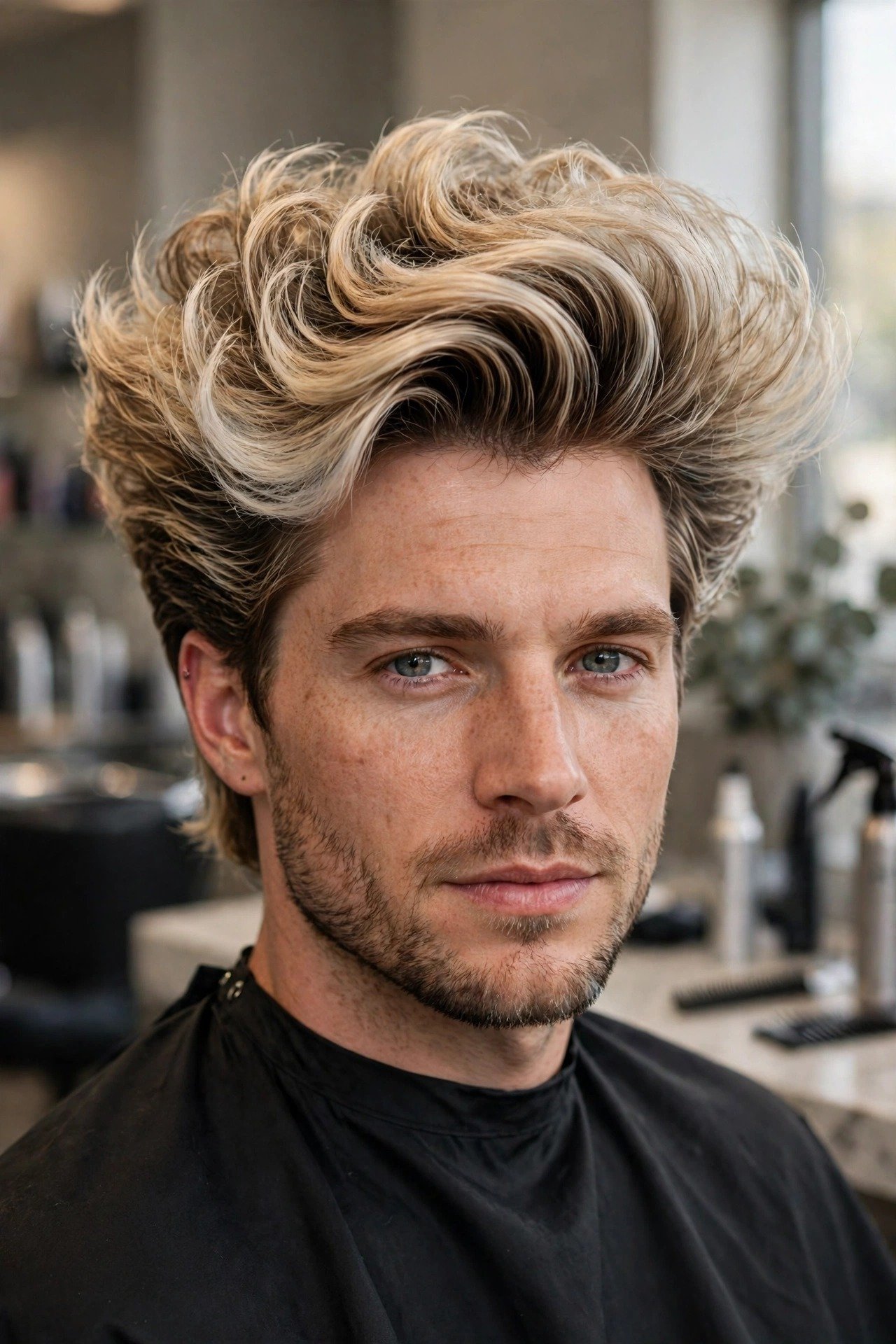
The blowout with frosted tips is the most unapologetically 90s version in this guide, because the lightened ends are a direct reference to the boy-band era when frosted tips were everywhere. The tips are lightened by one or two shades, usually with a balayage or a foil technique, so the ends catch the light and the volume of the blowout is highlighted in a way that solid colour cannot match. It suits confident men, younger wearers, and anyone who wants a playful, nostalgic finish. Ask your barber or colourist for subtle frosted tips on the ends only, keeping the roots natural, and a layered blowout cut that lets the lightened ends flick outward and show the colour.
Styling follows the classic blow-dry method, with extra care for the coloured ends. Apply a volumising mousse and a heat protectant to damp hair, blow-dry the top up and back with a round brush, and roll the ends outward so the frosted tips are visible. Finish with a light serum or a shine spray on the ends to make the colour pop, and use a matte paste through the top to keep the volume. The contrast between the natural roots and the lightened tips makes the blowout look even fuller, because the eye is drawn to the movement at the ends.
Coloured hair needs extra care, so use a colour-safe shampoo, a deep conditioner once a week, and a purple shampoo occasionally if the tips start to look brassy. Trim every four to five weeks to keep the frosted ends fresh, and touch up the colour every six to eight weeks. This version is not subtle, but it is fun, nostalgic, and instantly recognisable, and for men who grew up with the 90s, it is the most joyful blowout in the whole list.
30. Blowout with Spiky Texture
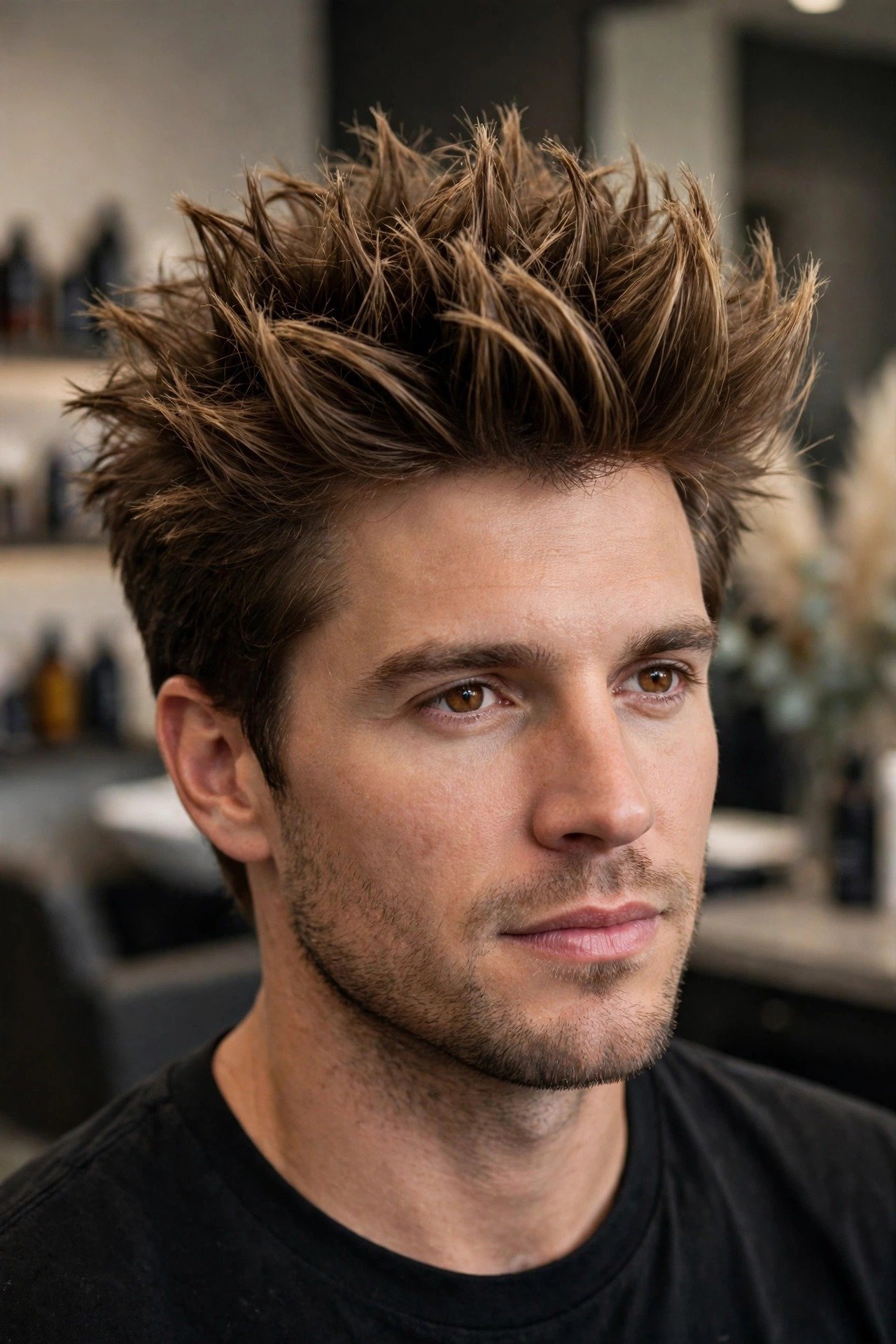
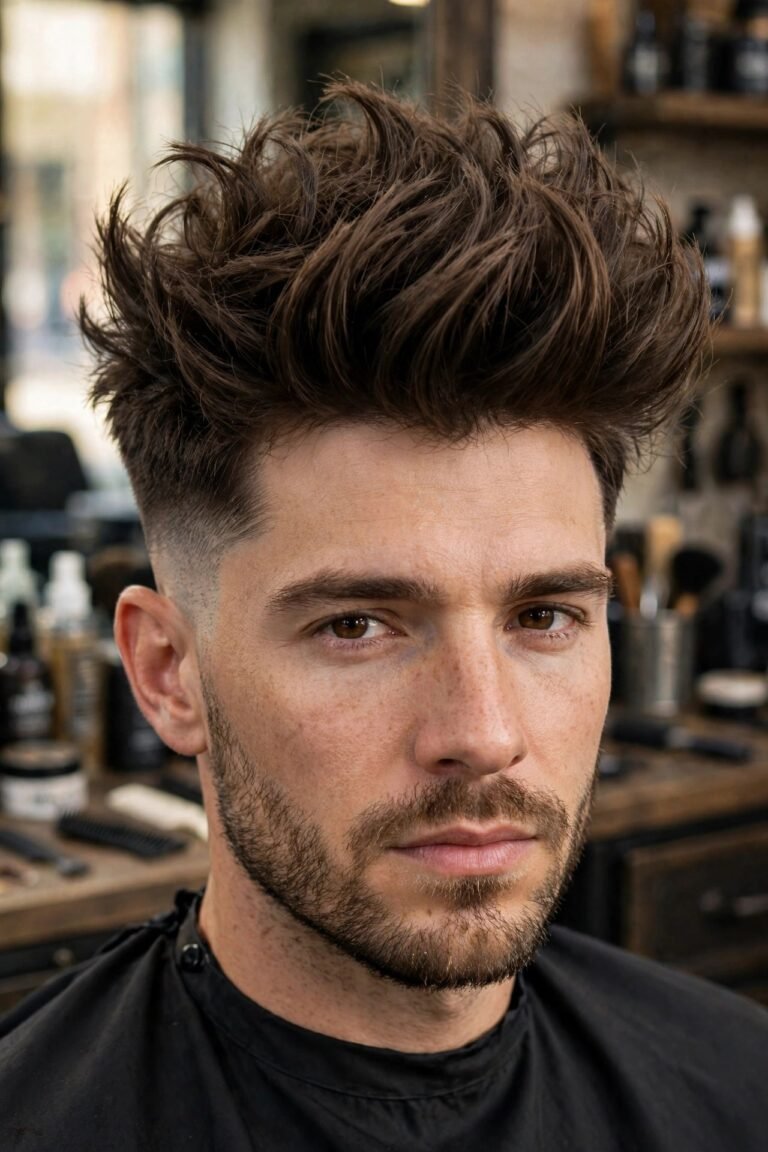
The blowout with spiky texture is the edgiest, most youthful version, combining the volume of a blowout with the definition of spiky, piecey texture on top. The hair is cut short to medium on top, textured heavily, and blow-dried up and back, then finished with spikes that point in different directions, giving the style energy and attitude. It suits younger men, men with thick hair that can hold a spike, and square or oval faces where the height adds balance. Ask your barber for a spiky textured cut with a short, layered top, a number 2 or 3 guard on the sides, and a front that is left long enough to spike upward and backward.
To style it, apply a volumising mousse to damp hair, then blow-dry the top upward with a vent brush or your fingers, lifting the roots and creating the basic shape. Once the hair is dry, work a strong-hold matte paste or a fibre product through the top, pinching small sections into spikes and directing them up and back. Use a little product at a time and build up, because too much at once will make the spikes clump together. A light hairspray, misted from a distance, holds the spikes without making them crunchy, and the blowout volume underneath keeps the style from looking like a flat, spiky crop.
Maintenance is simple: trim every three to four weeks to keep the spikes short and defined, wash with a volumising shampoo, and avoid heavy conditioners that would flatten the texture. This version is ideal for nights out, concerts, and casual days, because the spikes give it a playful, rebellious edge while the blowout volume keeps it polished. If you want a 90s blowout with a modern, spiky twist, this is the one to try.
31. Blowout with Brushed-Back Volume
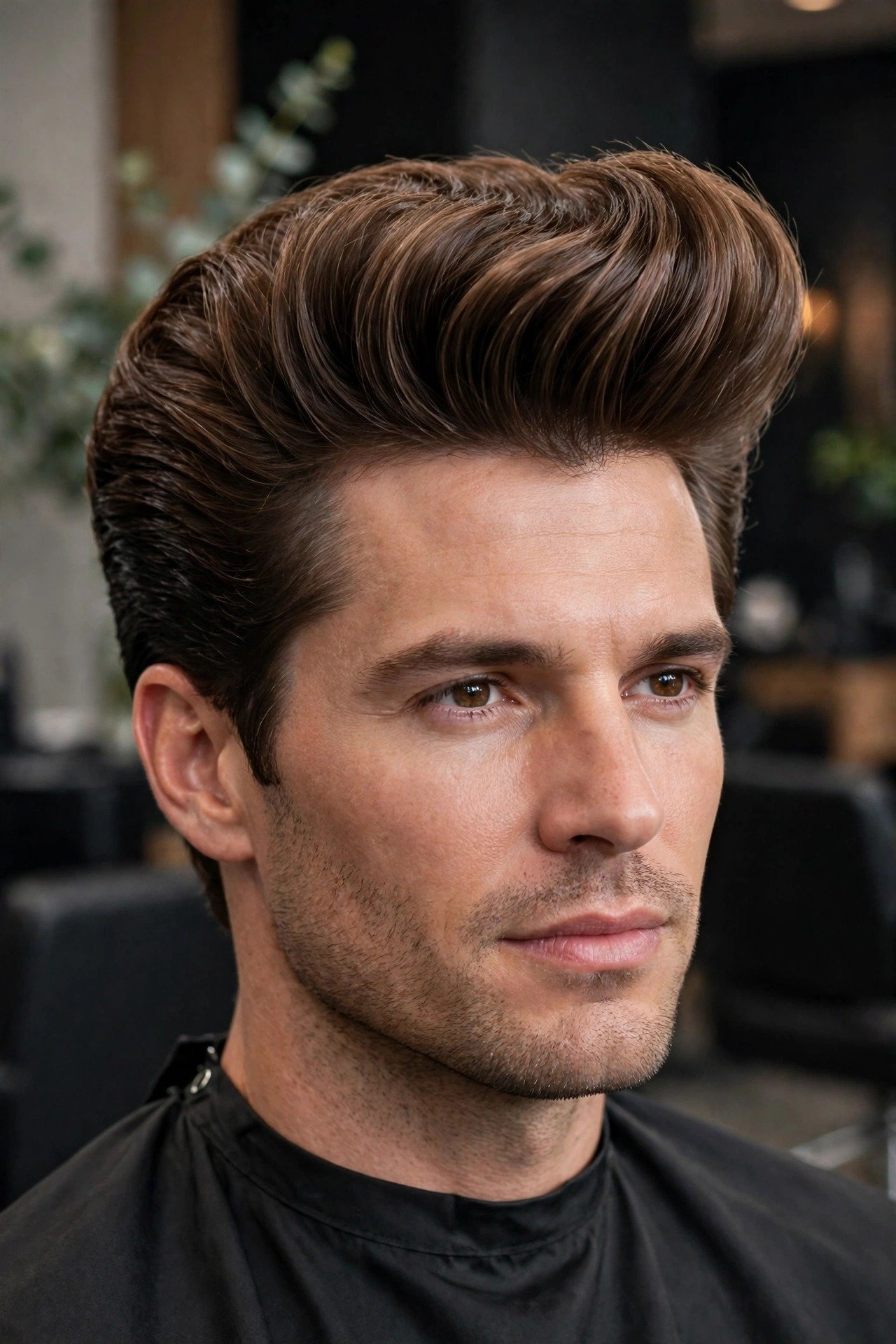
The blowout with brushed-back volume is the cleanest, most streamlined version, because the hair is brushed straight back from the forehead with no part and no fringe, creating a smooth, uninterrupted line of volume. The shape is tall at the front, flowing backward over the crown, and neat at the sides, so it looks polished and confident from every angle. It suits men with a strong forehead, an oval or square face, and thick hair that can be directed backward without falling forward. Ask your barber for a brushed-back cut with a long top, a layered crown, and tapered sides that support the backward direction without creating bulk at the temples.
Styling is simple but needs the right technique: apply a volumising mousse to damp hair, then blow-dry the hair straight back with a round brush or a vent brush, lifting the roots at the front first and working backward in sections. Use medium heat and keep the brush moving, so the hair dries smooth rather than frizzy, and finish with a medium-hold pomade or a matte clay, brushing it through from front to back to set the direction. A final brush with a soft-bristle brush smooths the surface, and a light hairspray keeps the brushed-back shape through the day without stiffness.
Maintenance is moderate: trim every four weeks to keep the top at the right length, because once it grows too long it will fall forward instead of brushing back. Wash with a volumising shampoo, condition the ends, and use a heat protectant every time you blow-dry. This version is excellent for formal occasions and for men who like a clean, no-fuss style that still has real volume, and it is the blowout that looks most like a classic, timeless men’s haircut.
32. Blowout for Straight Hair
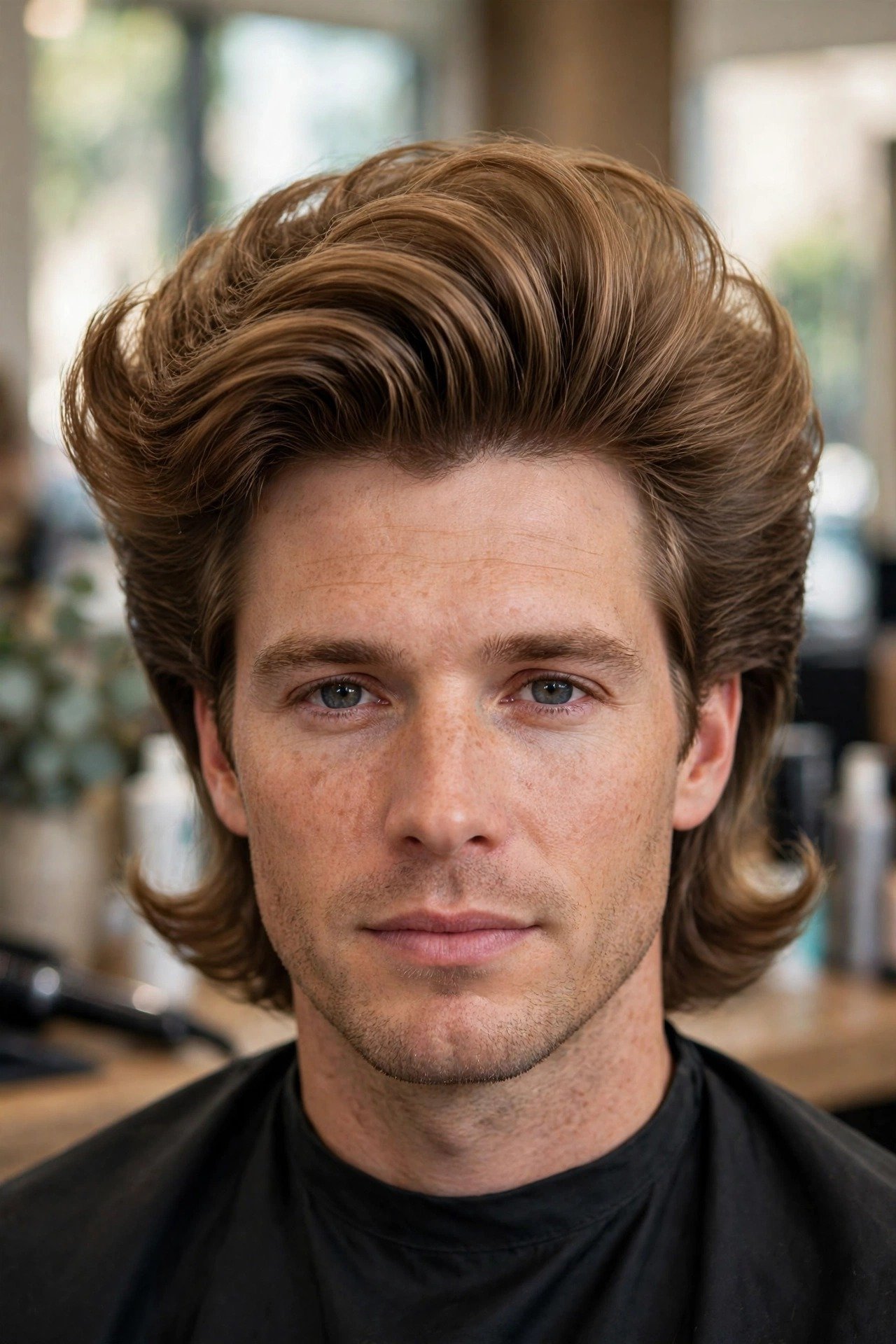
The blowout for straight hair is the version that proves straight hair can have just as much volume and movement as wavy hair, when it is cut and styled correctly. Straight hair naturally falls flat, so the cut uses layers and texture to create lift, and the blow-dry uses a round brush to bend the ends and build height at the roots. It suits men with fine to medium, straight hair and an oval or round face, where the added height balances the shape. Ask your barber for a layered blowout with textured ends, a soft taper on the sides, and a top that is long enough to roll around a round brush, usually four inches or more.
Styling straight hair needs heat and technique more than product. Apply a volumising mousse or a blow-dry spray to damp hair, then dry in sections with a large round brush, lifting each section up and back and rolling the brush through the ends to create the flick. Hold each section until it cools, because cooling is what sets the bend in straight hair, and work from the back to the front so the front, which is the most visible part, is dried last and holds its shape best. Finish with a light matte paste, applying it sparingly so the hair does not look weighed down, and a cool shot of air to lock everything in.
Maintenance for straight hair is about keeping it healthy and light: wash every one to two days, use a volumising shampoo, avoid heavy conditioners on the roots, and trim every four weeks to keep the layers fresh. Use a heat protectant every time you blow-dry, because straight hair shows heat damage quickly, and sleep on a silk pillowcase to reduce frizz. With the right cut and a little practice, straight hair makes a beautifully smooth, polished blowout that looks effortless and expensive.
33. Blowout with Natural Curls
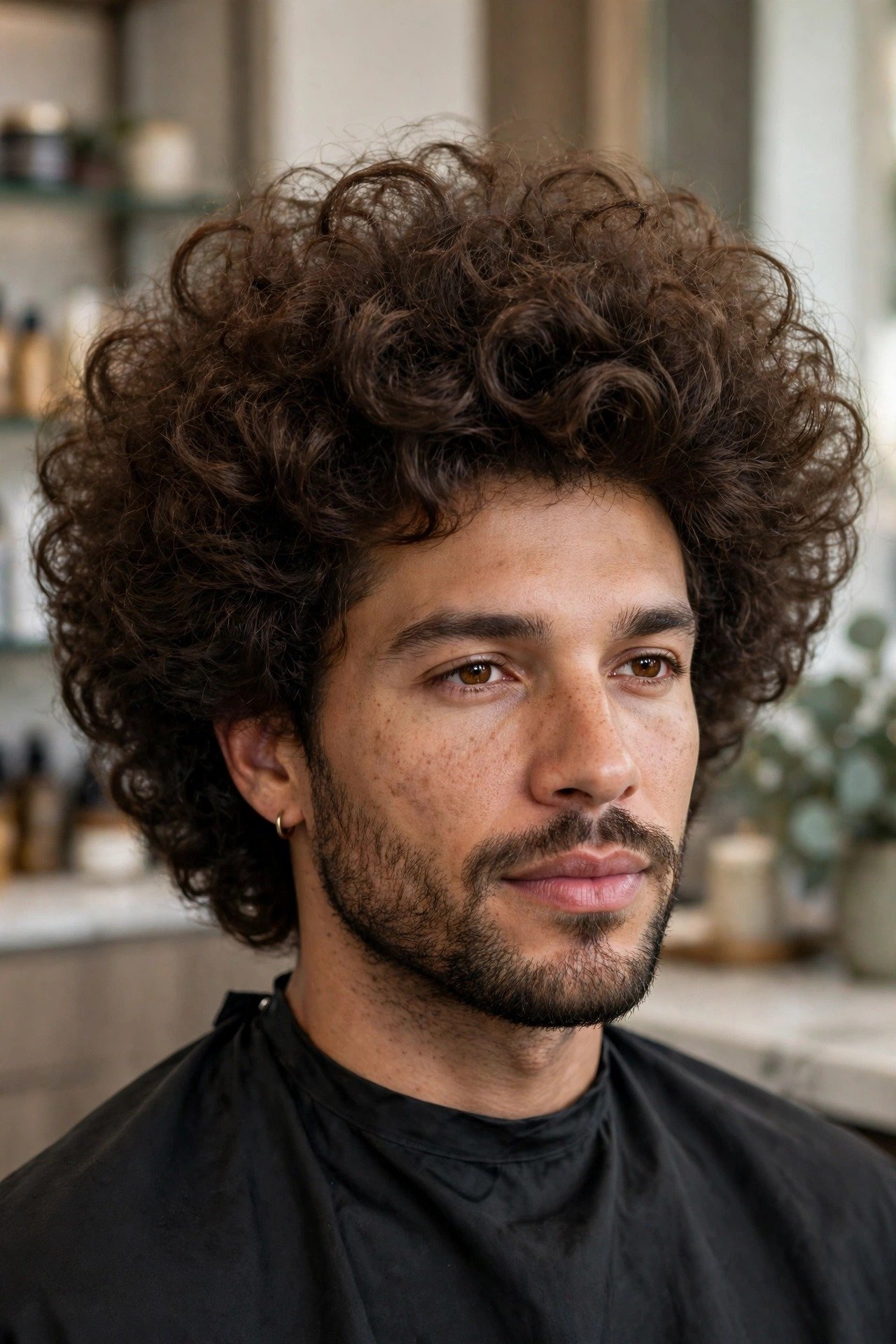
The blowout with natural curls is the version that lets curls be curls, only bigger, softer, and more shaped. Instead of straightening the hair, the blow-dry stretches the curls gently, opening them into loose, bouncy waves with a rounded, full silhouette that frames the face beautifully. It suits men with naturally curly hair who want a larger, more polished shape without losing their texture, and it flatters oval and heart-shaped faces. Ask your barber for a curly blowout cut with long layers, a shape that is cut dry or with the curls in their natural state, and sides that are tapered to keep the overall shape balanced and not too wide.
To style it, apply a leave-in conditioner and a curl cream to wet hair, then use a diffuser on low heat, lifting the roots and drying in sections until the hair is mostly dry. For a smoother blowout finish, follow with a round brush on medium heat, pulling each section up and back and letting it cool before you release it, so the curls stretch into soft waves. Finish with a light oil or a curl-defining cream, smoothing it over the surface to control frizz and add shine, and use your fingers to shape the front back from the face. Avoid a fine comb, which breaks the curl pattern and creates frizz.
Curly hair needs moisture above all else, so use a sulfate-free shampoo, a rich conditioner, and a weekly deep treatment. Trim every six weeks to keep the shape from becoming too wide, and refresh the curls between washes with a water mist and a little leave-in cream. This version takes patience, but the result is a full, sculptural blowout that is completely unique to curly hair, and it looks stunning in person and in photographs.
34. Blowout with Tapered Neckline
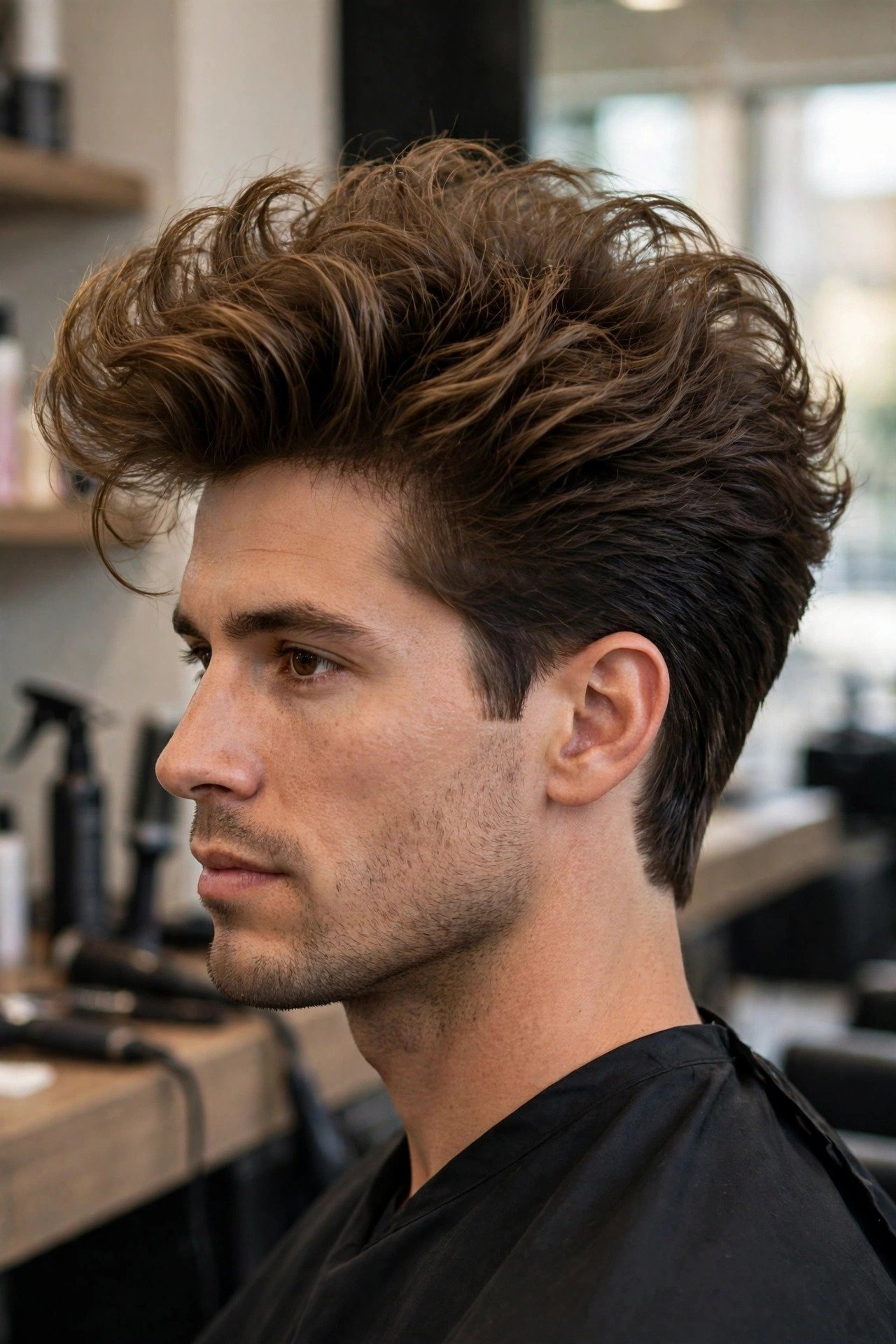
The blowout with a tapered neckline is the detail-focused version, because the clean, graduated taper at the back is what gives the whole style its finished, professional quality. The top is full and voluminous, the sides are neat, and the neckline is tapered rather than blocked or squared, so the hair flows naturally into the neck and grows out gracefully. It suits professionals, older men, and anyone who wants a blowout that looks tidy from behind as well as from the front. Ask your barber for a tapered neckline using a number 2 guard at the bottom, blending upward into the longer hair, with a layered top that can be blown back with height and movement.
Styling follows the classic method: apply a volumising mousse to damp hair, blow-dry the top up and back with a round brush, and keep the sides and back neat by directing the dryer downward over the tapered sections. Use a matte clay or a light cream to finish, smoothing the surface and shaping the front, and check the back in a second mirror to make sure the taper looks clean. A light hairspray helps the top hold its height, while the tapered neckline keeps the overall shape from looking heavy or untidy, even as the day goes on and the volume softens.
Maintenance is easy, because a tapered neckline grows out more gracefully than a blocked neckline and does not need a weekly clean-up. Trim every four to five weeks, wash with a gentle shampoo, and condition the top to keep it soft and manageable. This version is the quiet, well-mannered blowout in the guide, and it is the one to choose if you want volume on top and perfect manners at the back, every single day.
35. Blowout with Voluminous Crown
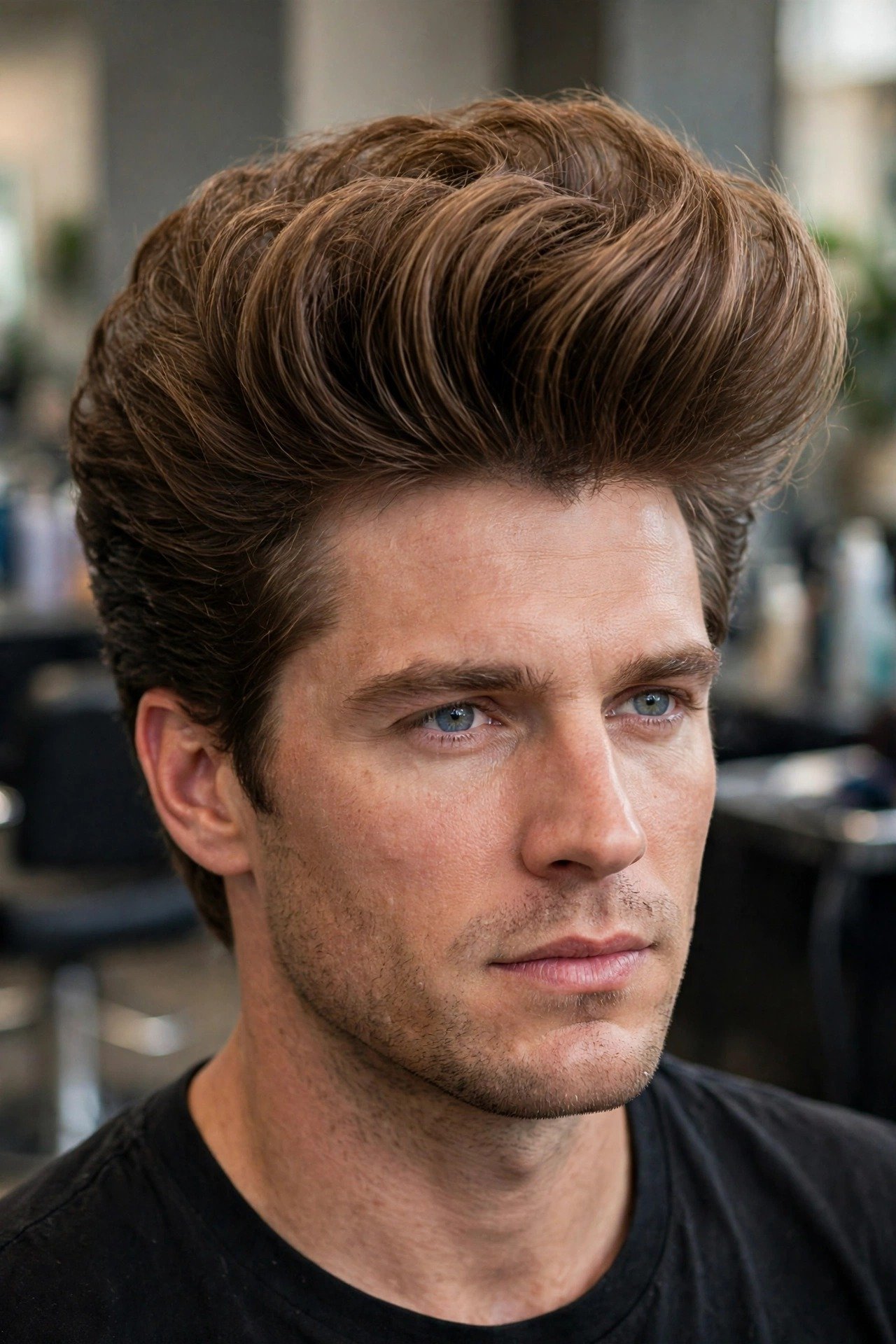
The blowout with a voluminous crown is the height-focused version, because the lift is concentrated at the crown, creating a tall, rounded silhouette that makes the whole style look bigger and more dramatic. The front is blown up and back, the crown is lifted even higher, and the sides are kept neat so the height at the top is the clear focal point. It suits men with a round face, because the extra height lengthens the face, and it works on thick, straight or wavy hair that can hold lift at the crown. Ask your barber for a crown-focused cut with extra layers at the crown, a long front, and tapered sides that do not compete with the height on top.
Styling the crown needs a round brush and a little patience. Apply a volumising mousse and a root-lift spray to damp hair, then blow-dry the crown first, lifting each section straight up from the scalp and holding it until it cools. Dry the front next, blending it into the crown, and use a matte clay to shape the height, applying it from the roots upward and then smoothing the surface with your fingers. A cool shot of air at the end sets the crown, and a light hairspray, misted from above, helps the height last through the day without making the hair stiff or crunchy.
Maintenance is moderate: trim every four weeks to keep the crown layers fresh, wash with a volumising shampoo, and avoid heavy products that would flatten the crown. Practise the blow-dry technique a few times, because the crown is the hardest part to lift, but once you have it, this version gives you the tallest, most confident silhouette in the guide, and it is the blowout that makes the biggest first impression.
36. Blowout with Modern Retro Finish
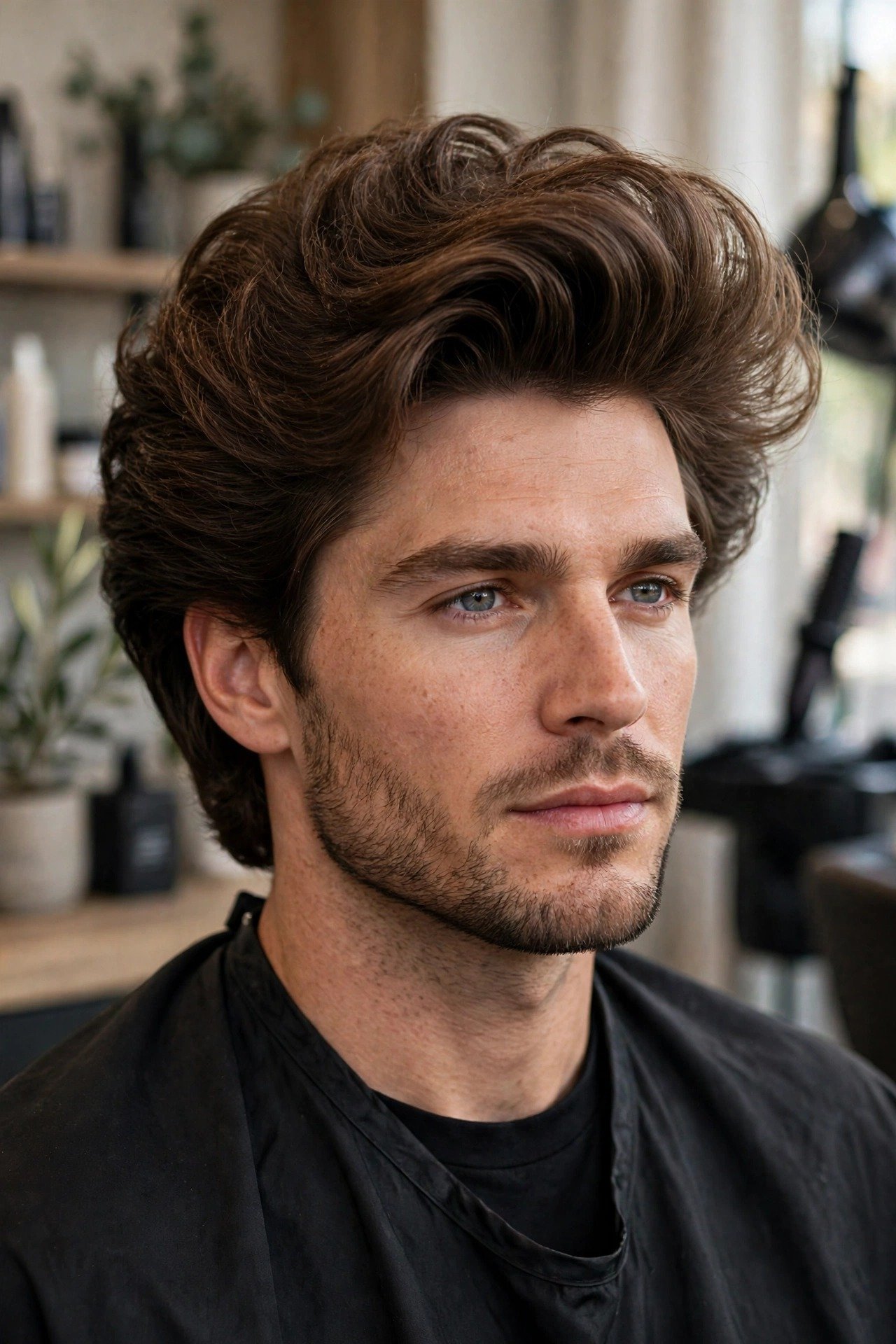
The blowout with a modern retro finish is the 2026 update to the classic style, and it is the version that most men will actually wear every day. It keeps the volume, the lift, and the flick of the original 90s blowout, but it updates the finish with a cleaner taper, lighter products, and a more natural texture, so the style feels current rather than costume. It suits every face shape and hair type, because the modern finish is adaptable, and it is the best choice if you want the retro reference without looking like you stepped out of a 90s music video. Ask your barber for a modern blowout with a layered top, a mid taper on the sides, and a textured finish that can be styled neat or messy depending on the day.
To style it, apply a volumising mousse to damp hair, blow-dry the top up and back with a round brush, and roll the ends outward for a soft flick. Use a matte clay or a light cream to finish, applying it sparingly and shaping the hair with your fingers so the texture stays visible and the volume stays soft. The modern finish is about balance: not too shiny, not too matte, not too neat, not too messy, with the hair looking healthy, full, and deliberately styled but still touchable. A light texturising spray adds the final touch of movement, and the style should hold its shape without feeling stiff.
Maintenance is the easiest of the modern versions: trim every four to five weeks, wash with a volumising shampoo, and use a heat protectant every time you blow-dry. This version grows out gracefully, works for work and weekends, and suits almost everyone, which is why it is the perfect final style in this guide. If you take one idea from this article, take this one: the 90s blowout is back, it is better than ever, and the modern retro finish is how you wear it in 2026.
How to Style and Maintain a 90s Blowout at Home
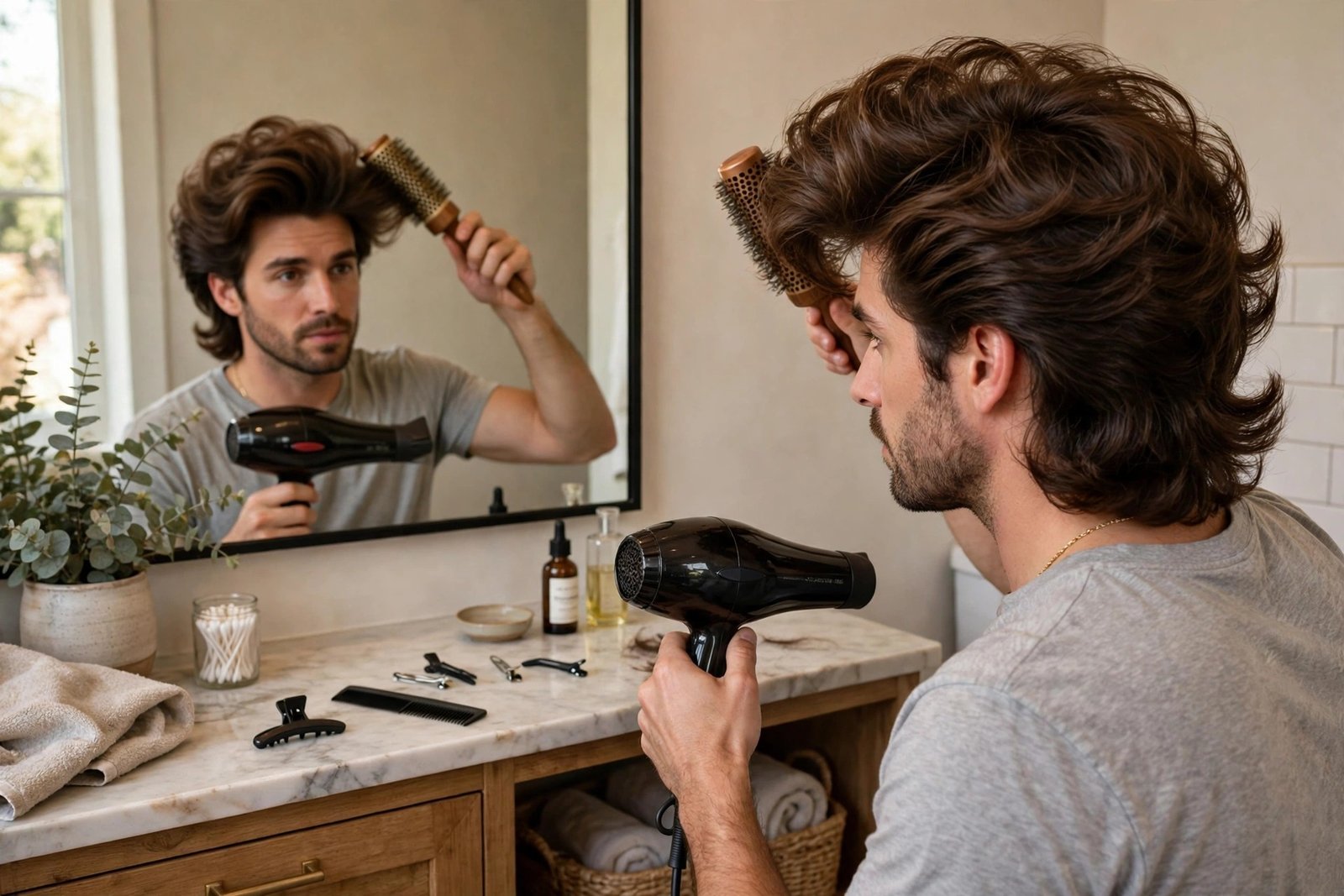
Start with the wash, because a good blowout is built on clean, healthy hair, not on product alone. Use a volumising shampoo that cleans the scalp without stripping it, and apply conditioner only to the mid-lengths and ends, never to the roots, because conditioner at the roots flattens volume before you even pick up the dryer. Wash every two to three days rather than daily if your hair allows it, because natural oils protect the hair and give it grip, and use lukewarm water rather than very hot water, which dries the hair out. Towel dry gently by patting, not rubbing, and leave the hair damp, not dripping, so the products you apply next can spread evenly and the dryer can do its work without fighting excess water.
The blow-dry technique is where the 90s shape is actually created, and the round brush is your most important tool. Apply a volumising mousse or a blow-dry spray with heat protection to damp hair, then work in sections, starting at the back and moving forward. Place the round brush under each section at the roots, lift it up and away from the scalp, and follow it with the dryer on medium heat, keeping the nozzle pointed down the hair shaft so the cuticle stays smooth. Roll the brush through the ends to create the flick, and hold each section for a few seconds after drying so it cools in the lifted position, because cooling is what locks the shape in place.
Product choice makes the difference between a blowout that lasts all day and one that collapses by lunchtime. Use a light product for the blow-dry itself, usually a mousse or a volumising spray, and save the stronger product for the finish. Once the hair is dry, warm a pea-sized amount of matte clay, fibre paste, or light cream between your palms, and work it through the hair from roots to mid-lengths, shaping the front and the crown with your fingers. Use less than you think you need, and add more only if the style needs it, because too much product is the most common reason a blowout falls flat. A light mist of hairspray, applied from a distance, adds hold without stiffness.
Finishing is about the details that make the style look polished rather than just big. Check the shape from the front and the side, adjust the part or the sweep with your fingers, and smooth any flyaways with a tiny amount of cream or a light serum on the surface. Make sure the ends flick in the direction you want, either outward for a retro feel or under for a neater finish, and use a wide-tooth comb or a vent brush to polish the surface without flattening the volume. Step back from the mirror and look at the overall silhouette: the front should be the tallest point, the crown should flow backward, and the sides should be neat, so the whole shape reads as intentional and balanced.
Maintenance is what keeps a blowout looking good between cuts, and it starts with the trim schedule. Book a cut every four to five weeks to keep the layers fresh and the ends healthy, and a taper or fade clean-up every two to three weeks if your version has short sides. Use a heat protectant every time you blow-dry, a deep conditioner once a week, and a dry shampoo on non-wash days to revive the roots without a full wash. Sleep on a silk or satin pillowcase to reduce frizz, avoid over-washing, and practise the blow-dry technique until it becomes a five-minute routine rather than a fifteen-minute project. With that habit, the 90s blowout becomes not a special-occasion style, but your everyday look.
Frequently Asked Questions
What is a 90s blowout for men?
A 90s blowout is a voluminous, blow-dried hairstyle in which the hair is lifted at the roots, directed up and back from the face, and finished with a soft wave or flip at the ends. The top is usually three to six inches long and layered, while the sides are shorter but not necessarily faded, so the silhouette stays full and retro. It was made famous by 90s heartthrobs in film and music, and the 2026 revival keeps the same shape with lighter products and a cleaner cut, so it looks fresh rather than dated and works for everyday wear as well as formal occasions.
Which face shapes suit a 90s blowout?
The 90s blowout suits almost every face shape, because the height, the parting, and the volume can be adjusted to balance the features. Oval faces can wear almost any version, square faces benefit from softness around the forehead, round faces gain length from the height at the front, and oblong faces should keep the height moderate and add width at the sides. A good barber will adjust the parting and the length to suit your face, so the best approach is to show a photo of the version you like and ask how it should be adapted for your bone structure and hairline.
What hair types work best for a 90s blowout?
The blowout works on straight, wavy, and curly hair, which is one reason it has become so popular in 2026. Straight hair needs layers and a round brush to create bend and volume, wavy hair already has natural movement that the blow-dry enhances, and curly hair can be stretched gently with a diffuser and a round brush into a full, rounded shape. Thick hair holds volume naturally, while fine hair benefits from a shorter, more layered cut and a volumising mousse. Almost any hair type can wear a blowout, as long as the cut is adapted to the texture.
How long does it take to style a 90s blowout?
A 90s blowout usually takes ten to fifteen minutes to style once you have practised the technique, although the first few attempts may take closer to twenty minutes. Short versions can be done in five minutes, while long or curly versions may need fifteen to twenty minutes because there is more hair to dry in sections. The time drops quickly with practice, especially if you use a good dryer, a large round brush, and a volumising mousse that does half the work. On busy mornings, a quick root lift and a finger-style can refresh the shape in two minutes without a full restyle.
What products do I need for a 90s blowout?
You need only three products to start: a volumising shampoo, a volumising mousse or blow-dry spray with heat protection, and a matte clay or fibre paste for the finish. A heat protectant is essential if you blow-dry daily, because it prevents damage and keeps the hair healthy, and a light hairspray adds hold without stiffness. Avoid heavy waxes, gels, and oils, which weigh the hair down and flatten the volume, and use a dry shampoo on non-wash days to revive the roots. With those basics, you can create and maintain any version in this guide.
How often should I trim a 90s blowout?
Most blowout versions need a trim every four to five weeks to keep the layers fresh, the ends healthy, and the shape balanced. Short versions and quiffs may need a cut every three to four weeks, because the proportions change quickly as they grow, while long and curly versions can stretch to six weeks. If your version has a skin fade or a high fade, book a sides-only clean-up every two weeks to keep the contrast sharp, and a full cut every four weeks. Regular trims also prevent split ends, which make the flick at the ends look ragged rather than polished.
What is the difference between a blowout and a blowout taper?
A blowout is the overall style, defined by the volume, the lift at the roots, and the blown-back shape on top, while a blowout taper is a specific version of that style in which the sides and back are gradually tapered shorter toward the ears and neckline. The classic blowout keeps the sides longer and fuller, while the blowout taper adds a clean, graduated finish that looks sharper and more modern. The top is styled the same way in both versions, so the choice comes down to how much contrast you want on the sides, and many men switch between the two depending on the season or the occasion.
Can a 90s blowout work on curly hair?
Yes, a 90s blowout works beautifully on curly hair, and the result is a full, rounded shape with soft, stretched curls that have real height and movement. The key is to use a leave-in conditioner and a curl cream, dry with a diffuser on low heat, and then use a round brush to stretch the curls gently into waves without straightening them completely. A good barber will cut curly hair dry or in its natural state, with long layers that respect the curl pattern, so the shape stays balanced. Curly blowouts need more moisture and a little more time, but the volume is unmatched.
How should I ask my barber for a 90s blowout?
Ask your barber for a 90s blowout by name, then be specific about the version you want, the length on top, and the finish on the sides. Say something like, I want a layered blowout with four to five inches on top, blown back with volume, and a mid taper on the sides, and show a photo of the exact version you like. Mention your hair type, how much time you want to spend styling each morning, and whether you want a fade, a taper, or longer sides. A photo plus those details gives the barber everything needed to adapt the cut to your face and hair.
Does a 90s blowout suit older men?
Yes, a 90s blowout suits older men very well, especially in the classic, low taper, and side-swept versions, which look polished and age-appropriate without feeling old-fashioned. The volume adds fullness that can make thinning hair look thicker, the soft finish is flattering, and the style works for work, weddings, and everyday life. Older men should choose a version with a clean taper, a moderate height, and a natural finish, and avoid the most dramatic fades or frosted tips unless they suit their personal style. With the right cut, the blowout is timeless at any age.
Conclusion
The 90s blowout has returned in 2026 because it does what few men’s hairstyles can do: it makes hair look thicker, healthier, and more intentional, it suits almost every face and hair type, and it works for every occasion from the office to a wedding to a casual weekend. Whether you choose the classic blown-back shape, a tapered or faded version, a curly or wavy interpretation, or the modern retro finish, the principles are the same: a layered cut, lift at the roots, a soft flick at the ends, and products that support the volume without weighing it down. Take your favourite style from this guide to the barber, practise the blow-dry for a week, and you will understand why this is the defining men’s hairstyle of the year.
Start with the version that fits your hair and your life, not the most dramatic one in the photos, and let the style grow with you. A short blowout is the easiest way in, a mid taper is the most balanced choice, and the classic is the one you will return to again and again. Keep the trim schedule, use the right products, and give the blow-dry a few minutes each morning, because the 90s blowout rewards a little effort with a lot of presence. Your hair has the volume already, it just needs the cut and the technique to show it, and 2026 is the year to let it do exactly that.